




Abstract
Research exploring gender differences in public attitudes toward parole is limited, despite a large body of literature showing that men and women have diverging views on other criminal justice issues, including capital punishment and offender rehabilitation and treatment. Drawing on an Australian national survey of community views on parole, the current study examines whether men and women differ in their support for the release of prisoners on parole. The results indicate that gender does predict parole attitudes, with Australian women significantly more likely to hold nonsupportive views on parole than Australian men. The results also reveal that women are more likely to take a neutral position toward parole, rather than supporting it. Together, these findings indicate there may be something about being a woman in Australia that prevents one from being willing to support the early release of prisoners. The implications of these findings for future research are discussed.
Introduction
The release of prisoners on parole has been controversial for a number of years. Indeed, an increased focus on the incapacitation of offenders, together with public misperceptions equating parole with the lenient treatment of prisoners, led to the abolition of discretionary parole release in many U.S. states (Petersilia, 2003). In Australia, where all states and territories retain discretionary parole release mechanisms, the public’s faith in parole has also been tested due to a number of “vicious and fatal crimes” committed by parolees (Gately, Ferguson, Ellis, & Cock, 2017, p. 293). These crimes triggered parole reviews in a number of Australian states, which in turn led to a suite of legislative reforms to tighten parole decision-making procedures and restrict prisoners’ eligibility for early release. As was the case in the U.S., these reforms were a “politically expedient way” to appease the apparently growing concern among the Australian public regarding the release of prisoners on parole (Petersilia, 2003, p. 17).
Despite these recent events, there is little empirical research examining how members of the Australian public view parole and no prior research as to whether Australian men and women differ in their support of this criminal justice process. A gender gap in parole support may be likely given the large body of research that shows men and women have diverging views on a number of criminal justice issues, including capital punishment and offender rehabilitation and treatment (Applegate, Cullen, & Fisher, 2002; Sprott, 1999). Thus, this study addresses this gap in the literature by examining gender differences in public attitudes toward parole using data from a national Australian survey of community views on parole.
Public Attitudes Toward Parole
Research on public attitudes toward parole has returned mixed findings, with some studies reporting that people’s views on parole are largely favourable and others that attitudes are overwhelmingly negative. J. Roberts (1988) reported that 63% of Canadians were in favour of some form of early release, while Samra-Grewal and Roesch (2000) found that less than half of Canadian respondents (47.4%) believed the parole system was too lenient and a majority (68.9%) did not want conditional release abolished. Support for parole has also been found in the U.S., with C. Roberts, Briker, Clawson, Doble, and Selton (2005) reporting that 78% of Massachusetts’s residents favoured the early release of selected, nonviolent inmates. Even in the red state of Texas, a majority of respondents (80%) preferred that prisoners serve part of their sentence on parole as opposed to being released at the end of their sentence with no supervision requirements (Texas Public Policy Foundation, 2015).
Other research has found, however, that the public are largely dissatisfied with parole. In one survey, 81% of respondents felt that parole was granted too frequently (Zamble & Kalm, 1990), while in another, a similar proportion (82%) felt that parole processes were too lenient (Cumberland & Zamble, 1992). More recently, Johnson (2009) reported that close to 72% of respondents believed U.S. parole boards needed to be stricter.
In the only Australian study conducted to date, mixed support for parole was also found (Fitzgerald, Bartels, Freiberg, Cherney, & Buglar, 2016). There, almost half of respondents (46%) agreed that prisoners should be released to serve the last part of their sentence in the community. Despite this, 38% of respondents disagreed with the idea of parole, and 59% believed that prisoners should serve their “entire sentence” in prison.
Is There a Gender Gap in Parole Support?
Gender has not been a focal consideration in the existing research on public attitudes toward parole. Consequently, very little is known about whether a gender gap in parole support exists. However, there is some empirical evidence to suggest that, compared with men, women may not be as supportive of parole release. Haghighi and Lopez (1998) reported, for instance, that women were more likely to oppose the shortening of offenders’ sentences and the paroling of offenders who had previously been paroled for a serious crime and less likely to favour the early release of offenders for good behaviour. More recently, O’Hear and Wheelock (2015) reported that the women in their sample were significantly more likely to support “truth in sentencing,” that is, the notion that prisoners should serve their entire sentence in jail. Indeed, in that study, the odds that male respondents, relative to female respondents, supported the early release of offenders were 1.39 times greater (O’Hear and Wheelock, 2015). These findings coincide with another recent study that found women tended to rate prisoners more positively when they had served the majority of their sentence within a correctional facility (Estrada-Reynolds, Schweitzer, Nunez, & Culhane, 2016).
Despite this, there is a large body of literature indicating men are more punitive than women in terms of capital punishment (Cochran & Sanders, 2009) and offender rehabilitation and treatment (Applegate et al., 2002; Cullen, Clark, Cullen, & Mathers, 1985; Falco & Turner, 2014). However, these studies have not considered processes, like parole, that involve the release of prisoners back to the community, and therefore, extrapolating from these findings to suggest that men will be less supportive of parole is undesirable. In addition, many of the studies that point to less punitive attitudes among women have largely emanated from the U.S., and there is reason to believe that Australian women may view these issues differently than their U.S. counterparts.
First, in an Australian study of death penalty support, women were found to be less supportive of capital punishment than men but more supportive of stiffer sentences for offenders (Kelley & Braithwaite, 1990). This finding led the authors to suggest there is “something about being a woman [that] makes one less willing to take a life in punishment for crime but at the same time more punitive in other ways” (Kelley & Braithwaite, 1990, p. 547). Furthermore, Australian electoral results indicate that unlike in the U.S., where women tend to vote for the Democratic Party, there has been a strong tradition over the last century among Australian women to vote for the conservative Liberal–National Coalition (Hill, 2003). Given the tendency of Australian women to vote conservatively, we might expect that Australian women may also take a tougher stance on crime-related issues, like prisoner reentry.
Factors Influencing the Views of Australian Women
There are also a number of theoretical reasons to expect a gender gap in parole attitudes in Australia. First, it is anticipated that women will express greater levels of fear of parolees than men and, consequently, will be more concerned about the potential release of prisoners on parole. A large body of literature shows gender to be the best predictor of fear of crime, with women consistently reporting higher levels of fear than men (see the review by Hale, 1996). Because of this heightened sense of fear, researchers have speculated that women will be more punitive toward offenders (Haghighi & Lopez, 1998; LaGrange & Ferraro, 1989). Some support for this argument has been found, with research showing that being fearful tends to make women, more so than men, favour incapacitative measures like longer sentences for offenders and the denial of early release (Haghighi & Lopez, 1998; Whitehead & Blankenship, 2000; cf. Hurwitz & Smithey, 1998).
Holding punitive views toward offenders is also likely to influence people’s views on parole. Research suggests that women are more likely than men to believe that the sentencing of offenders is not severe enough (Applegate et al., 2002; Kelley & Braithwaite, 1990; Sprott, 1999). In the current study, a “Punitiveness” scale measures the degree to which respondents support the harsher treatment of offenders. The items in that scale largely reflect respondents’ feelings about the adequacy of punishments given to offenders. As a result, it is expected that female respondents may have higher scores on this scale than males (indicating they hold more punitive attitudes). It is also anticipated that, as a result of their harsher views toward offenders, female respondents will also be less supportive of parole release.
A further theoretical explanation for a possible gender gap in parole support relates to the “Belief in Redeemability” thesis, which suggests that people’s views on offenders are influenced by the extent to which they believe offenders can change and desist from crime (Maruna & King, 2009). It is anticipated that the degree to which respondents believe in the possibility of redemption will significantly relate to their views on parole, due to the “obvious parallels to belief in the rehabilitative ideal and support for prisoner reintegration” (Maruna & King, 2009, p. 21). Thus, individuals with strong beliefs about the impermanence of criminal behaviour are expected to be more supportive of offender reentry and reintegration (Maruna & King, 2009; O’Sullivan, Holderness, Hong, Bright, & Kemp, 2016).
With respect to gender, research indicates that women are more optimistic about offender change than men (O’Sullivan et al., 2016) and hold more favourable views toward prisoner reentry policies (Ouellette, Applegate, & Vuk, 2017). Those findings are consistent with arguments that women tend to hold “greater hopes for positive change in offenders as they see most of them as reformable” (Haghighi & Lopez, 1998, p. 453), and that women are generally more forgiving than men (for a review, see Miller, Worthington, & McDaniel, 2008). As a result, it is possible that women may hold stronger beliefs about redemption than men and, as a result, be more supportive of parole release. On the contrary, the present study may find, like Haghighi and Lopez (1998), that women hold strong beliefs about the possibility of redemption, but that this does not translate to support for the release of offenders before the expiration of their full sentence.
The Present Study
The present study draws on data from the National Survey of Community Views on Parole, a telephone survey conducted in September 2015 with 1,200 individuals, aged 18 years and above, from all states and territories in Australia (see Fitzgerald et al., 2016). The aim of the survey was to measure public attitudes toward parole, as well as a number of factors that may account for differences in the public’s views on this issue. Thus, respondents were asked their views on prisoner reentry and reintegration, parole release, parole board decision making, and correctional practices. I was granted access and permission from the researchers of that study to conduct further analyses of the survey data. The primary research aims of the present study were to (a) determine how attitudes toward parole were distributed across the sample and (b) determine whether Australian women were more likely to hold nonsupportive views on parole than Australian men.
Method
Participants and Procedures
Respondents were contacted using a “dual frame” (landline and mobile phone) random digit dial sampling procedure. This sampling procedure involves the selection of respondents through the random generation of telephone numbers and has the advantage of including privately listed phone numbers. Upon a call connection being made, the interviewer requested to speak to an adult in the household who had the next upcoming birthday. This strategy resulted in 50% (n = 600) of respondents being drawn from a landline telephone sampling frame, and the remaining half from a mobile phone network sampling frame. Overall, the survey had a response rate of 33.8%. The final dataset was weighted to account for telephone type (landline vs. mobile), education by age, region, gender, and country of birth. Although there were 1,200 respondents in the original survey, 121 cases had missing data for one or more of the variables of interest in the present study. This reduced the analytical sample to 1,079 cases. Table 1 sets out the demographic characteristics of the analytical sample, by gender.
Demographic Characteristics of Sample, by Gender.
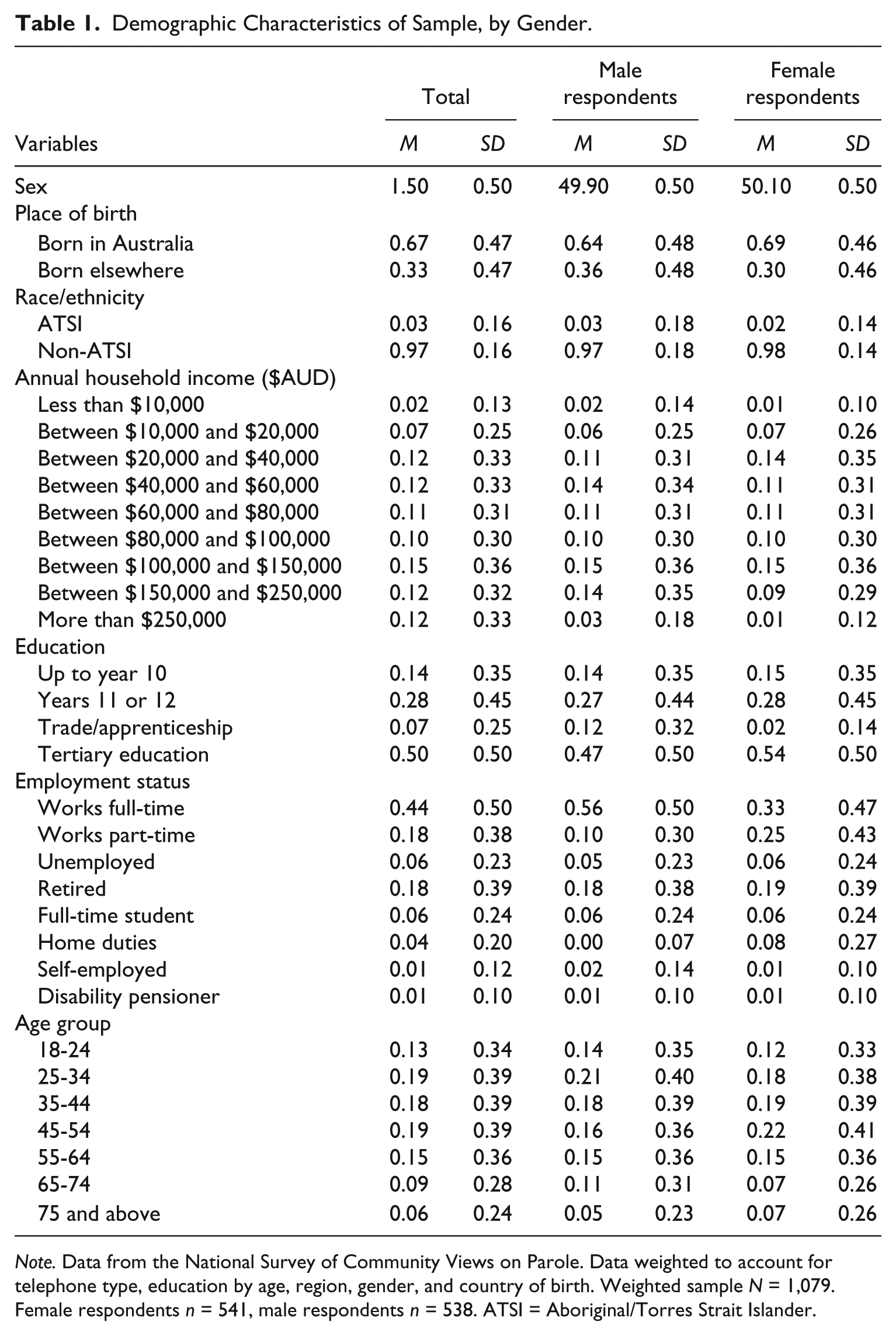
Note. Data from the National Survey of Community Views on Parole. Data weighted to account for telephone type, education by age, region, gender, and country of birth. Weighted sample N = 1,079. Female respondents n = 541, male respondents n = 538. ATSI = Aboriginal/Torres Strait Islander.
Measures
Outcome variable
The outcome variable, support for parole, is measured by participants’ responses to the following statement: “Prisoners should be released from prison to serve the last part of their sentence in the community under supervision.” Participants indicated their level of agreement with this statement using a 5-point Likert-type scale, ranging from 1 = strongly disagree to 5 = strongly agree. Although this statement does not refer to “parole” explicitly, this item was the very first presented to respondents in the survey and that immediately followed this explanation of parole:
Nearly all prisoners will eventually be released. Some prisoners may be paroled which means they are released from prison to serve the last part of their sentence in the community. Their release is supervised by corrections officers and they can get some help with things like mental health and substance abuse. They also need to obey certain rules. If they break any of these rules, they could be sent back to prison for the rest of their sentence.
Predictor variables
A number of factors previously associated with attitudes toward offenders more broadly are tested in this study for their ability to predict support for parole. First, the standard package of demographic characteristics are included, namely, gender (0 = male, 1 = female), income (0 = other, 1 = annual household income of $AUD 20,000-$40,000), education (0 = other, 1 = up to year 10 education), age (0 = other, 1 = 18-24 years old), employment status (0 = other, 1 = respondent employed on full-time basis), and parental status (0 = other, 1 = respondent has children living at home).
Instrumental factors are assessed by asking respondents whether they believe crime levels have gone up, gone down, or stayed the same in their state or territory in the past 5 years. Respondents’ support for various correctional goals was measured through four separate items. First, support for a rehabilitative approach was assessed: “Society has an obligation to assist a person’s reentry into the community following a prison sentence.” Second, preferences for “truth in sentencing” were measured: “When an offender receives a prison sentence, the entire sentence should be served in prison.” Next, respondents were asked whether they felt that additional funding should be allocated to finding effective education and treatment programs aimed at reducing offender recidivism. Finally, respondents were asked whether more money should be spent on the prison system, so that repeat offenders could be incapacitated for longer.
Next, two items measure respondents’ fundamental beliefs about offenders and, in particular, whether they believed that offending behaviour is attributable to some internal disposition of the person (“Crime is a choice—a person’s social circumstances are not to blame”) or the result of external factors (“Crime is mostly the product of a person’s circumstances and social context”). Respondents’ fear of parolees was also assessed through participants’ responses to the following statement: “I sometimes fear that I may become a victim of a crime committed by an offender on parole.” The effect of punitiveness on parole support was tested using a six-item Punitiveness scale (α = .82, M = 3.72, SD = 0.86; for example, “People who break the law should be given stiffer sentences”). Finally, respondents’ beliefs about the stability of criminal behaviour were assessed using Maruna and King’s (2009) “Belief in Redeemability” scale (α = .55, M = 3.03, SD = 0.70; for example, “Most offenders can go on to lead productive lives with help and hard work”).
Table 2 shows the distribution of respondents’ answers to the outcome variable and each substantive predictor variable, by gender.
Participants’ Responses to Variables of Interest, by Gender.
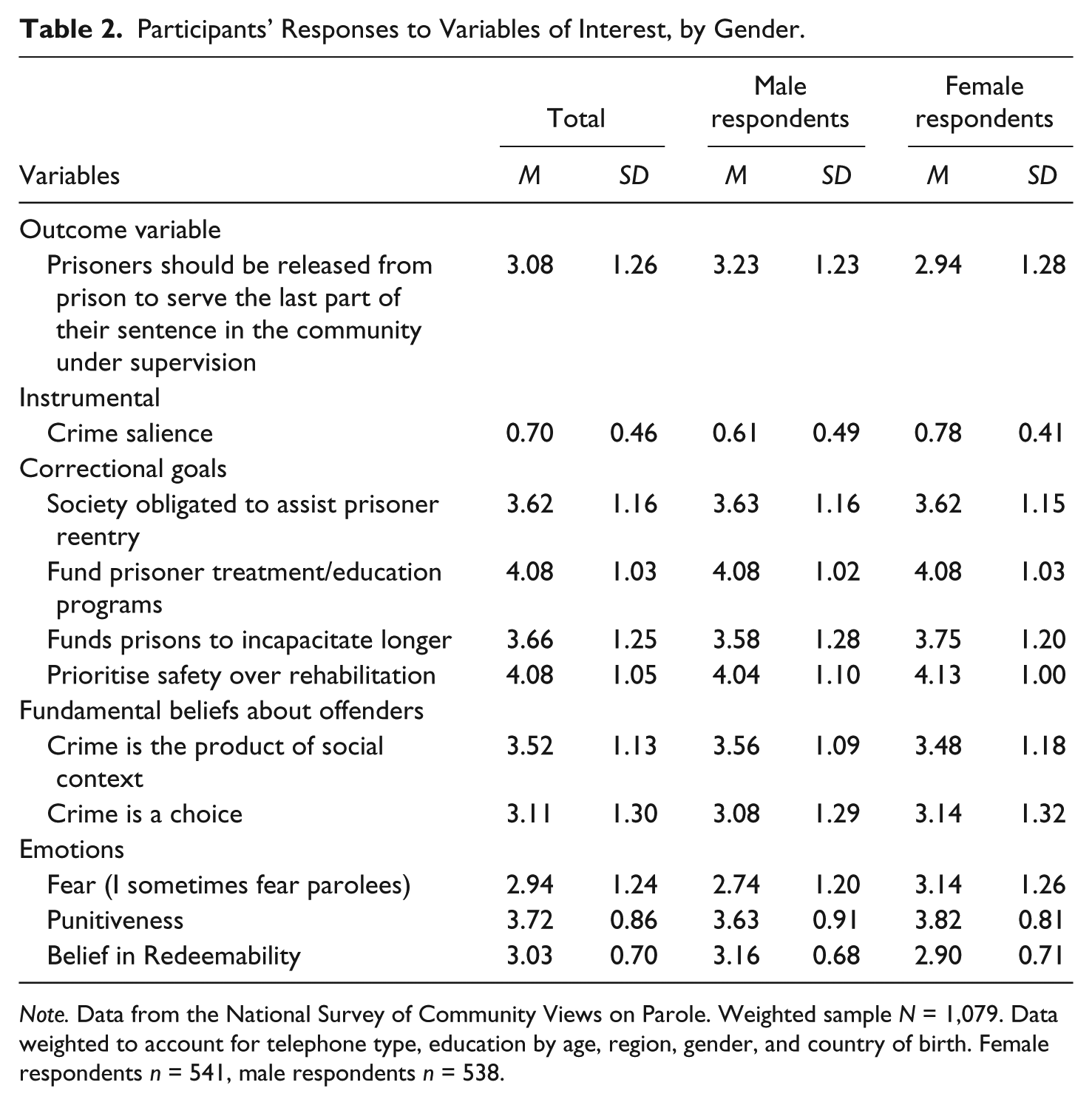
Note. Data from the National Survey of Community Views on Parole. Weighted sample N = 1,079. Data weighted to account for telephone type, education by age, region, gender, and country of birth. Female respondents n = 541, male respondents n = 538.
Data Analysis
To examine the relationship between gender and public support for parole, the distribution of parole attitudes across the sample was first explored using descriptive statistics and mean difference t tests. A multinomial logistic regression model (MNLM) was then used to examine the effect of gender, as well as a number of other predictor variables, on public attitudes toward parole. Although initially the use of multiple linear regression techniques for the analysis was explored, screening of the data revealed that the outcome variable was not normally distributed, but rather, bimodal. In particular, there were two “peak” responses—one agreeing with the outcome variable and the other disagreeing. Attempts to transform the outcome variable to achieve a normal distribution were unsuccessful. As a result, logistic regression was identified as the appropriate method of analysis. Data screening was carried out to confirm all necessary assumptions for logistic regression were satisfied.
Results
Distribution of Parole Attitudes
The outcome variable in this study, support for parole, was originally measured on a 5-point Likert-type scale. This variable was recoded to create three distinct categories of respondents that could be compared using logistic regression techniques—Parole Supporters (i.e., those who “agree” or “strongly agree” with the idea of parole), Fence Sitters (i.e., those who “neither agree nor disagree” with parole), and Parole Opponents (i.e., those who “disagree” or “strongly disagree” with parole). The proportion of respondents in each category, by gender, is shown in Table 3.
Proportion of Male and Female Respondents in Three Categories of Outcome Variable.
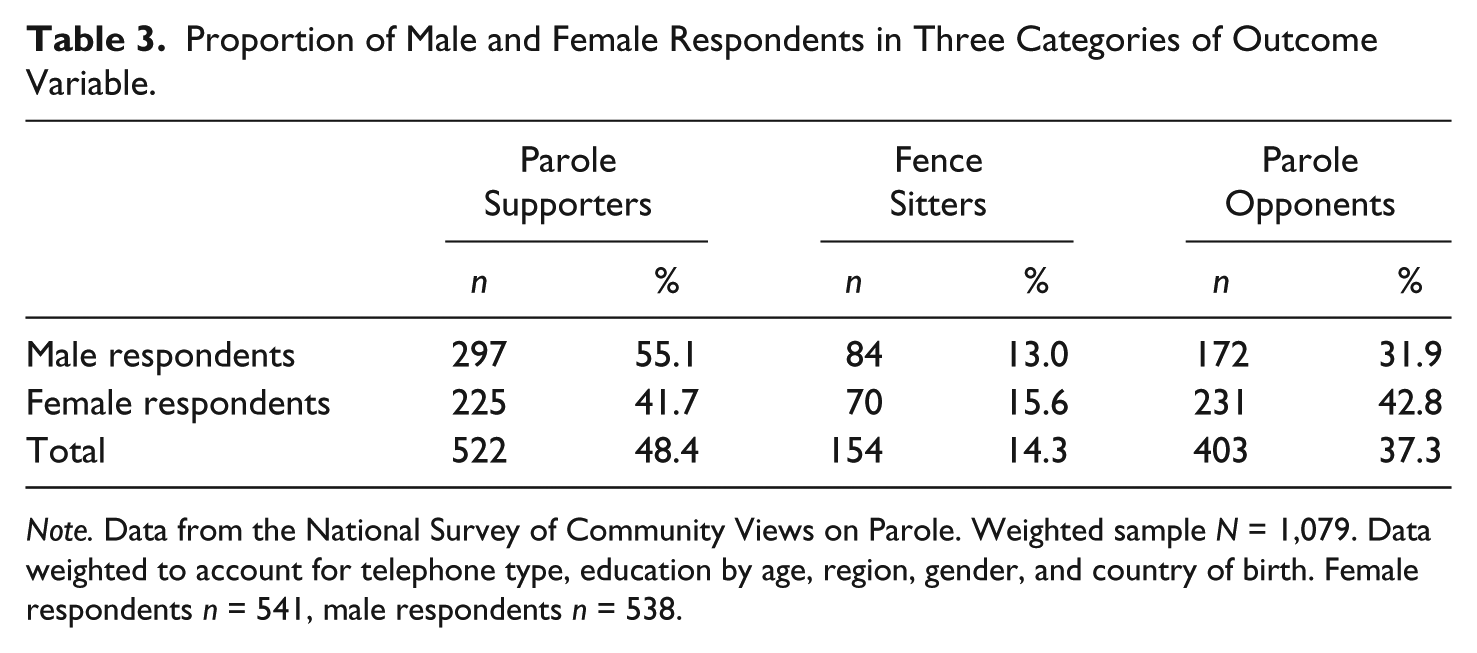
Note. Data from the National Survey of Community Views on Parole. Weighted sample N = 1,079. Data weighted to account for telephone type, education by age, region, gender, and country of birth. Female respondents n = 541, male respondents n = 538.
To begin, I explored whether statistically significant differences exist among the three categories of respondents using mean difference t tests. Here, the Parole Supporters are used as the reference category (see Table 4). First, the Parole Opponents were compared with the Parole Supporters. Significant mean differences between these categories were found in all but one variable, indicating that those who oppose parole and those who support it are dissimilar in most respects. In terms of demographic differences, the two categories differ on five out of the six variables of interest. First, the Parole Opponents are comprised of a significantly higher proportion of females, respondents with an education level of up to year 10 only, and respondents who have children living with them. On the contrary, the Parole Opponents have a significantly lower proportion of lower income earners (between $AUD 20,000 and $40,000) and respondents aged between 18 and 24 years of age. No significant differences were found in terms of those employed on a full-time basis.
Mean Difference t Tests for Parole Opponents, Fence Sitters, and Parole Supporters.
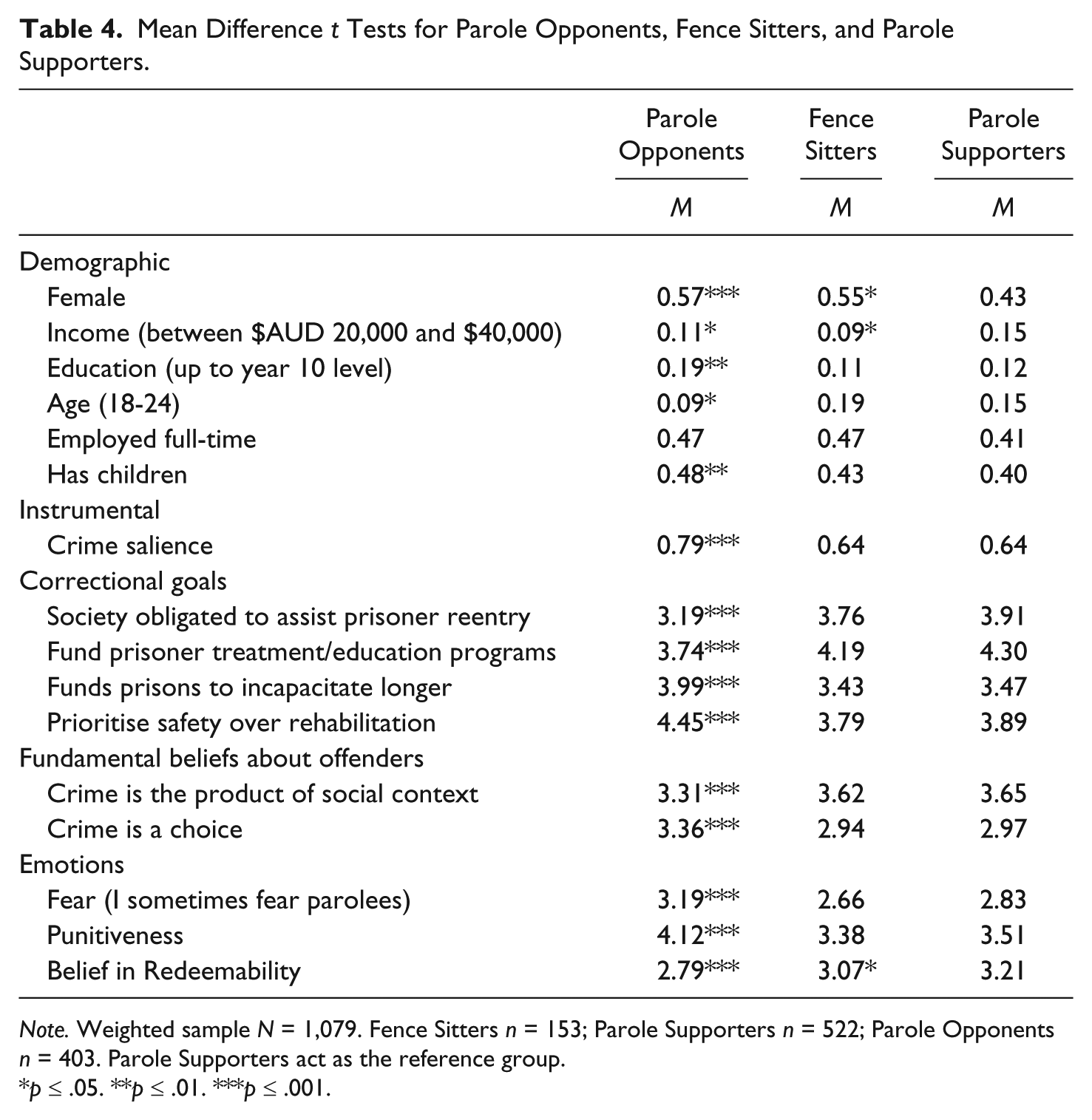
Note. Weighted sample N = 1,079. Fence Sitters n = 153; Parole Supporters n = 522; Parole Opponentsn = 403. Parole Supporters act as the reference group.
p ≤ .05. **p ≤ .01. ***p ≤ .001.
Moving beyond demographic differences, the Parole Opponents and Parole Supporters differ on all remaining variables. Most notably, Parole Opponents are more likely to believe that community safety must be prioritised over offender rehabilitation and that crime is freely chosen by offenders. On the contrary, they are less likely to believe that society is obligated to assist prisoners as they reenter the community or that additional funding should be allocated to treatment and education programs for offenders. Parole Opponents also have higher levels of fear and punitiveness than Parole Supporters but believe less in the possibility of redemption for offenders.
The Fence Sitters were then compared with the Parole Supporters. These categories differ in only three variables of interest. First, a larger proportion of Fence Sitters than Parole Supporters are female, while a smaller proportion of Fence Sitters are from a lower income group ($AUD 20,000-$40,000). Finally, Fence Sitters have lower mean scores on the Belief in Redeemability scale, indicating they are less likely to believe in the ability of offenders to change and desist from criminal activity.
Considered together, these findings confirm there are three distinct positions that respondents might adopt with respect to parole. The first category, the Parole Supporters, tend to be lower income males who do not have children and are employed on a basis other than full-time employment. Compared with the two other categories, the Parole Supporters believe most strongly in society’s obligation to assist with prisoner reentry and the need for increased funding of offender rehabilitation programs. They also believe most strongly that crime is the product of a person’s social context and that offenders can desist from criminal activity. In sharp contrast, the Parole Opponents tend to be older women with children and an education level of up to year 10. This category tends to believe that crime levels are increasing and that additional funding should be allocated to prisons. They believe strongly that community safety is more important than offender rehabilitation and are the most fearful of parolees and punitive toward offenders.
Finally, the Fence Sitters resemble the Parole Supporters in some respects. There are, however, some key differences between these two categories, with the Fence Sitters tending to be comprised of younger females who are the least fearful of parolees and the least punitive toward offenders. The Fence Sitters are also the least likely to desire additional funding to be allocated to prisons or to demand that community safety be prioritised over offender rehabilitation. They also tend to reject the idea that crime is freely chosen by offenders.
Multinomial Logistic Regression Analysis
Turning to the MNLM, the following seven blocks of predictor variables were used to predict parole attitudes: female, crime salience, correctional goals, fundamental beliefs about offenders, fear of parolees, punitiveness toward offenders, and beliefs about redemption. In the MNLM, a respondent’s age, education, income, employment status, and parental status are controlled for. These blocks of variables were used because they commonly serve as a measure of criminal justice attitudes in the broader literature on public attitudes toward offenders.
Parole Opponents Versus Parole Supporters
The first contrast is between Parole Opponents and Parole Supporters (reference category). It is expected that because these two categories represent opposing ends of the spectrum in terms of parole support, this contrast will be the most clearly differentiated. As seen in Table 5, eight variables significantly predict opposition to parole, with the odds ratios indicating that being a woman, wanting additional funds to be allocated to prisons, wanting community safety prioritised over offender rehabilitation, and being punitive toward offenders result in a greater likelihood of opposing parole. On the contrary, believing that society is obligated to assist offenders in their reintegration, wanting additional funds to be allocated to education and training programs for offenders, believing that crime is the product of social context, and believing that offenders can change and desist from criminal behaviour result in a greater likelihood of supporting parole.
Multinomial Logistic Regression Model Predicting Parole Attitudes.

Note. Weighted sample N = 1,079. Parole Supporters n = 522; Parole Opponents n = 403; Fence Sitters n = 153. Data weighted to account for telephone type, education by age, region, gender, and country of birth. Controlling for demographic variables (age, income, education, employment, and parental status). OR = odds ratio; CI = confidence interval.
p ≤ .05. **p ≤ .01. ***p ≤ .001.
Relative to men, women have odds of opposing parole that are 1.82 times (or 82%) greater. The four variables reflecting various correctional goals are also significant predictors of parole attitudes. First, with every 1-point increase in the item relating to wanting additional funding to be allocated to prisons so that offenders can be incapacitated for longer, the odds of a respondent opposing parole release increase 1.25 times. Similarly, with every 1-point increase in wanting to see community safety prioritised over offender rehabilitation, the odds of opposing parole increase 1.29 times. On the contrary, with every 1-point increase in the belief that society is obligated to assist prisoners in their reentry back to the community, the odds of opposing parole decrease by 0.74. Because of issues associated with interpreting odds ratio values of less than 1, this odds ratio can be inversely represented and interpreted as an odds ratio with a value greater than 1 (Osborne, 2006). Thus, it is the equivalent to say that with every 1-point decrease in the belief that society is obligated to assist prisoners in their reentry back to the community, the odds of opposing parole increase 1.35 times. Furthermore, with every 1-point decrease in the desire for additional funding of prisoner treatment and education programs, the odds of opposing parole increase 1.45 times (i.e., 1 / 0.69). In other words, the more strongly a respondent agrees with the correctional goals of incapacitation and community safety, and the less strongly they believe in supporting prisoner reintegration and funding prisoner treatment and education, the higher the odds they will oppose the release of prisoners on parole.
Furthermore, with every 1-point decrease in the belief that criminal behaviour is the result of a person’s circumstances and social context, the odds of opposing parole increase 1.20 times (i.e., 1 / 0.83). Contrary to expectations, believing that crime is a choice and that social circumstances are not to blame for criminal behaviour does not significantly predict being a Parole Opponent. This is somewhat surprising given earlier research, which found attributions of internality had a significant negative effect on support for community sanctions (Maruna & King, 2004).
Finally, with every 1-point increase in respondents’ Punitiveness scale score, the odds of opposing parole increase 1.82 times. On the contrary, with every 1-point decrease in respondents’ “Belief in Redeemability” score, the odds of a respondent being classified in the Parole Opponent category increase 1.47 times (i.e., 1 / 0.68). Thus, the less one believes that offenders are able to change and desist from criminal activity, the higher the odds they will oppose parole release.
Fence Sitters Versus Parole Supporters
The second contrast is between Fence Sitters and Parole Supporters, with the latter category acting as the reference group. In this comparison, only three predictor variables are significant predictors of parole attitudes—being a woman, respondents’ Punitiveness scores, and respondents’ “Belief in Redeemability” scores. With respect to gender, the odds of a woman, relative to a man, being a Fence Sitter increase 1.80 times. When considered together with the findings of the first comparison, these results show that women have greater odds of opposing or taking a neutral stance toward parole, than they do for supporting parole.
Furthermore, with every 1-point decrease in respondents’ Punitiveness score (indicating less punitive views toward offenders), the odds of being a Fence Sitter increase 1.35 times (i.e., 1 / 0.74). This particular finding is interesting, as it was expected that less punitive attitudes toward offenders would result in greater odds of supporting parole, rather than taking a neutral position toward it. Finally, for every 1-point decrease in respondents’ score on the “Belief in Redeemability” scale, the odds of being classified as a Fence Sitter increase 1.54 times (i.e., 1 / 0.65). Put simply, the less one believes in the ability of offenders to change and desist from criminal activity, the higher the odds they will take a neutral position toward parole as opposed to supporting it.
Fence Sitters Versus Parole Opponents
Finally, Fence Sitters and Parole Opponents were compared, where the latter acts as the reference category. Again, there are three significant predictors of parole attitudes in this comparison; however, unlike the two other contrasts, being a woman is not a significant predictor here.
For every 1-point increase in the belief that additional funding should be allocated to finding effective treatment and education programs for prisoners, the odds of being a Fence Sitter, as opposed to a Parole Opponent, increase 1.32 times. On the contrary, with every 1-point decrease in the desire to see community safety be prioritised over offender rehabilitation, the odds of being a Fence Sitter increase 1.35 times (i.e., 1 / 0.74). In simple terms, the more strongly a respondent believes that funding should be provided to treat prisoners, and the less strongly they feel that community safety must trump offender rehabilitation, the higher the odds that a respondent will take a neutral position toward parole rather than to oppose it. Finally, with every 1-point decrease in respondents’ Punitiveness score, the odds of being classified as a Fence Sitter increase 2.44 times (i.e., 1 / 0.41). Thus, respondents with less punitive views toward offenders have greater odds of taking a neutral position toward the early release of prisoners than to oppose it.
In terms of model fit, the MNLM significantly predicts the outcome variable better than the intercept-only model, χ2(32, N = 1,071) = 309.80, p ≤ .001. The pseudo R2 measure of McFadden’s index has a value of .144, a moderate effect size (Tabachnick & Fidell, 2007). On the basis of these measures, the MNLM used in this study appears to be a good fitting model.
Discussion
This study set out to explore gender differences in public attitudes toward parole using an Australian sample. It was hypothesised that Australian women would be more likely to hold nonsupportive views of criminal justice processes that allow for the early release of prisoners. This hypothesis was confirmed, with the results showing that women, relative to men, have odds of opposing parole that are 1.82 times greater. Furthermore, the odds that women will take a neutral position toward parole rather than supporting it increase 1.80 times. These results point to a reluctance among Australian women to support the release of prisoners on parole. On the contrary, they show that Australian men are more inclined to support parole or, at the very least, take a neutral position toward it. The question then remains, what is it about Australian women that leads to reduced support for parole release?
It was speculated that these results might be due to the trend among Australian women to vote conservatively and, therefore, take a harder line with respect to criminal justice issues. However, this could not be tested empirically, as respondents’ political views were not collected as part of the national survey. This is a matter for future research to explore. There are a number of other possible reasons for the gender gap in parole support found in this study. Research has highlighted the importance of emotions like empathy and forgiveness in shaping people’s views toward offenders and their policy preferences on prisoner reentry (Garland, Wodahl, & Smith, 2015; Gault & Sabini, 2000). Thus, future research should also explore whether men and women take different views on parole because they experience different emotions when thinking about this issue. Others argue that the key to understanding why some people are more punitive than others relates to the extent to which they can empathetically identify with an offender (Unnever & Cullen, 2009). In particular, those who can identify with offenders are thought to be more willing to provide them a second chance, while those who cannot are more likely to support punitive crime measures (Unnever & Cullen, 2009). This theory may provide a useful framework for further research exploring the gender gap in parole support, using scenarios of various offender types to explore whether men or women differ in their ability or willingness to show empathy.
A limitation of the present study was that the outcome variable was measured using a single item. In future, a multiitem scale measuring people’s views on parole may be preferable to ensure the complexities of people’s views are better captured. In addition, research has shown that individuals tend to express harsher views toward the early release of prisoners when asked global style questions than they do when presented a specific case involving a hypothetical offender applying for parole (Cumberland & Zamble, 1992). Thus, while the present study provides some preliminary answers to the question of gender differences in public attitudes toward parole, it is recommended that additional research be conducted using qualitative research techniques to delve deeper into the intricacies of people’s views on the early release of prisoners and to further explore the underlying basis for the gender gap in parole support found among Australian men and women.
In conclusion, although the existing scholarly literature shows that women tend to be more supportive than men of efforts to rehabilitate offenders, the present study points to a more punitive woman when it comes to the point of releasing prisoners back to the community, particularly when this release occurs prior to the expiration of an offender’s full sentence. These results may be considered by some to be surprising, given the stereotypical representation of women as being more strongly influenced by their emotions and making decisions based on their hearts and not their heads (Estrada-Reynolds et al., 2016). It is crucial, therefore, that we continue to explore these gender differences, and consider what implications they may have, particularly given the increasing involvement of women in criminal justice decision making, as judges, policy makers, legislators, and parole board members.
Footnotes
Acknowledgements
The author thanks Dr Robin Fitzgerald, Emeritus Professor Arie Freiberg, Associate Professor Lorana Bartels, and Associate Professor Adrian Cherney for granting access to the National Survey of Community Views on Parole dataset. The author also acknowledges and thanks Dr Robin Fitzgerald for her guidance in the preparation of this article.
Declaration of Conflicting Interests
The author(s) declared no potential conflicts of interest with respect to the research, authorship, and/or publication of this article.
Funding
The author(s) disclosed receipt of the following financial support for the research, authorship, and/or publication of this article: This research was funded by the Australian Government through the Australian Research Council.