




Abstract
Parole officers are an integral part of parolees’ reentry process and success. Few studies, however, have examined whether the quality of the relationship between parolees and their parole officer influences outcomes such as recidivism. This study assesses how recidivism is affected by the quality of the relationship that parolees have with their parole officers. Using the Serious and Violent Offender Reentry Initiative (SVORI) dataset, we use parolees’ perceptions of their relationship with their parole officer to determine whether they have established a positive or negative relationship, and whether these types of relationships differentially affect recidivism. Results show that parolees who have a negative relationship with their parole officer have higher rates of recidivism, while a positive relationship lowers parolees’ likelihood of recidivating. An implication of this study emphasizes parole officer training that develops positive, high-quality relationships with parolees. Further implications are discussed below.
Introduction
Since 1980, the United States has experienced a dramatic increase in its corrections population. Imprisonment rates have risen from just over 300,000 in 1980 to more than 1.5 million in 2014, representing an increase of more than 400% (Carson, 2015). A consequence of this prison growth is the increasing number of individuals returning to the community. More than 4 million individuals are supervised in the community, 800,000 of which are supervised on parole (Kaeble, Maruschak, & Bonczar, 2015). The large number of individuals under community supervision has also diminished the capacity of parole officers to develop meaningful relationships with the parolees they supervise. Moreover, the increase in the parolee population has burdened a dwindling number of caseworkers: In some states, an increase in the size of parolee caseloads has translated to an average contact time of 10 min a month between parole officer and offender (Edgemon, 2013). Parole officers serve as a critical link to parolees for successful reintegration; consequently, a reduced capacity among parole officers to meaningfully engage with parolees might hinder successful reentry.
The quality of the parolee–parole officer relationship might play a pivotal role in the likelihood of recidivism in both positive and negative ways. For instance, when offenders perceive positive relationships with their parole officers, they report feeling personal loyalty and accountability toward them (Robinson, 2005), which bodes well for future client outcomes. Within the context of a perceived positive relationship, a parolee might be more willing to confide in an officer and communicate treatment and service needs. In contrast, parolees who perceive a negative or ambivalent relationship might be less likely to share challenges they encounter; this may put parolees at a disadvantage in terms of referrals and other assistance an officer might be able to offer. Furthermore, a negative relationship might render certain supervision techniques ineffective (Orlinsky, Grawe, & Parks, 1994), and does not provide a solid foundation to affect behavioral changes. This is particularly important for serious and violent offenders, who are likely to be under more intense community supervision and for longer periods of time. As such, the dynamic between officer and parolee is instrumental in facilitating positive reentry outcomes.
Prior research examining the relationship between rapport and offender outcomes has largely combined measures of a positive and negative relationship onto a single scale (Horvath & Greenberg, 1986; Skeem, Eno Louden, Polaschek, & Camp, 2007). However, given that a positive or negative relationship would likely yield distinct effects on recidivism, analyzing their effects separately may provide important insights regarding what aspects of the parolee–officer relationship matter most and in what ways. As such, we expand on prior research by specifically examining the type of relationship, which we term supportive or non-supportive, independently on recidivism.
Little research has examined how parolee–parole officer relationships can result in positive community supervision outcomes. More specifically, we examine whether a supportive parolee–officer relationship from the parolees’ perspective reduces the likelihood of recidivism. We employ a unique dataset that follows serious and violent offenders over the initial 15 months following their release from prison. We ask (a) how does the parolees’ perception of the quality of their relationship—both supportive and nonsupportive—with their officer predict recidivism? and (b) do levels of contact (i.e., how often) and type of contact (i.e., face to face over the phone) differentially impact the relationship between levels of rapport and recidivism? In the coming sections, we discuss the role of parole officers and their importance for successful reentry while also examining the specifics of parolee–officer relationships and their impact on recidivism. Prior research examining how the dynamics between a parolee and officer might influence recidivism is limited, and no studies have examined how these dynamics apply specifically to serious and violent offenders. Understanding how these dynamics may affect reentry outcomes will provide practitioners and policymakers useful practices to guide parole officer interactions with parolees.
Parole
Parole was originally meant to ease an offender’s transition from prison to the community (Petersilia, 1999, 2005; Taxman, 2002; Vito, Higgins, & Tewksbury, 2015); parole officers provided parolees with support and assistance by helping them find employment or housing. More recently, the service emphasis of parole has shifted from rehabilitation to supervision, lowering the number and availability of services provided to parolees (Feeley & Simon, 1992; Lowenkamp & Latessa, 2005; Steiner, Wada, Hemmens, & Burton, 2005; Visher & Travis, 2011; Vito et al., 2015). This shift has had consequences: during their first year of release, nearly 50% of parolees are frequently unemployed, and more than 6% are homeless (Meredith, Speir, & Johnson, 2007; Petersilia, 2006; Visher, Debus-Sherrill, & Yahner, 2011; Western, 2006). Parolees are subject to a greater number of conditions of supervision upon release, and states are more likely to require parolees to submit to drug testing, complete community service, and pay restitution to victims (Clear, 2007; Petersilia, 1999; Travis, 2005). Consequently, parole officers dedicate more time to ensuring that offenders are complying with their conditions of release than activities more rehabilitative in nature (DeMichele, Payne, & Maltz, 2011; Erwin, 1990; Pearson, 1988; Petersilia & Turner, 1993).
The need to provide services to parolees contrasted with the requirement to maintain public safety complicates the relationship between officers and parolees. According to Trotter (2015), officers have a “dual role relationship” with offenders: They function as both a social worker and a law enforcement officer. On one hand, officers are responsible for enforcing the conditions of parole and protecting public safety by closely monitoring an offender to detect any violations of supervision, or involvement in new crime (Skeem et al., 2007; Trotter, 2015). On the other hand, officers also work with parolees to modify offender behavior by enacting prosocial change; this might involve referring offenders to community resources or other treatment services (Skeem et al., 2007; Trotter, 2015). Ricks and Eno Louden (2015) found that a majority of correctional officers perceived themselves in both roles, but as offenders became noncompliant, the officers were more likely to emphasize a supervision role. Importantly, increasing intensive supervision of parolees has not proven to increase public safety or reduce recidivism, particularly when it is not also coupled with behavioral interventions (Piehl & LoBuglio, 2005). Furthermore, recent studies have established that the way parole officers manage their diverse roles and expectations affects the relationship between an officer and his or her parolees (Manchak, Skeem, & Rook, 2014; Ross, Polaschek, & Ward, 2008; Skeem & Manchak, 2008). Studies have also found that when officers favor one role over the other, recidivism rates are considerably higher compared with officers who implement a more balanced approach between the two (Klockars, 1972; Paparozzi & Gendreau, 2005; Skeem & Manchak, 2008).
More recently, there has been a growing movement to better balance these two roles. Community supervision practices have been redefined to incorporate empirically based therapeutic practices into daily supervision (Taxman, 2008; Taxman, Henderson, & Lerch, 2010). Consequently, community supervision officers are increasingly tasked with playing a more prominent role in affecting behavioral change among offenders (Bourgon, Guiterrez, & Ashton, 2011; Lowenkamp, Holsinger, Robinson, & Cullen, 2012). Officers must focus on both controlling and changing an offender’s behavior (Lowenkamp et al., 2012). This is illustrated by the introduction of Core Correctional Practices (CCPs; Andrews, 2011; Andrews & Carvell, 1998; Andrews & Kiessling, 1980), which provides a framework for both correctional officers and treatment providers to enhance the effectiveness of correctional interventions. CCPs focus on five key factors, including the quality of interpersonal relationships, effective use of authority, prosocial modeling, problem solving, and utilizing community resources (Dowden & Andrews, 2004). Thus, the control aspect of supervision is combined with therapeutic goals and objectives. Prior research has found that supervision practices grounded in effective interventions are important (Andrews, Bonta, & Hoge, 1990; Gendreau & Andrews, 1990; Gendreau & Ross, 1987). Offender outcomes, however, are improved even more when CCPs are used in conjunction with the risk-need-responsivity principle (Dowden & Andrews, 2004).
Parolee–Parole Officer Rapport
A parolee’s willingness to comply with his or her conditions of supervision may stem from the quality of their relationship with their parole officer. A critical component for the development of parolee–parole officer relations is the establishment of rapport: the development of mutual trust and communication. Klockars (1972) argued that the relationship between the parolee, parole officer, and the parole institution is critical for parolee success. Klockars (1972) asserted that a parolee’s supervision will unfold over the course of three stages. In the first stage of supervision, the officer has only a minor attachment to the parolee, and a strong attachment to the institution. Conversely, the parolee has a weak attachment to the officer and is distrustful of the institution and its policies. In the second stage, the attachment between the officer and the parolee strengthens as the relationship between the two develops. In the final stage, the officer and parolee develop rapport, though the development of rapport can be hindered by the authoritative nature of the officer’s relationship to the parolee.
Klockars’s model has several implications for parolee outcomes. First, the development of rapport between a parolee and an officer might provide parolees with an important social bond that may inhibit criminal behavior. Life-course theory asserts that positive social bonds, which include bonds with family members, work, prosocial peers, and communities, can reduce the likelihood of future criminality (Laub & Sampson, 1993). This holds regardless of an individual’s background or circumstances. Scholars have established that events such as marriage and employment reduce recidivism (Laub & Sampson, 1993; Paternoster, Dean, Piquero, Mazerolle, & Brame, 1997; Uggen, 2000). The establishment of supportive rapport between a parolee and their parole officer might also serve as a similar crime reducing bond.
Second, rapport between an officer and parolee might enhance the ability of parolees to communicate service needs more directly to parole officers. As Ireland and Berg (2008) posited, assertive, regular, individualized contact on behalf of officers can give parolees a sense that their successful completion of supervision is a priority to that officer. In addition, this sense of priority may be associated with increased access to goods and services parolees need to succeed (Ireland & Berg, 2008; Taxman, 2008). Rapport between a parolee and parole officer also increases a parolees’ perception that the parole officer will help them complete supervision (Springer, Applegate, Smith, & Sitren, 2009; Taxman, 2008). Supportive rapport may facilitate an atmosphere conducive to a parolee asking for help when needed, and may deter technical violations for fear of losing assistance and access to services. This is particularly important given prior research finding that recidivism decreases as criminogenic needs are prioritized in offender–officer meetings (Bonta, Rugge, Scott, Bourgon, & Yessine, 2008).
Importantly, it may be that the perception of the parolee–officer relationship on the part of the parolee is what is most important with regard to offender outcomes. Parolees who perceive that they have established supportive rapport with their parole officer might be more forthcoming about their needs compared with those who perceive nonsupportive rapport. Indeed, the parolees’ perception of the relationship might be more critical than an officer’s assessment, as it is under this perception the parolee will operate. This may translate to reduced recidivism: indeed, when offenders are provided services in the community, studies have shown that recidivism is reduced by as much as 10% (Andrews, Bonta, & Wormith, 2006; Lipsey, 1995).
Recent research points to the importance of quality and consistency in relationships between parolees and officers for certain parolee outcomes (Robinson, 2005; Springer et al., 2009). Parolees have expressed developing feelings of personal loyalty and accountability to their parole officers (Robinson, 2005), and are more willing to accept advice or guidance within the context of a genuine, engaging relationship (Robinson, 2005). Seeking advice and guidance facilitates rapport, and allows the officer to help the parolee avoid the common pitfalls of reentry. Thus, the nature of the parolee–parole officer relationship can have a significant impact on a parolee’s ability to successfully reintegrate back into the community.
Prior Research Examining Parolee–Parole Officer Rapport
As noted above, few studies have examined how the quality of parolee–parole officer rapport might influence recidivism. Some research has found that parolees are more successful when parole officers regularly and respectfully engage them. In their study examining female parole officers, Ireland and Berg (2008) found that establishing rapport was critical to parolee compliance, parole officer safety, and obtaining information and assistance from the families and communities of parolees. Vidal, Oudekerk, Reppucci, and Woolard (2015) found that female juvenile offenders who perceived positive relationships with their parole officers had lower rates of reoffending; this effect was strongest for youths lacking parental support. Finally, Blasko, Friedmann, Rhodes, and Taxman (2015) examined recidivism outcomes among a sample of high-risk drug involved parolees randomly assigned to either a collaborative team consisting of a parole officer and a therapist or supervision as usual. The study found that parolees assigned to the collaborative teams reported stronger relationships and displayed lower drug use and recidivism rates compared with parolees receiving routine supervision. However, prior research has not examined the impact of the parolee–parole officer relationship across serious violent offenders generally who are considered high risk. This population is particularly important given that these types of parolees likely not only have greater frequency of contact with parole officers but also require more treatment and services for successful reintegration. Furthermore, the perceived nature of the relationship might influence the content of parolee–officer meetings. Given the importance of prioritizing service needs to reduce recidivism (Bonta et al., 2008), it is important to understand what aspects of the parolee–officer relationship are most salient facilitating the discussion of needs between parolees and parole officers. Determining the role of rapport for serious and violent offender outcomes, then, is particularly relevant. For instance, when parolees have better rapport with their parole officer, they may be more willing to talk about service needs, particularly sensitive ones like difficulty finding employment. Parolees who have nonsupportive rapport may be less likely to seek out help from their parole officer.
An important caveat to the relationship between rapport and recidivism is the amount of contact that a parole officer has with his or her assigned parolee. As noted earlier, parolee–parole officer rapport is vital to the post-release success of former prisoners in a number of ways: compliance (Blasko et al., 2015; Ireland & Berg, 2008; Vidal et al., 2015), lower drug use (Blasko et al., 2015), and lower rates of reoffending (Ireland & Berg, 2008). All of these outcomes are predicated on having contact with a parole officer. Rapport—supportive or non-supportive—cannot be built without contact. Thus, a critical component of this study is accounting for the type and amount of contact a parolee has with his parole officer.
Current Study
Prior research suggests that the parolee–parole officer relationship may play a critical role in reducing recidivism and enhancing parolee success. We build on prior research by examining how parolees’ perception of their relationship with their parole officer influences recidivism using a multi-state representative sample of serious and violent offenders. We also take into consideration the parolees’ perspective on negative relationships and how this impacts recidivism. Furthermore, we test whether relationship quality varies across the amount of contact that the parolee has with his parole officer and how this impacts parolee recidivism. Using a dataset which follows serious and violent offenders over the initial 15 months following their release from prison, we ask (a) how does the parolees’ perception of rapport with their officer predict recidivism? and (b) does type of rapport, supportive or non-supportive, differentially impact the relationship between contact amount and type and recidivism? Given that parolees have suggested their relationship with the parole officer can impact personal accountability and willingness to accept help and advice (Robinson, 2005), understanding how the parolee–parole officer relationship impacts recidivism is a crucial element to postrelease success.
Method
Data
This project employs the Serious and Violent Offender Reentry Initiative (SVORI) data. SVORI is a federally funded program which assists states in developing programs used to smooth the transition from prison to community for ex-prisoners and create better reentry outcomes for those ex-prisoners (Visher & Travis, 2011). Respondents were selected from the SVORI program from 12 states between July 2004 and November 2005. The SVORI program is a randomized control trial: some respondents received SVORI programming and some were selected as comparison subjects. In-person interviews with respondents were conducted 1 month before release from prison, and 3, 9, and 15 months after release from prison. These interviews occurred regardless of whether the ex-prisoner was re-incarcerated.
The first interview records the ex-prisoners’ incarceration experiences and what their plans are upon release. The follow-up interviews at 3, 9, and 15 months were used to not only document post-incarceration experiences and outcomes but also assess post-release relationships such as those between family and friends, and parole officers, which are the focus of this study (Lattimore & Visher, 2009). These data were supplemented with data from the National Crime Information Center (NCIC) at the Federal Bureau of Investigation (FBI) and administrative records data obtained from state correctional agencies. These data provided information on recidivism for every 3 months after the respondent was released from prison. 1 In this study, we use all four waves of the SVORI data. The SVORI project included male, female, and juvenile offenders. Here, though, we employ the adult male sample (N = 1,697 prior to data cleaning) who are currently on parole. We focus on adult males due to the relatively small number of the ex-prisoners who were adult females (n = 357) or juveniles (n = 337).
Dependent Variables
We begin with our dependent variable, recidivism. Recidivism is a dummy variable where 1 shows the respondent was re-incarcerated regardless of whether the reincarceration was due to a technical violation or new crime. Incarceration could occur during any wave of the study. To ensure temporal sequencing, interview and administrative data were drawn from waves prior to recidivism. We used the following indicators from the administrative data portion of SVORI for each wave: For Wave 2, which occurs 3 months postrelease, we use a 6-month recidivism indicator; for Wave 3, occurring 9 months postrelease, we use a 12-month recidivism indicator; finally, for Wave 4, occurring 15 months postrelease, we use an 18-month recidivism indicator. Once respondents recidivated, they were dropped from any subsequent waves in the analysis.
Independent and Control Variables
The main independent variables of interest relate to the respondents’ perceptions of their relationship with their parole officer, as well as the types and frequency of visits with their parole officer. First, we delineate two types of parolee–parole officer rapport: supportive rapport and nonsupportive rapport. Supportive rapport is meant to capture the positive elements of parolee–officer interactions, such as trust, professionalism, and helpfulness. It is important to stress that supportive rapport is not a measure of how well the parolee thinks he “gets on” with the parole officer; it is not a measure of sociability. Thus, the supportive rapport variable is a factor score constructed with principle components analysis and the following scale items: “My parole officer is helpful with my transition back to the community,” “My parole officer seems trustworthy,” “My parole officer gives me correct information,” “My parole officer treats me with respect,” and “My parole officer acts in a professional way.” Each of these items are scaled from 1 to 4 with 1 being strongly disagree and 4 being strongly agree. Supportive rapport is a robust factor score with an eigenvalue of 3.52; no other factors were prominent. In addition, factor loadings ranged from 0.78 to 0.87. Nonsupportive rapport is meant to capture aspects of the parolee–parole officer relationship that may be damaging to creating rapport, trust, and social bonds between parolees and their parole officers. The nonsupportive rapport variable is also a factor score constructed with principle components analysis and the following scale items: “My parole officer acts too busy to help me” and “My parole officer doesn’t listen to me.” Each of these items are scaled from 1 to 4 with 1 being strongly disagree and 4 being strongly agree. Nonsupportive rapport is a strong factor score with an eigenvalue of 1.58; no other factors were prominent and factor loadings were around 0.88.
As additional independent variables, we include measures indicating the type and frequency of contact with one’s parole officer, as these variables likely shape the formation of rapport. First, we assess how frequently the parolee has any type of contact with his parole officer. We create a dummy variable showing that the respondent has at least monthly contact with their parole officer. Second, we assess how often the parolee talks on the phone with his parole officer. Most parolees report speaking to their parole officer over the phone relatively infrequently (the average being about “once or twice”). Given this skewed distribution, we chose to collapse this variable into a dummy variable, where 1 represents that the respondent spoke on the phone with their parole officer at least once a month. Third, we include a variable showing that the respondent had face-to-face contact with his parole officer at least once a month.
We include a number of control variables. Both static and dynamic factors, outlined by Andrews and Bonta (1995), have been linked to recidivism. Demographic characteristics, such as being male and younger, increase the odds of recidivism (Benda & Tollett, 1999; Clarke, Lin, & Wallace, 1988; Gainey, Payne, & O’Toole, 2000). In accordance with these findings, we also include several demographic variables, specifically, age, race/ethnicity, current employment, and educational level. Race and ethnicity are measured by a set of dummy variables: Black (1 = yes), Hispanic (1 = yes), or Other (1 = yes); White is the reference category. Age is measured as age in years and is grand mean centered. Educational status is a dummy variable signaling the respondent does not have a high school level education. Finally, we include a dummy variable indicating whether the respondent has acquired a job postrelease (1 = yes).
Because prior criminal history is highly related to recidivism (Andrews & Bonta, 2010), we include several criminal history controls, specifically the logged number of days incarcerated and the logged number of prior incarcerations (Gendreau, Little, & Goggin, 1996; Langan & Levin, 2002). Next to property offenders, individuals convicted of a drug offense have the next highest rate of recidivism (Durose, Cooper, & Synder). This may be due to the fact that many drug offenders have unresolved substance abuse problems (Chamberlain, 2012), which can affect recidivism by increasing the likelihood that parolees’ will return to drugs or that they will engage in predatory income-producing crime to support their addiction (Chaiken & Chaiken, 1990). In addition, these individuals will have difficulty securing and maintaining employment and are at greater risk of associating with deviant associates (Belenko, 2006; Huebner & Berg, 2011; Taxman, Byrne, & Young, 2002). These considerations can dramatically impact recidivism. As a result, we include dummy variables showing the respondent has a prior drug offense (1 = yes) or is currently a gang member (1 = yes; Durose et al., 2015). We also control for whether an individual has used drugs in the past 30 days.
Our final variables are controls for the treatment group and interview wave. SVORI was an experiment where some respondents received greater release planning and postrelease services; as such, we include a variable identifying all respondents who received the experimental treatment. Also included in the analysis is a dummy for each wave. See Table 1 for the summary statistics of all variables in the study.
Descriptive Statistics of All Variables in Study.
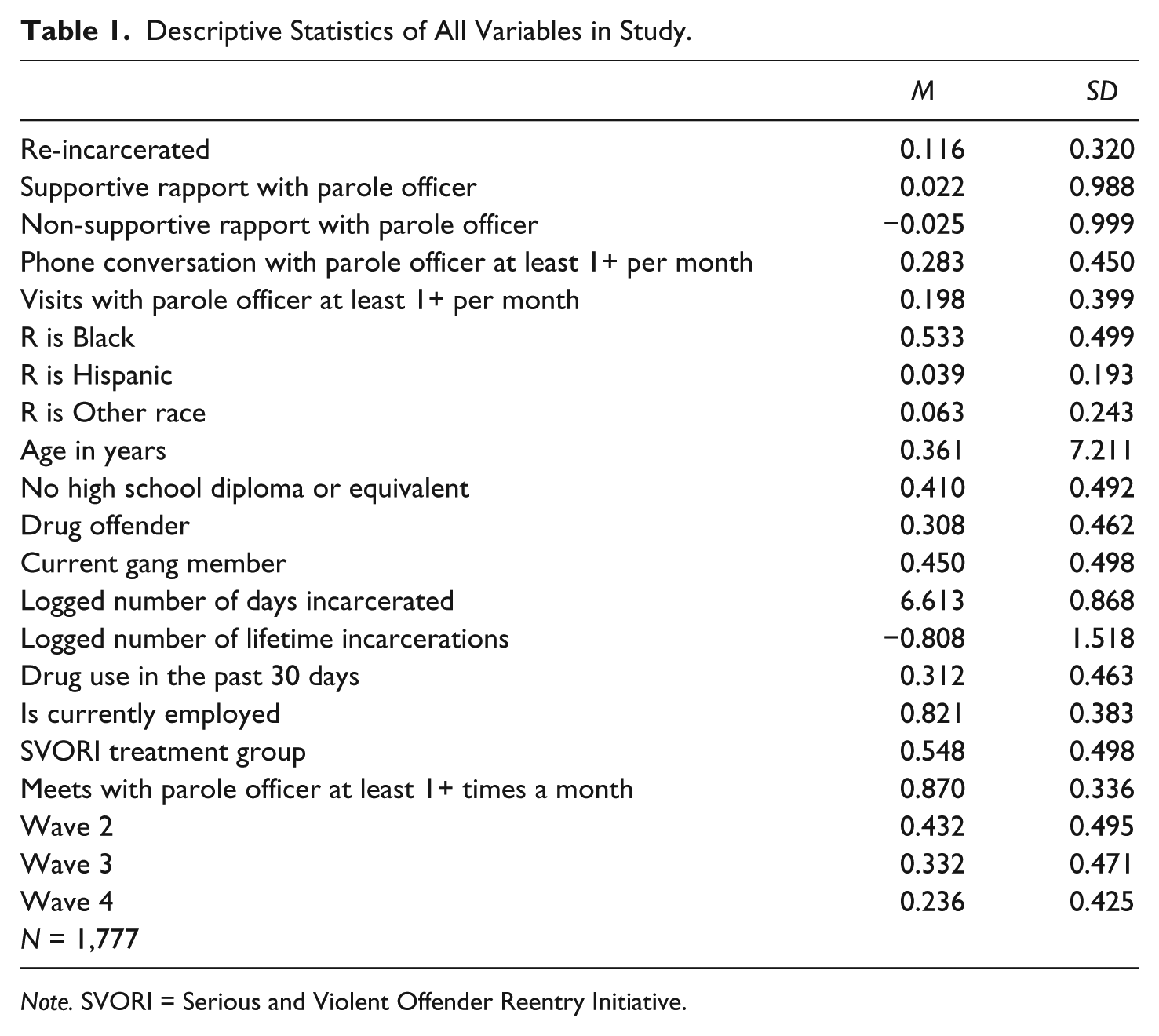
Note. SVORI = Serious and Violent Offender Reentry Initiative.
Analysis Plan
We employ a discrete hazard model with a random intercept predicting the likelihood of reincarceration. For the analysis, we convert the SVORI data into a “person-period” dataset (Reardon, Brennan, & Buka, 2002), where each period is measured in discrete intervals, and the interval constitutes a wave in the dataset (Reardon et al., 2002; Singer & Willett, 1993). Each respondent therefore has multiple records, with each record corresponding to a wave; in other words, waves are nested within individuals. Once the respondent recidivates, he no longer contributes to the person-period (Gupta & da Costa Leite, 1999). Under this modeling structure, the dependent variable is the log odds of a respondent recidivating at a particular wave; respondents who did not recidivate were left censored at Wave 4. The random intercept allows recidivism to randomly vary across individuals. Our equation is as follows:
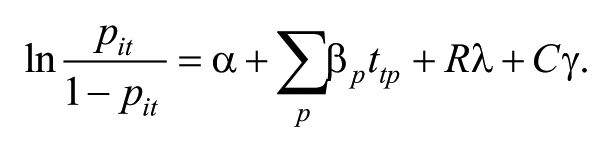
Here,
The benefit of a discrete hazard model is that it avoids many of the problems commonly experienced when modeling event histories and time. Discrete hazard models have the ability to include time-varying covariates even when the dependent variable is censored (i.e., there is no recidivism over the three waves). Given the data structure of the recidivism indicator, a discrete hazard model is a more appropriate means of modeling recidivism than survival analysis.
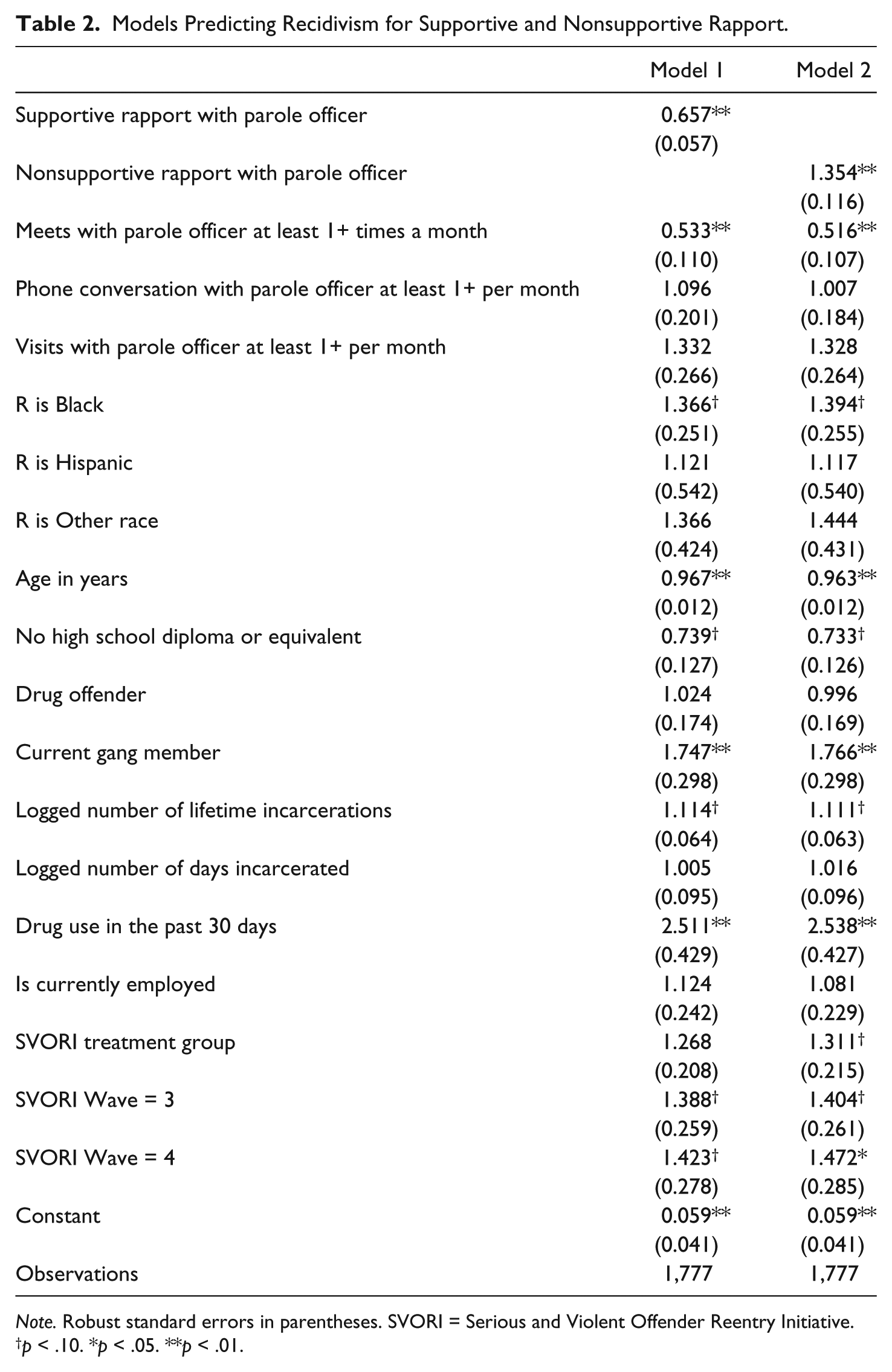
Below we present the following models. First, we present the baseline modes that show the relationship between positive or negative parole officer rapport and recidivism. These results are shown in Models 1 and 2 of Table 2. Next, we conduct a series of interactions between parole officer rapport and the three parole contact variables. Table 3 contains the three interactions using supportive rapport while Table 4 contains the interactions using nonsupportive rapport.
Models Predicting Recidivism for Supportive and Nonsupportive Rapport.
Note. Robust standard errors in parentheses. SVORI = Serious and Violent Offender Reentry Initiative.
p < .10. *p < .05. **p < .01.
Interaction Between Supportive Rapport and Type of Interaction on Recidivism.

Note. Robust standard error in parentheses. SVORI = Serious and Violent Offender Reentry Initiative.
p < .10. *p < .05. **p < .01.
Interaction Between Nonsupportive Rapport and Type of Interaction on Recidivism.

Note. Robust standard error in parentheses. SVORI = Serious and Violent Offender Reentry Initiative.
p < .10. *p < .05. **p < .01.
Results
Table 2 contains the models examining the relationship between parole officer rapport—both supportive and non-supportive—and the parolees’ likelihood of recidivism. Note that the results are presented as odds ratios. Before examining the independent variables of interest, we discuss the effects of the control variables. Parolees who met with their parole officer at least once a month, regardless of the type of meeting, were less likely to recidivate than their counterparts; their odds of recidivating were approximately 47% lower (=[1 − 0.533] × 100) than their counterparts. Next, as parolees age, their odds of recidivating decrease. This is consistent with the age-crime curve, even for serious offenders (Benda & Tollett, 1999; Clarke et al., 1988; Gainey et al., 2000). Conversely, parolees who were a current gang member saw a 75% increase in the odds of recidivating when compared with their nongang member counterparts. Also, individuals who have used drugs in the past 30 days have a 250% increase in the odds of recidivating versus those who have not currently used drugs. Blacks have a higher likelihood of recidivating than their non-Black counterparts, but note that this finding is only significant at p < .1. Similarly, individuals in the later waves of the study—Waves 3 and 4—are more likely to recidivate. These three effects are consistent across the models in the table.
Our primary independent variables are supportive and nonsupportive rapport. First, parolees who have a positive relationship with their parole officer have significantly lower rates of recidivism (Model 1). For every 1 unit increase in supportive rapport, there is a corresponding 34% decrease in the likelihood of recidivism. As supportive rapport increases between parolees and their parole officer, the decrease in recidivism becomes larger. Conversely, parolees perceiving nonsupportive rapport with their parole officer are more likely to recidivate (Model 2). In this case, each 1 unit increase in non-supportive rapport results in a 35% increase in the likelihood of recidivating. As nonsupportive rapport increases (i.e., rapport between parolee and officer is increasingly negative), the odds of recidivating increases.
Next, we turn to our interaction models where we examine whether the type of visits—phone call or face-to-face—between parolee and parole officer moderate the relationship between rapport and recidivism. Table 3 presents the interaction models for supportive rapport, while Table 4 presents the effects for nonsupportive rapport. The interactions between supportive rapport and the type of parole officer contact do not exert an influence on recidivism (Models 1-3). Table 4 is the interaction models for nonsupportive rapport. There are no interactions with nonsupportive rapport that are significant at p < .05.
Discussion
Parole officers are pivotal to the success of parolees, and the personal relationship between a parolee and parole officer likely plays a primary role in parolee success. Our study examines how the relationship between a parolee and parole officer—positive or negative—affects recidivism. In addition, we examine if the quality of the relationship and its effect on recidivism is affected by the type and amount of contact parolees have with their parole officer. Our findings are threefold and are discussed below.
The rapport parolees have with their parole officer impacts their likelihood of recidivism. Supportive rapport between a parolee and parole officer is based on trust, helpfulness, and professionalism; it is not based in the sociability of the relationship. When parolees perceive that they have supportive rapport with their parole officer, their likelihood of recidivating decreases. Relatedly, perceived nonsupportive rapport (which captures a lack of interest and helpfulness on the parole officers’ part) on the part of the parolee tends to increase recidivism. These findings are supported by earlier work on a sample of female juvenile parolees, showing that when parolee–parole officer relationships are positive, parolees had better postrelease outcomes (see Vidal et al., 2015) and parolees were more willing to take advice and have loyalty toward their parole officer (Rex, 1999; Robinson, 2005). Given the importance of a positive parolee–officer relationship, this suggests that greater emphasis should be placed on training parole officers how to establish positive, high-quality working relationships with parolees. Training programs for developing positive working relationships for clinicians working with offenders are already in place (Carpenter, Escudero, & Rivett, 2008; Crits-Christoph, Gibbons, & Hearon, 2006); these techniques could be reasonably modified so that they are applicable to the parolee–officer dynamic (Kennealy, Skeem, Manchak, & Eno Louden, 2012). In addition, it is important to deemphasize the supervision aspect of a parole officer’s job, enabling the parole officers to focus on providing services to their clients and, as a result, change the underlying behavior of the offender (Bonta et al., 2008; Bourgon et al., 2011; Lowenkamp et al., 2012). Importantly, we lack an objective measure indicating how well an officer is performing his or her job. Rapport is not merely a reflection of how an offender and officer might get along, but also involves the skill and professionalism of the officer. Future research should examine the extent to which perceptions of rapport are linked to the skill level of the officer.
Next, frequent contact with a parole officer can reduce recidivism. When parolees meet with their parole officer at least once a month, they have lower rates of recidivism. Remember that the modal response for the respondents is never or once or twice. This follows logically, as increased contact is necessary for the establishment of rapport. Interestingly though, how parolees and parole officers meet does not influence this effect. Face-to-face visits or phone visits did little to impact recidivism generally nor did these types of visits moderate the relationship between recidivism and supportive or non-supportive rapport. This suggests that it is the frequency of contact that takes primacy rather than the form when thinking about the relationship between recidivism and contact.
However, there are challenges associated with increasing frequency of contact between parolees and officers. Currently, community supervision officers are faced with growing caseloads as a consequence of decades of mass incarceration (Guerino, Harrison, & Sabol, 2011). Increasing caseloads for parole officers often translates to decreased contact between parolees and officers (Burrell, 2006; Lowenkamp et al., 2012). This limits the ability of officers to provide guidance and case management support, with the natural consequence being increased recidivism for those parolees not receiving as much support (Corbett, 2014; Phelps, 2013). Consequently, lowering caseloads for parole officers seems daunting. One solution to this problem may be reliance on other types of communication, such as email, text messaging, or chat programs between parolees and parole officers. Indeed, prior research has suggested integrating the use of smartphone applications to help officers better manage offenders under the burden of large caseloads (Jackson, Russo, Hollywood, Silberglitt, & Woods, 2015). Given that our results show that the mode of contact does not matter, these alternative forms of communication might be just as effective. This would increase the amount of contact between a parolee and officer, thus fostering rapport while simultaneously minimizing time requirements on the part of the officer. Although SVORI does not measure these types of communication, future research should examine these alternate forms of contact to determine whether they would increase rapport and reduce recidivism.
Our study has important limitations to note. First, our measure of rapport is based on parolee perception and may not be a true reflection of the parolee–officer relationship. As we do not have an independent measure of rapport, an officer may be engaging in proper case management. Future studies should incorporate a dyadic measure of rapport to capture both participants’ assessment of the relationship. However, despite this fact, we believe that understanding the parolee–officer relationship from the parolee’s perception is insightful for understanding how a parolee might engage an officer for services or other needs that might improve offender outcomes. This limitation is related to another: We have little information about the parole officer generally. Ideally, SVORI would include parole officer race, gender, and years of experience, or the quality of the services the parole officer offers, for example. Thus, our results reflect only the perspective of the respondent and controls only for his or her characteristics. Second, there is a high rate of attrition in the SVORI data. Approximately, 50% of respondents are lost after the in-prison interview (Lattimore & Visher, 2009); however, retention is high among respondents able to be contacted post-release. The data collection team behind SVORI did initial attrition and retention analyses and showed that the attrition was at random (Lattimore & Visher, 2009); therefore, it is unlikely that the attrition rate will systematically bias our findings. Third, as our study involves serious and violent offenders, the results may not be generalizable to other offender populations. However, as serious and violent offenders are typically less likely to desist from crime, there is potential for positive parolee–officer relationships among less serious offenders to produce even larger recidivism reductions. Fourth, the SVORI data consist of serious and violent offenders, and our focus here is on males. It is plausible that these relationships are different among female or juvenile offenders. The characteristics of the sample limit the generalizability of the study and also suggest a need for future work that is more encompassing of the wider population of offenders.
In conclusion, this study highlights the importance of establishing a positive, high-quality relationship between a parole officer and parolee for reducing recidivism among serious or violent offenders. With a national recidivism rate hovering around 60% (Durose et al., 2015), most former inmates will reoffend. In an effort to reduce recidivism, considerable emphasis has been placed on developing effective interventions consistent with evidence-based practices (Andrews & Bonta, 2010; Chadwick, Dewolf, & Serin, 2015). While programs utilizing evidence-based practices can be effective in reducing recidivism (Chadwick et al., 2015), our study suggests that offender outcomes might also be significantly improved by simply enhancing the supervision process to incorporate techniques associated with the establishment of supportive rapport.
Footnotes
Declaration of Conflicting Interests
The author(s) declared no potential conflicts of interest with respect to the research, authorship, and/or publication of this article.
Funding
The author(s) received no financial support for the research, authorship, and/or publication of this article.