



Abstract
This research focuses on an under-examined aspect of the post-release prison trajectory for a seldom-researched cohort. Narratives of the immediate days/weeks surrounding release were gathered from young men with histories of injecting drug use (IDU). Twenty-eight participants (aged 19-24) released from adult prisons in Victoria, Australia, participated in face-to-face in-depth qualitative interviews after release. Analysis of findings through the lens of a “risk environment” framework reveals how their experiences were compromised by risk factors embedded in the physical spaces and social situations they inhabited, as well as the multi-sectoral policy environments under which they were governed. A complex interplay between these factors, young men’s drug use and broader issues of structural vulnerability, including institutionalization and social disadvantage, combined to limit young men’s chances of “success”1 on the outside. Narratives provide evidence for interventions that transform risk environments into enabling environments, thereby promoting a more successful transition from prison to community for young men with IDU histories.
Keywords
Background
… people don’t understand, when you’re in jail you get in a routine, you’re in a comfort zone […] even though you’ve got your back up and you’re always fiery and ready to fuckin’ fight for your life, it’s a comfort zone, and when you get thrown back out and you’ve got nothing, nowhere to go, no one to pick you up and you don’t know what you’re doin’, anxiety goes through the roof … people don’t understand that . . . when you get out of jail, you’ve got nothin’ yeah, you’ve got absolutely nothin’. (Tarik, 23)
Tarik was 23 and had just completed a 2-year sentence in a maximum-security prison. From age 11, when Tarik first started injecting drugs, he was in and out of secure welfare, psychiatric units, and foster care; juvenile detention became his “second home.” Since turning 18, he had spent 4 years in adult prison. On his day of release, he had no one to collect him and nowhere to go. He felt anxious and certain he would be back in prison again soon. Tarik is one of at least 7,000 males aged 18 to 24 years released from adult prisons in Australia each year (Avery & Kinner, 2015). It is estimated (no authoritative data exist—Martire & Larney, 2009) this group constitutes the highest proportion of releases from prison (Avery & Kinner, 2015). They account for 17% (5,638 prisoners) of the Australian prison population, over one third are of Aboriginal and Torres Strait Islander descent (Australian Bureau of Statistics [ABS], 2016), and many have injecting drug use (IDU) histories (Butler et al., 2008; Kinner, Jenkinson, Gouillou, & Milloy, 2012).
Research on young adults in the criminal justice system has found they are much more likely than their same-age counterparts in the community to have poor educational and employment histories, exhibit risky health-related behaviors (Butler et al., 2008; Indig, Frewen, & Moore, 2014), been exposed to family violence and abuse, spent childhoods in institutional care, and to have parents with incarceration histories (Arditti & Parkman, 2011; Australian Institute of Health and Welfare [AIHW], 2015). Those with IDU histories have even more complex needs, including physical and mental health comorbidities and increased risk of blood borne virus (BBV) infections (Andrews & Kinner, 2012; Degenhardt et al., 2014). Furthermore, young men like Tarik exiting prison are six times more likely to die in the year after release than their peers in the community (van Dooren, Kinner, & Forsyth, 2013). They face logistical and socio-emotional challenges, exacerbated by preexisting health conditions and social disadvantage (Butler et al., 2008; Fougere, Thomas, & Daffern, 2013). In addition, younger men are more likely to be re-incarcerated than older men (ABS, 2010) and those with IDU histories more so (AIHW, 2015; Andrews & Kinner, 2012). Whilst their peers are transitioning into adulthood, undertaking tertiary education, employment, and independence from the adults in their lives, young men exiting prison are faced with returning to disadvantaged communities (Vinson & Rawsthorne, 2015) with limited financial resources or post-release support, and many lack the cognitive developmental tools to overcome these challenges (Arditti & Parkman, 2011).
A number of qualitative researchers from Australia (Halsey & Deegan, 2015), the United Kingdom (Forste, Clarke, & Bahr, 2011; Harvey, 2012), and the United States (Abrams & Terry, 2014; Arditti & Parkman, 2011; Hanrahan, Gibbs, & Zimmerman, 2005; Inderbitzen, 2009; Martinez & Abrams, 2013; Seal, Eldrige, Kacanek, Binson, & MacGowan, 2007) have studied the post-release experience from juvenile detention and adult prisons, for males aged 18 to 24 years. Halsey’s and Deegan’s (2015) longitudinal Australian study, involving in-depth interviews with male offenders aged 15 to 29 over a 10-year period provides useful insights about the complex factors that promote and prevent desistance for this group. Their study highlighted the chronic challenges young men face, recognizing that policies focused on “fixing the offender” address these issues only tangentially. In addition, a meta-synthesis by Martinez and Abrams (2013) about the dynamics of informal social support for returning young offenders (ages 14-24) found family and peers were particularly important for providing emotional and material benefits. However, balancing peer support and expectations with temptations to reengage in crime, and negotiating potential negative dynamics within families, created stress and complications for their reentry experience. In addition, Hanrahan et al.’s (2005) study of young men’s perceptions of parole supervision and revocation illustrates the myriad challenges they face at release, including housing difficulties, complex family relationships, and adhering to strict post-release requirements.
Findings of the above studies provide important insights into the many issues young men face as they prepare to leave custody. Difficulties navigating social relationships; dealing with discrimination, stigma, and housing insecurity; and facing the fear of making mistakes as they try to avoid re-incarceration were amongst challenges highlighted. However, despite the overrepresentation of people with IDU histories in prisons, and their increased risk of re-incarceration compared with noninjecting peers, none of these studies targeted young men with IDU histories. Furthermore, little scholarship exists about the immediate period of release from prison. Inderbitzen’s (2009) ethnographic study of five young men released from a juvenile correctional facility in the United States and Visher, LaVinge, and Travis’ U.S.-based study (2004) of the prison to community transition for men and women over 18 are two of few studies that focus on the hours and days surrounding prison release. For the young men in Inderbitzen’s study, hopes and fears prior to release and experiences soon after release revealed that the “transition out of a juvenile detention was one of the most significant challenges they would ever face” (p. 470). Confronted with a myriad of obstacles, participants struggled to build successful independent lives, having left “the safety net” of the institution with few resources and limited post-release support. The adults in Visher et al.’s study (2004) described turbulent accounts of the release experience, with only a quarter having participated in pre-release programs. Furthermore, more than half had no one meet them at the prison gate, and many were released into unstable housing with limited financial resources. Although findings of these U.S. studies provide useful insights into this transition period, a detailed understating of what transpires for young men with IDU histories remains relatively unexplored. Furthermore, given Australia’s historical emphasis on harm reduction responses to illicit drugs and lower incarceration rates than the United States, understanding young men’s experience from an Australian perspective can add important new insights.
This study uses Rhodes’s (2002) “risk environment” framework as a lens for understanding the experience of prison release for young men with IDU histories. In essence, the risk environment is the space where different types of environmental factors—social, physical, and policy—interact with different levels of influence (micro and macro) to increase the chance of risk occurring (Rhodes, 2002, 2009). Rhodes’s framework responds to an overreliance on individualistic behavior change models that largely ignore the physical, social, and policy settings—the risk environment—that combine to increase vulnerability to drug-related harm (Rhodes, 2002, 2009). Rather than “responsibilizing” harm to individual action, this model “shifts the focus for change from individuals alone to the [] situations and structures” (Rhodes, 2002, p. 91), including the social, policy, and physical landscapes that affect their experience (Rhodes, 2009). Using the risk environment as our analytic lens, we illustrate how young men’s risks are shaped by physical, social, and policy factors. The linkages between these and the interplay between individual- and structural-level experiences within them support theories that view structure as both enabling and constraining (Giddens 1984, Rhodes, 2009).
Although most studies utilizing this framework have examined risk environments involved in BBV transmission through IDU (Janulis, 2016; Strathdee et al., 2010; Tempalski & McQuie, 2009), recent studies have used this framework to understand the complex system of interactions between individuals exiting prison (Denton, 2017; Galea, Hall, & Kaplan, 2009). In Denton’s (2017) study of post-release experiences for 18 adult men with mental health and substance use disorders, she described individual risk behavior as situated within a “transition risk environment” that limited individual agency and created a “vicious cycle of release, relapse, and re-incarceration” (p. 51). Her participants shared expectations of a return to drug use despite hoping otherwise, with systems and services proving difficult to negotiate and access, sometimes creating more barriers than support. In addition, Barrenger and Draine (2013) describe how environmental and community-level factors, such as poverty, housing, social networks, and public policy, influence the experience of people with mental illness leaving prison, arguing that “preventing re-incarceration is a complex task, made nearly futile if one does not examine the risk environment in which [they] … are living their daily lives” (p. 163).
We aimed to extend Rhodes’s work by exploring the relationship between the lived experience of young men with histories of IDU leaving prison and the broader physical, social, and policy risk environments they were released from and into, at both the micro and macro levels. Specific aims were to develop an understanding of the lived experience of young men with IDU histories exiting prison and, by using a risk environment framework, draw insights into these experiences to inform enabling environments for change.
Method
This qualitative research is embedded within the longitudinal, prospective “Prison and Transition Health” (PATH) study of the Burnet Institute (Melbourne, Victoria, Australia), examining post-prison release trajectories of 400 men with IDU histories. Ethical approval for this qualitative study was received from the Victorian Department of Justice, The Alfred Hospital Ethics Committee, and Curtin University.
Recruitment and Sample
In PATH, participants were recruited for baseline quantitative interviews from three Victorian men’s prisons (minimum, medium, and maximum security). Eligibility included regular (at least monthly) IDU in the six months before incarceration, and being due for release within-three months of baseline. Thirty-seven PATH participants were aged below 25 years. At pre-release interviews, all were invited to participate in the qualitative arm of the study, and known and anticipated contact details were provided to enhance post-release follow-up. Upon release, attempts were made to contact all young men; nine were unable to be located soon enough after release to participate in a qualitative interview. Participants were given verbal and written information about the research before consenting to participate.
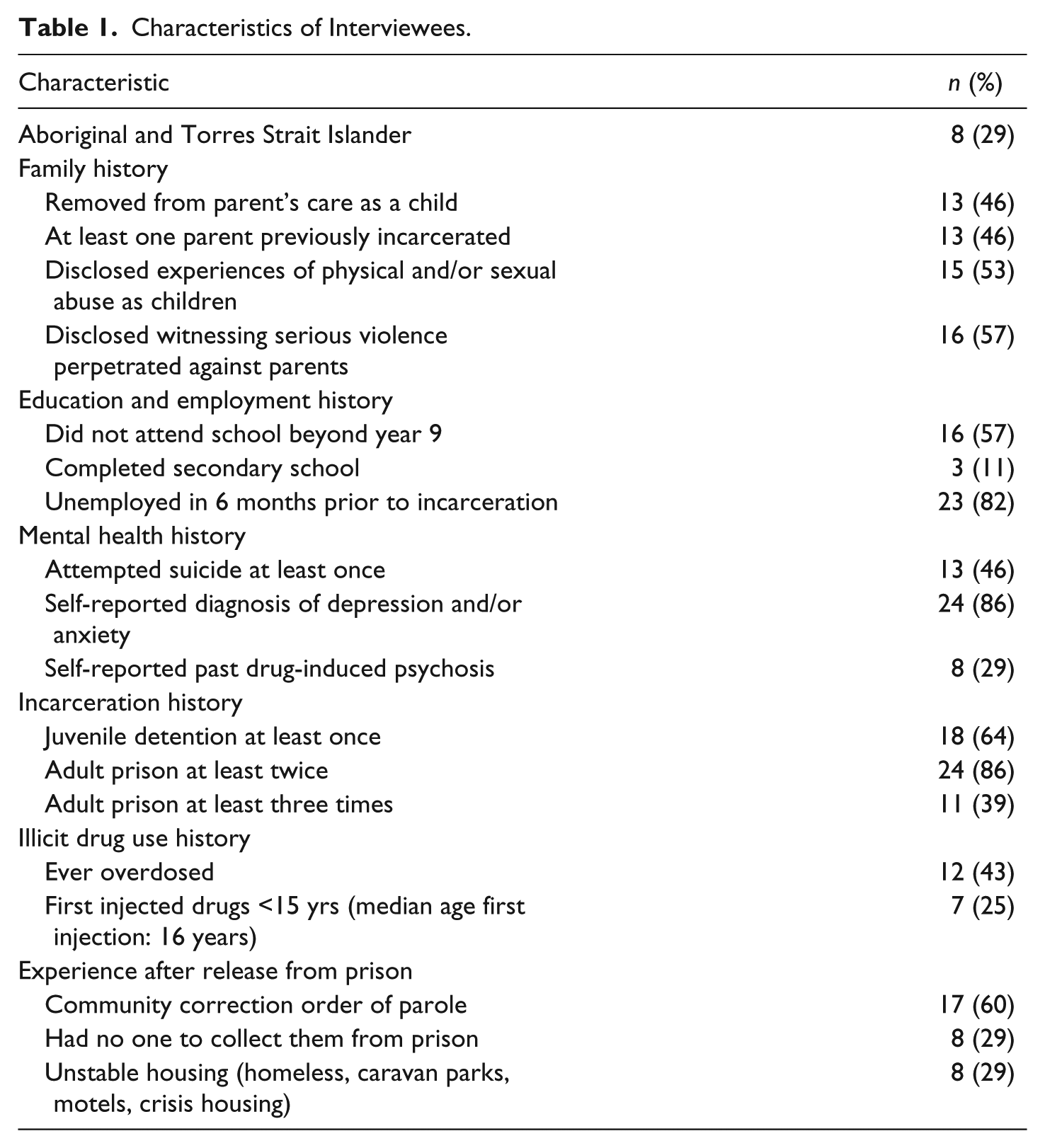
The sample included 28 young men aged 19 to 24 years at recruitment (average age 23 years). Sixteen were released from a maximum-security prison, five from a medium, and seven from a minimum-security prison. Recent prison sentences were one month to three years, with an average incarceration time of eight months. Twenty-six participants were Australian-born and seven identified as Aboriginal and Torres Strait Islander. As highlighted in Table 1, the sample is characterized by high levels of disadvantage and vulnerability. Almost half (n = 13) reported being removed from their parents’ care as children and had parents previously incarcerated. More than half disclosed experiences of physical and/or sexual abuse as children (n = 15), and many (n = 16) were witnesses of serious violence perpetrated against parents. More than half (n = 16) did not attend school beyond year 9, and most (n = 23) were unemployed in the 6 months prior to their most recent incarceration. Thirteen participants had attempted suicide at least once, and most (n = 24) self-reported a diagnosis of depression and/or anxiety. Furthermore, almost two thirds (n = 18) reported being detained as juveniles (n = 18), most (n = 24) had been incarcerated in adult prisons at least twice previously, and seven reported first injecting drugs under the age of 15 years. After release from prison, 19 were living in rural or regional towns in Victoria, four in inner city Melbourne, and five in outer suburbs.
Characteristics of Interviewees.
Data Collection
Qualitative data were collected between September 2015 and July 2016. A semistructured open-ended interview schedule was designed to capture participants’ narratives in their own words and allow them to explore topics of interest that were unanticipated by the interviewer (Hansen, 2006; Maxwell, 2012). The data collection process was iterative; as new topics emerged from early interviews, they were added to the interview schedule for exploration in later interviews (Srivastava & Hopwood, 2009). Interviews explored life course narratives, addressing experiences of illicit and IDU, crime, contact with police, juvenile detention, incarceration in adult prisons, release from detention, and what was happening in their lives at the time of interview. This article focuses on experiences prior to release, on the day of release, and in the 4 weeks after release.
Participants completed one (n = 9), two (n = 11), or three (n = 5) in-depth face-to-face interviews of one to three hours duration. Most initial interviews occurred within four weeks of prison release (n = 19); however, some participants were more difficult to locate and were interviewed two to three months (n = 5) or six to twelve months (n = 4) post-release. The first author conducted all 28 qualitative interviews, and most participants pre- and post-release PATH survey interviews—both before and after qualitative interviews—adding important context and understanding. Qualitative interviews occurred in various locations (caravan parks, health services, libraries, backyards, cars, and cafes), with due consideration of participant confidentiality and interviewer safety. Participants received AUD40 (approximately USD30) reimbursement for time and out-of-pocket expenses per interview. Interviews were audio-recorded and transcribed verbatim by the interviewer to ensure voices were accurately represented (Hansen, 2006). Transcripts included verbal and nonverbal expressions to provide an in-depth account of narratives. Pseudonyms protect participant identity, and other people or locations described in narratives have also been de-identified. PATH demographic data are used to characterize the sample and add context (see Table 1).
Data Analysis
Initial analysis involved the repeated reading of transcripts to become familiar with the depth and breadth of interview data (Braun & Clarke, 2006; Riessman, 1993). Themes were found by looking for repeated patterns of interest and contradictions. The transcription process was a key component of this phase, which Lapadat and Lindsay (1999) describe as an interpretive act that allows development of initial meanings before coding begins. Data were then coded manually to represent themes of commonality and interest, and inconsistencies within each transcript and across the data set. Themes were then sorted into meaningful groups using mind-maps (Braun & Clarke, 2006) to visually represent relationships between ideas and concepts. Corresponding codes were created in NVivo 11 qualitative data analysis software, and transcripts were imported. Narratives related to young men’s experience of release from prison were organized into higher level themes, and coded data of participant extracts were reread and refined for each theme. Finally, Rhodes risk environment framework was used to draw insights from young men’s experiences that would inform the development of enabling environments to promote a more successful prison to community reentry process.
Findings
Findings are presented within four broad themes: prerelease—no one understands; day of release—farewells, reunions, and alone at the gate; on the outside—good plans turn to regret; and the prison-to-community merry-go-round—“I know I’m goin’ back [to prison].” Themes represent recurring narratives of young men’s experiences before release, at the prison gate, and what transpired within the month following release.
Prerelease: No one Understands
A Reintegration Pathway (Corrections Victoria [CV], 2015) framework acknowledges transition planning as a continuum, with activity starting as soon as possible after entry into prison. However, narratives highlighted gaps in the delivery of this model of care, for example, whilst incarcerated, participants were offered post-release transition support services; however, meetings were described as brief and participants felt they did not adequately respond to their multiplicity of personal concerns, particularly with regard to anxiety about having nowhere to live, breaching supervised community orders (including parole and community correction orders [CCOs]), and returning to illicit drug use. Relapse or returning to the “habit” of illicit drug use was one of their greatest concerns, fearful it would lead back to crime, breaches of orders, and inevitable re-incarceration. Adding to this concern was that many participants reported difficulties accessing drug treatment programs and health care in prison, believing requests to access programs were not prioritized sufficiently. Although a range of alcohol and other drug (AOD) treatment services, including opioid substitution treatment (OST), are made available for prisoners with drug use issues, it is also possible that the contexts in which services are offered (e.g., variations between individual staff and staff roles, timing within their current sentence) may limit their likelihood of program participation. As Matt explained: Yeah, you could put in a form [to access AOD courses] in jail and you’re still not gonna see ’em, like I tried to get with services when I was locked up, but they just don’t come see ya, or it’s just like, rah, they do see ya and then they just blow ya off. (Matt, 23)
Although a third participated in AOD group programs, only a handful accessed individual AOD counseling, despite many preferring this style of therapy. Group programs were perceived as unsafe for disclosure, reduced their ability to remain anonymous in their drug use, and increased vulnerability to violence and being “stood over” (menaced) for drugs in prison. Jack’s comment highlights this point: I’d rather individual counseling than group sessions. [What’s that about?] You look at a prisoner […] you don’t know ’em from a bar of soap, then he could go tell, “yeah he’s a junkie.” (Jack, 22)
Whilst some participants chose not to access OST for fear of the consequences of disclosure of their illicit drug use, other participants described difficulties accessing OST whilst in prison. Prison transfers meant screening appointments were sometimes missed, and others reported difficulties convincing program workers of their need to access OST. For example, Arty had requested OST in prison but felt discouraged by the program worker. Feeling inadequately empowered to request a clinical appointment, he did not receive the treatment he felt he needed: I go, “look, if you think I’m havin’ dirty urines, I’ll get on the methadone program.” She goes, “Nah, ya don’t need methadone, ya don’t need to get on it.” I go, “the court letter says I’m misbehavin’, involved in drugs, so how about I do somethin’ about it, I’ll get on the methadone program.” She goes,“Nah, Nah.” So yeah we didn’t like each other [after] that. (Arty, 19)
More than half (n = 16) of the young men were released on CCO’s and one participant was released on parole. For those released into the community without a community order, reduced opportunities exist for post-release support. Conditions are placed on community orders to address the risk of reoffending, which can include regular supervisory meetings, random drug testing, unpaid community work, bans on entering specified areas, curfews, and compulsory AOD treatment. Most participants had been granted supervised community orders in the past and had been previously re-incarcerated for breaches due to non-compliance with the conditions of their orders—often for illicit drug use. These past experiences increased their fear of breaching again.
In Victoria, prisoners are not granted parole unless they have stable accommodation arranged for after release; however, CCO’s can be granted to prisoners irrespective of whether or not they have post-release housing arranged. Whilst Community Correctional Services (CCS) have some funds for crisis accommodation to support offenders at court when they are being considered for a CCO, despite such policies and provision, at least a third of participants’ narratives highlight housing was a key concern. Given most participants’ families were socially and economically disadvantaged, this also reduced their access to stable housing. Drew believed he should not have been released until stable accommodation was available: … anxiety was goin’ through the roof […] I said to my clinician, “I’m not ready to get out, like I’m gettin’ out to nothin’.” She goes, “Nah, you’ll be right.” I’m like, “it won’t be alright” […] they offered me a little fuckin’ sleeping bag thing […] they don’t do shit in there. I’d have stayed another month just ’til they found [something] … what’s another month when you’re doing two years already? (Drew, 22)
Although for Drew and others, crisis accommodation was arranged just days before release, these motels, boarding houses, and caravan parks were described as environments of ubiquitous drug use and crime. The “crack joint” where Franky described being housed, and the “dirty, fuckin’ junkie hole of a place” Drew defined being released to, meant “going straight” was perceived as almost impossible. On Drew’s first night in crisis accommodation, he was so anxious he would return to injecting that he feigned a fire, setting off the sprinkler system in the hope an ambulance would retrieve him. An ambulance arrived, but rather than taking him to the hospital as he had hoped, he was evicted from the rooming house and was homeless again.
Tim, an injector since age 16, believed he would inevitably return to crime to pay for accommodation and support his heroin use: … the governor said, “so what are ya doin’ when you get out?” I said, “I’m goin’ to get a tent, I’m comin’ back to pitch it out the front of ya jail, I got nowhere else to go.” He thought I was jokin’ […] I’ve actually got morals; I don’t like robbing off people, but if I’m down and out and that’s all I’ve got, I do stupid […] I do things like [that], I fuckin’ don’t like it, but I feel like I have no choice. (Tim, 24)
Following three nights in a motel renowned for housing people just released from prison, the only places Matt and his girlfriend could find in the weeks following were shared rooms in boarding houses where he “knew he’d get back on [drugs]”; they chose to remain homeless. He described feeling angry there had not been more pre-release support to find him stable housing: They offered to … get me housing, but they did nothin’ […] like ya put in forms to get help, and they just ignore it. Like if I had everythin’ put in place for me while I was in jail like I should’ve, like a house, a job […] I got out with fifty-seven dollars and a pension cheque. that wasn’t gonna last me long […] and then you’re fucked over the next fortnight … that’s what they don’t think about, it’s the worst. (Matt, 23)
In essence, narratives regarding young men’s experiences prior to release draw attention to the perceived barriers they faced accessing prerelease transition support and AOD treatment programs. Furthermore, most young men experienced anxiety related to housing uncertainty and fears of returning to harmful drug use that would lead to breaches of orders and re-incarceration.
Day of Release: Farewells, Reunions, and Alone at the Gate
Conflicting discourses emerged when young men reflected on feelings and experiences of leaving the prison gate. Most expressed feeling excited, and for some, the anticipation of being reunited with family and being “free again” was described as feeling just like “Christmas.” In contrast, for those who found themselves alone at the gate, anxiety was met with uncertainty, particularly for those with no accommodation. For many, these experiences were also coupled with a deep sadness as they bid farewell to friends who had become important emotional supports on the inside, support that would be unavailable after release. William and Noah’s reflections highlight their grief at “leaving mates behind”: … very nervous, couldn’t sleep, jumped up in the mornin’ ya know, just to see all me mates I’ve been livin’ with for a year, maybe two, sayin’ goodbye. We live, we eat, we share, we laugh, we have our sad times, and then it’s time to go […] I started cryin’ cos the boys are ya know all tearin’ up […] all the boys are now in prison, and I’m out by myself. (William, 23) I had good mates in there that I had to leave, and yeah I was a bit sad leavin’ them behind. They’ve got a while to go, so um yeah, that was probably the hardest part. (Noah, 22)
Most young men were collected from prison by family. Despite the ensuing chaos, many experienced in the days and weeks after release-day, reunions and “welcome home parties” were described as positive experiences by many. For example, William took the five-hr journey home with his father, who only visited twice during his two-year sentence. They valued the time together, and celebration drinks with family was important for reconnecting and catching up. Seb hadn’t lived with his father since early childhood, and although he was anxious about how it would go, he was also “excited” about seeing him again, as was Liam: … the last three weeks, that was prob’ly the longest somethin’s ever taken … just because I knew I’d be with my parents … I was just really looking forward to gettin’ out. (Seb, 22) … just excited ya know what I mean, like fuck I’m goin’ home, like [the] best feeling. Yeah got out and mum was there and me brother and sister and yeah, I was stoked, just happy to be out. (Liam, 24)
In contrast to participants whose family members collected them on release-day, six young men found themselves alone at the gate. Preparing for the unknown, these participants shared turbulent accounts of navigating public transport and accommodation with uncertainty and little money. Beyond the prison gate, heroin and ice [crystal methamphetamine] provided relief in solitary moments and suppressed anxiety and fear. Dash’s wife traveled for three-hours to meet him, but was delayed; Dash scored ice [crystal methamphetamine] at the train station to reduce his stress: I didn’t have no phone [and] the phone out the front of [prison] … wasn’t takin’ coins and her phone was flat […] I was stressin’ thinkin’ she’s just fuckin’ left me or taken off […] I ended up catchin’ a bus and got kicked off cos I didn’t have a bloody concession card. (Dash, 22)
With no one to collect him, Tarik took a bus to meet a friend from prison. Unable to contact or locate him, he went to a pub, was approached by a stranger, and introduced to a dealer. He scored ice and injected in a public toilet block. For Tarik, limited accommodation options and lacking trusted friends or family meant that he found himself in a risky situation on his day of release: I bought a gram of ice […] I knew my body wasn’t gonna be able to handle it […] I spewed everywhere […] literally spewin’ blood […] that was as scary as fuck, and then the fuckin’ whole ice thing kicked in and I fuckin’ went a million miles an hour that night … and just ended up runnin’ amok. (Tarik, 23)
Narratives of “day of release” experiences stress the importance of young men’s social supports during this process. Excitement about their release day, for those reuniting with family, was juxtaposed against turbulent accounts for those with no one to collect them from the prison gate, and sadness at leaving friends behind who had become important supports whilst in prison.
On the Outside: Good Plans Turn to Regret
In the first days and weeks after release, participants were confronted with numerous challenges as they adjusted to life outside. Concerns before release became hard realities. Returning to illicit drug use was the biggest concern for most, with all but one participant having reported crimes related to their most recent offense/s were linked to their drug use; they were “high” at the time or needed money for drugs. Once released, social connections on the outside for most were involved in illicit drug use and crime. This presented particular challenges for resisting the urge to “use [drugs].” For example, Matt had been determined to change his life after release, but when he was “handed an eight ball of ice [crystal methamphetamine] out the front of [prison]” by his brother, he felt obliged to use for fear of rejection from his most significant supports: … in jail everythin’s so different, like we had plans to be so different, then I got out and went [home] and relapsed, and [my girlfriend] got so devastated […] I think she’s more disappointed with me cos like I was plannin’ do the right thing, and I went back to the stupid shit I was doin’ before. (Matt, 23)
Matt was overwhelmed that everywhere he turned drugs were available and disappointed that his family did not understand how much he wanted to abandon it all: Everyone’s tryin’ to make me do the opposite […] the only people I know are from drugs, like everyone I run into has somethin’ to do with it […] and it’s just wreckin’ everythin’ really … like ya try ya hardest to get away from it all, and every turn there’s someone else tryin’ to force you to [go] back to what ya were […] but I s’pose when it’s the only thing ya know. (Matt, 23)
Although many young men described “plans not to use [drugs]” after release, most knew this would be difficult. For Harley, although intending not to use on his release-day, “plans just fell down the gurgler” after meeting old friends who were heroin users. Heroin blunted the emotional pain related to the death of his fiancée, whose funeral he was not allowed to attend whilst incarcerated.
Jack also planned not to use, but knew this was an unrealistic expectation: Everyone has a plan before they get out [but it] doesn’t really all play together once you’re there. [It’s] that strong, “I’m never gonna touch drugs, [or] do this and that,” but ya gotta think realistically. I can’t be a user from 13 ‘til now […] and then say I’m never gonna touch ’em again. (Jack, 21)
For some, being approached by dealers at train stations and in crisis accommodation created challenges for “staying clean.” After release, Jack drove to the train station in the city to meet a friend released from another prison that day. A dealer approached him with ice: While I was waitin’, a dealer comes up […] often happens around [the train station] … “ya wanna buy somethin’? […] like crystals?” and I’m like, “that’s my favorite’ […] it was eight months since I’d had a full point, and like I went overboard. I should-a really had half ya know. (Jack, 21)
Matt also described the dilemma of planning not to use, against being exposed to dealers after release, that made it difficult to “stick to [his] plan”: … like ya go [to the train station] any day … and all the dealers are sittin’ there waitin’ for the bus to pull up and release the boys off […] ’cause they think “fuck, we’ll take their prison cheque” […] ’cause every single one of them prisoners gettin’ off that bus is gonna buy drugs. (Matt, 23)
For many participants, relapse in the first days after release was often accompanied by disappointment and shame for not abstaining as planned. Tarik and Sam described finding themselves on “ice benders” that lasted several days; both were angry at themselves for having “relapsed”: [I] got on it again, went even harder this time though … [then] I woke up to myself and I was like, “you fuckin’ idiot, what’ve ya done, get the fuck away from this before it destroys ya.” (Tarik, 23): … as I walked out [of the rooming house], someone said “it’s been a long time, I’m goin’ to get some gear heroin]”—the thing I really, really wanted to stay away from when I got out […] and then it dawned on me, like you just got outta jail, and look what you’ve already done to yourself. (Sam, 24)
Findings stress that although the motivation for avoiding drugs may be high when young men leave prison, challenges in the social, physical, and policy environments meant “sticking to the plan” was almost impossible and created feelings of regret for those who relapsed. Structural vulnerability, stigma, and environmental barriers reduced their potential for a successful post-release experience.
Prison-to-Community Merry-Go-Round: “I Know I’m Goin’ Back [to Prison]”
A recurring theme amongst participants was that they would inevitably return to prison within weeks of release. Once released, they faced the stigma, real and imagined, of being an ex-prisoner and a “needle user,” which they felt limited their chances of success. Narratives of feeling constantly surveilled and set up to fail were common. For example, Jack believed “injectors” and “ice addicts” were targets by police: … if they know you’re an ice addict they’ll try and put you back in as quick as possible ‘cause they know if ya touch the ice again it’s gonna ya know … lead to criminal activities […] once you’ve got it on your record as a needle user, they basically will do anythin’ to put ya back in. (Jack, 21)
For Tarik, the anxiety of being on public transport for the first time in years was compounded by a feeling of paranoia that everyone knew he had just been released from prison: I was sittin’ on the bus, and the bus was fuckin’ packed, and when ya first get outta jail … it feels like everyone’s lookin’ at ya, because everythin’ you do in jail is all body language yeah … ya get really paranoid everyone’s lookin’ at ya, that they know you’ve got out-a jail. (Tarik, 23)
Tarik described feeling like he was never given a chance to prove he could make a go of his life, with the stigma of being a known “criminal” following him wherever he went: I’m sick of bein’ judged [and] assumed that I’m gonna do somethin’ wrong … I hate it, because of my past. Instead of someone just givin’ me the chance and steppin’ up and goin’, “alright, fuck what you’ve done in ya past because that doesn’t define ya, you might a done all that shit, but it’s made ya who ya are today” (holds back tears). They pick on me every time I come back to this town, or they think I’ve done somethin’ wrong, they go, “Assume he’s done it rah rah rah.” (Tarik, 23)
William described his Aboriginality as a factor that increased the discrimination he faced. Known to the police, he felt constantly surveilled from the moment he was released back into the community: I’ve still gotta go through the constant struggles with like the police … They’re just like, “aw, is that you William?” … they pulled me up, shined their lights on me … I wasn’t drunk … they just said, “aw a few Aboriginal people been muckin’ up tonight.” I said, “was my name mentioned?” and they’re like, “Nah, Nah, you don’t fit the category,” so I said, “what’s ya problem?” “No, just wanted to check up on ya. Are ya on parole?” I said, “I’m not on parole, I’m a free man … if you’s ain’t got nothin’ to talk to me about, then see ya’s later…” (William, 23)
The conditions placed on CCOs and parole are designed to incentivize individuals and address their risk of reoffending. Yet for many participants, the risk of re-incarceration for breaching orders was uppermost in the minds, as they described the difficulties of complying with orders. For example, getting to supervisory community corrections appointments was a challenge for many; without driver’s licenses, all were reliant on others or public transport. In the chaos of drug use and homelessness, some missed appointments, and others drove to them without a license, risking breaches of their orders: I can’t stand [parole] like if you’ve got a long stint on parole you can guarantee you’re goin’ back in […] it’s just near impossible, they breach ya for the stupidest things … it’s unstable livin’ man […] and the rules change all the time … they’ll breach ya if they don’t like ya [or] just cos ya look bad. (Jack, 21)
In addition, for some, conditions of parole or CCO’s involved restrictions on travel to particular geographical areas, which sometimes precluded opportunities to visit family. Although administrative processes may exist for appealing these decisions, the young men interviewed in this study appeared either unaware of this process, or may not have felt sufficiently empowered to pursue this process with Community Corrections Services (CCS). Jack made a conscious decision to breach parole, valuing contact with family above this threat: I wanted to come back to my hometown where my family and that were, and [because of parole] I couldn’t … [so] I knew that I was goin’ straight back in ya know, ’cause like I knew I was gonna come over here and see my family, and I even said to my parole officer, I said, “get ready to breach me ’cause I’m comin’ over to see my family.” (Jack, 21)
Evan’s family lived interstate, which meant he was unable to see his family; he too found this difficult: I can’t even go see me parents […] because I can’t leave the state ’cause of me corrections order … they weren’t approving travel ’cause they’re just nasty sometimes, yeah so I haven’t seen me mum, step-dad or any of my family since … the last two years. (Evan, 24)
The fear of breaching was so overwhelming that some expressed a preference for completing their entire sentence in prison, as Harley highlighted: Yeah from the start I just wanted to do a straight sentence … ‘cause I knew I was gonna re-offend, they set me up to fail I reckon […] I was just stressed about leavin’ them gates … yeah, I was really anxious, just worryin’ about what I was gonna do. (Harley, 23)
“I never wanna go back” was a recurring narrative, but so was a notion that at times, prison was an easier option. Matt’s main sources of social support remained in prison: Literally the other day I felt like … I just wanna go back to jail … sometimes it’s easier […] ya understand why everyone just goes straight back, like all their mates are there … people they’ve got along with for years … like jail is easier than bein’ outa jail. (Matt, 23)
Tim felt certain he would be returning to prison soon. Still grieving from the death of his sister whilst incarcerated, he did not want to go back, but rationalized that he would at least be accommodated and fed: I know I’ll be going back […] you’re not happy to go back, but I just deal with it ’cause I been back so many times. I used to stress about it a lot, but at least I know I get a bed, and I’m gettin’ fed there. (Tim, 24)
As highlighted previously, most of William’s friends were also still inside, and institutionalization after a two-year sentence made coping on the outside difficult. Although, like Tim, William did not want to go back to prison, he too spoke about why it seemed an easier option: I was so used to gettin’ told what to do, now it’s just like, I dunno, I feel alone, it’s mucked with me life […], and I can understand why people keep goin’ back, ’cause its somethin’ that … I dunno just, like when life gets hard out here it’s like, some people just go to jail […] but I don’t wanna go back there, nup it’s done so much damage here [points to his heart]. (William, 23)
In summing up, findings underscore how factors beyond young men’s control combined to reduce their chances of success on the outside. For our participants, like those in Denton’s (2017) study, individual risk behavior was situated within a “transition risk environment” that limited individual agency, and created a “vicious cycle of release, relapse and re-incarceration” (p. 51). Remaining on the merry-go-round of drug use, crime and re-incarceration was almost impossible to avoid for most.
Discussion
Our study provides a deeper understanding of a seldom-explored process in the post-release trajectory for a marginalized group of young men with IDU histories. Their experiences in the first few weeks after release from prison confirm this as a critical period. Our examination of narratives via a risk environment lens reveals how their pre-release desires to avoid returning to drug use and criminal behaviors were compromised by risk factors deeply embedded in the micro- and macro-level physical spaces and social situations they inhabited, as well as aspects of the broader policy environments under which they were governed. Findings challenge the notion often presented in epidemiological research, that over-rely on individual agency and choice as determinants of risk behavior; concepts that lend themselves to “victim blaming” (Rhodes, 2002, 2009). Rather, findings highlight how the experiences of young men with IDU histories are shaped by a complex interplay between social, physical, and policy environments that extend beyond the individual level and that these generate vulnerability, which combined to limit their chances of success on the outside.
Structural Vulnerability
Inherent structural vulnerabilities stemming from social disadvantage, experiences of trauma, institutionalization, and stigma were macro factors in the social risk environments of participants in this study. “Structural vulnerability” is a concept that affects the health of individuals within distinctly patterned marginalized population groups and social contexts (Rhodes et al., 2011), including amongst others “the poor … the incarcerated, and those with drug and alcohol problems …” (Quesada, Hart, & Bourgois, 2011, p. 346). Quesada et al. (2011) describe structural vulnerability as a population group’s location in a social structure, that increases their risk of negative health outcomes and physical-emotional suffering, through their interface with the political and economic organization of the social world they inhabit.
Childhood experiences of physical/sexual abuse and periods spent in out-of-home care and detention, combined with recent experiences of homelessness, poverty, and unemployment. A focus on the notion of structural vulnerability within a risk environment framework (Rhodes, 2002, 2009) helps draw attention to the larger upstream factors of social and economic disadvantage that impact the health and well-being of specific population groups (Quesada et al., 2011), such as those within this study.
Sarang, Rhodes, Sheon, and Page (2010) describe the criminal justice system as “one of the most visible and best documented, structural mechanisms perpetuating social suffering and health risk related to drug use” (2010, p. 815), where deprivation of independence and responsibility, social isolation, and sterile physical spaces are common. Whilst carceral settings posed inherent risks for young men (e.g., those associated with BBV transmission and violence related to drug use), they also provided a controlled, predictable, and stable environment alongside often supportive social networks with peers. Thus, coping beyond prison in the absence of macro-structures that offered familiarity and routine, and micro-social structures that provided support and comradery, was fraught with challenges in the relatively uncontrolled physical and social risk environments they were released to. Institutionalization, which can be particularly profound for those who enter such settings at an early age (Harvey, 2007), compounded participants’ experiences, as they were left with “little if anything to revert to or rely on … when the institutional structure [was] removed” (Harvey, 2007, p. 251).
Young men with histories of IDU and incarceration are a stigmatized population group. Once released from “the safety net of the institution” (Inderbitzen, 2009, p. 470), with scant resources or post-release support at their disposal, many were faced with experiences of discrimination and stigma (Johns, Williams, & Haines, 2017; Simmonds & Coomber, 2009); these combined to increase levels of anxiety. For example, in the micro-physical settings after release, feeling constantly surveilled by police for being a “needle user” and having a criminal history impacted on young men’s levels of stress. Descriptions of feeling rejected no matter what they did provided little incentive to behave in ways that contradicted this view. Furthermore, even seemingly simple things like using public transport created stress, as they sought to adapt to their new-found freedom to make decisions in unfamiliar and unpredictable physical and social spaces.
Findings highlight how micro- and macro-level factors in the social and physical environments overlapped to exacerbate young men’s “structural disadvantage” (Strathdee et al., 2010), which enhanced their “risk” of a return to harmful drug use and to prison.
Relationship Dynamics
The micro-level social environment participants were released from and into, presented particular challenges. The significance of social support derived from peers, both in prison and after their release, commonly emerged in narratives; however, relationship dynamics were often fraught. The seldom-explored stress of leaving behind friends who were primary sources of social capital in prison emerged as a common theme. That peers who had provided support and a sense of belonging in prison were unavailable upon release (Martinez & Abrams, 2013) was a catalyst for stress. In addition, reduced opportunities to grieve with families whilst in prison, when someone they loved died, meant grief and loss issues continued well beyond release.
Examining experiences of leaving the prison gate via a risk environment lens illustrates how the local environmental context and social factors influenced young men’s production of risk, particularly within specific micro-locations (Rhodes, 2002; Small, Rhodes, Wood, & Kerr, 2007). For example, the prison gate, for those with family to collect them, did not pose the same risks as for those who found themselves alone. This micro-risk setting increased levels of anxiety as they faced new-found freedom alone and negotiated public transport and potential homelessness. In addition, micro-settings such as crisis housing and train stations were largely unavoidable for many and routinely exposed them to the very social networks involved in illicit drug use and crime they had planned to avoid.
Furthermore, without the necessary “social capital”—a concept extensively explored in prison reentry literature (Lafferty, Treloar, Chambers, Butler, & Guthrie, 2016) and described as existing in relationships that bring benefits and access to resources (e.g., housing, transport and financial/emotional support)—meant challenges were exacerbated. Consistent with Martinez and Abram’s (2013) findings, young men’s social capital on the outside was often limited to friends involved in illicit drug use and crime. Although these networks provided important emotional support, relying on social capital from within these networks was often counterproductive and impeded post-release aspirations. In the absence of stronger connections to mainstream society (from which many felt alienated anyway), young men were faced with the dilemma of reuniting with peers who provided a sense of belonging and support, but also temptations to re-engage in illicit drug use/crime that could lead to breaches of orders and re-incarceration.
Despite young men’s motivation for avoiding drugs was high at the time of their release, drug use on the outside became a mechanism for dealing with micro-social stressors, such as social isolation and grief (Fletcher, Bonnell, Sorhaindo, & Rhodes, 2009; Rhodes, 2002; Small et al. 2007).
Prison-to-Community Transition and AOD Programs
A range of local criminal justice reforms aiming to improve prison-to-community transition outcomes have been implemented in Victoria over the past decade (CV, 2015). These programs are designed to be implemented from prison entry and throughout the period of incarceration, to sequentially build on achievements. It is anticipated that new funding will be made available to meet increases in the number of remandees and prisoners on short sentences; however, recent program success has been constrained by resource limitations in the context of an increasing prison population (Victorian Ombudsman, 2015). 2 Although some programs target the pre- to post-release needs of “prisoners with high transitional needs,” many of the young men in this study were ineligible to access these, given they were not amongst individual risk populations, such as women, those serving longer sentences, or Aboriginal and Torres Strait Islanders (CV, 2015). Whilst based on a principle of risk-need responsivity (Bonta, 1996), this emphasis on individual risk potentially fails to recognize broader factors in the social and physical environments that impact on the post-release experience. Furthermore, although young men participated in pre-release transitional assessment meetings, narratives suggest some staff may have lacked an appropriate appreciation or understanding of their fragile predicaments and related anxieties. For example, housing concerns and desires to access AOD treatment were perceived as remaining relatively unaddressed for many. Furthermore, fears about a post-release return to drug use were perceived as not sufficiently prioritized when young men articulated their concerns, a finding that was also explored in Denton’s study (2017). The perceived lack of understanding and concern by prison and program staff about the environmental risks that inappropriate accommodation and difficulties accessing OST treatment presented, potentially stems from demand pressures and resource limitations that prison staff cannot meaningfully address. A potential driver has been the recognized underinvestment from governments in the face of rising prison populations that place demand pressures on transitional programs and limit the options for prison programs staff to meet prisoner needs (Victorian Ombudsman, 2015). These issues coalesced to make the achievement of program aims inherently challenging.
Macro Criminal Justice Responses
Criminal justice policy in Australia reflects the need for a continuation of care from prison to community to ease the transition process and prevent re-incarceration (Borzycki & Baldry, 2003). Pre-release experiences, however, suggest challenges enacting policy into practice across a complex and overburdened prison system (Victorian Ombudsman, 2015) compromised prerelease aims. For example, the local Victorian Sentence Management Manual (Corrections Victoria, 2017) states, “to minimise potential institutionalization it is considered in the best interest of the prisoner to progress through the security levels, to be released from … the least restrictive environment possible” (p. 9), and yet two-thirds of participants were released from maximum-security prisons, macro-risk settings where fewer opportunities exist for rehabilitation and transition support than minimum-security prisons (Victorian Ombudsman, 2015).
Policies and programs targeting the health and welfare needs of young adults in the general population are informed by the knowledge that their individual needs are different to those of older adults, and driven by distinct complex physiological, psychological, and social changes (Prior et al., 2011; Pruin & Dunkel, 2015). Although some justice policy frameworks reflect this knowledge (Pruin & Dunkel, 2015; Victorian Ombudsmen, 2015), few programs have been evaluated in relation to their capacity to meet specific and often complex lived experiences of this group (Koehler, Losel, Akoensi, & Humphreys, 2013; Losel, Bottoms, & Farrington, 2012; Visher & Travis, 2011). Furthermore, most young adults—such as those in our study—are sentenced to adult prisons and receive generic rather than youth-specific programs, in prison and after their release. One exception is a youth unit in a maximum-security male prison in Victoria for those below 25 years, which has reportedly resulted in reduced recidivism, more positive relationships between prisoners and staff, and a greater focus on rehabilitation (Exton, 2014). An evaluation of the program found young men in this unit reportedly had greater access to post-release support and educational and health programs (including intensive AOD treatment and mental health support), with shorter waiting periods to access these, as well as individual mentoring and family visits through Skype. Yet, despite most participants in our study spending time at the prison where this initiative is implemented, only four accessed the program, largely because those with histories of adult incarceration are ineligible.
Recent reforms to local parole and CCOs have resulted in stricter macro-policy regimes (Taylor, 2016), creating a risk environment that limited young men’s likelihood of successful transition. Participant narratives and supporting literature (Halsey & Deegan, 2015; Hanrahan et al., 2005; Jhi & Joo, 2009) underscore how meeting the demands of CCOs was fraught with complex challenges. Whilst random/regular urine testing is designed to incentivize abstinence, the consequences of a CCO breach that can be based on a “dirty” urine fail to take account of the chronic and relapsing nature of drug dependence (Fraser, Moore, & Keane, 2014). Here, tensions exist between micro-policies that may help facilitate a successful transition for some but impede this outcome for others. For example, restrictions on travel may prevent young men reconnecting with peers involved in harmful drug use and crime, but for some young men in our study this limited their access to family whom they relied on for emotional support.
Enabling Environments
So far, we have highlighted how the physical, social, and policy environments at both the micro and macro levels impact on young men’s risk of returning to harmful drug use and re-incarceration. Now we turn to interventions that address these barriers. The relative success of interventions is shaped by the risk environments in which they occur, that is, if a primary determinant of harm is social, then the solution must also seek to bring about change in the social environment (Blankenship, Smoyer, Bray, & Mattocks, 2005; Rhodes, 2002). By addressing the environmental constraints to risk-taking, “enabling environments” can facilitate the production of more conducive settings for promoting a successful post-release experience. In this sense, environmental factors can play an enabling role, as well as one of risk.
Micro-social enablers could include mentoring programs, an increasingly popular form of offender intervention, with the potential to foster social capital (Brown & Ross, 2010) and address issues faced in young men’s social and physical environments. Although few prison-release mentor programs have been rigorously evaluated, some evidence of their success exists. Outcomes include providing positive role models that help build social capital and resilience (DuBois, Holloway, Valentine, & Cooper, 2002; Halsey, 2012) and continuity of support from someone who is trusted. The prison gate is another physical setting that comprises an aspect of the micro-risk environment amenable to social intervention. For those leaving prison with no one to collect them, being met at the gate by a mentor who understands their distinct needs could also help reduce the anxiety of navigating aspects of life otherwise taken for granted, such as accessing public transport and dealing with unexpected and stressful “everyday” situations upon release (Clinks, 2014), including supporting plans to abstain from drug use.
In light of evidence that access to stable accommodation can promote desistance (Baldry, McDonnell, Maplestone, & Peeters, 2003), government investment in more safe and affordable housing stock, and coordinated processes to ensure young men gain access to this accommodation may help reduce stress, increase employment opportunities, and create safer spaces for drug use or indeed environments conducive to reducing or avoiding drug use altogether. Furthermore, given evidence of young adults’ distinct socio-emotional needs (Prior et al., 2011) and limited access to youth-specific programs, recommendations from the Victorian Ombudsman (2015) that the 35-bed youth unit be replicated across other prisons and tailored to accommodate young male recidivist offenders not currently eligible for the youth unit, should be enacted.2
The delivery of prison-to-community transition programs also comprises an aspect of the micro-risk environment amenable to policy intervention for producing enabling environments for change. For example, financial investment to increase available transition support through targeted, more intensive, integrated and accessible pre- and post-release programs is needed, as are enhanced partnerships between justice, community, and health sectors to ensure an “end-to-end approach” is achieved (Binswanger et al., 2001; Denton, 2017; Jesuit Social Services, 2014). Furthermore, the catch-22 of being placed on CCOs without meaningful support to address illicit drug use or the social capital and resources needed to prevent breaching CCOs, versus release without supervision, highlights the need for much more accessible, holistic, and intensive post-release support in the community regardless (Halsey, 2008).
Despite growing awareness of the limitations of educational and individual behavioral change models to reduce harm for those who use illicit drugs, these have dominated the harm reduction field and received the most attention, both in prisons and in the community (Moore & Dietze, 2005; Rhodes, 2003; Small & Rhodes, 2002). Individual micro-level interventions, such as educational programs about safer drug use, transmission of BBVs, and overdose education, are prone to “blaming the victim” by placing the primary emphasis on individual choice and agency as determinants of risk behavior; evidence does suggest prison-based AOD treatment programs—including individual counselling and OST—can help reduce mortality/morbidity, support drug cessation, and promote desistance (Degenhardt et al., 2014). Thus, broadening access to these programs (Moore & Dietze, 2005), and ensuring policy and practice interventions in the community address marginalizing conditions that create structural vulnerability is needed, especially given young men’s drug use was a contributing factor in their incarceration, and kept them locked in a cycle of chronic drug use and re-incarceration (Buchanen & Young, 2000). Furthermore, for those delivering these programs, an understanding that individual behavior change is unlikely without first addressing the physical, social, and policy risk environments within which behavior occurs is paramount.
Many of the challenges experienced by the young men in this study are not necessarily unique to their experience of release from prison, given many incarcerated populations experience structural vulnerability, challenges within the dynamics of their relationships, and barriers accessing services and support. Findings do highlight, however, that for the young men in this study, their drug use posed particular and compounding factors across all environmental settings. Both drug use itself and the social and physical settings where drugs were acquired and used, coalesced to create a risk environment of significant cumulative drivers for returning to problematic patterns of drug use (Becker & Murphy, 1988) and re-incarceration. Whilst all young men reported attempts to avoid these “environmental risks,” in the year since their first interview, more than half (n = 16) were re-incarcerated, including three who returned to prison twice and two who returned three times. Most first returns to prison occurred within 3 months of release, underscoring that intervening early in the post-release period is critical. Furthermore, all returns to prison were related to young men’s drug use, which draws attention to the need for interventions that create enabling environments for resisting “relapse.”
This study is not without limitations. Some young men were unable to be interviewed in the month after their release from prison, which may have compromised their ability to accurately reflect on experiences in this period. Furthermore, the focus on prisoner’s retrospective perceptions may potentially be affected by recall bias. Finally, although findings provide important and valuable insights, results cannot be generalized for all young men with IDU histories leaving prison in Victoria or Australia, nor indeed other similar cohorts internationally. Findings are however valuable, given this is one of the first qualitative studies to target young men with histories of incarceration and IDU, and one of only a few to explore the immediate period of release from prison.
Conclusion
For the young men in this study, the transition from adult prison to community was fraught with a myriad of complex challenges embedded in the micro and macro-physical, social, and policy environments they were released from and into. These factors intersected with their own unique lived experiences and reduced their opportunities for post-release success. Our findings suggest mechanisms for creating “enabling environments” that address their specific transition-to-community needs. Findings also have implications for future research to continue to inform the development of targeted interventions for young men who inject drugs. Longitudinal studies with similar cohorts would help determine how risk environments change over time, and ethnographic inquiry into the first days and weeks after release would help to understand more intricately, the nature of the risk environment at this time.
Our analysis of narratives highlights how the transition from confinement to community is a particularly important point of intervention (Visher et al., 2004) for young men with IDU histories, and that solutions should be focused on understanding young men’s lived experiences during this highly vulnerable period.
As Halsey (2016, p. 207) points out, … if things get off to a bad start for those already at the limits of economic stress and social marginalization, the chance of these same people getting on track (that is, not having to resort to crime) is slim at best.
Although no single initiative or response can transform the risk environments in which young men find themselves, focusing on approaches that consider their environments, their distinct socioemotional needs (Pruin & Dunkel, 2015; Rogowski, 2013) and the interplay with experiences of institutionalization, structural vulnerability, and complex drug-related behavior (Galea et al., 2009) are likely to go some way to addressing the challenges faced.
Footnotes
Acknowledgements
The authors would like to thank Campbell Aitken who read and provided comment on an earlier draft of this article. We would also like to thank the Victorian Department of Justice and Regulation for their support of this study. Acknowledgements also extend to the young men who contributed their stories.
Authors’ Note
The researchers publicly state that material contained in this article cannot be considered as either endorsed by the Department of Justice and Regulation in Victoria or an expression of the policies or views of Corrections Victoria.
Declaration of Conflicting Interests
The author(s) declared no potential conflicts of interest with respect to the research, authorship, and/or publication of this article.
Funding
The author(s) disclosed receipt of the following financial support for the research, authorship, and/or publication of this article: This study was supported by an NHMRC Project Grant (GNT1029915). Shelley Walker is supported by an Australian Government Research Training Program scholarship. The National Drug Research Institute at Curtin University is supported by funding from the Australian Government under the Substance Misuse Prevention and Service Improvement Grants Fund. The Burnet Institute receives support from the Victorian Operational Infrastructure Support Program.