




Abstract
The federal correctional agency in Canada offers victim–offender mediation services to address serious crime. The current study used survival analysis to compare revocation rates of 122 offenders who participated in facilitated face-to-face meetings to a matched sample of 122 of non-participants. Results indicated that there was no significant difference between revocation rates when offenders participated while incarcerated, although the trend was that participants did better. When the meetings were held in the community post-release, however, participants were significantly more likely to spend a longer period of time under supervision in the community without returning to custody and were less likely to be revoked than their matched counterparts. The findings support participation in restorative justice sessions while under community supervision for higher risk offenders with histories of serious and violent crimes. The authors discuss how factors not controlled in the matching procedure may have contributed to this effect.
Keywords
Restorative justice (RJ) is considered the “third” option to the traditional punitive versus rehabilitation models typically employed in Western correctional systems (Leonard & Kenny, 2011; Zehr, 1990). The three pillars of the approach as articulated by Zehr (1990) are to understand the harm that has been done and the needs that result from that harm, to identify what must be done to right the wrong that has been committed and encourage accountability to right that wrong, and finally, to engage the victim, offender, and the wider community in the process. RJ encourages outcomes that promote responsibility, reparation, and healing for all (Latimer, Dowden, & Muise, 2005; Leonard & Kenny, 2011). Rather than retribution, the relational engagement of the offender, the victim(s), and the community is the cornerstone of the approach.
Fundamentally, RJ recognizes that crime is not merely the act of breaking the law; it is a violation of relationships and people (Zehr, 1990). Consequently, to appropriately address the harm caused by the actions of the offender, it stands to reason that those most closely related to the event (i.e., the victim, the offender, the community) come together to discuss the offence, arrive at an understanding, and, where possible, repair the harm caused by the crime. RJ has been developed into a comprehensive and powerful theory of justice (Roach, 2000) and it has been argued that this model is effective when addressing issues of victim and offender reintegration, particularly from a community perspective (Llewellyn & Howse, 1998).
There are three main types of RJ models: (a) circles, (b) conferences, and (c) victim–offender mediation (VOM). They are all based on the principles of RJ and can be used to address all offence types. The restorative process requires several elements to be successful. First, participation by both the victim and the offender must be voluntary. The offender must be willing to accept responsibility for his or her actions and be prepared to discuss the wrongful act. There should be open and honest dialogue regarding the offender’s criminality and, if a face-to-face dialogue is deemed appropriate, the meeting must take place in a safe environment. The presence of a third party facilitator is required and discussions should meet the participants’ identified needs to address the harms caused by the crime.
RJ programs differ from penal forms of justice as they do not solely focus on the crime and the punitive consequences for the unlawful act. Instead, the focus is on who has been harmed; how can the harms be addressed; and how the needs of all those involved can be met. This can appeal to victims and communities that continue to deal with the impact of crime. RJ advocates have long criticized research conducted on the effectiveness of RJ interventions in reducing reoffending, contending that the central goal of RJ is not a reduction in recidivism, but rather, a focus on reparation of the harms caused by the offence.
Even if there is a lack of agreement on the goals for implementing RJ programs, policy makers must have sound empirical evidence to support the application, or continued use, of RJ programs within government agencies. The debate continues despite individual studies (see Bergseth & Bouffard, 2012; Bonta, Wallace-Capretta, & Rooney, 1998; Hayes & Daly, 2003, 2004; Luke & Lind, 2002) and research reviews and meta-analyses (see Bonta, Jesseman, Rugge, & Cormier, 2006; Bonta, Wallace-Capretta, Rooney, & McAnoy, 2002; Latimer et al., 2005; Nugent, Williams, & Umbreit, 2004; Sherman & Strang, 2007; Strang, Sherman, Mayo-Wilson, Woods, & Ariel, 2013; Umbreit, Coates, & Vos, 2002; Wong, Bouchard, Gravel, Bouchard, & Morselli, 2016) that have provided evidence in support of the efficacy of RJ programs in producing some level of reduction in recidivism. Moreover, recent research suggests that RJ is more effective at reducing crime in cases that involve more serious offences and crimes that involve personal injury victims and that it is more likely to reduce recidivism as a supplement to conventional criminal justice processes (Sherman & Strang, 2007; Strang et al., 2013). The combined evidence to date led Braithwaite (2016) to reassert his 2002 analysis that recent (i.e., post 2007) research and reviews have found a modest but significant crime reduction effect for those who participate in these sessions. However, a review that only examined the outcome of those few studies the authors considered met minimum research design was not so sanguine. In their systematic review, Weatherburn and Macadam (2013) concluded that despite public support for these models and evidence that participating victims report levels of satisfaction with the process, there was little evidence that RJ interventions on their own reduced recidivism, particularly for serious offences. They cautioned that at this point, RJ processes should not be seen as an alternative to well-researched interventions such as cognitive-behavioural correctional programs, but instead, used in conjunction with such interventions as a means to increase offender compliance with the correctional programs they are required to attend.
Although first discussed by criminologists nearly four decades ago, RJ programs have long been practiced by Indigenous groups from around the world (Achtenburg, 2000) and, in some jurisdictions, have come to play a significant role in the criminal justice system. In the United States, for example, both the states of Texas and Minnesota, which generally have very different general approaches to criminal justice, have implemented well-established programs for several years (see, for example, Levin, 2005; Minnesota Department of Corrections, 2008). Furthermore, though RJ has predominantly been used with young offenders and relatively minor crimes, a number of programs now work with adult offenders and perpetrators of violent crime. Research in this area suggests that RJ may actually provide better outcomes for violent crimes and with adult offenders (Strang et al., 2013) insofar as victims and offenders who participate reported high levels of satisfaction, indicated that the process was useful, and had a profound and positive impact on their lives (Shapland et al., 2007; Umbreit, Vos, Coates, & Brown, 2003). Victims of violence also reported that they felt a greater sense of safety, and less fear of victimization (Strang et al., 2013).
Although reduced rates of reoffending may not have been the original impetus for implementing RJ programs, numerous other potential benefits that were central to the theory have empirical support, notably, evidence of high rates of compliance with restitution and restorative agreements and, most importantly, elevated rates of victim and offender satisfaction with both process and outcomes, and lower levels of victim posttraumatic stress symptoms (Angel et al., 2014; Bonta et al., 2006; Braithwaite, 2002; Latimer et al., 2005; Latimer & Kleinknetch, 2000; Shapland et al., 2007; Sherman & Strang, 2007; Strang, 2002; Umbreit, Coates, & Kalanj, 1994; Umbreit & Fercello, 1997; Umbreit et al., 2003). Studies have also shown that victims who have participated in RJ are less afraid of revictimization, have less desire for vengeance, are more satisfied with the amount of information received, better able to participate and share their views, and are more likely to feel they have been treated fairly and respectfully (Poulson, 2003; Sherman & Strang, 2007; Strang, 2002; Strang et al., 2013; Umbreit et al., 2002).
RJ programs have experienced increased growth in Canada and other jurisdictions in recent years (Hughes & Mossman, 2001), particularly as diversion programs for young offenders and remedial programs for more serious crimes committed by adults (Bazemore & Umbreit, 2001). In Canada, RJ has been part of the criminal justice system for more than 30 years. Its use is supported by the Criminal Code and the Youth Criminal Justice Act. RJ programs exist in all provinces and territories. These programs operate at various stages of the criminal justice system (e.g., police, crown, courts, corrections, parole; Latimer et al., 2005). With the creation of the Canadian Victims Bill of Rights, a significant piece of legislation that endeavors to establish statutory rights to information, participation, restitution, and the protection of victims (Bill C-32, 2014), RJ could provide a valid and evidence-based means of meeting the new requirements set out by law.
Programs offered by government-supported agencies to offenders and vulnerable populations need to be fully evaluated to understand their impact on participants and their efficacy in meeting public safety goals. The current study examined the efficacy of the Restorative Opportunities (RO) program implemented by the Correctional Service of Canada (CSC) in reducing rates of revocation of conditional release for adult federally sentenced offenders who had been convicted of serious crimes. The intervention involved facilitated face-to-face meetings held between victims and offenders in the presence of a professional mediator either while the offenders were incarcerated or while they were on release in the community.
Method
Procedure/Analytic Approach
A list of all 202 offenders who had ever participated in RO face-to-face meetings was provided by the RJ Unit of CSC. The list included unique identifiers for each participant, the offence for which RO was being requested, the date of the offence, and the date of the face-to-face meetings. Only offenders who had been supervised in the community before the end of the study period (December 31, 2014) and who were successfully matched with a non-program participant were included (n = 122; see Figure 1). Participants in the program could have had their face-to-face meetings prior to their release (n = 81) or post-release when the offender was under community supervision (n = 41). In general, the offences were serious in nature (e.g., homicide, manslaughter, sexual assault) and participation in the program was more often initiated by victims rather than the offenders. Outcomes examined were revocations on release. Revocations result in a return to federal custody while offenders are under warrant. Revocations could be for a new offence or violations of the conditions of release. In our sample, rates of revocation for a new offence were low; therefore, we included revocations for any reason.
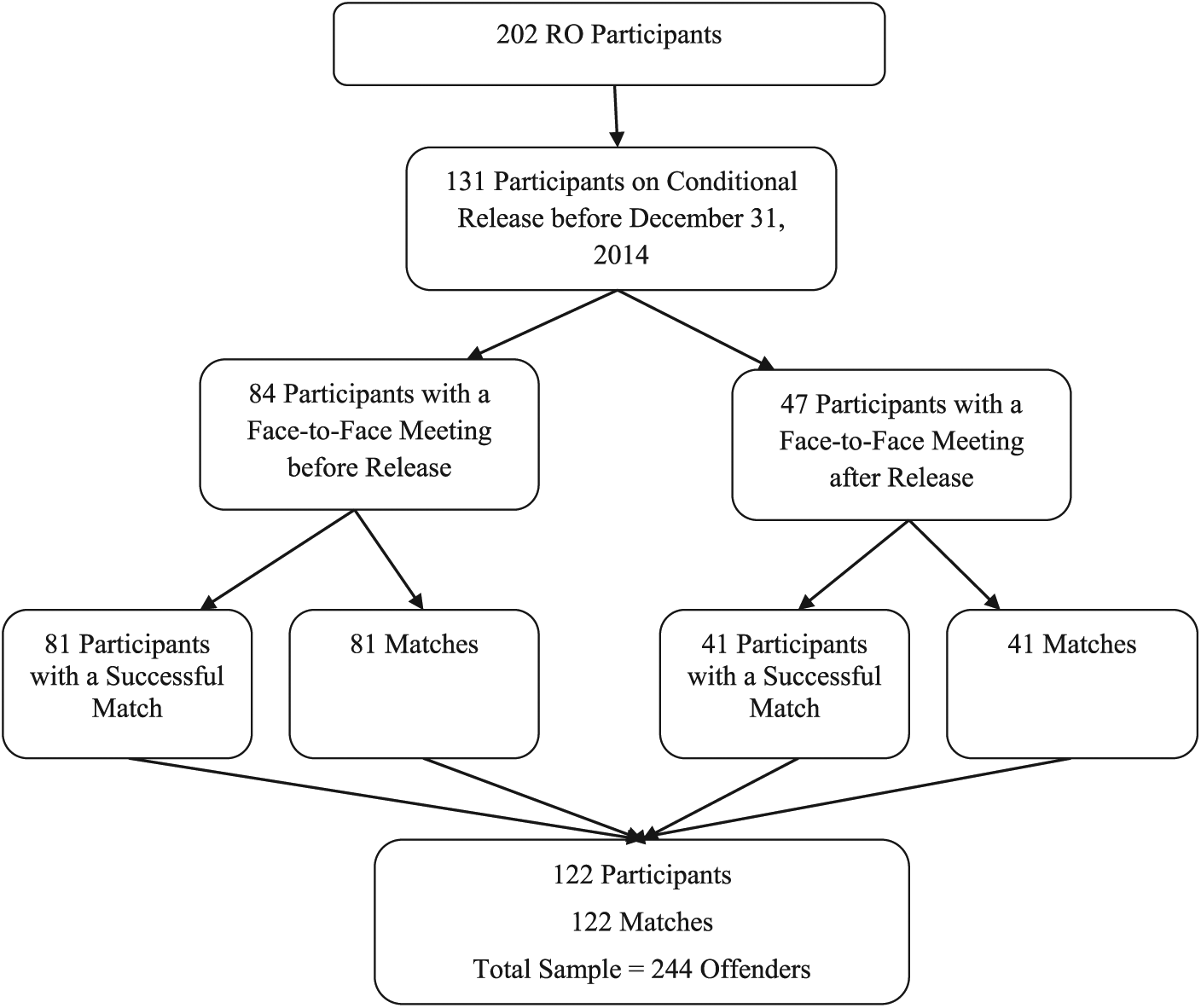
Flow of participants and matches.
Measures
As part of a comprehensive offender intake assessment, the Dynamic Factors Identification and Analysis (DFIA) assessment assesses dynamic need level for all offenders at intake (CSC, 2017). The current version of the DFIA, the Dynamic Factors Identification and Analysis–Revised (DFIA-R), consists of 100 indicator items, organized into seven criminogenic need domains: employment, marital/family, associates/social interaction, substance abuse, community functioning, personal/emotional orientation, and attitude. The trained parole officer rates each domain on a 4- to 5-point scale (factor seen as asset, no immediate need for improvement, low need, some need for improvement, or considerable need for improvement; some domains do not have the first rating option; the substance abuse and personal emotions domains only have four rating levels). After scoring the indicators as present or not present the officer makes an overall judgement of the level of dynamic need (low, moderate, or high) based on structured professional judgement. The Static Factors Analysis (SFA; CSC, 2017) is a 137-item scale design to assess criminal risk based on static (i.e., historical) risk factors for all incoming offenders. Each item is rated as “present” or “absent.” After rating all items, the officer makes an overall rating of low, moderate, or high static risk. Both the DFIA and DFIA-R and the SFA have demonstrated acceptable levels of reliability and predictive accuracy (Brown & Motiuk, 2005; Helmus & Forrester, 2014; S. Stewart et al., 2017).
Motivation to address the elements of their correctional plan is assessed at the completion of the offender intake assessment (CSC, 2017). Motivation is rated as high if the offender is self-motivated and is actively addressing problem areas, medium if the offender may not fully accept the overall assessment but will participate in recommended programs or other interventions, and low if the offender strongly rejects the need for change.
Finally, the reintegration potential rating is automatically calculated based on the results of the security classification scale, the Revised Statistical Information on Recidivism (SIR-R1; a static risk scale), and the SFA overall rating for non-Indigenous male offenders (CSC, 2017). For Indigenous offenders and women offenders, however, it is computed based on the security classification, the SFA overall rating, and the DFIA-R overall rating. Offenders are rated as low, moderate, or high reintegration potential. Offenders with low and medium reintegration potential ratings usually require correctional interventions and those with low reintegration potential require interventions as well as close supervision.
One-to-One Matching
Release outcome data were available for 122 participants; we sought to eliminate bias through matching on key variables.
Matching is broadly defined as a statistical technique used to assess the effectiveness (or outcomes) of a treatment group to a comparable non-treatment group in the study by “balancing” the distribution of factors related to the study’s outcomes in both groups. The goal of one-to-one matching is to produce non-treatment observations similar to the group of offenders that participated in RO. Propensity score matching was considered to generate a group of matches. This method establishes matches based on the probability each potential match of being in the participant group, as predicted by the control factors and assigns matches based on the generated scores. The technique, however, does not ensure that matches have similar covariate values but rather have similar propensity scores, which some argue, can actually increase error in estimated models (see King & Neilsen, 2016).
Several variables that have shown to influence correctional outcomes were used to match offenders. These variables included (a) release type (discretionary vs. statutory release), (b) offence type (homicide, sexual offence, and other offence), (c) static risk level, (d) biological sex, (e) Aboriginal (Indigenous) ancestry, (f) criminogenic need level (i.e., dynamic risk), (g) sentence length, (h) motivation level, (i) reintegration potential, and (j) time spent in the community after release (only for participants with a face-to-face meeting after their release date). Demographic, sentence, and offence information on all participants were obtained from the Offender Management System (OMS) databases, an automated electronic database, used by CSC to manage file information on all federal offenders.
Based on the information extracted, the pool of potential matches was restricted to correspond to the limits imposed by the participants (e.g., offence type, age, and admission dates of matches were all within the range set by participants). After restricting the sample of potential matches, with regard to admission date, release date, and type of offence, 152,360 offenders formed the pool from which one-to-one matching was conducted. In cases where a potential match had served multiple terms, a term was chosen at random to further restrict the pool.
Data extraction and analyses were conducted separately for the groups that participated in the sessions in the institutions and those who participated in the community to determine whether time of meeting had an impact on release outcomes. The demographic information of participants and matches and the results are, therefore, disaggregated by group.
Participants
CSC is the national agency that administers the sentences of men and women receiving sentences from the courts of 2 years or more. These offenders tend to have previous histories of criminal activity and/or to have committed serious crimes.
The study participants were 122 offenders who had taken part in RO and 122 matched offenders, for a total sample of 244 offenders. All participants had been, or were currently, under supervision in the community prior to December 31, 2014. The majority of participants and matches were men, single, and were assessed at high static risk and high dynamic risk (i.e., criminogenic need level; see Table 1). Unsurprisingly, due to matching, there were very few differences between the demographic profiles of participants and matches (see Table 1). No statistically significant differences were noted between participants and non-participants on key variables including age (34 years vs. 35 years, respectively).
Profile of Participants and Matched Offenders.
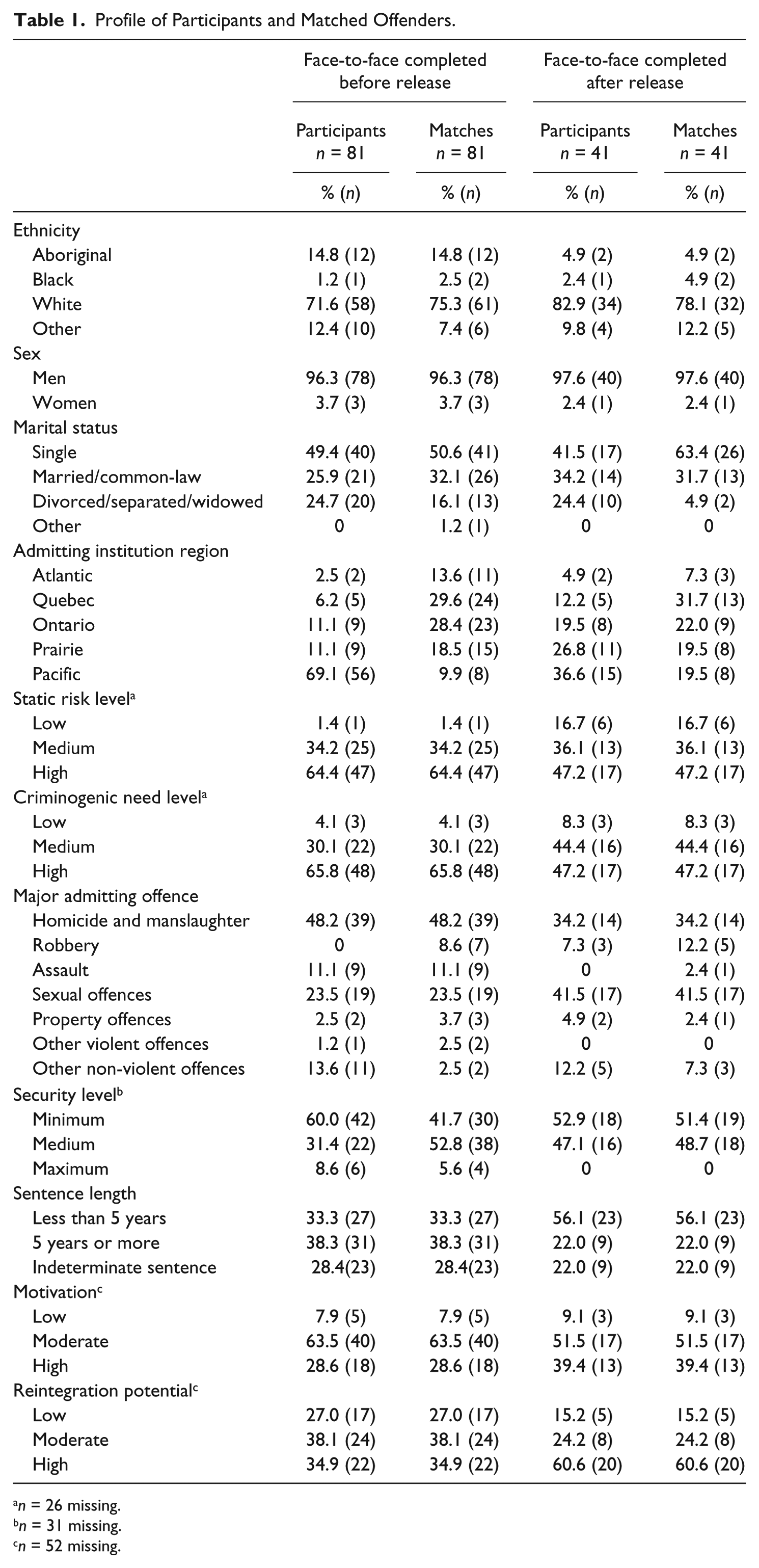
n = 26 missing.
n = 31 missing.
n = 52 missing.
RO Program
The RO program in CSC is victim focused and offender sensitive, and founded on the principles and values of RJ. Victims are given a chance to communicate, either directly or indirectly, with the offender. The program offers various VOM processes, suited to the needs of the participants and facilitated by professional mediators. Some of the processes include written correspondence, video messages, face-to-face meetings, circle processes, and shuttle mediations.
Referrals can be initiated by victims, institutions, or community parole offices. All referrals undergo an initial assessment by the RJ Unit. Assessments include a file review and discussions with the referral agent. Ongoing assessments are also completed by the mediator throughout the process. If the request is within the program’s mandate, a mediator is assigned to the file. Mediators are professionally trained community-based facilitators providing specialized VOM services for CSC.
The mediator will meet with the person who initiated the request to discuss the program and their motivations to participate. Only when it is determined that the request could potentially move toward a facilitate dialogue does the mediator contact the other party to gauge their interest and capacity to participate. In cases of institutional or community referrals, victims are contacted through a safe third party, for example, a CSC Victim Services Officer. The program has no timelines and participation is confidential and voluntary. Participants, as well as the mediators, can decide at any time to postpone or end the process.
If all parties agree to a facilitated dialogue, the mediator continues to meet with the participants separately throughout the preparation phase and engage in in-depth discussions about the offence and the harms caused, and explore themes such as trauma, accountability, victim empathy, victimization, transformation, individual needs, and safety. During those meetings, the participants and the mediators will decide on the type of dialogue that will best suit their needs. Should they agree on a face-to-face meeting, those can take place in a private area of the institution or in the community with offenders on conditional release. After all VOM processes, individual debriefings with both the victims and offenders take place along with any required follow-up by the mediator.
Analytic Approach
Descriptive and inferential statistics were used to analyze outcomes. Chi-square analyses were performed to assess differences between participants and non-participants on time spent in the community before revocation. Two Kaplan–Meier survival analyses were conducted to compare rates of revocation for offenders who participated in RO to non-participants. Survival analysis is a statistical method for studying the occurrence of an event (in this case, revocation) during a specified time (in this case, time spent in the community between release and study end date or revocation; Allison, 1995). Finally, a Cox regression was used to relate the time of revocation with offenders’ participation in RO. This method produces a hazard ratio, or an estimate of the treatment/intervention effects, after adjusting for other explanatory variables. A hazard ratio is expressed as the chance of an event (revocation) occurring in a treatment group (RO participants) as a ratio of the chance of the event occurring in the comparison group (non-participants; Duerden, 2009). A difference in survival time between groups is observed if the hazard ratio is less or greater than 1.0. For example, a hazard ratio of 2.0 can be expressed as one group being twice as likely as the comparison group to experience the event.
Results
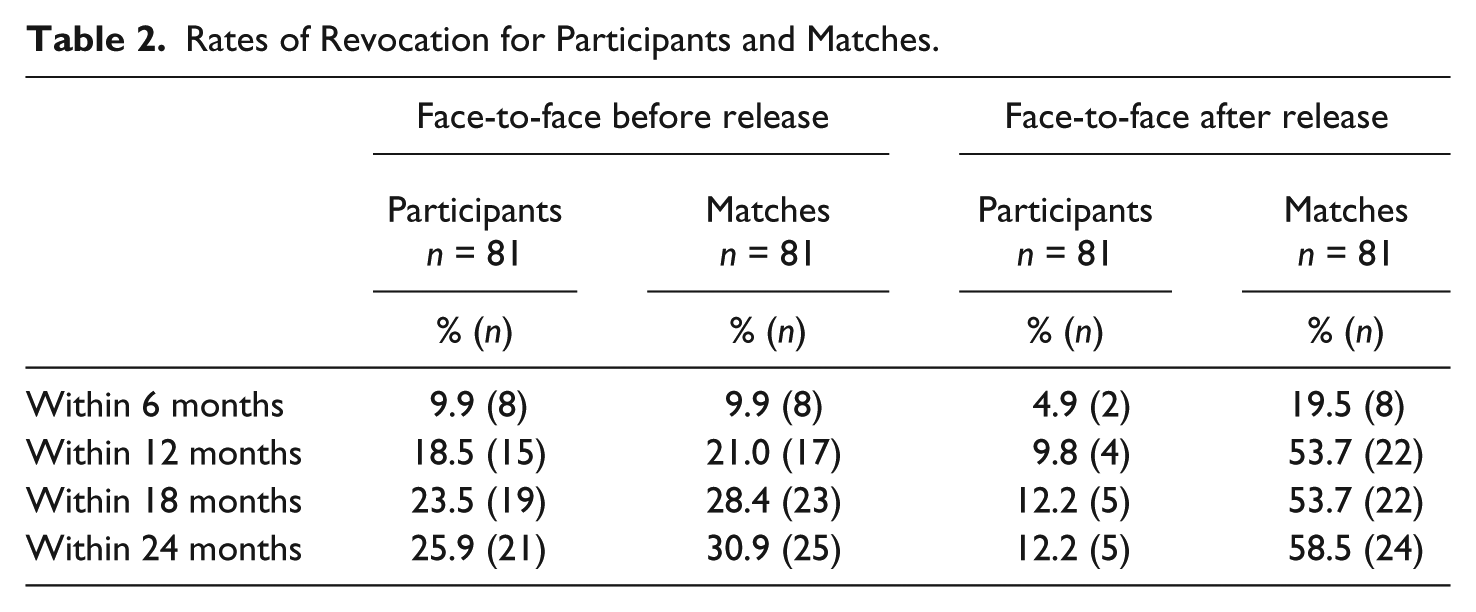
In total, there were 86 returns to custody among the 244 offenders included in the study. Of these, 30 (rate of 25%) were for RO participants and 56 (rate of 46%) were for the matched offenders. By comparison, a recent study determined that the rate of revocation on first release for offenders in CSC ranged from 24% to 56% across groups (24% for non-Aboriginal women; 54% for Aboriginal women; 36% for non-Aboriginal men, and 56% for Aboriginal men; Thompson, Forrester, & Stewart, 2015). Overall, the RO participants had significantly fewer revocations during the study period than the matched sample, χ2(1) = 12.14; p = .0005, and fewer of them returned to custody at each time point, especially for those completing their face-to-face meeting after release. A small number of participants (n = 5) and matches (n = 8) were revoked with a new offence but the majority had their conditional release revoked without an offence. Of those with a new offence, one participant and two from the comparison group returned with a violent offence and one offender from the non-participant group returned with a new sexual offence. Given the low number of reoffending events, it was only possible to examine the statisical outcome for revocations of conditional release for any reason.
The median
1
follow-up time was 487 days for participants with a facilitated face-to-face meeting before release (follow-up time ranged from 4 days to 6,641 days) and 708 days for those with a meeting post-release (follow-up time ranged from 112 days to 5,664 days). Given differences between groups on the length of time spent in the community, survival analyses were selected to examine outcomes on release. When comparing the participants and matches with a face-to-face meeting before release, although the trend was for fewer revocations among the participant group, no statistically significant differences in rate of revocation was observed (χ2 = .08; df = 1; p
Rates of Revocation for Participants and Matches.
Cox Regression Hazard Ratio by Time of Face-to-Face Meeting.
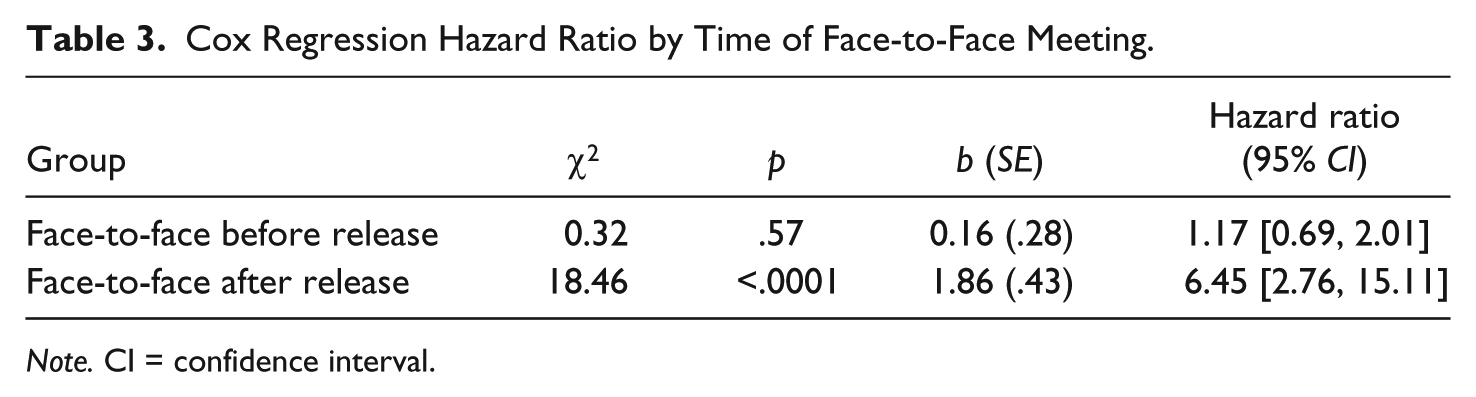
Note. CI = confidence interval.
Discussion
The popularity of RJ programs and recent changes to Canadian legislation pertaining to the rights of victims have increased the focus on efforts in Canada to deliver effective RJ-based VOM services. Likewise, the improved access and availability of RJ programs in the later stages of the system (i.e., correctional settings) has expanded, driving a demand for research in this area (Bell & Trevethan, 2003). To date, some international research has suggested that RJ approaches can produce decreased rates of recidivism in diverse offender samples and at various stages of the criminal justice system, although this was not the original or primary goal of such programs. The present study sought to establish the relationship between offender participation in the RO program administered by CSC and rates of revocation of conditional release.
The study’s main finding is the improved results for offenders who took part in RO while under conditional release. The same outcome was not found for those who had their face-to-face meeting while incarcerated. Although it should be noted that taking part in RO while in the institutions did result in improvements in recidivism rates, the result was not statistically significant.
RJ has long been promoted as a third option to traditional Western criminal proceedings and plays an important role within CSC to address the needs of victims and the community. Its primary aim is to engage victims, offenders, and the community to better understand the harms caused, and if possible, to agree to how reparation can be made. Several studies have found that reduction in recidivism could be attained through participation in RJ programs (Bergseth & Bouffard, 2012; Bonta et al., 1998; Bonta et al., 2002; Hayes & Daly, 2003, 2004; Latimer et al., 2005; Luke & Lind, 2002; Nugent et al., 2004) even if this is not a central pillar of the program. Nevertheless, reduced rates of reoffending mean fewer victims, foster stronger communities, and promote public safety.
Considerable research has focused on factors that can enhance reintegration potential for released offenders (e.g., Drake, Aos, & Miller, 2009; Wright & Cesar, 2013). Based on their early review of the research in this area, Taxman, Young, and Byrne (2004) developed a list of evidence-based principles influencing successful reintegration. Their first finding emphasized the importance of “informal social control,” that is, enlisting the help of family members, friends, and community members to support offenders and discourage them from reoffending. Taking part in a facilitated face-to-face meeting, including the one-on-one meetings leading up to the VOM, provides an opportunity for participating offenders to set meaningful goals for their release. Furthermore, voluntarily participation in a program that requires regular and sustained contact with prosocial individuals as well as exposure to several community organizations and services has the potential to assist individuals during the initial post-release reintegration process.
Participation in community-level interactions is a hallmark of successful reintegration (Wright & Cesar, 2013). In contrast, entrenchment in the criminal justice process in itself can become criminogenic. McAra and McVie (2007), for example, found that recidivism rates were higher for youth who were drawn further into the criminal justice system, a finding supporting differential association theory (Cressey, 1952; Sutherland, 1974) which posits that antisocial attitudes are learned through a social learning process involving exposure to antisocial individuals. By the same social learning process, prosocial attitudes can be learned through positive interactions with law-abiding people in the community.
The finding that post-release mediation sessions resulted in better outcomes than those held while the offenders were incarcerated is consistent with the results of meta-analyses that have shown that therapeutic interventions offered in the community are more effective than those delivered in institutions (Andrews, Bonta, & Hoge, 1990; Lipsey, 2009). In addition, face-to-face meetings in the community generally take place in a more neutral and less adversarial or punitive environment (e.g., community center, hotel meeting room, mediation office, etc.), than in visitation rooms within an institution, and may allow participants to feel more comfortable and invite more open communication. Furthermore, in CSC, offenders who take part in a community-facilitated meeting post-release are more likely to have already completed required correctional programming set out in their correctional plan than offenders who have not yet been released. Previous research has indicated that successful completion of CSC correctional programs contributes significantly to positive outcomes on release (Usher & Stewart, 2014).
Methodological Considerations
There were a number of methodological considerations and limitations that affect the interpretation of the results. First, all offenders were matched on several demographic and sentence variables resulting in very few differences between groups and, therefore, limiting the number of findings and explanations for factors that may have been related to rates of revocation and program participation. In addition, following offenders in the community restricted the sample of RO participants to only those who had been released prior to the end of the study period. In total, 202 offenders have taken part in a facilitated face-to-face meeting within the program to date; however, only 131 participants met the inclusion criteria, reducing the overall sample size and power (i.e., the ability to detect treatment effects). Although one-to-one matching was conducted, obtaining a perfect match was difficult and resulted in the exclusion of an additional nine offenders. Given the nature of the RO program, victims and offenders could initiate the process for offences that were committed decades ago. For this reason, it was not always possible to obtain data on certain offender characteristics, especially for some of the more recently implemented assessment tools (e.g., the DFIA-R component of the Offender Intake Assessment process). To circumvent these issues, offenders with missing data were matched with offenders missing the same data.
Finally, when examining the profiles of participants who took part in RO before and after release, it should be noted that we found a difference between the groups on motivation level and reintegration potential. A larger proportion of institutional participants had low or moderate motivation levels and reintegration potential than those who participated in RO in the community suggesting that the institutional sample would be less likely to succeed on release. As such, there may be a selection bias for community group membership. It should be noted, however, that there were no differences in these factors relative to participants and non-participants because of the success of the matching procedure. Nevertheless, offenders willing to be involved in RO and, in particular, offenders who initiated the process and were supported by a referral agent may be different from those who do not participate in ways we did not capture in this design. These differences could contribute to better outcomes. A more rigorous design would compare participant outcomes to those of offenders who agreed to participate or requested participation but for administrative reasons were not able to take part in the sessions. This issue may be less of a concern for this study, however, given that the majority of the sessions were victim initiated and the high level of acceptance by offenders when such sessions were offered.
Ideally, to determine whether there is in fact a qualitative difference between facilitated face-to-face meetings before or after release, a greater number of participants, particularly in the post-release group, would be needed in the sample and the follow-up period. Likewise, there was a trend suggesting that the sessions are helpful in reducing revocation for offenders who participated in the institutions, but it was not statistically reliable. Rates of revocation were low, thereby reducing statistical power. To produce clearer results for this aspect of the program, a larger sample followed for a longer period of time in the community would be required.
Future research should also consider the perspectives of victims and offenders and their response to the experience of participation in a VOM process and related meetings. This is important given a primary goal of RJ programs is to address the harms caused and to bring a greater sense of satisfaction and control to victims and the community at large. The current study focused on outcomes on release and, therefore, presents only one aspect, albeit a critical one, of the possible benefits that prior research indicates can be attained through RJ programs. Moreover, RJ approaches are holistic in nature and should be studied using a methodology that provides a more encompassing measure of participant and community impact, rather than recidivism or revocation rates alone. Although a key measure of offender success, they do not reflect other behaviours that are markers of rehabilitation and are of value to the community such as securing stable housing or employment and contributing to family life (Grattet, Lin, & Petersilia, 2011). Ultimately, to fully evaluate the effectiveness of the RO program, several other factors, including the voices of victims and offenders, should be taken into account.
Conclusion
The current study set out to establish the relationship between participation in the RO program and rates of revocation of conditional release for serious offenders. Most (73%) of the study sample included offenders who had been convicted of homicide, manslaughter, or serious sexual offences. The findings from the study demonstrated the utility of RO participation offered in the community for these higher risk offenders with histories of serious crime. Smaller benefits were evident when participants were involved in the program while incarcerated. From the point of view of policy recommendations, there is evidence that the RO approach should continue to be explored as an element in a menu of interventions for serious offenders. The intervention, however, should not be considered as an alternative to the many other programs and services available to federal offenders in Canada, but rather as an adjunct to correctional rehabilitation programs. Although results suggest that participating in a facilitated face-to-face meeting during incarceration may not significantly decrease rates of recidivism for this sample, further research exploring the impact of the sessions in this session should be undertaken before any decision would be taken to direct all the services to offenders on release. It should be cautioned as well that the positive results noted following participation in the sessions in the community may have been inflated by a selection bias that involved more offenders with a more prosocial orientation agreeing to, or requesting, participation in the mediation sessions.
Footnotes
Acknowledgements
We would like to extend our gratitude to the Restorative Justice Unit of the Correctional Service of Canada for their assistance with this project.
Authors’ Note
The views and opinions expressed in this article are those of the authors and do not necessarily reflect the policies and perspectives of the Correctional Service of Canada.
Declaration of Conflicting Interests
The author(s) declared no potential conflicts of interest with respect to the research, authorship, and/or publication of this article.
Funding
The author(s) received no financial support for the research, authorship, and/or publication of this article.