




Abstract
Evidence suggests that only a small minority of youth offenders will continue their behaviour in the longer term and largely independent of any interventions they may receive (Bateman, 2011; Haines & Case, 2015). Hence, “screening out” this larger low-risk cohort could have a positive impact upon the individual through a reduction in stigmatisation/labelling and free up resources for higher risk clients. This article outlines development of the Ceredigion Youth Screening Tool (CYSTEM)—developed and tested to address the two facets of criminality and vulnerability—closely aligned to the eight key risk indicators identified in the Risk-Needs-Responsivity (R-N-R) literature (Andrews & Bonta, 2010). Initial results with two cohorts of 372 young people indicate good convergent and discriminative validity in screening out the lowest level referrals, while also identifying 90% of potential future offenders. More importantly, CYSTEM is able to screen out approximately 35% of the low-risk offenders that are unlikely to require formal evaluation and/or intervention. It is suggested that the streamlining of this process using CYSTEM reduces demand on staff time and decreases the stigmatisation of young people referred for minor offences. Potential improvements to the tool and future developments in statistical risk prediction are also discussed.
Introduction
The predominant assessment metric currently used in Youth Justice is the ASSET system, an actuarial risk assessment protocol that evaluates a range of potential risk factors across twelve domains (Wilson & Hinks, 2011). Compiled during an interview by trained youth offending team (YOT) workers—along with access to statutory records such as Social Services registers—individuals are scored on factors such as living arrangements, substance use, attitudes to offending, and motivation to change. ASSET was recently replaced by ASSET-Plus (circa April 2016); theoretically and methodologically updated, the latter tool aims to address some of the shortcomings of the “scaled approach” (Baker, 2015; Youth Justice Board [YJB], 2013). The key revisions were designed to take ASSET-Plus into a more contextualised, holistic assessment paradigm, beyond the prescriptive scored domains of its predecessor (Almond, 2012), although notwithstanding some reservations about how this will manifest itself theoretically and practically (Bishop, 2012; Drake, Fergusson, & Briggs, 2014; Goddard & Myers, 2017; Horney, Tolan, & Weisburd, 2012).
This article outlines one such initiative—the Ceredigion Youth Screening Tool (CYSTEM)—which is being used to “screen out” low-risk referrals to youth justice services with the aim of diverting young people from formal interventions and reducing caseloads. The creation of this tool was motivated by the need to allocate resources more effectively; using a simple six-item checklist, approximately 30% of referrals can be provided with a “light touch” supervision approach without the need for a full risk assessment. Hence, CYSTEM sits procedurally before ASSET in that it will identify and “disconnect” those young people from the formal assessment and/or intervention process. The article outlines the testing and validation stages of CYSTEM and the expected utility of this tool in managing caseloads.
Historically, youth justice has reacted to differing emphasis upon the way young people interact with society; this is particularly pertinent to the response to antisocial and/or criminal behaviour (Kelly, 2012; Newburn, 2007; Rock, 2007). The identification and management of risk in young people have sought to identify factors (risk and protective) which allow predictions on later behaviour(s) (see Armstrong et al., 2005; YJB, 2001). Recent proposals, such as “Positive Youth Justice” have potential to change the youth justice system by allowing diversionary practices to take into account “developmental stressors” within the overall framework of youth work generally (Haines & Case, 2015). CYSTEM was largely developed in response to changing levels of service provision in Youth Justice and through the recognition that the majority of service users were very low risk. In essence, the screening tool identifies a number of personal and situational factors to differentiate the cohort in terms of service requirements; it is used to screen out the likely low-risk offenders, and little or no further evaluation (e.g., ASSET) and/or interventions are targeted at these young people. How best respond to youth crime/antisocial behaviour is twofold: First, creating a supportive and positive long-term environment for individuals most in need (risk; see Haines & Case, 2015; Kelly, 2012), and second, managing and targeting increasingly scarce resources at those most in need and likely to benefit (needs-responsivity; see Andrews & Bonta, 2010; Grieger & Hosser, 2014).
Theoretical Development of the CYSTEM
One of the biggest recent “success” stories in Criminal Justice has been the general downward trajectory of recorded crime since the late 1980s. Yet, although adult offending categories have experienced some levelling off, crime committed by young people in England and Wales has continued to fall by over 54% since 2005 (Howard League for Penal Reform, 2015). In some U.K. regions, for example, Ceredigion in mid-Wales, this reduction is nearly 70%. Youth justice policy and practice has undoubtedly had a significant impact: The increased understandings of youth crime trajectories, systematic case management, and diversionary policies have been proven to reduce offending behaviour by juveniles (Hendrick, 2015; H. A. Wilson & Hoge, 2013). However, evidence suggests that one of the most robust predictors of later adult offending is an involvement with Youth Justice services (Farrington, 2003; Gendreau, Little, & Goggin, 1996).
Much of the literature on the assessment of risk of offending (ROF), recidivism, and intervention/management is based on the Risk-Needs-Responsivity (RNR) principles, outlined by Andrews et al. (1990), and reviewed by Andrews and Bonta (2010). Risk is most closely linked to aligning the most intensive interventions to the offenders with the greatest need (or highest risk). The element, most central to the current discussion is Needs; the “Central Eight” indicators identified by Andrews and Bonta include antisocial attitudes, antisocial/criminal associates, previous criminal history, individual differences in antisocial personality features (e.g., impulsivity), substance abuse, dysfunctional family life, educational problems, and lack of pro-social leisure activities (e.g., sports clubs). These eight factors have been reliably shown to predict the preponderance of offending by young people (Grieger & Hosser, 2014; Lipsey & Derzon, 1998; Tong & Farrington, 2006). With the exception of prior criminal history, these indicators are dynamic (subject to change) and where interventions can be targeted, that is, prioritising the factors most likely to influence future criminal behaviour (Helmond, Overbeek, Brugman, & Gibbs, 2015). Responsivity is explained by assessing how demographic characteristics (including not only age, but also social class, gender, and individual differences, such as intelligence) can influence the impact of an intervention (Bergseth & Bouffard, 2013; Lösel & Farrington, 2012).
The theoretical basis for CYSTEM reflects on these key eight factors alongside a number of established psychological and criminological concepts. Specifically, it serves to recognise the coexisting elements of Criminality and Vulnerability. The first—criminality—is grounded within the issue of pro-criminal attitudes and antisocial behaviour; the source of these attitudes is manifested predominantly in peer relationships and family background (Granic & Butler, 1998; Liau, Barriga, & Gibbs, 1998; Wallinius, Johansson, Larden, & Dernevik, 2011). Wider criminological theories, such as Differential Association (Burgess & Akers, 1966; Rock, 2007; Sutherland, 1974), propose that criminal tendencies and pro-criminal attitudes are both created and maintained by association with deviant subcultures (Shapland, Bottoms, & Muir, 2012). In the early years, the family is a key source of these attitudes, and later the community and peers also exert an influence. A significant amount of research has been expended upon the family unit as a source of criminogenic behaviour (Kazemian, 2007). At a broad level, the early work of Hirschi (1969) identified that children with strong family ties were less likely to be delinquent by age 15. Subsequently, the development of criminal behaviour(s) often begins in the home, with twin and adoption studies illustrating the extent to which criminal behaviour can be due to an interaction between genetics factors and environment (Bonta, Law, & Hanson, 1998; Donker, Smeenk, van der Laan, & Verhulst, 2003).
Peer relationship too can be manifested into externalising problem behaviours (Rokach, 2000). Peer rejection can evoke aggressive reactions and additional developmental problems, such as truancy (Brendgen, Vitaro, Bukowski, Doyle, & Markiewicz, 2001). More severe cases can lead to early-onset conduct disorder and general delinquency (Miller-Johnson, Coie, Maumary-Gremaud, & Bierman, 2002). However, despite the importance of family and peer relationships in “developing” (or reducing) the onset of deviant behaviour, longitudinal data (see Moffitt & Caspi, 2001) suggest that individual differences (e.g., impulsivity, low IQ) were more predictive of the maintenance of criminal behaviour. Hence, the scope to address dysfunctional parenting and associations with delinquent peers for those without sociocognitive deficiencies remains promising.
Secondly, vulnerability and welfare problems associated with parental practices and home life can also impact upon childhood problem behaviours. Lack of supervision, harsh and inconsistent punishment, and attachment problems have shown consistent relationships with delinquent behaviours (Tremblay & LeMarquand, 2001). The actual victimisation of young people is one of the key indicators for later adult criminality, particularly interpersonal aggression which is manifested from within a “cycle of violence” that is also applicable to many sexual offences (Loeber & Farrington, 2012; Widom & Maxfield, 2001). Reviews of the wider evidence of the impact of child maltreatment have concluded that there are psychobiological consequences exhibited as “environmentally induced developmental disorders” (De Bellis, 2001). These can lead to low IQ (particularly delayed language development), exclusion from school, and emotional/mental health problems (Moffit, 1993). Young children (aged 7-12) that have been the victims of abuse are 2 to 3 times more likely to become chronic adult offenders that those having began offending in their teens (Loeber & Farrington, 2012). In essence, offending and antisocial behaviour can serve almost as a “proxy” measure for the identification of vulnerable young people requiring interventions.
Diversion and Labelling
Alongside criminality and vulnerability, the issue of labelling and diversionary practices also features in the aetiology of CYSTEM. Negative reinforces—particularly when unjustified or overly severe—can guide individuals to “adopt” certain ways of behaving in response to these perceived labels they have attached to themselves (Kurlychek, Brame, & Bushway, 2006). Becker (1963) suggested that these “deviant labels” become a self-fulfilling prophecy in that the individual then “plays up” to the tag with increasingly persistent deviant behaviour, thus continuing and further reinforcing the pattern. For the management of young people, these ideas on labelling have been recognised for some time (see Schur, 1973), yet have received somewhat of resurgence in recent research evaluations (see Loeber & Dishion, 1983; McAra & McVie, 2007). Wiley, Slocum, and Esbensen (2013) examined longitudinal data from a number of cities to test the deviance amplification hypothesis that being stopped or arrested by the police led to increase in later future delinquency. Their findings suggest that juveniles stopped/arrested reported higher levels of later delinquency. In addition, Wiley et al.’s findings recommend that interventions targeted at reducing the consequences of police contact (i.e., poor academic achievement, deviant identity formation, and delinquent peer associations) might also reduce the manifestation of secondary deviance (labelling).
The screening tool developed here aims to address these two linked factors: ROF and risk of vulnerability (ROV). The vast literature—briefly reviewed here—broadly suggests that children are often both perpetrators and victims of crime. For example, we may have young people witnessing and experiencing violent conduct in the home; in turn, they may model and/or express this behaviour as bullying among their peers. Similarly, criminal and antisocial behaviour among young people can be an expression of pro-criminal attitudes or the externalization of problems with family, school, peers, and so on. These issues are recognized among the majority of risk assessment models and tools; the aim of the current study is to utilize a range of these items to screen out those falling below the line of discernible risk to direct resources towards medium-high risk referrals.
Method
Sample
The total sample consists of a of 372 young people referred to the Ceredigion Youth Justice and Prevention Service over a 24-month period from April 1, 2014 to March 31, 2016. Data were collected in two stages; the first included 267 individuals up to September 31, 2015, and the additional 105 making up the full 372 total. The sample consists of 221 males and 151 females (approx. 60:40 split) and with an age range from 11 to 18. Referrals come into the team via three main routes:
Referrals for prevention services from social workers, teachers/schools, parents/carers, police, and young people themselves (known as “Preventions Referrals”). These referrals account for around two thirds of all referrals and the subjects of these referrals are considered by the referrers to be at risk of coming into contact with the police through antisocial and/or criminal behaviour.
Formal bureau referrals from the Police Force are part of the agreed criminal justice processes for young people. Bureau referrals account for approximately a quarter of all referrals. Since 2014, all young people aged 10 to 17 years, who admit responsibility for an offence that has been reported to and investigated by the police, are referred to the bureau system (provided they have not committed a serious specified offence and there is sufficient evidence to ensure realistic chance of conviction if the matter was referred to the criminal courts).
Referrals from the criminal courts (Youth Courts) account for less than a 10th of all referrals. The subjects of these referrals have been formally charged with criminal offences and referred to the criminal courts by the Crown Prosecution Service.
All Prevention and Bureau cases are formally assessed (using ASSET/ASSET-Plus); any identified as being at medium/high ROF and/or having medium/high safeguarding concerns, are then allocated to qualified staff for further assessment along with all Court referrals. 1
Procedure
Data are collected for both ASSET/ASSET-Plus alongside the additional items from CYSTEM for all referrals to the Service. Presently, the two systems (ASSET-Plus and CYSTEM) run simultaneously (see “Discussion” section for future developments).
Scale Development
At its inception, CYSTEM was perceived to be a prescreen tool that would reduce both the administrative burden and the potential for stigmatisation of the young people being referred (Farrington, 1977; H. A. Wilson & Hoge, 2013). The tool was initially informed largely by reference to existing practice inventories (predominantly ASSET), but with significant input from case managers and senior assessment staff. An initial pool of 12 items relating to both criminality and vulnerability were developed through a series of staff workshops and case management meetings (see Appendix A).
Initial analysis centred on the values assigned to the categories (i.e., intensity or level of the variable scored from 0-4) and the category boundaries for low–medium–high risk. Data were collated (Stage 1: n = 267) for the three Criminality items and the nine Vulnerability items representing the two key theoretical domains:
ROF: Three items representing criminal thoughts, antisocial attitudes, and behaviour; Scored 0-4—total out of 12; Arbitrary cutoff at 3 for medium and 6 for high risk.
ROV: Nine items indicating risk of suicide, contact with sexual/domestic violence (DV) perpetrators, records of contact with mental health, on child protection register, subject of strategy meeting, being a looked after child, not in education, employment or training (NEET)/homeless, substance misuse, reckless behaviour; Quality and extent of evidence define some variable scores; Range of scores from binary through to 0-3—total out of 12; Arbitrary cutoff at 2 for medium and 5 for high risk.
Preliminary screening of the data suggested that many of the variables from the Vulnerability items were of a very low frequency. For example, less than 3% of the sample recorded scores on Q1: Child Protection Register; similarly less than 8% scored as present on Q4: NEET/homeless. Subsequently, the vulnerability scale was reduced down from nine to three items with the low-frequency variables removed from the analysis. This left two subscales with three questions—a total of six items across the two key domains of risk of criminality and vulnerability (see Appendix B) 2 :
ROF: Q1: Criminal/antisocial thoughts Q2: Criminal/antisocial environment Q3: Criminal/antisocial behaviour
ROF: Q3: Looked after child/child in need/social service/disability Q8: Living with perpetrator of DV and/or sexual exploitation Q9: Reckless/harmful behaviour (incl. sexual)
The six items from the scale were grouped into their two respective categories: ROF and ROV. These two subscales are latent variables, measured by the three most frequent items from the main review and were assessed for invariant structure using confirmatory factor analysis (CFA). The data from the Stage 1 sample (n = 267) were analysed using Mplus 6.12 (Muthen & Muthen, 1998-2017). Because each item of the scales has a maximum score of three, robust weighted least squares estimation is used (weighted least squares with mean and variance adjustment) and scores essentially treated as binary (absent/present). Model fit was examined using the root mean squared error of approximation (RMSEA) and comparative fit index (CFI). According to Hu and Bentler (1999), RMSEA values of .06 to .08 indicate adequate fit and ≤.05 good fit (values ≥.1 poor fit). Similarly, Kline (2011) recommends CFI values of .9 and above are necessary to support models with good fit, although Marsh, Hau, and Grayson (2005) caution against overreliance on incremental fit indices when analysing item-level data. Tests for factorial invariance across gender were estimated using changes in the CFI, with deviations of ≤.01 suggestive of invariance within the model (see Cheung & Rensvold, 2002).
Results
CFA
Preliminary examination of the data from Stage 1 indicated a model with reasonably good fit to the data: There is some empirical support for the model (χ2 = 15.067, df = 8, p = .05; RMSEA = .058, 90% confidence interval [CI] = [.000, .102]; CFI = .992). Hence, the items for each domain are good predictors of the variables of ROF and ROV. The DIFFTEST procedure is used to assess structural invariance across the model for gender; both latent variances and covariances were invariant across males and females (χ2 = 12.37, p > .05) and the tool is therefore suitable for use with both genders.
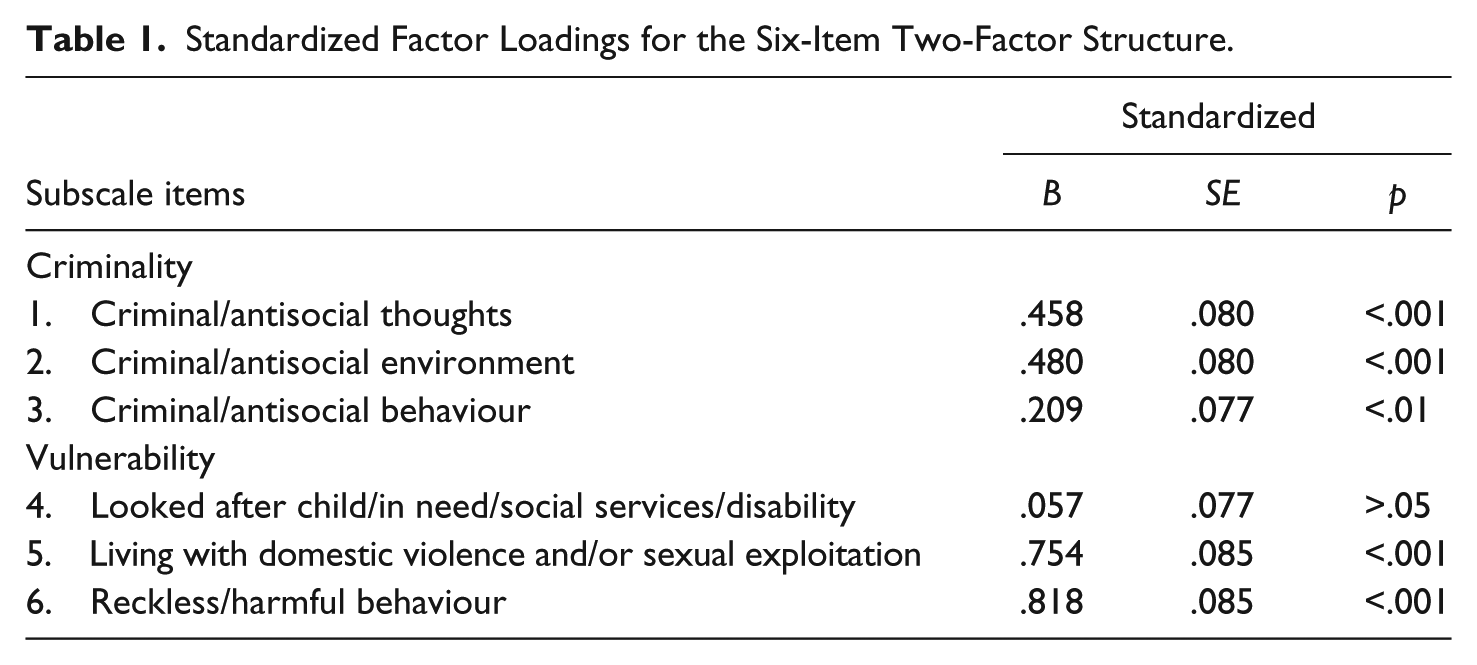
Factor loadings for the six items in the two-factor model are detailed in Table 1. Correlations between the two latent factors were .508. Only Item 4 (“looked after child/child in need/social services/disability”) was not significant.
Standardized Factor Loadings for the Six-Item Two-Factor Structure.
Sample 2: Scale Validation
To evaluate whether CYSTEM was a valid predictor of risk, a second sample of 105 young people referred to the service was tested using Sensitivity Analysis (Area Under Curve [AUC]). The outcome measure is whether the individual had gone on to offend in the following 6-month period.
Sensitivity Analysis (Area Under Curve [AUC])
Descriptive statistics indicated that a score of 1 on a binary 0-1 format would correctly identify 89% of referrals that would go on to offend (the true positives) and (incorrectly) 11% of those that would offend, but had not been identified for an intervention (the false negatives). Similarly, 66% of those selected for an intervention would not actually offend (false positives) with the remaining 34% being correctly screened out of the system (true negatives; see Table 2). Similar results for the subscales indicated a less optimum false negative rate in the identification of future offenders: ROF subscale (ROF; 25%) and ROV subscale (ROV; 29%). However, the ROF scale produced the highest number of true negatives, that is, those correctly screened out and not likely to offend, of 52% compared with 46% for the ROV. In total, CYSTEM would screen out 32% of all referrals (both later offenders and nonoffenders); the ROF in contrast screened 50:50 and the ROV screened out 45%.
Percentage of Offenders and Nonoffenders in Each Binary Group for Scale Total and Individual Subscales.
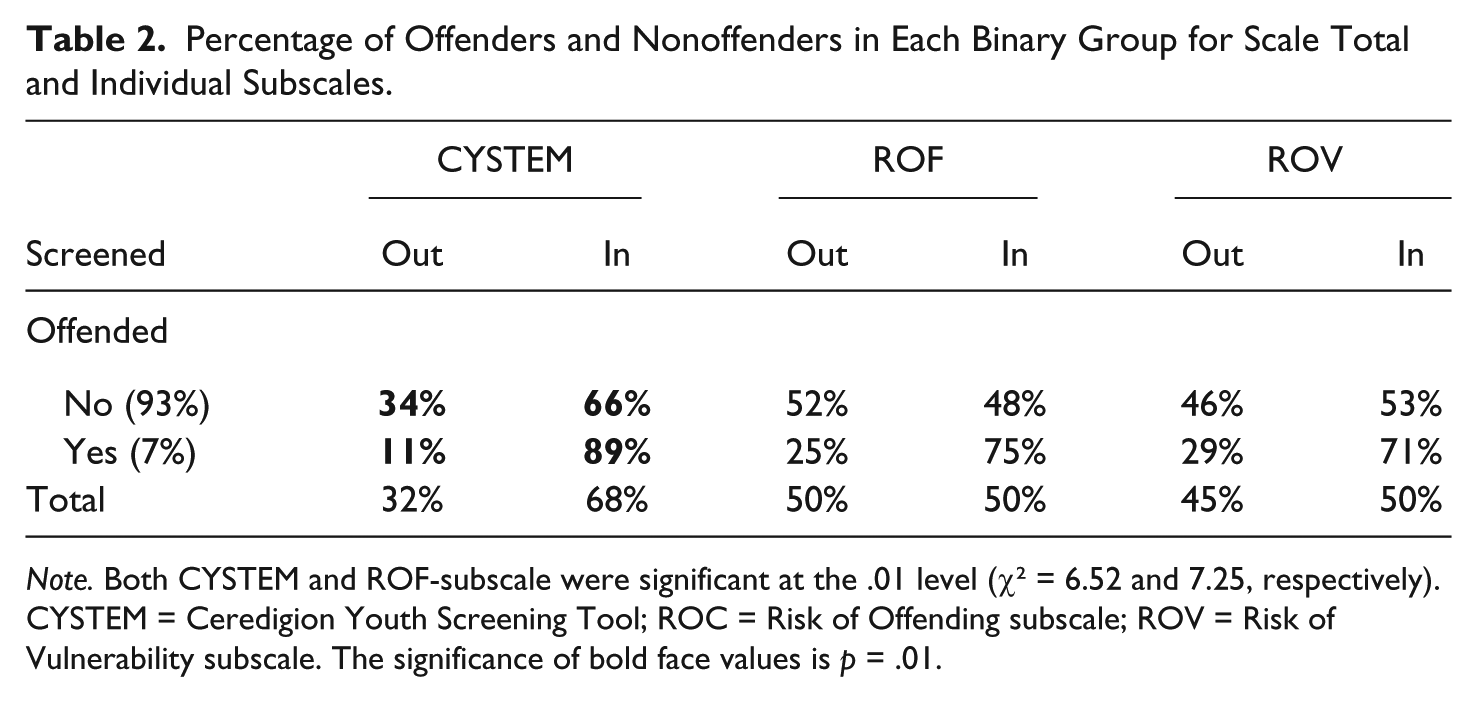
Note. Both CYSTEM and ROF-subscale were significant at the .01 level (χ² = 6.52 and 7.25, respectively). CYSTEM = Ceredigion Youth Screening Tool; ROC = Risk of Offending subscale; ROV = Risk of Vulnerability subscale.
The significance of bold face values is p = .01.
Common to all predictive tools, there is always a trade-off between specificity and sensitivity. The use of ROC analysis enables a more accurate definition of where the ideal cutoff point on each scale lies, alongside the relative ability to predict the outcome, ranging from 0.5 (no better than chance) to 1 (perfect prediction), with scores of 0.7 and above being good predictors (Swets, 1986). AUC analysis is also more robust with low-base rates than binary logistic regression making it more appropriate with the current sample (Fawcett, 2006).
Using the full ROF-ROV scale as a benchmark, the AUC was 0.645 (p = .011; 95% CI = [.549, .740]). The scale scores ranged from 0 to 3, with the optimum score being between 0.5 and 1.5. By comparison, the ONSET scale scores which were available for 80 participants in the sample, showed a comparable but not significant AUC of 0.655 (p = .078; 95% CI = [.496, .814]), with an optimum score of around 6.5. The ROF has a slightly higher AUC = 0.677 (p = .002; 95% CI = [.570, .784]) and the ROV just within significant with an AUC = 0.615 (p = .043; 95% CI = [.507, .723]). Hence, taking into account some minor variations, it appears that the optimum score for the scale total ROF-ROV is a binary 1-0 (see Appendix C, for individual AUC plots).
Rice and Harris (2005) produced an effect size rubric for forensic populations, with AUCs of between 0.56 and 0.63 representing a small effect, 0.64 and 0.70 as medium, and 0.71 and 1 as a large effect size (0.5 is the same as chance level accuracy). Hence, the ROV falls slightly below the acceptable limit and was also not significant; however, the full six items of the ROF-ROV (and the ROV subscale), meet Rice and Harris’ suggested threshold for a medium effect size relating to their power to predict outcomes. However, although these thresholds are published as a guide for estimation, Baird et al. (2013) caution on the variability of the AUC generally as a viable method to establish predictive ability in forensic samples. Hence, any expectations regarding the predictive capacity of CYSTEM would require further validations studies and suitable benchmarks (Gottfredson & Snyder, 2005).
Discussion
CYSTEM is a prescreen tool, and performs at significantly above chance in indicating those referrals for whom formal assessment and/or intervention is unlikely to be necessary. The effect size (AUC = 0.645) for the whole sample using CYSTEM was—according to Rice and Harris (2005)—medium in magnitude for a forensic sample. Comparisons with wider measures of youth risk assessment such as the Youth Assessment and Screening Instrument (YASI; Orbis Partners, 2007) recorded AUCs of 0.65. Finding the YASI as one of the top three predictive youth assessment tools,Baird et al.’s (2013) NCCD study showed these tools to have equal AUC accuracy scores (AUC = 0.68). Hence, aside from Baird et al.’s caveat regarding the utility of AUC predictions in this arena, we can be fairly confident that CYSTEM is a tool that can predict offending behaviour by young people and, arguably more importantly, has sufficient capacity to screen out those young people unlikely to require full assessment and/or formal intervention.
CYSTEM was devised to manage an increasing caseload by taking a pragmatic approach to the diversion of young people out of the formal Youth Justice system. Based upon the R-N-R literature alongside theoretical models of labelling and vulnerability, it assesses six core facets identified as predictors of later offending. The presence of one of these features during screening necessitates a formal ASSET assessment; for those identified as very low risk (i.e., not scoring on any of the key indicators), then no formal intervention is enacted. With an ASSET assessment taking upwards of 3 hr to complete, the predicted saving of over 30% of the referral caseload is considerable. Moreover, the wider evidence is that not only will it save time and costs, but also is likely to have longer term knock on effects by reducing the likelihood of this cohort encountering the Youth Justice service again in the future. For the remaining two thirds subjected to a full ASSET evaluation, only a small minority (<10%) will go on to offend; the use of CYSTEM therefore also releases resources to target those most likely to benefit from interventions (“needs-responsivity”).
Alongside the assessment of contact with the criminal justice system, CYSTEM also acts as a monitor for potential safeguarding issues. To date, this aspect of the tool has not been validated against statutory safeguarding outcomes. However, the screening questions that relate to safeguarding issues are based on concerns that should trigger further more in-depth assessments by practitioners to safeguard young people. Safeguarding concerns by the tool are rated present/absent. The screening process requires the practitioner to interrogate the YJPS and Ceredigion Social Services databases and access partners to carry out checks on the Local Education Authority, Police, Careers Wales, and CAMHS systems. Screening one referral takes around 30 min compared with 3 to 5 hr for an ASSET evaluation and 10 to 12 for a full assessment (Wilson & Hinks, 2011).
Evidence suggests that most young people who enter the criminal justice system do not go on to reoffend within 12 months whether or not they receive a formal intervention to try to reduce their ROF. Around 60% of preventions and bureau referrals are screened as low risk with no safeguarding concerns. Where further assessment indicates medium or high risks, young people are offered a tailored intervention package aimed at reducing risks. The intervention package is directly based on the ASSET assessment and targets specific dynamic risk factors that have been identified. Future refinement of CYSTEM should examine, in more detail, the impact of Item 4 (ROV4: looked after child/child in need/social service/disability), which was nonsignificant in the factor loading in the CFA. Potentially moving to a two-item factor of Vulnerability, however, is problematic in that it oversimplifies the practical nature of the screening tool. In some respects, the AUC of CYSTEM is improved slightly (from 0.655 to 0.677) by the removal of all the Vulnerability items. However, both are within the medium category in their effect sizes. More importantly, the presence of any of the vulnerability items requires statutory investigation under U.K. child welfare legislation. In addition, the sample drawn to validate this measure was from a predominantly rural location with relatively low levels of crime. The screening tool therefore may be more relevant to assess recidivism rates for similar contexts and low-base rate samples. Wider caveats regarding the use of risk assessment tools in predicting offending behaviour are also accepted (Gottfredson & Moriarty, 2006).
Conclusion
Utilising CFA, a theoretical model of youth offending risk was tested; results indicated that six items representing two separate latent variables of Criminality and Vulnerability was retained as an acceptable structure. Sensitivity analysis (AUC) indicated that there was a moderate level of predictive capacity in being able to identify the likely future offenders from the nonoffenders. In this domain, the screening tool showed comparable discriminant validity as similar tools. The key advantages of CYSTEM presented here relate to its relative ease of use, that is, six binary-scored unweighted items, which is important in respects to the key developmental aims of reducing staff time. As well as correctly identifying nearly 90% of the later offenders in the sample, CYSTEM manages to screen out approximately 35% of those young people unlikely to later offend and subsequently require any formal intervention. This achieves the key aims of reducing the demand for resources while also keeping young people outside of the criminal justice system.
Footnotes
Appendix A
Appendix B
Appendix C
Declaration of Conflicting Interests
The author(s) declared no potential conflicts of interest with respect to the research, authorship, and/or publication of this article.
Funding
The author(s) received no financial support for the research, authorship, and/or publication of this article.