



Abstract
Restitution to victims is rarely paid in full. One reason for low rates of payments is that offenders lack financial resources. Beyond ability to pay, however, we argue that fair treatment has implications for offender behavior. This study, a survey of probationers who owed restitution, investigated the links between (a) ability to pay, (b) beliefs about restitution and the criminal justice system, and (c) restitution payment, both the amount paid and number of payments. Results indicate that perceived fair treatment by probation staff—those most directly involved with the collection of restitution payments—was significantly associated with greater payment, net of past payment behavior, intention to pay, and ability to pay. Because restitution has potentially rehabilitative aspects if offenders pay more of the court-ordered amount and if they make regular monthly payments, how fairly probation staff treat probationers has implications for both victims and for the criminal justice system.
The regular payment of restitution promotes both responsibility and a sense of accomplishment and is, therefore, one way by which offenders can be reintegrated into the community (Haynes, Cares, & Ruback, 2014). Because offenders know that at least part of the monthly payments they make are earmarked for their victims, their regular payments can serve to restore justice both with the victim and with society. Moreover, the payment of restitution can reduce recidivism for both juveniles (Butts & Snyder, 1992; Farrington & Welsh, 2005; Haynes et al., 2014) and adults (Heinz, Galaway, & Hudson, 1976; Outlaw & Ruback, 1999), consistent with the theoretical work on restorative justice (Sherman, 1993) and reintegrative shaming (Braithwaite, 1989). Consequently, restitution has been touted as a “promising practice in restorative justice” by the National Institute of Justice (2007).
Despite this high promise, however, most court-ordered restitution is not paid (for an overview, see, for example, Davis, Smith, & Hillenbrand, 1991; National Center for Victims of Crime, 2011). Given the consequent unfulfilled benefits, there is a need to investigate why offenders do not pay restitution.
Probationers’ payment behavior depends on personal factors (beliefs, attitudes, and financial resources) and situational factors, including how they are treated by others. For the most part, studies have focused on the former factors and have found that offenders with less income and those who were unwilling to pay were unlikely to make payments (Hillsman, Mahoney, Cole, & Auchter, 1987; Hudson, Galaway, & Chesney, 1976). As Dickman (2009) noted, “the foremost reason for the nonpayment of criminal economic sanctions is the offender’s inability to pay them” (p. 1695). Given that about half of jail inmates made less than US$600 in the month prior to incarceration (Dickman, 2009), it should not be surprising that restitution compliance is a low priority for many offenders.
However, distributive fairness—how restitution is imposed across cases and whether it is done with regard to an offender’s ability to pay—is only one aspect of the payment puzzle. Procedural fairness—how offenders are treated by criminal justice system personnel—may also affect payment. In addition to classic indicators of restitution payment such as willingness and ability to pay, we investigate the payment and nonpayment of restitution in terms of fair treatment by probation staff in a sample of 144 probationers with active restitution orders.
Procedural Justice and Human Behavior
Individuals who are treated fairly by authorities are more likely to believe that they are valued members of society and more likely to obey the law because they believe it is the right thing to do (Tyler, 2006). In the criminal justice system, offenders who are treated fairly are more likely to follow rules and comply with orders (Jackson et al., 2012). This willingness to comply has widely been supported by research on individuals’ interactions with the police (Slocum, Wiley, & Esbensen, 2016), courts (Kaiser & Holtfreter, 2016), prisons (Beijersbergen, Dirkzwager, & Nieuwbeerta, 2016), and university-based sanctions (Reisig & Bain, 2016). For example, inmates who feel that they are treated fairly are less likely to behave disruptively (Sparks, Bottoms, & Hay, 1996). Thus, if offenders believe that the criminal justice system is legitimate and that they need to repair the harm they have caused, they may be less likely to commit a new crime and more likely to comply with the conditions of their sentence, including paying the amounts they owe to victims and the state.
If offenders believe that they are treated fairly by probation officers and if probation officers are perceived to be legitimate, offenders may be more likely to make the restitution payments they owe. Offenders who believe in the fairness of victim restitution and criminal justice processing should be most likely to pay their restitution, because individuals who have derived benefits from complying with the law in the past, such as fair treatment by criminal justice officials (Lind & Tyler, 1988), are more likely both to view compliance with the law favorably and to comply with the law in the future. Consistent with that rationale, there is some evidence that payment rates are higher when probation officers, rather than special collections units, are in charge of collecting payments (Ruback, Shaffer, & Logue, 2004). Individuals who believe that they are treated fairly and that probation staff are effective in their duties should feel morally obligated and should be more likely to comply with restitution orders (i.e., make payments).
Threats to the Fair Treatment–Payment Relationship
Offenders generally perceive economic sanctions to be a severe punishment, primarily because they have few legitimate sources of income. For example, McClelland and Alpert (1985) and Apospori and Alpert (1993) found that recent arrestees believed a US$5,000 fine was about as severe as spending a year in jail. In one survey of offenders, two thirds of the respondents said it was difficult for them to pay their sanctions due to income-related reasons (Ruback, Hoskins, Cares, & Feldmeyer, 2006). In addition, sanctions tend to disproportionately affect poor and minority offenders by further decreasing their limited financial power (Harris, Evans, & Beckett, 2010).
For these reasons, several scholars argue that the current system of economic sanctions—particularly fees, fines, and other court-related costs—represents impractical public policy (Beckett & Harris, 2011; Harris et al., 2010; Harris, Evans, & Beckett, 2011). Unlike compliance with police officer requests, which typically does not involve monetary loss by the participant, restitution compliance involves the payment of economic sanctions when the participant may not have the ability to do so. To address nonpayment due to inability to pay, several European countries use a sliding scale system known as day fines, whereby economic sanctions are progressively based on the ability of offenders to pay the sanctions, similar to an income tax (Hillsman, 1989).
However, restitution, which is intended to recompense victims for the harm suffered rather than recoup administrative costs for the criminal justice system, operates differently. For example, in some U.S. jurisdictions, an offender’s ability to pay may be considered in restitution imposition decisions, but in Pennsylvania, restitution must be ordered in full “regardless of the current financial resources of the defendant, so as to provide the victim with the fullest compensation for the loss” (18 Pa. C.S.A. § 1106). Therefore, the biggest threat to the link between procedural fairness and payment, particularly in places such as Pennsylvania, may be the inability of offenders to comply with court-mandated restitution orders.
As noted, paying restitution can increase the likelihood that an offender will successfully desist from crime. Inability to pay is perhaps the single most important factor that could block payment and, by extension, desistance. In addition to an inability to pay, there are differences among offenders in terms of how open they are to treatment, that is, how “‘ready’ they are to engage in a change process” (Casey, Day, Howells, & Ward, 2007, p. 1428). One aspect of treatment readiness is self-blame or acceptance of responsibility for the harm caused by a crime (Day et al., 2009). Individuals who express more self-blame and remorse for their actions are more likely to engage in treatment programs and should similarly be more likely to pay a greater amount of restitution.
Alternatively, there is the possibility, derived from Martin Seligman’s work on self-blame and attributional styles (Buchanan & Seligman, 2013; Peterson, Schwartz, & Seligman, 1981), that self-blame may be counterproductive. Characterological self-blame is related to self-esteem, unmodifiable personal traits (i.e., personality and character), and a perceived deservingness for past negative events. Individuals who blame themselves based on characterological flaws are more likely to exhibit symptoms of depression (Peterson et al., 1981). Thus, individuals who blame themselves for their offending because they believe they are “bad people” may be less likely to pay, because payment serves as a reminder that their offending is the result of immutable personal characteristics.
The Present Study
This study is a survey of probationers in one county in Pennsylvania who were ordered to pay restitution. All 775 individuals who owed restitution had been placed on a list because of nonpayment, and had been participants in an experiment examining the effects of providing information about amounts owed and paid and a rationale for payment on restitution payments (Ruback, Gladfelter, & Lantz, 2014). The 775 cases are exhaustive of all delinquent probationers, defined as having made no restitution payments for at least 3 months, in the county at the time the list was generated. Payments were tracked over a 12-month period.
This study examines characteristics of the offenders who owed restitution, the restitution they were ordered to pay, and their treatment by probation officers. In particular, we are interested in understanding whether, as in studies of interactions with other components of the criminal justice system, offenders who perceived fair treatment by probation officers were more likely to comply with the conditions of their restitution order, that is, pay more of the court-ordered amount. In doing so, we account for possible alternative explanations for payment, including ability to pay, self-blame, and other attitudes and behaviors.
In addition, past research suggests that individuals who are treated fairly may alter both the prevalence and frequency of behavior. For example, Paternoster, Brame, Bachman, and Sherman (1997) found that, among individuals who had been arrested for domestic assault, procedurally fair treatment by police reduced the incidence of subsequent domestic assault. Therefore, in addition to paying more of the raw dollar amount of restitution owed, we suspected that offenders who perceived fair treatment from probation staff would be more likely to make a greater number of monthly payments. The logic behind requiring continual payments across time is that they force the offender to recognize the harm caused by the crime and to assume personal responsibility for both causing and correcting that harm. If procedural justice leads to more of those internalized attitudes, then we would expect more procedural justice would lead to more frequent payments.
From the above, we derived two specific hypotheses for this study:
Restitution in Pennsylvania
Because policies and practices related to restitution imposition and payment are so varied across jurisdictions (Haynes, Cares, & Ruback, 2015), it is important to provide a brief contextual discussion of restitution practices in Pennsylvania. The defendant’s ability to pay is not a consideration when deciding whether and how much restitution to impose (Ruback, Ruth, & Shaffer, 2005). Restitution is mandated by law in all eligible cases, which are cases where a quantifiable loss or harm was suffered by an identifiable party, including a person, business, or insurance company. However, restitution is ordered only in about two thirds of eligible cases despite the legal mandate. In terms of payment, about half of cases receive no restitution and about a quarter receive payment in full.
Any and all restitution paid goes to the specific victim(s) listed in the case (Ruback et al., 2005). Offenders are also required to pay US$60 into a general victim fund, but this amount is listed as a “fee” that is separate from the ordered restitution amount. That is, 100% of any restitution paid goes to the victim of the crime. It follows that offenders’ attitudes about the payment of restitution reflect payments to the victim(s) in their cases rather than payment to some amorphous class of victims more generally.
Method
Prior Experiment
Ruback et al. (2014) tested the effect of sending letters to probationers on restitution payment. The population of current and former probationers who still owed restitution and who were delinquent on payments were randomly assigned to one of four conditions. The first condition received letters that provided information about the amount of restitution ordered by the court, the amount that had been paid up to the point that the letter was mailed, and the amount that still had to be paid. Probationers in the second condition received letters that provided a justification or rationale for payment (e.g., it helps victims). The third condition combined both information and rationale for payment into a single letter. The control condition received no letters. Letters were mailed monthly for 6 months, and any payments were recorded both between letters and after the mailings ceased. Results indicated that probationers who received informational letters, compared with the other three conditions, paid both more restitution and made more payments during the observational follow-up period.
Sample and Procedure
All participants who were enrolled in the prior experiment were solicited for participation in a follow-up survey (N = 775). To maximize the number of respondents, we used the Dillman (2007) survey method, which involved up to four mailings: (a) an initial contact letter briefly describing the study; (b) a survey with a one-dollar incentive attached; and, if necessary, (c) two follow-up surveys.
Of the 775 experimental participants, 530 (68%) were successfully contacted during the follow-up period with the remainder returned undeliverable, usually because the participant changed addresses. A total of 149 respondents (19% of the total; 28% of those located) completed the survey: 101 returned the first survey, 29 returned the second survey, and 19 returned the final survey. Given the transient nature of the population, the response rate is consistent with other surveys of offenders (Ruback et al., 2006; Wetzel & Lowenkamp, 2011). The survey, which took about 30 min to complete, consisted of a battery of questions spanning several topics. Respondents were mailed a US$20 Walmart gift card upon completion.
Five months after the survey, participants received a debriefing letter about the combined experiment and survey research and were informed that they could withdraw their data if they wished. Four respondents chose to withdraw their data and were eliminated from the data files.
Multiple Imputation, Survey Weighting, Data Quality, and Consent
Because of missing data, data presented in this article were subjected to multiple imputation. 1 Consistent with recent guidelines, we followed a series of design decisions for the imputation process: (a) all available measures were used as predictors in the imputation models, including the dependent variables, and a large number of datasets (M = 40) were imputed (Graham, 2009; White, Royston, & Wood, 2011); (b) values for categorical and ordinal variables were not rounded post-imputation, as doing so would bias the results (Wu, Jia, & Enders, 2015); and (c) no skewed variables were transformed prior to imputation (Graham, 2009). In addition, we constructed scales after imputing scores on the component items rather than the reverse.
Furthermore, data were adjusted for survey nonresponse (Grau, Potter, Williams, & Diaz-Tena, 2006). First, we ran a logistic model predicting the odds that a respondent could be located (i.e., a letter was not returned as undeliverable) based on available information (age, gender, race, and case characteristics). Next, given that a respondent could be located, we predicted the odds that a respondent would return a completed survey. Finally, we multiplied the two inverse probability weights together to create an overall weight. The weights used in all analyses represent the combined location and completion weights.
In addition, four respondents chose to remove themselves from the study, and we withdrew another case that was determined to be an extremely influential outlier (amount of restitution paid in excess of US$30,000). The final sample is 144 of the 149 participants who completed the survey.
Measures
In the following section, we describe only the measures directly examined in the present study. For composite measures, all indices represent the mean of component items unless specified otherwise, with items reverse-scored when appropriate. To our knowledge, Stata currently lacks the facilities to conduct principal components analysis on multiply-imputed data. Therefore, we were constrained to additive scales and relied on reliability coefficients for their construction.
Dependent Variables
We examined two dependent variables drawn from each respondent’s court case files: the amount of restitution paid and the number of months for which restitution payments were made. In Pennsylvania, all case information is public record and freely accessible on the Internet (via https://ujsportal.pacourts.us/).
Amount paid
The amount paid represents the total sum of restitution, in dollars, paid by the probationer during the 12-month span for which we tracked payments. This period covers the entire duration of the experiment and 6 months afterward (3 months preceding the survey). Payments ranged from US$0 to US$5,195, with US$0 being the modal category (30%). The average amount paid over the 12-month period was US$184. In comparison with the amount of restitution actually paid by respondents, the average amount of court-ordered restitution that respondents were mandated to pay was US$3,334.
Number of months paid
As part of the experiment, we collected payment information monthly for 6 months as well as at 3 and 6 months after the experiment ended. The maximum number of payment periods is, therefore, eight. On average, respondents made 2.3 payments; the modal category was 0 (30%).
Independent Variables
Our primary independent variable reflects procedural justice, or fair treatment by probation officers. We adapted five items from Jackson et al.’s (2012) survey. The original items measured beliefs about police, which we modified to reflect beliefs about the extent to which probation officers (a) “treat me with respect,” (b) “are helpful,” (c) “make fair decisions when handling problems,” (d) “usually act in ways that are consistent with my own ideas about what is right and wrong,” and (e) “can be trusted to make decisions that are right for probationers.” Responses ranged from 1 = not at all to 7 = very much. The five items were combined into a single scale.
Threats to the Treatment–Payment Relationship
Ability to pay
Given that offenders who lack the financial means to pay are probably unlikely to do so, ability to pay should be related to payment. We used total household income to measure respondents’ ability to make restitution payments. Income was measured across seven categories: four increments of US$10,000 from US$0 to US$40,000; two increments of US$20,000 from US$40,000 to US$80,000; and greater than US$80,000. Roughly 40% of offenders earned less than US$10,000. The mean household income was 2.3 (slightly more than US$20,000).
Behavioral intention
Based on prior research, respondents who express a desire or willingness to pay should be more likely to pay, especially if they have the means to do so. We measured behavioral intention using a single item (“I plan to pay all of the restitution that I owe”). Responses ranged from 1 = not at all true to 7 = very true, with a mean of slightly more than 6.
Emotions and self-blame
The affective measures regarding blame and motivation are adapted from the Corrections Victoria Treatment Readiness Questionnaire (CVTRQ; Casey et al., 2007). The CVTRQ is a 20-item index that measures beliefs about treatment programs. Following Casey et al. (2007), we report the total index as an average of the component scores. All items were measured on 5-point Likert-type scales with greater scores indicating greater agreement with the statement. Reliability for the combined 20-item index was high (α = .83).
According to Casey et al. (2007), the combined index measures four interrelated components. Component 1 (Attitudes and Motivation) consisted of six items about treatment programs (e.g., I can do treatment programs) and desire to change for the better (e.g., stopping offending is really important to me). Component 2 (Emotional Reactions) is captured by an additional six items measuring shame, regret, disgust, and guilt about offending. Component 3 (Offending Feelings) includes internal attributions of blame and anger. Finally, Component 4 (Efficacy) included miscellaneous items related to offenders’ self-perceived abilities (e.g., organization, trust in others).
Control Variables
Other attitudes toward probation
In addition to procedural fairness, we adapted six items from Jackson et al. (2012) to measure other beliefs about probation that may affect payment. The first index (Perceived Duty to Obey Probation Officers) reflected the antithesis of procedural justice and measured the extent to which respondents believed they should comply with probation officers even if they disagree and even if they do not like the way they are treated by the staff. The second index (Probation Officer Effectiveness) measured how effective probation officers are at supervising probationers, preventing crimes, and rehabilitating probationers. The final index measured Moral Alignment with probation officers. Respondents indicated the extent to which their “own feelings about what is right and wrong usually agree with the law” on a scale of 1 to 7, with higher scores indicating greater agreement.
Past behavior
The strongest predictor of behavior is past behavior (Ouellette & Wood, 1998). Therefore, individuals who had paid restitution in the past should be likely to do so in the future. We measured past restitution payments as the amount of restitution that had been paid, in hundreds of dollars, between the time that the case was processed with a restitution order by the court and the beginning of the experiment (Ruback et al., 2014). 2
Demographics
Key demographic measures used in this study included age, race (white vs. non-white), and gender (female vs. male) to account for possible differences in payment and attitudes across population subgroups.
Analytic Plan
First, we present the descriptive statistics for the analytic sample, including means and reliability statistics for all the variables used in the regression models. Second, we present the results of a linear regression model predicting restitution payments during the payment tracking period as a function of procedural fairness and the other predictors. Because there is reason to suspect that ability to pay may condition the effects of some other variables (e.g., intent to pay means little if one has no financial resources), we also test for interactions between income and procedural fairness and the potential threats to the fairness–payment relationship. Third, because payments were subject to overdispersion (i.e., 30% of offenders made no payments), we present a negative binomial (count) model that predicts the number of months in which payments were made. Finally, given that the average offender paid very little restitution, we present results from the survey regarding potential mechanisms that offenders said would or would not be likely to increase their payment.
Results
Table 1 presents the descriptive statistics for the analytic sample. Offenders were primarily white, male, and in their mid-30s. On average, offenders reported strong agreement with plans to pay their restitution (M = 6.2; max = 7). However, most respondents did not pay very much of their ordered restitution over the 12-month tracking period, nor did they make many payments. This is not surprising given that most offenders earned little (on average, a little more than US$20,000 annually). For most, then, it would be difficult to pay restitution in light of other debts, including housing, travel, and other necessities.
Descriptive Statistics for the Analytic Sample (n = 144).

Note. Mean estimates and standard errors of the mean estimates are derived from the pooled imputed datasets (M = 40). Scale reliabilities and correlations are derived from the raw, weighted data. PO = probation officer.aNumbers in parentheses are the number of items in the scale.
Regarding the main predictors, offenders had substantial heterogeneity in attitudes. For instance, some offenders believed that probation officers treated them fairly whereas others felt that they received unfair treatment. Based on the means on a 7-point scale with the midpoint of 4 indicating no strong preference, probationers felt they were treated somewhat fairly (M = 4.38), believed they were morally aligned with the goals of probation (M = 5.17), thought probation officers were slightly ineffective (M = 3.83), and felt a duty to obey probation officers (M = 5.25). On a 5-point scale on average, probationers slightly blamed themselves for their offending, felt guilt, and shame about offending, and indicated preferences toward changing for the better (M = 3.30).
Turning to the multivariate models, we first examined the effect of the attitudinal components and control variables on amount of restitution paid. In Table 2, all predictors were centered on the analytic sample means except as noted. Several findings are consistent with past research on payment of economic sanctions. First, consistent with research on behavioral prediction more generally, past payments predicted subsequent payments: For every US$100, a respondent paid prior to the payment tracking period, an additional US$12 was paid during the 12-month experimental follow-up period. Second, a greater level of income was associated with more restitution paid, though the effect was substantively weak. For each unit increase in income (a US$10,000 or US$20,000 increment), respondents paid, on average, about US$40 more in restitution, holding all other predictors constant at their respective means; however, the effect was significant only in the interaction model.
Regressions of Amount of Restitution Paid (In Hundreds of Dollars) and Number of Payments Over Eight Periods (n = 144).
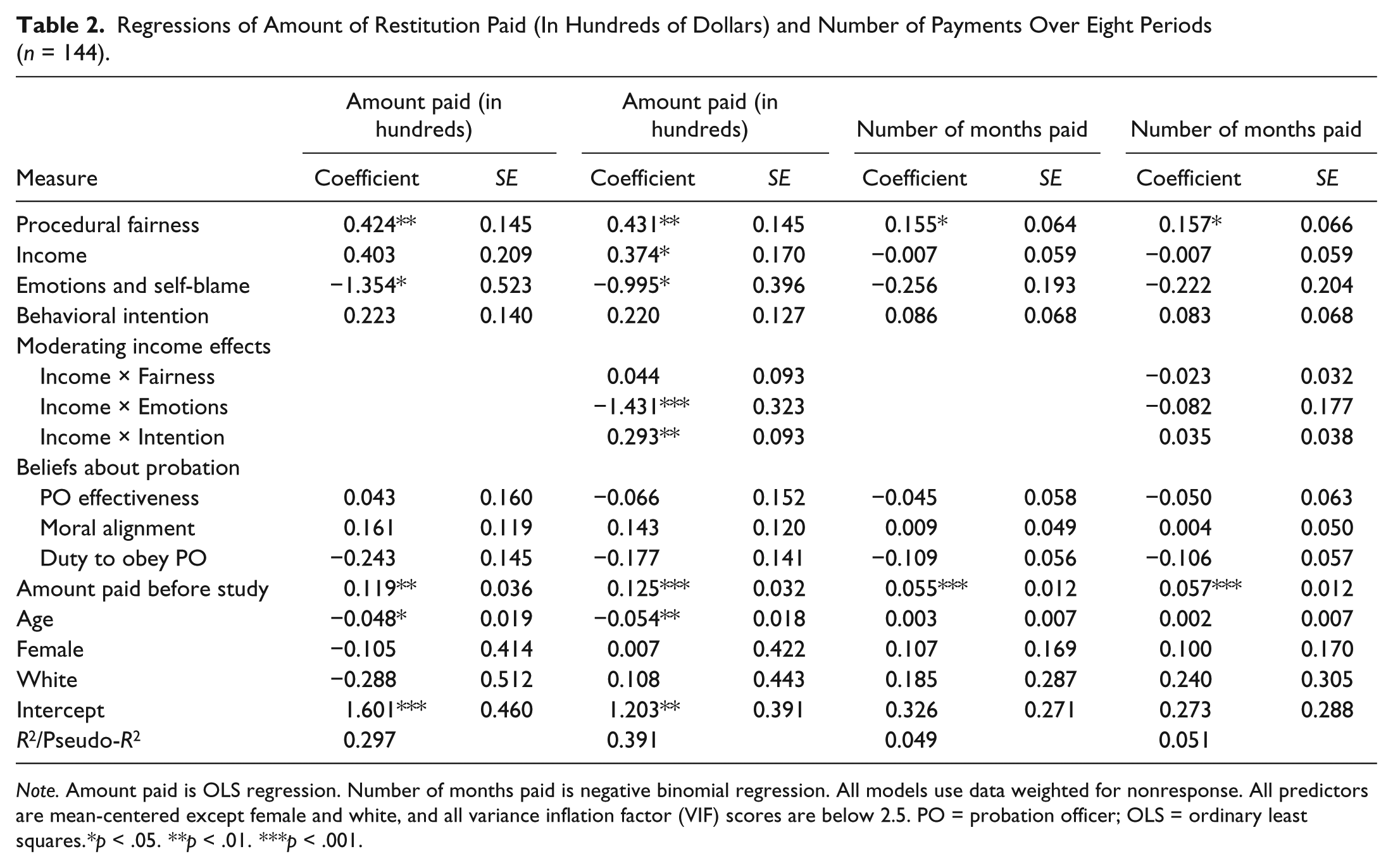
Note. Amount paid is OLS regression. Number of months paid is negative binomial regression. All models use data weighted for nonresponse. All predictors are mean-centered except female and white, and all variance inflation factor (VIF) scores are below 2.5. PO = probation officer; OLS = ordinary least squares.*p < .05. **p < .01. ***p < .001.
More importantly, the effect of fair treatment by probation officers on restitution payment is encouraging given our substantive focus on procedural fairness. For every unit increase in perceived fairness (on a Likert-type scale from 1 to 7), an additional US$42.50 was paid. In other words, an individual one standard deviation above the mean on perceived fairness paid about US$85 more than an individual at the mean, which is a meaningful amount considering that the average amount paid was US$193.
The interaction models presented in the second column yield some additional insights. The procedural fairness effect was not moderated by income. The lack of a significant interaction effect suggests that, net of income, fair treatment by probation staff significantly predicts payment. That is, even offenders with lower incomes found some way to pay at least some of the restitution that they owed if they believed they were being treated fairly.
Not surprisingly, the effect of behavioral intentions was conditioned by the respondent’s income. That is, those who intended to pay and had a higher level of income paid the most. In addition, the more respondents blamed themselves and had negative emotional reactions to their offending, the less they paid. The effect was also conditioned by income, such that those who scored the highest on the emotions and self-blame index and had the greatest income paid the least. Self-blame, guilt, and acceptance of responsibility are generally considered to be necessary components of successful rehabilitation, but our finding here could be consistent with Seligman’s work (see Buchanan & Seligman, 2013). We probe this possibility in greater detail in the discussion.
Given that most offenders had little income and, therefore, could not pay a large amount of money, we wondered if favorable attitudes yielded a greater number of payments regardless of the amount. Fair treatment by probation officers was significantly associated with a greater number of payments. For each unit increase in the fairness scale, the number of months for which a payment was recorded increased by about 17% (exp158 = 1.171), or 1.3 months. We suspect that the general lack of significant effects is because most offenders made no payments during the 12 months in which they were tracked and the mean number of payments was less than three out of a total possible eight.
Discussion
This study, a survey of probationers who owed restitution but had not paid the total amount ordered by the court, examined several reasons for payment and nonpayment beyond ability to pay. Importantly, respondents who perceived their probation officers to be fair, paid more restitution and made a greater number of payments toward fulfilling their obligations. In addition, the effect of perceived fairness was neither conditioned nor eliminated by the ability of respondents to pay their restitution, indicating that even respondents with few legitimate sources of income make payments if they believe they are being treated fairly. Arguably, the substantive effect of perceived fair treatment was even stronger than that of income given the scale of both measures used in this study. That the perceived procedural fairness of probation officers is important is consistent with work on the procedural fairness of police officers and other government agents (Jackson et al., 2012; Lind & Tyler, 1988). These findings have important implications for probation officer training and practices regarding the value of giving probationers the opportunity to communicate about their problems and to treat them with respect, to be honest, and to act with neutrality (Tyler, 2007).
Although the perceived legitimacy of the probation officer was related to payment, the perceived duty to obey the probation officer was not. This finding is consistent with Tyler’s (2006) model suggesting that authorities’ perceived legitimacy encourages individuals to regulate their own behavior. Consistent with Jackson et al.’s ideas that getting people to follow the law through procedural justice and legitimate authority (leading to internalized beliefs) rather than through fear of punishment (which is effective only as long as the threat is real), our research suggests that the perceived legitimacy of the probation officer is more effective than the perceived duty to obey in getting people to pay their court-ordered restitution.
Aside from ability to pay, which did not condition or undermine the effect of procedural fairness, we considered self-blame as another potential threat to the fairness–payment relationship. We argued that individuals may pay their restitution only if they first acknowledge the harm caused by their offending and accept responsibility and blame for their actions; this self-blame is one of the fundamental pillars of restorative justice and rehabilitation more generally. We propose two possible explanations for the somewhat unexpected negative finding. The first reason may be that the CVTRQ (Casey et al., 2007) is irrelevant for non-residential, non-programmatic treatment settings, and the negative effect is coincidental or spurious. Although the CVTRQ has been tested and supported in a range of cognitive-behavioral-based therapeutic correctional programs, the current study monitored offenders’ payments over time with no intensive treatment sessions. Thus, the concern is that the concept measured by the CVTRQ is not a valid indicator of what we intended to measure, and the negative effect could be explained by some (unmeasured) third variable.
However, the self-blame effect may be a “true” effect, as suggested by Seligman’s work (Buchanan & Seligman, 2013). Individuals who scored low on the scale are those who did not feel ashamed or guilty about offending and did not blame themselves for the offense. These individuals may have been more likely to pay because payment is viewed as a necessary part of the sanctioning process (e.g., because “I got caught” or “I’m being watched”) rather than a reflection on their perceived character flaws. In the absence of more refined information, we cannot directly test this pathway but offer it as a hypothetical explanation. At the very least, these results suggest that the traditional markers of rehabilitation (e.g., accepting blame) may be irrelevant for behaviors that actually indicate behavioral change (e.g., restoring the victim via restitution payments).
Limitations and Implications for Future Research
Limitations of this study relate to the size and representativeness of the sample. Because offenders are a highly mobile population, it was difficult for us (and for probation staff) to locate the probationers. Nearly a third of the total sample was definitively lost because we received an undeliverable letter from the post office, and an unknown number of additional surveys were delivered but may have been discarded by the tenants or other members of the household. Thus, the responses we received may not be representative of the entire sample, although we used statistical methods, by weighting for nonresponse, to control for both those individuals who were contacted and those individuals who responded.
The modal reason for failure to deliver was that the respondent had moved and left no forwarding address. In addition, four participants contacted us and explicitly requested that we avoid all subsequent communication (e.g., “the crime is in my past and I am over it”). It is imperative that the field of criminology attempt to identify the best channels through which to maintain contact with a highly mobile population that may wish to sever ties with agencies after being released from supervision. Despite multiple follow-ups, we obtained just 144 usable responses, which are sufficient to identify only large effects (Cohen, 1992). Nevertheless, we identified several robust and significant findings.
An ongoing challenge is to achieve balance between research expenses and an adequate sample size for analysis. At around 12 pages of text with a completion time of roughly 30 min, it is possible that the survey design contributed to the low response rate among respondents. However, we attempted to offset the potential burden on respondents’ time by including a US$20 incentive for completing the survey. At a cost of roughly US$2,700, the use of repeated follow-up mailings for non-responders produced an additional 48 respondents, an increase of nearly 50% more than the first mailing alone.
In addition, we measured ability to pay as household income, but income is clearly only one piece of an individual’s ability to pay economic sanctions. On one hand, household income does not capture outstanding debts, necessary monthly expenses, and nature of employment that may decrease an individual’s capability of paying. On the other hand, external sources of support—such as family and friends who provide housing or other financial aid—which may inflate an individual’s ability to pay, are not captured by household income. It is possible, for example, that third parties provided money to probationers to make restitution payments. Future research should consider the possibility that ability to pay takes numerous forms beyond income.
Temporal ordering is a concern due to the cross-sectional nature of the study and timing of the survey administration. To preserve experimental integrity by not alerting participants to the nature of the study, we withheld the survey until after the experiment had ended and recorded payments prior to the collection of attitudinal data. Typically, however, attitudes are recorded prior to behavioral measures. Supplemental analyses revealed no significant differences in attitudes between experimental conditions (including the control group), suggesting that it is unlikely that the experiment changed attitudes (available online).
It is also possible that the causal order is actually reversed, that is, the payment behaviors increased perceived fair treatment; our cross-sectional design cannot disentangle the temporal order of effects. Based on a careful reading of prior literature, we suspect that this possibility is unlikely. According to the theoretical model of procedural justice (Tyler, 2006), perceived fairness of treatment increases the perceived legitimacy of the criminal justice system, which in turn increases behavioral compliance with the law. Longitudinal research has repeatedly confirmed that perceived fair treatment predicts subsequent compliance behavior (Murphy & Tyler, 2008; Tyler, 2006; Wenzel, 2002), though to our knowledge, there are no studies supporting the opposite conclusion. However, in the absence of a longitudinal test, we cannot definitively rule out the possibility for reverse causation in this study.
Finally, the sample in this study may not generalize to other populations. Reflecting the demographic characteristics of offenders in the county, participants in this study were disproportionately white. Therefore, future research should attempt to replicate the findings in more diverse populations.
Conclusion
Among this sample of probationers, all of whom were delinquent in paying court-ordered restitution, ability to pay was an important predictor of payment. Beyond this obvious constraint, however, probationers who perceived that they were treated fairly were more likely to both pay more restitution and make more frequent payments. Although the criminal justice system cannot change offenders’ ability to pay, it can ensure that offenders are treated fairly by its professional staff, which may have demonstrable effects on clients’ subsequent behavior. This finding has implications for the way in which staff are selected and/or trained. If an emphasis is placed on treating probationers equitably and fairly, one consequence is that those probationers may be more willing to comply with the conditions of their probation, including the payment of restitution. Our research suggests that this emphasis on fair treatment would benefit both offenders in terms of more favorable attitudes toward the criminal justice system and victims in terms of greater restoration through receipt of restitution.
Supplemental Material
Gladfelter_-_Beyond_Ability_to_Pay_survey_instrument – Supplemental material for Beyond Ability to Pay: Procedural Justice and Offender Compliance With Restitution Orders
Supplemental material, Gladfelter_-_Beyond_Ability_to_Pay_survey_instrument for Beyond Ability to Pay: Procedural Justice and Offender Compliance With Restitution Orders by Andrew S. Gladfelter, Brendan Lantz and R. Barry Ruback in International Journal of Offender Therapy and Comparative Criminology
Footnotes
Acknowledgements
We thank the staff of the Centre County Department of Probation and Parole, particularly Director Tom Young, and Lauren Knoth, graduate assistant at Penn State, for their help with this project.
Declaration of Conflicting Interests
The author(s) declared no potential conflicts of interest with respect to the research, authorship, and/or publication of this article.
Funding
The author(s) disclosed receipt of the following financial support for the research, authorship, and/or publication of this article: This research was funded by Grant 1127014 from the “Law and Social Sciences” section of the National Science Foundation.
Supplemental Material
Supplementary material is available online with this article.
Notes
References
Supplementary Material
Please find the following supplemental material available below.
For Open Access articles published under a Creative Commons License, all supplemental material carries the same license as the article it is associated with.
For non-Open Access articles published, all supplemental material carries a non-exclusive license, and permission requests for re-use of supplemental material or any part of supplemental material shall be sent directly to the copyright owner as specified in the copyright notice associated with the article.
