



Abstract
The current research is a qualitative examination of the relations between self-control and deterministic/non-deterministic perceptions of life events and the drifts into or desistance from a criminal spin among juvenile delinquents. Based on in-depth semi-structured interviews with 21 adolescents (11 active delinquents and 10 desisters), we found that both the intensification of criminal behavior and the desistance from criminal activity are gradual and connected to the reduction or acquisition, respectively, of self-control and the offenders’ belief in their self-control. Criminal behavior and self-control were found to be associated with deterministic or non-deterministic perceptions of life events: the former combined with low self-control are associated with a delinquent lifestyle; the latter combined with high self-control promote the likelihood that young offenders will modify their behavior and desist from criminal behavior. The study may provide better understanding of the role of the criminal spin in the engagement or desistance from criminal behavior.
Introduction
Much academic attention has been paid to the origins of juvenile delinquency (Masten, 2011; Reynolds & Crea, 2015; Sebastian, Burnett, & Blakemore, 2008; Ward, Martin, Theron, & Distiller, 2007) and to the factors and motivations underlying the shift to criminal behavior among youth (Garbarino & DeLara, 2004; Gottfredson & Hirschi, 2016; Seginer, 2008). Two important areas of study have nonetheless been somewhat overlooked in this context: adolescents’ personal (subjective) understanding and interpretation of their criminal behavior, and the processes leading them to intensify their criminal conduct, both quantitatively (i.e., frequency of offending) and qualitatively (i.e., severity of crime).
The current phenomenological research aims at offering a “criminal spin” model (Ronel, 2011) to explain the aforementioned topics, focusing on the links between criminal behavior or desistance from crime and loss of self-control and deterministic/non-deterministic perceptions of life (Bensimon, Baruch, & Ronel, 2013; Ronel, 2013; Ungar, 2011). Specifically, this study focuses on three main themes: (a) the relationship between the criminal spin and the intensification of criminal conduct among juvenile delinquents, (b) the perceived impact of self-control on adolescents’ ability to cease the criminal spin, and (c) the relationship between deterministic/non-deterministic perception of life events, self-control, and desistance from crime.
Delinquency and Self-Control Among Adolescents
Alongside schools of thought that use environmental factors to explain adolescent delinquency are other schools that consider it the outcome of a major personal trait, for example, low self-control (Gottfredson & Hirschi, 2016). Self-control is a personality construct that reflects the extent to which individuals believe that what happens to them is within or beyond their control (Donner & Jennings, 2014; Lee-Kelley, 2006). Low self-control is characterized by several elements, such as impulsiveness, thrill-seeking, self-absorption, and a preference to engage in simple tasks that do not entail careful attention or thought (Fine, Steinberg, Frick, & Cauffman, 2016).
Various studies have found a correlation between low self-control and adolescents who turn to delinquency (Meldrum, Barnes, & Hay, 2015). Donner and Jennings (2014) showed that adolescents with poor self-control were typified by their failure to acquire basic skills of self-restraint and their tendency to take risks without addressing the implications of their actions (see also Mears, Cochran, & Beaver, 2013). Turanovic and Pratt (2013) demonstrated that at-risk youth with low self-control were more likely to use drugs and engage in violence and self-endangering activities than their counterparts with higher self-control. According to Casey (2015), adolescents with low self-control have difficulty delaying gratification, desires, and negative gestures and are more likely to turn to delinquency behavior.
Pratt (2016) claimed that delinquent individuals suffering from low or complete lack of self-control are subject to changes and influences over time at significant “turning-points” (p. 136). Such turning points are life events that require the individuals to choose future goals and work out ways of achieving them. Hence, for many juvenile offenders, such turning points reshape and redirect their lives.
Rosenbaum (1998) defined self-control as a set of behaviors aimed at achieving a specific goal, in other words, a choice that the individual makes by giving up one form of behavior for the sake of another preferred form. This definition emphasized two aspects: first, free will—individuals choose various forms of behavior due to their perceived importance and not as a result of peer pressure or absence of alternatives; and second, choice—people face several conflicting options and must decide on the best option for them at that given moment.
Self-control is a complex system composed of target-oriented cognitive skills (Shachar, Ronen-Rosenbaum, Rosenbaum, Orkibi, & Hamama, 2016). Studies examining these skills among adolescents found a strong correlation between delayed gratification, problem-solving, cognitive structuration, and diminished violent behavior (Walters, Ronen, & Rosenbaum, 2010). In addition, when individuals perceive themselves as responsible for the outcomes of their own behavior, they have a sense of inner control (Carrim, Basson, & Coetzee, 2006), which they do not necessarily abandon or transfer to external forces when forced to adapt themselves to the requirements or conditions of their environment. The stronger the individual’s belief in their ability to influence the outcome of their behavior, the greater their trust in their ability to affect future events and, ultimately, their fate. While different models depict the turn to delinquency as a result of low self-control (Gottfredson & Hirschi, 2016), this current phenomenological research proposes a different dynamic by examining the relationship between deterministic/non-deterministic perceptions of life events and of self-control and the intensification or desistance from criminal behavior.
Criminal Spin
While some of the juveniles who turned into delinquents desisted abruptly (Paternoster & Bushway, 2009), others continued their delinquent behavior and gradually intensified it in a process termed a “criminal spin” (Ronel, 2011). In a “criminal spin” process, individuals are “sucked” into a world of crime, deepen their criminal activity—both quantitatively and qualitatively—and eventually lose control over their ability to control the process and their criminal behavior. The current study focuses on such a process.
The phenomenological theoretical model of the criminal spin attempts to identify both a phenomenological factor common to various criminal behaviors and the elements affecting its development and duration. It maintains that adults and adolescents turn to criminal behavior due to a wide variety of factors and reasons, sometimes in contrast to their stated beliefs or usual thinking patterns. At the outset of their criminal path, they experience a sense of choice and control over their criminal acts and behaviors, but as their criminal efforts intensify, they gradually lose control over themselves and find it harder to stop their pull to criminal behavior. At the same time, they feel an existential need to intensify their criminal activity. A process that begins with a conscious and innocent decision might ultimately deteriorate and become uncontrollable. When the criminal spin happens, individuals tend to display behavior that was not their original intention. During this process, they feel an enhanced sense of self-centeredness and become increasingly focused on criminal activity, on its perceived benefits, and on the reduction of immediate personal risks and disregard the less immediate destructive implications for themselves and those around them (Ronel, 2011).
The criminal spin includes a series of elements, such as a dynamic between one’s inner and outer worlds, a desire for recognition and social esteem, a loss of self-control, and frequent involvement in violent behavior. As the spin process advances, these elements become unavoidable, interconnected, and coherent. The criminal spin entails behaviors, emotions, and thoughts that escalate and enhance momentum. A certain effort is needed to inject the process with momentum, but once the criminal spin begins, it is not easy to stop and its speed increases. The process is stronger than the sum of its parts and causes, and the individuals perceive it as accelerating the development of their criminal behavior. The process halts after experiencing a crisis or reaching a peak (Ronel, 2011).
The basic assumption of the criminal spin is that criminality, like any human behavior, is a subjective phenomenon. The criminal spin theory, therefore, attempts to present the viewpoint of those involved “from within” and to obtain descriptions that focus on the process and its significance rather than its etiology (Matza, 1964). The theory contends that free will declines as the spin develops, and the individual loses control of the actual process.
As noted, the criminal spin is composed of several sequential motifs. The first is a sense of heightened self-centeredness, and with this, the individual’s increasing involvement in behaviors and emotions which focus on themselves and their self-interests. The second is the intensification of self-awareness and embracement of egoistic desires. The third motif concerns the decline of empathy toward others and the subsequent neutralization of the guilt surrounding harmful behaviors toward people close to them (Bensimon et al., 2013). This diminished sense of guilt supports and often justifies the criminal spin. The final motif addresses two central situations: (a) “I can”—the feeling of capability and the self-legitimacy to commit crimes; and (b) “I must”—the perception that the way to remove an existential threat resulting from significant events in the individuals’ lives is by committing some drastic act. The spin is accompanied by a lack of concern for outcomes and the neglect of commitments, until the point when the individual loses control over the entire process.
Several phenomenological studies have supported the criminal spin model, among them Elisha (2010) who demonstrated the typical criminal spin using the narratives of sex offenders. Bensimon et al. (2013) described the criminal spin among gambling addicts and their process of losing control. Likewise, Uzan (2009) described the criminal spin of adolescents in closed institutions and the process that led them to delinquency, using the motifs previously described.
Desistance From Crime
Involvement in criminal behavior/activity increases throughout adolescence, peaking around the age of 16 (in cases of property crime) or 17 to 18 (in cases of violent crime) and declines thereafter as the juvenile delinquents enter adulthood (Piquero, Farrington, Welsh, Tremblay, & Jennings, 2009; Sampson & Laub, 2003). A relatively small number of juvenile delinquents persist in delinquent behavior after the age of 18. Understanding crime desistance as part of a normative transition into adulthood may provide important insights into the design of interventions aimed at encouraging desistance. Several competing theories on desistance have suggested that individuals change their lives by distancing themselves from harmful environments, undesirable companions, or even the past itself (Farrall, Hunter, Sharpe, & Calverley, 2014; Maruna & Roy, 2007). This process is often defined in the literature as a “turning point” in delinquent or criminal careers. Sampson and Laub (2003) have suggested that the primary route out of this cyclical trap is through a variety of turning points during the course of life, especially the development of cohesive marriages and inclusion in the labor force. Others (Farrall et al., 2014; Farrall & Maruna, 2004; Maruna & Roy, 2007) have maintained that crime desistance is based less on structural turning points and more on the idea that individuals can change internally or experience a reform of their character or a personal conversion in their way of thinking.
Using this line of reasoning, the current study targets how juvenile delinquents desist from crime or, alternatively, intensify their criminal conduct in accordance with their self-control and deterministic/non-deterministic perceptions of life events.
Method
To explore perceptions of self-control and of determinism/non-determinism regarding various life events and processes of criminal spin, we applied a qualitative strategy that is interpretive–constructive (Creswell, 2007). Constructivism’s main assumption is that people create the world they know and understand through the interaction of sensations that impinge on them and their responsive acts of cognition. Such an approach allowed us to incorporate unexpected contents and accommodate data as they emerged, thus enhancing the findings’ quality and authenticity (Stake, 2010).
Research Population
The study was conducted in Israel between 2013 and 2014 and participants included 21 juvenile desisters and delinquents. The first group comprised 10 ex-juvenile offenders (i.e., desisters) who, according to the Ministry of Justice and the Ministry of Social Affairs and Social Services files, had not committed any crime during the 2 (or more) years prior to the initiation of the study. The second group comprised 11 active juvenile offenders: 10 were under the supervision of a probation officer at the time of the study, and one was under house arrest.
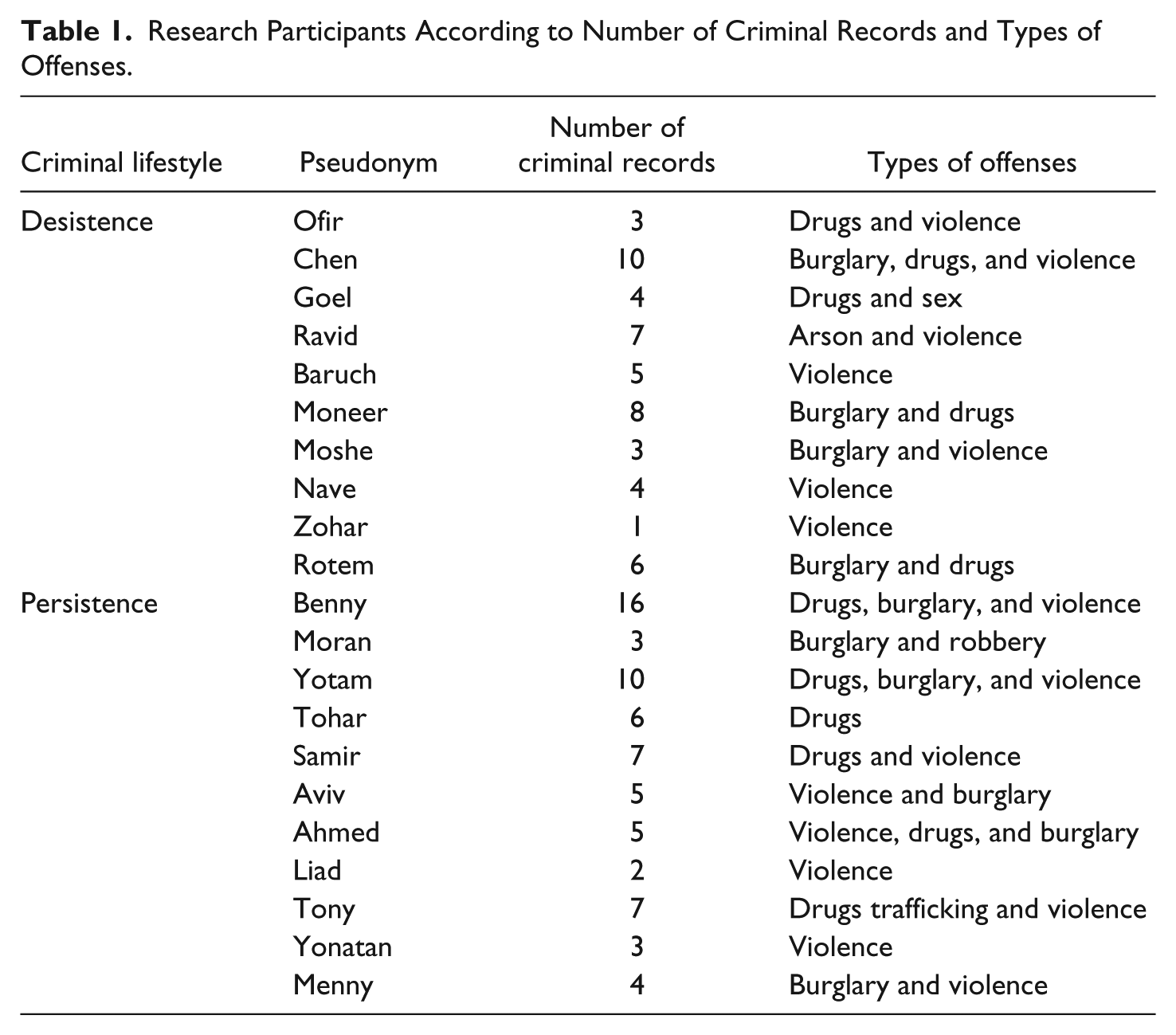
All 21 research participants were single and one, an active juvenile offender, had a child. The socio-demographic backgrounds and criminal backgrounds of all the participants were similar in terms of residential environment, criminal histories, age of criminal onset, and types of criminal activity. The criminal histories (number of criminal records and types of offenses) of the research participants are described in Table 1.
Research Participants According to Number of Criminal Records and Types of Offenses.
Research Tools
The current study employed in-depth, semi-structured interviews (Silverman, 2013) conducted in the form of conversations. The interviews, which followed an interview guide, focused on a number of issues related to the research questions and encouraged participants to share their personal stories and to address them and their subjective and retrospective meanings (Kvale, 1996). The topics covered in the interviews were as follows: (a) participants’ description and perception of the criminal spin; (b) meaningful life events; (c) relationships with peers; (d) perceptions of past, present, and future lifestyles; (e) attitudes toward criminality and antisocial behavior; and (f) self-control and self-management in the presence of the criminal spin escalation. The course of the interviews was designed to correspond with the answers received. The main advantage of this research tool relates to its ability to portray the interviewee’s world of meanings in a comprehensive way.
Research Procedure
The study was approved by the Israeli Adult Probation Service, the supervisor of the chain of rehabilitative homes in Israel for at-risk children and adolescents and the supervisor of therapeutic communities in the Israeli Ministry of Social Affairs and Social Services, and they assisted us in recruiting research participants.
The selected candidates were informed about the study’s general purpose and were asked about their willingness to participate. Their confidentiality was ensured, and all participants signed an informed consent form, approved by our Institutional Review Board. Over the following 6 months, we conducted 76 hours of in-depth semi-structured interviews with 21 participants. Initially, 24 adolescents were selected for the research but, for unknown reasons, three did not appear for their scheduled interviews. Six interviews were held in the rehabilitative homes, one in an interviewee’s private home, and 14 in coffee shops close to the participants’ residential areas or places of work.
All the interviews were held in Hebrew, recorded with the interviewees’ consent, and transcribed thereafter. The presentation of the questions was gradual. Initially, participants were asked general questions (e.g., “Could you please describe your childhood neighborhood?”). These were then followed by a set of questions focusing on the study’s core topics (e.g., “Was there a moment when you asked yourself ‘why do I act this way’?” or “Could you please describe your feelings when you were imprisoned?”).
The data analysis entailed three different stages: (a) repetitive reading of the interviews’ contents, (b) identification and classification of the major topics elicited during the interviews, and (c) categorizations of major themes and sub-themes (Silverman, 2013).
To ensure the validity (trustworthiness) and the credibility of the findings (Golafshani, 2003; Silverman, 2013), three methods were implemented: (a) peer/expert validation (in accordance with the constructivist paradigm)—data were interpreted and analyzed by two external readers (second and third authors) at different times and locations (Glazer & Strauss, 2009; Silverman, 2013); (b) participants’ validation—the findings were reviewed by a random sample of five participants who confirmed that the text and its interpretation reflected their intentions (Creswell, 2013); (c) the study was written as a thick description (Tracy, 2010), so that it includes information on the context of the topics presented and corresponding remarks by the interviewees (with pseudonyms to protect their anonymity) and provides an open conceptual discussion (Marshall & Rossman, 2010).
Limitations of the Study
The current research has three limitations. First, the research is retrospective and may thus be marked by narrative presentations that were built over time, based on the research participants’ memories and personal interpretations and adapted to their present-day lifestyles. The qualitative data presented in this article do not necessarily link with events exactly as they happened in the participants’ past lives but rather as they remembered and made sense of them retrospectively (Berge, Loth, Hanson, Croll-Lampert, & Neumark-Sztainer, 2012). Future research might entail a quantitative analysis of juvenile delinquents and the correlation between turning to, intensifying, and desisting from criminal behavior and self-control.
The second limitation concerns gender bias. The participants are only male juvenile delinquents and thus no light is shed on the processes, perceptions, and experiences of female juvenile delinquents. We recommend that future research is conducted among female populations to examine similar questions and processes.
Third, given the fact that all research participants had some kind of professional relationship with at least one therapeutic institution (boarding school, probation service, or drug rehabilitation center) at the time of the study, it could be speculated that some of them expressed negative attitudes toward the criminal way of life to conciliate these supervisory bodies.
Findings
Analysis and categorization of the research findings disclosed five major themes: (a) the development of the criminal spin, (b) intensification of criminal behavior, (c) loss of control, (d) deterministic perceptions of life events, and (e) turning point and desistance from crime.
The Development of the Criminal Spin
As noted previously, the criminal spin model proposes a phenomenological description of turning to delinquent behavior and drifting in it until reaching a total loss of self-control over one’s life (Bensimon et al., 2013). The participants’ statements in the present research reinforce the conceptual arguments of the criminal spin model, revealing a link between negative interactions and experiences with relatives and peers and the turn to and gradual drift into criminal behavior. The interviewees often related to the hurtful and/or anomalous interactions they had with various family members: At some point, I left home. I lived there but tried as much as possible to live elsewhere, to keep my distance from all the rows with my mother and her boyfriend. I used to sleep at a friend’s house. I spent a lot of time there [even though], his home wasn’t so great—there were drug dealers and addicts there, who also had no home. (Chen) There were never-ending conflicts at home, we couldn’t be alone. I started leaving the house as much as possible, tried not to be there. We were a bunch of kids who used to break into all sorts of houses and businesses, steal everything we could; we were outside the whole day; we used to climb up to the school roof and inhale gas from the air conditioners. (Ofir)
Often those blighted relationships were reflected in parents’ complete neglect of the youngsters that led the latter, as they noted, to spend long periods of time out of their homes and to deepen their spin in the criminal world: I was never at home. Don’t understand how they (the parents) never looked for me. At 13, I’d already picked up addicts’ and dealers’ slang. In fact, I got all my education on the streets. Over time I started drinking, went around with a group of drug addicts. They took drugs and I started with alcohol. (Chen) At 10 years old, I did drugs for the first time, and by 13 I was using regularly. I stole huge amounts of drugs from criminals; my parents were busy arguing with each other. I was busy on the streets, with friends, girls, drugs—everything that made me feel good. (Benny)
Intensification of Criminal Behavior
In some cases, problematic relationships within the family initiated senses of victimization among the adolescents, which led them to seek compensation. One way of gaining compensation was through intensive engagement in criminal activity: My difficulty was with my father . . . it took me to places of misery and self-pity. After a while, my behavior became more radical, I started stealing, did all sorts of things to get money, stole from the teachers, the kids, my mother. (Yotam) The physical violence was part of the “education system” my parents used. If I was late, I got the broom on my head from both of them. Hitting kids was considered something natural, it was education . . . but I didn’t see it as natural. It made me keep my distance from them, close myself off inside. I also imitated that pattern: from a kid beaten up by his parents, I became a kid who hit and sexually abused his little brother. (Goel)
In their interviews, several interviewees described the process in which they were pulled into criminal and violent activities, perceiving them as legitimate and effective ways of gaining power and control. Against the backdrop of the social impact that encouraged violence, they felt obliged to step up their violence. Feelings of control and power, allied with social encouragement by their peer group, encouraged them to embark on a spiral process that deepened and exacerbated their violent acts: It happened at school: I was high on grass and forgot the bong under a tree. One of the guys who’d been smoking with us said nastily “Get the bong,” and I said “I’m not your servant” and slapped his face, so no one would think I was unimportant. Then 10 kids attacked me. I fought back and a brawl broke out . . . I had to respond, it was important for me not to be seen as useless. (Goel) I was a problematic child. I was kicked out of school. I used to hang out with friends in the neighborhood, and then, the police arrested me for outbursts. Since then, they [the police] haven’t left me alone. They arrested me many times, I can’t remember how many. My family knows that it’s hard for me [to maintain normative lifestyle] and that I often get into trouble. They give me everything I ask for, but it does not help because I get in trouble again. (Moran)
Loss of Control
Interviewees spoke strongly about their intense involvement in violent activities and their permanent desire to demonstrate power and control over their peers. Nonetheless, and in parallel to such activities, it appears as if they lost power and control over numerous aspects of their everyday normative lives, as expressed by dropping out of school, disengaging from their families, and joining juvenile delinquents in their neighborhoods. The growing detachment from normative life and engagement in delinquent behavior led to an escalation in the criminal spin and to a loss of control over life: It was a year ago. On Friday night, we sat around a few friends near the house, talking, laughing, cursing and such things . . . He threw [a word] toward me, and it pissed me off. I felt like he was annoying me, I told him to stop . . . but he kept on saying those things. So, I injured him really hard. He lost consciousness, I didn’t mean to hit him so hard, I shouted at them to call an ambulance, and when it arrived, I went into shock because of what I had done, I totally lost control. We used to be best friends. (Ravid) I was raised in a wild neighborhood until I was seven. They would try to mess with me. If you don’t react properly, they really mess you up [assault you]. When they used to mess with me, I would hit back, you must, otherwise they “eat you alive” [attack you]. (Zohar)
Ultimately, this dynamic spiral led the adolescents to be constantly involved in criminal behavior that led to frequent arrests. These arrests were followed by an excessive use of alcohol and drugs, which led to growing involvement in criminal life, and so the loop intensified: I was drinking at some kiosk where all the lowlifes go to drink. I sat and talked with a big guy, and I must have said something that set him off and he stabbed me in my head, stomach, and arm. I took a broken bottle and injured him. He had a really bad head wound. An ambulance came, and they took me into custody. In detention I felt the “falling,” I was in despair. (Chen) Before enlisting in the army, I started messing around with all sorts of people, I got into black money. I thought the army would stop me [doing stuff like that], but problems started up at home. I broke into a house, a cop came, I attacked him and ran away. A van full of police officers arrived and beat me up with truncheons. We escaped in the car, I looked at my shirt, it was full of blood. Two weeks later, I got into trouble again. I was accused of violence because of my girlfriend—someone used to harass her on the phone, so I came with my uncle and we beat him up badly. (Tohar)
In conclusion, for these young people, the route from random criminal activity to loss of control has two stages. The first stage includes involvement in criminal activity to gain a sense of power and self-confidence and is characterized by feelings of control over life. The second stage includes gradual and continual loss of control over life and intensive immersion in criminal activity and the criminal spin and, ultimately, a total loss of control and inability to desist from criminal behavior. The unfolding of this process in a social framework that supports and encourages such behavior leads the adolescents to believe that their behavior is unavoidable, uncontrolled, and deterministic. This process is defined as the criminal spin process.
Deterministic Perceptions of Life Events
Determinism is a viewpoint which maintains that every event, action, decision, or thought is dictated by earlier events (Shoemaker, 2010). Accordingly, the individual’s ability to choose from several options at a decision-making point in their life is an illusion, because powers beyond their consciousness are already working to determine this choice (Baumeister, 2010).
Research participants who continued their involvement in delinquent behavior and who ultimately embraced a delinquent lifestyle expressed uncontrolled and deterministic perceptions toward life and the events that led to their delinquent behavior and, as a result, increased their engagement in criminal conduct: In the evenings, I would go out drinking . . . and in the mornings, I’d find myself in the detention center. It used to happen a lot. Every week or two I would end up in the detention center. I wouldn’t remember why. They said I was violent and had broken things, but I never remembered what I did. Because of alcohol, I did not know what I was doing. (Samir) I would give a dose of drug and get methadone in return. From the age of 15, it got out of control: I started “swallowing” all sorts of pills, street drugs, “hagigat” (cathinone), taking trips. I also took crystal meth and Ecstasy . . . it was only to show off, but what I liked best was heroin and methadone. I quarreled with the whole neighborhood, I used to come home to my parents [from boarding school] for the weekend through the back alleys; I was afraid they’d kill me. (Benny)
Interestingly, the adolescents’ perceptions of their criminal behavior as uncontrolled and deterministic often led them to engage in criminal activities against their declared will. According to the criminal spin model, this state of affairs reflects a phenomenological process in which the criminal spin intensifies from a situation of “I can” (perform a criminal act) to a situation of “I must” (perform such an act). Within the experience of “I must” there are inherent psychological processes, such as dissociation, which the individual experiences as a spin to the extent of losing self-control: I got used to being beaten up. As a child, I gave up hope. [The beatings] recurred; I’d already given up, all the time I said “well, that’s Mom, that’s Dad, you have to forgive them, and nothing can be done.” And I became like that too. My grandfather hit my father, my father hit me and my brother and sister, and I hit my younger brother and the little kids. I think my father is a very sick person who simply looked for a way out; he tried to live through something else and that path took control of him like [later] it took control of me by hurting other children and my young brother. (Goel) At school I was already out of control, I felt lost, I was in my inner world and nobody could get to me there . . . Dad hit his children, and Mom hit them too, and now I hit as well. It’s a chain. . . . All the time I saw that chain, I already knew it’s a loss of control. Toward the end of my addiction [to drugs] I wanted to break into banks, I was really looking for accomplices, I was already willing to cross all the lines, it’s funny how much it went in parallel—my desire to change when in fact my addiction was getting even worse, as if it was out of my control. (Tohar)
The practical and conceptual unavoidable end of this process is intensive and uncontrollable engagement in criminal activity and extreme self-centeredness. The youngsters showed no concern for the suffering and pain their acts inflict on others and no belief that they could prevent or curb their behavior (see also, Gottfredson & Hirschi, 2016; Hirschi, 2004): I saw that there was no humanness [in my actions]. There were moments when I just gave up. I lived automatically; my own conscience didn’t experience it. During that whole thing [sex offences that I committed] I was off my head; I was on automatic pilot, I did everything unconsciously. There were always those flashes that perhaps it’s not okay, but altogether I was on automatic pilot. (Chen) At the age of six or seven, we used to have sex and oral sex . . . in the orange groves . . . in dumpsters. I had the feeling that I had to do it. We used to do it the whole day, sometimes twice a day; it was “our secret.” I did it with an older boy, and I thought we were close—“enjoying ourselves”—inside I didn’t want to do it, but you can’t do otherwise. I couldn’t stand it, and later I started using drugs, I wanted to escape from myself and from those thoughts. It echoed inside me all the time: “what sort of person will I become?” (Goel)
Turning Point and Desistance From Crime
Following the psychological crisis they experienced in jail and the weakening of familial ties, some of the research participants, at different points in time and following an introspective process, reached the mental, emotional, and practical understanding that they wanted to stop the criminal spin, desist from criminal activity, and take control of their lives. However, it should be noted that this was a gradual process with desistance turning points and not an abrupt halt: I was alone and had time to think, I suddenly began to think for what? Suddenly you feel humiliated. Even as a child I went through a lot of humiliation and did not want to go through these humiliations, I was afraid and did not like it. I grew up in the street and I was in despair, I was in despair and I could not get out of my despair. (Chen) From the age of 15, I always smoked [marijuana] and other drugs. One time, I tried LSD; it was before Yom Kippur [the Day of Atonement]. Suddenly I felt bad. A month later, I suddenly began to hear voices. As a person who did a lot of drugs . . . suddenly, I heard a shofar from the synagogue. It was strange . . . I could not stand on my feet. I do not remember how long it took, but then I began to pray: “If there anybody in this world who can hear me, please help me.” (Ofir) After serving time in prison, I felt I couldn’t go on living like this! I saw people in the street who were shits, pardon the expression, I’m not like them, that’s not who I am. . . . Their lack of feelings, the way they talk, I thought about it a lot and I got depressed. I never had a direction in life, I would pass the time . . . I ran away from my feelings, I was with people who didn’t care about me at all, because I was always busy escaping. I decided I didn’t want to live like this anymore [in the world of crime]. (Chen)
At the same time, the desire for self-transformation was perceived by some of them as highly complicated, mainly due to its practical ramifications: relocation from their neighborhoods, the request for external assistance, and loneliness: I’ve been going to an AA [Alcoholics Anonymous] program and to a SA [Sex Addiction Anonymous] for two and half years, and it’s helping me a lot. There are many things you have to give up: bad relationships, hookers, porn, temptations. Before I go to sleep, I do spiritual work. I’ve given up the internet and TV. You have to give up those things to change your life. It’s very difficult, but it keeps me safe. (Goel) I gradually began to move away from the people I used to hang out with, I decided to find a cool job and get away from the troublesome places I used to visit. (Ofir) The only one who can help you is yourself. Just you! I have friends with one leg in the grave because of drugs. If you do not help yourself, no one can do it for you! I started to stay away from this world and not to hang out with the delinquents I used to [hang with]. (Rotem) After the violent incident I had with the policemen and the criminal conviction, my behavior in the boarding school was fine for half a year. There was a big improvement. Then, one day, just next to the pizzeria, I had an argument with two boys I knew from before, and during this argument one of them cursed me and I slapped him. The principal of the boarding school called me and said that because there was an improvement in my behavior he was giving me a second chance. Otherwise, he would have transferred me to another boarding school. I was afraid they would throw me out, and since then I have stopped with the violent behavior. (Moshe)
The process of desistance from criminal activity thus requires two components: drift and intensification of criminal spin and a breaking point. The introspective understanding of the adolescents about the destructive aspects of criminal life initiated new awareness that the criminal spin must and can be stopped. This awareness was subsequently translated into a dramatic mental change from deterministic perceptions of life events and lack of inner control to non-deterministic perceptions and the reestablishment of self-control. Eventually and pragmatically, this mental change revolutionized the adolescents’ everyday life and allowed them to desist from crime.
In contrast to all the above, some of the research participants belonging to the persistence group stressed the fact that they continued and intensified their criminal activity due to their perception that the world is an alien and hostile place and the best way to survive it is by embracing hostile and violent patterns of behavior: In the neighborhood there was poverty, crime, and violence. In Mexico, you need to be a Mexican or no one will accept you. You have no choice. (Ahmed) I grew up in a distressed neighborhood. People had nothing to do; they were looking for trouble. When you are being bullied, you kick back; gradually, they learn not to mess with you. (Tony) In the neighborhood where my father lives, they discovered I stole drugs from them; [as a result] I was “bombarded” by them . . . all over my body. They also broke into my father’s house. Some of these people, currently in prison, are very dangerous people. When you owe them money, you have to pay—no matter what and how. The main thing is to survive, otherwise they will kill you. (Benny) I went to jail and saw people with death reflected in their eyes. I also became such a person—because of the drugs and alcohol. . . . Because my father was violent toward my mother, I became violent as well. If you are not strong in this world, and especially in prison, people will harass you. (Tohar)
Discussion
The objectives of this research were to explore how the juvenile delinquent participants construe the dynamic processes that drew them into criminal behavior and to analyze the relationship between self- control and deterministic/non-deterministic perception of their criminal behavior and the intensification of or desistance from criminal behavior.
A major finding of the study relates to the relationship between engagement in criminal behavior and severe external tribulations and feelings of loneliness. The recognition and respect of their peers (i.e., other juvenile delinquents) were perceived as positive, boosting their sense of personal power, and, consequently, encouraging them to intensify and deepen their criminal activity. Simultaneously, an introspective analysis (Marshall & Rossman, 2010) of the harsh and damaging life events they had experienced thus far (e.g., domestic violence, poverty, and failure at school) shaped their perception of the world as violent and power-driven and their subsequent belief that the only way to survive and gain self-esteem and social respect is through violence and toughness (see, Mersky, Topitzes, & Reynolds, 2012). Such behaviors were perceived as rewarding, as they elevated the adolescents’ self-esteem and led them in a linear manner to intensification of their criminal behavior and, eventually, to a criminal spin and a loss of control over themselves and their lives.
In accordance with the criminal spin model (Ronel, 2011), all research participants refrained from questioning or assessing the harassing and often damaging impact of the violence and neglect they had suffered during their childhood and adolescence on their behavior and their worldview. Consequently, they carried on with their criminal and violent behaviors and deepened their involvement in it. In the interviews, they talked about their need for control and power in school which they achieved via violent behavior and harassment of children weaker than them. Such behavior, in addition to their inability to accomplish scholastic assignments and their poor familial relations, led them to drop out of school and strengthen their social relations with delinquent peers.
Criminal behavior and its (artificial) successful outcomes served as a desirable alternative and a sanctuary from academic failure and familial tension. Tragically, they also served as a catalyst for frequent serious criminal conduct and, ultimately, to personal deterioration. In line with the criminal spin model, juvenile offenders thus drift into the criminal world and, with time, lose their self-control and repetitively engaged in criminal behavior. Consequently, the juvenile offenders fail from desisting criminal behavior. Whereas the starting point of the criminal spin process is perceived as rewarding, since it is characterized by conscious and controlled involvement in antisocial and criminal conduct, its continuation is perceived as less gratifying, since it is characterized by frequent engagement in severe illegal behavior, the minimization of free will, and the embracement of deterministic perceptions of life.
The second key finding of this study relates to factors and processes leading juvenile delinquents to desist from criminal activity. According to research participants who desisted from criminal behavior, an engagement with a negative and dramatic incident led them, introspectively, to acknowledge that their drift into a criminal spin was characterized by emptiness, uncertainty, insecurity, and a lack of control. Likewise, it led them to recognize that they needed to undergo a profound and substantive change—mainly to desist from crime—and that such change was feasible and within their control. In other words, the motivation to desist from criminal behavior rests on a conceptual change in thinking from a determinist to a non-determinist perception of the world and an acknowledgment that individuals have a certain degree of control over their lives. It thus appears that the distressing life events that often propel adolescents into criminal behaviors and the criminal spin actually transform into “healing” elements which help them desist from crime (Chen, 2010). Specifically, adverse life events force a self-awareness which leads to the reshaping of their worldview and to the adaptation of non-deterministic views of life. Ultimately, adolescents are motivated to resume control over their lives and to halt their criminal spin. In a paradoxical way, a deterministic approach to life leads to an inevitable crisis which was solved by the transformation of attitude and the acceptance of a non-deterministic approach. These findings suggest that the loss of control is a reversible process and that growing self-awareness, at any stage, might reverse the direction of the spin. Consequently, by helping adolescents to shape their thoughts and behavior patterns and thus to identify and consolidate their authentic selves or inner voices (Frankel, 1946), stressful events may assist in ending deviant behaviors (see also, Berzonsky & Luyckx, 2008). This introspective and phenomenological process integrates smoothly with other quantitative and qualitative research findings that have suggested a connection between mental and emotional suffering and the cessation of criminal lifestyles (Luecken & Gress, 2010; Rutter, 2012; Ungar, 2011).
A third salient finding of the current research relates to the link between self-control and criminal behavior. Research participants who perceived themselves as suffering from low self-control tended to have deterministic views of the world and attributed their delinquent behavior to constant, immovable, and uncontrollable factors. These adolescents refrained from examining themselves, their conduct, and their place in the world and, consequently, “spun” into intensive criminal behavior. In contrast, participants who perceived themselves as having high self-control examined themselves, their place in the world, and the factors that led them to criminality and showed faith in their ability to reconstruct their lives and their futures. These adolescents chose to desist from criminal behavior and succeeded, ultimately, in doing so.
These findings suggest two main aspects: first, low self-control fetters juvenile delinquents to a criminal lifestyle and deterministic attitudes toward the world, while high self-control renders juvenile delinquents open to examining their own behavior and its underlying factors and to changing them in ways they consider effective and necessary; and second, low self-control is a changeable condition and not a stable trait, as previously suggested by the general theory of crime (Gottfredson & Hirschi, 2016). Although the degree of self-control is considerably reduced before or during the criminal spin, genuine self-reflection and sincere understanding of the idea that human behavior is the outcome of free will often lead to a growing sense of self-control and, consequently, to a concrete halt of the criminal spin and eventual desistance from crime.
In many ways, the aforementioned mental and practical processes experienced by juvenile delinquents who have desisted from crime strengthen Sartre’s (1974) philosophical argument that humans are free to assess, evaluate, and reconsider their choices in life. We cannot be enslaved to our fate, because the very essence of human existence is individuality and liberty, without which we have nothing. The absolute freedom embodied in existence is uncompromising. Any attempt to escape it will fail, for the very act of escape is also a decision made freely (Frankel, 1946). Accordingly, juvenile delinquents must use their own points of view to focus on their subjective experiences (Ronel & Haimoff-Ayali, 2010) and to actively reshape and re-navigate their behavior and trajectories (Hoffman, 2010).
The results of this preliminary explorative study add to the existing knowledge base about the factors leading juvenile delinquents to intensify or desist from criminal behavior and the relations between such behaviors and self-control. This may provide scholars, criminologists, and practitioners with a better understanding of the role of the criminal spin and self-control in the engagement or desistance from criminal behavior among delinquent youth.
Footnotes
Declaration of Conflicting Interests
The author(s) declared no potential conflicts of interest with respect to the research, authorship, and/or publication of this article.
Funding
The author(s) received no financial support for the research, authorship, and/or publication of this article.