



Abstract
To date, systematic studies of sexual homicides from Europe are scarce, in which none have been conducted in Sweden. This study aims to describe male-on-female sexual homicides in Sweden and differentiate from corresponding nonsexual homicides. Unsolved and solved sexual homicide (n = 33) cases were identified in a database containing all homicides in Sweden between 1990 and 2013 (N = 2,126), and subsequently data from forensic psychiatric evaluations were collected for convicted offenders. Male-on-female sexual homicides constituted 1.6% of all homicides and the clearance rate was 82%, which is comparable with the 83% overall clearance rate but took longer time to solve. Three factors differentiated sexual from nonsexual homicides: strangulation, younger age of the victim, and the absence of eyewitnesses. In solved cases, distance from the offender’s home to the crime scene was strongly correlated with time to clearance. A majority of the offenders suffered from personality disorders, while other diagnoses were uncommon.
Sexual homicides are rare but extreme to their nature and have not been devoted as much scientific attention as many other types of homicide. The research on sexual homicides is especially lacking within the European context and there is, to the best of our knowledge, no Swedish study. Furthermore, as pointed out by Beauregard and Martineau (2012), a large number of previous studies are limited by unrepresentative and small samples. Also, most comparative studies and reviews on sexual homicide offenders (SHOs) compare the offenders with nonhomicidal sexual violent offenders, for example, stranger rapists (Chan & Heide, 2016; Proulx, Beauregard, Cusson, & Nicole, 2007; Stefanska, Beech, & Carter, 2016). There has been less focus on the differences and similarities with other homicide offenders. Swedish research on sexual homicide and sexual assault is sparse, however Sturup (2018) report that among 25 convicted serial homicide offenders 1 between 1973 and 2012, eight (32%) offenders were sexually motivated. Furthermore, there are two studies that have examined serial rape in the Swedish context (Corovic, Christiansson & Bergman, 2012; Sturidsson et al., 2006).
Definition of Sexual Homicides
Dating back to the 19th century, von Krafft-Ebing’s (1886) work was going to be the first of many papers suggesting what defines and constitutes sexual homicide. His model involved three important components of sexual homicides, namely, sadism, fantasy, and an urge to kill, and he divided SHOs into passive and active offenders, where the passive offender uses already dead bodies for sexual gratification while the active offender kill in order to be able to have sex with the body. Brittain (1970) published a paper on the typical background of sexual sadistic killers from a forensic psychiatric perspective, and in 1988, a team of researchers working within the Federal Bureau of Investigation (FBI; Ressler, Burgess, & Douglas, 1988) developed a definition of sexual homicides. They proposed that if any of the following activities were present in the context of a murder, it should be considered a sexual homicide:
Attempted or completed sexual intercourse (oral, anal and/or vaginal),
exposure of the primary or secondary sexual parts of the body,
victim’s attire or lack of attire,
sexual positioning of the victim’s body,
insertion of foreign objects in to the victim’s cavities,
semen on or nearby the victim’s body,
substitute sexual activity,
sexual interest admitted by the offender, and
sadistic fantasies reported by the offender.
Beech, Fisher, and Ward (2005) later proposed a more conservative definition involving individuals who have killed someone where there is either clear forensic evidence of a sexual element, or a sexual component is admitted (or suspected).
Prevalence of Sexual Homicides
The occurrence rate of sexual homicides is associated with the overall level of homicide. In the United States, the incidence of sexual homicides has been reported to range between approximately 0.2% (James & Proulx, 2014) and slightly below 1% (Meloy, 2000). Another U.S. study, examining serial sexual homicides specifically, reported that these cases comprise approximately 0.5% of all homicides (McNamara & Morton, 2004). On the contrary, higher incidence has been reported in Canada, ranging from 2% (James & Proulx, 2014) to 4% (Roberts & Grossman, 1993). In England and Wales, it has been reported that among 4,860 homicides in England and Wales from 1985 to 1994, 3.7% (n = 178) were sexual homicides (Francis & Soothill, 2000). There are only a few studies published from the Northern European and Scandinavian context. However, a Finnish study on sexual homicides report an incidence of 2.8% of all solved homicides (Häkkänen-Nyholm, Repo-Tiihonen, Lindberg, Salenius, & Weizmann-Henelius, 2009). As only solved cases were included in the study, and as it is possible that the clearance rate of sexual homicides differs from that of other homicides in Finland, little is known about the true prevalence. In addition to including male-on-female sexual homicides, their study also incorporated female-on-male and male-on-male sexual homicides.
Differentiating Sexual Homicides From Other Homicides
A structured review of sexual homicide studies concluded that very few controlled empirical studies have differentiated sexual homicides from other homicides (Carter & Hollin, 2010). The review by Carter and Hollin (2010) included two comparative studies between SHOs and other homicide offenders (Langevin, Ben-Aron, Wright, Marchese, & Handy, 1988; Roberts & Grossman, 1993). We have identified one additional study, the abovementioned study by Häkkänen-Nyholm and colleagues (2009).
Langevin et al. (1988) compared 13 SHOs with 13 non-SHOs, and 13 nonhomicidal sexually aggressive offenders. The study suggested that SHOs showed signs of sadism earlier in life, used strangulation more often, and more often killed a female stranger victim compared with the other groups. The SHOs were more frequently diagnosed with personality disorder and sexual sadism, and were also more often assessed as psychotic at the time of the offence.
Roberts and Grossman (1993) investigated sexual homicides in Canada between 1974 and 1986, as noted above that 4% of all homicides were sexual homicides and that there was no change in incidence during the observation period. Furthermore, the researchers reported that the clearance rate in sexual homicides were comparable with that of homicides overall, which is about 75%. Concerning violent modus operandi in sexual homicides with female victims, 34% were killed through strangulation, a method that was used in only 14% of the nonsexual homicides. When compared with homicides committed in connection to robbery or burglary, the sexual homicides were considerably more often aimed at younger individuals, with 67% of the victims being below the age of 30. Homicides perpetrated during robbery or burglary revealed an inverse pattern, with 78% of the victims being 30 years or older (Roberts & Grossman, 1993).
In investigation of solved cases of homicides, Häkkänen-Nyholm et al. (2009) compared sexual homicides with other homicides and found that sexual homicides more often involved multiple offenders (28% vs. 12%), strangulation or suffocation (55% vs. 15%), and that the victim’s body was less often found at the crime scene (61% vs. 89%). Compared with non-SHOs, these offenders were more often victimized of sexual abuse in their childhood (19% vs. 5%), had a mental health contact before the age of 18 (50% vs. 23%), had a history of sexual crimes (25% vs. 4%), and scored higher on the Psychopathy Checklist–Revised (PCL-R; Hare, 2003) with a mean score of somewhat above 25, in comparison with 19 among non-SHOs. A logistic regression model demonstrated that multiple offenders, sexual crime history, and the presence of a mental health contact before the age of 18 were significantly associated with sexual homicides (Häkkänen-Nyholm et al., 2009).
With regards to research on sexual homicides in specific, Beauregard and Martineau (2012) examined a representative sample of 350 sexual homicides in Canada between 1948 and 2010, in which they found that a minority of offenders was known by the police to have either paraphilic tendencies (21%) or to possess a sexual collection (24%). Moreover, 46% of the offenders used at least one strategy that demonstrated forensic awareness.
SHOs and Mental Disorders
With regards to psychopathology in SHOs, previous studies have illustrated that mental illness at the time of offence is rather rare (Kerr, Beech, & Murphy, 2013; Meloy, 2000; Proulx & Sauvêtre, 2007), although Häkkänen-Nyholm et al. (2009) report that more than 20% of the Finish SHOs suffered from schizophrenia. Nonetheless, personality disorders and maladaptive personality traits are common features among SHOs, in which antisocial and borderline personality disorders appear to be predominant (Häkkänen-Nyholm et al., 2009; Hill, Habermann, Berner, & Briken, 2007; Proulx & Sauvêtre, 2007). Moreover, psychopathic traits are prevailing in these offenders (Häkkänen-Nyholm et al., 2009; Hill et al., 2007; Kerr et al., 2013, Sturup et al., 2016), and SHOs with psychopathic traits are more prone to perpetrate sadistic and gruesome violence (Porter, Woodworth, Earle, Drugge, & Boer, 2003).
The Present Study
In summary, sexual homicides are rare but extreme to their nature and have not been devoted as much scientific attention as many other types of homicide. Approximately 0.2% to 4% of all homicides are sexual homicides and there is often pressure from the general population and media to solve these offences. When conducting evidence-based offender profiling, the assessment should be based on both investigative and clinical experience, as well as empirical evidence (Dowden, Bennell, & Bloomfield, 2007). With regards to Sweden, there are only a few country-specific studies conducted on major sexual offences, in which none of these concern sexual homicides. Consequently, this leads to the risk of overlooking country-specific conditions when using the international literature on offender profiling (James & Proulx, 2014, 2016). This may also mean that incorrect investigative strategies will be suggested. It is unknown whether sexual homicides differ depending on the sex of the victim. Due to challenging investigations in sexual homicides aimed at females by strangers or offenders they vaguely knew, this study was solely based on male-on-female sexual homicides. There is a gap in the literature that needs to be addressed; therefore, this study aims to (a) describe sexual homicides in Sweden and (b) compare male-on-female sexual homicide with male-on-female nonsexual homicides.
Material and Methods
This nationwide study was based on all homicides committed in Sweden between January 1, 1990, and December 31, 2013 (N = 2,126). These data were retrieved from the Swedish National Council for Crime Prevention, in which information from police files, court verdicts, and forensic psychiatric reports has been coded. The data set has been checked repeatedly to control that all cases of homicide identified by the judicial system are included and that no cases have been duplicated. According to the Swedish Penal Code, homicide includes cases of murder, manslaughter, and infanticide, as well as cases of assault leading to death. All male-on-female sexual homicides (n = 33) were identified from the full database. For a full description of the data collection process, see Liem et al. (2013).
As described in the flowchart in Figure 1, there were 33 sexual homicide victims (SHVs) from 33 offences, 27 of the 33 offences were solved, and among the solved cases, there were three offenders who were serial offenders and had killed two victims each resulting in 24 SHOs. All cases were scrutinized by three of the authors before they were included as sexual homicide cases and doubled checked to other ongoing homicide studies (Sturup, Karlberg & Kristiansson, 2015; Sturup et al., 2016; Sturup, 2018). Examples of individuals who knew each other vaguely are two neighbors who occasionally met each other and said hello but never really talked to each other, or a female cashier in the local store and a male regular customer.
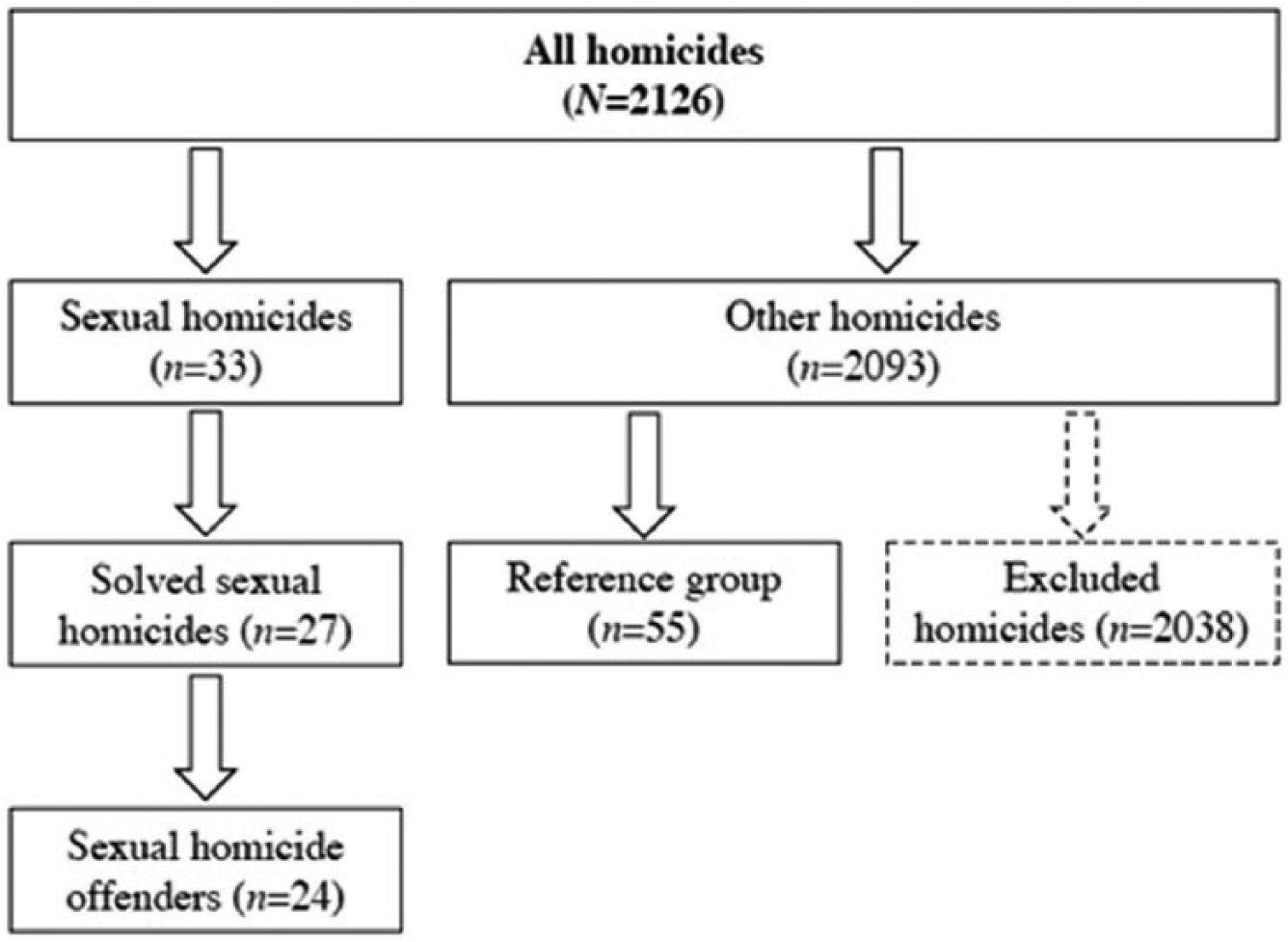
Flowchart over case inclusion in the sexual homicide study in Sweden, 1990 to 2013.
As it is somewhat unsure what a comparison between sexual homicides and all other homicides would add, we choose to use a similar reference group that were selected cases based on four factors (whereof the three first were the same as the case group): (a) male offender, (b) female victim, (c) stranger relationship, and (d) but without a sexual motive. Thereby, the reference group was very similar to the case group, on offender and victim factors, with the difference that the motivations behind the crime differed (such as a drunken brawl on the town, robbery, or altercation, etc.). The reference group consists of male offenders and female victims (n = 55) of nonsexual homicide (non-SHV). The reference cases were sampled from the same data set as the SHOs.
The court verdicts were collected in solved cases, and to identify the psychiatric diagnoses of perpetrators, the 10-digit individual personal number of all offenders, unique to every citizen in Sweden, was linked to the Central Archive of the National Board of Forensic Medicine. This registry contains data, including diagnoses, on all individuals subjected to a forensic psychiatric examination in Sweden since 1934 (computerized since 1987). As the age of legal responsibility in Sweden is 15 years, perpetrators who were 14 years and younger were excluded from the analyses. Thus, five perpetrators (ranging between 10 and 14 years of age) were excluded from the analyses, as were four offenders in which no age was specified (none were categorized as a sexual homicide).
Definitions
We have used a definition of sexual homicide including: admitted rape or sexual interaction with the victim (including post mortal activity) or clear evidence of sexual activity at the crime scene (such as insertion of foreign objects in the vagina, semen at the crime scene, body undressed with an apparent sexual component etc.).
One example of an included case is one involving an old woman found naked on the lower part of the body, stabbed to death but also stabbed several times in the lower abdomen but without clear evidence of penetration. Another example is a girl found raped and killed but where the exact cause-of-death could not be determined. This is a more conservative definition compared with, for example, the traditional FBI definition (Ressler et al., 1988), as it does not include cases solely based on the victim being found naked, and the impact on the findings are discussed in the “Methodological Considerations” section. Female victim—all female individuals in Sweden with no age limit. Stranger relationship—when the offender and victim have not met, or had any previous contact (17 of the 27 solved sexual homicide cases). Vaguely connected—when the offender and victim have met before but are unlikely to know each other’s name, or have not been in contact for several years (10 of the 27 solved sexual homicide cases). We have aimed at only sampling cases where the police found a deceased victim or when the crime is reported and the police have no suspects when the investigation starts (the so-called whodunnits).
Analyses
Differences between male-on-female sexual homicides and nonsexual male-on-female homicides were reported using descriptive statistics. Statistical significance of categorical variables was analyzed by conducting chi-square tests (and Fisher’s exact test when appropriate), while continuous variables were tested using independent-samples t test. Furthermore, odds ratios (ORs) from logistic regression were computed. Differences between groups regarding continuous variables were tested using one-way ANOVA. Due to multiple testing, we considered uncorrected probability values less than .01, derived from two-tailed tests, as statistically significant. Statistical analyses were performed using SPSS for Mac, version 23. The predictive value for the model to differentiate sexual homicides from other homicides was tested by using area under the curve (AUC) from receiver operating curve analysis. As the variable “duration until the case was solved” was of ordinal type (within 24 hr, within a week, within a month, within a year, longer than a year), the correlation between the distance from the offender’s home to the crime scene was tested using Spearman’s correlation. Rates per 100,000 were calculated based on population figures obtained from Statistics Sweden (www.scb.se) for each given year. As sexual homicides are unusual, the time analysis was conducted by dividing the data into three 8-year periods (1990-1997, 1998-2005, 2006-2013) to investigate trends of characteristics over time. The study has been approved by the Regional Ethical Review Board in Stockholm (reference number 2014/749-31/5).
Results
Male-on-female sexual homicides constituted 1.6% of all homicide incidents between 1990 and 2013 in Sweden, and the rate was 0.03 per 100,000 female inhabitants. Our findings disclose a decrease in numbers of sexual homicides, from 16 during 1990-1997 to six and 11 in the years 1998-2005 and 2006-2013, respectively. Almost 50% of the sexual homicides took place during nighttime and there were significantly less often eyewitnesses in the sexual homicide cases compared with the nonsexual homicides (3% vs. 36%). The clearance rate (one or more offenders convicted for the homicide) of the sexual homicides was 82%, which is similar to the overall clearance rate in the nonsexual homicides (83%). The sexual homicides were reported to the police significantly later than other homicides and took significantly longer time to solve; twelve percent took longer than 1 month to solve compared with 2% in the overall group of homicides (n = 2,038; df = 4; p < .001). The involvement of penetration was possible to confirm or dismiss in 27 of the cases and occurred in 15 of those cases (56%).
Comparison With the Reference Group
The SHVs were, at mean, significantly younger than the non-SHV, and strangulation was significantly more often used in the killing of SHV compared with non-SHV, and there were no significant differences between the groups with regards to number of victims being intoxicated (see Table 1). The SHOs were, at mean, roughly the same age as non-SHOs, equally often attacking in a public place and were to the same extent intoxicated by alcohol or drugs (Table 2).
Male-on-Female Sexual Homicide Offences Compared With Male-on-Female Nonsexual Homicide Offences (SHO) in Sweden From 1990 to 2013.

Fisher’s exact test.
seven unsolved cases excluded.
four unknown cases excluded.
twenty unknown cases excluded.
three unknown cases excluded.
thirteen unknown cases excluded.
Male-on-Female SHOs (n = 24) Compared With Male-on-Female Non-SHOs (n = 55) in Sweden From 1990 to 2013.

Note. SHO = sexual homicide offender.
Three unknown cases excluded.
Twelve unknown cases excluded.
In short, as seen in Table 1, there are three factors differentiating male-on-female sexual homicides from nonsexual male-on-female homicides: young age of the victim (0-19 years; OR = 3.9; p = .01; n = 83), no eyewitness (OR = 18.3; p = .006; n = 88), and strangulation (OR = 8.7; p < .001; n = 88). A predictor variable was computed by using significant variables: no eyewitness versus eyewitness (1/0), strangulation versus other violent method (1/0), and victim age 0 to 19 years versus other ages (1/0), resulting in an index ranging from 0 to 3 scores. The index variable could significantly predict the sexual homicide status (AUC = 0.81; SD = 0.5; p < .001; n = 83). None of the 24 victims who scored 0 on the predictor variable were a victim of sexual homicide, while six of seven of the victims scoring 3 were victims of sexual homicide (87%).
Concerning age interaction, there were quite different patterns displayed in the sexual homicide group and the comparison group (see Figure 2). While the control group was evenly distributed in offender age in the three victim age categories (M age = 26, 29, and 30 years), the pattern among the sexual homicides was different with decreasing mean age as the victim age increase (M age = 40, 28, and 25 years). A post hoc ANOVA analysis, however, revealed that the difference between the groups within sexual homicides was not statistically significant (F value = 4.6; p = .02; n = 33).

Offender mean age divided on the victim’s category in 33 male-on-female sexual homicide and 52 male-on-female nonsexual homicides in Sweden, 1990 to 2013.
Close-Up Description of the SHOs
At least eight of the 24 convicted SHOs (34%) were serial sexual offenders, where three of them were serial homicide offenders (13%; defined as two victims or more according to FBI, 2008, and Adjorlolo and Chan, 2014). The other five offenders were convicted for other nonhomicidal sexual offences (21%). Two of three offences were aimed at a total stranger and a majority of the cases involved clear evidence of planning; however, only one in four involved actual planning of the sexual homicide (Table 3). Just over half of the offenders were previously convicted of a violent crime and one in four was convicted of a previous sexual offence.
Crime Scene, Criminological, and Clinical Description of Male-on-Female SHO in Sweden From 1990 to 2013 (27 Offences by 24 Offenders).

Note. SHO = sexual homicide offender.
Three unknown cases.
There was planning involving another crime such as robbery, burglary, or rape.
There was clear evidence of planning involving the sexual homicide.
One unknown case.
Based on the 20 offenders with a major forensic psychiatric investigation.
None of the 20 SHOs who underwent a forensic psychiatric evaluation were diagnosed with a psychotic disorder. However, in line with previous research (e.g., Hill, Habermann, Berner, & Briken, 2006; Hill et al., 2007; Meloy, 2000; Myers & Blashfield, 1997), personality disorders were common. Fifteen of the 24 offenders met the criteria for any personality disorder: three each for antisocial and borderline personality disorder, one each for narcissistic and paranoid personality disorder, and seven for sadistic personality disorder (a diagnosis described in the appendix to the revision of the third edition of Diagnostic and Statistical Manual of Mental Disorders [3rd ed.; DSM-III; American Psychiatric Association, 1980] that ultimately was not included in later editions of the manual). Results of evaluations regarding psychopathy, performed using the PCL-R (Hare, 2003), were not available for all offenders and were therefore not included as a parameter in the present analyses. Somewhat surprising was that substance use disorders were quite uncommon, only one in three offenders were diagnosed with such.
Discussion
The present study supports the notion that male-on-female sexual homicides are rare. Moreover, the sexual homicides differ from nonsexual homicides, in which strangulation, younger age of the victim and absence of eyewitnesses were all associated with sexual homicides. Strangulation has previously been reported to differentiate between sexual and nonsexual homicide offences (Häkkänen-Nyholm et al., 2009; Langevin et al., 1988; Roberts & Grossman, 1993). As described in the background, the rate of sexual homicides in all homicides has been reported to range from 0.2% to 4%. In their Finnish study on sexual homicides, Häkkänen-Nyholm et al. reported that the percentage of sexual homicides was 2.8, which is considerably higher than the 1.6% reported in this study. The study by Häkkänen-Nyholm et al. (2009) involved male-on-female, male-on-male, and female-on-male sexual homicides. By only examining the male-on-female sexual homicides, the rate in the Finnish study by Häkkänen-Nyholm would also be approximately 1.6%, which is in line with the findings in present study.
Comparison With International Studies
The characteristics and modus operandi of the SHOs in this study will be discussed in the light of two comprehensive systematic reviews by James and Proulx (2014, 2016). Concerning the offender characteristics, most of our findings were in agreement with what was reported by James and Proulx (2014). The offenders in this study were on average approximately 27 years old, and 75% were single. It has been highlighted in previous research that SHOs predominantly have criminal histories or established criminal careers (Grubin, 1994; Oliver et al., 2007). In present study, about half had previously been convicted of a violent crime and, roughly similar to the findings by Beauregard and Martineau (2012), one fourth had previously been convicted of a sexual offence.
The SHO in present study differs in at least one aspect, as 75% of the offenders in present study had previously been convicted of at least one criminal act, compared with below 60% reported in the review by James and Proulx. The extent to which Swedish SHOs has been convicted of violent and sexual crimes is comparable with the figures found internationally; however, our findings suggest that general criminality is more common among Swedish offenders. In other words, the probability of finding these offenders in the police registries is somewhat higher in Sweden; however, this could be due to the advantage of the Swedish system of personal identification numbers (see Fazel & Grann, 2006).
With regards to victimology, the victims in current study were quite different to what has been reported by James and Proulx (2016). Ninety-one percent of the victims in present study were single, while the corresponding figure reported in the review was about one third of the victims. According to James and Proulx, the mean age of nonserial SHVs was 29.9 years and serial SHVs 26 years, while the victims in this study were on average 32.5 years old. There were also some differences regarding the offender–victim age differences with younger victims being killed by older offenders and vice versa. This is an interesting notion, which still needs to be replicated or refuted in future studies. Over half of the cases involved strangulation, which is similar to what has been reported by James and Proulx (2016), although sharp violence seems more common in the Swedish setting (36% compared with approximately 25%). This finding most likely reflects the low prevalence of firearms in Sweden compared with, for example, the United States (where most of the studies in this field have been conducted). The prevalence of strangulation was higher in the sexual homicides compared with the reference group (52% vs. 11%) and this finding corroborates with previous research (Chan, Li, Liu, Lu, & Jia, 2018; Häkkänen-Nyholm et al., 2009; Mathews, Abrahams, Jewkes, Martin, & Lombard, 2013; Safarik, Jarvis, & Nussbaum, 2002). However, as noted by Chan and Heide (2009), this was not true for male victims of sexual homicides, in which weapon was more often used. It is more uncertain why strangulation is associated with sexual homicides; it could be related to the offender having complete control over the victim at all times until she dies (Beech et al., 2005). It is worth pointing out that strangulation is not uncommon in nonhomicidal sexual offences (Mcquown et al., 2016; Zilkens et al., 2016). Penetration could be confirmed in 56% of the cases in present study, which is about the same as reported in international studies (54%; James & Proulx, 2016). Overall, the modus operandi of Swedish SHOs is in line with what has been reported in previous studies from other Western countries.
A majority of the offenders, 15 of 24, had been diagnosed with a personality disorder, while other psychiatric diagnoses were uncommon. Häkkänen-Nyholm et al. (2009) report that the SHOs scored higher on the PCL-R (Hare, 2003), with a mean score of 25.3 compared with 19.0 for non-SHOs. Similar findings have been reported among lifetime-sentenced offenders in Sweden, with a mean score of 19.0 for SHOs compared with 14.2 for non-SHOs compared with the other offenders (Sturup et al., 2016). In this study, we did not have access to PCL-R scores for all offenders, which is admittedly a methodological weakness, in that it precludes the comparison of our results with previous studies in the field. The finding that few of the sexual homicides involved eyewitness is partly due to, according to the routine-activity-theory, that sexual homicides more often compared with other types of homicides occur during nighttime and at places without capable guardians. However, it might also reflect how these offenders (with considerable psychopathic traits) commit their crimes (Declercq, Willemsen, Audenaert, & Verhaeghe, 2012), luring victims to, or conducting blitz attacks at scenes where they can take control over the victim and the situation. The relationship between personality traits, psychopathy, planning, and crime scene behavior is one area where more research is needed.
Methodological Considerations
One important factor worth emphasizing is that this study used a conservative definition of sexual homicide. The operationalization used in this study does not encompass cases where the offender does not acknowledge sexual intentions and where there was no forensic evidence at the crime scene of such intentions (i.e., cases were not included solely based on the fact that the victim’s body was found naked, for example). Furthermore, not only will the case be excluded from the case group, but it may also have been misclassified into the reference group. This may have implications for the results; however, if it has affected the findings, it has most likely deflated the differences between the two groups. An additional important aspect is that the male-on-male or female-on-male sexual homicides were not included, although we came across a few of these cases during the work. The exclusion of those cases, except for the finding of a lower prevalence, has mainly improved the study by reducing the heterogeneity, and thereby increasing the external validity. Another important factor is that homicides with missing, or with a long, period until the body is detected will not be included in this study, if the offender does not confess to have committed a sexual homicide (in line with the work by Beauregard & Martineau, 2014).
Practical Implications
As a consequence of sexual homicide being a rare type of crime, police officers and investigators may not be able to rely on previous experience and investigations (Beauregard & Martineau, 2012). Therefore, scientific inquiry of these specific cases can be of great importance. As pointed out by Beauregard and Martineau (2012), the large majority of SHOs have not been convicted of sexual crimes previously; therefore, the strategy of prioritizing known sexual offenders may be an inefficient approach.
Regarding investigation strategy and prioritizing suspects, the study demonstrates that, among the solved sexual homicide cases, there was a significant relationship between longer distance from the offender’s home and longer time until the offender is arrested. This has an impact on investigations in both the unsolved sexual homicides, and when investigating future sexual homicide cases. When a sexual homicide offence is detected/reported to the police, the investigation starts immediately, excluding all measures at the crime scene and other areas of interest. The first step is to map who the victim is and her activities during the last 12 to 24 hours. The second step is to investigate males of interest who either have lived or dwelled in proximity to the crime scene, the close-by area or where the victim last was seen/found. However, as reported in this study, it is not unusual that these offenders travel longer distances and that may be the reason why some of the sexual homicides remain unsolved. Therefore, if possible, given available resources, one additional investigative measure might be to let one or two investigators focus solely on offenders who live further away from the crime or dump scene.
Conclusion
The present study is a small, but population-based study. It highlights that male-on-female sexual homicides are rare and constitute about 1% to 2% of all homicides. The clearance rate is comparable with the overall clearance rate in homicides; however, these cases take longer time to solve. Therefore, it is important that the investigations are set up in an evidence-based fashion and that the investigations are provided long-lasting resources. In conclusion, the study demonstrates that sexual homicide offences in Sweden bear similarities to sexual homicide offences in other countries; however, it seems country-specific conditions exist, in which the characteristics of Swedish victims differ somewhat from victim characteristics reported in international studies. There is a need for studies examining sexual homicides in similar countries as Sweden (i.e., outside the North American context). And also, as this is low-prevalent incidents, data should be pooled from different countries to increase the generalizability of the findings.
Footnotes
Declaration of Conflicting Interests
The author(s) declared no potential conflicts of interest with respect to the research, authorship, and/or publication of this article.
Funding
The author(s) received no financial support for the research, authorship, and/or publication of this article.