



Abstract
The present study examines police officer attitudes and responses to domestic violence on a sample of 520 officers in a southern Chinese city. The police officers were asked to respond to two vignette scenarios depicting husbands assaulting their wives. The results show high correlations between officer responses to the two vignettes: Husbands are much more likely to be arrested than wives. The results of logistic regression analysis reveal that officers who view their profession as that of a law enforcer are more likely to arrest either husbands or wives. Officers who believe domestic violence to be a private matter are less inclined to arrest husbands, while those who hold profeminist attitudes are more inclined to do so. Finally, the implications are considered for further understanding of police responses to domestic violence in the Chinese context.
Introduction
Domestic violence is a worldwide and enduring social issue that may cause both physical and psychological problems for those involved. The studies of domestic violence can be traced back to the 1970s in Western societies and the United States in particular (Xu et al., 2005). Such studies are relatively rare in China where domestic violence is often considered to be a private rather than a public issue. Systematic nationwide statistics on domestic violence are thus scarce. The All China Women’s Federation (2010) reported that approximately one in four Chinese women experienced some type of violence in their lifetime. Based on the 1999-2000 Chinese Health and Family Life Survey, Parish, Wang, Laumann, Pan, and Luo (2004) reported that the 1-year prevalence rate of domestic violence against women amounted to approximately 34%. Empirical studies conducted in large metropolitan cities and provinces revealed an even higher lifetime prevalence rates ranging from 43% in Fuzhou (Xu et al., 2005) to approximately 50% in Beijing (Hou, Yu, Ting, Sze, & Fang, 2011).
Domestic violence was formally introduced as a legal term in China only with the enactment of the Anti-Domestic Violence Law of 2015. The respective law defines domestic violence as the infliction of psychological and other harm by members of the same household, including beating, restraint, injury, arbitrary deprivation of liberty, recurring verbal threats, and abuse (Article 2). In dealing with domestic violence cases, police officers possess great discretionary powers in deciding which actions need to be taken (such as warning as opposed to arrest). Their decision-making can be strongly affected by various factors such as their perceptions of the cases and attitudes toward the gender role of women in the Chinese context (Sun, Su, & Wu, 2011).
A review of previous studies conducted in China shows that research on domestic violence has focused primarily on four areas to date: prevalence and characteristics or patterns of domestic violence (e.g., Hou et al., 2011; Parish et al., 2004), determinants or correlates of domestic violence (e.g., Chan & Zhang, 2011; Lin, Sun, & Liu, 2016; Tu & Lou, 2017; Xu, 1997; Xu et al., 2005), legal or criminal justice responses to domestic violence (e.g., Jia, 2009; Zhang, 2006), and attitudes toward domestic violence (e.g., Anderson et al., 2011; Lin, Sun, Wu, & Liu, 2016; Nguyen et al., 2013; Sun et al., 2012; Wu, Button, Smolter, & Poteyeva, 2013). Among these four areas, attitudinal studies in particular have drawn increasing attention together with the significant growth of the global awareness of domestic violence and gender equity (Lin et al., 2016). Most of these attitudinal studies focused on examining university students’ attitudes toward domestic violence (e.g., Lin et al., 2016; Wu et al., 2013). Few have explored perceptions or attitudes of police officers, one of the frontline professions engaged in domestic violence in the Greater China area. Whereas only two studies conducted in Hong Kong and Taiwan, respectively, dealt with this issue (Chu & Sun, 2014; Tam & Tang, 2005), no such study has been conducted to date in mainland China.
The present study aims to examine the police officers’ perceptions of the responses to domestic violence in China. It aims to contribute to the existing literature in a threefold manner. First, it is among the first studies to examine responses to domestic violence among police officers. Specifically, it fills the void by examining the police perceptions of the responses to domestic violence on a sample of 520 police officers in a southern Chinese city. Second, it may help to identify relevant factors related to police perceptions and their responses—arrest in particular—to domestic violence in the Chinese context. The statistical model includes variables commonly used in the Western literature and those unique to the Chinese context. Third, because officers possess great discretionary powers in handling cases, the findings of the study may shed light on relevant policy-making.
Literature Review
Law enforcement agencies are in a position to offer great service to battered women, yet they have been criticized for the manner in which they respond to the issue. Police officers exercise a high level of discretion in handling domestic violence cases (Buzawa & Buzawa, 2003; Gracia, Garcia, & Lila, 2014; Miller, 2001; Sun et al., 2012). Studies comparing police responses to domestic violence cases and nondomestic violence cases revealed mixed results. Some reported that police conducted or preferred arrests in cases of violence involving family members or intimate partners compared with other types of violence (e.g., Dichter, Marcus, Morabito, & Rhodes, 2011; Gracia et al., 2014), while others found that the police tend to view women victims as noncredible and unworthy of police time (e.g., Avakame & Fyfe, 2001; Buzawa & Buzawa, 2003). In spite of the mixed findings, it is argued that police officers provide more assistance to the victims of domestic violence as a result of law reforms that emphasize promoting public awareness and protecting the victims (Sun, 2007; Sun et al., 2012).
Police Attitudinal Studies
Police officer interpretation and responses to domestic violence cases are influenced by their attitudes (Gracia et al., 2014; Logan, Shannon, & Walker, 2006). Research has identified a number of factors associated with officer perceptions and responses to domestic violence incidents including their socialization in the masculine gender role, stereotypes about domestic violence and women, police work experiences, and acceptance of physical force as a strategy to curb domestic violence (Saunders, 1980, 1995; Stith, 1990; Tam & Tang, 2005; Tang, 2003).
First, it is hypothesized that officer attitudes on the general roles of females and toward battered women specifically influence whether they take marital violence seriously or consider it to be a private “family matter.” Previous studies have shown that officers who view women as subordinate tend to exert greater tolerance of wife abuse and even blame wives for the abuse. Moreover, they are less likely to arrest the abuser and more likely to mediate and show hostility toward victims (Avakame & Fyfe, 2001; Saunders & Size, 1986; Stith, 1990; Tam & Tang, 2005). For example, Saunders (1980) and Saunders and Size (1986) in their studies on police officer responses and perception of marital violence found that few officers considered arrest to be the best solution. Arrest was positively related to nonsexist attitudes toward women, while minimal action in domestic violence calls was positively and significantly associated with supporting traditional female roles. In addition, those who held traditional views of women’s roles tend to blame the victims (Saunders, 1980, 1995; Saunders & Size, 1986; Stith, 1990). Stith (1990) examined the factors related to police domestic violence responses using data collected from 72 Midwestern male police officers in the United States. In his study, the officers were asked to respond to vignette scenarios describing husbands assaulting their wives. Three variables were found to significantly predict officer antivictim response: sex role egalitarianism, the approval of marital violence, and officers resorting to violence in their own marriage. A study by Saunders (1995) examined the tendency to arrest victims of domestic violence among 111 police officers using the same vignette depictions of domestic violence scenarios. The study confirmed that officers more likely to arrest the victim held more negative stereotypes and attitudes toward victims and women and were inclined to believe that domestic violence can be justified in certain situations.
Second, the police subculture or officer perceptions of their roles in responding to domestic violence incidents may exert an influence as well. The police assume multiple social roles including fighting crime, maintaining order, and social services (Balenovich, Grossi, & Hughes, 2008; Cole & Smith, 1999). The role of a law enforcer or crime fighter is arguably the most valued by the police officers while social service positions—which are often associated with feminine characteristics—such as intervening in domestic violence cases, are less valued within the police subculture (Balenovich et al., 2008; Garcia, 2005). Balenovich et al. (2008) conducted focus group interviews with a group of detectives assigned to a domestic violence unit and found that most police officers perceive their role to be as that of a strict law enforcer and only secondarily see theirs as a service-oriented social role in domestic violence cases. Officers who view their role as that of a strict law enforcer consider handling domestic violence to be an essential part of their work and, therefore, favor arresting the offenders (Chu & Sun, 2014).
Studies Conducted in China
Since the Fourth World Conference on Women held in Beijing (Sun et al., 2011) in 1995, a considerable literature has grown up around the theme of domestic violence in China. Nonetheless, policing domestic violence “remains rudimentary, low in priority, and largely nonpunitive” (Sun et al., 2011, p. 3293). On one hand, traditional views of women and women’s role arguably persist among Chinese people. In China’s long history, women were often considered subordinate to their husbands and sons when the husband passed away. Women were confined to their homes and to taking care of the family instead of seeking employment like men. Although nowadays women are said to have “occupied half of the sky” as a result of the global feminist movement, women’s social status in general remains lower than men’s. As a result of male dominant positions and females’ vulnerability, domestic violence is often regarded as a private family matter (Dobash & Dobash, 1979; Xu, 1997). The police are not willing to intervene in domestic violence incidents considering the matter to be a “hot potato.” A common practice is simply to enquire about the nature of the conflict and take records instead of arresting offenders (Sun et al., 2011). Only when severe injuries or deaths are involved would police conduct a criminal investigation (Sun et al., 2011). On the other hand, few Chinese consider the police as a useful source in dealing with cases of domestic violence cases. It is believed that domestic shame should not be made public and “not even the wisest officers can settle domestic troubles.” 1 Consequently, policing domestic violence is a challenging task.
A thorough literature review yielded a number of studies exploring police responses to domestic violence or intimate partner violence (IPV) in China. Most of these studies, however, focused on examining public opinions on police responses to domestic violence incidents. Few explored officer intention to make arrests. For example, Sun et al. (2011) and Sun et al. (2012) conducted several studies to examine public preferences for police responses to domestic violence. They compared preferences for traditional and proactive police intervention in domestic violence and assessed the determinants of such preferences using survey data collected from college students in Beijing, Hong Kong, and Taipei. The findings suggest that college student preferences for a traditional police response, that is, nonsupportive attitudes toward police intervention, were shaped mainly by their locality, whereas their preferences for proactive police intervention, including aggressive law enforcement interventions, were primarily influenced by their attitudes toward violence and gender roles. Based on the same data, Wu et al. (2013) found that Chinese students exert less support for law enforcement responses. Furthermore, Hong Kong students support both law enforcement and social services responses more than their Bejing counterparts do. Student preferences are influenced by factors such as male dominance ideology, perceptions of IPV causation, support for the criminalization of IPV, and tolerance of IPV.
Two studies examined police officer attitudes toward domestic violence in the Greater China area. Chu and Sun (2014) compared male and female police officers’ reactive and proactive attitudes toward handling domestic violence incidents using data collected from 272 male and female police officers in two metropolitan police departments in Taiwan. The findings show that male officers were more likely to tolerate domestic violence, and, therefore, more likely to support minimum police involvement. No gender differences were found between male and female officers in their endorsement of the proarrest policy. A study by Tam and Tang (2005) involved a survey of 71 social workers and 74 police officers in Hong Kong. The results showed that police officers held more conservative gender-role attitudes and tended to adopt more restrictive definitions of physical and psychological wife abuse compared with social workers. Moreover, officers who held more conservative gender-role attitudes were more likely to adopt restrictive definitions of wife abuse compared with those who held more liberal attitudes toward women (Tam & Tang, 2005). Although both studies tapped into police officer attitudes toward domestic violence and police tendency to getting involved in domestic violence incidents, no study to date has examined officer likelihood of arresting perpetrators in mainland China.
Method
Research Site and Sample
The research site is a prefecture city (Q) in Guangxi Zhuang Autonomous Region (equivalent to a province), 2 which comprises two core urban districts and two populous counties. It comprises approximately 60 towns and five urban subdistricts. The general population is close to 380 million, 140 million of which are residents of the urban districts (Guangxi Statistical Bureau, 2012). City Q has a total of 77 local police stations, with 1,888 sworn police officers, and a police–resident ratio of about 5:10,000 (Q City Yearbook, 2013). In the two urban districts, the number of sworn officers is approximately 1,000. 3 Policing includes not only enforcing the law in traditional criminal investigations, but also implementing legislation in traffic control, street patrol, immigration administration, logistical services, internet surveillance, and household registration management. Whereas some of the sworn officers have had experience handling domestic violence, none of them is assigned to dealing with cases of domestic violence specifically. Given the heavy workload, many officers were reluctant to intervene in family matters of local residents.
In addition to sworn officers, auxiliary officers, who are contract-based nonpermanent staff, assist with some police work. Hiring auxiliary police officers to handle cases, especially nonserious offenses, is a common practice for local police departments that are understaffed and under financial strain (Zhong, 2009). In contrast to sworn officers who are considered public employees and appointed based on strict written and physical examinations, most auxiliary officers are local citizens with no legal power to enforce the law by, for instance, making an arrest.
Because the city does not have a police department or a unit specializing in domestic violence cases, the target population is all police officers including both sworn officers and auxiliary officers working in the urban districts. In addition, not only were frontline police officers included, but also office staff handling administrative, logistical, and other services.
Survey Methods and Data Collection
The self-report or self-administered survey method was used to investigate police attitudes. The questionnaire on police attitudes toward domestic violence built directly on previous literature and relevant theories. Several questions were tailored to reflect police work in the Chinese context, such as the type of police concerned.
The survey instrument was pretested among a small number of police officers to explore the feasibility of conducting it on a larger police body. Adjustments to the questionnaire were made according to the pretest. With the assistance of the local police administration, including the chief police officer, trained research assistants distributed the questionnaire to police officers and collected them on site at the end of 2013. Officers who were available on the day completed the survey in a quiet meeting room. They were informed about both the purpose and the anonymous and voluntary nature of the survey. They were also asked to complete the questionnaire independently, with the assistance of the research assistants when necessary. Officers who were on duty or were out of office for other reasons were excluded from the survey. Altogether 520 valid responses were collected, with 151 from female officers and 369 from male officers. Among the officers, 359 were sworn officers while 161 were auxiliary officers. The missing values ranged from 0% for gender to 8% for arresting female party in vignette B.
Measures
Dependent Variables
Due to their descriptions of concrete situations, vignettes are considered as a means of producing more valid and reliable measures of respondent opinion than “simpler” abstract questions in opinion surveys (Alexander & Becker, 1978). Following the studies by Saunders (1980, 1995) and Stith (1990), two vignettes were used to measure the police officer likelihood of responding in a variety of ways, including arrest and “informal actions” such as mediation and counseling. In the present study, the dependent variables are the officer likelihood to arrest a man or a woman for both vignettes A and B:
Vignette A: You arrive at the scene of a family disturbance upon receiving a third such call to this family in about two months. The woman has a broken nose and numerous cuts and bruises on her face and arms. She is crying and says between her sobs, “He came home drunk and started accusing me of spending too much money on myself. When I said I wouldn’t discuss it when he was drunk, he started hitting me.” Immediately the husband says she is lying and tells you angrily: “Our fights are none of your business. She deserved what she got and she knows it too.”
Vignette B: You are dispatched to the scene of a domestic disturbance. The woman who comes to the door tells you her husband had been beating her and she wants him removed. She has apparently been crying and has a black eye and bruises on her arms and neck. They continue to argue in your presence.
The police officers were asked to rate the likelihood of arresting either the man or the woman. The response options ranged from 0 (0%) to 10 (100%). Due to high skewness of the dependent variables and for the purpose of testing the officer propensity for arrests, a dichotomous variable was created, where “1” indicated the responses with higher than 50% propensity, and “0” low or no propensity for arrests (also see Stith, 1990).
Independent Variables
The independent variables were categorized into four groups: demographic characteristics, attitudes toward women, police subculture, and police work experiences. Among the demographic variables gender is binary with “1” denoting male and “0” female. Age is an interval variable indicating one’s natural age. Ethnicity is another dichotomous variable with “1” indicating Chinese Han ethnicity, and “0” for other ethnicities. Educational attainment ranges from senior high school education or lower (1) to postgraduate education or higher (4). Marital status was also measured in binary response categories (married coded “1” and unmarried coded “0”).
The second group consists of three variables tapping into police officer attitudes toward women in general and battered women specifically. The first two variables, profeminist attitudes and conservative attitudes, focus on police officer attitudes toward women in general or “sex-role egalitarianism” (e.g., Stith, 1990). The measures of both variables are the short forms of the scales originally developed by Spence, Helmreich, and Stapp’s (1973). The scales were tested for validity and reliability in a number of studies (e.g., Nguyen et al., 2013; Saunders, 1995; Saunders & Size, 1986; Shen, Chiu, & Gao, 2012; Spence & Helmreich, 1979; Stith, 1990; Whatley, 2008). The profeminist egalitarian attitude scale consists of nine items including “women should take increasing responsibility for leadership in solving the intellectual and social problems of the day,” “it is insulting to women to have the ‘obey’ clause remain in the marriage service,” and “a woman should be free as a man to propose marriage.” The conservative attitude scale consists of 13 items, including, for instance, “swearing and obscenity are more repulsive in the speech of a woman than of a man,” “intoxication among women is worse than intoxication among men,” and “women should worry less about their rights and more about becoming good wives and mothers.” For both scales, the response categories range from strongly disagree (1) to strongly agree (5). The Cronbach’s αs for the two scales are .700 and .848, both of which indicate acceptable internal reliability.
Saunders and Size (1986) originally developed a scale measuring police evaluations of battered women and domestic violence in their study on attitudes about women abuse among police officers, victims, and victim advocates. It consists of three items, namely, “women who are physically abused by their husbands or boyfriends usually bring this violence on themselves,” “domestic violence may be avoided if women knew when to stop talking, and “if children are involved, a marriage should be saved even if the couple is sometimes violent. The response categories range from strongly disagree (1) to strongly agree (5). The Cronbach’s α was 0.711 indicating acceptable internal reliability. Officers who believe that marital violence is sometimes acceptable and women bear responsibilities for their victimization, may arguably hold more hostile attitudes toward the victims and be less likely to arrest the perpetrators (Stith, 1990).
The third group consists of three variables measuring the police subculture. Specifically, they measure whether an officer perceives their role to be social service oriented or law enforcement oriented and how they view their work in relation to domestic violence (Balenovich et al., 2008; Saunders, 1995). The police culture generally stresses the law enforcement work over service roles or order maintenance roles (e.g., Brown, 1988; Paoline, Myers, & Worden, 2000). The first variable of the service role is measured on a scale consisting of five items: “a good policeman should help maintain public order and harmony by analyzing and solving community issues,” “police should collaborate with local residents in solving community issues,” “police should spend more time informing residents of their services,” “police should spend more time informing residents of the local problems,” and “police should spend more time solving issues related to local residents and organizations.” The second variable of the law enforcement role of the police is measured on a scale consisting of three items: “a good policeman should strictly enforce the law (e.g., through arrest) in order to maintain public order,” “I like to do law enforcement activities instead of communicating with local residents,” and “I would lose dignity as a police officer if I do not play a dominant role during contacts with the local residents.” The response categories for both scales range from strongly disagree (1) to strongly agree (5). The Cronbach’s α for the two scales were 0.809 and 0.600, respectively, indicating acceptable internal reliability.
The third variable, reactive attitudes or traditional responses to domestic violence, gauges whether an officer favors low levels of involvement in domestic violence cases and prefers inaction or less coercive interventions, such as mediation, over arrest (Chu & Sun, 2014; Saunders & Size, 1986; Sun et al., 2011; Sun et al., 2012). Three items are included in this scale: “when police respond to fights between couples they are not really dealing with crime or crime preventions responsibilities,” “domestic violence is a private family matter, police should not overreact,” and “police has no responsibility/right to intervene in marital violence.” Officers rated their responses from strongly disagree (1) to strongly agree (5). The Cronbach’s α for this scale is 0.711, again indicating acceptable internal reliability.
The last group of variables is related to police work experiences, which are commonly included in the studies pertinent to domestic violence. Previous studies produced mixed results regarding the relationship between officer work experiences and the manner in which they handled domestic violence cases. Some studies found that officers with no or few experiences are more likely to support more punitive sanctions for domestic violence offenders than seasoned officers (Gover, Paul, & Dodge, 2011; Logan et al., 2006), while others found the opposite to be true (Stalans & Finn, 2006). Police experiences are measured by three variables. Time served in the current position is an interval variable measuring the actual time (in months); experience in handling domestic violence cases is a dichotomous variable in which officers with such experiences are coded “1” and otherwise “0.” Police type is another dichotomous variable with “1” representing a sworn officer and “0” an auxiliary officer. This variable is introduced because auxiliary officers are not entitled to conduct an arrest, which implies that their attitudes and responses to domestic violence may differ from those of sworn officers.
Statistical Analyses Strategies
The statistical analysis involves four logistic regression models (see Table 3). The first two models measure correlates of the police tendency to arrest the male offender in vignettes A and B. The third and fourth models explore the determinants of police arresting the woman in vignettes A and B. Significant effects of a variable in both vignettes are considered potentially to indicate a good correlation between the significant and the dependent variable.
Findings
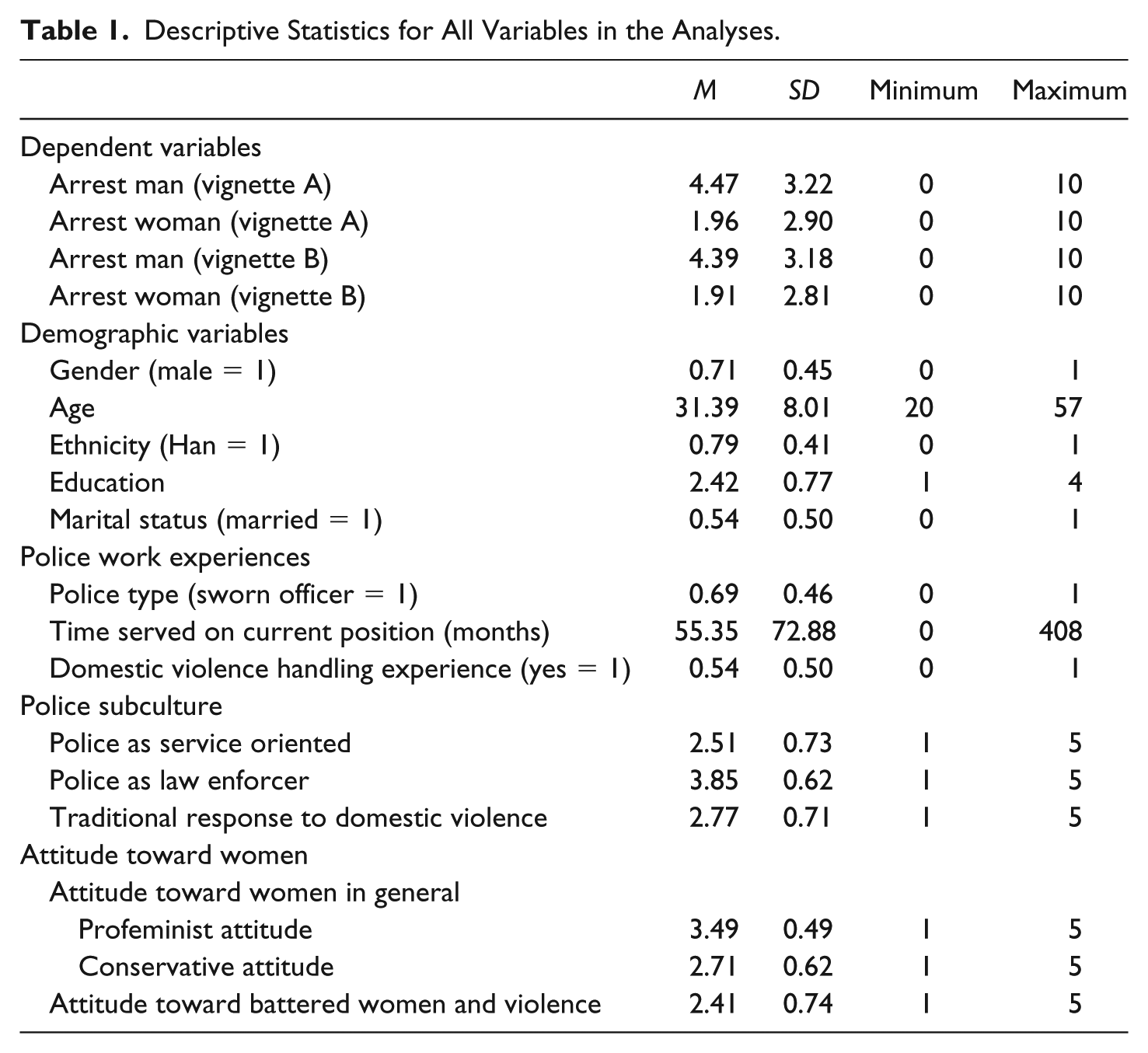
The descriptive statistics for all variables show that the vast majority of the respondents are male officers (71%) of Han nationality (79%), married (54%), and college-educated (53.4%). The average age of the officers is 31 years. Most of the respondents are sworn officers (69%) with some experience in handling domestic violence cases (54%). The mean time served on the current position is 55 months (around 4½ years). Most officers agreed that the main task of the police was to strictly enforce the law (3.85 out of 5), while fewer officers believed that providing services to the local residents and community was the main task of the police (2.51 out of 5). Some officers still support traditional police responses and consider domestic violence a private matter (with a rating of 2.77 out of 5). Moreover, most officers embrace profeminist attitudes toward women. The mean scores for officer profeminist attitude and conservative attitude are 3.49 and 2.71 (out of 5), respectively. The mean score for attitudes toward battered women and violence is 2.41 (out of 5) (see Table 1).
Descriptive Statistics for All Variables in the Analyses.
The police officers were asked to rate their tendency to arrest either the man or the woman in each vignette. They were also asked to rate their tendency to respond in other ways, such as warning the offender, mediating, and conveying understanding to the victim. The results show that the police officers are most likely to inform women of their legal and personal rights and mediate (more than 7 out of 10), followed by a warning to the man or possible arrest, and conveying understanding to women (more than 6 out of 10). On average, the tendency to arrest the male offender (4.47 out of 10) was not as high as the tendency to mediate and warn the man of a possible arrest. Some officers chose to discourage women from seeking an arrest (4.14 out 10). The results tentatively indicate that arresting the male is not the most common solution resorted to by the Chinese officers handling domestic violence cases. Most chose mediation, conveying understanding, and warning the men involved of possible arrest. The results of Pearson’s correlations and paired sample t tests show the officers’ responses to vignettes A and B to be quite similar (see Table 2).
Comparisons of Responses to Vignettes A and B.
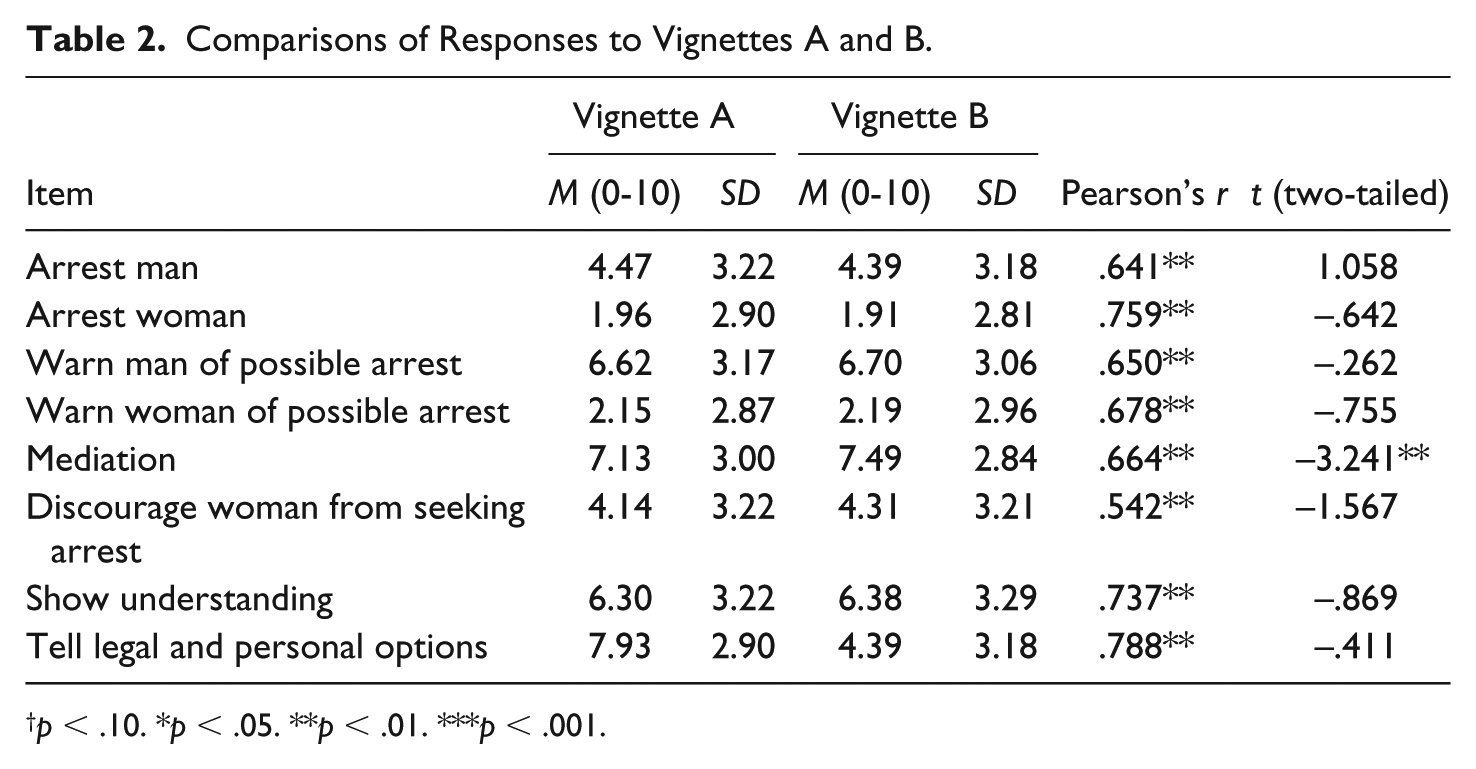
p < .10. *p < .05. **p < .01. ***p < .001.
The results of a binary logistic regression on arresting the male offender reveal that a profeminist attitude is the strongest predictor of officer tendency to opt for arresting the male offender, followed by traditional responses to domestic violence, and police role as a law enforcer (see Table 3). Specifically, officers who reported stronger profeminist attitudes were more likely to opt for arresting the male offender (for both vignettes) than those who were less supportive of gender equality (vignette A: odds ratio [OR] = 2.058, p < .01; vignette B: OR = 1.878, p < .05). The officers who primarily perceived their role as that of a law enforcer were more likely to opt for arresting the male offender (vignette B: OR = 1.446, p < .05), while those who regarded domestic violence as a private family matter tended not to opt for arresting the male offender (vignette B: OR = 0.491, p < .001). In addition, highly educated officers were less likely to opt for arresting the male offender compared with the less educated officers (vignette B: OR = 0.533, p < .01).
Logistic Regression Result on Arrest of Male Party.

Note. CI = confidence interval; DV = domestic violence.
p < .10. *p < .05. **p < .01. ***p < .001.
The logistic regression results of arresting the female party involved in the domestic violence cases show that the belief in the role of a law enforcer is the strongest predictor of the officer tendency to opt for arresting the female party, followed by two demographic variables, namely, education and age (see Table 4). Specifically, officers who viewed their role as that of a law enforcer were more likely to opt for arresting the female party (vignette A: OR = 1.648, p < .10; vignette B: OR = 2.843, p < .001), while the more highly educated officers were less likely to opt for arresting the female party in both vignettes (vignettes A: OR = 0.574, p < .10; vignettes B: OR = 0.454, p < .05). Older officers were more likely to opt for arresting the female party in vignette A (OR = 1.068, p < .05).
Logistic Regression Result on Arrest of Female Party.
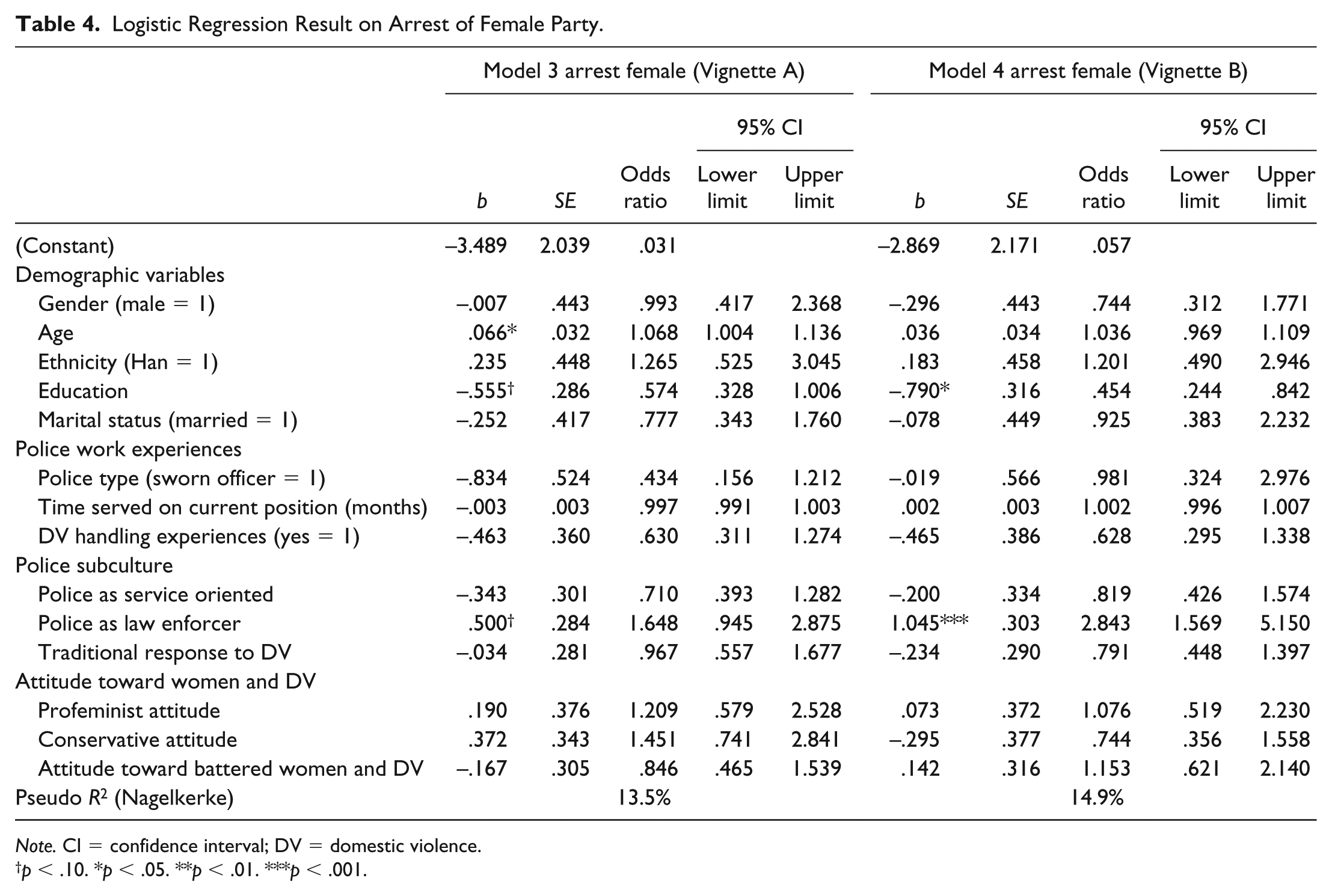
Note. CI = confidence interval; DV = domestic violence.
p < .10. *p < .05. **p < .01. ***p < .001.
Discussion and Conclusion
The present study examined police officer tendency to respond to the cases of domestic violence by arresting the male or female party involved, providing mediation, or legal or personal advice. This study is among the first to explore police officer attitudes and tendency to respond to domestic violence in the Chinese context. The results reveal that, unlike their Western counterparts who are increasingly resorting to arrest, which has in some cases even become a mandatory strategy in handling domestic violence (Eitle, 2005; Hirschel, Buzawa, Pattavina, & Faggiani, 2007), arresting domestic violence offenders is not the first option resorted to by the Chinese officers. Rather, they prefer less aggressive methods such as mediating the cases, informing the victim of their legal rights, conveying understanding to the victim, or warning the offender of a possible arrest.
To a certain extent, the findings are consistent with those of Saunders (1995), who made use of the same vignettes in rating officer responses. Specifically, Chinese police officers showed a similar tendency to warn the man or woman involved of possible arrest (around 22% among Chinese officers for both vignettes as opposed to 6% and 22% among American officers for the two vignettes) and to arrest the male offenders (around 44% among Chinese officers for both vignettes as opposed to 35% to 51% among American officers). A significant difference lies in the use of mediation. Apparently, Chinese officers were more inclined to mediate the cases involving domestic violence (around 73% among Chinese officers for both vignettes as opposed to 47% and 63% among American officers; see Saunders, 1995). In addition, Chinese officers showed a higher level of inclination to discourage women from seeking arrest (around 41% among Chinese officers as opposed to 11.9% and 15.2% among American officers) and to arrest the woman involved in the two vignette scenarios (around 20% among Chinese officers as opposed to 1.5% and 10.6% among American officers). It should be noted that Saunders’ study was conducted more than 20 years ago. It is thus likely that the differences in the findings between the two studies are greater as a result of the increased awareness of gender equity and negative consequences of domestic violence in the United States over the years.
The results of the logistic regression analyses further reveal that officer tendency to arrest male offenders are significantly related to their profeminist attitudes, their view on traditional responses to domestic violence, and their view on the role of the police as a law enforcer. The tendency to arrest female victims is significantly related to officer view on their role as law enforcer. The main findings are consistent with previous studies in that officers who were more likely to opt for arresting the male offender were found to hold more profeminist attitudes toward women (Saunders, 1995; Stith, 1990; Tam & Tang, 2005; Tang, 2003), while officers more likely to arrest the female victim were more likely to stress the police role as a law enforcer (Balenovich et al., 2008; Saunders, 1995).
None of the variables related to officer working experiences shows a significant impact on their tendency to make an arrest. A possible explanation for the nonsignificant effect of police working experiences probably lies in the fact that most officers, no matter what their experiences are, prefer less aggressive ways of handling domestic incidents. In-depth interviews with the police officers and their administrators reveal that the police officers received no systematic training on handling cases of domestic violence. Further descriptive analysis suggests that the vast majority of the officers (83.4%) do not believe or are unsure of whether arresting the offender is the best way of solving domestic issues. In addition, 64% of auxiliary police had experience handling domestic violence incidents, as opposed to only 49% of sworn officers. An important issue arising from these findings is that domestic violence has not been in the focus of police work or that it has not been dealt with as a crime. In spite of the increasing international awareness of women’s status and victim protection (Lin et al., 2016), many officers, especially the ones from the underdeveloped southern area of China, still considered domestic violence to be a private family matter. This may be explained by the Chinese traditional view of women as well as traditional ways of handling family matters.
Traditional Confucianism emphasizes social harmony, a society without lawsuits (Chia, 2012; Liu & Palermo, 2009). Criminal justice involvement is often treated with suspicion, as it is confrontational in nature (Chia, 2012). This holds especially true for the cases of domestic violence due to the persisting traditional notions of gender roles in the Chinese culture. The woman’s role is thus that of a good daughter, wife, and mother, who shows obedience, loyalty, and devotion to her father, husband, and sons. The qualities of a woman are fidelity, her physical charm, propriety in speech, and efficiency in needlework (i.e., “three types of obedience and four virtues” of women, see also Chu & Sun, 2014; Gallin, 1992). The fact that women were traditionally considered to be the property of men justifies violence to a certain extent committed by a man in the family. Previous research provided evidence showing the relationship between the women’s low social status and family violence against women. For example, Anagnost (1988) analyzed cases involving women who committed suicide due to not giving birth to boys and suffering long-term family violence as a result, which still occurs even today. In spite of the increasing social status of women over the past decades and the efforts made by the Chinese government to pass the Anti-Domestic Violence Law in 2015, traditional patriarchal ideology may still linger deep in the Chinese culture. Officer perceptions of their roles and responses to domestic violence may intertwine with the patriarchal ideology and the submissive role of women (Chu & Sun, 2014).
The finding that both male and female officers prefer mediation is in line with the traditional way of approaching minor criminal offenses in China. Mediation in handling minor or criminal cases has a long history in China (Liu & Palermo, 2009). The general guidelines for mediation include following the law and published policies, as well as social mores and ethics if there are no existing laws or policies (Liu & Palermo, 2009). Domestic violence is often considered a family matter and as such minor. It is, therefore, not surprising that police officers choose mediation as their preferred method of responding to domestic violence cases.
Finally, more highly educated officers tend to arrest fewer male and female parties involved in domestic violence. The finding is consistent with some earlier Western studies (Rydberg & Terrill, 2010). It is theorized that less educated officers would be more likely to make an arrest because they experience more satisfaction with police work. Previous studies produced mixed results in terms of the relationship between the officer education level and the likelihood of arrest (for a comprehensive review, see Rydberg & Terrill, 2010).
The present study highlights the importance of police attitudes toward women and police subculture in officer perceptions and responses to domestic violence. Improving knowledge about police attitudes toward domestic violence can help inform future policy, practice implementation, and training programs (McPhedran, Gover, & Mazerolle, 2017). China’s first Anti-Domestic Violence Law has been in effect since March 2016. The Law has introduced a broad range of measures drawing on Western societies, such as restraining orders. It represents a great advancement in curbing domestic violence and the protection of victims. In spite of detailed stipulations on handling cases, police officers are granted great discretionary powers in deciding on the appropriate responses to domestic violence. The fundamental challenge arguably lies in changing attitudes toward domestic violence. Systematic training and education should be provided to officers who handle domestic cases to reduce the impact of traditional patriarchal ideology and better to protect victims of domestic violence.
The study has several limitations which limit generalization of the findings. First, the data were collected before the Anti-Domestic Violence Law came into effect. Legal or policy changes may lead, however, to changes in police officer perceptions and responses to domestic violence (Friday, Metzgar, & Walters, 1991; Hirschel et al., 2007). A further study could examine attitudinal changes among police officers. Second, another variable that may require further attention is the police officers’ personal experience of domestic violence. Arguably, those who have personally experienced domestic violence may respond to domestic cases differently. Third, although the findings are informative, they describe only tendencies to respond to domestic violence. Actual police responses may differ from the reported responses to vignette scenarios (Saunders, 1995). Future research should take all these into consideration and measure police responses with self-report surveys in tandem with field observations.
Footnotes
Declaration of Conflicting Interests
The author(s) declared no potential conflicts of interest with respect to the research, authorship, and/or publication of this article.
Funding
The data utilized in this study were part of a project (MYRG2018-00094-FSS) funded by University of Macau.
