




Abstract
Sex differences in child abuse and neglect (CAN) have long interested researchers due to their adverse impact. Cognitive appraisal of CAN may also affect the negative consequences. The purpose of this study was to assess sex differences in (a) the experience and (b) the cognitive appraisal of CAN among 247 Israeli inmates. The findings indicated that female inmates experienced higher rates of total CAN than male inmates. No significant sex differences were found in physical abuse, emotional neglect, or cognitive appraisal of CAN. However, there were significant sex differences in ranking the significance of different dimensions of cognitive appraisal of CAN. Paternal partner violence was a predictor of CAN and its cognitive appraisal for both sexes; maternal partner violence was a predictor of both among female inmates only. Even when male and female inmates share similar family risk factors, their effects may differ by sex. Possible clinical implications are discussed.
Research has shown that incarcerated individuals have experienced significantly higher rates of child abuse and neglect (CAN) compared with the general population (K. Williams, Papadopoulou, & Booth, 2012). Some studies found no significant sex differences in the experience of different types of CAN, with the exception of child sexual abuse (CSA; Kang, Deren, & Goldstein, 2002). In others, the female inmates reported a history of CSA more frequently than their male counterparts, and male inmates reported physical abuse more frequently than female inmates did (Carlson, Shafer, & Duffee, 2010). In general, the results of research on sex differences in CAN have been mixed and inconsistent. Moreover, most of the studies to date have focused on the effects of CSA and physical abuse, and not on the multiple forms of CAN, or on nonincarcerated samples (Asscher, Van der Put, & Stams, 2015; Kelley et al., 2010).
The experience of CAN has a lingering effect and is a risk factor for mental health problems and future involvement in criminal behaviors. In her study of the cycle of violence, Widom (1989) highlighted the relationship between exposure to physical abuse and neglect and future violent offending. Research on the negative consequences of CAN among inmates has shown that those who experienced various forms of CAN are much more likely to become substance misusers (Wolff & Shi, 2012), suffer from severe psychiatric problems (Tripodi & Pettus-Davis, 2013), and engage in violent and criminal behavior (Neller, Denney, Pietz, & Thomlinson, 2006) than those who did not. Nevertheless, studies on the differential effects of CAN on both sexes are inconsistent (George, 2012), and it also remains uncertain whether exposure to various forms of CAN affects female and male inmates differently with respect to crime, substance misuse, or mental health disorders (Forsythe & Adams, 2009).
One factor that might also affect the consequences of CAN is the victim’s perception or cognitive appraisal of abuse-related experiences (Merrill, Thomsen, Sinclair, Gold, & Milner, 2001). Survivors who do not view their experiences of abuse as negative may be less likely to seek help, despite deleterious outcomes (Steever, Follette, & Naugle, 2001). However, there have been relatively few studies on sex differences in the cognitive appraisal of CAN and the results have been mixed (Fondacaro & Holt, 1999; Kucharska, 2017). Moreover, most studies of these subjects have concentrated on the effect of either abusive experiences or the cognitive appraisal of CAN, but not on their combined effect. To the best of our knowledge, this is the first study to assess sex differences in both abusive experiences in childhood and the cognitive appraisals of these experiences, as well as their combined effect, which may be an important step toward understanding the variance in adverse outcomes among both sexes and may have significant clinical implications. In light of the above, the first goal of the current study was to assess sex differences in the experience of CAN among inmates, and the second was to examine sex differences in the cognitive appraisal of CAN.
Adverse Childhood Experiences Among Prison Inmates
Previous studies have shown that adverse childhood events (ACEs) are a complex set of highly interrelated and cumulative experiences that may include CAN, as well as family dysfunction, such as an incarcerated, mentally ill, or substance-abusing family member, intimate partner violence (IPV), or absence of a parent because of divorce or separation (Dong et al., 2003). The results of a recent study conducted by McLaughlin et al. (2010) among women and men in the general population showed that exposure to ACEs involving maladaptive family functioning, such as parental mental illness, substance use disorders (SUDs), delinquency, family violence, physical and sexual abuse, and neglect, were significantly associated with persistence of psychiatric disorders, and these associations remained statistically significant throughout the life course.
There is evidence to suggest that incarcerated women and men frequently come from dysfunctional families in which one or more members misused drugs or alcohol and/or engaged in criminal activities (Altintas & Bilici, 2018; Chen & Gueta, 2016a), or families prone to IPV and family maltreatment (Eriksson & Mazerolle, 2014). Furthermore, there is a wealth of information that supports the notion that conditions such as family mental health problems, substance misuse, and crime are related to family violence, in general, and to multiple forms of abuse during childhood, in particular (Altintas & Bilici, 2018; Kim-Cohen, Caspi, Rutter, Tomas, & Moffitt, 2006). Moreover, research has revealed significant sex differences in exposure and responses to childhood adversity (Javidi & Yadollahie, 2012; Wolff, Shi, & Siegel, 2009). There are also sex differences in the types and number of traumas to which they are exposed. Bassett (2013) found that multiple types of ACEs were more prevalent among female than male delinquent youth, with the former experiencing 7.3 types and the latter, an average of 6 types of ACE, exposing them to increased risk of developing psychiatric and SUDs.
Sex Differences in CAN Among Inmates
Despite the evidence of significantly higher rates of CAN among incarcerated people than others (Levenson, Willis, & Prescott, 2016; Messina, Grella, Burdon, & Prendergast, 2007; K. Williams et al., 2012), the research results on sex differences in the experience of CAN have been inconsistent, as mentioned above. Furthermore, research has shown that inmates differ by sex in the extent of their exposure to certain risk factors, such as IPV, CAN, and mental health problems in their families (Belknap & Holsinger, 2006). Specifically, it has been found that female inmates are influenced by childhood victimization and a negative family environment more than their male counterparts are (Chen & Gueta, 2016a). For instance, Widom and White (1997) found that abused and neglected women, but not men, were at significantly higher risk for SUDs than their nonabused counterparts. Furthermore, researchers have reported that the outcomes of maltreatment, such as trauma, play a greater role in the development of criminal behavior among women than men (Foy, Ritchie, & Conway, 2012; Hipwell & Loeber, 2006). For example, research in Japan revealed stronger associations of psychiatric disorders, drug offenses, and violent crimes with a childhood history of sexual or physical abuse among women than men in the general population (Fujiwara, Okuyama, Izumi, & Osada, 2010).
CAN is associated with others forms of family violence in childhood. As mentioned above, CAN and IPV are especially widespread in families characterized by certain risk factors, such as difficult living conditions, addictions, criminal behavior, mental health difficulties, and others (Dong et al., 2004). In a systematic review of 10 scientific articles published between 2003 and 2013, Bidarra, Lessard, and Dumont (2016) found a 12% to 70% prevalence of co-occurrence of IPV with sexual abuse and other maltreatment. The review also indicated that children are at greater risk of being victims of sexual abuse or suffering other maltreatment when exposed to IPV. Its effects include criminal offending, violent crimes, mental health problems, and substance misuse (Finkelhor, Ormrod, & Turner, 2007).
Sex Differences in the Cognitive Appraisal of CAN
Cognitive appraisal of abuse-related experiences, which may affect the consequences of CAN, involve an individual’s perception, interpretation, and evaluation of experiences, which are all important in determining psychobiological responses to stressful events (Lazarus & Folkman, 1984). Cognitive theories of stress are based on the assumption that the psychopathological reaction to stress is influenced not only by the severity of the potentially traumatic event, but also by the biased cognitive appraisals of the event (Brewin & Holmes, 2003). Spaccarelli (1994) argued that cognitive appraisals and coping responses mediate the stress resulting from CSA. He hypothesized the potential role of cognitive appraisals, such as perceived threat of physical harm and negative self-evaluation, in the development of symptomatic outcomes for the abused child. Specifically, he suggested that perceptions of abusive experiences may impact psychological functioning and social interactions.
Offenders often refrain from reporting a history of sexual abuse. Studies have indicated that 40% of randomly selected male inmates met the criteria for being defined as victims of sexual abuse; however, of these, 41% did not consider themselves to have been sexually abused (Fondacaro et al., 1999). Societal influences and the process of men’s gender socialization may make men reluctant to see themselves as “victims” or as less dominant in their sexual experiences (Romano & De Luca, 2001); this may be especially true for men in correctional institutions (Hensley, Castle, & Tewksbury, 2003). However, Gagnier and Collin-Vézina (2016) found that concerns about being labeled as unmanly, homosexual, or responsible for their own abuse were sociocultural barriers to disclosure of abusive experiences among men in the general population in Canada. In another study of women and men navy recruits in United States, Stander, Olson, and Merrill (2002) found that women defined abusive childhood sexual experiences (CSE) as CSA three times more often than men, and men were less likely than women to acknowledge abuse and to report CSE. These differences between female and male survivors in the general population may lead men to normalize their experience of CSA and inhibit self-disclosure (Andersen, 2013), which are crucial barriers to recovery from trauma and may have significant clinical implications (Steever et al., 2001).
The Present Study
Due to the mixed and inconsistent results regarding sex differences in the experience and the cognitive appraisal of CAN, many questions remain unanswered regarding their negative effects. The purpose of this study was twofold: to assess sex differences (a) in the experience of CAN and (b) in the cognitive appraisal of CAN. We focused specifically on three research questions:
Method
Participants
The original sample comprised 290 Israeli prison inmates (65 women and 225 men). Totally, 25 participants (eight women and 17 men) were excluded because they did not have a history of CAN. About 18 participants (10 women and eight men) failed to answer the CAN questionnaire. Thus, the final sample comprised 247 Israeli prison inmates (49 women and 198 men) with a history of CAN. The participants were recruited from seven of Israel’s state penitentiaries (maximum- and medium-security prisons); six were prisons for men and the other one was the only women’s prison in Israel (housing approximately 170 women). The majority of the male inmates were single (45.7%), and their mean age was approximately 38 (SD = 13.22). The majority of the female inmates were divorced (40.9%), and their mean age was approximately 38 (SD = 11.75). Power analysis was conducted with G*Power. For a general analysis of variance with two groups, low to moderate effect size 0.20, α = .05, and power = 0.85, the required sample size is 228 participants. For a multiple hierarchical regression analysis with nine predictors groups, low to moderate effect size 0.10, α = .05, and power = 0.85, the required sample size is 184 participants.
Procedures
The Committee of the Israel Prison Service (IPS) and the relevant university approved the current research. Social workers from the seven prisons first asked inmates whether they were willing to participate in a study. Participants signed an informed consent form provided by the IPS, including a declaration of voluntary agreement to participate and acknowledgment that they could withdraw at any time. The researchers then approached a convenience sample of 247 inmates and informed them of the purpose of the research.
Measures and Variables
Participant’s background questionnaire
A self-report questionnaire was used to obtain data including (a) sociodemographic characteristics of the participants, such as education and marital status and the like, and (b) family history of crime (0—no, 1—yes), and substance abuse of family members (0—no, 1—yes).
The Childhood Trauma Questionnaire (CTQ)
We used Bernstein et al.’s (1994) CTQ to assess histories of childhood abuse. This self-report is a 28-item test that measures five types of maltreatment: emotional, physical, and sexual abuse and emotional and physical neglect. The items are rated on a 5-point Likert-type scale according to the frequency of such experiences, ranging from 1 = never true to 5 = very often true. The total score is based on the cumulative frequency of childhood victimization. In the present study, internal consistency of α = .90 was found for physical abuse, α = .81 for emotional abuse, α = .95 for sexual abuse, α = .81 for emotional neglect, and α = .91 for the total score. Physical neglect was removed due to low internal consistency (α = .52).
The Cognitive Appraisal Questionnaire of Child Abuse and Neglect (CAQCA)
The researchers designed a 20-item self-report scale to assess the cognitive appraisal of personal abuse experiences (Supplemental Matrial). The questionnaire also includes indirect (i.e., structured projective) questioning (4, 8, 13, 14, 18, 21) to reduce social desirability bias or inability to report accurately on sensitive topics. For example, “I think that parents neglect children who are not loved by the family.” In addition, the questionnaire includes five reversed-code items (1, 5, 9, 11, 16) to detect socially desirable responses or false-negative trauma. For example, “I think my family has been a source of warmth, love, and support.” The 20 original items were scored on a 7-point Likert-type response option scale ranging from 1 = strongly disagree to 7 = strongly agree. Higher scores represent a higher perception of CAN and of the impact of CAN.
Factor analysis with oblique rotation revealed four meaningful factors. The first was composed mainly of items pertaining to the perception of physical and emotional neglect, with Eigenvalue = 5.16, 25.78% of the explained variance, item loadings .47 to .68, and Cronbach’s α = .68 (Items: 8, 10, 15, 17, 23). The second factor was composed of items pertaining to the perception of family malfunctioning and lack of support, with Eigenvalue = 3.05, 15.23% of the explained variance, item loadings .59 to .85, and Cronbach’s α = .85 (Items: 1, 5, 9, 11, 16). The third and fourth factors were composed of items pertaining to the perception of the abuse, with no apparent content-related distinction between them, Eigenvalue third factor = 1.49, 7.44% of the explained variance, and Eigenvalue forth factor = 1.25, 6.23% of the explained variance. Item loadings were .41 to .81, and Cronbach’s α for the combined measure was .78 (Items: 4, 6, 7, 13, 14, 18, 20, 21, 22, 25). The total score for the CAQCA scale was α = .84.
Revised Conflict Tactics Scale for measuring IPV (CTS2)
In the present study, we used a short self-report form, a 14-item test that measures the parents of the respondent’s levels of physical assault (we used the term “parental partner violence” or parental IPV instead of IPV; Straus, Hamby, Boney-McCoy, & Sugarman, 1996). The items are rated on a 7-point Likert-type scale according to the frequency of the given parent committing the physical assault, ranging from 1 = happened almost every day to 7 = never happened before/at all. The total CTS2 score is based on the cumulative frequency of IPV. The CTS2 has demonstrated high internal consistency and reliability ranges from .79 to .95 (Straus et al., 1996). In the present study, internal consistency of α = .96 was found for paternal partner violence and α = .98 for maternal partner violence. The scale score was computed from item means with a higher score, representing more violence between parents. About 50% of the cases represented paternal IPV and 30% of cases represented maternal IPV. The scale score was thus dichotomized (0, 1), representing the existence/nonexistence of paternal or maternal partner violence.
Analytic Procedures
The analysis began with examination of the distributions of CAN and cognitive appraisal of CAN and performance of logarithmic transformations due to nonnormal distributions. Descriptive statistics were calculated. We then conducted two multivariate analyses of variance (MANOVAs) to examine sex differences in CAN and the cognitive appraisal of CAN. We employed hierarchical multiple regressions analyses to examine the predictions of CAN and cognitive appraisal of CAN. The interactions of sex with family background variables (crime, substance misuse, and parental IPV) were entered in a stepwise manner in a separate final step of the regressions, to minimize the risk of confounding variables. Simple slopes analysis was used to interpret the significant interactions. This method is used to examine interaction effects by looking at the effects of an independent variable on the dependent variable within levels of another independent variable (Aiken & West, 1991; Dawson, 2014). The significance level was set at p < .05.
Results
Preliminary Results
Child abuse and neglect
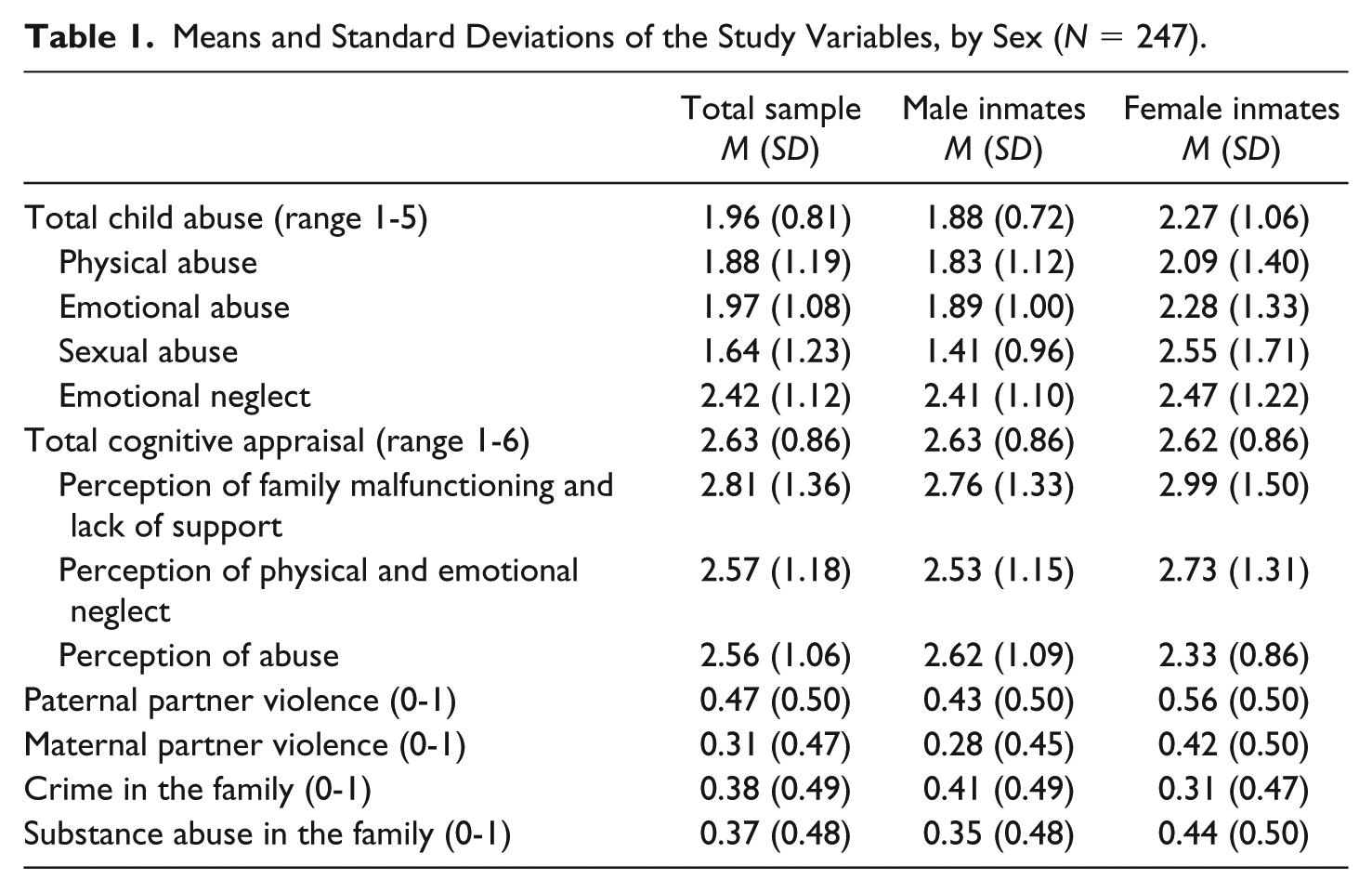
Any positive value on the subscales of CAN was regarded as indicating the existence of abuse. Female inmates reported emotional abuse (67.3%), sexual abuse (57.1%), physical abuse (61.2%), and emotional neglect (85.7%); male inmates reported emotional abuse (67.7%), sexual abuse (24.7%), physical abuse (55.5%), and emotional neglect (87.4%).
Family background variables
Crime
Among the female inmates, 15 (30.6%) reported crime in the family, including mainly drug dealing (9; 18.4%), property offenses (3; 6.1%), and robbery (4; 8.2%); 69 (40.6%) of male inmates reported crime in the family including drug dealing (31; 18.2%), property offenses (31; 18.2%), and robbery (13; 7.6%).
Substance misuse
Among female inmates, 20 (44.4%) reported substance abuse in their families, most of them (14; 31.1%) alcoholism; 56 (34.8%) of male inmates reported substance abuse in the family; and most of them (33; 20.5%) of drug misuse.
Parental partner violence
About 48 female inmates reported parental partner violence on this dichotomous scale (0—no, 1—yes). Around 17 of the inmates (35.4%) reported both maternal and paternal partner violence; 10 (20.8%) reported only paternal partner violence; 3 (6.3%) reported only maternal partner violence; and 18 (37.5%) did not report any parental partner violence. Male inmates also reported parental partner violence (n = 134); 33 of them (24.6%) reported both maternal and paternal partner violence; 25 (18.7%) reported only paternal partner violence; 4 (3.0%) reported only maternal partner violence; and 72 (53.7%) did not report any parental partner violence.
The distribution of the study variables reveals rather low means for CAN, except for emotional abuse, which was somewhat higher than others. The cognitive appraisal of CAN was also below mid-scale (see Table 1).
Means and Standard Deviations of the Study Variables, by Sex (N = 247).
RQ1: Are There Sex Differences in the Experience of Various Forms of CAN?
To address RQ1, we performed MANOVA for sex differences in the experience of various forms of CAN (see Table 2). Type III sums of squares were used to correct for the unequal group sizes. The raw scores are presented in the table; the calculations were conducted with the transformed variables. In addition, the Box test for equality of covariance matrices was found significant, Box M = 25.82, F(10, 34,231.33) = 2.50, p = .005, but removing sexual abuse from the equation resulted in a nonsignificant outcome, Box M = 5.14, F(6, 44,596.51) = 0.84, p = .541, revealing that the observed covariance matrices of the dependent variables were equal across groups. Therefore, the results pertaining to sexual abuse should be interpreted with caution.
Means, Standard Deviations and F Values for Child Abuse and Neglect by Sex (N = 247).
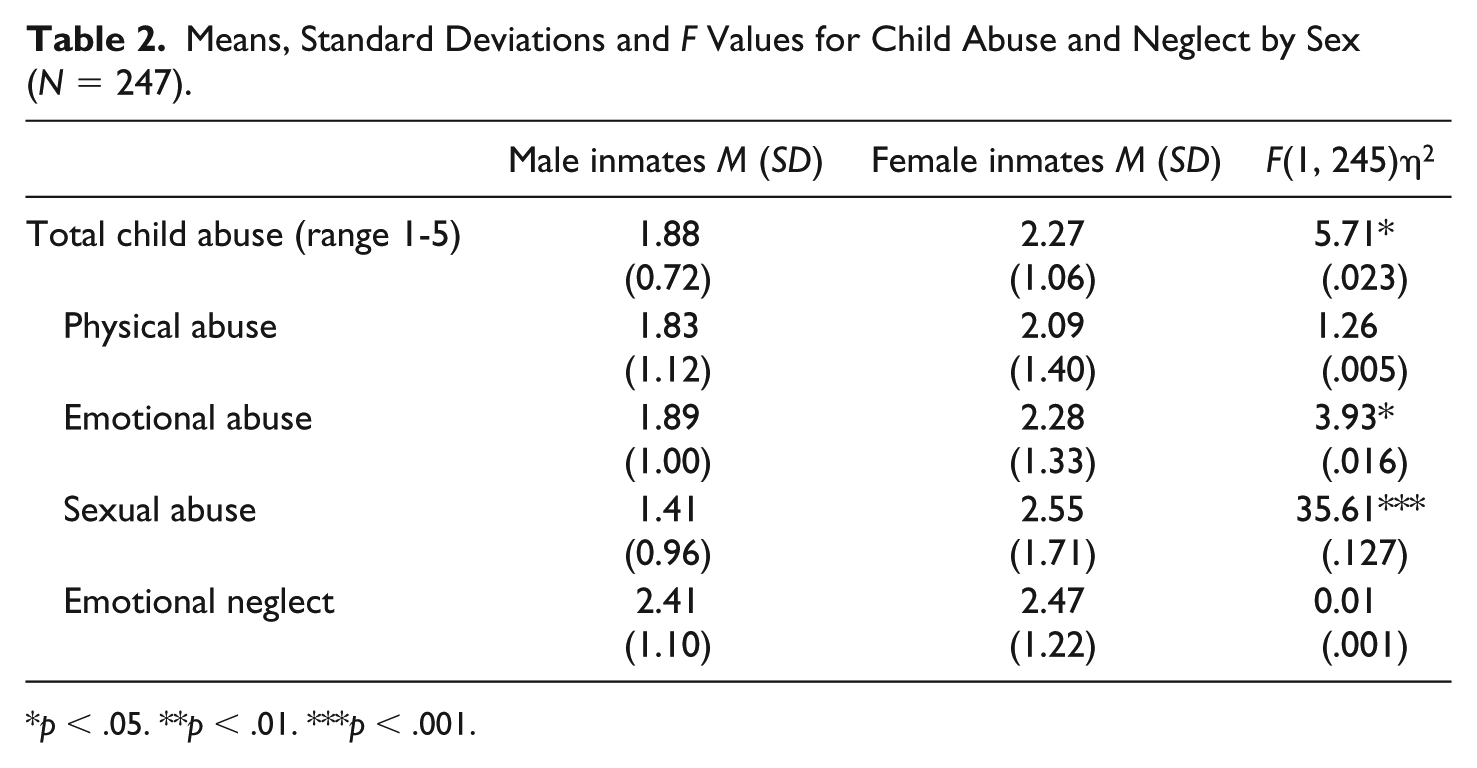
p < .05. **p < .01. ***p < .001.
The findings indicated significant sex differences in CAN, with female inmates reporting higher rates of total CAN, emotional abuse, and sexual abuse. No significant sex differences were found in physical abuse and emotional neglect. Looking at the existence of CAN dichotomously (existing/nonexistent), it was found that among the male inmates, emotional neglect was more prevalent than emotional abuse, and emotional abuse was more prevalent than physical abuse. All types were more prevalent than sexual abuse for both male, χ2(3) = 189.03, p < .001, and female inmates, χ2(3) = 14.81, p = .002.
In addition, sex differences were found in ranking the types of abuse, F(3, 735) = 11.98, p < .001, η2 = .047. For male inmates, emotional neglect was highest. It was ranked higher than physical abuse and emotional abuse (p < .001), and all were higher than sexual abuse (p < .001). For female inmates, emotional neglect, emotional abuse, and sexual abuse were higher than physical abuse (p < .05).
RQ2: Are There Sex Differences in the Cognitive Appraisal of CAN?
To address RQ2, we performed MANOVA for sex differences in the cognitive appraisal of CAN (see Table 3). Type III sums of squares were used to correct for the unequal group sizes. A Box test for equality of covariance matrices was found nonsignificant, Box M = 8.78, F(6, 38,834.28) = 1.43, p = .200.
Means, Standard Deviations and F Values for the Cognitive Appraisal of Child Abuse and Neglect by Sex (N = 242).

The findings indicated no significant sex differences in the cognitive appraisal of any dimension of CAN. However, sex differences were found in ranking the significance of the dimensions of the cognitive appraisal of CAN, F(2, 480) = 3.31, p = .045, η2 = .014. The male inmates ranked the perception of family malfunctioning and lack of support higher than neglect (p = .042 and p = .025, respectively). The perception of abuse was in between them, with no significant sex difference. The female inmates ranked the perception of family malfunctioning and lack of support higher than abuse (p = .012), and the perception of neglect was in between them, with no significant difference.
We also looked at the correlations between CAN and cognitive appraisal, to assess whether they were interrelated or independent of each other. The total score of CAN was positively correlated with the total score of the cognitive appraisal of CAN (r = .61, p < .001). All the other correlations were positive and significant, as well (see Table 4).
Pearson Correlations Between CAN and the Cognitive Appraisal of CAN (N = 242).

Note. CAN = Child Abuse and Neglect.
p < .05. **p < .01. ***p < .001.
RQ3: Does Sex Moderate the Relationships Between Family Background Characteristics (Crime, Substance Misuse, and Parental IPV), CAN, and the Cognitive Appraisal of CAN?
To address RQ3, we performed two hierarchical multiple regression analyses for the predictions of CAN and the cognitive appraisal of CAN (see Table 5). These regression analyses allowed us to assess the multivariate relationships between family background characteristics, CAN, and cognitive appraisal of CAN. They also enabled assessment of the effects of the interactions between sex and family background characteristics. In Step 1 of each regression, we entered sex (0—female, 1—male) as the basic group variable of the study, and in Step 2, we entered the main predictors, namely, the family background variables. Step 3 included the interactions of sex with the predictors. These were entered in a stepwise manner, so that only the significant predictors were included, to avoid confounding variables.
Multiple Regressions: CAN and Cognitive Appraisal of CAN, by Family Background Characteristics (Crime, Substance Abuse, and IPV).

Note. CAN = Child Abuse and Neglect; IPV = intimate partner violence.
p < .05. **p < .01. ***p < .001.
Regarding CAN and the cognitive appraisal of CAN, both dependent variables were log transformed to achieve a normal distribution. The intercorrelations among the predictors ranged between r = -.15 (p = .040) and r = .52 (p < .001). Regarding CAN, the maximum Variance inflation factor (VIF) was 1.73, and the maximum condition index was 6.10; regarding the cognitive appraisal of CAN, the maximum VIF was 1.72, and the maximum condition index was 6.00, thus indicating no multicollinearity.
The regression model for the total child abuse score revealed that about 18% of the variance was explained by the study variables. Sex was not found significant. Paternal partner violence emerged as a significant predictor of CAN. The significant interaction of sex with crime in the family of origin was analyzed with simple slopes. The slope for female inmates was significant (B = 0.24, t = 1.98, p = .049); the slope for male inmates was nonsignificant (B = −0.02, t = −0.26, p = .793). In other words, crime in the family was found to be a significant predictor of CAN among female but not male inmates.
The regression model for the total cognitive appraisal of CAN score revealed that about 9% of the variance was explained by the study variables. Paternal partner violence was found to be a significant main effect predictor of the cognitive appraisal of CAN. In addition, the significant interaction of sex with maternal partner violence was analyzed with simple slopes. The slope for the female inmates was found to be significant (B = 0.27, t = 2.50, p = .014); the slope for the male inmates was nonsignificant (B = 0.02, t = 0.29, p = .775). In other words, the maternal partner violence was a significant predictor of cognitive appraisal of CAN among female but not male inmates.
Discussion
Sex Differences in the Experience of CAN
The findings indicated higher rates of experiencing various types of CAN among female inmates relative to their male counterparts. The female inmates reported higher rates of total childhood abuse, emotional abuse, and sexual abuse. No significant sex differences were found in physical abuse or emotional neglect. Nevertheless, a high prevalence of CAN was also found among the male inmates, with emotional neglect more prevalent than physical, emotional, or sexual abuse. Our research results supported those of previous research (Chen & Gueta, 2016a).
Another finding of this study concerns sex differences in ranking the significance of the dimensions of CAN. Male inmates ranked emotional neglect highest. It was higher than physical and emotional abuse, and all were higher than sexual abuse. Female inmates ranked emotional neglect, emotional abuse, and sexual abuse as higher than physical abuse. Similarly, previous studies have found that emotional neglect was more prevalent than physical, emotional, or sexual abuse among male inmates (Chen & Gueta, 2016b) and the most prevalent type of child abuse among men in the general population (Finkelhor, Turner, Shattuck, & Hamby, 2013). Emotional neglect represents a dysfunction of the protective parental relationship and is the most prevalent form of child maltreatment (Cohen, Menon, Shorey, Lec, & Temple, 2017). Emotional neglect is a major risk factor for mental health problems (Norman et al., 2012), violence (Chapple, Tyler, & Bersani, 2005), and substance misuse (Jewkes, Dunkle, Nduna, Jama, & Puren, 2010). Moreover, Lee and Hoaken (2007) argued that the effects of emotional neglect are far more dramatic than those of physical abuse. Although neglect is less studied than abuse, results of the limited research available suggest that, similar to abuse, neglect is associated with the development of severe behavioral problems. For example, boys who were victims of child neglect were convicted for offending four times more often than those who were not (Kazemian, Widom, & Farrington, 2011).
With regard to sex differences in the prevalence of CSA, previous studies indicated, similar to our results, that female inmates reported a history of sexual abuse more frequently than their male counterparts (Carlson et al., 2010; Drapalski, Youman, Stuewig, & Tangney, 2009). Sundaram, Laursen, and Helweg-Larsen (2008) explained that the different prevalence rates might be the result of underreporting of sexual abuse by men in the general population in Denmark. The underreporting of sexual abuse by men has been explained by societal influences, including shame about their perceived lack of power and masculinity and fear of being labeled homosexual. Furthermore, men’s sexual socialization may make them reluctant to perceive themselves as “victims” and as less dominant in sexual experiences (Romano & De Luca, 2001), especially men in correctional institutions (Hensley et al., 2003). These differences suggest that male and female CSA survivors might respond differently to the undermining effect of CSA. CSA has psychological effects on both sexes; however, some studies have suggested more trauma symptoms in women than men (Ullman & Filipas, 2005), and others found similar consequences for both female and male survivors (Banyard, Williams, & Siegel, 2004).
Sex Differences in Exposure to Parental Partner Violence
Research findings have indicated paternal partner violence as a significant predictor of CAN and the cognitive appraisal of CAN for both sexes. The present data confirm earlier findings that parental IPV is often accompanied by child abuse (Hamby, Finkelhor, Turner, & Ormrod, 2010; O’Keefe, 1995). Fathers have been shown more likely to be the abusers (O’Keefe, 1995) and appear to be a high-risk group for child maltreatment (Margolin, Gordis, Medina, & Oliver, 2003). Children who witness parental IPV and are also victims of child abuse are at higher risk of behavior problems and maladjustment than those exposed to one type alone (Moylan et al., 2010).
Sex Differences in the Cognitive Appraisal of CAN
The results of the current study indicated no significant sex differences in the cognitive appraisal of CAN, in contrast to Stander et al. (2002)’s finding that men were less likely than women to acknowledge abuse and report CSE characteristics indicative of abuse. The women did define abusive CSE as CSA more often than the men did, but no significant sex differences were found in behavioral correlates (alcohol abuse, anger and aggression, compulsive sexuality, and relationship stability).
One possible explanation of our findings is a narrowing of the sex gap in various forms of CAN and in the association between CAN and adverse outcomes, with increasing numbers of both women and men facing the undesirable consequences of abusive experiences (Kang et al., 2002). Likewise, studies examining long-term effects have shown that men and women are very similar or display only a few differences in the problems they report (Finkelhor, 1990). There is evidence that both sexes may have converging patterns of delinquency (Steffensmeier & Allan, 1996) and substance abuse (Chen & Gueta, 2016a). This can be explained by the “gender equality” hypothesis (Steffensmeier & Allan, 1996), according to which differences in crime converge as male and female roles become more similar. Moreover, there is evidence that both sexes may share underlying psychosocial factors (Fagan, Van Horn, Hawkins, & Arthur, 2007), including victimization (English, Widom, & Brandford, 2001), which may lead to crime. This might also be explained by the convergence hypothesis, defined by Bloomfield, Gmel, Neve, and Mustonen (2001) as “a narrowing of the sex gap” (p. 42), as the result of societal changes in the perception of and exposure to CAN (Collin-Vézina, De La Sablonnière-Griffin, Palmer, & Milne, 2015).
Our findings also revealed sex differences in ranking the significance of the dimensions of the cognitive appraisal of CAN. Male inmates ranked the perception of family malfunctioning and lack of support as higher than the perception of neglect; the perception of abuse was between them, with no significant difference. Female inmates ranked the perception of family malfunctioning and lack of support and the perception of physical and emotional neglect as higher than the perception of abuse. Interestingly, both sexes gave the highest rank to the perception of family malfunctioning and lack of support. Likewise, in a study that compared girls and boys who were physically abused during adolescence with nonabused adolescents, Sunday et al. (2008) found that the perceptions of parenting were generally similar among adolescents who had suffered abuse, except that girls, especially the girls who had suffered abuse, reported feeling less close to their fathers.
Two additional key findings concern female inmates. First, a significant interaction of sex with a family history of crime was found. In other words, crime in the family was found to be a significant predictor of CAN for female, but not male inmates. According to various studies, family history of substance misuse and crime is related to family violence, in general, and to multiple forms of abuse during childhood, in particular (Herrenkohl, Sousa, Tajima, Herrenkohl, & Moylan, 2008). There is evidence to suggest that women who suffer from CAN frequently come from families in which one or more family members misuse drugs or alcohol and engage in criminal activities (Chen & Gueta, 2016a). Second, maternal partner violence is a predictor of the cognitive appraisal of CAN among female but not male inmates. Thus, several scholars stressed the primacy of the mother–daughter relationship, placing it among a woman’s most significant relationships due to its sexual identity (Friedman, 2011; Miller-Day, 2004).
Limitations and Future Directions
Our data were based on a cross-sectional design, and therefore the findings indicate only associations and not causal relationships. In addition, the study elicited retrospective self-reporting, which has been associated with underreporting or minimization of painful or traumatizing experiences, as well as possible exaggeration of maltreatment to justify deviant behavior or elicit more sympathy. Finally, the possibility of generalizing the results may be affected by the nonrandom selection of the sample, the small size of the sample of women, and the unequal group sizes.
Implications
Despite these limitations, this study stresses the importance of the cognitive appraisal of childhood abusive experiences, which may also have significant clinical implications. The findings indicated a relationship of CAN with the cognitive experience of CAN, which intensifies the cumulative negative consequences of both and their combined effect. Furthermore, assessment of the combined effect of abusive experiences in childhood and the cognitive appraisals of these experiences may be an important step toward understanding the variance in negative consequences among victims and is crucial to recovery from the trauma. Therefore, early intervention services are required. At the time of intake and throughout incarceration, prison authorities should screen and evaluate inmates’ perceptions of abusive events in childhood, to tailor adequate therapeutic interventions according to their needs. Furthermore, in light of the exclusive impact of abuse and parent’s IPV on female and male inmates and the differential effect of a family history of crime on female and male inmates, it is important to develop sex-sensitive programming.
Supplemental Material
Supplemtal_Material – Supplemental material for Cognitive Appraisal of Child Abuse Among Israeli Inmates: Does Sex Make a Difference?
Supplemental material, Supplemtal_Material for Cognitive Appraisal of Child Abuse Among Israeli Inmates: Does Sex Make a Difference? by Gila Chen and Keren Gueta in International Journal of Offender Therapy and Comparative Criminology
Footnotes
Declaration of Conflicting Interests
The author(s) declared no potential conflicts of interest with respect to the research, authorship, and/or publication of this article.
Funding
The author(s) received no financial support for the research, authorship, and/or publication of this article.
Supplemental Material
Supplemental material for this article is available online.

References
Supplementary Material
Please find the following supplemental material available below.
For Open Access articles published under a Creative Commons License, all supplemental material carries the same license as the article it is associated with.
For non-Open Access articles published, all supplemental material carries a non-exclusive license, and permission requests for re-use of supplemental material or any part of supplemental material shall be sent directly to the copyright owner as specified in the copyright notice associated with the article.
