



Abstract
The legal systems and the judiciary in many countries have been changed and reformed, with the aim of dispensing justice quicker and more effectively. Some reforms have tried a less adversarial approach to resolving legal disputes, for example, Therapeutic Jurisprudence (TJ) and Restorative Justice (RJ). The objective of this article is to describe how institutionalized these movements are in the United States and the roles played by judges in this process. The data collection involved document analysis, observation of court-hearings, and interviews with 13 judges from several judicial areas involved in TJ and/or RJ judicial proceedings in the United States. Data analysis was undertaken using content analysis and the software NVivo. The results provide evidence that (a) these movements are in a process of divergent change implementation; (b) judges who engage with these approaches act as institutional entrepreneurs; and (c) the judges interviewed can be classified into four roles that are complementary in the promotion of TJ/RJ: promoter, author, convener, and maintainer.
Keywords
Introduction
Overcrowding in prisons produces precarious and often inhumane conditions in many countries and is an increasingly widespread problem (United Nations Office on Drugs and Crime [UNODC], 2013). Building more prisons with more space might not solve the problem. Since the early 1990s, it has been recognized in the United States that incarceration alone does not break the cycle of drug use and crime (Hora, 2002). With a focus on achieving better results for victims, litigants, defendants, and communities, the United States pioneered a new way of dispensing justice (Berman & Feinblatt, 2001), including Therapeutic Jurisprudence (TJ; Winick, 2010) and Restorative Justice (RJ; Menkel-Meadow, 2007).
TJ began as an academic interdisciplinary approach in the field of mental health and provides the theoretical foundation for Problem-Solving Courts (PSC; Winick, 2002). Since its inception in 1987, TJ has been based on the principle that substantive rules, procedures, and legal papers have therapeutic or antitherapeutic effects (Hora, 2002).
Traditional notions such as deterrence, rehabilitation, incapacitation, and crime prevention are analyzed and thought of differently by RJ (Braithwaite, 1999). In an attempt to cure the hurts caused by an injustice, this approach gives the opportunity for discussion between all stakeholders involved to decide what should be done (Braithwaite, 2002). Seeking to understand the effect of legal practices on people, both the TJ and RJ are committed to an evidence-based framework, including the use of rigorous methods of social science (Braithwaite, 2002; Stobbs, 2015). A PSC is an organization (court) that uses the values and principles of TJ and/or RJ seeking to apply new ways of making justice.
When judges realized that traditional interventions of penitentiaries and supervised parole or probation did not stem the tide of drug use among criminals and drug-related crimes in America, they gave support to a grassroots movement that gave rise to drug courts (Hora, Schma, & Rosenthal, 1999). By introducing a problem-solving approach to a system accustomed to finding facts and punishing, adult drug courts were a significant innovation in the criminal justice system (Tanner-Smith, Lipsey, & Wilson, 2016).
The traditional role of judges in the adversarial U.S. criminal justice system is to hear the evidence, provide a decision based on the facts presented, and act as neutral arbitrators who are impartial (Portillo, Rudes, Viglione, & Nelson, 2013). The role of the judge was changed by TJ, from a neutral role to an important one in the rehabilitation of offenders (Hora & Stalcup, 2007).
The judge is no longer passive as he or she was traditionally (Portillo et al., 2013). Leader, communicator, educator, community collaborator, and institutional builder are the characteristics of the effective judge in a drug court (Marlowe & Meyer, 2011). In the United States, the judge participates in the legal process, the Legal Activity, having a voice in determining institutional norms and indicating which actors are relevant to determine a certain action (Hoffman, 1999).
This research describes how institutionalized TJ and RJ are in the United States and the roles played by judges in this process. It is argued that the development of new ways to achieve justice, through these approaches trying to solve judicial problems in a therapeutic and holistic way, is possible because they combine the concepts of institutional change, innovation, and entrepreneurship. Despite the strong inertia of institutions (Battilana, Leca, & Boxenbaum, 2009), institutional change can happen when there is a break with institutionalized practices. Explanations of institutional change have increasingly been the focus of neo-institutional theorists (Dacin, Goldstein, & Scott, 2002). In addition, the strong relationship between TJ and social science (Wexler & Winick, 2003b) makes the choice of institutional theory more appropriate. Although there is already a book focused on the role of the judge in TJ (Wexler & Winick, 2003a), observation and interview of judges for social science research in the courts are rare. This research gap reinforces the relevance of this study.
Theoretical Background
With attention focused on social processes, institutional theory considers forces that are beyond the organizational boundary (DiMaggio & Powell, 1991; Scott, 2005). This perspective considers that rational instrumental approaches are limited and attach importance to the relationship between organization and the environment, understood as cultural entities (DiMaggio & Powell, 1991). It should be noted that this approach considers that institutions change over time. The role that organizations and/or individuals play in institutional change has been addressed by neo-institutional theorists since the late 1980s (Battilana, 2006).
In the 1990s, organizational change and adaptation were a central research issue because of the complexity of political, regulatory, and technological changes confronting most organizations (Greenwood & Hinings, 1996). It was during this same period that the U.S. criminal justice system realized that imprisonment was not solving problems (Hora, 2002). A new way of dispensing justice emerged aiming to achieve better results for victims, litigants, defendants, and communities (Berman & Feinblatt, 2001). The traditional adjudication process was changed by drug courts (Nolan, 2001).
In the processes of change at several organizational levels, disruptive events have been central to explanations (Hoffman, 1999). Morrill (2017) proposed a conceptual framework to analyze institutional change based on three stages: innovation, mobilization, and structuring. The initial motive for beginning an institutional innovation is to correct a perceived institutional failure. This is followed by mobilization and the collective efforts of multiple, sometimes competing, critical masses, who frame alternative practices to secure legitimation and resources from key organizational players in existing organizational fields. Eventually, alternative practitioners are able to form a structured organizational field, claim professional jurisdiction, and modify institutionalized ideologies and structuring occurs (Morrill, 2017).
Until the appearance of TJ, the areas that involve emotional life and psychological well-being have not received much attention in the law field (Wexler, 2000). The humanization of the law and concern with the human, emotional, and psychological side of the law and with the legal process is the intention of the TJ (Wexler, 2000). The legal theory of TJ resulted from an attempt to reconcile or accommodate this approach with traditional legal values such as due process (Osafo, Akotia, Andoh-Arthur, Boakye, & Quarshie, 2018). Promoting the reparation of the victims and the community in a way that reintegrates the aggressor into the community is part of the ideology of RJ and the legal development that ensures the well-being of all those involved without sacrificing other important values is part of the ideology of TJ (Schopp, 1998).
In Daicoff’s (2005) view, TJ and RJ are two of the main converging “vectors” of a movement that takes a comprehensive, integrated, humanistic, interdisciplinary, restorative, and often therapeutic approach to law. Other examples of vectors of this movement cited by Daicoff (2005) are collaborative law, creative problem solving, holistic justice, preventive law, problem-solving courts, procedural justice, and transformative mediation. Empathy with human survivors of legal conflicts can be considered the greatest methodological similarity between TJ and RJ (Braithwaite, 2002). Thus, it is considered in the present study that despite the differences between TJ and RJ, both can be considered as strands of the same approach.
Unlike what happens in a normal criminal court, in a drug court the judge engages the clients directly, encourages them, and asks personal questions in the treatment process. The traditional punitive strategies of law enforcement are marked by simple incarceration and formal social control. In the drug court, the logic concentrates the cognitive attention of drug justice practitioners on the participants’ obedience, respect for authority, and adherence to rules and expectations (McPherson & Sauder, 2013). For offenders as well as affected family systems, judges, and prosecutors may view their roles as therapeutically useful (Edwards & Hensley, 2001).
The role of the judge has changed and been extended in courts that apply TJ and RJ approaches. The conventional role was neutral, a fact-finder, but became a problem solver who uses the coercive power at their disposal, for example, to help address an offender’s drug addiction (Feinblatt, Berman, & Foxx, 2000). Many scholars discuss problem-solving courts as judge-led initiatives (e.g., Miller & Johnson, 2009). Institutional entrepreneurs are crucial in the process of establishing new ways that instantiate new beliefs, norms, and values (Rao, Morrill, & Zald, 2000). The National Drug Court Institute (NDCI) has identified nine core competencies that describe the role of the drug court judge (Table 1).
Core Competencies of Drug Court Judges.
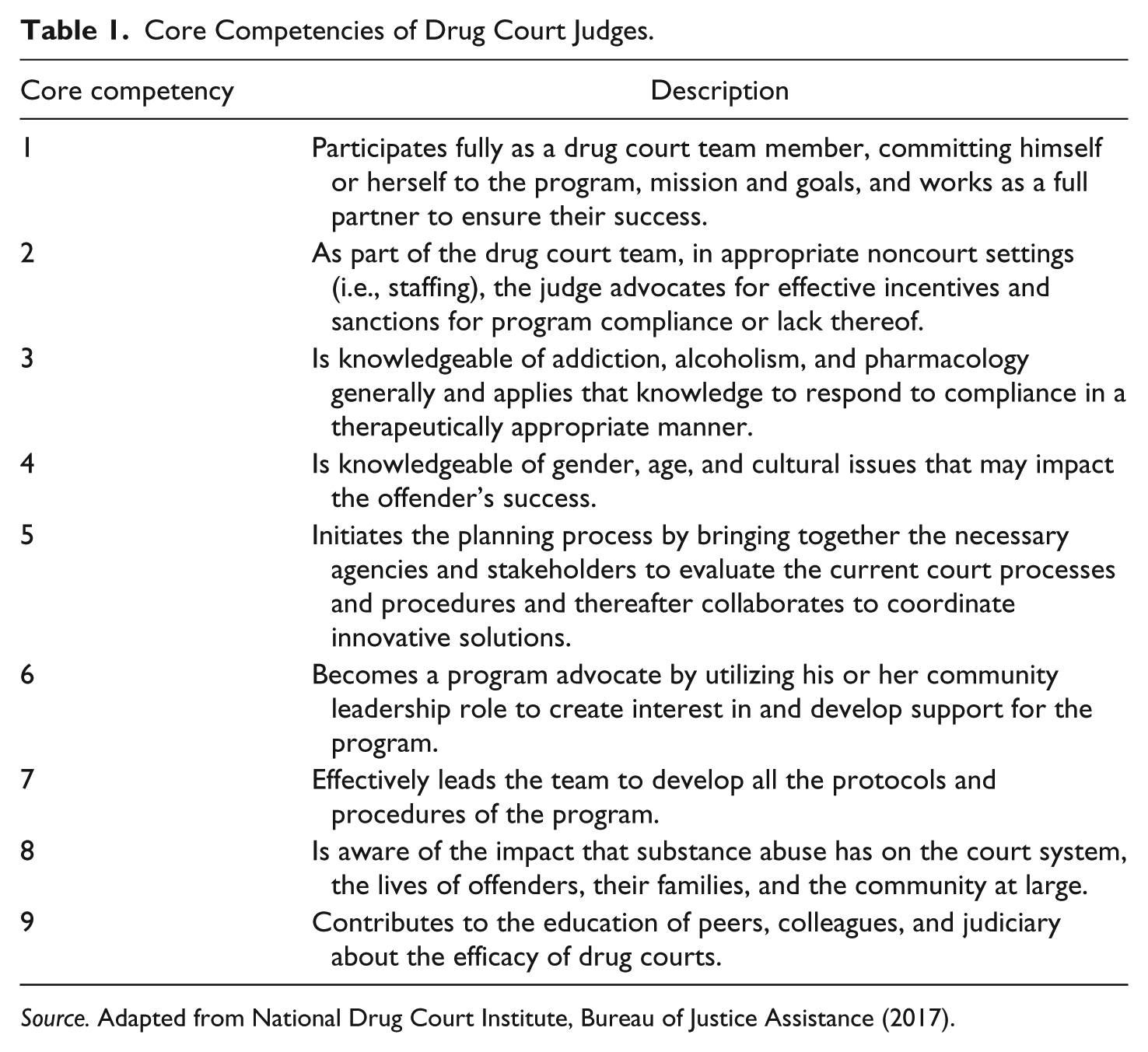
Source. Adapted from National Drug Court Institute, Bureau of Justice Assistance (2017).
One should not confuse the creation of successful demonstration projects with the implementation of a new idea in a state or national system. Whatever the field—courts, health, education, or social welfare—the process of institutionalization represents a unique set of challenges (Feinblatt et al., 2000). Identifying the measures needed to reduce prison populations is a first step. Ensuring that these measures are accepted and implemented is a step that depends on the conviction of all the major players in the criminal justice world (Lappi-Seppala, 2003). Therefore, we sought to understand the role of judges in this process.
Greenwood, Suddaby, and Hinings (2002) proposed six stages of institutional change: I—Precipitating Jolts, II—Deinstitutionalization, III—Preinstitutionalization, IV—Theorization, V—Diffusion, and VI—Reinstitutionalization. When events destabilize established practices, Stage I occurs. Institutional entrepreneurship characterizes the stage of deinstitutionalization. One of the greatest challenges facing contemporary institutional theory is called the paradox of embedded agency and consists in the fact that the agency in institutional change is a point of controversy considering the tension between the notion of actors as strategic agents of change and the powerful influence of institutional forces on human agency (Battilana et al., 2009). The resolution of this paradox may be in the notion of institutional entrepreneurship as long as it accounts for actors’ embedded agency (Battilana et al., 2009).
At the moment of change, institutional entrepreneurs can be strategic and opportunistic, taking advantage of uncertainty in the institutional order they seek to change, since change can arise suddenly and unpredictably, pushing institutional actors into periods of revolution (Hoffman, 1999). Notwithstanding institutional pressures are directed at stagnation, field characteristics and social position allow actors to engage as institutional entrepreneurs in implementing divergent changes involving the creation of a vision and the mobilization of allies (Battilana et al., 2009).
As people have social positions and expectations of their own behavior and of other people, Role Theory explains and focuses on characteristic behavior patterns or roles (Biddle, 1986). This theory provides an intermediary between society and the individual that can explain why individual behavior implies characteristics that are constant (James, 1968). The different and predictable ways that humans behave, depending on their respective social identities and situation is one of the most important characteristics of social behavior that is analyzed by Role Theory (Biddle, 1986).
Actors deeply embedded in the field through reflexive deliberations can motivate changing established institutional arrangements, showing that they are not static (Delbridge & Edwards, 2013). The need to explore the relationship between context and action and to capture the legitimizing arguments informing such change are two ideas that are at the core of recent discussions of institutional change (Delbridge & Edwards, 2008). Patterns of content, rhetoric, and dialogue among the constituents of the field allow us to have notions of the institutions they reflect (Hoffman, 1999).
The chronology of creation, implementation, and changing of social norms and behaviors, that is, institutions, such as TJ and RJ, can be a helpful tool to analyze their process of institutionalization. In 1989, through an administrative order issued by Chief Judge Gerald Wetherington, the nation’s first drug court was created (Hora et al., 1999). The new movement took on major proportions, starting from the center of the city, and reaching suburban and rural communities, the Drug Treatment Courts grew (MacKenzie, 2016).
According to the Timeline of Drug Courts and Other Problem-Solving Courts in the United States, published by NDCI, by 1990, spending on correction exceeded US$26 billion nationally. A year later, in 1991, there were five drug courts. In 1992, the first women’s drug court opened in Kalamazoo, Michigan. The first community court opened in 1993 in Brooklyn, New York. The National Association of Drug Court Professionals (NADCP) was founded in 1994 and in 1995 NADCP held the first national drug court training conference in Las Vegas, Nevada. Ten years after the creation of the first court, there were 472 drug courts in the United States in 1999.
An example of documents disseminating the TJ and RJ approaches that have been published is “Development and implementation of mediation and restorative justice measures in criminal justice” (United Nations, 1999). In 2000, the Conference of Chief Justices/Conference of State Court Administrators passed a resolution in support of problem-solving courts (CCJ/COSCA). In 2003, the National Institute of Justice reported drug court recidivism rates were as low as 16.4% nationwide 1 year after graduation and there were 1,667 problem-solving courts in the United States. In 2006, UNODC published the Handbook on Restorative Justice Programmes. By 2007, 3,204 problem-solving courts existed and the National Center for Driving While Impaired (DWI) Courts (NCDC) was founded and UNODC launched the Handbook of Basic Principles and Promising Practices as Alternatives to Imprisonment. In 2010, the Organization of American States (OAS) and the American University published the Establishing Drug Treatment Courts: Strategies, Experiences and Preliminary Outcomes. In the same year, the Center for Court Innovation published the What Makes a Court Problem-Solving?
In 2011, NDCI published a study called The Drug Court Judicial Benchbook. According to the Bureau of Justice Statistics’ (BJS) Census of Problem-Solving Courts (CPSC), there were 3,052 problem-solving courts distributed in all the states of the American territory in 2012. The five U.S. states with the highest number of PSCs were California (208), New York (188), Florida (164), Texas (153), and Michigan (141). The states with the smallest numbers were North Dakota (10), South Dakota (10), Maine (9), Rhode Island (7), and Vermont (6).
States across the country have developed best practices, guidelines, recommendations, or standards that are intended to guide courts seeking to implement a new problem-solving tribunal or existing courts to improve program outcomes for participants and the community. Other states have developed certification checklists to demonstrate continued compliance or have established rules to govern the operations of the problem-solving courts (National Center for State Courts [NCSC], 2015).
In 2013, the Red Hook Community Justice Center Evaluation was established in New York. In 2014, five projects about PSCs were completed. The following year, the states of Arizona, Illinois, Indiana, Oregon, Pennsylvania, Texas, Virginia, and Wisconsin completed projects related to PSCs. In 2015, COSCA published the study “Problem-Solving Courts in the 21st Century.” Colorado, Florida, Minnesota, and Virginia completed projects in 2016. In 2017, studies were undertaken evaluating PSCs in the states of Colorado, Michigan, Minnesota, Nebraska, New Mexico, Utah, and West Virginia, and Illinois Criminal Justice Information Authority (ICJIA) published “An Overview of Problem-Solving Courts and Implications for Practice.” In the same year, the NCSC and Center for Court Innovation published “Inspired by Peacemaking: Creating community-based restorative programs in state courts: An implementation guide.” In 2018, West Virginia developed statewide performance measures for West Virginia’s Juvenile Drug Treatment Courts and conducted process and outcome evaluations of selected Juvenile Drug Courts.
This study used the theoretical concepts and the chronology described above in the process of exploring the opinions of judges applying TJ and RJ in the United States, according to the research method described in the next section.
Data and Method
Data were collected from multiple sources. Primary data were collected from semistructured interviews with judges from the United States who work in TJ and/or RJ and a judge who does not act in that field, to obtain the points of view of actors with different positions on the same phenomenon. The method of Participant Observation was also used, as it allowed the study of details and the sequence of events in an in-depth way. Secondary data were obtained by means of documentary research in journals, internal documents, and websites of several organizations in the field.
The 13 in-depth interviews were carried out between August and December 2017, with judges from the United States working with mental health, family, youth, restorative justice, drug programs, and one judge who was not working in that area. At the time of the interviews, the judges worked in counties located in four U.S. states—California, New York, Illinois, and the District of Columbia. The interviewed judges represent different generations in the Judiciary but share similar perspectives regarding the TJ and/or RJ. Some of the interviewees participated in the conceptualization of the first drug courts, others have very recent experience such as the case of a judge who has only 6 weeks working in this new perspective. Thus, each one spoke about the experience he or she had with TJ or RJ. Six of the 13 interviewees are female and seven are male. “Saturation point,” when the answers add no new information, was reached in the 10th interview. Table 2 lists the 13 U.S. judges interviewed, the nomenclatures they use most, and whether they practice TJ or RJ.
U.S. Judges Interviewed.
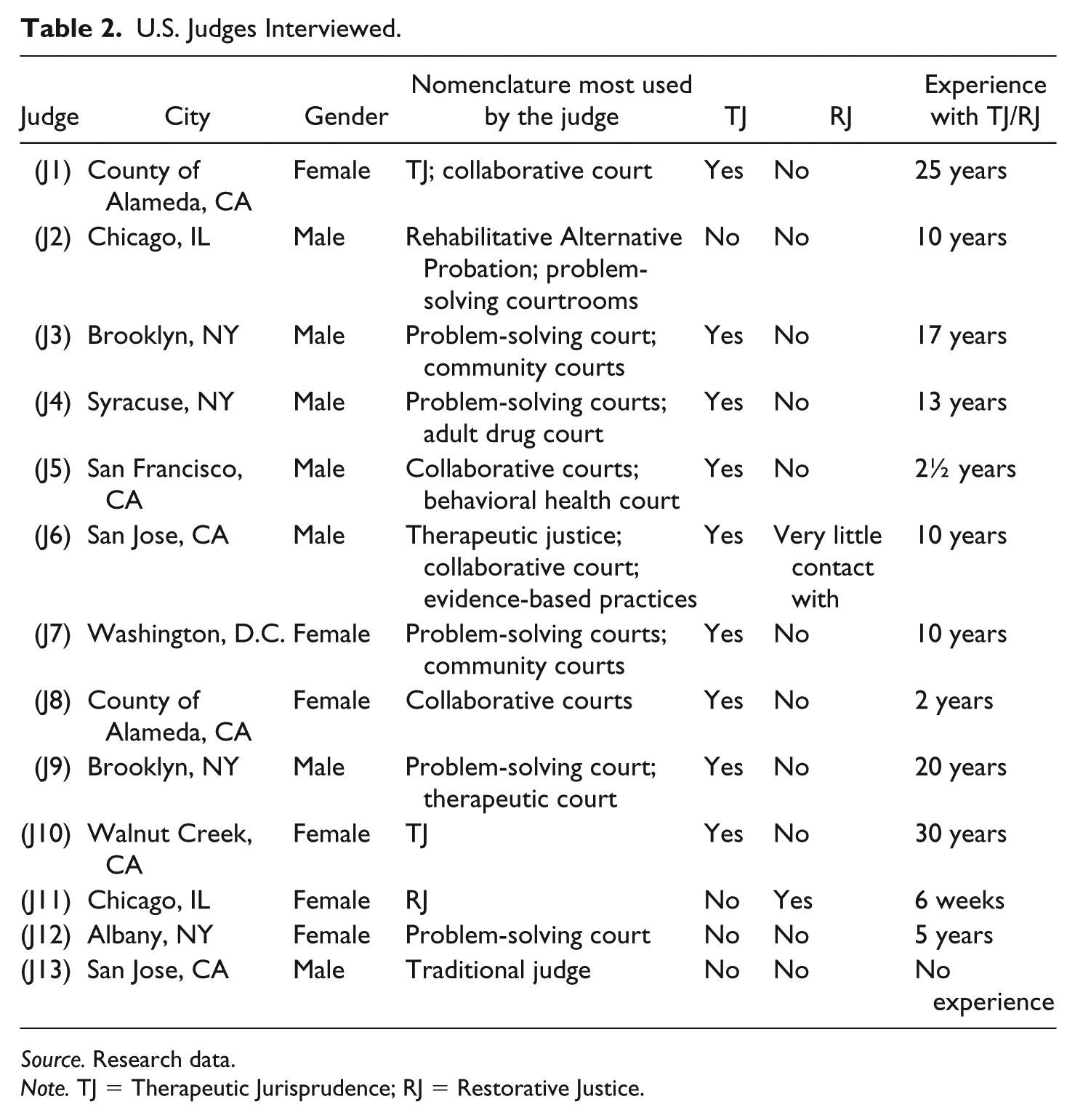
Source. Research data.
Note. TJ = Therapeutic Jurisprudence; RJ = Restorative Justice.
The theoretical concepts of institutional theory already presented steered the questions asked of the judges interviewed. Interviews were taped and transcribed and afterward the data analysis was performed. The analysis of the verbal data collected consisted of the identification and systematization of similarities, regularities, and constancy in the speech of the interviewed. To assist in the organization, categorization, and analysis of interview data, NVivo software was used.
As a flexible and useful research tool, thematic analysis can provide a rich and detailed but complex account of data (Braun & Clarke, 2006). We used this tool to analyze interview data. Representing some level of standardized response or meaning within the data set, a theme captures something important about the data in relation to the research question (Braun & Clarke, 2006). Participant observation, also used in this research, is an important method of data collection that can inform the development of the theory, providing understanding of participants’ behaviors and contexts that influence their behaviors (Dahlke, Hall, & Phinney, 2015). Another technique that was used in this research is historical analysis (Hoffman, 1999; Leblebici, Salancik, Copay, & King, 1991; Maguire, Hardy, & Lawrence, 2004; Morrill, 2017). In this sense, the next section starts with the main events related to TJ and RJ in the United States. Afterward, the data analysis of the interviews is presented.
The Process of Institutionalization of TJ and RJ in the United States
From the data analysis of the present research, it was identified that all the judges interviewed, including the judge who does not apply TJ/RJ, showed a positive perspective on TJ and RJ. When asked about the beginning of the movement and the proposed change, the judges gave answers that TJ and RJ represent a divergent change and institutional innovation. The innovative character of the TJ/RJ can be identified in the judges’ statements that show the need for something different: “We needed to think of something different so that we could try to keep people from continuing their time in the criminal justice system” (J4), “We need to do something different” (J3).
Some of the interviewees said that the perception of the need for something innovative started from society. “Society started to realize that they were treated poorly and left to wallow in the streets sometimes. And once that happened, again, I think the court system said that, you know, ‘We have to do better, as well’” (J9). The perception that the previous judicial practice was not working was also reiterated: “people realizing that what we were doing before wasn’t really working or wasn’t having an effect” (J4). The problem of addiction to harmful substances was pointed out: “It was someone looking at our community and realizing we were one of the top ten crack-infested communities in the United States and that we had to do something different” (J3).
When asked about the main factors that pushed the beginning of the TJ/RJ movement, there was a consensus among the judges interviewed. The frustration with what the judges call the “revolving door” was stated by eight of the 13 interviewees. Dissatisfaction is the main starting point for judges engaging in these movements, dissatisfaction with their jobs, with the tools at their disposal, and with the “revolving door” that returns the same offenders to the courtrooms again and again. This problem is also discussed by Berman and Feinblatt (2002).
This metaphor used by the judges emphasizes one of the major problems facing criminal justice—recidivism—“it was revolving-door justice that created drug courts” (J3). The following excerpts reiterate this point: . . . judges want to get involved with these courts because of the frustration that you feel with the revolving door of justice . . . the frustration that you see from seeing the same people over and over and over again, and you’re feeling like you’re just not making any progress with these individuals. (J12) The traditional role of the court was somebody’s arrested on a drug charge—they go to trial—they’re convicted—you give them the maximum sentence. They go to jail. They get out. They’re still a drug addict. So, they commit crimes, so they can get drugs. (J9)
The feeling that the decisions made by them, the judges, do not really matter, that despite sentences of probation and detention defendants eventually are arrested again, is one of the biggest frustrations for the judges of the criminal courts, as also suggested by Berman and Feinblatt (2002). The excerpts from the interviews illustrate this feeling: “I think that we were seeing a high volume of low-level misdemeanor arrests. People making the same mistakes again and again and again” (J7). This observation of seeing people making the same mistakes was quoted by some of the judges interviewed as a major discomfort felt by them: “Keep people from getting rearrested over and over again and just having the same problems” (J4).
Despite the recognition that something innovative was needed to solve the “revolving door” problem—“The drug addict would get out of jail and commit crimes all over again to feed his habit that was never treated in prison” (J9) and even if the judges were not satisfied “and usually that’s the judge who’s also frustrated with the way things are” (J10), it is not an easy task to make an institutional change. As Hargadon and Douglas (2001) argue, the collision of two social forces occurs when institutions meet innovations, the first focused on the stability of social systems and the second on change.
One of the judges spoke about the distribution of these innovative courts that apply TJ and RJ in the United States: Now we have drug treatment courts, mental health courts in every borough in the city, in most counties in the state, and they’ve spread around the country, as well. (J9)
Writing reports is one of the actions that U.S. judges use to spread the idea around the world, the following passage illustrates this: “To institutionalize it, I have to make sure that we have protocols—that we have procedures in place that keep the public safe and keep the person going” (J9). The following quote shows the interest coming from other parts of the world: And in fact, I’ve had visitors from Australia, from the United Kingdom, from Scotland, from Canada, and other jurisdictions in the United States come to look at the mental health court to see what they can learn to establish these courts in their jurisdictions. (J9)
Well-structured guidelines are of the utmost importance in a process such as this in which judges step out of their conventional role and become active problem solvers (Feinblatt et al., 2000). For the success and longevity of the programs, the development of standardized written policies and procedures is crucial, but often bureaucratic rules and procedures are barriers (Marlowe & Meyer, 2011). Therefore, we sought to understand how judges promote TJ and RJ to institutionalize these ideas in the United States.
Berman (2000) reported that discussion among judges, attorneys, policy makers, and scholars questioned the operation of traditional thinking and quoted one respondent as saying: “You know, I feel like I work for McJustice: we sure aren’t good for you, but we are fast.” The comparison made with the use of the term McJustice is somewhat surprising, but it does highlight the strong argument used by judges who believe in new approaches to deliver justice. Actors will need to leverage and convene support and acceptance of new institutional arrangements as the field is institutionalized (Dorado, 2005).
One point raised by some critics of TJ and RJ is the increased involvement on the part of the judges with the offenders that can reopen paths to possible unconscious bias in the processing and outcomes of cases. One interviewee highlighted this involvement: “Some of the clients in the low court think of me as a father type of figure” (J5). One might ask whether the judge, after emotional involvement with the defendant, is able to judge him or her if TJ or RJ methods do not produce a solution.
The Roles of U.S. Judges
All the 13 judges interviewed agreed that the judge’s role in TJ and RJ is essential for the institutionalization of these new practices: “When I went into this, I didn’t think the role of the judge was that important. I’ve changed my mind” (J3). The interviewed judges had a clear opinion about their role in TJ/RJ: “One of the roles of a judge is as a convener” (J11), “The judge takes a leadership role in the court” (J9).
The role of convener indicates that the judge is an institutional entrepreneur who seeks to convince the other colleagues to adopt TJ and RJ. And even the traditional judge shares this opinion: “The role of the judges as a convener of a team, so the therapeutic court judge convenes folks” (J13). The judge can be seen as an institutional entrepreneur because he favors change in a conscious, open, motivated way, as the following excerpt from one of the interviews shows: (Therapeutic Jurisprudence/Restorative Justice) grew organically out of the interest of individual judges who were the strong advocates for them. Like, for example, Judge Brosnahan with the behavioral health court. That was her and it’s been her thing. No one else . . . and it runs based upon the way that she promotes that. (J8)
The role of convener is fully linked to NDCI Core Competency 6—“Becomes a program advocate by utilizing his or her community leadership role to create interest in and develop support for the program.”
Being successful in institutionalizing new practices is not a requirement for an individual to be an institutional entrepreneur, and several organizational changes may be promoted by institutional entrepreneurs (Battilana, 2006). But judges act in this process of institutionalization of TJ/RJ as institutional entrepreneurs: “Only judges can probably convince other judges that something’s worthwhile” (J5). This is consistent with Core Competency 9—“Contributes to the education of peers, colleagues, and judiciary about the efficacy of Drug Courts.” And they lead the promotion of these new ideas: These programs were promoted by individual judges who felt that the system was not successful and that people with various mental health needs and with drug addiction needs, needed to be treated differently because we see people constantly coming through. (J8)
The promoter role represents this social influence of judges, of being able to convince peers and other actors. According to one of the interviewees, peer judges have the “power to encourage other judges” (J11) and one of the ways they can encourage colleagues is with testimonials like this: “It’s a very different way of judging. But I’ve found it the most satisfying part of my career” (J10). “Judges do have a great ability to be persuasive with this” (J8).
Another way of promoting mentioned by one of the interviewees is the influence that the judge has with the team: The judge is key. If the judge is not on board, you don’t have a drug court program that works. If the judge doesn’t know how to motivate people, if the judge is bored or disgusted or unfriendly, impatient. It doesn’t work. It’s crucial. (J10)
The judge can set the tone: “The judge sets the tone for how people are treated in the courtroom and throughout the court building” (J3). The way the judge treats the offender in court, can spread a new attitude: “Treating people with respect has to come from the judge” (J3).
The judges’ arguments on this theme included statements highlighting the role of the judge in promoting the new perspective on dispensing justice. One of the judges interviewed was cited by other colleagues for writing an article that dealt with this subject. Thus, the role of the judge as author helps to promote new ideas, according to the comment below: He basically crystallized my thinking about the necessity of being able to build in therapeutic aspects, even in an adversarial court. And trying to sentence people on evidence-based practices and trying to individualize sentences and look at those. So, from the criminal end I got a really good education from him. And then I read extensively his works. (J1)
From this point of view, the author role represents judges who are concerned with the documentation of practices and the dissemination of this knowledge. It is important to stress that intellectual production is an effective way to promote TJ and RJ.
The argument that it is an effective form was given emphatically by the judges interviewed: “That is why you’ve seen a spread of the courts. They work” (J9). For some interviewees, it is already evident that this new form works and is effective: “We’re very effective at getting them to address those problems and also successfully graduate from our treatment court, where their charges get reduced substantially or dismissed” (J4). Another judge said that “It’s the only way to handle these cases. It’s extraordinarily effective. You’re able to cut down crime, cut down people recycling through the courts. You help them get their lives back on track” (J3).
According to some interviewees, the concept of effectiveness means that “They don’t want to go back to what they were doing because their life was upside down. So, I think these programs are very, very effective” (J2). The judge considers the program effective, because it changes the life of the offender, to make him not want to return to the crime.
How to go beyond the first wave of judges who have adopted the principles and values of restorative and therapeutic justice, to engage the rest of the judiciary, and overcome the barrier of resistance to the idea of tinkering with their traditional role are some of the challenges faced by this new approach (Berman & Feinblatt, 2002). A common point in the response of eight of the 13 interviewees, especially among the more experienced ones, is that the judge has to have partnerships. “Making these changes requires a lot of support and buy-in from other folks” (J8).
Partnerships with professional organizations working in the criminal justice sector and with nongovernmental organizations that are active in the field of crime and punishment can be a good tool for the State to disseminate and promote the use of alternatives to reduce imprisonment (UNODC, 2007). This point of view was stated by most of the interviews, as in the following: “The main support was the support from prosecution and police. If we hadn’t had that, we would not have been nearly as successful for drug courts” (J10).
Another common point in the answers of six interviewees, including the traditional judge, is the importance of “not be centered on just one person” (J6), stressing the role of maintainer for the judge. For institutional change, cognitive, social, and material support are essential resources (Dorado, 2005). From this point of view, the magistracy cannot hold all the knowledge, as the following quote shows: I have to talk about what I call stewardship. I’m only here as a caretaker. So, if I leave, and it ends, I did nothing. So, what I’m hoping is I built something that I can step down. Another judge can step in. Take over. And it goes on. (J9)
The role of maintainer was also identified in other responses: “We have a role in terms of maintaining it that helps institutionalize it long-term” (J8). “Everyone must know what the rules are” (J13). This role relates to Core Competency 7—“Effectively leads the team to develop all the protocols and procedures of the program” (NDCI).
Judges still have to mobilize institutional support alliances to overcome barriers: “One of the challenges that we face now is that we get our funding for what we do from other county agencies and from grants that we get with the federal government and the state and from other folks” (J8). Core Competency 5 corroborates this—“Initiates the planning process by bringing together the necessary agencies and stakeholders to evaluate the current court processes and procedures and thereafter collaborates to coordinate innovative solutions” (NDCI).
Following the model of the process of institutional entrepreneurship proposed by Battilana et al. (2009), we structured a framework for the TJ and RJ phenomenon in the United States, represented in Figure 1.

Institutional entrepreneurship process for TJ and RJ in the United States.
Battilana et al. (2009) have stated that key roles in enabling institutional entrepreneurship are field characteristics as well as actors’ social position. The field-level manifestation of the logic of the state is represented by the logic of criminal punishment which is traditionally the standard behavior of judicial response to crimes, especially drug-related (McPherson & Sauder, 2013). The probability that organizations engage in institutional entrepreneurship can be influenced by actors’ social position (Battilana et al., 2009). Battilana (2006) suggests that the probability of individuals having access to key resources that may be useful to conduct a divergent organizational change increases the higher the actor is in the organizational hierarchy. In terms of the framework in Figure 1, the case suggests that the social position occupied by the judges favors the divergent change, because the judges occupy higher hierarchical positions. It is possible to say that the roles of the judges identified in the present study are essential for Divergent Change Implementation specifically in the phase called Mobilizing Allies.
Discussion, Conclusion, and Recommendations
This study offers several insights into institutional entrepreneurship in emerging TJ and RJ and extends current knowledge about the phenomenon in the United States. The growth of the number of PSCs in the United States gives evidence of the institutionalization of these new ways of dispensing justice. The distribution of problem-solving courts across the United States shows that this new kind of justice has spread throughout the country. This theorization activity can be seen in the large number of reports published on TJ and RJ. Another feature is that the impetus for diffusion shifts from simple imitation to a more normative basis, reflecting implicit or explicit theorization of structures.
Full institutionalization involves sedimentation. In this phase, the variability in the implementation decreases. This still has not occurred in TJ/RJ in the United States. There are still several nomenclatures, and different practices. The full institutionalization of a structure will depend on the joint effects of relatively low resistance from opposing groups, continued cultural support, and promotion by advocacy groups and positive correlation with desired outcomes. This promotion is already happening through the judges.
For the consolidation of a specific innovation, the social recognition of an anomaly may require some kind of collective mobilization (Lounsbury & Crumley, 2007). The idea of “revolving door” is probably the best way to explain the great frustration of the judges interviewed with the traditional model of justice, it was the recognition of an anomaly. This frustration aroused the desire for change in these judges, pushing TJ and RJ approaches in the United States. These new ways of dispensing justice are conceptualized in this article as an institutional change.
The research data suggest that judges who apply TJ and RJ behave as institutional entrepreneurs. Presenting some degree of agency is not enough to qualify an individual as an institutional entrepreneur. What makes an individual an institutional entrepreneur is the fact of breaking with the rules and practices associated with the dominant institutional logic and developing alternative rules and practices (Battilana, 2006).
Based on the opinions of the judges interviewed, we identify four predominant roles played by judges who drive the process of institutionalization of TJ and RJ in the United States: promoter, author, convener, and maintainer. The judges involved in the creation of the first courts that acted in this new way showed themselves to be promoters of these new ideas and as the classification of the roles proposed demonstrates, some of them were authors of articles, studies, and reports that publicized their progress. Many of them have acted as conveners, and this view is shared even by the traditional judge interviewed. Last, but not least, the role of maintainer, of not letting knowledge and practice get lost, so the whole team must work together and the judge plays the key role, was also clear in the interviews.
It is important to emphasize that these roles are not mutually exclusive but complementary. Some of the interviewed judges have characteristics of all roles, because they have written important articles in the field, they promote ideas and convince colleagues with enthusiasm and motivation, they want to keep the new format even when there is another judge in place and build partnerships for the institutionalization of TJ/RJ.
The present study has one main limitation. As only one traditional judge was interviewed, the contrary view was limited, as this judge proved to be a supporter of TJ/RJ. In a future study, we suggest an in-depth analysis of those who resist the new ideas. Although this is beyond the scope of our study, it would be useful for future research to measure resistance from traditional judges who oppose the application of innovative TJ/RJ approaches.
Similarly, it may also be useful to focus on the empirical application of institutional theory to test whether, in a few years, TJ and RJ have entered into the sedimentation process. One possible way would be to check the dimensions of theorization activity, variance in implementation, and the rate of failure of structures.
The interest of researchers, judges, and policy makers from other countries to know more about how the U.S. programs work in practice, and to know about the physical structure, was mentioned by most of the judges interviewed. In this sense, the findings may be useful in promoting such practices in other countries. Finally, it is emphasized that, as described in the introduction to this article, the problems related to prison systems are widespread across the world, and state-of-the-art innovations in justice deserve constant attention.
Footnotes
Acknowledgements
The authors thank the judges interviewed who accepted to be part of the study, and the valuable criticisms and contributions from Adalmir Oliveira Gomes, professor at the University of Brasilia and from two anonymous reviewers, which improved the quality of the paper.
Declaration of Conflicting Interests
The author(s) declared no potential conflicts of interest with respect to the research, authorship, and/or publication of this article.
Funding
The author(s) received no financial support for the research, authorship, and/or publication of this article.
