




Abstract
Sex workers as a group are one of the more common targets in serial homicide, yet the most likely to go unsolved. Part of the reason for this is the difficulty in linking individual crime scenes to a series, especially in those series where offenders not only target sex worker victims but also target non-sex worker victims. Inconsistencies in both victim targeting and behaviors engaged in across series add to the difficulties of linking and solvability in these types of crimes. The current study aimed to add to the current body of literature on serial crime linkage by examining not only the most salient behavioral indicators useful for crime scene classification of serial homicides that involve sex worker victims but also examine the trajectories of behavioral change that can help link apparently inconsistent crime scenes and proposes the new Model for the Analysis of Trajectories and Consistency in Homicide (MATCH). The study examines 83 homicide series, including 44 (53%) series where all victims were sex workers and 39 (47%) series that included a mix of sex workers and non-sex worker victims. Using the MATCH system allowed for the majority of series to be classified to a dominant trajectory pattern, over half as many as a traditional consistency analysis that focusses on behavioral similarity matching. Results further showed that Sex Worker Victim series were almost three times more consistent across their series than Mixed-Victim series, not only in victim selection but also in the overall behavioral patterns. Findings are discussed in line with theoretical and psychological issues relating to understanding the nature of behavioral consistency and the importance of going beyond simple matching toward a model that allows for the identification of consistency in seemingly inconsistent series, as well as investigative implications relating to linking serial crimes.
Keywords
Offender Profiling and Crime Scene Investigation
The main aim of behavioral crime scene analysis, otherwise known as offender profiling, is to analyze the way an offender commits their crime, and then link subtypes of crime scene actions to the most likely offender background characteristics. This information is then used in criminal investigations as an important tool for the police to narrow their suspect pool down to statistically the most likely type of offender and/or identify and link series of crimes.
Three general interlinked areas have been the focus of this behavioral crime scene analysis and offender profiling research: individual differentiation, behavioral consistency, and inferences about offender characteristics (Canter, 2000; Salfati, 2008b):
Individual differentiation aims to establish differences between the behavioral actions of offenders and identify subgroups of crime scene types.
Behavioral consistency is a key issue in profiling, specifically for understanding both the development of an offender’s criminal career and an individual’s consistency across a series of crimes—that is, whether the same subsets of actions are displayed at each crime scene over a series of offenses.
Inferences about offender characteristics based on the way an offender acts at the time of the crime are at the core of profiling and uses consistency analysis as its main focus.
The current article aims to identify crime scene patterns in series that involve sex worker victims and use this as an exploration of what features are the most salient for consistency analysis within series, and what differentiating patterns exist between series.
Behavioral Consistency and Linkage Blindness
A key question in the area of investigating serial crimes is whether we can link crime scenes to each other based on certain consistent aspects at the crime scene. Alongside being able to identify actions that can be used to link a series, we also need to know how to differentiate one series from another series. Key to this process is the question of what aspects of the crime scene are the most reliable for making these determinations. Central to this question is what is meant by consistency and how this may be displayed at the crime scene in terms of the actions most useful to establish both similarity and differentiation.
Egger (1984), in one of the earliest writings on serial homicide, wrote that the key challenge for investigators is what he terms “linkage blindness.” Linkage blindness is a situation whereby crime scenes that are part of the same series are not identified as such due to overt factors (such as type of victim or specific behaviors engaged in by the offender) looking dissimilar, and as such conclusions are made that they are unlinked.
Egger (2003) goes on to point out that 65% of serial homicide victims are female, and nearly 78% of female victims of serial homicide offenders are sex workers. As a subgroup of vulnerable victims, they therefore present a specifically highly targeted group.
A number of studies have suggested that sex workers specifically are a highly targeted group of victims in serial homicide (Brewer et al., 2006; Brooks-Gordon, 2006; Egger, 2003; Kinnell, 2006; Quinet, 2011; Salfati, 2008; Salfati, James, & Ferguson, 2008). Quinet (2011) suggested that 32% of serial homicides involve sex workers, and Brewer et al. (2006) calculated that when sex worker victims are killed, in at least 35% of cases, a serial offender will be involved. In addition, despite the overall general decline in serial homicide cases between the 1980s and 2000s, research indicates that serial homicide cases involving sex worker victims have dramatically increased by decade (Quinet, 2011). Quinet also found that the average length of time that offenders were active was longer for cases involving sex worker victims. This undoubtedly relates to the fact that sex worker homicides are some of the most difficult to solve, which is supported by some statistics that show that 10 years on, 69% of sex worker homicides are still unsolved (Kinnell, 2001).
Victimology has been a focus in some of the general linking work. One of the groups of victims of particular focus in this work has been that of vulnerable victims and subgroups of highly targeted women such as sex workers (e.g., Abrams, Palmer, & Salfati, 2016; Salfati, 2007, 2013, 2014; Salfati et al., 2008a; Salfati, Horning, Sorochinski, & Labuschagne, 2015; Salfati & Sorochinski, 2018; Sorochinski & Salfati, 2010). However, as highlighted by results of some of this work, offenders who target sex workers are not always consistent in their victim targeting, which leads to the specific issue of linkage blindness (Egger, 1984) for any work that aims to use victimology as part of their behavioral consistency analysis.
Key Findings From the Literature on Behavioral Consistency
Salfati and Sorochinski (2018) in a recent review showed that there has been a steady building of a body of literature focused on understanding linking serial crime and identified 40 empirical research studies that have been published to date that directly address the issue of linking serial crime using behavioral evidence. However, of these 40 empirical studies, only half focus on violent crime; six on serial homicide 1 and 13 on series of sexual offenses. 2 Of these 19 studies, over half examined behavioral linking using only two crimes from a series, either two consecutive crimes 3 or a random pair of two crimes within the series. 4 Although these studies have employed stringent statistical methods which has augmented the empirical basis of this work, these pair-linking studies do not allow for the examination of the actual progression of consistency and change over time. This is problematic, especially because emerging evidence suggests that offenders may become less consistent as their series progress (see Salfati, in press, for a review), which highlights the importance of more fully investigating behavioral patterns across a larger number of crimes within series. Only four of the studies on serial homicide (Bateman & Salfati, 2007; Salfati & Bateman, 2005; Salfati et al., 2015; Sorochinski & Salfati, 2010) and two of the studies on sexual assault (Kearns, Salfati, & Jarvis, 2011; Sorochinski & Salfati, 2018) specifically looked at the issue of behavioral consistency, and an additional three studies focused on the consistency and progression (transitions) for four crime transitions (Hewitt & Beauregard, 2014; Leclerc, Lussier, & Deslauriers-Varin, 2015; Lussier et al., 2008).
These studies go beyond simply demonstrating the statistical evidence for similarities between random pairs of crimes within series, to more specifically examine the patterns of development, consistency, and change across an offender’s full series, so as to start understanding the possible psychology that may underlie an offender’s behavioral patterns across time—a much more important and pertinent question when we aim to understand offending patterns in serial crimes, and how this may affect actually linking in investigative practice. From this small pool of studies that have looked at behavioral consistency and inconsistency, Salfati (2019) draws out some of the key results relating to both salient features to focus on, as well as patterns that have started to emerge (for a detailed review of these behavioral consistency studies, see Salfati, 2019).
Salience of Behaviors
The salience, or importance, of the behaviors used for any consistency analysis is critical to support the choice of the variables for any study aiming to measure consistency patterns. A big critique of work in behavioral analysis at the start of the field was that both research and practice were not based on identifying and using these most salient factors to increase the likelihood of the validity of both research and practice. As such understanding what variables are the most important (salient) for understanding the type of crime we are dealing with is of utmost importance for any consistency analysis.
In the early literature on profiling, there was much speculation on the key factors that are important specifically for classifying and linking serial homicide. However, much of this work was unsubstantiated by any empirical work. Bateman and Salfati (2007) reviewed this early literature and identified six key behavioral categories: body disposal behaviors, forensic awareness behaviors, mutilation behaviors, weapons used, theft behaviors, and sexual behaviors. They went on to empirically test which of these were the most useful for linking. Interestingly, their results showed that the sexual component which had been the focus of much of the literature showed the least amount of consistency of all the subgroups of behaviors in the study. Instead, the behaviors that did show any level of consistency were all reflective of an underlying psychological issue of control. Other studies done in the area of linking serial sexual assaults using random pairings have since then highlighted control as a key variable (Woodhams, Grant, & Price, 2007; Woodhams, Hollin, & Bull, 2008; Woodhams & Labuschagne, 2012). Sorochinski and Salfati (2010) in a study on consistency behavioral patterns in serial homicide confirmed this finding by showing that individual crime scenes could be distinguished in terms of the control element behind planning behaviors, type of violence, and the interaction with the victim. Sorochinski and Salfati (2018) in a recent study on behavioral consistency patterns in serial sexual assault additionally confirmed that control and violent behavior subtypes were the most useful for classification, but additionally found that they could best be understood quantitatively (i.e., in terms of the degree of the behavior employed). They also examined sexual behavior and found that although this category of behavior remained less useful, it increased in utility if examined qualitatively in terms of the specific subtype of behaviors engaged in. Both the 2010 study on serial homicide and the 2018 study on serial sexual assaults additionally showed that using these categories, when looking at the progression of the series, although none of the offenders exhibited complete consistency across all the behavioral subtypes, the majority of offenders did show consistency in at least one subtype. Furthermore, of those who were not consistent, the vast majority followed an identifiable trajectory of change, confirming that the search for consistency in serial crime should not stop at exact matching, but rather should go into more depth in the analysis of the trajectories of behavioral change.
Canter (1995) in a discussion of what he outlines as the “canonical equation of profiling” (p. 345) makes the important point that for profiling to work, it needs to examine the salience of the variables that are used for the process. In the past two decades of offender profiling and behavioral crime scene analysis work, the focus has been on determining salience. This has further been looked at in the last decade for the purpose of behavioral consistency analysis, and the focus on the element of control and how this may be displayed has been key in this work (e.g., Bateman & Salfati, 2007; Slater, Woodhams, & Hamilton-Giachristsis, 2015). A number of recent studies (e.g., Hewitt & Beauregard, 2014; Leclerc et al., 2015; Salfati, 2009; Salfati & Sorochinski, 2018; Sorochinski & Salfati, 2010, 2018) have additionally discussed the importance of looking beyond stability of behavior and of understanding consistency in terms of patterns of behavioral change. Fleeson and Noftle (2008) also in their theoretical work on the consistency of human behavior in general argued that “the question is not whether behavior is consistent or not; rather, the question is which ways behavior is more consistent and which ways it is less consistent” (p. 1357). Fleeson and Noftle further suggested that consistency does not have to be manifested through the identical repetition of a given behavior, but rather can manifest itself in complex patterns, that is, looking beyond stability of behavior and understanding consistency in terms of patterns of behavioral change.
Classification
The importance of valid and reliable classification systems, based on salient behaviors, was a key issue of focus in the development of behavioral crime scene analysis and offender profiling as an empirical field (e.g., Canter, Alison, Alison, & Wentink, 2004; Canter & Wentink, 2004; Salfati, 2000; Salfati & Canter, 1999). However, despite work in this field having made great strides in refining classification models by testing the salience of behaviors they include, they remain challenged in their ability to classify crime scenes to a dominant behavioral subtype. The issue facing many of these studies is that a substantial number of crime scenes do not show a dominant type, but instead show what has been referred to as a hybrid type, a crime scene made up of components of more than one type (Salfati, 2000). This has included both work on single homicide that in earlier years showed a hybrid crime scene rate above a third of all samples looked at (Salfati & Canter, 1999; Salfati & Dupont, 2006; Salfati & Haratsis, 2001; Salfati & Park, 2007) and serial homicide which included refinements of more salient variables but still showed a hybrid crime scene rate ranging between an average of 10% to 25% (Salfati & Bateman, 2005; Salfati et al., 2015; Sorochinski & Salfati, 2010; Sorochinski, Salfati & Labuschagne, 2015). Trojan and Salfati (2009), in their review of classification methods, stated that the method used additionally affected the rate of classification and hybrid rates. In terms of the implication of hybrid crime scenes on consistency analysis, research has outlined how hybrid crime scenes were excluded from consistency analysis. Salfati and Bateman (2005), the first study in the field to empirically investigate behavioral consistency patterns across series, reported that 70% of series in their study included hybrids and so were excluded from the consistency analysis. Sorochinski and Salfati (2010) in their study included hybrids, but only provided case study–level analysis. However, their study provided a clear insight into the complexities of trying to understand consistency when these are included in any consistency analysis. Hybrid classification of crime scenes has been previously seen as a limitation on the ability of a model to be used for subsequent consistency analysis. However, it may be possible that hybrid crime scenes and hybrid series are a type of their own and so should be incorporated as part of a broader classification model, and by so doing, allowing for a more comprehensive consistency analysis.
Inconsistency
One of the emerging results in the consistency literature is the fact that offenders do not display carbon-copy consistency in their series when examined at an individual behavioral level (i.e., the comparison of a specific behavior) or even on a subtype level (i.e., groups of similar types of behaviors, or behaviors united by a more underlying psychological factor) which includes the additional challenge of hybrid crime scenes. Conclusions from this work are that there may, however, still be some discerning patterns regarding when changes in behavior occur (e.g., Kearns et al., 2011; Salfati et al., 2015; Sorochinski & Salfati, 2010, 2018). These studies have shown that change may happen at certain points in the series, which suggests that behavioral consistency may decrease as the series progresses, but that we are as yet unclear exactly where the most change happens, how or why, which poses a very real problem for linking in practice unless a clear understanding and quantification of these changes can be determined. This also highlights the importance of integrating findings such as these into the work being done on linking based on random crime-pair analysis which has been done by other studies in the linking field.
Trajectories of Consistency
An additional emerging result in the consistency literature is that although offenders may outwardly appear inconsistent, there may still be consistent patterns to their inconsistency (Salfati, 2008). Sorochinski and Salfati (2010) in a study on serial homicide showed that although individual crime scenes could be distinguished in terms of planning, type of violence, and the interaction with the victim, offenders did not display a linear consistency in all of these as the series progressed. However, distinct trajectories of change, such as escalation or de-escalation, situation-induced learning, and evolvement of sexual fantasy could be identified in most series, effectively reducing the proportion of series that would have previously been deemed as inconsistent. Sorochinski and Salfati (2018) in a study on serial sexual assaults showed similar patterns, but additionally showed that specific subgroups of actions need to be looked at in terms of how much (quantification) of the actions the offender engages in, or what specific subtype of behaviors (qualification) they engage in, this last one especially relating to the nature of the sexual activity.
Key Findings From the Literature on Behavioral Consistency in Series Targeting Sex Workers
In addition to the studies above, there has been a developing literature that specifically looks at serial homicides that include sex worker victims. Additional details have been gleaned from these studies regarding the issues of behavioral salience and consistency.
Salience of Behaviors
Salfati (2019) provided a detailed review of specific behaviors that have been found useful in the analysis of behavioral consistency in serial homicides and sex offending. Recent works on sex worker series specifically have also started to look for the key salient factors that may be of importance. Salfati et al. (2008) in a U.K. sample examined the nature of the sexual and nonsexual violence in sex worker homicides by comparing them with sexual and nonsexual homicides of non-sex worker women. Their study highlighted some key issues of importance for understanding the relationships between victim type and crime scene actions. At the crime scene, they displayed a higher rate of the sexual indicators (leaving victim naked, using an object to penetrate the victim) and a higher level of wounding. Post-crime activities that occurred more often in sex worker homicides included theft activity, transporting the victim away from the original crime scene after death, leaving the body of the victim outside, and hiding the body of the victim. Salfati (2007, 2013), in their study on series that included sex workers (see above), estimated 5 that 43% of sex workers and 44% of non-sex workers were sexually assaulted. When the sexual element was looked at to determine whether it provided the element of consistency that ties the different types of victims together, the analysis further showed that, of the 19 series examined, two series included sex worker victims who were all sexually assaulted, five series included sex worker victims who were not sexually assaulted, and 11 series included mixed victim types (sex workers and non-sex workers) and a mix of sexual assaults and no sexual assaults. The results thus indicate that overt sexual assault is not a simple distinguishing factor between victim types.
From general body of work on behavioral consistency in sexual assaults and homicides, as well as from the small body of work specifically on sex worker series, we have some preliminary indications that certain crime scene factors are salient for this group overall, and also help to determine differentiation and similarity between crime scenes when we look at them within a series context. These include actions that precede the crime itself (victim type and location), actions during the crime (sexual activity, theft, and wounding), and actions that occur after the assault (post-mortem wounding, transportation of the body, and body disposal). However, as yet, there has been no comprehensive empirical study that have pulled all of this together to obtain a detailed full picture of how these interact to understand their role in helping elucidate within-series similarities as well as between-series differences in series that include sex worker victims.
Victim Type Switching
In much of the literature on behavioral crime scene analysis and behavioral consistency, even when it focusses on behavior, has been the underlying psychological focus on how these behaviors may reflect something about how the offender interacts with the victim. At the heart of the behavioral crime scene analysis work, therefore, has been the question of the role of the victim, as well as the key question of the consistency with which offenders are targeting certain subtypes of victims, and the prevalence of victim type switching from one crime to the next as the series continues. One of the groups of victims of particular focus in the work on serial sexual offenses has been that of vulnerable victims, and subgroups of highly targeted women in serial homicides, such as sex workers (see Sorochinski & Salfati, 2019, for a review).
Recent studies specifically on sex worker homicides have shown that all serial offenders who target sex workers do not only, as has been previously assumed, specialize and only target sex workers but also target non-sex workers. Salfati (2007, 2013) reported that only 42% of offenders target sex worker victims only as part of their series, and 58% target both sex worker victims and other victim subgroups. Abrams et al. (2016) reported that in their data set of homicides involving sex workers, 43% were apparent one-off offenses, 33% were sex worker only series, and 24% were mixed-victim series. In addition, they found that mixed-victim series were longer and had more victims when compared with sex worker only series. Salfati and Sorochinski (2018) 6 reported that 45% of the series they analyzed included only sex worker victims, 42% included a mix of sex workers and non-sex workers, and another 13% were inconclusive in terms of the exact nature of the victim types due to missing data, although they all included at least one sex worker victim. In the United Kingdom, Cunningham, Sanders, Platt, Grenfell, and Macioti (2018) in their recent study, although they did not indicate specific numbers, also pointed out that some of the serial offenders in their sample were known only to have targeted sex workers and others had both sex worker and non-sex worker victims. These initial results all go against much of the generally held belief in the field that offenders are behaviorally consistent and display victim preferences, especially in cases where sex workers are targeted.
Sorochinski and Salfati (2018, 2019), in an attempt to understand consistency in victim targeting, looked at whether differentiation is possible between sex worker victims who are part of sex worker only series versus mixed series, as well as whether offenders remain consistent overall in the mixed series in terms of behaviors they engage in with the sex worker and non-sex worker victims. The results of this study suggested that while there are some salient features that can help differentiate between sex worker victims from the victim-consistent versus mixed series (specifically, whether the victim was found outside, whether the victim was strangled, and whether the victim was sexually assaulted) and statistically predict the presence of non-sex worker victims in the series, predicting a victim-consistent (i.e., sex worker only) series is problematic. Furthermore, the exploration of overall consistency in behaviors across mixed-victim series showed that there are more differences that similarities in offenders’ behaviors between the two types of victims in those series, which led to the conclusion that mixed-victim series are not a homogenous type of series, but that further differentiation of those series into subtypes is needed to understand offending patterns both in terms of victim type switching and in terms of the behaviors that offenders engage in with the different types of victims in the same series.
Crime Type Switching
Salfati (2009) and Hewitt and Beauregard (2014), among others, highlighted the issue of crime types having been looked at separately which has caused an issue in both the clinical literature, and also for understanding consistency in terms of patterns of behavioral change in series.
Studies specifically having looked at sex worker homicides have indicated that offenders, some of whom target sex workers, often show a pattern of generalized violence against women and have previous convictions for violence and sex offenses (Brooks-Gordon, 2006). In terms of patterns of offending within series, Salfati (2008) also highlighted the need to expand the framework for looking at consistency to not simply restricting it to series within one crime type, such as homicide or rape, to instead look at it as an overall psychological pattern of violence in terms of varying types (sexual and nonsexual) and levels (lethal and nonlethal) of violence. In this way, consistency is not contained within legal boundaries which do not necessarily follow patterns of human behavior, but instead taking a more global look at understanding the trajectory of the behaviors of the offender over time. Indeed, Sorochinski and Salfati (2019) found that 17% of the victims in their data set of homicide series were actually deliberately left alive by the offender while having been sexually assaulted. Thus, not only do offender show an inconsistency in the type of victim that they target but also an inconsistency in the overall type of crime (i.e., homicide vs. sexual assault) that they engage in.
Summary
To date, a substantial amount of empirical research has been done in the area of linking serial crimes; however, the subset of studies that have empirically examined linking issues in serial sexual assaults and homicide is small, and smaller still when we specifically look for studies that have aimed to understand the patterns of consistency in the behavioral trajectories across an offender’s full series (see Salfati, in press, for a review). When we focus on victimology, especially how it plays out in series that include high-risk vulnerable victims such as sex workers, recent literature has shown that this adds further complexity to the behavioral consistency analysis process.
What the body of literature to date has however done is refine the key elements to focus on when we aim to understand behavioral consistency, particularly as it pertains to criminal investigations and linking. The three key elements that have been highlighted by the literature include victim type (sex worker victim and non-sex worker victim), crime type (homicide and assault, i.e., whether the victim was killed or left alive), and specific crime scene actions (such as behaviors that occur before, during, and after the offense, and which focus on salient factors such as cognition as demonstrated by planning, and violence as demonstrated by type of assault patterns and sexual assault). The important next step is now to combine these elements in a systematic way to effectively distinguish between different types of individual crime scenes and, most importantly, link those crime scenes into series while also distinguishing between different types of series.
Research Aims
Previous research has mainly focused on ascertaining how consistent offenders are in terms of engaging in the exact same pattern of behavior at pairs of crime scenes or in several crime scenes in their series. This research has highlighted that a large number of offenders do not display complete consistency across series, which causes great difficulties in linking individual crime scenes to a series on a practical investigative level, causing linkage blindness. This study aims to provide a more discerning and stronger basis for linking by providing a broader framework of understanding consistency patterns and to help investigators look for elements that may help link series despite lack of complete behavioral similarity across crimes.
The consistency literature on homicide series that include sex worker victims has refined the key salient factors that form an empirical basis for this analysis and include three main groups of crime scene features:
Victim type (sex worker victim and non-sex worker victim);
Crime type (homicide and assault, i.e., whether the victim was killed or left alive);
Specific crime scene actions (such as behaviors that occur before, during, and after the offense, and which focus on salient factors such as cognition as demonstrated by planning, and violence as demonstrated by type of assault patterns and the presence of sexual assault).
The current study provides a detailed examination of how these can be used to examine behavioral consistency across series by looking at consistency not as an exact match, but rather as a distinct pattern of progression from one crime to the next in a series.
The study includes two studies, separately focused on consistency patterns on the crime scene level, as well as on the series level. Both studies aim to compare consistency patterns as they relate to two separate types of series, notably Sex Worker Victim series where offenders targeted only sex workers, and Mixed-Victim series where offenders targeted both sex workers and non-sex workers.
Study 1: Crime Scene Consistency Patterns and Classification of Crime Scenes
The first part of Study 1 aims to use the salient crime scene features identified by the behavioral consistency literature to classify crime scenes into subtypes centering on the planning and sexual nature of the crime and examine how many crime scenes can be seen to display a dominant crime scene style.
Previous literature on crime scene classification has often focused on determining an offender’s behavior at the crime scene as displaying a dominant style, and disregarding crime scenes that do not display a dominant type but rather show an equal combination of behaviors from several types, also called hybrid crime scenes. Hybrid crime scenes have not been looked at in detail for their contribution to understanding how the offender acts at the crime scene. The current study aims to include an examination of these crime scenes.
The second part of Study 1 aims to examine how the overall patterns of classification for crime scenes relate to different types of victims and different types of series (sex workers within Sex Worker Victim series, sex workers within Mixed-Victim series, and non-sex workers within Mixed-Victim series) so as to be able to understand similarities and differences between victim types who make up different series. This examination, it is hypothesized, will help understand the connection between the victims the offender targets and the behaviors the offender engages in, and the implication this may have on linkage blindness.
Study 2: Series Consistency Patterns and Classification of Series
The first part of Study 2 aims to examine in more detail the consistency patterns at the series level, by providing a more thorough and expanded model of consistency patterns than previously used in the literature. Previous literature on behavioral consistency has mainly focused on consistency as measured by the exact matching in either behaviors or subtypes of behaviors and has been defined as series in which offenders engage in the same behaviors, or same dominant type throughout the series, or the majority of the series, such as two out of three crime scenes or three out of four crime scenes. Hybrid crime scenes have often been disregarded and have not been used in any behavioral consistency analysis to understand broader trajectory patterns. As a consequence, the rates of consistency have generally been reported as low. Recent studies, as previously outlined, have therefore increasingly discussed the need to account for consistency in inconsistent patterns by examining the distinct trajectories of behavioral change across series. The current study therefore aims to examine behavioral consistency patterns that include hybrid pattern combinations so as to provide a full analysis of series consistency patterns. Behavioral consistency patterns will subsequently be examined in detail, and a more comprehensive behavioral consistency classification system developed.
The second part of Study 2 aims to compare subsequent consistency patterns as they relate to two separate types of series (Sex Worker Victim series and Mixed-Victim series).
Method
Data Collection
Data for this project were collected from open media sources that include local, national, and international newspapers; broadcasts; and magazines, as well as books and documentaries. Data collection took place in several stages, with first initial extensive searches through news sources databases, including LexisNexus, National Newspapers Index (ProQuest), Ethnic Newswatch, General OneFile, and others. Search terms used were different combinations of “sex worker,” “prostitute,” “call girl,” “escort,” + “homicide,” “killed,” and “murder.” After this initial search, each victim and/or offender names were searched extensively to find all available information pertaining to the case. To maximize the reliability of the information acquired on each case, a required minimum number of three independent news sources was set as standard (i.e., there had to be articles coming from at least three different newspaper titles for a case to be considered complete for inclusion). Overall, the median number of sources per case was seven, and the median number of articles from across the sources per case was 15.
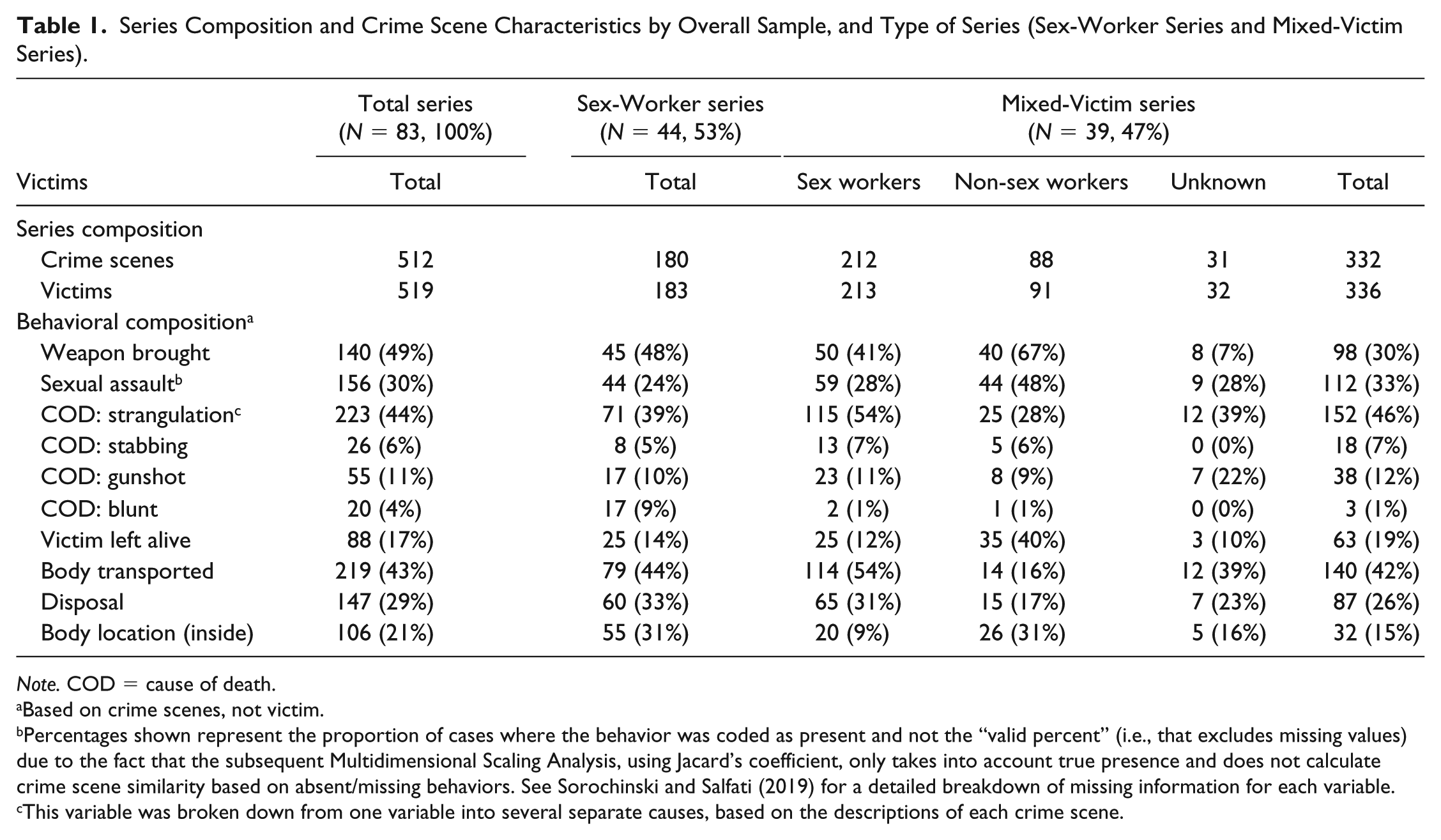
Information for cases was collected and coded using the Homicide Involving Prostitutes (HIP©; Salfati & Sorochinski, 2016) coding dictionary specifically developed for the purpose of this project. The dictionary contains 66 variables pertaining to victim and offender demographics, crime type, and crime scene characteristics, as well as the outcome of the case. A subset of these variables that the literature had highlighted as the most salient for classification and consistency analysis was used for the current study (see Table 1). Most variables are coded dichotomously (present/absent). A total of 10 coders went through training on use of open-source data and on use of the coding dictionary, followed by several rounds of inter-rater agreement testing that entailed groups of three to four coders coding the same three cases, and inter-rater agreements of at least 86% were achieved before independent coding was allowed.
Series Composition and Crime Scene Characteristics by Overall Sample, and Type of Series (Sex-Worker Series and Mixed-Victim Series).
Note. COD = cause of death.
Based on crime scenes, not victim.
Percentages shown represent the proportion of cases where the behavior was coded as present and not the “valid percent” (i.e., that excludes missing values) due to the fact that the subsequent Multidimensional Scaling Analysis, using Jacard’s coefficient, only takes into account true presence and does not calculate crime scene similarity based on absent/missing behaviors. See Sorochinski and Salfati (2019) for a detailed breakdown of missing information for each variable.
This variable was broken down from one variable into several separate causes, based on the descriptions of each crime scene.
Data
The data set used in this study included a total of 83 series committed by 83 male offenders, with a total of 512 crime scenes and 519 victims (seven crime scenes included two victims; M = 6.25, SD = 6.32, Mdn = 4). Data originated from six different countries (69 from the United States, 14 international, including Canada [3], the United Kingdom [6], Australia [3], Austria [1], and Hong Kong [1]).
Of the 83 series in the data set, 44 (53%) were series where all victims were sex workers (Sex-Worker series). These included 180 crime scenes and 183 victims (35% of all the victims in the data set; M = 4, SD = 2.92, Mdn = 3). Another 39 (47%) were series that includes sex workers and non-sex worker victims (Mixed-Victim series). These included 332 crime scenes and 336 victims (65% of all victims in the data set; M = 8.62, SD = 8.11, Mdn = 7). Of the 39 Mixed-Victim series, 59% started their series by targeting a sex worker victim, and 41% started their series by targeting a non-sex worker victim. 7 The full series composition is outlined in Table 1.
Results
Study 1: Crime Scene Consistency Patterns and Classification of Crime Scenes
The current study aimed to look at crime scene–level patterns. The study aimed to use the most salient behavioral factors identified by the literature to identify subtypes of crime scenes and to identify how many individual crime scenes displayed a dominant crime scene subtype. In addition, the study aimed to examine how the overall patterns of classification for crime scenes related to different types of victims and different types of series (sex workers within Sex Worker Victim series, sex workers within Mixed-Victim series, and non-sex workers within Mixed-Victim series).
Data
The full data set of 83 series with a total of 512 crime scenes was used for the current analysis. Of the 512 crime scenes analyzed, victim type was accounted for by what series type they were part of. In total, 181 crime scenes were of sex workers that were part of Sex-Worker series. Of the 331 crime scenes part of Mixed-Victim series, 212 were of sex workers, 88 were of non-sex workers, and 31 were of victims of unknown type.
The variables chosen for the analysis in this study pertain to those identified by the literature as the most salient in terms of understanding crime scene behavioral consistency patterns. Salient crime scene variables were chosen based on the actions that occurred before, during, and after the crime so as to represent the full spectrum of the event, and actions that specifically focused on the cognitive element such as pre- and post-planning actions (choice of victim type, bringing a weapon, killing a victim, specific ways of disposing the victim’s body such as through transporting the victim’s body or making an effort in disposing the body through hiding, covering, burying, or drowning, and the final location of victim disposal), as well as the nature of the violence, including both assault by weapons (stabbing and using a gun) and manual opportunistic assaults (strangulation or using a blunt instrument), and sexual assault. The full list of variables, as well as frequency levels of each variable in the data set, can be found in Table 1.
Analysis: Differentiation of crime scene types
A smallest space analysis (SSA; Shye, Elizur, & Hoffman, 1994) was conducted to identify thematic divisions within each behavioral subgroup. SSA is a multidimensional scaling procedure that allows for the analysis of behavioral co-occurrences within the data set. SSA results in a visual representation of the data where each variable is represented as a dot in a three-dimensional geometrical space with variables that often co-occurred in the data set appearing closer to each other, and variables that do not co-occur often appearing farther from each other. This type of analysis permits the identification of clusters of behaviors with a common underlying theme that are most likely to occur together during a given crime. A coefficient of alienation measures how well the spatial representation fits the data. The lower this coefficient is, the better the fit (i.e., the better the geometrical representation approximates the true relationship between the variables in the data). It is generally accepted that for this type of data a coefficient of .2 is considered a good fit (Shye et al., 1994).
SSA is a robust and appropriate method of analysis for multivariate classification studies and has been used extensively (and almost exclusively) in the literature that pertains to crime scene classification and offender profiling, and more specifically in studies exploring behavioral consistency patterns in serial sexual assaults and homicide. It is a hypothesis testing technique, which depends on the most salient variables being chosen for the analysis. For this reason, the variables highlighted by the literature as the most salient (and having been previously tested by similar analysis in the literature) were chosen as the basis for the SSA analysis, which forms the basis for the classification of behaviors which forms the Aim 1 of the study which focused on classification of crime scene actions into distinct crime scene subtypes, and Aim 2 of the study which used this subsequent classification system to look at consistency patterns across series.
The SSA of the 10 behaviors across the 512 crime scenes can be seen in Figure 1. The Jaccard coefficient of alienation was .09846 showing an excellent representation of the data in the three-dimensional (3D) plot. As can be seen from the patterns of co-occurring behaviors in the SSA, three regions, representing three subtypes, were clearly evident. 8 Each subtype included separate mutually exclusive causes of death and was also distinguishable by the type of planning or lack of planning. The Opportunistic Violence subtype was defined by crime scenes where the victim was found killed by an opportunistic or manual defined weapon such as using a blunt instrument or strangling the victim. The planning element was more forensic in nature post-crime through actions such as transporting the body of the victim away from the crime scene, and engaging in disposal activities such as hiding the body from view, all activities related to covering up the crime and delaying solvability. The Planned Violence subtype was defined using a weapon such as a knife or a gun. The planning element related to pre-crime activity such as bringing a weapon to the crime scene. The Sexual Violence subtype was defined by wounds caused by sexual assault. The planning element in these crime scenes were defined by victims who were both targeted (and later also found) inside and who were left alive after the crime.

3D solution of smallest space analysis of crime scene behaviors of 512 crime scenes.
Analysis: Classification of crime scenes
The next step aimed to examine whether each individual crime scene could be reliably classified into one dominant theme within each behavioral subgroup, prior to examining the consistency levels of the offender’s use of these themes across their series.
Trojan and Salfati (2009) did a thorough examination of cutoff criterions reported across different classification studies in the profiling literature using SSA and concluded that most useful criteria for identifying the dominant theme included a semi-stringent criteria where the proportion (%) of behaviors from one theme was 1.5 times greater than the proportion of behaviors from the second theme, and a more stringent criteria where the proportion of behaviors from one theme had to be twice as large as the proportion of behaviors from the other theme. As the current data were not primary source data, because each subtype included a small number of behaviors, and because the model included three subthemes, the semi-stringent criteria were used. In addition, rather than using a proportion, the actual count was used. The classification procedure first included the calculation of the sum of behaviors present from each subtype. The next step determined that a crime scene displayed a dominant theme if the sum of one subtype was 1.5 times greater than the sum for each of the two other themes. If a crime scene displayed an equal number of behaviors in two subtypes, and was 1.5 times greater than the remaining subtype, the crime scene was classified as a hybrid. If a crime scene displayed an equal number of behaviors in each crime scene, the crime scene was classified as a multi-hybrid crime scene. Finally, any crime scene that displayed none of the behaviors looked at was labeled unclassifiable. 9
The analysis included the behavioral elements of the crime scene that previous literature has highlighted to be the most salient for classification. The clear division of these crime scene actions into three distinct types confirms that these behaviors are salient in classification. The classification of crime scenes to dominant types also provided evidence that crime scenes on an individual level show clear dominant patterns.
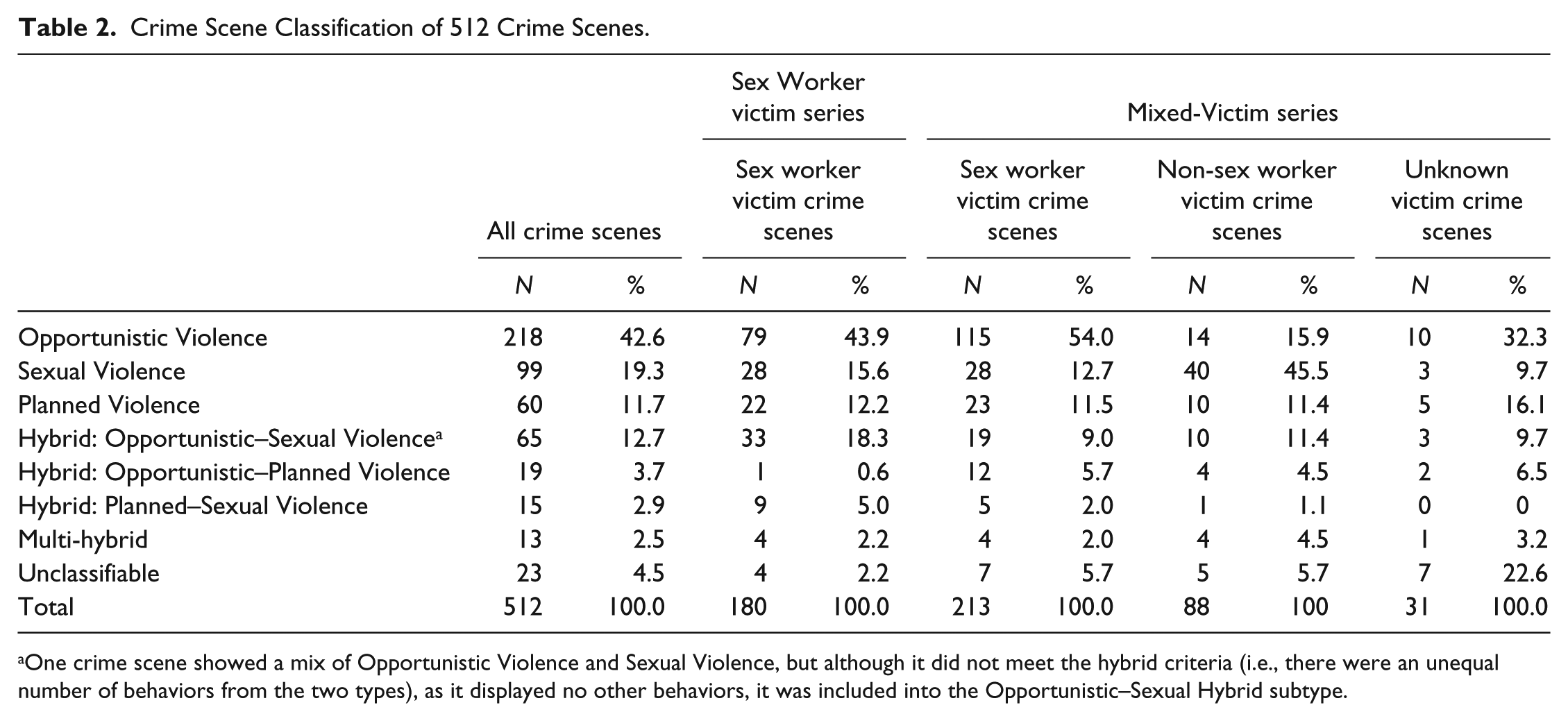
As can be seen from Table 2, the classification analysis determined that 73.6% of the crime scenes could be classified to a dominant subtype. The largest number of cases (42.6%) showed a dominant Opportunistic Violence subtype, indicating that most crime scenes display behaviors consistent with manual cause of death and subsequent post-offense behaviors to cover up the offense. This was followed by Sexual Violence (19.3%), which was defined by cases of victims who were sexually assaulted and in many cases left alive (83 out of 88, 94% of live victims were in this theme). The final subtype of Planned Violence occurred in the minority of cases (11.7%), indicating that planning, as indicated by bringing a lethal weapon to the scene, is not a common behavioral pattern. An additional 19.1% of crime scenes showed a hybrid crime scene classification (i.e., an equal split between two themes), over half of which were a mix between the Opportunistic and Sexual Violence themes. Only 2.5% of crime scenes showed a multi-hybrid classification (i.e., equal amounts across all three themes) or were unclassifiable (4.5%).
Crime Scene Classification of 512 Crime Scenes.
One crime scene showed a mix of Opportunistic Violence and Sexual Violence, but although it did not meet the hybrid criteria (i.e., there were an unequal number of behaviors from the two types), as it displayed no other behaviors, it was included into the Opportunistic–Sexual Hybrid subtype.
Analysis: Linking crime scene classification to victim and series type
When the classification patterns were examined as a function of what type of victim was targeted within the two types of series (sex workers within Sex Worker Victim series, sex workers within Mixed-Victim series, and non-sex workers within Mixed-Victim series), Table 2 clearly shows that sex worker victims in both types of series displayed a majority of crime scenes in the Opportunistic Violence subtype, whereas the non-sex worker victims dominantly exhibited a Sexual Violence subtype. The victims in the Mixed-Victim series whose status was unknown also showed dominance in the Opportunistic subtype, suggesting these victims were likely sex worker victims.
Study 2: Series Consistency Patterns and Classification of Series
The current study aimed to look at series-level patterns. The study outlines possible consistency patterns and aimed to identify how many series displayed a dominant consistency pattern subtype.
Previous literature on behavioral consistency has mainly focused on consistency as measured by the exact consistency in either behaviors or subgroups (or themes) of behaviors and has been defined as series in which offenders engage in the same behaviors, or same dominant theme throughout the series, or the majority of the series, such as two out of three crime scenes or three out of four crime scenes. Some attention has also been given to what has been termed hybrid themes, that is, crime scenes that do not display a dominant type but rather show a combination of behaviors from several themes, but the definition of hybrids has remained strictly defined and has not been looked at in detail, and these types of crime scenes have not typically been used in any behavioral consistency analysis to understand broader trajectory patterns. As a consequence, the rates of consistency have generally been reported as low and overall, there has been a lack of any deeper examination of trajectories, and how seemingly inconsistent patterns can in fact be seen to show consistent trends if looked at in more detail. Recent studies, as previously outlined, have therefore increasingly discussed the need to account for consistency in inconsistent patterns.
The current study therefore aimed to examine behavioral consistency patterns by developing a more detailed understanding of how an offender may display these consistent patterns, specifically as it relates to hybrid pattern combinations.
Data
For this analysis, the first five crime scenes (or fewer if the series had fewer than five crimes) of the series were chosen for this analysis. Although understanding the full progression of very long series is important from a theoretical perspective, from a practical point, it is most important to be able to link series together early on and so focusing on the beginning of a series and determining how consistent or inconsistent offenders are in those first crimes is most practically justified. Furthermore, while including only two crimes from each series would be insufficient to determine any pattern, including series of vastly different lengths (e.g., some series in the database spanned as many as 49 crime scenes) would be problematic for the validity of the analysis. In addition, three series had to be excluded from the analysis completely because they had two or more crime scenes that were deemed unclassifiable (i.e., none of the behaviors were known to be present at the scene), and thus these series were deemed unclassifiable as well.
The refined data set thus resulted in 80 series and 302 crime scenes, of which 44 (56%) were Sex Worker Victim series (with 148 crime scenes) and 36 (44%) were Mixed-Victim series (with 154 crime scenes).
Analysis: Classification of series patterns
The classification was based on the first five crime scenes in the series, or less, if the series was shorter. A total of 35 series had five (or more) crimes, eight series had four crime scenes, 21 series had three crime scenes, and 16 series had a total of two crime scenes.
Consistency itself was determined based on 100% consistency, that is, that a series fully adhered to one of the below series consistency subtypes. Table 3 breaks down the data to show the relationship of series victim type and series consistency pattern.
Classification of Consistency Pattern Types in 80 Series.

Percentages out of individual series type (by column).
To provide a full analysis of series consistency patterns, the six-level Model for the Analysis of Trajectories and Consistency in Homicide (MATCH) was developed for this study to examine behavioral patterns in more detail. The six separate behavioral consistency patterns of MATCH are outlined below:
Inconsistent. These series showed three or more different types of crime scenes present in the series, such that no discernible consistency pattern could be identified.
Consistent Pure Type. These series demonstrated a consistent pattern of one dominant behavioral subtype at each crime scene in the series, for example, Opportunistic Violence.
Pure Type Switcher. These series demonstrated a consistent pattern of one of two dominant behavioral subtypes at each crime scene in the series, for example, Opportunistic Violence or Sexual Violence.
Consistent Hybrid. These series demonstrated a consistent pattern of one dominant hybrid subtype at each crime scene in the series, for example, Opportunistic–Sexual Violence Hybrid.
Pure Type-Hybrid Switcher. These series demonstrated a consistent pattern of one dominant behavioral subtype at each crime scene in the series or a hybrid subtype that included the same subtype, thus demonstrating a consistency of the same behaviors at each crime scene, for example, Opportunistic Violence or Opportunistic–Sexual Violence Hybrid.
Double Pure Type-Hybrid Switcher. These series demonstrated a consistent pattern of a mix between two behavioral patterns in different combinations throughout the series, which could include a combination of one of two dominant behavioral subtypes or a hybrid subtype that included the same subtype (a combination of Types 3 and 4 above), for example, Opportunistic Violence, Sexual Violence, and Opportunistic–Sexual Violence Hybrid.
As can be seen from Table 3, the classification analysis determined that examining series consistency, using the detailed six-type breakdown, allowed for over 65 out of 80 series (81.3%) to be classified to a dominant consistency type, and in addition provided details with regard to the distribution of series to specific consistency patterns.
Results showed that 24 out of 80 series (30%) showed a Consistent Pure Type pattern, and an additional 2 out of 80 series (2.5%) displayed a consistent pattern of the same hybrid subtype. Previous studies in the field have shown similar percentages; however, the current study was based not on majority (e.g., two out of three, or three out of four crime scenes) as used in previous studies, but 100% consistency. The refinement of the model using the most salient behaviors can thus be seen to reflect a more robust classification of series, with this 32.5% being reflective of pure consistency.
Interestingly, when consistency is further expanded by providing a more detailed systematic examination of what would normally be seen as inconsistent, using the six-type consistency model provided here, and looking at the three combination (Switcher) patterns, an additional 48.8% of series can be classified to a consistent pattern.
In addition, valuable information regarding the content of these combination patterns can also be gleaned from Table 3, although due to number of subgroups, the numbers are small, and as such statistical analysis cannot be performed in any meaningful way. However, meaningful trends can still be observed. Of the 24 Consistent Pure Type series, 17% of the total sample (just less than 57% of the Consistent Pure Type patterns) displayed a consistent Opportunistic Violence type. Contrary to the results in Study 1, which looked at individual crime scenes, very few series (N = 1, 1.3%) displayed a consistency of Sexual Violence crime scene types. However, when looked at on a series basis, it becomes clear that the sexual nature of crimes was often dominant in the hybrid pattern, and the three combination patterns. Some proportion of Sexual Violence was thus present in all series, and therefore a defining feature of series, and thus not a good differentiator between series, which previous literature has also suggested when looking at consistency in serial homicide (e.g., Bateman & Salfati, 2007).
The different combination patterns provide additional information on which consistency patterns are the most common, notably patterns that contain elements of Opportunistic Violence and Sexual Violence. However, these display differently in terms of how “pure” the series is. In addition, as we move toward the more complex combinations (e.g., the last of the combination types, the Double Pure Type-Hybrid Switcher), we see fewer series, which shows an interesting result that even when we look for consistency in seemingly inconsistent patters, these do not tend to be complex in nature.
Analysis: Linking series patterns to series type
Sex Worker Victim series were more than twice as likely (N = 18, 40.9%), or almost three times as likely (N = 20, 45.5%) if the Consistent Pure Hybrid were additionally included, to be consistent, as Mixed-Victim series (N = 6, 16.7%).
Mixed-Victim series, on the contrary, were almost twice as likely (N = 9, 25%) to be inconsistent as Sex Worker Victim series (N = 6, 13.6%). They were also more likely (N = 21, 58%) to have one of the three Switcher patterns than Sex Worker Victim series (N = 18, 40.9%).
Discussion
Key Issues in Crime Scene and Series Consistency Pattern Analysis
A key question in the area of investigating serial crimes is whether we can link crime scenes to each other based on certain consistent aspects at the crime scene. Egger (1984), in one of the earliest writings on serial homicide, wrote that the key challenge for investigators is “linkage blindness,” a situation whereby crime scenes that are part of the same series are not identified as such due to our lack of understanding of how to assess consistency. Alongside being able to identify actions that can be used to link a series, we also need to know how to differentiate one series from another series. Central to this question is what is meant by consistency and how this may be displayed at the crime scene in terms of the actions most useful to establish both similarity and differentiation.
One of the emerging results in the consistency literature is that offenders do not display carbon-copy consistency in their series. However, although they may outwardly appear inconsistent, researchers in the area of serial crime have suggested that there may still be consistent patterns to their inconsistency. This would pertain to both the behavioral element of the crime scene and the type of victim targeted, as well as the type of crime engaged in (e.g., rape or homicide).
Sex workers as a group embody all of these key issues highlighted in the linking literature, and this article has aimed to explore all these behavioral consistency issues within series that include these types of victims, notably series where all victims were sex workers, and series that included sex workers and non-sex worker victims. Analysis focused on two specific levels of consistency pattern analysis: (a) consistency patterns on the crime scene level (comparing sex worker victim crime scenes to non-sex worker crime scenes) and (b) consistency patterns on the series level (Sex Worker Victim series where offenders targeted only sex workers, and Mixed-Victim series where offenders targeted both sex workers and non-sex workers).
Key Takeaways From the Pattern Analysis of Crime Scenes
The study used variables identified by the literature as the most salient in terms of understanding crime scene behavioral consistency patterns in sex worker crimes. These included crime scene actions that occurred before, during, and after the crime so as to represent the full spectrum of the event, and actions that specifically focused on the cognitive element such as pre- and post-planning actions, as well as the nature of the violence and cause of death, and the presence of sexual assault. Using these salient crime scene indicators resulted in a clear model of three distinct crime scene patterns: Opportunistic, Planned, and Sexual Violence. Each crime scene pattern was distinguishable by cause of death and the type of planning or lack of planning, which is in line with previous literature detailing the importance of understanding what are common to most crimes, and what are the features that can help distinguish different crimes (e.g., Canter et al., 2004; Salfati, 2003; Sorochinski & Salfati, 2010). Using actions identified as the most salient led to a robust model that allowed almost three quarters of crime scenes to be classified to a dominant pattern, and for less than 5% to be unclassifiable.
The model was additionally useful when examining how it related to victim types (sex workers and non-sex workers) in each of the two types of series (Sex Worker Victim series and Mixed-Victim series). The majority of the crime scenes of sex worker victims in both types of series could be classified as showing an Opportunistic Violence pattern, whereas the non-sex worker victims dominantly exhibited a Sexual Violence pattern. Results therefore demonstrated that sex worker victims could not easily be distinguished in terms of the type of series they may belong to. Results also demonstrated that different types of victims within Mixed-Victim series had crime scene patterns. Both these results show the very real difficulties of understanding similarity and differentiation in crime scenes, which makes the first step of any consistency analysis in series a challenge.
Key Takeaways From the Pattern Analysis of Series
Previous literature on behavioral consistency has mainly focused on consistency as measured by the exact consistency in either behaviors or subtypes of behaviors using classification systems as the one presented in Study 1 and has been defined as series in which offenders engage in the same behaviors, or same dominant crime scene subtype throughout the majority (a dominant proportion) of the series. Some attention has also been given to what has been termed hybrid themes, that is, crime scenes that do not display a dominant type but rather show an equal combination of behaviors from several types. The definition of hybrids has, however, not been looked at in detail for their contribution to understanding how the offender acts at the crime scene. An offender displaying a hybrid crime scene has also been seen to show inconsistency, and as a consequence, the rates of consistency have generally been reported as low. Overall, there has been a lack of any broader examination of patterns of consistency.
Recent literature has therefore increasingly discussed the need to account for consistency in inconsistent patterns to increase the success of the linking process (e.g., Fleeson & Noftle, 2008; Hewitt & Beauregard, 2014; Leclerc et al., 2015; Salfati, 2009; Salfati & Sorochinski, 2018; Sorochinski & Salfati, 2010, 2018). Some research in linking to date, as outlined early in the article, has focused on examining pairs of crimes belonging to the same series without taking account of where in the series they are, which has been just as fraught as research in the behavioral consistency literature that has only looked at exact pattern matching.
To address the need for increasing the rate of linking by providing a broader understanding of behavioral consistency, the current study provided a more detailed examination by specifically focusing (a) on the trajectory of the crimes in the series (addressing issues in the pair-matching linking literature) and (b) on series patterns beyond simply looking at series that had a majority of crime scenes displaying only the same crime scene type (addressing issues in the behavioral consistency literature), and included crime scenes classified as hybrid in the analysis.
By expanding the examination to look at trajectory patterns of series, and including hybrid crime scenes, the six-level MATCH of series consistency patterns was developed, which allowed 81.3% of series to be classified to a consistent pattern. Over half of these series were series that would previously have been deemed to be inconsistent series, thus showing the very real contribution the expanded conceptualization of consistency patterns that the MATCH system provides to examine, understand, and uncover consistencies in series.
Series that would previously not have been identified as consistent were inconsistent due to switching from one behavioral pattern to another across their series and also displaying hybrid crime scenes. The MATCH system allows for a much broader, and more detailed, conceptualization of consistency by looking at what specifically stays consistent across a crime, which beyond Inconsistent series and Pure Type series that were completely consistent, was seen to also include a Pure Type Switcher series where offenders who consistently switch between two different dominant crime scene behavioral styles that are linked based on the psychological nature between them (e.g., the element of planning): a Consistent Hybrid series where offenders show a consistent pattern of one dominant hybrid subtype at each crime scene in the series, and a Pure Type-Hybrid Switcher series where again hybrid crime scenes feature and where offenders show a consistent pattern of a dominant behavioral subtype at a crime scene in the series or a hybrid subtypes that is based on the dominant behavioral subtype, thus demonstrating a psychological consistency of the same behaviors at each crime scene, and finally a Double Pure Type-Hybrid Switcher series where an offender displays a consistent pattern of a mix between two behavioral patterns in different combinations throughout the series, which could include a combination of either any of the dominant subtypes or hybrid subtype, but that all share a common psychological element (e.g., the element of violence).
The different combination patterns found in the current study provided additional important information on which consistency patterns were the most common using the specific crime scene classification model used with this specific sample, notably patterns that contained elements of Opportunistic Violence and Sexual Violence. Opportunistic and Planned patterns were also mostly mutually exclusive in series patterns. It is important to note, however, that when looking at patterns that included some element of crime scene type switching, a proportion of Sexual Violence was present in all of these series and therefore can be seen as a defining feature of series, which provides important information that it may not be a good differentiator between series, which previous literature (Bateman & Salfati, 2007) has also suggested when looking at consistency in serial homicide.
Using the broadened understanding of behavioral consistency from using the broader conceptualization on behavioral consistency as outlined by the MATCH system ultimately allowed for a clear pattern to be evidenced when applied to the two types of series (Sex Worker Victim series and Mixed-Victim series), which was the key aim of the study. Results showed that Sex Worker Victim series were overall more likely to be consistent. Mixed-Victim series, on the contrary, were not only less consistent overall but also displayed a larger proportion of series that included patterns where offenders switched from one crime scene type to another in their series.
Understanding that crime scenes showing outwardly behavioral inconsistencies are in fact consistent when understood as part of the MATCH system reduces linkage blindness and ultimately increases the chances that crime scenes may be identified as part of the same series and ultimately get solved.
Limitations
There are a few limitations in the present study that are worth highlighting. First, data were collected from media sources that often differ in the amount of information available for any given case and, as such, have not been written for research purposes and thus often lack pertinent details. This creates missing data that can skew the true rates of behavioral consistency between two crimes in a series. Specifically, there were a small but significant number of cases where it was impossible to determine whether the victim was a sex worker or not, thus limiting the possibility to fully identify the victim selection trajectory across the series. In addition, the presence or absence of sexual assault in homicides, particularly those involving a sex worker victim, was also often difficult to determine thus limiting the reliability of this variable for use in consistency analysis. Additional research is necessary to confirm the findings of the present study. In addition, in this study, the analysis of consistency and behavioral trajectories was limited to the first five crimes in the series. Although this is an improvement over only looking at behavioral similarities in crime pairs, later crimes in longer series were excluded from the analysis to allow for a more succinct comparison of series, and it may be important to determine whether important behavioral changes occur toward the end of these longer series.
Conclusion and Implications for Behavioral Consistency Theory and Linking Practice
Providing a more detailed model for crime scene pattern analysis (by focusing on salient behaviors) and a more detailed model for series pattern analysis (by focusing in a more encompassing concept of consistency) has provided for an approach that allows for more crime scenes and more series to be analyzed and classified. This has provided a richer base line for drawing conclusions about behavioral consistency patterns and a basis for linking in practice.
As a summary, based on the results of the current study, the key to the expanded understanding and identification of consistency can be summarized as being based on system that includes the following:
a solid crime scene classification model where each subtype is distinct but is understood as each including different presentations of similar psychological constructs. In the case of the current model, this related to the elements of violence, planning, and sexual activity, and
an examination of trajectories, such as using the MATCH, which includes not only exact pattern matching but also similarities of the underlying psychological nature of the classification of each individual crime scene.
The next important steps to develop the field must now include a more detailed analysis of the patterns of the full series trajectories themselves, in terms of how series start, and the pattern of change and development over time, as well as how all of these factors will allow us to make more valid and reliable associations to the most likely offenders who engage in each of these behavioral consistency patterns, and thus allowing for a more theoretically and empirically solid foundation for offender profiling.
Footnotes
Acknowledgements
The authors would like to sincerely thank the many research assistants involved in this project for their help with data collection. Special mention goes to the following for their extensive input on data preparation: Rosanne Libretti, Sneha Gupta, Marissa M. Abrams, and Marcel Trujilo.
Declaration of Conflicting Interests
The author(s) declared no potential conflicts of interest with respect to the research, authorship, and/or publication of this article.
Funding
The author(s) disclosed receipt of the following financial support for the research, authorship, and/or publication of this article: Support for this project was provided by a PSC-CUNY Award, jointly funded by The Professional Staff Congress and The City University of New York.
