




Abstract
Although the idea of criminal rehabilitation in China has a long history, research on offender rehabilitation in contemporary China is limited. Although Chinese scholars generally agree that rehabilitation through correctional education helps inmates with social reintegration and reduces recidivism, few have examined factors associated with prisoners’ participation in such programs. Building on relevant theory and studies in Western societies, this study examines how Chinese prisoners’ participation in vocational and academic programs is associated with a range of push and pull factors. Our research questions are addressed with binary and multinomial logistic regressions based on a unique prisoner data set collected in Zhejiang, China. Results show that some factors found to affect inmate participation in the West failed to demonstrate significant relationships with participation among Chinese prisoners. Furthermore, factors most significantly associated with participation appear to be incarceration related, such as prison visits, prison phone calls, and sentence lengths. We conclude with a discussion of the implications of our results.
Introduction
The Chinese prison system that we observe today, including correctional ideology, methods, and physical layout, is a mixture of traditions that date back as early as the Great Shun Era (2255-2195 B.C.) and Western ideas and measures since the Opium War in 1840 (Shaw, 2010). Although the development of the correctional system in China has taken a long and twisted road, it is not difficult to find overlap between traditional Chinese and contemporary Western ideologies. One of the commonly discussed and valued elements in corrections is rehabilitation through education. A comprehensive and efficacious correctional system extends far beyond mere punishment. From the long-term perspective, a correctional system fails in one important respect if it does not convert an offender into a morally capable citizen. The idea and practice of rehabilitating criminals through moral education and productive labor in China can be traced to the West Zhou Dynasty (1045-770 B.C.; Shaw, 2010). This idea has survived for thousands of years, and it has far-reaching impacts on today’s Chinese correctional systems. Regardless of specific content, education has been widely recognized as a major part of the correctional system in preventing recidivism and promoting rehabilitation of criminals to facilitate their reintegration in the society upon release (Hobler, 1989; Zeng, 2013).
Social science researchers have found that inmates’ participation in vocational or academic training during incarceration is associated with a range of individual and societal benefits, including higher self-esteem, higher morality, more and better job opportunities after release, and lower chances of recidivism (Adams et al., 1994; Lochner & Moretti, 2004; Quan-Baffour & Zawada, 2012; Tyler & Kling, 2006; Vacca, 2004). It is thus important to study and learn what are the factors and mechanisms that facilitate inmates’ participation of vocational and academic training in prison.
Inmates’ participation in rehabilitation programs has been studied extensively by Western researchers. One of the most established overarching frameworks employed in relevant studies is the push-and-pull perspective describing inmates’ decision to participate. The theory considers inmates’ participation as a result of the attempt either to escape from undesirable scenarios or to acquire anticipated rewards (Manger et al., 2010). Results from these studies have been used to inform broader frameworks prescribing prisoner rehabilitation and treatment, such as the risk–need–responsivity (RNR) framework.
By contrast, such research on inmates’ participation in the Chinese context is scarce. Academic and vocational education programs are not prevalent throughout all Chinese prisons because provision of such programs require additional financial resources and qualified instructors. In addition, in prisons where these programs are available, participation is generally encouraged but not required. Therefore, without a uniformly employed inmate rehabilitation structure and adequate supporting theoretical and empirical research, prisoner rehabilitation in China lags behind in important aspects. Building on the push-and-pull framework and previous findings in Western societies, the current study aims to fill the Chinese correctional system literature gap by examining how Chinese prisoners’ preincarceration sociodemographic factors and in-prison characteristics are related to participation in vocational and academic education programs.
Prior Research
Theoretical Frameworks and Empirical Findings in the West
Optimism about the potential for offender rehabilitation through correctional programs in the West has been enhanced by the development of the RNR model (Blanchette & Brown, 2006; Ward, Melser, & Yates, 2007). The framework was first formalized in 1990 (Andrews, Bonta, & Hoge, 1990), and later elaborated and contextualized within a general personality and cognitive social learning (GPCSL) theory of criminal conduct (Andrews & Bonta, 2006). The core of RNR are the three principles of risk, need, and responsivity. The risk principle states that the level of treatment and supervision should be matched with the risk of the offender (Andrews et al., 1990). In other words, interventions given to low-risk offenders should not be equally intensive to those provided to higher risk offenders (Andrews et al., 2011). Prior research has shown that providing intensive rehabilitative programs and supervision to low-risk offenders is actually associated with increased risk of recidivism (Andrews & Friesen, 1987; Lowenkamp & Latessa, 2004). Therefore, the risk principle has implications at the level of service delivery and the usage and prioritization of scarce resources (Chua, Chu, Yim, Chong, & Teoh, 2014). The need principle suggests that offender rehabilitation programs or interventions should target dynamic criminogenic needs that are functionally related to criminal behavior to lower the risk of recidivism (Hoge, 2002). Such needs include, but are not limited to, procriminal attitudes, substance abuse, antisocial personality pattern, and problematic family/marital relationships. Lastly, the responsivity principle indicates that the style and mode of intervention should be tailored to fit offenders’ abilities and learning styles. Empirical evidence supports the importance of the responsivity principle. For example, researchers have consistently shown gender differences in patterns and manners of participation in rehabilitation programs (e.g., Crittenden & Koons-Witt, 2017; McCall, 2016; Tietjen, Garneau, Horowitz, & Noel, 2018). In addition, it has been found that educationally disadvantaged prisoners tend to be more motivated to participate in education during incarceration (Manger, Eikeland, & Asbjørnsen, 2013). Taken together, research has shown that offender rehabilitation and intervention programs that adhere to all three principles have been associated with significantly greater reduction in recidivism rates than those that failed to do so.
Of course, the claimed benefits of rehabilitation programs are only likely to be realized to the extent that inmates actually participate. Therefore, it is crucial for researchers and prison administrators to understand the factors influencing inmates’ participation in such programs and the differences between participants and nonparticipants. Of the many theoretical frameworks explaining factors shaping inmates’ participation, the push–pull perspective is one of the most prominent and established. The push–pull perspective is most explicitly developed in the sociology of education to explain individuals’ motivations and decisions in education (see Elster, 1979; Gambetta, 1987). This perspective has been adopted by researchers of prisoner rehabilitation to further our knowledge on reasons behind inmates’ participation in rehabilitation programs or the barriers thereof (e.g., Brosens, De Donder, Dury, & Verté, 2015; Brosens, De Donder, Dury, & Verté, 2016; Costelloe, 2003; Eikeland, 2009; Manger, Eikeland, & Asbjørnsen, 2013; Manger et al., 2010).
The push–pull perspective classifies factors affecting inmates’ participation into two major groups based on their differential operating mechanisms. The framework can be conceived as operating on a continuum where a varying level of consciousness and active decision making is involved. On one end of the spectrum are the push factors. The “push-from-behind” model suggests that individuals’ behaviors sometimes emerge from social or psychological causes that are completely irrelevant to individuals’ consciousness. In one way or another, an individual’s actions are seen as propelled by forces that are not within the immediate reach of his or her conscious state (Gambetta, 1987). Here, individuals do not clearly perceive and weigh the alternatives presented but are moved by factors acting independently of their awareness, such as norms, traditions, class values, and structural constraints (Gambetta, 1987). In such cases, individuals become puppet-like actors compelled into certain course of actions. Research on prison education indicates that push factors involve forces driving inmates away from things considered as aversive, such as prison work, discipline, isolation, and conflicts (Manger et al., 2010). From this perspective, inmates participate in rehabilitation programs not to obtain the perceived benefits of such programs but merely as a means to get away from negative experiences associated with incarceration. Such perceived or actual negative experiences, thus, push inmates into participation and leave inmates with little room for planning, evaluation, and decision.
By contrast, the other end of the continuum encompasses the pull factors. According to the “pulled-from-the-front” view, people are active decision makers who act purposely in accordance with their intentions (Manger et al., 2010). Rather than being forced into various directions and actions, individuals evaluate their situations and options, and they decide their actions based on the merit of certain action in itself as well as anticipated future rewards and benefits. In such scenarios, inmates decide on participation either for the sake of education or perceived benefits associated with it, such as better jobs upon release, more harmonious relationships with prison guards, and self-fulfillment (e.g., Behan, 2014; Manger, Eikeland, & Asbjørnsen, 2013). These potential rewards, thus, attract, or pull, inmates toward participation in rehabilitation programs. The pure push and pull models essentially serve as ideal types. In reality, push and pull factors are not necessarily exclusive, and individual behaviors can be shaped simultaneously by both push and pull factors.
The existing literature provides plentiful empirical evidence for the push–pull perspective. Researchers consistently find that aversive experiences and environments unique to the prison setting are positively associated with participation in rehabilitation programs such as academic and vocational education, thereby supporting the “push-from-behind” model. For example, in one of the recent studies conducted in Greece, Papaioannou, Anagnou, and Vergidis (2018) conducted a meta-analysis on 44 studies (from 2006-2016) examining the Second Chance School (SCS) program implemented in Greek prisons. Their findings show that prisoners are “pushed” into the program by a number of push factors, such as suffocating prison environment, isolation from the outside world, prison routine, loss of time, and mind inertia. Similar findings are also reported by Panitsides and Moussiou (2019). Using interview data from 72 male prisoners in the Korydallos prison in Greece, the authors showed that one of the most consistently mentioned reasons for participation is to escape from the prison environment. In other words, inmates are likely to participate in education programs as a way to get away from the undesirable prison life, even just temporarily. Similar findings have also been reported in studies conducted in other countries, such as Norway and Ireland (e.g., Behan, 2014; Costelloe, 2003; Manger, Eikeland, & Asbjørnsen, 2013; Manger et al., 2010). For example, based on data collected from 467 inmates attending Norwegian prisons, Manger and colleagues (2010) demonstrated that inmates participate in education programs partially due to social reasons and reasons unique to the prison context. Although specific reasons cited vary from one person to another, examples of such reasons include lack of freedom in prison, isolation from the outside world, and deprivation of normal life patterns and activities, such as schooling and employment (Manger et al., 2010). In a study using data from Irish prisons, Behan (2014) found that inmates participate in prison schools to escape from work and the stressful atmosphere in prison, and to better endure and cope with the incarcerated life.
Another salient predictor of prison education participation is time served or number of years incarcerated (Brosens et al., 2016; Jackson & Innes, 2000; Velasquez, 2016). As a potential push factor in itself, time served in prison is also likely to increase participation indirectly through other previously discussed push factors. As inmates spend more time in prison, aversive experiences associated with sufferings and deprivations would continue to ambulate and strengthen.
With regard to pull factors, the most commonly reported reasons for prison education participation are those with a future orientation. Manger et al. (2010) suggested that inmates consider participation in rehabilitation programs as a way to prepare themselves for life upon release. Among other things, gaining knowledge and skills to improve employability upon release is probably the most frequent reason cited by inmates regarding participation in academic and vocational education as well as other rehabilitation programs (see Behan, 2014; Cai, Ruhil, & Gut, 2019; Manger et al., 2010; Papaioannou et al., 2018; Tewksbury & Stengel, 2006). Rather than merely running away from aversive experiences associated with incarceration in a passive manner, inmates in these instances are actively evaluating their options regarding prison life and planning for the future. Perceived future benefits in employment and a regular life pull them into rehabilitation programs. In addition to potential economic benefits, inmates participate in prison programs also to acquire perceived social and psychological rewards (Cai et al., 2019; Croux, Brosens, Vandevelde, & De Donder, 2019; Hall & Killacky, 2008; Papaioannou et al., 2018; Schlesinger, 2005; Tewksbury & Stengel, 2006; Torre & Fine, 2005).
Regarding psychological benefits, researchers have found that some inmates are attracted into various prison programs with the hope of acquiring higher self-esteem and self-efficacy, greater confidence, and to achieve self-improvement and personal fulfillment (e.g., Croux et al., 2019; Papaioannou et al., 2018; Tewksbury & Stengel, 2006). At the same time, inmates are often motivated by social reasons. For example, in their study on inmates’ perception on prison adult education, Hall and Killacky (2008) discovered that many inmates consider the program as helpful in developing abilities to take care of not only themselves but also their loved ones, such as children, spouses, and parents, when they return home. In addition to supporting the loved ones financially, researchers also found that some inmates, particularly those with children, are pulled into prison education to become decent role models for their children (Aldridge, 2015; Hall & Killacky, 2008; Schlesinger, 2005; Torre & Fine, 2005). In a study on data from 2004 U.S. Department of Justice’s Bureau of Justice Statistics, Velasquez (2016) examined relationships between inmates’ participation in prison programs and child contact during incarceration. The author discovered that frequent contact with children in prison was associated with a greater likelihood of participation. Velasquez (2016) suggested that contact with children could provoke stronger sense of responsibility, which, in turn, pulls inmates toward participation.
For the larger population of inmates, researchers have found that prisoners with a generally healthy and frequent contact with the outside world, through visitors and prison phone calls, are more likely to participate in rehabilitation programs (Brosens et al., 2015; Brosens et al., 2016; Brosens, De Donder, Vanwing, Dury, & Verté, 2014; Jackson & Innes, 2000). It is possible that prison visits and phone calls act as pull factors for inmates’ participation because they provide inmates with information, encouragement, emotional support, and a sense of duty to others. These factors, in turn, assist inmates to better evaluate their situations and options and facilitate the decision of participation. In addition to the above pull factors, inmates sometimes participate for utilitarian reasons. In his research on motivators and inhibitors regarding inmates’ participation in West Virginia Division of Corrections, Aldridge (2015) showed that one of the most important pull factors for participation is to impress the parole board, so that their incarceration could be shortened. The same finding was also reported by Panitsides and Moussiou (2019) in their study on 72 male inmates in Korydallos prison. The abovementioned pull factors are instrumental in nature as they take participation in rehabilitation programs as a means to differential ends. However, researchers have also suggested that some inmates participate in prison education programs purely for the sake of knowledge rather than any additional goals (e.g., Panitsides & Moussiou, 2019; Papaioannou et al., 2018). Therefore, thirst for knowledge and learning could be a strong pull factor in itself. Other pull factors include prior education achievement, previous employment, and possessing qualifications required to participate (Cai et al., 2019; Jackson & Innes, 2000).
There are many other factors affecting inmates’ participation, which cannot be clearly categorized as either a pull or push. Studies have shown that participation is affected by a range of additional variables operating at both individual level and institutional level. At the individual level, inmates’ participation have been found to be influenced by gender, age, race, peer pressure, support from correctional officers/staff, language proficiency, competing prison activities, lack of information, nationality, and offense type (Aldridge, 2015; Brosens et al., 2015; Brosens et al., 2016; Croux et al., 2019; Manger et al., 2010; Tietjen et al., 2018; Velasquez, 2016). At the institutional level, inmates’ participation is often conditioned on program availability, adequacy of qualified adult education teachers, facility and teaching and learning materials, availability of staff and resources, lack of integration between education and prison work, and long waiting list (Brosens et al., 2015; Crittenden & Koons-Witt, 2017; Kyalo, MuIwa, Matuta, & Rutere, 2015; Tietjen et al., 2018).
The Chinese Context
Although the idea of prisoner rehabilitation has existed for thousands of years in China, the application of theoretical knowledge to guide programming in contemporary Chinese prisons has been limited. In recent decades, changes have been observed, thanks to the importation of elements of penology theories and research findings from Western societies. However, a systematized, overarching rehabilitation framework such as RNR and its supporting research remain largely absent. In general, prison management team members in Chinese prisons have frequent interactions with prisoners, retaining detailed records of each individual’s information, including personal characteristics, performance, health, and activities they have participated in. Prison staff typically use a scoring system to regularly assess inmates’ performance, risks, and needs. These evaluation systems are used to assess the possibility of reducing a prisoner’s sentence or imprisonment time, thus, motivating prisoners to participate in the programs and receive the benefits of the programs. Furthermore, programs with positive effects can be further strengthened, developed, whereas programs that show less effects can be modified and improved (Chen, 2018; Sun, 2019). Some of the better developed prisons have begun to follow footsteps of their counterparts in Western societies and have employed systems such as the Level of Service Inventory–Revised (LSI-R) for this purpose. However, due to the lack of evidence-based programs and interventions, the implementation of such assessments and planning system is not consistent (Zhang, 2013). For some poorly established prisons, inmate assessment and rehabilitation recommendations are often made based on the judgements of prison staffs (Zhang & Liu, 2015).
Chinese prisons typically include several types of programs for rehabilitation purposes, such as work/laboring programs, academic educational programs, thought education programs, psychological counseling programs, recreational and cultural activity programs. These programs are designed and implemented by prison administrators and researchers at system level.
The most commonly practiced program is the work/laboring program, which requires the participation of all prisoners to work, often on some production lines. The program allows certain adjustments for those with advanced age, health issues, or other conditions preventing them from doing assigned jobs (Chen, 2018; Sun, 2019). Similar to labor programs, thought education programs are also commonly available and offered on daily basis. Prison counselors as well as guards would take the initiative to talk to or council inmates who encounter personal problems, have conflict with other prisoners, or violated rules in prison (Zhou, 2018).
Another relevant program involves psychological counseling provided by trained psychological counselors. Generally, counseling is provided to those who seek psychological counseling, but when a prisoner is suspected of having mental problems, the prison administration will arrange a psychiatrist to treat him or her (Zhejiang Second Prison Research Group, 2018). Recreational and cultural activity programs are also provided, though they differ in scale, variety, and depth from one prison to another depending on available space, financial support, and qualified instructors. Such programs generally include activities such as basketball competition, singing, painting, calligraphy, sculpture, drama, and movie viewing. These programs are organized by prison officials to enrich the life of the prisoners and are expected to produce positive influences on their psychological and physical health, social networks, worldviews, and value systems (Yang, 2018).
Comparatively, other programs are less prevalent and less consistently practiced in Chinese prisons. Academic educational programs usually feature different levels of education, including literacy education, elementary school education, junior and senior high school programs, and college-level programs. Prison staffs will identify inmates’ current educational level and accordingly encourage them, and require them in certain prisons, to participate in academic education of an appropriate level (W. Ma, 2013). Vocational programs, when available, are offered in a similar way. Each prison will design vocational programs based on available human and economic resources, infrastructure, need of the prison production, and current needs and trends in the job market. For complicated vocational skills, such as computer science or tailoring, the prison will provide the education at different levels. Inmates are encouraged to participate in the appropriate level according to their current knowledge and skills.
That being said, although the Chinese Prison Law of the People’s Republic of China (2012) states that inmates have rights to continuing academic and vocational education and that the prisons should fulfill their responsibility of delivering such education, the law also mandates that, as previously mentioned, all capable inmates participate in productive labor to create revenue for the regular functioning of the prison. Thus, it is not uncommon for some prisons to give priority to the sustainability of the prison facility over inmates’ right to education and rehabilitation (Li, 2017). Inmates are, in these instances, required to carry out mechanical and low-level manual work, and they have few opportunities to equip themselves with necessary academic knowledge and vocational skills that can help them acquire better jobs and reintegrate them into the society after release. There are additional factors at the system level that may prevent inmates from getting quality education programs. Such factors include, but are not limited to, the lack of adequate qualified instructors who are certified by the government to deliver sound education to inmates, inadequate financial support for correctional education from the state, obsolete and badly maintained production equipment and technology, outdated educational ideas and systems in prison, and lack of research and evidence-based rehabilitation frameworks (Li, 2017; Wan, 2007).
In our search of the Chinese literature, we have identified only one study that specifically explores participation from the individual perspective. Using descriptive statistics on 683 inmates in China, Shao (2014) demonstrated that inmates’ participation is associated with their assessment of education/rehabilitation programs, which is, in turn, affected by the length of imprisonment. The author suggested that inmates who had served more than a year are more likely to harbor a negative view toward correctional education compared with those who had served less than a year. The author also indicated that inmates’ negative attitude would keep them away from further participation. Thus, Shao (2014) suggested that factors that influence inmates’ participation in correctional education do not perform consistently throughout the period of incarceration and could change as the inmates spend more time in prison.
Taken together, the limited and inconsistent provision of rehabilitation programs, especially education programs, in Chinese prisons as well as the lack of evidence-based prison policy and practice point to the pressing need for studies that examine factors influencing Chinese inmates’ participation in prison programs.
The Current Study
As documented in our literature review, the push–pull theoretical framework has proven to be quite useful in identifying the kinds of factors that help explain the participation of inmates in educational programs in the West. The generalizability of this framework and the empirical findings associated with it to the Chinese context, however, are largely unknown. The main objective of our research is to fill this conspicuous gap in the literature by systematically examining of factors with the potential to affect inmates’ participation in education programs using original survey data collected from four prisons in Zhejiang, China.
Based on the push–pull perspective, we pose the following overarching hypotheses:
We include nine pull factors, which may motivate inmates to participate. The nine factors include being married, having children, education level, parental relationship, peer relationship, neighborhood relationship, number of prison visits, number of prison phone calls, and positive attitude. As mentioned previously, research on correctional education participation indicates that some inmates participate in available programs to get knowledge and skills to secure better employment after release, which, in turn, empowers them to take care of their loved ones, and to become role models for their children (e.g., Hall & Killacky, 2008; Schlesinger, 2005; Torre & Fine, 2005). These anticipated future rewards could attract, or pull, inmates into participation. Thus, we assume that being married and having children work as pull factors to motivate inmates to participate.
Education is another important pull variable. Prior research on factors motivating inmates’ participation has shown that inmates with higher educational level or greater prior educational achievement are more likely to participate in education programs (e.g., Cai et al., 2019; Jackson & Innes, 2000). This is so because inmates with higher educational levels possess certain qualification required by particular programs, more self-efficacy, and capacity to complete and enjoy the program. Education programs would thus become even more attractive to such inmates. Therefore, we expect that higher educational level to be a pull factor that attracts inmates into education participation.
The three variables pertaining to the nature of relationships are included as pull factors because we anticipate that they can indirectly promote participation by at least two means. First, a strong relationship with families and friends may strengthen inmates’ desires to fulfill their responsibilities after release from the prison. Second, healthy relationships with families, friends, and the neighborhoods offer inmates potentially increased availability of jobs after release when combined with anticipated rewards from participation in prison education. Such expectations could pull inmates toward future preparation in prison academically or vocationally.
We consider prison call and visit as pull factors because families could drive inmates into education programs through constant encouragement, care, and comfort. As mentioned earlier, inmates with frequent contacts with the outside world tend to be associated with greater participation in prison education (Brosens et al., 2015; Velasquez, 2016). In fact, the mere presence of family members, even just their voice, could remind inmates of their current status and future responsibilities, and, thus, may work as incentives for inmates’ participation in correctional education. Therefore, we expect that inmates with more prison visits and phone calls are more likely to participate in education. The last pull factor, positive attitude, measures prisoners’ general attitude toward their life in prison. We assume that inmates with more positive attitudes and perception toward their current life in prison may be better adapted to the prison and more motivated to participation in education programs.
Based on the push model, we include two potential push variables: sentence length and time served. We assume that some inmates would take correctional education as a coping strategy for imprisonment, and that the need for such coping strategy would be greater for those with a longer period of incarceration. A long incarceration is naturally associated with the pains of imprisonment. Prisoners are deprived of many things, such as freedom, security, autonomy, goods and services, and purposes. Inmates, particularly those with longer sentence, are likely to take prison rehabilitation programs as a way to escape from such deprivation and aversive experiences, and to restore a sense of purpose, hope, dignity, and value that are essential to humanity. In this sense, inmates are pushed into participation. Therefore, we expect that inmates with longer sentence are more likely to participate in prison education.
Time served in prison, by contrast, measures the length of time inmates have been incarcerated so far for the most recent sentencing. As inmates spend more time behind bars, aversive experience and negative emotions would begin to unfold. As a result, some prisoners choose to participate in prison activities and programs to stay away from such negative feelings and occasions. Thus, we hypothesize that inmates who have served longer time in prison are more likely to participate in education.
Data and Method
Data
The current study employs survey data collected from inmates incarcerated in Zhejiang, a southeastern coastal province of China. 1 The procedures for the research were approved by the prison authorities, and they complied with widely accepted ethical standards in similar research in China (see Jin, 2017; Kong, 2019; Liu, 2015). Before conducting research in Chinese prisons, researchers must first acquire permission from prison administrators who will then assist with the administration of surveys or interviews (Jin, 2017; Kong, 2019; Liu, 2015). Respondents in our study were selected using a stratified random sampling design. In the first stages of sampling, researchers selected four out of the total 14 prisons in the province, nine provisional prisons, and five municipal prisons. Each of the selected prisons represents a particular type of prison with respect to inmates’ gender and terms of sentence. Of the four prisons, three are populated by male inmates and the other one by female inmates. The female prison (Zhejiang F Female Prison) holds female offenders who were serving a range of sentences. Of the three male prisons, one is populated by inmates sentenced of more than 15 years (Zhejiang T Prison). A second male prison holds inmates who serve a sentence between 3 and 15 years (Zhejiang Q Prison). A third prison consists of comparatively less serious male inmates who were serving 3 years and below (Hangzhou S Prison). The prison with the less serious male offenders was selected from the municipal prisons, whereas the other three prisons, including the women’s prison, were selected from the provisional prisons.
The target sample was to include 2,000 inmates, 500 from each selected prison. Given that participation in the research was completely voluntary, we ended up with an effective sample size of 1,933, 500 from Zhejiang Q Prison, 497 from Zhejiang T Prison, 444 from Zhejiang F Female Prison, and 492 from Hangzhou S Prison. The overall participation rate was about 97%, which is consistent with other prison surveys that have been officially authorized and conducted in China (see Ke, Lin, & Zhang, 2018; L. Ma, 2009; Shao, 2017; Zhejiang Qiaosi Prison Research Committee, 2016).
Our research team administered the survey in the four selected prisons in July and August 2014. The general procedure was similar in each survey site. The research group leader first introduced all the researchers involved in the data collection, who were members of a juvenile delinquency research society in the province. Then, he explained the nature of the study and the scope of the survey. The group leader emphasized that the survey was completely anonymous and voluntary, and that the respondents had the liberty to refuse to answer any questions. Inmates were also assured that the data would be used only for academic research and would not be shared with the prison administration or any other official agencies. Oral consent was acquired from each inmate participating in the study. Lastly, the group leader explained that the results of the research would hopefully be beneficial to inmates, stimulating better public policies with respect to rehabilitation and future job prospects for released inmates.
The surveys were conducted in a work site in prison during break hours, and the average time for completing the survey was about 30 min. The respondents were advised to fill in the questionnaire carefully based on their own situation and understanding of the questions. They were allowed to ask the researchers on site for clarification if necessary. In the very small number of cases with illiterate inmates (four in the prison with sentences from 3-15 years, and nine in the women’s prison), the researchers assisted the respondent in completing the questionnaire with his or her permission.
Because inmates had the option to refuse to answer any of the questions, missing values were observed for various variables. Preliminary regression analysis revealed that 463 cases (24.95%) would be excluded with listwise deletion. Therefore, we applied multiple imputation (with STATA). The missing data display a nonmonotone missing pattern, so we implemented multiple imputation with the Multiple Imputation by Chained Equations (MICE) method. The sample N after the multiple imputation is 1,933. We recognize that imputing about 25% of the data might raise questions. Accordingly, we replicated the analyses using data without imputation as a sensitivity check. The analyses using the varying samples produced only marginal differences in the magnitude of the coefficients, which do not alter the substantive conclusions. Results for the sensitivity check are not presented but are available upon request. Lastly, given that the sampling design oversamples females, we accordingly report the results separately for the two sexes.
Measures
Our prisoner data contain a range of inmates’ pre- and postsentence characteristics. Presentence information depicts their socioeconomic status, demographic characteristics, psychological characteristics, social networks, and a number of experiences, such as those with discrimination, victimization, and offenses. Postsentence information indicates inmates’ experience with incarceration, such as sentence length, incarceration status, prison activities, and relationships.
Dependent variable
The four prisons selected in this study provide a variety of training programs that are diverse in content and levels, such as domestic services, accounting, tailoring, and floriculture. Some of the vocational programs, such as tailoring, come in different levels. Inmates can start from the intermediate level and continue to work their way up to the advanced level. These programs are intended to provide inmates with skills that are immediately applicable to job market upon release. However, these programs are limited to knowledge and skills involving basic work. Based on inmates’ self-reports, the academic programs offered by the prisons in the survey range from basic literacy to high school. Inmates were able to choose the appropriate level of education program to participate and work toward a diploma. Due to the nature of self-report and limited access to prison-related information, it is not possible to examine the specific content of each program, how it is implemented, and its usefulness to inmates during incarceration and after release. These are certainly important research questions deserving further study in the future.
To test our hypotheses, we first created a binary variable indicating whether inmates had participated in any type of education program. An inmate is coded 1 if she or he had participated in either a vocational or an academic program. We accordingly employ binary logistic modeling for these regression analyses. To probe further, we created a multinomial variable for participation to explore potential differences across types of program. There are four categories for the multinomial variable, where the reference category indicates that an inmate participated in neither program. The other categories are participated in vocational programs only, participated in academic programs only, or participated in both types of programs. Based on the multinomial nature of this dependent variable, we employ multinomial logistic regression for the statistical analysis.
Independent variables
We created a dummy variable to indicate the marital status of inmates, which is coded “1” if the survey inmate is married and “0” otherwise. Similarly, a dummy variable is constructed to indicate whether inmates have any children. The variable is coded “1” if the inmate has any children and “0” if not. Education is an ordinal variable ranging from 1 (below elementary school) to 6 (college and above).
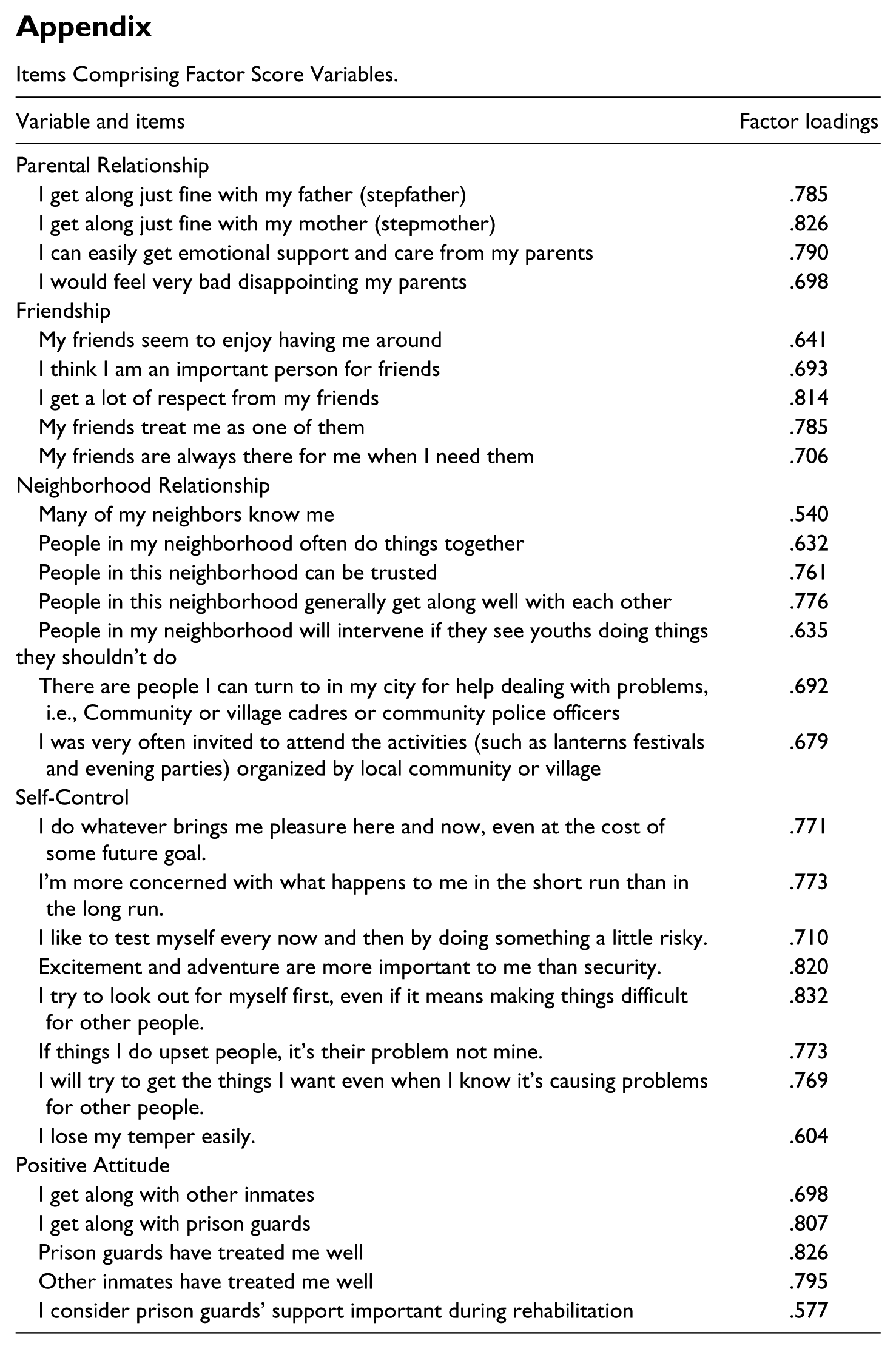
To indicate inmates’ relationships with family, friends, and the neighborhoods lived in prior to incarceration, we constructed a factor variable for each. Taking parental relationship as an example, the survey contains five items measuring how an inmate is related to his or her parents. Specifically, respondents were asked how much they agree with the following questions: “You get along with your father (stepfather),” “You get along with your mother (stepmother),” “It is easy to get emotional support and care from parents,” “You would feel guilty if you disappointed parents,” and “Parents will NOT attribute your misbehavior to the government.” A factor score 2 was calculated through principal component analysis with an eigenvalue greater than 1. The five items loaded well on one dimension with component loadings ranging from .525 to .793. The same procedures were applied to create peer relationship and neighborhood relationship. Five items and seven items, respectively, were employed to create the two variables. Component loadings ranged from .641 to .814 for peer relationships, and from .540 to .776 for neighborhood relationships. Specific items used to create each factor score variable are shown in the appendix.
Our variables on prison visit and phone call were constructed based on inmates’ self-report to indicate the number of times an inmate’s family calls or visits him or her in the past 12 months. The last pull factor, positive attitude, is a factor score generated to measure prisoners’ general attitude toward prison life. The factor score was generated while restricting the number of factors to 1. The factor loadings for items used to create the variable ranged from .577 to .826.
Turning to our push factors, sentence length is measured as the total number of months inmates need to serve for the current incarceration. Likewise, time served is measured as the total number of months inmates have spent in prison for their current sentence.
Control variables
We also include in our models a number of control variables. We control for prison sector to minimize the effect of a range of unmeasurable contextual differences in correctional education, such as education policy, number of available seats for participants, and quality of instruction. Sampled inmates come from 16 prison sectors, 13 holding males and three holding females. Because we analyze the data separately for male and female inmates, we arbitrarily selected one prison sector from each sex-specific group as the corresponding reference category. Other control variables pertain to inmates’ personal characteristics and experiences. Age is measured as a continuous variable coded in years ranging from 16 to 68.
Hukou status is controlled as an indicator of social status and social capital. As a unique residential registration system, Hukou has been effectively used by the Chinese government to control internal migration from rural areas to cities and has often been considered a source of higher social status for urban residents but a source of discrimination for rural residents, especially rural migrants residing in cities (Zhang, Li, & Xue, 2015). Possessing urban Hukou may assist inmates acquire more and better job opportunities after release and, thus, could motive urban prisoners to enroll in correctional education programs to obtain necessary knowledge and skills. Hukou status is created as a binary variable for which “1” indicates urban Hukou and “0” rural Hukou.
Our fourth control variable is the level of self-control. Participation in correctional education is a long-term investment that requires inmates to foresee the potential benefits it could bring in months or years rather than immediately. In the criminological literature, a person with low self-control has been conceptualized as one who values short-term happiness and interests over those of the future and who are prone to act without careful plans (Gottfredson & Hirschi, 1990). Therefore, we assume that inmates with higher self-control are more likely to participate in correctional education than those with lower self-control. The variable is constructed based on the factor analysis on nine survey items, which had conventionally been used to measure self-control (see the appendix). The factor loadings for the nine items ranged from .513 to .821. The higher value on the variable indicates higher self-control. We hypothesize that higher level of self-control is positively associated with participation.
Results
Table 1 reports descriptive statistics. All but one variable, prison sector, are presented in the table. Statistics for male and female samples are placed side-by-side. Regarding the dependent variables, two thirds (67%) of the 1,489 male inmates had participated in at least one program. When type of participation is disaggregated, 31.3% had participated in vocational program only, 7% in academic program only, and about 29% in both. Generally similar patterns are observed for female inmates, although male and female samples are significantly different in the two instances. There is a higher proportion of male inmates who had participated in both programs compared with the female sample. In addition, 43% of female inmates had never participated in either program compared with 33% among males. The proportion of inmates participating in academic programs only is very low for both groups. This can possibly be explained by the limited level (illiteracy to high school) of academic education offered in prison. The number of inmates who need such programs may, thus, be relatively low.
Descriptive Statistics by Sex.

N indicates the number of cases.
The mean of male group is significantly different from that of the female group at .05 probability level.
With respect to pull factors, 38% of male inmates are currently married, compared with 41.6% for females, although the difference is not statistically significant. Male and female inmates differ significantly in the proportion with children. About 65% of female inmates, compared with 50% of males, report having children. With respect to relationships, female inmates, on average, possess better relationships with families and friends as well as higher education level than their male counterparts. We also observe that, on average, female inmates receive slightly more prison visits and calls in a month than their male counterparts, although the differences are not statistically significant. Female inmates generally display greater positive attitude toward prison life than males. Regarding the push factors, male and female inmates are similar on the average sentence length and the average time that has been served. Lastly, with respect to control variables, female inmates are older on average than males, and tend to possess higher self-control and urban Hukou.
Table 2 presents regression results for the male sample. The first model demonstrates results using the binary dependent variable, and the remaining three models show results for multinomial logistic regressions. Starting with control variables, we observe from the binary logistic analysis that there is significant variation in the likelihood of education program participation across prison sectors. This variation is also observed in multinomial analysis, although by different magnitudes. An exception exists in the Model 3, where being in different prison sectors is not related to the risk of participation in academic program only. Overall, our results show that it is important to account for environmental factors in correctional education research, especially for male inmates.
Relative Risk Ratios of Education Program Participation for Males.

Note. N = 1,489; 95% confidence intervals reported. Baseline comparison group in the dependent variable includes inmates who had never participated in either program.
Bold texts indicate statistically significant values.
Results from binary logistic regression.
Results from multinomial logistic regression.
p < .1. *p < .05. **p < .01. ***p < .001.
Regarding other control variables, age shows a modest negative relationship with the risk of participation in binary logistic regression. The same finding is observed with the risk of participation in both programs. However, it fails to exhibit significant association with the chance of participation in vocational-only or academic-only programs. Neither urban Hukou nor self-control shows any significant relationship with participation.
Turning to our pull factors, we do not find any significant relationship with participation for being married, having children, and any of the three relational variables. Such findings fail to offer support to our hypothesis regarding pull factors and are contrary to findings reported in Western research (e.g., Brosens et al., 2014; Hall & Killacky, 2008; Schlesinger, 2005; Torre & Fine, 2005; Velasquez, 2016). By contrast, education level appears to be a salient predictor for participation. In the binary logistic model, education shows a positive association with the risk of participation. Each unit increase in education is associated with an increase in the likelihood of participation by a factor of 1.181. When participation is disaggregated by type, the effect of education varies. Education exhibits a positive effect on the relative risk of vocational program–only participation, a negative effect on the risk of academic program participation, and a null effect on participation in both programs. The positive effect of education on vocational participation falls in line with the effect of education depicted by prior literature (Cai et al., 2019; Jackson & Innes, 2000). A possible explanation for the positive association between education level and vocational program participation is that inmates with higher education level are more likely to possess required qualification, such as prior knowledge and skill, and thereby are more confident (Cai et al., 2019). The negative relationship between education and academic program participation can possibly be explained by the limited level of academic education offered in prison. Inmates who have already achieved high education level may no longer see the benefit to participate in prison academic education offered at equivalent or even lower levels.
Most of the pull factors that matter to participation seem to be embedded in the incarceration setting. The measure of prison calls exhibits a consistent positive association with the likelihood of any participation and of the disaggregated types of participation. Positive attitude also generally exhibits a positive association with participation, except for participation in academic program only. With regard to our push factors, sentence length has positive associations with the risk of participation in vocational and both programs, but it is marginally related with academic program–only participation. Similarly, time served in prison 3 shows a very weak positive association with the risk of any participation, as well as weak positive associations with vocational-only and both types of participation.
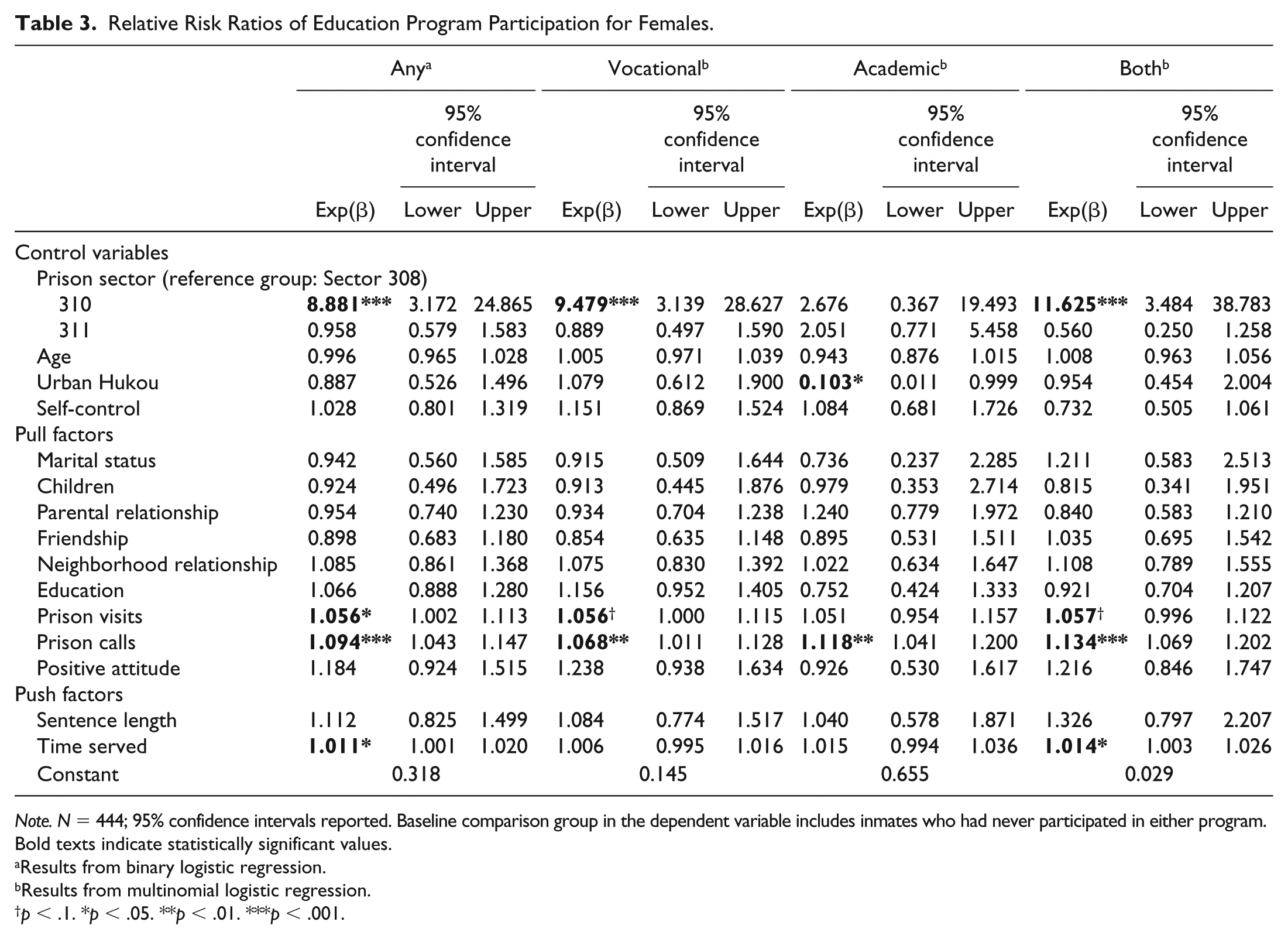
Table 3 presents regression results for the female sample (N = 444). Compared with male inmates, there are a few appreciable differences that are worth noting. First, among control variables, the results reveal that urban Hukou status is associated with a greatly reduced risk of participation in academic program only. This finding echoes the education gap between rural and urban areas. Residents in rural areas, on average, receive less education in both quality and quantity compared with their urban counterparts. Thus, inmates from rural places are much more likely than those with urban Hukou to participate in academic programs to acquire literacy and basic knowledge.
Relative Risk Ratios of Education Program Participation for Females.
Note. N = 444; 95% confidence intervals reported. Baseline comparison group in the dependent variable includes inmates who had never participated in either program.
Bold texts indicate statistically significant values.
Results from binary logistic regression.
Results from multinomial logistic regression.
p < .1. *p < .05. **p < .01. ***p < .001.
Second, the measure of prison visits, which fails to show any significant association with risk of participation among male inmates, is related with higher risk of any participation for females. The associations of prison visits with vocational only and both types are also positive but marginally significant. In contrast, although education level, positive attitude, and sentence length exhibit relatively strong and consistent associations with participation for males, they fail to show any significant relationship with risk of participation for females.
Similar to the male sample, prison call exhibits the most consistent association with correctional education participation. However, we again fail to find evidence for effects of marital status, having children, and relational factors. Based on our findings, female inmates’ participation in correctional education in China, thus, appears less susceptible to the influence of individual and incarceration-related factors and is mostly affected by their personal contact with the outside world during imprisonment.
Summary and Conclusion
Our objective in this research has been to examine how Chinese inmates’ participation in correctional education programs could be shaped by a number of push and pull factors. Several of the factors were selected in light of research findings from relevant Western studies, whereas others were based on the distinctive setting of the sampled Chinese prisons and our unique prisoner data. We conducted analyses of male and female inmate samples separately due to the oversampling of females. The dependent variables indicate any participation in either vocational or academic programs, and participation disaggregated into the categories of vocational participation only, academic participation only, participation in both types of programs, and no participation (the reference category for multinomial regression analyses).
A number of important findings emerge from the analyses. Our research fails to find any significant associations between participation and being married, having children, and the three variables measuring inmates’ relationships with parents, friends, and their neighborhoods. Our findings contradict those reported by studies in Western societies (e.g., Brosens et al., 2014; Hall & Killacky, 2008; Schlesinger, 2005; Torre & Fine, 2005; Velasquez, 2016). These results hold regardless of the sample and type of dependent variables employed. The only factor with consistent associations with participation is prison calls. For both males and females, greater numbers of prison calls are related a higher likelihood of participation in correctional education.
The null effects of sociodemographic characteristics should be interpreted with the larger prison context in mind. Recall that correctional education in China is severely underdeveloped, and the rehabilitation efforts in many Chinese prisons are still oriented primarily to productive labor. For example, Article 64 of the current Prison Law of China stipulates that prisons should provide inmates with vocational training according to the need of both prison production and inmates’ employment prospect upon release. It would not be surprising if inmates’ rights to quality education are sometimes sacrificed for the “greater good” of the prison. Furthermore, the few regulations supporting correctional education are often too broad and vague to make any appreciable difference. For example, Article 63 of the current Prison Law of China states that prisons, depending on particular circumstances, could offer inmates with literacy education and elementary and secondary equivalent education. Under such a backdrop, prison administrators, without proper monitoring and evaluation systems, are left to their own discretion regarding the content and level of educational program to provide and who will be allowed to participate. Thus, a possible explanation for nonsignificant associations between participation and prisoners’ sociodemographic attributes is that the underdevelopment of Chinese correctional education, combined with limited prison resources and authoritarian control of the prison, circumscribe the role of inmates’ choice, which lessens the influence of their personal characteristics on participation. Note that by controlling for the prison sector in our regression models, our study shows that inmates’ participation in correctional education is partially explained by prison context. However, due to data availability, we are unable to examine specific environmental factors affecting participation. Each prison (or prison sector) can be conceived as a small ecological unit that encompasses a range of demographic, organizational, and institutional characteristics that could determine inmates’ accessibility and motivation to participate in correctional education. Therefore, incorporating more prison-level factors is an important task for future research on Chinese correctional education.
Other key independent variables perform differently across sex-specific groups and types of program. For males, the measures of education level, positive attitude, time served in prison, and sentence length are positively associated with any participation and with participation in vocational programs only and participation with both types of programs. By contrast, they fail to show significant relationship with academic program participation. The measure of prison visits exhibits significant associations with these dependent variables (any participation, participation in vocational programs only, and participation in both programs) but only for females. Thus, the current study indicates the utility of analyzing participation by sex-specific groups and types of program participation. Push/pull factors could work in divergent manners for males and females, and they shape participation differently according to the specific type of involvement in educational programs. Previous studies have shown that males and females could be encouraged or discouraged from participation by different factors and in divergent ways (Crittenden & Koons-Witt, 2017; Tietjen et al., 2018). Therefore, we call for fine-grained, sex-specific analyses of the potential effects of push/pull factors in studies on correctional education within the context of contemporary China.
The current study offers a number of policy implications that would benefit inmate participation and prison management. Our results suggest that inmates’ participation is partially conditioned on system-level factors. As mentioned previously, such factors could be quite diverse, including financial resources, human capital, facility, equipment, theory guidance, evaluation system, and need assessments. Therefore, inmates’ participation and rehabilitation results should be studied with a holistic perspective. However, as we are limited by data availability, it is impossible to demonstrate specific system-level factors at work and their effects.
We can, nevertheless, speculate on things that prison administrators could do to improve inmates’ participation. One is to employ programming analogous to the RNR system, as well as its revisions such as LSI-R, to continually evaluate risks and needs to inform rehabilitation program design and application. As each prison has its particular inmate composition and characteristics, and each individual inmate is distinctive in personal background, interests, habits and tendency, a prison-based evaluation system will be crucial to inmate rehabilitation.
Second, prison visit and prison phone calls in this study have shown to be salient predictors of participation. Therefore, prison staff should encourage more contact between inmates and the outside world, especially families and friends, to help them develop healthier and stronger social networks and to acquire more emotional and instrumental support during incarceration. Such benefits may motivate inmates to participate in rehabilitation programs more actively as they anticipate greater rewards from these programs. Furthermore, prison staff could form collaboration with inmates’ family members and friends to facilitate rehabilitation.
Third, our findings document a relationship between positive attitude during incarceration and participation, at least for males. Both positive attitude and rehabilitation program participation have been considered as part of the general adaptation to prison life. Thus, when considering factors affecting participation, we should also pay attention to the larger picture and examine how inmates’ adaptation to prison and the overall experience with prison can be improved. Prison staff should strive to create a prison environment, which is perceived as safe, positive, encouraging, friendly, and harmonious by inmates. In other words, prison staff are responsible to minimize inmates’ aversive experience and physical or emotional barriers to participating in rehabilitation programs. Although we find that push factors, that is, factors inmates attempt to escape from, would enhance participation, it is crucial to keep in mind that participation per se is not an end. Researchers and prison staff should be more concerned over and dedicated to the improvement of the general life experience and successful rehabilitation in prison.
The results should be interpreted with caution as the study is limited in a number of respects. First, our study is based on inmates’ self-reports only, and such data may be subject to a number of limitations regarding validity. Our access to prison- and prisoner-related information kept by the prison was very limited. Future study should consider combining inmates’ self-report and prison-provided data to improve measurement. Second, we acknowledge the potential reciprocal relationship between participation and positive attitude. Although it is possible that higher positive attitude would pull inmates into correctional education, it is also likely that experience with participation promotes positive attitude toward prison life and rehabilitation. However, given that we are limited by the cross-sectional nature of our data, such causal processes are difficult to infer. We, thus, encourage future studies to examine causal effects of push and pull factors using longitudinal data. Third, we acknowledge that our findings are limited in generalizability. Because China has such a vast territory populated by diverse ethnic groups, its population composition varies from place to place. Therefore, regional data such as ours may be subject to limited representativeness. For example, about 40% of our female sample possess urban Hukou, although the figure could be much lower if the sample was selected from prisons located in more rural regions. Observed relationships might be heavily dependent on sample composition. We, therefore, strongly encourage that similar correctional education studies be conducted in other regions of China, such as the Northern and Eastern areas. Such regions possess distinctive attributes in economy, demography, and culture from those in Zhejiang.
With these caveats in mind, the present study contributes to correctional education literature in the following ways. First, as one of the first quantitative studies on correctional education in China, our analyses affirm that participation is associated with incarceration-related push/pull factors, such as prison call, prison visit, and sentence length, albeit in complex ways. Second, our findings suggest that factors shaping Chinese inmates’ participation are not the same as those found in most Western studies. The results demonstrate that Chinese inmates and prisons possess unique characteristics that are not found in Western societies. We thus encourage further research to be conducted in China to promote correctional education quality and participation. Finally, our findings that push and pull factors have differential associations with participation across sex-specific groups and types of program participation underscore the pressing need for further theorizing about the nature of the processes that link push and pull factors with participation in correctional education within the Chinese setting.
Footnotes
Appendix
Items Comprising Factor Score Variables.
| Variable and items | Factor loadings |
|---|---|
| Parental Relationship | |
| I get along just fine with my father (stepfather) | .785 |
| I get along just fine with my mother (stepmother) | .826 |
| I can easily get emotional support and care from my parents | .790 |
| I would feel very bad disappointing my parents | .698 |
| Friendship | |
| My friends seem to enjoy having me around | .641 |
| I think I am an important person for friends | .693 |
| I get a lot of respect from my friends | .814 |
| My friends treat me as one of them | .785 |
| My friends are always there for me when I need them | .706 |
| Neighborhood Relationship | |
| Many of my neighbors know me | .540 |
| People in my neighborhood often do things together | .632 |
| People in this neighborhood can be trusted | .761 |
| People in this neighborhood generally get along well with each other | .776 |
| People in my neighborhood will intervene if they see youths doing things they shouldn’t do | .635 |
| There are people I can turn to in my city for help dealing with problems, i.e., Community or village cadres or community police officers | .692 |
| I was very often invited to attend the activities (such as lanterns festivals and evening parties) organized by local community or village | .679 |
| Self-Control | |
| I do whatever brings me pleasure here and now, even at the cost of some future goal. | .771 |
| I’m more concerned with what happens to me in the short run than in the long run. | .773 |
| I like to test myself every now and then by doing something a little risky. | .710 |
| Excitement and adventure are more important to me than security. | .820 |
| I try to look out for myself first, even if it means making things difficult for other people. | .832 |
| If things I do upset people, it’s their problem not mine. | .773 |
| I will try to get the things I want even when I know it’s causing problems for other people. | .769 |
| I lose my temper easily. | .604 |
| Positive Attitude | |
| I get along with other inmates | .698 |
| I get along with prison guards | .807 |
| Prison guards have treated me well | .826 |
| Other inmates have treated me well | .795 |
| I consider prison guards’ support important during rehabilitation | .577 |
Declaration of Conflicting Interests
The author(s) declared no potential conflicts of interest with respect to the research, authorship, and/or publication of this article.
Funding
The author(s) disclosed receipt of the following financial support for the research, authorship, and/or publication of this article: China National Science Foundation, Reference Number: 12BFX054 and University of Macau Research Fund, Reference Number: MYRG131(Y1-L2)-FSH12-LJH.
