




Abstract
A sample of 129 (73% male) youth admitted consecutively into a juvenile detention center were used to examine individual characteristics that contribute the implementation of a behavioral intervention within a juvenile detention center. Given that a system of rewards and punishments is considered the mechanism of change within many behavioral interventions, individuals risk characteristics (i.e., proactive and reactive aggression, behavioral inhibition, subsystems of behavioral activation, callous–unemotional traits, perceived containment) were examined in relation to the rewards (i.e., positive feedback) and punishments (i.e., fines) used by the facility. Data were collected via structured interviews with youth and archival data. The number of days youth spent in detention was the only predictor of positive feedback received. Number of days in detention, sex, and race were related to fines. Behavioral activation drive was the only individual characteristic related to fines. Implications of findings are discussed.
Keywords
Introduction
Given the over 54,000 youth in juvenile detention centers nationwide (Hockenberry, 2016) and the federal mandate to reduce the use of punitive punishment (e.g., restrictive housing; U.S. Department of Justice, 2016), alternative methods of control need to be evaluated to better serve the youth in these settings. One promising alternative to current programs includes the use of behavioral interventions, such as token economies or positive behavioral supports. These behavioral interventions have demonstrated usefulness in justice settings (Caldwell, 2011; Caldwell, McCormick, Wolfe, & Umstead, 2012; Doll, McLaughlin, & Barretto, 2013; Fernandez, McClain, Williams, Ellison, 2015; Gendreau, Listwan, Kuhns, & Exum, 2014); however, these interventions do no work for all individuals (Weisz et al., 2013). Accordingly, to build effective behavioral programs, interventions need to consider individual characteristics that may influence their implementation. Accordingly, this study aims to examine individual characteristics (i.e., proactive and reactive aggression, behavioral inhibition, behavioral activation, callous–unemotional traits, and perceived containment) that may relate to the implementation of a behavioral program within a juvenile detention facility.
Behavioral Interventions
One alternative to the more punitive approach often employed in juvenile detention facilities is the use of behavioral interventions, such as token economies or positive behavioral supports. Token economies utilize a currency of tokens that are distributed as reinforcement for wanted behavior and taken away as punishment for unwanted behavior (Hine, Ardoin, & Call, 2017; Ivy, Meindl, Overley, & Robson, 2017; Kazdin & Bootzin, 1972). Within these programs, the accumulation of tokens is encouraged as they can be exchanged for larger reinforcements (Doll et al., 2013; Gendreau et al., 2014). For example, youth may receive tokens to buy supplies from the commissary or time watching TV or playing videogames. On the other hand, positive behavioral support interventions attempt to create an environment that prevents unwanted behavior, by encouraging social learning and allowing youth and staff to work together (Carr et al., 2002; Scott, Alter, Rosenberg, & Michael, 2010). Positive behavioral support programs implement a tiered system in which increasing supports are offered, such as group and individual therapy, as unwanted behavior escalates (Dunlap, Sailor, Horner, & Sugai, 2009).
These types of behavioral interventions utilize principles of learning theory to change behavior. Specifically, learning theory stipulates that when determining whether to engage in a given behavior, individuals use a learning history to determine the likelihood of reinforcement (i.e., rewards) and punishment (Brauer & Tittle, 2012; Johnson, Rasbury, & Siegel, 1997). One component of learning theory, operant conditioning, delineates that reinforcements maintain behavior, while punishments decrease behavior (Brauer & Tittle, 2012; Kazdin, 1997; Moore, 2011). Accordingly, the use of reinforcement and punishment is suggested to be the mechanism by which behavior is changed, making the system of reinforcement and punishment vital to successful interventions. However, it could be that individual characteristics contribute to the likelihood of engaging in the behavior that elicits reinforcement or punishment.
Individual Characteristics
To our knowledge, no study has examined the role of individual characteristics in the implementation of behavioral interventions (i.e., the reception of rewards or punishments) within juvenile detention. Consistent with Bronfenbrenner’s social ecological theory, individuals exert influence on their environment in the same way that their environment may influence their behavior (Bronfenbrenner, 1977). Accordingly, it could be that the youth who exhibit risk factors for rule breaking and aggression are less likely to receive reinforcement and are more likely to receive punishment. There are many established risk factors for aggression that may influence behavior within a juvenile detention facility, including individual factors proactive and reactive functions of aggression, behavioral activation, and callous–unemotional traits, and perceived containment (Dodge & Coie, 1987; Fite, Pederson, & DiPierro, 2018; Fite, Raine, Stouthamer-Loeber, Loeber, & Pardini, 2010; Frick & White, 2008; Morgan, Bowen, Moore, & van Goozen Stephanie, 2014). Accordingly, this study evaluates a range of individual risk factors that may influence the reward and punishment that they receive.
Proactive and reactive aggression
Proactive and reactive aggression, while highly correlated (e.g., Fite et al., 2018), are theoretically and empirically distinct functions of aggression that are associated with differing patterns of behavior (Card & Little, 2006; Crick & Dodge, 1996; Dodge, 1991; Dodge & Coie, 1987). Proactive aggression is aggression used to obtain a desired goal and is best explained through a social learning model in which aggressive acts are rewarded (e.g., achieving a desired goal), maintaining their use over time (Bandura, 1973; Crick & Dodge, 1996). Conversely, reactive aggression is used in response to a perceived threat and is best explained by the frustration aggression hypothesis (Berkowitz, 1978; Crick & Dodge, 1996; Dodge, 1991). Proactive aggression is associated with a more deliberate and persistent aggressive behavior (Fite et al., 2010). Furthermore, proactively aggressive individuals tend to judge outcomes of aggressive behavior as positive (Crick & Dodge, 1996; Dodge, 1991). On the other hand, reactively aggressive individuals are more likely to exhibit a hostile attribution bias, wherein they are likely to judge neutral events as hostile or threatening (Dodge & Coie, 1987; Lobbestael, Cima, & Arntz, 2013).
Behavioral activation and inhibition systems
The behavioral activation system (BAS; sensitivity to punishment) and the behavioral inhibition system (BIS; sensitivity to reward) are motivational systems that may be important to an individual’s response to behavioral interventions. The BAS is characterized by approach motivations in which individuals are motivated to seek rewards, whereas the BIS is associated with withdraw behavior in which cues of punishment indicate the discontinuation of behavior (Gray, 1991; Higgins, 1997). While high levels of the BIS have been associated with anxiety and depression (Campbell-Sills, Liverant, & Brown, 2004), high levels of BAS activity have been associated with externalizing behavior, including conduct disorder and psychopathy (Morgan, Bowen, Moore, van, & Goozen, 2014).
Of interest in this study, the BAS can be divided into three subsystems, namely drive, fun seeking, and reward responsiveness. Drive reflects the motivation and persistence used to achieve desired goals. In addition, fun seeking reflects the desire for new rewards and willingness to approach rewards spontaneously. Finally, reward responsiveness reflects focus on positive responses and anticipation of reward (Carver & White, 1994; Morgan et al., 2014). While some evidence suggests that both drive and fun seeking are associated with impulsivity (Morgan et al., 2014), drive appears to be more consistently associated with aggression, including conduct problems, alcohol use, revenge seeking, and a range of psychopathic traits (Johnson, Kim, Giavannelli, & Cagle, 2010; Morgan et al., 2014; Seibert, Miller, Pryor, Reidy, & Zeichner, 2010). Conversely, reward responsiveness has been negatively associated with conduct problems (Morgan et al., 2014).
Callous–unemotional traits
Callous–unemotional traits are characterized by flat affect, insensitivity toward others, and lack of remorse (Frick & White, 2008). Callous–unemotional traits are associated with a severe and persistent offending pattern (Frick & Dickens, 2006). Of interest to behavioral interventions, those who exhibit high levels of callous–unemotional traits also exhibit little empathy and concern for others (Pardini & Byrd, 2012) which may change their response to the rewards and punishments given by others. Interestingly, callous–unemotional traits are notoriously difficult to treat (e.g., Manders, Dekovic, Asscher, van der Laan, & Prins, 2013), suggesting that youth may not respond to treatment within a standard behavioral intervention without additional supports.
Perceived containment
Perceived containment refers to a person’s perceptions as to whether authority figures can set limits on their behavior (Dumas, LaFreniere, & Serketich, 1995; Schneider, Cavell, & Hughes, 2003). While there are few studies directly examining perceived containment, research suggests that it is associated with aggressive behavior, as youth do not respond appropriately to the requests of authority figures such as teachers or parents (Schneider et al., 2003). It could be that youth who have difficulty accepting limits placed on them by authority figures may have more difficulty learning and complying within the context of a behavioral intervention.
The Current Study
Therefore, this study aims to identify individual characteristics (i.e., proactive/reactive aggression, BAS drive, BAS fun seeking, BAS reward responsiveness, BIS, callous–unemotional traits, perceived containment) that may contribute to the reception of reward and punishment 1 within the context of a behavioral intervention in a juvenile corrections facility. It is expected that higher levels of proactive aggression, reactive aggression, BAS drive, BAS fun seeking, callous–unemotional traits, and perceived containment will be positively related to fines, as they are risk factors for externalizing behavior and may require increased levels of punishment to mitigate unwanted behavior. Furthermore, it is expected that the BIS and BAS reward responsiveness will be negatively associated with fines, as they are negatively associated with problem behavior (e.g., Morgan et al., 2014). Finally, it is expected that higher levels of risk factors of externalizing behavior (e.g., proactive aggression, reactive aggression, behavioral activation, callous–unemotional traits, perceived containment) will be negatively associated with positive feedback.
Age, sex, race, and number of days spent in detention are included in analyses as control variables. Evidence suggests that racial/ethnic minority youth may experience the justice system differently than Caucasian youth (e.g., Bishop & Frazier, 1988; W. Hayward Burns Institute, 2016). Furthermore, males tend to be incarcerated more frequently than female youth (Sickmund, Sladky, Kang, & Puzzanchera, 2017) and experience more victimization while incarcerated (Beck et al., 2013). Accordingly, race and sex may contribute to socialization factors that alter experiences and response to interventions within the juvenile justice system. Consistent with theories of developmental psychopathology, there is also preliminary evidence to suggest that age influences youths’ experience within juvenile detention (e.g., Fite et al., 2018; Pederson, Poquiz, & Fite, under review; Piquero, Jennings, Diamond, & Reingle, 2015). Consistent with previous research demonstrating that longer time spent in detention is related to the use of more interventions (Fite et al., 2018), days in detention is also considered as a control variable.
Method
Participants
This study included 129 (72.9% male) youth from a juvenile detention center in a midsized county in the Midwest over the course of a year. The sample was primarily Caucasian (67%), with other ethnicities represented including 27.0% African American, 4.0% Native American/Alaskan Native, and 0.8% Asian. Note that information regarding race was not provided for two youth. Youth admitted into the residential program were either pending court sanctions, serving sanctions imposed by the court, or classified as a child in need of care. Of the youth admitted to the facility, 53% were admitted on a new charge, 23% were admitted for a probation violation, and 19% were admitted for some other reason, such as a child in need of care or runaway violations. Youth arrest charges varied, with 12% admitted for a sexually based offense, 36% admitted for a violent offense, 20% admitted for a drug-related offense, 30% admitted for a theft related offense, 5% admitted for arson related offenses, and 22% admitted for offenses using a weapon. Note that offense data was not provided for 21 youth and that youth could be admitted on multiple charges. The facility is licensed to provide residential services to up to 18 youth between the ages of 11 and 18. The average age for youth in this study was 15.93 years. The average length of stay was 54.75 (SD = 80.05) days ranging between 1 and 318 days.
The facility uses a combination of token economy and positive behavioral supports frameworks, providing the ideal sample with which to examine these associations. Consistent with a token economy, accountability for this system is provided using a checkbook in which youth keep track of the number of positive feedbacks (PFs) and fines they are given from the facility staff. Youth receive PF (adding money to the checkbook) for following facility rules, such as following instructions, using appropriate tone of voice, and turning in contraband. However, youth receive fines (subtracting money from the checkbook) for minor misbehavior, such as being off task, interrupting, or engaging in horseplay. Youth are then able to purchase privileges with the monies they earn through good behavior, which includes extra shower time, playstation time, movie purchases, and other desirable activities and supplies. Consistent with a universal positive behavioral supports intervention, facility staff are encouraged and trained to provide a least five PFs per every negative feedback across the facility. Furthermore, rules are stated in the positive, and positive language is used when giving youth commands.
Measures
Demographic information
The facility provided data on age, sex, race, and days in detention.
PFs and fines
Information of the number of PFs and fines a youth received was provided by the facility, as this information is routinely collected to evaluate intervention implementation. The number of PFs and fines a youth received was cumulatively totaled during youths’ stay at the facility. Accordingly, PFs and fines are count variables with higher numbers representing more PFs and/or fines. There was a wide range of PFs (Min = 0 Max = 3,761) and Fines (Min = 0, Max = 764) received within the current sample.
Proactive and reactive aggression
Proactive and reactive aggression were measured using self-reports on the Peer Conflict Scale (Marsee & Frick, 2007; Marsee et al., 2011). Twenty items were used to measure proactive and reactive physical aggression, with 10 items assessing for proactive (e.g., I have hurt others to win a game or contest) and 10 items assessing for reactive (e.g., When I am teased, I will hurt someone or break something) aggression. Youth rated their level of agreement using a 4-point scale (0 = Not at all true, 3 = Definitely true). Mean scores were developed from the subscales and used for analysis, with higher numbers indicating higher levels of either proactive or reactive aggression. Proactive aggression demonstrated a modest internal consistency (α = .66). The internal consistency for reactive aggression was good (α = .82).
BIS and BAS
Carver and White’s (1994) measure was used to assess BIS and BAS sensitivity. Youth reported on 20 items, with 13 representing the BAS and 7 representing the BIS (e.g., Criticism or scolding hurts me quite a bit). Items on the BAS were further divided into subscales of drive (4 items; e.g., I go out of my way to get things I want), fun seeking (4 items; e.g., I’m always willing to try something new if I think it will be fun), and reward responsiveness (5 items; e.g., When I’m doing well at something I love to keep at it). Youth were asked to determine to what extent each statement applied to them using a 4-point rating scale (1 = Very true for me, 4 = Very false for me). Mean scores were calculated and used for analysis, such that lower levels (i.e., more true) indicate higher levels of BIS or BAS sensitivity. The BIS subscale (α = .67) and two BAS subscales (drive α = .62, fun seeking, α = .55) demonstrated modest internal consistency. Reward responsiveness demonstrated acceptable internal consistency (α = .72).
Callous–unemotional traits
The Inventory of Callous–Unemotional Traits (Kimonis et al., 2008) was used to assess for callous–unemotional traits (e.g., I do not feel remorseful when I do something wrong). These self-reported items were assessed using a 4-point rating scale (0 = Not at all true, 3 = Definitely true). Mean scores were used for analyses, such that higher levels were indicative of higher levels of callous–unemotional traits. The measure demonstrated good internal consistency (α = .82).
Perceived containment
Perceived containment was measured using self-report on nine items (Schneider et al., 2003). The first four items are in a vignette format in which youth respond yes or no to scenarios asking if they would comply with requests made by their school teacher. Vignette items were altered slightly from the original measure to be more developmentally appropriate (e.g., change recess to lunch). The next five questions ask about how youth typically respond to school teachers (e.g., My teacher can make me obey him or her even if I really don’t want to) using a 4-point scale (1 = Never like me, 4 = Always like me). Vignette items were coded one or four representing extreme ends of the scale and keeping consistent with the scale used during the remainder of the questionnaire. Accordingly, mean scores were calculated such that higher levels represent higher levels of perceived containment. The measure demonstrated good internal consistency (α = .81).
Procedures
Data from the current project come from a de-identified database provided by the facility. The researchers’ institutional review board approved the use of a de-identified database provided by the juvenile detention facility for research purposes. Given that data collection procedures were initiated as standard procedure at the facility and that a de-identified database was provided for research purposes, consenting procedures were waived by the researcher’s institutional review board. Over the course of 1 year (January 2015 to January 2016), youth admitted into the facility’s residential program were administered a standard battery of questions regarding their individual characteristics. The facility collected data on their behaviors during this time and for an additional 3 months (March 2016) to monitor youths’ behavior for at least 60 days, thus encompassing the average length of stay at the facility. Following the audited period, the facility provided the research team with a de-identified database that included details on the implementation of the behavioral intervention (e.g., PFs, fines) in addition to data on their individual characteristics.
Trained interviewers administered the standard survey to youth. These interviewers had at least a bachelor’s degree and were not affiliated with the facility. To become an interviewer, individuals were required to complete the facility’s volunteer training, including a background check. Interviewers were further trained to become familiar with data collection protocols by working with a senior interviewer and being observed during an interview.
The standard survey was typically administered within 24 hr of youth being admitted into the facility. However, some youth left the facility prior to scheduled interview times. Furthermore, if youth were behaviorally dysregulated upon an interviewer’s arrival they were not given the survey, as the youth either refused to participate or were deemed unsafe to participate by facility staff. The standard survey was administered in the visitation room at the facility during youths’ regularly scheduled activities. Surveys were given using Qualtrics survey software on a laptop computer. In the event that the visitation room was being used, surveys were given in the facility’s main room using a paper copy of the same survey. Interviews took approximately 15 min to complete, and youth were told that their responses would be used by the facility to improve the services that they provide. Although all interviews were visually monitored by facility staff, staff were separated from the youth as much as possible to improve accuracy in reporting. All questions were read out loud to improve comprehension. Youth then provided verbal answers, and interviewers recorded their response.
Results
Correlations
First, correlations were completed to understand simple relations between variables (see Table 1). PFs and fines were significantly positively associated. Furthermore, the number of days in detention was significantly positively associated with both PFs and fines. Interestingly, no individual characteristics were associated with PFs. Proactive aggression was positively associated and perceived containment was negatively associated with fines, such that lower scores on perceived containment were associated with more fines. BAS drive was also negatively associated with fines, suggesting that lower scores of BAS drive subscale was associated with more fines.
Correlations, Means, and Standard Deviations.
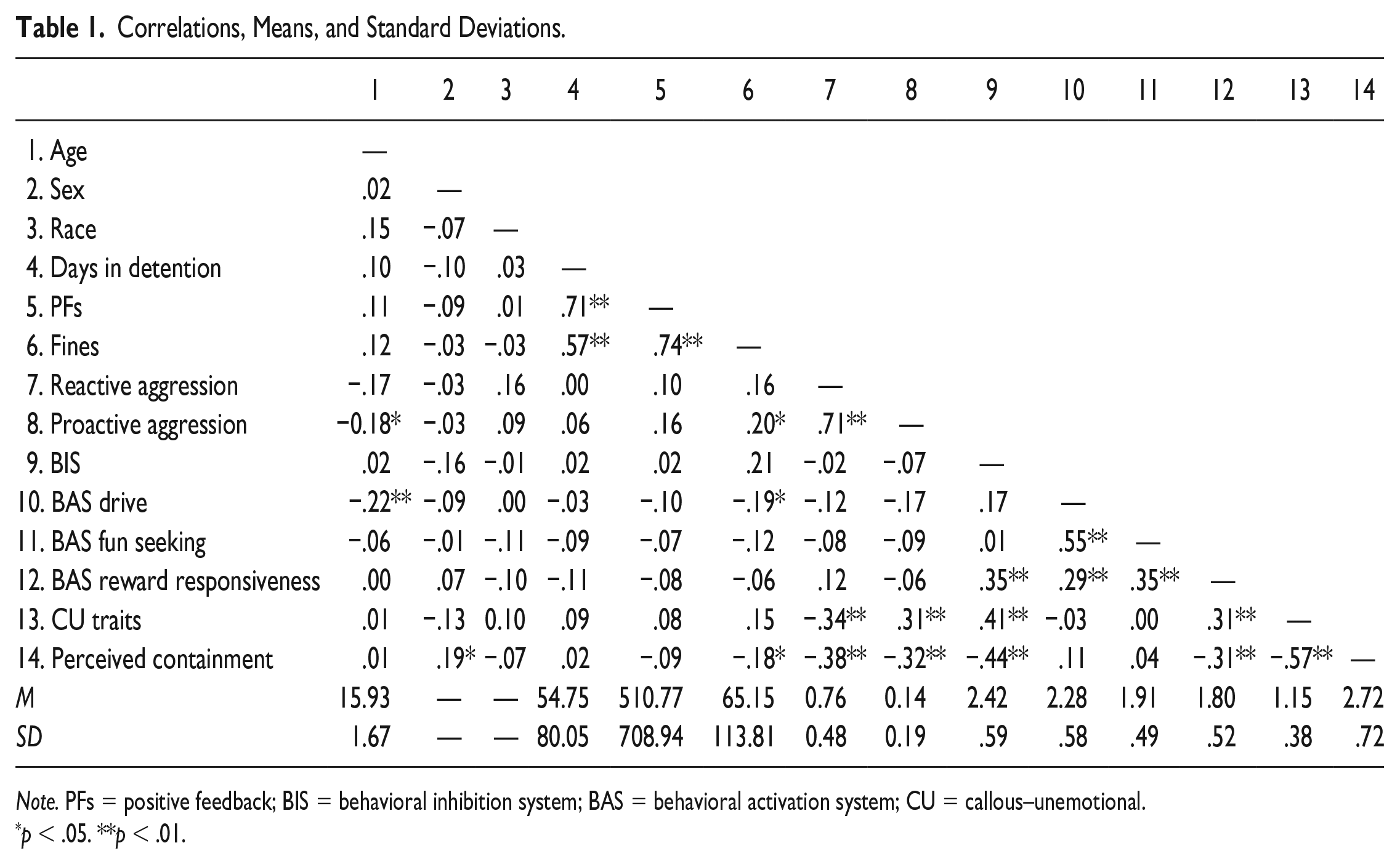
Note. PFs = positive feedback; BIS = behavioral inhibition system; BAS = behavioral activation system; CU = callous–unemotional.
p < .05. **p < .01.
Regression Analyses
Next, regression analyses were used to assess unique associations with outcomes of interest. A negative binomial distribution was used to account for the use of count variables as outcomes (i.e., PFs, fines). Negative binomial distributions were used in lieu of Poisson distributions, as negative binomial distributions better account for data with an over dispersion of zero counts (Atkins & Gallop, 2007). Only significant simple effects were included in regressions.
PFs were regressed on all individual characteristics (i.e., proactive and reactive aggression, BIS, BAS drive, BAS fun seeking, BAS reward responsiveness, CU traits, perceived containment) and control variables (i.e., days in detention, sex, age, race; see Table 2). Only control variables were associated with the number of PFs received. Days in detention were positively associated with PFs, such that more days in detention were associated with receiving more PFs. Furthermore, age and race were significantly positively associated with PFs, such that older youth and non-White/minority youth received more PFs.
Negative Binomial Regression for PFs.

Note. BIS = behavioral inhibition system; BAS = behavioral activation system.
p < .05.
Fines were regressed on reactive aggression, proactive aggression, BIS, BAS drive, BAS fun seeking, BAS reward responsiveness, CU traits, and perceived containment with days in detention, sex, race, and age included as control variables (see Table 3). Similar to PFs, days in detention were significantly positively related to fines. Race was associated with fines such that non-White/minority youth were more likely to receive fines. Sex was also positively associated with fines, such that females were more likely to receive fines. Finally, BAS drive was negatively associated with fines, such that lower scores on BAS drive were associated with a higher number of fines.
Negative Binomial Regression for Fines.
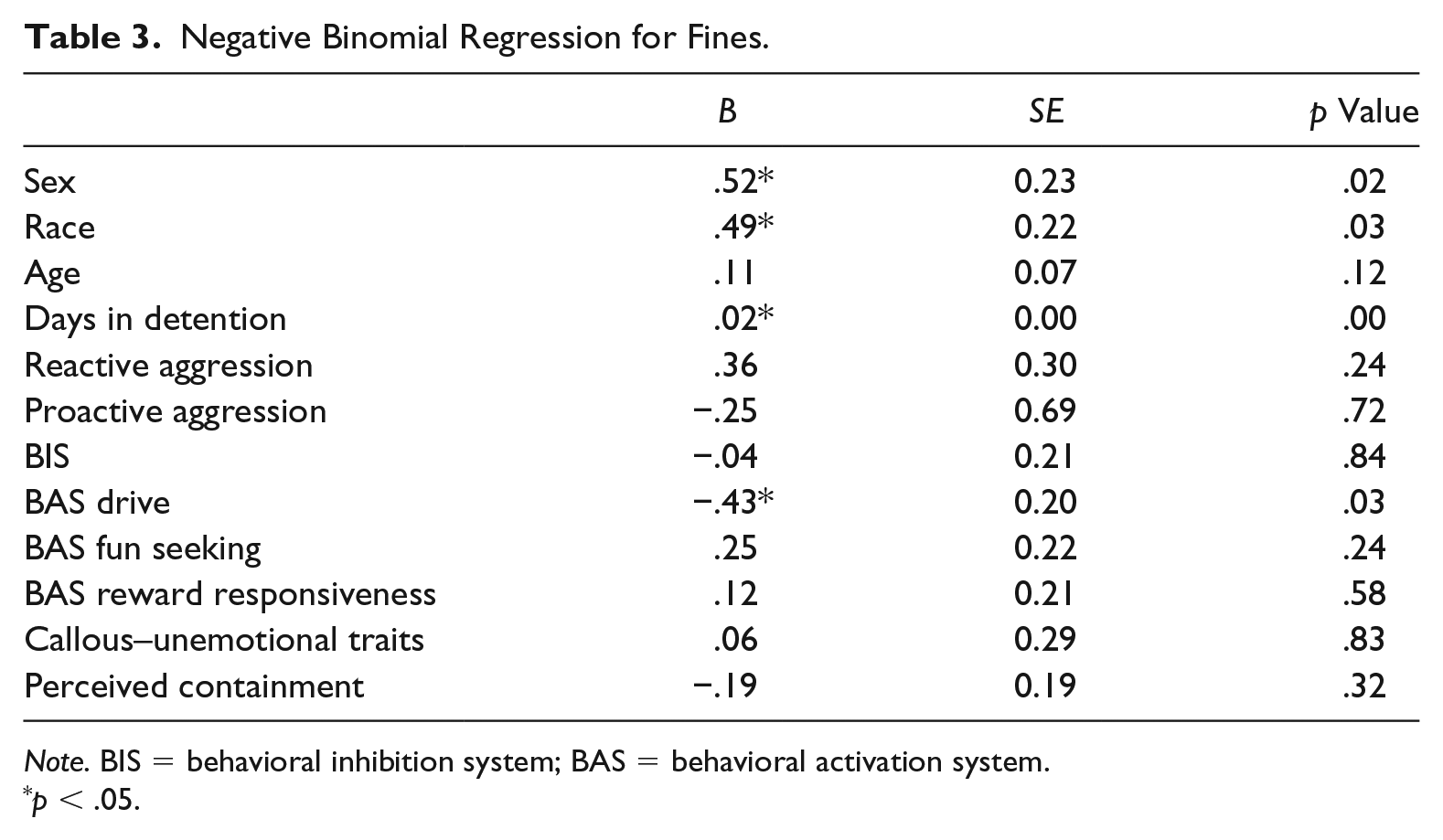
Note. BIS = behavioral inhibition system; BAS = behavioral activation system.
p < .05.
Discussion
This study identified individual characteristics that contribute to the implementation of a behavioral intervention within a juvenile detention center. Specifically, the relations between proactive and reactive aggression, BIS, BAS drive, BAS fun seeking, BAS reward responsiveness, callous–unemotional traits, and perceived containment and reward (i.e., PFs) and punishment (i.e., fines) were evaluated. Contrary to expectations, findings indicated that no individual characteristics were associated with PFs. In addition, while a number of factors were correlated with fines (e.g., proactive aggression, BAS drive, and perceived containment), BAS drive emerged as the only unique individual characteristic predictive of fines, such that the more an individual displayed characteristic of BAS drive the more likely they were to receive fines. Race and sex were also associated with fines, such that non-White/minority youth and females were more likely to receive fines.
Interestingly, no individual characteristics were associated with PFs. This finding is especially encouraging as it appears that the guards implementing the intervention are able to reward behavior regardless of the individual characteristics displayed by the youth on the unit. This is consistent with their training and principles of positive behavior supports, in which interventionists are encouraged to maintain a positive environment by providing five PFs for every fine. Furthermore, youth who are placed in juvenile detention likely exhibit several risk factors for maladaptive behavior, and it appears that the guards implementing the intervention are able to continually reward behavior regardless. This further suggests that a wide range of youth can experience success within the intervention as individual characteristics do not decrease the likelihood for reward.
Interestingly, BAS drive was the only individual characteristic that operated as a unique predictor of fines, although proactive aggression and perceived containment were individually related in correlational analyses. Given that BAS drive has been identified as a robust predictor of severe antisocial behavior (Johnson et al., 2010; Morgan et al., 2014; Seibert et al., 2010), it could be that youth exhibiting high levels of this characteristic take a longer time to respond to the intervention. Namely, BAS drive represents persistence in achieving an indicated goal; thus, it could be that drive does not allow for the ready switching to more adaptive goals presenting in a behavioral intervention. Accordingly, more punishment (i.e., fines) may be needed to decrease unwanted behavior for individuals high in BAS drive as they are persistent in attempts to achieve desired, albeit maladaptive, goals. This persistence may explain why other individual characteristics were not predictive of fines. It could be that once new adaptive behavior is rewarded as a part of the intervention, individuals exhibiting high levels of other individual characteristics may be able to adapt their behavior to receive rewards rather than continue to exhibit behavior that warrants fines.
Other demographic characteristics were related to PFs and fines. Days in detention were positively associated with both PFs and fines, lending further support to the idea that more time spent in detention allows additional opportunities to receive rewards or punishments within these settings. In other words, lengthier stays in detention likely provide more time for youth to accrue rewards and punishments. Demographic characteristics, including age, race, and sex, were also associated with outcomes of interest. Specifically, age was related to PFs, such that increases in age were associated with increases in PFs. It could be that as youth get older, they are able to better understand how to gain rewards from the behavioral system, thus allowing them more opportunities to receive rewards. Interestingly, race was associated with both PFs and fines, such that non-White/minority youth were more likely to receive both. Perhaps similar, previous research has demonstrated that minority youth are more likely to be disciplined for externalizing behavior than Caucasian youth (e.g., Skiba, Michael, Nardo, & Peterson, 2002). Rule breaking disruptive behavior is viewed as gender non-normative for girls (e.g., Ohan & Visser, 2009), which may draw more attention to females who do not adhere to this norm. Accordingly, it could be that these identification biases are operating within the context of juvenile detention resulting in increased fines for non-White/minority youth and females. These associations should continue to be examined within more diverse juvenile detention settings, especially for sex, as less than 30% of the sample is female.
Limitations, Future Directions, and Implications
Given that the data were provided in aggregate, it is impossible to determine youth response to intervention over time. While it could be that increase in PFs and fines with additional time in detention is a function of response to the intervention, it is not possible to model that data given current limitations. As a future direction, it may be helpful to examine how individual characteristics influence intervention response over the course time spent in detention. Furthermore, reliability was modest for several scales, including proactive aggression, BAS drive, BAS fun seeking, and BAS reward responsiveness, limiting our ability to detect effects. While we would anticipate that the associations demonstrated between these variables would become stronger with improved reliability, future research should attempt to find and use more reliable measures. In addition, given the scope of the study, we were not able to assess for all individual factors that may contribute to these associations. Future studies are encouraged to examine other individual characteristics (e.g., alexithymia, hostile attribution bias, agreeableness, extroversion), mental health considerations (e.g., anxiety, depression), and contextual factors (e.g., parental psychological control, negative life events; parenting styles; delinquent peers) that may be related to PFs or fines. Furthermore, behaviorally dysregulated youth were unable to be included in this study, and this may have altered the sample to be less characteristic of the larger population of youth in juvenile detention. Thus, it may be helpful for future studies to include data collection procedures that are able to capture more dysregulated youth. Finally, as mentioned earlier, the number of females included in this study limits our ability to make solid conclusions regarding sex. Accordingly, future studies are encouraged to include more female participants to get a better of sense of how sex may influence a behavioral intervention.
There are several implications resulting from this study. Interestingly, BAS drive was isolated as an important characteristic to consider for additional intervention. Provided that individuals high in BAS drive are motivated to achieve a singular goal, it may be helpful to assist youth in developing alternative goals upon entering the facility that better fit within the behavioral system being used. In addition, reminders of alternative goals, provided through verbal reminders from staff or written reminders listed on a desk or in their cell, may provide helpful guidance for youth when determining the use of appropriate behavior. Furthermore, if unwanted behavior persists beyond the capabilities of a universal intervention, youth may benefit from individual therapy with goals to improve decision making and increasing behavioral flexibility. Finally, race and gender were also associated with increases in fines. Interestingly, non-White/minority youth also received more PFs. However, this may be artificially inflated due to staff requirements to give PFs. While inherent biases to provide more negative feedback to non-White/minority youth and females is a common finding within systems that youth typically engage (e.g., school; Skiba et al., 2002), interventionists may benefit from trainings that highlight the nature of these biases.
Findings also provide support that the behavioral intervention was implemented as designed. Given that findings suggest individual characteristics do not have a significant impact on youths’ ability to receive rewards, it could be that most youth are able to experience success (i.e., receive rewards) within this intervention, which is an important component to a successful behavioral program. Furthermore, this suggests that guards provide rewards to individuals despite individual characteristics and behavior.
Footnotes
Declaration of Conflicting Interests
The author(s) declared no potential conflicts of interest with respect to the research, authorship, and/or publication of this article.
Funding
The author(s) received no financial support for the research, authorship, and/or publication of this article.
