



Abstract
To date, international comparisons of self-reported crime have been mostly limited to Western countries. The current study explores offending for large samples of university students in Malaysia (N = 2,058) and the United States (N = 2,511), and utilizes measures of social bond theory to test its predictive utility cross-nationally. The descriptive results reveal that for both males and females, offending rates were substantially higher in the United States, often 3 to 4 times higher. Rare events logistic regression results reveal not only some support for our measures of the social bond constructs in both countries but also that there are significant cross-country differences in the correlates of offending. Partitioned regression models suggest these differences vary considerably by type of crime, and that some of the significant correlates of offending are similar cross-nationally but that unique predictors emerge by country dependent on the offense in question. Offending in the U.S. sample appears to be more closely linked to breakdowns in family structure (parental divorce, single parenthood), whereas for the Malaysian sample, parental income and respondent’s education level seem to be more closely linked to offending. The current study provides one of just a few comparative studies between a Western country and an Asian country based on self-reported data. Such data can provide a useful cross-check of international comparisons based on official data. Methodologically, implications are that the self-report survey method continues to be a fruitful avenue for exploration of cross-national offending.
Keywords
Introduction
Although there has been a long-standing interest in comparing the nature of crime and criminality internationally, as well as scientific attention to explaining differences in offending cross-nationally (Junger-Tas, 2004; Tonry, 2015), it has only been over the last quarter century that comparative research on this topic has made substantial progress (Enzmann et al., 2010; Junger-Tas, 2010). Explanations for cross-national variation in criminal behavior has usually focused on between country economic differences; income inequality and socioeconomic development have been the oft used predictors of national-level offending (Nivette, 2011). Early efforts utilized official crime statistics to make cross-national comparisons with the obvious problems of different levels of sophistication in record collection, and differences in crime definitions (Junger-Tas, 2004; Van Dijk, 2015). A great deal of the cross-national research, therefore, was conducted at the macro level (i.e., a comparison of national-level crime rates), and one cannot assume that what is found in ecological research will apply to individual-level research. Theoretically, aggregate-level research informs theories developed to provide macro-level explanations but has little to say about microlevel theories that are important for criminology.
Via self-report surveys, criminologists have been able to overcome some of the limitations in studying official statistics, and at the same time uncovered many noneconomic factors as influential in crime etiology (Junger-Tas, Marshall, & Ribeaud, 2003). Indeed, the self-report method has been utilized by criminologists since the 1940s and has been deemed a valid and reliable method by which to measure criminal offending (Barberet et al., 2004; Junger-Tas & Marshall, 2012) and test theories on the correlates of crime and delinquency (Krohn et al., 2010). More recently, survey methodology has been utilized in comparative studies of crime and delinquency. The International Self-Report Delinquency (ISRD) Survey in 1990, for example, was the first of its kind to attempt a large-scale comparative survey across various countries. Since that inaugural study, only a handful of studies have compared self-reported offending cross-nationally (Barberet et al., 2004; Enzmann et al., 2010; Gover, Jennings, Tomsich, Park, & Rennison, 2011; Junger-Tas et al., 2003; Killias & Ribeaud, 1999; Kobayashi, Vazsonyi, Chen, & Sharp, 2010; Vazsonyi & Belliston, 2007). In the last decade, the data and results of a second ISRD undertaken with a total of 30 countries from Europe, North America, and South/Central America are being analyzed and results published (Enzmann et al., 2010; Junger-Tas, 2012; Posick & Rocque, 2015, to name a few). Besides the ISRD and the ISRD-2, research studies that explicitly focus on a cross-national design for comparative purposes are very limited (Junger-Tas & Marshall, 2012), and even fewer cross-national comparisons of self-reported offending include samples from Asian countries (Gover et al., 2011; Kobayashi et al., 2010).
The goals of the current study, therefore, are threefold: (a) to expand the international study of crime and delinquency by exploring the correlates of offending in one Asian country, Malaysia, and one Western country, the United States; (b) to provide an examination of a microlevel theory (social bonding theory); and (c) to employ a cross-national self-report survey methodology, which has been underutilized in past research.
Literature Review
The Malaysian Context
In general, Asian countries have relatively low crime rates by Western standards. The Asian continent, however, encompasses many distinct social and cultural traditions that lead to widely differing crime rates (J. Liu, 2009). Culturally and socially, Malaysia is unique in the Asian context as it has been listed as one of the most identifiable examples in the world of a truly pluralistic society (Hefner, 2001). As shown in Table 1, Malaysia has roughly one tenth the population of the United States and median age is much younger at 28.6 years versus 37.7 years in the United States. Malaysia is predominantly made up of three different ethnicities (i.e., native Malays, ethnic Chinese, and ethnic Indians). In terms of religion, nearly all native Malays are Muslim, whereas the Chinese are predominantly Buddhists and Christians, and the Indians are mainly Hindus. Although there have been ethnic conflicts over the years, most of the relationships between these three ethnic groups are polite and respectful (Evason, 2019). As with other Asian populations, Malaysians are more collectivistic than is typical of Western societies (Keshavarz & Baharudin, 2009). This means that Malaysians see themselves as being members of groups, such as the family or a particular ethnicity or culture (Evason, 2019). The family unit and parenting styles are highly influenced by cultural context (Keshavarz & Baharudin, 2009); the family is an important group membership, therefore, Malaysians are much more conservative, compared with their Western counterparts, adhering to traditional social norms pertaining to family, adulthood, dating, and marriage (Evason, 2019). In Malaysia, engaging in antisocial or delinquent behavior is seen as bringing shame not only to the individual but also to one’s family unit. It might be expected, therefore, that Malaysian students would be less likely than Western students to report engaging in delinquent and criminal behavior.
Summary Information Regarding the Malaysian Context.

Although police records of crime, or what are known as official statistics, have many limitations from a comparative standpoint (Van Dijk, 2015), the United Nations Office on Drugs and Crime (UNODC; 2015) compiles a world data atlas of statistics for a few select offenses. Comparing official crime rates between the United States and Malaysia presents some difficulty because of a lack of reporting or inconsistency in annual reporting of crime statistics in Malaysia. Malaysia also has a greater per capita police force than the United States (Harrendorf & Smith, 2010). Nonetheless, some description of what is reported can be useful as background for the current study. The data from UNODC generally reveal much higher crime rates in the United States, although crime has been on the rise in Malaysia in recent years. For example, homicide rates per 100,000 in the United States are more than twice as high as they are in Malaysia (5.60 vs. 2.34 in 2005 and 4.70 vs. 2.35 in 2012).
Regarding more minor offenses, differences vary by crime type but U.S. rates are considerably higher. In 2006, for example (the last year for which Malaysia reported statistics to the United Nations for these offenses), Malaysian rates for assault, robbery, burglary, and motor vehicle theft were 21.7, 81.3, 10.7, and 312.6, respectively. The U.S. rates in the same year were 289.2 for assault, 149.3 for robbery, 729.4 for burglary, and 398.2 for motor vehicle theft. One caveat in making cross-national comparisons, however, is that many crimes go unreported because citizens believe the police are uninterested or not helpful in assisting victims; in this sense, differential nonreporting affects official statistics (Skogan, 1984). Punishment for law violations is generally more severe in Malaysia as due process is more limited. Sentences for drug violations for example, either possession or trafficking, are harsh and include long prison terms, large fines, and even the death penalty (UNODC, 2015).
Theoretical Frameworks
Previous survey research on self-reported offending has made use of both correlational and multivariate analysis, examining the relationship between several exogenous variables and the main endogenous variables of interest (C. E. Marshall, 2013). Variables measuring societal, cultural, and family factors have been shown to play an important role in adolescent development and, therefore, also likelihood for involvement in delinquent behavior (Davis, Tang, & Ko, 2004). Existing studies have also shown that increased education is correlated with decreased levels of offending (Junger-Tas et al., 2003). Indeed, several different theories have been proposed in attempts to explain the nature and prevalence of crime and delinquency. At the microlevel, however, social bond theory has been one of the most oft tested theories utilizing self-report surveys of offending (Bohm & Vogel, 2011).
Social bond theory focuses on individuals’ attachments, commitments, involvements, and beliefs in forming bonds to society. In general, the theory proposes that offending will occur when individual’s bonds are not well formed, or they are somehow weakened (Hirschi, 1969). Instead of trying to explain why an individual might engage in delinquent or criminal behavior, social bond theory uniquely explores the opposite, asking why individuals refrain from engagement in crime (Akers & Sellers, 2013). Social bond theory proponents, therefore, believe that all individuals are capable of engaging in delinquency and crime but those who have well-established and strong bonds to family and other social institutions are less likely to offend. As a result, bonds to conventional norms, or lack thereof, in individuals are considered important predictors of whether an individual will engage in delinquent behavior or not (Bao, Haas, Chen, & Pi, 2014).
Although the existing literature testing the above theoretical framework is fairly extensive and informative, a relative lack of comparative studies limits a broader understanding of the generalizability of this theory and whether a lack of bonds to conventional society correlates with offending cross-nationally (Gover et al., 2011). This is especially true regarding countries with vastly different cultures and social structures (Bao, Haas, & Pi, 2007). To date, the majority of studies use data from Western nations (Davis et al., 2004), especially samples from the United States. Research in this area is especially lacking with samples from Asian countries (Lu, Yu, Ren, & Marshall, 2013).
Research on Cross-National Offending
The first large-scale international study of delinquency via the self-report method was the ISRD. An interesting outcome of this cross-national study was that despite some methodological differences, offending involvement was similar across countries (Junger-Tas, 2004). Furthermore, no matter the country, or method, males reported committing both violent and property offenses at higher rates than females, and the differences were largest for violent offenses. In general, low education was associated with violent offending, and dropping out of school and unemployment were associated with drug use. An important outcome of this groundbreaking research was the conclusion that “self-report measures are fairly robust despite differences in sampling method and method of administration of the instrument” (Junger-Tas, 2004, p. 4). The second version of ISRD (ISRD-2) extended the first study in 31 countries (Junger-Tas & Marshall, 2012). Similar to the ISRD, the ISRD-2 found large gender gaps in both property and violent offending, where males reported committing 2 to 3 times as many offenses as females. Again, this gap was the most pronounced for violent offenses (Junger-Tas, 2012). Researchers also found that family structure and dynamics were influential of offending rates. For example, in Latin American countries where families have more of a matrifocal structure, women being more responsible for family income, youth crime was relatively low (Junger-Tas, 2012).
In general, previous research examining microlevel correlates of crime and delinquency has revealed that low academic achievement, socialization, and inadequate parenting are linked to offending (Farrington, 2015; Gorman-Smith, Tolan, & Henry, 2000), with family factors being among the strongest predictors. Also regarding the family, research demonstrates that breakdowns in the family structure (i.e., divorce) are associated with greater levels of reported offending (Farrington, 2015). Similarly, familial closeness and adherence to strict religious teaching have been shown to be related to lower levels of offending (Barberet et al., 2004; I. H. Marshall & Enzmann, 2012), although the deterrent effect of religion on crime is largely inconclusive (C. J. Baier & Wright, 2001), or may be present only for less serious offenses (Schwartz & Steffensmeier, 2007). Most studies to date also conclude that religiosity is not as influential as other factors, or that its effects are indirectly associated via other behaviors such as alcohol use (D. Baier, 2014). Religiosity, however, has also mediated the effect of other variables; Jensen (2006), for example, in a study of 41 countries, found that the associations between income inequality and social welfare, on one hand, and the rate of homicide, on the other, fell to nonsignificance after controlling for measures of religiosity. Another international study focused on the importance of social capital, and the authors reported that higher levels of collective trust in community members reduce homicide levels (Lederman, Loayza, & Menendez, 2002).
One other cross-national study reported a negative association between religious involvement and criminal behavior, and unlike most studies, it did not limit itself to just homicide (Ellis & Peterson, 1996). Specifically, the researchers examined data from 13 industrial nations and found that more religious countries have lower crime rates than less religious countries, at least with respect to property crimes. The relationship was more pronounced in the case of the more overt aspects of religiosity (especially church attendance and church membership) than in the case of any specific religious beliefs. Finally, two related studies have investigated the impact of religiosity on acceptance of unethical behavior. In a study of individuals from 36 nations, Stack and Kposowa (2006) found that, controlling for social bonds, economic strain, and demographic factors, religiosity was associated with less acceptance of tax fraud. Data from managers from 28 countries revealed that greater religiosity predicted less willingness to justify ethically suspicious behavior (Cullen, Parboteeah, & Hoegl, 2004). In summary, cross-national research is too limited to draw firm conclusions, but support for the view that religion leads to more crime is stronger for homicide than nonviolent crime. By contrast, the hypothesis that religion reduces crime receives more support when the focus is on less serious criminality. The latter conclusion is consistent with individual-level research that finds a stronger negative association between religiosity and crime when the behavior is minor (e.g., consensual crime, illegal drug use; Ellis, 1985). Research also reveals that the deterrent effects of religion on crime are more pronounced in studies with more diverse populations, and for nonviolent offenses and drug use (C. J. Baier & Wright, 2001).
Regarding familial closeness, a cross-national study of five countries found that maternal closeness was negatively correlated to deviance; the exception, however, was that this result was not significant for their sample of Japanese students (Vazsonyi & Belliston, 2007). Indeed, Hirschi (1969) introduced the idea that delinquency is produced by inadequate socialization. He proposed that proper socialization comes from strong moral bonds between an individual and society (Bohm & Vogel, 2011). Specifically, strong attachment to parents and school act as a protective factor against delinquency (Hirschi, 1969). Gottfredson and Hirschi (1990) further noted that a main cause of crime and delinquency is ineffective child rearing, and Trembley (2006), utilizing data from multiple sources and countries, found support for the idea that family dysfunction is related to physical aggression. Few studies, however, have examined parental attachment or closeness and its effects on delinquency in Asian contexts. R. X. Liu (2011), for example, found that measures of parental attachment were significantly related to delinquency in a sample of middle-school students in China; these effects, however, were weakened by higher levels of strain. Vazsonyi and Belliston (2007), however, in a five-country cross-national study (Hungary, Japan, the Netherlands, Switzerland, and the United States), found maternal closeness to be negatively correlated with deviance in all countries except Japan. Bao, Haas, and Pi (2004) found more generally that negative personal relations for middle and high school students in three different areas in China were significantly associated with delinquent behavior, and Bao et al. (2014) further found that negative treatment by parents and teachers was positively related to delinquency using the same sample of students.
C. K. Cheung, Ngai, and Ngai (2007), however, in their study of secondary school students in Mainland China and Hong Kong, reported that parental agitation was positively related to adolescent delinquency in both samples, but that parental support was only negatively associated with delinquency in the Hong Kong sample. In supplemental analyses, these authors further find that despite the nonsignificant finding in the Mainland Chinese sample, for adolescents whose mother was not working, parental support was positively associated with delinquency. They conclude that parental support is better at reducing delinquency in the Hong Kong versus the Mainland Chinese sample. In another study of middle and high school students in China, Bao et al. (2007) found that social support from both family and school was key in protecting adolescents from engaging in offending behavior. Finally, Wong (2001) using qualitative in-depth interviews with both delinquents and nondelinquents in China reported that engagement in delinquent behavior coincides with serious family disruptions or difficulties.
The aforementioned studies have shown some empirical support for cross-cultural predictors of criminality. There is less empirical evidence to support arguments that criminality is a common phenomenon across geographical location (Rocque, Posick, Marshall, & Piquero, 2015), and much fewer studies have explored cross-national differences in the correlates of crime. More recently, a couple of studies garnered some support for the idea that crime etiology holds across cultures (Lu et al., 2013; Ren et al., 2016). Wong (2001), however, used criminogenic factors from many theories in a study of delinquent and nondelinquent Chinese youth, and concluded that no one theory could explain delinquency onset, escalation, or desistence. Similarly, Vazsonyi and Belliston (2007) report “strong evidence of a . . . cross-nationally invariant etiological sequence, or at least pattern of associations, among key measures of family processes...and deviance” (p. 524). Moreover, only a handful of studies have undertaken cross-national comparisons of criminality in Eastern and Western countries (Webb, Ren, Zhao, He, & Marshall, 2011). These studies have generally revealed lower self-reported delinquency rates in Asia (Gover et al., 2011 [South Korea]; Greenberger, Chen, Beam, Whang, & Dong, 2000 [China and Korea]; Jessor et al., 2003 [China]; Kobayashi, Vazsonyi, Chen, & Sharp, 2010 [Japan]; Webb et al., 2011 [China]) than in the United States.
Empirically, however, there have been a few research studies of crime and delinquency in Asian countries. Existing studies testing constructs from social bond theory using samples from Asia have demonstrated some support for the relationship between bonds to conventional society and criminal offending. Because Asian societies place greater emphasis on the collective, support for other theories such as self-control have not been as pronounced as in studies with Western samples (Lu et al., 2013). Furthermore, several studies with Asian samples reveal that relationships between low self-control and crime are mediated when variables measuring social bonds are included (N. T. Cheung & Cheung, 2008, in Hong Kong; Cretacci, Ding, & Rivera, 2010, and Wang, Hengrui, Shaowei, & Zhang, 2002, in China; Hwang & Akers, 2003, in South Korea). The current study, therefore, is an attempt to add to this body of research examining a cross-national comparison of self-reported offending with university students in two countries, the United States, and a significantly understudied Asian country, Malaysia.
Current Study
Much of the extant criminological research on offending behavior is limited to Western countries, especially the United States. This research has observed certain reliable correlates of crime; however, these results are difficult to generalize to other cultural contexts. If researchers find correlations that hold up in an array of countries, we can have more confidence that these predictors of crime are universal, or at least that they have wide applicability. Similarly, if there are universal predictors of offending, this also suggests that empirically supported theories might also have widespread relevance. Finally, if research of this type reveals that certain correlates have validity globally, this would also suggest that criminological policy that flows from theory can have broader applicability. The current study focuses on identifying the extent to which university students from the United States (a Western country) and Malaysia (a non-Western country) might be similar or different regarding involvement in a wide range of criminal offenses. We include variables in our analyses that measure theoretical constructs from social bond theory. Specifically, we have several measures for two main dimensions of social bonds, attachment (having children, parent marital status, and family closeness) and beliefs (types of religion and strict religious adherence). Regarding the other two dimensions of social bond theory, commitment and involvement, we also include measures regarding educational attainment and involvement in academic work. The current study, therefore, is an attempt to provide a comparative examination of whether the same measures are influential of self-reported offending in these two distinct countries, and to test whether important dimensions of social bond theory have predictive utility cross-nationally.
Method
The questionnaire used in the current study was developed and refined in English. It was then translated into Bahasa Malaysia, Malaysia’s official language. To help ensure that the Malaysian translation was equivalent to the English version, the Malaysian questionnaire was backtranslated into English until all discrepancies were eliminated. In comparative research, this is referred to as the collaborative method, where researchers from both countries cooperate in the construction of the questionnaire in an attempt to prevent language and definitional misinterpretations (Farrington, 2015). Both questionnaires were four pages in length and covered a wide variety of topics, only a few of which are part of the current study.
Undergraduate students attending public university in two countries—Malaysia and the United States—were recruited as respondents for this study. All samples were convenience samples and institutional review board (IRB) approval was obtained for recruitment and administration of the survey: Faculty distributed questionnaires to students in mostly social science–related classes and had them complete them during class time. The 2,058 Malaysian students were all attending the University of Malaya (in Kuala Lumpur), whereas the U.S. students were attending the following eight universities: Boise State University (145 respondents), California State University at Fullerton (251 respondents), Evangel University in Missouri (264 students), Minot State University (173 respondents), Pennsylvania State University (110 respondents), the University of Missouri (258 respondents), the University of Texas of the Permian Basin (UTPB; 1,048 respondents), and the University of Texas at San Antonio (261 respondents), for a total of 2,511 respondents. In some cases (University of Texas of the Permian), students were encouraged to recruit age-mates who may or may not have been actually attending UTPB at the time. All the added individuals were at least 18 years of age, but otherwise were not separately identified in the UTPB sample.
Questionnaire and Independent Variables
The questionnaire solicited information on a wide variety of traits including demographic information about the respondents and their families as well as information on involvement in crime using an inventory of 14 self-reported offenses. In general, our independent variables can be classified into two types: control variables and family bonding/dynamic variables. Several questions collected information on control variables and include gender, which was measured as a dichotomous variable (1 = female); age (measured as a continuous variable); and race/ethnicity (measured as a series of dummy variables representing White, Black, Hispanic, Native Malay, East Asian, Other Asian, and Other), education (measured as a continuous variable in years, 12=high school education), and the type of area the respondent grew up in (measured as a dichotomous variable where 0 = urban and 1 = rural). Finally, respondents were asked to identify their religious affiliation (measured as a series of dummy variables representing Christian, Buddhist, Muslim, None/Atheist, and Other). Other variables are included as measures of aspects of social bonds. These include the respondent’s marital status (measured as a series of dummy variables representing married, divorced/separated, and single) and whether the respondent had children, which was measured as a dichotomous variable (1 = has children). Several questionnaire items measured more specific aspects of the respondent’s potential family bonds. These family bonding/dynamic variables included parent’s marital status (measured as a series of dummy variables representing married, divorced/separated, widowed, and single), family income (a continuous measure ranging from 1-10; 1 = very low to 10 = very high), family closeness (a continuous measure ranging from 1-10; 1 = not very close to 10 = extremely close), and parent’s strict enforcement of religious teachings (a continuous measure ranging from 1-10; 1 = not at all to 10 = to an extreme degree).
Dependent Variables
To measure their involvement in crime (including delinquency and some near-criminal driving offenses), respondents were provided the following list of 14 different offenses: serious assault or beating (needing medical treatment); minor assault or beatings (not needing medical treatment); sexual assault (including attempted sexual assault, molesting, rape); domestic or courtship violence; reckless driving (e.g., road bullying); illegal car racing; serious theft or robbery (including motor vehicle theft); minor theft or robbery (including shoplifting, purse snatching, pick pocketing); serious damage to property (major vandalism and arson); minor property damage (minor vandalism such as breaking windows in houses or cars); bribery, fraud, or other finance-related offenses; illegal gambling; distribution of illegal drugs (excluding alcohol), use of illegal drugs (excluding alcohol). Respondents were asked to report the number of times they had committed each of the above offenses during their lifetime (they were instructed to write down a “0” if they had never engaged in the activity). The numbers of each type of offense they reported were recorded unless the number exceeded 10, in which case 10 was recorded.
Finally, one additional question was included in an attempt to assess the veracity of the respondent’s answers. The final item appearing on the questionnaire read as follows: How carefully did you read and try to honestly answer the questions in this questionnaire? (answer from 0-10, with 0 meaning not at all honest to 10 meaning extremely honest). This question was utilized as a check on the veracity of respondent’s answers. Most respondents in both countries provided high ratings to the final question regarding how carefully and honestly they responded to the questionnaire, although there were country differences in this regard. Specifically, for Malaysian males, the average care/honesty score was 8.40, whereas that for U.S. males was 9.42 (t = 10.572, p < .001). Similarly, the average care/honesty rating for Malaysian females was 8.47 and that for U.S. females was 9.42 (t = 16.634, p < .001). Overall, there is no reason, therefore, to suggest that a failure to be careful and honest in responding to our questionnaire is responsible for differences between the Malaysian and U.S. students in offending rates that might be found in this study. We do, however, acknowledge that this method of gauging the veracity of honesty by research participants is not a validated measure and may suffer from limitations that other more conventional methods such as social desirability scales do not.
Demographics of the Sample
Information on the independent variables are provided in Table 2 for the full sample and for each country separately. As can be seen in Table 2, a substantially higher proportion of the sample respondents (for both countries) were female. This partially reflects the fact that, in both countries, greater proportions of females than males are attending university in recent decades (DiPrete & Buchmann, 2006; Dorius & Firebaugh, 2010). Another factor may be that most of the students sampled were taking various social science classes, which tend to be more popular among females than males (Arcidiacono, Aucejo, & Spenner, 2012; Corra, Carter, & Carter, 2011). Because of the relatively high proportion of females sampled and because involvement in criminal behavior tends to be considerably higher among males than females (Ellis, Farrington, & Hoskin, 2019), initial analyses were also performed separately by gender.
Frequencies and Means of Sample Demographics for the Independent Variables.

Note. Cells reflect frequencies and percentages, or means and standard deviations.
Table 2 displays the extent to which the two countries sampled differ demographically. The average age of the U.S. students was slightly older than that of the Malaysian students (24 vs. 21 years old). Another difference involved marital status. Whereas just more than 13% of U.S. students were married, this was true of less than 2% of the Malaysian students. Consequently, a much larger percentage of the U.S. sample as compared with the Malaysian sample also reported having children (19% vs. 1.2%). Furthermore, although a majority of the respondents in both countries reported that their parents were married, a much larger percentage of parents in the Malaysian sample were married, as a result, and similar to previous research (Vazsonyi & Belliston, 2007), a much larger percentage of parents in the U.S. sample were either divorced (32.3% vs. 2.2%) or were acting as a single parent (6.8% vs. 0.8%).
The two largest differences between the two samples involved race/ethnicity and religious affiliation. Table 1 reveals that whereas the U.S. sample was comprised of a majority Whites (~56%), Blacks (~7%), and Hispanics (~30%), not a single Malaysian student fit any of these three categories. Instead, the vast majority of the Malaysian students were either native Malays or Bumiputera (the latter meaning “sons of the soil”; ~72%), native Chinese (East Asian ~23%), with most of the remainder being native Indians (Other Asian ~4%). These proportions are quite similar to the racial/ethnic composition of the Malaysian population as a whole (Goldstein & Goldstein, 1983; Hatin et al., 2011). The race/ethnicity of the U.S. sample is not as representative (according to 2015 population estimates from the U.S. Census, 62.1% of the current U.S. population is White, non-Hispanic; 13.2% is Black, non-Hispanic; 5% is Asian; and 17% is Hispanic), and partially reflects the areas of the country from which the students were sampled. More than half of the respondents in the U.S. sample were from Texas (2015 Texas population estimates from the U.S. Census reveal that 43.5% of the population was White, non-Hispanic; 12.5% was Black, non-Hispanic; 4.5% was Asian; and 38.6% was Hispanic). Because of this, the U.S. sample is underrepresentative of Whites, Blacks, and Asians and overrepresentative of Hispanics.
In the case of religious affiliation, most of the U.S. sample were Christian (79%), compared with only about 6% of the Malaysian sample. Roughly 70% of the Malaysian students affiliated with the Muslim faith, with most of the remainder identifying with Buddhism (~18%). One can also see in Table 1 that whereas nearly 15% of U.S. students stated that they affiliated with no religion, less than 1% of the Malaysian students did so.
Education levels of samples were similar by country, with average education levels at around 14 years, although the Malaysian sample averages were slightly higher, M = 14.7 vs. 13.6; t(4,340) = 18.7, p ≤ .001. Median education levels, however, were 14 in both countries, suggesting that the among both country samples, the typical respondent is roughly a sophomore in university rank. The education levels of the respondent’s parents were also higher in the United States than in Malaysia, mothers: t(4,058) = −19.9, p ≤ .001; fathers: t(3,989) = −13.8, p ≤ .001. Regarding area in which the respondent grew up, a little more than half of the Malaysian sample (52%) reported growing up in a rural area versus only 31% of the U.S. sample. Self-reported family income was higher for the U.S. sample, M = 5.97 vs. 4.76; t(4,340) = −24.1, p ≤ .001; respondents in the Malaysian sample, however, reported slightly higher levels of family closeness (8.60 vs. 8.14; t(4,275) = 7.9, p ≤ .001), and sizeably higher levels of parents strictly enforcing religious teachings (8.15 vs. 5.09; t(4,324) = 41.2, p ≤ .001).
Results
Nature of Differences in Offending According to Country
Table 3 displays the country averages for each type of offense according to gender. It also presents the significant differences in these averages between countries and between genders within both countries. These initial analyses were conducted to compare what, if any, differences exist in offending rates between these two countries for both males and females. Regarding these comparisons (t score for national differences), all but five of the results are statistically significant, mostly at the p < .001 level. Four of the five nonsignificant comparisons were for males, and these involved the offenses of sexual assault, serious thefts, major vandalism, and bribery and fraud. The nonsignificant finding for females between countries was for sexual assault, meaning that there are no significant differences in reports of committing sexual assault by Malaysian and U.S. female respondents. In conclusion, for most of the offenses studied here, both U.S. males and females report significantly higher average offending rates than their Malaysian university counterparts.
Malaysian–United States Differences in Mean Offending Rates for 14 Offenses and for Offending Diversity.
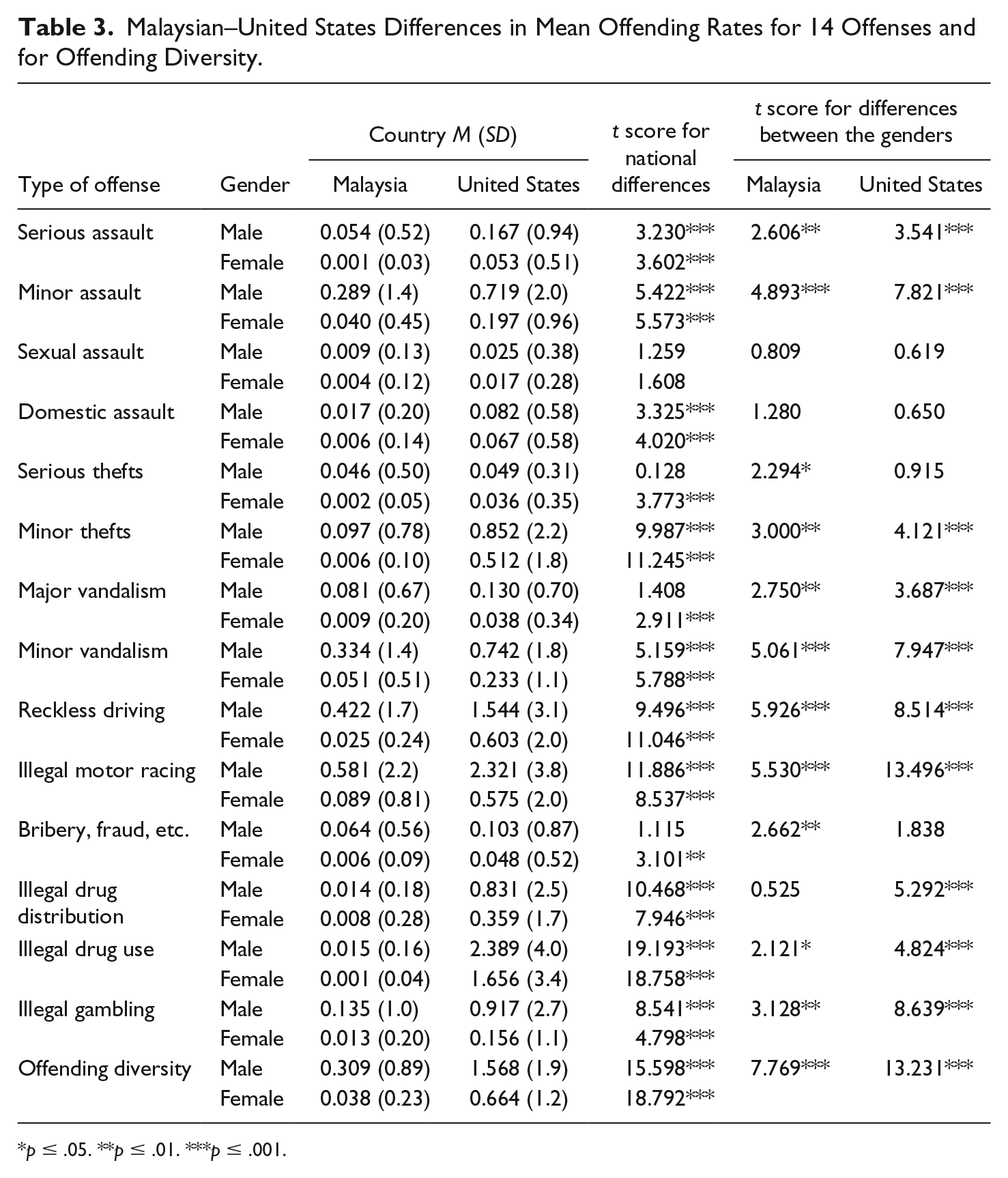
p ≤ .05. **p ≤ .01. ***p ≤ .001.
We also analyzed differences in offending between males and females in each country. The last two columns of Table 3 indicate that all but three of the differences in both countries were statistically significant. For the Malaysian students, the nonsignificant differences were for sexual assault, domestic assault, and illegal drug distribution. For the U.S. students, means that were not significantly different were for sexual assault, domestic assault, serious thefts, and bribery and fraud offenses. The one commonality regarding these nonsignificant differences is that they were for offenses for which neither gender reported even moderate involvement. Overall, the preliminary analyses in Table 3 reveal that even after performing comparisons separately for males and females, significant differences in offending exist between the Malaysian and U.S. students, and in all cases, U.S. students had higher self-reported offending, usually by factors of 3 or 4 to 1.
These initial analyses also reveal that the majority of respondents reported committing very few, or no, offenses, and the distributions for the 14 crime types are highly skewed and overdispersed. Some researchers have criticized lifetime frequency of offending as a reliable crime measure due to memory loss over time. Others have noted that the majority of respondents in survey research report not committing any crimes, or only committing them once; thus, the key question becomes a dichotomy of whether the participant has engaged in the offense or not (Thomas, 2015; Vazsonyi & Belliston, 2007). For this reason, the present study focuses on offending as dichotomous variables. We dichotomized our 14 crime measures (those who did not report committing offenses were coded 0 and those who reported committing the offense one or more times were coded 1) to allow examination of offending prevalence through multivariate analysis. Furthermore, a small percentage of respondents fall into the “1” category, and, therefore, for analytic purposes, the 14 offenses were consolidated into six categories of offenses: violent (major assaults, minor assaults, sexual assault, and domestic violence), property (major thefts, minor thefts, major vandalism, minor vandalism), endangerment (reckless driving and illegal auto racing), financial (bribery, fraud), drug (drug distribution, illegal drug use), and gambling (illegal gambling). Regression analyses were then conducted on these six measures of offending.
Table 4 displays the frequencies for the six dichotomous dependent variables for the full sample as well as the partitioned U.S. and Malaysian samples. Chi-square analyses were performed to assess significant differences between the U.S. and Malaysian sample respondents’ reporting of participating in the six consolidated offense categories. These tests were significant (p ≤ .001) for all categories of offenses and, similar to previous research, reveal that a significantly larger portion of the U.S. sample reported committing these offenses compared with the Malaysian respondents. The largest differences in reported offending between the U.S. and Malaysian samples were for drug offenses, gambling offenses, and endangerment offenses.
Frequencies and Percentages of the Dependent Variables for the Full, U.S., and Malaysian Samples.
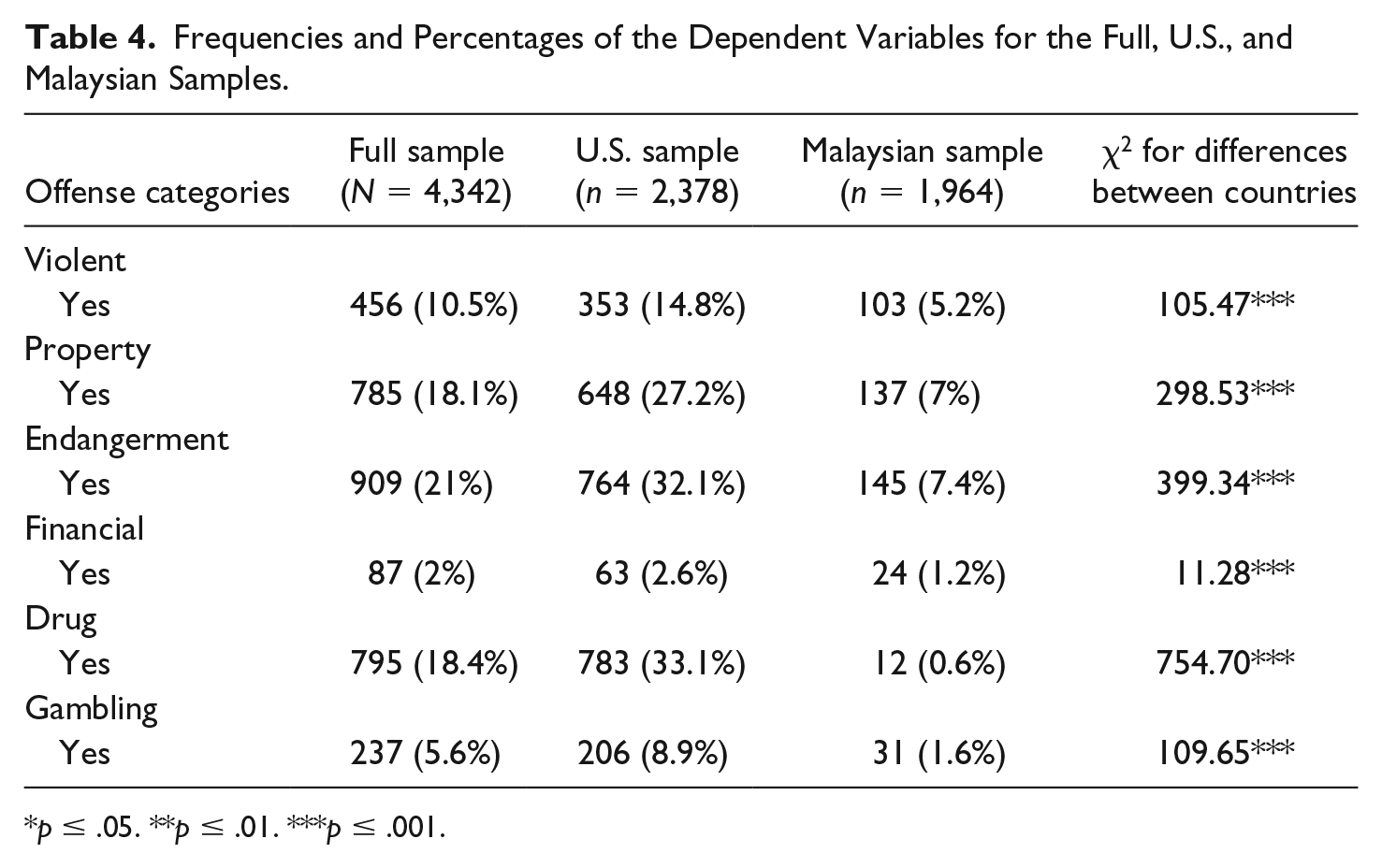
p ≤ .05. **p ≤ .01. ***p ≤ .001.
Multivariate Analyses
As can be seen in Table 4, for some of the offenses, especially in the Malaysian sample, very few respondents self-report offending behaviors. Ordinarily, modeling the predictors of offending for dichotomous dependent variables would require utilizing logistic regression analyses, which use maximum likelihood estimation (MLE). For rare events, such as is the case for some offenses here, however, MLE suffers from small sample bias, and underestimates the probability of the rarer of the events (King & Zeng, 2001; Piquero, MacDonald, Dobrin, Daigle, & Cullen, 2005). In other words, when studying rare events, or a small number of cases on the rarer of the two outcomes, prediction becomes difficult (King & Zeng, 2001). Although for some of the offense types analyzed here, self-reported offending is not rare (almost a third to more than a third of respondents self-report property, endangerment, and drug offending in the U.S. sample), rare events logit that utilizes penalized likelihood is always superior to MLE in producing finite, consistent estimates of regression parameters (Allison, 2012). King and Zeng (2001) further report that “when the results make a difference, our methods work better than logit; when they do not, these methods give the same answer as logit” (p. 702). Therefore, to identify the best predictors of self-reported offending in our samples, rare events logit was employed to regress the independent variables on the six dichotomous dependent variables measuring self-reported involvement in crime for the full sample and for each country separately.
The results of these models are displayed in Tables 5 to 7. Table 5 shows the results of the logistic regression analyses for the full sample. As can be seen in Table 5, the variable measuring the country of the respondent is significant for four of the six criminal offense categories; the exception is financial and gambling offenses. The odds of reporting having committed violent, property, endangerment, and drug offenses for U.S. respondents are almost twice, 4 times, 5 times, and 36 times the odds of that for the Malaysian respondents, respectively. Female respondents were significantly less likely to report committing offenses for all six of the offenses studied. Odds for females participating in crimes were more than 3 times smaller for violent offenses, more than 2 times smaller for property offenses, almost 4 times smaller for endangerment offenses, more than 2 times smaller for financial offenses, almost one and a half times smaller for drug offenses, and almost 6 times smaller for gambling offenses. Similar to the results in Table 3, even after controlling for several other factors, gender is a significant predictor of self-reported offending across multiple offense types in this cross-national study.
Logistic Regression Results for Six Consolidated Offenses for Full Sample.
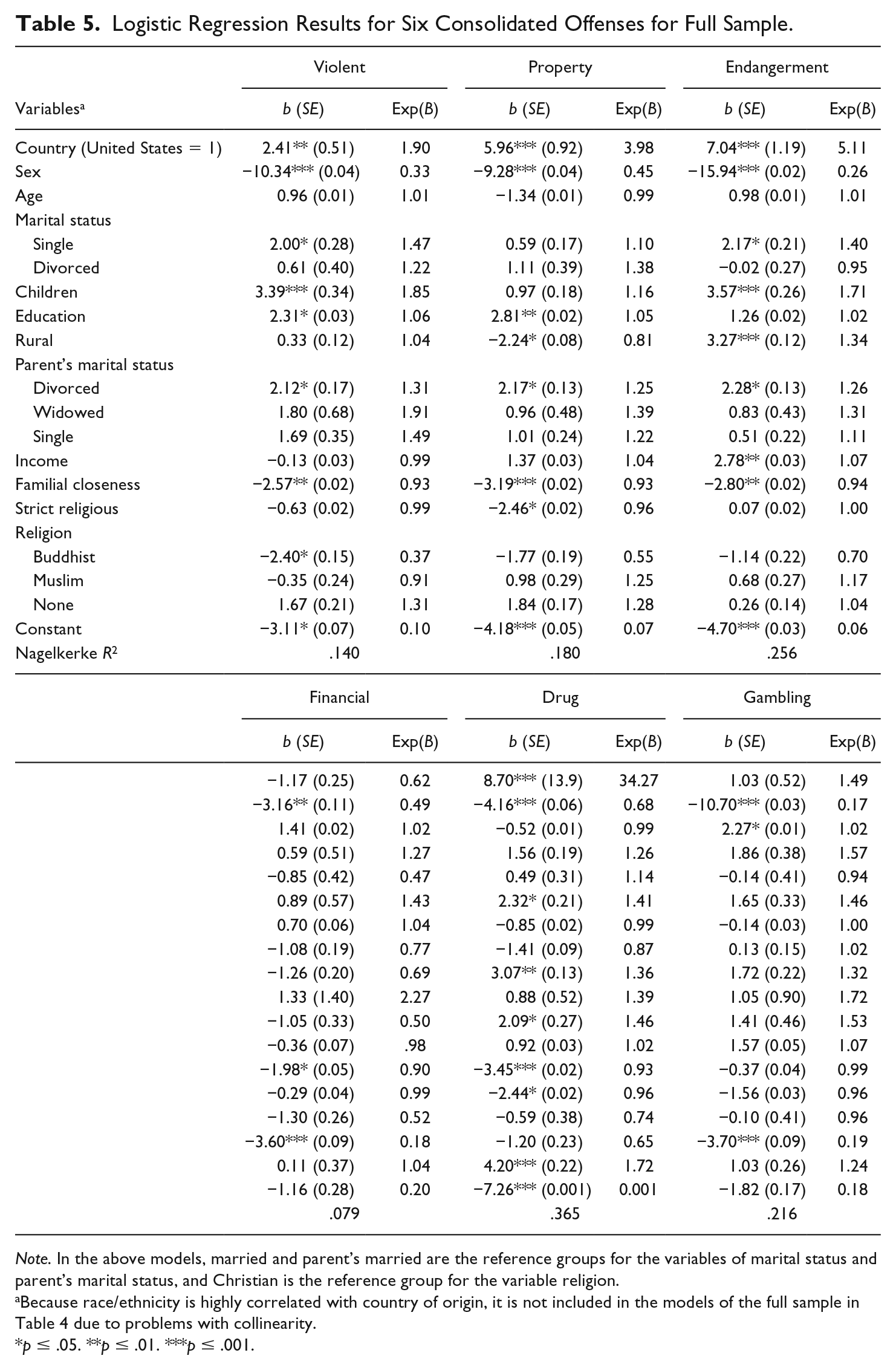
Note. In the above models, married and parent’s married are the reference groups for the variables of marital status and parent’s marital status, and Christian is the reference group for the variable religion.
Because race/ethnicity is highly correlated with country of origin, it is not included in the models of the full sample in Table 4 due to problems with collinearity.
p ≤ .05. **p ≤ .01. ***p ≤ .001.
Logistic Regression Results for Six Consolidated Offenses for U.S. Sample.

Note. In the above models, White is the reference group for the variable of race, married and parent’s married are the reference groups for the variables of marital status and parent’s marital status, and Christian is the reference group for the variable religion.
p ≤ .05. **p ≤ .01. ***p ≤ .001.
Logistic Regression Results for Six Consolidated Offenses for Malaysian Sample.
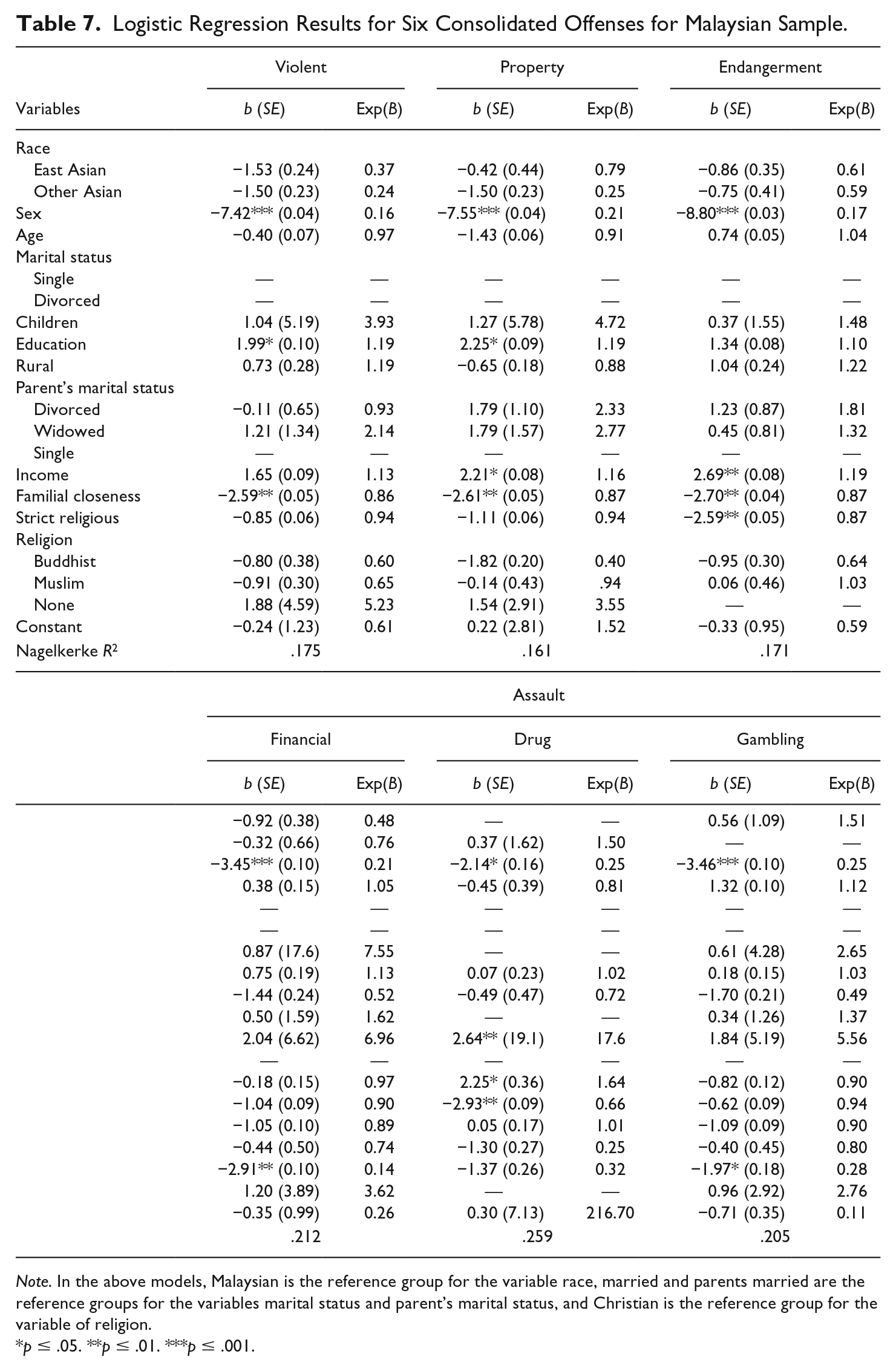
Note. In the above models, Malaysian is the reference group for the variable race, married and parents married are the reference groups for the variables marital status and parent’s marital status, and Christian is the reference group for the variable of religion.
p ≤ .05. **p ≤ .01. ***p ≤ .001.
Regarding marital status and whether or not one has children, respondents who reported being single had significantly larger odds of committing violent and endangerment offenses (odds ratios of 1.47 and 1.40, respectively). There were no significant differences across the other offense types by marital status, but those with children reported significantly larger odds of committing violent, endangerment, and drug offenses (odds ratios of 1.85, 1.71, and 1.41, respectively). One caveat related to the result of the positive relationship between having children and offending is that respondents who had children also tended to be older. Average ages of those who had children versus those who did not in the U.S. sample were 35 years versus 21 years, and in the Malaysian sample were 34 years versus 21 years. Thus, part of the effect of having children might be an age effect, where older respondents have had more years to commit offenses 1 .
A respondent’s education level and area in which he or she grew up were also related to involvement in some of the offenses. As the respondent’s years of education increased, his or her involvement in violent and property offenses increased. Those who reported growing up in rural areas reported significantly larger odds of committing endangerment offenses and significantly smaller odds of committing property offenses. Respondents who reported that their parents were divorced had significantly larger odds of reporting offending for four of the six offenses—that is, violent, property, endangerment, and drug offenses. Also respondents who reported that their mother or father was a single parent also had significantly higher odds of committing a drug offense. Parent’s marital status had no effects for financial and gambling offenses.
Our measures of family income and family closeness also significantly correlated with some of the offense variables. The income variable was only significant for the endangerment offenses and the direction of the association was positive. Family closeness, however, was significantly negatively associated with five of the six offenses: violent, property, endangerment, financial, and drug offenses. This finding is similar to other cross-national research, in particular, a study of five countries, including Japan, that found maternal closeness to be negatively correlated to deviance (Vazsonyi & Belliston, 2007). Similarly, increases in levels of family enforcement of strict religious teachings were associated with significantly smaller odds of engaging in property and drug offenses. Our family social bond measures (family closeness, parental control), therefore, seem to have an influence on most of the offenses studied here where they are associated with smaller odds of offending. Finally, self-reported religious affiliation had mixed effects on the offenses. Compared with those reporting Christian as their religion, Buddhists had significantly smaller odds of committing violent offenses (almost 3 times smaller), Muslims had significantly smaller odds of reporting engagement in financial and gambling offenses (more than 5 times smaller in both cases), and those who reported no religious affiliation had 1.7 times larger odds of reporting participation in drug-related offenses. Religious affiliation had no significant effects on property or endangerment offenses. Regarding overall model explanation, the R2 statistics are the largest for the drug and endangerment models and lowest for the violent and financial-related offense models.
Country-Specific Analyses
U.S. sample
The above regression models were run with the data partitioned by each country to assess any difference in the correlates of self-reported offending by country. Results for the U.S. sample are displayed in Table 6. Regarding race and ethnicity, Hispanic respondents had significantly larger odds of committing violent, financial, and gambling offenses than White respondents. The only significant difference between Black and White respondents was for financial crimes, where Black respondents had odds 3 times larger than Whites for participation in financial offenses. Finally, Asian respondents had significantly smaller odds of participating in endangerment offenses; there were no significant differences in offending by race/ethnicity for property, endangerment, or drug offenses. Similar to the initial models, female respondents had significantly smaller odds of committing five of the six offenses; the only exception was financial crimes. Age was not a significant predictor of offending for five of the six offense types, the exception was gambling offenses where older respondents reported increased odds of gambling.
Regarding marriage, respondents who were single were the only group who had significantly larger odds of reported offending and only for endangerment offenses. Parent’s marital status, however, had effects on three of the six offenses; those whose parents were divorced had increased odds of committing violent, endangerment, and drug offenses, and those who had a single parent had significantly larger odds of engaging in drug offenses. Respondents who reported having children had significantly larger odds of participation in violent, endangerment, and drug offenses. Education level was significantly associated with property offending only, and the urban/rural variable was only significant for endangerment offenses, where those who reported growing up in a rural area also had larger odds engagement. Family income produced significant effects for gambling offenses only, but increased family closeness and stricter religious upbringings were significantly associated with smaller odds of involvement in property and drug offenses. Overall, these results suggest that family cohesion and increased parental control, at least for this sample, are important for reducing engagement in property and drug offending. Finally, religious affiliation had little effect on self-reported offending. The only significant finding was for drug offenses where respondents who reported no religious affiliation had larger odds (1.73) of self-reported drug offending versus those who affiliated with the Christian faith.
Malaysian sample
Results for the Malaysian-only sample models are shown in Table 7. Regarding these models, values on some variables were almost perfectly correlated with a value of the dependent variable. As such, these variables had to be removed from the models. The results of these models reveal no significant race/ethnicity effects for any of the six offenses examined here. Gender, however, was again a significant predictor of offending across all six offenses. Malaysian females had substantially smaller odds of committing all of the crime types studied here. Beyond these gender effects, far fewer variables are significant in predicting self-reported offending for the Malaysian sample. Age and having children had no significant effects for any of the offenses studied (having children was removed from the model for drug offending as there were only 26 respondents in the Malaysian sample who reported having children and none of these respondents reported having committed a drug offense). Increased years of education was associated with larger odds of having committed two offenses only, violent and property offenses. There were no significant differences for any offenses with regard to the urban/rural variable in the Malaysian sample, and the only significant finding related to parent’s marital status was in the case of drug offenses, where those who had a deceased (widowed) parent had odds that were more than 17 times larger for committing a drug offense versus those whose parents were married.
The variables for family income and family closeness were significant for four offense types but had differing relationships. Increases in family income were positively associated with the odds of committing property, endangerment, and drug offenses, whereas increases in family closeness were associated with smaller odds of committing those same three offenses, plus violent offenses. Increases in strict religious adherence were associated with significantly smaller odds of only endangerment crimes being committed. Again, these family closeness and parental control variables show some deterrent effects for certain offenses. Regarding religious affiliation, the only significant effects were found in the models for financial and gambling offenses, where those who reported being of the Muslim faith had odds that were 7.1 and 3.5 times smaller than those who report being of Christian faith.
Conclusion and Discussion
Implications of Findings for Cross-National Research
As noted in the “Introduction” section, cross-national research of self-reported offending behavior has become fairly common in the last two decades, but it is still primarily limited to Western countries. The current study was an attempt to add to this growing body of literature and fill in some remaining gaps by providing a cross-cultural comparison of self-reported offending between a Western and an Eastern (Asian) country: the United States and Malaysia. In general, and similar to previous studies (Gover et al., 2011; Greenberger et al., 2000; Jessor et al., 2003; Kobayashi, et al., 2010; Webb et al., 2011), our most notable finding is that for all types of offending, involvement was greater in the United States than in Malaysia, often by 3 or 4 to 1 (Table 3). In fact, our comparative analyses (Table 5) interestingly found either significant differences between the U.S. and Malaysian students (all offenses except financial and gambling offenses) or between Muslim and Christian groups (financial and gambling offenses).
The results of our rare events logistic regression models also reveal that the correlates of offending in the two countries were similar in some instances but different in others. Both countries exhibited the well-documented tendency for males to engage in significantly more crime than females for nearly all the offenses examined (Ellis et al., 2019). Females had significantly smaller odds of reporting offending for all six offenses in the full sample and in the Malaysian sample, and for five of the six offense categories in the U.S. sample, the only exception was for financial crimes. This gender effect is consistent with previous cross-national comparison studies (Barberet et al., 2004; Ellis et al., 2019; Junger-Tas, 2012), and suggests that with limited exceptions, females are significantly less likely to report engaging in criminal behavior than males. These results also suggest the need for more cross-national comparative research with respect to the offending behavior of females to confirm crime as a male-dominated phenomenon across all offense types. Some of the between-country differences in our initial analyses with respect to gender could also be reflective of the fact that there has been an increase in female involvement in crime relative to males in Western countries since the 1970s and especially post 1990s (Junger-Tas, 1996), which may not have occurred as rapidly in Asian countries. Although higher education enrollment levels for females are equal, or in some cases, higher, than males, and participation in social activities that result from involvement in higher education is associated with increased opportunities for delinquency (Felson, 1998), an alternative possibility could be that Malaysian females do not socialize or go out as much as Malaysian males or their U.S. female counterparts. This is purely speculative, however, as one limitation in the current study is that we do not have measures of whether these students are still living at home with their parents or have moved out on their own, or whether, and how much, this differs by country.
In the Malaysian sample, with the exception of gender, very few of the independent variables were significant predictors of offending and these variables did not consistently predict odds of offending across all the offense types examined. Interestingly, results show that increased education (in violent and property offenses) and family income levels (for property, endangerment, and drug offenses) for Malaysian students resulted in larger odds of offending. This could suggest that older students and those with greater resources also have more opportunities in the Malaysian context to commit certain types of offenses. In the U.S. sample, increased education levels were associated with slightly increased odds of committing property offenses only. These variables, as measures of the social bonds of involvement and commitment, therefore, may not be as influential as our attachment and belief measures due to the lack of variation in the age and educational levels of our samples.
The age and marital status of the respondent had no effects for any of the offenses for the Malaysian sample and only had significant effects for two offenses in the U.S. sample, that is, older respondents had larger odds of having engaged in illegal gambling, and being single was associated with larger odds of committing an endangerment offense. Likewise, having children surprisingly had significant positive effects on the odds of reporting engaging in violent, endangerment, and drug offenses in the U.S. sample. Having children had no effects in the Malaysian sample; it is possible that the low percentage of respondents who had children in the Malaysian sample could be responsible for the nonsignificance of this variable in those models. As in previous research, in the United States, offending is significantly correlated with parental divorce (Farrington, 2015), whereas this variable was not significant in the Malaysian sample (possibly because divorce rates are comparatively low in Malaysia). Likewise, as has been found in past research (Barberet et al., 2004; I. H. Marshall & Enzmann, 2012), the current study’s results show respondents who report increased family closeness and strict religious adherence, have lower odds of committing property and drug offenses in both the United States and Malaysia.
Previous research has demonstrated a deterrent effect in offending for getting married and having children (King, Massoglia, & Macmillan, 2007) but that this finding is more pronounced for males than females. Other research has demonstrated that, especially for males, parenthood deters offending more than marriage but the combination of the two (i.e., being married with children) has the strongest deterrent effect (Zoutewelle-Terovan, van der Geest, Liefbroer, & Bijleveld, 2014). Because we study samples of university students, our marriage and children measures are not as consistent. In fact, having children increases the odds of reporting offending for three offense types in the U.S. model. In the current study, the status of the respondents’ parent’s marriage appears to be more influential than whether they themselves are married or have children.
Collectively, this study’s results provide some support for social bond theory as our measures of the constructs of attachment and belief influence offending across both countries studied. Similar to previous research (Barberet et al., 2004; I. H. Marshall & Enzmann, 2012), increased family closeness and strict religious adherence both significantly decreased the odds of offending in both the United States and Malaysia. Furthermore, our findings demonstrate that weakened social bonds (i.e., breakdown of the family structure) are associated to criminal behavior in both countries, and especially in the United States; parental divorce in the U.S. sample is significantly related with offending behavior.
Despite its contributions to this line of research, there are several methodological limitations of the current study that are important to mention. The first limitation relates to the cross-sectional nature of the data collected. Although we uncovered some interesting country-specific, as well as cross-national, similarities and differences in the correlates of the criminal offenses studied here, it is not possible with these data to speak to the causal nature of these phenomena. Another limitation of this study involves the fact that respondents consisted almost entirely of university students. By definition, those enrolled in institutions of higher education are among the best educated segment of this age group of the population. Therefore, because education remains a good predictor of noninvolvement in crime (Ellis et al., 2019), one must guard against assuming that comparing samples of university students represents the extent of offending in the countries where the universities were located. Lack of representativeness is a limitation, but with a sample that is more homogeneous (more range restriction) than the population, this might work to produce conservative estimates of the links between predictors and offending. In other words, if the sample was more representative, the results might simply be stronger. In general, we found no significant differences regarding education levels, and in fact even for some offenses, a positive relationship between education level and offending was uncovered, which is contrary to a number of previous studies.
Implications for Future Research
Given an increased interest in cross-national crime comparisons by both researchers and policy makers (Junger-Tas, 2010), the current study provides a modest estimate of the nature of differences in self-reported offending for six different offense categories for samples of university students in the United States and Malaysia. It also provides some preliminary insight into the differing cultural factors that may influence offending behavior in these two different countries. Overall, students in the United States appear to be considerably more involved in offending than is true for Malaysian students. Similar to previous research comparing offending in the United States and other countries, this survey of average differences in offending by university students in Malaysia and the United States supports the conclusion that major differences exist in the commission of most types of crime, delinquency, and traffic violations, with U.S. students being more involved in offending. Because of the nature of our samples and the cross-sectional nature of the data, these findings are preliminary, and much of the national differences in self-reported offending remained to be explained. Similarities in explaining offending across both countries emerged as well. Both descriptively and inferentially, however, weakened social bonds (as measured by a nonintact family structure, family closeness, and strict religious following) were associated with offending in both countries. Additional research on the correlates of criminality cross-nationally would assist in further exploring support for social bond theory and the impact of its constructs of attachment, belief, involvement, and commitment, on crime.
One limitation of the current study is that the criminal behaviors included as dependent variables were not legally defined for the study participants. As with nearly all self-report instruments, it is possible that in response to queries about these behaviors, participants used definitions of offending behavior that were different for the U.S. and Malaysian students. Future cross-national research should continue to refine measures of criminality that are legally and culturally specific. The most consistent factor associated with offending in both countries was gender; males appear to commit more offenses. It is, therefore, difficult to believe that cultural differences in interpreting questions about the nature of criminality could be responsible for this difference. Overall, this finding comports with the view that greater criminality among males is a culturally universal pattern (Ellis et al., 2019). Setting aside the matter of U.S. and Malaysian students having different conceptions of what constitutes “criminal offending” (which we are unable to directly assess), it appears that most forms of criminality are substantially lower among Malaysian students compared with U.S. students. More research, therefore, is needed to establish why. Among the possibilities is that alcohol, gambling, and drug abuse are less common in Malaysia than in the United States.
Methodologically speaking, self-report studies continue to be a fruitful method to gain insight into the prevalence and correlates of delinquent and criminal behavior (Krohn et al., 2010). The current study illustrated, via both univariate statistics and multivariate analyses, that there are important similarities, as well as unique differences, in U.S. and Malaysian university students self-reported offending. Despite a few limitations, criminological studies in Malaysia are rare, and the results of the current study are interesting and suggest the need for future comparative research utilizing understudied samples across diverse countries. Future studies should also explore the explanations for variation in the predictors of crime across different countries as well as include other pertinent variables to further uncover crime etiology in different contexts.
Besides providing a new standard for comparing student populations in various societies regarding their involvement in crime, this study can also provide a basis for better understanding the diversity of human societies in general. Our univariate sample statistics reveal similarities and differences in samples of university students from two distinct countries in offending propensity. The multivariate findings indicate that crime in predominantly Muslim and Asian countries may have both similarities and differences from a causal standpoint relative to predominantly Christian and Western countries.
Footnotes
Acknowledgements
The following individuals assisted in the recruitment of research participants for this study: Drew H. Bailey, David Geary, Richard Lippa, Emi Prihatin, Anthony Walsh, and Alan Widmayer.
Authors’ Note
Lee Ellis is now semi-retired and residing in California.
Declaration of Conflicting Interests
The author(s) declared no potential conflicts of interest with respect to the research, authorship, and/or publication of this article.
Funding
The author(s) disclosed receipt of the following financial support for the research, authorship, and/or publication of this article: Funding for the collection of data utilized in this study was provided, in part, by a research grant from the University of Malaya to its Department of Anthropology and Sociology (Number RG143-10HNE) while the second author was in the department as a visiting professor.
