




Abstract
Past research among U.S. correctional staff has found that work–family conflict has negative outcomes such as decreasing job satisfaction, decreasing organizational commitment, and increasing job stress. Little empirical research has addressed the association of the specific types of work–family conflict with job involvement. The present study contributes to the literature by separately analyzing the relationship of the four specific major types of work–family conflict (time-based conflict, strain-based conflict, behavior-based conflict, and family-on-work conflict) with job involvement among surveyed staff at two Chinese prisons. Job involvement varied by the type of work–family conflict. Specifically, time-based conflict and strain-based conflict had nonsignificant association with job involvement, but behavior-based and family-based conflicts had significant negative associations.
Correctional staff are a critical resource for correctional organizations. Staff are responsible for a myriad of duties and responsibilities required for the effective operation of a humane, safe, and secure institution. In light of their importance, a growing body of empirical research has focused on staff, including how workplace variables are related to staff work attitudes. Most of the work attitudes research has focused on job satisfaction and organizational commitment. While job satisfaction and organizational commitment are salient work attitudes in their own right, they are not the only ones. Job involvement is another important work attitude. Job involvement refers to a person’s level of the psychological identification with the job. At the opposite end of the continuum of job involvement is job alienation, which refers to having little connection to the job (i.e., being detached from the job; Kanungo, 1982a, 1982b). Hackman and Lawler (1971) believed that job involvement resulted in motivation for workers. Saks (2006) contended that workers with greater connection to the job were more likely to feel competent and put forth more effort in their work, thereby becoming more successful. Chen and Chiu (2009) noted that workers with high job involvement are more independent and self-confident—they not only conduct their work in accordance with the job duties required by the company but are also more likely to do their work in accordance with the employees’ perception of their own performance. (p. 478)
Job involvement has been reported to result in higher job satisfaction, higher commitment to the organization, greater work engagement and productivity, less absenteeism, and lower likelihood of voluntarily quitting (Blau & Boal, 1989; Brown, 1996; Chen & Chiu, 2009; DeCarufel & Schaan, 1990; Diefendorff et al., 2002; Elloy et al., 1991; Lambert & Paoline, 2010; Paoline & Lambert, 2012; Rabinowitz & Hall, 1977). Job involvement is an important work attitude that needs to be studied.
There is a small but growing body of literature that has explored how workplace factors affect the job involvement of correctional staff. Part of this body of research has explored how workplace variables are associated with correctional staff job involvement; however, the association of work–family conflict with job involvement has been studied very little. Work–family conflict occurs when the work domain and home domain spill over into one another and cause conflict (Netemeyer et al., 1996; Triplett et al., 1996, 1999). Specifically, work–family conflict is a form of inter-role conflict in which the role pressures from the work and family domains are mutually incompatible in some respect. That is, participation in the work (family) role is made more difficult by participation in the family (work) role. (Greenhaus & Beutell, 1985, p. 77)
There are different types of work–family conflict: time-based conflict, behavior-based conflict, strain-based conflict, and family-based conflict (Lambert et al., 2006; Triplett et al., 1996). Only a single published study could be found that explored how work–family conflict and job involvement were related to one another among correctional staff. Lambert (2008) found among U.S. correctional staff that both family-based conflict and a composite measure of work spilling over to home had positive associations with job involvement. Clearly, additional research is needed to determine the connection between work–family conflict and job involvement. Furthermore, the single published study to date on correctional staff was conducted in the United States. The relationship, if any, that exists between the different types of work–family conflict and job involvement among correctional staff in other cultures is unclear.
The current study was, therefore, undertaken to fill this void by exploring how the four major types of work–family are associated with job involvement among corrections staff in the People’s Republic of China (henceforth, China). China is the most populous nation in the world and a major nation on the world stage (World Factbook, 2018). Conducting international research allows scholars to determine whether the associations for the types of work–family conflict are universal (i.e., cuts across countries) or contextual (varies between nations). Jowell (1998) pointed out that the importance and utility to social science of rigorous cross-national measures is incontestable. They help to reveal not only intriguing differences between countries and cultures, but also aspects of one’s own country and culture that would be difficult or impossible to detect from domestic data alone. (p. 168)
In addition, no correctional study could be found that examined the relationship of the four types of work-on-family conflict with job involvement. Lambert (2008) used a composite measure of time-based conflict, strain-based conflict, and behavior-based conflict.
Institutional Corrections in China
China has a long history of use of correctional facilities: Chinese prisons can be traced back to the Xia dynasty (2029–1559 B.C.; J. Jin, 1997). Many changes have occurred in Chinese correctional systems since the communist party took power in China in 1949; however, as in Western nations, the primary objectives of prisons are to incarcerate offenders to punish and rehabilitate them.
Chinese prisons are closed institutions and, until recently, no access was granted to outsiders, including Chinese scholars (Wu, 2003). There are similarities between China’s correctional system and correctional systems in the United States. For example, China has two types of correctional institutions: detention centers and prisons. Detention centers, similar to jails in the United States, hold persons having a sentence less than 1 year, awaiting trial, and pending transfer to prison to serve their sentence. In China, detention centers are under the control of the Ministry of Public Security (i.e., the police; China.org.cn, 2016; Hill, 2006). Prisons hold offenders who have been sentenced to imprisonment for more than 1 year and are under the direction of Bureau of Prison Administration in the Ministry of Justice (Hill, 2006). Overall, the philosophy of Chinese prisons tends to emphasize rehabilitation of prisoners through punishment, treatment, and education (J. Jin, 1997; C. Jin, 2016).
There are approximately 1.65 million inmates confined in about 680 Chinese prisons, which translates to an incarceration rate of 118 inmates per 100,000 citizens; Chinese prisons collectively employ approximately 300,000 staff (Shao, 2011; World Prison Brief, 2018a). In comparison, there are approximately 1.5 million adult inmates confined in almost 1,700 U.S. correctional institutions, an incarceration rate of 655 inmates per 100,000 citizens, employing about 430,000 staff (University of Albany, 2018; World Prison Brief, 2018b).
The U.S. correction system often classifies prisons based on security levels (e.g., minimum, medium, and maximum). Chinese prisons do not have a set security level but instead distinguish inmates using different custody levels and sentence lengths. The terms used for staff in the United States and China are somewhat different. In the United States, the term correctional staff is frequently used. In China, the preferred terms are prison staff, prison police, or corrections police (Hill, 2006; Wu, 2003). All Chinese prison staff wear uniforms, regardless of job duties or supervisory level (Wu, 2003). Perimeter security in Chinese prisons is provided by the Chinese People’s Armed Police, a separate entity under the Central Military.
Particularly relevant to our study, the classification of Chinese prison staff differs from Western nations. For example, in the United States, correctional staff are broken down into custody (e.g., correctional officers) and noncustody (e.g., counselors, food service, and business office). Although Chinese prisons have different sections, divisions among staff are not as clear in Chinese prisons. Chinese staff are expected to carry out assigned duties across the entire spectrum of prison work. Duties and tasks within the prison are assigned by need and individual and not by position (Hill, 2006; Wu, 2003). This is relevant in the sense that change in scheduling needs can be met by a wider range of prison staff.
Chinese prison staff are civil servants with good job stability (Wang & Kong, 2006). This may be relevant in reducing strain-based conflict. Nevertheless, similar to their Western counterparts, Chinese prison staff work in a challenging work environment compared with other jobs. They are responsible for controlling and directing offenders who are being held against their will. Staff must be ready at all times to deal with disturbances, violence, and emergencies, although such events happen less frequently in China compared with the United States (C. Jin, 2016), and this may imply a lower level of strain-based conflict. Prisons in both countries need to operate 24 hr a day, every day of the year, including holidays. Chinese prison staff work approximately 12-hr shifts each day, whereas other Chinese noncorrectional government employees work 8-hr shifts (Hu et al., 2015; Wang & Kong, 2006). The occurrence of work–family conflict among Chinese prison staff is a real possibility, as it is for Western correctional staff. What is not clear, however, is how different types of work–family conflict affect the job satisfaction and organizational commitment of the Chinese correctional staff.
Extending the literature of the impact of work–family conflict on job involvement to Chinese context is highly meaningful. The results will inform both the scholarly community and practitioners about the generalizability of the Western findings and help to illustrate the impact of very different political, cultural, and social contexts on generally established Western findings and theories. This research will further the literature by examining separately how each dimension of work–family conflict influences job involvement for Chinese prison staff. We estimated the associations of time-based conflict, strain-based conflict, behavior-based conflict, and family-on-work conflict with job involvement. The results will also have important policy implications for improving job involvement.
Literature Review
Job Involvement
Job involvement is a concept that been studied in organizational studies for more than 50 years. Lodahl and Kejner (1965) introduced the concept of job involvement, which they conceptualized as both being psychologically connected with the job and having high job engagement. The dual definition of the concept resulted in disagreement, where it was argued that being psychologically connected to the job and high job engagement were different concepts (Kanungo, 1979). Lawler and Hall (1970) contended that job involvement was the “psychological identification with one’s work” and “the degree to which the job situation is central to the person and his identity” (pp. 310–311). Kanungo (1982a, 1982b) solidified the definition of job involvement as the psychological identification with the job. Job involvement refers to how important the job is in an individual’s life (Paullay et al., 1994). As pointed out by DeCarufel and Schaan (1990), “an individual with a high degree of job involvement would place the job at the center of his/her life’s interests. The well-known phrase ‘I live, eat, and breathe my job’ would describe someone whose job involvement is very high” (p. 86). As previously noted, on the opposite continuum would be job alienation, the feeling of no connection to the job or feeling that the job is boring (Kanungo, 1982a, 1982b). DeCarufel and Schaan (1990) further noted that “persons with low job involvement would place something other than their jobs (e.g., family, hobbies) at the center of their lives” (p. 86). Singh and Gupta (2015) also saw job involvement as the degree of psychological identification and importance of a job for a person. For the current study, the conceptualization of job involvement was the psychological identification with the job proposed by Kanungo (1982a, 1982b). This definition of job involvement is used in many current studies across different occupations, such as business (Singh & Gupta, 2015), sales (Li et al., 2019), teaching (Wang et al., 2017), and banking (Farhangian, 2016).
Job involvement, along with job satisfaction and organizational commitment, is viewed as an important work attitude (Abdallah et al., 2016; Brooke et al., 1988); however, job involvement is distinct from job satisfaction and organizational commitment (Brown, 1996). Job satisfaction is the “pleasurable or positive emotional state resulting from the appraisal of one’s job or job experiences” (Locke, 1976, p. 1300). Brooke et al. (1988) pointed out that job satisfaction is the “emotional state of liking one’s job” while job involvement is the “cognitive belief state of psychological identification with one’s job” (p. 139). Research has empirically demonstrated that job involvement and job satisfaction are distinct concepts (Brooke et al., 1988; Lawler & Hall, 1970). Organizational commitment is the cognitive bond/attachment of the worker with the employing organization, having the core elements of identification with the organization, internalization of organizational goals, acceptance of organizational core values, and willingness to put forth effort to help the organization be successful (Mowday et al., 1982). As such, organizational commitment is the connection to the overall organization and job involvement is the attachment to the job (Brown, 1996). Research has demonstrated that job involvement and organizational commitment are empirically distinct concepts (Blau, 1987; Brooke et al., 1988).
Past Correctional Staff Job Involvement Research
Before reviewing the correctional staff job involvement literature, it is important to note that there is a rich and growing body of job involvement across many different occupations. Job involvement has been reported to have important outcomes. For example, among Indian police officers, job involvement had a negative association with all three dimensions of job burnout (i.e., emotional exhaustion, depersonalization, and reduced sense of accomplishment; Lambert et al., 2018). Among Indian workers, job involvement had a positive relationship with organizational commitment and professional commitment (Singh & Gupta, 2015). Johari and Yahya (2016) reported a positive association between involvement and work performance among Malaysian public service agencies. Job involvement had a positive relationship with job satisfaction among Jordanian banking staff (Abdallah et al., 2016). In a meta-analysis, job involvement had positive relationships with job satisfaction and organizational commitment, and a negative association with turnover intent (Brown, 1996). Research on how workplace variables are associated with job involvement across different occupations is a testament to its importance.
Workplace variables have been reported to be associated with job involvement among employees across different occupations and countries. For example, among Taiwanese workers in private manufacturing, finance, and service firms, employee well-being had a positive relationship with job involvement (Huang et al., 2016). Among Indian police officers, the workplace stressors of role ambiguity, role conflict, role overload, role underload, and repetitiveness each had a negative association with job involvement (Qureshi et al., 2019). Job feedback and task significance were positively related to involvement among Malaysian public service agencies (Johari & Yahya, 2016). In a meta-analysis, Brown (1996) reported that the workplace variables of participation, supervisor consideration, job autonomy, and job feedback had positive associations with job involvement, whereas role ambiguity, role conflict, and work–family conflict were negatively associated. In a meta-analysis, role involvement (i.e., the degree of importance of the work role) was postulated to result in work–family conflict and was found to have a positive relationship with work-on-family conflict but a nonsignificant relationship with family-on-work conflict (Michel et al., 2011). It is important to note that this meta-analysis was mainly based on cross-sectional data and other studies have postulated that work–family conflict resulted in lower job involvement (Brown, 1996; Fedi et al., 2016; Greenhaus et al., 2001; Thompson & Blau, 1993). While work–family conflict is postulated to affect job involvement, it is important to note that the current study’s data are cross-sectional and cannot be used to show causality. Instead, the current study can only show an association or relationship (or lack of it) between the different types of work–family conflict and job involvement. As such, the term effects is not used in the current study, but the term association or relationship is used. Finally, research among correctional staff also supports the contention that job involvement has important outcomes, and that workplace variables are related to involvement.
Job involvement has been linked to significant outcomes among correctional staff. Among U.S. correctional staff, job involvement was linked to lower job stress, lower absenteeism, and lower turnover intent (Lambert et al., 2011, 2015; Lambert & Paoline, 2010; Paoline & Lambert, 2012). Furthermore, job involvement was reported to raise job satisfaction, increase organizational commitment, and was associated with greater support for treatment of offenders among U.S. correctional staff (Lambert, 2008; Lambert, Hogan, Barton, & Elechi, 2009; Lambert et al., 2011, 2015; Lambert & Paoline, 2010; Paoline & Lambert, 2012). Studies have also explored how workplace variables are related to job involvement. Stressors (i.e., things that cause strain for a person) have been found to result in lower involvement in the job. Among U.S. correctional personnel, role conflict and fear of being hurt on the job were reported to reduce job involvement (Lambert et al., 2013).
Workplace resources (i.e., workplace factors that aid workers) have been observed to be positively related to job involvement. Input into decision-making, job variety, perceptions of procedural justice (i.e., fair processes are used for making important decisions that affect staff), formalization (i.e., having written rules and manuals available for staff), and organizational support are associated with higher involvement among U.S. staff (Lambert et al., 2013; Lambert & Paoline, 2012). Among Chinese correctional staff, transactional justice (treating staff with respect and dignity), distributive justice (salient organizational outcomes affecting staff are seen as fair), quality supervision, and job variety each raised job involvement, whereas fear of being victimized lowered involvement (Lambert et al., 2018). Finally, as noted earlier, Lambert (2008) observed that job involvement had a positive association with family-on-work conflict and a combined measure of time-based conflict, strain-based conflict, and behavior-based conflict among U.S. correctional employees.
The literature points to four reasons why the current study is needed. First, there has been limited research conducted on both the antecedents and the consequences of job involvement among correctional staff. Second, findings suggest that workplace variables influence job involvement. Third, all but one correctional study focused on U.S. staff. To date, only a single study has been published that studied how workplace variables relate to job involvement among non-Western correctional staff. Fourth, there is a paucity of research on the effects of work–family conflict on correctional staff job involvement. The current study, therefore, was undertaken to examine the effects of the four major types of work–family conflict on the job involvement among staff at two prisons in the Guangdong province in southern China.
Work–Family Conflict
Work and home are the two major domains for most adults and, when the two domains spill over into one another, work–family conflict can occur (Brough & O’Driscoll, 2005; Greenhaus & Beutell, 1985; Lambert et al., 2017). Work–family conflict derived from the role conflict theory proposed by Kahn et al. (1964) who theorized that if major roles in a person’s life were not in agreement, conflict would likely occur. Work–family conflict is bidirectional in that problems at work can cause conflict at home and problems at home can cause conflict at work (Armstrong et al., 2015; Netemeyer et al., 1996). Family issues that spill over to work, resulting in problems, are referred to as family-on-work conflict (Grzywacz & Butler, 2008; Michel et al., 2011). For example, a staff member who had a nasty fight with his or her spouse may come to work angry, taking it out on inmates or coworkers, and thereby causing new work problems (J. Liu et al., 2017).
Issues at work can follow a staff member home, resulting in work-on-family conflict (Lambert et al., 2006). The three major types of work-on-family conflict are time-based conflict, strain-based conflict, and behavior-based conflict (Lambert et al., 2006; Netemeyer et al., 1996). Time-based conflict occurs when work schedules do not meet the time needs of home (Armstrong et al., 2015). Correctional facilities operate 24 hr a day, 365 days a year, including major holidays. Staff may need to work different shifts or mandatory overtime because of an emergency (e.g., disturbance) or to cover a post because of an absence. This type of scheduling can often interfere with the work schedule, the needs of people at home, and other family obligations (Lambert et al., 2006). Work schedules that are incompatible with those of family members and friends can result in conflict for the staff member. For example, an unexpected need at the institution may result in a staff member missing a child’s game or not being able to be home for an important holiday (J. Liu et al., 2017).
Strain-based conflict occurs when work strain follows a staff member home, resulting in both decreased interactions and more strained interactions at home (Lambert et al., 2006; Netemeyer et al., 1996). Working in a correctional facility is a unique occupation that can result in trying experiences (Armstrong et al., 2015; Triplett et al., 1996, 1999). As pointed out by Armstrong and Griffin (2004), “few other organizations are charged with the central task of supervising and securing an unwilling and potentially violent population” (p. 577). Work demands can follow staff home, resulting in conflict there (Lambert et al., 2010). It is unlikely that straining experiences and feelings can be turned off at the end of a shift (J. Liu et al., 2017). Anger, frustration, and even shock raise the chances of disagreement and conflict at home, as well as being distant and shut off from loved ones (Brough & O’Driscoll, 2005; Lambert et al., 2006). For example, a staff member may have had to use physical force on an inmate who attacked another inmate and refused verbal commands to comply. The resulting adrenalin spike and heightened negative emotions are likely to follow home, especially if the incident occurred near the end of a shift, thereby causing problems. Another example could be if a staff member witnesses a bloody inmate-on-inmate assault and the resulting psychological distress affects the quality of interactions at home (J. Liu et al., 2017).
The behavioral roles of working in a closed correctional institution are different from those found in many other professions, such as being a teacher, nurse, or salesperson, and these unique work roles may cause behavior-based conflict for correctional staff. Behavior-based conflict occurs when work roles and home roles are incompatible with one another, resulting in conflict (Armstrong et al., 2015; Netemeyer et al., 1996). Greenhaus and Beutell (1985) indicated that “specific patterns of in-role behavior may be incompatible with expectations regarding behavior in another role” (p. 81). The home and work roles for some correctional staff are not always compatible with one another and being able to switch effectively from one role to another in different domains is not always possible. In the end, this can result in frustration and conflict (Armstrong et al., 2015; Lambert et al., 2006). For example, correctional work roles are to be suspicious and questioning of the actions of others, as well as being emotionally detached, which are not compatible with the home role of being open, supportive, and nurturing. Engaging in such behavior at home is likely to result in conflict (J. Liu et al., 2017). Similarly, barking orders at work may be acceptable but doing so to spouses/partners, children, and friends is not likely to be favorably accepted at home.
The different types of work–family conflict should be negatively associated with job involvement as a job demand. Karasek (1979) defined job demands as “the psychological stressors involved in accomplishing the workload, stressors related to unexpected tasks, and stressors of job-related personal conflict” (p. 291). Stressors result in psychological strain for a person. The job strain model postulates that stressors are linked to negative outcomes, such as reduced job involvement, because the psychological tension and strain detract from positive work experiences and feelings (Karasek, 1979; Lambert et al., 2017). Work–family conflict is a job demand, which is seen as a stressor for correctional staff (Armstrong et al., 2015; Lambert et al., 2013). As stressors, the types of domain spillover conflict should reduce the level of importance of the job in a person’s life.
Past Correctional Staff Work–Family Conflict Research
In light of the fact that working in institutional corrections can result in work–family conflict, scholars have studied domain strain. Work–family conflict has been linked to negative outcomes, such as job stress and job burnout among both U.S. and Chinese correctional staff. Specifically, behavior-based, strain-based, and family-on-work conflicts have been observed to raise the level of job stress and job burnout among U.S. staff (Armstrong et al., 2015; Lambert et al., 2006, 2010; Triplett et al., 1999) and strain-based and behavior-based conflicts had positive associations with Chinese correctional staff job stress (J. Liu et al., 2017). In addition, the spillover between work and home domains also has been found to lower both job satisfaction and organizational commitment, with time-based, strain-based, behavior-based, and family-on-work conflicts lowering job satisfaction (Armstrong et al., 2015; Lambert et al., 2002, 2006) and reducing organizational commitment of U.S. staff (Lambert et al., 2006, 2014). Work–family conflict in the form of strain-based conflict and family-on-work conflict decreased engagement in organizational citizenship behaviors (i.e., going beyond what is expected at work) among U.S. staff (Lambert et al., 2013). While many studies have measured the four major types of domain conflict, some studies used an overall composite measure among U.S. staff, finding that work–family conflict overall negatively affects life satisfaction, organizational commitment, and support for treatment of inmates (Hogan et al., 2006; Lambert et al., 2005, 2008; Lambert & Hogan, 2009; Lambert, Hogan, Elechi, et al., 2009) and is linked to higher levels of job stress, job burnout, and depression (Griffin, 2006; Lambert & Hogan, 2010; Lambert et al., 2007; Obidoa et al., 2011). Furthermore, a composite measure of work-on-family conflict had a negative association with job satisfaction for Taiwanese correctional staff (Hsu, 2011). Finally, as previously indicated, Lambert (2008) observed that job involvement had a positive association with family-on-work conflict and a combined measure of time-based conflict, strain-based conflict, and behavior-based conflict among U.S. correctional personnel.
Four major conclusions can be reached from past research. First, the major types of work–family conflict are stressors that decrease positive outcomes (e.g., job satisfaction) and increase negative outcomes (e.g., job stress) for correctional staff. Second, the associations between the four major types of work–family conflict and job involvement varied, suggesting that to obtain a clear picture of the association of work–family conflict with job involvement the specific types rather than a composite measure should be used. Third, the vast majority of the research to date has focused on U.S. correctional staff and there is a need to study domain spillover among staff in other nations across the globe. Fourth, very limited research has focused on the relationship between the different types of work–family conflict and job involvement among correctional staff. In fact, only a single published study could be found, and it examined the relationship of family-on-work conflict and a composite measure of work-on-family conflict with job involvement among U.S. correctional staff. There is a need for more research on how the different forms of work–family conflict are associated with job involvement among non-Western correctional workers.
Hypotheses
As noted earlier, job involvement, job satisfaction, and organizational commitment are seen as important but separate work attitudes (Abdallah et al., 2016; Brooke et al., 1988). Job involvement refers to the bond or psychological identification with the job (Kanungo, 1982a, 1982b; Lambert et al., 2015). Job satisfaction is the degree of emotional pleasure gained from the job (Armstrong et al., 2015; Locke, 1976). Organizational commitment refers to the bond to the overall organization (Lambert et al., 2014; Mowday et al., 1982). Thus, job involvement is the identification with the job, job satisfaction is the degree of pleasure gained from the job, and organizational commitment is the identification with the overall employing organization (Lambert & Paoline, 2012). Work–family conflict is seen as a stressor for correctional staff (Lambert et al., 2013). Stressors are theorized to have a negative association with work attitudes (Armstrong et al., 2015; Lambert, Hogan, Barton, & Elechi, 2009; Lambert et al., 2011). As indicated below, past research has found that types of work–family conflict have a negative relationship with job satisfaction and organizational commitment. Based on the postulation that work–family conflict is a stressor, having negative associations with work attitudes, and the past correctional staff research, which found negative relationships between the types of work–family conflict and the work attitudes of satisfaction and commitment, the following hypotheses propose why each of the four types of work–family conflict would have a negative association with job involvement among the studied Chinese correctional staff.
It is reasonable to expect that job scheduling–related problems would be negatively associated with job involvement as past research has linked work–family conflict to job stress and job burnout among U.S. and Chinese correctional staff (Armstrong et al., 2015; Lambert et al., 2006, 2010; J. Liu et al., 2017; Triplett et al., 1999). Past research also indicates that time-based conflict has a negative relationship with job satisfaction and organizational commitment among U.S. staff (Armstrong et al., 2015; Lambert et al., 2002, 2006, 2014), whereas job satisfaction and commitment have been positively linked to job involvement (Lambert, 2008; Lambert, Hogan, Barton, & Elechi, 2009; Lambert et al., 2011, 2015; Lambert & Paoline, 2010; Paoline & Lambert, 2012).
Past research has indicated that strain-based conflict is negatively associated with job satisfaction, and organizational commitment among U.S. staff (Armstrong et al., 2015; Lambert et al., 2002, 2006, 2014), whereas job satisfaction and commitment have been positively linked to job involvement (Lambert, 2008; Lambert, Hogan, Barton, & Elechi, 2009; Lambert et al., 2011, 2015; Lambert & Paoline, 2010; Paoline & Lambert, 2012).
Past research has indicated that behavior-based conflict is negatively related to job satisfaction and organizational commitment among U.S. staff (Armstrong et al., 2015; Lambert et al., 2002, 2006, 2014), whereas job satisfaction and commitment have been positively associated with job involvement (Lambert, 2008; Lambert, Hogan, Barton, & Elechi, 2009; Lambert et al., 2011, 2015; Lambert & Paoline, 2010; Paoline & Lambert, 2012).
Similar to above reasoning, past research has indicated that family-on-work conflict is negatively related to lower job satisfaction and organizational commitment among U.S. staff (Armstrong et al., 2015; Lambert et al., 2002, 2006, 2014). In addition, job satisfaction and organizational commitment have been reported to have a positive association with U.S. correctional staff job involvement (Lambert, 2008; Lambert, Hogan, Barton, & Elechi, 2009; Lambert et al., 2011, 2015; Lambert & Paoline, 2010; Paoline & Lambert, 2012).
Method
Participants
Staff at two prisons located in the province of Guangdong in China were surveyed. The first prison employed 280 staff members and housed about 1,500 inmates. The second prison employed 160 staff and housed about 700 inmates. Each prison contained inmates classified into different levels of custody (i.e., highly intensive/maximum custody, intensive/medium custody, and general/minimum custody). The staff were assigned to various posts and worked as teams. The survey was distributed to staff during a weekly team meeting. The survey instrument was translated into Chinese and then back to English by bilingual scholars. Specifically, the back method of translation was used, wherein survey materials (cover letter and survey) were translated into Chinese and a second scholar translated the materials back into English to determine whether there were any translation problems. The survey was also pilot tested to determine whether there were issues of understanding and none were found. Staff were informed of the purpose of the study, that participation was voluntary, that any question could be skipped, that answering the survey could be ended at any time, that there were no rewards or punishments for participation, and that all responses would be anonymous.
Approximately, 70% of the prison staff from the two prisons completed and returned the survey (i.e., 322 usable surveys were returned), and the response rates were very similar for both prisons. The mean age was 43.94 years, with a standard deviation of 6.82. The mean tenure with the correctional organization was 19.81 years, with a standard deviation of 8.08. Approximately, 46% of the participants were men and 54% were women. In terms of the highest educational level, 63% of the participants reported having less than a college bachelor’s degree and 37% indicated that they had earned a bachelor’s or higher degree. About 32% of respondents marked that they were a supervisor of other staff. About 88% marked that they were currently married, and 42% indicated that they had one or more children aged 16 years or younger living at home at the time of the survey. Furthermore, 64% indicated that they worked at the first correctional facility and 36% were assigned to work at the second correctional institution. The participants appeared similar in terms of gender, educational level, age, and tenure compared with the overall prison staff population. About 48% of the overall prison staff were male and 40% had a bachelor’s degree; however, the human resource office in both prisons could not provide information on marital status or percentage of employees with a child aged below 16 years living at home for the overall prison staff population.
Variables
Dependent variable
An additive index of job involvement was formed by summing three items from Kanungo (1982b). The three work involvement items were as follows: (a) I live, eat, and breathe my job (i.e., my job is very important to me); (b) the major satisfaction in my life comes from my job; and (c) the most important things that happen to me in my life usually occur at my job. The response options for the job involvement items were set in a 6-point Likert-type scale of 1 = strongly disagree, 2 = disagree, 3 = somewhat disagree, 4 = somewhat agree, 5 = agree, and 6 = strongly agree. Cronbach’s alpha, a measure of internal reliability, for the three items was .74. In a factor analysis, all the job involvement items loaded onto a single factor. In this study, eigenvalues and scree plots were used, along with cutoff factor loadings of .40 or higher, to determine whether the group of items were measuring the same latent concept, indicating unidimensionality (Gorsuch, 1983).
Independent variables
The independent variables of focus were the four different types of work–family conflict. The work–family conflict items were based on the work of Bohen and Viveros-Long (1981) and Higgins and Duxbury (1992). The following three items were used to measure time-based conflict: (a) my job keeps me away from my home too much; (b) I often have to miss important family or social activities/events because of my job; and (c) the uncertainty of my work schedule interferes with my family and/or social life. The four items used to measure strain-based conflict were as follows: (a) due to all the work demands, sometimes when I come home, I am too stressed to do the things I enjoy; (b) work makes me too tired or irritable to fully enjoy my family social life; (c) when I get home from work, I am often too stressed to participate with family or friends; and (d) I find that I frequently bring home problems from work. Behavior-based conflict was measured using the following items: (a) the behaviors I use at work do not help me to be a better person at home; (b) the behaviors I learned at work do not help me to be a better parent, spouse, friend, and so forth; and (c) the behaviors that are effective at home do not seem to be effective at work. The following four items were used to measure family-on-work conflict: (a) because of family/social concerns, I sometimes have a hard time concentrating at work; (b) due to stress at home, I am often preoccupied with family matters at work; (c) tension from home often follows me to work; and (d) due to the pressures at home, it is sometimes hard for me to do my job well. All the work–family conflict items were answered using the same 6-point Likert-type scale that was used for job involvement items. Cronbach’s alpha values for time-based conflict, strain-based conflict, behavior-based conflict, and family-on-work conflict were .88, .93, .88, and .93, respectively. In a factor analysis, work–family items loaded onto the expected factor with a loading score higher than .40, indicating unidimensionality. The responses for each particular type of work–family conflict were summed together to form an additive index.
Finally, past studies have included measures for personal characteristics, such as age, tenure, gender, educational level, supervisory status, marital status, having a child/children aged below 16 years living at home, and prison of employment. In addition, work and home demands may be different for those who are married or have minor children at home (Armstrong et al., 2015; Brough & O’Driscoll, 2005; Lambert et al., 2006). Overall, the personal characteristic variables were included in this current study more as control than explanatory variables. Age and tenure with the correctional agency were measured in years as continuous variables. Gender was a dichotomous variable representing whether the participant was a woman (coded 0) or a man (coded 1). Educational level represented whether the participant had earned a bachelor’s degree (coded 1) or not (coded 0). Supervisor status represented whether the participant was a supervisor of other staff (coded 1) or not (coded 0). Marital status was coded as 1 = married and 0 = currently not married. Having a child/children aged below 16 years living at home was coded as 1 = yes and 0 = no. Finally, a dichotomous variable representing the prison where the participant worked was included (first prison coded as 1 and second prison coded as 0).
Results
The descriptive statistics and coding for the variables used in the study are reported in Table 1. There appeared to be significant variation in the dependent and independent variables (i.e., none were constants). Statistical tests indicated that the variables were normally distributed. Similarly, the median and mean values for the variables are similar to one another, also suggesting a normal distribution. For the index variables, Cronbach’s alpha values were .74 or higher and values above .70 is viewed as good (Nunnally & Bernstein, 1994). Finally, the typical participant was a married woman in her mid-40s, with no children at home and less than a bachelor’s degree, who had worked for the first prison for about 20 years, and who was a not a supervisor of other staff.
Descriptive Statistics.

Note. Min = minimum value; Max = maximum value; Md = median value; M = mean value; SD = standard deviation value; α = Cronbach’s alpha value. The total number of participants was 322.
The correlations for the variables are presented in Table 2. The variables for tenure, prison of employment, time-based conflict, strain-based conflict, behavior-based conflict, and family-on-work conflict all had statistically significant correlations with job involvement. Increases in tenure were associated with greater involvement in the job. Staff from the second prison tended to be higher on job involvement as compared with staff from the first prison. Each type of work–family conflict had a negative correlation, which means that an increase in any of these domain spillover variables was associated with lower job involvement. Finally, age, gender, educational level, supervisory status, marital status, and having a child/children at home each had a nonsignificant correlation with the dependent variable.
Correlation Matrix of Study Variables.
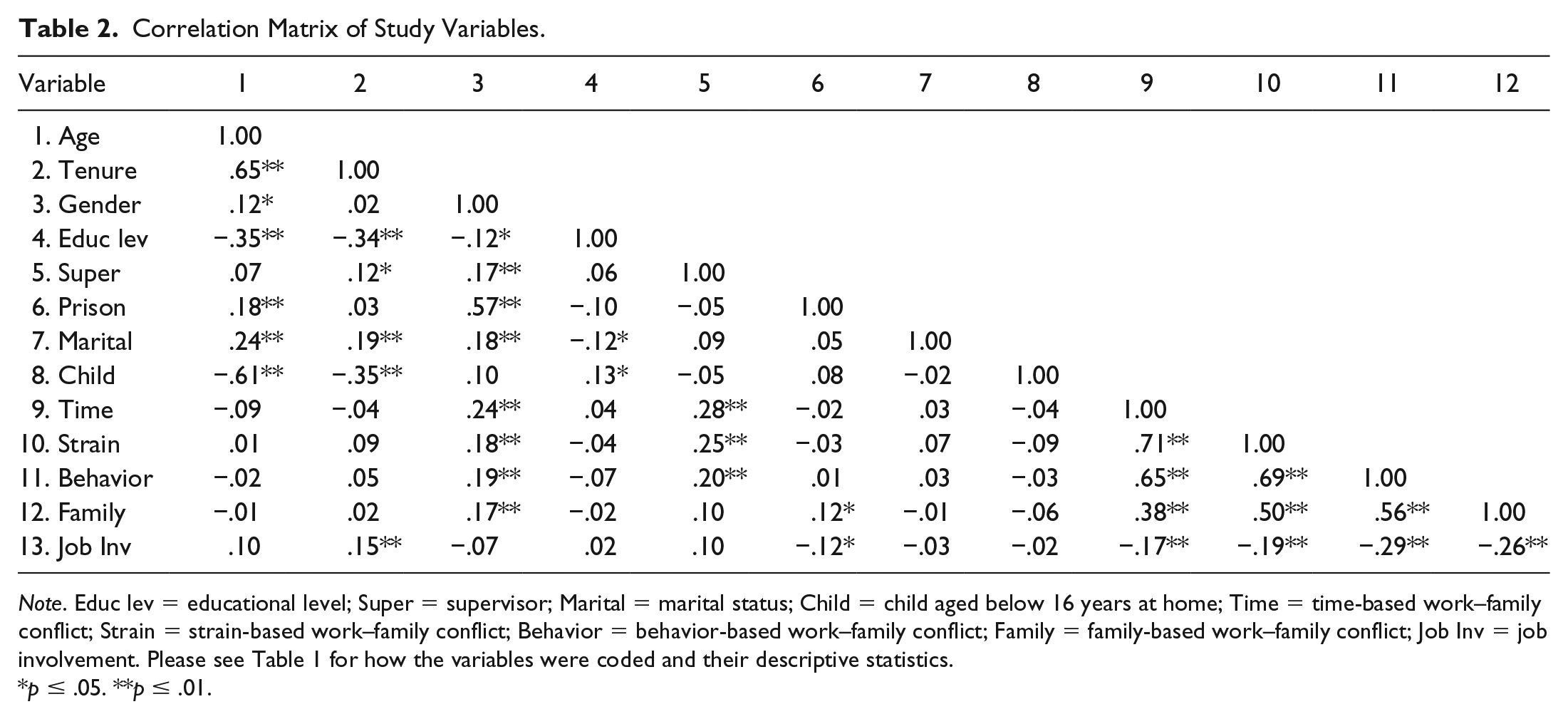
Note. Educ lev = educational level; Super = supervisor; Marital = marital status; Child = child aged below 16 years at home; Time = time-based work–family conflict; Strain = strain-based work–family conflict; Behavior = behavior-based work–family conflict; Family = family-based work–family conflict; Job Inv = job involvement. Please see Table 1 for how the variables were coded and their descriptive statistics.
p ≤ .05. **p ≤ .01.
An ordinary least squares (OLS) regression equation was computed with job involvement as the dependent variable and the personal characteristics and the four work-variable types as the independent variables. The results are reported in Table 3. Multicollinearity (i.e., when two or more variables share too large an overlap in variance) is seen as a problem when variance inflation factor (VIF) scores exceed 6 (Tabachnick & Fidell, 2013). Based on the VIF scores reported in Table 3, multicollinearity was not a problem. In addition, the issues of outliers, influential cases, normality, linearity and homoscedasticity of residuals, and independence of errors in the regression analysis were tested and were not a problem (Berry, 1993; Tabachnick & Fidell, 2013).
Multivariate OLS Regression Results of Associations of Types of Work–Family Conflict With Chinese Correctional Staff Job Involvement.
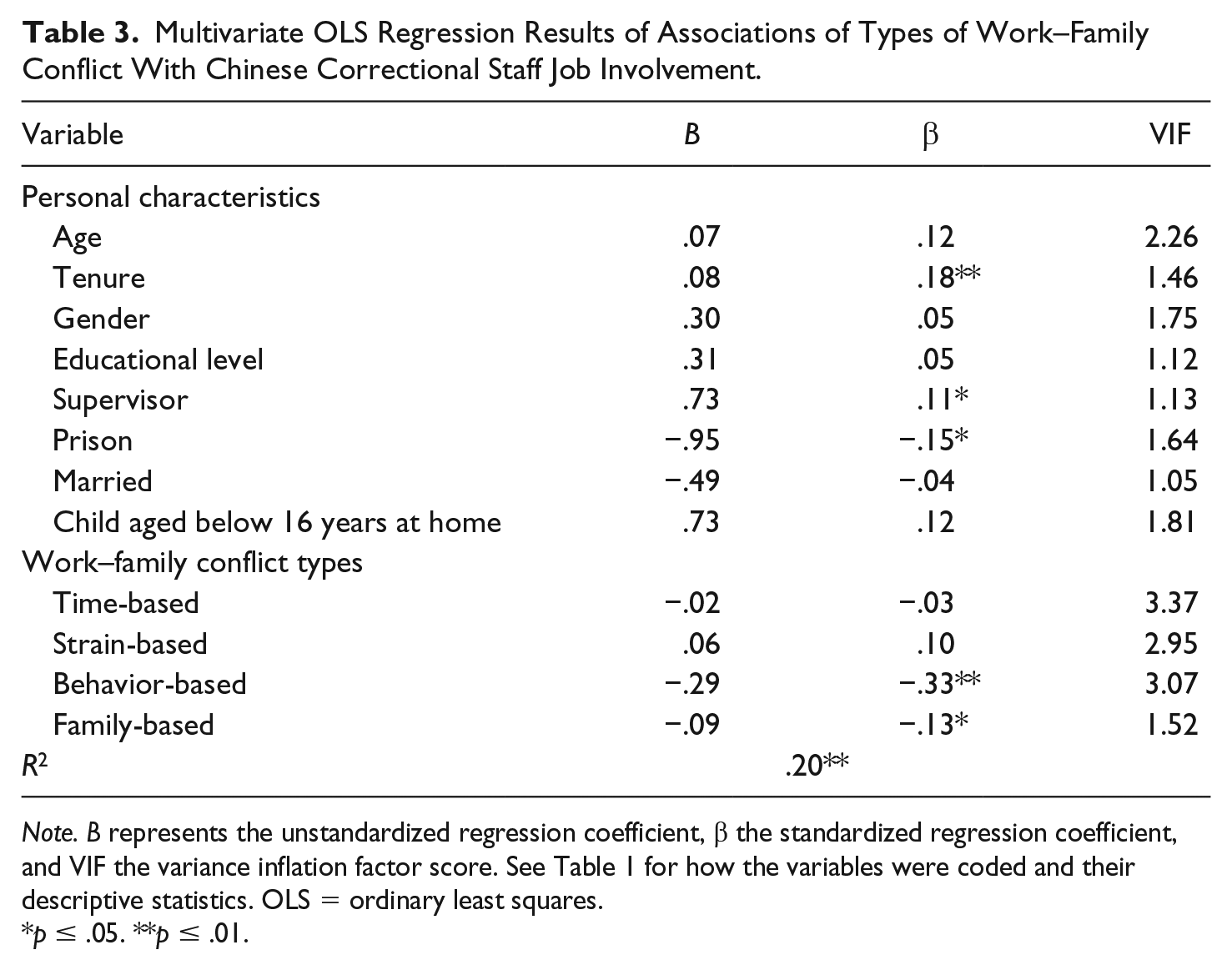
Note. B represents the unstandardized regression coefficient, β the standardized regression coefficient, and VIF the variance inflation factor score. See Table 1 for how the variables were coded and their descriptive statistics. OLS = ordinary least squares.
p ≤ .05. **p ≤ .01.
The R2 value for the OLS regression equation for job involvement was .20, which means the independent variables as a group explained approximately 20% of the observed variable of the job involvement index. Tenure, supervisor status, prison, and behavior-based and family-on-work conflicts each had significant associations with the dependent variable. Increases in tenure were associated with greater involvement. Supervisors generally had higher job involvement than nonsupervisory staff. Again, staff at the second prison generally reported greater involvement as compared with their counterparts at the first prison. Increases in behavior-based and family-on-work conflicts were associated with lower job involvement. Age, gender, educational level, marital status, having children at home, and time-based and strain-based conflicts each had nonsignificant associations with the dependent variable.
Discussion and Conclusion
Overall, the current results provide support for the postulation that work–family conflict has a negative association with the job involvement of the surveyed Chinese correctional staff. The relationship of the specific types of this domain conflict, however, did differ. Of the four hypotheses, only two, namely, Hypotheses 3 and 4, were supported.
As predicted, job involvement was negatively associated with behavior-based conflict. Behavior-based conflict occurs when unsuitable work role behaviors are brought home and subsequently perceived by family members as negative or incompatible, resulting in work-on-family conflict (Greenhaus et al., 2001). This could be the result of culture forces in China. In Chinese culture, there is heightened concern about face (mianzi), most closely defined as “dignity” or “prestige.” In the West, this is commonly referred to as “saving face.” Mianzi is an important concept in Chinese culture (Buckley et al., 2006). “As part of their collectivistic culture, Chinese people are attuned to how others view them in order to gain mianzi” (Lin et al., 2019, p. 5). Mianzi is considered a significant concept that influences individuals’ social life in China (Zhang, 2016). One of the worst things that can happen in Chinese culture is to lose face. A. H. Liu et al. (2014) suggested that “keeping face” in Chinese culture is more about understanding and meeting the expectations of significant others rather than satisfying one’s own wants and desires, as is found in some Western nations. Keeping face both at work and home is important (Choi, 2008). Both work and family are critical domains in Chinese culture. If a staff member loses face with others, it causes his or her other family members to also lose face. Thus, when work role behaviors (e.g., aggressive, controlling, or demanding behavior) spill over into the family domain (e.g., openly criticizing, challenging, or disagreeing with a family member), the result can be losing face, which can generate considerable stress and conflict. In turn, job involvement can be negatively affected. Loss of face because of behavior-based conflict could be seen as a moral failure because the staff member has a responsibility to balance different roles in life. According to L. H. Yang and Kleinman (2008), this can result in “social death” (disgrace), which, in the end, reduces the level of involvement in the job (Zuo & Bian, 2001). Choi (2008) noted that losing mianzi hurts a Chinese person’s self-image and often results in criticism from others for failure to meet role demands, resulting in higher life stress. Probably, this stress detracts from the job, resulting in a lower connection with the job. As such, culture may play a role in the association or lack of association between different types of work–family conflict and job involvement. The idea that mianzi plays a role in why behavior-based conflict is negatively related to job involvement among the surveyed Chinese correctional staff is an untested postulation. Future research needs to explore why behavior-based conflict has a negative association with job involvement and whether and how mianzi plays a role. In addition, research in Western cultures is needed to determine whether behavior-based conflict has a negative relationship with job involvement or not. If it does not, but is found by other studies that it does in China, this would support the explanation that mianzi helps to explain this association.
In addition, as predicted, family-on-work conflict had a significant negative association with job involvement. It appears that when problems and conflict at home spilled over into the work environment, the job involvement of the surveyed Chinese prison staff suffered. This makes sense, as it would seem that one’s attachment to work would probably weaken when one is facing conflict and problems at home. For people to be fully immersed in their work, they need a clear mind, not a mind filled with stressful thoughts about unresolved conflicts at home. The strain of work–family conflict can negatively affect a worker’s attention and concentration, resulting in poor job performance, which can stress the worker even further. In addition, workers typically experience less control over home-on-work conflict than the control they perceive regarding time-based or strain-based conflicts. Workers can readily make adjustments for family activities disrupted by work schedules and participate in various management strategies for work-related stress; however, it is typically more difficult for workers to control the feelings and behavior of their spouses, in-laws, parents, children, and adolescents. The less control people perceive over their life circumstances, the more strain they tend to experience. The more strain they experience, the more negatively their job involvement is affected. In addition, unique forces in Chinese culture may explain why family-based conflict had a significant negative association with job involvement in the current study. Mianzi could have played a role. Having family problems that spill over to work may have resulted in a loss of face at work, causing greater stress and strain for the person. This increased stress for a person could result in a reduced connection with the job. In addition, the concepts of renqing (relational obligation) and huibao (reciprocity and reciprocation) may have also played a role (Lin et al., 2019). In China, people are expected to engage in balanced giving and receiving, especially for those important in their lives. As noted above, both home and work are important domains in Chinese culture. If home life is in conflict, renqing and huibao could result in undue distraction for a staff member at work, which could reduce the level of involvement in the job. As with behavior-based conflict, this explanation for the negative relationship between family-based conflict and job involvement is untested. Future studies need to examine why family-based conflict is negatively associated with job involvement and whether this relationship varies between nations. As previously noted, Chinese culture has unique social forces and expectations not found in many other cultures.
It is also possible that behavior-based and family-based conflicts can lead to a negative view of the organization and erode one’s level of job involvement (Hogan et al., 2006; Lambert et al., 2006). In other words, correctional staff experiencing family-on-work conflict and/or behavior-based conflict may blame the organization for their stress, which can harm the staff member’s connection or positive view of his or her job and weaken job involvement. It is also possible that high levels of job involvement may help mitigate a staff member’s perceptions of family-on-work conflict at first but, over time, the employee’s level of job involvement may lessen as strain and conflict at home take their toll.
Interestingly, neither time-based conflict nor strain-based conflict had significant associations with job involvement for these correctional staff. One possible explanation for this finding is that both, in fact, are significant predictors of job involvement but were not so in this study because of random error. We suspect, however, that another explanation is more likely. We believe that behavior-based conflict and family-on-work conflict may create considerably more strain for these Chinese correctional employees than time-based and strain-based conflicts. Before being hired, correctional workers and their families generally understand that there will be strict work schedules and possible mandatory overtime that will probably interfere with family functions and responsibilities. Their awareness, acceptance of expected inconvenience, and the adjustments that families make to minimize its impact can minimize strain.
Furthermore, several researchers have posited that the Chinese culture of collectivism encourages Chinese workers to labor predominantly for the welfare of the family (N. Yang et al., 2000). For most Chinese workers, the family is considered to be the root of life. Thus, for these workers, work is seen as a way to promote the overall benefit of family or to strengthen the root (N. Yang et al., 2000). According to Chinese culture, workers and their families tend to perceive work as adding value or benefit to the family (Redding, 1993). Thus, Chinese family members tend to perceive work as a means of improving the family’s economic welfare and social status, and, therefore, view the value or benefits of large workloads and demanding work schedules to exceed the downsides of missed family activities and less personal time with family members (N. Yang et al., 2000). On the contrary, viewed from an economic perspective, several researchers (Lu et al., 2006) contended that the Chinese workers are expected to put their jobs before their families because hard work is seen as necessary for maintaining and/or improving the family’s standard of living. Aryee et al. (1999) posited that self-interest and economic gains are evaluated at the family group level in China rather than at the individual level. Chinese people regard work as a way of fulfilling family responsibilities and, therefore, emphasize work success because work is instrumental in establishing the family’s economic well-being (Aryee et al., 1999). Western workers, on the contrary, tend to have a more individualistic view of work, seeing it more as a means of career enhancement than a means of family welfare improvement; therefore, when work interests interfere with family interests, family members are more likely to support the individual’s work priority behaviors.
As with many studies, the current study has limitations. It was a single study of staff at two Chinese prisons located in the Guangdong province. The current findings may be situational and contextual, varying across different Chinese prisons and countries. Staff at other Chinese prisons need to be surveyed to determine whether the results can be replicated. Similarly, staff at prisons in other nations need to be studied. To date, our study is only the second to look at the connection of work–family conflict and job involvement among correctional staff. There are far too few empirical findings to conclude how the work–family conflict and job involvement associate with one another among correctional staff, and there are insufficient findings to determine whether the associations of the types of work–family conflict with job involvement are universal or vary across different types of correctional institutions. Our cross-sectional research design does not allow for the demonstration of causality. This is a shortcoming. While based on the postulation that work–family conflict is an antecedent of job involvement, the opposite is possible. For example, high job involvement could result in family-based conflict because the person is focused on the job and not the home domain. To demonstrate causality between the variables empirically, a longitudinal design is required. In addition, a longitudinal design would allow exploration of how the different types of work–family conflict are related to one another. In the current study, the four types of work–family conflict were treated as correlated but not causally related variables. It is possible that one type of domain spillover increases the level of another type. For example, behavior-based conflict could raise the level of family-based conflict, with inappropriate work roles causing problems with home roles. As indicated in Table 2, there is a positive correlation of .56 (p ≤ .01) between these two variables. Similarly, time-based conflict and behavior-based conflict may be contributing to strain-based conflict. Between being at work too much or having schedules that conflict with home needs may result in greater strain-based conflict. Job roles may result in arguments and problems for a person, resulting in greater strain-based conflict. As indicated in Table 2, the correlation between time-based conflict and strain-based conflict was .71 (p ≤ .01) and the correlation between behavior-based conflict and strain-based conflict was .69 (p ≤ .01). Future longitudinal research will be able to determine how work–family conflict is related to job involvement and how the different types of domain spillover are associated with one another.
Future research should measure the involvement and the four types of domain spillover indexes with more items. We used three or four items to measure these latent concepts because of limitations on the number of items that could be on the survey. Similarly, more items should be used to measure job involvement, which was measured using three items. In addition, some of the items used to measure job involvement, such as “I live, eat, and breathe my job” from Kanungo (1982b), may be viewed as extreme measures of job involvement. There are other measures for job involvement, such as the one from Paullay et al. (1994), which measures the importance of the job to a person. Research using different items to measure job involvement will give a clearer picture of this concept and how it is related to work–family conflict. In addition, efforts should be made to increase Cronbach’s alpha value of job involvement. Furthermore, only about 20% of the variance in the job involvement index was accounted for in the OLS multivariate regression equation, which means that other variables help shape the dependent variable. These variables need to be identified and tested. Research is needed to identify potential causes for work–family conflict so that effective interventions can be put into place. After being instituted, the interventions to reduce or help staff deal with work–family conflict positively need to be evaluated. Finally, future studies should explore the associations of domain conflict with other work areas, such as job burnout, absenteeism, turnover intent/turnover, work performance, work engagement, life satisfaction, and organizational citizenship behaviors not only among Chinese correctional staff but also staff working in correctional institutions across the planet. This research will add to the literature by providing a better understanding of how work–family conflict affects correctional staff.
In closing, correctional staff are an imperative resource for correctional facilities, including those in China. Work and home are two important domains for staff. While ideally there is balance between these domains, this is not the case for all staff. For some, there is spillover between the domains, resulting in work–family conflict. There are different types of work–family conflict. The current study examined the relationships of time-based, strain-based, behavior-based, and family-based conflicts with the job involvement among staff at two prisons in the Guangdong province of China. OLS multivariate regression analysis found that behavior-based conflict and family-based conflict had negative associations with job involvement. The results indicated that correctional administrators need to be aware of the issue of work–family conflict and explore possible ways to reduce it. There is a need for more studies on work–family conflict for correctional staff, not only in China, but across the world. At the very least, we hope the current study will spur more interest and research on the subject of work–family conflict among correctional staff. With research, work–family conflict can be combatted effectively.
Footnotes
Acknowledgements
The authors thank the reviewers and editorial staff for their comments. The authors also thank Janet Lambert for proofreading this paper.
Authors’ Note
The authors Jianhong Liu and Eric Lambert worked equally on this article and are listed in random order.
Declaration of Conflicting Interests
The author(s) declared no potential conflicts of interest with respect to the research, authorship, and/or publication of this article.
Funding
The author(s) received no financial support for the research, authorship, and/or publication of this article.
