




Abstract
Research on the forgiveness of self has largely focused on less severe, more common types of offenses among samples within developed westernized nations. In this brief report of a study within a developing nation in Africa, applications of self-forgiveness are extended to incarcerated people. The sample comprised N = 310 males (83.87%) and females (16.13%) who were incarcerated in a medium-security Ghanaian prison (Mage = 39.35, SDage = 13.28). Participants completed measures of self-forgiveness, shame-proneness, and guilt-proneness. Prison records were examined for criminal history details. We hypothesized that self-forgiveness would correlate negatively with shame-proneness and positively with guilt-proneness. We tentatively hypothesized that this association would be moderated by offense type. Self-forgiveness correlated with both shame- and guilt-proneness in the hypothesized direction. However, neither association was moderated by type of offense. The findings offer further evidence on the salience of self-conscious emotions in forgiving oneself, particularly among incarcerated offender populations. We discuss the implications of the findings for enhancing offender rehabilitation initiatives.
Many people who are convicted of crimes experience guilt or shame (Van Gelder et al., 2015). Some develop a guilt- or shame-prone disposition. Shame and guilt represent self-conscious emotions that can be evoked by self-evaluation in response to perceived wrongdoing (Tangney & Tracy, 2012) or by self-reflection. Shame often involves negative, self-denigrating evaluation of the global self after wrongdoing, though shame can also be a response to negative self-evaluation from reflecting on oneself relative to an ideal or standard. Guilt refers to negative evaluation of one’s behavior (Dempsey, 2017). Most research on shame and guilt has focused on samples from general and university populations, although some studies of people who have offended exist. Similar to non-incarcerated samples, evidence from incarcerated individuals indicates shame and guilt have distinct associations with key outcome variables (Vanhooren et al., 2017). Specifically, guilt, as opposed to shame, has consistently been linked to favorable psychosocial outcomes (e.g., anger-control, acceptance of blame, concern for others) in samples of incarcerated individuals (e.g., Tangney, Stuewig, Mashek, & Hastings, 2011; Wright et al., 2008). In addition, shame and guilt (and their dispositional counterparts of shame- and guilt-proneness) have been related to recidivism (Tangney et al., 2014). Self-forgiveness might also be related to recidivism through its effect on shame- and guilt-proneness.
Despite evidence to suggest that shame and guilt are influenced by culture (Goetz & Keltner, 2007), shame and guilt experiences of incarcerated populations have been examined almost exclusively in western contexts that are guided by individualistic principles (e.g., Tangney, Stuewig, Mashek, & Hastings, 2011; Tangney & Tracy, 2012; Vanhooren et al., 2017). Compared with individualistic cultures in which shame is typically experienced as a negative event, collectivistic cultures can value shame as a positive human experience (Sheik, 2014), or at least see shame as a motivation to improve one’s behavior. Many African cultures, including Ghana, are guided by collectivistic principles that emphasize relational interdependency. It is likely that normative beliefs about guilt and shame in Ghana shape how individuals experience these emotions. Ghanaians usually experience shame negatively, but shame also reflects on one’s family or identity group. Thus, shame might function as a motivator that spurs people to correct aberrant behavior.
Guilt-prone people who have been released after incarceration have been found to be less likely to re-offend. Shame-prone people might or might not be likely to re-offend. Tangney et al. (2014) found that shame-proneness positively predicted recidivism through externalization of blame. There was also a direct effect of shame on recidivism. When defensive externalization of blame was low, shame inhibited recidivism. Tangney et al. (2014) suggest that the pain of shame may have two faces—one with destructive potential and the other with constructive potential.
Acknowledging one’s role in an offense can elicit emotional distress (e.g., guilt, shame). This is particularly true because people often feel defensive when they admit to blame (Gottman, 1993). Forgiving oneself is one of many ways people may cope with offense-related distress and reduce defensiveness of shameful or guilty acts (Woodyatt & Wenzel, 2013). Self-forgiveness involves restoring one’s moral standing through responsible behavior (e.g., accepting responsibility, attempting to make amends) and restoring one’s emotional equanimity by letting go of negative self-condemning emotions and motivations (Griffin et al., 2018; Wenzel et al., 2012). Thus, there are two fundamental processes (i.e., value reorientation and esteem restoration) that are considered essential to forgiving oneself (Griffin et al., 2015). Self-forgiveness has been conceptualized as a generalized response tendency to offenses (i.e., dispositional self-forgiveness) and a response to a specific offense (i.e., state self-forgiveness), with evidence that supports both state (e.g., Griffin et al., 2018) and dispositional theorizations of self-forgiveness (e.g., Thompson et al., 2005).
Although high externalization of blame does not necessarily imply low self-blame, this is often the case (Mueller et al., 2015). Thus, we might suspect that self-forgiveness is a mediator between shame-proneness (and possibly guilt-proneness) and recidivism. However, the relationship, if fully understood, would be complex because a person might be high or low in externalization of blame, and high or low in self-blame (which suggests that he or she might cope by either forgiving themselves or letting themselves off of the hook). Before the complexity of these relationships can be investigated, however, more basic relationships must be studied—namely, the associations of shame- and guilt-proneness with self-forgiveness.
In the present brief report, we take that first step. We also consider the putative relations of shame- and guilt-proneness with self-forgiveness in a collectivistic culture. This addresses a missing part of the literature—what occurs in prisons in collectivistic cultures. The relationships are complicated because collectivism, of course, is multi-faceted. Some collectivism is highly concerned with forgiveness as a way to maintain collective relationships (for a review, see Sandage et al., 2020). Thus, when forgiveness is seen as a pathway to restoration of relationships, wrongdoers are more likely to apologize, make amends, and offer restitution. All of these lead to more genuine self-forgiveness (see Wenzel et al., 2012).
Other collectivism is concerned more with maintaining group solidarity through forbearance—simply not responding to provocations for the sake of group harmony (for a review, see Ho, 2020). In collectivistic cultures that advocate forbearance, anger can fester even though civil behavior prevails (see Adams, 2005). To maintain group harmony, a wrongdoer is not likely to be censured for wrongful behavior. Shame might be lower in such cultures because blame is low (Stuewig et al., 2010). Genuine self-forgiveness is neither highly motivated nor encouraged, and the social consequences of letting oneself off of the hook for an offense are low.
Some collectivistic cultures rely on restoring group solidarity by seeking to regain honor after an offense is deemed to violate honor. Restoration of honor is sought through justice-oriented or vigilante-justice-oriented acts such as honor killings (Nisbett & Cohen, 1996). Wrongdoers in honor cultures often expect reprisal, which can inhibit self-forgiveness because anticipation of reprisal is not conducive to making oneself vulnerable. In those instances, letting oneself off of the hook for an offense is more likely.
According to The World Factbook (Central Intelligence Agency, 2017), Ghana is among the highest ranked Christian cultures. Approximately 72% of its adults self-identify as Christians. Christians have been found to highly value and practice forgiveness (Rye et al., 2000). Ghanaian culture is also highly collectivistic (LeFebvre & Franke, 2013). Thus, Ghana has a type of collectivism that relies on forgiveness as a major motive for maintaining collective relationships. Forgiveness is often applied to oneself when one does wrong due to perceiving that one has been forgiven by God or those one has harmed (see Hall & Fincham, 2005)—both of which are highly likely in Ghana’s Christian-influenced culture. Thus, we might expect associations between self-forgiveness and other justice-relevant variables, such as shame- and guilt-proneness, will be enhanced in Ghana relative to what has been found in western contexts.
The Present Study
Evidence suggests that self-forgiveness is most often negatively associated with shame and positively associated with guilt (e.g., Carpenter et al., 2016; Griffin et al., 2016). As Tangney et al. (2014) found, shame-proneness is positively associated with recidivism through externalization of blame except when the person is able to overcome defensive externalization of blame, which we have hypothesized can be done through genuine self-forgiveness. Studies that have examined shame-proneness and self-forgiveness have largely been conducted with non-incarcerated samples in western, principally individualistic cultural settings. Thus, the relevance of such findings to non-western contexts (i.e., Africa) remains unknown (Worthington & Cowden, 2017; Worthington et al., 2020). Drawing on this prior research—even though it is not culturally congruent with Ghana—we posed two primary hypotheses. In Hypothesis 1, we expected shame-proneness to associate negatively with self-forgiveness (i.e., Griffin et al., 2016) given the self-depreciative experience of shame. We expected this to maintain after controlling for sex and age. In Hypothesis 2, we expected guilt-proneness to associate positively with self-forgiveness, given its function as an other-oriented reparative response to wrongdoing (and to maintain after controls). We posed one tentative, exploratory hypothesis that has not previously been investigated. We hypothesized that offense type (i.e., against person vs. against property) would moderate the relations between guilt-proneness and self-forgiveness, but not between shame-proneness and self-forgiveness. Specifically, we expected that the positive association between guilt-proneness and self-forgiveness would be stronger among incarcerated individuals who had committed crimes against persons.
Method
Participants
The sample comprised N = 310 incarcerated males (83.87%) and females (16.13%) from a medium-security prison in Ghana. The participants ranged from 18 to 83 years of age (Mage = 39.35, SDage = 13.28) and identified themselves as Christian (82.58%), Muslim (12.90%), and “other” (e.g., Buddhist, 2.26%; unspecified, 2.26%). Almost all of the participants were first-time offenders (96.45%), with current sentence lengths ranging from 2 weeks to multiple life sentences (unspecified, 1.29%). The participants were serving sentences for offenses against persons (59.03%), against property (38.39%), and against public order (.32%). Offenses that could not be categorized or were captured by other statutes outside the Criminal and Other Offences Act, 1960, Act 29 (as amended), were grouped as “other” (2.26%).
Measures
Self-forgiveness
The tendency to self-forgive was measured using the respective subscale from the Heartland Forgiveness Scale (HFS; Thompson et al., 2005). The self-forgiveness subscale consists of six items (e.g., “Learning from my mistakes helps me get over them”), each of which are rated on a 7-point response scale anchored at 1 (almost always false of me) and 7 (almost always true of me). Thompson et al. (2005) provided evidence in support of the construct validity of the HFS subscales. Three-week temporal stability was r = .72 and alphas ranged from .72 to .76 (Thompson et al., 2005). In the current study, omega total (ωt) for the self-forgiveness subscale of the HFS was .65.
Shame- and guilt-proneness
Participants completed the shame and guilt items on Test of Self-Conscious Affect—Socially Deviant Version (TOSCA-SD; Hanson & Tangney, 1996). Participants read 13 scenarios (e.g., “You break something at a restaurant and then hide it”) and rated the extent to which their response to each scenario would be accompanied by guilt (e.g., “You would think, this is making me anxious. I need to fix it or talk to the manager”) and shame (e.g., “You would leave as quickly as you can”) using a 5-point response format (1 = not at all likely; 5 = very likely). The TOSCA-SD possesses similar psychometrics to the community-based measures (i.e., TOSCA-3, TOSCA-A) that have preceded it (Hanson & Tangney, 1996). Tangney, Stuewig, Mashek, & Hastings (2011) reported alpha values of .80 and .71 for the guilt-proneness and shame-proneness subscales of the TOSCA-SD, respectively. In the current sample, the estimated internal consistency of scores on both subscales was ωt = .73.
Procedure
Written permission from a medium-security prison was obtained and ethical clearance granted by the Ethics Committee for the Humanities at the University of Ghana (ECH 026/16-17). After obtaining written permission to collect data from a medium-security prison comprising incarcerated males and females, correctional facility wardens notified incarcerated individuals about the study. Individuals who expressed an interest in partaking in the study were screened for eligibility by a research assistant. Those who were currently on remand, seeking psychiatric treatment, or were otherwise incompetent to provide informed consent (n = 7) were excluded from study participation. Individuals who agreed to participate offered their verbal informed consent and completed a survey battery that was administered uniformly across participants. Sociodemographic items were completed first, followed by the shame- and guilt-proneness items of the TOSCA-SD and the self-forgiveness subscale of the HFS. The survey was administered in a quiet and comfortable location to groups consisting of approximately 50 individuals. With participants’ consent, incarceration and criminal history details were extracted from institutional records. The final sample represents 8.38% of the 3,103 males and 83.33% of the 60 females who were incarcerated at the correctional facility during the time of data collection. Participants were compensated with $5 of commissary funding.
Data Analyses
All statistical computations were performed using R (R Core Team, 2019). The variables were initially examined for missing values and gross outliers. Internal consistency was estimated using omega total (ωt). Assumptions were evaluated prior to inferential analyses. There was an array of offenses reported as the basis for incarceration, which were categorized into crimes against persons, property, or neither (i.e., public order and “other” crimes). Given the few cases in this third group (n = 8), only the crimes against persons or property were included in the analyses.
The Pearson and point-biserial correlations were used to estimate relations among self-forgiveness, guilt- and shame-proneness, age, sex, length of incarceration, and type of offense. A moderated multiple regression analysis was performed with self-forgiveness as the criterion variable and interaction effects specified between offense type and the mean-centered shame- and guilt-proneness variables. A Type I error rate of .05 was applied to all inferential analyses.
Results
Data screening revealed several missing values on selected biographical items; none of the measures contained missing values. We proceeded with all analyses using a pairwise deletion approach. Descriptive statistics, internal consistency estimates, and bivariate analyses are reported in Table 1.
Descriptive Statistics, Internal Consistency Estimates, and Bivariate Associations Among Study Variables.
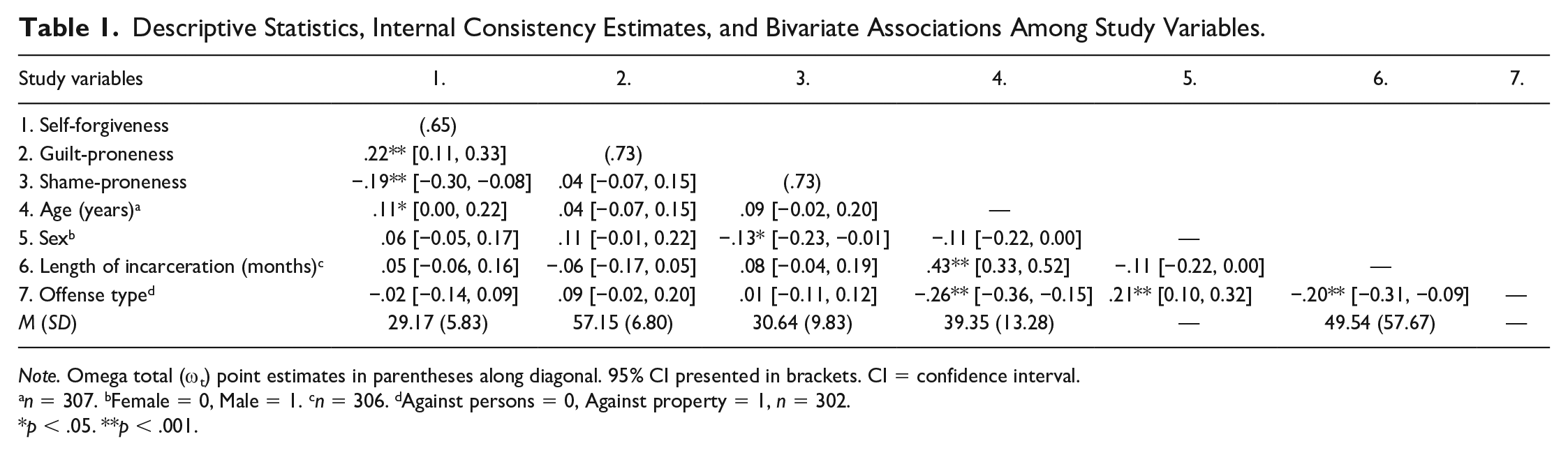
Note. Omega total (ωt) point estimates in parentheses along diagonal. 95% CI presented in brackets. CI = confidence interval.
n = 307. bFemale = 0, Male = 1. cn = 306. dAgainst persons = 0, Against property = 1, n = 302.
p < .05. **p < .001.
As hypothesized, self-forgiveness associated positively with guilt-proneness and negatively with shame-proneness. Age associated positively with self-forgiveness. Shame-proneness was higher among females. Both age and sex were included as control variables in the multiple regression analysis.
Results of the moderated multiple regression analysis are reported in Table 2. Consistent with the bivariate analyses, age, shame-proneness, and guilt-proneness were associated with self-forgiveness. Type of offense did not moderate the associations of shame- or guilt-proneness with self-forgiveness.
Unstandardized and Standardized Parameter Estimates for Moderated Multiple Regression Analysis.

Note. CI = confidence interval.
Reference category = Female. bReference category = Against person.
p < .05. **p < .001.
Discussion
These findings are among the first obtained from a sample of incarcerated individuals living in a cultural context oriented by collectivistic principles. This study offers insight into the role of shame- and guilt-proneness in the self-forgiveness process in non-western cultures. However, the findings are also consistent with those found among western samples (e.g., Carpenter et al., 2016; Griffin et al., 2016), indicating similarities in the way shame and guilt relate to self-forgiveness across cultures.
There was no evidence to support offense type as a moderator of relations between guilt- and shame-proneness and self-forgiveness. Although there was no prior research or theory to justify a hypothesis, the result for guilt-proneness was contrary to our expectation. That result suggested that offenses against persons (compared with those against property) do not elicit a stronger positive association between guilt-proneness and self-forgiveness.
In planning future studies, some evidence suggests there may be several alternative factors beyond offense type that are involved in moderating relations of shame and guilt with self-forgiveness. For instance, Kovács et al. (2019) recently found no differences in shame and guilt between incarcerated individuals based on offense type (i.e., violent vs. nonviolent), but those with a family history of incarceration reported lower scores on each criterion variable compared with those who did not. However, at this point, moderating effects of criminal history and other criminological constructs (e.g., psychopathy) on associations of shame and guilt with self-forgiveness in incarcerated samples have not been tested.
Other possible factors that could affect associations of shame- and guilt-proneness with self-forgiveness relate to the consequences, not the type, of offense. Offenses are inextricably linked to consequences, and repercussions associated with offenses often influence offenders’ decisional and emotional responses. The consequences attached to more mundane offenses that do not result in incarceration may vary considerably depending on contextual factors (e.g., whether an apology was offered), but the primary consequence associated with incarcerated individuals’ offenses (i.e., imprisonment) is consistent across all types of offenses.
The consequences of offenses that require incarceration (relative to those that do not require incarceration) may alter the strength of how shame- and guilt-proneness relate to self-forgiveness for several reasons. First, with incarceration, there is probably more self-condemnation to forgive. Thus, higher levels of self-forgiveness are necessary for offenders to reach a net positive valence toward the self. Second, incarceration also creates a time of enforced self-reflection and self-evaluation, which might result in more shame and less self-forgiveness (Kovács et al., 2019). Third, when incarceration does not occur, the offender is more likely to come into additional contact with the victim. Offender–victim contact increases opportunities for offenders to engage in conciliatory behavior (e.g., apologize), which has been found to promote self-forgiveness (Wenzel et al., 2012).
Practical Implications
Our findings have implications for offender rehabilitation. Incarcerated individuals need support to confront the guilt and shame that come with incarceration. They need help with taking appropriate responsibility for their offense, processing emotional distress (e.g., guilt, shame), and engaging in reparative behaviors (Fisher & Exline, 2010; Woodyatt & Wenzel, 2013). Teaching incarcerated individuals to develop empathy, take personal responsibility for their actions, and gain a sense of control can help transform the maladaptive prospects of shame into the possibility of personal growth (Fisher & Exline, 2010). Such efforts are likely to enhance incarcerated individuals’ experiencing of “shame-free” guilt (Tangney et al., 2014), and many of these processes reflect fundamental steps in progressing toward self-forgiveness (see Griffin et al., 2018; Wenzel et al., 2012).
Restorative justice programs, victim-offender mediation, and community services can afford incarcerated individuals opportunities to reflect on their offenses, understand the impact of their behavior on victims, and engage in prosocial behaviors (Armour & Umbreit, 2005; Tangney, Stuewig, & Hafez, 2011). In Ghana, offender rehabilitation programs focus narrowly on education and skills training (Antwi, 2016), and there is a need for rehabilitation efforts to emphasize holistic personal development by integrating initiatives that promote emotional and psychological growth. With the emergence of interventions designed to promote self-forgiveness (e.g., Griffin et al., 2015), such approaches may facilitate adaptive processing of offense-related emotional distress (e.g., guilt, shame), motivate amends-making, and restore positive self-regard among incarcerated individuals. Griffin et al. (2015) recently found evidence supporting the efficacy of a do-it-yourself workbook approach to promote self-forgiveness. The workbook is freely available and can be easily accessed without the need for technological resources (e.g., computer, internet), which is attractive to and suitable for correctional settings. Although it is necessary to examine the efficacy of this self-forgiveness workbook approach for use with incarcerated individuals, the cost-effective approach has the potential to enhance rehabilitation efforts in correctional settings within low-resource countries such as Ghana.
Limitations and Future Research Directions
Although this study makes a modest contribution to the global literature on the associations of self-conscious emotions with self-forgiveness among incarcerated individuals, to our knowledge, it is the first investigation into the concept of self-forgiveness in Ghana. As such, it opens potential doors for promoting offender rehabilitation. Despite the merits of this study, the methodological approach we employed had some limitations. First, use of a cross-sectional design precludes conclusions from being made about the temporal order of relations among the variables. Longitudinal approaches are needed to examine the role of self-forgiveness in long-term behavior change (Wohl et al., 2017), including key markers of successful rehabilitation (e.g., recidivism). Second, we measured all primary study variables as generalized tendencies across situations (i.e., dispositions) rather than in response to a specific offense (i.e., states). Thus, caution should be applied when generalizing the findings to specific offenses, particularly those for which offense-related characteristics (e.g., victim–offender closeness) are more salient. Third, the findings should be considered alongside the measures that were used to assess self-forgiveness, guilt-proneness, and shame-proneness, which were developed and applied in western contexts. To ensure measurement equivalence across cultures, psychometric evaluations are needed to assess the cross-cultural utility of the measures included in this study within Ghana and other countries in Africa. Fourth, the sample of males represented <10% of males incarcerated at the correctional facility, potentially affecting the results and their interpretation.
Conclusion
The findings of this study extend current evidence on the role of self-conscious emotions in the process of self-forgiveness for a sub-population whose offenses have been severe enough to justify criminal convictions and incarceration. While the other-oriented reparative emotion of guilt is linked to higher levels of self-forgiveness, the self-denigrating experience of shame is associated with lower self-forgiveness. Considering that a majority of self-forgiveness research has focused on general populations from highly industrialized western nations, this study furthers intellectual understanding of self-forgiveness to non-western populations.
Footnotes
Declaration of Conflicting Interests
The author(s) declared no potential conflicts of interest with respect to the research, authorship, and/or publication of this article.
Funding
The author(s) disclosed receipt of the following financial support for the research, authorship, and/or publication of this article: Data collection for this study was supported by the Templeton World Charity Foundation (grant no. TWCF0101/AB66). The opinions expressed in this publication are those of the authors and do not necessarily reflect the reviews of the Templeton World Charity Foundation.
Ethical Approval
All procedures performed in studies involving human participants were in accordance with the ethical standards of the institutional and/or national research committee and with the 1964 Helsinki declaration and its later amendments or comparable ethical standards.
Informed Consent
Informed consent was obtained from all individual participants included in the study.
