



Abstract
This article examines the applicability of general strain theory to correctional samples by testing whether prison strains are positively related to deviance among prisoners through strain-associated negative emotions and whether the negative emotions-deviance relationship is systematic in terms of inner versus outer directedness. Latent-variable structural equation modeling was applied to analyze survey data from 986 male prisoners in South Korea. First, an inmate’s dissatisfaction with correctional officers was found to be positively related to anger and fear of victimization, whereas in-prison victimization was related only to the fear. Second, outer-directed emotion (anger) was positively related to outer-directed deviance (aggressive and property misconduct and anticipated reoffending) but not to inner-directed deviance (self-injury/suicide attempt). On the contrary, inner-directed emotion (fear) was related positively to the inner-directed deviance but inversely to property misconduct. Finally, some of the indirect relationships of victimization and dissatisfaction with deviance via negative emotions were found to be significant.
Keywords
Introduction
While Agnew’s (1992) general strain theory (GST) has been empirically established as a leading theory of micro-criminology; its empirical support derives mostly from research based on adolescent and young adult samples from the general population (Agnew, 2006b). Despite an increase in GST research, relatively lacking has been the application of GST to the criminal justice system. This is unfortunate since individuals encountering the criminal justice system regularly experience severe forms of strain and thus are at risk of engaging in deviant coping (DeLisi, 2011). One obvious example is prisoners who live in a “total institution” (Goffman, 1961), where they experience the “pains of imprisonment” (Sykes, 1958) and are likely to react to prison strain by committing infractions, whether outer-directed (e.g., violence) or inner-directed (e.g., suicide) (Blevins et al., 2010), which have costly consequences (Tewksbury et al., 2014; Torrey et al., 2010).
Prior research has applied GST to examine relationships of pre-prison and post-prison as well as in-prison strains with infractions and reoffending among offenders incarcerated and those released from prison. However, the previous models often failed to include negative emotions, which GST posits mediate the relationship (e.g., Leban et al., 2016; Listwan et al., 2013; N. L. Piquero & Sealock, 2000). In addition, the models have rarely been tested using a latent-variable modeling approach, which is appropriate to estimate relationships among the key constructs of GST. To fill these gaps in GST research on correctional samples, this article tests whether relationships between in-prison strains (including experiencing victimization) and deviance (infractions and the self-reported probability of reoffending) are mediated by negative emotions (anger and fear of victimization) among prisoners. Also tested is whether the negative emotions-deviance relationship is systematic in terms of inner-versus outer-directedness. For these tests, this study analyzed survey data from a sample of male prisoners in South Korea.
This article begins with a brief discussion of GST as related to this study before reviewing prior research on the relationship between in-prison strain and infractions and recidivism among offenders and its explanations. Then hypotheses are introduced, followed by a description of the sample, measurement, and analytic strategy. After presenting empirical results, theoretical and practical implications of the findings as well as suggestions for future research are discussed.
General Strain Theory (GST)
Agnew’s (1992) GST consists of three key propositions: defining strain more broadly than classic strain theories (Cloward & Ohlin, 1960; Cohen, 1955; Merton, 1938), specifying how strain leads to crime, and explaining why only some individuals commit crime in reaction to strain. The theory suggests that a variety of “events or conditions … disliked by individuals” (Agnew, 2006b, p. 4)—that is, failure to achieve goals, loss of positive stimuli, and presentation of negative stimuli—pressure the individuals to do something about them, which is likely to be crime when the strains are criminogenic and those individuals have criminal coping propensity and lack conventional coping skills (Agnew, 2001, 2013).
Specifically, most strains conducive to crime are seen as high in severity and magnitude (i.e., degree or size, duration, frequency, recency, and centrality) and unjust, are associated with low social control and create pressure or an incentive for criminal coping, whereas individuals most likely to cope with crime under the strain tend to have poor coping skills and resources, low levels of conventional social support and control, criminal association and beliefs, and exposure to criminogenic situations and opportunities (Agnew, 2006b). In addition, chronic and repeated strains contribute to negative emotional traits (Agnew, 2006b) or “negative emotionality” (Agnew et al., 2002), which DeLisi and Vaughn’s (2014) temperament-based theory posits explains not only antisocial behavior but also negative interactions with the criminal justice system, such as prison misconduct and recidivism (Baglivio et al., 2016).
For GST, the source of pressure for corrective action to take in response to strain is primarily strain-caused negative emotions, specifically, emotional states, while the theory also attributes the criminogenic effect of strain to factors of low social control and criminal learning. That is, crime is committed to alleviate strain-generated negative emotions as well as addressing strain itself (Agnew, 1992). Consistent with the proposed mediation of negative emotions between strain and crime, previous studies tend to find that negative emotions explain the effect of strain on crime and deviance (Agnew, 2006b; Bunch et al., 2018; Jang & Rhodes, 2012; Oh & Connolly, 2019; Walters & Espelage, 2017).
In GST, negative emotions refer to unpleasant feelings or mood (Mirowsky & Ross, 2017). Although anger is emphasized as the most critical emotional reaction to strain in relation to crime, particularly, violence, strain also generates other emotions, such as feelings of depression (e.g., sad, lonely, and suicidal) and anxiety (e.g., worried, tense, and fearful). A conceptual distinction between the former and the latter emotions can be made based on Solomon’s (1993) dimension of outer- or other-versus inner- or self-directedness. That is, anger is outer-directed in that it typically refers to an externalizing emotion unless it is specified as being toward the self (i.e., self-hostility), and the feelings of depression and anxiety are internalizing emotions and thus inner-directed. Agnew (1992:59) proposed that outer-directed emotions are more likely to result in externalizing, outer-directed (e.g., interpersonal aggression) than internalizing, inner-directed deviance (e.g., suicide), whereas inner-directed emotions are more likely to lead to inner- than outer-directed deviance. Prior research provides empirical support for this proposition (Agnew, 2006b; Jang, 2007; Jang & Lyons, 2006).
During its first decade, GST received support from studies using data collected in the United States, but subsequent support came from research based on non-U.S. data from Canada, European nations, and Asian countries as well (e.g., Agnew, 2015; Bao et al., 2004; Baron, 2004; Botchkovar et al., 2013; Froggio & Agnew, 2007; Jang & Song, 2015; Maxwell, 2001; Moon & Morash, 2017; Oh & Connolly, 2019; Sigfusdottir et al., 2004). Findings based on non-U.S. data tend to be consistent with the GST propositions about the positive relationships among the three key constructs (strain, negative emotions, and crime) and the mediation of outer- and inner-directed emotions between strain and crime, while some differential patterns were observed due likely to sociocultural differences between Asian and western countries (e.g., Moon et al., 2008). 1 Despite these differences, findings from non-U.S. samples tend to validate the generality of GST (Agnew, 2015).
The generality of GST has also been tested using data from various samples in terms of age, sex, race/ethnicity, and criminality, although they were drawn more often from a general rather than institutionalized population. While recognizing the diversity of data sources used by GST research, DeLisi (2011) called for the application of GST to the criminal justice system. Since this call, there has been an increase in research on GST’s applicability to the justice system based on samples of not only law enforcement and correctional officers but also prison inmates.
GST Research on Prison Inmates
Imprisonment is strain primarily as “the removal of positive stimuli” and “the presentation of noxious stimuli” (Agnew, 1992), which Sykes (1958) detailed in terms of five “pains of imprisonment.” 2 Prisoners are stripped of supports taken for granted in the outside world and thus lose their sense of self-worth as a result of a series of degradations of self in the “total institution” (Goffman, 1961). They are also exposed to negative and dangerous conditions and incidences, such as overcrowding and violent victimization, as well as negative relations with others, whether correctional officers or other prisoners. These strains cause both inner- (e.g., anxiety) and outer-directed negative emotions (e.g., anger), which in turn may lead to the deviant coping of infractions, inner- (e.g., self-injury and suicide) and outer-directed (e.g., violence and theft), as prisoners tend to lack prosocial coping skills. Thus, GST offers a theoretical framework to explain infractions among prisoners (Blevins et al., 2010).
While researchers have examined the effect of pre-prison or post-prison strains (e.g., childhood physical/sexual abuse) on deviance and found empirical support for GST (e.g., Sharp et al., 2012), this literature review focuses primarily on prior research on in-prison strain. Previous studies provide empirical evidence of the applicability of GST to the explanation of infractions, examining a variety of strains in prison. For example, it has been found that physical health, spatial distance from home, and poor and dangerous conditions of prison (e.g., poor physical conditions, overcrowding, high-security facility, and exposure to gang members) were positively related to infractions including violence (Bierie, 2012; Grosholz & Semenza, 2018; Lindsey et al., 2017; Morris et al., 2012; Steiner & Wooldredge, 2009). However, the strain of serving life-without-parole was not necessarily more severe than that of serving life-eligible-for-parole in terms of the potential outcome of infractions (Sorensen & Reidy, 2019).
Criminal victimization is one of the most criminogenic strains (Agnew, 2006), and prior research has examined different types of in-prison victimization in relation to infractions: experienced, vicarious, and anticipated (Agnew, 2002) as well as verbal, property, violent, and sexual victimization (O’Donnell & Edgar, 1998). For instance, Day et al. (2015) found that their measure of “coercive prison environment,” which included experiences with property and violent victimization in prison, was positively related to various infractions including violent misconduct. Similarly, based on a large sample of inmates in state prisons, Toman (2019) reports that those who experienced victimization were more likely to commit both violent and non-violent misconduct than their peers who did not experience victimization. In addition, Leban et al.’s (2016) qualitative study of inmate reactions to verbal, property, and physical victimization revealed that in-prison victimization was likely to lead to physical retaliation.
In-prison victimization has also been found to be positively related to not only in-prison but also post-prison deviance. For example, Boxer et al. (2009) found that ex-prisoners who witnessed or experienced violence in state prison or county jail were more likely to show antisocial behavioral propensity than those who did not. Similarly, McGrath et al. (2012) reported that experiencing and witnessing physical victimization in prison increased the likelihood of engaging in violence and using alcohol or drugs among adult parolees (see also Zweig et al., 2015). Daquin et al. (2016) also found that witnessing victimization in prison, particularly, property (theft) and sexual victimization was positively related to parole violation and post-release arrest although experienced victimization was not. In addition, Listwan et al.’s (2013) study of ex-prisoners revealed that anticipated as well as experienced victimization in prison predicted post-release arrest and reincarceration, while negative relations with correctional officers did not.
Unlike prison strain, emotional consequences of strain and their relationships with behavioral outcomes have not often been studied, while a few exceptions tend to provide some support for GST. Boxer et al. (2009) found ex-prisoners who witnessed or experienced violence in prison reported higher levels of postprison emotional distress (including anxiety and depression) and antisocial behavior than those who did not, although they failed to examine the relationship between the emotional and behavioral consequences of in-prison victimization. Hochstetler et al. (2010) also studied ex-prisoners and found their perceived strain in prison, including noise and fear of violence in prison, to be positively related to post-prison hostility (e.g., having urges to beat, injure, or harm someone or to break or smash things) among “low support” parolees (whose social support from friends and family were below average), though not among “high support” parolees.
Two other studies provide some evidence of negative emotions’ mediation between in-prison victimization and violence and drug/alcohol use. Although they did not focus on the mediation, McGrath et al.’s (2012) analysis of retrospective data from parolees showed that the positive relationship between in-prison victimization and violent behavior in prison became nonsignificant (experienced victimization) or reduced in size (vicarious victimization) when negative emotionality (trait anger) was controlled for, which implied the negative affect’s mediation of the strain-violence relationship. A similar pattern was observed when drug/alcohol use in prison was examined. Next, based on four-wave panel data from offenders interviewed before release from prison and three times afterwards in 12 states, Zweig et al. (2015) found offenders who were physically assaulted or threatened tended to show negative emotional reactions to the experienced victimization, which in turn increased the probability of violent crime and substance use after release. Specifically, overall findings indicated the effects of in-prison victimization on violent crime, and drug use after release were partly mediated by post-prison hostility and depression.
Finally, according to Beijersbergen et al.’s (2015) study, though it did not examine in-prison victimization, inmates who perceived to be treated unfairly and inhumanely and had negative relationships with correctional officers were more likely to commit prison misconduct than those who did not, using latent-variable structural equation modeling to analyze two-wave panel data. It was also found that the strain effect was fully mediated by inmates’ situational anger (i.e., resentment and irritation experienced when they thought about the way they were treated by correctional authorities), although it was not tested whether the mediation was significant.
In sum, although the number of GST studies on prison strain has increased over the past 10 years, research on the effect of in-prison victimization on negative emotions and infractions among prisoners is limited. Particularly understudied is whether negative emotions mediate the effect of prison strain on infractions. While there is some indication of an indirect effect of in-prison victimization on infractions and offending after release from prison (McGrath et al., 2012; Zweig et al., 2015), the statistical significance of mediation has rarely been tested.
The Present Study
To address these issues, this study examines whether an inmate’s in-prison strain is positively associated with negative emotions, which are in turn positively related to deviance. Prison strain is measured by an unpleasant condition in prison (cell overcrowding), negative relations with others (dissatisfaction with correctional officers), and victimization experienced in prison. On the other hand, negative emotions and deviance are operationalized in terms of inner-directed (fear of victimization and self-injury/suicide attempt) versus outer-directed type (anger and prison misconduct and anticipated reoffending after release) because the negative emotions-deviance relationship of the same directedness tends to be more likely than that of its opposite counterpart (Jang & Johnson, 2003).
Fear is an inner-directed emotion because feeling afraid and worried is indicative of being anxious (Mirowsky & Ross, 2017), whereas anger is outer-directed because this study measures it in terms of losing one’s temper (see below), which typically refers to becoming very angry toward other people rather than the self. Fear has not been examined as often as anger in GST research (Agnew, 2006a) until recently (Archer, 2019; Keith, 2018; May et al., 2015; Steele, 2016) but is relevant to deviance, especially, inner-directed, such as self-injury and suicide attempt, which are often intended to temporarily alleviate intense negative emotions, like fear and depression (Klonsky & Muehlenkamp, 2007; Valois et al., 2015). While fear of victimization as well as anger is an anticipated emotional reaction to experienced victimization, it is also expected in response to signs and perceptions of low security in prison (i.e., overcrowding and a lack of trust of correctional officers in securing order in prison), which increases the risk of victimization.
The above relationships are empirically examined by testing the following hypotheses.
Methods
Data
To test the hypotheses, survey data were drawn from a study of prisoners in South Korea (Yoon, 2015), conducted by the Department of Correctional Studies at Kyonggi University between July and August of 2009 with the approval of the institutional review board (IRB) of the Korea Correctional Services, Ministry of Justice, as well as Kyonggi University IRB (Reyns et al., 2018). As of 2008, there were 49 correctional facilities in the Asian country, and, excluding detention centers, juvenile institutions, and female prisons, 31 of them were male prisons (Yoon, 2011), which the study focused on. For two-stage purposive sampling, first, 20 (64.5%) of the 31 prisons were chosen based on three characteristics—region (four regions of Seoul, Daejeon, Daegu, and Kwangju), type of prison (first-time vs. repeated offender prison), 3 and prison size (i.e., prisoner population)—so diverse prisons could be included in the study. Second, all prisoners who had served their time for at least 1 year were eligible for the study, and 60 inmates were randomly selected from larger prisons (i.e., those with 1,000 or more prisoners) and 40 from smaller prisons (i.e., those with less than 1,000 prisoners) (Reyns et al., 2018). Inmates who signed a consent form participated in self-administered survey, written in Korean, in group. The final sample consisted of 986 adult male inmates.
Measurement
Prison strain was measured in terms of prison overcrowding, victimization, and dissatisfaction with correctional officers. First, an inmate’s perception of cell overcrowding was measured by a single item asking, “Considering the size of your cell, what do you think of the number of inmates?” (1 = totally acceptable, 2 = acceptable, 3 = many, 4 = too many). Second, victimization was measured by using 15 items, which asked an inmate how many times other inmates did any of listed things—which varied in seriousness from calling names to theft, sexual assault, and physical violence toward him—during 12 months prior to the survey (0 = never, 1 = 1–2 times, 2 = 3–5 times, 3 = 6–9 times, 4 = 10 or more times). Confirmatory factor analysis (CFA) was conducted to estimate a single-factor model, and the items had high loadings, ranging from .524 to .812, and high inter-item reliability (α = .880) as reported in Appendix A. 4 Third, dissatisfaction with correctional officers was measured by five items about inmate’s negative perceptions and relations with the officers, like a lack of trust or discriminatory treatment (see Appendix A). CFA showed that the items were all loaded on a single factor with high loadings, ranging from .504 to .792, and high internal reliability (α = .805).
The inner-directed emotion of fear of victimization was measured by five items about the extent of an inmate being afraid that other inmates hit or harass, sexually assault, and bully him as well as spreading bad rumors about him and stealing his items by force. Exploratory factor analysis (EFA) generated a single-factor solution, where the items had high loadings, ranging from .731 to .857, and high inter-item reliability of .894. For outer-directed emotion, a single item of trait anger (“I lose my temper easily”; 1 = strongly disagree, 2 = disagree, 3 = agree, 4 = strongly agree) was used as a proxy measure of state anger under the assumption that inmates who were high on the score of trait anger were more likely to have angry emotional reaction to prison strain than those low on the score (Agnew, 2006b).
Inner-directed deviant coping was measured by two items asking about how many times an inmate engaged in self-injury/suicide attempt in the past 12 months prior to the survey (0 = never, 1 = 1–2 times, 2 = 3–5 times, 3 = 6–9 times, 4 = 10 or more times), which had a high inter-item reliability (α = .833). Two measures of outer-directed prison misconduct were created separately for interpersonal aggression and property-related misconduct, regardless of whether they were disciplined or not. Specifically, aggressive misconduct was measured by five items asking inmates how many times they engaged in verbal and physical aggression against other inmates and correctional officers in the past 12 months prior to the survey (0 = never, 1 = 1–2 times, 2 = 3–5 times, 3 = 6–9 times, 4 = 10 or more times), whereas property misconduct was measured by six items related to theft, contraband, vandalism, and gambling. Separate EFA showed the five and six items of misconduct were loaded on a single factor with loadings higher than .400, and they had a good internal reliability (α = .738 for both). Another measure of outer-directed deviance was based on a single item asking inmates about the probability of reoffending after release from prison (1 = very high, 2 = high, 3 = low, 4 = very low; reverse coded).
Sociodemographic and justice system-related variables were included as controls in the analysis. The former variables were an inmate’s age, highest education achieved (1 = elementary school, 2 = middle school, 3 = high school, 4 = undergraduate, 5 = graduate; all whether graduated or not), and pre-prison employment status (0 = employed, whether full-time, part-time, or working as a day laborer, 1 = unemployed) and average monthly income (1 = less than $500, 2 = $500 or more but less than $1,000, 3 = $1,000 or more but less than $2,000, 4 = $2,000 or more but less than $3,000, 5 = $3,000 or more). In addition, dummy variables were created to measure inmate’s marital status (married, divorced, and cohabitation prior to incarceration, and widowed with single being the reference category), whether he had any children (0 = no, 1 = yes), and religion (Protestant, Catholic, Buddhist, and other religion, including Confucianism, Anglicanism, Islam, and others with no religion being the omitted category). The justice system-related variables included age when inmate was taken into custody for the first time (onset of custody), number of prior incarceration, security risk classification (1–4 being Classes 1–4 with Class 1 being the lowest level of risk), length of sentence (in months), current offense (dummy variables of property offense, drug offense, and other offense with violent offense being the reference category), and whether the inmate had participated or was participating in educational and/or vocational program at the time of survey (0 = no, 1 = yes). 5
Analytic Strategy
To test the hypotheses, this study applied a latent-variable structural equation modeling approach, which has not often been used in GST research. Latent-variable modeling is appropriate because the key concepts of GST are latent construct and thus not observable. It also allows this study to control for measurement errors which generates more valid and reliable results than what manifest-variable modeling would produce and to directly test the statistical significance of the hypothesized mediation, while holding constant associations among mediators via residual correlations. For model estimation, this study employed Mplus 8 (L. K. Muthén & Muthén, 2017) that incorporates B. O. Muthén’s (1983) “general structural equation model” and full information maximum likelihood (FIML) estimation. As variables were measured by ordered categorical (e.g., victimization) and continuous variables (e.g., age), the method of MLR, which generates the “maximum likelihood parameter estimates with standard errors … that are robust to non-normality and nonindependence of observations” (L. K. Muthén & Muthén, 2017, p. 668). Finally, FIML was employed to treat missing data, which tends to produce unbiased estimates, like multiple imputations (Baraldi & Enders, 2010; Graham, 2009).
Besides the χ2 statistic, three types of model fit index are reported: incremental (CFI: Comparative Fit Index), absolute (SRMR: standardized root mean squared residual), and parsimonious fit index (RMSEA: root mean square error of approximation). A model was determined to have a good fit to data if one of two Hu and Bentler’s (1999) joint criteria was met: specifically, (CFI ≥ .950 and SRMR ≤ .080) or (SRMR ≤ .080 and RMSEA ≤ .060). For statistical significance (α = .05), while conducting two-tailed test, this study also used one-tailed test for the hypothesized relationships since their directions are a priori known.
Results
Table 1 shows the descriptive statistics of variables used in analysis. For example, on average, the survey respondents were about 39 years old with the youngest and the oldest being 19 and 74, respectively, and had less-than-high-school education (2.847) and monthly income between $1,000 and $2,000 before they were arrested (3.314). In addition, 20.8% of them were unemployed at the time of arrest. The inmates’ average level of security risk fell between Classes 2 and 3 (2.789) with inmates of all four levels participating in the study (6.1% Class 1, 22.5% Class 2, 57.7% Class 3, and 13.6% Class 4; not shown in Table 1), and their average length of sentence was about 5 years and 4 months (64.215 months). In addition, the age of onset of custody ranged from 12 to 20, and inmates had been incarcerated, on average, about three times (2.778) prior to the current imprisonment.
Descriptive Statistics of Variables Used in Analysis (n = 986).
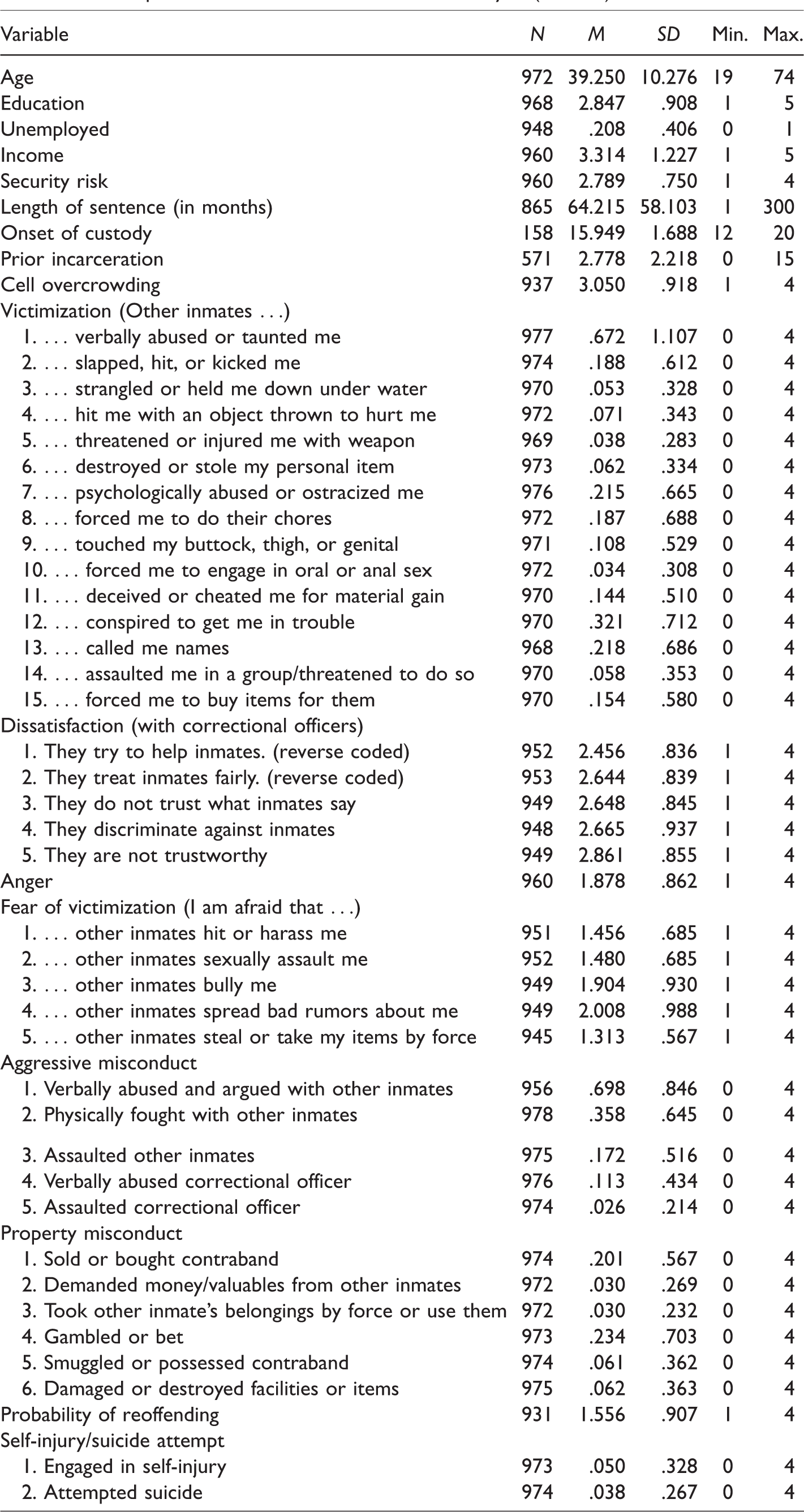
While not presented in Table 1, 40.2% of participating inmates reported that they had children, whereas about half (47.8%) indicated they were single with the other half being married (21.2%), divorced (19.0%), cohabiting before incarceration (8.7%), or widowed (3.3%). Almost 90% (87.8%) of the inmates identified with a religion, specifically, with Christianity (59.1%; 42.9% Protestant, and 16.2% Catholic), Buddhism (26.0%), and other religion (2.8%), while about 1 out of 10 inmates had no religion (12.2%). In addition, more than half of them (55.6%) were incarcerated for a violent offense (27.0% property offense, 4.6% drug offense, and 12.7% other offense), and about a quarter of the sample had participated or were participating in educational (26.5%) and vocational program (25.8%) at the time of survey.
A structural model was estimated twice, first including aggressive misconduct for the outer-directed deviance of prison misconduct and then replacing it with property misconduct. Table 2 presents results from estimating the model including aggressive misconduct (standardized coefficients and their standard error in parenthesis). The model was found to have good fit, meeting one of the two joint criteria (i.e., RMSEA = .045 < .060 and SRMR = .055 < .080). Thus, the results are acceptable for hypothesis testing. Estimated measurement models showed all indicators of each latent factor had high loadings (.500 or higher), consistent with the results from EFA and CFA (see Appendix B).
Estimated Model of Aggressive Misconduct, Probability of Reoffending, and Self-Injury/Suicide Attempt Among Korean Prison Inmates (n = 986).
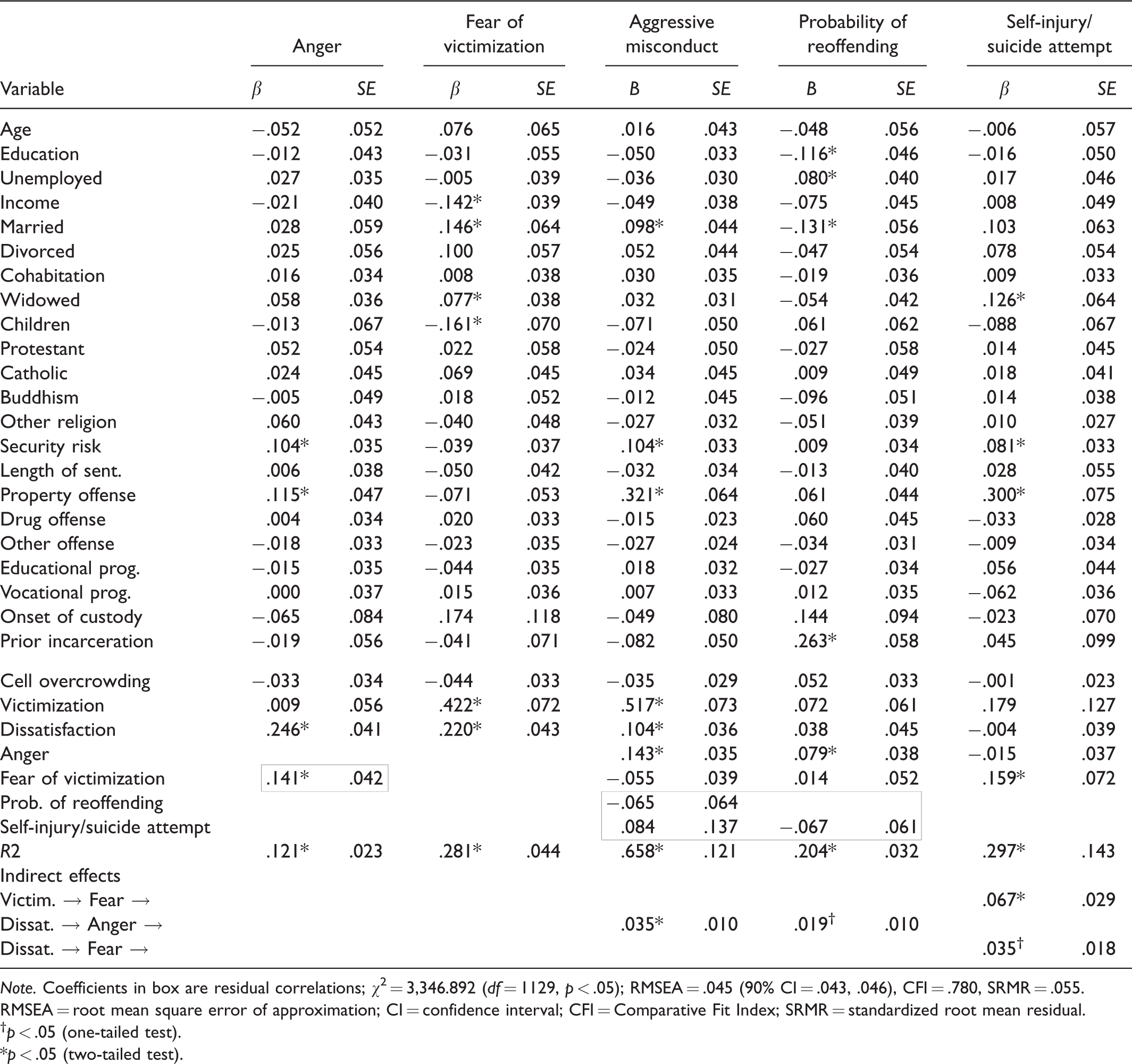
Note. Coefficients in box are residual correlations; χ2 = 3,346.892 (df = 1129, p < .05); RMSEA = .045 (90% CI = .043, .046); CFI = .780; SRMR = .055.RMSEA = root mean square error of approximation; CI = confidence interval; CFI = Comparative Fit Index; SRMR = standardized root mean residual.
†p < .05 (one-tailed test).
*p < .05 (two-tailed test).
As hypothesized, inmate’s dissatisfaction with correctional officers was positively related to both measures of negative emotion—anger (.246) and fear of victimization (.220), whereas victimization was related only to fear of victimization (.422). However, the perception of cell overcrowding was not related to either emotion. Thus, Hypothesis 1a received partial support. It was also observed that two strain variables, victimization and dissatisfaction, were directly related to aggressive misconduct (.517 and .104, respectively). This finding indicates the strain effects on misconduct were not fully mediated by negative emotions included in the model.
Hypothesis 1b also received partial support as anger was significantly related to aggressive misconduct (.143) and the self-reported probability of reoffending (.079) in the expected direction, though not to self-injury/suicide attempt (−.015, p > .05), whereas fear of victimization was positively associated only with self-injury/suicide attempt (.159). These results also provide support for Hypothesis 2 as negative emotions–deviance relationships of the same directedness were found to be significant, while those of its opposite counterpart were not. 6
Results from testing Hypothesis 1c (presented in the bottom panel of Table 2) showed all four indirect relationships between strain and deviance, which consisted of both significant strain–mediator and mediator–deviance relationships, were statistically significant: victimization → fear of victimization → self-injury/suicide attempt (.067), dissatisfaction → anger → aggressive misconduct (.035), dissatisfaction → anger → probability of reoffending (.019), and dissatisfaction → fear of victimization → self-injury/suicide attempt (.035). In sum, Hypothesis 1c received partial support.
To highlight some of the significant findings about controls, ceteris paribus, inmates of high socioeconomic status (SES) were less likely to say they would commit crime again after release from prison (education, −.116; unemployed, .080) and to have fear of victimization (income, −.142) compared to those of low SES. Other things being equal, married and widowed inmates were more likely to be afraid of victimization (.146 and .077) than singles, whereas participants who had children were less likely to report fear of victimization (−.161) than those who did not have children. Next, inmates of high-security risk were more likely to report that they had engaged in not only aggressive misconduct (.104) but also self-injury/suicide attempt in the last 12 months prior to the survey (.081) than those of low security risk, and the number of incarceration prior to the current one was positively related to an inmate’s self-reported probability of reoffending after release from prison (.263). However, an inmate’s religious affiliation, program participation, and age of onset of custody were not related to any endogenous variables.
The structural model was estimated again after replacing aggressive misconduct with property misconduct, and the model still had good fit (i.e., RMSEA = .043 < .060 and SRMR = .052 < .080). The results, presented in Table 3, remained generally the same with respect to hypothesized relationships, though we found some differences in other relationships. First, unlike its relationship with interpersonal aggression, an inmate’s dissatisfaction with correctional officers was not directly related to property misconduct (−.003, p > .05), while it still had significant indirect relationship with the misconduct via anger (.024) as it did with aggressive misconduct (.035; see Table 2). In addition, the perception of cell overcrowding was positively related to the probability of reoffending (.055), whereas victimization was related directly to self-injury/suicide attempt (.347) as well as reoffending (.114), although both strains were not associated with either deviance in the aggressive misconduct model.
Estimated Model of Property Misconduct, Probability of Reoffending, and Self-injury/Suicide Attempt Among Korean Prison Inmates (n = 986).

Note. Coefficients in box are residual correlations; χ2 = 3,305.962 (df = 1185, p < .05); RMSEA = .043 (90% CI = .041, .044); CFI = .783; SRMR = .052). RMSEA = root mean square error of approximation; CI = confidence interval; CFI = Comparative Fit Index; SRMR = standardized root mean squared residual.
p < .05 (one-tailed test).
*p < .05 (two-tailed test).
Second, fear of victimization, which was not related to aggressive misconduct, was found to have an inverse relationship with property misconduct (−.094). 7 As a result, indirect relationships, which victimization and dissatisfaction had with property misconduct via fear of victimization, were found significant (−.036 and −.020). Third, it is worth noting that the indirect relationship between dissatisfaction and self-injury/suicide attempt via fear of victimization (which was significant in the aggressive misconduct model) was not significant despite the fact that the strain–mediator (.216) and mediator–deviance relationships (.128) were both significant. 8 This finding illustrates the importance of testing statistical significance of indirect relationships rather than simply presuming its significance based on whether its constituent relationships are significant or not.
In sum, as far as hypothesized relationships were concerned, the level of support (or lack thereof) for Hypotheses 1 and 2 based on results from the property misconduct model was about the same as that based on results from the aggressive misconduct model. 9
Discussion
The purpose of this study was to “examine the applicability of GST to criminal justice system outcomes and correctional samples” (DeLisi, 2011, p. 174) by testing whether prison strains were positively related to deviance among prisoners partly through strain-associated negative emotions based on survey data collected from male prisoners in South Korea. Despite a recent increase in the number of GST studies on prisoners, research testing the key proposition of GST regarding negative emotions’ mediation between in-prison strain and deviance has been scant. In addition, latent-variable modeling has not often been applied to GST research on prison inmates. To fill these gaps in prior research on GST, this study examined whether an inmate’s perceived cell overcrowding, experienced victimization, and negative relations with correctional officers were positively related to anger and fear of victimization, expected to be positively associated with misconduct and self-injury/suicide attempt in prison and anticipated reoffending after release from prison; and, if so, whether the indirect relationships between prison strains and deviance were statistically significant. It was also tested whether the negative emotions–deviance relationship was systematic in terms of inner-versus outer-directedness, which has rarely been examined using correctional samples.
Overall findings provide partial support for the applicability of GST to a correctional sample in a non-U.S. context. That is, as expected, South Korean male prisoners who had negative relations with correctional officers and experienced victimization in prison tended to report higher levels of anger and fear of victimization than those who did not. The negative emotions were in turn related to deviance in prison. Specifically, the outer-directed emotion (anger) was positively related to outer-directed deviance (aggressive and property misconduct and anticipated reoffending after release from prison) but not to inner-directed deviance (self-injury/suicide attempt). On the contrary, the inner-directed emotion (fear of victimization) was positively related to the inner-directed deviance, as hypothesized, but inversely to one of two measures of prison misconduct (i.e., property misconduct). These results are consistent with previous findings based on samples of the general population in the United States (Agnew, 2006b; Jang, 2007). In addition, this study found that some of the indirect relationships between prison strains and deviance were significant based on statistical test of mediation, which previous studies testing GST based on correctional samples often failed to conduct.
Among the three measures of prison strain, dissatisfaction with correctional officers was more likely to be positively related to negative emotions and deviance than the other two including victimization, which has been found to be one of the most criminogenic strains (Agnew, 2006b). Particularly, the positive relationship between dissatisfaction with correctional officers and fear of victimization is worth noting as it indicates that inmates who think of officers as unfair and untrustworthy and thus were likely to perceive them to be incapable of keeping prison in order, tended to be afraid of victimization. The positive relationship between disorder and fear of victimization has been found by research on social disorganization and community disorder (Markowitz et al., 2001; Ross & Jang, 2000; Skogan, 1992). Thus, improving inmates’ relations with correctional officers is important to reduce fear of victimization among prisoners just as positive relationship between police officers and neighborhood residents via community policing has shown to decrease fear of crime (Weisburd & Eck, 2004). Enhancing the relationship between inmates and correctional officers is also likely to increase prison security given that dissatisfaction with correctional officers was found to increase the likelihood of misconduct in prison. Furthermore, high-quality dual-role (custodial and treatment) relationships between inmates and correctional officers are likely to contribute to offender rehabilitation (Cullen et al., 2014).
On the contrary, although an inmate’s perception of cell overcrowding was found to be directly associated with the probability of reoffending in the property misconduct model, it was not related to infractions, whether inner-directed or outer-directed. While not supportive of this study’s hypothesis, the observed non-significant relationship might indicate that prison overcrowding is unlikely to have an impact on inmate behavior unless it is related to a decrease in prison security (Franklin et al., 2006).
It is necessary to acknowledge key limitations of this study. First, the causal direction of all hypothesized relationships could not be established due to the use of cross-sectional data. For example, the current measures of perceived overcrowding and dissatisfaction with correctional officers were used to explain the previous measure of prison misconduct and self-injury/suicide attempt, while the causal order of strain–reoffending relationship was justified because a future measure of deviance (i.e., the self-reported probability of reoffending after release from prison) was predicted by the previous and current measures of prison strains. The causal ordering between victimization and misconduct (both previous measures) was based on Agnew’s (1992) argument about the largely contemporaneous effect of strain on crime but is indeterminate. Thus, future research needs to replicate this study using longitudinal data.
Second, this study was based on data collected from male inmates, so the present findings are related only to one gender group. Therefore, it remains to be seen whether generally the same would be found with data from female inmates. For example, while in-prison victimization was found to be quite prevalent among male and female inmates with similar rates (e.g., Wolff & Shi, 2009), emotional and behavioral reactions to victimization might differ between males and females. Specifically, compared to men, women are more likely to experience inner- (e.g., depression) as well as outer-directed emotions (anger) and thus engage in inner-directed coping behavior, like self-injury (Broidy & Agnew, 1997; Jang, 2007), which future researchers should examine. Third, another limitation concerns the use of self-reported data on infractions and reoffending since self-reported data are susceptible to response bias (e.g., social desirability). However, criminologists generally find self-reported measures have random rather than systematic measurement errors (Farrington et al., 1996; A. R. Piquero et al., 2002) and tend to be “acceptably valid and reliable for most research purposes” (Thornberry & Krohn, 2000, p. 33). Nonetheless, future research needs to cross-validate the present model using alternative measures, like official data or observer ratings (Serin et al., 2013). Fourth, readers need to be reminded that this study analyzed data from a non-representative sample of prison inmates in South Korea, so the results should be interpreted with caution given their limited generalizability.
Finally, although fear of victimization was measured as negative emotional state, which the concept of negative emotion means in GST, this study could not operationalize anger to be state anger, instead, measuring it with an item of trait anger, due to data constraints. While it was plausible to assume that inmates high on trait anger were more likely to have experienced state anger in reaction to past strains in prison than those low on trait anger (e.g., Stephens et al., 2016), using a proxy measure of state anger is a methodological limitation of this study. Stated differently, the finding of trait anger being positively related to prison misconduct is consistent with DeLisi and Vaughn’s (2014) temperament-based theory positing that negative emotionality explains negative interactions with the criminal justice system, such as infractions in prison.
In conclusion, despite these limitations, this study is believed to contribute to the GST literatures by examining a topic that has been understudied: testing the applicability of GST to correctional samples based on latent-variable modeling approach. Overall findings, including the statistically significant mediation of negative emotions between in-prison strain and deviance among inmates and the observed directedness of negative emotion–deviance relationship, tend to provide some support for the potential applicability of GST to individuals incarcerated in prison as well as a general population.
Footnotes
Declaration of Conflicting Interests
The author(s) declared no potential conflicts of interest with respect to the research, authorship, and/or publication of this article.
Funding
The author(s) received no financial support for the research, authorship, and/or publication of this article.
