



Abstract
Correctional staff are a necessary and valuable resource for correctional institutions, in both Western and Nonwestern nations; however, studies of correctional staff in Nonwestern nations, particularly those in Africa, are lacking. Improving the job satisfaction and organizational commitment of these staff are imperative, as both of these job attitudes have been linked to many salient beneficial outcomes. Most of the existing empirical research on correctional staff organizational justice explores only the effects of procedural and distributive justice and ignores interpersonal justice. Additionally, there has been little research on how procedural, distributive, and interpersonal justice affect correctional staff in Nonwestern correctional organizations. The current study explored the effects of all three forms of organizational justice on the job satisfaction and organizational commitment of staff at a medium security prison in southeast Nigeria. Based on Ordinary Least Squares (OLS) regression, all three forms of justice had significant positive effects on commitment. Procedural and interpersonal justice had positive effects on job satisfaction, while distributive justice had nonsignificant effects. Correctional administrators need to be aware the importance of procedural, distributive, and interpersonal justice and attempt to improve perceptions of these organizational justice variables.
Keywords
Crime occurs across the world. While different nations have different approaches to dealing with crime, virtually all use some type of correctional facility to deal with individuals who commit crimes. Ideally, these facilities are well run, with correctional staff carrying out a myriad of tasks and duties to ensure the prison operates as safe, secure, and humane place. Staff play a vital role in the successful (or unsuccessful) operation of correctional institutions. Not only do staff have an impact on correctional organizations, but organizations impact their staff. Empirical research has shown that workplace variables affect employees’ work attitudes of job satisfaction and organizational commitment (Elechi et al., 2018; Griffin & Hepburn, 2005; Lambert, 2003; Tewksbury & Higgins, 2006).
Job satisfaction refers to the degree people like or dislike their jobs (Spector, 1996), while organizational commitment refers to the bonds that staff members form with the organization (Allen & Meyer, 1990; Lambert et al., 2015). Job satisfaction and organizational commitment are important work attitudes for both staff and correctional organizations. Each has been reported to be associated with higher engagement in organizational citizenship behaviors (i.e., going beyond what is expected at work), improved work performance, higher support for treatment of inmates, greater compliance with rules, increased life satisfaction, lower absenteeism, reduced job burnout, lower turnover intent, and less voluntary turnover (Camp, 1994; Culliver et al., 1991; Hogan et al., 2013; Lambert, Edwards, et al., 2005; Lambert, Elechi, et al., 2019; Lambert, Hogan, & Griffin, 2008; Lambert, Hogan, et al., 2005; Leip & Stinchcomb, 2013; Matz et al., 2013; Stohr et al., 1992; Whitehead & Lindquist, 1986). These studies support the need to raise both the job satisfaction and organizational commitment of correctional staff in order to reduce turnover and improve performance. As such, research that explores how different workplace variables relate to these two concepts at different correctional institutions across the globe is needed.
The correctional work environment is complex and has many aspects. A growing body of studies has examined how different aspects of the workplace relate to correctional staff job satisfaction and organizational commitment; one promising workplace aspect is organizational justice, which empirical research has linked with correctional staff job satisfaction and organizational commitment (Boateng & Hsieh, 2019a; Lambert, 2003, 2008; Lambert & Hogan, 2009; Lambert et al., 2002; Lambert et al., 2007; Lambert, Hogan, & Jiang, 2008; Lambert, Keena, et al., 2020; Lambert et al., 2018). Organizational justice refers to the perception that the employing organization treats workers in a fair and just manner (Colquitt, 2001; Greenberg, 1990a, 1990b; Lambert et al., 2007). There are multiple dimensions of organizational justice, with the major ones being distributive justice, procedural justice, and interactional justice (Ahmed et al., 2018; Boateng & Hsieh, 2019b; Colquitt, 2001; Lambert, 2003; Wolfe & Piquero, 2011). Interactional justice has been further subdivided into the areas of informational justice and interpersonal justice (Colquitt, 2001; Colquitt et al., 2001; Cropanzano et al., 2007). The vast majority of the correctional staff research to date, however, has included only measures of distributive and procedural justice and excluded interpersonal justice (Boateng & Hsieh, 2019a; Lambert, 2003; Lambert et al., 2007, 2018; Lambert, Keena, et al., 2020). As noted by Boateng and Hsieh (2019a), the vast majority of correctional staff studies that have focused on the relationship of organizational justice with job satisfaction and organizational commitment have included measures of distributive and procedural justice but not interactional justice. In a study of Ghanaian correctional staff, Boateng and Hsieh (2019a) found that distributive and procedural justice (but not interactional justice) had positive effects on job satisfaction, and only procedural justice (but not distributive or interactional justice) had a significant positive association with organizational commitment. This was the only published study of correctional staff that examined distributive justice, procedural justice, and interactional justice. Our view is that there is a need for more research on how different forms of organizational justice affect correctional staff satisfaction and commitment.
Further, the vast majority of past correctional staff studies on organizational justice’s connection with job satisfaction and organizational commitment have surveyed Western (most commonly U.S.) correctional staff (Lambert, 2003, 2008; Lambert et al., 2002, 2007; Lambert & Hogan, 2009; Lambert, Hogan, & Jiang, 2008; Lambert, Keena, et al., 2020). There has been some research on the relationship between organizational justice and job satisfaction and commitment among correctional staff in Nonwestern nations, including those in Africa, but more is needed. The current study was undertaken because no previously published study could be located that specifically examined the association of distributive, procedural, and interpersonal justice with job satisfaction and organizational commitment among correctional staff in the Federal Republic of Nigeria (henceforth, Nigeria).
The current study adds to the literature in three ways. First, it tested whether the effects of distributive and procedural justice can be replicated. Replication of results across different correctional institutions and nations is important in determining whether relationships are universal or contextual. As noted by Lindsay and Ehrenberg (1993), “Replication is little discussed in the statistical literature nor practiced widely by statistically minded researchers. It is needed not merely to validate one’s findings, but more importantly, to establish the increasing range of radically different conditions under which the findings hold, and the predictable exceptions” (p. 217). Second, the current study added an understudied dimension of organizational justice – interpersonal justice. Third, the current study surveyed Nigerian staff. International studies can help narrow the gap between nations and build bridges so that information flows more freely (Cao & Cullen, 2001). As noted by Jowell (1998), “the importance and utility to social science of rigorous cross-national measures is incontestable. They help to reveal not only intriguing differences between countries and cultures, but also aspects of one’s own country and culture that would be difficult or impossible to detect from domestic data alone” (p. 168). Nigeria was chosen because it is a populous, growing, and important African nation. One out every six Africans is Nigerian. With a population of about 214 million, Nigeria is the sixth most populous nation in the world (World Factbook, 2020). Due to its economic resources and its population size, Nigeria has a significant influence on other African nations and the world (Bratton, 2004; Lambert et al., 2012).
Literature Review
Organizational Justice
Greenberg’s (1987) influential work on organization justice theory posited that an employee’s view of the fairness of the organization influences that employee’s attitudes and behaviors. Essentially, organizational justice refers to employees’ perceptions that the organization treats its employees in a fair and just manner (Greenberg, 1990a, 1990b; Lambert, 2003), and it is important for effective organizational operation (Colquitt & Greenberg, 2005). Cropanzano et al. (2007) wrote organizational justice “is the glue that allows people to work together effectively” (p. 34). Greenberg (1990b) maintained that perceptions of organizational justice are “a basic requirement for the effective functioning of organizations and the personal satisfaction of the individuals they employ” (p. 399). Skarlicki and Folger (1997) noted that “if organizational decisions and managerial actions are deemed unfair or unjust, the affected employees experience feelings of anger, outrage, and resentment” (p. 434). At the heart of organizational justice is the perception that outcomes are fair, processes are just, and employees are treated in a fair and just manner (Colquitt et al., 2001; Greenberg, 1990a, 1990b; Lambert, 2003). As indicated earlier, organizational justice is a multidimensional concept; it is comprised of the major dimensions of distributive, procedural, and interactional justice (Ahmed et al., 2018; Beugré & Baron, 2001; Colquitt et al., 2001; Lambert et al., 2007; Skarlicki & Folger, 1997).
Distributive justice refers to employee perceptions that salient outcomes are fair (Beugré & Baron, 2001; Colquitt & Greenberg, 2005; Lambert et al., 2007; Skarlicki & Folger, 1997). Important outcomes include pay, benefits, assignments, evaluations, promotions, and discipline (Greenberg, 1990a, 1990b; Lambert, 2003). Perceptions of this dimension of justice are based on equity, not equality (Colquitt et al., 2001; Greenberg, 1990a; Lambert, 2003). Under the equity exchange principle, employees evaluate how much they give to the organization compared to how much they receive from it, and they also compare to what others (with similar inputs and circumstances) give and receive, in order to decide whether or not the particular outcome is just (Colquitt, 2001; Cropanzano et al., 2007). Under the equality exchange principle, employees would receive a similar outcome, regardless of their inputs (Lambert, 2003).
Procedural justice refers to employee perceptions that the processes and procedures to reach distributive outcomes are fair and just (Beugré & Baron, 2001; Colquitt et al., 2001; Greenberg, 1990a, 1990b; Lambert et al., 2007). Processes and procedures need to be consistent, open, and fair; if not, they can be perceived as unfair (Lambert, 2003; Skarlicki & Folger, 1997; Taxman & Gordon, 2009). The process can be as important or even more important as the outcome itself (Cropanzano et al., 2007; Lambert et al., 2007). Landy et al. (1980) found that the perceived fairness of employee evaluation procedures was very important for employees – more important than whether the performance appraisal was negative or positive.
Interactional justice was originally defined as displaying social sensitivity in providing explanations for decisions, showing empathy, and treating employees with respect and dignity (Skarlicki & Folger, 1997). Beugré and Baron (2001) contended that interactional justice indicated to employees that they were valued and full members of the organization, while unfair treatment signaled the opposite. Later, interactional justice was split into the areas of informational justice and interpersonal justice (Colquitt, 2001; Colquitt et al., 2001; Cropanzano et al., 2007). Informational justice refers to the perceived degree that information and explanations are provided to explain procedures and decisions (Ellis et al., 2009). Informational justice also focuses on whether the information provided is perceived to be truthful (Cropanzano et al., 2007). Interpersonal justice refers to employees’ perceptions that the organization treats them with dignity and respect (Cropanzano et al., 2007). This concept primarily focuses on the way supervisors and administrators treat subordinates (Ahmed et al., 2018; Bies & Moag, 1986; Colquitt et al., 2001; Colquitt & Greenberg, 2005; Lambert, 2003). Being treated in a fair overall manner does not mean that there must always be agreement. What matters is that the disagreements are handled professionally, with dignity, and with respect (Krehbiel & Cropanzano, 2000). Basically, distributive justice deals with perceptions of the “ends,” procedural justice deals with perceptions of the “means,” and interactional justice deals with perceptions of the “hows” (Colquitt et al., 2001; Colquitt & Greenberg, 2005; Lambert, 2003).
Due to limited space on the survey instrument, the current study only included measures for distributive, procedural, and interpersonal justice. This is not to say that informational justice is not important. While it has never been directly tested among correctional staff, it is likely important and warrants study.
Job Satisfaction
Locke (1976) defined job satisfaction as “a pleasurable or positive emotional state resulting from the appraisal of one’s job or job experiences” (p. 1300). Hopkins (1983) defined job satisfaction as fulfillment or gratification derived from work. Muchinsky (1987) viewed job satisfaction as an emotional, affective response resulting from the extent to which a person derives pleasure from his or her job. Job satisfaction is basically an affective (i.e., emotional) feeling towards one’s overall job (Cranny et al., 1992). Job satisfaction deals with overall satisfaction from the job rather than from specific facets of the job (Camp, 1994; Lambert et al., 1999). As Spector (1996) noted, it is simply “the extent to which people like or dislike their jobs” (p. 216).
Organizational Commitment
Organizational commitment is the bond between an employee and the overall organization (Allen & Meyer, 1990; Lambert et al., 2015; Mowday et al., 1982). There are three major types of commitment depending on how the bond is formed – continuance commitment, normative commitment, and affective commitment (Allen & Meyer, 1990; Lambert, Hogan, & Jiang, 2008). The bond for continuance commitment forms because of investments made over time from working for a particular organization, such as pay, benefits, seniority, nontransferable skills, retirement plan, social connections, and lost opportunities (employment with other organizations) (Becker, 1960; Lambert et al., 2013a, 2013b; Meyer & Allen, 1991). Over time, these investments in the employing organization become “sunken costs” that bind workers to the organizations, resulting in continuance commitment to the organization (Allen & Meyer, 1990; Becker, 1960; Iverson & Buttigieg, 1999). These investments would be lost or diminished if the person left the organization or if the organization failed (Lambert et al., 2013a, 2013b; Meyer & Allen, 1984). Jaros et al. (1993) contended that continuance commitment is “the degree which an individual experiences a sense of being locked in place because of the high costs of leaving . . . and the employee feels compelled to commit to the organization because monetary, social, psychological, and other costs associated with leaving are high” (p. 953). Continuance commitment may also be referred to as calculative commitment because a person calculates the costs of staying or leaving an organization (Lambert et al., 2013a, 2013b).
The bond for normative commitment, also referred to as moral commitment, forms because of socialization prior to joining organization; after joining, it creates a sense of obligation to commit to the organization because the organization hired and employs the person (Allen & Meyer, 1990; Lambert, Hogan, & Jiang, 2008). Weiner (1982) noted that this form of commitment is the …totality of internalized normative pressures to act in a way that meets the organizational goals and interests. The stronger the commitment, the stronger is the person’s predisposition to be guided in his actions by such internalized standards rather than by a consideration of the consequences of these actions. Thus, committed individuals may exhibit certain behaviors, not because they have figured that doing so is to their personal benefit, but because they believe that it is the ‘right’ and moral thing to do (p. 421).
The socialization of moral commitment is illustrated in the adages of be “loyal to your employer” and “do not bite the hand that feeds you” (Meyer & Allen, 1991). The bond forms because the person feels it is the moral or right thing to do (Lambert et al., 2013b; Weiner, 1982).
The bond for affective commitment is a voluntary psychological connection with the organization that forms because of positive treatment by the organization and includes the elements of identification with the organization (i.e., pride in the organization and internalization of organizational goals) and involvement in the organization (i.e., personal effort made for the sake of the organization) (Lambert et al., 2013a, 2013b; Meyer & Allen, 1991; Mowday et al., 1982). This bond represents shared interests and values between the person and the employing organization (Mowday, 1998). Under the reciprocity principle of social exchange theory, positive treatment yields a positive view of the organization and allows for a person to bond with the organization willingly (Cropanzano & Mitchell, 2005; Lambert et al., 2013a, 2013b). Affective commitment takes time to develop but once it is developed tends to be strong (Jaros et al., 1993; Lambert et al., 2017). Mercurio (2015) noted that affective commitment goes to the core essence of organizational commitment.
The three forms of organizational commitment differ from one another based on the bond and the source of such bonds. Continuance commitment forms because of reciprocity of necessity to protect investments. Moral commitment forms because of reciprocity of obligation with the expectation/duty to bond with the organization. Affective commitment tends to form voluntarily because of reciprocity by desire because of positive treatment by the organization (Meyer & Allen, 1991). Using intent to remain as an illustration, Meyer et al. (1993) noted that “employees with strong affective commitment remain because they want to, those with strong continuance commitment remain because they need to, and those with strong moral commitment remain because they feel they ought to do so” (p. 539). Past research has observed that high continuance commitment can result in a feeling of staff feeling trapped, resulting in negative outcomes, such as job burnout and reduced life satisfaction (Lambert et al., 2013a, 2013b; Lambert et al., 2013). The effects of normative commitment are mixed and moderate at best (Lambert, Hogan, & Jiang, 2008; Lambert et al., 2013b).
Affective commitment is seen as a more powerful and strongly beneficial force (Lincoln & Kalleberg, 1990), and is linked to the many salient positive outcomes, as noted previously. In addition, affective commitment is the most common form of organizational commitment measured in past correctional staff studies (Griffin et al., 2014; Lambert, Hogan, & Jiang, 2008). As such, affective commitment was the type of commitment measured in this study.
Brief Overview of Organizational Justice Studies
There is a rich and growing body of research on how organizational justice affects the job satisfaction and/or organizational commitment across the globe. While much of this research has been conducted on organizations in Western nations, particularly the U.S. (see Cohen-Charash & Spector, 2001; Colquitt et al., 2001; Colquitt & Greenberg, 2005; Viswesvaran & Ones, 2002), there is also been a growing body of research on the effects of organizational justice on job satisfaction and organizational commitment of workers in organizations in developing and/or emerging nations. For example, among manufacturing workers in Saudi Arabia, distributive and interactional justice had positive effects on job satisfaction, while procedural justice had nonsignificant effects (Sohail & Nuhu, 2010). Beugré (2002) contended that the social justice movement that swept Africa increased the desire to be treated fairly at work. Research shows that organizational justice likely plays a role in shaping the satisfaction and commitment among African workers. For example, among employees at six Kenyan universities, distributive justice had a positive relationship with commitment (Kipkebut, 2010). Among health workers in Malawi, procedural and distributive justice were both related to job satisfaction (McAuliffe et al., 2009). Both distributive and procedural justice had significant positive effects on affective commitment among workers at a food and beverage firm in Nigeria (Akanbi & Ofoegbu, 2013). Distributive, procedural, and interactional justice had positive associations with organizational commitment among Nigerian secondary teachers (Friday & Ugwu, 2019) and among workers at five manufacturing firms in Nigeria (Ajala, 2015). Distributive and interactional justice (but not procedural justice) had significant positive correlations with overall quality of work-life (which included job satisfaction) among Nigerian university lecturers (Gabriel & Nwaeke, 2014). A composite measure of organizational justice (distributive, interactional, and procedural combined) had a positive association with commitment for Nigerian oil workers (Ebeh et al., 2017). Onyeka (2018) observed that distributive, procedural, and interactional justice have a positive relationship with the commitment of Nigerian brewery workers.
There is empirical support that organization justice affects to the work attitudes of employees in different nations, including Nigeria; however, almost all of the published research on the relationship between organizational justice and the work attitudes of satisfaction and commitment has surveyed U.S. correctional staff. In studies involving U.S. correctional staff, a composite measure (i.e., combining the distributive and procedural justice items into one variable) was observed to be positively associated with affective commitment (Lambert, 2008; Lambert et al., 2002; Lambert & Hogan, 2009; Lambert, Hogan, & Jiang, 2008). When separate measures of distributive and procedural justice were included, the results are mixed. In two studies involving U.S. correctional staff, both distributive and procedural justice had significant positive effects on job satisfaction; however, only procedural justice had a significant positive relationship with affective commitment (Lambert, 2003; Lambert, Keena, et al., 2020). Similar results were observed among correctional staff in Ghana (Boateng & Hsieh, 2019a). Conversely, at a high security private U.S. facility, both forms of organizational justice had significant effects on affective commitment, with procedural justice having a more robust effect; furthermore, only procedural justice was a predictor of job satisfaction (Lambert et al., 2007). Likewise, among Chinese correctional staff, both distributive and procedural justice had positive effects on organizational commitment, but only distributive justice had significant effects on job satisfaction (Lambert et al., 2018).
Only one published study on correctional staff that included a measure of interactional justice was located. In a recent study among Ghanaian prison staff, both procedural and distributive justice had positive associations with job satisfaction, but interactional justice had a nonsignificant association. Further, only procedural justice had a significant positive effect on commitment while both distributive and interactional justice had nonsignificant effects (Boateng & Hsieh, 2019a). In a related study, distributive and interactional justice were reported to have a negative relationship with misconduct. Moreover, of the three types of justice measured, only interactional justice had negative relationship with job stress among correctional staff in Ghana (Boateng & Hsieh, 2019b).
The research on the effects of organizational justice on correctional staff job satisfaction and organizational commitment is limited, regardless of nation. This limited research indicates that the effects of distributive and procedural justice may be contextual and situational, varying between types of prisons and nation; however, more research is needed. Additionally, other forms of organizational justice have been missing from correctional staff work attitude studies, with the exception of the recent research by Boateng and Hsieh (2019a), who cautioned that leaving out other measures of organizational justice, such as interactional or interpersonal justice, may be a mistake (Boateng & Hsieh, 2019b). Building on the work of Boateng and Hsieh (2019a), the current exploratory study was undertaken to determine the effects distributive, procedural, and interpersonal justice had on Nigerian correctional staff job satisfaction and affective organizational commitment.
Current Study
The current study seeks to provide a greater understanding of how perceptions of the work environment influence individuals’ sense of satisfaction with their jobs and feelings of commitment to their jobs. In order to understand such relationships more fully, the current study examines the influence that three forms of organizational justice (distributive, procedural and interpersonal) have on feelings of job satisfaction and affective commitment.
Feeling that outcomes are fair should result in positive feelings, which, in turn, should contribute to an increase in job satisfaction. Fair outcomes are likely to allow employees to feel better about their jobs. Conversely, perceptions of unfair outcomes can result in feelings of frustration and anger, which are likely to detract from the overall affective feeling gained from the job. For the current study, distributive justice was predicted to have a positive relationship with job satisfaction (Hypothesis 1).
Similarly, feeling that procedures and processes are just should result in employees feeling better about their jobs. Conversely, feeling that procedures and processes are unfair can result in resentment and discontent, which detract from job satisfaction. For the current study, procedural justice was postulated to have a positive association with job satisfaction (Hypothesis 2).
Being treated with dignity and respect is usually enjoyable and can make one’s job more pleasant and satisfying. Being treated in a disrespectful and rude manner can be a trying experience, resulting in less satisfaction being derived from the job. For the current study, interpersonal justice was hypothesized to have a positive effect on job satisfaction (Hypothesis 3).
Every organization requires a level of legitimacy for people to form a voluntary commitment to it (Lincoln & Kalleberg, 1990). Organizational justice goes to the heart of the organization (Lambert, 2003), and it is critical for building and maintaining the organization’s legitimacy among workers. Staff who feel outcomes are just should see the organization in a more favorable light, and by being treated to fair outcomes staff is more likely to form an affective bond. Seeing unjust outcomes will increase views that the organization is not trustworthy. For the current study, distributive justice was hypothesized to have a positive relationship with affective organizational commitment (Hypothesis 4).
Similarly, positive effects from having fair processes encourages staff to form a connection with the organization. Seeing the procedures to arrive at outcomes as unjust increases the chances of negative feelings, which are attributed to the organization, reducing the voluntary bond. For the current study, procedural justice was postulated to have a positive effect on affective organizational commitment among correctional staff (Hypothesis 5).
Finally, being treated with dignity and respect will allow the organization to be seen in a more favorable manner. On the other hand, being treated in a disrespectful and unfair manner will result in negative feelings, and the organization will likely be blamed for allowing this to occur. For the current study, interpersonal justice was predicted to have a positive association with affective commitment (Hypothesis 6).
Method
Participants
Data for this study came from a survey of sampled staff at a medium-security prison in the Ebonyi state in southeast Nigeria. The prison was selected due to its proximity to the college of one of the authors of this study, who oversaw the data collection once human subjects’ approval was secured. The National Code of Health Research Ethics of Nigeria was followed. The Nigerian college professor worked with Nigerian ministry officials and administrators in the Nigerian Prisons Service to secure permission for the survey and to ensure the protection of the surveyed staff. A formal request asking for access to the staff for the study was sent to the command office. The commandant (warden) of the prison arranged a meeting with the Nigerian college professor. At the meeting, the nature and aim of the study was explained. The outcome of the meeting led to a formal approval for the study to be conducted among the prison staff.
The survey was conducted in 2016, and, at the time of the study, the correctional facility employed 246 full-time staff and housed approximately 1,000 inmates, including those sentenced (convicted) and those awaiting trial. A computer program randomly selected 145 staff identification numbers (to ensure at least 100 completed survey to meet the estimated minimum power of analysis requirement). The corresponding staff members were provided a study packet at work. This packet included a description of the study, a cover letter, a consent form, the questionnaire, and an envelope to return the questionnaire. The cover letter indicated the purpose of the study, that participation was voluntary, that a person could stop answering the survey at any time, that responses would be anonymous, and that the individual level data would be kept confidential and stored securely. There were no incentives or rewards given for participation and there were no negative consequences for declining to participate. Staff were allowed to complete the questionnaire at work. Of the 145 distributed packets, 131 completed or partially completed surveys were returned. The survey was dropped if responses were missing for any study variable. There were 120 cases not missing data, which translates to a response rate of 83%. The dropped surveys were examined, and no discernable pattern was noted.
The median age of those who responded was 38 and ranged from 23 to 60. Approximately 68% of the participants were men, and 32% were women. The median tenure with the agency was 13.5 years, ranging from 2 to 36 years. Approximately 50% of the participants indicated that they had some type of post-secondary education and the other half did not. Based on information from human resource of the prison, the participants were similar to the overall staff population in terms of age, gender, tenure, educational level, and supervisory status.
Variables
Dependent variables
The dependent variables were job satisfaction and affective organizational commitment. The items for these indexes and their response options are presented in Table 2. Job satisfaction was measured using three items adapted from Brayfield and Rothe (1951). Their Cronbach’s alpha value (a measure of internal reliability) was .92, and the responses to these items were summed together to form an additive index for job satisfaction. Affective commitment was measured using five items adapted from Mowday et al. (1982). The Cronbach’s alpha was .91 for the five items. The responses for the items were summed together to form an additive index of affective organizational commitment.
Independent variables
The independent variables of interest were distributive, procedural, and interpersonal justice. The items and their response options for distributive and procedural justice are presented in Table 2 and were adapted from Lambert et al. (2007). Distributive justice and procedural justice were each measured using three items, and interpersonal justice with a single item. The single item for interactional justice was: “how fair is the prison in treating you with respect and dignity,” with the same response items used for distributive and procedural justice (see Table 2). The items for distributive and procedural justice were summed to form additive indexes, which had Cronbach’s alpha values of .90 and .87, respectively. Variables for age, gender, tenure with the correctional agency, and educational level were included, primarily as control variables, as they have frequently been included in past studies. See Table 1 for a summary of the variables’ coding.
Descriptive Statistics of Study Variables.
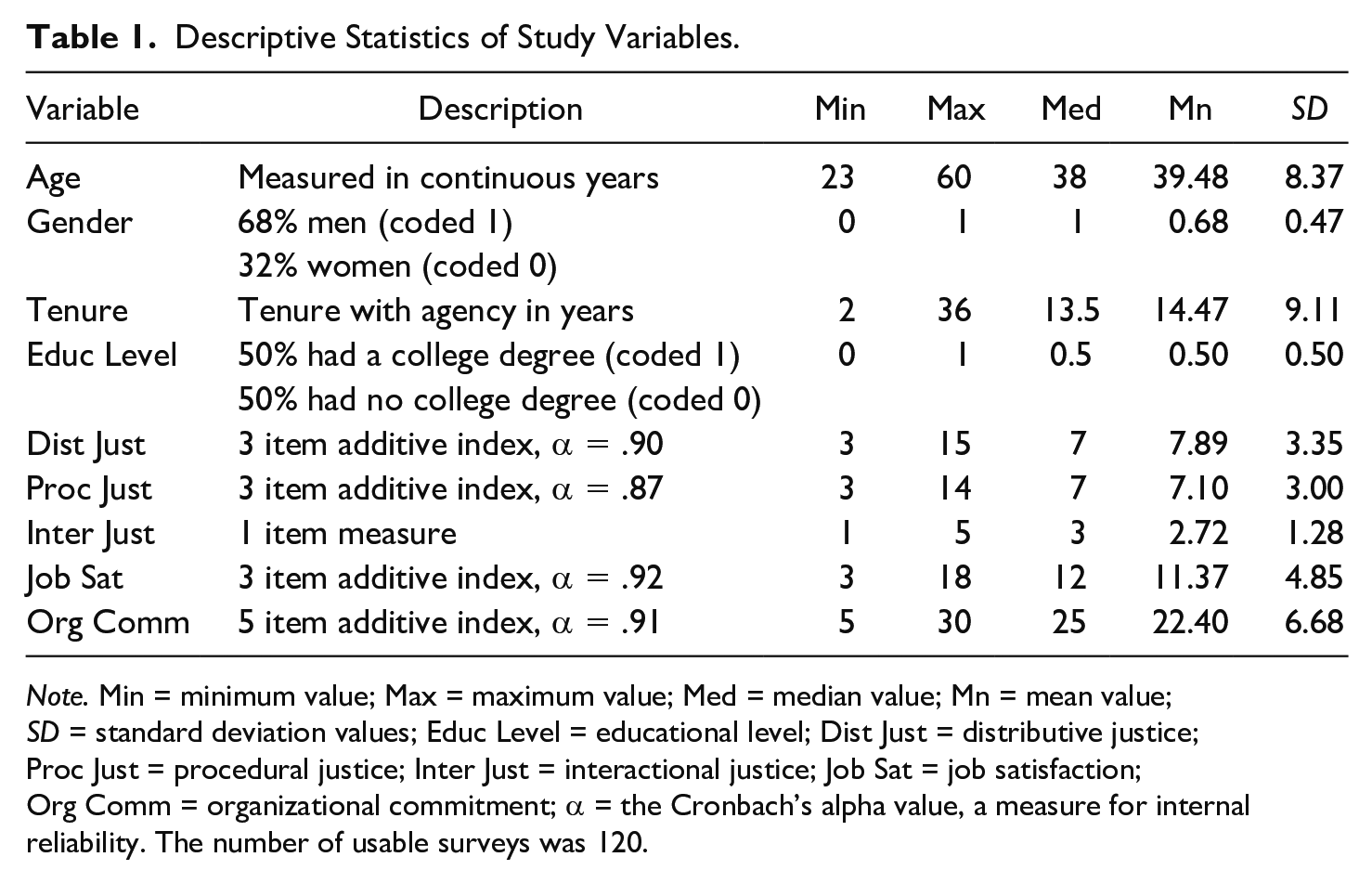
Note. Min = minimum value; Max = maximum value; Med = median value; Mn = mean value;SD = standard deviation values; Educ Level = educational level; Dist Just = distributive justice; Proc Just = procedural justice; Inter Just = interactional justice; Job Sat = job satisfaction; Org Comm = organizational commitment; α = the Cronbach’s alpha value, a measure for internal reliability. The number of usable surveys was 120.
Principal Axis Factoring with Varimax Rotation Results of Latent Variables.
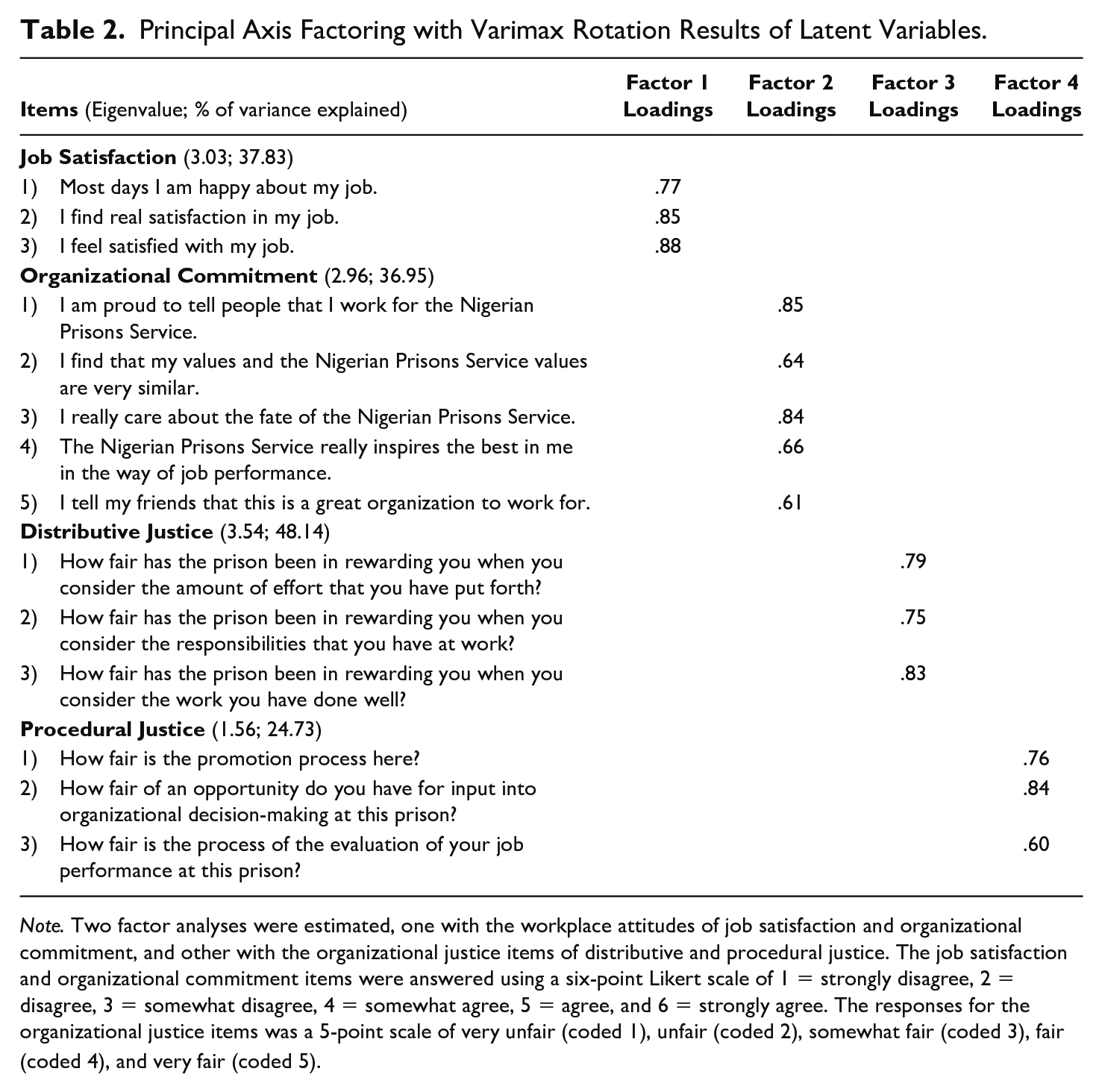
Note. Two factor analyses were estimated, one with the workplace attitudes of job satisfaction and organizational commitment, and other with the organizational justice items of distributive and procedural justice. The job satisfaction and organizational commitment items were answered using a six-point Likert scale of 1 = strongly disagree, 2 = disagree, 3 = somewhat disagree, 4 = somewhat agree, 5 = agree, and 6 = strongly agree. The responses for the organizational justice items was a 5-point scale of very unfair (coded 1), unfair (coded 2), somewhat fair (coded 3), fair (coded 4), and very fair (coded 5).
Results
The descriptive statistics for the study variables are presented in Table 1. There was significant variation in the dependent and independent variables (i.e., none were constants). The data conformed approximately to a normal distribution according to the skewness and kurtosis statistics. Likewise, the median and mean values for the variables are similar to one another, also suggesting a normal distribution. As previously indicated, all the variables measuring latent concepts (e.g., job satisfaction) had Cronbach alpha values of .87 or higher, which is viewed as very good. In addition, the items for the latent variables loaded on the predicted factor in factor analysis, indicating unidimensionality (Gorsuch, 1983). Principal Axis factor analysis with a Varimax rotation was conducted for two groups of variables, with a Kaiser eigenvalue of 1 or higher and factor loadings above .40 used (Braeken & Van Assen, 2017; Nunnally & Bernstein, 1994). The first group was the items measuring the workplace attitudes of job satisfaction and organizational commitment, and the second group being the items for distributive and procedural justice (interactional justice was excluded because it was a single item measure). The factor analysis results are presented in Table 2. Each variable loaded separately on a single factor for job satisfaction, organizational commitment, distributive justice, and procedural justice.
A correlation matrix of the study variables is presented in Table 3. Age, gender, tenure, and educational level had nonsignificant correlations with both job satisfaction and affective commitment. All three organizational justice variables had statistically significant positive correlations with both job satisfaction and affective commitment; an increase in any of the organizational justice variables was associated with an increase in job satisfaction and affective commitment.
Correlation Matrix of Study Variables.
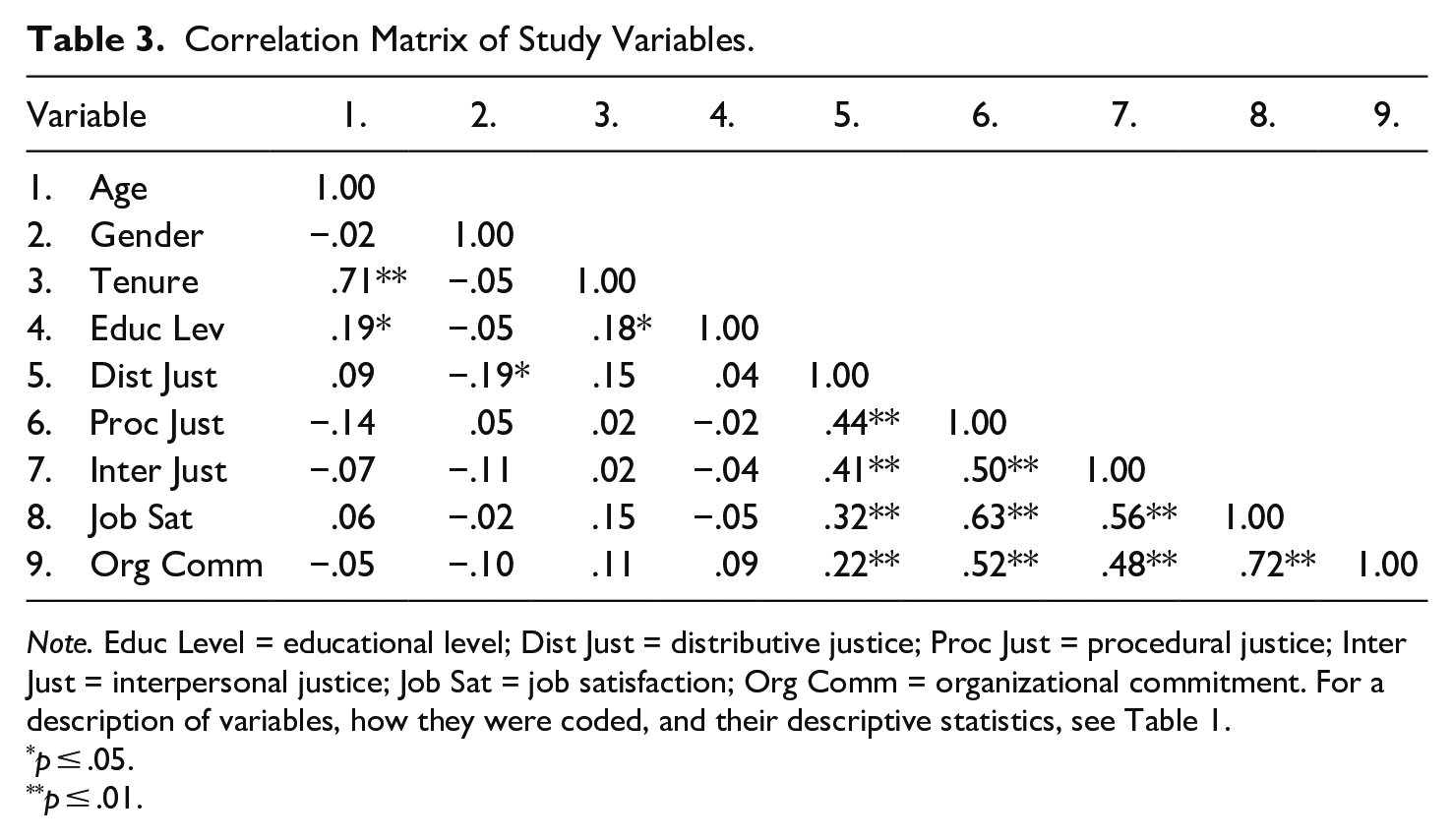
Note. Educ Level = educational level; Dist Just = distributive justice; Proc Just = procedural justice; Inter Just = interpersonal justice; Job Sat = job satisfaction; Org Comm = organizational commitment. For a description of variables, how they were coded, and their descriptive statistics, see Table 1.
p ≤ .05.
p≤ .01.
Two Ordinary Least Squares (OLS) regression equations show which independent variables are statistically associated with changes in job satisfaction and affective commitment. For both equations, the independent variables were age, gender, tenure, educational level, distributive justice, procedural justice, and interpersonal justice. The results are reported in Table 4.
Regression Results for the Effects of Organizational Justice Variables on Nigerian Correctional Staff Job Satisfaction and Organizational Commitment.
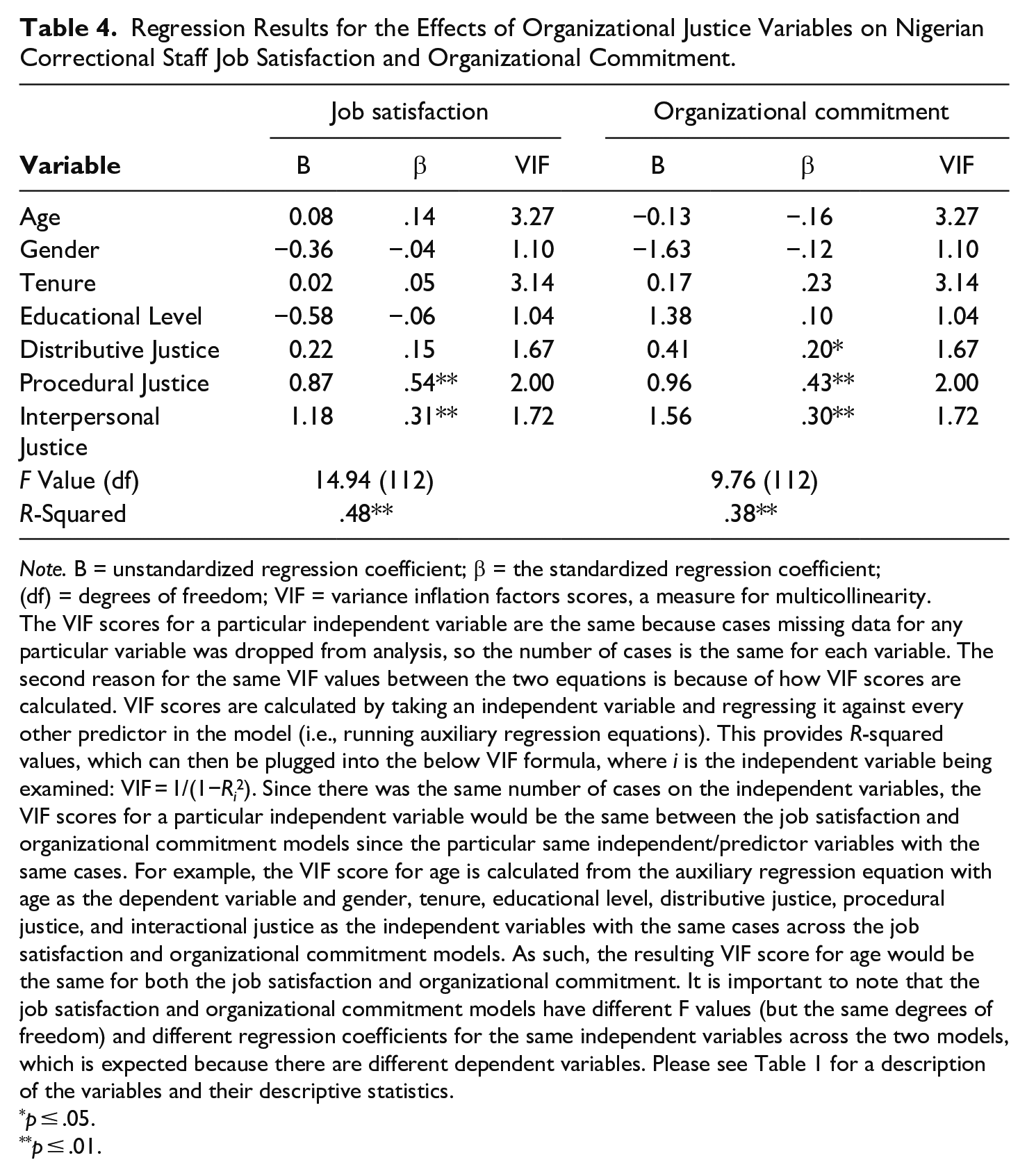
Note. B = unstandardized regression coefficient; β = the standardized regression coefficient; (df) = degrees of freedom; VIF = variance inflation factors scores, a measure for multicollinearity. The VIF scores for a particular independent variable are the same because cases missing data for any particular variable was dropped from analysis, so the number of cases is the same for each variable. The second reason for the same VIF values between the two equations is because of how VIF scores are calculated. VIF scores are calculated by taking an independent variable and regressing it against every other predictor in the model (i.e., running auxiliary regression equations). This provides R-squared values, which can then be plugged into the below VIF formula, where i is the independent variable being examined: VIF = 1/(1−Ri2). Since there was the same number of cases on the independent variables, the VIF scores for a particular independent variable would be the same between the job satisfaction and organizational commitment models since the particular same independent/predictor variables with the same cases. For example, the VIF score for age is calculated from the auxiliary regression equation with age as the dependent variable and gender, tenure, educational level, distributive justice, procedural justice, and interactional justice as the independent variables with the same cases across the job satisfaction and organizational commitment models. As such, the resulting VIF score for age would be the same for both the job satisfaction and organizational commitment. It is important to note that the job satisfaction and organizational commitment models have different F values (but the same degrees of freedom) and different regression coefficients for the same independent variables across the two models, which is expected because there are different dependent variables. Please see Table 1 for a description of the variables and their descriptive statistics.
p ≤ .05.
p ≤ .01.
Multicollinearity is seen as a problem when Variance Inflation Factor scores (VIF) exceed 5 (Tabachnick & Fidell, 2013). As indicated in Table 4, none of the VIF scores were higher than 3.27; therefore, multicollinearity is not seen as a problem. For both equations, the two variables with the highest level of collinearity were age and tenure, but not high enough to raise concerns. The issues of outliers, influential cases, normality, linearity and homoscedasticity of residuals, and independence of errors (all of which can affect the regression results) were tested (Berry, 1993; Tabachnick & Fidell, 2013).
For the job satisfaction equation, the R-Squared value was .48, which means the independent variables as a group accounted for approximately 48% of the observed variance in the job satisfaction index. Age, gender, tenure, and educational level each had nonsignificant effects. Likewise, distributive justice had nonsignificant effects. Both procedural and interpersonal justice had positive effects, suggesting these variables were associated with greater satisfaction from the job. Based on the standardized regression coefficients (values in the β in Table 4), the magnitude of effect can be ranked. Procedural justice had the largest sized effects, followed by interpersonal justice.
For the affective commitment equation, the R-Squared value was .38, which means the independent variables as a group explained about 38% of the observed variance in commitment index. Age, gender, tenure, and educational level each had a nonsignificant relationship with the dependent variable. All three organizational justice variables had significant positive relationships with commitment. In other words, an increase in distributive, procedural, and interpersonal justice were associated higher affective commitment. Based on the standardized regression coefficients, procedural justice had the largest sized effect, followed by interpersonal justice, and then distributive justice, which had about half the effect of procedural justice.
As age and tenure were highly correlated with one another (r = .71, p ≤ .01), the two regression analyses were rerun without age as one of the independent variables. While not reported in tabular format (results available upon request), the findings were similar in terms of the R-squared values and the significant predictors. For job satisfaction, R-squared for the regression equation without age was .48, and procedural and interactional justice were significant predictors. For organizational commitment, R-squared for the regression equation without age was .37, and distributive, procedural, and distributive justice were significant predictors.
Of the six proposed hypotheses guiding this study, five were supported. Specifically, distributive justice had nonsignificant effects on job satisfaction (i.e., Hypothesis 1 was not supported), but procedural and interpersonal justice had positive effects (Hypotheses 2 and 3 were supported). All three forms of justice had significant positive effects on organizational commitment (Hypotheses 4, 5, and 6 were supported).
Discussion and Conclusion
The current findings support the overall contention that organizational justice plays a role in shaping Nigerian correctional staff job satisfaction and organizational commitment. While overall supportive of the importance of organizational justice for shaping correctional staff’s degree of job satisfaction and affective commitment to the organization, there are differences in the form and degree of influence for each form of perceived organizational justice. The effects of the different dimensions differed somewhat between job satisfaction and affective commitment. It is important to note that in regard to both job satisfaction and affective commitment procedural justice has the greatest influence. Procedural justice, the issue of how an organization handles staff supervision and discipline is perceived as the most important of the organizational issues. When employees feel that they are evaluated fairly and have a voice in organizational issues they are most likely to feel a sense of satisfaction from their jobs and to feel a psychological connection with their organization.
It is not just the issue of what means are used by the organization, but also important are the ways in which supervision and tasks are managed. Interpersonal justice – the sense of being treated with respect and dignity – is also a very important influence on job satisfaction and affective commitment to one’s employer. To be treated with respect and dignity, which is a core value for most correctional systems regarding inmates, is also of primary importance to correctional staff. When individuals feel that they are respected and treated in a dignified manner they are more likely to have positive affect toward their job/employer and they are more likely to perceive their job in an overall positive light. Our finding that interactional justice has a positive association with both job satisfaction and organizational commitment is harder to compare to the correctional staff literature. As noted earlier, the only published correctional staff satisfaction and commitment study that included more than just distributive and procedural justice was done by Boateng and Hsieh (2019a). In their study involving staff from five correctional facilities, Boateng and Hsieh (2019a) found that interactional justice (a measure of both interpersonal and informational justice) was not a significant predictor of either job satisfaction or organizational commitment, but both distributive and procedural justice were significant predictors of satisfaction and only procedural justice was a significant predictor of commitment. There are at least three possible explanations for the differences in the results of the current study and the work of Boateng and Hsieh (2019a). First, the differences are due to random chance, and future studies may find a more consistent pattern of the connection of interpersonal justice with job satisfaction and organizational commitment. Second, the studies were done in different nations and the effects of different types of justice may be situational and contextual, varying across prisons in various nations. Third, our study only measured interpersonal justice using a single item measure, while the research by Boateng and Hsieh (2019a) measured interactional justice (both interpersonal and informational) justice using three items. Our results could have been different if a measure of informational justice or an overall measure of interactional justice was used. More research is needed.
In addition to the effects of procedural and interpersonal justice, the issue of distributive justice – the perception that outcomes of administrative actions are fair – while hypothesized to be significantly associated with job satisfaction and affective commitment showed a statistically significant relationship with affective commitment. While many may believe that the most important thing an organization can do is have fair outcomes for all employees, in fact the outcomes of actions are not as important as how the outcomes are reached and how employees are treated when it comes to identifying influential factors that yield a sense of commitment to the organization. In short, this study shows that, similar to their American counterparts, Nigerian correctional staff value having a fair evaluation process, a voice in organizational decisions, and being treated with respect and dignity more highly than just having desirable outcomes/products of their work. They may feel a closer affinity with their organization when they believe they are rewarded fairly and justly, but the outcomes do not have a significant influence on how employees feel about their jobs. In short, staff feel better about their jobs and more committed to the organization when they are treated with dignity, respected, evaluated fairly, and provided a voice in organizational decision making.
This different influence of distributive justice could be related to the idea that fairness in all dimensions is important because it goes to the heart of the legitimacy of the correctional organization. It is hard to form a voluntary bond with the organization if that organization is deemed unfair. The current findings show that all three dimensions matter in influencing Nigerian correctional staff commitment; however, one’s rewards and what one receives from the job is a separate issue and appears to stand on its own regarding how employees derive satisfaction from their jobs. It appears that distributive justice is important for staff to develop a bond with the organization, but it is not important in determining whether or not staff are satisfied with their jobs overall. As previously argued by Lambert (2003), having fair processes and procedures goes to the heart of an organization’s legitimacy. Our findings support this contention.
Our results partially replicate past studies with correctional staff (Boateng & Hsieh, 2019a; Lambert, 2003; Lambert et al., 2007). As noted earlier, the results of the handful of studies to date have been mixed. We found that procedural justice, but not distributive justice, was a significant predictor of job satisfaction. Our finding is consistent with that of Lambert et al. (2007) among U.S. correctional staff, but is not consistent with Lambert (2003), who reported both distributive and procedural justice had significant effects on satisfaction in their study of U.S. staff, Boateng and Hsieh (2019a) who found both distributive and procedural justice had significant positive effects among Ghanaian correctional staff, and Lambert et al. (2018) found the same among Chinese correctional staff. Interesting, among Chinese correctional staff, distributive justice but not procedural justice was important in producing job satisfaction. We observed that both distributive and procedural justice had significant positive effects on commitment, which was found by Lambert (2003) and Lambert et al. (2018) among U.S. and Chinese correctional staff, respectively. Lambert (2003) found that procedural but not distributive justice had significant effects on commitment among U.S. staff. Similar, Boateng and Hsieh (2019a) reported in their study of Ghanaian correctional staff that procedural justice but not distributive or interactional justice had a significant relationship with organizational commitment.
Explanations of these differences must begin with a look at culture. The studies available to date of influences on job satisfaction and organizational commitment have been from three very different correctional systems and cultures – the United States, China, and Nigeria. Clearly there are major cultural, political, economic, legal and social differences between these three societies. These cultural differences undoubtedly have importance for how correctional staff perceive their environment, jobs and the way their jobs are structured and administered. A second important point here is that only one of the past studies have included the issue of interpersonal justice, with Boateng and Hsieh (2019a) including a measure of interactional justice (which included measures for both interpersonal and informational justice. Our findings were likely partially influenced by including this dimension of organizational justice. When controlling for a different set of organizational perceptions, it is not surprising that the influences on job satisfaction and affective commitment might change. Our findings suggest that the effects of distributive justice may be contextual and situational varying across different institutions and nations. On the other hand, our results support the contention that procedural and interpersonal justice are important workplace variables in terms of influencing satisfaction and commitment and their effects may be universal.
While both procedural and interpersonal justice were important influences on the experiences of Nigerian correctional staff it is also important to note that none of the demographic/control variables (i.e., age, gender, tenure, and educational level) had significant effects in the multivariate analysis. Again, this finding is consistent with research on U.S. staff. Once workplace variables were considered, personal characteristics are found to be nonsignificant. If striving to create a work environment in which staff are satisfied and committed to their jobs (and hence, less likely to leave their jobs), altering individual variables such as gender, age, and educational level are (generally) not a possibility. Instituting policy and practice changes to increase perceptions of organizational justice, however, are within the control of correctional administrators.
Assuming the current findings are replicated, there are several important implications. First, there is a need to raise perceptions of distributive, procedural, and interpersonal justice among staff. To do this, staff need to be asked for their input on various aspects of distributive, procedural, and interpersonal justice, whether they perceive any aspects to be unfair as currently administered, and what realistic changes they would recommend for improvement. Staff need to feel confident to share this information without reprisal in an open dialogue with the administration (Lambert, 2003). It is likely that not all suggested changes can be made. Part of the dialogue would be to provide explanations for why some suggested changes cannot be made (e.g., some might violate the law, there is no funding available, or physical plant restrictions prohibit some actions). Administrators often have more information than line staff and need to provide this information, if possible. Managers and supervisors need to be trained on the importance of the three dimensions of organizational justice and how they can be implemented. Managers and supervisors need to ensure that no favoritism occurs, and things are done in a consistent and transparent manner (Lambert et al., 2007). Staff need to be treated in a respectful manner, even when there are disagreements. Disagreements must be handled in a professional manner. Managers and supervisors should be evaluated and rewarded for treating staff fairly.
The good news is that procedural justice had the largest sized effects on both satisfaction and commitment, followed by interpersonal justice. Some distributive outcomes, such as pay and benefits, tend to be out of the direct control of correctional administrators or tend to require major time and effort to change. Procedural and interpersonal justice, however, are more in the control of administrators and are easier to change (Lambert, 2003). Martin and Bennett (1996) pointed out that “the economic costs of acting in a procedurally fair manner – treating individuals with respect, providing advance notice of and justification for actions – are minimal” (p. 100). Thibaut and Walker (1975) contend that allowing staff a voice in the organization will improve perceptions of procedural justice. Likewise, treating staff with respect and dignity is not an expensive proposition. Changes to policies and practices that enhance procedural and interpersonal justice perceptions can be relatively simple to implement, with minimal cost and potentially very large benefits.
As with many studies, our study has limitations. The current exploratory study surveyed staff at a single Nigerian correctional facility. Staff at other Nigerian prisons and other Western and Nonwestern correctional institutions should be studied as well so as to determine whether similar or different findings are obtained. Without more research across different correctional institutions and nations, it is not fully clear if the effects of distributive, procedural, and interpersonal justice on correctional staff job satisfaction and affective commitment are universal or may be situational and contextual. More research will help answer this question. A second limitation is that the study was cross-sectional. While the causal process regarding organizational justice on satisfaction and commitment are based on theory accepted in the literature, we cannot empirically demonstrate the causal order. In order to demonstrate the causal process empirically, longitudinal research is needed. A third limitation was the limited items to measure the latent variables. In the present study, interpersonal justice was measured with a single item. Future research should measure this concept with multiple items (Beugré & Baron, 2001). Distributive justice, procedural justice, and job satisfaction were measured using three items each. Future studies may consider measuring these latent concepts with more items. Additionally, new research should measure job satisfaction with not only more items but more diverse items to obtain a richer picture of this salient workplace variable. Further, only the interpersonal justice part of interactional justice was measured. Future studies should include a measure of informational justice (Colquitt, 2001 Cropanzano et al., 2007). A fourth limitation is the small number of participants. As noted earlier, 145 staff members were randomly sampled rather than surveying all the prison staff. Future studies should sample all the staff so there are more cases for analysis. With only 120 participants, the current study was unable to do subgroup analyses.
While about 48 and 38 percent of the variance of satisfaction and commitment were accounted for in the regression analyses, other variables are also important in the shaping of these two important concepts. Future studies should explore what other variables affect correctional staff satisfaction and commitment. Additionally, if we believe that organizational justice is central to how staff perceive and respond to their environments, the effects of distributive, procedural, and interpersonal justice on other outcome areas, such as job involvement, job stress, organizational citizenship behaviors, life satisfaction, absenteeism, turnover intent, and voluntary turnover with correctional staff across different nations should also be addressed by researchers. Finally, new research should explore how distributive, procedural, and interactional justice (including both interpersonal and informational justice) contribute to the systemic justice of correctional organizations (Beugré & Baron, 2001). Sheppard et al. (1992) postulated that systemic justice is an overall view of how fair an organization is in the eyes of its employees. This form of justice likely is the result of the organizational justice areas of distributive, procedural, and interactional (Beugré & Baron, 2001).
In closing, correctional facilities are found around the globe, and staff are an important resource for the vast majority of these facilities. There is a need to know and work to enhance the satisfaction and commitment of staff. Future research conducted across different aspects of the work experience will provide information on what workplace variables are universal in their effects and which have situational and contextual effects. In this way administrators and policy makers can understand what they can do to enhance satisfaction and commitment, and in turn operate safer, more secure, and more humane institutions. Perhaps most important, the current findings highlight the need to include the dimension of interpersonal justice in future studies. Correctional staff matter and there needs to be greater research on how the work environment affects them. At the very least, it is hoped that this study will spark further interest in studying how distributive, procedural, and interpersonal justice affect correctional staff around the globe.
Footnotes
Acknowledgements
The authors thank Janet Lambert for proofreading the paper. The authors thank the reviewers, editor, and editorial staff for their review of the paper.
Declaration of Conflicting Interests
The author(s) declared no potential conflicts of interest with respect to the research, authorship, and/or publication of this article.
Funding
The author(s) received no financial support for the research, authorship, and/or publication of this article.
