



Abstract
Among others, the study sought to find out whether being convicted of the possession of marijuana for personal use for the first time or multiple times, would predict marijuana, and other drug use within the past 30 days. Using a cross-sectional survey, two hundred and fifty three (253) male offenders were conveniently sampled from three prisons in Ghana. The average age of participants was 31.26 (SD = 10.19). It was established that those who had been convicted of the possession of marijuana for personal use for the first time were likely to have used marijuana within the past 30 days (OR = 4.15, 95% CI = 2.00, 8.58), and other drugs within the past 30 days (OR = 2.44, 95% CI = 1.09, 5.47). Also, those who were recidivist robbers were likely to have used other drugs within the past 30 days (OR = 6.63, 95% CI = 2.55, 17.25). These, and other findings are discussed.
Introduction
Models of Drug Use and Crime
Kaskela and Pitkanen (2018) noted that most crimes are carried out by individuals with problems of substance abuse. They further suggest that criminality may account for substance use through association with subcultures, access to drugs or as a way of coping with the stress triggered by a criminal lifestyle. To explain the relationship between crime and drug use, Goldstein (1985) proposed a tripartite model by describing the link from a systemic, psychopharmacological, and an economic-compulsive perspective.
The economic-compulsive position argues that expensive drug use could lead an individual into committing crime since s/he will need money to purchase drugs. Bennett et al. (2008) observed that drug users engage in crime (e.g., property crimes, drug dealing, and prostitution) in order to fund their drug use. Also, the systemic posture posits that crime such as assaults, violent crimes, and thefts are a function of illegal drug market (Bennett et al., 2008; Colman & Vandam, 2009; Seddon, 2000). Further, the psychopharmacological perspective have been proven by some studies portending that psychoactive effects of drug use may cause crime (Boles & Miotto, 2003; Prichard & Payne, 2005).
Although the association between crime and drug use can be seen in the light of more multifaceted interaction process that entails a lot of factors working at different levels (Seddon, 2000), some studies have suggested a linear cause and effect association—‘crime-cause-drug use’ or ‘drug-causes-crime’ (Bennett et al., 2008; Colman & Vandam, 2009). Seddon (2000) argued that the ‘deterministic’ view of a direct causal relationship between drug use and crime is insufficient, advancing the idea that a more plausible model should be one that conceptualizes the drug use and crime relationship as a multifaceted interaction process that entails a number of factors interacting and operating at diverse levels. The drugs-crime association is affected by many other variables as suggested by Seddon (2000). Such variables include sociocultural factors or the role of deviant subcultures that may reward or encourage substance use and crime. Other variables are drug-related stress and disruptive childhood (Neale, 2000).
Childhood abuse has been found to lead to drug use (Sagoe, 2012), and associated problems (Delker & Freyd, 2014). Sagoe (2012) found that some Ghanaian youth resort to drugs as a coping mechanism for abuse suffered from their family members. In consonance with Sagoe (2012), Delker and Freyd (2014) suggested that those who have ever suffered childhood abuse use drugs to help them cope with the negative emotions associated with abuse. Consistent with Delker and Freyd (2014), Teixeira et al. (2017) showed that people use addictive drugs as a way of coping with stress associated with childhood experiences. Moreover, physical and sexual abuse in childhood has been associated with drug use consequences among offenders (Swogger et al., 2011).
Although the association between childhood abuse and drug use has been well established in other contexts, it is too early to establish such a relationship within the Ghanaian context considering the scarce literature on such an association. In essence, there is the need for other studies to throw more light on the association between childhood abuse and drug use within the Ghanaian context. Consequently, we sought to answer the question “what is the association between childhood abuse and drug use within the past 30 days among offenders in prisons in Ghana?”
Drug Use in Prison
Marijuana has been noted to be the most commonly used drug in the world (Wu, 2010). The use of marijuana, heroin, cocaine, amphetamine, tranquilizers, and sedatives have been recorded among inmates in prisons in Kenya (Kinyanjui & Atwoli, 2013). Likewise, the Uganda Prisons Service (2009) has documented the use of marijuana among offenders in prisons in Uganda. In essence, Boys et al. (2002), and Kolind and Duke (2016) suggested that prison is a high-risk environment for drug use. Although at the time of arrest some offenders test positive for the use of marijuana (Zhang, 2004), offenders also continue to use drugs in prison (Tompkins, 2015). This state of affairs has been attributed to prison culture, prison social network, and economics (Wheatley, 2007).
Bullock (2003), and Tompkins (2015) put forth that the use of drugs like heroin and marijuana among offenders in prison is dependent on prison establishment. Mjåland (2016) showed that contextual factors such as the availability of drugs account for the occasional use of drugs in prison, necessitating a change in drug use patterns while in prison (Boys et al., 2002; Bullock, 2003). This could be attributed to the unavailability of desirable drugs at a particular time (Tompkins, 2015), making it difficult for prisoners to maintain problematic level of use (Bullock, 2003). Thus, the extent of drug use in prison is dependent on the interaction between drug control strategies, availability, and the psychopharmacological properties of a drug (Bullock, 2003; Penfold et al., 2005; Stover et al., 2008). This is consistent with Seddon’s (2006) position that a number of variables (e.g., drug supply and availability) come to play when explaining the reasons why offenders use drugs.
In addition, variations exist in the association between types of crime committed and drug test results (Makkai, 2001). While those charged with drug offenses were likely to have tested positive for marijuana, those charged with property offenses were likely to test positive for sedatives and opiates (Makkai, 2001). Although Adu-Gyamfi and Brenya (2015) suggested that marijuana abuse is a problem that permeates the social strata of Ghana, it is not clear whether those convicted of the possession of marijuana for personal use in Ghana continue to use it in prison. Since it has been established that drug use is dependent on prison establishment and the availability of drugs within a specific period of time (Tompkins, 2015), we sought answers to these questions: (1) what is the association between being convicted of the possession of marijuana for the first time and multiple times, and the use of marijuana and other drugs within the past 30 days among offenders in prisons in Ghana?; (2) What is the relationship between being convicted of robbery for the first time and the use marijuana and other drugs within the past 30 days among offenders in prisons in Ghana?
Drug-Crime Relationship, and Recidivism
Facchin and Margola (2016) noted that pleasure derived from drug use accounts for later persistent use. Also, a number of studies have indicated that since drug-involved offenders are unable to desist from substance abuse, they are most likely to re-offend (e.g., Blumstein & Beck, 2005; Prendergast, 2009; Warner & Kramer, 2009). Similarly, Belenko (2006) found that, inmates who frequently use drugs have a higher tendency of recidivating. Cartier et al. (2006) corroborates this by showing that methamphetamine use significantly predicts general recidivism and self-reported violent criminal behavior.
As Antwi (2015) indicated, recidivism rates in Ghana go to the “dark figure” since there are no proper mechanisms put in place to identify both first time offenders and re-offenders. This makes it difficult to rely on the recidivism rates compiled by the Ghana Prisons Service (i.e., they do not portray the true picture of recidivism in Ghana). Although some studies have established an association between drug use and recidivism (e.g., Blumstein & Beck, 2005; Prendergast, 2009; Warner & Kramer, 2009), these studies were conducted in different contexts. With some models of the drug-crime relationship proposing that the relationship is plausibly a complex one (Seddon, 2000), other relationships within different sociocultural backgrounds ought to be investigated. In effect we asked, “what is the association between being a recidivist robber, and the use of marijuana and other drugs within the past 30 days among offenders in prisons in Ghana?”
Considering the unavailability of drug rehabilitation facilities in prisons in Ghana, we are of the opinion that establishing the correlates of drug use in the major prisons in Ghana will provide evidence to help inform drug policy, and also give some demographic characteristics of offenders who might be using drugs in prison and would therefore require rehabilitation. On the basis of the gaps that have been identified in the literature in previous paragraphs, we sought to find out whether childhood abuse would predict marijuana and other drug use among offenders in some major prisons in Ghana within the past thirty days. Further, we ascertained whether being convicted of the possession of marijuana for the first time, and multiple times would predict marijuana and other drug use within the past thirty days. Whether being convicted of robbery for the first time, and being a recidivist robber would predict marijuana and other drug use within the past thirty days was investigated.
Methods
Study Setting, Population and Sample
There are 44 prisons in Ghana, with an authorized holding capacity of 9, 945 (Ghana Prisons Service, 2019). They are generally classified into special facility (1), juvenile facility (1), open and agricultural settlement camp prisons (12), female prisons (7), local prisons (14), central prisons (7), medium security prisons (1), and maximum security prisons (1). Contrary to the authorized holding capacity, the current population is 15, 203 with an overcrowding rate of 52.87%. Out of the total figure given by the Ghana Prisons Service (2019), 13, 355 had been convicted, while 1, 848, were still on remand. Male offenders constitute 98.8% (15, 015), with an estimated number of 188 (1.2%) female offenders. In 2015, a total of 501 were convicted of robbery, 3, 267 for stealing, and 234 for the possession of narcotic drugs (Ghana Prisons Service, 2019). The population of the study was offenders in two central prisons (each in Takoradi and Kumasi), and a medium security prison at Nsawam. Among these three prisons, the Nsawam medium security prison is the largest in terms of population and facilities. In general, these prisons are among the largest in Ghana where different types of offenders are imprisoned: offenses against the person, property, and public order. Due to the sensitive nature of the study, we envisaged the challenge of participation, hence the decision to visit these prisons which have the largest population of inmates. Besides, the offense type in these prisons could also be found in the other prisons in the country, thus making them representative of the others. Two hundred and fifty three (Mage = 31.26, SDage = 10.19) male offenders were conveniently sampled. This was the total number of offenders who responded to the invitation to participate in the study. Most of the participants were Christians (80.3%), had obtained high school education (46.7%) and from middle income backgrounds (47.8%).
Ethical Considerations and Data Collection Procedure
Ethics approval was obtained from Noguchi Memorial Institute for Medical Research (NMIMR) (Protocol number: 087/17-18). Prior to contacting offenders, approval was obtained from the Ghana Prisons Service. After obtaining approval, visits were made to the Kumasi, Nsawam, and Takoradi prisons. Through the ‘prefects’ of the various cells, announcement about the study was made to offenders in the various cells in the prison. A prison officer brought into an open office, and a classroom, offenders who were willing to participate in the study. Consent was obtained from participants after the aims of the study was explained to them. Participants were allowed to withdraw from the study at any time without penalty. In keeping with anonymity and confidentiality of participants’ responses, their names or any information that could link them to their responses were not required. They were also assured that the study was not done in corroboration with the prisons service or any other security agency. Offenders who gave consent were made to complete the questionnaires themselves in a makeshift ‘booth’. A distance was maintained between the researcher and the participants to ensure that the responses of participants were not known to the researcher. Upon completing the questionnaires, participants were made to drop the questionnaires in a box. On the average it took about 15 min for a participant to complete a questionnaire. Participants did not suffer risk as a result of their participation in the study.
Research Instruments
A self-administered questionnaire was used for the survey. The first part of the questionnaire requested for some basic demographic characteristics such as age, educational attainment, religious affiliation, and socioeconomic background. To find out whether an inmate was convicted of robbery for the first time, the question “this is the first time of being convicted of taking away someone’s belonging/property with force” was asked. “This is the second time of been convicted of taking away someone’s belonging/property with force” was used in determining whether a person was a recidivist for robbery. Items such as “this is the first time of being convicted of the possession of marijuana for personal use”, and “this is the second/more time(s) of being convicted of the possession of marijuana for personal use” were used in ascertaining whether an inmate was in prison for the first time or multiple times for the possession of marijuana for personal use. The dependent measures were the use of marijuana, and other drugs within the past 30 days: “do you presently use marijuana”, and “do you presently use any other drugs”. Responses were dichotomous (Yes=1 or No=0). For clarity or better understanding, the other names for marijuana were provided (i.e., smoke, ganja, grass, herb, weed). It was also clarified to participants that the time frame of reference for ‘presently use’ was the past 30 days.
Data Analysis
Data was inputted into IBM SPSS versus 22 for analysis. Due to the dichotomous nature of the responses for both the independent and dependent variables, the data was further analyzed using binary logistic regression.
Results
It was observed that a hundred and ten (44.9%) of the offenders had ever suffered childhood abuse. While 82 (32.8%) of the participants had used marijuana within the past 30 days, 44 (17.7%) had ever used other drugs within the past 30 days. Eighty four (36.5%) of the participants had been convicted of robbery for the first time, and 33 (14.0%) were recidivists for robbery. Also, 64 (27.6%) of the participants indicated being convicted of the possession of marijuana for the first time, and 22 (9.4%) had been convicted of the possession of marijuana for the second/more time(s).
The model is significant, χ2(5, 210) = 64.37, p < .001 (Table 1). Between 25% (Cox and Snell R2) and 36% (Nagelkerke R2) of the variance in whether a person had ever used marijuana within the past 30 days is explained by the model summary. The Hosmer and Lemeshow test is insignificant, χ2(5, 210) = 4.88, p > .05 which is good, with a PAC of 76.3% observed from the classification table. Whether an offender had ever suffered childhood abuse predicted whether that offender had ever used marijuana within the past 30 days, Wald χ2 = 13.54, p < .001. Offenders who had ever suffered childhood abuse were about thrice more likely to have ever used marijuana within the past 30 days than those who had never suffered childhood abuse (OR=3.59, 95% CI=1.82, 7.09). Whether it was the first time of being convicted of the possession of marijuana predicted whether the offender had ever used marijuana within the past 30 days, Wald χ2=14.68, p<.001. Offenders convicted of the possession of marijuana for the first time were about four times more likely to have ever used marijuana within the past 30 days than those who were not convicted of the possession of marijuana for personal use (OR=4.15, 95% CI=2.00, 8.58). However, whether an offender had been convicted of the possession of marijuana for personal use on multiple occasions failed to predict whether the person had ever used marijuana within the past 30 days, Wald χ2=.17, p>.05. Offenders who had been convicted of the possession of marijuana for personal use on multiple occasions and those who were not, were equally less likely to have ever used marijuana within the past 30 days (OR=.79, 95% CI=.25, 2.46). Also, whether an offender had been convicted of robbery for the first time predicted whether the person had ever used marijuana within the past 30 days, Wald χ2=11.07, p=.001. Those who had ever been convicted of robbery for the first time were about three times more likely to have ever used marijuana within the past 30 days than those who were not convicted of robbery (OR=3.13, 95% CI=1.59, 6.13). Likewise, whether an offender was a recidivist robber predicted whether the person had ever used marijuana within the past 30 days, Wald χ2=10.38, p=.001. Offenders who were recidivist robbers were about five times more likely to have ever used marijuana within the past 30 days than those who were not recidivist (OR=4.93, 95% CI=1.87, 13.02).
Summary of Logistic Regression Analysis for Variables Predicting Whether an Offender Had Ever Used Marijuana within the Past 30 Days.

p < .001.
Table 2 shows that the model is significant, χ2(5, 209)=30.54, p<.001. Between 13% (Cox and Snell R2) and 22% (Nagelkerke R2) of the variance in whether an offender had ever used any other drug within the past 30 days is explained by the model summary. The Hosmer and Lemeshow test is not significant, χ2(5, 209)=6.16, p>.05 which is good, with a PAC of 82.2% observed from the classification table. Whether an offender had ever suffered childhood abuse predicted whether he had ever used any other drug within the past 30 days, Wald χ2=5.18, p=.023. Offenders who had ever suffered childhood abuse were about twice more likely to have ever used any other drug within the past 30 days than those who had never suffered childhood abuse (OR=2.55, 95% CI=1.14, 5.71). Whether it was the first time of being convicted of the possession of marijuana for personal use predicted whether the offender had ever used any other drugs within the past 30 days, Wald χ2=4.66, p=.031. Offenders who had been convicted of the possession of marijuana for personal use for the first time were about twice more likely to have ever used any other drug within the past 30 days than those who were not convicted of the possession of marijuana for personal use (OR=2.44, 95% CI=1.09, 5.47). Nevertheless, whether an offender had been convicted of the possession of marijuana for personal use for the second time failed to predict whether the offender had ever used any other drug within the past 30 days, Wald χ2=.09, p>.05. Those who had been convicted of the possession of marijuana for the second time and those who were not, were equally less likely to have ever used any other drug within the past 30 days (OR=.83, 95% CI=.24, 2.82). Moreover, whether an offender had been convicted of robbery for the first time failed to predict whether the person had ever used any other drug within the past 30 days, Wald χ2=1.17, p>.05. Those who had been convicted of robbery for the first time and those who were not, were equally less likely to have ever used any other drug within the past 30 days (OR=1.53 95% CI=.71, 3.31). However, whether an offender was a recidivist robber predicted whether the person had ever used any other drug within the past 30 days, Wald χ2=15.03, p<.001. Those who were recidivist robbers were about six times more likely to have ever used any other drug within the past 30 days than those who were not recidivist (OR=6.63, 95% CI=2.55, 17.25).
Summary of Logistic Regression Analysis for Variables Predicting Whether an Offender Had Ever Used Any Other Drugs within the Past 30 Days.
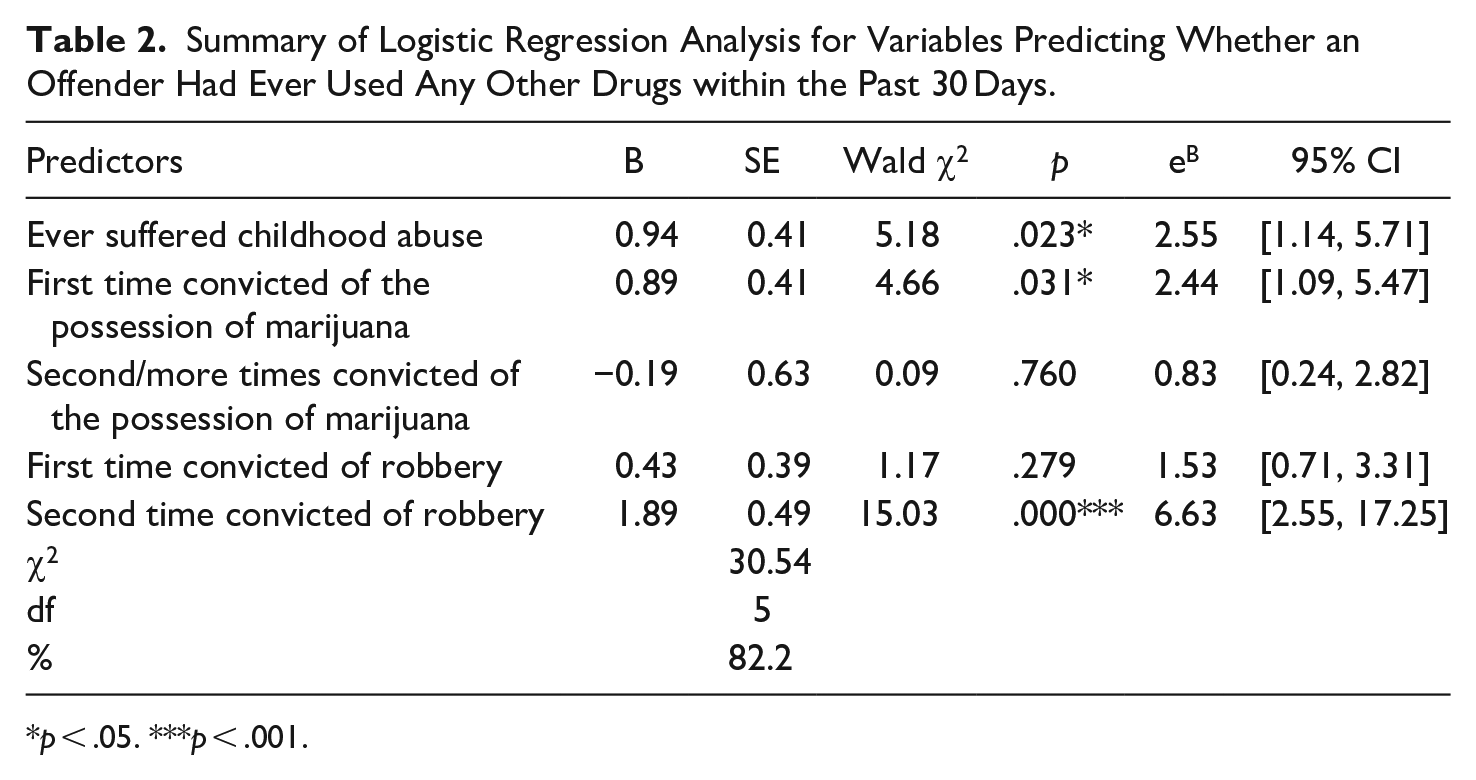
p < .05. ***p < .001.
Discussion
The study sought to find out whether childhood abuse would predict marijuana and other drug use among incarcerated individuals. We also sought to investigate whether being convicted of the possession of marijuana for personal use for the first time or multiple times would predict the use of marijuana, and other drugs within the past 30 days. Whether being convicted of robbery for the first time or multiple times would predict the use of marijuana, and other drugs within the past 30 days was also examined. It was observed that offenders who had ever suffered childhood abuse were likely to have used marijuana within the past 30 days. This group of offenders were also likely to have used other drugs within the same period. Those who had been convicted of the possession of marijuana for personal use for the first time were likely to have used marijuana, and other drugs within the past 30 days. However, being a recidivist for the possession of marijuana for personal use failed to predict marijuana, and other drug use within the past 30 days. Offenders who had been convicted of robbery for the first or multiple times were likely to have used marijuana within the past 30 days. Although being convicted of robbery for the first time did not predict the use of other drugs within the past 30 days, those who were recidivist robbers were likely to have used other drugs within that period.
In consonance with Sagoe (2012) who showed that Ghanaian youth who suffer abuse from their family members tend to resort to the use of drugs as a coping mechanism, it was observed that offenders who had ever suffered childhood abuse were likely to have used marijuana, and any other drug within the past 30 days. This association has also been established by Swogger et al. (2011). Besides, Delker and Freyd (2014) put forth that childhood abuse increases one’s likelihood of engaging in drug use. This goes to buttress Bennett’s et al. (2008) conclusion that crime and drug use is related, but not causally. Moreover, Seddon (2000) argued that a number of factors account for why people use drugs. Thus, offenders continue to use drugs in prison not necessarily because of the pharmacological effects, but probably as a coping mechanism. Teixeira et al. (2017) corroborates this by suggesting that people use drugs to help them cope with the stress that follows childhood abuse.
Further, we observed that those who had been convicted of the possession of marijuana for personal use for the first time were likely to have used marijuana, and other drugs within the past 30 days. However, being a recidivist for the possession of marijuana for personal use failed to predict marijuana, and other drug use within the past 30 days. It must be noted that although offenders find themselves in the same prison, they however belong to different cells within the same prison. The availability of drugs within some particular cells may not necessarily mean that those within other cells would have access to it within a specific period. This could be explained by the kind of social network that exists within the prison. Wheatley (2007) asserted that drug use within prison is also dependent on prison culture, and social network. All things being equal, offenders within a particular cell are more likely to establish some form of social network different from those within other cells. This goes to buttress the assertion that drug use within prison entails the interaction of different factors (see Bullock, 2003; Penfold et al., 2005; Stover et al., 2008). Moreover, there could be a social network among those who were being convicted of the possession of marijuana for the first time, different from that of those who are recidivist for the possession of marijuana. Such separate networks could account for why the pattern of marijuana use was different among these two groups of offenders. The availability of marijuana and other drugs among the first time offenders could make it possible for members within their social network to gain access to them.
In addition, other studies (Blumstein & Beck, 2005; Prendergast, 2009; Warner & Kramer, 2009) found that drug involved offenders reoffend due to their incapability to desist from drug use. Granted that if one is convicted of the possession of marijuana for the second or more times the fellow will continue to use marijuana, in the absence of the availability of the drug, the person is not likely to use it (Bullock, 2003; Mjåland, 2016). Mjåland (2016) showed that contextual factors such as the availability of drugs determine the extent to which inmates use drugs in prison. Hence the occasional use of drugs during incarceration (Mjåland, 2016). This confirms Seddon’s (2006) position that factors such as drug supply and availability could account for why people use drugs. Essentially, if an offender is a recidivist for the use of marijuana, and is likely to crave for the drug, the unavailability of the drug within his cell is likely to make it difficult for him to gain access to the drug. Although the study did not explore the differences in drug use by cell affiliation, we see this to be the plausible reason why those who were recidivist for the possession of marijuana for personal use were not likely to have used marijuana and other drugs within the past 30 days. Future studies could examine such nuances with regards to drug use and cell affiliation.
The study established that offenders who had been convicted of robbery for the first or multiple time(s) were likely to have used marijuana within the past 30 days. As well, those who were recidivist robbers were likely to have used other drugs within the same period. This is in consonance with Kinyanjui and Atwoli (2013) who showed that offenders incarcerated in one of the prisons in Kenya use marijuana and other drugs. Contrary to Makkai (2001), it was found that being convicted of robbery for the first time did not predict the use of other drugs within the past 30 days. Makkai (2001) indicated that inmates charged with property offenses were likely to test positive for sedatives and opiates. Nevertheless, it has been suggested that drug use patterns change in prison (Boys et al., 2002; Bullock, 2003). Although offenders in the study used marijuana, they might not have used other drugs probably due to the unavailability of those drugs within the period (Mjåland, 2016).
Limitations and Recommendation
Though the authors tried as much as possible to ensure that participants gave honest responses, it is still probable that the sensitive nature of some of the items might have triggered social desirable responses. Authors could only rely on participants to know whether they were recidivist or not since there were no proper mechanisms put in place in the prisons to distinguish between those who were recidivist from those who were not. In spite of these weaknesses the findings are instructive, giving us some of the characteristics of offenders within some prisons in Ghana that predict marijuana and other drug use. The study further suggests the persistent use of drugs by some category of offenders in prisons in Ghana. For the purposes of details, other studies could also investigate the association between other types of offenses apart from robbery, and other types of drugs such as heroin and cocaine.
Conclusion
In consonance with other studies, it was established that those who had ever suffered childhood abuse were also likely to have ever used marijuana and other drugs within the past 30 days. We found that offenders who had been convicted of the possession of marijuana for personal use for the first time were likely to have used marijuana, and other drugs within the past 30 days. In contrast, being a recidivist for the possession of marijuana for personal use was not associated with marijuana, and other drug use within the past 30 days. Further, the study showed that offenders who had been convicted of robbery for the first or multiple time(s) were likely to have used marijuana within the past 30 days. Besides, those who were recidivist robbers were likely to have used other drugs within the same period. Additionally, it was established that being convicted of robbery for the first time did not predict the use of other drugs within the past 30 days. These findings suggest variations in the pattern of drug use among offenders, which could probably be due to factors such as the availability of drugs within the prison and specifically within various cells. This could also be explained by the kind of prison culture and social network that is at play within the prisons and the various cells within the prison. The study suggests that drug related offenders (i.e., marijuana) should be diverted to rehabilitation centers instead of prison, since prison seems not to deter such offenders from drug use. Apart from the diversion of drug related offenders from prison, it is recommended that drug rehabilitation within the prisons be targeted at offenders with a history of childhood abuse, and those convicted of robbery. In addition, there is the need for prison authorities in Ghana to develop measures aimed at cutting off the supply of drugs into the prisons.
Footnotes
Acknowledgements
The authors express their gratitude to all the inmates who took part in the study, and the Ghana Prisons Service. Also, the commanders of the Takoradi, Kumasi, and Nsawam medium security prisons as well as Supt Robert Kavi (Nsawam prisons), and Supt Constance Dokumah (Takoradi prisons) are hereby acknowledged.
Authors’ Note
Feikoab Parimah is now affiliated with Basic Research, Advocacy and Initiative Networks, Kwabenya, Accra, Ghana.
Declaration of Conflicting Interests
The author(s) declared no potential conflicts of interest with respect to the research, authorship, and/or publication of this article.
Funding
The author(s) disclosed receipt of the following financial support for the research, authorship, and/or publication of this article: This work was supported by the Danish International Development Agency (DANIDA).
