




Abstract
This study investigated the operational dynamics of male violent offenders incarcerated in Abakaliki custodial center, Nigeria. A cross-sectional survey research design was adopted and purposive technique used to recruit 260 inmates charged with violent offenses. The data generated from structured questionnaire were analyzed using Predictive Analytic Software (PAS), with ordinary least regression, descriptive statistics and spearman rank order correlation techniques, employed in testing the variables explored. Findings revealed that this population use drugs to enhance criminal performance through being brutal; instilling fear in victims to secure their total compliance and submission; and suppressing regret for their criminal acts. Heroin, followed by, cocaine, cannabis, tramadol, and multiple drug use, were commonly used drugs in the population surveyed, with their offenses ranging from cultism, armed robbery, murder and burglary to kidnapping and assault and battery. Gaining insights into the changing operational knowledge, procedures and dynamics of violent offenders will (re)direct policy approach and action that are capable of increasing public and custodial safety. It will also orient and direct practical prison reforms for successful rehabilitation and reintegration of released inmates into the free world.
Introduction
Scholars and researchers have been searching for suitable pathways to understanding the complexities of drug use and its direct or indirect association with crime and violence, with each researcher approaching the problem from their own unique perspectives (e.g., Adayonfo & Akanni, 2019; Belenko & Spohn, 2015; Deitch et al., 2015; Link & Hamilton, 2017; Mamman et al., 2014; Nnam et al., 2018; Nyameh et al., 2013; Philips, 2012; Romm & Metzger, 2018). Difficulty in identifying the nature of the relationship between drug use and crime—be it correlational or causal (i.e., does drug use lead to crime, or does crime lead to drug use)—is one reason that the drug-crime nexus is still contested in the social science literature, as evidenced by the large volume of literature on the topic currently available (see Goldstein, 1985; Gottfredson et al., 2008; Nelson & Nnam, 2020; Nnam et al., 2018, 2020a; Philips, 2012). The current study is not actually trying to explore or measure these variables, as it were. While building on them as a robust and related/relevant literature and theoretical constructs, this study sets out to broaden human horizons on drug-violent crime scholarship by elaborating on details of “using drugs to enhance criminal performance” as a subcategory of the “crime leading to drug use and vice versa” hypotheses (see the sections on Literature Review, Results and Discussion for details).
Like crime, the “drug problem” is universal. For instance, the United Nations Office on Drugs and Crime (UNODC) report revealed that drug use is not limited to geographic boundaries, but rather is a universal problem (Atkinson et al., 2011). Psychoactive drugs are common in many countries and their resultant abuse has been reported as one of the major public health and social problems worldwide (Nelson & Obot, 2019; Nnam, 2017a, 2017b; Obot, 2012; Otu, 2013; Room et al., 2010; UNODC, 2010, 2015, 2018a, 2018b, 2019). Furthermore, the dramatic increase in prison population across the globe (see Country Policy and Information Note Nigeria: Prison Conditions, 2016; Nnam, 2016; Walmsley, 2018; Wilson, 2010), with violent offenders constituting a substantial number, has been a major concern to governments and their criminal justice system, prison scholars and the public (Nnam, 2016; Wilson, 2010). In Nigeria, “the Port Harcourt prison for instance, built to accommodate 800 inmates, had over 4,000 inmates occupying its cells as at August 2019. Similarly, Kirikiri Maximum Prisons, with the capacity to hold only 956 inmates held about 2,600 also as at August 2019. It becomes of little wonder then, why these prisons are continuously described as ‘living hells’” (Ojeah, 2020, p. 2). Even the study area, Abakaliki custodial center, has overstretched its carrying capacity of 387 population; the institution has consistently housed over 1000 inmates in recent times (Field Survey/Abakaliki Prison Recording Board, 2017, 2018, 2019).
Compiled by Walmsley (2018, p. 2), the World Prisons Population List (11th ed.) revealed that “there are more than 2.2 million prisoners in the United States of America, more than 1.65 million in China (plus an unknown number in pre-trial detention or ‘administrative detention’), 640,000 in the Russian Federation, 607,000 in Brazil, 418,000 in India, 311,000 in Thailand, 255,000 in Mexico and 225,000 in Iran . . . prison population rates vary considerably between different regions of the world, and between different parts of the same continent. For example”: In Africa, the median rate for Western African countries is 52 whereas, for Southern African countries, it is 188; in the Americas, the median rate for South American countries is 242 whereas, for Caribbean countries, it is 347; in Asia, the median rate for South Central Asian countries (mainly the Indian sub-continent) is 74 whereas, for Central Asian countries, it is 166. In Europe, the median rate for Western European countries is 84 whereas, for the countries spanning Europe and Asia (e.g. Russia and Turkey), it is 236. In Oceania, the median rate is 155 (Walmsley, 2018, p. 2).
Although many factors are responsible for imprisonment, scholarship that specifically linked offending behaviors (of prison inmates) to drugs are largely of foreign origin (see Arbach-Lucioni et al., 2012; Bonta et al., 2014; Friedmann et al., 2008; Hamilton & Belenko, 2016; Link & Hamilton, 2017; Lu et al., 2019; Wakeman & Rich, 2015). On the other hand, current empirical studies from Africa, particularly Nigeria, are comparatively underrepresented in the international research literature on the subject matter (e.g. Adayonfo & Akanni, 2019; Ayodele et al., 2018; Hussein et al., 2017; Nnam et al., 2018; Olaniyi, 2020). Specifically, what has yet to be given adequate empirical investigative attention, however, is the possibility that individuals committing crimes may be using drugs in order to enhance their criminal behavior, similar to how some athletes tape joints before engaging in competition or tournaments to prevent injury and emerge victorious. This raised the academic curiosity of the researchers to further explore this somewhat neglected but potentially important area of research interest.
Accordingly, eliciting firsthand and in-depth pieces of information on both the object (drug-criminal performance enhancement assumption) and the subjects (violent offenders who use drugs to enhance their criminal performance) could have serious implications for the criminal justice system and harm reduction interventions. It is on this premise that the current study attempts to reexamine a subset of drug use-crime/crime-drug use hypothesis, hoping to unearth the nuances of drug use in influencing the operational dynamics of violent offenders in Nigeria using Abakaliki custodial center as a unit of analysis.
Literature Review
Since scientific literature specifically on the use of drugs to enhance criminal performance is hard to come by, significant portions of the review revolves around related previous scholarly works, particularly on general crime-drug use and drug use-crime relationships. Research shows that “up to 50% of sexual offenders were actually intoxicated at the time of committing the offense . . . the lifetime prevalence rate of cannabis use among sex offenders was 37.1% while it was 5.7% among non-sexual offenders” (Adayonfo & Akanni, 2019, p. 04). The problem of illicit drug use, its casual relationships with crime and violence, and eventual arrest and incarceration of its users, is on the increase (see Arbach-Lucioni et al., 2012; Friedmann et al., 2008; Nnam et al., 2020a; UNODC, 2013, 2015, 2018a, 2018b; World Health Organisation [WHO], 2010). Take for instance, the National Institute on Drug Abuse (NIDA) identified three offenses associated with drug use. First, offenses defined by drug possession or sales. Second, offenses directly related to drug use (for example, stealing to get money for drugs). Third, offenses related to a lifestyle that predisposes the drug user to engage in illegal activities, for example, through association with other offenders or with illicit markets (Fletcher & Chandler, 2014).
Other studies, both extant and current, point to the fact that there is a great debate on the drug-crime correlation, with three influential but conflicting explanatory constructs dominating academic discourses to account for drug use and its correlate, crime. First, drug use leads to crime; second, crime leads to drug use; and third, the drug-crime relationship is explained by a set of common causes (Dennison, 2013; Goldstein, 1985; Gottfredson et al., 2008; Huebner, 2006; Link & Hamilton, 2017; Nnam et al., 2018). Seeing it as a global problem, Nnam (2017b, p. 128) explained that “there has been a significant increase in drug use (and its connection with crime and violence) worldwide, and no society—whether urban or rural, developed or developing—is free; all are affected by one drug problem or another.” In the United Kingdom (UK), substance abuse is linked to about half of domestic homicide. For instance, the use of substance has been found among domestic homicide offenders more than four times as often as it has among those killed by them in recent times (Home Office, 2016). From a recent UNODC report, there is a steady increase in drug use in Nigeria which has led to increased law enforcement efforts and greater political commitment to control drugs, with many users arrested and incarcerated (UNODC, 2013, 2018a). The trend could be attributed to a number of “social change and mobilization processes, such as increasing urbanization, westernization, peripheral industrialization, and mass communication exposure. Some of these processes have seriously undermined customary values and beliefs, while at the same time desecrating human life” (Eteng, 2014, p. 259).
Some studies have found that people Who Inject Drugs (PWID), particularly the homeless, have frequent contacts with law enforcement agents/agencies and are subject to routine imprisonment and violence (Markwick et al., 2015; Nelson & Nnam, 2020). Citing UNODC (2013, 2018a), Nnam et al. (2020a, p. 2) revealed that the “drug situation in Nigeria which has led to increased law enforcement efforts and greater political commitment to control drugs. In the national or home front, for instance, 847.46 hectare of cannabis plantations nationwide were discovered and destroyed in 2013.” A survey conducted by the UNODC (2018b) showed that “an estimated 10.8% of the population or 10.6 million people, had used cannabis in the past year; and the average age of initiation of cannabis use among the general population was 19 years” (p. 12). The study further revealed that “cannabis use was seven times higher among men (18.8% among men vs. 2.6% of women), while the gender gap in the nonmedical use of pharmaceutical opioids (such as tramadol) was less marked (6% among men vs. 3.3% among women)” (p. 12).
The preceding argument has a share in the growing incidents of such violent offending as armed robbery (Etuk & Nnam, 2018; Otu & Elechi, 2015), kidnapping (Otu et al., 2018a, 2018b; Tade et al., 2020), cultism (Nnam, 2014b), and terrorism (Eteng et al., 2021; Nnam et al., 2018, 2020b; Ordu, 2017; Tade & Onwuanaegbule, 2020). At the same time, it is important nevertheless to note the fact that variations still exist in the interplay between drug use and offending. Gadd et al. (2019), Gilchrist et al. (2019), and Rolando et al. (2020) also acknowledged that the association between drugs and crime differs; they vary according to type of drugs and over time and space, as well as other correlates. A case in point is the findings of a study carried out in Sweden, which revealed a positive relationship between violent crime and binge drinking and use of sedatives and, on the other hand, was negatively related to cocaine, heroin, amphetamine, and injecting drug use (Hakansson & Jesionowska, 2018). By implication, as progressively reviewed, some people would find certain behaviors and tasks—whether prosocial (e.g., pursuing educational career) or antisocial (e.g., pursuing criminal career)—very difficult or impossible to accomplish without recourse to undue influence or following illegitimate route (Personal communication of the researchers).
Psychoactive drug use is seen as both behavior enhancer and influencer intentionally patterned toward accomplishing some assignments or goals, such as rape and other sexual offenses (see also Adayonfo & Akanni, 2019; Effiong et al., 2022). To further underpin this study, the researchers theorize that illicit substances are used by violent offenders as a rational choice action that may interacts mutually with other criminogenic circumstances, forces or factors to sustain their criminality over time. Kidnapping, armed robbery and such other violent crimes are not carried out on the spur of the moment; they are herculean tasks that require careful planning and exploring different crime encouraging paraphernalia, among which, is illicit drug use (see Nnam, 2014a, 2014b; Otu & Elechi, 2015; Otu et al., 2018a, 2018b). According to rational choice theorists, social behavior (including drug use by criminals and noncriminals) is a rational action carried out by people as a reaction to particular strains, opportunities, pressure, and situational inducements (Burke, 2019; Clarke & Cornish, 1985; Clarke & Mayhem, 1980; Trasler, 1986).
From the predictions of rational choice, criminals are avoiders of “pains” (arrest, punishment, unsuccessful operations, regrets, and so on) and seekers of “pleasure” and “gains” (successful operations, being high on drugs to attenuate the “pains of committing crime,” taking precautionary measures to escape arrest and prosecution, among others). While pains and pleasure/gains are naturally endowed to man, they are manipulated, assimilated, and upheld in this context as criminogenic hazing and leanings that direct his decision on whether or not to commit crime. Implicitly, this particular argument was supported by Cornish and Clarke (1986), Burke (2019), and Tade et al. (2020), who argued that the basic assumption of rational choice theory is predicated upon the fact that human beings are rational thinkers and decision takers, so that they seldom take decisions which the costs are presumed to outweigh the expected benefits. This is usually done after a rational assessment of the complex processes required to succeed in the drug and crime industry, whether at individual level or in group context. Being “dominant approach for conceptualizing human action in the social sciences, rational choice theory focuses on a few determinants of individual choices, and methods of aggregating social behavior are based on the decisions of individual actors” (Burns & Roszkowska, 2016, p. 196).
Illicit drug use and criminality are psychosocial behaviors, which perpetrators must learn and acquire the requisite skills and modus operandi before a decision on whether or not to be involved in the acts is made. This is where rational choice theory interconnects with social learning theory to further explain the rationale behind the use of drugs by offenders. Indeed, learning the pathways to drug culture and its connection to crime and criminality involves the acquisition and maintenance of certain behavior, including initiation, continuity and termination of antisocial conducts, such as drug abuse and violence. Supporting the effect of psychosocial learning and practices on offending behavior, Nnam et al. (2018, p. 52) argued “that (the learned) illicit substance use inhibits the pathways to criminal desistance (aging out of crime) and heightens the trajectories to criminal persistence (recidivism).” Some crimes, such as unlawful drug use, is not biologically determined or inherited by individuals; rather, it is a learned behavior. And the learning processes usually take place within intimate social groups (Sutherland, 1939). Sutherland’s view significantly addressed, at least, the underlying causes and spread of substance abuse in present-day Nigeria.
Critical to the exponents of social learning theory (e.g., Bandura, 1979; Siegel, 2008) is that people are not born with the ability to abuse substances, but instead they learn the act through life experiences. Examples include personally observing others hiding under the influence of substances in order to reach some societal goals, whether by fair means or foul; and watching admired people being rewarded for illicit drug use on television, in movies, or at home. Bandura (1979) confirmed that individuals learn how to behave (including abusing substances) by modeling their behavior after that of others, especially those people they see as role models. This behavior is socially transmitted through examples that come from the intimate personal groups such as family, subculture and mass media. Nnam (2017a) interpreted these principles of social learning theory to mean that people learn how to abuse substances by not only imitating and emulating their peers, celebrities or models in the media industry but also close adult associates and parents who engage in this thrilling but harmful practice in their presence.
Methods
Design, Study Frame, and Sample Size
A cross-sectional survey research design was adopted, which facilitated the collection of quantifiable data and evaluation of patterns of associations among the participants (see Heap & Waters, 2019) at one-time research period. The study was conducted in Abakaliki custodial center which is located in the capital territory of Ebonyi State, Nigeria. Although this Medium Security custodial center was initially established in 1902 as a Slave/Settlement Camp, it was converted and became a fully-fledged prison in 1936, with the capacity to accommodate a maximum of 387 inmates. However, the correctional institution had overstretched its carrying capacity; it is currently housing 1,047 inmates of various social, psychological, economic and medical status and offense category. But the nature of this study requires that the sample be drawn, from the total population of 1,047, only drug abusing violent inmates.
Also using Otu and Elechi’s (2015) theoretical and empirical social-ethical contexts or constructs as parameters for determining where to locate a fairly large numbers of substance using violent offenders, the samples were drawn from this study area and population. The social contexts, according to these authors, are: (1) media and police reports of violent crime incidents occurring in Abakaliki and other cities in Nigeria, (2) violent offenders who were already convicted and were serving their times, (3) willingness to participate in the study, and (4) accessibility and convenience. The samples from this custodial center were drawn from inmates that fall under category number two and three, and they were 284. Of this target population, 266 volunteered to participate in the study, but a final sample size of 260 was obtained after data gleaning (see the section on data collection and settings for details).
Data Collection and Settings
Data for this study were collected using a questionnaire instrument, which contained structured questions. The instrument was scored using multiple choice items and five points Likert scale. The instrument was dichotomously scored and measured based on the participants’ responses to these variables: Socio-demographic characteristics, motives for drug use during and after criminal operations, types of drug use, income level, length of time spent serving time, and so on. Purposive sampling technique was used to recruit only drug using male inmates detained for the following violent offenses: Kidnapping, armed robbery, “cultism” (i.e., violent and destructive activities common among campus/street secret cult groups in Nigeria), murder, assault and battery, and burglary. Our choice of purposively recruiting and studying this particular population of inmates is premised on the argument of Otu et al. (2018b), who stated that understanding perpetrators’ perspective is of salient importance if researchers are to gain a balanced view of violent crime, and that sampling the opinions of the main actors is particularly helpful in solving that particular social problem and other related problems. Nnam et al. (2020a, p. 5) further corroborated our justification for adopting this sampling strategy when they alluded that drug using violent offenders are better sample, since “they have prior knowledge of the subject, location and phenomenon under study and, for this reason, stand a better chance (more than any other population) of providing us with sufficient, relevant and reliable information and data needed for this study.”
Since “purposive sampling is best used alongside with other types of sampling to reduce bias” (Kara, 2017, p. 70), reliable formation in the repositories of Abakaliki custodial center was explored to reached the target audience. These categories of inmates, according to the prison records, have spent 3 to 5 years on the average serving time, and were 266 in number. They were called out from their respective cells and locations by two prison officials using the prison records as a guide, and the questionnaires conducted in a face-to-face manner. Given the low literacy level of the participants, however, the researchers read out all the items in the questionnaires one after another and also allowed the lead and fourth authors who were versatile in the local language and dialects to explain/interpret the items therein to enable the inmates complete the instrument appropriately.
Of the 266 questionnaires administered and completed, six were rejected due to mutilations, incompleteness and contradictions after crosschecking and thereby reducing the sample size to 260. To reach the target audience following ethical considerations, a letter stating the objective, area and population of the study was written to the Controller of Abakaliki custodial center before permission was granted to conduct the study. Strict protocols and adherence to the rules and regulations regarding inmates’ security, rights, confidentiality, anonymity and risk were observed. Despite the approval of the researchers’ “Letter of Permit,” free and informed consent of the participants was still sought and obtained orally before administering the questionnaire to them. Data collection took place in the Social Welfare Unit of the prison under the supervision of two prison officers. Nevertheless, the researchers requested the supervising officers to keep short-distance away from the particular spot where the questionnaires were being completed with a view to guaranteeing the confidentiality, anonymity and security of the inmates. Indeed, this strategy paved way for a smooth data collection and assisted greatly in eliciting honest responses from the inmates.
Data Analysis
The second, third and last authors collated, cleansed, coded and analyzed the data using Predictive Analytic Software (PASW), while ordinary least regression and descriptive statistics were used to analyse the socio-demographic variables in relation to drug use and violent behavior. Correlation matrix was also used to test the multiple independent variables against the dependent variable (use of psychoactive drugs and enhancement of violent criminal behavior, performance).
Map showing the direction of Abakaliki Custodial Center
Source: From https://www.google.com/search?client=firefox-b-d&q=location+of+prison+in+abakaliki

Results
The regression results and descriptive statistics presented in Table 1 showed that 45% of the participants fall within the age category of 20 to 24 years, 42% were 25 to 29 years of age while 13% were above 30 years. This indicates that the participants in all the age categories were involved in drug use and drug related offenses. The violent offenders whose age fall within 20 to 24 years were more involved in drug related offenses. Age showed a negative significance to drug use with the regression coefficient of −.210*, mean value of 1.7115, and the standard value of .72826. Regarding marital status, the regression coefficient revealed that marital status appears not to be significant to drugs use. The result showed that the mean value for the marital status of the participants is 2.2231, while the standard deviation value is .56630. Of the various categories of marital status, 75.3% of the participants were singled (unmarried) and appeared to be more involved in drug use and drug related offenses.
Ordinary Least Regression Results and Descriptive Statistics for Socio-Demographic Variables.

Note. N = 260 which stands for the population, min for minimum, max for maximum, M for the mean and SD for standard deviation. Occupation for occupation of the participants, B represents unstandardized regression coefficient, SE (B) represents the standard error for the regression coefficient and β for regression coefficient.
p ≤ .05. **p ≤ .01.
The variable of “Highest Educational Qualification” has the mean value of 2.5769, standard value of 1.62207, and the regression coefficient of .200**. This result shows that educational qualification is significantly related to drug use and drug related offenses. The 42.7% of the participants who were involved in drug use and drug related offenses were primary school certificate holders. Their low educational level appeared to be responsible for their involvement in drugs. The mean value for religion is 1.0231, while the standard value is .15044. From other categories of religion, 97.7% of the participants identified with Christian religion. The mean value for the occupation of the participants is 3.4654, while the standard deviation is 1.17682. Whereas the participants who were unemployed are 41.9%, the remaining 58.1% is for other categories.
Homelessness appeared to be significantly related to the involvement of the participants in drug use and violent behavior. From the Table 1, 22.7% of the participants had a home while 77.3% of them lived with their friends and family relations. The regression coefficient of .166** suggests a significant relationship between homeliness and drug abuse among the violent offenders. Further results revealed that the mean value for income level of the participants is .6923, while the standard deviation is .91192. The regression coefficient of −105* suggests a negative relationship between income level and drug use. The category of participants whose monthly income falls within =N= 10,000 ($22.22 equivalent) and =N= 20,000 ($44.44 equivalent) is 54.2%. The 45.8% is for other income categories. The variables above account for 96.7 % of the predictors of drug use and violent behavior, while the remaining 3.3% was not accounted for in this study.
The correlation matrix of the study variables is presented in Table 2. Cannabis, heroin, tramadol, cocaine and multiple drug use significantly correlate with such types of violent behavior as kidnapping, armed robbery, cultism, murder, assault/battery, and burglary.
Spearman Rank Order Correlation Matrix of Violent Behavior and Types of Drug Use.

Note. N = 260.
Correlation is significant at 0.01 level (2-tailed).
The result in Table 3 indicated that, out of all the reasons given by the inmates in prison for their involvement in psychoactive drugs, only two reasons appears to be significant. These reasons include to gain strength and not to regret their criminal activities during and after operations. To gain strength has the mean value of .2346, the standard deviation of .42458 and the regression coefficient of .150*, while not to feel regret after their criminal action has the mean value of .3038, the standard value of .46080, and the regression coefficient of .813**. The result also revealed that the aforementioned reasons contribute to 88.5% for why psychoactive drugs were used. The remaining 14.5% reasons for drugs use was not revealed in this study.
Regression Results and Descriptive Statistics of Reasons for Drugs Use.
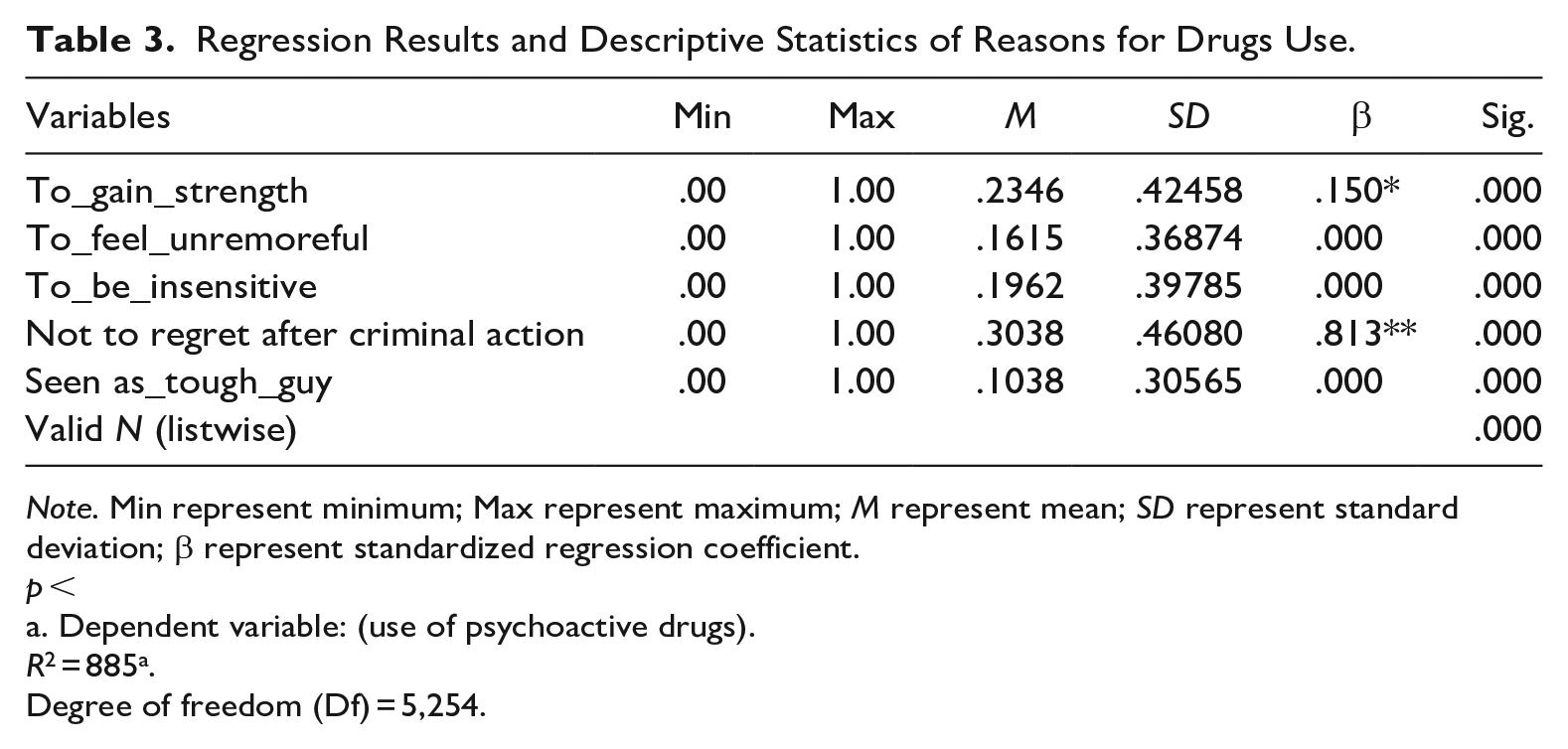
Note. Min represent minimum; Max represent maximum; M represent mean; SD represent standard deviation; β represent standardized regression coefficient.
p <
Dependent variable: (use of psychoactive drugs).
R2 = 885a.
Degree of freedom (Df) = 5,254.
Discussion
Empirical evidence from the results revealed that young violent offenders use psychoactive drugs to enhance performance compared to the older population. The rationale behind the increasing use of psychoactive drugs by violent offenders is to amplify emotional and physical defects for a successful career in crime. While drug is used as a robust criminal performance-enhancer, it also increases criminality rates and eventual incarceration, suggesting that this particular population of prison inmates (drug abusing violent inmates only) were confined in connection with not only violent offenses and violence precipitated by drug abuse but also on the grounds of possession and use of illicit drugs (see Table 3 for details). These findings coincide with the relatively few empirical studies in sub-Saharan Africa, especially Nigeria (see Adayonfo & Akanni, 2019; Nelson & Nnam, 2020; Nnam et al., 2018, 2020a). Similar to the findings is the postulation of Link and Hamilton (2017), which predicts that the relationship between drugs and crime tend to fall into one of four categories: Drug use precedes criminal behavior, criminal behavior precedes drug use, drug use and deviant or criminal behavior are mutually reinforcing or accelerating, and drugs and crime are both the product of a common external cause.
Further discussions on the reason for participants’ imprisonment would revealed that, the more drugs people do and its influence on the gravity of their offenses, the longer the prison sentence they would serve. Acknowledging the connection between drug use and crime and its resulting increase in prison population, Wilson (2010) and Nnam (2016, 2017b) emphasized that the trends have raised serious concerns among governments, criminal justice system administrators and members of the public. Crime commission often leads to imprisonment, with the predictor found to be strongly related to the use of specific drug/substance, while committing crime. Hussein et al. (2017, p. 155) affirmed “that there is positive link between drug use and crime—crime causes drug abuse as some crimes need courage through drugs; drug causes crime because youths involve in both crimes against person and crimes against property.” It was also found in the result that illicit drug use encourages the commission of different forms of violent offenses and continuity of crime among users. As earlier reviewed, a recent survey by Adayonfo and Akanni (2019, p. 04) reported that “up to 50% of sexual offenders were actually intoxicated at the time of committing the offense. . .the lifetime prevalence rate of cannabis use among sex offenders was 37.1% while it was 5.7% among non-sexual offenders.”
One fundamental result in the current study is the correlation between offenders who are under the influence of psychoactive drugs and the degree of their violent behavior during operations. Various type/forms of violent crimes commonly committed by people who are under the influence of drugs were explored and hypothetically tested. And a plethora of research outcomes attest to the current research findings, that since kidnapping, armed robbery, murder, burglary, cultism, and assault and battery are offending behaviors which are perpetrated using the element of violence and/or threat of it, perpetrators of these crimes almost always take to drugs to successfully do the crime (for similar research findings, see Ayodele et al., 2018; Cambron et al., 2018; Gadd et al., 2019; Gilchrist et al., 2019; Hussein et al., 2017; Link & Hamilton, 2017; Nnam et al., 2018; Olaniyi, 2020; Otu et al., 2018b; Rolando et al., 2020; Shek et al., 2019). Indeed, findings of the present study specifically revealed that the involvement of violent offenders in drug abuse is to increase energy and agility, remain fearless and insensitive to their victims’ plight, and never regret their actions during and after perpetrating the crime (see Table 3 for details).
Although the study found a significant relationship between the drugs (cannabis, heroin, tramadol, cocaine, and multiple drug use) explored and violent crimes, variations in their level of use were observed. For instance, cannabis, which most studies and reports (see e.g., National Drug Law Enforcement Agency [NDLEA], 2013; Pacular & Smart, 2017; UNODC, 2015, 2018a, 2018b; WHO, 2010; World Drug Report [WDR], 2019 as cited in UNODC, 2019; Nnam et al., 2020a), found to be the most used drug and which has a significant causal relationship with crime and violence, was the third most abused drug in this research. From the Spearman rank order correlation matrix (see Table 2 for details), this result does not vitiate the fact that cannabis has significant relationship with the motive of the violent offenders and crimes they committed. Rather, the most abused drug was heroin, followed by cocaine, cannabis, tramadol, and multiple drugs. Generally, all the drugs showed a significant relationship in terms of motive for drug use in relation to violent behavior.
The abused drugs by the population surveyed suggest that they are strong predictors of such violent crimes as cultism, armed robbery, murder, burglary, kidnapping, and assault and battery vis-a-vis their motives for indulging in drug use. The study showed that the crime of murder was frequently committed, followed by armed robbery, cultism, burglary, assault and battery, and kidnapping. In Nigeria, similar results were found in the cases of kidnapping (Nnam, 2014a; Otu et al., 2018a, 2018b; Tade et al., 2020); cultism (Nnam, 2014b); armed robbery (Etuk & Nnam, 2018; Otu & Elechi, 2015). In UK, substance abuse is responsible for approximately half of domestic homicide since 2011. It has been found among domestic homicide perpetrators more than four times as often as it has among those killed (Home Office, 2016). Although not exclusively related to drug use, a recent research finding confirmed that illicit drug use was in most cases predicted people’s involvement “in theft, burglary, robbery, online fraud, drug dealing or assault, but there were also (a few) cases of possession of an offensive weapon, attempted murder, human trafficking, and violence resulting in death” (Rolando et al., 2020, p. 3).
Limitations
While the study has capacity to strengthen the evidence base for policy and action, it is not without some unavoidable limitations. The sample comprised only violent offenders and thus leaving behind other offenders who might also be involved in drug use. The sample was conveniently and purposively drawn from one custodial center, thereby limiting the extent to which the results can be generalized to inmates in all the Nigerian Correctional Services (NCS). Since the sample size was relatively small, the statistical strength may have been reduced. Consequently, future studies on the variable of interest and even related phenomena that could engage more participants are recommended. The aim is to achieve a significant reduction in the probable sampling error, or outright elimination of sampling error and hence creates more possibilities that would increase the statistical rigor and empiricism.
Likewise, the design is cross-sectional, which has limited statistical power in terms of establishing a more robust and empirical causal relationship of social phenomena when compared to longitudinal studies or data. Hence, adopting the latter approach in investigating the drug-violent crime nexus is strongly advocated. This is because longitudinal research is amenable to gradual evaluation of changes over a long-time research period, encourages the use of large sample size, and stronger causal relationships between and/or among variables established with certainty and wider acceptability. Sharing similar view with the researchers, Ugwu and Igbende (2017, p. 8) recommended that “future studies should employ longitudinal data in order to explore change over time and to make stronger claims about the causal direction of the relationships between variables.”
Finally, only one instrument was used in this study for the purpose of data collection. The self-report questionnaires may have given rise to a mono-method bias. The implication is that the relations among variables may be unduly inflated, because of “common methodology effects,” “demand characteristics,” “social desirability bias,” and other sources of “mono-method biases.” It is therefore, suggested that further studies on the phenomenon be focused on mixed methods approach (systematic combination of both quantitative and qualitative data), or adopt a single approach but increase the scope and measure more variables that could permit generalization. These limitations notwithstanding, the potential implications of our research findings cannot be overemphasized. The results are still valid and acceptable, because they were consistently corroborated by both previous theoretical and empirical research outcomes. Even national and international policy discourses and scholarship lent credence to the study results.
Conclusion and Policy Implications
The conclusion is made in relation to our findings, which showed a significant relationship in all the hypotheses tested. From the results, for instance, the conclusion is reached that there are positive correlations between the following variables: Drug use and inmates admission into the prison, the degree of violent behavior of drug offenders is influenced by drugs, the use of drugs by violent offenders is to make them to not regret their actions, and is established that violent offenders use drugs to increase output. This goes to suggest that crimes committed, to a large extent, were precipitated and influenced by illicit psychoactive drug use. The research findings are considered valuable and timely in addressing the issues of harmful drug use and its resultant problems. Put differently, “in a country with a weak economic base, such as Nigeria, whose internal structures are characterized by structural violence, inequalities, deeply ingrained corruption leading to unemployment, acute deprivation of the masses, permanent scarcities, inflation, mass poverty and alienation, future studies should investigate the socioeconomic background of these drug users to determine whether they are into drugs and crime as avenues to escape the harsh economic conditions in the country” (Eteng, 2015, p. 154).
Although extensive studies have been carried out in the Western world to establish the association between illicit substance use and crime of violence, research in Nigeria that specifically looked at the phenomenon of interest is lacking. Thus, conducting this study is particularly a conscious effort to reexamine drug culture of violent offenders in relation to both the patterns that unfold and the tactical strategies employ to regulate and modify behavior in order to improve performance during and after crime commission. It is also a contribution to the relatively few existing empirical studies on drugs-crime connections. Obtaining firsthand information on the sequential chain of complex events-demonstration by offenders under the influence of drugs to facilitate their criminal activities would provide much insights into understanding and explaining “what actually works” in “the war on drugs.” There is therefore the need for all levels of government (federal, State, and local) and their policymakers to always allow treatment (harm reduction interventions) of drug use population in the criminal justice system to take precedence over punishment (clinging on the counterproductive idea of “getting tough on drugs and their users”).
Furthermore, our findings confirmed that the application of violence and aggression by offenders during operations is to instill fear and then secure victims’ submission and compliance. It is also aimed at boosting offenders’ morale and energy, increase their callousness, and make them never to regret their actions and inactions, as they continue with the use of psychoactive substances, even after attacking their victims. Gaining insights into the overt and covert modus operandi is a strong lead to dissecting the core of the problem and, in that way, a robust course of action would be initiated to further direct policy and action. The study made a considerable contribution in the existing scholarship on drugs-crime/violence connections—a significant paradigm shift from generality to specificity. Understanding and addressing the changing operational knowledge and procedures adopted by violent offenders hold great potential for redirecting their thought pattern and behavior toward conformity and law-abidingness. This has critical implications for security: It will orient and direct practical prison reforms for successful rehabilitation and reintegration of released inmates into the free world, as well as increase public safety. Interrogating the varying operational dynamics of violent offenders will readdress and reinforce existing policy directions or approaches for increasing public and custodial safety.
Footnotes
Declaration of Conflicting Interests
The author(s) declared no potential conflicts of interest with respect to the research, authorship, and/or publication of this article.
Funding
The author(s) received no financial support for the research, authorship, and/or publication of this article.
