



Abstract
This study evaluates the generality of self-control theory with a previously untested cultural group rarely studied by criminologists, the Deaf community. Survey data (n = 428) from participants attending a university that houses a college for the Deaf and hard-of-hearing were compared with a sample of “hearing” students. The findings support Gottfredson and Hirschi’s cultural invariance thesis as self-control was consistently able to predict a wide range of rule-breaking behaviors among the culturally distinct groups examined. However, several unexpected results challenge the parental management thesis. In particular, exposure to effective parenting techniques was a significant contributor to variations in self-control for the hearing, but not the Deaf sample. Additionally, self-control did not fully mediate the relationship between child-rearing experiences and norm violating behaviors for the Deaf sample. Implications of these findings are discussed.
Introduction
A General Theory of Crime has been tested numerous times, employing a wide array of methodologies that have found empirical evidence providing support for the theory (see de Ridder et al., 2012; Pratt & Cullen, 2000; Vazsonyi et al., 2017). Self-control theory, as argued by Gottfredson and Hirschi (1990, pp. 174–179), is not conditioned by differences found across cultures. This cultural invariance hypothesis has previously been tested with a wide variety of cultural groups. These empirical studies, however, have not examined self-control theory among cultures that transcend race and ethnicity and that are not bound by geography. In particular, self-control theory has not been tested among the distinct culture established by the Deaf and hard of hearing population. This current study attempts to add to the cross-cultural evaluations of A General Theory of Crime drawing on samples from a mid-sized private university that also houses an institute for Deaf and hard-of-hearing students.
Deaf Culture
The Deaf community represents a unique avenue to examine the cultural invariance of self-control theory. According to Ladd (2003), the earliest use of the term “culture” to describe the collective life of individuals with profound auditory loss began in the 1950s with the sociolinguist’s use of “subcultures” (Lunde, 1960), the “social and cultural characteristics of deaf people” (Stokoe et al., 1965), and “Deaf community life” (Higgins, 1980). One of the earliest definitions of Deaf culture was produced by Padden (1980) when she referenced a “set of learned behaviors of a group of people who have their own language, values, rules for behavior, and traditions” (p. 92). While these early references to Deaf culture occasionally varied in their specific emphasis, they shared a common understanding based on the distinction between the audiological condition of not hearing, often denoted with a lowercase deaf, from the group membership of individuals sharing a common language, institutions, norms, values, and customs, and designated with the uppercase Deaf (Padden & Humphries, 1988). In other words, “those within the deaf community who are culturally Deaf consider themselves to be a linguistic and cultural minority, not people with a disability (Pray & Jordan, 2010, p. 173).” According to Reagan (1995), “The Deaf cultural community is, from the perspective of the sociocultural model of deafness, characterized by the same kinds of elements that characterize any other cultural community, including: a common, shared language (ASL), a shared awareness of Deaf cultural identity, distinctive behavioral norms and patterns, cultural artifacts, endogamous marital patterns, a shared historical knowledge and awareness, and a network of voluntary, in-group social organizations (Reagan, 1995, p. 243).” It has been estimated that approximately half a million people in the United States view deafness from this cultural framework (Lane, 2005). This figure, of course, does not include members of the mainstream culture—for example, hearing friends and family, Deaf allies, ASL interpreters, et cetera—who may also subscribe to this cultural framework as well. Below we provide a brief overview of the literature defining the Deaf culture that we offer in support of the inclusion of this group in our cross-cultural test of self-control theory.
Some have argued that the most prominent feature or defining characteristic of Deaf culture is language (Pray & Jordan, 2010). American Sign Language (ASL) is the primary language used by Deaf native signers and it is estimated that ASL is the predominant language used by between 100,000 and 500,000 Americans (Padden, 1987). Holcomb (2013) describes language as “[enabling] people in the community to have an effective communication system – the ultimate bond that holds them together.. . . language gives community members a way to express specific feelings, thoughts, and ideas, which is crucial to their survival and therefore is essential for effective living” (p. 17). ASL is the foundation of the cultural Deaf identity, comparable to the role that language plays in the cultural identities of any sociolinguistic group (Lane et al., 2011).
Understanding the contributions that language makes to Deaf culture requires an appreciation for the institutions that have developed and fostered that language. Residential schools for the Deaf can be traced to the first school established in Hartford in 1817 and these schools have been central to the development of language (e.g., ASL) as well as the more general transmission of cultural values and norms (Edwards, 2012). While the traditional transmission of culture is typically vertical from older family members to younger members (Bisin & Verdier, 2000), this does not easily apply to the transmission of the Deaf subculture as approximately 95% of deaf children are born to hearing parents (Mitchell & Karchmer, 2005). This means that Deaf people frequently become acculturated by cultural players outside their immediate family in a form of horizontal cultural transmission (Bisin & Verdier, 2000; Holcomb, 2013). Educational institutions like residential schools often play a primary role in this cultural transmission.
While educational institutions have made significant contributions to Deaf culture, there is a rich history of social, political, professional, athletic, and other institutions that have made important cultural contributions and add to the legitimacy of Deaf culture (Sparrow, 2005). For example, the International Committee of Sports for the Deaf (ICSD) is the main governing body for the Deaflympics and other World Deaf Championships for athletic competitions (www.deaflympics.com/icsd). The Professional Theatre School was established by the National Theatre of the Deaf in 1967 and was the first professional theatrical training program for the Deaf in America (www.ntd.org). The Deaf Professional Arts Network (D-PAN) is a nonprofit organization that promotes accessible music, music culture, news, and information. In 2016, D-PAN launched D-Pan.tv (The Sign Language Channel) that offers entertainment and educational content produced by and starring members of the Deaf community (www.d-pan.org). Online or virtual communities represent a more recent mechanism for communication within Deaf culture. For example, DeafRead (www.DeafRead.com) was founded in 2006 and represents an aggregator of deaf-related blogs. A systematic analysis of weblogs archived on the DeafRead website demonstrated that this organization contributed substantial expressions of Deaf cultural values (Hamill & Stein, 2011). Finally, there are some examples of community-based institutions that offer resources to parents and families with deaf children. The National Center for Hearing Assessment and Management (NCHAM) coordinates the Deaf/Hard of Hearing Adult Involvement Learning Community (www.infanthearing.org/dhhadultinvolvement/). The purpose of this organization is to partner adults who are deaf or hard of hearing with families of deaf or hard of hearing children. The adult partners then serve as mentors, role models, and guides. This is arguably one of the more deliberate or intentional examples of institutional enculturation within the Deaf community.
In addition to the institutions that contribute to the development and transmission of Deaf culture, it is important to note that other professional organizations and institutions have acknowledged and incorporated Deaf culture into their service obligations. Examples of these cultural recognitions can be found in health care (Meador & Zazove, 2005), social work (Barclay & Yuen, 2017; Luey et al., 1995), and victimology/victim services (Smith & Hope, 2015). This work is mostly informative in nature and is designed to educate professional service providers about the cultural values, norms, and social mores specific to the Deaf community.
As indicated above, an important aspect of any culture are its customs, behaviors, norms, values, and markers denoting in-group cultural identity, that have been passed down through generations as artifacts of times gone by; rituals that have remained although the reasons behind them are outdated. There are several unique Deaf customs that help reinforce cultural values. Examples of these include “leave-taking,” an emphasis on collectivism, and personal information sharing. According to Meador and Zazove (2005), “English communication works its way up to the main point and then concludes; ASL communication starts with the main point and winds down” (p. 218). This is related to the concept of “leave-taking” which is a formal ritual of leaving a conversation or social setting that involves individual goodbyes to each person at the event. Historically this social behavior provided an opportunity for future event planning and was especially important during an era that pre-dated modern communication technology like telephones and computers. Despite the changing need, leave-taking, originally formed out of practical necessity, remains as a salient characteristic of modern Deaf culture (Holcomb, 2013). While American culture is generally regarded as particularly “individualistic” compared to that found in other countries, scholars have noted that Deaf culture is far more “collectivist” in comparison (Holcomb, 2013; Mindess, 2006). Shared history and experiences with limited access to information or opportunities have fostered a collaborative spirit of mutual aid, reciprocity and community empowerment, hallmarks of the collectivist nature of Deaf culture (Hamill & Stein, 2011; Holcomb, 2013). Following directly from this collectivist cultural value, Deaf culture is also known to emphasize the practice of personal information sharing, even if done at the expense of what the broader American culture might view as private. Given the historical lack of access to information (e.g., radios, non-captioned television, lack of sign-language interpreters, telephones, non-signing colleagues, or family members, etc.), information sharing is a critical cultural expectation. Withholding important information is “unacceptable and may be considered rude and selfish” (Holcomb, 2013, p. 200). This emphasis on information sharing often results in direct forms of communication that may be perceived as blunt or rude by the standards of the hearing community but is valued for its honesty and straightforwardness from within Deaf culture. Finally, there is evidence of strong in-group cultural identity within Deaf culture. Reagan (1995) notes that “. . .in ASL there is actually a sign used to denigrate a Deaf person who ‘thinks like a hearing person,’ roughly comparable in use to the term ‘Uncle Tom’ among African Americans” (p. 244). This strong cultural identity can also be enhanced and demonstrated through the establishment of strong endogamous marital patterns. It has been estimated that the rate of in-group marriage within the Deaf community is as high as 90% (Reagan, 1990).
Deaf culture is one that is distinct from mainstream American culture. It is centered around American Sign Language and a collective pride that rejects the idea of deafness defined strictly from the framework of a disability. This culture contains its own unique customs, values, history, and institutions. In this regard we agree with Sparrow (2005) that: ‘Deaf culture’ falls closer to the paradigmatic cases of ethnic and national cultures than do many other proposed candidates for the appellation. Unlike subcultures, or even some ethnic cultures, Deaf people possess their own distinct language(s), each with a unique vocabulary and grammar. Deaf people also have a shared set of experiences, relating to the consequences of deafness in a hearing culture, a shared history and distinct set of institutions. They have their own schools, clubs, meeting places and even sporting competitions. The combination of the possession of a language and a set of institutions makes the claim of Deaf culture a particularly strong one. (p. 140)
The validity of Deaf culture allows for the analysis of self-control theory via comparison of hearing and Deaf students. We now turn our attention to a discussion of self-control theory and the role that child-rearing practices play in the development of self-control.
Theoretical Overview
Self-Control
According to Gottfredson and Hirschi (1990, p. 89), an individual’s lack of personal constraint, a low level of self-control, increases the likelihood that they will engage in deviant behaviors. Instant gratification becomes attractive to obtain money, sex, revenge, and other desired outcomes. As a result of fulfilling desires in a deviant manner, such behavior may or may not result in some sort of consequence from an authority, either formal or informal. Self-control theory posits that impulsive individuals who lack adequate levels of self-control exhibit six traits: (1) low impulse control with immediate gratification taking precedence over deferred gratification without thought for the consequences, (2) a penchant for taking the apparent easy way to gratifying one’s desires, (3) a partiality for excitement and risk taking, (4) are easily frustrated and angered, (5) preferring physical activities rather than intellectual pursuits, (6) and are self-centered without thought for consequences for themselves or others.
How Self-Control is Formed
The main factor in the development of low self-control is located in the family dynamics and the lack of adequate parenting and the associated consequence of poor socialization (Gottfredson & Hirschi, 1990, p. 97). Self-control theory posits that in order to avoid children developing poor self-control, parents must adequately monitor their children, recognize deviant behavior, and punish them when they engage in deviance. This must be done early on in a child’s development as the level of self-control becomes fixed early on and is unalterable.
Comparative Tests of Self-Control Theory Across Cultures
Self-Control as a Predictor of Deviance
Self-control theory has most commonly been tested using samples of juveniles or traditional college-aged students. A few studies, however, have also employed samples of adults (see Forde & Kennedy, 1997; Hirtenlehner & Kunz, 2017; Kerley et al., 2008; Tittle & Botchkovar, 2005a, 2005b). Based on the review of the literature, two common methodological characteristics of cross-cultural research are apparent. First, with the exception of a few studies that employed cohort designs (Caspi et al., 1994; Paternoster & Brame, 1998; Polakowski, 1994), self-control theory has generally been tested with cross-sectional data. Second, the vast majority of studies have relied on self-reported activities concerning substance use, property offenses, computer crime, and aggressive behaviors as measures of the dependent variable. A few exceptions to the use of self-reports include the use of official data (Caspi et al., 1994; Polakowski, 1994) or the use of self-reported projections of future behavior (Tittle & Botchkovar, 2005b).
Among the cross-cultural tests of self-control theory, some have failed to find support for the central proposition that low self-control is a significant predictor of deviant behavior (see Cheung & Cheung, 2008; Hwang & Akers, 2003; Meneses & Akers, 2011; Wang et al., 2002). Several commonalities are evident in the literature that does not find support for self-control theory in that three of the four studies were conducted in Asia and participants were juveniles (Cheung & Cheung, 2008; Hwang & Akers, 2003; Wang et al., 2002); and all four studies that tested self-control theory included other alternative criminological explanations in their models—for example, social learning, social bond, labeling, differential association, and strain.
Many other studies, however, that did find statistically significant support for self-control theory also used a sample from the same Asian countries as the non-supportive research used (Cretacci et al., 2009, 2010; Moon et al., 2010; Rebellon et al., 2008) or other Asian countries (Kerley et al., 2008; Kobayashi et al., 2010; Rebellon et al., 2008; Vazsonyi et al., 2001, 2004). Additionally, many studies that included competing theories in their models have reported statistical support for self-control (Caspi et al., 1994; Forde & Kennedy, 1997; Johnson et al., 2015; Nakhaie et al., 2000; Ozbay & Köksoy, 2009; Rebellon et al., 2008; Tittle & Botchkovar, 2005b; Vazsonyi & Huang, 2015).
Child-Rearing and Self-Control
Despite the premise put forth by self-control theory that poor parenting practices are a major factor in the development of low self-control, only a few cross-cultural studies have actually directly tested this mechanism. Four cross-national studies, conducted in over 30 countries, found that ineffective parenting practices had a significant, albeit modest, association with the development of low self-control (see Alvarez-Rivera, 2016; Alvarez-Rivera et al., 2017; Cheung, 2016; Cretacci & Cretacci, 2012; Polakowski, 1994; Rebellon et al., 2008; Vazsonyi & Belliston, 2007; Vazsonyi et al., 2016). A review of the psychological and educational literature also finds broad support for the link between ineffective parenting low self-control (see Buker, 2011). There are, however, exceptions in the cross-cultural literature. Morris et al. (2007) found parenting was not a significant predictor of self-control among Native Americans but was significant for the sample of white students. Smith and Crichlow (2013) also found similar results when comparing participants from a North American, Caribbean, and Mediterranean country as the Caribbean sample failed to find a statistically significant link between effective parenting techniques and self-control.
Current Study
This study seeks to empirically evaluate Gottfredson and Hirschi’s (1990) cultural invariance claim by conducting parallel analyzes of two culturally distinct groups to determine if significant differences are observed in formal hypothesis tests. While a considerable body of cross-cultural tests of self-control theory has accumulated over the years, this study provides a modest contribution to this literature by examining a cultural unique group rarely examined by criminologists. Given the paucity of research involving members of the Deaf culture, this study seeks to determine if the cultural invariance argument can be confirmed with an empirical test of the following theoretical predictions advanced by the architects of self-control theory:
Hypothesis 1: Exposure to effective child-rearing practices is expected to be positively associated with levels of self-control for individuals of any cultural group.
Hypothesis 2: Increased levels of self-control are expected to be negatively associated with norm-violating behavior for individuals of any cultural group.
Hypothesis 3: A negative association between self-control and norm-violations is expected for all types of conceptually distinct behaviors and across individuals of any cultural group.
Population Examined
All participants in this study attended the same private university located in the Northeast region of the United States. A unique feature of this institution is the presence of the National Technical Institute for the Deaf (NTID) which enrolls almost 5% of the entire university’s population of approximately 16,000 students. In terms of racial and ethnic composition, institutional records report 58.2% of NTID students identified as White, non-Hispanic as compared to 75.4% of non-NTID students. Gender differences are also observed as 48.4% of NTID students identifying as female as compared to 32.1% of non-NTID students. Unfortunately, data on the socioeconomic status of students are not kept by the institution.
IRB Approved Procedure
A homogeneous sampling technique was employed for the current investigation to allow comparisons of responses by auditory status. For the Deaf sample, time was set aside in a 2-week orientation program for incoming NTID students to complete a self-report questionnaire. Deaf participants, 18 years or older, were told the study was an attempt to learn why people follow or break rules and that participation was completely voluntary. The prospective research subjects were also informed that, because of the sensitive nature of some questions, the survey was designed to preserve anonymity by limiting the number of questions that could potentially reveal their identities. Additionally, students were told that they could skip any question they felt uncomfortable answering. All students, whether they participated or not, were asked to seal their surveys in an envelope provided by the researchers when they were finished. Additionally, American Sign Language (ASL) interpreters were available during the administration of the survey to field any questions students might have had.
The comparison group, hearing participants, was assembled by administering anonymous surveys to a convenience sample of nine undergraduate classes in the first 2 weeks of the academic term following the same protocol employed for the Deaf sample. In addition, students were asked not to participate in the study if they had taken the survey in another class or at the summer orientation program for new NTID students. Since Deaf students were enrolled in these classes, an additional question appeared on the survey asking participants about their auditory status. Forty students identified as deaf and, therefore, were included in the Deaf sample. In sum, a total of 428 surveys were netted for this study (Deaf n = 267, Hearing n = 161).
Data and Analysis
Measures
Normative deviance scale
A modified version of Vazsonyi et al.’s (2001) Normative Deviance Scale was employed as a dependent variable. Respondents were asked if they had ever engaged in several behaviors—covering several behavioral spheres including alcohol consumption, drug use, assault, theft, vandalism, school misconduct, and general deviance (see Appendix A)—in their lifetime. All behavioral items were combined to form an additive scale that was normally distributed (skewness = 0.70, kurtosis = −0.10), and possessed excellent internal consistency (α = .90).
Self-control
Grasmick et al.’s (1993) attitudinal self-control scale was employed for this study. Twenty-four questions, representing each dimension of the personality construct, were each measured using a 4-point Likert scoring technique (4 = Strongly Disagree, 3 = Disagree, 2 = Agree, 1 = Strongly Agree) and combined to form a single scale that had an acceptable internal consistency score (α = .78) and was normally distributed (skewness = 0.06, kurtosis = 0.20). High scores on this measure indicate poor self-control.
Exposure to effective child-rearing techniques
The measure was created using modified items taken from Gibbs et al.’s (1998) Parental Management Scale and Cochran et al.’s (1998) Effective Parenting Scale. The scale consists of eight items that measures the presence of explicit household rules, level of parental monitoring, parental recognition of wrongdoing, and consistency of disciplinary punishment when the participant was 15 years old. Each question was measured using a nine-point semantic differential scoring technique where 1 = Not True at All and 9 = Always True. All items were combined to form a single summative scale where high scores reflected greater exposure to effective child-rearing practices. Finally, the reliability coefficient for this scale has an acceptable level of internal consistency (α = .81) and was normally distributed (skewness = −0.51, kurtosis = 0.02).
Control variables
Two demographic variables are included as standard controls in the multivariate models: Self-reported gender (0 = Female and 1 = Male) and age (measured in years). As mentioned previously, the Institutional Review Board was concerned that anonymity would be compromised if too many identifiers were collected. Consequently, participants were not asked to reveal other important socio-demographic characteristics such as race, ethnicity, and social class. Given this recommendation by the IRB, the rationale behind the selection of gender in lieu of other characteristics was based on the well-established gap in offending between males and females. If self-control is the cause of rule-breaking behavior as Gottfredson and Hirschi contend, the theory should be able to substantially diminish the association of one of the strongest predictors of crime, gender. The rationale for selecting age was based on the operationalization of the dependent variable, Normative Deviance Scale, which measures the lifetime prevalence of rule-breaking behavior. Given this context, age was selected as a proxy measure of opportunity, a central concept in self-control theory. Older participants are presumed to have been exposed to a greater number of opportunities to violate a wide array of rules as compared to their younger counterparts. Finally, a transformation of Age was required as univariate statistics evidenced signs of a positively skewed distribution (skewness = 2.97, kurtosis = 14.02). The mathematically re-expressed variable achieved the qualities of a normal distribution after a natural log of the measure was computed (skewness = 0.51, kurtosis = −0.10).
Analytical Plan
Ordinary Least Squares (OLS) regressions were performed employing an approach employed by several prior examinations of the cultural invariance hypothesis (see Morris et al., 2007; Smith & Crichlow, 2013; Vazsonyi & Crosswhite, 2004; Vazsonyi et al., 2004; Vazsonyi & Klanjšek, 2008) where split samples offer the ability to compare and contrast findings across cultural groups. Issues with multicollinearity were not detected as the highest Variance Inflation Factor score observed for any variable in every model generated (VIF = 1.107) did not warrant action be taken. Scatterplots of standardized residual and standardized predicted values, however, evidenced a fan shape sign of heteroskedasticity. Given the risk of inflating the potential for Type I error (Caudill, 1988; Fox, 1997), heteroskedasticity-consistent standard errors were computed for all regression models employing a widely cited SPSS macro developed by Hayes and Cai (2007).
In addition to comparing regression coefficients for key theoretical variables between the Deaf and Hearing samples, tests for slope differences employed by several prior studies investigating the cultural invariance thesis (see citations for split-sample studies above) were performed. If self-control is culturally invariant, the estimated effects generated for the Deaf and Hearing samples should be statistically equivalent. In other words, the computed effect of the theoretical variable is equal across both cultural groups (bDeaf = bHearing). The z-tests of statistical significance were calculated following the equation suggested by Paternoster et al. (1998, p. 862):

Sample Characteristics
Independent samples t-tests were undertaken to determine whether statistically significant differences existed between Deaf and hearing participants. There were no differences between groups in terms of the gender composition of the samples; however, the hearing sample was slightly older than the Deaf sample. Regarding self-control, hearing participants were significantly more likely to have ample levels of self-control than did their Deaf counterparts. In terms of individual traits that make up the personality construct, Deaf respondents reported significantly higher scores for all attributes except for risk seeking as they had a lower penchant for thrilling experiences than hearing participants did. Regarding upbringing experiences, the hearing sample reported significantly greater levels of exposure to effective parenting techniques. In particular, the largest difference is evidenced in the area of disciplinary actions. Hearing participants, on average, reported that their parents were more likely (consistent) to punish them if they had been caught doing something wrong. Finally, in terms of differences in engaging in various deviant behaviors in their lifetime, the Deaf sample had a significantly lower prevalence of violating norms. However, there were no differences between the groups in terms of theft, assault, and acts of school misconduct (Table 1).
Sample Characteristics (n = 428).

p ≤ .05. **p ≤ .01. ***p ≤ .001.
Results
Hypotheses Tests
Separate OLS models were calculated for each cultural group to test the first hypothesis (see Table 2). Controlling for gender and age, exposure to effective child-rearing practices was a significant predictor of (low) self-control for the hearing sample (β = −.23, p ≤ .01) but not for the Deaf sample (β = −.04, n.s.). Results of the slope differences test (z = −1.82, n.s.) favor the cultural invariance argument; however, the z-score value nearly achieved statistical significance at the .05 level (two-tailed) or z = 1.96.
Split-Sample OLS Regression Predicting Self-Control with Robust Standard Errors and Test for Slope Difference (n = 428).

p ≤ .05. **p ≤ .01. ***p ≤ .001.
Table 3 presents the results from multivariate tests of the second hypothesis. The cultural invariance claim was supported by the following findings: (1) both groups find (low) self-control to be a statistically significant predictor of norm violating behaviors, controlling for all other variables in the model, and (2) the test for slope differences for (low) self-control was statistically insignificant (z = −0.72, n.s.).
Split-Sample OLS Regression Predicting Normative Deviance Scale with Robust Standard Errors and Test for Slope Differences (n = 428).

p ≤ .05. **p ≤ .01. ***p ≤ .001.
Supplementary Tests
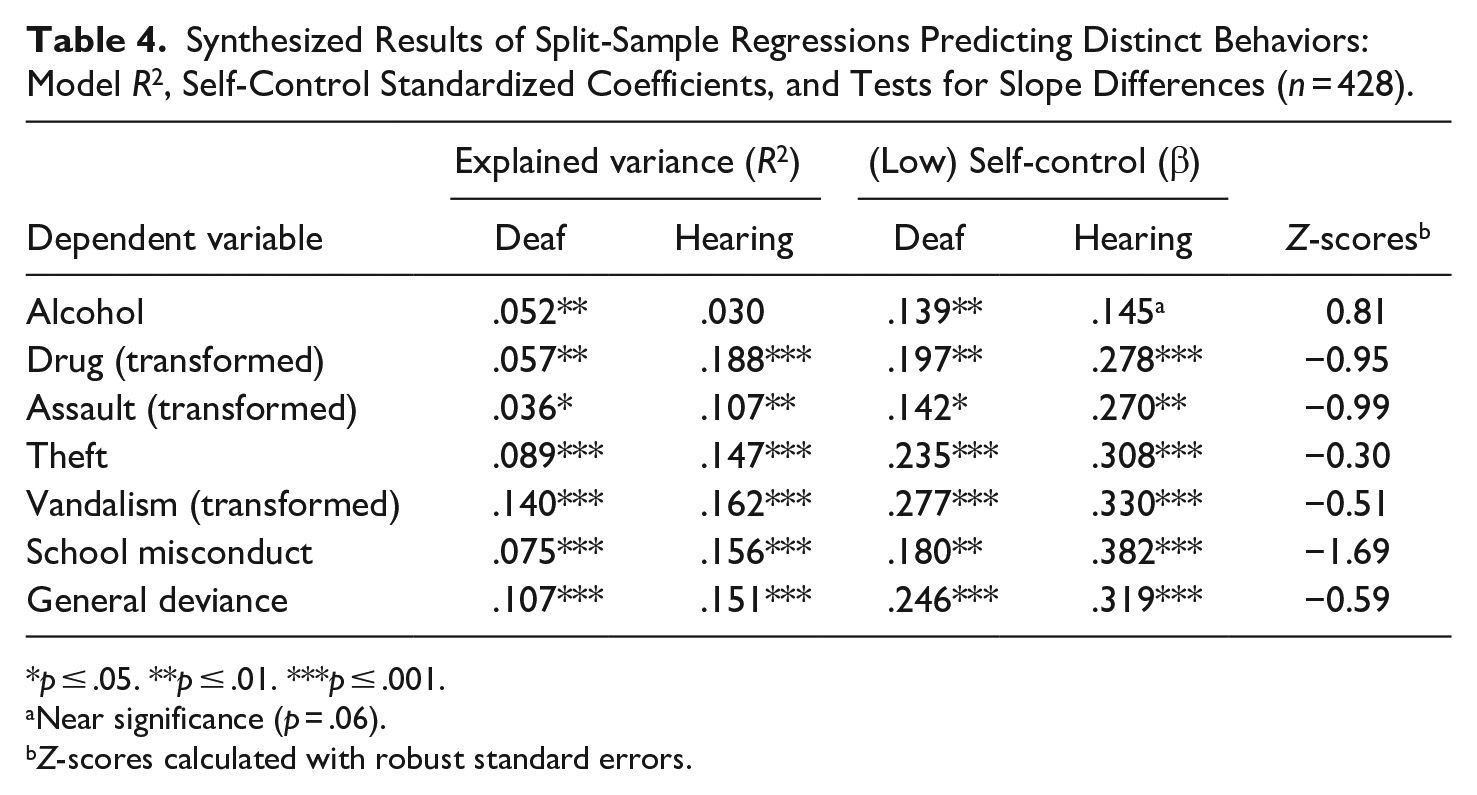
Additional split sample OLS regression tests were performed for each conceptually distinct domain of behavior that forms the norm violation scale—alcohol, drug, assault, theft, vandalism, school misconduct, and general deviance—to further investigate the generality of self-control theory between culturally distinct groups. While most of the behavioral subscales were normally distributed—Alcohol (skewness = −0.12, kurtosis = −0.47), Theft (skewness = 0.38, kurtosis = 0.55), School Misconduct (skewness = 0.53, kurtosis = −0.77), and General Deviance (skewness = 0.87, kurtosis = −0.07)—three dependent variables required mathematical re-expressions before regressions were performed. After the log transformations were computed, the following measures achieved qualities of a normal distribution: Drug (skewness = 0.73, kurtosis = −0.48), Assault (skewness = 0.84, kurtosis = −0.64), and Vandalism (skewness = 0.78, kurtosis = −0.30). Each regression modeled gender, age, exposure to effective parenting techniques, and (low) self-control. Summary results reporting explained variance and standardized regression coefficients for the self-control measure for the seven models are presented in Table 4 above. Additionally, z-scores to test for slope differences are included as well.
Synthesized Results of Split-Sample Regressions Predicting Distinct Behaviors: Model R2, Self-Control Standardized Coefficients, and Tests for Slope Differences (n = 428).
p ≤ .05. **p ≤ .01. ***p ≤ .001.
Near significance (p = .06).
Z-scores calculated with robust standard errors.
Regarding the ability to explain variations in the prevalence of conceptually distinct types of norm-violating behavior, every model tested was statistically significant with the exception of alcohol-related violations among hearing participants. Rank ordering R2 values, from lowest to highest, also finds some level of correspondence between groups in that the model with the lowest amount of explained variance was conduct related to alcohol followed by assaultive behaviors. With the exception of alcohol, the models for the hearing sample consistently outperformed the regression models for Deaf participants in terms of the amount of variation in the dependent variable that could be explained by the variables tested in the model. Concerning how (low) self-control performed as a predictor variable, all beta values were low to moderate in strength and statistically significant but for the alcohol-related norm violations model for hearing participants. Even so, this anomalous finding approached statistical significance (p = .06). Another interesting pattern observed is related to the beta weights, as the level of self-control for hearing participants consistently possessed a greater amount of predictive power on the outcome variables after controlling for all other variables in the model than as compared to models generated for Deaf participants. However, despite this observed pattern, all tests for slope differences were insignificant lending further support for the cultural invariance claim.
Discussion and Conclusion
The findings from this investigation provide empirical confirmation of the cultural invariance hypothesis. Apart from alcohol-related types of behavior, self-control was a statistically significant predictor of every class of norm violating behavior analyzed for each culturally distinct group. Additionally, no significant slope differences were observed for any of the subtypes of norm violating behaviors tested. These findings are consonant with the body of evidence from prior cross-cultural tests where many studies have reported empirical support linking poor self-control to rule-breaking behavior.
Two results from this study failed to support Gottfredson and Hirschi’s theoretical assertions. First, a test examining the relationship between exposure to effective childrearing practices was not a significant predictor of variations in levels of self-control for the sample of Deaf participants. The extant literature finds broad support linking family processes with the formation of self-control among a wide range of culturally distinct groups; however, including the results from this investigation, there have been some exceptions to this general finding for certain cultural groups (see Morris et al., 2007; Smith & Crichlow’s, 2013). Second, while self-control mediated the relationship between parental efficacy for the sample of hearing participants, this did not hold true for the Deaf sample as exposure to effective parenting remained a statistically significant predictor of norm violations.
This study found significantly lower levels of exposure to effective child-rearing practices among the Deaf sample. We would note that there is a body of research that has documented differences in parent-child relationships for Deaf children and their hearing peers. Across a range of age groups, this research has observed differences between these two groups in parent-child communication (Barker et al., 2009), parental involvement (Brubaker & Szakowski, 2000; Dirks & Rieffe, 2019; Ekim & Ocakci, 2016), and disciplinary practices (Knutson et al., 2004; VanOrmer et al., 2019). This literature suggests that parents of Deaf children may exhibit less joint engagement with their children, that their relationships are characterized by less warmth and less autonomy, and that these parents rely on a narrower range of disciplinary practices, including greater reliance on corporal punishment. We encourage future research to investigate how Deaf and hearing populations have differentially experienced child-rearing practices and to further consider the role that these parent-child relationships may play in testing self-control theory.
Additionally, the unexpected findings may challenge the idea that parental management is the only causal force behind the development of self-control. Indeed, prior research suggests the “etiology of self-control may be more complex than the theory specifies” (Meldrum, 2008, p. 244) and, as such, researchers should consider other forces that may help shape levels of self-control. For example, there is some evidence to suggest a biological or genetic basis for variations in self-control (see Beaver & Wright, 2005; Beaver et al., 2013; Boisvert et al., 2012; Unnever et al., 2003). Other environments and social actors outside the home, too, may contribute to the development of self-control such as the school (Turner et al., 2005), deviant peers (Meldrum, 2008), and neighborhood-level social controls (Pratt et al., 2004).
In conclusion, several caveats of this study should be noted. First, the samples were not randomly selected, therefore generalizations about members of the Deaf community and hearing populations based on this study’s findings should be avoided. Second, the cross-sectional nature of this investigation does not permit the establishment of causal sequences. Third, many tests for statistical significance were performed, increasing the probability of a false-positive finding (Type I error). Fourth, potential problems related to recalling experiences with parental management that occurred when respondents were 15 years old introduces a degree of imperfection (error) to the measure. Finally, given the restrictions set forth by the Institutional Review Board, an important limitation of this investigation is the absence of key socio-demographic correlates of norm-violating behavior such as race, ethnicity, and social class. While Gottfredson and Hirschi (1990) argue that self-control can explain any type of crime (analogous) behavior regardless of cultural setting or group characteristics, this study was unable to fully validate this bold theoretical assertion in the absence of these measurable attributes. As such, future research should consider attending to, inter alia, the shortcomings of this current investigation to empirically verify the bold claims made by self-control theory. Moreover, results from future tests of the cross-cultural invariance thesis would be further strengthened if other robust explanations of norm-violating behaviors, such as differential association and strain theories, are allowed to compete against self-control theory.
Footnotes
Appendix A. Modified Normative Deviance Scale Items
Declaration of Conflicting Interests
The author(s) declared no potential conflicts of interest with respect to the research, authorship, and/or publication of this article.
Funding
The author(s) received no financial support for the research, authorship, and/or publication of this article.
