




Abstract
Little research has explored the role of aggression, anger, and family history of incarceration as they relate to female offenders. The current study aimed to address this gap in the literature by investigating these possible risk factors for incarceration among both men and women. The survey involved 123 (61 female and 62 male) prisoners convicted for violent crimes and a comparison group of 118 (60 female and 58 male) adults from the community. We found that women (convicted and non-convicted) were more sensitive to provocation than men, while community adults showed higher levels of trait anger than prisoners. Detainees were more likely than community adults to have a relative in prison. Although male and female inmates were equally likely to have a relative in prison, they differed in their relation to the imprisoned relative. Male and female prisoners showed increased risk for incarceration of same sex, first degree relatives (father and brothers for men, and mothers for women). These results may contribute to improved understanding of incarcerated populations. As such, this represents a critical first step in creating recovery programs that are more gender appropriate.
While women’s representation in prison settings continues to be relatively small (Eurostat Statistic Explained, 2019; Prison Service, 2019), there has been a vivid pattern of increasing representation of women in the prison system in the past few decades. In fact, the probability of imprisoning a female compared to a male has doubled from 1980 to 2008 (Cauffman, 2008), yet females are often not a significant focus in criminological research (Campaniello, 2019). Difficulties conducting prison research, combined with a low rate of violent female inmates has led to a literature on female prisoners that is, at times, incomplete, chaotic, and fragmented (Miszewski, 2016).
Questions about personal and environmental factors related to female crime are among the issues that remain less resolved (Hollin & Palmer, 2006). Traditional policies to reduce crime have often not distinguished between women and men (Campaniello, 2019; Suter et al., 2002) and prison programs and services designed for males are often extended to female inmates with little alteration (Koons et al., 1997 ). This is particularly problematic in light of the fact that both etiological contributors (e.g., Asscher et al., 2015) and the needs of males and females may be very different (e.g., Cauffman, 2008; Fields & Abrams, 2010; Hornsveld et al., 2018; Muller & Kempes, 2016). For instance, a recent study of male and female prisoners in the UK found that women report greater mental health needs in relation to men (e.g., personality disorders, mood disorders, PTSD; Tyler et al., 2019). Improved understanding of female inmates could improve attempts at intervention in this population.
In considering risk factors that may contribute to recidivism for male and female inmates, previous research among female prisoners convicted of violent crimes indicates that women have lower levels of hostility than men, but higher levels of anger (Hornsveld et al., 2018). Similar results, although from a sample involving relatively few violent female participants (12% of females were violent in contrast to 54% of males who were violent), were obtained by Suter et al. (2002). They identified inmate gender differences with regard to both experience and expression of anger. In general, their research using State Trait Anger Expression Inventory (STAXI, Spielberger, 1991), found that women received higher scores than men on state anger, trait anger, angry reaction, angry temperament, anger in, anger out and anger expression. Suter et al. (2002) notes that a similar pattern, with females scoring higher on anger or anger manifestation, has been found in clinical samples. Importantly, research to date suggests that women and men from the community do not differ in terms of trait anger (Archer, 2004; Averill, 1983; Deffenbacher et al., 1996).
Anger has been a considerable focus in the offender literature (e.g., Hornsveld et al., 2018; Lim et al., 2011; Roberton et al., 2015) and it is a risk factor for violent recidivism (Loza & Loza-Fanous, 1999). Studies to date suggest that the prison population is characterized by higher levels of anger than is found in the general population (Schönenberg & Jusyte, 2014; Suter et al., 2002), with level of anger in prison settings approaching levels found in clinical samples (e.g., Jones et al., 1999). Anger is a predictor of aggressive behavior (Smith & Waterman, 2006) and plays a key role in hostile or retaliatory violence (Browne & Howells, 1996; Holbrook, 1997). Anger is associated with increased aggressive behavior under conditions of provocation (Bettencourt et al., 2006), and provocation itself is among the most important causes of aggression (Anderson & Bushman, 2002).
Sensitivity to provocation may also influence the intensity of the aggressive responding (Lawrence & Hutchinson, 2013) Among prisoners, sensitivity to provocation is negatively associated with agreeableness (Zajenkowska et al., 2013), suggesting a tendency to lack trust, to be hostile and irritable, and to have a low regard for others (Costa et al., 1989). Such individuals may also exhibit destructive conflict resolution tactics, such as physical action and threats (Jensen-Campbell & Graziano, 2001). This pattern is consistent with a general tendency for individuals who are prone to provocation to misinterpret social situations as hostile and threatening (Bondü & Richter, 2016), although this tendency is more typical for males than for females (Zajenkowska & Rajchert, 2020).
A rich literature has examined the tendency for children whose parents are engaged in criminal activities to be more likely to be engaged in criminal activities themselves (e.g., Andrews & Bonta, 2010; Hawkins, 2000). Indeed, having a parent imprisoned before turning 10 years old makes it twice as likely that a male youth will commit a crime involving physical assault (Farrington, 1989). In a recent meta-analysis of 23 papers with nearly 3.5 million children, Besemer et al. (2017) confirmed the tendency for individuals with criminal behavior to be more likely to have parents with criminal behavior, with the pattern consistent across more than eight different countries. A range of theoretical explanations for this pattern have been proposed, including social learning theory, environmental influences, biological factors and others (see Besemer et al., 2017).
In fact, it seems most likely that criminal behavior and risk for incarceration is the result of interactions among a host of personal, environmental, and social factors. Anger and sensitivity to provocation may increase the tendency for aggressive responding in a parent (Lawrence, 2006) leading to difficulties with attachment with a child (Bowlby, 1973) and a tendency for overly punitive parenting approaches. In turn, the child may acquire genetic characteristics from the parent that place them at a similar risk for anger and aggression or antisocial behavior (e.g., Raine, 2002), while the child’s experience of aggressive and overly punitive parenting approaches creates an opportunity for simultaneous social learning of aggression (e.g., Bandura, 2073; Farrington, 2011) and maladaptive coping and problem solving. Finally, some parents and their children (who later becomes an adults) are more likely to find themselves in environments and circumstances (e.g., poverty, unsafe neighborhoods) that encourage criminality in both the parents and offspring (Farrington, 2011).
Possible gender specific patterns in this intergenerational pattern still are not well understood. For example, early work focused primarily on risk for male youth (Farrington, 1989), with some indication that imprisonment of a father might have the greatest impact (Baker & Mednick, 1984). Farrington found that imprisonment of a father was predictive of later criminality of a son regardless of arrest circumstances for other relatives (Farrington et al., 2001). Similar research regarding females has lagged a bit (Farrington et al., 2001; Johnson, 1987), but early work has suggested that female inmates are more likely to have convicted mothers than convicted fathers (Farrington et al., 2001). In Besemer et al. (2017) recent meta-analysis, transmission appeared to be strongest from mothers to daughters, then mothers to sons and fathers to daughters, and lowest from fathers to sons.
In summary, prior research has shown that anger and associated vulnerability to provocation, as well as having an incarcerated relative, are risk factors for incarceration. However, details regarding the extent to which these variables play a role for male versus female inmates remains less clear. The aim of the current study is to clarify these uncertainties.
Current Study
The current study evaluated characteristics of female and male detainees in prisons using comparison to female and male individuals in a community sample. Because female inmates are more likely to be convicted for less violent crimes (Campaniello, 2019), we focused only on female and male prisoners convicted for violent offenses such as physical assault, attempted murder, or murder. This approach reduced the potential for confounds related to severity of the crime when making systematic comparisons between male and female inmates. Due to logistics of conducting research within a prison setting, all inmates who met eligibility criteria and were willing to participate were included in the research sample.
Violent crime perpetration may be associated with higher rates of psychopathology (e.g., Hornsveld et al., 2018; Suter et al., 2002), particularly among females, who present higher level of anger than men (Suter et al., 2002). Given this pattern, we predicted that violent female prisoners would present higher levels of trait anger as compared to male prisoners. We did not expect sex differences for non-prisoner (community) adults.
Although it has received very little attention in research with inmates, sensitivity to provocation may be a precursor and risk factor for anger and aggression (Bondü & Richter, 2016; Lawrence, 2006); thus, this variable was a secondary focus in the present study. While research on sensitivity to provocation has produced mixed results with regard to sex differences, there is some evidence suggesting gender differences in brain activation in situations of provocation. It also appears that aggressive men, when provoked, act more automatically than aggressive women (Repple et al., 2018). A meta-analysis on aggression as a function of provocation showed that unprovoked males are more aggressive than females, but when provoked, the differences decrease (Bettencourt & Miller, 1996). Our own studies indicate that women may show greater sensitivity to provocation than men, and it appears that this pattern might vary as a function of cultural features of the country in which the research is conducted (Lawrence, 2006; Zajenkowska et al., 2014). In general, female students have shown higher sensitivity to provocation (SP) than males (Zajenkowska et al., 2013, 2014) but similar research with prisoners found no sex-differences (Zajenkowska et al., 2013). In the current study we examined patterns of sensitivity to provocation in male and female inmates matched to a community sample. Based on past research using the same measure (Zajenkowska et al., 2013, 2014), we expected greater sex differences in SP among adults from the community.
Finally and most importantly, we wanted to compare history of a relative in prison among males and females in both prisoners and a non-prisoner sample to determine whether patterns mirrored those found in past research and whether gender differences in this potential risk factor emerged.
Method
Note on Data
The study was part of a larger research project, for which underlying data can be accessed at apsycholab.pl. All analyses and results reported here are novel. Further reports regarding sensitive to provocation, anger, and their relation to rejection sensitivity are reported in another work by Bodecka and colleagues (2021).
Participants
Participants consisted of 123 male and female inmates from two adult prisons in Poland. Investigators matched this sample to a group of 118 non-prisoners (i.e., “community sample”) based on gender and age. Corrections officers, on the basis of judicial documents, identified persons who were convicted of violent crimes (murders, attempted murders, brawls, robberies) and invited them to participate in the study. Individuals who agreed to take part in the survey 1 were scheduled to meet with the researcher. There were no age differences between the prisoners and the community group t(224.25) = 1.20, p = .23), but groups significantly differed on education (see Table 1), as outside prison, it was difficult to recruit older individuals with lower educational backgrounds to the study. Low education is one of the risk factors for imprisonment (e.g., Andrews & Bonta, 2010; Hawkins, 2000); both community and prison samples appeared to be representative of the larger population from which they were selected.
Demographics for Offender and Community Samples.
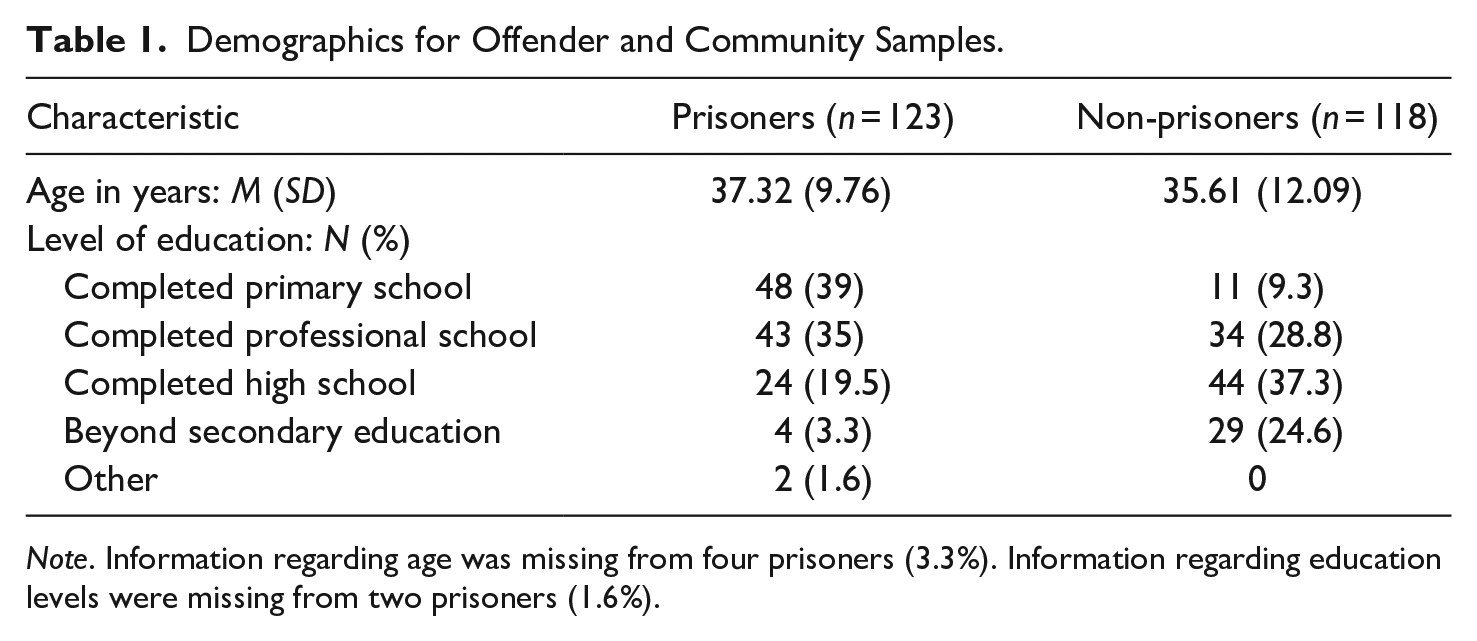
Note. Information regarding age was missing from four prisoners (3.3%). Information regarding education levels were missing from two prisoners (1.6%).
All prison participants were Polish, and most of the prisoners lived in towns or cities (92% female, 76% male) before imprisonment. Some of them were in relationships (38% female, 26% male), while others were single (33% female, 54% male), and some had experienced broken relationships (divorce or death of the spouse—29% female, 20% male). For inmates, the average age was 37.32 years (SD = 9.76l, range 19–65 years). There were no significant differences with regard to age as a function of sex t (116.07) = 0.457, p = .649. Women had fewer prior convictions (t (115.97) = 7.64, p < .001) than men, and they were significantly older when they were first convicted (t (120) = 4.71, p < .001; see Table 2).
Conviction Statistics for Female and Male Inmates.
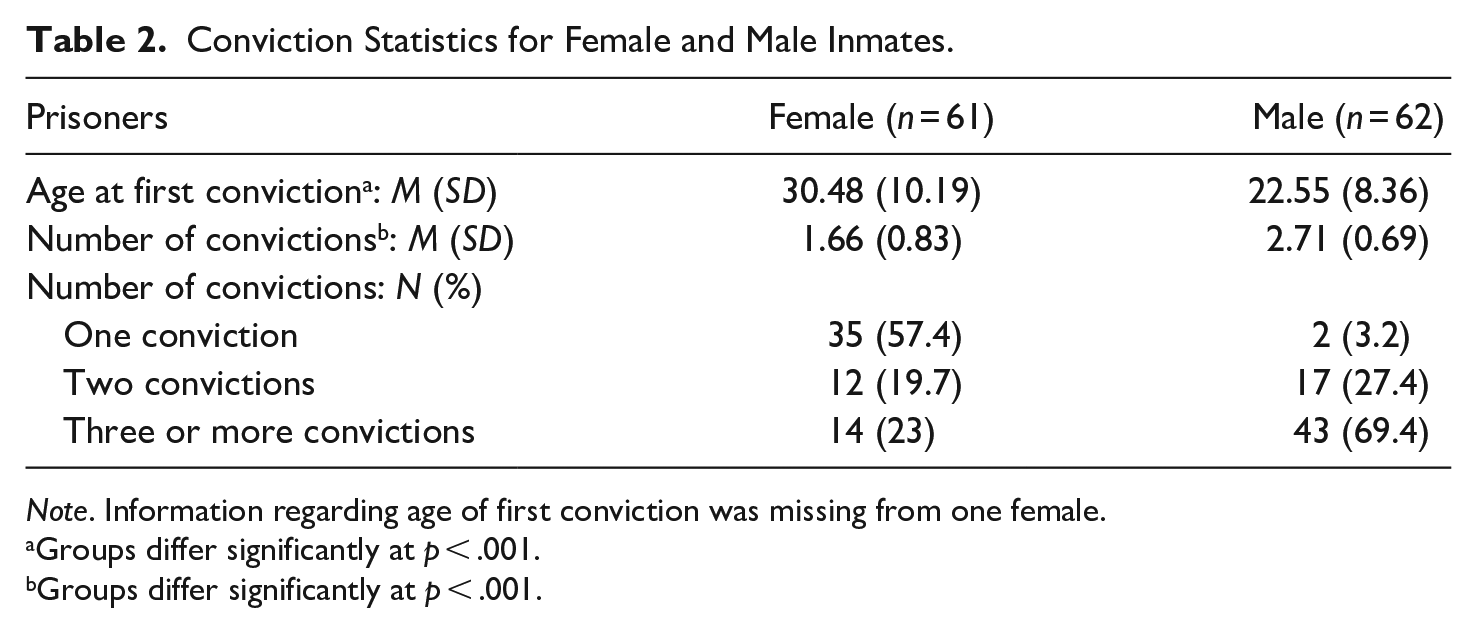
Note. Information regarding age of first conviction was missing from one female.
Groups differ significantly at p < .001.
Groups differ significantly at p < .001.
The community sample had 118 participants (60 female). The average age was 35.61 years (SD = 12.08, range 23–80 years); there were no sex differences with regard to age t (110.59) = −0.65, p = .52. Individuals from this group were recruited via social media or asked directly by investigators in their community to take part in a larger study. Most of the community sample, like prisoners, came from a town or city (68% female, 88% male), and there was also diversity in terms of close relationships (48% female and 41% male were single; 43% female and 57% male were in a relationships; 9% female and 2% male had a broken relationship).
Measures
Participants in the study completed a series of measures as part of a larger research project. Sensitivity to Provocation was measured using The Situational Triggers of Aggressive Responses (STAR) scale (Lawrence, 2006). The full questionnaire consists of 22 items (10 reflecting Sensitivity to Frustration—SF and 12 reflecting Sensitivity to Provocation—SP). For the purpose of this study we used only the SP subscale. Items included: a friend betrays me; I am the subject of a practical joke; someone insults me, someone behaves in an inconsiderate manner toward me, someone makes offensive remarks to me. Participants provided a rating of how aggressive each of the 12 situations typically made them feel using a 5-point, Likert scale. This instrument has high internal consistency (α = .82 for SP) and has demonstrated validity in past research (Lawrence, 2006). It has also been used successfully in previous research in Poland (e.g., Zajenkowska & Konopka, 2015; Zajenkowska et al., 2013). Cronbach’s alpha in the present research was α = .89. Anger was assessed using The State-Trait Anger Expression Inventory—STAXI-2 (Spielberger & Reheiser, 2003), which is a well-established measure of anger that has been used extensively in past research (Howells et al., 2005; Roberton et al., 2015; Velotti et al., 2017). The STAXI-2 contains 57 items comprising three scales (state anger, trait anger, and anger expression/control). Only the trait anger section was used in this study. This scale uses 10 items to assess how frequently angry feelings are experienced over time. Likert responses ranged from 1 (almost never) to 4 (almost always). The STAXI-2 has been validated in a forensic sample (Etzler et al., 2014) and adapted for use in Poland, where the reliability of each scale has been shown to be high (on average α = .80; Bąk, 2016). Analyses confirmed similar reliability in the present study (α = .89).
Information about family members was collected through questions: “Has anyone in your family ever been convicted?” and “Who was that person to you?”
Procedure
The study used a quasi-experimental research design. All participants completed structured and standardized self-report questionnaires. Individual measurements were conducted in designated rooms of the facility (in prison, it was usually a common room) by trained, senior psychology students from the research team. Participants who were interested in participating were provided an overview of the study and offered the opportunity to participate. If they chose to participate, they were informed that they could discontinue without penalty at any time. Participants were also informed that their responding would be confidential and that their responses would not be revealed to anyone. Upon completion of the questionnaires, participants were debriefed and thanked for their participation. The research study was approved by the university ethics committee and the prison directors.
Results
To determine whether prisoners and non-prisoners differed in terms of sensitivity to provocation and anger, a MANOVA was conducted. For this analysis, group (prisoners and non-prisoners) and gender were included as the between-subject variables, and sensitivity to provocation (STAR) and anger (STAXI-2) 2 were the within-subject variables. The analysis revealed a main effect of gender in case of STAR F(1, 237) = 10.54, p = .001, η2p = .043, such that women (M = 3.77, SD = 0.08) were more sensitive to provocation than men (M = 3.43, SD = 0.08); the main effect of prisoner versus non-prisoner group was not significant. In the case of Anger (STAXI-2), analyses were significant F(1, 237) = 3.92, p = .49, η2p = .016, with non-prisoners (M = 2.48, SD = 0.06) showing higher levels of trait anger than prisoners (M = 2.30, SD = 0.06). The interaction effect between group and gender was non-significant in the case of both STAXI-2 (p = .76) and STAR (p = .61).
A chi-square test of independence was performed to examine the relation between group membership (prisoners and non-prisoners) and likelihood of having an imprisoned relative. The relation between these variables was significant,
Relatives in Prison of Female and Male Prisoners.

Note. Information regarding relatives in prison was missing from two male.
The categories are separable.
Discussion
The present study focused on examining psychological and environmental characteristics of female and male prisoners that may be associated with risk for recidivism, and comparing these characteristics to those of females and males in a community sample. Both community and inmate females showed greater sensitivity to provocation than males, but there were no sex differences in trait anger. The community sample showed higher levels of anger than prisoners. With regard to family history of incarceration, detainees were more likely than adults from the general population to have a relative in prison. While female and male inmates were equally likely to have a relative in prison, female inmates’ and male inmates’ relationship to the imprisoned relative differed: females were more likely to have an imprisoned mother or father, while males were more likely to have an imprisoned father or brother.
Our findings highlight the fact that sensitivity to provocation and trait anger are related but not identical constructs (Bondü & Richter, 2016). Individuals who are sensitive to provocation react strongly to external triggers, and those triggers may result in feelings of anger and reactive aggression (Lawrence, 2006). In turn, individuals characterized by a heightened anger trait experience a state of anger more frequently and more strongly, but this is not necessarily situation related, and it may be due to temperament (Bąk, 2016).
Our findings regarding gender differences with regard to these two characteristics are largely consistent with patterns reported in previous research. For example, the finding that females are more sensitive to provocation than males is consistent with previous research where female students (e.g., in Poland, Greece) were more likely than male students to report feeling aggressive as a result of direct provocation (Zajenkowska et al., 2014). Similar patterns have also appeared in research on aggressive feelings and beliefs in violent inmates in the UK (Archer & Haigh, 1997). On the other hand, the lack of sex differences in terms of anger in inmates convicted of violent crime are consistent with previous studies finding no gender differences in the frequency, intensity and duration of the reported anger in general population (e.g., Archer, 2004).
Previous research on sensitivity to provocation among prisoners did not find the sex difference that were apparent in our present study (Zajenkowska et al., 2013). Differences may reflect variations in the prisoner samples, since this current study (unlike the previous one) focused only on the most violent female and male inmates. Future research may wish to explore the possibility that gender and resulting social roles may be more important predictors of differences in trait anger and sensitivity to provocation than having been convicted of a violent crime.
The pattern of sex differences with anger may require further exploration. It is possible that, particularly for women, “anger” is also expressed or experienced in other closely-related, yet somewhat distinct, emotional forms (e.g., irritation, frustration, annoyance). In fact, narrative studies with teenage men and women show sex differences in anger perception. Unlike male teenagers, teenage women often see anger as a “burden” (Budziszewska & Hansen, 2019). Our data raise the possibility that the variability in the experience of angry feelings in reaction to provocation within gender could be greater than between genders, since individuals may subjectively experience anger very differently (Shields, 2013).
Surprisingly, prisoners in the present study were less angry than adults from the community sample (the result is on the verge of a statistical trend). It is possible that, due to the prison context in which the study took place, inmates experienced a process of habituation to a variety of provocation events, which led to a lower level of experienced anger. It is also possible that the prison setting induces a sense of lack of control (i.e., learned helplessness), resulting in a lower level of the motivation or drive that is often the source of anger (Harmon-Jones et al., 2013). The possibility that this leads to reduced anger and frustration in inmates (e.g., Carver & Harmon-Jones, 2009) needs further attention.
We cannot rule out the possibility that the low ratings of anger among inmates may have been influenced by measurement factors. The State-Trait Anger Expression Inventory - STAXI-2 (Spielberger & Reheiser, 2003), although widely used in forensic research is considered susceptible to impression management. McEwan et al. (2009) have demonstrated that socially desirable response bias may be associated with lower reported anger in forensic samples. In spite of this, self-report is typically used to assess anger in offender populations (e.g., Hornsveld et al., 2018; Howells et al., 2005; Roberton et al., 2015), and assurances that responses would be confidential may have served to attenuate tendencies for socially desirable responding in the present study. However, future studies on anger in prisons may benefit from the inclusion of physiological measures (e.g., galvanic skin response or pupil dilation) which may be less amenable to socially desirable responding.
As expected, prisoners were more likely than non-prisoners to have a relative in prison. Our data are consistent with research that crime is often nested within families, so that incarceration of one family member increases the likelihood that another family member will also experience incarceration (e.g., Farrington et al., 2001; Kiliszek, 2013). The increased family history of incarceration among inmates may reflect a tendency for social learning of aggressive behavior (Bandura, 1973; Lefkowitz et al., 1977) from parent figures in the home. It is also possible that transfer of imprisonment is associated with the development of a tendency to hostile attributions that increase the risk of aggressive behavior (Crick & Dodge, 1994) and that are acquired during interaction with the caregiver and during socialization (Dodge, 2006). Finally, it is clear that the probability of a child being imprisoned can be increased by the absence of the father in the family home (Harper & McLanahan, 2004), which could be related to loss of security, lower self-esteem or poverty (e.g., O’Neill, 2002).
The tendency for male and female prisoners to show increased risk for incarceration of same sex, first degree relatives (father and brothers for men and mothers for women) may reflect an increased tendency for children to model the behavior of the same-sex parent. Consistent with this notion, a good relation with the same-sex parent can be a protective factor against criminal activity (Laible & Carlo, 2004). Indeed, fathers may play a critical role in shaping the trajectories for children of both genders: Hoeve et al. (2009), provide evidence that poor paternal support is more strongly related to child criminality than poor maternal support. However, fathers appear to have more influence on their sons’ delinquency than mothers. Similarly, with regard to interventions, parental training sessions in which the father participates are more effective than those in which the mother is alone (Lundahl et al., 2008).
Limitations and Future Research
While attempts were made to match our group of prisoners to a community sample for comparison, there were educational differences between the group of inmates and the community sample. The prisoner sample consisted of a number of individuals with primary or vocational education, which is consistent with the tendency for low educational level to be one of the most significant risk factors for imprisonment (e.g., Wasserman, 2003). Unfortunately, it proved difficult to recruit adults with limited education for the community sample. As a result, differences between prisoner and non-prisoner groups (e.g., family history of incarceration) may have been influenced by educational level. Additionally, we did not receive information from the prison authorities regarding the rates at which inmates declined to take part in the study. It is possible that individuals with specific psychological characteristics (e.g., higher agreeableness) were more likely to participate, so attention to such sampling characteristics would be important in future research.
A second limitation was that our reliance on self-report of anger may have led to underreporting of anger this inmate population. Although this possibility cannot be ruled out completely, research using the same self-report instrument found higher rates of anger for incarcerated offenders in Italy and Australia than those living in the community on parole (Velotti et al., 2017). While cultural differences make direct comparisons difficult, this finding attenuates some of the concern that inmates may be simply unwilling to report anger. Additionally, violent versus nonviolent inmates have shown expected differences in anger scores on this instrument in past research, a finding that further supports the validity of this instrument for use in the prison population (Lim et al., 2011). Future work with prisoners may consider the possibility of using physiological responding or qualitative approaches to better understand anger in this population.
Conclusion and Policy Implications
Despite its limitations, our study highlights several important findings. First, it appears that differences in trait anger and sensitivity to provocation between prisoners and the community are not as large as commonly believed. Often differences between inmates and non-inmates are assumed a priori, but there are not many studies that compare forensic groups with the general population. Additional research comparing mechanisms of action of individual traits for inmates and non-inmates, as well as their interactive effects with the situational context, would be useful. While we found patterns by which women (both inmates and non-inmates) showed stronger sensitivity to provocation than men, the implications of this pattern in offender populations remain unclear. The possible impacts of this sensitivity for social dynamics of female prisoners both while incarcerated and upon release, warrants further consideration. Additionally, to the extent that decreased anger in inmate populations (compared to community samples) might reflect a pattern of learned helplessness, this raises concerns about whether inmates who are incarcerated maintain the degree of self-efficacy that may be required for successful re-engagement in society and re-integration to the community upon release. Finally, further exploration of the impacts of parent imprisonment on socialization and development of children within the home are warranted. For example, our data suggest that prevention programs might benefit from increased attention to incarcerated first degree relatives of inmates, who may find themselves on the fringes and at risk of entry to the criminal justice system.
In conclusion, continued work to identify unique characteristics and needs of male and female inmates can only improve our ability to meet the needs of these offender populations via primary and secondary prevention, as well as during incarceration and upon release. As our understanding of the complex and interactive processes that lead to criminal behavior and incarceration improve, intervention programing can better target the ways in which the family histories, social experiences, and personal characteristics of male and female prisoners shape their developmental trajectories (e.g., Dixon et al., 2004; Roberton et al., 2015).
Footnotes

Declaration of Conflicting Interests
The author(s) declared no potential conflicts of interest with respect to the research, authorship, and/or publication of this article.
Funding
The author(s) disclosed receipt of the following financial support for the research, authorship, and/or publication of this article: This work was supported by the National Science Centre under Grant [UMO-2017/26/D/HS6/00258].