




Abstract
The adjustment of prison inmates is recently becoming a social concern. In the current study we focused on the role of gratitude, interpersonal forgiveness, and anger, which have been widely addressed as likely to influence people’s health and adaptive behaviors, in shaping prison inmates’ psychological wellbeing and criminal attitudes. Participants were 104 male prison inmates aged between 24 and 75 (Mage = 46.63, SD = 11.38) imprisoned in Northern Italy who were asked to fill in an anonymous self-report questionnaire. Results highlighted that all dimensions considered play an important, albeit different and highly specific, role; Gratitude is a promotional factor that enhances psychological wellbeing, whereas interpersonal forgiveness appears to be a protective factor against the adoption of a criminal attitude as violence or antisocial intent. Finally, anger is a risk factor toward both psychological wellbeing and violent behaviors. Implications of these results and further developments of the study are discussed.
Introduction
According to the Italian Justice Department, in Italy there currently are over 53,000 prisoners (Ministero della Giustizia, 2021). The mental health of prison inmates is recently becoming a social concern and public issue that needs to be faced. Indeed, recent literature on this topic has shown how prisoners overall report low levels of general psychological wellbeing (Fazel & Seewald, 2012). According to a systematic review carried out on a sample of 23,000 prison inmates, there are high rates of psychiatric morbidity among prisoners, whereas 11.4% are affected by major depression (Fazel & Seewald, 2012). Results from a cross-sectional study carried out in Italy among 990 prisoners showed a similar pattern of results; Indeed, 19.3% of respondents had one or more current mental disorder (Carrà et al., 2004). More interestingly, Macciò et al. (2015) compared a group of 300 detainees held in an Italian prison with a similar group of controls and found that the former presented a significantly higher prevalence of psychiatric and stress-related disorders if compared to the latter.
Beside this, prison inmates may also show high levels of aggression (e.g., Cima et al., 2008; Falk et al., 2017). More specifically, criminal attitudes and antisocial intents of prison inmates have shown to be related to a greater risk of recidivism (Mills et al., 2004). Despite some sociodemographic variables as prisoners’ age and gender have been found to be directly related to their violent recidivism (Piquero et al., 2015), a recent study carried out on a sample of adult offenders interestingly highlighted how their reported maladaptive emotion regulation was likely to be positively associated with histories of aggression (Roberton et al., 2014). According to a study carried out on 635 adult Spanish offenders, the inmates’ criminal history and antisocial pattern were predictive of violent recidivism (Nguyen et al., 2011).
Based on all the above considerations, it becomes of crucial importance to find possible risk factors and useful resources for prison inmates to face the challenges for psychological wellbeing and the risk for adoption of violent and/or antisocial behaviors which are in turn likely to cause recidivism. We aimed therefore at integrating the theoretical framework of traditional criminology, mainly focused on those factors which lead to deviant behaviors, with a new conceptual perspective of criminology, namely positive criminology (Ronel & Elisha, 2011, 2020), where the focus is instead on positive experience and on factors which distance from deviance and crime. Indeed, positive criminology may provide a spiritual horizon that allows people to reduce self-centeredness in order to find a higher meaning in daily life (Ronel & Segev, 2014).
Past research has found that positive psychological constructs are positively related to inmates’ mental health (e.g., Randall & Bishop, 2013; Wong et al., 2017). Accordingly, in the current study we focused on the role of trait gratitude and trait forgiveness, which have been widely addressed as positive psychological constructs likely to influence people’s health and adaptive behaviors, in shaping prison inmates’ psychological wellbeing and criminal attitudes. However, also negative psychological constructs are likely to contribute to explain these outcomes; among others, we specifically focused on trait anger.
Gratitude
Gratitude has been defined as “a generalized tendency to recognize and respond with grateful emotion to the roles of other people’s benevolence in the positive experiences and outcomes that one obtains” (McCullough et al., 2002, p. 112). It has important implications in psychological adaptation and wellbeing (for a review see Alkozei et al., 2018); for example, the higher is the level of gratitude, the lower tend to be the levels of depression and anxiety (e.g., Lambert et al., 2012) and the higher life satisfaction is (e.g., Robustelli & Whisman, 2018).
Gratitude was found to have positive effects in studies carried out on prison inmates as well, where it may reduce psychological distress and aggressive attitudes and behaviors. Specifically, Yang et al. (2018) tested the effectiveness of a gratitude intervention where 144 prison inmates in China were asked to recall and write down on a daily basis three events for which they felt grateful. The authors found that the intervention significantly increased prisoners’ wellbeing especially when compared to a control group who did not take part to any intervention. Differently, Wong et al. (2017) in their study carried out on a sample of 97 American male inmates found that positive benefit appraisals and positive reframing were indirectly related to a greater psychological wellbeing as mediated by state gratitude.
The effects of gratitude interventions for prison inmates are not only limited to psychological wellbeing. Indeed, a recent study proposed by Deng et al. (2019) carried out on 104 prisoners found that participants in the “Gratitude-sharing” and “Blessing-counting” conditions displayed significantly lower levels of aggression than the control conditions. That is, doing the “exercise” of sharing the reasons why they felt grateful in a group context or counting their blessings in their lives lowered prisoners’ levels of aggression.
Forgiveness
Similarly to gratitude, interpersonal forgiveness has been consistently found to be a significant positive predictor for mental health and psychological wellbeing (e.g., Hill et al., 2015). Forgiveness has been conceptualized as the “juxtaposition or superimposition of strong, positive, other-oriented emotions over the negative emotions of unforgiveness” (Berry et al., 2005, p. 186). With regards to victims of offense, forgiveness may be considered as a real coping strategy capable of positively influencing their mental health as a consequence of the offense suffered (Griffin et al., 2015). The personal disposition to forgive is also positively linked to life satisfaction, especially for older adults; Differently, for respondents aged between 31 and 40 years it seems to play a crucial role the possibility to reduce one’s own unforgiveness in order to promote life satisfaction (Kaleta & Mróz, 2018).
The role of forgiveness has also been recently, albeit limitedly, investigated with specific attention to the prison population. Indeed, Erzar et al. (2019) suggested that levels of forgiveness depend on the type of injustice perceived and that prison inmates tend to show lower levels of forgiveness when compared to non-offender samples. With specific regards to the wellbeing of prison population results are inconsistent; indeed, previous research has highlighted that forgiveness does not predict anxiety or depression in prison inmates (Allen et al., 2008), but forgiveness of others seems to play a relevant role in positively influencing the evaluation of life (Randall & Bishop, 2013). Interestingly, recent works have strongly supported the possibility to develop interventions for prison inmates specifically focused on forgiveness capable of promoting wellbeing, positive social relationships and quality of life, and reduce recidivism (Forgiveness Therapy; see e.g., Akhtar & Barlow, 2018; Day et al., 2008; Enright et al., 2016; Praptomojati & Subandi, 2020). According to this perspective, focusing on forgiveness through the empirically verified intervention of Forgiveness Therapy with prison inmates would allow to reduce negative states as anxiety and depression. Results from this kind of intervention also showed promising effects in enhancing prison inmates’ self-acceptance (Praptomojati & Subandi, 2020). Additionally, due to the documented relation between forgiveness and the reduction of aggressive behaviors (e.g., Webb et al., 2012) this specific kind of intervention may also influence the prison inmates’ behaviors in this desired direction as well.
Anger
Trait anger has been defined as a general disposition to experience anger frequently and intensively. All in all, it is assumed to be a quite stable disposition which does not vary across different life situations. In prison settings, which are highly characterized by denying resources, research has specifically shown that anger and frustration are likely to arise (Trammell et al., 2021). This makes particularly relevant for this specific population to consider their anger levels which are likely to affect their subsequent states and behaviors.
According to previous studies on the topic, high levels of anger and the inability to regulate it are positively related to problematic behaviors and misconducts, also including aggressive and/or violent behavior (Blair, 2012), which has led policymakers to consider anger as relevant mental health issue (Howells et al., 2002). Moreover, the capability to manage and cope with one’s own anger was found to be in positive relation with good levels of mental health especially among older adults (Phillips et al., 2006).
With specific regards to the prison inmates, anger may play a key role in exacerbating violent and aggressive behaviors (e.g., Humber et al., 2013; Suter et al., 2002) and to enhance psychological distress (Humber et al., 2013). This is the main reason why for a long time training focused on anger management have been considered as valid tools in order to prevent undesired behaviors (see e.g., Breiner et al., 2012; Holbrook, 1997). Indeed, research has shown how psychological treatment with male forensic patients was particularly important when targeting prison inmates’ anger and violent behaviors (e.g., Evershed et al., 2003). However, the effects of anger on prison inmates appear to be not fully consistent; in a study carried out on 67 male incarcerated offenders, researchers showed how venting anger may have different effects depending on the kind of prisoner considered. Indeed, it reduces the aggression among forensic psychiatric offenders while an opposite pattern of relations was found among penitentiary offenders (Tonnaer et al., 2020).
The Current Study
From the brief overview of the literature presented so far, it is possible to highlight the benefits of positive psychological traits as gratitude and forgiveness for the prison population, as well as the potential risks caused instead by trait anger on psychological wellbeing and on aggressive and/or antisocial attitudes and behaviors. However, to the best of our knowledge no studies have simultaneously considered these three dimensions and did not therefore consider the unique effects of different traits as gratitude, interpersonal forgiveness, and anger within the prison population. According to the available literature, these are highly interrelated among them; More specifically, both in general and clinical samples gratitude and forgiveness have been shown to be positively related among them (e.g., Neto, 2007; Toussaint & Friedman, 2009). Gratitude and forgiveness have both been also shown to be negatively related to anger (Erzar et al., 2019; Ford et al., 2018). It follows that it is highly important to understand whether and the extent to which each of these traits uniquely predicts well-being and criminal attitudes in order to comprehend on what kind of intervention it is important to lean on.
Based on all the above considerations, the aim of the current study was to consider the unique contribution of trait gratitude, trait forgiveness, and trait anger in predicting prisoners’ psychological wellbeing on the one hand and criminal attitudes on the other, thus integrating the focus of both traditional and positive criminology. Specifically, we hypothesized that, when controlling for the other traits, gratitude and interpersonal forgiveness promote wellbeing (H1) while discouraging instead criminal attitudes (H2). Conversely, anger was expected to be a negative predictor of wellbeing (H3) and a positive predictor of criminal attitudes (H4).
Method
Participants and Procedure
Participants were 113 male prison inmates imprisoned in Northern Italy; 104 of them fully responded to the self-report questionnaire administered. They were aged between 24 and 75 (Mage = 46.63, SD = 11.38). On average participants had already spent in jail 9.37 years (SD = 7.94, range 1–42), whereas they still had to serve 18.4 years (SD = 28.22, range 1–100). About 49.4% of participants committed a murder, followed by robbery (13.3%), sexual abuse (12%), attempted murder (7.2%); the rest of them (18.1%) committed other kinds of crime. Most participants were Italian (77.9%), while the others had been living in Italy on average for 17.22 years (SD = 11.53, range 5–50). Around 94.2% of participants was visited by relatives on a regularly basis (weekly for 70.4%).
Participants were recruited through the collaboration of the prison in Northern Italy where they were imprisoned. This prison is widely known for being highly characterized by providing the inmates with opportunities in terms of trainings, study, and work activities. Specifically, participants were contacted by the professional educators working in the penitentiary based on their availability (e.g., not involved in other activities) at the moment of data collection. Overall, 150 participants were contacted and 113 filled in and returned the questionnaire; of those, 104 fully responded to all scales (response rate: 69.3%). Participants were informed about the main objectives of the study and were advised that their participation was free and voluntary. Participants who provided their informed consent were asked to fill in an anonymous paper self-report questionnaire in the presence of a research staff member. This study followed the AIP ethical guidelines for research.
Measures
Sociodemographic information
Participants were asked questions about their personal (age, nationality, and years living in Italy) characteristics, as well as their experience in jail (years spent in prison, years to serve, crime committed, visits of relatives).
Gratitude
We measured trait gratitude using the Italian adaptation of Gratitude Questionnaire-6 proposed by Caputo (2016). The scale measures the degree to which a person is grateful about life and other people. An item example is: “I have so much in life to be thankful for.” Participants were asked to rate on a 6-point Likert scale (from 1 = strongly disagree to 6 = strongly agree) the extent to which they considered each statement as true in their life. Internal consistency of the scale measured through Cronbach’s alpha was found to be acceptable (α = .74).
Forgiveness
In order to measure participants’ interpersonal forgiveness, we used the Trait Forgivingness Scale (TFS; Berry et al., 2005), which is a 10-item scale which considers the respondent’s self-appraisal of his/her proneness to forgive interpersonal transgressions. An item example is “I can forgive a friend for almost anything.” Respondents were asked to provide their answer on a 6-point Likert scale (from 1 = strongly disagree to 6 = strongly agree). Internal consistency of the scale measured through Cronbach’s alpha was found to be acceptable (α = .74).
Anger
To measure participants’ trait anger we used the 10 items of the trait anger dimension of the State-Trait Anger Expression Inventory-2 (STAXI-2; Spielberger, 1999) which measures how frequently angry feelings are experienced over time, this assessing a disposition to experience anger (range 10–40). An item example is “I am bad tempered.” Responses are made on a 4-point Likert scale which ranges from 1 (almost never) to 4 (almost always). Internal consistency of the scale measured through Cronbach’s alpha was found to be good (α = .80).
Wellbeing
To measure participants’ level of wellbeing we used the short version of the Psychological General Well-Being Index (PGWB-S) as proposed by Grossi et al. (2006). Specifically, this is a six-item measure which provides an overall score of the respondents’ wellbeing. An item example is: “I felt cheerful, lighthearted during the past month.” Respondents rated on 6-point Likert scale (from 0 = never to 5 = always) the extent to which they have felt in the way described in the past month. The total score of wellbeing was obtained by summing the responses to all six items, with higher scores indicating higher levels of wellbeing. The results were then transformed in order to obtain scores ranging from 0 to 110, comparable to the longer version of the scale (Grossi et al., 2006). Internal consistency of the scale measured through Cronbach’s alpha was found to be acceptable (α = .79).
Criminal attitudes
The Measures of Criminal Attitudes and Associates (MCAA; Mills & Kroner, 1999) was used to measure respondents’ criminal attitudes. Specifically, for the aim of the current study we only used some items of the second part of the scale assessing three dimensions: Violence (Item example: “Someone who makes you very angry deserves to be hit,” α = .82), namely an endorsement of attitudes that are supportive of violence, Antisocial Intent (Item example: “I could easily tell a convincing lie,” α = .81), namely the potential antisocial actions that the respondent believes that he/she could commit in the future, and Entitlement (Item example: “Only I should decide what I deserve,” α = .65), that are the attitudes focusing on a right to take whatever one wants. For the aim of the current study, respondents were asked to rate on a 6-point Likert scale (from 1 = strongly disagree to 6 = strongly agree) the extent to which they agreed with each of the statement presented.
Data Analysis
We first described the study variables (participants’ gratitude, interpersonal forgiveness, anger, wellbeing, and criminal attitudes) in terms of means, standard deviations, and ranges and then we calculated bivariate Pearson correlations among them. To assess the extent to which prison inmates’ gratitude, interpersonal forgiveness, and anger were uniquely associated with their wellbeing and criminal attitudes we performed multiple regressions (MR) with gratitude, forgiveness, and anger as predictors. One regression model was performed for each criterion variable: wellbeing, violence, antisocial intention, entitlement. Throughout MR, we estimated the overall R2 and determined the statistical significance of individual regression coefficients.
Results
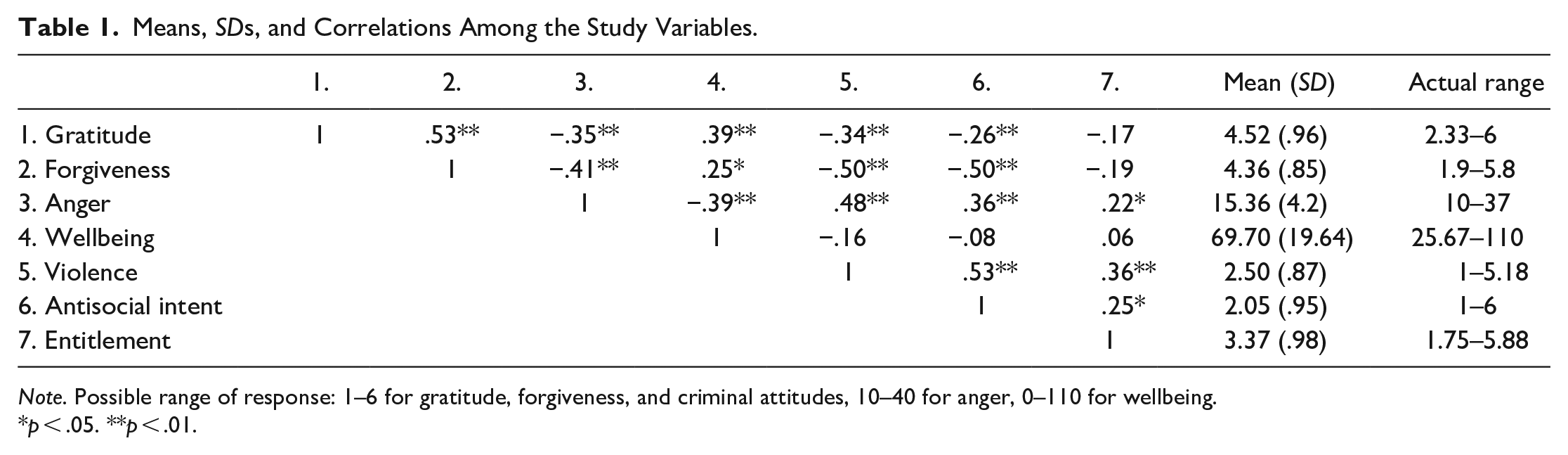
Means and standard deviations of the study variables ant their intercorrelations are reported in Table 1.
Means, SDs, and Correlations Among the Study Variables.
Note. Possible range of response: 1–6 for gratitude, forgiveness, and criminal attitudes, 10–40 for anger, 0–110 for wellbeing.
p < .05. **p < .01.
Respondents reported medium to high levels of trait gratitude, forgiveness, and also wellbeing. Compared to previous studies on Italian community samples of this same age range (Grossi et al., 2006), participants showed similar levels of wellbeing. They instead reported low levels of trait anger, statistically significantly lower compared to previous studies which involved male prisoners aged 40 on average (e.g., Roy et al., 2014; Velotti et al., 2017). Descriptive statistics revealed also medium to low scores of violence and antisocial intent, and medium levels instead of entitlement. Antisocial intent and entitlement were higher if compared to previous studies on male criminal offenders (e.g., Bäckström & Björklund, 2008).
Gratitude and forgiveness were strongly positively correlated among them, while they were both negatively correlated to anger. Gratitude also showed respectively moderate positive and negative relations with wellbeing on the one hand and violence and antisocial intent on the other. Forgiveness showed the same mentioned relations, albeit those with criminal attitudes being bigger in size, with the negative correlation with violence and antisocial intent being large. Anger was instead moderately and negatively correlated to wellbeing, and positively related to all dimensions of criminal attitudes considered. Wellbeing did not show any statistically significant relation with criminal attitudes, which were instead positively and moderately (strongly in the case of violence and antisocial intent) correlated among them.
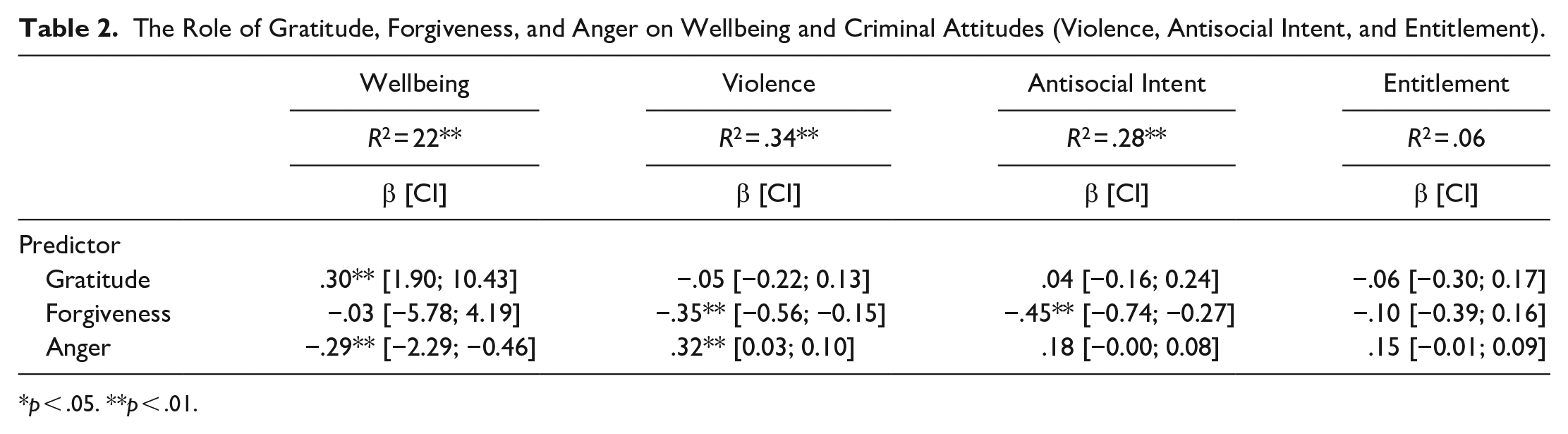
From the four different regression models we found different statistically significant relations (see Table 2). Specifically, trait gratitude was positively related to respondents’ wellbeing, whereas trait anger was negatively related to this outcome. Trait forgiveness showed instead statistically significant negative relations both with violence and with antisocial intent. Anger showed instead a statistically significant positive relation with violence. Differently, entitlement did not appear to be associated with any of the considered predictors. 1
The Role of Gratitude, Forgiveness, and Anger on Wellbeing and Criminal Attitudes (Violence, Antisocial Intent, and Entitlement).
p < .05. **p < .01.
Discussion and Conclusions
The aim of the current study was to investigate the role of traits as gratitude, interpersonal forgiveness, and anger—which have been widely addressed as psychological constructs likely to influence people’s health and adaptive behaviors—in shaping prison inmates’ wellbeing and criminal attitudes. Indeed, the mental health, and the adaptation of the prison population, who is constantly increasing, is strongly becoming a public social concern.
Past research has found that positive psychological constructs serve to foster mental health. Based on previous research on these positive psychological constructs, gratitude, and interpersonal forgiveness play an important role in influencing general population both psychological wellbeing and aggressive behaviors (e.g., Griffin et al., 2015; Hill et al., 2015; Lambert et al., 2012; Robustelli & Whisman, 2018; Webb et al., 2012). Similarly, gratitude and forgiveness are likely to promote prisoners’ psychological wellbeing (e.g., Praptomojati & Subandi, 2020; Yang et al., 2018) and lower their levels of aggression (e.g., Deng et al., 2019). It is important to note that the research tradition on gratitude and forgiveness has led to consider these two psychological constructs separately. However, recent works have recommended to take simultaneously into account gratitude and forgiveness, since they may influence each other and play a complementary role in preventive and/or remedial interventions (e.g., Fincham & Beach, 2013), but no studies focused on the inmates’ population have followed this suggestion so far.
Differently, anger has been strongly addressed as a potential trait likely to put at risk people’s psychological wellbeing (Humber et al., 2013). Indeed, it is the capability to manage and cope with one’s own anger which is positively associated with mental health (Phillips et al., 2006). Anger, moreover, tends to exacerbate violent and aggressive behaviors (e.g., Humber et al., 2013; Suter et al., 2002) among the prison inmates, and this has provoked great interest in the development of specific training based on anger management in prison contexts (see e.g., Breiner et al., 2012; Holbrook, 1997). Since positive traits go along with negative ones, it becomes relevant to simultaneously consider both aspects.
Based on all this, our study focused therefore on the role of traits as gratitude, interpersonal forgiveness and anger in influencing the psychological wellbeing and the criminal attitudes of a sample of prison inmates held in a prison located in Northern Italy. Overall, respondents reported medium to high levels of gratitude and forgiveness, thus suggesting that these psychological resources might be something that prisoners may count on. Anger levels appeared instead to be low, also if compared to previous studies which involved male Italian prison inmates as well (e.g., Roy et al., 2014; Velotti et al., 2017). Self-reported answers also highlighted an overall good level of psychological wellbeing, not different from previous studies on Italian general population, student, and patient samples (Grossi et al., 2006). Criminal attitudes were generally present in the sample, with antisocial intent and entitlement being slightly higher compared to previous studies on male criminal offenders (e.g., Bäckström & Björklund, 2008). Similarly to previous research involving incarcerated adult males (e.g., Mills et al., 2002), entitlement was the most present criminal attitude among the sample. From the correlational analysis, it was possible to empirically confirm that gratitude and forgiveness were strongly associated to each other, thus showing how these positive psychological constructs appear to go “hand in hand” in the prison population as well. The two were also negatively related to anger, this in line with previous research on the topic (e.g., Ford et al., 2018). Moreover, gratitude and interpersonal forgiveness showed similar correlations with our variables of interest, since they were both respectively positively associated with respondents’ psychological wellbeing and negatively with violence and antisocial intent. Neither gratitude nor forgiveness were instead related to prison inmates’ entitlement. Anger showed instead a completely reversed pattern of relations, thus being moreover the only variable (positively) associated to entitlement.
However, the main aim of our study was to simultaneously consider the role of traits as gratitude, forgiveness, and anger in influencing prison inmates’ both psychological wellbeing and criminal attitudes. Indeed, the regression analyses allowed us to determine the statistical significance of each predictor (gratitude, forgiveness, and anger) on the dependent variable considered (psychological wellbeing, violence, antisocial intent, and entitlement).
The regression analyses showed that gratitude was the only positive predictor of psychological wellbeing, this partially confirming H1, while—in line with H3—anger was a negative predictor of psychological wellbeing. Differently from what found among victims of offense for whom forgiveness is positively related to mental health (Griffin et al., 2015), for prison inmates this was not related to their personal wellbeing; we may here speculate that when the offense is caused rather than suffered it is the forgiveness of the victim what counts most to feel better. Nevertheless, forgiveness negatively influenced violence and antisocial intent, thus partially confirming our H2, whereas anger was only a positive predictor of violence, again partially confirming H4. In contrast with our expectations (H2), gratitude did not play a significant role on criminal attitudes.
All in all, these results on the one hand confirmed the positive role of trait gratitude on prison inmates’ psychological wellbeing (Wong et al., 2017; Yang et al., 2018), while disconfirmed instead its previously found “corrective” role (Deng et al., 2019), that is its possibility to negatively influence prisoners’ criminal attitudes. Indeed, despite gratitude was found to be negatively related both to violence and antisocial intent, if we take into account forgiveness and anger as well, these are the only predictors of these outcomes (forgiveness for violence and antisocial intent, anger for violence only). Moreover, these results also support the recent trends of research and interventions that are increasingly focusing on the relevance of forgiveness for prison inmates (see Day et al., 2008; Enright et al., 2016; Praptomojati & Subandi, 2020) expanding the possibility for this positive psychological construct to reduce their criminal attitudes. This appears a relevant socially desirable goal to promote in order to also reduce recidivism, which is inherently related to this aspect (Mills et al., 2004). All this supports therefore the perspective of positive criminology, according to which promoting integration at different levels and a focus on existing strengths and resources may help offenders to desist, to rehabilitate and to recover (Ronel & Elisha, 2011, 2020) and to find a spiritual horizon and a higher meaning for daily life (Ronel & Segev, 2014). However, it seems clear from our results the importance to focus on anger reduction and management as well, since this trait needs to be considered whenever the main aim is to reduce prison inmates’ violence. Additionally, not only gratitude and forgiveness are differently related to the outcome variables, but this study has shown how the same is true for forgiveness and anger, thus emphasizing the unique contribution of each trait considered in terms of influence on the prison inmates’ wellbeing and the criminal attitudes.
It may therefore be important to develop interventions which consist in promoting gratitude by using tools as for example the Three Blessing exercise or the Gratitude Journal (see e.g., Emmons & McCullough, 2003), while working on forgiveness and anger (Breiner et al., 2012; Enright et al., 2016) by adopting specific strategies aimed at their enhancement and reduction, respectively. Indeed, the “best results” in terms of prison inmates’ wellbeing and criminal attitudes derive from integrating these aspects. Additionally, this assumes great relevance in the light of the fact that criminal attitudes of prison inmates have shown to be related to a greater risk of recidivism (Mills et al., 2004). Promoting forgiveness and reducing anger leads to a reduction of criminal attitudes which in turn plays a role on recidivism in a desirable direction.
It is also important to note that none of the variables considered was found to influence a specific form of criminal attitude, namely entitlement. Previous research has clearly highlighted how criminal attitudes differ among prisoners who committed different crimes; for example, entitlement was found to be more frequent among sex-offenders (e.g., Mills et al., 2004). Future research should try to investigate—with more heterogenous samples, since our sample mainly consisted of participants who committed a murder or an attempted murder—whether the association found may vary depending on the crime committed by the prison inmate.
This study has some strong points. Indeed, to the best of our knowledge it is the only study which takes into account both gratitude, forgiveness, and anger in a sample of prison inmates. The complementary role of gratitude and forgiveness (e.g., Fincham & Beach, 2013) found support in the prison population as well. Moreover, our results suggested how all dimensions considered play an important, albeit different and highly specific, role in promoting prisoners’ psychological wellbeing and in reducing their criminal attitudes. Indeed, gratitude can be considered a promotional factor that enhances psychological wellbeing, whereas forgiveness appears instead to be a protective factor against the possibility to adopt a criminal attitude as violence or antisocial intent. Finally, anger is a risk factor for wellbeing and toward the adoption of violent behaviors.
In interpreting our results, it is important to keep in mind a few limitations. First, the cross-sectional design of the study limited both causal inferences from the data and considerations regarding the bidirectionality of the links. It would be therefore informative to consider the possibility to carry out a longitudinal development of the present research. Second, the sample was one of convenience, as participants were selected according to their willingness to take part to the study. Third, self-presentation strategies may have affected our results, which relied on self-report measures only. Fourth, we only focused on male prison inmates, this also based on the fact that the majority of prisoners are males. However, literature on the broader population (e.g., Danioni & Regalia, 2021) suggests relevant gender differences regarding these psychological constructs, and these may impact on their influence on the outcomes considered as well. Future research should therefore consider these relations on female samples.
Previous research has consistently documented the effectiveness of interventions in terms of wellbeing promotion and reduction of undesired behaviors for prison inmates aimed at targeting each of the traits considered (Deng et al., 2019; Praptomojati & Subandi, 2020; Tonnaer et al., 2020; Wong et al., 2017). However, based on our findings we suggest the possibility to develop interventions aimed at simultaneously working on the positive dimensions of gratitude and forgiveness among prison inmates, while also working on the reduction of their anger. Indeed, they have all demonstrated significant and unique effects on prisoners’ mental health and criminal attitudes.
Footnotes
Acknowledgements
This research was made possible thanks to the financial support of My Life Design Ente del Terzo Settore – O.D.V.
Declaration of Conflicting Interests
The author(s) declared the following potential conflicts of interest with respect to the research, authorship, and/or publication of this article: This research was made possible thanks to the financial support of My Life Design Ente del Terzo Settore – O.D.V. which is the affiliation of two of the co-authors.
Funding
The author(s) disclosed receipt of the following financial support for the research, authorship, and/or publication of this article: UCSC (Università Cattolica del Sacro Cuore) received financial support for the research by My Life Design Ente del Terzo Settore – O.D.V.
