



Abstract
This study examines what it means to be a man with an incarcerated romantic partner. Despite recognition that those experiencing familial incarceration are a heterogeneous group, the extant literature lacks a clear focus of the experience of men with incarcerated romantic partners. Using a phenomenological design, the researchers interviewed seven men with incarcerated romantic partners to explicate the essential structures of their lived experience. The interviews are explicated into six essences illuminating the experience of being a man with an incarcerated partner. Identified essences explored are: embodying the social tie facilitator, love and commitment living in future time, the sense of something missing, felt confinement, and the new normal. Fifteen additional sub-themes are discussed. These findings inform implications for both future research and policies that can aid in maintaining the ties that bind during familial incarceration.
Introduction
Recognizing that the collateral consequences of imprisonment generate residual obligations for researchers, we take up Bülow’s (2014) obligation to “search for knowledge” to better understand the harms experienced by family members of the incarcerated. To this end, this paper examines the lived experience of men with incarcerated romantic partners. The extent to which this research is important is grounded in the data on incarceration. About 2.2 million people are incarcerated in the United States and nearly half of all persons living in America have experienced the incarceration of an immediate family member (Enns et al., 2019). While these numbers give us a rough idea of the extent of those impacted by familial incarceration, there is no current data which can paint an accurate picture of the number of men with incarcerated romantic partners. While much of the extant literature describes the burdens and strains experienced as collateral or secondary punishments (Arditti, 2012; Comfort, 2009; Einat et al., 2015; Kirk & Wakefield, 2018; Turanovic et al., 2012), the term “symbiotic harm” (Condry & Minson, 2020) captures the phenomenological underpinnings of this study. The lens of symbiotic harms takes an agentic approach, arguing that families with incarcerated members are a heterogeneous group, and situates the harms experienced by families as occurring in a nonlinear fashion, in relation to and mutually alongside the incarcerated individual (Condry & Minson, 2020).
The extant body of literature related to familial incarceration focuses on harms experienced by children (Condry & Smith, 2018; Poehlmann, 2005; Robillard et al., 2016; Turney & Wildeman, 2018), wives of male prisoners (Apel et al., 2010; Arditti, 2012; Turney & Wildeman, 2018), and caregivers (Granja, 2016; Tasca, 2016; Turanovic et al., 2012). Research on the effects of incarceration on the family largely finds that families experience strains related to stigma, degrading family and social ties, and economic hardships (Arditti, 2012; Condry & Minson, 2020). However, research on male spouses of incarcerated women (Einat et al., 2015), sisters of incarcerated brothers (Tadros et al., 2020), and women with incarcerated partners (Condry & Smith, 2018) remind us that those experiencing familial incarceration extend beyond these commonly studied groups of wives, children, and caregivers. Yet, a gap remains in understanding the experience of men with an incarcerated romantic partner.
Literature Review
Incarcerated Women
Research has noted the rapid nature of the rise in the incarceration of women, especially in relation to rates of material incarceration in the United States (Turney & Wildeman, 2018), and in response, researchers examining the effects of familial incarceration have begun to examine the effects of maternal incarceration on the family (Arditti, 2012; Burgess-Proctor et al., 2016; Comfort, 2009; Turanovic et al., 2012). This research finds that families experience stigma-laden secondary prisonization as intra-familial interactions are shaped by pervasive carceral norms (Aiello & McCorkel, 2018). The rise in the incarceration of women has led to an increase in scholarly literature that focuses on the experiences, attitudes, and beliefs of incarcerated women (Poehlmann, 2005; Turney & Wildeman, 2018). Within this sphere of research are studies that examine the social support experienced by incarcerated women and mothers (Clone & DeHart, 2014; Cooper-Sadlo et al., 2019; Leverentz, 2006; Severance, 2005; Tasca, 2016).
Incarcerated mothers report that their relationship with their child’s caregiver impacts their relationship with their child (Poehlmann, 2005). When the incarcerated mother and caretaker have a positive view of one another, visits are more likely than when relationships are frayed. As Gilham (2012) found, this applies across gender lines. Heidemann et al. (2014) examined life satisfaction via perceptions of social support experienced by incarcerated women and found, similar to the larger field of research (Granja, 2016; Turanovic et al., 2012), that romantic partners provided both positive and negative social support. Clone and DeHart (2014), examining self-reported social support networks through in-depth interviews with incarcerated women, found that partners (non-gendered) were commonly listed as sources for emotional, economic, and informational support. Research has found that families experiencing maternal incarceration experience chronic strains in all aspects of family functioning (Turney & Wildeman, 2018). Turney and Wildeman (2018) found that, in line with previous research maternal incarceration has a negative spillover effect on fathers’ perceptions of romance and co-parenting (Einat et al., 2015). The authors note the need for narratives of mothers, children, and fathers impacted by maternal incarceration to provide depth to these statistical findings.
Therapeutic Practice
Incarceration depletes the social and economic capital of families (Christian et al., 2006; Wolff & Draine, 2004), and families are often unprepared for the return of their loved one from prison (Hart et al., 2017). Ongoing conflicts within the family system can impact the reentry process and lead to recidivism (Mowen & Visher, 2015; Tadros et al., 2019). Programing that focuses on helping families adjust to the changing relational dynamics may help successful reintegration after prison (Datchi & Sexton, 2013; Tadros & Finney, 2018; Van Voorhis & Braswell, 2016), however there is limited empirical data concerning the efficacy of such work with incarcerated adults (Garofalo, 2020).
One promising therapy for use in correctional settings is Functional Family Therapy (FFT) (Alexander & Parsons, 1982). FFT focuses on developing communication skills, addressing conflict, and nurturing reciprocity within the family unit. In their evaluation of FFT Datchi and Sexton (2013) found that incarcerated adults who received FFT experienced improvements in relational functioning, decreases in family conflict, and higher levels of family cohesion than the control group. Celinska et al. (2019) found that FFT was effective at reducing reconvictions for drug and property offenses, and participation reduced the number of technical violations among a small sample of juveniles. Such findings support the view that systemic thinking is needed when planning therapeutic programing in correctional settings rather than only working with the incarcerated individual (Hart et al., 2017; Sexton, 2016).
Caretakers
Studies examining the families and social networks of incarcerated individuals most frequently examine the experience of caregivers of children. Using broad conceptualizations of caregivers, these studies find that caregivers are a heterogenous group when it comes to harms and stressors experienced and their willingness to support connections between the child in their care and the incarcerated mother (Tasca, 2016; Tasca et al., 2016). Serving as a proxy measure for the success of social tie maintenance by caregivers is the quality of relationships reported among children, incarcerated mothers, and caregivers. Mackintosh et al. (2006), examining acceptance and rejection within the caregiver-child dynamic, found that caregiver stress was a significant predictor of acceptance and warmth, with increases in stress decreasing both feelings. The most significant stressors reported by caregivers include financial strains, feeling overburdened, lacking time in the day, and the degradation of family ties (Mackintosh et al., 2006). Delving into what may cause the degradation of ties, Robillard et al. (2016), found that when caregivers had better relationships with the incarcerated mother children reported more positive relationships with their mother and caregiver. Echoing findings on single fathering (Bronte-Tinkew et al., 2010), this study found that male caregivers reported frequent deep and emotional conversations with children under their care (Robillard et al., 2016). Granja (2016) explores how relatives of incarcerated men and women in Portugal maintain ties and finds that harms experienced by families of the incarcerated as being simultaneously economic, social, and emotional (Granja, 2016). Individuals reported positive aspects to the incarceration of their family members, such as the individual getting the help they need with a drug habit or interrupting a disruptive home environment alongside the overarching negative consequences (Granja, 2016).
While prior studies have included men within their samples of caregivers, few focus on men’s relationships with the incarcerated individual. Studies that examine the role of caretakers in facilitating visitations often find that caretakers go to great lengths to facilitate social tie maintenance through symbolic representations of family life, but these studies seldom differentiate spouses from other visitors (Tasca, 2016; Turanovic et al., 2012). This gap persists even though nearly one in four children with an incarcerated mother lives with their father (Mackintosh et al., 2006) Within the extant literature, there is one study that directly examines the lives of men with incarcerated loved ones. This study, contrary to the image painted by the above literature, uncovered that children were not a factor in their decision to stay in the relationship (Einat et al., 2015). Men reported that it was their love for their wife and their ability to remain in contact through phone calls and visits that kept their marriages intact (Einat et al., 2015). As seen in previous research, these men expressed financial hardships and immense strain due to the lack of intimacy and the felt physical space between them and their spouse (Einat et al., 2015).
The Current Study
The heterogeneous portraits of men with incarcerated spouses derived from Einat et al. (2015), as well as the limited body of literature on this topic, necessitates examining the foreground that informs their decision to stay. Through a phenomenological lens, this study seeks to understand the essential structures of being a man with an incarcerated romantic partner. The researchers delve into the lifeworld of these men through in-depth interviews to examine not only the ties that bind but the maintenance of these ties. The central research question asks: what essential structures define the lived experience of men with incarcerated romantic partners? The researchers presuppose no answers to this guiding research question. Doing so would break with the lifeworld of the individuals’ experience as told through their narratives (Van Manen, 1990).
Philosophical Underpinning
Phenomenology examines lived experience to uncover the essential structures of a phenomenon (Heidegger, 1962; Merleau-Ponty, 1962). Phenomenology is concerned with the experience of “Being” by “being” (Caputo, 2019). The phenomenologist examines how people (beings) experience the fundamental essences of various aspects of existence (“Being”). Phenomenology primarily seeks to answer what an experience is like, how something is experienced, and what the experience means (Merleau-Ponty, 1962). The philosophical underpinning of this research is the existential hermeneutical phenomenology of Merleau-Ponty (1962). The lifeworld, a core concept in hermeneutic phenomenology, suggests a subjective reality based on an individual’s perceptions (Heidegger, 1962). The omnipresence of socio-cultural structures means that neither the subject nor the research can fully engage in bracketing of their lifeworld and relies on interpretations rather than pure description to distil out essence (Heidegger, 1962).
Method
Sample and Procedure
Adapting to the suspension of prison visitation due to COVID-19, the researchers engaged in purposeful sampling by utilizing online message boards of individuals with incarcerated loved ones. When seeking access to individuals, the researchers identified themselves and gained approval to submit an informational flier. A flier provided study information and offered a participation incentive of $30. Individuals that reached out expressing interest received an informed consent form. Once the researcher received the signed consent form, video interviews were conducted. Video interviews allowed the researcher to simulate in-person interaction while still abiding by social-distancing protocols. During the call, the researcher once again obtained permission to record only the audio of the interview.
In line with methodological recommendations (Creswell, 2007; Van Manen, 1990), seven semi-structured video interviews averaging 1 hour in length were conducted. All seven individuals were male, and six were in committed relationships with a female partner and one in a committed relationship with a male partner. Table 1 provides demographic information on these men.
Demographics.

Each interview opened with the question, “Can you tell me about your loved one?” and closed with, “Do you have any advice for other men with incarcerated romantic interests?” The researcher asked guiding questions dictated by the flow of the interviewees’ narratives. Silence was honored to induce, as best as possible, an unguided narrative based on the individuals’ lived experience.
Explication of Data
The method takes inspiration from the hermeneutical methodology of Van Manen (1990). The hermeneutic circle is an iterative process that requires the researcher to reflect on the textual narrative, assumptions, and prior research in order to explicate essential structures. The researcher entered the hermeneutic circle by bracketing out their preconceptions about the phenomenon and known results of prior research to attune themselves to the lifeworld of the textual narrative (Merleau-Ponty, 1962).
Following transcription of the recordings, a line-by-line analysis was used for data explication (Van Manen, 1990). The line-by-line approach ensures that all sentences and fragments are considered during initial cluster formation. The reduction of initial clusters to condensed meanings used original words from the text (Van Manen, 1990). Through these condensed meanings, the researcher actively reflected on the research question to eliminate non-essential structures of the lived experience. Essential condensed meaning underwent the same process to create sub-essences, which were compared once again to the parts of the text, the whole text, and research question in order to explicate the essential and incidental essences of the lived experience (Van Manen, 1990). Validity in the phenomenological analysis requires remaining intentional and oriented to lived experience narratives (Van Manen, 1990). The authors maintained their orientation and intentionality through the process of bracketing (Merleau-Ponty, 1962) and memo writing (Charmaz, 2014). The second author performed a validity check on the explication of essences formed by the first author.
Data Explication
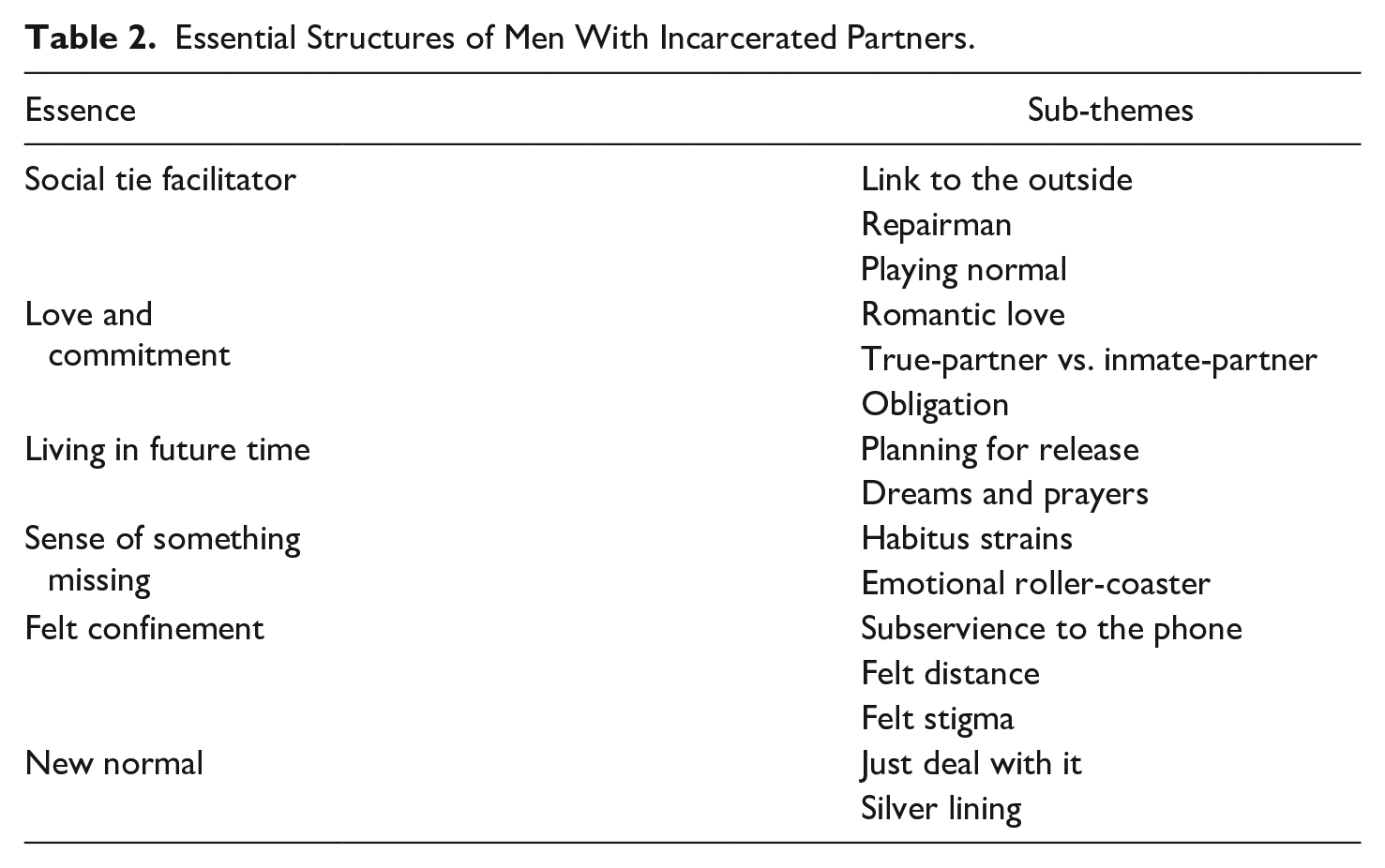
Essential structure explication through the hermeneutic circle revealed fifteen sub-essences within six essential structures of the lived experience of being a man with an incarcerated romantic partner. Table 2 shows these six essential structures of being a man with an incarcerated romantic partner embody: (1) the social tie facilitator, (2) love and commitment, (3) living in future time, (4) the sense of something missing, (5) felt confinement, and (6) a new normal.
Essential Structures of Men With Incarcerated Partners.
Social Tie Facilitator
Essential to the experience of having an incarcerated partner is the maintenance of familial and wider social ties (Condry & Smith, 2018; Einat et al., 2015; Granja, 2016; Jardine, 2018). Being the social tie facilitator is an agentic choice as seen through the sub-themes of providing a link to the outside, playing repairman, and playing house. For these men, this role features a mixture of unconscious acts and deliberate plans for facilitating the ties that bind.
Link to the outside
Universal to the lived experience of men with incarcerated partners is performing the role of social tie facilitator by facilitating communication between their partner and the world outside. The use of phone calls was especially important for this process. All men used phone calls for expressing day to day happenings. This includes sharing days, physical and emotional wellbeing, and as one man put it, “all the small stuff” (M6). When asked why this type of communication was important despite the reported high cost, one participant responded: “You talk to them about what you can when you can. . . about what it doesn’t matter, anything under the sun just to keep that connection strong” (M3). For others, this role included passing on information about their incarcerated partner to friends and family and communicating messages from family back to their loved one.
Repairman
In line with the wider field of research on families of the incarcerated, there was heterogeneity in the functioning of relationships before incarceration (Comfort, 2009; Granja, 2016). Several men noted that one positive aspect of their partners’ incarceration had been the chance to repair a strained relationship. For one man, his partner’s incarceration alleviated strains associated with her drug dependency and allowed for a tighter bond to develop as he helped her through her detox with daily phone calls. Others enacted the repairman’s role by engaging in more open and honest communication to maintain their relationship over a distance.
Playing normal
Every man recalled maintaining social ties through performing a sense of normalcy both over the phone and during visitations. Visitations are especially important for ritualistic reenactments of normalcy, such as family dinners, game nights, and the creation of mutually constructed memories (Comfort, 2009; Tasca et al., 2016). For one man this meant constructing shared experiences based on people watching, one of the limited activities available during visitation. “Oh, you want to see some of the worst neck tattoos of you life, go to (prison name). We will sit there and see who has the worst tat” (M1). For another, prison visits allowed the recreation of the ritual of family mealtime while simultaneously providing a break from prison food. “I was able to cook for him; I made BBQ chicken and mac and cheese” (M7). Visitations also allowed for recreating pre-incarceration normalcy through board games, for one man and his romantic partner “We play games, we play Uno, we play Jenga, we play whatever we have time for” (M5).
Love and Commitment
The essence of love and commitment is a critical component of the decision to continue with the experience of being a man with an incarcerated spouse. This essence consists of the sub-themes of romantic love, true-partner versus inmate-partner, and obligation. The former two sub-themes make up the love side of the paradigm, consistent with previous research (Einat et al., 2015), whereas our new finding, obligation, speaks to commitment.
Romantic love
As shown in Einat et al. (2015), a discourse around true love dominated the discussion on these men’s decision to stay with their partner. Found in all seven interviews, expressions of romantic, selfless love dominated the discussion on what their partner means to them. When asked why they remain with their partner men responded with variations on the theme of romantic love: “I love her to death buddy, nothing is going to change that” (M1), “It was worth it to ride it out for a really simple reason; we were in love” (M2) and, “Everything I do is for her. . .that is our love” (M5). Romantic love commonly came up when individuals described the content of telephone calls, how they see their partner in their head, and the visitation experience. Included in these expressions of romantic love was the desire to view their relationship with their partner as unique or atypical. As one interviewee described, “Even one (friend) who is like a brother to me, he’s like, dude, I don’t know if I could do that” (M1).
True-partner versus inmate-partner
A sub-theme of love and commitment for all seven men is the mental labor undertaken to differentiate the image they hold of their partner from their criminal label. The “true” personhood of their partner dominated their conceptualization of who their partner is, and men called upon narrative devices to sustain this image. The following constructions of the image they hold of their partner came from being asked to close their eyes, picture their partner, and describe their partner to the researcher: “She is more than one mistake” (M4), “She is a wonderful person; the incarceration isn’t her, She didn’t deserve it” (M3), and “That’s the real story of who they are” (M7).
These constructions echo previous research findings on men with incarcerated partners (Einat et al., 2015). For these men, their partners’ incarceration presented them with cognitive dissonance between their mentally constructed image of their partner and the label of criminality. When facing disconnects between their partners’ inmate-self and true-self, men often went to extremes expressing sentiments such as “She shines, she is the best thing in my life” (S3). Ultimately the inmate-partner image becomes viewed as an unjust representation of their true-partner.
Obligation
Common to all seven interviews is the sub-essence of obligation, the commitment side to the essential structure. Obligation, emerges when men with incarcerated partners reflect on why they stay despite the overarchingly negative experience, often alongside selfless love. The concept of not wanting to make their partner’s life harder came through in each of the seven interviews, and for two men stemmed from their recognition that their partner stayed by them through their own addiction or incarceration. For one man, obligation took the form of knowing he was her only link to the outside world, “This might be a 1% part of it, but if I were to have left her then her family are out of the country, and it would be very hard on her because they can’t just fly up” (M1).
Living in Future Time
The essence of living in future time consists of the sub-themes of planning for release and dreams and prayers for reunification. In line with previous research, this proverbial “light at the end of the tunnel” helps men with incarcerated partners continue to enact a preparatory role (Comfort, 2009; Einat et al., 2015; Granja, 2016).
Planning for release
All participants talked about concrete plans they were making for their life with their partners after their incarceration. These plans, ranged from everyday activities like, “Just to see her in the clothes she wants to be seen in, makeup and stuff” (M4) to finally doing that one thing they always talked about doing together. For one individual this was; “To go on the Ellen show and be in the audience” (M3). Shared plans served as motivators for working through daily relationship strains. For one man, his way of planning to make the new house a home involved purposely leaving the house unfinished: “The pictures and stuff isn’t getting hung up on the wall. She goes, why? I say cause you know how those pictures are going to get hung up? When you get out, there is going to be this bright shiny new Estwing hammer and nails waiting” (M1).
Plans embody rewards for sticking it out through their partners incarceration, as indicated by one man when asked for his thoughts about life with his partners post-incarceration: “Our time together is going to be that prize at the end of the finish line” (M5).
Dreams and prayers
While planning involved discussing concrete, mutually known, post-incarceration activities, four men oriented themselves toward the future through the frequent mentioning of dreams and prayers Those identifying as religious tended to use the word “prayers” while others expressed future oriented thought through “dreams.” As seen in the words of one man, “If I was writing her late at night, I’d dream about her, what it would be like to see her on the outside, what we would do” (M4), and “I think toward the future, I think that one day her feet will be right here too” (M2). Juxtaposed with those that preferred prayer-driven language, “I just want to tell them to be strong and pray, pray, pray, visualize him with you” (M7).
Sense of Something Missing
The essential structure of the sense of something missing embodies strains experienced by those with incarcerated loved ones in the wider literature (Comfort, 2009; Dallaire, 2007; Turanovic et al., 2012; Wakefield et al., 2016). These strains experienced, whether they be social, emotional, or, financial inscribe themselves on the body as habitus strains. These same strains are common in the literature on the lived experiences of single fathers (Forste et al., 2009; McClatchey, 2018). Dealing with these strains and newfound tasks brings about the second sub-theme of the emotional roller-coaster of processing; what it means for these men to go it alone.
Habitus strains
Habitus strains, or, negative experiences resulting from a forced shift of routine (Ortega, 2019), are a common experience for all men with incarcerated partners. Habitus strains result in a home becoming a house as men experience the sense of something missing. These strains themselves can interfere with the ability to perform the task causing the strain, relative to housework and basic chores, as one individual remembered: “Depression really set it, it became hard to do any of these things” (M3). Missing a partner to split costs and workloads was a commonly identified stressor in the experience. In realizing the consequences on domesticity that the incarceration of their partner had, one man stated: “I did not know what I was going to do when she got incarcerated everything was up to me. . .laundry, grocery shopping, honestly, these were things I did not know how to do, I had never done them” (M5). A key component of habitus strains was the financial impact. As another detailed, “So we are just trying to maintain a household, pay with high rent out here, and juggle taking care of my husband, myself, and my family” (M7).
Emotional roller-coaster
Feeling the sense of something missing brought about negative emotional reactions to living a life with an incarcerated partner. The realization that their life must continue without their partner by their side caused all men in the sample to recall wide-ranging emotions from anger to despair, in both the initial months and years later. Often anger and sadness were expressed in tandem, pointing to a complex emotional response. When asked about what it was like to hear their partner receive their sentence, complex emotional responses emerged: “Yeah, I was pissed, and I was worried too, though” (M2) and “Honestly, I felt a lot of disbelief. . .anger really, and disbelief” (M3).
For several men, the end of a visit was often associated with the feeling of abandoning their partner, unable to bring them home, and forced once again to face the sense of something missing. As one man recalled: “I tried not to cry in front of him, but it was really hard. It was like I was forced to abandon the life I want” (M7). Or another when asked about what they think about on their drive home after their first visit: “I failed to protect her, and I thought about that non-stop” (M1). In multiple interviews the weight of the emotional roller coaster led to emotional breakdowns. For one man, the loss of his partners physical presence was palpable every night: “I am used to falling asleep next to her and waking up in the same bed, and poof, that was taken away, I cry every night” (M5) and for another crying comes with thinking about what it will mean when their partner is released “I cry, I just cry and pray, pray hard” (M7).
Felt Confinement
Felt confinement is expressed in the sub-themes of subservience to the phone, felt distance, and felt stigma. The essence provides nuance to what it means to experience “secondary prisonization” (Aiello & McCorkel, 2018; Comfort, 2009; Turanovic et al., 2012), these men symbiotically feel constrained by the power of the state (Crewe, 2011; Hulley et al., 2016). Felt confinement inscribes itself on the experience of being a man with an incarcerated partner, as one man described: “It’s uhh it’s hard she has two years left, I talk to her every day, I make sure she has an email every morning, you know it’s like part of me feels. . .back inside” (M3).
Subservience to the phone
Restructuring of one’s lived time around phone calls was found in the narratives of all seven men. For one man, the phone became physically inscribed through lived time: “I spent all my free time working around her being away, calls, and all that stuff. They wouldn’t let the phones call cell phones, so I had to get a landline” (M2). For others time became structured around the phone, replacing other activities such as household and work responsibilities, and maintaining a social life, “I just wanted to be around for when she called. Nothing else really mattered” (M3). In another expression of lived time, one man mentioned that his interview must end in 45 minutes because: “He will be calling again in 43 minutes; I know exactly the time he usually calls, so I can make sure to never ever miss one” (M7). All men in the sample mentioned the financial strain of these calls, which were as high as $4.00 for 15 minutes. On average, these men talked to their partners through at least three phone calls a day. For some, this cost was a source of mental and emotional stress. One man described the related stress as: “All the communication had really high stakes because it could only happen in specific ways at specific times, that was really stressful and exhausting” (M2).
Felt distance
For men with incarcerated partners, distance exists in hours and miles. “Travel is the hardest part, three hours one way, umm, of course, the drive back is harder, but it’s six hours on the road. . ..it sucks” (M1). Another described: “Her son would want to see her, but driving in a car for six hours is a fear for me. . .let alone a small child” (M5). For others, distance occurs not in miles but in sensation, “She just seems so far away, I can’t touch her, you know” (M3). In describing why video calls were preferred despite their cost, one man said, “Because it is the closest thing to being in person, it is when the space between us feels the smallest” (M5).
Felt stigma
Men with incarcerated partners experience direct questioning for their decision to stay, and the internalization of shame and judgment often results. All men in the study recalled experiencing courtesy sigma (Goffman, 1963). Frequently, this results in a severing of ties with the unsupportive party, including for one man, his mother: “I told her hasta la vista” (M1), and for another severing ties due to felt stigma required quitting his job “I knew there were whispers, and so I was like fuck this man, I am going to get a better job, and I did” (M4).
Often men internalized these negative encounters, as one man put it when asked about why he thinks people question his decision to stay “I mean. . . it is more of them trying to cut ME down” (M3). As these negative encounters multiply, the men interviewed often began to expect this treatment when disclosing information about their partner. “I do not think people say anything to my face, but I am positive people say things behind my back” (M5).
New Normal
The essence of a new normal and its sub-themes of “just deal with it” and “silver linings” reflect the culmination of the inscription of the previous essences on the body. Experiencing a new normal, seen in both the familial incarceration literature (Comfort, 2009; Jardine, 2018; Turanovic et al., 2012) and the single fathering literature (Bronte-Tinkew et al., 2010; Forste et al., 2009; McClatchey, 2018), is a passive acceptance that people with an incarcerated family member will confront daily emotional, financial, and social strains with no end in sight. The only option for coping being to “just deal with it.” Pointing to heterogeneity in the experience (Turney & Wildeman, 2015), several men talked of silver linings within their experience.
Just deal with it
Rather than overcoming obstacles presented to them, all men interviewed discussed how they grew accustomed to the daily strains previously outlined. As one individual described when asked about his own mental and emotional state, “I’m doing.” (M1). Men frequently mentioned living with depression and talked about “managing” their emotions, being careful not to feel emotional highs or lows. Equating the experience of being a man with an incarcerated partner to his former military experience, the second individual interviewed captures this essence of just dealing with it, “You are going to have to eat shit every day, but why dwell on it. Being upset, whining, yelling at her, none of that was going to change the reality.” (M2).
Silver lining
For men with incarcerated partners, finding positive elements of this overarchingly negative experience was key to explaining how their relationship has strengthened. For several men their partners incarceration facilitated abstinence from drug-use. As one man acknowledged, the incarceration allowed their partner to get sober. “It made things easier because I knew she wasn’t using drugs, but in other ways, it made things more difficult” (M2).
Additionally, five of the seven men found silver linings related to changing their own lives. Several men mentioned drinking, smoking, and drug use cessation as part of their decision to “get myself together for when she gets out” (M3). Silver linings included learning a new skill or finding a previously undiscovered passion such as cooking or folding laundry. For one man, working with anti-incarceration advocacy groups provided a source of satisfaction and a way of networking with fellow individuals impacted by familial incarceration. Avenues for potential self-growth served as a source of pride in “doing” for all seven men.
Discussion
The current study examined what it means be a man with an incarcerated partner through a phenomenological lens to better understand the inter-experiential heterogeneity of familial incarceration (Comfort, 2009; Condry & Minson, 2020; Einat et al., 2015; Wakefield et al., 2016). Described by the six essences and fifteen sub-themes explicated, the experience of being a man with an incarcerated partner consists of daily negative experiences and strains which frequently test the decision to stay. Those that stay rely on feelings of love and commitment and fall forward into living in the future to cope with the sense of something missing and experiences of felt confinement in the present. This leads to a new normalcy of enduring strains while finding small, victories and lifestyle improvements to grasp onto. Thus, the essential structures of being a man with an incarcerated partner, as explicated in the current study are embodying: (1) the social tie facilitator, (2) love and commitment, (3) living in future time, (4) the sense of something missing, (5) felt confinement, and (6) the new normal. These essential essences and their sub-themes, viewed as pieces of a whole, reflect what it means to experience being a man with an incarcerated partner. This experience provides nuanced depth to the extant quantitative research on the symbiotic harms of incarceration experienced by families of the incarcerated by showing the foreground of daily lived experience. These essential structures often fight against one another in the lives of these men, with the essence of love and commitment being necessary to overcome the stains produced by the sense of something missing and felt confinement. These men employed the coping mechanism of living in future time, as shown in the data explication section, as a way of constructing how the strains and symbiotic harms currently experienced will ultimately produce a brighter future. For the men in this study, the totality of the first five essences explicated produce the final essence of a new normal, a life based on daily symbiotic harm management.
Additionally, men with incarcerated partners reflect the four existentials of: lived interpersonal relation, lived body, lived time, and lived space (Merleau-Ponty, 1962). Rather than each nestling concretely into one of these four distinctions, the essential structures of being a man with an incarcerated partner are inter-existential. The experience of felt confinement cannot be explicated without viewing it as an experience of lived time (years spent apart), lived space (distance in miles), and lived inter-personal relation (a felt symbiotic sentence). The sense of something missing inscribes itself on the body through habitus strains (lived body) and the navigating of a new environment (lived space). These essential structures and sub-themes provide nuance to the concept of the experience of secondary prisonization.
Limitations
Men with incarcerated partners, being a hidden and understudied population necessitated the qualitative design of this research. However, this also contributed to the limited sample size of this paper. Phenomenologically speaking, the authors recognize that their interpretations of the essential structures of being a man with an incarcerated partner are limited. Phenomenology does not concern itself with generalizability but rather recognizing that multiple interpretations of experience are expected (Merleau-Ponty, 1962; Van Manen, 1990). As such, the small sample size is wholly appropriate for a phenomenological study. The COVID-19 outbreak placed two limitations for consideration on this study. The researchers needed to turn to message boards for recruitment rather than attending visitation centers. This also points to the possibility of selection bias; our sample consists of those most willing to self-select into sharing their stories.
Despite these limitations, this study adds to the extant literature on those impacted by familial incarceration. By examining the entirety of what it means to be a man with an incarcerated romantic partner this phenomenology paints a comprehensive portrait of the experience. Each essential structure and subtheme add depth to understandings of the individual level experience of secondary prisonization and in doing so lends support for the reconceptualization of this experience as “symbiotic harms” (Condry & Minson, 2020). Of methodological importance is the use of video call software paired with memos to continue qualitative research during the COVID-19 pandemic. Video call software allows for researchers to mimic face-to-face interviews while no longer being bound by spatial proximity to potential populations of interest.
Recommendations
This study reveals that, foremost, there are men who remain committed to the experience of being a man with an incarcerated partner. Having been largely ignored by previous research, this finding is important for providing nuance to the heterogeneous category of those impacted by familial incarceration (Bülow, 2014). The primary policy recommendation of this paper is to lessen the costs of maintaining the ties that bind. Lessening telecommunication costs as well as video-call costs would not only facilitate the maintenance of social ties but would also decrease the financial impact felt by those with an incarcerated partner. Additionally, facilitating visitations once jails and prisons reopen, and finding ways to better communicate information to men experiencing familial incarceration embody the moral obligations discussed by Bülow (2014). Providing men with information on support groups, counseling services, or some form of educational program on how to adapt to experiencing the incarceration of a loved one is also of utmost importance. Therapeutic interventions, such as FFT, which focus on nurturing communication and building family cohesion appear highly appropriate.
Future research should continue to explore, with nuance and depth, the experiences of men with incarcerated partners through the lens of symbiotic harms (Condry & Minson, 2020). Research should seek to examine causal elements behind both the decision to stay or the decision to leave to better understand what policy recommendations can prevent the breakup of families and lessen the burdens experienced by men with incarcerated partners.
Footnotes
Declaration of Conflicting Interests
The author(s) declared no potential conflicts of interest with respect to the research, authorship, and/or publication of this article.
Funding
The author(s) received no financial support for the research, authorship, and/or publication of this article.
