



Abstract
Research indicates that individuals with intellectual disabilities (ID) are overrepresented among sexual offenders, and that those with ID might differ from those without ID in terms of the etiology of offending behavior. Despite this, few studies have explored ID using incarcerated U.S. samples. The present study sought to identify relevant characteristics of this population by comparing individuals with and without ID who are incarcerated in the U.S. for sexual offenses. Archival records for 3,066 participants were used to determine demographic, historical, and offense-related characteristics. Participants with ID, including those with borderline ID, comprised 19.1% of the sample and displayed elevated rates of adverse childhood experiences and psychopathology. Contrary to previous research, participants with ID were no more likely to offend against children than those without ID. These findings help to elucidate the etiology of offending behavior among those with ID and inform on potential targets for intervention.
Research indicates that people with intellectual disabilities (ID) are overrepresented among sexual offenders (Barron et al., 2004; Cantor et al., 2005). Estimated rates of ID in individuals convicted of sexual offenses have varied widely, due in part to differences in sample sources (e.g., clinical, forensic) or methods of determining ID (e.g., clinical diagnoses, IQ cutoffs; Lindsay, 2002). Sexual offenders with ID might differ from those without ID in terms of the etiology and nature of offending behavior, as well as associated psychosocial characteristics (Craig & Lindsay, 2010). As such, this population may require more specialized treatment, diversion, and intervention initiatives. However, there is conflicting data on the nature of these differences and their implications for treatment (Craig & Lindsay, 2010; Lindsay et al., 2018).
Research in this area has focused largely on small clinical samples from the United Kingdom (U.K.; Jones & Chaplin, 2020), with very few comparison studies of incarcerated individuals in the United States (U.S.). A recent systematic review regarding treatment approaches in individuals with ID who sexually offend (Jones & Chaplin, 2020) identified a single study of U.S. individuals—which had just three participants—that met the review’s criteria (Singh et al., 2011). However, it may be important to understand individuals who commit sexual offenses in the U.S. given differences in legislation, incarceration rates, demographic characteristics, and access to mental health care (Hayes et al., 2007; Hoffman & Paradise, 2008; Walmsley, 2015). The present study thus sought to compare demographic, historical, and offense-related characteristics in a large sample of individuals incarcerated for sexual offenses in the U.S. with and without ID.
Background
Symptoms and Demographics
ID is characterized by intellectual and adaptive deficits with onset in the developmental period (American Psychiatric Association, 2013). A diagnosis of ID is used to describe individuals with both mild and profound levels of impairment. Deficits span several domains, and can include difficulty with judgment, planning, academic learning, independent living, and communication. People with ID are more vulnerable to various adverse conditions, such as poverty and abuse (Emerson, 2007; Wissink et al., 2015), and may be predisposed to comorbid psychopathology (White et al., 2005). These characteristics, in turn, may be related to offending behavior. However, the etiology of sexual offending behavior in people with ID remains unclear.
The Centers for Disease Control and Prevention (CDC; McGuire et al., 2019) estimate that 1.11% of children in the non-institutionalized population have ID, with Black children being disproportionately more likely to be diagnosed with ID (Zablotsky et al., 2017). Research has also consistently linked ID to poverty (Emerson, 2007). This effect is due partly to poverty-related social and environmental health risks, including exposure to toxins such as lead, smoking or alcohol use during pregnancy, and childhood illnesses (Blair et al., 2012; Grandjean & Landrigan, 2014; Tyler et al., 2008). Families supporting a child with ID also face increased financial burdens associated with caretaking (Emerson, 2007). While there is less research concerning poverty among adults with ID, data suggests that people with ID face lifelong poverty and exclusion from the workforce (Butterworth et al., 2011; Emerson et al., 2005). In turn, poverty is indirectly associated with violent crime and incarceration in the general population (Rabuy & Kopf, 2015; Vieraitis, 2000).
Estimates of the prevalence of ID among offenders have varied widely, though most researchers agree that levels of ID are elevated among populations of sexual offenders (Lindsay, 2002). A meta-analysis of the prevalence of ID among 12,000 prisoners (both sexual and nonsexual offenders) found that most studies reported rates between 0.5% and 1.5%, although some studies using more basic screening methods found that up to 10% of offenders had ID (Fazel et al., 2008). While few studies have provided estimated rates of ID among sex offenders specifically, the relationship between ID and sexual offending is well-documented (Lindsay, 2002). A meta-analysis of intelligence testing in criminal offenders found that the mean IQ of sex offender samples was approximately five points lower than that found in non-sex offender samples (Cantor et al., 2005). Other studies have found increased rates of sexual offending relative to other types of offending among people with ID (Barron et al., 2004). Higher rates of problematic sexual behavior not resulting in conviction have also been reported among people with ID (McBrien et al., 2003).
Psychosocial and Environmental Characteristics
Individuals with ID are vulnerable to adverse conditions and experiences which may contribute to the development of sexual offending behavior. In addition to poverty and unemployment, people with ID are more vulnerable to sexual abuse. Both children and adults with ID are more likely to report abuse (Byrne, 2018; Wissink et al., 2015). Lifelong dependency on others for care, social isolation, and a lack of sexual education and understanding among people with ID may contribute to abuse (Akbaş et al., 2009), while difficulty with communication may inhibit disclosure and thus allow abuse to continue (Hershkowitz et al., 2007). Childhood sexual abuse is associated with long-term sequelae in individuals with and without ID, including post-traumatic stress disorder, social isolation, suicidality, and negative attitudes toward sex (Gil-Llario et al., 2019; Sigurdardottir et al., 2012; Wilson, 2010). A history of childhood sexual abuse is commonly reported by sexual offenders and may be a risk factor for later offending behavior (e.g., Jespersen et al., 2009). This effect may be particularly pronounced in individuals with ID who sexually offend, who report higher rates of sexual abuse compared to both non-offenders with ID and sexual offenders without ID (Hayes, 2009; Lindsay et al., 2012). In addition to sexual abuse, individuals with ID are more likely to experience a range of peer- and family-based traumatic events, the effects of which may be exacerbated by ID and contribute to psychopathology (Martorell & Tsakanikos, 2008).
People with ID may face social isolation beginning in childhood. Relationships between children with ID and their teachers are characterized by less closeness and more conflict (Eisenhower et al., 2007). Adolescents with ID may also have lower-quality and less warm friendships and are less likely to spend time with friends outside school (Tipton et al., 2013). These difficulties persist into adulthood; older individuals with ID have limited social opportunities, resulting in fewer friendships and lower quality of life (McCausland et al., 2021). In turn, social isolation may contribute to violent behavior (Kalvin & Bierman, 2017), while social support can act as a buffer to the development of offending behaviors (Hoskins & Kunkel, 2022).
In addition to social and environmental factors, psychological characteristics also appear to contribute to offending behavior among individuals with ID. Further, certain psychiatric symptoms, such as psychopathy and impulsivity, have been shown to limit the efficacy of interventions aimed at reducing sexual recidivism (Harkins & Beech, 2007). People with ID are at an increased risk of developing a serious psychiatric disorder (White et al., 2005), demonstrating higher rates of psychosis (Cooper et al., 2007) and attention deficit disorders (Hastings et al., 2005). Antisocial Personality Disorder also appears to be prevalent in forensic populations of people with ID (Morrissey & Hollin, 2011). However, individuals with ID may face difficulty in obtaining an accurate diagnosis; the symptoms of ID may overlap with other disorders (Andersen, 2015), and individuals with ID might be less capable of assisting in the assessment process (White et al., 2005).
Offense-Related Characteristics
While comorbid psychopathology may play a role in offending behavior and treatment, there is some evidence to suggest a more direct neurodevelopmental link between ID and deviant sexual interests, particularly pedophilic preference. A series of studies using phallometric testing have demonstrated that lower intelligence is associated with stronger pedophilic preference overall, as well as a preference for male children in particular, in clinically-referred samples of sexual offenders (Blanchard et al., 1999, 2007). Moreover, these studies link both low intelligence and pedophilic preference to other characteristics associated with neurological development, including childhood head injuries (Blanchard et al., 2002, 2003), advanced maternal age (Blanchard et al., 1999), and non-right handedness (Blanchard et al., 2007). While there appears to be a neurodevelopmental link between intelligence and pedophilic sexual preference, few studies have compared rates of ID in individuals incarcerated for offenses against children versus offenses against adults. Sexual offenders who target children may differ from those who target adults with regard to the etiology of offending behavior (Bard et al., 1987) and underlying psychopathological characteristics (Shechory & Ben-David, 2005; Sigre-Leirós et al., 2014). As such, a better understanding of offending behavior among individuals with ID who sexually offend is needed in order to tailor interventions and treatment to this population.
Current Study
Research indicates that individuals with ID experience environmental obstacles and unique psychopathological characteristics that can contribute to the etiology of offending behavior and influence the efficacy of treatment. However, few studies have compared sexual offenders with and without ID. Furthermore, the majority of studies in this area have focused on small, non-incarcerated samples in the U.K. In order to better understand the features of this population and to inform strategies for intervention and treatment, the present study sought to compare individuals incarcerated for sexual offenses with and without ID in a large U.S. sample.
The primary objective of the study was to identify relevant characteristics of individuals with ID who sexually offend. To this end, we examined group differences in demographic variables (e.g., race/ethnicity, socioeconomic status) and historical variables (e.g., history of abuse, history of psychiatric problems). In addition, the present study examined whether those with ID more often offend against male children, per previous research that demonstrates a link between ID and pedophilic preference. It was hypothesized that individuals with ID would exhibit higher rates of adverse childhood experiences and mental illness, and that this group would be more likely to offend against both males and children.
Methods
Archival data for this between-subjects study were originally collected as part of a broader institutional review board-approved (IRB) study examining sex offender placement decisions within the criminal justice system (Mercado et al., 2013). Archival records included demographic, institutional, and offense-related information. Ten trained graduate-level research assistants were responsible for transcribing data from physical records into a data collection tool developed by the study researchers.
Participants
While the original study had a sample size of 3,168, only those who had a clear determination of their intellectual status in archival records were included for the present study (N = 3,066). The present study compared two groups: those with ID (n = 587) and those without ID (n = 2,479). However, sample size differs significantly for each of the variables tested based on the availability of data for certain measures, and the valid sample size for each variable is included when applicable (valid N). An analysis of the missing data by the authors of the original study found that missing values were randomly distributed and were consistent with other large-scale archival studies (Mercado et al., 2013).
Data were gathered for all sexual offenders released from a prison-based sex offender treatment facility in one Northeastern U.S. state between 1996 and 2007 (n = 833). In addition, the study collected data for all sex offenders committed as sexually violent predators (SVP) in the state during this period (n = 366), as well as a random sample of approximately 45% of all sex offenders released from non-treatment state prisons (n = 1,866).
Demographics
As a whole, participants averaged 33.18 (SD = 12.16) years of age at the time of index offense. In terms of socioeconomic status (SES; valid N = 1,251), the majority of offenders (73.0%, n = 913) fell into the “low” category, while 21.1% (n = 264) and 5.9% (n = 74) fell into the “middle” and “high” categories, respectively. Most of the offenders in this sample were White (41.9%, n = 1,283) or Black (36.4%, n = 1,114), with the remainder being of Latino origin (20.1%; n = 614), Asian/Pacific Islander (0.8%, n = 26), or of other/unknown race or ethnicity (0.8%, n = 23). The demographics of the sample are similar to those reported by the Bureau of Justice Statistics (2003) on U. S. sexual offenders as a whole.
The most common index offense was molestation of a minor child (72.2%, n = 2,261) followed by adult sexual assault (18.0%, n = 564). The remaining participants (9.8%, n = 306) were serving sentences for non-contact sexual crimes (e.g., computer-related offenses, voyeurism) or a combination of more than one type of crime. In addition, 29% (n = 846) had at least one prior charge or conviction for a sexual offense. When examining both previous and index offenses, 77.1% (n = 2,352) of participants had at least one charge or conviction for molestation of a minor child.
Measures
Intellectual disability
Previous studies have used a variety of methods to determine inclusion criteria for ID, resulting in significant variability in the estimates of prevalence (Lindsay, 2002). For the present study, eligibility for inclusion in the ID group was determined based on available records. Participants were categorized as having ID if (1) clinical or institutional records included a diagnosis of ID or mental retardation 1 or (2) scores from intelligence testing indicated an IQ below 80. Records for most participants did not include IQ scores or detailed descriptions of symptom severity; the majority of determinations were made based on whether a diagnosis of ID was present in the participant’s records. Offenders labeled as “low-average” intelligence in records were not categorized as having ID unless the term was accompanied by an IQ score below 80 or other qualifiers, as some definitions of “low-average” intelligence include individuals who score above 79. Data for this variable were dichotomous, with offenders falling into either the ID or non-ID category.
There is some disagreement within the literature about whether individuals with borderline intellectual functioning, or an IQ between 71 and 79, should be categorized as having ID. While the diagnostic criteria for ID does not specify an IQ cutoff, many studies use an IQ of 70 or below to determine limited intellectual functioning (American Psychiatric Association, 2013; Boat & Wu, 2015). However, others have advocated for the inclusion of subjects with borderline intellectual functioning (Wieland & Zitman, 2016) and an IQ score cutoff of 80 has been used by some researchers, as well as the English prison system, to define ID (Lindsay & Craig, 2018). People with borderline intellectual functioning, who fall between 1 and 2 standard deviations below the mean IQ score, display significant neurocognitive, social, and mental health limitations (Peltopuro et al., 2014). The current study includes those with borderline ID in the ID group, as the archival records did not provide sufficient detail to discern the level of disability for many participants.
Demographic variables
Demographic variables included (a) race/ethnicity, (b) SES (low, middle, or high), and (c) highest level of education completed. Chi-square tests were used to compare the proportion of participants with and without ID in each category. In addition, Fisher’s exact test was used to compare group differences for categories with few participants.
Historical and mental health variables
Historical variables included (a) whether the participant grew up in a two-parent home (yes/no), (b) whether the participant reported being abused as a child (yes/no), and (c) what type of abuse the participant reported, if applicable (e.g., sexual, physical, psychological). Mental health variables included (a) whether the participant had a history of psychiatric problems (yes/no), and (b) whether the participant had a history of suicide attempts (yes/no).
Offense-related variables
Offense-related variables included (a) the nature of the index offense (e.g., molestation of a minor child, adult sexual assault) and (b) the gender of the victim(s) for the index offense (male, female, or both). In order to further explore offending behavior, the present study also examined (a) whether the participant had prior charges or convictions for sexual offenses (yes/no), and (b) whether the participant’s current or prior charges included molestation of a minor child (yes/no).
Results
Of the 3,066 participants, 19.1% (n = 587) met the criteria for ID. The remaining 80.9% (n = 2,479) of participants were categorized as non-ID. The frequencies of each variable were compared among ID and non-ID individuals using chi-square and are presented in Tables 1 to 3.
Demographics.

Note. SES = socioeconomic Status.
p for Fisher’s exact test is displayed.
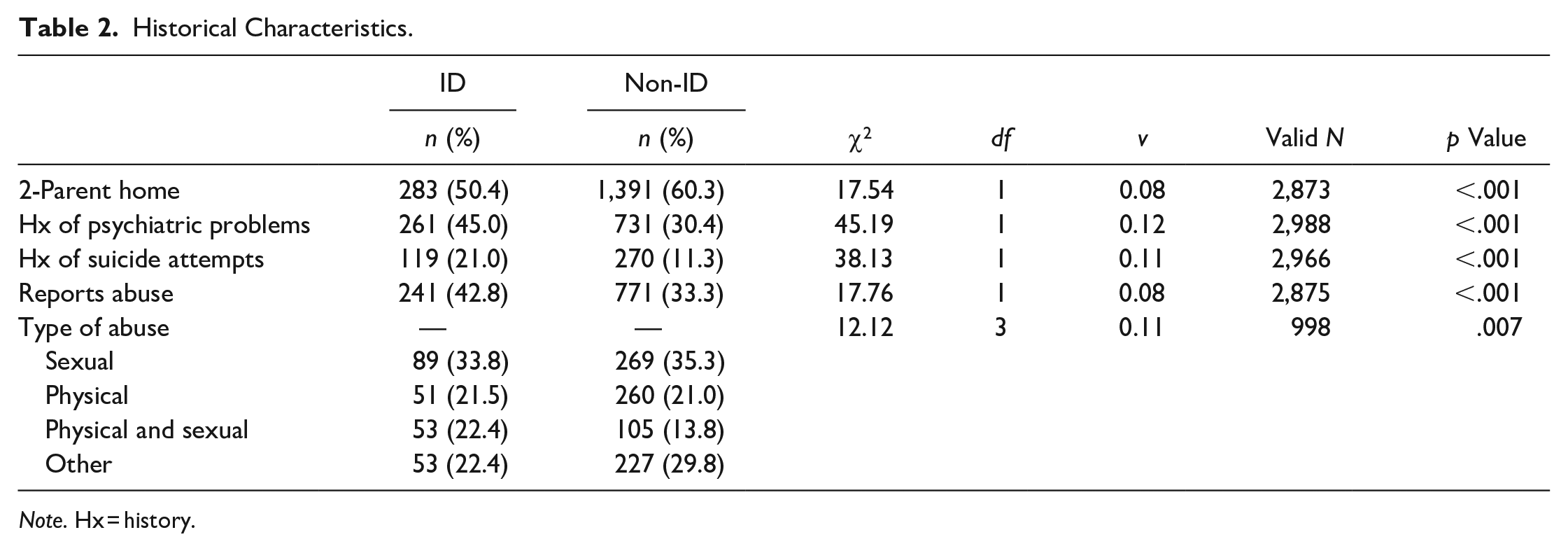
Historical Characteristics.
Note. Hx = history.
Offense-Related Characteristics.

Demographics
Participants with and without ID differed with regard to race/ethnicity (Table 1). Those with ID were more likely to be Black and less likely to be White or Asian/Pacific Islander compared to participants without ID. However, it should be noted that Asian/Pacific Islander individuals comprised a small proportion of the sample as a whole (0.8%, n = 26). Individuals with and without ID did not differ significantly in proportion with regard to the Hispanic/Latino or Other Race/Ethnicity categories.
As seen in Table 1, the two groups also differed with regard to SES, such that participants with ID were more likely to be categorized as “low” SES and less likely to be categorized as “middle” SES compared to participants without ID. The proportion of participants with and without ID did not differ significantly within the “high” SES category; as a whole, participants were unlikely to be high SES (5.9%, n = 74).
Participants with and without ID also differed significantly with regard to level of education (Table 1). Of participants with ID, 23.5% (n = 137) reported having an 8th grade education or less, compared to just 8.6% (n = 211) of participants without ID. Participants with ID were less likely to have obtained a GED or high school diploma and were less likely to have completed any postsecondary education (e.g., trade school, 2- or 4-year college degrees).
Historical Characteristics
Participants with and without ID differed significantly with regard to each dichotomous historical variable tested (Table 2). Individuals with ID were less likely to have been raised in a 2-parent household compared to individuals without ID. Individuals with ID were more likely to have a history of psychiatric problems and suicide attempts than those without ID.
Individuals with ID were more likely to report experiencing childhood abuse compared to individuals without ID. The two groups also differed regarding the type of abuse reported. While those with and without ID did not differ with regard to the proportion of participants reporting sexual abuse only or physical abuse only, participants with ID were more likely to report experiencing a combination of physical and sexual abuse than those without ID.
Offense-related Characteristics
Participants with and without ID did not differ with regard to the nature of index offense (see Table 3); individuals with ID in the present sample were no more likely than those without ID to be incarcerated for molestation of a minor child. However, participants with and without ID did differ with regard to the gender(s) of their victims. Participants with ID were more likely to have male, or a combination of male and female victims and less likely to have female victims than participants without ID.
To better capture offending behavior within the sample, the present study also examined the criminal histories of participants. Participants with ID were more likely to have prior charges or convictions for a sexual offense compared to those without ID, however they were not more likely to have child victims when considering both prior and index offenses.
Discussion
The present study compared demographic, historical, and offense-related characteristics among individuals incarcerated for sexual offenses with and without ID. Overall, the results demonstrate that ID is prevalent among individuals incarcerated for sexual offenses and that individuals with and without ID differ in terms of demographic makeup and historical factors. Results concerning offense-related characteristics differed from prior studies, however, in that participants with ID were no more likely to offend against children than those without ID.
There is little research concerning the racial demographics of individuals with ID who sexually offend. This is likely due in part to the lack of studies that have utilized U.S. samples of incarcerated individuals, which may be more racially and ethnically diverse than samples from other countries. For example, prior studies examining the race and/or ethnicity of incarcerated individuals with and without ID from Australia focused only on differences between Aboriginal and non-Aboriginal individuals (Cockram, 2005; Gathercole et al., 2016). Another study from the U.K (Hayes et al., 2007) compared the rate of ID for White and Black participants and found no significant differences; however, the authors note that White participants comprised 87.9% of the sample, and that White individuals comprised 95% of the U.K. population at the time of the study.
Data regarding U.S. sexual offenders more broadly suggest that while Black individuals are overrepresented among registered sex offenders, the majority of those convicted for a sexual offense are White (Ackerman et al., 2011). In the U. S., Black children are more likely than White children to be diagnosed with an intellectual disability (Zablotsky et al., 2017). Moreover, both Black children (Mersky et al., 2021) and children with ID (Martorell & Tsakanikos, 2008) are more likely to experience a range of adverse experiences, some of which may represent risk factors for future offending behavior (e.g., Jespersen et al., 2009; Rabuy & Kopf, 2015). More research utilizing U.S. samples, which may be more racially and ethnically diverse, will help to clarify the relationship between race, ID, and sexual offending.
As hypothesized, socioeconomic differences between participants with and without ID were consistent with previous studies. Similar to previous research, individuals with ID in this study were more likely to be low SES (Emerson, 2007; Emerson et al., 2005), although it should be noted that the majority of the sample as a whole (73.0%) fell into the low SES category. Differences in SES may be particularly consequential with regard to accessing appropriate treatment and services. In the U.S., poverty, insurance coverage, and healthcare access are interconnected such that lower SES individuals face more difficulty obtaining services, which may limit accessibility for at-risk populations (Hoffman & Paradise, 2008).
Participants with ID also had less education on average; only 30.0% of those with ID earned a GED or higher, compared to 61.1% of participants without ID. In addition to difficulty with learning (American Psychiatric Association, 2013), individuals with ID may struggle in school due to behavioral symptoms and adaptive deficits (de Bildt et al., 2005). The accessibility and quality of education for individuals with disabilities is also inconsistent (Cosier et al., 2018). School may play an important role in the prevention of later offending behavior. Disruptions to education and school failure serve as risk factors for negative psychological outcomes and delinquency in individuals with ID (Morrison & Cosden, 1997). In addition, school can serve as a safety net for children who are abused; school closure is associated with diminished detection of child maltreatment (Puls et al., 2021).
Similar to previous research (Hayes, 2009; Lindsay et al., 2012), participants in the ID group reported abuse at higher rates than those without ID. Participants with ID were also more likely to report a combination of both physical and sexual abuse. Individuals who experience more than one type of abuse during childhood may demonstrate more severe mental health symptoms in adulthood (Edwards et al., 2003), though more research is needed to explore the impact on offending behavior. Participants with ID were also less likely to be raised in a two-parent home than participants without ID. A previous study that utilized the present sample found that individuals who were raised in a two-parent home were less likely to use physical violence during the index offense (O’Toole & Jeglic, 2014).
Previous research suggests that people with ID experience a wider range and greater number of adverse childhood experiences than those without ID, which can have a cumulative effect on the development of psychopathology (Hatton & Emerson, 2004). The results of the present study are consistent with this finding. Participants with ID were more likely to have a history of psychiatric disorders and suicide attempts. While no disorder has emerged as wholly responsible for sexual offending behavior in people with or without ID (Myers et al., 2005), some maladaptive traits do appear to play a role and should be considered when developing treatment protocols for offenders with ID.
Participants in our sample with ID offended against males, or both males and females, more often than participants without ID, consistent with prior research (Blanchard et al., 1999). This may be a salient finding in terms of risk assessment: research on sexual offending indicates that individuals with male victims are more likely to recidivate (Harris & Hanson, 2004). However, it’s unclear whether this is true for individuals with ID. Those with ID were also more likely to have prior charges and convictions for sexual offenses. While this result might indicate more persistent offending in those with ID, there are several additional potential explanations that should be explored. Additional research regarding recidivism and prosecution outcomes, as well as well as analyses of criminal careers in those with ID, will help to put this finding in context.
Contrary to previous research which has linked ID to pedophilic sexual preference (e.g., Blanchard et al., 2007; Cantor et al., 2005), participants with ID were no more likely to have child victims in their index or prior convictions compared to participants without ID. Previous studies have indicated that the link between ID and pedophilia may have neurodevelopmental origins (Blanchard et al., 2002, 2003). Rather than contradict these findings, the results of the present study raise questions about individuals with ID who offend. Much of the research in this area has focused on individuals who offend against children, while less is known about individuals with ID who offend against adults. However, it is also important to note that the present study used categorical variables to measure both ID and offense type, whereas previous research has measured the relationship between IQ and the strength of pedophilic preference, allowing for more nuanced analyses and inferences which are not possible using categorical comparisons.
Limitations
There are several limitations of the current study. While the use of archival records allowed for analysis of a large sample, there are inherent drawbacks to this method. The data used was dated, with some participants leaving prison as early as 1996. Practices related to the incarceration of sexual offenders have evolved in the interim, as have the diagnoses and support provided to people with ID, and it is important to consider the findings of the present study in light of developments. In addition, the cross-sectional and exploratory nature of the study does not permit the establishment of causal mechanisms that link ID to certain characteristics among individuals who sexually offend.
The present study was also unable to use a uniform method of determining ID, instead relying on notes in the records. This limitation also necessitated using a liberal definition of ID that included those with borderline intellectual functioning. While research shows that this subset of the population faces obstacles similar to those with more profound disability (Peltopuro et al., 2014), many studies utilize a more conservative IQ cutoff. This limits the extent to which results regarding the prevalence of ID can be compared to previous research or generalized to the broader population of incarcerated individuals who sexually offend. Furthermore, we were unable to explore whether differing levels of ID are associated with different characteristics in individuals who sexually offend, which may be particularly relevant to developing treatment and interventions.
One drawback to using a sample of incarcerated participants is the possibility of undetected or uncharged sexual offenses. Individuals who commit sexual offenses but are not convicted may differ in important ways from those who are charged and convicted. As such, the intention of the present study is to inform on the incarcerated population, rather than all those who commit sexual offenses. Undetected sexual offenses may also complicate interpretations of offense-related findings, as offenders apprehended for one type of offense may have unknown histories of other types of offenses.
Implications and Future Directions
The majority of research to date on sexual offenders with ID has focused on clinical samples in the U.K. However, it may be particularly important to understand the complex needs of this population within the context of the U.S. criminal justice system. Studies regarding the placement of individuals with ID who sexually offend in the U.K. indicate an emphasis on treatment within community and secure psychiatric settings (Hogue et al., 2006; Lindsay et al., 2010). The U.S. imprisons a greater proportion of its citizens than any other developed country (Walmsley, 2015). People with mental illnesses are overrepresented among U.S. inmates, and access to mental health treatment and disability accommodations are limited (Reingle Gonzalez & Connell, 2014; Vallas, 2016). Individuals with ID in the present sample had higher rates of psychiatric illness and suicidality, suggesting a need for these services. Further, those with ID may face additional challenges in navigating the criminal justice system with regard to understanding their rights and assisting in their own defense (Salekin et al., 2010). Research has also demonstrated that individuals with ID who are incarcerated encounter a disproportionate amount of solitary confinement and are more vulnerable to sexual and physical assault which can cause further trauma to an already traumatized group (Linhorst et al., 2018). Results of the present study indicate that a significant proportion of individuals incarcerated in the U.S. for sexual offenses have ID, and that this subset of the population may be predisposed to unique risk factors and psychopathology. A better understanding of this population may help to ensure more equitable treatment for those with ID within the criminal justice system, as well as develop interventions that are sensitive to their needs.
The results of the present study may have important implications for intervention and treatment. Demographic results indicate potential barriers to prevention. For example, low SES individuals with ID may be at an increased risk for offending behavior and face additional obstacles with access to treatment (Hoffman & Paradise, 2008). The number of participants with ID who failed to complete high school may represent another barrier, as school can act as a buffer against the development of delinquency and allow for detection of abuse (Morrison & Cosden, 1997; Puls et al., 2021). Successful intervention initiatives will thus need to overcome these hurdles to ensure access to care and support for those who are most at risk.
Higher rates of psychopathology among participants with ID should also be considered when developing treatments. While results of the present study suggest that those with ID may have higher rates of psychiatric disorders more generally, future research should examine specific disorders and characteristics that are known to influence treatment outcomes (Harkins & Beech, 2007). The results also provide additional evidence for the role of abuse in the development of offending behavior for people with ID, however at present few prison-based sex offender treatment programs include individualized trauma work (Fritzon et al., 2021). A shift in treatment focus toward trauma may contribute to more positive outcomes for individuals with ID, though more research is needed to examine the efficacy of trauma therapy within this population.
Data regarding patterns of offense may also be important for treatment. Results from this study suggest that individuals with ID may constitute a significant proportion of those incarcerated for sexual offenses against adults. Those who offend against adults differ from those who offend against children in terms of psychological characteristics (Shechory & Ben-David, 2005; Sigre-Leirós et al., 2014), and neuroimaging research has hinted at brain differences between these groups (Joyal et al., 2007; Kirk-Provencher et al., 2020). While some studies have examined the neurodevelopmental origins of pedophilic preference among those with ID (Blanchard et al., 2002, 2003), more research is needed to understand the role that brain development may play in sexual offending against adults. Environmental risk factors for offending behavior may also differ between these subtypes. While childhood sexual abuse is relatively common among those who perpetrate sex crime generally, there is evidence that suggests increased rates of child sexual abuse among those who offend against children relative to other sexual offense types (Jespersen et al., 2009). In developing treatment for individuals with ID, it is important to consider the full spectrum of offending behavior. A better understanding of the etiology of offending behavior in individuals with ID who offend against adults is needed in order to develop interventions that are sensitive to the neurological, psychological and developmental characteristics of this population.
The findings of this study also highlight the importance of continuing to study issues related to ID among incarcerated individuals in the U.S. Future research should aim to address this study’s limitations by using a uniform measure of ID and by studying individuals who are currently incarcerated. The results obtained in this study also point to potential areas of exploration. The relationship between race, ID, and sexual offending should be examined in order to disentangle the risk factors associated with both race and ID. In addition, future research should also focus on individuals with ID who sexually offend against adults, as little is known about this group. Finally, more research is needed to examine the efficacy of prevention and treatment options tailored to individuals with ID.
Footnotes
Acknowledgements
The authors thank the New Jersey Department of Corrections and New Jersey Department of Human Services for their support in providing access to files. The opinions, findings, conclusions, and recommendations expressed are those of the authors and do not necessarily reflect those of the institutions that supported this research.
Declaration of Conflicting Interests
The author(s) declared no potential conflicts of interest with respect to the research, authorship, and/or publication of this article.
Funding
The author(s) disclosed receipt of the following financial support for the research, authorship, and/or publication of this article: This research was supported in part by Grant No. NIJ 2007-IJ-CX- 0037 from the National Institute of Justice, Office of Justice Programs, U.S. Department of Justice.

Data Accessibility Statement
The data that support the findings of this study are available from the corresponding author, Perry A. Callahan, upon reasonable request.