



Abstract
This study seeks to identify the underlying factors related to the sentencing process for juvenile justice cases in Chile. To this end, a factorial survey method or quasi-experimental vignette method was used. This method allows us to understand with greater clarity the complex cognitive process involved in judicial decision-making. The results confirm that legal factors carry the critical weight for judicial decisions, though extralegal factors also play a role. Among these, factors associated with the offender (such as drug use and school attendance) and characteristics of the judges themselves (such as judicial attitudes and their previous experience) all influenced the decision-making process. These findings allow us to provide evidence about decision-making in the Latin American contexts and add to existing evidence in order to understand the moderating effect of certain class and gender stereotypes.
Introduction
The experience of incarceration has a decisive impact on the lives of adolescents, representing a turning point in their development (Lambie & Randell, 2013). A custodial sentence certifies them as delinquents and forces them to confront the social stigma associated with it, contributing to the progress of criminal trajectories (Lemert, 1951; McAra & McVie, 2007). In addition, it causes other detrimental effects, such as possible victimization, interruption of normative experiences and loss of opportunities in terms of learning and developing human and social capital (Mulvey & Schubert, 2012).
Evidence shows that, despite the great impact of judicial decisions on individuals’ lives, the decision-making processes within the justice system are not unbiased (Rachlinski & Wistrich, 2017). This gets more complex in the context of the juvenile justice system, because—unlike adult justice—it avoids a logic based only on retribution, and leans instead toward rehabilitation (Applegate et al., 2000; Bishop et al., 2010). Under this logic, extralegal factors—namely, those variables that consider the past, present and future of the offender—should be more important when considering a suitable sentence for a young offender than they are in the adult justice system. Nevertheless, this can grant the decision-maker an opportunity for using their discretion, increasing the chances of arbitrary and discriminatory decisions (Applegate et al., 2000; Caudill et al., 2013; Sieverdes et al., 1979; Smith & Rosier, 2015).
Different theoretical models have sought to explain the legal and extralegal factors that could affect the judicial decision-making process (Koublitskaia, 2012; Posner, 2008; Tamanaha, 2008): many of them focus on diverse legal factors, such as the seriousness of the offense, while others have analyzed the role played by extralegal factors, such as the characteristics of young offenders (i.e., gender and race) and judges (i.e., political ideology, gender, race, and experience). There is, however, only a relatively small—if growing—body of literature which comprehensively explores how the combination of legal and extralegal factors may inform the judicial decision-making process (Applegate et al., 2000; Cochran et al., 2003; Fine et al., 2017; Leiber & Peck, 2015).
Furthermore, most of this evidence comes from Anglophone countries (mainly the United States), and there is lack of information regarding judicial decision-making in the youth justice system in Latin America. Considering recent youth justice reforms in the region, it is crucial to provide evidence for the above to shed light on the role that legal and extralegal factors play in the judicial processes. This information would influence criminal justice policies, aiding the development of progressive reforms that promote young offenders’ rehabilitation and—crucially—avoiding the irrational and extensive use of custodial measures that have characterized Latin American criminal justice systems.
Therefore, this article – based on data drawn from a factorial survey conducted with 246 Chilean judges—seeks to provide new evidence regarding the role played by legal and extralegal factors in the judicial decision-making process within the Chilean Youth Justice System.
Literature Review
Theoretical Framework
There is extensive comparative literature that attempts to elucidate the mechanisms that motivate decisions in judicial contexts. The Focal Concerns theory has been a dominant theoretical framework for explaining the link between judges’ discretion and the inconsistent treatment of disadvantaged groups (Hartley et al., 2007; Steffensmeier et al., 1998). Decision-makers, including judges, normally have limited time and information about cases and offenders, and therefore base their decisions on three main and interrelated, focal concerns: (i) blameworthiness and damage done to the victim (i.e., severity of the offense); (ii) the protection of the community (i.e., the presence of violence during the offense); (iii) negative practical implications (i.e., prison overcrowding). Additionally, judges use perceptual shorthand (Hawkins, 1981) based on stereotypes—including gender, race and class—to reduce uncertainty. So, beyond the fact that their focal concerns include legal factors (related to the offense itself, such as the type of crime and its severity), extralegal factors also operate within the decision-making process: they deal with institutional and organizational context, or the offender’s attributes—whether on an individual level (such as gender, race, or age), or according to their personal context (such as class or support networks).
In this respect, the Attribution Theory developed by Heider (1958, p. 80) describes the process through which people attribute “transient and variable behavior and events to relatively unchanging conditions, called dispositional properties of people and places.” This theory is frequently cited in studies about sentencing disparity conducted in the United States to explain the relations between extralegal factors and judicial decisions (Auerhahn et al., 2017). Bridges and Steen (1998), with data provided by probation officers in the United States, found that criminal judges were more likely to attribute the offenses committed by black offenders to internal negative characteristics, such as attitudes or psychological dispositions (dispositional attribution), whereas the offenses committed by white offenders were attributed to external negative aspects, such as child abuse or economic deprivation (situational attribution). Thus, judges’ causal attributions confirmed the belief that minority offenders were more aggressive, and therefore demanded more severe sanctions (Bridges & Steen, 1998). Moreover, several studies have shown that shared attributions within criminal courts result in the formation of stereotypes about “normal offenses” and “normal offenders,” and that these in turn influence sentencing results (Auerhahn et al., 2017, p. 29).
Legal factors
The main legal factor highlighted in the literature which impacts judicial decision-making is the seriousness of the offense (Demuth, 2003; Schlesinger, 2005). This is determined by the circumstances that surround the offense, and through other indicators such as the use of weapons and the offender’s relationship with the victim. Criminal records are decisive as well, but they depend on the type of the previous offense (escalation vs. de-escalation) and whether the offender was on probation or parole at the time when they committed the offense (Spohn, 2009). Several researchers from the United States have found that legal factors are central in imposing harsher sentences (Campbell & Schmidt, 2000; D’Angelo, 2002; Leiber & Mack, 2003; Minor et al., 1997; Ruback & Vardaman, 1997; Spohn, 2009). Since the spirit of the juvenile justice system has, in recent decades, moved from focusing on the offender to the offense itself, the weight of legal factors has become more decisive (Catlin et al., 2011; Smith & Rosier, 2015).
Extralegal factors related to the offender
Extralegal factors can be differentiated between those associated with characteristics of the offender (such as gender, age, race, or drug use) and those related to their context (such as socioeconomic status, support networks, and education). The evidence here is less conclusive, especially in reference to the (extensively studied) effect of race and gender: while some scholars have found that being white reduces the chances of receiving a severe sanction (Armstrong & Rodriguez, 2005; Bishop et al., 1996; Bridges & Steen, 1998; Caudill et al., 2013; Ericson & Eckberg, 2016; Fader et al., 2014; Mears et al., 2015; Ray & Alarid, 2004), others have found the opposite trend (Barrett et al., 2006; Bishop et al., 2010). Meanwhile, regarding gender, Leiber and Peck (2015) with data from 28 Juvenile Courts in the United States, found that women are 25% less likely to progress through the legal process than men, while other authors, such as Freiburger and Hilinski (2013), found that both women and men have the same probability of receiving a short-term sentence rather than a long-term one. Given this duality, it has been suggested that sentencing mechanisms are to be better understood through the intersectionality of these factors (Fine et al., 2017): the main issue is therefore when, rather than if, these variables are significant.
Additionally, there is a real sparsity of evidence regarding the role played by factors other than race and gender in youth sentencing processes (Fine et al., 2017)—and, for this reason, the literature has given more attention to offenders’ contextual factors. In fact, these factors can be decisive and could be associated with a great disparity in decision-making (Fine et al., 2017). They can be understood as indicators of “social stability” (Spohn, 2009) in terms of the likelihood of reintegration, or can be considered as protective factors against recidivism. For example, it has been found that adolescents with backgrounds of abuse (Caudill et al., 2013) and strong dependency on social services (Schwalbe et al., 2009) have a higher chance of receiving more severe sentences, regardless of other legal or extralegal factors. In a similar vein, Matza (1954) argued many decades ago that judges’ discretion was greatly guided by the will and ability of the young offender’s parents to support them during the legal process—a fact which has been confirmed by further research (Fader et al., 2001).
Extralegal factors related to the judge
The impact of the characteristics of the judges in decision-making goes beyond their demographic attributes. Studies have explored their motivations, the role played by their preferences over punishment and their legal beliefs—all of which are key variables through which to understand how judges justify their decisions. It has been found, for instance, that judges who attribute the offense to individual qualities (dispositional attribution) are more punitive than those who associate it with an offender’s contextual characteristics (situational attribution) (Cochran et al., 2003). Koublitskaia (2012) highlights two models to explain judges’ motivations within the sentencing process. On the one hand, the attitudinal model states that decisions made by judges are based, in part, on their political preferences rather than on legal factors (Segal & Spaeth, 2002). Epstein and King (2002, p. 61), for example, analyzed death penalty cases from a legal and attitudinal perspective and found that, while legal factors precisely predicted the outcomes in 75% of the cases, “the attitudinal model predicted 81% of the cases.” On the other hand, the personal attributes model (Koublitskaia, 2012) incorporates more variables than the previous model: it accounts for the possibility that judges’ decision-making is influenced by their own socio-economic background, geographical particularities and political affiliation. The personal attributes that can affect the judicial decision-making process include age, gender, race, religion, education, previous judicial expertise and political affiliation, among others (George, 2001). Although there is extensive evidence that confirms this model (Koublitskaia, 2012), it is necessary to clarify some of them.
Regarding the role of age, evidence suggests that younger judges may be more likely to favor the alleged victim of the offense (Green & Heilbrun, 2011). Gender might also play a role, with some scholars arguing that women’s rationality is more oriented toward an ethic of care than men’s (Gilligan, 1982). Moreover, both women and minorities are more likely to refract their own experiences through the process, and are therefore more sensitive to specific offenses, such as sexual offenses against women (Wei, 2021).
The Current Study
Since 2000, Chile has reformed its criminal procedure, transitioning from an inquisitorial system toward an adversarial or accusatorial system. As in other parts of the world, this change separated the prosecution and sentencing phases, incorporating the National Prosecutors’ Office as a relevant actor in the investigation and accusation stages of the criminal process (Langer & Lillo, 2014). The Youth Justice System has also experienced several reforms, which have been reflected in The Adolescent Criminal Responsibility Act, Law 20,084, that establishes a special justice system for young people between 14 and 17 years of age who have violated the law. Although this Act has brought about relevant improvements in the fulfillment of international standards, since it modified the Penal Code and the Juvenile Law, it has not been able to carry out an effective social reintegration of adolescents or an adequate execution of the sanctions. The Youth Justice System is still based on adult penal procedures (Langer & Lillo, 2014) and lacks the necessary specialization of legal actors (Berríos Díaz, 2011). Consistently, the role played by judges is still strongly based on the adult criminal system and, as a consequence, maintains the legacy of retribution. Moreover, there is no availability of guidelines to promote consistent judges’ decisions, standards for sentencing or ex-post controls (Berríos Díaz, 2011).
Furthermore, although risk assessments have been introduced and more information regarding extralegal factors of young offenders has been available for the judicial decision-making process regarding custodial sentences, these have not been informed by empirical local evidence regarding the role that legal and extralegal factors play in the judicial decision-making process in the Chilean justice system (Politicas Publicas UC, 2018)
Based on the international literature and evidence available, this article seeks to explore the above, using a factorial survey method or quasi-experimental vignette method to understand with greater clarity the complex cognitive process involved in judicial decision-making among Chilean judges.
Methodology
The study used data from a survey administered to a sample of criminal judges in Chile. 1 The survey was online and self-administered, and was sent by email (with support from the Chilean Supreme Court) to all judges in charge of managing juvenile justice cases (N = 900) at the national level. Out of this total, 246 judges completed it voluntarily (27.3% of the total population). This means, as in most self-selection web surveys (Bethlehem, 2010), that the sample is not statistically representative, because it may have a selection bias. 2 For this reason, the results should be interpreted with caution. It should be noted that the survey was divided into two modules: one to assess the characteristics of the participants, and another designed under the factorial survey method (described below), to understand their decision-making process and assess the role played by legal and extralegal factors.
Factorial Survey Design
One of the methodological pillars of the study is the factorial survey method, which was used as an attempt to break open the “black box” of judges’ decision-making processes. This method facilitates the understanding of the development of complex normative social judgments, and allows an unveiling of its content (Auspurg & Hinz, 2014). This is a recognized method due to its inclusion of an “hybrid” technique that reaches the external validity of a conventional survey—to the extent that it could be applied to a representative sample—as well as the internal validity of an experimental study (Wallander, 2009). This method presents participants to realistic scenarios carefully created by the researchers, with the purpose of studying the dependent variables (attitudes, opinions, judgments) through the manipulation, control and systematic variation of independent variables or explanatory factors. The main component of this method is the “vignette,” which is an hypothetical or fictitious brief description of a “social object” (a person, situation, etc.) that presents a systematic combination of characteristics (Atzmüller & Steiner, 2010; Wallander, 2009). Accordingly, the vignettes considered in the present study are focused on the description of cases of adolescents (fictitious) charged with an offense, to which the judges must determine whether to impose a custodial sentence. Such cases comprise different variables considered theoretically relevant for the judges’ decision-making (criminal records, socio-economic level, education and drug use, among others), and each one contains different categories or “levels.” For example, the variable “adolescent’s drug use” contains levels of “problematic drug use” and “don’t use drugs” (see model in Table 1). Table 1 shows the levels for each dimension, which are underlined.
Vignette Model.
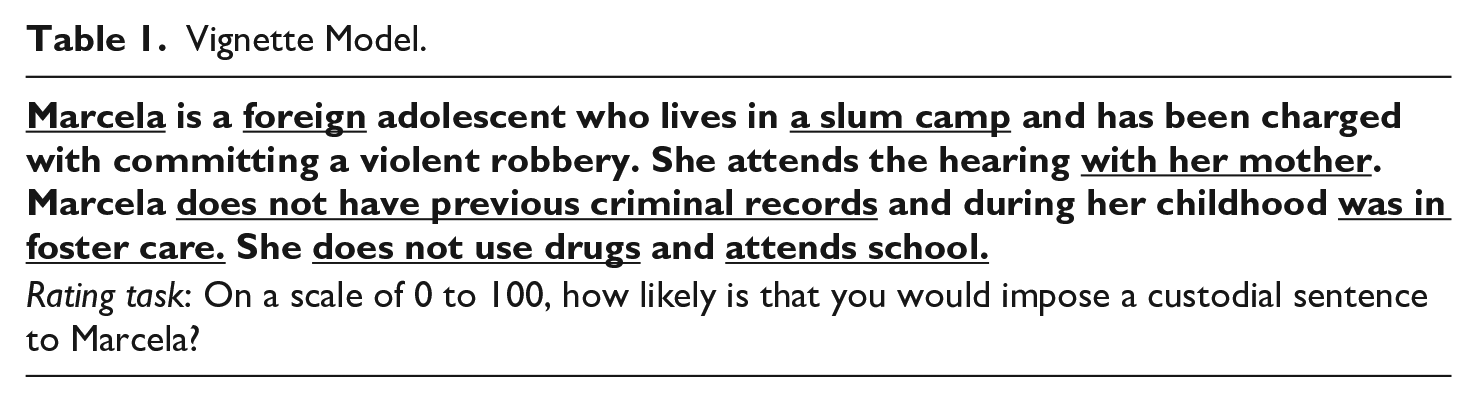
Table 2 shows all the dimensions and levels contemplated in the study. The aim of the dependent variable proposed in the vignette is that the judges adopt a position on the case (rating task), by estimating the probability (subjective) of giving a custodial sentence for the accused adolescent (continuous variable from 0 to 100). In all scenarios, the adolescents are accused of the same crime: having committed a violent robbery. This decision seeks comparability between cases, given a common and/or constant offense. The design of factorial surveys requires the selection of a sample of vignettes from the vignettes universe that includes all possible level combinations (Jasso, 2006). In this case, the universe is the result of the Cartesian product 2 × 2 × 3 × 2 × 3 × 2 × 2 × 2, with a total of 576 possible vignettes, considering the number of dimensions and vignettes included. Then, 144 units or types of vignettes were randomly selected and divided in 12 sets (or decks) of 12 vignettes respectively. Each deck was arbitrarily assigned to the participants. The way of selecting the vignettes, as well as the rating task used, is not the only one possible and requires the appropriate methodological strategies.
Operationalization of the Dimensions Contemplated in the Study.

Regarding the quality of the factorial design, many studies show that around 8 dimensions per vignette, and around 10 vignettes per respondent, entails a suitable extension. Furthermore, continuous dependent variables (rating task) are more suitable and flexible for providing judgments (Auspurg & Jäckle, 2017). The main advantage of the factorial survey method, however, is that it achieves the “orthogonality of factors” (namely, a perfect non-correlation between studied variables), which is typical of an experimental design, but can be obtained under this method using sampling procedures of conventional surveys (Wallander, 2009). This is relevant to the degree that social reality generally suffers from multicollinearity, which is hard to avoid. For example, in many societies, criminal record is a variable closely associated with socioeconomic status, and it seems impossible to separate both variables. In this sense, factorial surveys consider a design whereby the factors (or variables) of a vignette combine themselves with total randomness. Therefore, variables correlated in real life are not correlated here, because the factorial design creates an experimental and controlled setting. This helps social scientists to observe the effects of each one of the decontaminated factors, as distinct from the usual overlapping of effects of the real world.
Sample
Table 3 shows judges’ characteristics. Out of 320 who answered the questionnaire, 246 completed all the questions and were considered in the analyses. Almost half of the judges were women, and the average age of the sample was 47 years. The majority of the judges (98.4%) declared that they were not exclusively working in the Youth Justice System, but combing they workload with cases from the adult system.
Judges Characteristics.

Analytical Strategy
Given that each judge had to assess a set of vignettes, the resulting structure of the data of the factorial survey is, by definition, hierarchical (Hox et al., 1991). The vignettes are the first level of analysis, because they are nested within the personal criterion and context of each one of the judges, whereas the judges’ characteristics corresponded to the second level unit of analysis. The literature is consistent in arguing that multilevel analysis is the most appropriate and efficient strategy to study data with a hierarchic structure (Bryk & Raudenbusch, 1992; Goldstein, 1986; Hox et al., 1991; Jasso, 2006). The main use of multilevel models is that, when considering different levels of analysis, it is possible simultaneously to study the impact of the factors mentioned in the vignettes (associated with a social component) and the importance of the individuals’ characteristics (idiosyncratic component) when considering the eventual judgments. At the same time, it allows for an assessment of relations between variables within each level and between levels of study, which creates an analysis of great complexity. Since the dependent variable (rating task) of interest is numeric (0–100), a multilevel lineal analysis was carried out. This strategy proposes models with two regression equations: the first, forms the effects of the vignette within each respondent; while the second, forms the effects of the personal characteristics of the judges. In this way, at the first level, the mentioned vignette’s factors correspond to the independent variables of the statistics models (see Table 2 for each variable evaluated).
At the second level, such factors are dependent variables, and introduce characteristics related to the individuals (judges) as independent variables that explain the effect of each factor over the response variable. Finally, regarding data treatment, the models presented were estimated through the statistical package STATA 14.
Results
Legal and extralegal factors were examined through the evaluation of the vignettes. Considering that each judge assessed 12 fictional descriptions of young offenders, there was a total of 2,952 vignettes evaluated by 246 judges. Table 4 shows three initial models for the analysis:
Initial Models.

Note. Standard errors in parentheses.
p < .001, **p < .01, *p < .05.
The first one is the null model, also called “unconditional,” because it does not have independent variables. This model is used to prove if there is significant variability among judges and judicial decisions, since otherwise the homogeneity in judgments would not justify the use of a multilevel strategy. The results indicate that 40% (intraclass correlation) of the variation in the judgment of vignettes is due to the judges’ characteristics, which justifies the use of a two-level model.
Model 1 indicates the effect of each of the vignettes’ dimensions—in other words, the legal and extralegal variables of the offender—on the judgments regarding the probability of imposing a custodial sentence in each described case. The second Model adds level 2 variables relevant for the study (i.e., those related to the judges) 3 to the first model, which contributed to understanding the role of the judges’ characteristics. As indicated above, 50% of the level 1 variance (Bryk/Raudenbush R-squared Level 1) is explained by the dimensions of the vignettes. The level 2 variables included explain 18% (Model 2) of the variance regarding the judges; meanwhile, Model 1 includes level 1 variables—but in a standardized way—in order to establish a hierarchic order of the effects of each variable. Undoubtedly, legal factors are the most important ones for judicial decision-making, because the information about criminal records is significant and has a greater relative weight. But extralegal factors also play an important role, and—even though their effect is less decisive—they show that adolescents’ characteristics can explain disparity in decision-making. In fact, the results reveal that the significant extralegal factors are (in decreasing order of importance): drug use, school attendance and the socioeconomic level (proxy: “area of residence”) of the offenders. However, the results suggest no significant effects on decision-making of variables such as gender, nationality, family support and experiences of foster care during childhood.
The second model considers not only the characteristics of the adolescent offender (Level 1), but also the characteristics of the judges (level 2), so it demonstrates the contribution of hierarchic models to the analysis of factorial surveys. In addition, as this model does not present the standardized variables of level 1, its interpretation is more intuitive. Regarding legal factors, when offenders have homicide records, the perceived probability (or disposition) of judges to impose a custodial sentence increases by 41.1% compared to someone with no records. However, that percentage decreases to 31.8% in cases with violent robbery records and to 20.1% when they have burglary records, both compared to offenders with no records. This is an interesting finding, because it shows that judicial decisions do consider the severity of previous criminal records and even if there is “de-escalation” (the last offense committed was less serious than the former one), having a criminal record (as opposed to not having one) increases the probability of judges imposing a custodial sentence. Regarding the extralegal characteristics, drug use and school absence increase the probability of receiving a custodial sentence by 6.1% and 2.7%, respectively. Nevertheless, the results also show that belonging to lower socioeconomic levels can be a protective factor against receiving a custodial sentence: low or medium socioeconomic levels decrease the probability of custodial sentencing by 2.6% and 1.6%, respectively, compared with adolescents from a higher socioeconomic level.
Having said that, regarding the effect of the judges’ “lenses’ in the sentencing process, the results show that the judges” characteristics are not only significant, but also have a greater effect than extrajudicial factors. Therefore, judges of a less punitive orientation are, on average, 7.7% less likely to impose custodial sentences than those who recommend sanctions with a punitive function only, regardless of the characteristics of the case. Similarly, those who consider “the capacity of young people to control their impulses and understand the consequences of their actions to make judicial decisions” are between 4.3% and 12.0% less likely (in each case) on the scale of perceived probability to impose custodial sentences. 4 In the same vein, for every 1-point increase in the procedural justice scale (1–10), the perceived probability of the judges imposing a custodial sentence diminishes by 1%. On the other hand, when judges consider that custodial sentences are effective for social integration among young people, their probability of imposing these types of sanctions increases 8.4% compared with those who do not have the same belief. The results allow for a dismissal of the notion that gender and the age of the judges play a significant role on decision-making (Gilligan, 1982; Green & Heilbrun, 2011).
This analysis can be extended to consider other elements. Since the formation of judgment is a complex cognitive process, not only must the independent effect of different factors be considered, but also the combination of those elements. As a result, it is relevant to study how interactions between (or combinations of) adolescents’ characteristics affect the probability of judges imposing a custodial sentence. After carefully analyzing several models to test interactions between Level 1 factors, Table 5 shows the significant interactions between the dimensions of the vignettes and the characteristics that describe the young people subject to judicial sentences.
Interactions Between Level 1 Factors.

Note. Standard errors in parentheses/***p < .001, **p < .01, *p < .05/The dimensions of the vignettes and the level judge variables of model 3 have been included on each model.
There is an interaction between legal and extralegal criteria which proposes that the effect of criminal records on judgments is affected when there is extrajudicial information about the cases. When judges have information regarding drug use or homicide criminal records, the perceived probability of imposing custodial sentence falls by 5.1% (Model 3). However, the effect of drug use does not have a significant impact on other types of less serious records (robbery) or no records. Furthermore, the results indicate that being female—together with other extralegal factors—may influence the judges’ custodial decision (see Models 4–6). Data demonstrate that being female and attending the hearing alone (effect −2.4%), being female and not going to school (−3.2%), and being female and Chilean (−2.8) all reduce the perceived probability by the judges to impose custodial sentences.
Therefore, when there is information that shows the vulnerability of the accused young women, it is less likely for the judges to impose a custodial sentence. This gender factor does not apply in the same way in the case of migrant women, where the previously mentioned effect is not significant. Nevertheless, these results show that, unlike male cases, vulnerability is somehow “less punished” in female cases.
The way in which interactions between adolescents’ and judges’ characteristics affect judicial decision-making was also examined. Table 6 shows the three models that proved to be significant after testing the different variables of both analysis levels.
Interactions Between Level 1 and 2.
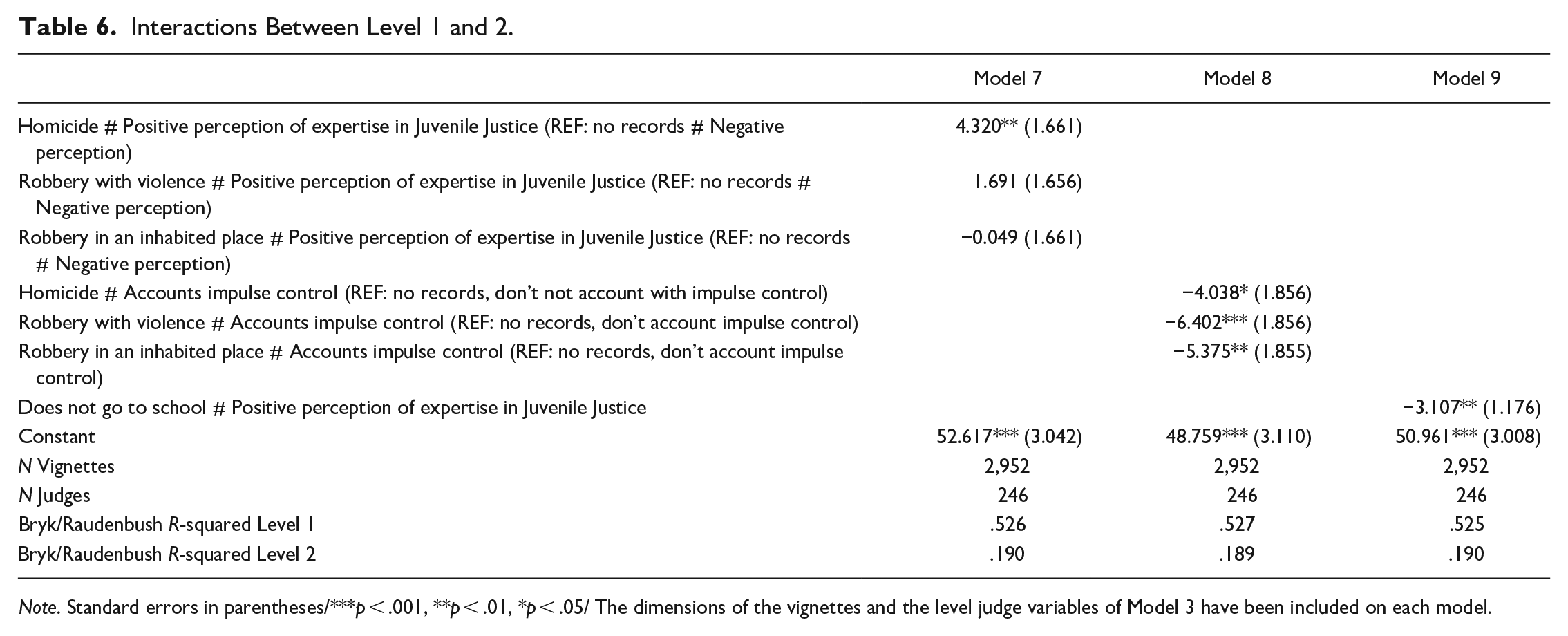
Note. Standard errors in parentheses/***p < .001, **p < .01, *p < .05/ The dimensions of the vignettes and the level judge variables of Model 3 have been included on each model.
Thus, Models 7 and 8 demonstrate that legal factors are evaluated differently by certain types of judges. According to Model 7, those judges with a positive perception of their expertise with juvenile justice cases are more likely to be more severe with adolescents with homicide criminal records, with a 4.3% higher probability of imposing a custodial sentence, than those judges that do not describe their experience as positive and assess cases with no criminal records. Model 8 shows that judges who incorporate information about offender’s impulse control in their decision-making, tend to accord less importance to the criminal records of the cases (by a factor between 4% and 6.4% depending on the type of record), as compared to those who do not account for impulse control. Finally, Model 9 reveals that those judges who consider themselves as experts on juvenile justice, accord less importance to the fact that adolescents do not attend school than those who do not have the same perception of their expertise.
Discussion
The Juvenile Justice System should keep children and adolescents, as much as possible, away from the criminal system. The system also should not make arbitrary use of certain factors that can restrict the equitable exercise of the adolescents’ rights. Therefore, studying the process of sentencing in Juvenile Justice is an urgent matter, especially considering the recent Youth Justice Reform that has been carried out in Chile. The results described above show several similarities and confirm some previous research findings from Anglophone countries (mainly the United States)—but, nevertheless, there are some findings that contradict previous research, showing the relevance of local and cultural particularities.
Firstly, in line with the “focal concerns” perspective, the findings of this study confirm that legal factors are the main concern when it comes to decision-making. However, stereotypes and other extralegal considerations also guide the judges’ decisions (Hartley et al., 2007; Steffensmeier et al., 1998): specifically, drug use, school attendance and the socioeconomic level of young people are factors that directly affect the decision-making process. This could be explained by the fact that judges see higher risk of recidivism related to those factors, rooted in the ideas that school non-attendance generally implies more time in unstructured activities and an increase drug use, thereby triggering criminal behavior. In this sense, it can be argued that judges’ mentality seems mainly to lean toward the protection of the community—and thus, as previous studies have shown, extralegal information tends to toughen the punitive response instead of adapting it (Armstrong & Rodriguez, 2005; Auerhahn et al., 2017; Bishop & Frazier, 1996; Bridges & Steen, 1998, 1998; Caudill et al., 2013; Ericson & Eckberg, 2016; Fader et al., 2014; Mears et al., 2015; Ray & Alarid, 2004).
However, contrary to previous research conducted in the United States (Auerhahn et al., 2017; Bridges & Steen, 1998; Heider, 1958), the effect of the socioeconomic level of the offenders could be considered as an exception, with the results showing that, the lower this level is, the lower the likelihood of judges imposing a custodial sentence. This may be because it was evident for the judges that the information being gathered was specifically intended to probe their dispositions regarding class bias (so they gave a socially desirable answer), or because they consciously wanted to avoid any disparity of this kind. In any case, the effect of the socioeconomic level in this study contradicts Attribution Theory and studies conducted in the United States, which have shown that the poorer the adolescents, the harsher the sentence they receive (Auerhahn et al., 2017; Bridges & Steen, 1998; Heider, 1958). These results might be explained by the fact that contrary to what happens in developed countries, such as the United States; in Chile custodial sentences do not necessary assure the access to social services and programs to reduce recidivism (Politicas Publicas UC, 2018; Werth, 2013). Therefore, they do not offer opportunities to social integration and to counteract socioeconomic disadvantages.
Secondly, the relevance of legal factors on decision-making in the context of juvenile justice does not necessarily imply being reasonable. In the Chilean context, instead of considering the offender’s characteristics to guide the criminal response, judgments are mostly based on the characteristics of the offense itself (Catlin et al., 2011; Smith & Rosier, 2015). This might be a cause for concern, since judges decide cases based on little information: even when they are legally based, decisions are made on a bounded rationality (March & Simon, 1958). Thus, past experiences, stereotypes and prejudices, along with organizational considerations, usually play a role in creating patterns of responses (Albonetti, 1991). In this way, implicit extralegal factors on many occasions further the punitive disposition of the judge—and the results showed that, when extralegal information of the case is combined in a certain way, it affects judicial decisions. This article therefore contributes to the efforts of former research to understand the moderating effect of some stereotypes (Fine at al., 2017; Leiber, 2015). In particular, the judges who believe in the presence of homicide criminal records as a decisive consideration, moderate the weight of this variable when there is information about the offenders’ use of drugs. This could mean that, under certain conditions, the judicial response is adapted to the adolescents’ needs, which, as Bishop et al. (2010) propose, is exactly what should differentiate the adolescent criminal system from the adult one. Likewise, the gender of the offender together, with other indicators of vulnerability, had the effect of moderating the punitive decision of the judges. Indeed, the profile of a Chilean young woman, who attends her hearing alone and is not attending school, is less likely to elicit a custodial sentence from a judge. This is consistent with Leiber and Peck (2015), who argued that women have more advantages in a judicial process than men. This can also be interpreted from a cultural perspective, since in Latin American contexts chivalry plays a crucial role and women offenders could being afforded greater leniency than other offenders (Espinoza et al., 2020; Heidensohn & Gelsthorpe, 2007).
A third relevant element of the findings is that the judges’ own characteristics cannot be ignored when studying the sentencing process. This research identified that there is less of a disposition to impose custodial sentences among those judges who consider the psychological characteristics of the offender (information about impulse control), who consider themselves experts of juvenile justice and who have greater procedural justice orientations and consider the rehabilitative purpose of sanctions. By contrast, those judges who considered that custodial sentences are effective, showed a greater disposition to impose a custodial sanction than those who considered them an ineffective mechanism for the social integration of adolescents. Meanwhile, and contrary to previous research, the findings allow for a dismissal of the view that judges’ age (Green & Heilbrun, 2011) and gender (Gilligan, 1982) are relevant. The fact that judges’ age was not relevant in the decision-making process, might be explained by the fact that different to the research contexts where most of the research has been conducted (mainly the United States where Juvenile Court judges are specialized), in Chile Juvenile Court judges are not specialized and do not have an accumulated experience within the Youth Justice System (Langer & Lillo, 2014; Politicas Publicas UC, 2018).
Finally, the interaction between the characteristics of the judges and the cases, show that those judges who considered themselves experts of juvenile justice were more severe with cases with homicide criminal records – but, at the same time, moderated the negative weight of the school drop-out. Similarly, those judges who accorded importance to the psychological characteristics of young offenders, tended to give less consideration to their criminal records. Besides confirming what has been suggested in other research regarding the importance of judges’ motivations in sentencing (Cochran et al., 2003; George, 2001; Koublitskaia, 2012; Young, 1991), this study provides new evidence about the interaction between the characteristics of the judges and the judicial case.
Implications and Limitations
From the results obtained, it is possible to draw implications on three central points. Firstly, according to the results, some extralegal factors play a role and balance the effect of criminal records on the probabilities of adjudicating a custodial sentence. This is the case for information regarding social exclusion, participation in school and substance use. However, the availability of this information should be fulfilled to ensure the due process and the right to equal treatment before the law, and it would therefore be necessary to exclude information that may operate in a discriminatory fashion. This shows that the claim regarding the availability of more information for judicial decision-making could be highly contentious—hence, the question regarding what information must be available and who and when can access it, must be deeply discussed.
A second implication that emerges from the results is the need for judicial training and for promoting specialization within the Youth Justice System, especially in the Latin American context where Youth Justice Systems are relatively young. In terms of organic specialization, this not only means time-dedication or time-exclusivity of courts dealing with juvenile justice matters, but also that a set of policies should be enacted in order to modify certain organizational practices and to reduce the stress factors in the decision-making process (Casey et al., 2013). In terms of functional specialization, the results show that beliefs and orientations regarding justice, play a relevant role in judicial decisions. Given this, it has been suggested that a minimum unitary policy of training and education for all justice system operators is necessary (Glaser et al., 2014).
Finally, it is possible to think of ex-post control mechanisms on judicial decisions (Rachlinski et al., 2008). These processes might be relevant to verify the consistency of judicial outcomes with the Convention on the Rights of the Child and the spirit of the aforementioned Law 20,084. This monitoring could also help to avoid bias and arbitrariness in a system that operates with little information and with a high level of discretion. Similarly, in some jurisdictions, it has been proposed to provide feedback to judges, so that they became aware of and can evaluate, the consistency of the decisions they make (Casey et al., 2013)
Finally, although the methodology of the study allows a sophisticated analysis of a complex cognitive process, it presents some limitations. One, is the criticism of the validity of the results obtained under this method—since, in fact, judges do not decide hypothetical situations in the real world. However, the supporters of this methodology point out that the most critical and even unrealistic situations are precisely where the “real” principles behind a judgment can be discovered (Wallander, 2009). Despite the gap existing between fictitious and real people, there is no current methodology available with which to study the social phenomena without “separating” people from their everyday context, and this point must therefore be understood as a problem for social sciences in general. In addition, since the design of the vignettes must avoid participants’ fatigue, researchers had to choose a limited range of factors affecting decision-making processes and put aside some other theoretically relevant variables. Lastly, this research provides information about just one stage of the complex process of the juvenile justice system, whereas the criminal justice process includes more variables and actors besides judges (Bishop & Leiber, 2012). The above may conceal some cumulative disadvantages produced within the judicial process (Applegate et al., 2000; Baumer, 2013).
Footnotes
Declaration of Conflicting Interests
The author(s) declared no potential conflicts of interest with respect to the research, authorship, and/or publication of this article.
Funding
The author(s) disclosed receipt of the following financial support for the research, authorship, and/or publication of this article: We would like to thank the support provided by Concurso Políticas Públicas UC and FONDECYT Regular 1212047.
