



Abstract
Core components of the Intake Assessment (IA) process in the Canadian federal corrections system were examined to determine whether a simplified algorithmic equation for individuals sentenced for sex crimes could be tailored and differentiated from other violent offence types. Two major offence type categories, namely sexual and other violent were constructed for 2,896 adult male first releases for 2016 to 2017 and 2017 to 2018. A restricted set of static risk indicators, dynamic need ratings, and other actuarial measures as well as whether or not there were any returns to federal custody were extracted for each case. A combined risk index yielded robust predictions of custodial return for sexual and other violent offence types with significant and robust AUCs of 0.77 and 0.71, respectively. Analyses showed that five-level risk groupings could be derived independently for the two offence type categorizations.
Introduction
Internationally, criminal justice policy makers and practitioners have had a keen interest in the safe reintegration and risk management of persons sentenced for sex crimes and other types of violent offences because of the enormous costs and harm to victims. While sexual and violent offending continue to present a serious social problem, low public tolerance for these type of offences, as well as focused media and political attention have led to increases in victim reporting, criminal detection, prosecution, and more sanctioning (both custodial and non-custodial) for these types of crimes. Moreover, the public is deeply concerned with the manner in which these sentenced individuals are case managed because those providing reintegration services are seen as being responsible for the safety of vulnerable groups of the public.
It is now widely accepted that having a comprehensive and integrated assessment and treatment planning process at the intake/admission stage to the correctional system is critical to help inform the level of risk at the later phases of the sentence, when decisions as to possible release may be taken (Moore, 2015; Motiuk & Keown, 2021). At the same time, it is noteworthy that there are many successful models of risk assessment for conditionally released offenders in the community (Bonta & Andrews, 2017; Motiuk, 1999). Decades of empirical research regarding the predictive value of offender risk and needs assessment has led to three major conclusions: (1) having a criminal record is strongly related to outcome on release; (2) a relationship exists between the type and number of criminogenic needs and likelihood of re-offending; and importantly; (3) combined assessments of risk and needs can significantly improve the ability to differentiate cases according to their likelihood of re-offending (Gendreau et al., 1996; Motiuk & Keown, 2020).
In 1991, under the auspices of a Correctional Strategy initiative, a national working group was set up in the Correctional Service of Canada (CSC) to design, develop, and implement a systematic and comprehensive Offender Intake Assessment (OIA) and correctional planning process at the time of admission to federal custody. In 1992 to 1993, the process was pilot tested in all five of CSC’s administrative regions—Atlantic, Quebec, Ontario, Prairies, and Pacific. Because of empirical testing, refinements were made and throughout 1993 to 1994 work began to address staff training, technological support, and data collection. In the fall of 1994, the OIA process was implemented bilingually (English/French) in all regions across the country. Since then, nearly 120,000 offender intake assessments have been completed and entered into the Offender Management System. Presently, the situation exists where about 95% of the federal institutional population have comprehensive risk/need assessment information derived from OIA.
Instruments
Beginning at sentence commencement, CSC parole officers coordinate the collection of all relevant information (criminal and social history) about federally sentenced (2 years or more) offenders from within and outside the correctional system. This information serves as the foundation for future recommendations and decisions (e.g., security level, program intensity, and temporary absence) that case management teams must make throughout the course of the offender’s sentence. In addition to being the central figure in a federally sentenced individual’s assessment process, parole officers play a major role in correctional planning; monitoring progress while in the institution; preparing cases for decision (parole board reviews and release); and supervising them while in the community.
All federally sentenced persons go through the OIA process at the time of admission (Motiuk, 1993, 1997, 1998). OIA has a number of core components: a preliminary and post-sentence community assessment; an immediate needs assessment (security, health); a static factors risk assessment (youth and adult criminal history, offence severity, and sex offence history); a dynamic factors risk assessment or criminogenic needs identification (employment, marital/family, associates/social interaction, substance abuse, personal/emotional orientation, and attitude); supplementary assessment(s) (mental health, psychological, Indigenous elder, substance misuse, education, literacy, and family violence risk); an assessment of motivation, accountability, and responsivity; an assessment of serious harm; and a release risk assessment using the Statistical Information on Recidivism—Revised 1 scale (Nafekh & Motiuk, 2002; Nuffield, 1982, 1989).
Static Factors Assessment
By systematically reviewing the offender’s file, which includes police reports and court transcripts, a criminal history, and offence severity record is completed. When applicable, a sex offender history checklist is also done (Motiuk & Porporino, 1993). Information is gathered on previous offences, current offences, the number and types of convictions, youth court dispositions, adult court dispositions, adult court sanctions, and crime-free periods. This information is compiled into three separate indices of the criminal history record: previous youth court involvement, previous adult court involvement, and current offence. Together these yield a total score that reflects the nature and extent of an offender’s involvement with the criminal justice system.
Similarly, a systematic review of the offender’s file is used to complete an offence severity record. Information is gathered on current offences, previous offences, types of convictions, sentence length, the number and types of victims, the degree of force used on victims, and the degree of physical and psychological harm to victims. This reflects the nature and degree to which an offender has inflicted harm on society in general, and on victims in particular. In addition, the offender’s file is reviewed thoroughly to complete a sex offence history checklist. Then a determination of overall static risk is made using professional judgement.
Empirical investigations have found convergent for the static factors assessment component of the OIA, including its criminal history record subcomponent, with other measures of risk such as security level designations (Helmus & Forrester, 2014a; Motiuk, 1997). Moreover, predictive validity was found for the criminal history record subcomponent demonstrating strong relationships to community outcomes (revocation without offence, readmission with any offence, and readmission with violent offence) and outperforming the overall static factors risk rating (Helmus & Forrester, 2014b). Recently, the criminal history record subcomponent was transformed into a five risk-level groupings Criminal Risk Index (CRI) which re-established that criminal history information can be quantified in ways that accurately reflect relative risk estimations; these predict discretionary release and post-release re-offending for men, women, and Indigenous offenders regardless of offence type (Motiuk & Vuong, 2018).
At intake, sexual offenders are also administered the Static-99R, a risk assessment tool designed to assist in the prediction of sexual and violent recidivism among adult male sexual offenders (Hanson & Thornton, 2000; Harris et al., 2003). Used to assist in the referral of sexual offenders to correctional programing, the Static-99R has been found to be moderately accurate in predicting sexual recidivism and deemed useful in applied (Reeves et al., 2018).
Dynamic Factors Assessment
At the time of OIA development, CSC parole officers had been using the Community Risk/Needs Management Scale (Correctional Service Canada, 1990; Motiuk & Porporino, 1989). The dynamic factors assessment component of OIA collapsed the 12 need areas of the Community Risk/Needs Management Scale into 7 need dimensions or target domains. Each domain area in the dynamic factors assessment component of OIA contains a series of indicators as well as guidelines used to rate each of the seven dynamic factors and provide an overall dynamic factors rating. Studies conducted on the dynamic factors assessment component have found the indicators and domain ratings to be valid predictors of discretionary release and returns to custody for men, women, and Indigenous offenders (Stewart et al., 2017a, 2017b, 2017c).
New Technology
Faced with the new challenges of 2020s such as transformative legislation (Bill C-83: An Act to amend the Corrections and Conditional Release Act and another Act, 2019) and responses to COVID-19, CSC is exploring the efficacy of using hand-held assessment mobile technology upon admission to correctional facilities in a comprehensive, integrated, and systematic fashion and to routinely reassess them thereafter. A nation-wide mobile-based structure for systematically collecting and integrating individual evaluations has been designed for assessment, correctional planning, and reporting on progress. This application specifically tailored for the IA process can improve the way correctional agencies manage risk and deliver interventions more effectively. Underway is scientifically testing the foundation of data structures and scoring algorithms inherent in the application. It is also important to determine if the prediction of recidivism (any return to federal custody) is influenced by the major offence types. These are the fundamental queries being addressed in this research.
Methodology
Setting
During the fiscal periods of 2016 to 2017 and 2017 to 2018, CSC admitted nearly 14,400 federally sentenced (2 years or more) persons, of which roughly 10,000 were newly sentenced and approximately 4,400 were readmitted on a revocation of conditional release. On the other hand, releases from federal custody over the same 2-year period numbered about 15,200. The resulting turnover of having fewer admissions to custody and more successful releases to the community partly explains an observed decline in the federal custody population over the past 5 years from 14,886 at year-end in 2014 to 2015 to 13,920 in 2019 to 2020.
In the Canadian federal correctional system, each new admission is interviewed and provided an orientation session. Then, all newly sentenced persons progress to the two core components of the IA process: static and dynamic risk assessment for development of an individualized correctional plan. Adjudicated cases are then initially placed at an assigned security level (minimum, medium, or maximum) in 1 of 43 institutions distributed across Canada. As the sentence progresses, cases are reassessed by parole officers who update correctional plans on a regular basis. Upon reaching release eligibility dates, cases may be conditionally released (parole or statutory release) and mandated to report to 1 of 90 parole offices located in various communities. While CSC makes recommendations about the conditional release of a federally incarcerated person, the Parole Board of Canada, (PBC) an independent agency, is responsible for making the decision about early release, either day, or full parole. Otherwise, statutory release occurs at two-thirds of the sentence.
Participants
The individuals who were examined in this study were all federally released adult males with a major admitting offence that fell under Schedule I of the Corrections and Conditional Release Act (violent-excluding murder) and first conditional releases (e.g., day/full parole or statutory release) between 2016 to 2017 and 2017 to 2018.
A total of 2,896 men were drawn for this study because they had complete risk and needs assessment data available that could be extracted from the Information Management System. Of the study participants, 39% had been released on parole and the remainder on a supervised statutory release.
Study participants were distributed within Schedule I offences articulated in the Corrections and Conditional Release Act by two major offence types as follows: 884 for sex crimes (or 31%) and 2,012 for other violent offences (or 69%) offences. With respect to individuals sentenced for sex crimes included 52% for sexual assault or rape (all types), 31% for sexual interference or exploitation, and 18% for other sexually related offences. Among the other violent offence types, major offence for which the person the longest portion of their current sentence was comprised of 36% for robbery, 31% for major assault, and the remainder for other violent (i.e., manslaughter, common assault, kidnapping, etc.).
For the entire sample, all participants were available for at least a 1-year post release follow-up with an average follow-up period of 1.7 years (SD = 0.82). The study participants ranged in age from 19 to 89 years (M = 36.8, SD = 12.5). Determinate sentence length ranged from 2 to 18 years (M = 3.95, SD = 3.41).
In Table 1, descriptive statistics are presented across the two major offence groupings. Significant differences were observed between the groups with respect to age, sentence length, time served in custody, and time spent out under community supervision. Not surprisingly, cases sentenced for sexual offences were older, had shorter sentences, and served less time in custody and more time under community supervision. Meanwhile, other violent offence types were younger, had longer sentences, and served more time in custody and less time under community supervision.
Sexual Offence and Other Violent Type Grouping Characteristics.

T-test of difference between means, t = −19.24, p < .001.
T-test of difference between means, t = 4.93, p < .001.
T-test of difference between means, t = 3.96, p < .001.
T-test of difference between means, t = −7.18, p < .001.
Procedure
A reduced set of 11 static risk indictors for each case were gathered from the criminal history record subcomponent of OIA. These included: any prior youth (ages 12 to under 18) convictions, previous community supervision as a youth, prior failure while under supervision as a youth, previous youth custody, escape/attempt escape/UAL as a youth, any prior adult (ages 18 or over) convictions, previous community supervision as an adult, prior failure while under supervision as an adult, previous adult custody, escape/attempt escape/Unlawfully at Large as an adult, and disciplinary sanctions while in adult custody. In addition, the dynamic risk domain level ratings were extracted for the following seven areas: employment/education, marital/family relations, associates/social interaction, substance misuse, community functioning, personal/emotional orientation, and attitude. Furthermore, available Static-99 scores for those serving sentences for sexual offences.
Analyses
Predictive validities for 11 static risk indicators, 7 dynamic needs ratings, their respective indexes or simple tallying of scores, combined static risk and dynamic needs scores, differential cut-points (three- and five-level risk groupings), and actuarial measures (Static-99R) were explored across the two major offence type categories through F-tests, Cramer’s V, and AUC statistics with any returns (technical violations of conditional release [parole or statutory release] and/or re-offending) to federal custody as the criterion measure. In the context of this paper, the focus is on any type of return to custody not just sexual offending so as to understand the risk return at the broadest level. Revocations of conditional release, whether due to a technical violation of conditions or otherwise are independently decided upon by the PBC and result in a return to federal custody.
Results
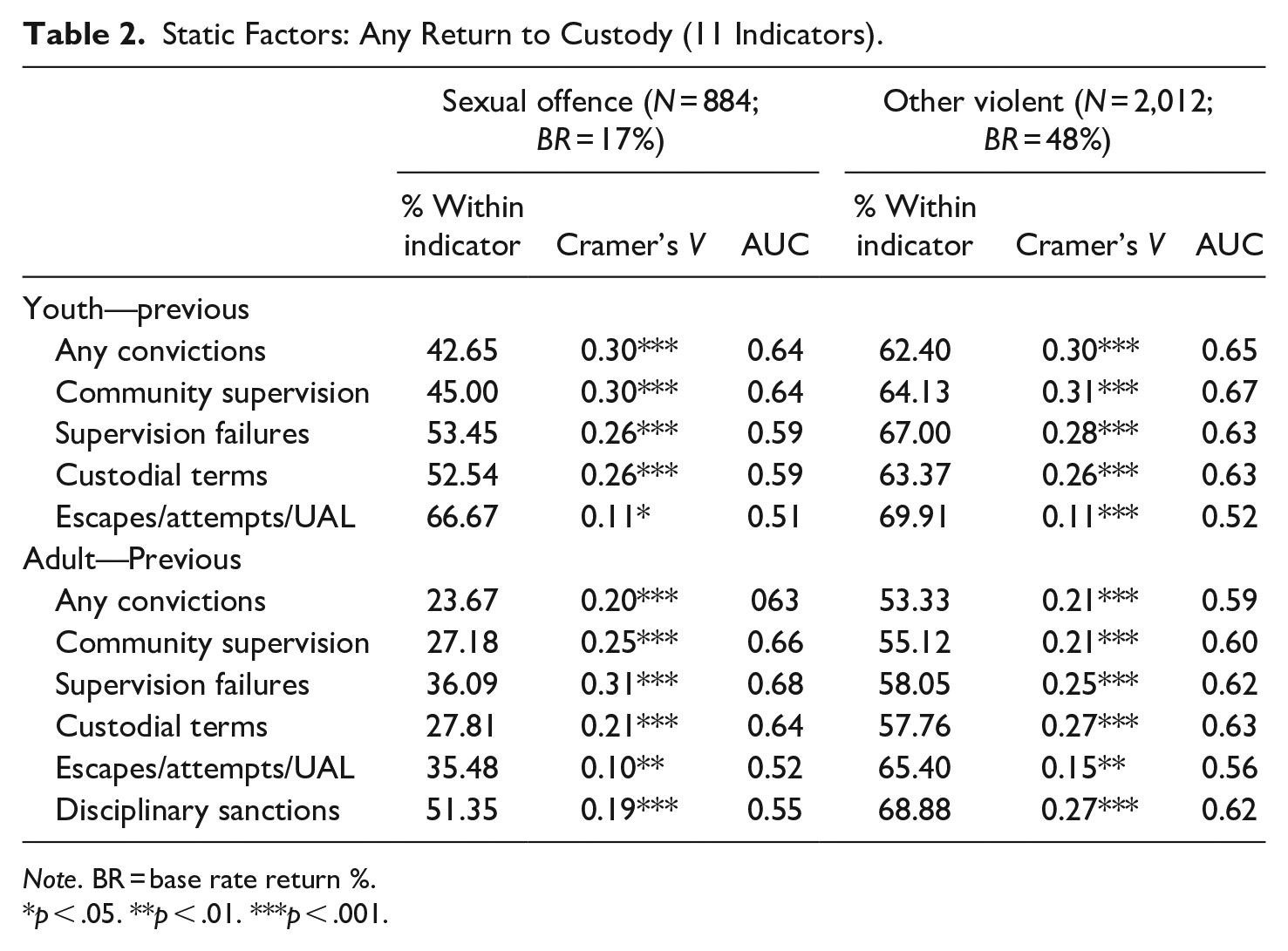
Measures of association are presented in Table 2 for the 11 static risk indicators across the 2 major offence types in relation to any return to federal custody. The returns to federal custody were 17% for sexual and 48% for other violent offence types. For both offence groups, all of the Cramer’s V statistics between the selected set of static risk indicators and the criterion measure were statistically significant. While lower associations were observed for Youth—Previous and Adult—previous Escapes/Attempts/UAL, these variables recorded the highest percentage within indicator of future returns to custody (70% and 69%, respectively).
Static Factors: Any Return to Custody (11 Indicators).
Note. BR = base rate return %.
p < .05. **p < .01. ***p < .001.
For sexual offenders, the highest corresponding AUCs were in relation to adult previous supervision failures (0.69), any previous youth convictions (0.64), and community supervision (0.64).
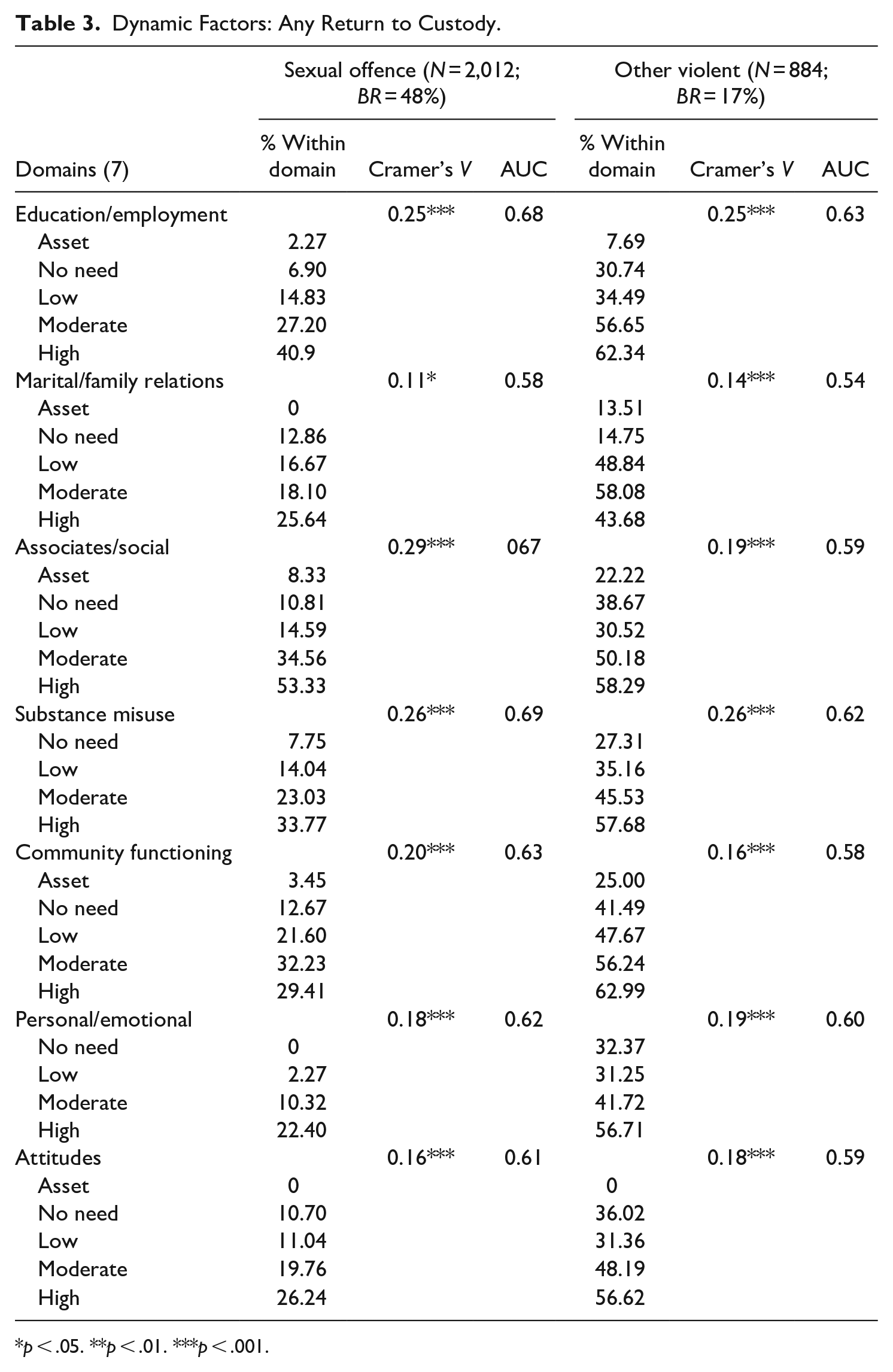
Table 3 presents the association statistics for each of the seven dynamic risk ratings across the two major offence type categorizations in relation to any return to federal custody. For both offence types, all of the Cramer’s V statistics between the dynamic risk ratings and the criterion measure were statistically significant.
Dynamic Factors: Any Return to Custody.
p < .05. **p < .01. ***p < .001.
For sexual offenders, the highest corresponding AUCs were in relation to substance misuse (0.69), education/employment (0.68), and associates/social interaction (.67). With respect to other violent offenders, the highest corresponding AUCs were in relation to education/employment (0.63) and substance misuse (0.62).
As shown in Table 4, the mean static score (a summation of 11 indicators) was 2.0 for sexual and 4.9 for other violent offenders. The mean dynamic risk score (a summation of rating weights ranging from +1 for asset, 0 for no need, 1 for low, 2 for moderate, and 3 for high) was 8.2 for sexual and 11.6 other violent offenders. The mean combined static and dynamic risk score was 10.3 for sexual and 16.5 other violent offenders. Significant differences were found between the static, dynamic, and combined risk score across the two major offence type categorizations.
Static, Dynamic, and Combined Risk Across Major Offence Type.
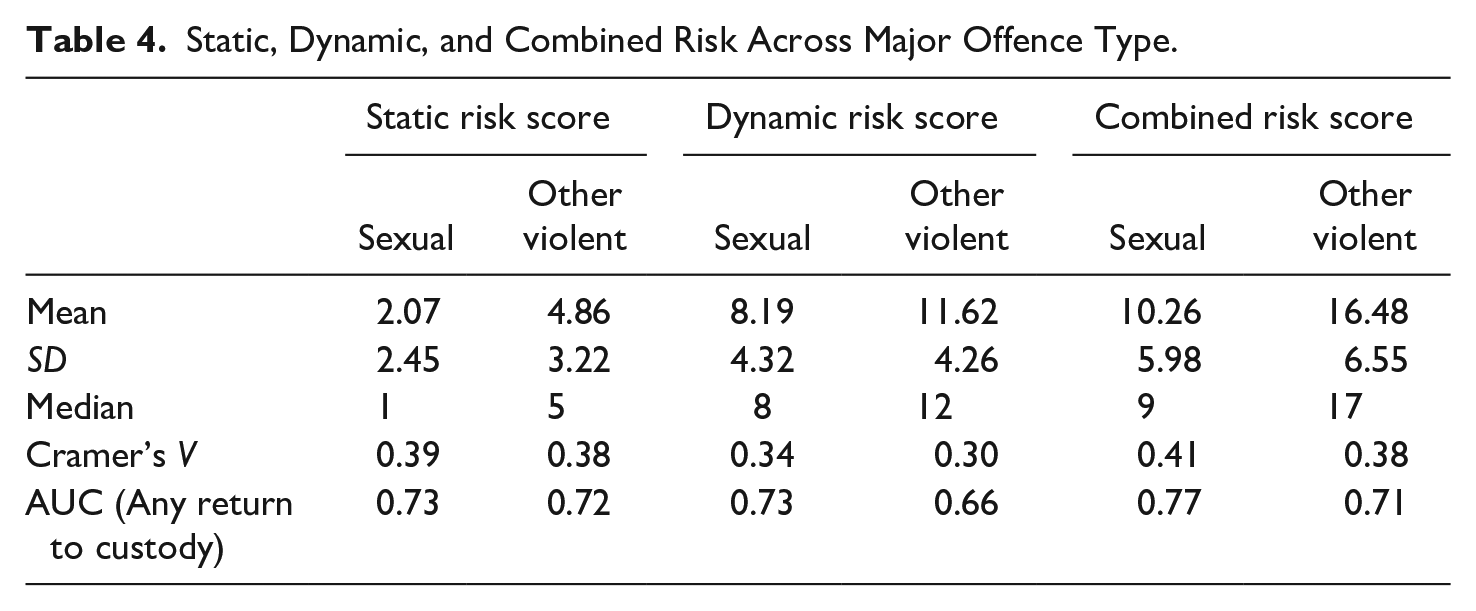
As reflected in Table 4, across all of the major offence types the Cramer’s V statistics between the static, dynamic, and combined risk score were statistically significant in relation to returns to custody. In addition, the AUCs reflected strong associations with static and dynamic risk scores. However, slightly higher AUCs for any return to custody were observed with combined static and dynamic risk scores in relation to outcome. This is, 0.77 for sexual and 0.71 for other violent offenders.
In tailoring risk levels to each major offence type for combined scores (see Table 5), proportional cut-offs were set at roughly one-third for three-level (low, moderate, and high) and one-fifth for five-level (low, low-moderate, moderate, moderate-high, high) groupings.
Proportional Cut-Offs Across Offence Types and Risk-Levels.
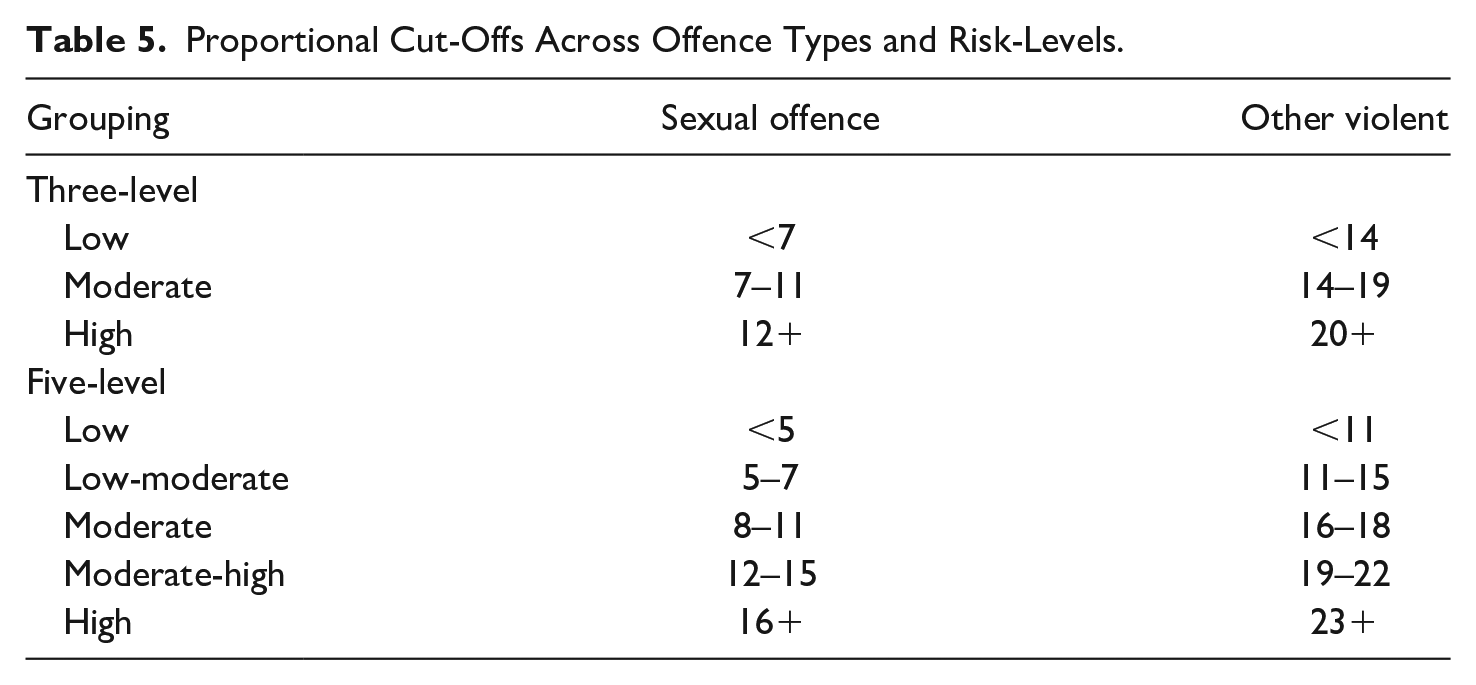
To further explore the practical utility of applying various risk-level cut-offs to the combined score distributions for sexual and other violent offenders separately, the rates of return to custody for three- and five-level risk groupings were statistically analyzed. As Table 6 reveals, from lower to higher risk there were substantive increases in returns to custody as reflected by increasing base rates and statistically significant associations.
Rates of Return to Custody Across Major Offence Types and Risk-Levels.

The congruent validity between the combined algorithmic equation, static, and dynamic risk scores with another risk measure for sexual offenders, the Static-99R, is reflected by the statistically significant correlations in Table 7.
Congruent Validity: Combined Static + Dynamic, Static, Dynamic Risk, and Static-99R.

p < .05. ***p < .001.
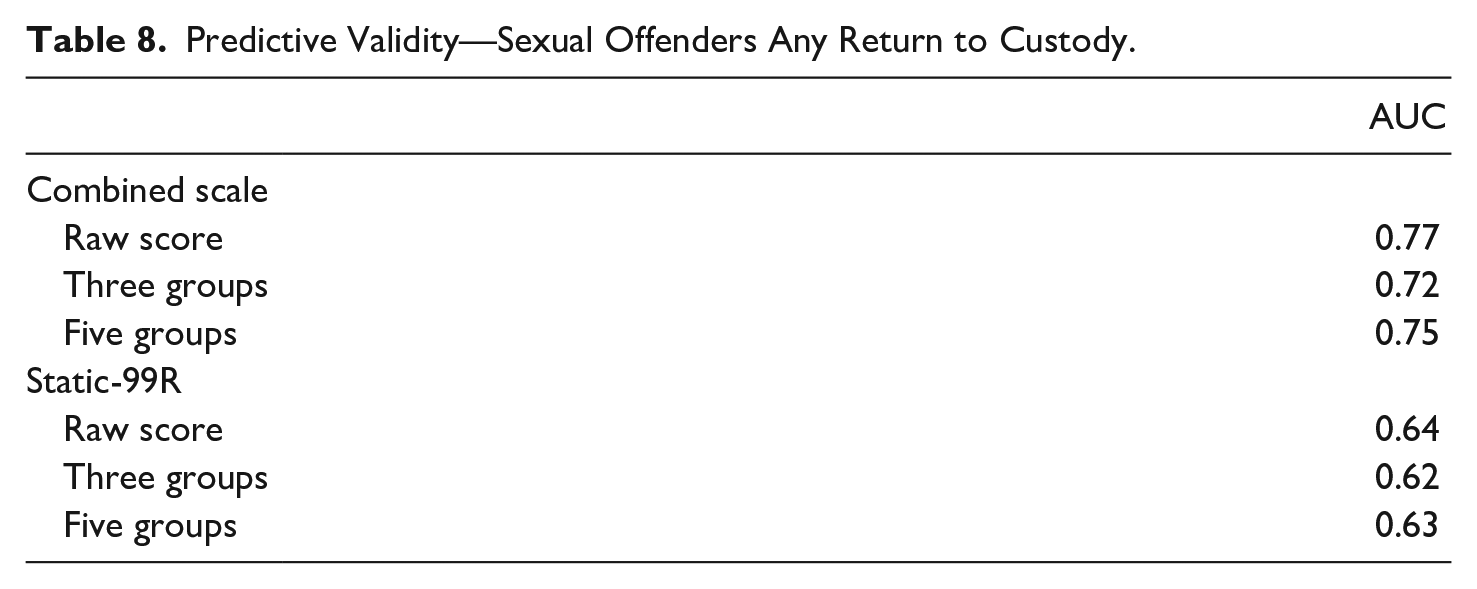
Also for sexual offenders, the incremental predictive criterion-related validity of the combined static and dynamic risk index relative to the Static-99R was explored by calculating the AUCs for three- and five-level risk groupings. As shown in Table 8, AUC values show large effect sizes for the combined static and dynamic risk algorithm.
Predictive Validity—Sexual Offenders Any Return to Custody.
Discussion
A critical theme in accommodating and managing custodial populations continues to be enhancing the public safety aspect of reintegrating them successfully back into the community. While the Canadian federal custody and community supervision populations are comprised mostly of individuals with a violent offence history, the number serving a sentence for a sexual offence on conditional release has steadily risen over time (Motiuk, 2018). This sustained growth necessitates the effective management and treatment of the recidivism risk of these individuals as well as for other violent offence types while in prisons and then afterwards, under community supervision (Cortoni, 2020). Consequently, stringent adherence to rigorous case-based analysis, structured case planning, evidence-based programing, and careful release preparation remain vital.
In the Canadian federal corrections system, the Risk-Need-Responsivity (RNR) principles of identifying individualized level of risk (intensive services to higher risk cases), targeting criminogenic needs (areas such as employment skills and substance misuse), and attending to responsivity (matching service delivery to learning style) are at the core of correctional service delivery (Bonta & Andrews, 2017; Correctional Service Canada, 2018). Upon admission to federal custody, offenders are systematically assessed then a correctional plan is developed and, if deemed appropriate, they are referred to education, vocational training, or various streams and intensity levels of an Integrated Correctional Program Model (ICPM). The ICPM is a multi-target or holistic program model, including one specifically designed for sexual offenders (Correctional Service Canada, 2014). Upon conditional release (parole or statutory) and while under supervision, these offenders may also be referred to and participate in a Community Maintenance Program. As well, they can also be placed on electronic monitoring depending on their level of risk as part of their community reintegration strategy (Hanby et al., 2019).
ICPM completions have been found to be associated with a lower likelihood of any revocations for conditionally released men when completed in custody (Correctional Service Canada, 2020). Furthermore, participation in the Community Maintenance Program component of ICPM also has been found to be associated with substantial reductions in the likelihood of any revocations (Correctional Service Canada, 2021). It is likely that the enhanced correctional services sexual offenders receive both while in custody and under community supervision are attenuating future returns to custody. For sexual offenders, the lower rate of return for any reason (technical violations, charges, or new crimes) is relatively lower than other violent offence types. This finding suggests that consideration be given to expanding risk appraisals beyond estimating the likelihood of a return or reconviction of another sexual offence. The practice of recommending early or discretionary release from custody using assessment instruments calibrated to measure only the likelihood of sexual recidivism is seen to be limited; an algorithmic approach may prove to be helpful in assisting with broader risk estimations for sexual offenders as well as other violent offence types. Reincarceration for any reason incurs significant costs to criminal justice systems, correctional agencies, and victims.
Predictive analytics revealed that an overall risk and need rating of any return to custody can be derived from a combined set of static and dynamic factors into a robust and valid scoring equation. It appears that an algorithmic-driven approach can be used to assist in intensifying intervention services when required and thereby reduce recidivism. As Austin (1977) had found earlier, there is an important link between major offence type and recidivism. Notwithstanding the lower base rate of custodial return for sexual offenders in comparison to other violent counterparts, the analyses suggest the solution to alleviate potential bias inherent in any decision-making process is to create better algorithms by tailoring them specifically for major offence types with customized cut-points for a variety of cohorts.
Footnotes
Declaration of Conflicting Interests
The author(s) declared no potential conflicts of interest with respect to the research, authorship, and/or publication of this article.
Funding
The author(s) received no financial support for the research, authorship, and/or publication of this article.
