



Abstract
We examined Twitter data using thematic analysis to understand public perceptions of the impact of COVID-19 on incarcerated people and reactions to including incarcerated populations in the early phases of the vaccine rollout. Our findings from n = 513 Tweets yielded six themes: Twitter as usual, Advocacy, Deserve to suffer, Vaccine priority debate, Inadequate response, and Misinformation. Stigma-laden statements cut across themes, highlighting the role pathologizing beliefs play in forming opinions about incarcerated people in public health crises. Trust of government response and buy-in to public health communication are positively associated with adherence to guidelines. Although public health decisions are derived from logic and research, our findings indicate that public perception may be driven by personal morals and stigma associated with justice-involved individuals. We recommend that attention be turned toward effective policy messaging, and use of social media, to increase trust and decrease stigma that tends to dominate societal perception.
COVID-19 Impact on Correctional Settings
Currently 2.3 million people are imprisoned in different carceral systems in the United States (U.S.) (Wagner & Sawyer, 2020). The effects of incarceration are long lasting and extend beyond the incarcerated individual to negatively impact families; incarceration takes an emotional, financial, and social toll on incarcerated individuals’ family members (Comfort et al., 2016), with parents, partners, and siblings left to face the burdens of having a loved one incarcerated, such as financial strain, residential and familial instability, relationship dissolution, and stigma (Gueta, 2018; Tadros & Durante, 2021; Tadros et al., 2020). Incarcerated people are in need of quality mental and physical health care, yet often receive inadequate and untimely treatment (Al-Rousan et al., 2017).
More than 1,700 people died of COVID-19 while incarcerated in U.S. prisons by the end of 2020, and another at least 275,000 incarcerated individuals were infected at the time (Schwartzapfel et al., 2020). By February, there were 381,400 confirmed cases in prison (The Marshall Project, 2021). Although health care is a constitutional right for incarcerated people, access to and quality of care vary significantly (PEW, 2017). Carceral settings are commonly overcrowded and experience frequent turnover—especially in jails where individuals are usually awaiting trial or completing short sentences—rendering adherence to social distance protocols near impossible (Hawks et al., 2020). Infectious outbreaks in jails and prisons can have collateral consequences for the staff and communities in which they are located. Hawks et al. (2020) observe, “When they are unable to adhere to measures needed to contain and mitigate a viral epidemic, incarcerated persons, staff, and the wider community are endangered” (p. 1041). Accordingly, carceral settings should be among the first to receive interventions aimed at mitigating further spread of COVID-19. Medical, public health, and epidemiology scholars alike recommended early-on that public health strategies addressing COVID-19 include correctional settings (Burki, 2020; Elbek, 2020; Simpson & Butler, 2020).
Stigma-laden beliefs about the incarcerated population may inform public perception of how “deserving” incarcerated people are of COVID-19 related prevention and treatment strategies. Kinner et al. (2020) state, “Prison health is public health by definition. Despite this and the very porous borders between prisons and communities, prisons are often excluded or treated as separate from public health efforts” (p. e188). Public reactions to the inclusion of incarcerated people in early phases of COVID-19 vaccinations may have been impacted by existing stigma-based beliefs, despite a clear rationale for COVID-19 related public health responses to prioritize incarcerated populations. Chaimowitz et al. (2021) posit, “It is conceivable that public perceptions toward vulnerable populations could be influenced in the face of a global pandemic, including the exacerbation of negative attitudes toward already stigmatized groups. Critically, these developing perceptions may be seen in media coverage of the pandemic, allocation of healthcare resources, and the development of public health policies” (p. 106, emphasis ours).
It is imperative that researchers and practitioners understand the public’s perception on COVID-19 related public health strategies because research indicates that trust in government response to pandemics is directly associated with willingness to adopt and abide by public health guidelines (e.g., from the Centers for Disease Control and Prevention) intended to mitigate infectious diseases (Lazarus et al., 2020). In other words, public buy-in of infectious disease management strategies should facilitate better adherence to public health guidelines overall, thereby acting as a key mechanism for containing global pandemics (Freimuth et al., 2014; Seale et al., 2020). The stakes are high, and the toll is unfathomable when trying to manage the spread of a pandemic disease such as COVID-19; lives are lost, economies weaken, and the well-being of people across the globe are at risk. It is crucial that we understand how pre-existing stigma of incarcerated persons intersects with developing perceptions of COVID-19 public health strategies given the role that trust and buy-in of the public plays in managing public health crises. We suspect that there exists a clear through line from pre-pandemic existing stigma of incarcerated persons to public reactions to the news that they would be included in most Phase 1 (i.e., before the general public) COVID-19 vaccine guidelines. There is a lack of research that examines public perception of the inclusion of incarcerated people in early phase COVID-19 related prevention and treatment strategies, as most COVID-19 related research thus far has focused on the spread of the virus and recommendations for public health approaches. Public perception research is essential to identifying and addressing barriers to disease control objectives (Lazarus et al., 2020).
Social Media and COVID-19: The Virtual Landscape of Public Health Communication
In the stay-at-home context of COVID-19, much of our pandemic related news and public health recommendations are unfolding in real time over a virtual landscape (Chaudhry, 2016; Hswen et al., 2021). Social media (i.e., Facebook, Twitter, Instagram) is a popular source for in-the-moment communication and responses to breaking news (Pulido et al., 2020). Social media platforms are important tools for dissemination of emergency and health information, since traditional methods of promoting health and disease prevention do not always reach young adults, specifically, 18–24-year-olds (Villanti et al., 2017). Due to circumstances of the pandemic many are now communicating through virtual channels and social media even more than before (Pulido et al., 2020). Further, social media is increasingly being used for communicating important information by government officials, rendering it a “go-to” method of communication for the general public (Hswen et al., 2021).
Twitter in particular is a popular social networking site (SNS) with over 192 million users worldwide (Lin, 2020). A recent report by the Pew Research Center (Wojcik & Hughes, 2019) described demographics of Twitter users, about 22% of adult users were representative of the general population but differed in that: Twitter users were more likely to be younger, identify as Democrat, more highly educated, and have higher incomes than the general U.S. population (Wojcik & Hughes, 2019). Twitter, with its “trending” feature, is often buzzing with breaking news and global events, and people’s reactions and discussions to such events. In particular, Twitter users tend to post news information and responses in “real time,” often quicker than traditional media can verify and report (Chaudhry, 2016). As such, it is an ideal medium to provide a glimpse into public discourse on a particular topic (Hswen et al., 2021). Indeed, scholars have begun to mine Twitter for empirical data on public discourse and opinions (e.g., Fan et al., 2019). Yet, not much is known about the perceptions of public health decisions, the COVID-19 pandemic itself, and how communication on social media intersects with historically stigmatized populations, such as incarcerated persons. Further, how people talk about diseases (i.e., language used) can further promote stigma, and at times backlash, toward marginalized people such as religious and ethnic minorities, and incarcerated people (World Health Organization, 2015). For example, a recent study by Hswen et al. (2021) found that while one in five tweets with #covid19 contained anti-Asian sentiment, half of the tweets with #chinesevirus were anti-Asian. These findings were based on Twitter data collected in the two weeks following a tweet from former President Trump in which he referred to COVID-19 as the “Chinese Virus.” The study suggests that language used on social media platforms can shape opinions, attitudes, and even behaviors toward stigmatized populations.
Public perception of COVID-19 public health strategies and decisions involving historically stigmatized populations are important to understand and address in order to strengthen public buy-in of evidence-based health guidelines and recommendations.
Several recent studies have examined qualitative data from Tweets regarding infectious disease outbreaks (Ahmed et al, 2019; Hswen et al., 2021). Twitter, specifically, provides rich data patterns on health-related topics (Ahmed et al., 2019) and can be used to study virtual communication and to quickly disperse accurate health information to the public, especially during a pandemic (Ahmed et al., 2018; Hswen et al., 2021). One useful methodological approach to examining public perceptions on social media is thematic analysis (Braun & Clarke, 2006), an inductive and methodical approach to identifying themes representative of its linguistic data. Employing thematic analysis can possibly detect important health related information on infectious diseases circulating on social media (Ahmed et al., 2018, 2019). Ahmed et al. (2019) researched the Swine flu as a public health risk and emergency on Twitter, as it was the first pandemic that went viral on social media. Twitter Tweets and keywords used were “swineFlu,” “Swine flu,” and “H1N1” (Ahmed et al., 2019). Consistent with studies conducting research with Twitter data, Ahmed et al. (2019) employed Braun and Clarke’s (2006) procedures for thematic analysis.
Xi et al. (2020) conducted a similar social media-based study, which searched for themes in references to older adults during COVID-19 on a Chinese social media platform called Weibo, similar to Twitter (Li et al., 2020). Using an inductive, thematic analysis approach, results highlighted that differences in culture, personalities, and levels of respect play a role in the perceptions of older adults during COVID-19. Similarly, Fan et al. (2019) used Twitter to examine emotions in users’ posts. Emotions were clearly expressed through self-reports, from Tweets containing catch phrases “I feel,” “I am feeling, and/or “I’m feeling,” lending insight into how Twitter users express feelings and beliefs in posts. Recent research highlights the usefulness in employing thematic analysis on social media to best understand perceptions of social phenomenon, especially surrounding emotional responses and reactions to infectious disease events (Fan et al., 2019; Xi et al., 2020).
Current Study
The purpose of this study is to gather the thoughts, beliefs, and feelings of the general public on incarceration in the context of the COVID-19 pandemic. We aimed to understand the complex, dually vulnerable population of those incarcerated during a pandemic. Further, understanding how people discuss the most vulnerable of people is a reflection of our society and has crucial public health implications as policy is derived from how people think and respond to such crises. Thus, we ask the research question: What are the current thoughts, beliefs, and feelings toward incarcerated people during COVID-19? The kind of data sought out were publicly available Tweets on Twitter containing brief statements surrounding incarceration and COVID-19.
Method
Data Collection
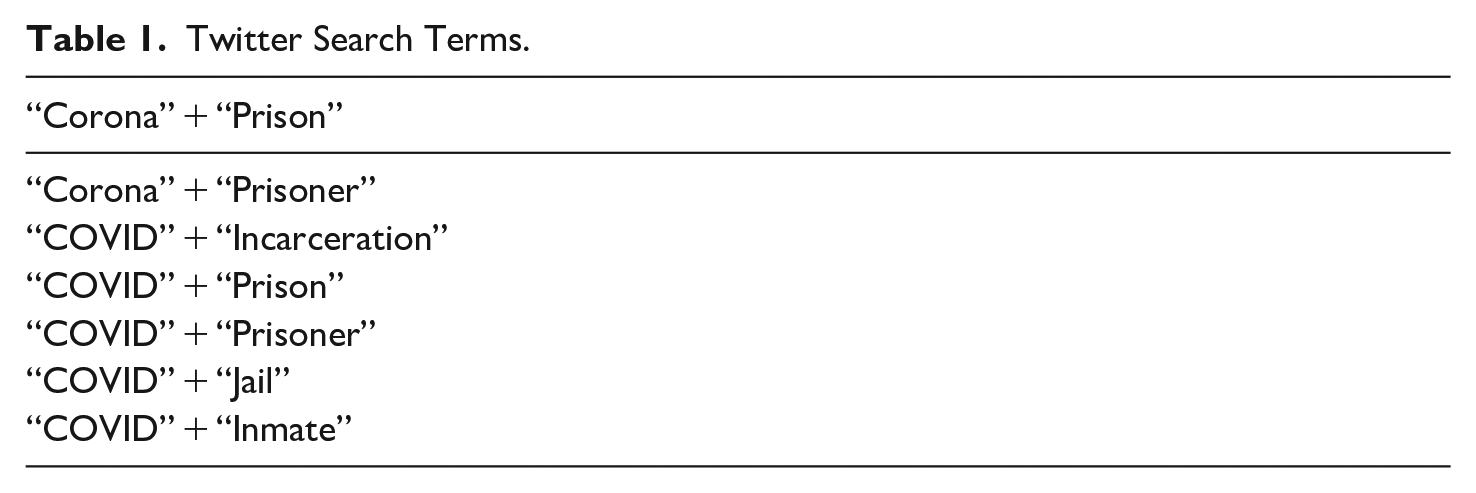
As a team of Twitter users and interdisciplinary researchers connected by scholarship on incarceration, we began data collection by identifying potential search terms (Table 1). Each author was assigned a set of search terms and spent 2 hours saving each tweet that populated. We then met as a group to discuss refining our search terms. For example, we found that pairing the terms “COVID” and “prison” together yielded far more results than the words “Corona” and “prison.” We finalized and divided our search terms amongst ourselves and spent a total of 6 hours collecting Tweets (i.e., collecting every tweet that populated during our data collection time frame) populated by our search terms over a three-week time frame. We included all Tweets that were written in English, related to both COVID-19 and incarceration, and posted during our data-collection timeframe. Our search terms yielded some clearly unrelated Tweets. For instance, when searching “COVID” and “prison” we excluded a tweet that referred only to COVID but had a username containing the word “Prison.” Our unit of analysis was an individual tweet, final sample size was n = 513. Institutional review board approval was obtained prior to data collection. To protect confidentiality, demographic information was not collected, usernames will not be reported, and quotes will only be shared in part.
Twitter Search Terms.
Analytic Procedures
Thematic analysis discerns data patterns, themes, and topics (Braun & Clarke, 2006). Thematic analysis is recognized as a rigorous methodological approach to inductively analyzing qualitative data and giving meaning to important patterns or sequences within data (Willig, 2013). Each tweet was coded independently by two coders; all authors were involved in data collection and analysis. First, two coders separately developed open-ended textual descriptions for each piece of data. Second, we identified brief (i.e., one to two words) codes based on the textual descriptions. Next, we identified overarching themes that best categorized the emerging codes. In phase four, we refined the themes by developing a thematic map visually representing preliminary themes. We reviewed the data again and change as necessary, the best possible code and theme assignment. We identified, discussed, and resolved any discrepancies as a team using a consensus-based approach. In the final phase, we finalized the thematic map and developed a final written report of the results.
Rigor and trustworthiness
First, we followed Braun and Clarke’s (2006) methodological guidelines to fidelity, ensuring that our analysis of the data was completed as precisely as possible. Further, because using Twitter for data collection is relatively new in criminological research, we adhered to methodological recommendations by those who have conducted this type of research before (Ahmed et al., 2019; Fan et al., 2019; Xi et al., 2020). Further, we met regularly as a group and resolved methodological uncertainties using our best scholarly methodological judgment. All authors participated in team meetings in which data analysis was conducted until saturation was reached. We created a codebook to compare and combine notes and resolve differences as necessary (Holland et al., 2020). Examples of data coding and themes, from tweet analysis, were disclosed at our meetings. As part of the audit trail, each tweet was reviewed by a second coder to check the accuracy of interpretations and guard against taking any particular narrative or hashtag out of context. In instances where both coders were not confident in data interpretation, all three authors discussed the tweet as a group until consensus was reached. Further, we maintained an audit trail of all methodological considerations, discussions, decisions, and reflections. Finally, each author engaged in memoing, in which we journaled about our experiences, thoughts, and reactions and discussed them as a group to further inform methodological rigor (Creswell & Creswell, 2018).
Results
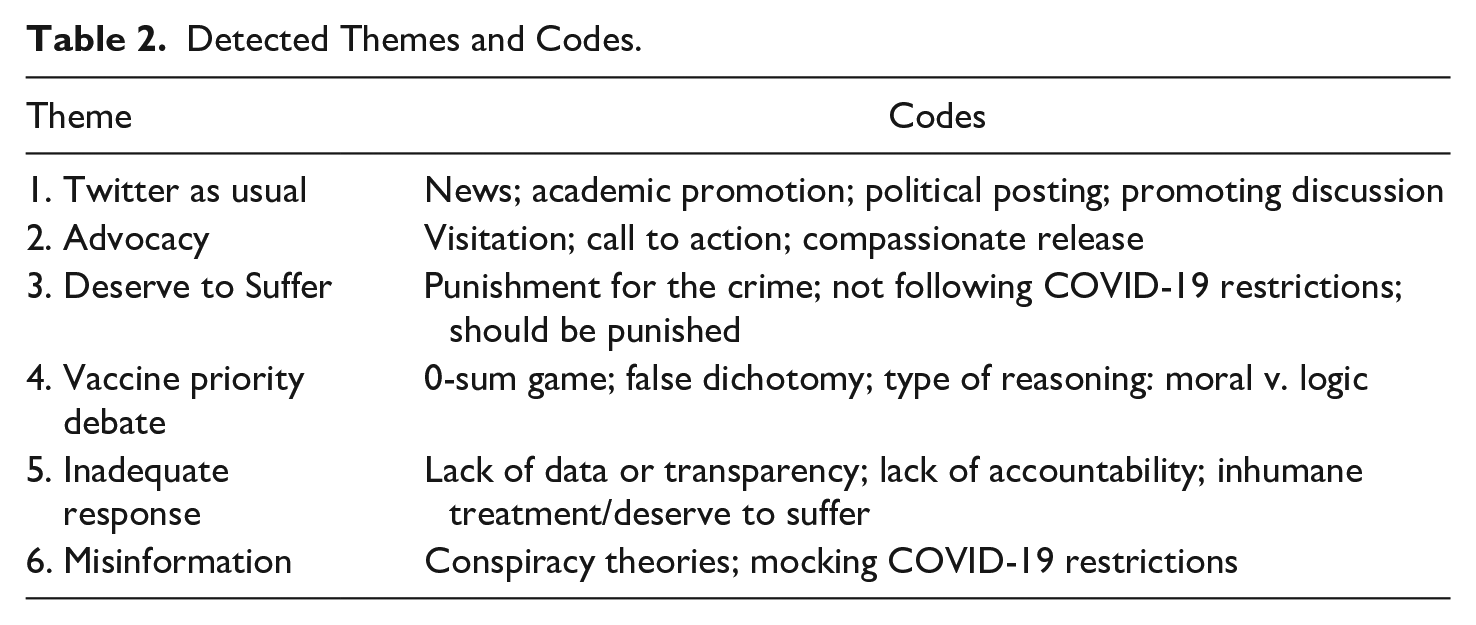
Using our identified search terms, we collected a total of n = 515 Tweets from 482 unique Twitter users. Although the vast majority (95.6%) only tweeted once, 21 users tweeted more than once (R = 2–7; M = 2.53; Mdn = 2.00). Two Tweets were excluded because they were not in English (n = 2). The final sample was n = 513 Tweets. Thematic analysis yielded six overarching themes that distinctly represent the data: Twitter as usual, Advocacy, Deserve to suffer, Vaccine priority debate, Inadequate response, and Misinformation. Each theme is represented by subcodes (italicized) and explored with exemplar quotes. In an effort to protect the users behind our exemplar Tweets, we present them in part and with minor changes (e.g., punctuation, synonyms, etc.), where possible, that facilitate anonymity while maintaining the original essence of the tweet (Tables 2 and 3).
Detected Themes and Codes.
Frequency of Codes.
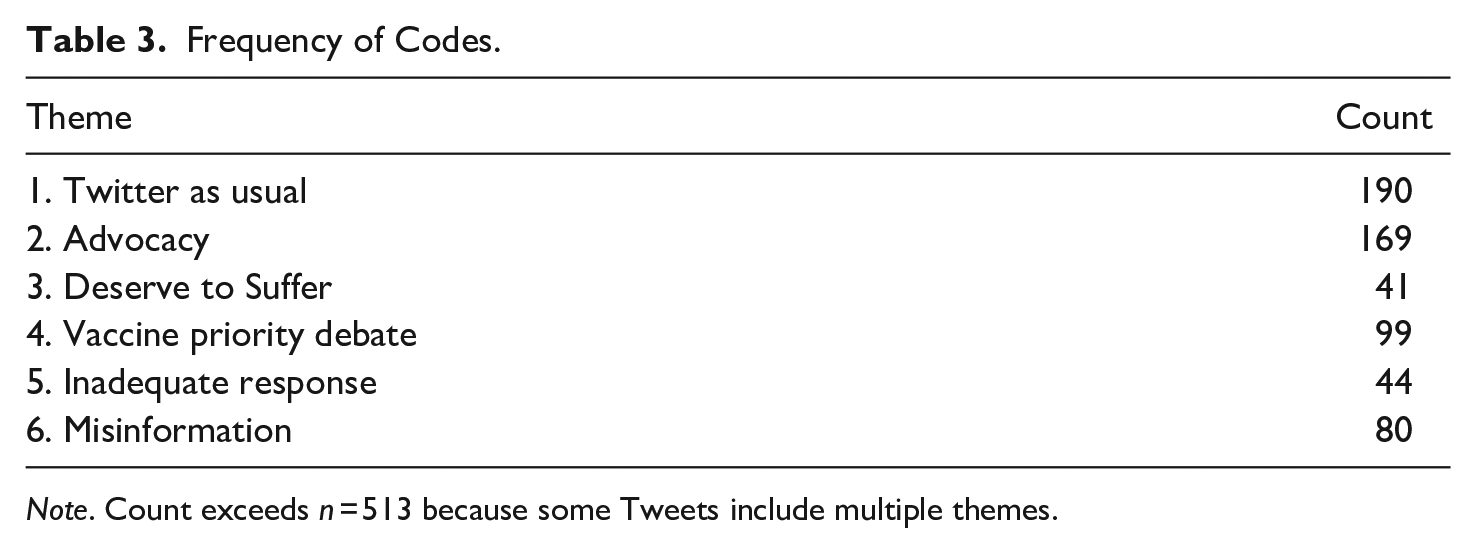
Note. Count exceeds n = 513 because some Tweets include multiple themes.
Twitter as Usual
Twitter is generally used as a “microblogging” SNS where users promote discussions on current events, popular culture, and politics, to name a few (Williams et al., 2012). Consequently, a portion of our Tweets represented “Twitter as usual” in that the spirit of the Tweets appeared congruent with how Twitter is broadly used. Some users (including formal news and non-profit organizations) shared news about COVID-19 testing, cases, and vaccines. For example, “[County] district jail in lockdown after inmate tests positive for COVID-19. Public health officials working on contact tracing” (183) and “New COVID-19 tests for [state] workers in prisons are easier than nasal swabs” (9). In particular, news related Tweets focused on rising cases, “5,051 new COVID-19 cases and 130 more deaths statewide. Health officials identified 8 clusters in [county]” (228) and vaccine related information, “[news organization] reports that vaccinations have begun for medical staff at [federal prison]. This is of great importance. Correctional facilities have suffered some of the largest COVID-19 outbreaks” (31).
Although sharing and responding to news was the most common version of “Twitter as usual,” other uses included academic promotion, “First pub of 2021! We examine COVID-19 and suicide risk in correctional settings and during community reentry” (5) and promoting general discussion, “This is a stellar op-ed. Very proud of my colleague [user tag]. She and I just published a paper. . .” Another large category of “Twitter as usual” was opinions, both complementary and critical, of politicians and political events. For example, “Trump’s agenda isn’t to make America great. If he cared, he would not have lied about COVID” (134) and “All of the dems are emptying the prisons due to COVID” (93). Some political Tweets were in response to specific politicians’ COVID-19 related decisions, “Incarcerated people are particularly vulnerable to COVID-19. [Politician]’s take is just wrong and inhumane” (232). Although the “Twitter as usual” Tweets are consistent with the general use of Twitter, many of our most noteworthy Tweets fell under other themes.
Advocacy
Many of the Tweets promoted some form of advocacy related to COVID-19 in correctional settings. Most commonly, users raised awareness on certain issues. In this way, these Tweets served as a “call-to-action.” For example, “The average federal inmate of the [country] is not a murderer, close to half of inmates are sentenced for drug related crimes. Prisons should be a priority” (247), “Regardless of how you feel about people who are incarcerated, at the end of they day they’re PEOPLE, citizens who are inherently vulnerable in this deadly pandemic” (263), “Today is a day of [hashtag] and action in support of prisoners across [state] who have been on hunger strike to draw attention to government negligence of COVID in jails and prisons” (289), and “All prisoners should get time off their sentences due to terrible conditions during COVID - sign the petition!” (304).
Other users presented very specific forms of advocacy; a few pleaded for compassionate release, “There is no way for anyone to be safe and healthy inside jail or prison, mass releases of people from corrections settings should be our priority #freethemall” (480). Conversely, some pleaded against compassionate release, “On [date] a close relative was murdered and the murderer got life. On [date in 2020], he was released from prison due to COVID-19. I fought this release and lost” (452). Other people advocated for the friends and families of incarcerated people, pointing out the difficulties COVID-19 would have on contact and visiting experiences, “In person visiting has stopped due to increased rates of COVID-19. Easy to be hard-hearted on these issues, but this will be very difficult for prisoners’ families” (321) and “What is the status of getting prison visits back? How long must a facility be free of COVID-19?” (16).
Lastly, many Tweets advocated for the acknowledgment of inhumane treatment at the intersection of COVID-19 and correctional settings. For example, “They are all toilets. Especially the nasty [county name] jail that recirculates all their air. Prisoners get to breath nice COVID filled air” (211), “Despite worsening health conditions and an outbreak of COVID-19 in the jail, she is still incarcerated under subhuman conditions” (213), “An inmate’s lawsuit says the conditions inside [state] prisons - which he says includes COVID 19 infected prisoners - is leading to potential death sentences for inmates” (243), “To say prisoners do not deserve the vaccine is inhumane” (322), and perhaps most pointedly, “[Name of person] was awaiting trial. He died less than two months later from COVID without being able to say goodbye to his family. This was entirely preventable - incarceration should not be a death sentence” (338).
Deserve to Suffer
For as many people as there were advocating for awareness and humane treatment of incarcerated people there were also many people who pointedly stated that incarcerated people deserve to suffer in the COVID-19 pandemic. Specifically, many Twitter users implied or directly stated that contracting COVID was part of punishment for the crime. Adjacently, although less common, other people suggested that those not following COVID restrictions (e.g., stay-at-home, mask wearing, etc.) should be punished in the “horrible” conditions of jail or prison. In this way, this theme can broadly be understood as “just deserts” in which the punishment fits the crime. Tweets that represent punishment for the crime include, “Easy fix. Stop committing crimes” (71), “It’s one way to clean the jails out” (92), “Don’t do the crime if you can’t do the time” (94), “Amazing the energy spent on criminals” (110), “They’re prisoners for a reason. Oh well, they should have thought about consequences before committing their crimes” (133), “Prisoners get medical care. Covid is mild for the most part. They will be okay” (311), and “My stepbrother murdered his wife and her partner and is in prison. Does he deserve a vaccination before my 92 year old mother? Not in any universe” (342).
Similarly, although less common, some people suggested that those not following COVID safety restrictions should be punished with a jail or prison sentence. Like, “She’s going to prison where she belongs. Hopefully she’ll catch COVID there” (49), “Clearly [person’s name] should be locked up in a COVID wracked prison” (13), and “You spread COVID at that event and should go to Jail for it!!! You knew you had it and still went!” (417). Although distinct from COVID as punishment for the crime, what these two codes have in common is the notion that carceral settings are where “bad people” go to receive their “just deserts.”
Vaccine Priority Debate
The “good people versus bad people” narrative was also strongly evident in Tweets where people debated if and when incarcerated people should receive the COVID-19 vaccine. Our data collection happened to coincide with a national announcement about the scaffolding of when certain groups were designated to begin receiving the COVID-19 vaccine. Consequently, there were many Tweets hotly debating the topic. Tweets that were part of the vaccine priority debate appeared to use a moral versus logic type of reasoning. Moral reasoning focused on how prisoners are people too and therefore deserve the vaccine, or conversely, that prisoners are “bad” and deserve the vaccine last. For example, “[Politician]’s position on this is remarkably inhumane. It is morally corrupt to suggest that prisoners should not be viewed as vulnerable. It’s hard to imagine a more vulnerable population in terms of COVID” (285), “You baffoon! You white male privileged POS! That’s right, ignore correctional staff & families, the spread of Covid to communities the facilities are located in & the prisoners who are disproportionately indigenous, black, POC, impoverished or addicted. Racist, elitist POS!” (288), “A prisoner sick with COVID is still a sick person” (313), and “not all prisoners are bloodthirsty serial killers. Many people who are in jail are not violent, some arguably would belong more in a psychiatric institution and none have been condemned to be infected with Covid as part of their sentencing” (330). On the other side of the morality debate were statements such as, “[@state governor] I’m a 60 year old law abiding citizen. Why are young and healthy prisoners who have committed terrible crimes ahead of me on getting the vaccine??? Are criminals lives more important than mine?” (269), “Prisoners being offered the vaccine ahead of higher-risk, taxpaying citizens? Does that seem right to you?” (295), and “I hope he gets his COVID vaccine before your grandmother. . . . You know. Because people in jail are nice people and deserve it before you” (230). Inherent in these morality-based Tweets is the idea that public health decisions should be based on who “deserves” the vaccine rather than public health decision making models.
Alternatively, logical reasoning eschewed the issue of morality altogether and instead focused on why vaccinating prisoners first protects the larger society, or conversely why it makes “more sense” to vaccinate other people first. Logical reasoning as to why incarcerated people deserve the vaccine first included, “The vaccine should be allocated by public health priority. If prisoners are more likely to spread Covid, then they should be in the earlier groups” (280), “Sick prisoners occupy hospital beds. COVID spreads like wildfire in prisons. Not vaccinating incarcerated people means others can’t get healthcare!” (281), “Most COVID outbreaks have a spread of 1-10 people contracting the virus. In a prison, 1 case can lead to 60+, as is the case in several prisons right now. Prisoners’ access to healthcare is limited. A prison term is not and should not be a death sentence” (303), “Saying things like ‘prisoners don’t deserve the vaccine’ reveals a dangerous ignorance of how diseases spread. If you don’t vaccinate prisoners, every prison becomes a vector to keep COVID in the whole community” (306), and “It’s not before anyone else, it’s in addition to. Prisoners are our responsibility. They can’t isolate. If covid gets in prison it will spread quickly and that will put prisoners and workers in hospitals” (320). On the other side of the argument people stated, “We need to vaccinate officers first and then the inmates will already be protected from COVID-19” (220), “Why vaccinate those in a locked facility? I’d set up a COVID wing or special jail for the infected” (227), “If you vaccinate the guards first then they can do their job no matter how many inmates have COVID” (253), “Really. Who has more time to clean, can take showers everyday, wash their hands properly. I know [racial slur regarding indigenous people] prisoners. So stop Running your mouth, you are just pandering” (105), and “Everything about this is wrong! The prisoners are in a safe, enclosed, controlled environment and risk of getting Covid is therefore LOW! They should be bumped to the back of the line!” (327).
Inadequate Response
Outside of debate on if and when incarcerated people should be vaccinated were broader whistleblowing-criticisms of how the pandemic was being handled by government and public health officials. Criticism-laden Tweets pointed to a lack of accountability, a lack of data, and lack of transparency. In particular, lack of accountability Tweets included, “A friend in prison said he caught COVID and they aren’t doing a good job at containing it” (143) and “Prisoners lives are being put at risk by correctional officers refusing to wear masks. Despite a rise in COVID cases in prisons across the country, many staff are still not using adequate PPE” (149). Critiques on the lack of COVID-19 related public health data included, “That’s the problem with COVID in prisons. We don’t have enough data to know if it’s bad or not yet” (154) and “The work [@ specific user] is doing to track COVID-19 in [county] jail is crucial, and it’s remarkable (and disturbing) that it has fallen on the volunteer efforts of a law student to do this” (194). Lack of overall transparency was also described as concerning, “When these deaths are counted, it’s going to be horrifying” (83), “We get updates on COVID pretty much every day here but now they are leaving out how many people die every day. This is unacceptable!” (104), and “[state] prisons scrub key COVID data from website, obscuring the magnitude of inmate deaths and COVID infection rates” (239). Taken together, the lack of accountability, data, and transparency coalesce into an overall sense of mistrust of those tasked with responding adequately to the COVID-19 pandemic in carceral settings.
Misinformation
On the opposite end of not enough information represented in the Inadequate response theme was overt misinformation. Misinformation Tweets broadly fell into two categories: Mocking COVID-19/COVID-19 restrictions and conspiracy theories. Those mocking COVID-19 and COVID-19 restrictions relied on logical fallacies in the arguments. Examples include, “So we have to release prisoners because of COVID-1984. But if you break our rules we’ll send you to prison. Totally makes sense” (316), “Releasing criminals from prison due to COVID. Now arresting people for violating COVID related restrictions” (147), “So if you’re really scared about COVID, break the law, get sent to jail, and then you’ll get a vaccine” (188), “It might even keep you out of a jail cell recently vacated to free up a violent felon attempting to avoid COVID-19” (199), “if you’re into highly experimental, untested vaccines break a COVID law, go to prison, and get vaccinated” (209), and “No big deal, they’ll get the vaccine in jail and be released when they are at high risk of getting COVID in jail” (192).
More serious forms of misinformation appeared to align with conspiracy theories. In an effort to not legitimize overtly incorrect and potentially dangerous misinformation, examples of these Tweets will be shared at a minimum. Twitter users promoting conspiracy theories that made a range of speculations from COVID as a hoax, “COVID is a LIE! Wake up! People will go to jail for this” (390) and “Whatever the actual cause of death, they’ll put COVID-19 on the death certificate, right?” (249), to COVID-19 as part of a brainwashing campaign “My friend came out of jail recently, obviously brainwashed by watching TV in there, he was actually scared of COVID” (223), to racist-laden Tweets about the virus’ country of origin, among others. Twitter and other SNS have recently begun to actively combat misinformation, although these efforts are new and imperfect. However, it appears that the politicization of COVID-19 has intersected with existing stigma toward justice involved individuals. These Tweets may be a snapshot of public discourse and opinion on the impact of COVID-19 on incarcerated people.
Discussion
This study used publicly available Twitter data to examine how people on Twitter are conversing about the COVID-19 pandemic in regard to incarcerated people, a disproportionately vulnerable population. Broadly, people engaged in this topic in one of two ways: by seeing incarcerated people as humans deserving of proper healthcare and treatment, or as criminals who deserved to be “last in line” in the response to the COVID-19 pandemic. We believe that this dichotomy represents both the current polarizing political climate, as well as existing stigma toward people involved in the criminal justice system (Arditti et al., 2020). Given the increasing power that SNS like Twitter have in shaping social and political discourse, as well as public buy-in to government health recommendations, it’s imperative that we understand how users and their Tweets shape these narratives. To the best of our knowledge, our study is the first of its kind. We explore our findings, offer implications, and discuss future research.
Stigma
First, our findings lend support to the idea that there may be a throughline from pre-pandemic existing stigma of certain populations to buy-in of public health communication involving those same populations. Though we cannot confirm, we suspect that those who defended decisions to provide COVID-19 vaccines to the incarcerated early on likely held humanizing parallel beliefs (e.g., “prisoners are people too”) prior to the pandemic. Similarly, it may be that those who disagreed with federal and state decisions to provide COVID-19 vaccines for the incarcerated may have held pre-pandemic beliefs that aligned more with a “punitive” attitude toward incarceration, rather than a “rehabilitation” based mindset. Broadly, these findings add to the growing body of research, and anecdotal experiences, indicating that people of the U.S. are polarized. The importance of these findings cannot be understated, as they suggest that, during highly politicized times, people may form opinions and make important decisions grounded in pre-existing stigma-based beliefs. Indeed, previous research indicates that social media-based algorithms may foster “echo-chambers” in which one’s preexisting beliefs are echoed back to them—confirmed and expanded—by accounts and posts of similar beliefs (Colleoni et al., 2014). And, to a dangerous extent, SNS may act as echo chambers of mis/disinformation campaigns. Although SNS cannot act as the sole arbiters of truth, we recommend that policy makers attend to, and address, how misinformation campaigns can undermine public health and policy communication efforts. Further, our findings suggest that in addition to social and political discourse, social media is a key mechanism of effect in maintaining and reiterating stigmatizing beliefs, or lack of, toward vulnerable populations such as the incarcerated. A recent study found that humanizing depictions of people who commit crime may support decarceration through the induction of empathy (Ivanov et al., 2021). Thus, inducing empathy may be a way to lessen the stigma (Arditti et al., 2020). Given that justice related issues (i.e., public health decisions, legislative policy, etc.) are fraught with stigma toward justice involved persons (Arditti et al., 2020), our findings suggest that decision makers may benefit from addressing and mitigating stigma to promote public buy-in of these issues.
Moral versus Logic Based Perspectives
The second main contribution this research provides is insight into how the public interprets public health decisions, and forms opinions about them, during a global pandemic. Interestingly, the majority of Tweets regarding COVID-19 and the incarcerated appeared to use a moral versus logic-based model in formulating and sharing their beliefs on Twitter. It was noteworthy that this decision-making model (i.e., logic vs. moral) appeared most often when participants discussed public health triaging decisions, especially related to the COVID-19 vaccine. In particular, Tweets discussing incarcerated persons and the COVID-19 vaccine mentioned how “prisoners are people too” and deserve the vaccine, or conversely, “prisoners had their chance” and do not deserve the vaccine before the general public. Statements like these highlight how, for some, public health decision making should be centered around who “deserves” prevention and treatment pandemic responses first, and in what order. Morality-based beliefs and decision making are evident in other high-stakes contexts, such as political violence and the decision to engage in warfare (Ginges, 2019). Compared to morality driven perspectives of the incarcerated and COVID-19, others eschewed morality-based opinions and instead pointed to logic as the reasoning for their beliefs. Broadly, these types of statements highlighted how vaccinating the incarcerated early-on makes sense due to close proximity of living conditions, inability to socially distance, and the potential of carceral settings to infect the communities within which they are situated. Logic-based perspectives related to COVID-19 and the incarcerated were largely in line with public health experts who shaped state and federal response guidelines in managing the spread of COVID-19 (Burki, 2020; Elbek, 2020; Kinner et al., 2020; Simpson & Butler, 2020).
Identifying the potential underlying mechanisms by which people form beliefs about vulnerable populations (i.e., moral vs. logic) has important implications for state and federal public health communication. Although public health triaging decisions may be made using logical inferences and with the best available research, many people try to make sense of these decisions based on morality. Consequently, it may be critical for public health and legislative experts to preemptively address potential morality-based opposition by clearly explaining why preventing and treating highly stigmatized populations first, such as the incarcerated, serves to protect the larger population more quickly. Similarly, we posit that logic and science-based decisions regarding justice-involved individuals (e.g., decriminalizing substance use, sex work, etc.) include explanations that highlight logical benefits of the broader population and address opposing perspectives grounded in “good versus bad” perspectives. Our findings merely highlight that moral versus logic-based opinions may be an important method by which people form opinions regarding vulnerable populations. It is imperative that future research further examine these findings to better inform communications around criminological and public health policy.
Twitter as an Advocacy Vehicle
The final contribution our findings yielded was the use of Twitter as an active platform for advocacy. SNS have long been a mechanism for opinion sharing, social justice movements, and political advocacy (Colleoni et al., 2014). Prior research indicates that advocacy is understood as a growing use of Twitter in particular (Borgmann et al., 2015). A recent study investigated benefits of social media use among medical experts, nearly three in four (i.e., 74%) of participants endorsed advocacy as a perceived benefit of Twitter (Borgmann et al., 2015). Other perceived benefits included networking (97%), research (75%), and career development (62%) (Borgmann et al., 2015). Other scholars similarly describe Twitter, and other SNS, as an effective platform for advocacy and, in particular, public health related advocacy (Gough et al., 2017; Lee et al., 2014). Our findings add to this growing body of evidence suggesting that social media, and in particular Twitter, is an increasingly popular method of advocacy efforts, both individual and collective. At the intersection of public health and criminology, such is the case for understanding how the COVID-19 pandemic is impacting the incarcerated population, these findings highlight how Twitter may be an effective advocacy strategy. Organizations seeking to share public health information, promote legislative advocacy, and combat mis/disinformation campaigns may benefit from engaging with SNS, and in particular Twitter, as an effective advocacy and communication tool. We suggest future research focus on continuing to better understand Twitter as a communication machine and best practices for promoting important advocacy efforts within criminological and public health issues.
Current Context
Although our findings highlight the nuanced uses of Twitter, and Twitter-based discussions, at the intersection of public health and criminology, we would be remiss not to acknowledge the pandemic context in which we collected this data. We suspect that our findings, and most COVID-19 related research, are inextricably tied to the context of the COVID-19 pandemic. The year 2020, continuing into 2021 thus far, has been a challenging time for many; one that is rife with hopelessness, grief and loss, economic uncertainty, and anxiety surrounding the virus itself (Lebow, 2020). It may be that public discourse, and in particular social media discourse, is clouded by the challenging circumstances of our present environment. We cannot evaluate the degree to which these statements, typed in a brief moment, represent the user’s beliefs and perspectives. Indeed, our highly politicized climate, in conjunction with existing stigma, may coalesce into passionate statements that are representative of the current pandemic context. Nevertheless, prior research has indicated that SNS are increasingly a fruitful source for examining public perceptions and discourse related to social phenomena. Thus, in a time where people are connecting virtually now more than ever, it may be that Twitter users’ posts are authentically reflective of their beliefs.
Limitations
Although this study has a variety of strengths, we aim to be transparent about the limitations that coincide with this type of research as well as this particular study. Data collection was limited to those who have internet access as well as a Twitter account/ability to tweet. Thus, participants who do not have access to the internet based on socioeconomic status may have been excluded due to this. This may be a limitation because there may be individuals of a lower socioeconomic status that are not represented. This could be a limitation by not having these perspectives reflected. Additionally, gender and racial inequality surrounding visibility has been found to be present on Twitter (Messias et al., 2017). Similarly, our tweets may reflect this.
By using thematic analysis, codes were created by all three authors and themes naturally emerged from these codes. However, there are several limitations regarding the thematic analysis conducted in this study. For example, “while thematic analysis is flexible, this flexibility can lead to inconsistency and a lack of coherence when developing themes derived from the research data” (Holloway & Todres, 2003, p. 2). Additionally, since we used secondary data (i.e., previously published Tweets) and because we deidentified the data to protect participants, we are unable to provide demographic information as there was no way to positively identify the Twitter user’s gender, education level, socioeconomic status, race/ethnicity, employment, etc., of the participants. It would have been assumptive and potentially harmful if we guessed this information solely based on a picture or name. Further, Twitter may not provide a representative sample of the overall population. Another limitation is that Twitter data typically involves short responses to questions, which poses particular challenges for identifying thematic patterns across the dataset (Braun & Clarke, 2006). The short responses are only a snapshot of what people mean/say, so there is a chance we misunderstood or took things out of context. Further, the data is more consistent because it does not include emojis or pictures. However, if we had chosen to include those there may be more to explore. Since the analysis does not include pictures or emojis, commonly placed within Tweets, some of the meaning may be lost.
Future Directions
Expanding on our data collected, an important avenue to explore is how the opinions of people who are incarcerated differ between people that know someone in a correctional facility and those who do not. Stigma may be deeper to the degree that a person has no personal experience toward the stigmatized population. It is also important to examine how the dynamics that exist between incarcerated individuals and staff may also play a role in the spreading of COVID-19 in correctional facilities. An evaluation can be done on how facilities with predominantly marginalized groups differ in the response to Covid-19 than in facilities with predominantly white incarcerated individuals.
Future research should examine best practices and offer instruction for how to best use data derived from this rich source. Research of this kind is likely to have further implications for public health communication. Further, we witnessed how people seem to report their honest and blunt opinions, which often reflect a stigma or bias toward the incarcerated. Prior studies have shown how stigma impacts incarcerated individuals (Tyler & Brockmann, 2017) and their families (Arditti, 2012; Tadros et al., 2020), which warrants future study that looks at this population outside of its intersection with COVID-19. A further look into how people communicate ideas on Twitter and pictures, emojis, and conversations can be included in the conversation will bring greater clarity to data collected. Further, it has been recommended that correctional administrators provide correct information through clear communication about permissible contact in carceral facilities, specifically via multiple platforms such as website updates, phone calls, and texts (Dallaire et al. 2021). We advocate that Twitter be a means of information sharing for incarcerated loved ones. Further, we add to the recommendations to collect incarceration-based data in reference to COVID-19 to gain a deeper understanding of the consequences of COVID-19 on vulnerable populations, specifically, incarcerated individuals (Novisky et al., 2020).
Footnotes
Declaration of Conflicting Interests
The author(s) declared no potential conflicts of interest with respect to the research, authorship, and/or publication of this article.
Funding
The author(s) received no financial support for the research, authorship, and/or publication of this article.
