




Abstract
Female offenders released from prison often face challenges within the community such as lack of employment, inconsistent attendance in substance use treatment, and complying with parole and probation conditions, which typically decreases their self-efficacy and motivation to refrain from reoffending. Despite this, much is still unknown of psychological factors that could impact female offenders’ attitudes toward self-efficacy, such as mental illness symptoms, Adverse Childhood Experiences (ACEs), and personality differences. Thus, this cross-sectional study explored whether mental illness symptoms, ACEs, and personality differences were associated with attitudes toward self-efficacy (N = 398). Results suggest that mental illness symptoms, ACEs, and neuroticism negatively associated with attitudes toward self-efficacy in contrast to extraversion and conscientiousness. Parole/probation reentry and therapeutic implications are discussed.
Female offenders released from prison often face unique challenges within the community, such as maintaining employment, housing, reuniting with their children, and often enduring the stigma of being released from prison (Dodge & Pogrebin, 2001; Severance, 2004; Turnbull & Hannah-Moffat, 2009). While female offenders encounter these challenges, they typically have to attend substance use treatment, avoid interacting with antisocial associates, attend employment training, meeting with their parole officers, and attend group therapy aimed to develop a positive support network and challenge maladaptive beliefs (Cobbina, 2010; Graffam et al., 2004; O’Brien, 2001; Richie, 2001; Serin & Lloyd, 2009). When these criminogenic needs are unaddressed, female offenders on parole/probation were less likely to successfully reintegrate into the community (Doherty et al., 2014; Goulette, 2020). One aspect that could impact the degree to which female offenders adhere to their parole/probation conditions is their attitudes toward self-efficacy. More specifically, their perceptions and willingness to approach challenges they may encounter while on parole or probation. To better understand contributing factors related to attitudes toward self-efficacy is important because prior literature suggests individuals higher on self-efficacy were more likely to abstain from using substances (Dolan et al., 2008; Kadden & Litt, 2011; Maisto et al., 2000; Sitharthan & Kavanagh, 1991) and more resilient when stressed. Specifically, within the offender population, individuals higher on self-efficacy were more likely to refrain from future criminality (Brezina & Topalli, 2012).
Overall, female offenders’ attitudes toward self-efficacy appear to be a crucial aspect of successful reintegration; therefore, it is essential to investigate individual and psychological factors that could associate with attitudes toward self-efficacy.
Self-Efficacy
The need to achieve intended goals through effort and perseverance often shapes our cognitive processes, which then influence our behaviors (Bandura, 1977, 1982). Individuals who are high on self-efficacy often think optimistically, engage in futuristic planning, typically approach challenges, possess adaptive coping strategies, and attribute their failures to situational influences rather than personal factors (Azizli et al., 2015; Bandura & Locke, 2003; Sherer et al., 1982). However, individuals who are low on self-efficacy often lack the motivation to achieve their intended goals. More specifically, individuals low on self-efficacy were less likely to quit smoking compared to their higher self-efficacy counterparts (Boardman et al., 2005), generally endorse anxiety and depressive symptoms (Muris, 2002), and often avoid difficult challenges (Bandura, 2011). Upon release from custody within the offender population, offenders who have lower self-efficacy were less likely to cope with daily stress and less motivated to adhere to their probation conditions (Pelissier & Jones, 2006).
Self-efficacy is an important motivational agency among offenders, which could serve as a protective factor against future criminality. Therefore, it is essential to better understand personality differences, adverse childhood experiences (ACEs), and mental illness symptoms that could associate with female offenders’ attitudes toward self-efficacy.
Big Five Personality
Personality is characterized by stable traits that often interact with the person’s environment (Goldberg, 1992; Olver & Mooradian, 2003). Subsequently, research has indicated that personality differences are also related to physiological processes, suggesting that underlying innate factors often shape cognition and behavior (Bouchard, 2004; Hopwood et al., 2011; Penke et al., 2007). Within offender literature, prior literature has suggested that personality differences often relate to criminal behavior (DeLisi & Vaughn, 2015). Furthermore, individuals higher on consciousness were often motivated to complete goal-oriented tasks and typically refrain from deviant behavior compared to other personality constructs (Decuyper et al., 2009; Eysenck & Eysenck, 1971; Judge & Ilies, 2002; Miller & Lynam, 2015; Parks & Guay, 2009). Some contend the reason for personality differences pertaining to self-efficacy is that individuals higher on neuroticism were often less likely to appreciate the consequences of offending, which increases their chances of engaging in risk-taking behavior (Craig et al., 2006; Gudjonsson & Sigurdsson, 2004).
Although the link between personality differences and self-efficacy is established, much is still unknown whether personality differences associate with attitudes toward self-efficacy among female offenders. As personality differences often predict motivation and self-efficacy among the general public (McGeown et al., 2014; Parks & Guay, 2009), it is possible that consistent with prior literature, individuals higher on conscientiousness and agreeableness, and extraversion would maintain positive attitudes toward self-efficacy than their neurotic counterparts.
Mental Illness Symptoms
In the United States, approximately 14%−16% of former offenders under supervision often meet criteria for one or more serious mental illnesses such as bipolar disorder, schizophrenia, depression, and various personality disorders (Peterson et al., 2014; Steadman et al., 2009; Teplin, 1984, 1990). As such, many studies have focused on the link between mental illness symptoms and perceptions about refraining from criminal activity. Several studies suggest that mental illness increases the probability of offenders to recidivate (Grann et al., 2008; O’Driscoll et al., 2012; Skeem et al., 2011). However, contrary to these results, other studies contend that mental illness alone does not lead to criminal behavior (Palermo et al., 1992; Peterson et al., 2014). More specifically, there were no significant differences among offenders with mental illness compared to healthy offenders who reoffended (Skeem et al., 2014).
Although there is contradictory research evidence pertaining to the role of mental illness on recidivism, prior literature has indicated that the way in which offenders with mental illness think often impacts their chances of recidivating (Lewis et al., 2013). As such, offenders who have a greater sense of psychological flexibility, optimistic about their future, and higher self-efficacy, were more likely to comply with mandated supervision obligations and less likely to recidivate (Woldgabreal et al., 2016). Drawing from this evidence, offenders’ cognitive ability is not only related to better psychological flexibility, but it is related to their wiliness to approach daily challenges. Therefore, drawing from studies that suggest mental illness symptoms often decreases motivation among offenders (Morgan et al., 2012; Tierney & McCabe, 2002), it is quite possible female offenders who endorsed mental illness symptoms would maintain less favorable attitudes toward approaching a challenging task and overall lower self-efficacy.
Adverse Childhood Experiences
Adverse childhood experiences (ACEs) refer to the traumatic or negative experiences children often encounter vicariously or personally (Felitti et al., 1998). Over the years, literature has shown that approximately 90% of juvenile offenders experience some sort of trauma during their childhood years (Dierkhising et al., 2013; Friestad et al., 2014; Kim et al., 2016; McClelland et al., 2004). Additional studies have shown individuals who were abused both emotionally and physically were more likely to make contact with the justice system compared to individuals who did not experience trauma or neglect (Maxfield & Widom, 1996; Smith & Thornberry, 1995; Widom, 1989). In addition, among juvenile offenders, juveniles exposed to ACEs had greater chances of reoffending compared to juveniles who reported no ACEs (Baglivio & Epps, 2016; Craig et al., 2019; Wolff & Baglivio, 2017).
Along with previous studies on juvenile offenders, subsequent studies suggest severe and repeated childhood trauma such as physical and emotional abuse often lead to offending among women (Chesney-Lind & Rodriguez, 1983; Colman et al., 2009; Rebecca Block et al., 2010; Tuchman, 2010). Although higher ACEs often lead to offending among women, there is a gap in the literature pertaining to ACEs and attitudes toward self-efficacy among women offenders. Because female offenders released from prison often have childhood trauma that is often unaddressed (Matheson et al., 2015; Rowan-Szal et al., 2012), it is quite possible that ACEs would decrease the likelihood of female offenders maintaining positive attitudes toward self-efficacy.
Present Study
Female offenders often encounter unique challenges in the community, which could diminish their motivational agency and negatively impact attitudes toward self-efficacy. Despite this, few studies have explored psychological factors that could associate with attitudes toward self-efficacy, such as personality differences, ACEs, and the endorsement of mental illness symptoms. Therefore, to address the literature gaps, the current study tested whether personality differences, ACEs, and mental illness symptoms associated with attitudes toward self-efficacy among female offenders.
Hypotheses:
Female offenders higher on agreeableness, conscientiousness, and extraversion will report positive attitudes toward self-efficacy.
Female offenders higher on neuroticism will report negative attitudes toward self-efficacy.
Female offenders who endorse mental illness symptoms will report negative attitudes toward self-efficacy.
Female offenders with higher ACEs will report negative attitudes toward self-efficacy.
Method
Secondary Data that was used from the Probation/Parole Officer Interactions with Women Offenders, Michigan, 2011 to 2014 (Morash et al., 2015). The purpose of the study was to examine whether parole/probation agents’ interactions with substance-involved women predicted recidivism, rule violations, and their criminogenic needs. Another goal of the study was to explore whether factors such as social networks, anxiety, self-efficacy, therapy, and childhood experiences predicted outcomes. To investigate these relationships, 77 agents were identified within 16 counties in Michigan recruited for the purposes of the study. Then, 73 to 77 parole/probation officers were recruited to participate in the study. However, four did not take part in the study, one withdraw, one refused to participate, one resigned from supervising women, and one took a medical leave.
To identify women offenders, the research team together with the parole/probation agents filtered women who were charged with felony convictions, substance involvement, and were required supervision for at least 3 months. Agents recruited women offenders by giving them the researchers contact card, introducing them to onsite research interviewers, and obtaining women’s permission to share their information. Overall, 402 women offenders met the criteria and were recruited for the study. The sample of the current study consists of 398 women on parole/probation, 46.5% White-Caucasian, 33.1 Black-African American, 18.7% Hispanic, 1.7 other, 75.9% on probation, and 23.1% on parole.
Measures
Dependent variable
Predictor variables
Results
Data Screening and Bivariate Analysis
Prior to final analysis, all continuous variables were screened for skew, normality, collinearity, and multivariate outliers. There was no problematic skewness, data was normally distributed, and there was no evidence of data highly correlated with each other (see Table 1). Bivariate correlations were examined and extraversion, (r = .16, p < .001), agreeableness (r = .11, p = .02), conscientiousness (r = .46, p < .001) positively corrected with attitudes toward self-efficacy. However, ACEs (r = −.46, p < .001) was negatively correlated with attitudes toward self-efficacy.
Correlations.

p < .05. **p < .01. ***p < 001.
Multiple Linear Regression Analysis
A simultaneous linear regression was used to assess whether ACEs, personality differences, and mental illness symptoms associate with attitudes toward self-efficacy. Extraversion, (β = .03, p = .02) and conscientiousness (β = .14, p < .001) were both positively associated with attitudes toward self-efficacy. However, mental illness symptoms, (β = −.22, p = .02), neuroticism, (β = −.09, p < .001), and ACEs, (β = −.08, p = .01) were all negativity associated with attitudes toward self-efficacy. Agreeableness was not statistically related to attitudes toward self-efficacy, (β = −.07, p = .70) (Table 2).
Regression Coefficients and Standard Errors Predicting Attitudes Toward Self-Efficacy (N = 398).
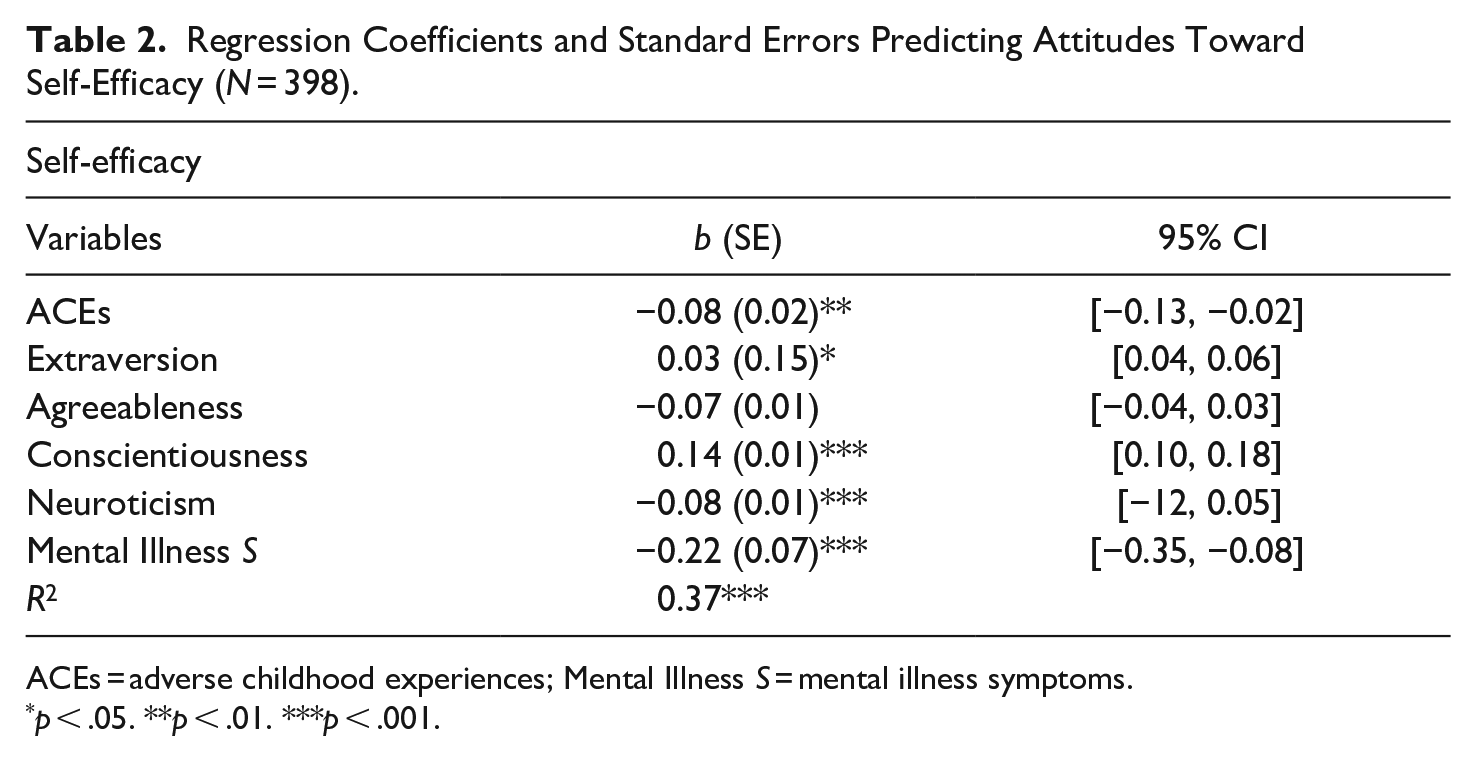
ACEs = adverse childhood experiences; Mental Illness S = mental illness symptoms.
p < .05. **p < .01. ***p < .001.
Discussion
This study aimed to examine the predictive roles of mental illness symptoms, ACEs, and personality differences on attitudes toward self-efficacy among female offenders. Hypothesis one stated that agreeableness, conscientiousness, and extraversion would positively associate with attitudes toward self-efficacy. This prediction was partially supported, such that agreeableness was not statistically predictive of self-efficacy; however, conscientiousness and extraversion were both positively associated with attitudes toward self-efficacy. This result suggests that although agreeableness was not associated with attitudes toward self-efficacy, female offenders who were often responsible, diligent, and social were more likely to maintain positive attitudes toward self-efficacy.
This is partially consistent with prior literature, which suggested individuals higher on conscientiousness and extraversion were more likely to be intrinsically motivated, which increases self-efficacy (Hart et al., 2007; Pocnet et al., 2017). Another explanation of this result could be that as individuals higher on extraversion are often resilient during stressful events (Sarubin et al., 2015), female offenders’ resilience directly increased their willingness to approach challenging events. Finally, as prior literature suggests, individuals higher on conscientiousness often report lower levels of negative affect (Javaras et al., 2012) and were more likely to adaptively regulate their emotions (Jensen-Campbell et al., 2007). It is possible that their increased ability to adjust might have increased their attitudes toward self-efficacy.
Hypothesis two stated that female offenders higher on neuroticism would report negative attitudes toward self-efficacy. As expected, female offenders higher on neuroticism maintained negative attitudes toward self-efficacy. This partially supports prior literature, which suggested individuals higher on neuroticism were often less optimistic about the future (Muris, 2002), less autonomous in their decisions (Olesen et al., 2015), and less likely to cope with daily stressors (Gunthert et al., 1999). This result could suggest that female offenders who are high on neuroticism were less likely to approach daily challenges and were less confident in their abilities. Another explanation of this could be as prior literature indicated that individuals higher on neuroticism often make impaired decisions when under pressure (Byrne et al., 2015); it is possible that the stressors while on probation/parole could decrease their willingness to approach challenging situations.
Hypothesis three stated that female offenders who endorse mental symptoms would report negative attitudes toward self-efficacy. Consistent with this prediction, female offenders with mental illness symptoms maintained negative attitudes toward related to self-efficacy. This result coincides with consistent with the literature, which suggested offenders with depressive symptoms often reported lower levels of self-efficacy (Holt et al., 2009). Another explanation could be female offenders were less confident in the prognosis of their symptoms, which subsequently could have diminished their confidence in approaching difficult tasks.
Hypothesis four stated that female offenders with ACEs would report negative attitudes toward self-efficacy. As expected, results were consistent with this prediction, such that ACEs were negatively related to self-efficacy. There are several possible reasons for these results. One possible explanation could be, as prior literature indicated, individuals who had higher ACEs reported lower levels of self-efficacy (Sachs-Ericsson et al., 2011). Another reason could be, as prior literature indicated, people who experienced traumatic events early in their lives were less likely to cope with chronic stress (Karatekin, 2018; Nurius et al., 2015), which could have decreased positive attitudes toward self-efficacy among female offenders.
Parole and Reentry Implications
As this study revealed various interesting results, there are important implications for parole/probation supervision, forensic psychologists, and future studies. Results indicated that personality differences among women offenders directly associated with attitudes toward self-efficacy. Specifically, female offenders higher on extraversion and conscientiousness were more likely to believe in their abilities to attain intended goals and more likely to approach challenges compared to those higher on neuroticism.
Taken from these results, while parole/probation and forensic psychologists assess risk factors among offenders, it would be essential to use motivational interviewing strategies to increase self-efficacy among women offenders, particularly for women offenders higher on neuroticism. Although personality differences are often considered to be stable over time (Soldz & Vaillant, 1999; Wortman et al., 2012), in some instances, personality traits are often changeable depending on various situational factors (Rakhshani & Furr, 2021). Another way for forensic psychologists to increase attitudes toward self-efficacy is during treatment, forensic psychologists should focus treatment on reducing criminal thinking (Simourd et al., 2016), which could increase self-esteem, and specifically address individual criminogenic needs. Another way to increase self-efficacy is that forensic psychologists should assess and treat cognitive distortions such as jumping to conclusions or discounting the positive, which could decrease negative automatic self-talk often experienced among offenders with lower self-efficacy.
Pertaining to ACEs and mental illness symptoms, although many offenders involved in the juvenile/criminal justice system have experienced traumatic events early in their lives (Baglivio & Epps, 2016; Levenson & Socia, 2016), and offenders in the criminal justice system often experience one or two mental illness symptoms (Grisso, 1999; Powell et al., 1997), effective interventions while incarcerated often lead to a reduction of psychiatric symptoms (Cox et al., 2015) and could also reduce recidivism rates (Kingston et al., 2018). While intervention targets psychiatric symptoms and trauma from childhood, forensic psychologists and mental health clinicians should also implement ways to increase self-efficacy and self-reliance strategies. Parole/probation officers should cultivate a positive relationship with female offenders, increasing positive outcomes (Morash et al., 2015). Addressing these factors could increase the probability for offenders to adjust while on parole/probation and decrease the likelihood of re-offending.
Limitations and Future Directions
As other studies, the current study has limitations that future studies should address. First, because this study used a cross-sectional design, it is possible that attitudes toward self-efficacy can vary over time. Therefore, future studies should test whether female offenders’ attitudes toward self-efficacy change over time using a longitudinal approach. Second, this study only measured various mental illness symptoms but failed to include specific diagnoses. To address these limitations, future studies should explore whether mood, psychotic, and personality disorders associate with attitudes toward self-efficacy.
Conclusion
In sum, the current study examined the predictive associations among personality, ACEs, mental illness symptoms on attitudes toward female offenders. It is important for parole/probation and forensic psychologists to incorporate actuarial and clinical assessments while assessing risk among female offenders to identify criminogenic needs for appropriate intervention. Additionally, parole/probation should strengthen their relationship with female offenders, which could increase their attitudes toward self-efficacy.
Footnotes
Declaration of Conflicting Interests
The author(s) declared no potential conflicts of interest with respect to the research, authorship, and/or publication of this article.
Funding
The author(s) received no financial support for the research, authorship, and/or publication of this article.
