




Abstract
Peer influence is generally understood to be one of the primary predictors of crime and delinquency. It is unclear, however, whether the mechanism that connects peer association, endorsement of deviant values, and delinquent behavior applies equally across different age and sex groups. This study examined age- and gender-specific susceptibility to delinquent and prosocial peer influence using a sample of justice-involved individuals. Based on multigroup structural equation modeling, the author found the nexus among peer association, endorsement of deviant values, and violent delinquency varied across gender and age groups. Among adult male respondents, delinquent peers strengthened deviant culture whereas prosocial peers inhibited that culture. Among juvenile respondents, deviant culture was not inhibited by relationships with prosocial peers. The results for adult females showed no significant influence by either delinquent or prosocial peers.
Keywords
Introduction
Associating with delinquent, antisocial friends, particularly those who engage in violent behavior, has been found to be one of the strongest proximal predictors of criminal behavior (Akers, 2001; Akers & Jensen, 2011; Haynie, 2001; Haynie & Osgood, 2005; Steinberg & Monahan, 2007; Warr, 2002). The causal path from delinquent peer association to offending is said to be based on a variety of individual motivations, including learned definitions and justifications favorable to delinquency (Akers, 1998; Akers & Jennings, 2019; Burgess & Akers, 1966) as well as the desire to solidify peer loyalty (Baron, 2015; Warr, 2002), advance self-interest by obtaining access to illicit income (Copes et al., 2010), or elevate personal power and dominance at school and in one’s neighborhood (Anderson, 1999; Liu et al., 2022; Matsuda et al., 2013).
The effects of delinquent peer association have garnered vast empirical support from studies of various criminal behaviors (e.g., Ferguson et al., 2009; Jennings et al., 2010; Leverso et al., 2015; Stoolmiller & Blechman, 2005) and social groups (e.g., Carson, 2013; Leve & Chamberlain, 2005; Mowen & Boman, 2019). The causal path suggested by those studies connects delinquent peer association to the endorsement of deviant values and then to delinquency. However, an important question for policymakers, researchers, and practitioners remains unanswered: Does age or gender affect the direction or strength of peer influence on delinquency? That is, are adults as susceptible as juveniles, and are women as susceptible as men? Prior studies of delinquent peer association have examined either juveniles (Akers & Jensen, 2011; Battin-Pearson, 1998; Carson, 2013; Leve & Chamberlain, 2005; Singer et al., 1993) or adults (Heidemann et al., 2014; Mowen & Boman, 2019) but have not compared the two age groups. Past studies have also been methodologically constrained. They have relied primarily on regression models (an exception is Simons et al., 1980). Regression models, however, are rarely able to estimate the role of a deviant value, which is needed for studies based on social learning theory (Akers & Jennings, 2019). In addition, although studies of delinquent peer association often cite Akers’ social learning theory, it is important to appreciate that this theory is not limited to the effects of harmful peers; it also pertains to the effects of beneficial influencers such as prosocial peers, religious organizations, and school teachers (Akers & Jennings, 2019, p. 106). Prosocial peer association, however, has received little attention in the research. Social learning theory-based research on delinquent peer association has also been limited by a reliance on general population samples. The applicability of the theory to justice-involved social groups is less well understood. Deviant values, for example, have been shown to be a main driver of delinquency (Martinez & Abrams, 2013). These values can be weakened through rehabilitation programs involving cognitive-behavioral or other therapeutic approaches (Cuevas et al., 2017). It is important to assess whether, following involvement in these programs, individuals can again become susceptible to deviant values by associating with delinquent peers. 1 Prior studies have found post-incarcerated persons bear the stigma of a criminal: they tend to be rejected from conventional groups and are more likely to associate with deviant peers, which decreases their odds of benefiting from conventional social networks or of maintaining employment following reentry and increases their potential for mental health problems. It is thus imperative to examine how deviant peer association puts the reentering person at a higher risk of reentry failure.
The present study aimed to address these gaps in the literature by assessing the multiple ways peers influence delinquency among post-incarcerated juvenile males, adult males, and adult females. To address the temporal order issues found in cross-sectional studies, the study used longitudinal data and regressed delinquency on prior peer association, controlling for the respondents’ delinquency level before their association with delinquent peers.
Literature Review
The Peer Association—Deviant Value—Delinquent Outcomes Nexus
Akers’ social learning theory, the most prominent theoretical framework in criminology, focuses on the link between affiliation with peers and offending (Akers, 2001; Akers & Jensen, 2011). It postulates that peer interactions have a substantive impact on an individual’s behavior (Akers & Jennings, 2009). Through their interactions with delinquent peers, people learn definitions, excuses, and justifications that legitimize and encourage deviant behavior, which in turn increases their risk of offending (Akers & Jennings, 2019, p.106). Social learning theorists have argued that delinquent peer association accounts not only for the first delinquent act people commit but also for their re-engagement in crime after some pause in delinquency. Recent studies found that people who committed an offense as gang members could disengage from and then re-engage with gang organizations. Intermittency and reengagement in delinquency were explained by their time-varying associations with other gang members (Augustyn & McGloin, 2021). Most research has focused on delinquent peers’ influence, but prosocial peers’ influence should also be assessed. Prosocial peers are friends who act intentionally to benefit others, such as by helping and comforting others (Eisenberg et al., 2006), and are thought to inhibit the learning of values that favor violations of the law (Akers & Jennings, 2019). Empirical studies have found an inhibitory effect of prosocial peers on problems such as aggression (Caprara et al., 2015), substance use (Coyle et al., 2016), and delinquent attitudes (Carson, 2013). Association with prosocial peers has also been found to promote self-esteem (Zuffianò et al., 2014) and prosocial behavior (Farrell et al., 2017). Scholars have highlighted the importance of simultaneously investigating the impact of prosocial and delinquent peers on delinquency (e.g., Padilla-Walker & Carlo, 2007).
Social Rejection, Association With Delinquent Peers, and Mental Health During Reentry
The risk of associating with delinquent peers varies across the population. Network centrality (e.g., McGloin & Shermer, 2009) and negative labeling (Haynie, 2001) are important causes of delinquent peer attachments. When post-incarcerated individuals are rejected from conventional networks and social groups (McGloin & Shermer, 2009) and stigmatized as deviant and criminal, their risk of socializing with delinquent peers is likely to be higher than it is for the general population (Aaron & Dallaire, 2010; Martinez & Abrams, 2013). Once post-incarcerated individuals join a deviant group, their conflict with prosocial family members and friends may be exacerbated (Formoso et al., 2000), further shrinking their opportunities to return to school and join the workforce (Mowen & Boman, 2019), which in turn triggers stress and other mental struggles (LeBel, 2012) and, ultimately, increases their risk of engaging in externalizing behaviors (Yuen et al., 2017).
Delinquent peers have been found to play a primarily criminogenic role during the reentry process (Martinez & Abrams, 2013; Mowen & Boman, 2019), but it is unknown how prosocial peers affect that process. People with prosocial friendships have been found to have higher self-esteem and lower levels of depression than those involved with delinquent peers (e.g., Corsano et al., 2017). This suggests that delinquent peer associations create stress for reentering individuals who seek to move on from their deviant past, while prosocial peer associations protect them from depression by providing healthy human interactions they sorely crave after their release from prison.
Age Differences in Susceptibility to Peer Influence and Empirical Findings
Although social learning theorists maintain that their theory is general rather than adolescent-specific (Akers, 2001; Akers & Jennings, 2019; Akers & Jensen, 2011), a vast body of literature has documented the crucial importance of peers in adolescent development. Several reasons have been proposed to explain why juveniles are more likely than adults to be influenced by their peers.
First, juveniles prioritize peers more than adults do (Sampson et al., 2006; Sampson & Laub, 2003). For adults, family and work are the primary focuses (Laub et al., 2018; Sampson & Laub, 2003). Adolescence is the developmental transition from childhood to adulthood (Steinberg, & Monahan, 2007). Adolescents place less priority on building a family and securing gainful employment. They desire freedom, autonomy, and interactions with peers without the coercive supervision and monitoring of parents and teachers (Brown, 2004; Brown et al., 1986). When faced with challenges, juveniles are more apt to find solace in peer groups (Brezina & Azimi, 2018; Weiss, & Smith, 2002). These divergent priorities explain why peers’ influence on juveniles’ behavior is amplified compared to adults.
The second reason juveniles are more likely than adults to be influenced by their peers focuses on their greater behavioral persuasibility. A hallmark of adolescent development is the remodeling of social information processed by the cognitive system: adolescent values and behaviors are relatively malleable (Nelson et al., 2005; Steinberg & Morris, 2001). During puberty, adolescents are increasingly aware of and attentive to the opinions of their peers (Brown, 2004; Nelson et al., 2005). Adolescents begin to sort themselves into groups, and both the perceived and actual pressure to adopt the styles, values, and interests of one’s friends may intensify (Steinberg & Silverberg, 1986). Normative regulation emerges in which adolescents use social influence to regulate their friends’ behavior and thereby foster group uniformity and identity and distinguish themselves from other youth (Brown, 2004; Steinberg & Silverberg, 1986). Peer groups begin to play an important role in defining the values and behaviors of adolescents. In contrast, adults spend less time with their peer groups and have less unstructured social time than juveniles (War, 1993, 1996). The more salient role of peers in adolescence may result in a greater susceptibility to peer influence among youth.
While many studies have estimated the influence of peers on criminal offending, these studies generally focus on delinquent rather than prosocial peers (e.g., Cochran et al., 2017; Pyrooz et al., 2013). Published studies that explore the age-specific effect of peer influence are rather sparse. Only a handful of studies have included an age-peer interaction term in their models, but those used either juvenile-only samples (Matsueda & Anderson, 1998; Myner et al., 1998; Powell et al., 2019; Pyrooz et al., 2013) or adult-only samples (Heidemann et al., 2014; Mowen & Boman, 2019). For example, in a study of juvenile offenders, Powell et al. (2019) distinguished between younger and older adolescents and created an interaction term for the age concentration of delinquent youth in a neighborhood. They found an age-specific effect for delinquency, which suggests the risk of offending increases for younger adolescents in neighborhoods with a concentration of delinquent youth but does not for older adolescents (Powell et al., 2019). Because this study examined only juveniles, the comparability of delinquent peer influence on juvenile and adult respondents remains less understood. To the best of the author’s knowledge, criminology studies comparing the delinquent peer association → endorsement of deviant values → offending path across juvenile and adults are nonexistent.
The Gender Effects on Peer Influence and Empirical Findings
The theoretical premise of research on the gender-specific effects of peer influence falls into one of two camps. One camp has contended, either explicitly or implicitly, that peer influence is gender neutral. In studies of crime, girls are thought less likely to endorse deviant values because they spend less time with delinquent peers (Giordano, 1978) and have fewer delinquent peers in their lives (Mears et al., 1998; Morash, 1986; Simons et al., 1980). For example, Simons et al. (1980) found a large portion of the gender gap in delinquency could be explained by the fact that males were more likely than females to have friends that supported delinquent behavior. They also argued that females’ lower delinquency rate is due to the less robust nature of their association with delinquent peers (Simons et al., 1980).
Some empirical studies have provided support for this camp. Hartjen and Priyadarsini (2003) collected self-reported data from a sample of boys and girls in rural France and found measures of learning/differential association were strongly related to delinquency and were about equally important for boys and girls. Their results were echoed by Clark and Lohéac’s (2007) study. Using the Adolescent to Adult Health survey data, they found delinquent peers’ influence on drinking and substance use was similar for male and female youth. Similarly, Giordano’s (1978) qualitative study demonstrated that girls who spent more time in groups with boys were more delinquent than those who associated only with girls, suggesting that girls’ lower level of delinquency may be a result of less exposure to delinquent peers. Lastly, Osgood et al. (1996) found that time without an authority figure’s supervision explained the association between gender and offending.
The other camp of researchers has argued that the influence of peers is not gender neutral. Rather, the gender gap in offending is a function of the differential impact peer networks have on males and females (Mears et al., 1998; Warr, 2002). Females are said to be less susceptible to the criminogenic effect of delinquent peers because they are more likely than males to have strong moral values that disapprove of criminality (Chesney-Lind & Shelden, 2013; Gilligan, 1982; Thoits, 1991). Even with similar exposure to delinquent peers, females are more “immune to peer influence” (Mears et al., 1998, p. 263). Warr contended that higher altruism among females may protect against peer pressure to engage in delinquency, especially in behaviors that would cause pain to others (Warr, 2002). Other researchers have argued delinquency is not compatible with feminist scripts (Heimer & De Coster, 1999). A large body of literature on gender roles has found conventional expectations for females such as warmth, nurturance, and compassion (Bem, 1974; Gilligan, 1982; L. Liu & Miller, 2019; Messerschmidt, 1986). In contrast, the socially-constructed male role involves traits such as dominance, assertiveness, adventurousness, and independence, all manifest by elevated levels of aggressiveness and acting out (Adler, 1975; Campbell, 1993; Chapple et al., 2005; Messerschmidt, 1986; Rosenfield, 1980). Under the influence of feminine scripts, women are said to be less motivated toward violence and offending and therefore less susceptible to the criminogenic effect of delinquent peers.
The extensive prior empirical research on peer influence has not assessed the gender-specific effect of delinquent peers even when the sample included both males and females (e.g., Bahr & Hoffmann, 2008; Haynie & Osgood, 2005). Only a handful of studies investigated the gender aspect of peer influence. Johnson (1979) tested an integrated model of delinquency containing family, school, socioeconomic, deterrence, and peer variables. He found the effect of delinquent peers on self-reported delinquency was substantially stronger among males than females. This finding was confirmed by other studies. Using a sample of college students, for example, Duncan et al. (2005) found male students, unlike female students, were vulnerable to peer influence on drinking decisions. Using two models to predict boys’ and girls’ delinquency respectively, Piquero et al. (2005) found delinquent peer associations were better predictors of the delinquency of boys than girls. Other studies, however, contradict these findings. For example, using longitudinal data, Jennings et al. (2010) found the latent groups that demonstrated distinct offending trajectories were more similar than different across the sexes. Delinquent peers also predicted group membership similarly for both males and females (Jennings et al., 2010).
Most of these studies did not test the peer association → deviant values → delinquency nexus suggested by social learning theory; they only used peer association to predict delinquency. The scant evidence on the age and gender aspects of peer influence thus limits our understanding of those components of the mechanism proposed by social learning theory. Compounding this are age- and gender-specific challenges facing reentering juveniles and adults. Life course criminologists who focus on the continuation and desistance of offending have identified distinct challenges facing offenders based on age and sex (e.g., Giordano et al., 2002, 2011; Laub et al., 2018; Sampson & Laub, 2017). Family and children are considered a primary deterrence for justice-involved adults, especially adult females, from re-engaging in offending (Bachman et al., 2013; Giordano et al., 2002; Grant, 2020; Laub et al., 2018; Liu et al., 2023). Because having conventional family roles limits time for associating with peers, justice-involved adults might be less vulnerable to the criminogenic influence of deviant peers the justice-involved juveniles (Mowen & Boman, 2019). Empirical tests are thus needed to understand whether the mechanism of social learning theory is universal or age- and gender-specific among justice-involved persons.
The Current Study
This study sought to fill the gap in knowledge by examining peer influence on three post-incarcerated target groups: juvenile males, adult males, and adult females. The study was not able to obtain access to juvenile females’ data. First, using data from the Serious and Violent Offender Reentry Initiative (SVORI), the study extends prior research in several respects. The SVORI study administered identical questions about peer associations, deviant values, and delinquent outcomes to all three target groups, which enhanced the robustness of tests of gender- and age-specific effects across the groups. Second, the current study employed multiple-group structural equation modeling (multigroup SEM) to conduct a group-based analysis of peer influence. Third, since individuals both learn values from and experience enhanced mental well-being when bonding with their peers (e.g., Layous et al., 2012), this study assessed the effect of peers on both deviant values and mental health. Several hypotheses lead the analysis:
Methods
Data and Sample
This study used data from the evaluation of the Serious and Violent Offender Reentry Initiative (SVORI), a federally-funded program that helped states develop programs and policies to smooth the transition of individuals returning from prison to the community; the goal was to create better reentry outcomes for adult men, adult women, and juveniles (Lattimore & Steffey, 2009). Respondents were selected from the 12 states receiving SVORI funding between July 2004 and November 2005. They included individuals who had received in-prison SVORI programming as well as a control group of those who had not. The total sample was comprised of 306 juvenile males, 1,697 adult males, and 357 adult females who participated in in-person interviews at 3, 9, and 15 months after reentry (hereafter T1, T2, and T3, respectively). The three interviews collected information about the respondents’ reentry experiences including friendships, deviant values, mental health, and delinquent outcomes.
Respondent attrition is an issue in nearly all panel studies, and the SVORI study had a high rate: researchers were unable to reach over 50% of the sample members after they were released for the T1 interview. The pool of respondents shrank further at T2 and again at T3. This is not surprising given that post-incarcerated persons may have difficulty participating in a study if they are challenged by homelessness and food insecurity. To assess how T1 peer association affected T3 delinquency outcomes via T2 deviant values and mental health, the sample for this study included respondents who had participated in all three waves of post-release interviews. The final sample thus consisted of 157 juvenile males, 552 adult males, and 157 adult females. Several prior studies based on SVORI data have also examined multiple waves of data (e.g., Liu et al., 2022; Stansfield et al., 2019). Researchers have consistently found sample attrition to be random and therefore unlikely to introduce bias in the study results (e.g., Wodahl et al., 2021). Sensitivity tests conducted for the present study were consistent with those findings: there were no noticeable differences in age, race, SVORI participation, or education level between sample members included in the study and those not included (Supplemental Appendix A).
Dependent Variables
The focal outcome of this study was T3 violent delinquency. This is a latent factor that measured violent delinquent acts using the Conflict Tactics Scale (CTS, Straus, 1990). These questions asked respondents at T3 whether, since their T2 interview, they had (1) threatened to hit someone with a fist or anything else that could hurt them, (2) thrown anything at someone that could hurt them, (3) pushed, grabbed, or shoved someone, (4) slapped, kicked, bitten, or hit someone with a fist, or (5) threatened to use or used a weapon on someone. Responses for each question were on a Likert-type scale ranging from 1 (never) to 7 (several times a week). Model fit of factor analysis based on CTS was found to be sufficient overall (Comparative Fit Index (CFI) = 0.98, Tucker–Lewis Index (TLI) = 0.96, Root Mean Square Error of Approximation (RMSEA) = 0.04, Standardized Root Mean Squared Residual (SRMR) = 0.03). The items exhibited good internal reliability (α = .85).
Independent Variables
T1 Delinquent Peer Association
This latent variable measured the level of crime and delinquency in which the respondents’ close friends engaged. The latent-factor construct was based on four items that asked respondents how many of their close friends had committed theft, sold drugs, assaulted someone, or were incarcerated at some point. Responses ranged along a 4-point Likert-type scale (1 = none of them, 2 = some of them, 3 = most of them, or 4 = all of them). Model fit was strong on two measures (CFI = 0.99, TLI = 0.97, RMSEA = 0.03, SRMR = 0.02). Cronbach’s alpha was .83.
T1 Prosocial Peer Association
This variable was measured a latent-factor on the role of respondents’ prosocial peers in facilitating a successful reentry. Respondents were asked to express their level of agreement with four statements: (1) I have a friend to provide advice on a place to live, (2) I have a friend to provide advice on finding a job, (3) I have a friend to provide transportation, and (4) I have a friend to provide financial support. Responses ranged from (1) strongly disagree to (4) strongly agree. Model fit indices showed to be good (CFI = 0.95, TLI = 0.86, RMSEA = 0.09, SRMR = 0.04). Cronbach’s alpha was .72. One may argue friends could provide prosocial support as well as engage in deviant acts, and prosocial and delinquent peers can be the same group of people. To address this issue, the author conducted correlation tests between prosocial and delinquent peer associations. The Pearson correlation coefficient was very close to zero (−0.02), indicating there was no evidence that respondents who felt close to delinquent friends also felt close to prosocial friends. This suggests prosocial and delinquent peers are unlikely to be the same group of people.
T2 Endorsement of Deviant Values
To measure this latent reentry risk factor, SVORI researchers adopted Sampson and Bartusch’s (1998) legal cynicism scale, a widely used instrument to measure deviant values. The instrument has five criteria: (1) Laws are made to be broken, (2) It is okay to do anything you want as long as you don’t hurt anyone, (3) To make money, there are no right and wrong ways, only easy and hard ways, (4) Fighting between friends or within families is nobody else’s business, and (5) Nowadays a person has to live pretty much for today and let tomorrow take care of itself. Respondents were asked about the extent to which they agreed with each statement. Answers ranged from 1 (strongly disagree) to 4 (strongly agree). Model fit was strong on two measures (CFI = 0.99, TLI = 0.97, RMSEA = 0.04, SRMR = 0.02). Cronbach’s alpha was .90.
T2 Depressive Symptoms
This latent variable captured respondents’ severity of depressive symptoms at T2 based on a depression index developed by the Center for Epidemiologic Studies (CES-D, see Radloff, 1977). The index used items to measure the frequency of five depressive symptoms: feeling blue, feeling no interest, feeling hopeless, feeling mind going blank, and feeling inferior to others. The responses for each item ranged from 1 (not at all) to 5 (extremely). Model fit was strong on two measures (CFI = 0.95, TLI = 0.90, RMSEA = 0.06, SRMR = 0.04). Cronbach’s alpha was .76.
Several control variables were included in the analysis. The baseline violent delinquency, an indicator of respondents’ violent delinquency measured at the baseline interview, was included to best estimate the effect of peers on delinquent outcomes. This variable was measured with the same items as T3 violent delinquency. Respondents’ rehabilitation program participation (SVORI participant = 1, non-participant = 0) and three demographic variables, including age, race (1 = White, 2 = Black, 3 = Other 2 ), and years of educational attainment, also served as control variables.
Analytic Strategy
The primary approach for analyzing the peer influence → endorsement of deviant values → mental health → delinquency nexus was structural equation modeling (SEM) with latent constructs. Following conventions for using SEM to analyze longitudinal data with attrition (Zweig et al., 2015), especially for SVORI data (Link et al., 2019), T1 measures were used as exogenous variables, and T2 measures as key variables to explain the influences of T1 measures’ on T3 outcomes. That is, T1 measures of delinquent and prosocial peer associations were exogenous variables for predicting T2 endorsement of deviant values and mental health. These T2 variables, in turn, would explain T3 delinquency. The SEM models imposed equal paths for juvenile males, adult males and adult females and relaxed the assumption that peers influenced the three groups identically. The fit of these two nested models was compared to evaluate the appropriateness of imposing equality constraints on the paths across the three groups.
Results
Descriptive Statistics
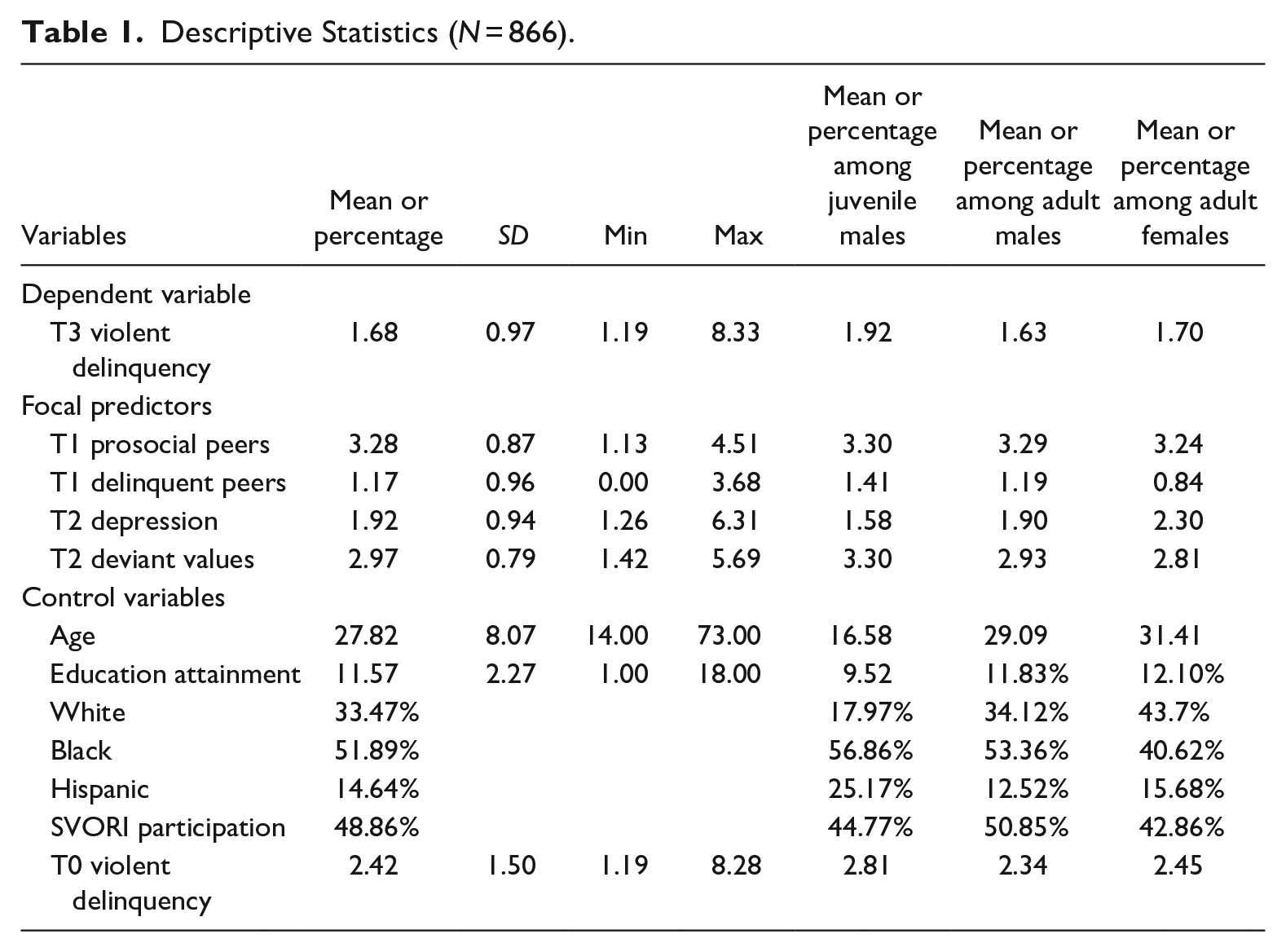
Table 1 reports the descriptive statistics for each study variable. The average age for juvenile respondents was 16.58 years; for adult males and adult females, the averages were 29.09 and 31.41, respectively. Among males, the majority of respondents were Black (57% of juveniles, and 53% of adult males). Among females, the majority (44%) were White. Nearly half of the respondents had participated in the SVORI program, including 45% of the juveniles, 51% of the adult males, and 43% of the adult females. Juvenile male respondents had the highest level of T3 violent delinquency (μ = 1.92) among the three groups. There was little difference in delinquency levels between adult males (μ = 1.63) and females (μ = 1.70). Reentering adult females had the lowest level of delinquent peer association (μ = .84). Juvenile males had the deepest involvement with delinquent peers (μ = 1.41). Endorsement of deviant values had a similar pattern: reentering youth had internalized deviant values to the greatest extent, whereas reentering adult females had the lowest level of endorsement of such values. However, adult females had the highest levels of depression, one of the mental health indicators.
Descriptive Statistics (N = 866).
Structural Equation Model Results
Structural equation Model 1 restrained all paths to be age- and gender-invariant. The results are presented in Table 2. As expected, T1 delinquent peer association was positively associated with T2 deviant values endorsed by respondents (B = 0.18, p < .001). Peers appear to have influenced deviant values. T1 prosocial peer support, however, was not a significant predictor of T2 deviant values. A significant path was found from T2 deviant values to T3 violent delinquency, with a large coefficient size in the model (B = 0.12, p < .001). Regarding the influence of peers on mental health, T1 delinquent peer was positively associated with T2 depressive symptoms (B = 0.18, p < .001) whereas T1 prosocial peer support was negatively associated with T2 depressive symptoms (B = −0.09, p < .01). T2 depressive symptoms were positively associated with T3 violent delinquency (B = 0.07, p < .001). Among the control variables, age was negatively associated with T3 violent delinquency (B = −0.01, p < .01). Older respondents appeared to have been less engaged in violent delinquency than younger respondents. Not surprisingly, baseline violent delinquency was a strong predictor of T3 violent delinquency (B = 0.17, p < .001). Education appears to have inhibited the internalization of deviant values. Those who had higher education had a lower endorsement of deviant values than those with lower levels of education (B = −0.17, p < .001). The model fit indices suggest poor model fit (CFI = 0.55; TLI = 0.50; SRMR = 0.05; RMSEA = 0.07).
Group-invariant Structural Equation Model (Model 1) Results.
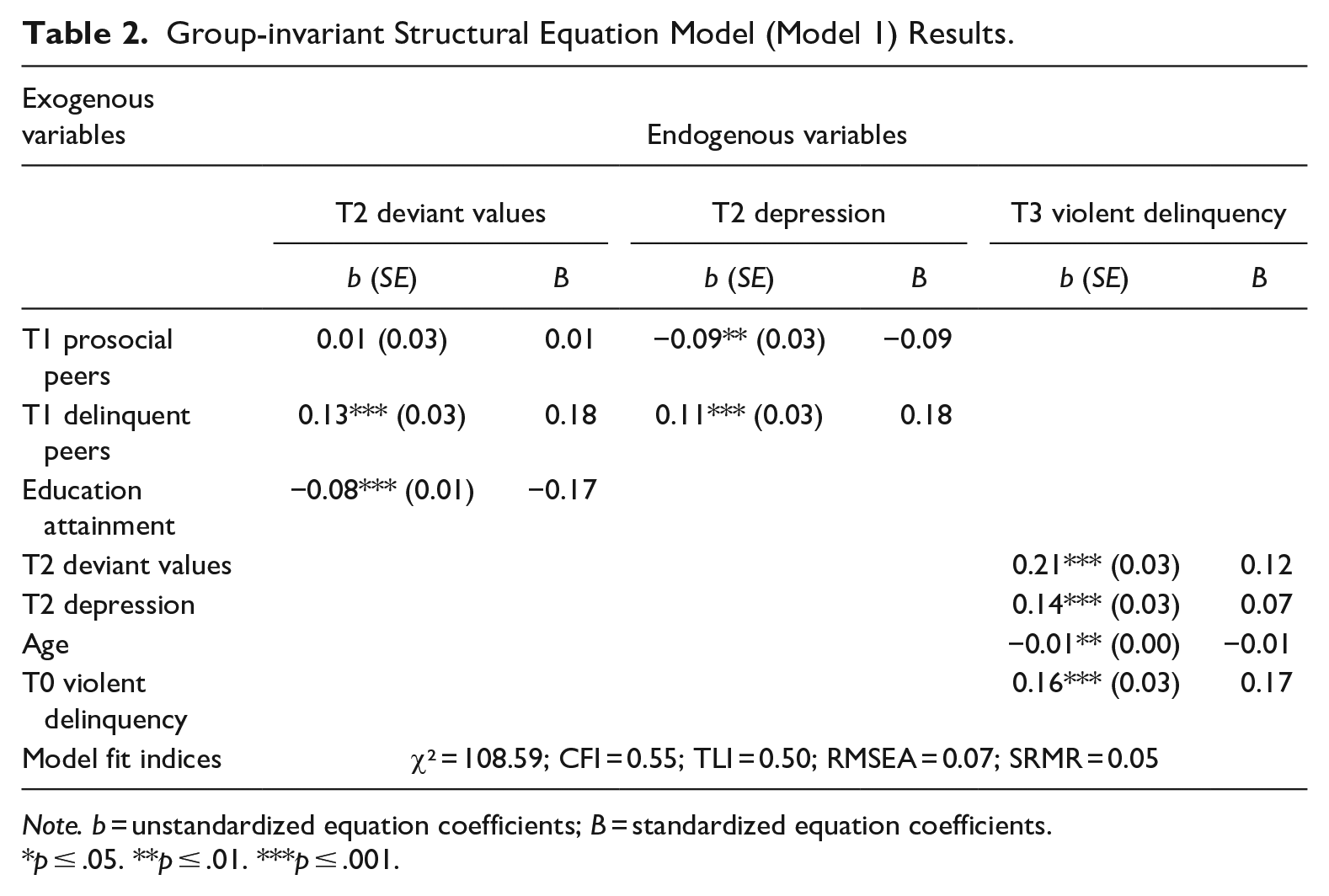
Note. b = unstandardized equation coefficients; B = standardized equation coefficients.
*p ≤ .05. **p ≤ .01. ***p ≤ .001.
Model 2 relaxes the strong assumption that all paths are identical across juvenile males, adult males, and adult females. The results are provided in Table 3. The multigroup SEM revealed quite a different picture compared with Model 1(Figure 1). First, delinquent peers positively affected the endorsement of deviant values for juvenile and adult males, but not for adult females. The standardized effect of the path for juvenile males was .19 (p < .05), higher than the path for adult males (B = 0.13, p < .001). The path from deviant values to violent delinquency was marginally significant among juvenile males (B = 0.13, p < .10) and its effect size was smaller than that of adult males (B = 0.26, p < .001). For adult males, deviant values were not a significant predictor of violent delinquency.
Group-based Structural Equation Model (Model 2) Results.
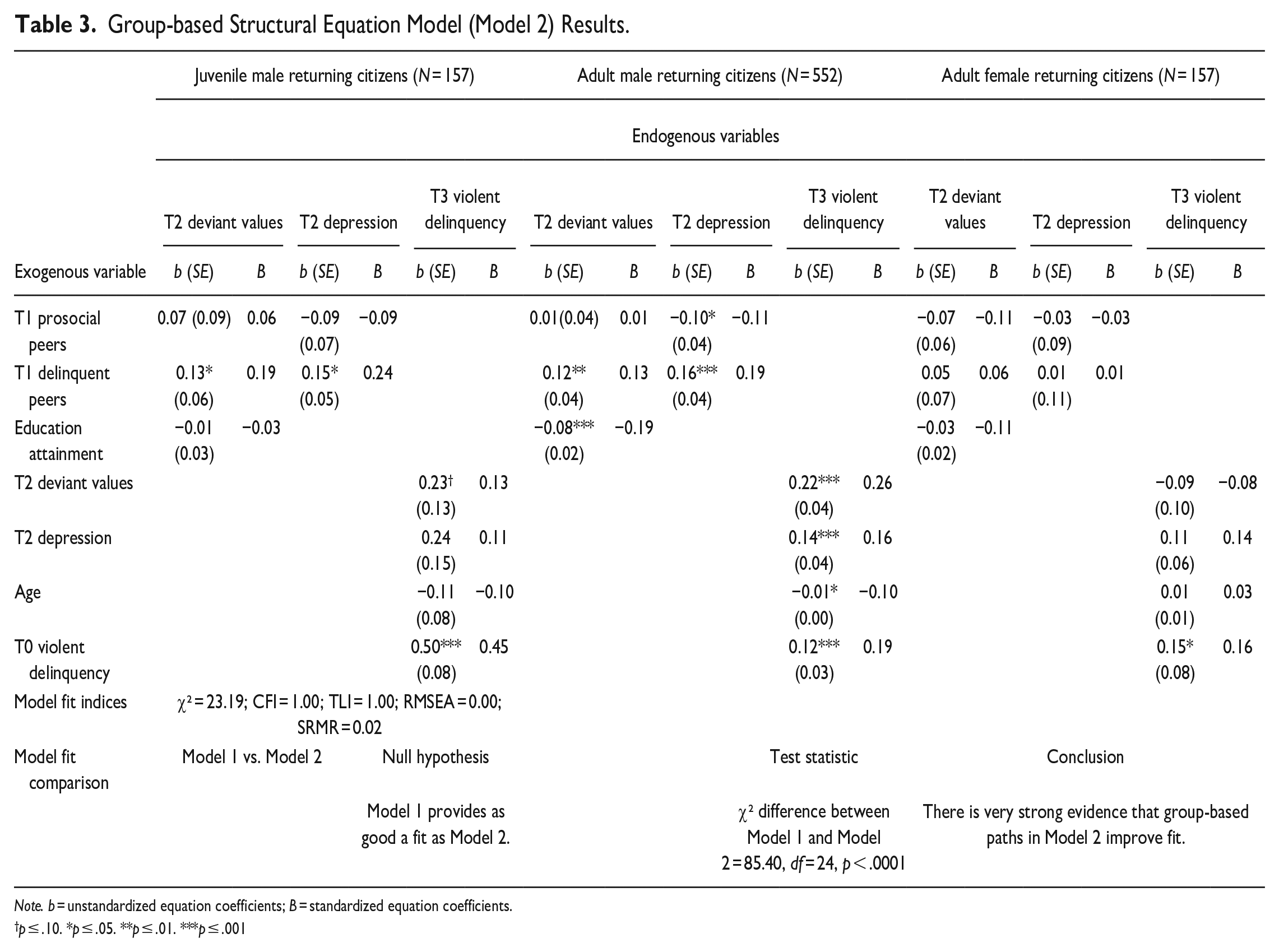
Note. b = unstandardized equation coefficients; B = standardized equation coefficients.
p ≤ .10. *p ≤ .05. **p ≤ .01. ***p ≤ .001

Multi-group structural equation model results.
Regarding the mental health factor, a delinquent peer was positively associated with depressive symptoms for both juvenile and adult males, though its detrimental effect was slightly stronger for juvenile males (B = 0.19 for adult males, B = 0.24 for juvenile males). Prosocial peer support was found to inhibit depressive symptoms for adult males but not for juvenile males. For adult males, each unit increase in prosocial peer support was associated with a .11 drop in depressive symptoms (p < .01). Better mental health appeared to have protected adult males against violent delinquency. Adult males who suffered depressive symptoms engaged in a significantly higher level of violent delinquency (B = 0.16, p < .001). Interestingly, there was no significant path from peer association to deviant values and depression among the adult female group. Further, neither depressive symptoms nor deviant values could sufficiently explain the variation of violent delinquency among adult females; the coefficients of the two variables also were not statistically significant.
Among the control variables, 3 baseline violent delinquency was a significant predictor of T3 violent delinquency for all respondent groups. Age was significantly associated with violent delinquency for only the adult male group. Education’s effect was also group specific: it only inhibited the internalization of deviant values among adult males. Model 2 achieved very good fit (CFI = 1.00; TLI = 1.00; SRMR = 0.02; RMSEA = 0.00). 4
The last step of the analysis was to compare the fit of Models 1 and 2. Using the chi-square model fit comparison of nested models, we tested the null hypothesis that the less complicated model (Model 1) provided as good a fit as the more complicated model (Model 2). The difference in the chi-square value between Model 1 and Model 2 was 85.40 (with a difference in degrees of freedom equal to 24). The p-value was less than .0001. Therefore, the null hypothesis that Model 1 provided as good a fit as Model 2 was rejected. There was strong evidence the group-based paths in Model 2 improved fit. Model fit indices such as CFI and RMSEA also clearly indicated that Model 2 outperformed Model 1.
Discussion
The era of mass incarceration in the United States has created an unprecedented number of people reentering society after incarceration. The primary barriers to reentry, according to past studies, include delinquent peer association (e.g., Abrams & Snyder, 2010), mental health difficulties (e.g., Link et al., 2019) and endorsement of deviant values (e.g., Kirk, 2016), among others. However, limited research has been devoted to how peer influence operates in the context of reentry (Akers, 2001; Akers & Jennings, 2019). Even less is known about the gender- and age-specific effect of peer influence on delinquent outcomes among juvenile and adult post-incarcerated individuals. Using longitudinal data, this study assessed whether the proposed learning mechanism through which peers influence violent delinquency varies. In addition, the nexus of peer influence, depression and post-release violent delinquency was assessed. Several key findings emerged from the study.
The applicability of the social learning perspective varies by age and gender. The theory applies well to juvenile and adult males: the delinquent peers → endorsement of deviant values → violent delinquency path was completely supported by the data. In contrast, adult females seem to be immune to peer influence during reentry. Delinquent peer association was not associated with deviant values among adult females, and their violent delinquency was not explained by deviant values. This finding contrasts with some previous studies that, using mixed-gender adolescent samples, found peer influence on delinquency was gender neutral (e.g., Jennings et al., 2010). The findings from this study are in line, however, with other studies maintaining that, due to feminist scripts that disapprove of criminality, females are less susceptible to the criminogenic effect of delinquent peers and deviant values (Chesney-Lind & Shelden, 2013; Gilligan, 1982; Mears et al., 1998; Thoits, 1991).
This study also found some support for the protective effect of prosocial peers against delinquency. For prosocial peer influence, which social learning theorists (e.g., Akers & Jennings, 2019) said inhibited the endorsement of deviant values but has rarely been studied, the current analysis showed adult males benefit from prosocial peer association while adult females and juvenile males reap no benefit. The developmental stage of post-incarcerated juveniles is characterized by a strong tendency to challenge traditional culture and norms (Abrahamson et al., 2002; Dailamy, 2018). This might explain why prosocial peer association did not inhibit their endorsement of deviant values. Adult females released from prison bear a noticeably heavier stigma because they defied the altruistic and caring feminine script and chose to be an offender (Chesney-Lind & Pasko, 2012; Estrada & Nilsson, 2012). It may be that post-incarcerated adult females internalized guilt and shame to a much greater degree than their male counterparts, which forced them into learned hopelessness and acceptance of a “doomed to fail” fate even with the availability of prosocial friends’ support. This may explain why a protective effect of prosocial peer association was only observed among adult male respondents.
The third major finding is the link between peer influence and depression. Model results suggest that, for adult males, an association with delinquent peers exacerbates depression whereas an association with prosocial peers inhibits depression. The finding is consistent with previous studies that identified the mental struggles reentering persons experienced when associating with deviant friends during the transition out of prison: deviant friends tend to drag reentering persons away from conventional groups and diminish their chances of reentry success (Formoso et al., 2000; McGloin & Shermer, 2009). Associating with prosocial peers, in contrast, solidifies the reentering person’s chance to re-engage in conventional communities and protects them from social rejection (Mowen & Boman, 2019; Yuen et al., 2017), which might explain why it also alleviates depressive symptoms. Although the direction of the effect of prosocial peers on depression in the juvenile male and adult female models is negative, as had been expected, the effect did not achieve statistical significance. The small sizes of these two groups may have limited the statistical power to identify smaller effects. Further research using larger samples is needed to test the influence of prosocial peers on the mental health of reentering juvenile males and adult females.
Although this study makes a meaningful contribution to the literature, the findings are constrained by several limitations. First, there were no juvenile female respondents included from the SVORI study. It was not possible to assess peer influence among at-risk juvenile females. Further, although the study is based on longitudinal data, the evidence for the T1 peer association → T2 deviant value and mental health → T3 delinquency nexus should not be assumed sufficient to establish causality. A third limitation pertains to the generalizability of the findings. The sample used in the study consists of at-risk social groups, that is, formerly incarcerated juveniles and adults who committed serious violent offenses. Whether peer influence varies by age and gender in the general population should be further examined. Lastly, the peer delinquency variable was based on respondents’ perceptions. The study was unable to compare direct and perceived measures of peer delinquency. Future research would benefit from examining the consistencies and discrepancies between the two types of measures.
Conclusions
With an unprecedented number of post-incarcerated individuals reentering society, facilitating reintegration remains one of the toughest challenges faced by researchers, policymakers, and practitioners. A proper understanding of the mechanism through which a risk factor affects reintegration is critical for prevention programming. Drawing insights from the social learning perspective, this study elucidated the role age and gender plays in post-incarcerated individuals’ susceptibility to peer influence. This extends our understanding of the role of peers in delinquency and highlights the importance of enhancing intervention programs through better classification, responsiveness, and tailoring to age- and gender-specific needs.
Supplemental Material
sj-docx-1-ijo-10.1177_0306624X231172647 – Supplemental material for Is Peer Influence Gender and Age Specific?: Findings From a Sample of Justice-Involved Individuals
Supplemental material, sj-docx-1-ijo-10.1177_0306624X231172647 for Is Peer Influence Gender and Age Specific?: Findings From a Sample of Justice-Involved Individuals by Lin Liu in International Journal of Offender Therapy and Comparative Criminology
Footnotes
Declaration of Conflicting Interests
The author(s) declared no potential conflicts of interest with respect to the research, authorship, and/or publication of this article.
Funding
The author(s) received no financial support for the research, authorship, and/or publication of this article.

Notes
Supplemental Material
Supplemental material for this article is available online.
References
Supplementary Material
Please find the following supplemental material available below.
For Open Access articles published under a Creative Commons License, all supplemental material carries the same license as the article it is associated with.
For non-Open Access articles published, all supplemental material carries a non-exclusive license, and permission requests for re-use of supplemental material or any part of supplemental material shall be sent directly to the copyright owner as specified in the copyright notice associated with the article.
