




Abstract
High rates of recidivism persist among incarcerated men, particularly those with extensive trauma histories, while many rehabilitation programs remain primarily cognitively focused. This systematic review synthesizes evidence on experiential psychotherapies, including mindfulness-based interventions, Acceptance and Commitment Therapy (ACT), yoga, meditation, and creative arts therapies delivered in forensic settings to adult males. Twenty-four studies met inclusion criteria. Thematic synthesis identified three outcome domains: (1) psychological and emotional well-being, including reductions in stress, anxiety, depression, and trauma symptoms; (2) behavioral and cognitive regulation, including improved impulse control and prosocial identity shifts; and (3) recidivism and desistance, with several studies—particularly those examining Transcendental Meditation and structured mindfulness programs—reporting reduced reoffending. Evidence for Compassion Focused Therapy and most creative arts therapies was limited or absent. Overall, findings suggest experiential psychotherapies may support emotional regulation, identity change, and desistance, though heterogeneity in study design and outcomes limits generalizability and highlights the need for more rigorous longitudinal research.
Plain Language Summary
Many people who go to prison return again after release. This is especially true for men who have lived through trauma, violence, or neglect and who struggle with strong emotions such as anger, fear, or shame. Most rehabilitation programs focus on changing how people think, but they often do not address how people feel in their bodies or how they experience their emotions. This review looked at whether therapies based on experience and awareness, such as mindfulness, meditation, yoga, Acceptance and Commitment Therapy (ACT), and creative activities, can help people in prison change in deeper and longer-lasting ways. We reviewed 24 studies from several countries that tested these approaches with men in prisons and other secure settings. We looked at three main outcomes: mental and emotional health, behavior and self-control, and whether people returned to crime after release. Many studies found that these therapies helped reduce stress, anxiety, depression, and trauma symptoms. People often reported better emotional control, greater self-awareness, and a more positive sense of who they are. Some programs, especially meditation-based approaches, were also linked to lower rates of reoffending. However, the studies used different methods and were not all high quality. There was also very little research on compassion-based therapy or creative arts programs. Overall, these approaches show promise as part of rehabilitation. They may help people heal from trauma, manage their emotions, and build a new sense of self. More long-term and carefully designed studies are still needed.
Keywords
Introduction
Globally, crime and recidivism remain important concerns for criminal justice systems and policymakers, with individuals involved in life-course offending often experiencing complex histories of trauma and adversity (Yukhnenko et al., 2023). Many justice-involved individuals report cumulative exposure to violence, instability, and social marginalization, both prior to incarceration and afflicted anew within carceral institutions (Crewe, 2011; Laws, 2022). These dynamics can complicate rehabilitation efforts and underscore the need for interventions that address not only behavior, but the emotional and relational processes underlying criminal conduct.
The issue is particularly visible in the United States, where incarceration rates remain among the highest globally. Recent international estimates indicate that approximately 40% of individuals released from prison are reincarcerated within 1 year, with substantially higher rates observed over longer follow-up periods (Yukhnenko et al., 2023). Although recidivism rates have declined in several jurisdictions compared to earlier decades, they remain sufficiently high to motivate continued efforts to improve rehabilitative strategies and support sustained desistance. Rates of recidivism are particularly elevated among men and individuals from marginalized racial and ethnic groups, reflecting structural vulnerabilities (Campbell & Vogel, 2017). While incarceration is often justified as a deterrent, a growing body of research suggests that carceral environments may exacerbate psychological stressors such as shame, emotional dysregulation, and interpersonal conflict (Crewe, 2011).
Contemporary rehabilitation frameworks, most notably the Risk-Need-Responsivity (RNR) model and related cognitive-behavioral interventions, have demonstrated measurable success in addressing criminogenic needs and reducing reoffending (Andrews & Bonta, 2010; Smith et al., 2024). However, some scholars have suggested that these approaches may be complemented by interventions that engage emotional regulation, embodied awareness, and identity transformation, particularly among individuals with extensive trauma histories (Levenson & Willis, 2018;Maruna, 2001;Van der Kolk, 2014).
As contemporary rehabilitation efforts attempt to pivot toward desistance, a growing body of literature has called for therapies that reach beyond the cognitive and into the embodied, affective, and experiential dimensions of criminal behavior (Sapp, 2023). Experiential psychotherapies, including Acceptance and Commitment Therapy (ACT), mindfulness-based interventions, yoga, meditation, and creative expression seek to cultivate emotional awareness, self-regulation, and reflective engagement with internal experience, which could be a precondition for rehabilitation. These approaches differ from traditional cognitive interventions in that they emphasize experiential engagement with affective and bodily processes. By strengthening emotional regulation and tolerance of difficult internal states, experiential modalities may help create the foundational psychological conditions necessary for individuals to engage meaningfully with cognitive and behavioral rehabilitation programs. Emotional regulation has been repeatedly identified as a core mechanism underlying successful rehabilitation and behavioral change (Gross, 1998; Tangney et al., 2007), suggesting that interventions cultivating embodied regulation may play a crucial role in supporting desistance by addressing shame-based emotional patterns that sustain cycles of violence and disconnection (Taylor & Hocken, 2021).
However, the empirical literature remains fragmented, with considerable heterogeneity in study design, outcomes assessed, and intervention modalities. To date, few systematic reviews have examined experiential psychotherapies collectively within forensic settings, or evaluated their influence on aggression, emotional regulation, and desistance-related outcomes.
This study addresses this gap through a rapid systematic review, a streamlined approach designed to synthesize emerging evidence in a timely manner. Through narrative synthesis, it examines the extent to which experiential psychotherapy interventions delivered in forensic contexts influence emotional and behavioral outcomes associated with offending, with particular attention to aggression, emotional regulation, self-awareness, and desistance processes.
Background
Contemporary criminological research increasingly recognizes that persistent offending cannot be fully explained by rational choice or cognitive deficits alone. Individuals who experience chronic social exclusion, poverty, and blocked opportunities are disproportionately exposed to adversity, violence, and instability across the life course. These pressures often manifest as apathy toward legal norms, substance abuse, and early justice involvement (McAra & McVie, 2025). For many incarcerated individuals, criminal behavior emerges not as isolated deviance but as an adaptive response to cumulative trauma, frequently rooted in adverse childhood experiences and reinforced across generations, operating as both a personal and social inheritance, reinforcing familial cycles of dysfunction (DeVeaux, 2013; Felitti et al., 1998; Low et al., 2012; Moore et al., 2013; Wolff & Shi, 2012).
Trauma, Shame, and the Carceral Cycle
Trauma, shame, criminal behavior, and incarceration may follow a cumulative and cyclical trajectory across the life course. This review is concerned primarily with incarcerated populations who are at higher risk of persistent offending and whose histories often include unresolved trauma and early adversity. While the purpose of this review is not to exclusively assess studies that screened participants for complex trauma, it is well established that the majority of incarcerated individuals present with some form of childhood victimization, psychological distress, or both (Compassion Prison Project, 2020;Wolff & Shi, 2012). Studies consistently show that incarcerated individuals report significantly higher rates of trauma exposure than the general population, including childhood abuse, community violence, and repeated victimization (DeVeaux, 2013; Wolff & Shi, 2012). Among men in the United States, lifetime exposure to at least one traumatic event ranges from approximately 43% to 92% in community samples, with higher rates of assaultive violence among those from socioeconomically disadvantaged and urban backgrounds (Breslau, 2009; Breslau et al., 1998). These risk factors are disproportionately represented among incarcerated populations from multiple jurisdictions (Angelakis et al., 2019; National Research Council, 2014). While estimates vary across contexts and measurement approaches, studies conducted primarily in the United States suggest that over 80% of incarcerated men report at least one adverse childhood experience, with a substantial proportion reporting four or more—rates significantly higher than those observed in the general population (Baglivio et al., 2015). Together, this evidence underscores that trauma is not incidental but a normative feature of the life histories of many incarcerated individuals.
This review conceptualizes trauma as occurring across two primary domains: early-life adversity and carceral exposure, both of which interact to shape emotional processes such as shame across the life course. While trauma is associated with a wide range of psychological outcomes, including anxiety, depression, substance use, and post-traumatic stress, this review advances the proposition that shame may function as a central or organizing emotional mechanism through which other outcomes are expressed in justice-involved populations. Drawing on theoretical and empirical work on moral emotions and identity (Braithwaite, 1989; Maruna, 2001), and interpersonal neurobiology (Thompson, 2015), shame is conceptualized here not merely as one consequence of trauma, but as a potentially foundational emotional process shaping self-concept, behavioral adaptation, and responses to social threat. From this perspective, other commonly observed outcomes, such as aggression, withdrawal, or substance use, may be understood, in part, as downstream expressions of unresolved or internalized shame.
Early exposure to trauma is associated with disruptions in emotional development, including difficulties in affect regulation and the emergence of shame-based self-concepts (Felitti et al., 1998; Tangney & Dearing, 2002; Thompson, 2015). In this context, offending behavior may function, in part, as an adaptive response to unmanaged emotional distress, threat sensitivity, or attempts to cope with or externalize the internal states of shame and fear (DeVeaux, 2013;Gilligan, 2003). Subsequent contact with the criminal justice system may further entrench these patterns. Carceral environments characterized by surveillance, loss of autonomy, and exposure to violence can reinforce shame-based identities and exacerbate existing trauma-related dysregulation (Crewe, 2011; Haney, 2013).
What results may be a potential cycle in which early trauma contributes to shame and emotional dysregulation, which in turn shape offending behavior, while incarceration may further compound these vulnerabilities rather than resolve them. Without interventions that address these underlying emotional processes, individuals may return to the same structural conditions and internal states that contributed to their initial offending, increasing the likelihood of continued justice involvement.
To further examine the mechanism which may sit at the center of this cycle linking trauma to offending behavior, it is important to distinguish between related but conceptually distinct emotional processes, particularly guilt and shame. While guilt refers to a negative evaluation of a specific behavior and appears to be a clear protective factor among criminal offenders, shame refers to a negative evaluation of the self (Lewis, 1971; Tangney & Dearing, 2002). Children raised in environments wrought with violence, substance abuse, or mental illness often inherit emotional dysfunction and antisocial behavior (Low et al., 2012). These experiences can leave deep imprints of shame, a corrosive emotional state (Thompson, 2015).
Individuals who can separate their past behavior from their “core self” externalize blame for past behavior and minimize their internal deviance. On the contrary, persistent offending is more parallel to the learned helplessness model of depression or deeply entrenched shame. I can’t help it. I am evil. There is something wrong with me. Importantly, shame is not solely a cognitive phenomenon; it is an embodied experience. Psychiatrist Curt Thompson introduced a dialect of interpersonal neurobiology (IPNB) into the conversation on shame suggesting its biological effect on the brain, the concept of self, and the ability to empathize and form healthy relationships with others. Thompson's theory of shame, viewed through the lens of interpersonal neurobiology, is an embodied emotional experience that emerges when individuals feel exposed, unworthy, or disconnected from others. It affects how the brain processes information, particularly in the areas responsible for social connection and self-awareness (Thompson, 2015).
Through experiential practices and attuned interactions, individuals can rewire the neural pathways associated with shame, reducing its power over emotional and social functioning (Thompson, 2015). But carceral practices that emphasize surveillance, punishment, and stigmatization can entrench shame-based identities, reinforcing the very criminogenic processes rehabilitation efforts seek to disrupt.
For those already carrying the somatic residue of early trauma, such conditions can deepen their disconnection from their bodies, others, and a coherent sense of self. Van der Kolk (2014) emphasizes that effective trauma treatment often requires approaches that extend beyond verbal or cognitive processing alone to include the restoration of bodily awareness and a sense of physiological safety. This includes cultivating awareness of internal states (interoception), restoring breath and movement regulation, and accessing practices that help individuals reinhabit their physical selves without fear.
This insight is critical for rehabilitation programs. A failure to address trauma’s embodied dimensions often leads to recidivism, emotional shutdown, or impulsivity—behaviors that are pathologized within the criminal justice system rather than understood as the echo of earlier harm (DeVeaux, 2013;Levenson & Willis, 2018).
Rehabilitation Models and Desistance
Contemporary correctional rehabilitation is largely grounded in cognitive-behavioral frameworks, particularly the Risk-Need-Responsivity (RNR) model and the Good Lives Model (GLM), both of which have demonstrated effectiveness in reducing recidivism and improving behavioral outcomes among justice-involved populations (Andrews & Bonta, 2010; Maruna, 2007). Thus, these approaches play an important role in addressing criminogenic needs, enhancing problem-solving skills, and supporting behavioral change.
In response to the high prevalence of trauma among incarcerated populations, several trauma-informed adaptations of cognitive-behavioral therapy have been developed, including programs such as Seeking Safety (Najavits, 2002), the Trauma Recovery and Empowerment Model (TREM; Fallot & Harris, 2002), Beyond Trauma (Covington, 2003), and TARGET (Ford & Russo, 2006). These interventions integrate psychoeducation, cognitive restructuring, and coping skills with elements such as grounding, emotional regulation, and, in some cases, body awareness practices. Empirical evaluations of these programs have demonstrated improvements in post-traumatic stress symptoms, emotional regulation, and institutional behavior among participants (Ford et al., 2012; Najavits, 2002; Swopes et al., 2016; Wolff et al., 2012).
However, these approaches are typically multi-component in nature, making it difficult to isolate the specific contribution of experiential processes such as embodied awareness and mindfulness. While such elements are often incorporated as supportive techniques, they are rarely evaluated independently as mechanisms of change. The present review builds on this literature by examining experiential therapies as a distinct category of intervention, with particular attention to their potential role in addressing shame and embodied trauma in forensic populations.
Importantly, this perspective does not position experiential approaches as alternatives to cognitive-behavioral interventions, but rather as complementary interventions that may enhance their effectiveness. They may help individuals cultivate new emotional and physiological states that are less compatible with violence, impulsivity, and shame, creating the psychological conditions necessary for individuals to more fully engage with, and benefit from, cognitive and skills-based interventions.
From a desistance perspective, these distinctions are particularly important. Desistance from crime is best understood as a dynamic and relational process rather than a singular event. It involves not only the cessation of offending behavior but also shifts in identity, agency, and social recognition (Maruna, 2001). Desistance scholars distinguish between primary desistance (temporary lapses in offending), secondary desistance (internalized identity change), and tertiary desistance (external validation and social reintegration; McNeill, 2012).
Sustained desistance most likely occurs when individuals can construct coherent, prosocial identities and access supportive social structures such as employment, housing, and community belonging. Longitudinal research indicates that individual motivation, emotional resilience, and commitment to change remain critical components of sustained desistance (Bottoms et al., 2006; Farrall et al., 2010; Maruna, 2001), but, for individuals with histories of chronic shame, the capacity to engage in these processes and capitalize on external opportunities even when they arise may be significantly constrained. Trauma-related dysregulation and entrenched shame-based identities can undermine agency and limit emotional awareness even when external opportunities for change are present (Crewe, 2011; Haney, 2013). In this context, interventions that directly target emotional and embodied processes may play a critical role in enabling the internal shifts that desistance theory identifies as central to long-term change.
Theoretical Basis of Experiential Therapy
Experiential psychotherapy encompasses a range of therapeutic approaches that prioritize direct engagement with internal experience, including emotional states, bodily sensations, and moment-to-moment awareness, as central mechanisms of psychological change. Rather than relying solely on verbal insight or cognitive restructuring, experiential therapies aim to access and process core emotional experiences through modalities such as mindfulness practices, body-based awareness, creative expression (e.g., writing, art, music, and drama), and techniques rooted in Gestalt, Compassion Focused Therapy (CFT), and Acceptance and Commitment Therapy (ACT). While these modalities differ in their specific techniques and theoretical origins, they share a common emphasis on reducing experiential avoidance and increasing individuals’ capacity to attend to, tolerate, and meaningfully process internal experiences. These approaches emphasize emotional authenticity and the development of internal resources such as self-compassion, resilience, and non-judgmental acceptance.
It is critical to note here that although the U.S. and U.K. differ significantly in their prison systems, a common thread across both contexts is the high prevalence of adverse childhood experiences among incarcerated individuals. Studies consistently show that the majority of prisoners in both regions report histories of childhood abuse, neglect, and adversity, which are strongly associated with later emotional dysregulation and offending behavior (Moore et al., 2013;Wolff & Shi, 2012). These findings suggest that rehabilitative strategies targeting underlying trauma and its emotional sequelae have relevance across U.S. and U.K. settings, and thus, the following discussion draws on theoretical and empirical literature from both contexts. However, the interventions discussed here may not be generalizable to correctional systems that are not characterized by the same aforementioned carceral conditions or histories of cumulative disadvantage.
Mindfulness and Meditation
Mindfulness and meditation reframes rehabilitation as not merely the suppression of deviance, but the restoration of human potential through inner regulation, consciousness development, and stress recovery. The approach posits that accumulated stress lodged at the chemical, mechanical, or structural level of the body, produces dysregulated neurophysiological patterns that manifest as anxiety, aggression, impulsivity, or criminal behavior (C. N. Alexander et al., 1987). Mindfulness practices, unlike cognitive or behavioral interventions alone, offer a physiological antidote to this dysregulation, by operating directly on the stress response system, eliciting a unique state of “restful alertness,” reducing activity in the amygdala, the brain’s fear center, while increasing integration between the prefrontal cortex and limbic system (Travis & Shear, 2010). This neurological recalibration allows individuals to process emotional stimuli with less reactivity and more executive control. In this way, mindfulness-based approaches exemplify the core principle of experiential therapy by facilitating direct, non-avoidant engagement with internal experience, allowing individuals to relate differently to emotional and physiological states that underlie behavior.
Crucially, mindfulness may also affect moral emotions such as shame and guilt, which are often implicated in both the perpetuation of criminal behavior and the motivation for change. Mindfulness encourages a stance of acceptance and nonjudgment, which can help individuals sit with uncomfortable emotions, including guilt, without becoming overwhelmed (Tangney et al., 2007). This may open the door for reflection, accountability, and ultimately, reparative action.
Unlike concentration-based or mindfulness techniques that emphasize observation of thoughts, Transcendental Meditation (TM) is designed to enable the practitioner to effortlessly settle the mind inward, beyond thought, to experience what Maharishi termed “pure consciousness”—a silent, expansive awareness marked by profound restfulness and inner alertness (Yogi, 1963). TM programs began to be introduced into correctional facilities in the U.S. as early as the 1970s, with the idea that stress reduction and inner regulation could facilitate behavioral change among incarcerated populations (Dillbeck & Abrams, 1987).
Beyond individual-level outcomes, TM has also been explored at the community level. This example is relevant even in the context of prison-based interventions because community-level TM is not simply referring to the population demographic; it reflects the idea that when large numbers of people engage in awareness-based practices, the ecological state and collective consciousness of the broader community can shift toward reduced stress and increased coherence. The study was a test of the capability of the Consciousness-Based approach to prevent crime in society as a whole, through group practice of TM (Rainforth, 2000).
Mindfulness-Based Interventions (MBIs), including Mindfulness-Based Cognitive Therapy (MBCT) go a step further by integrating elements of cognitive-behavioral therapy with structured mindfulness practices. However, unlike traditional or trauma-informed CBT programs in which experiential techniques are incorporated as one component among many, mindfulness-based approaches position experiential engagement, specifically, sustained attention to present-moment internal experience, as the primary mechanism of change. MBCT emphasizes “decentering,” the process of observing thoughts and emotions nonjudgmentally and without attachment, thereby shifting individuals’ relationship to internal experiences rather than directly attempting to modify their content (Segal et al., 2012; Williams, 2010).
In this sense, while MBCT includes cognitive elements, these function in service of cultivating experiential awareness rather than replacing it. Mindfulness practices require no belief system, can be delivered in a standardized format, and do not rely on verbal disclosure, which is often a barrier in correctional settings where individuals may mistrust authority or engage in trauma-related avoidance (Himelstein, 2011). These features make MBCT particularly well-suited for examining experiential processes as a primary therapeutic mechanism in forensic populations.
Yoga
Early studies demonstrated that regular yoga practice could reduce heart rate, blood pressure, and cortisol levels, and improve mood regulation and autonomic nervous system balance (Patel, 1973; Telles et al., 1995). Over the following decades, yoga-based interventions became increasingly integrated into treatment programs for depression, anxiety, post-traumatic stress disorder (PTSD), substance use disorders, and chronic pain (Balasubramaniam et al., 2013; Hofmann et al., 2010). Clinical applications were further validated by neuroimaging studies showing that yoga practices enhance emotional regulation, interoception, and self-awareness through modulation of brain regions like the prefrontal cortex and insula (Gard et al., 2014).
In forensic and correctional settings, yoga has emerged as a promising adjunctive treatment for incarcerated populations, addressing the high prevalence of trauma, emotional dysregulation, aggression, and substance misuse. Yoga’s core emphasis on physical embodiment, and parasympathetic activation is uniquely positioned to alleviate hypervigilance, institutional stress, and emotional suppression, conditions that mark the carceral environment (Shonin et al., 2013; Van der Kolk, 2014). From this perspective, yoga can be understood as an experiential modality that operates through embodied awareness, enabling individuals to access and regulate internal states at a physiological level.
Creative Arts Therapies
Creative arts therapies have deep historical roots, emerging from diverse cultural traditions and rituals that recognized the healing potential of artistic expression long before the term “therapy” was formalized. Across centuries, humans have turned to music, painting, storytelling, and dance expression as means of processing grief, healing trauma, and fostering communal resilience. While contemporary art therapy became institutionalized in the West during the 20th century, particularly post-WWII as part of the effort to rehabilitate veterans, the therapeutic use of the arts spans Indigenous and non-Western traditions that predate this formalization by generations (Junge & Asawa, 1994;Malchiodi, 2005).
Modern Creative Arts Therapies—including art therapy, music therapy, dance/movement therapy, drama therapy, and expressive writing—are now widely applied across mental health, education, and rehabilitative contexts (de Witte et al., 2021). These modalities share the foundational assumption that creative expression can support psychological insight, emotional regulation, trauma integration, and identity reconstruction, often where verbal therapies are limited.
The act of creative writing can mimic the effects of experiencing literature, and “traveling” outside of one’s immediate surroundings to explore the elastic capabilities of the mind. The aim is to put some distance between the client’s identity and what happened to them changing their relationship with the events of their life and their thoughts and feelings connected to it. Creative writing and narrative therapy approaches have been utilized to support individuals in reconstructing self-narratives, often as part of desistance-based work. These methods help participants “author” a non-criminal identity by reframing their life stories and integrating moments of change or redemption (Maruna, 2001; White & Epston, 1990).
Visual arts therapy, including painting, drawing, and sculpture, helps individuals externalize and process emotional experiences that may be difficult to articulate. Music therapy has likewise gained traction in both clinical and correctional settings. It enhances mood, cognitive functioning, and impulse control, while also fostering group cohesion and emotional catharsis (de Witte et al., 2020;Kamioka et al., 2014).
Dance Movement Therapy (DMT) reconnects individuals with their physical selves—essential in populations marked by trauma and incarceration, where disassociation from the body is common and is particularly unique in carceral settings because dance goes against prison-culture codes of masculine behavior (Seibert, 2023). The approach has been shown to reduce symptoms of PTSD, improve affect regulation, and foster embodied self-awareness (Koch et al., 2014).
Across modalities, creative arts therapies reflect the core tenet of experiential therapy by providing non-verbal and embodied pathways for engaging with internal experience, particularly in contexts where emotional states may be inaccessible through purely cognitive or linguistic means.
Acceptance and Commitment Therapy
Within the broader framework of experiential therapy, ACT occupies a critical position by translating experiential engagement into behavioral change, with acceptance functioning as a mechanism through which individuals learn to remain in contact with internal experiences rather than avoid or suppress them. Grounded in functional contextualism and Relational Frame Theory (RFT), ACT focuses on the contextual and relational nature of human language and cognition, rather than altering the content of thoughts themselves (Hayes et al., 1999). Simplistically, while CBT seeks to change or eliminate negative thoughts, ACT accepts the thoughts but acts on values. An apt metaphor may be to let one’s thoughts ride in the passenger seat, but don’t let them steer the car.
At the core of ACT is the cultivation of psychological flexibility—the capacity to remain present and open to experience while engaging in behavior aligned with deeply held values. Psychological inflexibility, on the other hand, often manifests through experiential avoidance (efforts to suppress distressing thoughts and emotions) and cognitive fusion (over-identification with one’s thoughts), which can drive maladaptive coping behaviors, including violence, substance abuse, and recidivism (Hayes et al., 2012).
Compassion Focused Therapy
An umbrella term that encompasses a therapeutic experiential approach aimed at helping individuals develop and harness compassion both for themselves and others, Compassion Focused Therapy (CFT) integrates elements from several fields of psychology and therapy, making it comprehensive in its scope. CFT conceptualizes emotional functioning through three evolved systems: threat, drive, and soothing, with psychopathology arising from chronic threat activation and underdevelopment of soothing capacities (Gilbert, 2010). In practice, CFT integrates psychoeducation, mindfulness, and imagery-based exercises to foster an internal sense of safety and warmth, allowing clients to relate differently to difficult emotions (Gilbert, 2010). In this sense, CFT aligns with experiential therapy by targeting the emotional and physiological substrates of shame through practices that cultivate felt experiences of safety, compassion, and affiliation. While CFT shows strong promise in targeting emotional dysfunction relevant to offending behavior, its application in adult correctional settings remains under-examined (Gilbert, 2010; Kirby et al., 2017; Leaviss & Uttley, 2014).
Methodology
This study was conducted as a rapid systematic review, a form of evidence synthesis that uses streamlined methodological procedures to produce timely summaries of evidence (Tricco et al., 2017). In line with rapid review methodology, certain processes were simplified, including single-reviewer screening and the use of narrative rather than quantitative synthesis. These adaptations were appropriate given the exploratory nature of the research question and the emerging state of the literature (Tricco et al., 2015, 2017). While dual screening and formal inter-rater reliability assessment are considered best practice in systematic reviews, rapid reviews commonly employ streamlined procedures to expedite evidence synthesis (Tricco et al., 2017). To enhance consistency, eligibility criteria were applied systematically, and uncertainties were resolved through consultation with the supervising researcher. This rapid systematic review was conducted in accordance with a protocol that was registered on the PROSPERO database to ensure methodological transparency and adherence to established standards for systematic evidence synthesis. The review aimed to evaluate the impact of experiential psychotherapies on emotional, behavioral, and desistance-related outcomes in forensic populations.
A comprehensive literature search was conducted in May 2025 across five electronic databases: PubMed, PsycINFO, Web of Science, ProQuest, and Google Scholar. Search terms combined intervention-related keywords (e.g., Acceptance and Commitment Therapy, Compassion Focused Therapy, mindfulness, yoga, meditation, creative arts, music, dance, creative writing) with population and outcome terms (e.g., offender, incarcerated, prison, aggression, emotional regulation, desistance, recidivism). Reference lists of included studies were also screened using backward and forward citation searching.
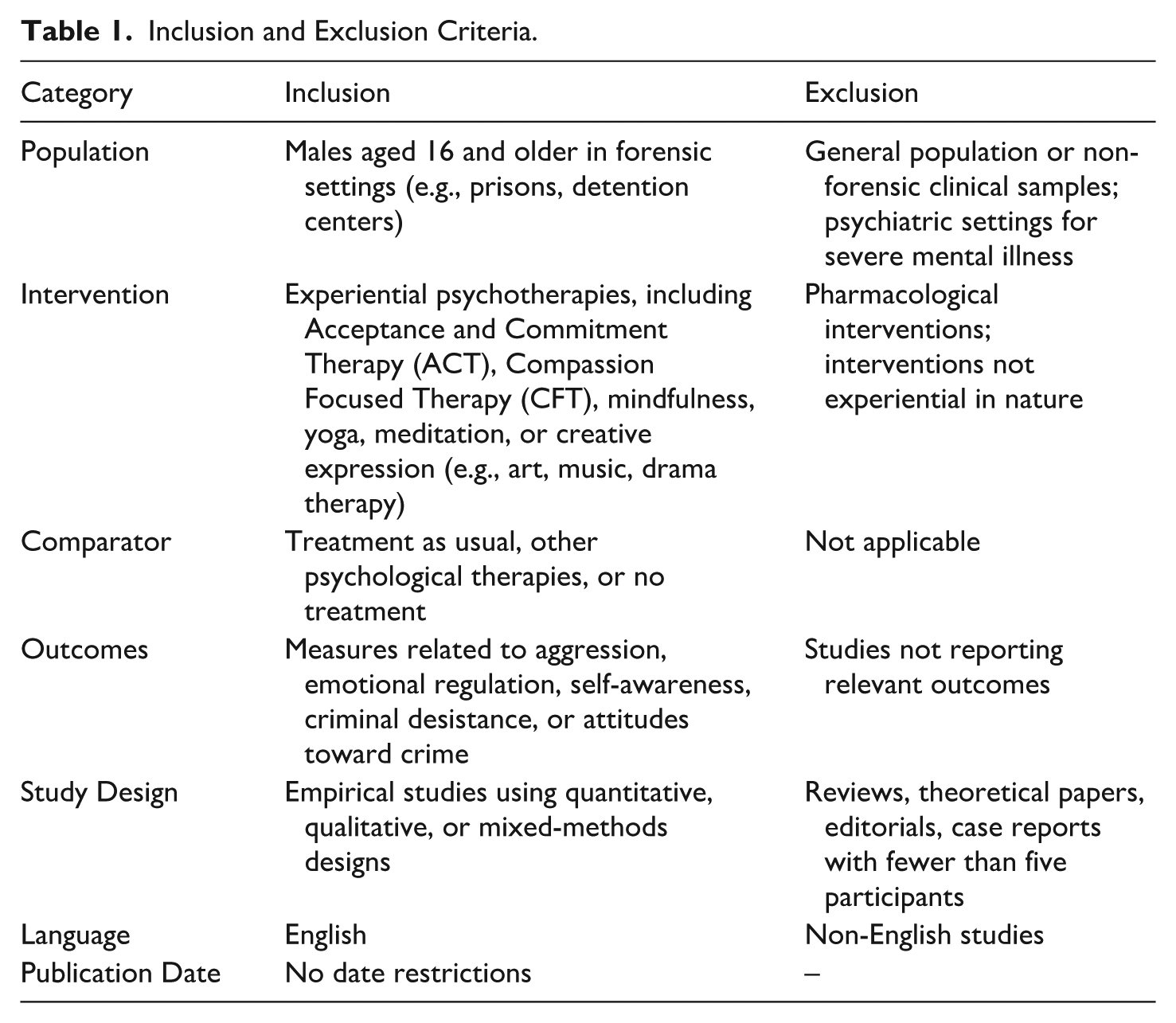
Search results were limited to English-language publications, with no restrictions on publication date. All records were imported into Covidence (Covidence, n.d.), where duplicates were removed and titles and abstracts were screened against predefined eligibility criteria. Full text screening was conducted for potentially eligible studies, with discrepancies resolved through reference to the registered protocol. Full inclusion and exclusion criteria are presented in Table 1. A detailed accounting of the review process can be found in the Preferred Reporting Items for Systematic Reviews and Meta-Analyses (PRISMA) diagram in Supplemental Materials.
Inclusion and Exclusion Criteria.
Data Evaluation
Data extraction was conducted using a standardized form developed in Covidence. Information extracted from each study included author and year, study design, country, sample characteristics, intervention type and duration, outcome domains assessed, and key findings related to behavioral, emotional, or recidivism-related outcomes. Studies were grouped by intervention type to facilitate comparison across contexts. (c.f. Table A-1. In Supplemental Materials)
Methodological quality was assessed using established appraisal tools appropriate to study design. Randomized controlled trials were evaluated using the Cochrane Risk of Bias tool (Higgins et al., 2011), while non-randomized quantitative, qualitative, and mixed-methods studies were appraised using Joanna Briggs Institute (JBI) checklists (Joanna Briggs Institute, 2017). Quality assessments informed interpretation of findings but were not used as exclusion criteria (See Table A-2, Supplemental Materials).
A meta-analysis was considered; however, quantitative synthesis was not appropriate due to substantial heterogeneity across studies in intervention type, duration, outcome measures, and follow-up periods. Even within intervention subgroups (e.g., meditation-based interventions), variability in study design and outcome reporting precluded meaningful statistical pooling. The GRADE framework was not applied for the same reasons. Despite these constraints, a narrative synthesis approach was adopted to allow for structured comparison across diverse study characteristics providing an overview of an emerging and heterogeneous evidence base, enabling identification of key patterns, gaps, and directions for future research. Findings were synthesized narratively using a thematic approach and outcome variables were coded and grouped based on conceptual similarity. The synthesis emphasizes both reported outcomes and methodological strengths and limitations within the existing evidence base.
This review did not involve the collection of primary data from human participants and therefore did not require formal ethical approval. All the studies included were publicly available and had undergone their own ethical review processes where applicable. The review was conducted in accordance with established systematic review guidelines to ensure transparency and integrity (Page et al., 2021). Given the sensitive nature of forensic and mental health research, care was taken to report findings respectfully and without stigmatizing language.
Results
The final sample comprised 24 empirical studies (c.f. Supplemental Figure A-1 and Table A-1) employing a range of methodological designs. Studies were published between the late 1970s and early 2020s, with earlier work primarily evaluating Transcendental Meditation (TM) interventions in correctional settings and more recent research reflecting increased attention to mindfulness-based interventions, Acceptance and Commitment Therapy (ACT), and yoga-based programs.
Eight studies employed randomized controlled trial designs, alongside four longitudinal cohort studies and a range of quasi-experimental and matched-control designs. Several studies incorporated mixed-methods or pre–post designs with follow-up assessments, examining outcomes including aggression, emotional regulation, trauma-related symptoms, identity change, and recidivism. Quantitative outcomes were typically assessed using standardized self-report measures, institutional records, or administrative data, while qualitative components, present in seven studies, provided contextual insight through participant interviews or practitioner observations.
Studies were conducted across multiple jurisdictions, including the United States, United Kingdom, Norway, Hungary, the Netherlands, and China, reflecting growing international interest in experiential interventions within forensic settings. Despite differences in national context, the studies addressed common psychological and behavioral challenges associated with incarceration, enhancing the relevance of findings across comparable carceral systems.
Participant samples primarily comprised adult male incarcerated individuals aged 16 to over 60, most of whom were convicted of violent offenses or classified as high risk for recidivism. No studies explicitly examined differential effects by race, ethnicity, or socioeconomic status. Notably, no eligible studies evaluating Compassion Focused Therapy (CFT) were identified, and only three studies examining music-based interventions met inclusion criteria. No qualifying studies assessed other creative arts modalities, such as visual arts, dance, or creative writing, underscoring significant gaps in the evidence base.
Thematic Outcomes
The initial review of intervention effects revealed a broad range of reported outcomes, from emotional regulation and stress reduction to shifts in self-identity and longer-term behavioral change. Through an inductive process, these diverse outcomes were clustered into three overarching categories that reflected both the proximal and distal goals of experiential therapies in forensic settings: (1) psychological and emotional well-being—capturing immediate mental health benefits and emotional shifts; (2) behavioral change and cognitive regulation—reflecting changes in thought patterns, impulse control, and value alignment; and (3) recidivism and desistance—representing longer-term behavioral outcomes and reintegration markers. This thematic framework was chosen because it allowed for a holistic understanding of how experiential therapies operate across different levels of change, from internal emotional states to external behavioral patterns. It also aligned with desistance theory and trauma-informed rehabilitation models, providing a coherent structure through which to interpret the varied effects of interventions. Across these domains, Transcendental Meditation and other mindfulness therapies produced the most consistently positive outcomes.
Psychological and Emotional Well-Being
Evidence across multiple decades and jurisdictions indicates that experiential interventions, particularly meditation- and mindfulness-based approaches, are associated with improvements in psychological and emotional well-being among incarcerated men. Across the 24 included studies, outcomes commonly assessed included stress, anxiety, depression, emotional regulation, trauma-related symptoms, self-awareness, and psychological flexibility.
Meditation and Mindfulness-Based Interventions
Four studies examined the effects of Transcendental Meditation (TM) on psychological outcomes. Early foundational work conducted in U.S. maximum-security settings demonstrated that sustained TM practice was associated with reduced psychopathological traits, enhanced self-awareness, and higher levels of ego development compared to inactive control groups (C. N. Alexander & Orme-Johnson, 2003; C. N. Alexander, Walton, et al., 2003). These effects remained significant after controlling for demographic and program participation variables. More recent randomized evidence supports these findings. In a large RCT involving 181 incarcerated men, Nidich et al. (2016) reported significant reductions in trauma symptoms, anxiety, depression, dissociation, sleep disturbance, and perceived stress relative to treatment as usual at 4-month follow-up (p < .001).
Retrospective matched-control studies further suggest that psychological benefits may mediate behavioral outcomes. Bleick and Abrams (1987) and Rainforth (2000) reported substantial reductions in recidivism among TM participants, hypothesizing that enhanced emotional regulation and stress resilience contributed to these effects, although mediation was not directly tested.
Qualitative and mixed-methods studies provide complementary insight into participants’ subjective experiences. Evaluations of Vipassana meditation in United States and Israeli prisons found high acceptability and reported improvements in mindfulness, emotional intelligence, self-control, and identity narratives, with participants describing increased empowerment and trust within the institutional environment (Perelman et al., 2012; Ronel et al., 2011). Similarly, a mixed-methods study of Mindfulness-Based Stress Reduction (MBSR) across five Dutch prisons found reductions in anger and stress alongside improvements in impulse control, emotional awareness, and self-esteem, corroborated by staff observations (Bouw et al., 2019). A brief mindfulness intervention in a Chinese prison also demonstrated improvements in emotion regulation and self-awareness across quantitative and qualitative measures (Zhang et al., 2022). As these studies employed qualitative or mixed-methods designs, statistical significance testing was not reported, and findings are based on thematic and self-reported outcomes.
Acceptance- and Values-Based Approaches
The Reentry Values and Mindfulness Program (REVAMP), which integrates mindfulness with values-based cognitive work, demonstrated improvements in psychological flexibility among incarcerated men in a United States jail setting. In a randomized controlled trial, participants showed greater gains in acceptance and willingness relative to treatment as usual (d = .72), with effects persisting at 3-month follow-up (Malouf et al., 2017). Participants also reported increased awareness of shame and self-judgment (d = .73), suggesting enhanced capacity to engage with difficult emotional states without avoidance. ACT-based interventions are discussed further in relation to behavioral and cognitive regulation outcomes below.
Yoga
Three studies examined yoga-based interventions, often delivered alongside meditation or mindfulness practices. Across these studies, participation was associated with improvements in emotional control, anxiety, locus of control, and aspects of self-concept (Barrett, 2016;Bunk, 1978;Pham, 2013). Early comparative work suggested additive benefits when yoga and meditation were combined (Bunk, 1978). More recent mixed-methods research found that incarcerated men participating in yoga programs reported greater spiritual well-being, emotional calm, and introspection, although methodological limitations—including self-selection, lack of baseline data, and reliance on retrospective self-report—temper causal inference (Pham, 2013).
Creative and Expressive Modalities
Evidence for music therapy was limited but suggestive. A randomized study in Norway reported short-term reductions in state anxiety following a 2-week music therapy intervention (d = 0.33, p = .025), though no effects were observed for trait anxiety or depression (Gold et al., 2014). In contrast, a larger randomized trial in China (n = 200) found significant reductions in anxiety and depression and improvements in self-esteem at both mid- and post-intervention assessments, with effects ranging from small to large (e.g., STAI-State p = .006 at mid-test; p < .001 at post-test; BDI p < .001; Chen et al., 2016). However, the absence of long-term follow-up limits conclusions regarding durability. Differential responsiveness by age and education level was observed but not theoretically explored, highlighting the need for more nuanced analyses of participant characteristics.
Behavioral Change and Cognitive Regulation
Four studies explored the application of Acceptance and Commitment Therapy (ACT). Plambeck (2015) conducted a quasi-experimental study in a California county jail and found statistically significant reductions in trait anger, problematic anger-related behaviors, and psychological inflexibility following an 8-week ACT intervention, based on paired-sample analyses. These improvements were sustained at 1-month follow-up, suggesting the intervention’s potential to promote cognitive regulation and behavioral restraint in high-risk populations. But several limitations temper the strength of these conclusions. First, the short-term nature of the follow-up, just 1 month, limits understanding of the intervention’s durability, particularly post-release when individuals face heightened stressors. Second, county jail populations differ markedly from prison populations in terms of sentence length, population turnover, and institutional structure, potentially limiting generalizability to longer-term incarcerated individuals.
Berta (2017) applied ACT in a group of non-compliant incarcerated intimate partner violence (IPV) perpetrators. The 8-week program resulted in a statistically significant reduction in experiential avoidance, a key ACT target associated with rigid, emotionally driven behavior (t(18) = −3.87, p < .001). But no control group was utilised, limiting any conclusions about causal inference and the small sample size (N = 23) constrains generalizability.
Eisenbeck et al. (2017) conducted a randomized controlled trial in a Hungarian prison comparing ACT (n = 9) to treatment as usual (TAU; n = 8). Although the sample size was small, ACT participants demonstrated significantly greater improvements in values-consistent behavior compared to TAU (F(1, 8) = 9.73, p = .016, η² = .54), with within-group analyses indicating significant increases from pre- to post-intervention (Z = −2.02, p = .043). However, no statistically significant effects were observed for depression, anxiety, or psychological flexibility in either group (all p > .05), although anxiety showed a non-significant trend toward reduction in the ACT condition (p = .080).
Choppa (2024) added a new dimension to ACT research by examining its impact on identity and agency among adult male inmates in a Kentucky reentry facility. The study examined the relationship between psychological flexibility, identity, and agency among adult male inmates participating in an ACT-informed intervention. Although the sample was small (n = 10) and most findings did not reach statistical significance, the observed patterns were consistent with theoretical expectations. Higher psychological flexibility was associated with greater identification with a law-abiding identity and increased sense of agency, while lower flexibility was associated with stronger identification with a criminal identity. These findings provide preliminary support for the role of psychological flexibility in identity-related processes relevant to desistance, although conclusions are limited by the exploratory design and lack of statistical power.
While ACT-based interventions primarily target cognitive and behavioral regulation through psychological flexibility and values-based action, related mechanisms may also be engaged through mindfulness practices such as meditation, which emphasize attentional control, self-awareness, and non-reactivity to internal experiences. In a study conducted in Curaçao, Hawkins et al. (2003) reported statistically significant improvements in cognitive distortions (p = .036) and intelligence-related measures (p = .05). No statistically significant effects were observed for aggression, impulsivity, or psychological distress, and psychological well-being did not reach statistical significance (p = .082).
In Perelman et al. (2012), participants in the Vipassana meditation group demonstrated improvements in self-reported mindfulness, with significant increases from pretest to posttest (p = .023) and higher overall scores compared to the comparison group (p = .002). Emotional intelligence showed some improvement over time for Vipassana participants (p = .025), although the overall model was not statistically significant. No significant effects were observed for anger. Vipassana participants also reported lower overall mood disturbance compared to the comparison group (p = .003), although mood did not change significantly over time. In contrast, no statistically significant differences were observed between groups in behavioral outcomes, including institutional infractions (p = .32), segregation (p = .80), or medical visits (p = .78) at follow-up.
Recidivism and Desistance
Only a subset of seven studies explicitly measured recidivism outcomes.
Transcendental Meditation (TM) interventions were examined in three quasi-experimental studies conducted in the United States (C. N. Alexander, Rainforth, et al., 2003; Bleick & Abrams, 1987; Rainforth, 2000), all of which reported lower rates of reincarceration or felony reconviction among TM practitioners compared to matched controls. In Rainforth’s long-term retrospective study, TM participation was associated with a 43.5% reduction in recidivism risk over a follow-up period of up to six years. Bleick and Abrams (1987) similarly found that parolees who had practiced TM during incarceration had 40–45% lower rates of new prison terms compared to matched non-meditators.
Yoga-based interventions demonstrated more modest outcomes. The largest retrospective study (Kovalsky et al., 2020) examined 5-year rearrest and reincarceration rates among over 1,000 Israeli inmates, comparing those who participated in prison yoga with matched controls. While rearrest rates did not differ significantly, recidivism was consistently lower among yoga participants, though effect sizes were small. These findings point to a potentially protective effect of yoga on reoffending, though further prospective studies are needed to confirm causality.
ACT interventions presented mixed results regarding recidivism. In Berta's (2017) study of IPV offenders in a United States jail, ACT was associated with a relatively low IPV-specific recidivism rate (5%) 1 year post-release, comparable to community-based norms. However, general and violent reoffending remained high (24–67%), suggesting that while ACT may target specific risk pathways such as experiential avoidance, its behavioral effects may require additional structural support to generalize beyond intimate partner violence. The REVAMP program (Malouf et al., 2017) also assessed post-release outcomes. At both 3-month and 3-year follow-up, lower rates of criminal behavior were observed in the intervention group compared to treatment as usual; however, these differences did not reach statistical significance (p values ranging from .06 to .10).
In contrast, music therapy, despite its promise in enhancing emotional expression and interpersonal functioning, did not yield measurable reductions in recidivism. In Gold et al.’s (2014) second study, no statistically significant differences were found between music therapy participants and controls in terms of new convictions.
Mindfulness-Based Stress Reduction (MBSR) and Mindfulness-Based Cognitive Therapy (MBCT) interventions largely focused on psychological outcomes, and recidivism data were not reported.
Discussion
Trauma is not a singular or isolated phenomenon—it is cumulative, layered, and multidimensional (Van der Kolk, 2014). Addressing trauma, then, cannot be reduced to a single modality or intervention. Rehabilitation must be understood as a holistic process. Experiential therapies are promising in correctional contexts because they target embodied processes central to trauma recovery, including emotional regulation, interoceptive awareness, and internal coherence. However, these approaches are unlikely to be sufficient in isolation. Sustainable rehabilitation also requires psychoeducational components that support self-awareness and behavioral insight, alongside structural supports such as stable housing, employment, and community connection. Interventions that integrate experiential practices within broader therapeutic and rehabilitative frameworks may therefore be best positioned to support long-term change among justice-involved populations.
The interventions explored, Transcendental Meditation (TM), mindfulness-based programs, yoga, Acceptance and Commitment Therapy (ACT), and music therapy, offered varying degrees of evidence for reducing psychological distress, promoting emotional regulation, and supporting desistance from crime. Transcendental Meditation (TM) emerged as the most robustly supported intervention across all outcome domains, though these findings should be interpreted cautiously given the predominance of non-randomized designs and potential selection bias.
The TM studies—spanning four decades and conducted in diverse settings including the United States and Curaçao—demonstrated an association with consistent and significant improvements in psychological well-being, self-awareness, and reduced cognitive distortion. But more importantly, TM was also associated with reductions in recidivism, with effects sustained over multi-year follow-ups. These benefits appeared especially pronounced among participants who continued TM practice post-release.
The Walpole series of studies conducted by Alexander and colleagues (2003) at MCI Walpole exemplify a shift in emotional architecture that is critical in behavioral change and desistance (C. N. Alexander & Orme-Johnson, 2003; C. N. Alexander, Rainforth, et al., 2003; C. N. Alexander, Walton, et al., 2003; Maruna, 2001). Participants who practiced TM regularly demonstrated statistically significant reductions in psychopathology, including anxiety and aggression, and developed higher stages of ego maturity compared to control groups. These are not trivial findings. Rather than conceptualizing these changes as the strengthening of ego in a conventional sense, the findings may be more accurately understood as a shift from self-centeredness toward self-transcendence. While TM has been associated with higher stages of ego development as measured by Loevinger’s framework, these stages reflect increased perspective-taking, integration, and reduced defensiveness rather than heightened egocentricity (Cook-Greuter, 1999;Loevinger, 1976). In this sense, “ego development” may be better interpreted as the loosening of rigid, self-protective identity structures that are often organized around threat, shame, and survival. The included studies suggest that TM could have the capacity to restructure these maladaptive thinking patterns and enhance self-efficacy—factors that strain theory identifies as critical to navigating structural barriers without resorting to crime (Agnew, 1992).
This distinction is particularly relevant in forensic populations, where self-centeredness has been identified as a core feature of offending behavior (Maruna, 2001; Walters, 1990). Importantly, such self-centeredness may not reflect stable narcissistic traits, but rather adaptive responses to chronic trauma, shame, and threat exposure. Individuals who have experienced persistent adversity may develop heightened self-focus as a means of psychological survival, prioritizing immediate needs, minimizing vulnerability, and maintaining defensive control in unsafe environments (Gilbert, 2014;Van der Kolk, 2014). Interventions such as TM and yoga may operate by quieting habitual self-referential processing, allowing individuals to experience a broader sense of connection beyond the self. This mechanism aligns with recovery models such as the 12-Step framework, which explicitly targets the reduction of self-centeredness as a pathway to behavioral change (Kelly et al., 2010).
These findings must be understood within the context of the carceral world’s psychological harms. Prisons do not merely incapacitate—they deconstruct the psyche (Crewe, 2011). They isolate, dehumanize, and retraumatize individuals who often carry a long history of emotional wounds. TM’s ability to intervene at the level of the nervous system (C. N. Alexander & Orme-Johnson, 2003) is what may make it uniquely potent in such environments. Rather than demanding cognitive reframing or behavioral compliance from individuals who may not yet possess the regulatory capacity to perform such tasks, TM may restore baseline functioning, reestablishing the physiological conditions under which growth and healing become possible (C. N. Alexander & Orme-Johnson, 2014). This process creates an emotional and mental foundation from which to build on, introducing other interventions such as career skill building, social support, and structural renovations in housing affordability and employment accessibility. TM may support the development of a mindset that not only notices, but is receptive and willing to seize positive opportunities, when they become available.
Despite these compelling findings, the evidence base for TM requires careful interpretation. Much of the literature relies on non-randomized designs and voluntary participation, introducing the possibility of selection bias and limiting causal inference. While the consistency of positive outcomes, particularly in relation to recidivism, is notable, these results should be understood as suggestive rather than definitive evidence of effectiveness. At the same time, it is important to acknowledge the practical constraints of conducting randomized controlled trials in correctional settings, where ethical, logistical, and institutional barriers often limit experimental rigor.
An additional consideration is the temporal context of several key TM studies, including those conducted by Alexander et al. and Bleick and Abrams, which draw on data from the 1970s and 1980s. Correctional environments have changed substantially over the past four decades, with many contemporary systems characterized by increased overcrowding, longer sentencing structures, and more punitive institutional climates (Garland, 2001). These shifts may influence both baseline psychological functioning and responsiveness to intervention (Liebling & Maruna, 2005), raising questions about the direct applicability of earlier findings to present-day contexts.
Nevertheless, the consistency of findings across multiple decades and diverse institutional settings suggests that TM may be engaging underlying psychological or physiological processes that are not entirely context dependent. Rather than invalidating these earlier studies, their age underscores the need for contemporary replications using more rigorous designs in modern correctional environments. Updating this evidence base is essential for determining whether the observed reductions in recidivism remain robust under current institutional conditions.
TM’s underutilization in correctional settings may also reflect a broader discomfort with interventions that do not align neatly with risk management frameworks or behaviorally oriented models of rehabilitation. TM is not a behavior modification tool—it is a consciousness-based approach that resists easy quantification. Its language and lineage, rooted in Eastern philosophy, may also trigger skepticism in secular institutions. But dismissing TM on these grounds risks overlooking a body of evidence that, while methodologically limited, remains among the most suggestive in the field. Future research should therefore focus not only on strengthening the empirical base, but also on identifying and addressing the logistical, ideological, and policy-level barriers that may be constraining its broader implementation.
Mindfulness-based interventions (MBIs) and Mindfulness-Based Cognitive Therapy (MBCT) demonstrated promise, particularly in reducing stress, anxiety, and emotional dysregulation. Programs such as Vipassana retreats and MBCT-style interventions showed measurable effects on emotional well-being, mindfulness, and self-reported impulsivity. Of note, participants in Perelman et al.’s (2012) study were serving life sentences for violent crimes, many of whom will never be released. This raises new questions as to the purpose or cost/benefit of implementing these programs in populations that will likely never reenter the community. While recidivism outcomes were rarely assessed directly in these studies, the consistent psychological benefits suggest these programs may influence intermediate variables critical for desistance for people who do reenter society.
MBIs in the selected studies appear to challenge the internalized scripts of shame and social devaluation that many incarcerated people carry. Participants in the Vipassana studies often described an emergent sense of peace, purpose, and clarity, experiences that rehumanize the self and counteract the corrosive narratives of unworthiness (Perelman et al., 2012; Ronel et al., 2011). This re-centering of identity is essential for desistance, especially in its tertiary form, where internal transformation must be mirrored by social recognition. Mindfulness practices do not explicitly address shame or criminal identity, but by cultivating self-regulation and present-moment awareness, they create space for these narratives to shift organically. Rather than a therapist simply telling clients that they are worthy and should not internalize shame, theoretically, they will feel it for themselves and begin to view their experiences in a new light.
Yoga-based interventions yielded modest improvements in emotional regulation, locus of control, and well-being. While yoga did not consistently reduce rearrest, one large study in Israel found small but significant reductions in reincarceration over five years (Kovalsky et al., 2020). These findings suggest that yoga may function more as a stabilizing practice that supports internal regulation, which could create conditions conducive to rehabilitation when paired with cognitive therapeutic modalities and structural reentry support. It should also be noted that released inmates are often supervised after release and may be more likely to be viewed as a suspect when crime occurs. This could lead to an increase of arrests among this group that do not necessarily end in incarcerations.
ACT interventions produced mixed results. While psychological flexibility, ACT’s core outcome, was significantly improved in most studies, the translation of these changes into recidivism outcomes was less consistent. The small sample sizes and lack of long-term follow-up limited conclusions about durability and generalizability. However, ACT’s unique emphasis on agency, values-based action, and identity transformation aligns well with desistance theory. The intervention may be especially suited to addressing internalized criminal identities and promoting prosocial self-concepts but likely needs to be integrated into a broader framework of structural support to impact reoffending meaningfully.
Creative arts therapies, despite their historical and cultural significance, were underrepresented in the literature. Only three music therapy studies met the inclusion criteria, and two suffered from limited treatment duration and small sample sizes. Of note, the Norway music interventions were conducted at a minimum-security prison and only a part of the sample needed an intervention at the outset, at least in terms of anxiety and depression levels (Gold et al., 2014). While participant narratives suggested that music therapy supported emotional expression, group cohesion, and mood regulation, their self-report warrants scrutiny. These limitations precluded meaningful conclusions about emotional and recidivism impact. Similarly, although Chen et al.’s (2016) music study claims cultural relevance and contextual applicability, it does not explore how cultural attitudes toward emotional expression and therapy in Chinese prisons might have shaped the findings. In settings where emotional suppression is normalized or where mental health stigma persists, participants may under-report symptoms or respond differently to expressive modalities like music therapy. This cultural dimension is particularly relevant given the use of Western-developed psychometric scales. The study would benefit from greater attention to intervention detail, long-term follow-up, participant engagement, and contextual analysis. Nonetheless, it provides a valuable contribution to a growing but still limited body of empirical research on music therapies in carceral environments.
The absence of qualifying studies on other creative modalities such as visual arts, dance, or writing underscores a critical research gap. The exclusion of these culturally resonant, non-verbal modalities from the academic literature raises important questions about the Western bias in evidence-based treatment paradigms and the need for greater methodological pluralism. Although prison and societal conditions vary across global contexts, human beings share core psychological needs and emotional drives that transcend culture. Research in evolutionary psychology and cross-cultural studies has consistently shown that humans everywhere seek safety, belonging, self-worth, and meaning, and respond similarly to shame, trauma, and disconnection (Deci & Ryan, 2000; Gilbert, 2014). Because creative arts interventions engage innate human capacities for creativity and connection, their underlying mechanisms are likely to be relevant across settings. While adaptations to local culture and prison conditions are necessary, the shared nature of human needs makes it reasonable, and indeed important, to explore the applicability of such interventions beyond their original contexts.
In their chapter “Creative Encounters: Whatever Happened to the Arts in Prisons?” Cox and Gelsthorpe’s critique—that arts interventions in corrections are often seen as optional—aids in understanding how, despite their therapeutic potential, creative therapies may be undervalued or under-resourced within rehabilitation frameworks (Cox & Gelsthorpe, 2017). Their evaluation of Beats & Bars demonstrates tangible gains such as enhanced self-esteem and self-efficacy, underscoring art’s role in identity transformation and desistance (Cox & Gelsthorpe, 2008).
There remains a conspicuous lack of empirical research on the use of Compassion -Focused Therapy (CFT) among adult men in forensic settings. This gap is notable given CFT’s theoretical alignment with many of the needs of justice-involved populations, namely, its focus on self-compassion, shame reduction, and emotional safety. There are several possible explanations for this research gap. First, the cultural and institutional environments of prisons may be fundamentally at odds with the core mechanisms of CFT, which relies on safety, vulnerability, and warmth—conditions rarely found in carceral spaces (Crewe, 2011). The culture of hypermasculinity in many men’s prisons may lead individuals to reject compassion-based interventions as weak or incompatible with the norms of survival and emotional suppression that dominate correctional environments. This may make CFT a hard sell for both prison administrators and participants, especially in high-security settings.
Furthermore, gendered assumptions about emotional vulnerability may also play a role in the lack of CFT research for adult men. CFT has been more commonly applied in settings involving women or clinical populations with mood disorders, where emotional openness and trauma processing are already somewhat normalized (Asano et al., 2022; Millard et al., 2023). The emotional language of compassion, rooted in care, tenderness, and internal soothing, may clash with dominant masculine norms, making both researchers and practitioners hesitant to explore its utility in male correctional populations. As such, the lack of empirical evidence for CFT is itself a significant finding, pointing to the need for research that examines not only effectiveness, but also feasibility, acceptability, and cultural adaptation in these settings.
Limitations of the Evidence Base
Several methodological limitations temper the conclusions of this review. Many included studies employed quasi-experimental, retrospective, or matched-control designs, and sample sizes were frequently small. Apart from one randomized controlled trial (Nidich et al., 2016), the Transcendental Meditation (TM) evidence base relied primarily on non-randomized designs. While such approaches are often necessary in correctional settings where randomization is ethically or logistically constrained, they remain vulnerable to confounding and limit causal inference.
A key concern across non-randomized studies is self-selection bias. In most TM interventions, participation was voluntary, raising the possibility that individuals who elected to engage in meditation-based programs differed systematically from non-participants. Volunteers may have entered programs with higher motivation for change, greater psychological openness, or fewer institutional rule violations—factors independently associated with improved psychological functioning and reduced recidivism (Laub & Sampson, 2001; Maruna, 2001). Although some studies attempted to control for demographic and criminal history variables (e.g., C. N. Alexander & Orme-Johnson, 2003; C. N. Alexander, Rainforth, et al., 2003; C. N. Alexander, Walton, et al., 2003), unmeasured differences in psychological readiness or intrinsic motivation cannot be ruled out.
Selection effects may be further amplified by the prison context itself. Participation in experiential therapies may serve instrumental purposes, such as regaining a sense of agency, demonstrating compliance, or supporting parole preparation, making it difficult to disentangle therapeutic effects from institutional incentives. Contextual factors also limit generalizability. Several studies were conducted in minimum-security settings or in prison systems characterized by comparatively rehabilitative conditions, most notably Norway. Participants in these environments may present with lower baseline psychological distress, producing floor effects that constrain detectable change. Moreover, Norway’s “normality principle” and emphasis on autonomy and rehabilitation may independently contribute to positive outcomes, complicating attribution to specific interventions. Findings from such contexts should therefore be interpreted cautiously and complemented by research conducted in higher-security, trauma-saturated environments.
Heterogeneity across intervention formats, outcome measures, and follow-up periods further complicates synthesis. Recidivism, a key policy-relevant outcome, was not uniformly assessed, and where reported, operational definitions and follow-up durations varied substantially. Greater standardization of outcome reporting and longer-term evaluations are needed to strengthen comparability across studies.
Although long-term follow-up data from several TM studies are notable, program fidelity and intervention dose were inconsistently reported. Attrition was common, and sustained engagement with practices post-release varied widely, yet analyses were often conducted using intent-to-treat designs. While methodologically appropriate, this limits understanding of dose–response relationships and the level of engagement required to achieve meaningful psychological or behavioral change.
An important consideration across the evidence base is the heterogeneity in data collection methods, which has implications for interpreting the strength of findings. Many studies relied on self-report measures of psychological well-being, mindfulness, or emotional regulation, which are valuable for capturing subjective experience but remain vulnerable to social desirability bias, demand characteristics, and limited introspective accuracy. Qualitative data, particularly from mindfulness and music interventions, provided rich insights into participants’ lived experiences of transformation, including shifts in identity, emotional awareness, and meaning-making. However, these findings cannot be assumed to translate directly into behavioral outcomes such as recidivism.
In contrast, studies that incorporated objective or behavioral measures offer stronger, policy-relevant evidence, though they remain limited by non-randomized designs and potential selection bias. Notably, the strongest evidence for recidivism outcomes was observed in TM studies, which more frequently included behavioral follow-up data, whereas mindfulness-based and creative arts interventions relied predominantly on subjective or qualitative measures. ACT studies occupied an intermediate position, often demonstrating improvements in psychological flexibility through validated scales but with limited evidence linking these changes to behavioral outcomes. This uneven distribution of methodological approaches across intervention types complicates direct comparison of effectiveness and may partially account for differences in reported outcomes.
Few studies triangulated subjective, behavioral, and physiological data, and no included studies employed formal mediation analyses to test proposed mechanisms of change. As such, the mechanisms discussed should be understood as theoretically informed hypotheses rather than empirically established processes. This represents a significant limitation of the current evidence base and highlights the need for research that explicitly tests mechanisms of change. Future research would benefit from multi-method designs that integrate self-report, behavioral outcomes, and biological or neurophysiological indicators to more robustly assess intervention effects.
Finally, the review’s focus on adult men, while theoretically justified, limits generalizability. Future research should examine whether experiential interventions operate similarly among women, who often present with distinct trauma profiles and responsivity patterns (Van Voorhis et al., 2010). Likewise, the absence of studies explicitly examining racial or ethnic subgroup differences represents a significant gap, particularly given the disproportionate incarceration of people of color. Addressing this gap will require culturally responsive study designs that attend to the legacies of racialized punishment and differential access to rehabilitative resources (M. Alexander, 2012).
Implications for Practice and Research
The findings of this review suggest that experiential therapies may have value within correctional rehabilitation; however, this potential is uneven across intervention types and should not be interpreted as uniform. A differentiated approach is therefore required, with implementation and policy decisions guided by the relative strength of evidence for each modality. Particularly Transcendental Meditation (TM), mindfulness-based interventions (MBIs), Acceptance and Commitment Therapy (ACT), and yoga have potential value within correctional rehabilitation, provided they are implemented within supportive institutional contexts. Effective delivery requires adequately trained facilitators, sufficient intervention dosage, and integration within trauma-informed frameworks that recognize the embodied and emotional dimensions of offending behavior.
Additionally, cost-effectiveness of TM requires more careful consideration. Initial implementation in correctional settings involves trained instructors, structured program delivery, and ongoing organizational support, but the practice itself can be sustained independently once learned, with individuals able to engage in TM without continued direct facilitation. This may offer potential advantages in terms of scalability and long-term cost efficiency. None of the included studies conducted formal cost-effectiveness analyses or compared TM to alternative interventions. Future research should explicitly evaluate economic feasibility and address logistical and institutional barriers through pilot programs, staff training, and policy-level support.
Mindfulness-based interventions (MBIs) and Acceptance and Commitment Therapy (ACT) demonstrate moderate evidence for improving intermediate outcomes relevant to desistance, including emotional regulation, psychological flexibility, and identity transformation. However, evidence linking these changes to recidivism outcomes remains limited. These interventions may therefore be most appropriately implemented as components of broader rehabilitative programming rather than as standalone solutions. Future research should prioritize identifying optimal intervention dosage, delivery formats, and mechanisms of change, particularly in resource-constrained or high-security environments.
Evidence for yoga-based interventions suggests modest but potentially protective effects on emotional regulation and impulse control. When consistently delivered and culturally adapted, yoga may serve as a stabilizing adjunct to broader rehabilitative programming, supporting internal regulation while other interventions address behavioral and structural needs.
In contrast, evidence for music and other creative arts therapies remains preliminary and insufficient to support firm conclusions regarding behavioral outcomes. Similarly, no eligible studies were identified for Compassion-Focused Therapy (CFT) in adult male forensic populations. The absence of evidence for these modalities should not indicate their irrelevance but rather reflects an opportunity to meaningfully address the emotional underpinnings of criminal behavior. Bridging this gap will require both cultural shifts within the justice system and methodological creativity from researchers committed to fostering authentic, trauma-informed rehabilitation. Future research should include pilot and feasibility studies examining how these modalities can be adapted to custodial environments, with particular attention to trauma sensitivity, institutional culture, and participant engagement. Given their theoretical relevance to shame reduction, identity reconstruction, and moral repair, these approaches warrant systematic investigation as components of comprehensive, trauma-informed rehabilitation models.
From an implementation perspective, the successful integration of experiential therapies in correctional settings requires coordination across multiple stakeholders. Correctional administrators and policymakers play a central role in allocating resources and determining program adoption, while effective delivery depends on access to trained facilitators and sustained program infrastructure. Consideration should also be given to participant selection, with individuals experiencing high levels of trauma exposure, emotional dysregulation, or psychological distress potentially deriving the greatest benefit. Integration with existing services, including mental health provision, educational programming, and reentry support, is essential to maximize impact and avoid fragmentation. Pilot programs with embedded evaluation frameworks may provide a pragmatic pathway for assessing feasibility, effectiveness, and cost within specific institutional contexts.
Supplemental Material
sj-docx-1-ijo-10.1177_0306624X261456565 – Supplemental material for Understanding the Influence of Experiential Psychotherapy Among Men Who Have Offended: A Systematic Review
Supplemental material, sj-docx-1-ijo-10.1177_0306624X261456565 for Understanding the Influence of Experiential Psychotherapy Among Men Who Have Offended: A Systematic Review by Herina Koko Ayot in International Journal of Offender Therapy and Comparative Criminology
Footnotes

Ethical Considerations
This review did not involve the collection of primary data from human participants; therefore, formal ethical approval was not required. All studies included in the review were publicly available and had undergone their own ethical approval processes where applicable. The review was conducted in accordance with established guidelines for systematic reviews to ensure transparency, reproducibility, and integrity (Page et al., 2021). Sources were accurately cited, and findings were reported without fabrication, falsification, or misrepresentation. Given the sensitive nature of the subject matter, particularly relating to forensic populations and mental health, care was taken to present information respectfully and without the use of stigmatizing language.
Consent to Participate
Not applicable. This study is a systematic review of previously published literature and did not involve the collection of new data from human participants.
Funding
The author received no financial support for the research, authorship, and/or publication of this article.
Declaration of Conflicting Interests
The author declared no potential conflicts of interest with respect to the research, authorship, and/or publication of this article.
Data Availability Statement
All data analysed in this study are included in the published articles reviewed and in theSupplementalTables of this manuscript. No new data were generated.
Supplemental Material
Supplemental material for this article is available online.
References
Supplementary Material
Please find the following supplemental material available below.
For Open Access articles published under a Creative Commons License, all supplemental material carries the same license as the article it is associated with.
For non-Open Access articles published, all supplemental material carries a non-exclusive license, and permission requests for re-use of supplemental material or any part of supplemental material shall be sent directly to the copyright owner as specified in the copyright notice associated with the article.
