



Abstract
The effect of explosive treatment with variation in the shock pulse configuration and in the pressure within the shock front on the structure and thermomechanical properties of a composite of polytetrafluoroethylene with 30% polyarylate was investigated.
Keywords
Introduction
The increasing requirements of industry, including the oil and gas sector, concerning the strength and heat resistance of components can be met by using heat-resistant polymers. One of the new approaches to creating superstructural plastics is the use of polymer–polymer systems based on thermoplastics such as polytetrafluoroethylene, polyimides, aromatic polyamides, polyarylates, and polyesters. The combination of these polymers in composites makes it possible to create materials of low density with increased heat resistance (up to 300 °C), chemical resistance, and weather resistance, specific strength, and antifriction properties [1,2].
The level of the service properties of composites is ensured primarily by the intensity of adhesion interaction of components, increase in which is possible by using mechanical, chemical (treatment with surface-active substances), or high-energy treatment (shock treatment, radiation exposure, ultraviolet, ionising, laser, and ultrasonic irradiation, etc.) [3–11]. A promising method for producing filled polymer composites (PCMs) is explosive treatment (ET), which makes it possible to combine processes of activation and pressing of powder composite mixtures. The use of explosives by exciting high-velocity shock waves (SWs) in solids ensures simultaneously high pressures (up to 10 GPa) and temperatures (up to 1000 °C), which causes activation of the components of the powder mix, a change in both physical and strength characteristics, and the emergence of new properties [8–11].
The present work is devoted to an investigation of the effect of different ET conditions on the intensity of structural transformations affecting the thermomechanical properties of composites of polytetrafluoroethylene (PTFE) with rigid-chain, glassy polyarylate (PA) (polyoxybenzoyl).
Investigation Procedure
In the work, PCMs based on PTFE (GOST 10007–80) filled with 30 vol% PA (GOST 25288–82) obtained by the ET of a powder composite mix were investigated. The ET conditions were varied by creating different shock pulse configurations [plane loading with a sliding shock front (SF) and an annular SF in a cylindrical ampoule] [12]. The intensity of loading was controlled by using different types of explosive substance, which made it possible, by changing the detonation rate of the explosive from 1800 to 3800 m/s, to achieve pressures of 0.9–4.6 GPa. In an analysis of the results of SW loading, a shock-front pressure, P, calculated using a computer program, was used [12]. The obtained specimens comprised solid pressings, and in the case of loading with a sliding SW with an ET pressure of 0.9, 2.8, and 4.6 GPa they had the form of 50 × 100 mm sheets of 3.0 mm thickness.
In the case of ampoule ET, the SWs converge in the central part of the pressing, where a sudden increase in ET pressure to 1.5 GPa occurs, in contrast to the peripheral part, where the pressure does not exceed 0.6 GPa [12]. The collision of SWs at the centre of the treated material leads to the most intense impact of the powder particles and their deformation, friction, and heating up, and the material in the central part of the solid cylindrical pressing of 14 mm diameter and 120 mm height acquires a darker colour than at the periphery.
Thermomechanical investigations were conducted on a Hyperion 402 F1/F3 thermomechanical analyser by measuring the depth of penetration of the indenter (1.0 mm diameter) into the investigated specimen measuring 5 × 5 mm, of 2 mm height, with a load of 1 N and a heating rate of 5 °C/min. The loading of plane specimens was conducted along the direction of shock compression, and, in view of the sharp difference in the structure of the centre and periphery of the cylindrical pressing, specimens from different zones of the pressing were accordingly investigated by loading along the ampoule axis. The relative deformation, e, was defined as the ratio of the depth of penetration to the initial height of the specimen. The temperatures of softening (glass transition, melting) and flow were determined from the characteristic infections of the thermomechanical curves (TMCs). The given TMCs were obtained by approximation of experimental data for three identical PCM specimens.
The microstructures of the PCMs were investigated on an Olympus BX-61 optical microscope in reflected light. The morphology of the specimens was studied on a high-resolution Versa 3D electron scanning microscope.
Results and Discussion
The conducted investigations showed that, irrespective of the intensity of SW treatment, the shape of the TMCs was identical (
Increase in ET pressure from 0.9 to 4.6 GPa led to a monotonic decrease in ts from 319 to 303 °C and in tfl from 384 to 376 °C, and to an increase in the relative deformation by a factor of 1.5 (
The characteristic temperatures and deformations of PCMs of PTFE + 30% PA after explosive treatment with a sliding SW

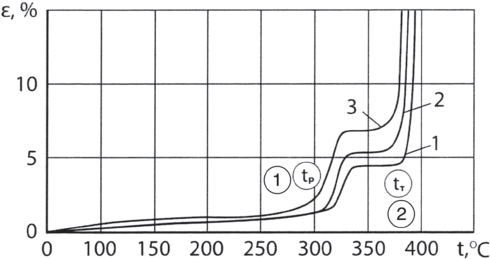
Thermomechanical curves of PCMs of PTFE + 30% PA after ET at different pressures: 1 – 0.9 GPa; 2 – 2.8 GPa; 3 – 4.6 GPa. Vertical axis: ɛ, % Horizontal axis: t, °C Key to fg.: 1. ts; 2. tfl
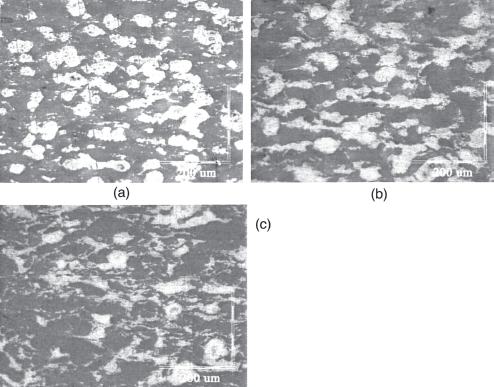
The microstructures of PCMs of 70% PTFE + 30% PA after ET at different pressures: (a) 0.9 GPa; (b) 2.8 GPa; (c) 4.6 GPa; dark areas – PTFE; light areas – PA
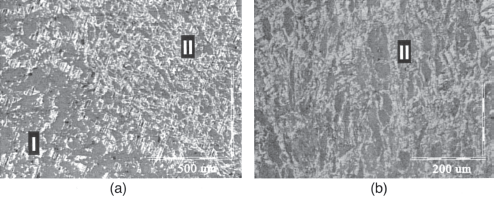
The microstructures of PCMs of PTFE + 30% PA over the radius (a) and along the axis (b) of the ampoule: I – periphery; II – central zone; dark areas – PTFE; light areas – PA
Investigation of the microstructure of pressings produced in an ampoule (
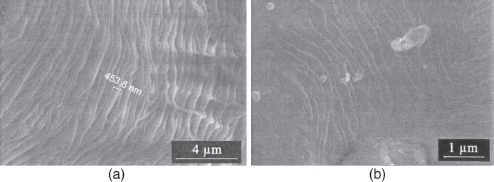
Electron scanning micrographs of PCMs of PTFE + 30% PA: (a) PTFE; (b) PA
The change in nature of the structure affects the properties of the materials. Thermomechanical analysis (TMA) showed (
The characteristic temperatures and deformations of PCMs of PTFE + 30% PA after ampoule ET

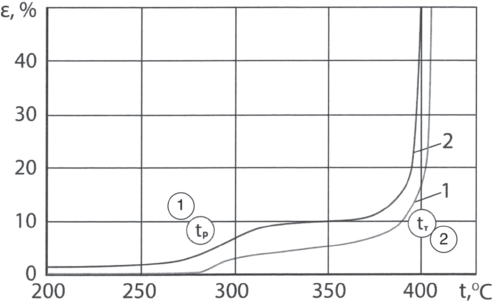
The thermomechanical curves of PCMS of PTFE + 30% PA after ampoule ET: 1 – peripheral zone; 2 – central zone. Vertical axis: ɛ, % Horizontal axis: t, °C Key to fg.: 1. ts; 2. tfl
Conclusions
The possibility of controlling the structural ordering, which affects the change in the thermomechanical properties of PCMs of PTFE with 30% PA, by changing the pressure in the wave front and the shock pulse configuration has been established.
Increase in the pressure of explosive treatment from 0.9 to 4.6 GPa in the case of the loading with a sliding shock wave of PCMs of PTFE with 30% PA led to structural transformations consisting of intensification of plastic deformation of the polymer particles right up to the crushing of the glassy PA under the action of the highest pressure, which caused a reduction in the softening points from 319 to 303 °C and in the temperature of viscous flow of the material from 384 to 376 °C, and an increase in thermal deformations to 6.8%.
The intense shock effect during ampoule explosive treatment of a powder mixture of PTFE with 30% PA with the formation of a metastable oriented structure in the central zone of the pressing made it possible to achieve higher thermomechanical characteristics in the PCM, which is borne out by an 11% increase in the temperature of viscous flow of the material in relation to the periphery and a 22–30 °C increase in the temperature of viscous flow in relation to material pressed with a sliding SW.
Footnotes
Acknowledgements
This study was supported financially by a grant from the Russian Research Fund (No. 14-29-00158).