



Abstract
A method is proposed for assessing the effectiveness of modifying polyvinyl chloride in order to reduce the rate of plasticiser extraction. The reduction in the extraction rate depends on the modification conditions. The proposed approach establishes the influence of the modification regimes on the reduction in the extraction rate.
Plasticiser desorption from polyvinyl chloride (PVC) leads to a change in the properties of the material, to an adverse effect on human health, and to pollution of the environment. To reduce the desorption, different methods are used to modify the PVC, and hence there is an urgent need to develop methods for assessing their effectiveness, and also to justify the modification method, depending on the service conditions of the polymer.
Purposeful selection of the PVC modification method requires determination of the desorption mechanism, which is connected with the rapid transfer of plasticiser from the bulk to the surface of the PVC (diffusion of the plasticiser in the PVC) and with removal of the precipitating plasticiser from the surface by different methods, depending on the phase state of the surrounding medium. The desorption kinetics is limited by the rate of the stage with minimum plasticiser transfer.
It is of practical importance to determine the mechanism of evaporation of the plasticiser, which is due to the similar flows of its transfer from the bulk to the surface of the PVC and from the surface [1–3]. During migration (contact of PVC with a solid capable of absorbing the precipitated plasticiser) and extraction, the rate of removal from the surface generally exceeds the rate of diffusion of the plasticiser in the PVC.
Determination of the mechanism of desorption involves establishing the types of kinetic dependence of the process in different systems of time coordinates. During evaporation, linear dependences in the coordinate system Mτ/M0–τ (where Mτ is the amount of plasticiser that is desorbed within time τ, and M0 is the initial amount of plasticiser in the PVC) reflect the dependence of the process kinetics on the volatility of the plasticiser from the surface [4]. With the desorption kinetics dependent on the diffusion rate of plasticiser in the PVC, the kinetic dependences in the Mτ/M0–τ0.5 coordinate system consist of two linear segments [5–8]. In this case, the slope tangent of the linear segments of the kinetic dependences reflects in the given time coordinate system the rate of the different stages of desorption. During migration, a linear form of the kinetic dependences in the Mτ/M0–τ0.5 coordinate system can reflect the dependence of the process kinetics not only on the diffusion rate of the plasticiser in the PVC but also on the rate of its diffusion in the solid in contact.
With the desorption kinetics dependent on the diffusion rate of the plasticiser in the PVC, and with retention in the process of desorption of the PVC–medium interface, the transition to the second stage of desorption involves a reduction in the rate of the process [5–8]. Reduction in the rate of the second stage of desorption is due to glass transition of the PVC after the reduction in the plasticiser content. The amount of plasticiser that needs to be desorbed in order for glass transition of the PVC to occur and the desorption rate to be reduced is determined by a known method [9]. It is more difficult to calculate the parameters of transition to the second stage of extraction, which proceeds under conditions of counterflow of the extractant into the polymer. Transition to the second stage of extraction under such conditions may be the consequence of plasticiser-extractant interaction in the swollen layer of PVC.
In the case of evaporation, the methods for reducing the diffusion rate of the plasticiser in the PVC differ from the methods for reducing the volatility of the plasticiser. During migration, reduction in the desorption kinetics is achieved by reducing the diffusion rate of the plasticiser in the PVC or in the solid in contact with the polymer. During extraction, reduction in the process kinetics is generally achieved by reducing the diffusion rate of the plasticiser in the PVC. It is of practical importance to justify the use of experimental data obtained in accelerated tests or by using model media to predict the desorption kinetics under possible service conditions of PVC.
The initial segment of the kinetic dependences in the Mτ/M0–τ0.5 coordinate system, reflecting the rate of the first stage of desorption, is described by equations of the general form

The aim of the present work is to investigate the use of the parameters k and Mc/M0 to assess the reduction in the rate of plasticiser desorption with a limiting diffusion stage from modified PVC.
The proposed approach was used to process the experimental results of a previous study by Lakshmi and Jayakrishnam [10] that involved an investigation of the extraction rate of dioctyl phthalate (DOP) from unmodified and modified PVC tubes of medical designation (Solmed, Denmark). In the cited study, the authors investigated the dependence of the kinetics of extraction of DOP with kerosine at 30 °C on the method and conditions of surface modification of PVC with diethyl carbonate (DEC) sodium salt in the presence of different catalysts (chemical modification) or with subsequent irradiation of the treated surface of the PVC by an infrared lamp of 125 W power (chemicophysical modification). A marked reduction in the extraction kinetics was achieved by using tetrabutylammonium hydroxide (TBAH). Reduction in the kinetics of extraction of DOP was attributed to the formation of a surface layer on the wall of the tubes.
The experimental conditions ensured the rapid removal of precipitated DOP from the surface of the PVC [10] and the retention in the process of extraction of the PVC-extractant boundary, which determines the dependence of the kinetics of the process on the diffusion rate of DOP in the PVC or in the modified surface layer. The limiting diffusion stage of extraction of DOP is confirmed by linear dependences in the Mτ/M0–τ0.5 coordinate system (
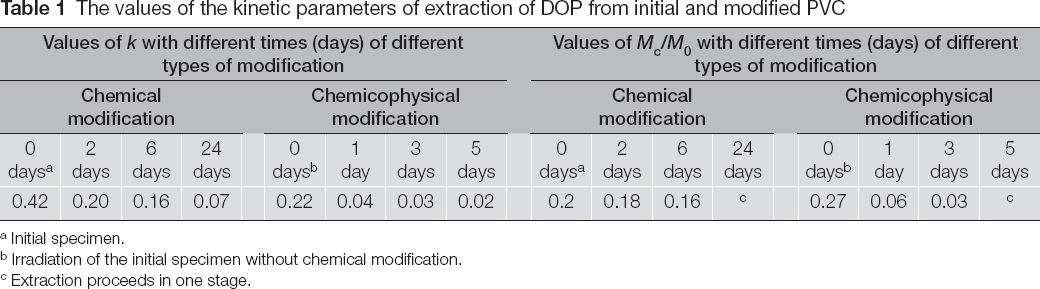
The values of the kinetic parameters of extraction of DOP from initial and modified PVC
Initial specimen.
Irradiation of the initial specimen without chemical modification.
Extraction proceeds in one stage.
When untreated PVC is used under experimental conditions, transition to the second stage of extraction is achieved within 0.18 days or within 4.2 h. Within the first stage, up to 20% of the initial content of DOP is extracted. The effectiveness of chemical modification depends on the time of the chemical reaction. With a relatively short reaction time there is an increase in the time of transition to the second stage of extraction, roughly to 0.7 days or to 16 h. Here, the amount of DOP extracted within the first stage of the process is retained. The maximum time of the chemical reaction leads to extraction proceeding in one stage, with a significant reduction in its rate (
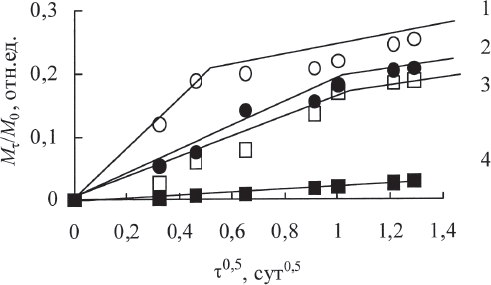
The kinetic dependences of the extraction of DOP from initial PVC (1) and from PVC treated at DEC = 0.2 mol/L and TBAH = 0.03 mol/L with reaction times of 2 h (2), 6 h (3), and 24 h (4) without irradiation. Vertical axis: Mc/M0, relative units; Horizontal axis: τ0.5, days0.5
By comparison with the extraction of DOP from the initial PVC, its irradiation without carrying out chemical modification increases the time of the first stage of extraction to 2 days. Here there is an increase in the amount of DOP extracted at the first stage of the process, which reaches 30% of its initial content. Chemicophysical modification lowers the rate of the first stage of extraction, and the time of the first stage of extraction approaches the time of the first stage of extraction from the irradiated initial PVC (
Chemicophysical modification changes the mechanism of extraction. After the extraction of a small portion of the DOP there is an increase in the rate of the process, which depends on the irradiation time (
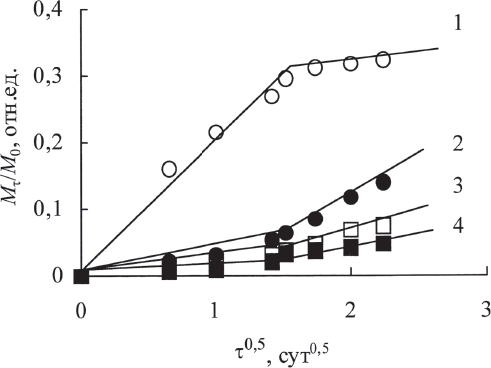
The kinetic dependences of extraction of DOP from PVC at DEC = 0.2 mol/L and TBAH = 0.03 mol/L with an irradiation time of 24 h without chemical modification (1) and with times of irradiation after chemical modification of 1 h (2), 3 h (3), and 5 h (4). Vertical axis: Mc/M0, relative units; Horizontal axis: τ0.5, days0.5
According to Lakshmi and Jayakrishnam [10], in the case of chemicophysical modification, during surface irradiation of PVC the crosslinking of macromolecules occurs. It can be assumed that a consequence of the crosslinking of macromolecules is an increase in the internal stresses and a reduction in the mobility of segments of the macromolecules. Reduction in the mobility of segments of the macromolecules leads to a reduction in DOP diffusion in the modified surface layer and to a reduction in the extraction rate. The relaxation of internal stresses is reflected by the appearance of defects at the micro and macro levels of the modified layer, which leads to an increase in the transfer of the plasticiser within it.
With a short irradiation time, the mobility of segments of macromolecules is retained, and consequently internal stress relaxation occurs, the rate of which increases as the DOP diffuses into the modified surface layer. Rearrangement of the structure of the surface layer is manifested by an increase in the extraction rate. With increase in the irradiation time, the low mobility of segments of the macromolecules reduces the transfer of DOP into the modified layer and limits internal stress relaxation, which is reflected by a lower diffusion rate of DOP in the surface layer, and accordingly by a lower extraction rate (
Conclusions
The proposed method for assessing the effectiveness of modification of PVC determines the quantitative parameters of reduction in the extraction rate of plasticisers.
UV irradiation of the surface lowers the effectiveness of reduction in the rate of desorption of the plasticisers.
There are limitations in assessing the effect of modification of PVC on reduction in the diffusion rate of the plasticisers from the results of accelerated tests of the first stage of desorption.