



Abstract
The synthesis of nitrogen-containing alkyl(C8–C12)phenol formaldehyde oligomers grafted with vegetable oils was investigated with the aim of creating new materials with the properties of protective coatings. Soybean and linseed oils were used as the vegetable oils. The interaction between phenol formaldehyde oligomers and vegetable oils probably occurs through the functional groups formed as a result of oxidative processes at the carbon atoms in the a-position to double bonds. The probable structure was established using infrared and nuclear magnetic resonance spectroscopy, and the physicochemical properties of the synthesised products were studied.
Keywords
Effective film-forming materials are obtained by oxidising vegetable oils, and also by their application in mixtures with different resins. Vegetable oils mainly consist of glycerol esters with unsaturated carboxylic acids, and the double bonds play an active role in oxidative processes, alongside which occur the isomerisation of double bonds, the oligomerisation of triglycerides, and the formation of new functional groups that play a positive role in processes of interaction with resins and curing. The polycondensation products of phenol and its derivatives with formaldehyde are resins of this kind.
Among the phenolic resins grafted with vegetable oils, boron-containing water-soluble film-forming materials are known [1], as well as petrol-resistant lacquers and enamels based on phenol formaldehyde oligomers (PFOs) modified with linseed oil, rosin, and also tall oil [2]. Chinese scientists have synthesised linseed-oil-modified PFOs that are noted for heat resistance [3–5]. Compounds of this type are also of interest as high-quality lubricants.
The present paper considers the process of partial replacement of known nitrogen-containing alkyl(C8–C12) PFO with vegetable oil in order to lower the manufacturing cost and achieve high physicomechanical properties of film-forming materials based on them.
Experimental
The interaction between PFOs and vegetable oil probably occurs through the functional groups formed as a result of oxidative processes at the carbon atoms in the α-position to double bonds, alongside the carbon atoms forming the double bonds, and the methylol groups of the oligomer macromolecules, in connection with which the high content of double bonds is a positive factor and preference is given to more unsaturated oils. Soybean and linseed oils are therefore used.
The composition and certain physicochemical properties of the vegetable oils used
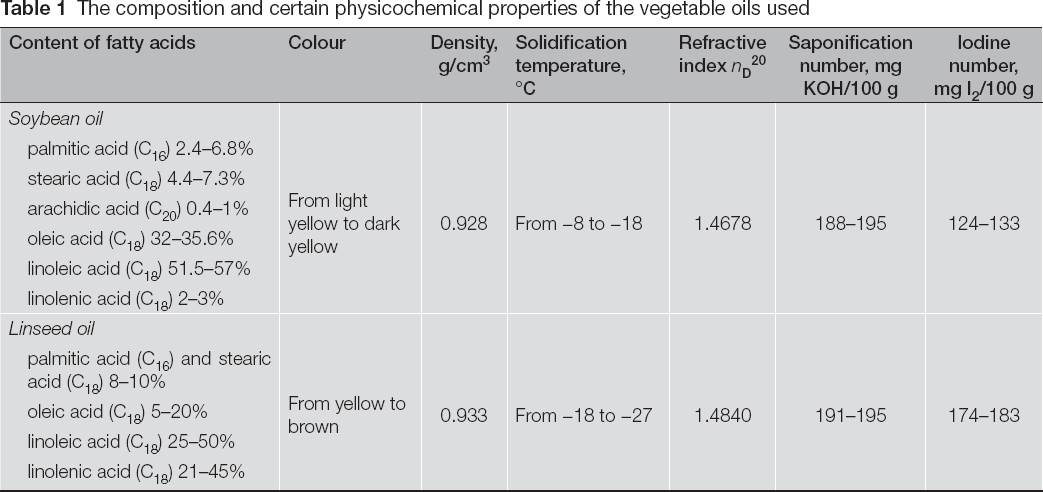
As can be seen from
At the first stage, monoalkyl(C8–C12) PFOs of the novolac type were synthesised by a known method with a molar ratio of alkylphenols and formaldehyde of 1:0.85 at a temperature of 98–100°C in an acid medium (pH = 3) for 3–4 h. Benzoguanamine, benzamide, and carbamide were used as modifiers, in a quantity of 0.1–0.3 mol per 1 mol phenolic compound.
At the second stage of the process, the reaction of the synthesised oligomer and the vegetable oils was carried out, with mass ratios of 1:3, 1:1, and 3:1 respectively. To avoid premature thickening, one-half of the oligomer was dissolved in oil for 1 h, with a slow increase in temperature to 190°C, and then the remaining mass of the oligomer was added and the reaction was continued for 3–4 h at a temperature of 230–250°C. The processes were conducted by passing air through the reaction system, and also in a nitrogen atmosphere, to study the influence of molecular oxygen. At the initial stage of the investigation it was established that the presence of molecular oxygen in the system is necessary for the components to interact, and that the use of modifiers with nitrogen-containing functional groups has a positive effect.
The material balance of the first and second stages of the process is given in
The material balance of the synthesis of nitrogen-containing monoalkyl(C8–C12) PFOs grafted with vegetable oils
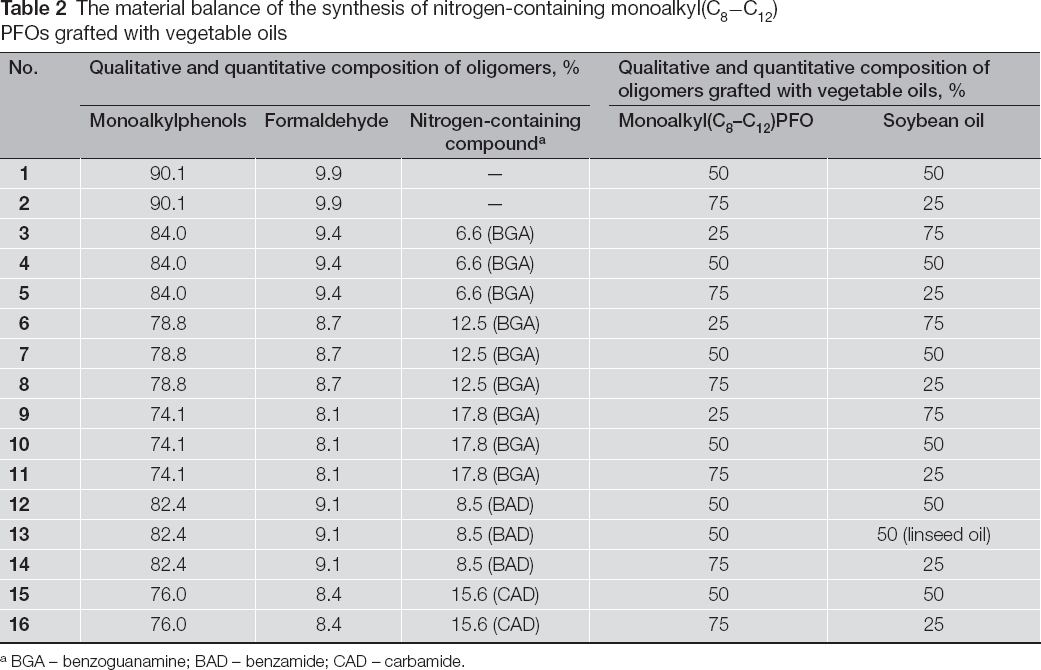
BGA – benzoguanamine; BAD – benzamide; CAD – carbamide.
It is known that natural triglycerides (glycerol esters based on saturated and unsaturated monoatomic higher fatty acids) amount to ~95–98% of vegetable oils, the remaining 2–5% consisting of free fatty acids (~1–2%), phosphatides – lecithin, cephalin, and inosine phosphatides (~0.5–3%), sterol and phytophosphines (~0.3–0.5%), and pigments and vitamen E (~0.5%). However, in view of the fact that a small quantity of impurities does not significantly affect the application properties of the end products as protective coatings, raw vegetable oil without impurities removed is used. In selecting the oils, preference was given to vegetable oils with more unsaturated fatty acid fragments. However, there was no significant difference in this regard between the selected oils, and therefore, for practical work, soybean oil was mainly used, on the basis of the fact that the high content of linolenic acid residues in linseed oil may lead to yellowing of the coatings based on them with the passage of time.
The physicochemical properties of monoalkyl(C8–C12) PFOs modified with benzoguanamine and grafted with soybean oil are given in
As can be seen from
The physicochemical properties of nitrogen-containing monoalkyl(C8–C12) PFOs grafted with soybean oil

The numbers correspond to those in Table 2.
With increase in the amount of nitrogen-containing modifier from 0.1 to 0.3 mol (by way of example, 3 → 6 → 9, 4 → 7 → 10, 5 → 8 → 11), with a certain mass ratio of oligomer to vegetable oil, the viscous properties increase.
The proposed structure of nitrogen-containing monoalkyl(C8–C12)PFOs grafted with soybean oil was investigated on a Fourier NMR spectrometer (Bruker, Germany) at a frequency of 300 MHz. The chemical shifts of the groups of atoms belonging to soybean oil and the initial oligomer were found in spectra of the end product (

NMR spectra of nitrogen-containing monoalkyl(C8–C12) PFOs grafted with soybean oil. Horizontal axis: ppm
The signals at 0.864 ppm relate to the H atoms of methyl CH3 groups, and the signals at 1.256 and 1.517 ppm relate to H atoms of methylene –CH2–groups. Chemical shifts relate to H atoms of methylene groups in the vicinity of carbon atoms forming double bonds (–C (4.248 ppm), and to –CH=CH– fragments (5.450 ppm). Chemical shifts observed at 6.809–7.21 ppm relate to the H atoms of R–OH and Ar–H fragments.
The proposed structure of nitrogen-containing monoalkyl(C8–C12) PFOs grafted with soybean oil was studied on an IR Fourier spectrometer (Bruker, Germany). In order to study the mechanism of the process, a spectral kinetic investigation was carried out. IR spectra were taken both of the initial components (the nitrogen-containing monoalkyl(C8–C12) PFO and the soybean oil) and of the reaction mixture at the second stage of the process at an interval of ~0.5 h, and comparisons were made. In the spectra of the initial oligomer, the following absorption bands are observed: at 750 cm–1, relating to the methylene groups; at 1370 cm–1 (deformation vibrations) and 2872 cm–1 (stretching vibrations), relating to the –C–H bond of the methyl groups; at 1456 cm–1 (deformation vibrations) and 2957 cm–1 (stretching vibrations), relating to the –C–H bond of the methylene groups; at 1508 cm–1 (deformation vibrations) and 3027 and 3060 cm–1 (stretching vibrations), relating to the C-H bond of the benzene rings; at 1602 cm–1 (stretching vibrations), relating to the C=C bond of the benzene rings; at 783, 823, and 878 cm–1 (deformation vibrations), relating to the C–H bond of the alkyl substituents of the benzene ring; at 1235 cm–1 (deformation vibrations) and 3307 cm–1 (stretching vibrations), relating to the O–H bond, and at 1012 cm–1 (deformation vibrations), relating to the O–H bond of the alcoholic groups; at 953 and 1543 cm–1 (deformation vibrations), relating to the NH bonds. Besides the absorption bands in the IR spectra of the reaction mixture of nitrogen-containing monoalkyl(C8–C12) PFOs and soybean oil (at the start of the process), stretching vibrations of the C=O bond of ester fragments at 1743 cm–1 were found, and also absorption bands of the C=C bonds characteristic of alkene fragments of esters with an intensity of 1651 and 3008 cm–1 in spectra of the end product.
By investigating the change in optical density of different functional groups in the reaction mixture with the passage of time, and by comparing this with analogous functional groups both of soybean oil – D1743 cm–1 (C=O), D1720 cm–1 (C=O), D1743 cm–1 (C=C), D3008 cm–1 (C=C) – and of the initial oligomer – D1235 cm–1 (OH of phenol), D1543 cm–1 (N–H), D1012 cm–1 (CH2OH) – it was established that:
The optical densities corresponding to the double bonds in the soybean oil are almost unchanged over the course of the process, and this confirms that the double bonds are not consumed.
The carbonyl groups in the composition of the ester fragments do not take part in the reaction, but new carbonyl groups are formed at 1720 cm–1, similar in intensity to the existing carbonyl groups, and this indicates that during high-temperature oxidation of the triglycerides in the soybean oil, new carbonyl groups are formed. The optical density of these groups was formed in the course of the first two hours and remains constant almost to the end of the process.
The optical densities of the phenolic O–H groups and N–H groups also do not change with the passage of time.
The observed reduction, by a factor of ~4, in the indices of optical density of the methylol groups (1012 cm–1) indicates the consumption of these groups in the process.
Taking the above into account, it is assumed that the reaction at the second stage proceeds roughly in the first two hours, and there is no need for further expenditure of time or energy. An analysis of the results shows that, at the second stage, interaction occurs between the methylol groups of the oligomer macromolecules and the new functional groups (OH, OOH, and so on) of triglyceride fragments of the soybean oil that are formed as a result of oxidative processes. Thus, the mechanism of the first and second stages of the process can be presented in the following way:
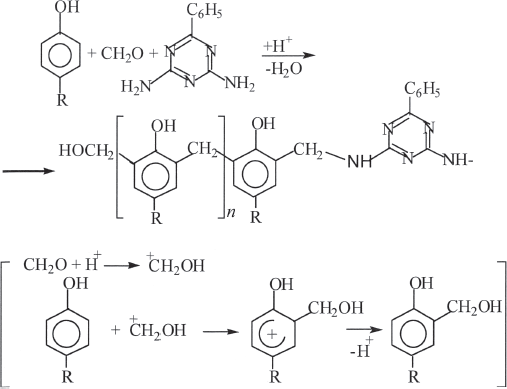

The hydroperoxides are unstable and therefore undergo homolysis by the –O–O– bond when heated, which serves as a source of chain growth.
The latter radicals may be subject to the following changes:
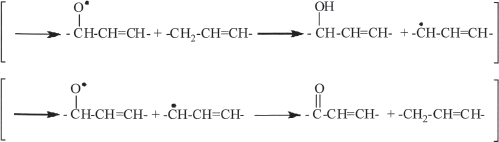
These reactions [7] form part of the processes occurring during the oxidation of the triglycerides, and they confirm the formation of new functional groups in the soybean oil at high temperature (carbonyl and hydroxyl groups), which then react with methylol groups of the oligomer.
The proposed structure of the graft oligomer can be presented in the following way:

Note that the molecular weight indices of the end products [8] make it possible to assume that degradative processes have taken place. Thus, the formation of a fraction with a low average molecular weight and also the small increase in the average molecular weight of the high fractions confirm this assumption.
The synthesised products are recommended as film-forming materials [9].