



Abstract
The concentration dependences of the adhesive strength, τ, of joints of 150 μm diameter steel wire and modified epoxy binder were investigated. The modifier used was PSK-1 polysulphone of different molecular weight, M. The concentration, C, of PSK-1 was varied from 5 to 20 wt%. It was shown that the form of the τ-C curves changes with change in M. At M = 5000 and 10 000, τ is not dependent on C; at M = 17 000 and 27 000, the τ-C relationship is described by a curve with a maximum. At M = 35 000 and 42 000, the adhesive strength decreases with increase in C. The factors affecting the measured value of τ in the case of epoxides modified with heat-resistant thermoplastics are considered.
Keywords
The modification of epoxy oligomers with heat-resistant, rigid-chain thermoplastics – polysulphones, polyethersulphones, polyetherimides, polyarylene ether ketones – is now widely used. This makes it possible to avoid any reduction in the glass transition temperature of the epoxides, which generally results from the addition of active diluents and rubbers.
Among the industrially produced thermoplastics, polysulphone (PSP) has been widely used. Blends of PSP with epoxy resins have largely been investigated [1–7].
Heat-resistant thermoplastics as-supplied are solid substances. They exist in the form of powder of different degrees of comminution, fibres, granules, and films. In this state, their adhesion to solids (and to fibres in particular) without the application of external pressure is practically zero, and hence there is a risk that the introduction of a component with zero adhesion into the epoxide will lead to a deterioration in the adhesion capacity of the entire composite. Questions associated with the adhesion of thermoplastic-modified epoxides are extremely important, as these binders are widely used as matrices of fibre composites and as adhesives for adhesive joints.
Information about how the molecular weight of polysulphone affects the physicomechanical (including adhesion) and processing properties of epoxy composites is virtually non-existent.
The aim of the present work was to study the effect of polysulphones of different molecular weight on the strength of bonding of polysulphone-modified epoxy oligomers with fibres.
Experimental
The investigation was conducted on epoxy/polysulphone composites based on epoxy bisphenol A resin ED-20 (GOST 10587–84) modified with different amounts of polysulphone PSK-1 with molecular weights of 5000, 10 000, 17 000, 27 000, 35 000, and 42 000. The polysulphone concentration in the binder amounted to 5, 10, 15, and 20 wt% of the ED-20 and was not dependent on the molecular weight of PSK-1.
The curing agent was triethanolaminotitanate (TEAT); the substrate of the investigated adhesive joints was steel wire of 150 μm diameter.
The mixing of ED-20 and PSK-1 was carried out using a mechanical stirrer for 5–6 h at a temperature of 100°C until the polysulphone was entirely dissolved in the epoxy oligomer (without using solvents).
To assess the adhesion capacity of the investigated composites, their shear adhesive strength, τ, was measured in joints with steel wire. Measurements were conducted by the pull-out method.
Specimens were prepared in aluminium dishes (depth 3 mm, diameter 8 mm, thickness of aluminium foil 0.03 mm). A special punch and die were used for stamping of the dishes. A segment of steel wire (4–6 cm in length) was placed in the centre of the dishes, and then the investigated blend was poured over it. The moulds with the poured specimens were placed in an oven and held there for 8 h at 160°C. The procedure for preparing the specimens, the carrying out of measurements, and the processing of the results were described earlier [8–10].
Results and Discussion
The dependences of the adhesive strength, τ, on the area of contact, S, for joints of unmodified oligomer ED-20 and of its blends with different concentrations of PSK-1 with steel wire are presented in

The dependence of the adhesive strength on the area of contact of the polymer with fibre for ‘ED-20 + PSK-1–steel wire’ joints with different polysulphone concentrations: • 0%, ○ 5%, △ 10%, ▲ 20%; (a) molecular weight 5000; (b) molecular weight 10 000; (c) molecular weight 17 000; (d) molecular weight 35 000; (e) molecular weight 42 000. Vertical axes: τ, MPa; Horizontal axes: S, mm2
It can be seen that for ‘pure’ epoxy resin and for resin modified with polysulphone of different molecular weight, the adhesive strength, τ, decreases with increase in the area of contact, S, between the binder and the steel wire. The given τ–S dependences are typical. They are observed for ‘polymer–fibre’ joints with adhesives and substrates of most diverse nature [8–11]. The fall in τ with increase in S is associated with the non-uniform distribution of tangential stresses at the interface and is due to:
the non-uniform distribution of the shear (tangential) stresses arising at the ‘fibre-resin’ boundary when an external load is applied;
the residual temperature stresses arising at the interface during formation of the joint and its subsequent cooling to the test temperature.
This last factor is considered to be the principal cause.
From the dependences of adhesive strength τ on contact area S (the cross-section of the τ–S curves at S = const), the concentration dependences of the shear adhesive strength of joints of fibre and epoxy resin + PSK-1 of different molecular weight were obtained (
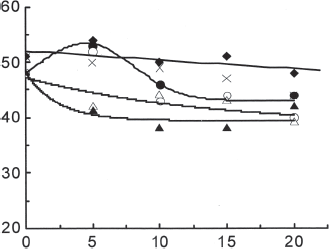
The concentration dependences of the shear adhesive strength of ‘fibre-epoxy resin ED-20 + PSK-1 of different molecular weight’ joints. Area of adhesive joints S = 0.65 mm2. Molecular weight: ♦ 5000; × 10 000; • 17 000; ○ 27 000; △ 35 000; ▲ 42 000. Vertical axis: τ, MPa; Horizontal axis: CPSK-1, wt%
From
The use of polysulphones with molecular weights of 17 000 and 27 000 as modifiers of ED-20 resin will lead to the creation of binders with similar adhesion capacity: the strength of bonding with fibres when 5% of these polysulphones is introduced increases slightly (by 10%) and then decreases a little, retaining, with 10–20% PSK-1, values that are similar to the initial values characteristic of joints with resin without a modifier. Modification with polysulphones with a molecular weight of 35 000 and 42 000 causes a more appreciable fall in strength of the interface. Primarily this relates to the modifier with a molecular weight of 42 000. However, even when 20% of this PSK-1 is introduced into the resin, it ensures the production of joints whose strength is only 18% lower than the strength of joints with unmodified resin. When PSK-1 with a molecular weight of 35 000 is used, the fall in interface strength does not exceed 10%. Thus, the data given in
As noted above, the adhesive strength, τ, in polysulphone–fibre joints is much lower than in ED-20–fibre joints, and therefore a marked reduction in τ in joints of epoxy/polysulphone binders with fibres might be expected. However, the adhesive strength decreases little (
the nature of the bonds acting through the interface;
their number;
the defectiveness of the interface;
the residual stresses acting at the phase boundary;
the structure (phase state) of the near-surface interphase layers.
Analysis of earlier data [11–16] makes it possible to assert that each type of modifier changes the given principal factors in a specific way peculiar to it; however, because of the variety of polymer systems, any one of them requires individual examination.
Let us consider how these factors may vary in the case under examination – when polysulphone is introduced into ED-20 epoxy resin, what form the concentration dependences of the adhesive strength of epoxy/polysulphone binders with fibres may take in this case.
It is obvious that the introduction of polysulphone cannot increase either the energies acting through the boundary of the bonds or the number of bonds, i.e. change in these two factors either will lead to a fall in adhesive strength or will leave it unchanged. Nor can the introduction of polysulphone improve the state of the interface: when it is added, the viscosity of ED-20 + PSK-1 composites increases all the more sharply the greater the concentration of modifier introduced. With increase in viscosity, the spreading and wettability deteriorate, and the probability of the formation of different defects that subsequently (under load) will become sources of stress concentration (sources of crack growth) increases. Thus, change in this factor as a result of modification should likewise lead to a fall in τ values.
In a number of papers [17,18] it has been shown that the residual stresses existing at the ‘fibre–polymer’ boundary before the application of an external load and arising because of the difference in the thermal and mechanical characteristics of the components of the adhesive joint (primarily, because of differences in the coefficients of linear thermal expansion and in the elastic moduli) can be lowered by adding a heat-resistant thermoplastic to the epoxy oligomer. Lowering of these residual stresses will lead to an increase in the measured value of adhesive strength. However, any significant reduction can be expected only at the maximum (roughly 20%) concentration of the introduced modifier, i.e. when the values of τ become minimal. Thus, an increase in adhesive strength (its synergism) or a relatively small fall may be associated only with the last factor (the structure and phase state of the near-surface layers), which largely determines the process of failure of adhesive joints.
The phase state of epoxy/polysulphone blends was studied in detail in studies by Chalykh et al. (see, for example, [19,20]). It was shown that the phase structure of cured polymers depends on the composition of the initial blends and changes as PSK-1 is added. Blends that are entirely compatible in a wide temperature range before curing separate into layers during cooling.
When a small quantity of polysulphone (5%) is introduced into the resin, a structure of the ‘matrix–inclusion’ type is formed, in which individual ‘islands’ of modifier are dispersed in the ED-20 resin; when polysulphone is added in a quantity of 10 and 15%, structures with ‘coextended’ phases are formed.
Here, the structure of cured epoxy/polysulphone matrices in layers adjoining the fibre is similar to the bulk structure but is resin enriched.
Thus, during curing, not only are adhesive bonds established but the investigated blends separate into layers – phase separation, appearing particularly distinctly at large (20%) modifier concentrations. Modification changes the structure and properties of the near-surface layers (bordering the fibres) of the matrix. Accordingly, there is a change in the conditions under which cracks responsible for the failure of joints nucleate, form, and propagate. For example, in the presence of particles of disperse phase and/or coextended structures, the path and nature of movement of a crack may vary. Accordingly, there is an increase in the energy needed for failure, which as a result increases the strength of the interface. It is quite likely that, owing to the action of this mechanism, the fall in strength during the modification of epoxides even with high-molecular-weight polysulphones is small.
Thus, the fall in adhesive strength, τ, when epoxy resin is modified with heat-resistant thermoplastic is associated with increase in the concentration of phase enriched with the component with lower adhesion capacity; retention of or increase in adhesive strength is associated with change in the nature of crack growth and propagation in the near-surface layers.
The proposed five-factor analysis can be regarded only as a first approximation, by means of which it is possible in general outline to explain the concentration dependence of adhesive strength during modification. However, it does not provide answers to more particular questions (for example, why the form of the concentration curves changes with the molecular weight of the polysulphone). This requires further complex investigations in which, besides adhesive strength, the structure and properties of modified epoxides in the liquid and solid state will be studied.