



Abstract
The most important challenge in automotive industries is to reduce global warming CO2 generation substantially to Zero. Electrification is the main trend to achieve this objective, such as EV, FCV and PHEV. Polymer materials are expected to contribute to this aspect as functional materials e.g. high thermal conductive electrical insulator. Vehicle weight reduction is the big factor to reduce vehicle running energy consumption. Module construction and component integration are quite effective for this purpose. CFRP is expected to contribute weight reduction for the future automotive application. Rubber components are also required weight reduction and demands for low running resistance tire is increasing. New application of polymer materials will be widely expected for the next generation automotive.
Introduction
In 2016 over 5 million (5,080,000) vehicles were sold, which suggests that we have recovered from the temporary stagnation that was triggered by the rise in consumption tax and the rise in light vehicle tax, etc. Sales of hybrid cars and light vehicles have increased markedly in recent years, and now these types of vehicles occupy all of the top 10 best-seller positions. Hybrid car sales have been boosted by the introduction of the Note e-Power, which is the first ever series hybrid car and is unlike the series parallel hybrids typified by Prius. There has also been much talk of driverless (autonomous) cars, and companies that have not previously manufactured cars, such as Google and other IT companies, have recently entered the race to make driverless cars a reality. In Japan, driverless cars are becoming necessary as a response to the rapid aging of the population, and although issues remain with full automation, the use of driverless cars is highly cost-effective and is therefore expected to increase.
The demand for safe cars and the needs of the environment are causing major transformation of the automotive industry, away from the time when automotive technology was centred on our love for driving petrol-burning cars. In this new era, how are the polymeric materials used in automobiles going to change?
Efforts to Prevent Global Warming
The biggest challenges facing the automotive industry today are its response to global environmental problems and the prevention of global warming. Conventional automobiles run on energy generated by burning fossil fuels such as petrol and light oil. Consequently, up to 20% of the exhaust gas is CO2. Every effort must be made to minimise this emission volume.
Target for 2050
At the G8 Hokkaido Toyako Summit it was decided that we must halve CO2 emissions worldwide by 2050, and it was said that the developed countries bear greatest responsibility and must therefore decrease emissions by 80%. With regard to how Japan will respond to this target, the respective positions of the Ministry of the Environment and the Ministry of Economy, Trade and Industry differ and are not reconciled. How is CO2 emission reduction progressing in Japan, as a developed country? It has been suggested that decreasing CO2 emissions will adversely affect the economy.
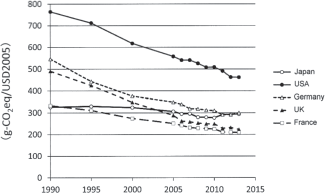
Trends in greenhouse gas emissions per GDP in developed countries
Whatever the case, the world has started to work toward this target, and strict targets will also have to be set for automobiles. Toyota, Nissan and the like are announcing that a 90% decrease will be necessary.

CO2 emissions by passenger vehicle weight
Common issues in the move towards electrification
Next generation automobiles refers to hybrid electric vehicles (HEVs), plug-in hybrid vehicles (PHEVs), electric vehicles (EVs) and fuel cell vehicles (FCVs) (the usual definition of next generation automobiles also includes clean diesel vehicles, but these are not included in this discussion). As all of the abovementioned vehicles are either partly or wholly driven by electricity-powered motors, “next generation automobiles” means electrification. There are three important components that are common to all of these vehicles: secondary batteries for storing electricity, high-performance motors for driving and for generating electricity, and inverters for controlling the electricity. These components are not present in the internal combustion engines used to date. A characteristic problematic feature of electric vehicles is that their driving range is short because they cannot store very much energy, and so they need to be lighter than conventional petrol cars.
The polymer-related challenges associated with electrification are summarised in
Common technical challenges in electrification

Common technical challenges in electrification

Structure of the lithium-ion laminate battery
Polymeric materials are electrical insulators, but have poor thermal conductivity. Ceramics are electrical insulators and have high thermal conductivity, but unmodified ceramic material cannot be molded into the necessary shape. Development is underway of high thermal conductivity insulators comprising large amounts of ceramic powder of good thermal conductivity mixed into polymeric material of good moldability.
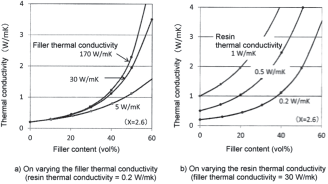
Increase in thermal conductivity when filler is packed into resin
Weight reduction using plastics
Plastics have not as yet made a major contribution to weight reduction.
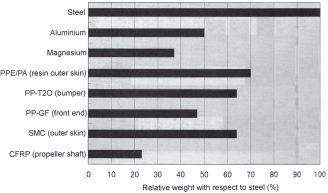
Comparison of weight reduction performance using isorigidity statistics (compared to steel)
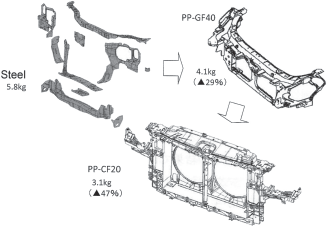
Changing the front end module (radiator core support) material
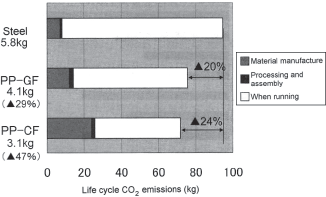
LCA results for PP radiator core support
A major aim is to decrease the weight by using resin as the base in module construction. The base part has many parts attached to it, and is therefore complex in shape, and plastics can be injection molded to make complex shapes in a single operation, which is advantageous.
Another example of the shift to resins is the introduction of CFRP propeller shafts, as shown in

Weight reduction by use of CFRP propeller shaft
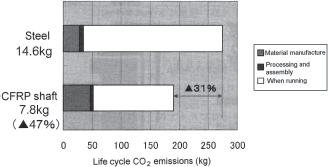
LCA results for CFRP propeller shaft
Recently, CFRP has been tested and adopted for use as car body material, due to the weight reduction it affords. Obviously, CFRP is an anisotropic material and so some design difficulties remain. The level of reinforcement also depends on whether the fibres will be subjected to tensile stress, compressive stress or shear stress. Cost-reduction, including process innovation, is being investigated, and although CFRP is still expensive and difficult to use in ordinary cars, it is expected to be a trump card in next generation weight reduction. Interestingly, BMW are using a CFRP car body in their electric car “i3”, and keeping CO2 emissions down by using hydroelectric power as the energy for CF production [7].
Although rubbers have low specific gravity, in most cases carbon black is incorporated, which increases the specific gravity. Thermoplastic elastomers tend not to contain much filler, and so they have low specific gravity. Glass runs are large rubber parts that used to necessitate the use of around 1 kg EPDM per vehicle. Now, however, most are made from TPOs, which affords a 1520% decrease in weight.
Furthermore, many thermoplastic elastomers are hard materials, and so in order to maintain flexibility, they are often used thinly. This also contributes to weight reduction. A disadvantage of the hardness is poor sealability, and so careful design is necessary. For example,
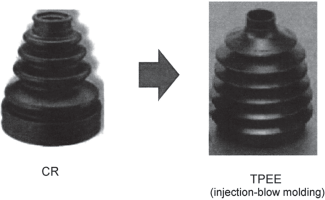
TPEE CVJ boot
Resin (thermoplastic elastomer) is also being used for hoses. Changing from conventional single-part fuel hoses made from FKM/ECO/polyester fibre/ECO to electroconductive ETFE/PA12 fuel hoses has resulted in a near 90% decrease in weight. A “quick connector” is used, and fluorine rubber and fluorosilicone are used together for the O-ring to ensure the seal. An example of a resin fuel hose is shown in
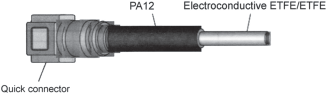
Example of a resin fuel hose
There are many cases where changing from rubber to TPE has led to weight reduction, but TPEs readily become permanently distorted at some temperatures, and so the use of TPEs for parts often requires careful design.
There are three aspects to the rationale for using resin for weight reduction as described above.
The moldability of the material affords freedom with regard to the shape. Rigidity can be maintained by using the necessary thickness or by creating a local rib structure. Changing from rubber to TPE means that the parts will have to be thinner in order to maintain flexibility, and this will bring the weight down.
Good moldability means that parts can be integrated. The main consequence of integration is that parts disappear, rather than decrease in weight. Even losing just one bolt will lower the weight. This technology includes integration and the use of TPEs for plastic bodies and seal parts.
Composites comprising highly rigid material have the specific characteristics of the respective elements. Also, the part will maintain its shape, and stress will not be borne uniformly. It is therefore possible to achieve effective weight reduction by considering how the load will be borne when multiple materials are used. CFRP can provide high rigidity, plus the high strength of CF.
Fuel-saving tyres
When a car is running, up to 15% of the energy losses are attributed to the tyres. Electrification will not allow us to dispense with tyres, and so the proportion of the energy losses attributed to the tyres will increase. Fuel-saving tyres will therefore become even more important. When the car is running, much of the energy lost from the tyres is released as heat, due to deformations in the tread. It would therefore be advantageous to use rubber of low tan δ, except that this tends to adversely affect the wet skid properties. The characteristic frequency when running is equivalent to several tens of Hz, whereas the characteristic frequency when braking is equivalent to around 10,000 Hz, due to unevenness in the road surface. Calculating this difference in frequency using the temperature/time rule reveals that fuel saving is good at around 50°C when tan δ is small, and the braking characteristic reveals that fuel saving is good at around 0°C when tan δ is large. Therefore a recent trend is to use liquid polymer SBR with a controlled microstructure as the rubber material, and to use silica instead of carbon black as the reinforcing material. The effects of changing to silica are shown in
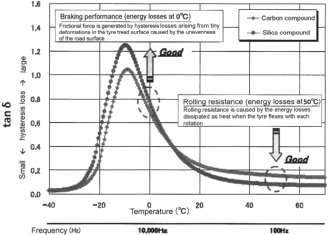
Relationship between tan δ, temperature and frequency (comparison between silica compound and carbon compound)
In the 1990s, destruction of the ozone layer prompted CFC-12 to be replaced by HFC-134a as the refrigerant in cars. However, although HFC-134a does not damage the ozone layer, it does have a global warming potential of around 1410 (the GWP of CO2 is 1), and so the development of a refrigerant with a lower global warming potential would be desirable. Using CO2 as refrigerant was considered, but in view of efficiency and the fact that this would increase the size of the system, it is currently thought that the next generation refrigerant will be HFO-1234yf. Refrigerant and oil that also acts as lubricant are mixed in the air-conditioning unit, and the development of a hose material that will last sufficiently long under these conditions is also progressing.
Conclusions
The trends in the use of polymers for next generation automobiles have been discussed above. The main target is that at least the developed countries must decrease greenhouse gas emissions by 80% or more by 2050. In order to achieve this, we will have to switch to electric cars that do not use petrol (although it may be possible to use biofuel for some vehicles). Whether the main power source is electricity or hydrogen, it will be secondary energy, and so wherever the energy comes from, however it is made, and by whatever route it is delivered into the car, we will have to shift to total energy efficiency. It is not simply a case of saying “it doesn't emit CO2 so it's okay”. Having experienced the Fukushima nuclear accident we will perhaps hesitate to depend on nuclear power, and ultimately we will have to rely on renewable energy. Of course, it may not be easy to become a technologically advanced society that has sufficient power. In order to achieve this we must think about how to use our precious energy as efficiently as possible.
These are tempestuous times. Immediately after the 2018 cars were launched, California's zero emission vehicle (ZEV) standards were greatly revised. Hybrid cars, which have hitherto been seen as advanced environmental technology, will perhaps come to be seen as ordinary vehicles. Therefore we can count only on EVs or FCVs for our response to these ZEV regulations. In other words, EV development is a matter of urgency.
Fuel-saving regulations are also getting stricter in Europe, where emissions are limited to no more than 95 gCO2/km. In response, the countries of Europe are investing in electric cars, hybrid cars, and plug-in hybrid cars. Energy sources may change, but we are nevertheless approaching an era in which we will have to use energy efficiently.
Under these circumstances, polymers will play an important role as structural materials and as functional materials. Surely, if we use our ingenuity, this period of transformation could constitute a great business opportunity.