



Abstract
An area of 306 sq m was excavated in the Main City South at Tell el-Amarna between 7 October and 2 November 2017. The work focused on the area of a building complex denominated M50.14, M50.15 and M50.16 by C. L. Woolley, who initially excavated these buildings in 1922 on behalf of the Egypt Exploration Society. After an initial season of re-excavation in 2014, the 2017 work encompassed the northern sections of house M50.16, the whole of house M50.15, as well as the eastern, south-eastern and south-western parts of courtyard M50.14. Several domestic and pyrotechnical features have been excavated and recorded, together with a large amount of material related to the processing and manufacture of glass, faience, stone (agate) and metal objects. The results of the excavation reflect the industrial character of several houses in Amarna’s Main City and provide a great insight into the layout and purpose of a domestic building in this settlement.

Introduction and background
An area of 306 sq m was excavated in the Main City South at Tell el-Amarna between 7 October and 2 November 2017. 1 The work focused on the area of a building complex denominated M50.14, M50.15 and M50.16 by C. L. Woolley, 2 who initially excavated and published these buildings in 1922 and 1923 respectively on behalf of the Egypt Exploration Society (EES) (fig. 1). 3 Therefore, the 2017 work encompassed both re-excavation and new excavation. Buildings M50.14–16 have also received attention by A. Shortland and P. T. Nicholson, who mentioned the site in their analyses of glass and faience workshops at Amarna. 4 A previous season of excavation had taken place in October and November 2014, uncovering an area of 217 sq m, 5 and the work carried out in 2017 completed the area occupied by buildings M50.14, .15 and .16 (fig. 2).

Map of Amarna, showing the location of site M50.14–16 in the Main City South (map: author, courtesy of the Amarna Project).
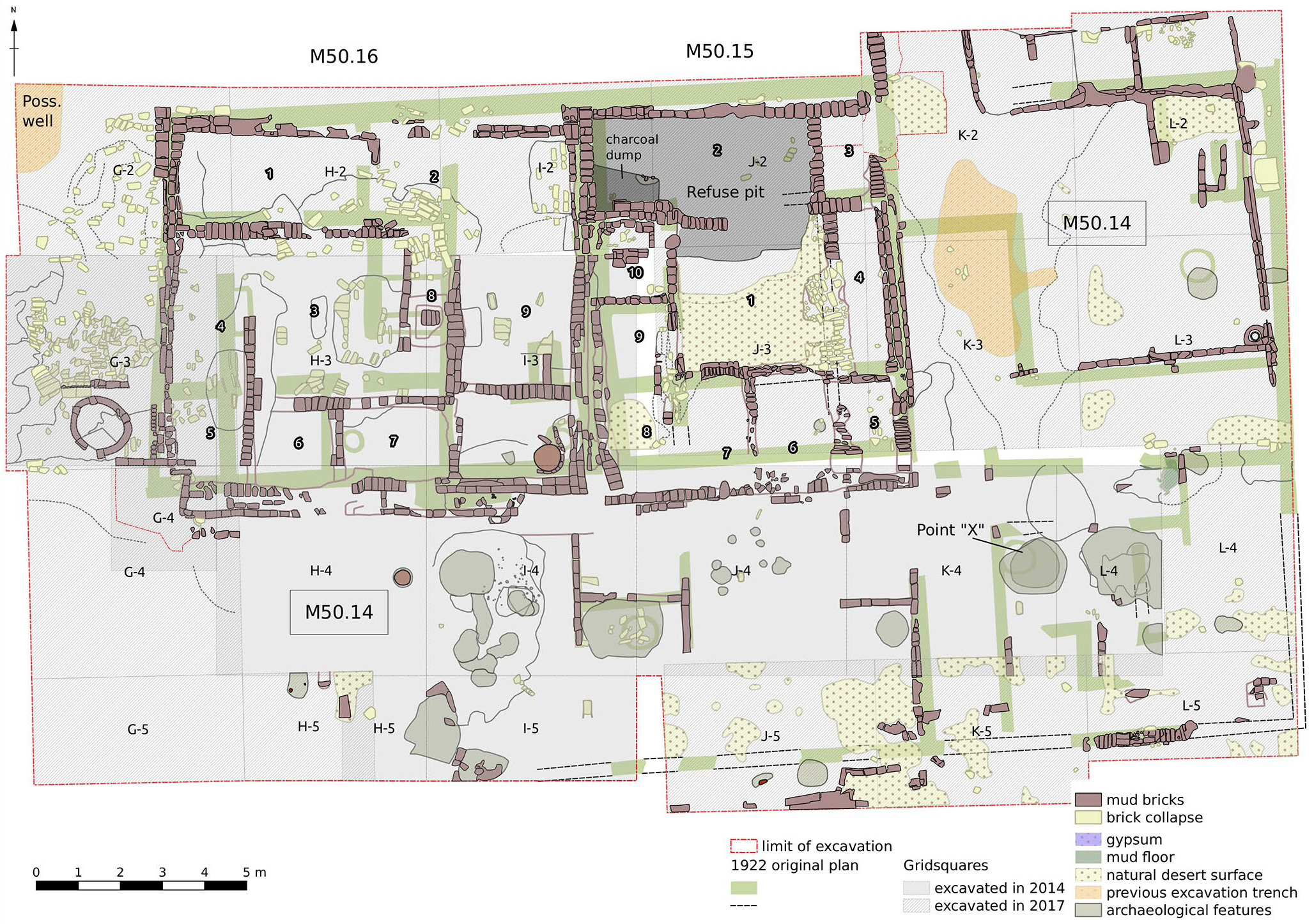
Plan of the site showing walls and features excavated in 1922, in 2014 and in 2017 (plan: author, courtesy of the Amarna Project).
The work was planned after an area of vitrified brick, clay and sandstone, i.e. kiln or furnace debris, was discovered on the surface of M50.14, an indicator of high-temperature industries (fig. 15).
6
In fact, the original publication of the building complex described it as a workshop for the manufacture of glass and faience objects: Apparently a series of workrooms attached to the dwelling-houses M. 50.15 and 16: there is no house-plan recognisable on this much-ruined site. At point X, remains of a glaze kiln: pit cut in sand l.00 m diam. by 0.50 m deep, full of burnt brick, glass and glaze slag, and fragments of the pots used in the kiln for standing the glazed vessels on: the bottoms and sides of these are covered with tricklings of glaze.
7
Previous work, including Petrie’s 8 and other explorations of the material culture, such as chemical analysis for the determination of provenance and trade networks and the excavation of urban workshops, has already provided much information on the Amarna Period glass industries, and more general examples of Late Bronze Age Egyptian glass production or glass-working. In particular, the excavation of high-temperature workshops has highlighted the tri-partite system of urban workshops present at Amarna, already identified by Kemp. This system encompasses large, institutional and highly specialised workshops, manufacture in elite houses, and (usually smaller) domestic workshops. 9
In addition, Kemp’s concept of Amarna being an ‘urban village’, meaning a network made up of connected ‘nodes’, characterised by influential individuals, i.e. the elite, with the royal court in the centre, enabling inter-urban communication and goods exchange, 10 can be used to describe the network of glass-manufacturing sites at Amarna, including those excavated at workshops Q48.4, 11 O45.1, 12 and Grid 12 and the House of Ranefer. 13
The 1923 excavation report, as well as the 2014 excavations at the site, facilitated the recognition of its importance as a domestic workshop in the Amarna glass industries and, possibly, in the international trade of glass. In addition to evidence of faience production and agate working, a large amount of material related to glass-working was discovered. Furthermore, a large fragment of a blue glass ingot was found in the courtyard of the complex in 2014, which fits perfectly into a series of cylindrical vessels found at M50.14–16 (fig. 15) and from Amarna overall. 14 Since the glass ingots found on the Uluburun shipwreck, based on their measurements, would also fit into the cylindrical vessels from Amarna, and since the Uluburun ingots have a chemical fingerprint similar to Egyptian Late Bronze Age glass objects, 15 this may indicate that they were produced at Amarna. Based on this, the ingot fragment from M50.14–16 may also have been produced at Amarna, possibly even at M50.14–16. Because of its potential to deliver crucial new information on Late Bronze Age glass industries, and in order to gain a complete picture of the industrial activities which took place in the courtyard and to place them into context with the activities found in the domestic houses and the industrial activity encountered in Grid 12 and the House of Ranefer, it was therefore decided to (re-)excavate the site and to expand the area opened in 2014.
The archaeological remains
Introduction and excavation methodology
Building complex M50.14–16 lies in the Main City South of Amarna, in the direct surroundings of the House of Ranefer and the Grid 12 excavations carried out in the early 2000s (fig. 1). 16 The complex encompasses a domestic house (M50.16), a second house to the east of the latter (M50.15) and the surrounding courtyard, which describes the overall area of the building complex (M50.14). Since the southern portion of house M50.16, together with a large area of the southern courtyard, M50.14, were excavated in 2014, the 2017 season encompassed the northern sections, including the northern boundary wall, of house M50.16, the whole of house M50.15, as well as the eastern, south-eastern and south-western sections of courtyard M50.14 (fig. 2).
The excavated area encompasses a total of 17 grid squares, measuring 25 sq m each, although only seven of these were fully excavated. 17 The size of the other squares has been adjusted in order to take into account a large spoil heap to the north, and to limit the excavated area to the features under investigation. Although some discrepancies between the encountered archaeology and the original plan had already been discovered in 2014, it has been possible to further revise the original plan and to add previously unknown walls and features, in particular to the north-east and the west of the site (fig. 2).
The initial set-out of the grid squares was done by total station. Squares were extended by tape measure. Prior to excavation, a topographical survey was undertaken across each grid square. Workmen were then employed to remove overburden layers, which usually consisted of windblown sand and/or backfill from the 2014 season. All archaeological deposits were removed by trowel and brush, and spoil was 100% sieved for finds. Hollow features, such as pit cuts, were initially half-sectioned before being fully excavated, and the entire area was planned at 1:25. The excavation was back-filled after the conclusion of the work, using spoil from the excavation, and clean sand.
The courtyard, its industrial installations and evidence of industrial activity
The area of courtyard M50.14 appears to have been open, at least without a permanent roof. No remains related to a temporary structure have been found. The partition walls excavated within this area were thin and poorly preserved, usually being no more than two courses high. This was particularly evident in grid squares
The southern boundary wall as marked on the 1923 plan has been identified, although its preservation is somewhat poor, with only a few bricks remaining in place. The best preserved section of the wall was encountered in
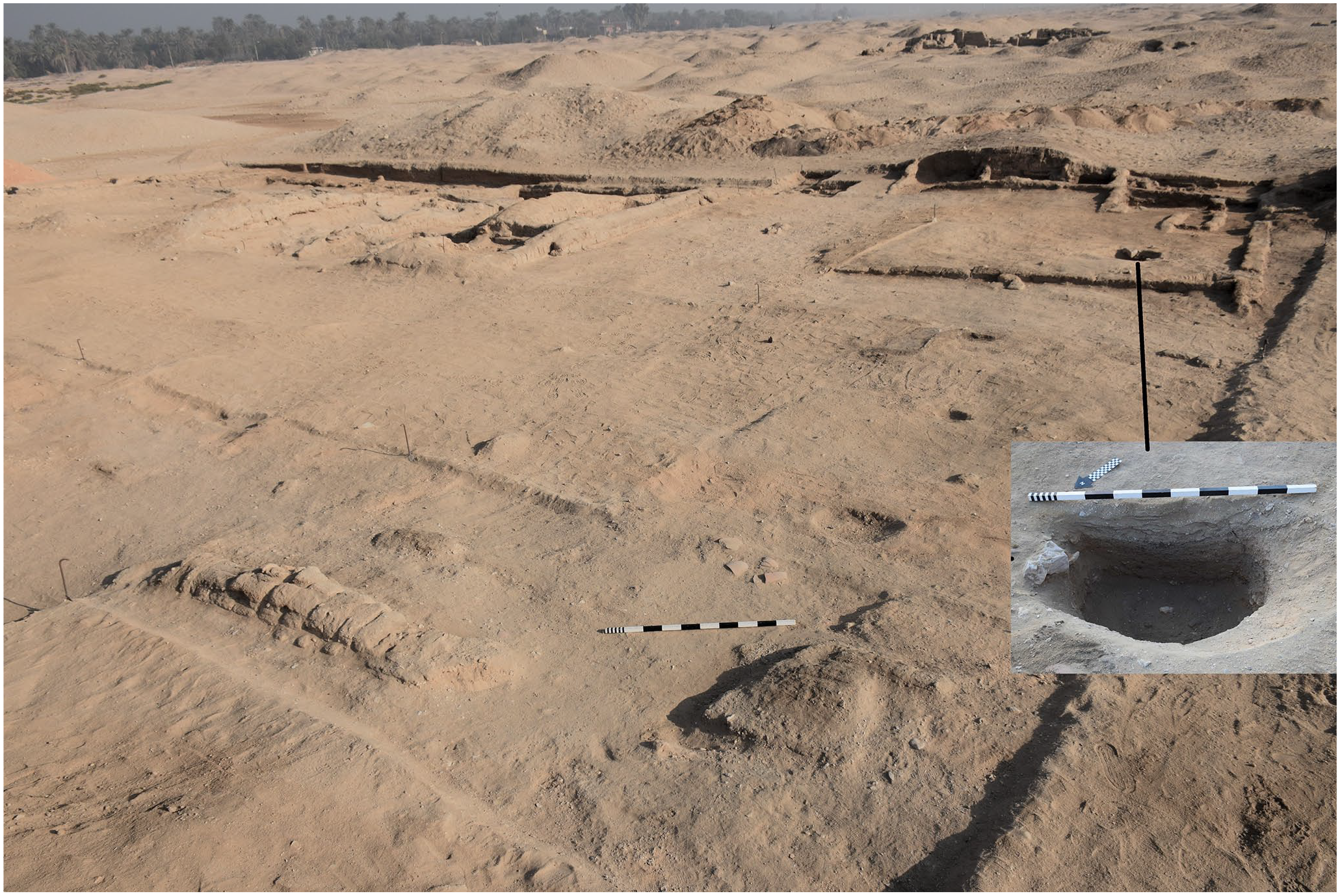
The south-eastern extent of the courtyard, showing the remains of the boundary wall, partition walls and the circular oven, looking north-west (photo: author, courtesy of the Amarna Project).
The floor of the courtyard appears to have directly overlain the desert surface (gebel) and consisted of trampled ground, which contained pottery fragments and pieces of charcoal. Only one small patch of mud-floor with two layers of gypsum whitewash was found against the remains of two mud bricks forming a corner in
The southern courtyard incorporated one probable oven pit, which may have once been lined with clay, indicated by the presence of two fragments of vitrified clay in its eastern cut. The oven contained one fill, which included pieces of charcoal; several objects related to glass-working and faience manufacture were found, including ingot fragments, rods and several faience bead wasters. The southern boundary wall of the courtyard forms a corner against this oven in

The oven found in J-5, with the boundary wall forming an angle around it (photo: author, courtesy of the Amarna Project).
As described earlier, the original publication describes the circular feature marked on the original plan with the letter ‘X’ as a glaze kiln (fig. 2).
18
This feature was excavated in the area between squares
No direct evidence of glass-working was found in the area of this oven, although the surrounding rooms contained numerous objects related to high-temperature activities. A small fireplace was found against the eastern enclosure wall, which has caused reddening of the adjacent bricks (fig. 5). An almost intact, clay-lined and blue-painted water-jar was found in the south-eastern corner of the room containing the aforementioned oven, and this was filled with some collapse and organic material (fig. 6).
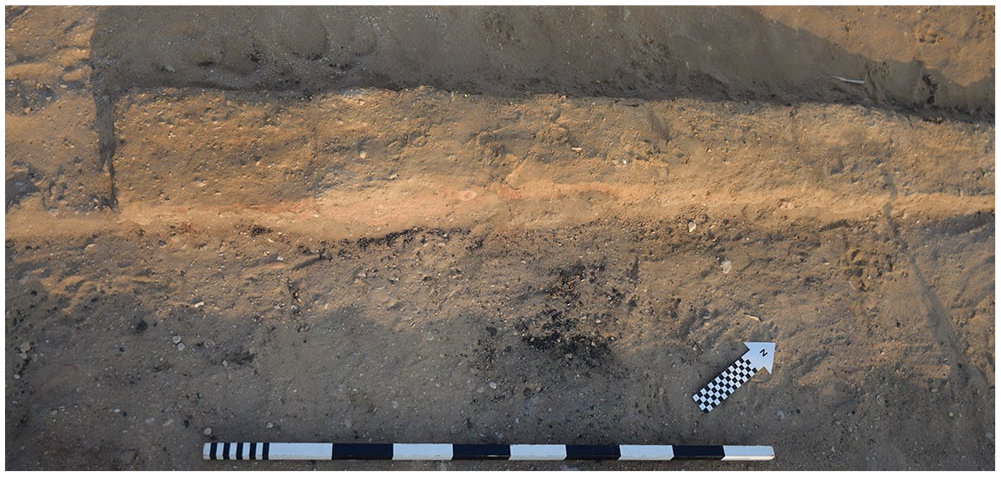
A superficial fireplace against the eastern boundary wall, in the north-eastern part of grid square L-3, looking west (photo: author, courtesy of the Amarna Project).

The blue-painted water-jar during excavation, looking south-east (photo: author, courtesy of the Amarna Project).
The north-eastern area of the courtyard M50.14 contained some walls not previously marked on the 1923 plan of the complex. This is probably because the complex was not fully excavated in 1922. Rooms with ashy fills were excavated in the north-eastern areas of grid squares
Evidence of metal-working activity in the northern courtyard in the form of crucible fragments and lumps of copper-alloy was first encountered during the 2017 excavations. Other activities observed in the courtyard include stone-working, particularly of agate – one unfinished, and two finished beads were found – glass, and faience. Tools from stone and metal, including six metal rod fragments, which may have been used as mandrels in the manufacture of glass beads, were also discovered (fig. 15).
The western sections of the courtyard were found to be covered with large quantities of mud brick collapse from the boundary walls of buildings M50.16 and M50.15. It was decided to remove some of this mud brick collapse, but to leave other parts in place in order to protect the underlying archaeological features. However, the removal of the mud brick collapse in the north-western part of
Grid square
The remains of the domestic houses, M50.15 and M50.16
M50. 16
Since the larger part of this building was already excavated in 2014, only the northernmost strip of this building, measuring c.31 sq m was uncovered in 2017 (figs. 2 and 7). The northern boundary wall of M50.16 in the western and eastern part of the house appears to be in fairly good condition although it becomes very unclear in the central part, where large sections have collapsed. A gravel trench covered the course of the wall in
In situ dumped pottery was discovered in the gap between the western side of the eastern boundary wall of M50.16 and the western wall of M50.15 in room 9 of M50.16. A cylindrical household oven was found here in previous seasons; thus, this room was interpreted as an open area for cooking activities. Due to the series of collapse layers and weathered surfaces, consistent with water-hardened sand and mud brick collapse (see fig. 7) it was not possible to add much further detail to the plan of M50.16.
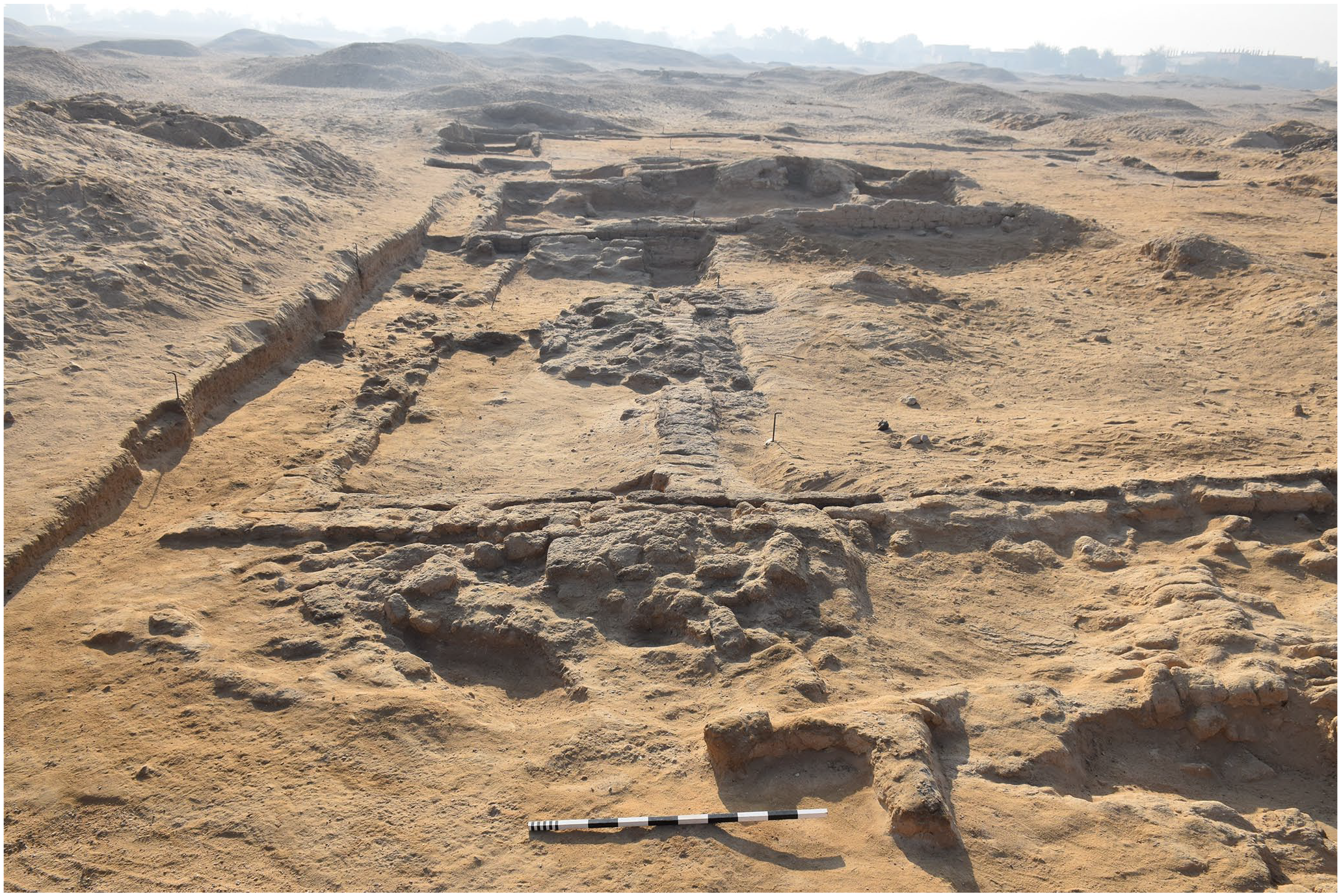
The northern parts of M50.16, with the parts excavated in 2014 to the south, looking east. Mud-brick wall collapse can be seen to the west and towards the centre of the image (photo: author, courtesy of the Amarna Project).
M50. 15
Building M50.15 was not excavated during the 2014 season, although the southern boundary wall was planned. Since the 1922 excavations did not examine this structure in great detail, it was decided that the 2017 excavations should pay special attention to this building. House M50.15 consists of 10 rooms, covering an area of c.51 sq m in grid squares

House M50.15, looking south (photo: author, courtesy of the Amarna Project).
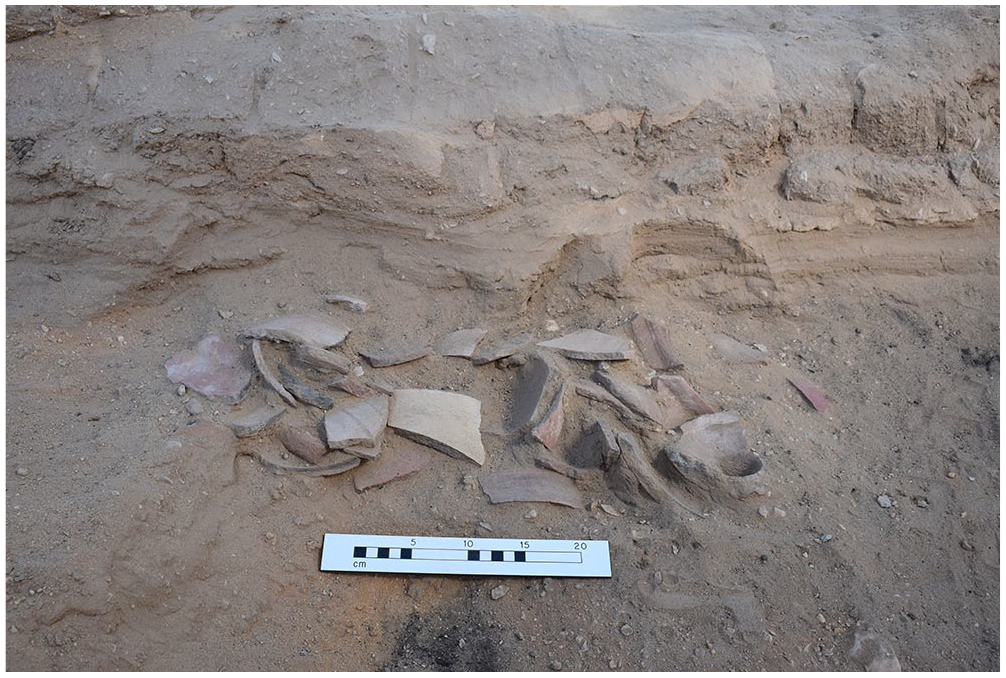
Concentration of pottery against the north–south wall separating rooms 10 and 1 in M50.15. Possibly part of the refuse pit on which the house was built (photo: author, courtesy of the Amarna Project).
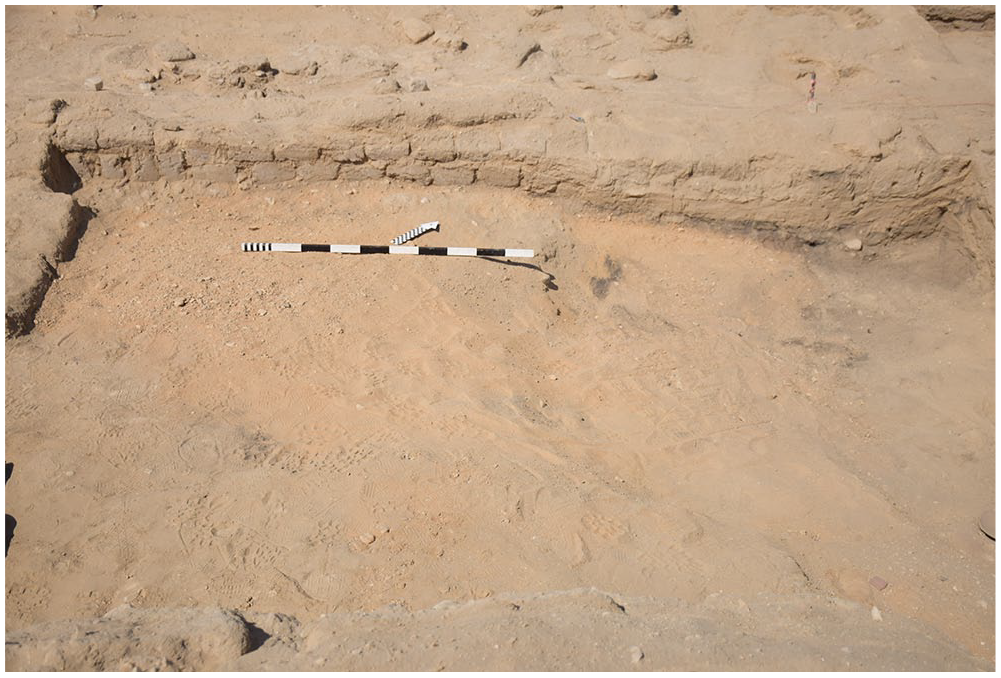
Looking west from room 1 into room 10 in M50.15: the natural desert surface sloping down to reveal the refuse pit along the north–south wall (photo: author, courtesy of the Amarna Project).

Charcoal dump in the north-west of M50.15, showing a fireplace to the east (photo: author, courtesy of the Amarna Project).

A row of bricks visible under the northern wall of room 5 in M50.15, looking north (photo: author, courtesy of the Amarna Project).
In summary, house M50.15 can be said to have been smaller in area than M50.16, probably having functioned as a secondary building to the latter. In terms of preservation, both houses appear to have suffered a similar fate, having been excavated during the 1922 excavations and subsequently left exposed to the elements, after which numerous instances of collapse occurred, and water action affected the collapsed bricks, the remains of which mixed with wind-blown sand.
The finds
Recording methodology
The finds from the 2017 excavation were sorted according to material: glass, faience, metal, worked stone, organic remains (charcoal, animal bone, shell and others), vitrified material (sandstone, clay and mud brick), industrial and architectural remains (gypsum, brick), pottery (diagnostic), blue-painted pottery, industrial pottery, and other industrial material (including faience moulds). Glass and faience objects were then further separated into fragments, beads, inlays or working pieces (ingot fragments, bars, rods, etc.). Faience and glass beads were recorded by bead type. 19 All objects were catalogued in a database by square, unit number and date excavated, although not every object has been registered individually and post-excavation analysis of the material is ongoing.
The objects
Glass objects and evidence of glass-working (fig. 13)
The excavations discovered 145 fragments of glass most of which were chips of glass ingots, indicating that the processing of glass took place at this site. A fine ‘parting layer’ of lime powder was found adhering to several of these fragments, indicating that these were once part of a larger glass ingot. 20 The parting layer was applied to the inside of the vessels used as ingot moulds, in order to separate the glass from the ceramic material after the batch had been melted and cooled down. As mentioned earlier, two ingots (one almost complete, and a larger fragment) were found at the site during the 2014 season, and the impression of the ceramic vessel was visible on both of these objects. Many of the chips are very small (<5 mm ø), eroded and weathered, while others are larger and occasionally have a similar profile to those ingots of the Uluburun type.

Objects from glass (photo: author, courtesy of the Amarna Project).
Bubbly fragments, and those fragments that are translucent and light green or brown, may indicate impurities, which entered the glass during manufacture, such as carbon dioxide or iron oxide respectively, contained in the glass matrix. 21 These fragments are usually chipped in the same manner as flint, demonstrating that at least part of the workforce employed here was skilled in the chipping of stones and able to transfer this skill to the cold-working of glass (see fig. 13, bottom right). The same has been observed to have taken place at Grid 12. 22 The colour of the glass ranges from dark blue and turquoise blue/green, the two most common colours for ancient Egyptian glass, via purple, yellow, translucent, almost colourless glass to opaque white glass.
In addition, 102 glass rods, bars and strips were found, some of which bore tool marks, demonstrating the chaîne opératoire of glass-working, particularly the manufacture of beads. One undecorated, monochrome dark blue glass vessel fragment was found. Two further monochrome dark blue vessel fragments found in 2014 may indicate that fragments of undecorated glass vessels, which broke during manufacture, may have been recycled at site M50.14–16 in order to produce new glass ingots. An extremely clear fragment of glass, with only a very slight light blue tint, has also been found, and this had been very carefully chipped and highly polished. It appears to have broken vertically in the centre but had most likely been intended as an eye inlay for a piece of sculpture (see fig. 13, top right: centre object).
There were 25 vessel fragments of cylindrical shape found across the site in 2017. Six of these came from the spoil heaps to the south and south-east of the site, which were created during the 1922 excavations. These vessels had been used as moulds for glass ingots, and some fragments had blue and purple glass adhering to them (see fig. 15). As mentioned earlier, their standardised size is reflected in the glass ingots discovered aboard the Late Bronze Age Uluburun shipwreck, and the large glass ingot fragment discovered at site M50.14–16 in 2014 also fits into most these vessels, which may hint at Amarna having been the site of their production. 23 The cylindrical vessels may also have been used for the re-melting of glass, and the drawing of glass-rods for the decoration of vessels and the production of beads. 24
In total, 56 glass beads have been discovered, the most common type being a small sphere bead. These were usually blue in colour and heavily weathered and 14 of these beads were unfinished, showing trails of glass yet to be polished off. Again, 12 waster beads were discovered, which had not fused properly (see fig. 13, top left: left and centre objects).
Faience objects and evidence of faience manufacture (fig. 14)
Twenty five faience ring fragments were found, eight of which preserved part of the bezel with an open udjat-eye design. Two plaque-shaped bezels were also found, one of which is decorated with a fish, while 24 faience amulets and pendants were registered, some of which are floral in design (e.g. poppy buds, cornflowers and leaves), while others depict household deities, including Bes, and one faience scarab was also found.

Objects from faience and faience moulds (photo: author, courtesy of the Amarna Project).
In total, 286 faience beads of a variety of types were found in 2017. The most common type is the small ring bead, followed by the disc bead and segmented and spacer beads. In addition, a total of 40 wasters (i.e. manufacturing errors where beads had fused together and were therefore discarded) were found.
There were 120 fragments of faience tiles or inlays discovered, and the monochrome fragments were grouped by colour (41 light turquoise fragments, 40 dark turquoise fragments, and 29 dark blue fragments). These objects functioned as decorative elements, set into plaster, for walls and wooden furniture. A larger fragment of a detailed polychrome lotus-flower tile was also found.
The excavations furthermore yielded a total of 12 faience moulds from fired clay, the designs of which did not repeat. Designs include a scarab, floral amulets, a Bes playing the tambourine, a frog, a nfr symbol and two fragments (not matching) of a cartouche design. 25
Metal objects and evidence of metal-working (fig. 15)
Most of the metal found across the site came in the form of small, indiscernible copper-alloy fragments and lumps, which were weighed and counted by unit and square number. In addition, eight blade fragments and two possible chisel fragments were found alongside one rectangular piece of metal sheeting and six metal rods. These rods may have been used in glass-bead production as mandrels, similar to the ones used in the modern lamp-working technique, where the molten glass rod is wrapped around the rod to form the bead. They may, however, have been used for several other purposes, such as decorative wire.

Objects from metal and clay, a cylindrical vessel, metal-working crucibles and vitrified material (photo: author, courtesy of the Amarna Project).
In total, 33 fragments of metal-working crucibles were identified in the 2017 season. These objects were somewhat crude fragments of Nile silt bowls, although only a very small number of diagnostic sherds were found. They are similar in shape, material, and vitrified appearance to both the material from Grid 12 at Amarna, 26 and that from Qantir. 27
Agate debitage
The 2014 object corpus included a total of 1438.86 g of agate debitage. A smaller, but similarly distributed range of agate objects was found in 2017, 866.41 g in total. Most of this material consists of small debitage and micro debris (< 1 cm) and medium-sized flakes (1–2 cm), while some raw bead products were also found. The material has been analysed and evaluated by lithics specialist Cordula Werschkun.
Stone tools and other worked stones
A small range of stone tools, mainly polishing stones from sandstone or quartzite, was found. In addition, tools from pottery sherds were probably used in the manufacture of glass objects.
Vitrified sandstone and mud brick (fig. 15)
While the 2014 season yielded almost 65 kg of vitrified mud bricks, clay and sandstones, only c.6.5 kg of vitrified material was found during the 2017 season. This may be due to the fact that a small amount of the material from the concentration located in 2014 was scattered. Thus far it has not been possible to reconstruct a kiln structure from this material, although some matches have been made.
Other materials
One fragment of a clay document sealing with a stamped cartouche and string impressions has been found (fig. 15). In addition, a small number of small fragments of textile with black decoration were found in room 2 of house M50.15. Small amounts of painted mud plaster and some larger (undecorated) pieces of gypsum provide some information on architectural materials used in the building of the house.
Conclusions
The excavated complex, M50.14–16 comprises a main, domestic building (M50.16), a secondary building (M50.15) and associated outside working areas with some thin partition walls and firing structures (M50.14). We can infer from the large number of raw materials and objects related to industrial activity found at the site that the excavated workshop must have processed relatively large quantities of glass, metal and stone objects. These finds are similar to those discovered during the recent excavations at the nearby house of Ranefer and those at Grid 12, 28 and concur with the hypothesis that this area of the Main City South at Amarna was somewhat specialised in this activity.
The evidence would suggest that the workshop integrated in the courtyard specialised in the production of glass and faience beads, but also produced beads from other materials, such as agate. The general layout of this complex fits well into the greater picture of Amarna, in particular that of the Main City, where it is believed that areas of small, industrial houses developed amongst the larger, elite houses, to which they reported.
The project has enhanced our understanding of the socio-economic structures of the Main City South at Amarna, as well as the architecture and functionality of domestic structures and their involvement in industrial processes at Tell el-Amarna during the Eighteenth Dynasty in ancient Egypt. Future planned work includes the detailed post-excavation analysis, together with a spatial analysis of all data in preparation for a final publication.
Footnotes
Acknowledgements
The members of the team are indebted to the Amarna Project, in particular director Barry Kemp, and Anna Stevens, for their kind support of this project, help and encouragement, in particular their permission to use the excavation house and equipment. We are furthermore grateful to the Minister of State for Antiquities, Khaled El-Anany, Ahmed Fathy and Hamada Kellawy of the el-Minya branch of the ministry and Mahmoud Salah, the general manager of antiquities for el-Minya. We would also like to thank the Egypt Exploration Society, who kindly funded our work.
The team of archaeologists consisted of the following members: Anna K. Hodgkinson (field director, Freie Universität Berlin), Antonio Cantele, Kay Kossatz (both Freie Universität Berlin), Thais Rocha da Silva (University of Oxford), Kimberley Watt (University of Cambridge), Cordula Werschkun (formerly University of Liverpool), and our inspector from the Ministry of State for Antiquities, Kariman Abdelalim. We were also joined by our trainee inspector, Nabil Abdeltieff. The team employed 13 Egyptian workmen from Hagg Qandil and Et-Till: Walid Mohamed Omar, Ahmed Mohtar Salan, Salah Osman Mehenni, Hilal Mohamed Omar, Abdelaal Talaat Abdelaal, Ahmed Hamdy Ali, Bilal Nazzer Omar, Hosny Osman Mehenni, Abdel Hafiz Abdel Aziz Ibrahim, Reda Omar Mohamed, Osman Mohammed Osman, Hassan Mohammed Raleb and Mohammed Abdelghafar Abdelhag.
Funding
Anna Hodgkinson is grateful to the Egypt Exploration Society for funding the 2017 fieldwork and two study seasons carried out in 2018 and 2019 through two Fieldwork and Research Grants. The 2014 fieldwork was funded by the G. A. Wainwright Fund, the Corning Museum of Glass (Rakow Grant), the Association for the History of Glass and the Thames Valley Ancient Egypt Society.