



Abstract
Research for the final report of a large Middle Kingdom tomb dug jointly by the fifth Earl of Carnarvon and The Metropolitan Museum of Art provides provenance information for 12 writing boards from Carnarvon tombs on the West Bank at Luxor. Through disparate records at the Griffith Institute Oxford, Egyptian Museum Cairo, and The Metropolitan Museum of Art New York, the tablets can now be assigned to a small area below or adjacent to Hatshepsut’s valley temple. The results put the texts into a broader cultural context at the same time that the study illustrates the fragility of information from excavations that deserve to be accurately and widely known.
Keywords

Carnarvon Tablet I is well known for the literary text The Instruction of Ptahhotep and for a historical narrative of the Hyksos wars. Carnarvon Tablets II–IV present additional literary texts from the same general period. The boards came from Carnarvon Tombs 9 1 and 37 2 in what Carnarvon and Carter termed ‘the Birabi’ 3 and other archaeologists working in the area termed ‘lower Asasif’. 4 In 1911, at the end of the excavations that would be published in Five Years’ Explorations at Thebes (hereafter Five Years), Carter and Carnarvon came upon a third tomb with writing boards. Briefly cited as ‘Tomb no. 41’ in Five Years, 5 it is properly termed Carnarvon Tomb 62. 6 As would be discovered, this large saff (pillared) tomb was divided between the concession of Lord Carnarvon and The Metropolitan Museum of Art (MMA). Eventually Carter turned over British records to Ambrose Lansing, who dug the Museum’s third but published only a preliminary report of his own work. 7 Seven writing tablets with literary texts can now be traced to this large court tomb, three of them previously published without specific provenance.
Intense scrutiny of archival sources was necessary to contemplate a publication of the Carnarvon 62 site. Ultimately the adjacent area was also investigated 8 and publication with digital format combining text and image was used so that original documentation could be presented with present-day description and analyses. 9 Serving as a Final Report for Carnarvon and the MMA, the project demonstrated the fragility of records when not published by original excavators, at the same time it showed the challenges of modern digital publishing. 10
Effectively, Tombs 9, 37, and 62 made a small cemetery along with Carnarvon Tomb 65, a corridor tomb where well-known stelae were found. 11 All are shown in figure 1 with the ‘north boundary wall’ of Hatshepsut’s valley temple. Various factors indicate that Tombs 37, 62, and 65 were cut in the Middle Kingdom and reused from the late Second Intermediate Period (conventionally the Seventeenth Dynasty) through the first reigns of the Eighteenth Dynasty. In the early years of Hatshepsut’s joint reign with Thutmose III, the four tombs were probably all covered by construction for the valley temple that would lead to the Deir el-Bahri temple. Tomb 9’s initial construction is not established but its remains date to the period of reuse at Tombs 37, 62, and 65.
For Tombs 9 and 37, the major text documentation is Carnarvon and Carter’s ‘Report 1907–11’, the informal term Carter used for the Five Years publication of 1912. 12 For Tomb 62, the major text source is Carter’s heretofore unpublished manuscript, ‘Report 1912–13’. 13 For the history of the writing boards after excavation, records in the Egyptian Museum Cairo (EMC) and the Ashmolean Museum Oxford, as well as A. H. Gardiner papers in the Griffith Institute Oxford 14 supply information. Photographs taken by Carnarvon and Carter and architectural plans drawn by Carter of Tombs 37 and 62 are in the Griffith Institute Archive ‘Carter MSS’, a body of material formerly in the MMA and transferred to the Griffith by W. C. Hayes in 1956. 15 The MMA has some duplicate and additional photos that probably accompanied the ‘Report 1912–13’ when Carter turned it over to Lansing for publication. Further information could most likely be found at the Griffith and perhaps at Lord Carnarvon’s house, Highclere Castle. 16 Any such documents could modify observations and statements made here.
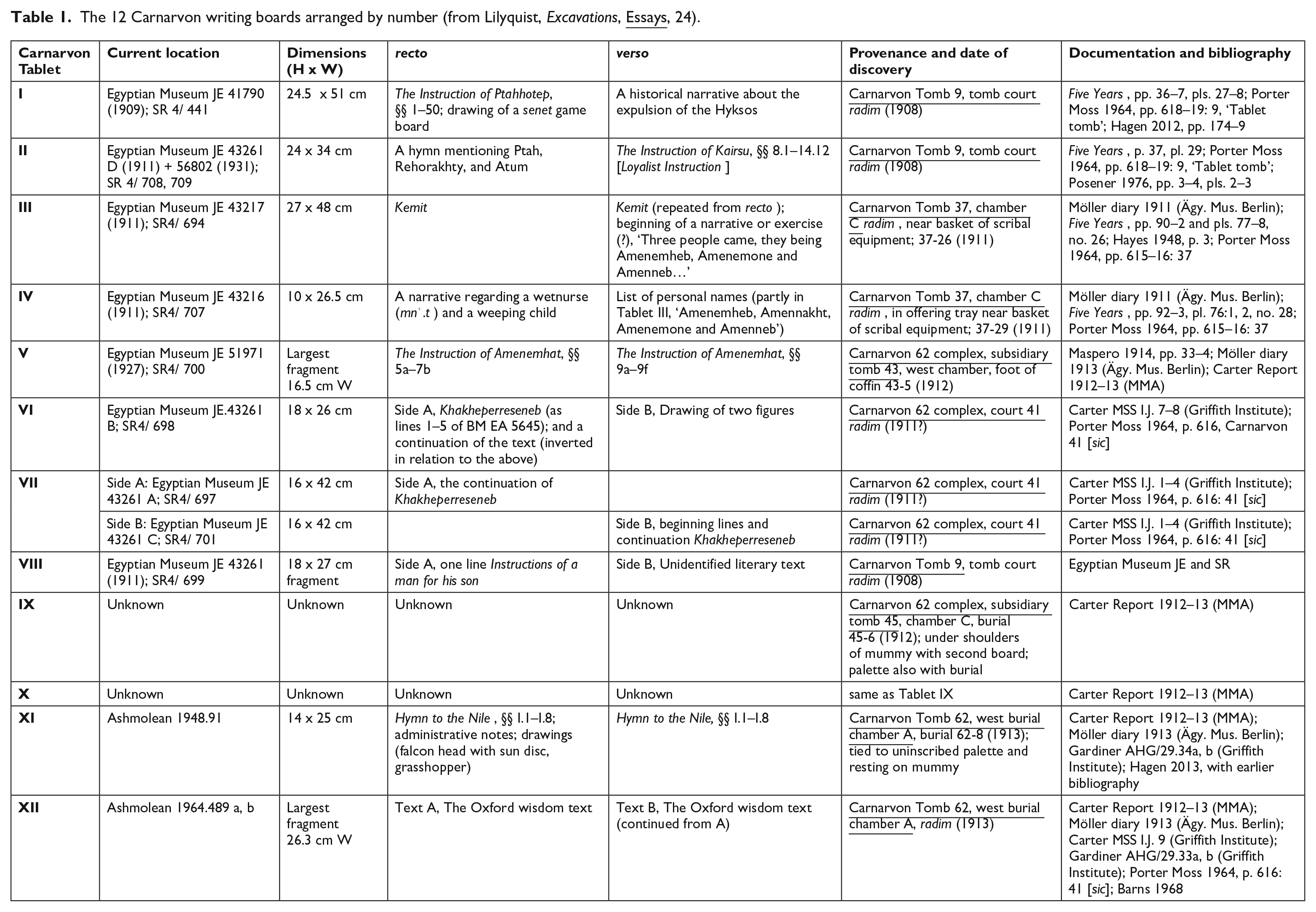
In this article, writing boards not previously recognized have been given numbers in the Carnarvon Tablet series, in consultation with Fredrik Hagen. Table 1 shows all 12 boards ordered by Carnarvon number, but they will be discussed later in the article according to date of discovery and tomb provenance. The eight tablets in the EMC were recently made available to Hagen for study and photography, thanks to the curatorial and professional staff of the Egyptian Museum. 17 That would not have been possible without the generous collaboration of Khaled Hassan of Cairo University, who located Carnarvon V–VIII in the museum and forwarded documentation for all the EMC Carnarvon boards. The history of V–VIII would not have been brought to fruition without him.
The 12 Carnarvon writing boards arranged by number (from Lilyquist, Excavations,
Carnarvon Tomb 9, court debris, 1908: 18 Carnarvon Tablets I, II, and VIII
Tomb location, plan, and tablet finds
Lord Carnarvon discovered this tomb in 1908 before Carter joined him as archaeologist.
19
It was in the ‘Birabi’ section of the Earl’s concession, according to the ‘Introduction’ he wrote for Five Years, ‘near the desert edge, between the hills of Drah abu ‘l Nagga and the cultivated land’ and adjoining ‘the entrance to the dromos of Hatshepsut’s famous terrace temple’.
20
When Carter joined Carnarvon at the tomb the next year for further clearance,
21
he too gave only a general location for Tomb 9: ‘between the native house ‘Beit el Meleitên and the village mosque, about one hundred and fifty metres north-east of the mouth of the Dêr el Bahari valley’.
22
The ‘house of Meleitên’, the ‘mouth of the Dêr el-Bahari valley’, and even the ‘northeast’ direction mentioned are difficult to identify today,
23
and Carter did not include the tomb on known maps of the area. However, he did write that the tomb adjoined ‘the “Valley”-Temple to the Dromos of Hatshepsut’s Mortuary Chapel at Dêr el Bahari (Site 14, Pl. XXX)’,
24
and Carnarvon most fortunately wrote that the north boundary wall for the valley temple was discovered in 1908 when he was uncovering Tomb 9:
Jutting out of one side of the hole caused by the excavation of the tomb … appeared the beginning of a well-built stone wall. About 40 metres’ length of this wall was [subsequently] cleared, and though unfinished, the masonry in general was good. A doorway, giving ingress from the north (see Plan PL. XXX), eighteen metres along its length, showed that its northern side formed its exterior face.
25
In Carter’s Chapter V of Five Years, he added that Hatshepsut’s valley temple had been discovered by the ‘excavation of the tomb No. 9, which exposed some of its stone-work’. 26
Carter’s most detailed plan of the area is in the Griffith, Carter MSS. I.G. 78–78A. It is reflected in fig. 1, a plan drawn up in the 1980s at the MMA; the wall’s west (left) end is approximately 18 m from a gateway in the wall. According to the I.G. 78–78A plan, a distance of about 37.5 m runs east, from the west end, to the point where the wall juts southeast; it thus roughly corresponds to Carnarvon’s dimensions (the wall’s total length is c.55.8 m).
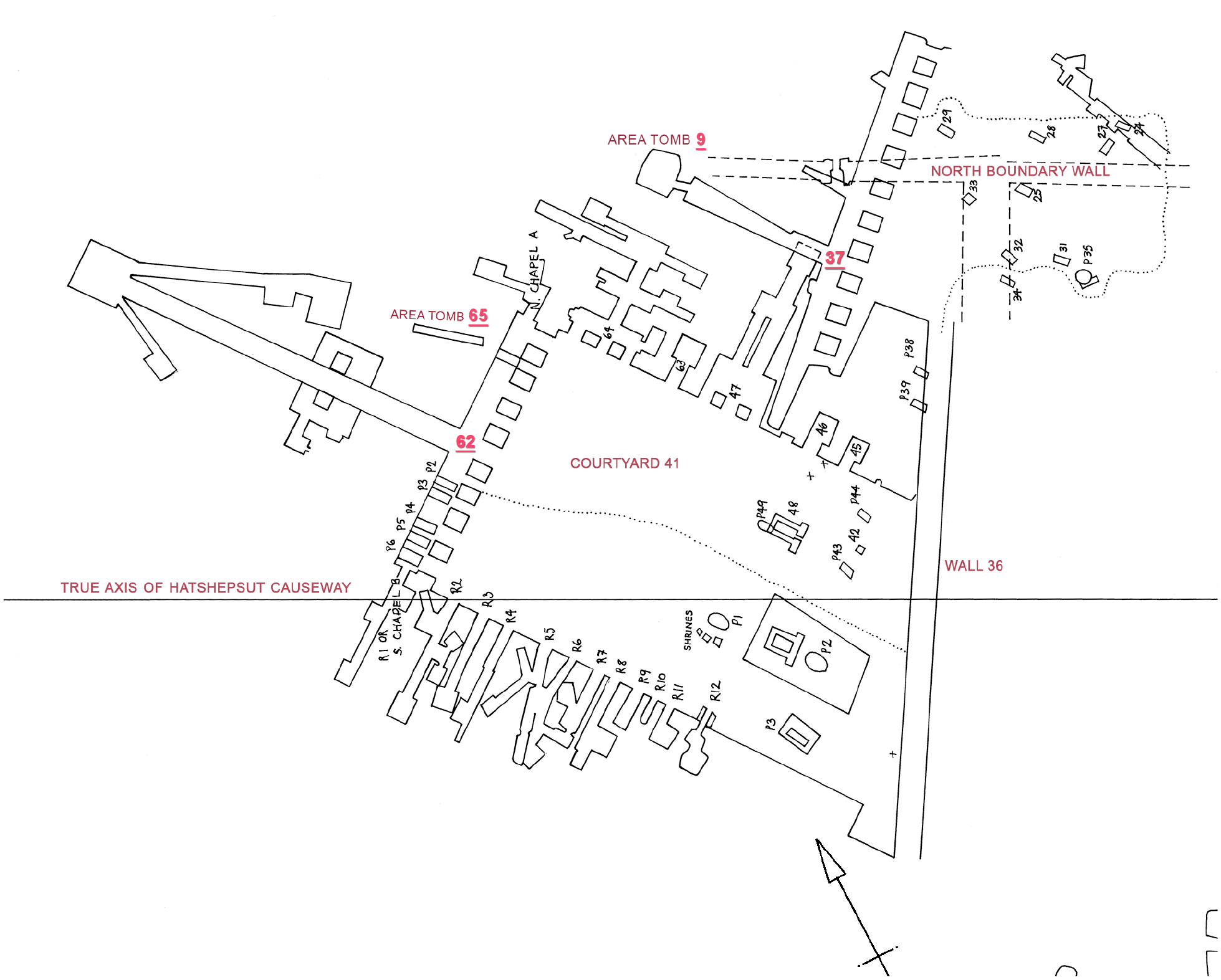
The provenance of the tablets, with Carnarvon Tomb numbers in bold: 62 (Tablets V–VII, IX–XII), 37 to the northeast (Tablets III–IV), and 9 near 37’s innermost chamber ‘C’ (Tablets I–II, VIII). The plan is schematic; missing in Tomb 62’s plan are pits in the main and subsidiary tombs and graves along the south side of court 41 (author, from © plan AM 4403, courtesy of The Metropolitan Museum of Art, Department of Egyptian Art Archives).
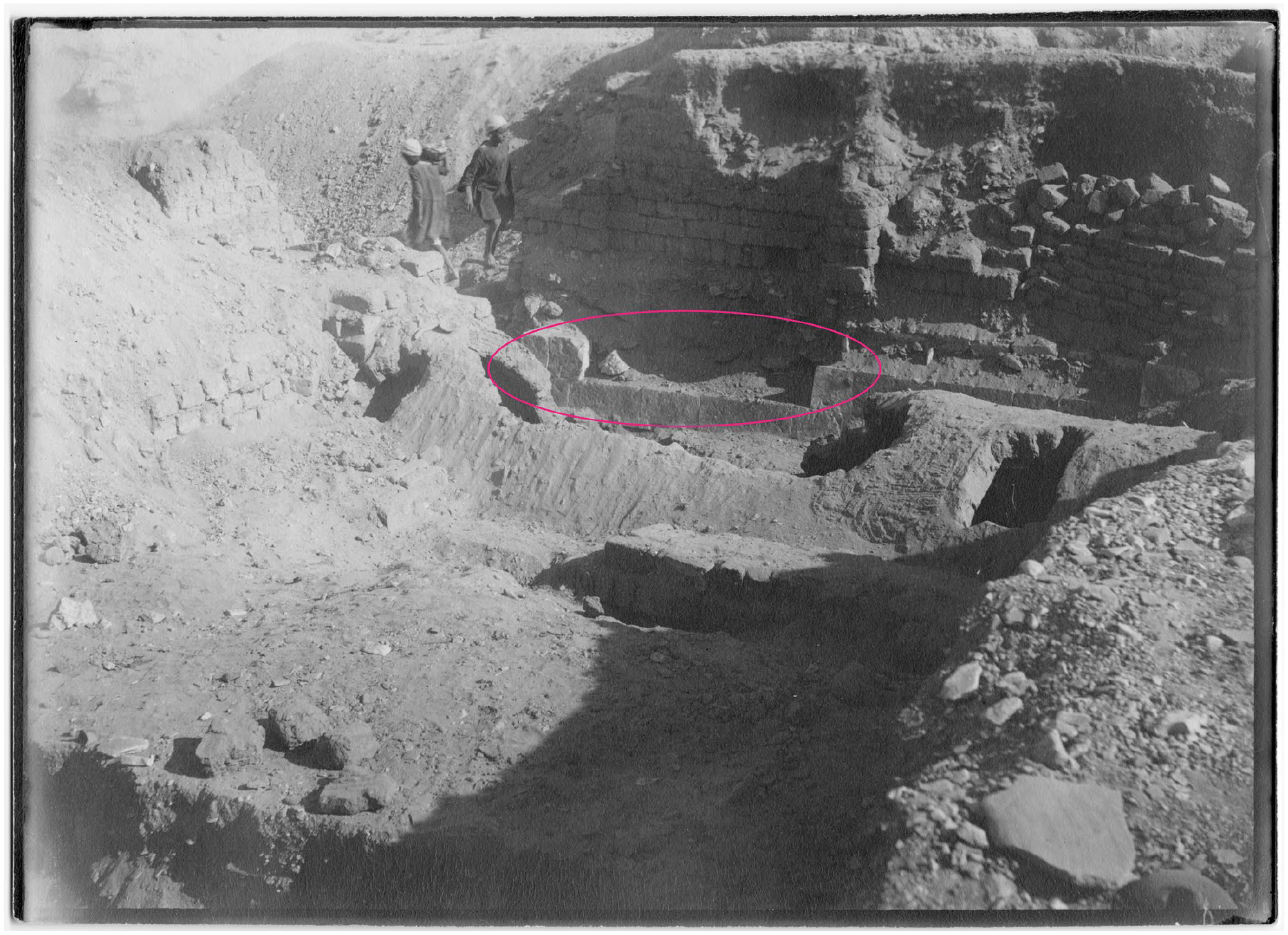
Unfortunately, photographic coverage of Tomb 9’s site is poor. Fig. 2 is identified as ‘Tomb no. 9’ in the Griffith inventory 27 and probably shows the tomb area before discovery. 28 Carnarvon’s dog is in the foreground; perhaps the prominent building in the upper right (marked ‘c’ in fig. 5) is Beit el Meleiten. In fig. 3, the west end of the north boundary wall emerges from debris; fig. 4 shows another part of the wall emerging, with its footing; and fig. 5 records the section seen earlier in fig. 3. Figs 3, 4 and 5 are all identified in the Griffith list as ‘Site 14, Ptolemaic vaulted graves’. Fig. 5 does not show Ptolemaic graves above Tomb 9, rather, Ptolemaic tombs south of the wall and above Carnarvon 37. 29 Other Carnarvon/Carter photos show the wall emerging from debris, 30 or along its north face after clearance (fig. 6), but no photos have been discovered that show Tomb 9 and the wall together. The most that can be said is that Tomb 9 was near the west end of the wall and a little east of Carnarvon 37’s westernmost chamber, hall C. 31 Carter and no doubt Carnarvon used the trenching method to locate tombs, backfilling as they went, a process that makes studying piles of debris difficult. At the same time, Carnarvon was by himself and had had no training in archaeology, thus one is grateful for any available photographs.
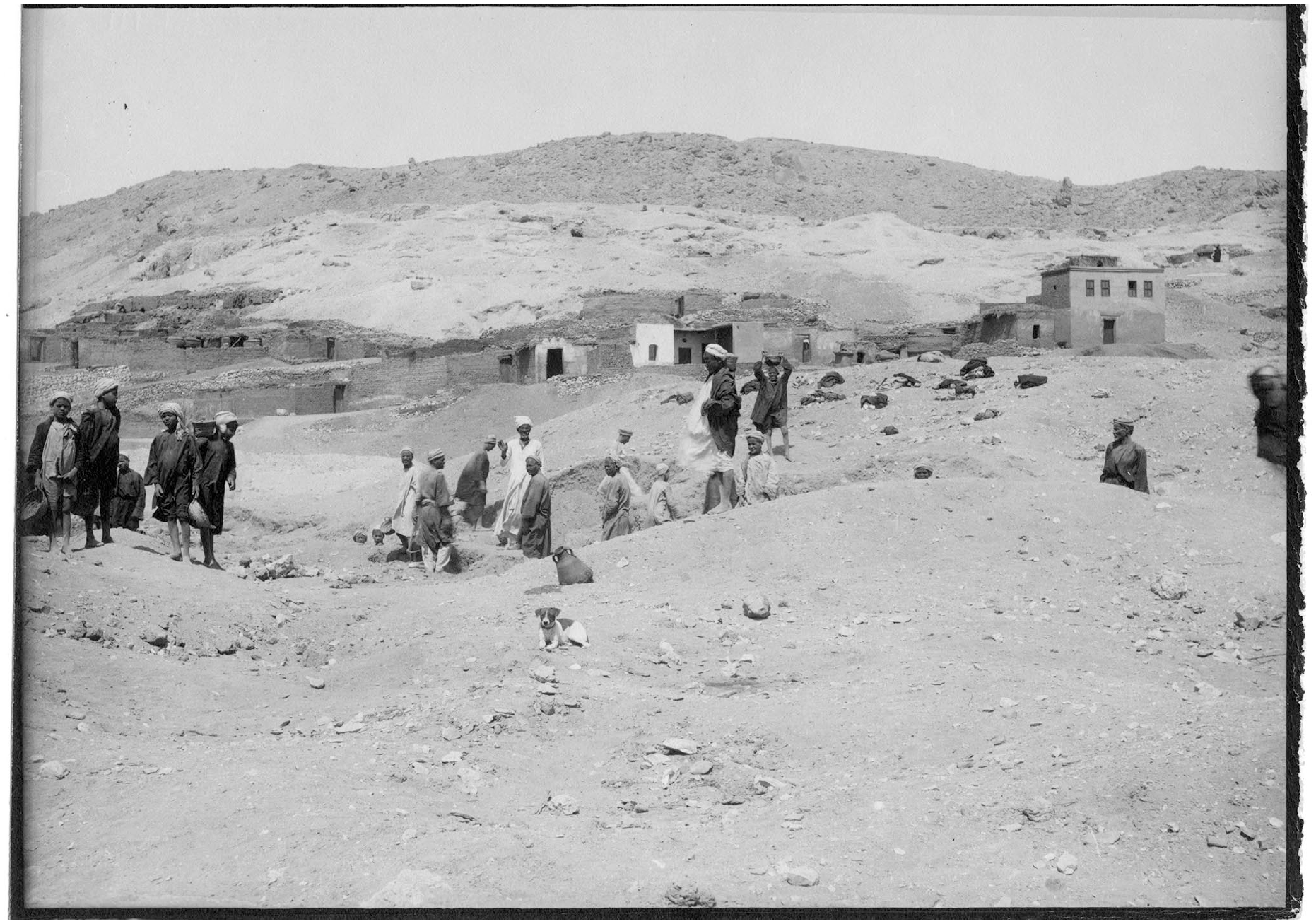
Carnarvon workmen in area where Tomb 9 and Hatshepsut’s north boundary wall would be discovered (Griffith Institute Archive, Carter MSS I.J. 111; © Griffith Institute, University of Oxford).
South side of a section of the north boundary wall as it emerged from debris; brick remains are probably Ptolemaic, note the vault of a tomb to the right (author, from © photo Carter MSS I.J. 251, Griffith Institute Archive, courtesy Griffith Institute, University of Oxford).
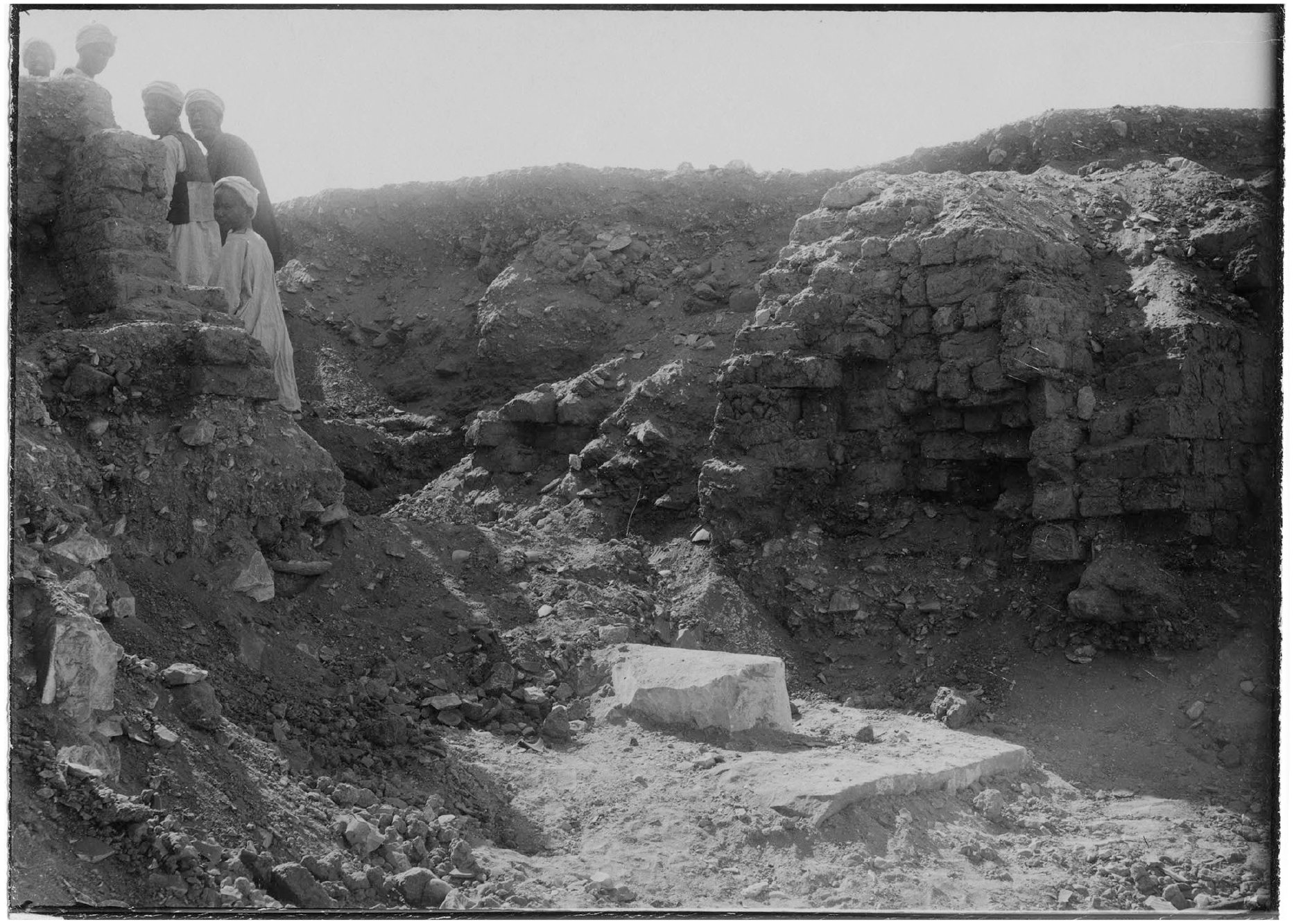
Stone block on a footing, probably the north side of the north boundary wall, west end, later uncovered, see figure 6 (Griffith Institute Archive, Carter MSS I.J. 245; © Griffith Institute, University of Oxford).
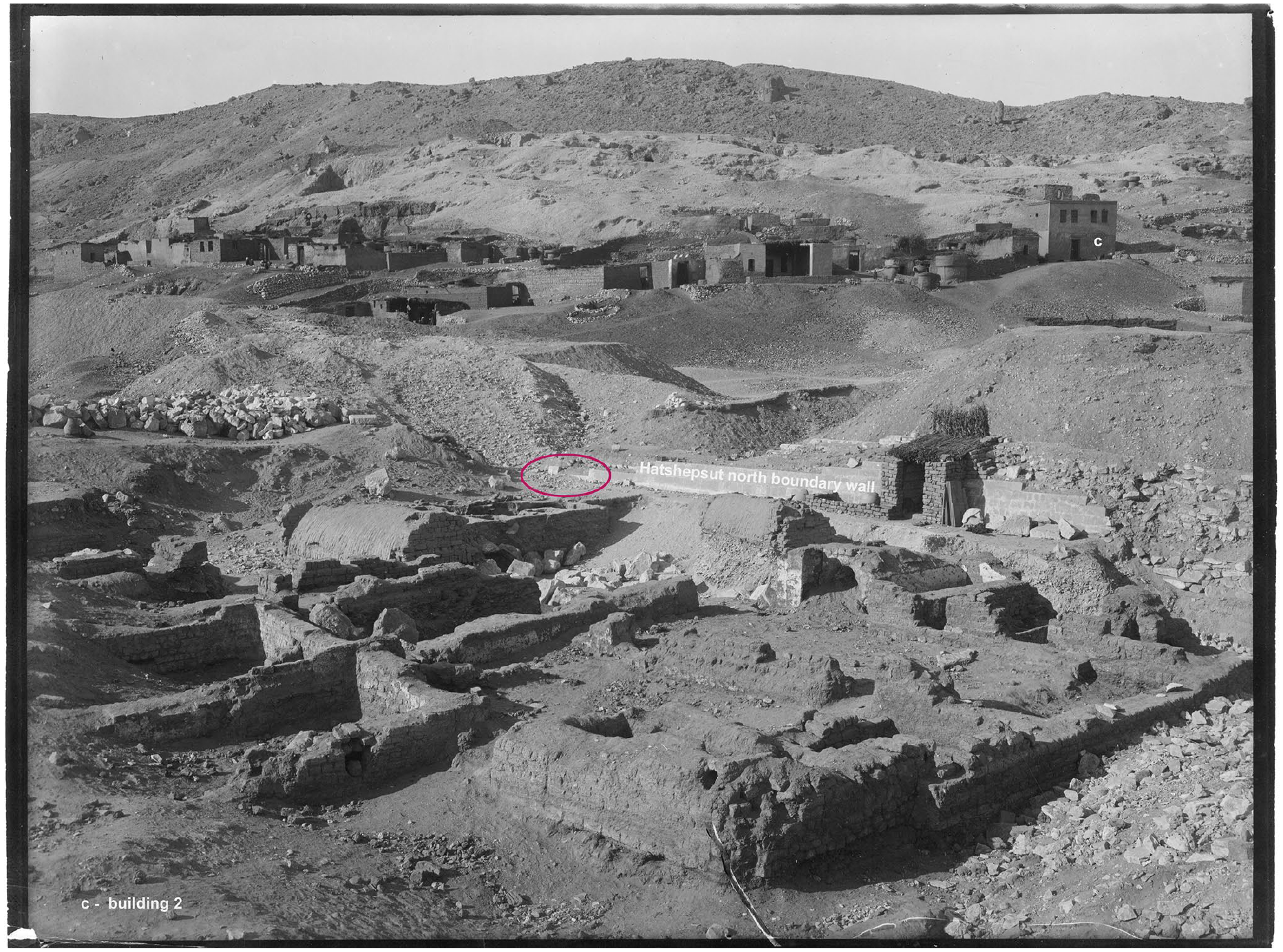
South side of north boundary wall, showing section seen earlier in figure 3 encircled (author, from © photo Carter MSS I.J. 284, Griffith Institute Archive, courtesy Griffith Institute, University of Oxford).
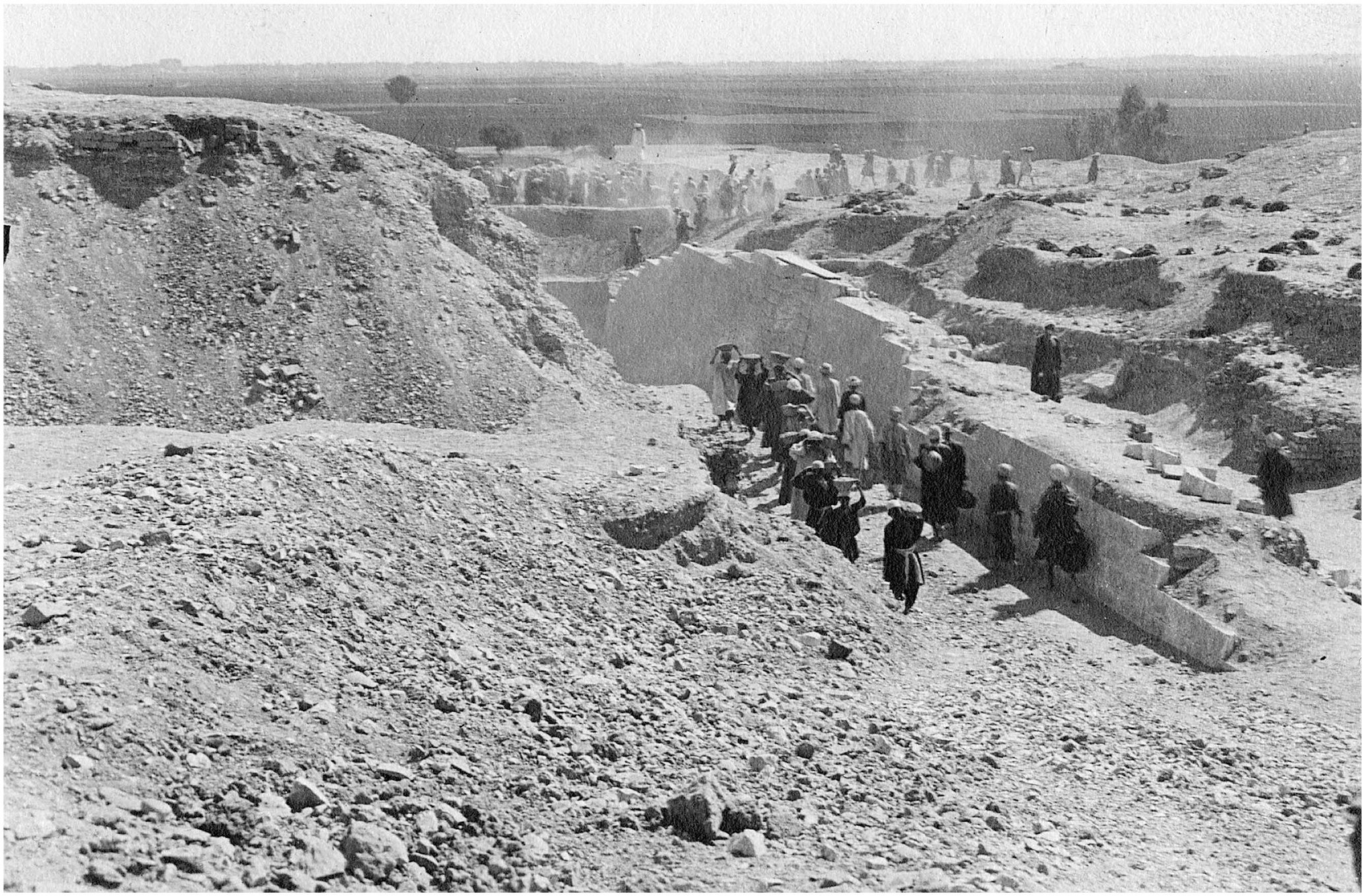
North side of north boundary wall, looking east; Tomb 9 would already have been reburied in the right foreground (© Metropolitan Museum of Art, Department of Egyptian Art Archives, pb 41_13_tr).
Specific documentation for Tomb 9 comes from texts of both Carnarvon and Carter in Five Years, three site photos (figs 7–9),
32
and a plan drawn by Carter (fig. 10). Carnarvon wrote:
Three days’ digging in loose debris unmasked a hidden burial place. Masses of pottery and denuded mummies were brought to light, and at the very threshold of the tomb (afterwards numbered 9) were discovered two wooden tablets (one in fragments) covered with stucco and inscribed with hieratic texts. One of these tablets has written (1) on its obverse, an important historical text relating to the expulsion of the Hyksos kings by the king Kamosi; and (2) on its reverse, a copy of part of the well-known Proverbs of Ptah-hetep.
33
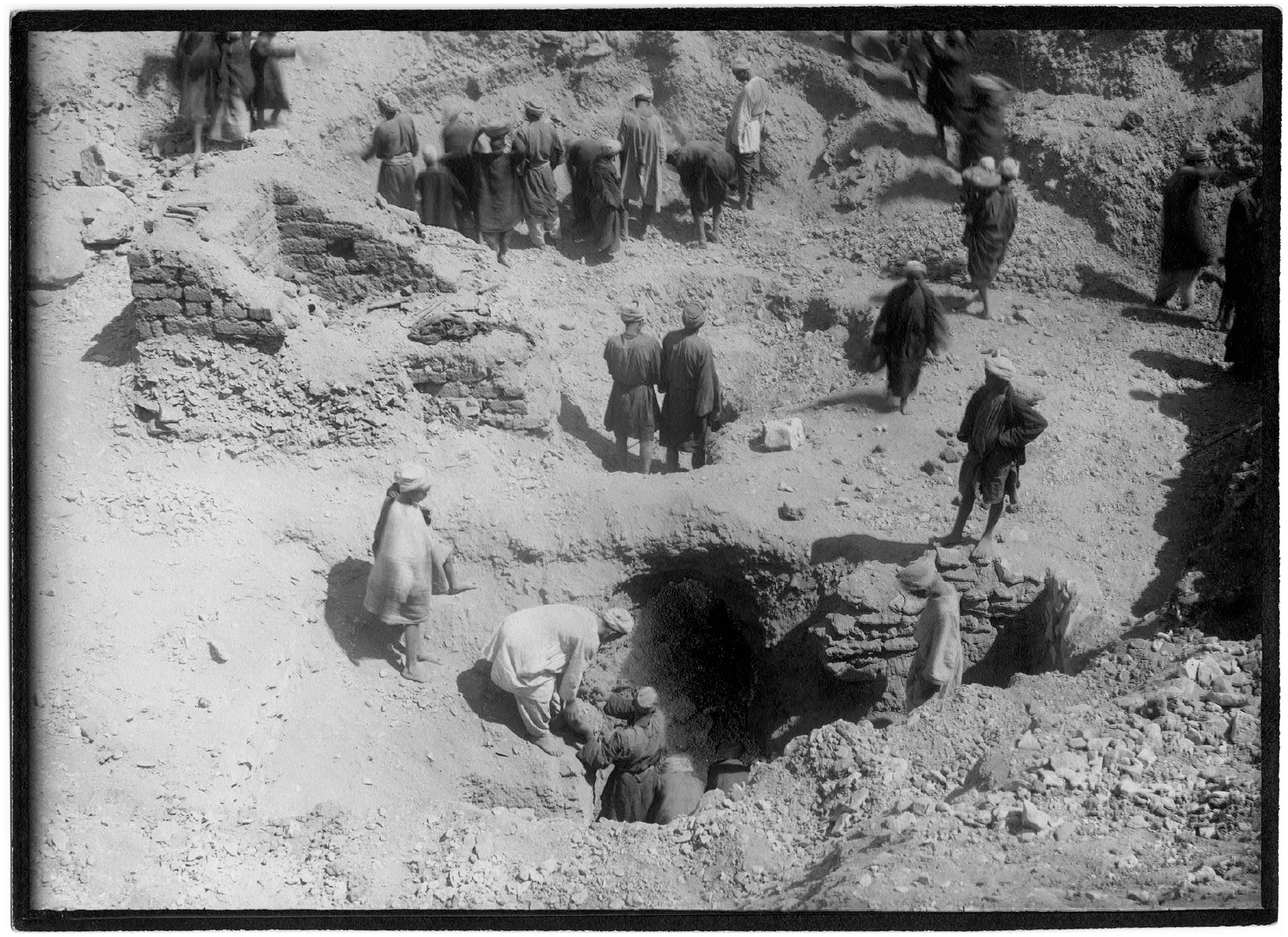
The Tomb 9 site: brick lining for pit (upper left), court (lower center) (Griffith Institute Archive, Carter MSS I.J. 113; © Griffith Institute, University of Oxford).
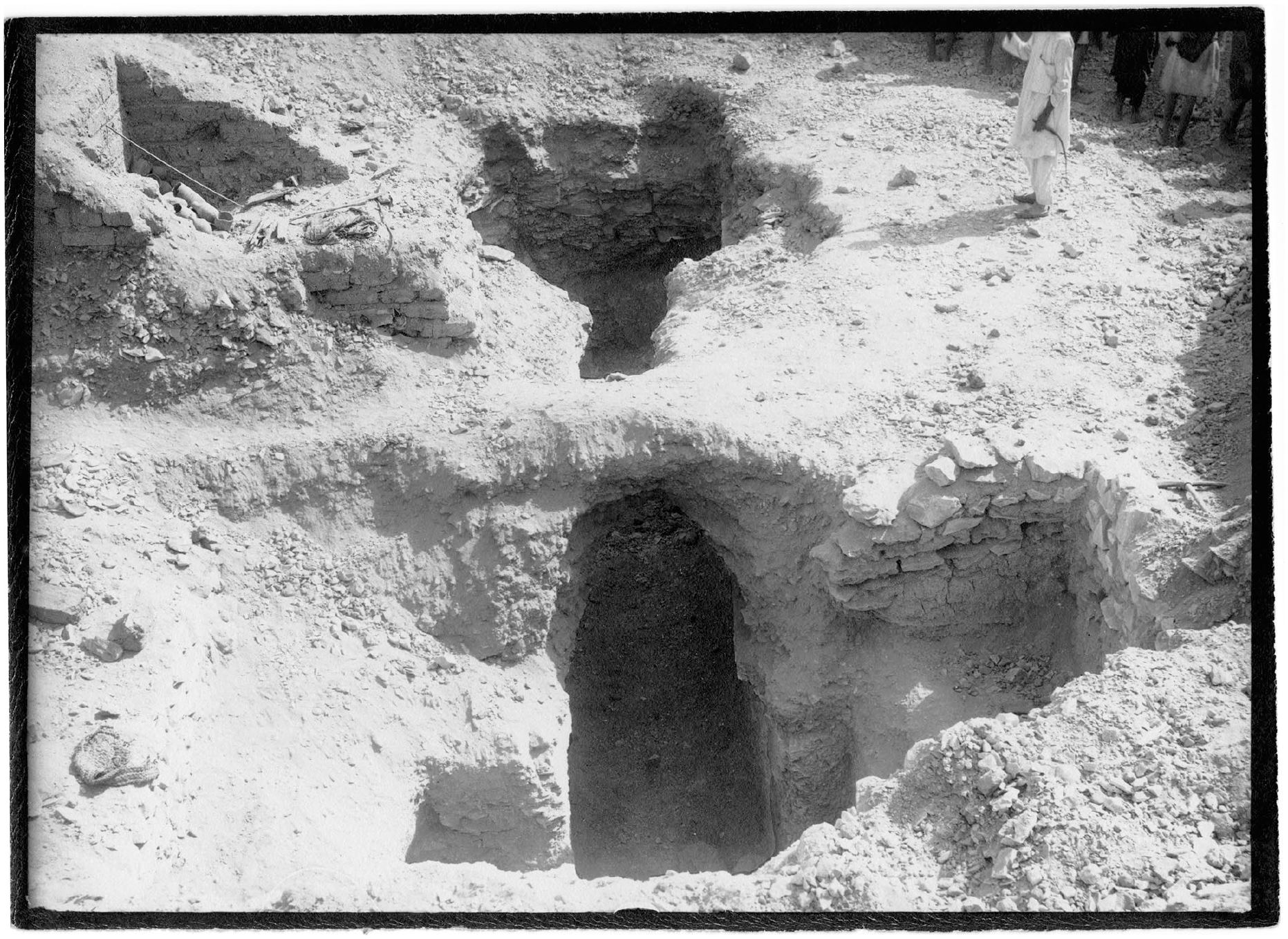
Further view of Tomb 9; rock ledge where tablets were found in lower right, low ‘stone and mortar walls’ above; note pots in brick structure, upper left (Griffith Institute Archive, Carter MSS I.J. 115; © Griffith Institute, University of Oxford).
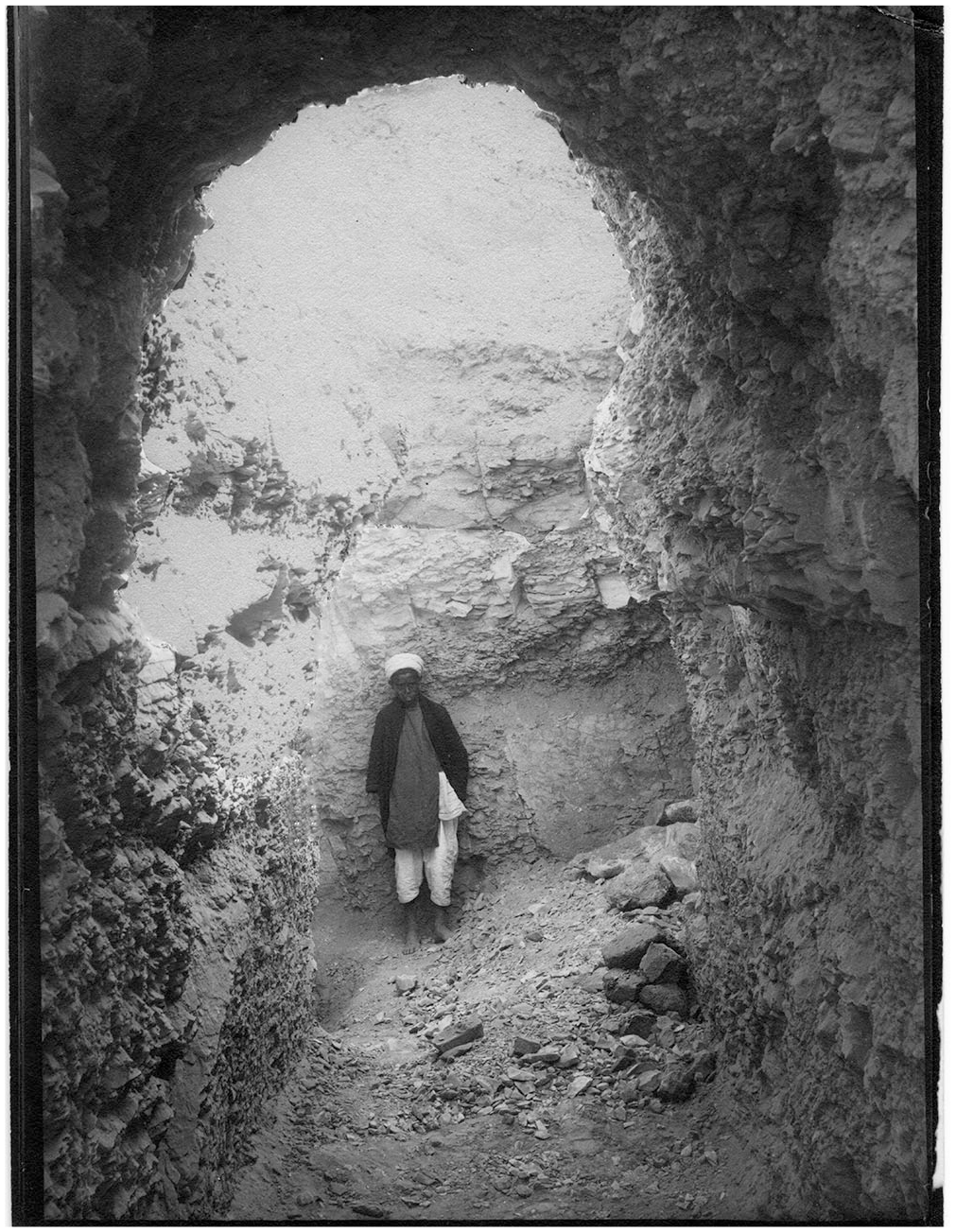
View into chamber E; apparently D is vaulted (Griffith Institute Archive, Carter MSS I.J. 118; © Griffith Institute, University of Oxford).
As noted, Carter saw the tomb only in 1909 after Carnarvon had covered it at the end of 1908. He too mentions two tablets (one broken); 34 his plan notes ‘rubbish containing potsherds’ to the west of the tomb opening. These sherds were no doubt sherds still present at the site in 1909, for Carter wrote that it was hard to imagine that ‘such a mass of pottery as was found in the rubbish outside could have all come from so small a tomb … one is inclined to think that the greater part must have come from some neighbouring and perhaps larger tomb’. Notably, the plan shows that the full extent of the court was never cleared.
With the plan drawn up in 1909, Carter provided the following guide:
a court formed by low stone and mortar walls [A], with a cutting in the centre [B] leading to the entrance [C]: this entrance or doorway gave access to a passage, cut in the rock, some six metres in length [D], which led to a rectangular chamber [E] that apparently formed one of the sepulchral repositories. Cut in the floor of this chamber … was a shaft nearly three metres deep [F], giving ingress to two other chambers, one [G] above the other [H].
35
Carter also stated that in 1908 Carnarvon had cleared only the ‘front court, pit, and pit-chamber’, where ‘everything of interest’ was discovered. He did not refer to mummies in the court.
The ‘front court’ that Carnarvon excavated should be B–C on Carter’s plan, and indeed, in the lower right of fig. 8 are a few stone and mortar courses above the rock ledge where the tablets would have been found. The ledge is shallow, therefore the tablets were probably in fragments upon discovery, Arthur Weigall’s implication that Carnarvon had mishandled them before delivery notwithstanding. 36 The stone and mortar courses near the top of the tomb’s entrance were apparently not necessary in passage D; their purpose would have been to shore up friable rock at ground level. Ground level is presumed to be indicated by the brick structure in the upper left of fig. 8; this would be the ‘pit’ in Carter’s drawing, the brick courses being comparable to a brick lining built around the opening of a shaft in the MMA’s part of court 41 at Carnarvon 62. 37 The brick structure here has pots within it, at least one of which looks like a beaker illustrated in Five Years from Tomb 9. 38
If this is the pit Carnarvon excavated in 1908, 39 then the ‘pit-chamber’, as Carter subsequently used the term in the ‘Report of 1912–13’ at Tomb 62, should be Tomb 9’s subterranean chamber H. On the other hand, fig. 8 shows passage D opened from the top, thus that photo should have been taken in 1909 when, because of the ‘depth and sliding nature of the rubbish, a more extensive excavation had to be made to open the main chambers’. Yet workers are not shown clearing the pit in either photo, pots rest within it. Carter also wrote that ‘in 1909 our attention was … confined to the inner chamber [singular] only’. In sum, it is not certain which interior spaces were cleared in 1908 or in 1909.
Fig. 8 also shows debris extending from D further east, past the pit, the passage’s arched ceiling cut away for exploration. Presumably the young Egyptian in fig. 9 stands against the end wall of the last ground-level chamber, E, its roof having been removed during excavation.
Altogether it is problematic to categorize Tomb 9 or date its construction, due to its ‘court’ configuration as drawn, the absence of sections that show the relation of the brick pit to chambers G and H, as well as to passage D, and the tomb’s orientation to the west, rather than east as at Carnarvon 37 and 62. 40 Carnarvon defined two types of tomb plan at Tombs 37 and 62: (1) pit tombs, comprised of ‘a vertical shaft with one or more chambers at the bottom, and (2) corridor tombs, with open court in front, vestibule and passage leading to chambers with vertical shafts, and sarcophagus chamber below’. 41 But Carter’s use of the word ‘court’ was fluid. A court to him need not be a broad extended space in front of a tomb, as at Carnarvon 62. At Tomb 9, what is shown of B–C in fig. 10 is quite abbreviated; Tomb 37’s pillared façade simply faced ‘a rock-cutting of the nature of an open court’ 42 (fig. 1). In fact Carter didn’t even completely clear all pillars he drew at Tomb 37. 43
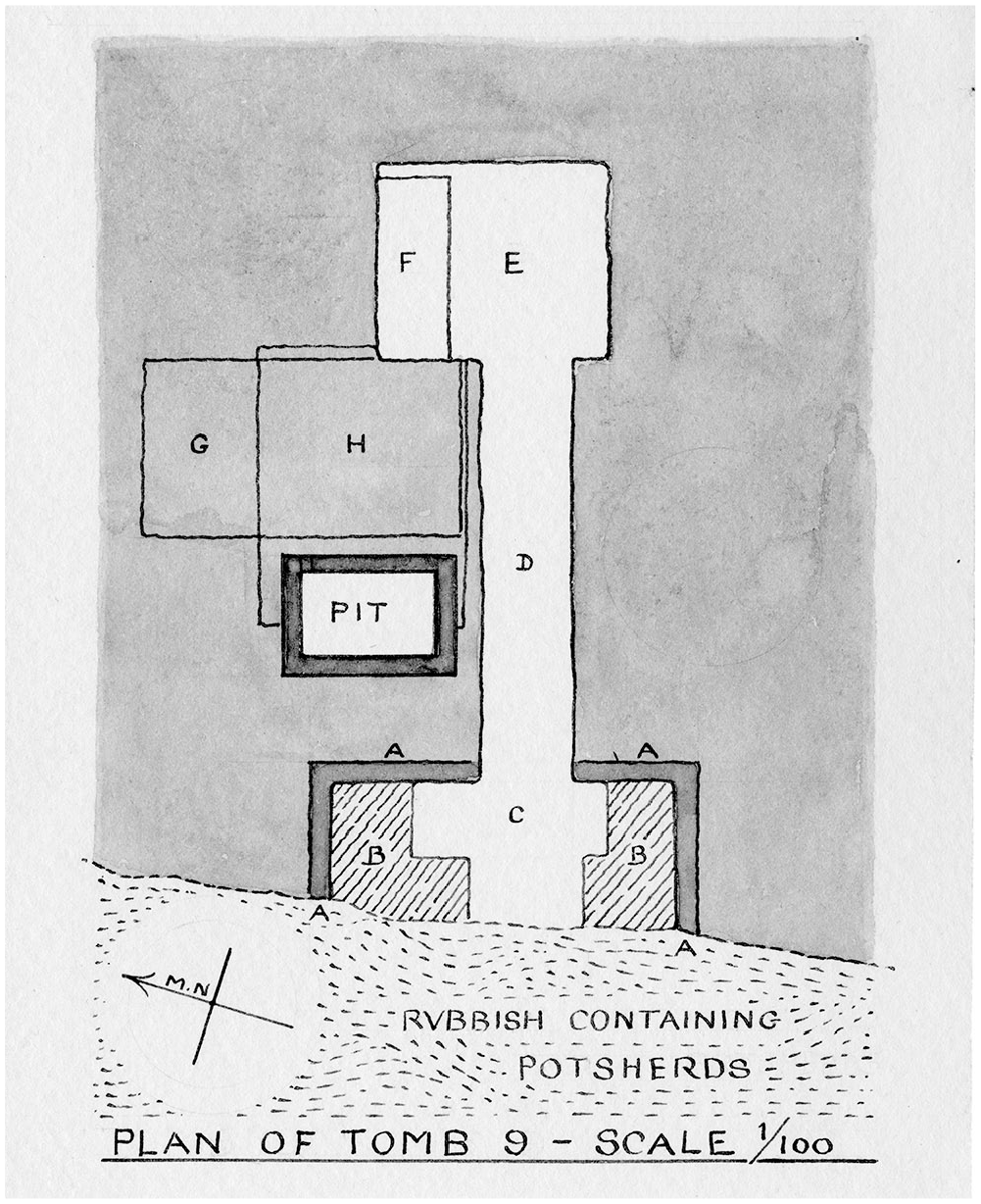
Plan as Carter drew it. Note shape and size of court and orientation of tomb (Griffith Institute Archive, Carter MSS I.J. 119; © Griffith Institute, University of Oxford).
Other finds
In addition to Tomb 9 writing boards in the court, Carnarvon found parts of a canopic box, three canopic jars, and ‘destroyed remains of a plundered burial’ in the pit and pit-chamber. The canopic box should have been in H but that is not sure because of the uncertainty concerning which interior parts Carnarvon cleared in 1908, and which parts he and Carter cleared in 1909. Details conflict and there is no way to verify matters.
One of the canopic box parts was inscribed for Tatinakht 44 and shows a weeping Wadjet and two jackals on shrines. The parts were registered in the EMC as JE 43835 in 1912, 45 while the three uninscribed canopic jars were purchased by the MMA that year from the Museum’s saleroom (MMA 12.181.253a–c). No doubt the fourth stopper was animal headed, to complete the representation of Sons of Horus. Up to now, parallels for such stoppers have not been identified before the Ramesside Period. However, the four clay jars of Senenmut’s mother included one with an animal head, 46 and the Pit 2 D2 coffin at Carnarvon 62 has representations of three theriocephalic Sons of Horus. 47 The context of that coffin indicates that such iconography was part of funerary literature before the early years of Hatshepsut/Thutmose III.
The good condition of three pots illustrated in Five Years pl. xxvi.1 indicates that they could not have come from a court filled with mummy parts and masses of sherds. Natasha Ayers, who catalogued the pottery at Carnarvon 62, states that the Tomb 9 illustrated pottery falls into two ceramic phases: Seventeenth Dynasty to early Eighteenth Dynasty for the various shapes in pl. xxvi.2, and, for the jars in pl. xxvi.1, 48 the succeeding ceramic phase thought to begin with Hatshepsut/Thutmose III.
The ‘child’s coffin too decayed for preservation, and a reed burial of a poorer and much later man’ found in 1909 are difficult to date without more information, but in theory needn’t fall outside a Seventeenth to early Eighteenth Dynasty date. Since so few finds were discovered, and no finds of a date later than that already known were reported inside or outside the tomb, it is possible that the tablets came from within the tomb, but at the least they are consistent with the finds that were noted.
Post-excavation history of Tablets I–II, VIII
Carnarvon I
The recording of this Tablet after removal from Tomb 9 was straightforward. It was registered in the Egyptian Museum in 1909 as JE 41790,
49
and according to a recent examination of the JE by Hassan, the board is described there as,
Tablette portant d’un côté le commencement des maximes d’Ptahhotep, de l’autre un récit de la lutte contre les Pasteurs sous Kamès. Bois stuqué. 0.51 x 0.245. Gournah, fouilles de Lord Carnarvon.
In 1959, when the EMC collection was divided into seven sections to provide for more precise documentation, 50 Carnarvon I became part of Section IV; its number in that section’s Special Register (SR) is 441 (on page 35). Recently the Tablet was given the number GEM 22841 for the Grand Egyptian Museum.
Carnarvon II
The post-tomb history of Carnarvon II was more complicated. This Tablet contains the Instruction of Kairsu and a hymn; and although mentioned and illustrated in Five Years, it was not discussed there.
51
In fact, Carnarvon finds from the lower Asasif that went to the EMC from the 1908–14 seasons were not registered in a methodical or detailed manner, thus it is not surprising that Carnarvon II’s original entry, as understood from later sources, was as follows, as copied by Hassan:
JE 43261 [without the letter (D)]: ‘5 fragments ayant formés 2 tablettes – port. [portant des] inscript. hiératiques – en noir. Bois couverte de plâtre’.
Neither Carnarvon II, a Carnarvon provenance, nor tablet dimensions are mentioned; it is only the later SR IV.708 entry that equates Carnarvon II with JE 43261 ‘D’ and gives the dimensions as 24 × 33 cm (on page 63; see later in this article). There are small grammatical mistakes in the original 43261 entry; its author is not known, but the most logical interpretation is that the entry was originally for four fragments belonging to Carnarvon II (that is, those seen in Five Years, pl. xxix) and one fragment belonging to an up-to-now unrecognized tablet (Carnarvon VIII, next entry).
As stated, the original JE 43261 entry, without letter, was written in 1911, and was preceded there by seven objects (43254–60), all seven of which are mentioned in Five Years as part of the 1908–11 work. 52 The first five objects also have ‘Thebes, fouilles Lord Carnarvon’ as provenance.
From this information one may suggest that in 1911, five writing board fragments from Tomb 9 were registered in the JE, as a separate lot, with or slightly later than seven objects from another Carnarvon location. At a later date, additional Carnarvon writing boards were registered and added to the 43261 entry, making it necessary to give letters ‘A–C’ to the new boards, and ‘D’ to Carnarvon II as seen in Five Years, pl. xxix. The fifth fragment of the original 43261 entry was left without letter (Carnarvon VIII, see next section).
The four pieces of Carnarvon II were augmented subsequently, as reported initially by Gardiner. 53 By 1916, Petrie had acquired a fifth fragment and passed it to Gardiner, 54 who identified it and sent it on to Cairo with Battiscome Gunn in 1931. The fragment was entered as JE 56802 that year (vol. xii), its dimensions recorded as 8.2 × 18.2 cm. It later became SR IV.709 and now—with SR IV.708 (both on page 63 there)—is GM 14180. Probably it was in 1931 that a photo of the Tablet as it appeared in Five Years was inserted into the ‘Remarques’ column of JE 43261, an arrow pointing to the place where the new fragment, 56802, belonged with 43261 ‘D’. Thus the Museum’s documentation for Carnarvon II was completed.
Carnarvon VIII
The number ‘VIII’ is here assigned to the fifth fragment of the original JE 43261 entry that covered four Carnarvon II fragments. Registered on SR IV page 62 as no. 699 with dimensions attributed to the JE (18 × 27 cm), its JE number is listed as 43261 (no letter). The description reads, ‘Tablette. Fragment only; inscribed in black hieratic, on both sides. Bois et stuc.’
Unlike fragments of Carnarvon II, there is no mention of Carnarvon, and of course no reference to Five Years, probably because the Carnarvon II fragments were not yet studied. However the casual circumstances of tablet finds at Tomb 9, 55 Carnarvon II and VIII’s fragmentary natures, and the lack of another Carnarvon source for Tablet VIII all speak for a Tomb 9 provenance for this fragment. Today Tablet VIII has a GEM number, 14427. As shown now by Hagen, in this issue, side A has a line from The Instruction of a Man for His Son, and B, an unidentified literary text. Dating Carnarvon I and II to the early Eighteenth Dynasty, Hagen assigns Carnarvon V to the Second Intermediate Period and perhaps slightly earlier than the other Carnarvon writing boards. Of social interest, Hagen sees mistakes in the text as indications of training (as in Carnarvon VI and VII, see later in this article). Unfortunately, Carnarvon and Carter did not dig the whole of what Carter termed a ‘court’ at Tomb 9, nor its adjacent area.
Carnarvon Tomb 37, 56 hall C, burial 37–23 of Djehuti, 1911: Carnarvon Tablets III–IV
Tomb location and form
Carnarvon 37 was a saff tomb north of Carnarvon 62 and east of Tomb 9 (Fig. 1). Carter dated it to the late Middle Kingdom on the basis of a few finds of that date associated with a layer of rubbish, and more extensive finds of the Late Middle Kingdom in several tombs to the east of 37. On the basis of physical conditions in Tomb 37, Carter believed that the initial phase was followed by a period of abandonment and then extensive reuse, largely ‘for the storing of numerous stray burials of epochs ranging through the Intermediate Period down to the early part of the XVIIIth Dynasty’. 57 According to the tomb’s location, it would have been mainly or wholly covered by construction for the valley temple of Hatshepsut.
Several questions concerning Tomb 37’s history arise from the existing documentation. 58 However, it is clear that two burials in the innermost ground level chamber (C), adjacent to Carnarvon Tablets III and IV, were essentially intact. They suffered minor disturbance but did not belong to two stacks of coffins in that chamber. 59
Tablet finds
Djehuti and his wife Ahhotep were buried in white coffins that date late in Miroslaw Barwik’s sequence of the type (fig. 11). 60 Ahhotep’s canopic box was at her feet, and had a representation of a canopic jar with a human Kebehsenuef stopper. On top of her box was a lesser viscera box that must have belonged to Djehuti. Ahhotep had more objects in her coffin than her husband; however, some elite objects that would logically be associated with Djehuti rather than the stacks of coffins nearby were on the floor near him, including a basket with extensive scribal equipment (fig. 12). Next to it was Carnarvon III (Kemit and part of a narrative or exercise), lying ‘broken in two halves … among the stones covering the floor of the chamber’. Examination of the recent EMC photos taken for Hagen show that the Carnarvon II Tablet was repaired in antiquity.
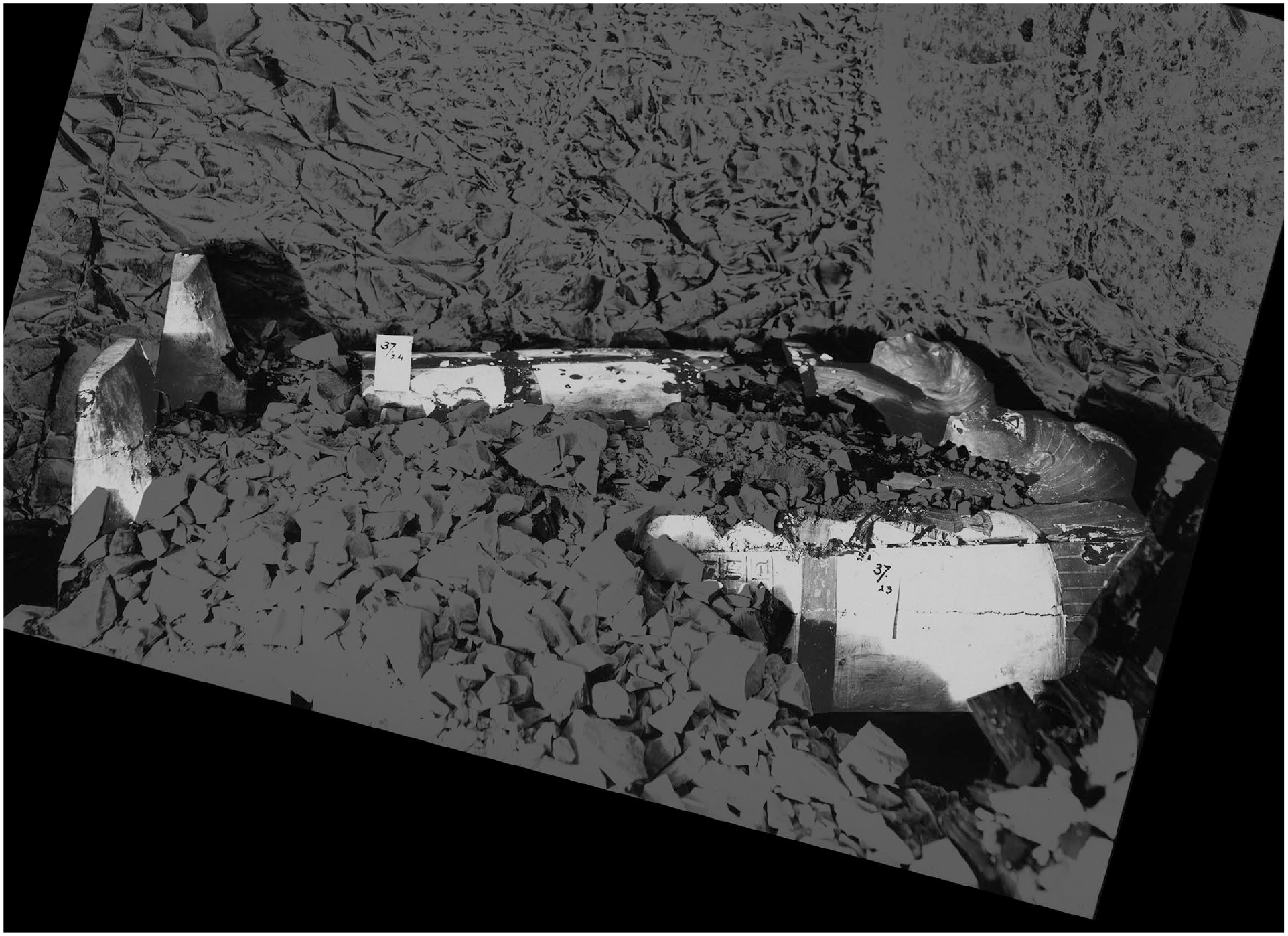
Coffins of Djehuti and Ahhotep in hall C of Carnarvon 37 (Griffith Institute Archive, Carter MSS I. J. 62; © Griffith Institute, University of Oxford; photo digitally manipulated by author to highlight coffins).
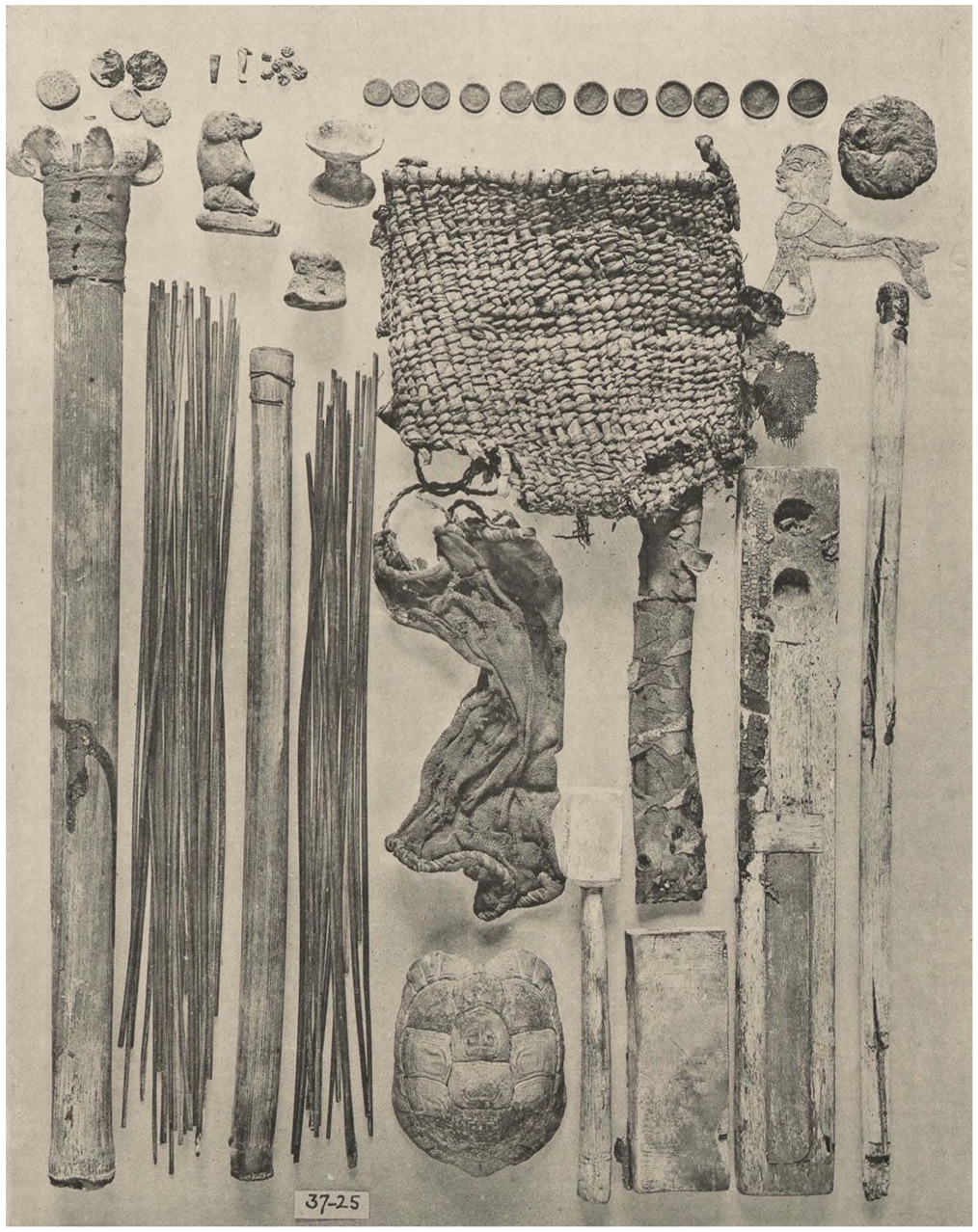
Scribal equipment from a basket adjacent to Carnarvon Tablet III in Tomb 37 (Five Years, pl. lxvi).
Just beyond the foot of the two coffins was a pile of coffins, among which was a late Middle Kingdom pottery offering tray holding an assortment of objects, including the small tablet Carnarvon IV (a narrative regarding a wet nurse and a list of names). Georg Möller mentioned Carnarvon III and IV on 24 February 1911, after visiting Carter/Carnarvon from his own excavations at Deir el-Medineh: ‘Zwei Schreibtafeln, die eine einen lehrhaften Musterbrief, die andre eine Leuteliste enthalted, Schrift des Westcar’. 61
Möller also reported that IV’s ‘reverse is mended with a piece of bark’, 62 thus indicating that both III and IV had some history before deposition and were of importance to Djehuti.
Post excavation history
Tablets III and IV were registered in the JE in 1911, there being no gap between excavation and registration. Tablet III became JE 43217 (SR IV.694 on page 61) with dimensions of 27 × 48 cm, and Tablet IV, JE 43216 (SR IV.707 on page 63) with dimensions of 10 × 26.5 cm. 63 In sum, the sequence of JE entries was Tablet I from Tomb 9 in 1909, II and VIII from Tomb 9 in 1911, and III–IV from Tomb 37 later in 1911.
Carnarvon 62 complex, various locations: Carnarvon Tablets V–VII, IX–XII
Carnarvon 62 is the dominant tomb in the area (fig. 1). Like Tomb 37, it had a pillared façade and was rock-cut. But unlike Tomb 37, it opened onto a large court, and over time, subsidiary and probably secondary chambers were hollowed out in the main tomb. Rock-cut subsidiary and secondary tombs lined the north and south walls of its court, and pits and graves were dug into the court. The term ‘Carnarvon 62 complex’ is used in the digital publication to include all of these parts, for the following reasons.
In 1909 when Carter began working with Carnarvon, a numbering system for every feature investigated in Carnarvon’s vast concession was instigated. In 1909–10, for instance, the men worked 19 sites. 64 These ‘sites’ could be a group of tomb chambers, a trench, a mound, the valley temple of Hatshepsut (site 14), or the north boundary wall of the valley temple (wall 36). At 62, the sites included a court (41), a shallow grave in the court (42) and the main tomb to which the court belonged (62). In the digital publication, a connection between the main tomb and the subsidiary and secondary tombs is indicated through the use of upper case and lower case letters (Tomb 62 versus tomb 42). 65 At Tomb 37, individual finds within a burial could even be numbered, just as subsidiary tombs were separately numbered at Tomb 62.
Tomb plan and development
According to architecture and finds, Tomb 62 was cut late in the Eleventh Dynasty or very early in the Twelfth Dynasty, 66 and the complex was used into the mid-Thirteenth Dynasty. Pottery and some of these finds were preserved into the later period of reuse, but most finds at the complex date to the later period, the Seventeenth Dynasty through the early reigns of the Eighteenth Dynasty until Hatshepsut’s valley temple project completely covered the site.
Carnarvon Tomb 62, Court 41 debris, 1911–13: Carnarvon VI–VII
No precise location was given for these two Tablets and they do not appear in the ‘Report of 1912–13’. Indeed court 41 lacks a section in the Carter manuscript for Tomb 62. However, the Tablets are recorded in eight Carnarvon/Carter photos within an envelope now in the Griffith Institute marked, in Carter’s hand, ‘Tablets: Courtyard 41’ (fig. 13).

Griffith Institute documentation for Tablets VI–VII and XII (Griffith Institute Archive, Carter MSS I.J. 1–9; © Griffith Institute, University of Oxford).
It is not certain when or precisely where in the court Carter/Carnarvon found these Tablets. If it was late Spring 1911 or early 1912, it would have been the northeast corner of court 41; but as the team continued to clear the court into 1913, and as the envelope is labeled ‘Courtyard 41’ rather than ‘Tomb 41’, the Tablets may have been in the court’s northwest quadrant, depending on when Carter annotated the envelope.
Finds from the British and American sectors of the court differed in several ways. 67 Of the 664 Carnarvon entries in the catalogue of objects for the complex, only five came from court 41 debris: 68 the writing boards, a few uninscribed funerary cones, and a Middle Kingdom scarab ring. Of the 946 entries in the catalogue of MMA objects, 58 were from court 41 debris: a few Middle Kingdom items or fragments but mainly whole pots of the Seventeenth Dynasty to early Eighteenth Dynasty ceramic phase. Occasionally Lansing judged that some items in the court had been thrown out from pits. The comparative lack of objects in the court is consistent with the orderly blocking of tombs.
In any event, the eight black and white photos of Carnarvon VI and VII are of typical Carnarvon/Carter format and appear to show one side of three tablets. In 2014, Stephen Quirke identified Khakheperreseneb in one of the photos (now numbered Carnarvon VI), and thereafter Hagen took on the responsibility of preparing an essay for the digital publication cited in footnote 9 of this article, with a plan for full publication (Hagen, this issue).
Post-excavation history
Inquiries to the EMC, Griffith Institute, and Ägyptisches Museum Berlin for writing boards or notes of Möller brought no results, but in late 2016, thanks to a paper Hagen gave where he showed the Carnarvon/Carter photographs, Khaled Hassan recognized the Tablets in small photos of the EMC’s SR IV for nos 697–8, 701 on page 62. These entries had the JE numbers ‘43261 A–C’. In the original JE entry of 1911 for 43261 discussed earlier, Hassan found the following secondary notes (mentioned earlier with Carnarvon II and VIII from Tomb 9). In the ‘Remarques’ column, to the right of ‘curly bracket’ sign {, was written,
43261 A — 42 × 16 43261 B ‘Tablet VI’ 26 × 18 43261 C ‘Tablet VII’ 42 × 16 43261 D ‘Tablet II’ 24 × 33
This notation must have been made after Maspero assigned ‘Carnarvon V’ to the tablet fragments found in 62’s subsidiary tomb 43 that he published in 1914 (see later section of this article). The JE entered a few Carnarvon 62 objects in 1912 and 1913; 69 Carnarvon Tablets VI and VII were probably brought to the Museum in 1913. In any event, 43261 A–C were ‘back’ entered into an earlier Carnarvon Tablets JE entry (43261, of 1911) without specific provenance. 70
Hassan noted one other secondary note with the 1911 JE 43261 entry. A photo of the Gardiner fragment was pasted in by a different staff member in 1931 and, in the ‘Publications’ column, wrote ‘Five Years Explorations, Carnarvon, Earl of, and Carter, pl. 27–29’ as a reference to Carnarvon I–II for the ‘A–C’ Tablets. That person subsequently crossed out the reference as a mistake.
Hagen’s recent examination of JE 43261 A–C has revealed that two of the eight black and white Carter/Carnarvon photos in figure 13 show the recto of one Tablet (43621 B, now Carnarvon VI), while the other six photos show recto and verso of a second Tablet (43261 A and C, now Carnarvon VII). In other words, the verso of the board 43261 ‘A’ is bare, ‘C’ is plaster only, and the measurements of the two are very close. This explains the lack of a Tablet number for ‘A’ in the JE 43261 list cited. According to Hagen, Carnarvon VI has beginning lines of Khakheperreseneb and a continuation of Khakheperreseneb on side A; and on side B, two study drawings that, in my opinion, best fit a late Second Intermediate Period date. Carnarvon VII has the continuation of Khakheperreseneb on side A, and the opening lines as well as the continuation of that text on side B.
Carnarvon 62 complex, Pit tomb 43, near burial 43-5, 1912: Carnarvon V
Plan and finds
Pit tomb 43 lay in the northeast corner of court 41 (fig. 1). 71 Brick courses surrounded its opening. The pit led to three bricked up chambers, each of them with at least some blocking, according to Carter’s sketch. He reported a few traces of Middle Kingdom items, from which he judged that the tomb had been dug in the Middle Kingdom. But essentially the three chambers had what Carter judged to be 16 intact burials from the later period of use. In fact the finds generally date to the Seventeenth Dynasty and first reigns of the Eighteenth Dynasty, but a scarab naming Neferure was in one of three coffins in the west chamber, and a Bichrome-inspired juglet dated to the time of Hatshepsut by Ayers was in his ‘north’ chamber with 11 of the coffins.
Carter’s ‘west’ chamber had three coffins, side by side: a ‘semi-decorated anthropoid’ (white, with cross bands) flanked by two plain rectangular coffins. 72 In a drawing of the chamber, Carter wrote, ‘fragments of tablet’ at the feet of rectangular coffin 43-5. Judging by Carter’s recording processes, the fragments were notable enough to mention, although he did not note them in his text.
Coffin 43-5 ‘contained two mummies. Upon one of the mummies was a cowroid mounted in a gold funda’, wrote Carter. Daphna Ben-Tor, who studied the scarabs and seal amulets at Carnarvon 62, found the cowroid of typical Eighteenth Dynasty form but was not able to comment further without a photo of the base. 73 However, the placement of an incomplete tablet outside a coffin that contained two mummies does not certify that the tablet originated in that coffin. Fragments of a chair, found on two separated coffins in the north chamber of tomb 43, were not assigned to a specific burial by Carter.
Pit tomb 43 was dug in 1912. In 1913, Möller visited Carnarvon and Carter’s work and thereafter wrote the following in his diary:
28 Feb: …[Carter and Lord Carnarvon] haben einige Holztafeln mit hieratischen Texten gefunden, dabei angeblich eine Niederschrift der ‘Unterweisung des Amenemhêt’ aus der Hyksoszeit. 4 Mar: Carter eine Anzahl beschriebener Holztafeln, hieratisch, Ende der Hyksoszeit und früheste 18te Dyn, sehr cursiv, dabei ein Stück aus den ‘Unterweisungen des Amenemhêt’ und einen Nilhymnus. Ich habe die Bearbeitung dieser Texte für Carnarvon übernommen.
74
Again judging by Carter’s recording processes, the fragments must have been well enough preserved for Carnarvon to ask Möller to work them up. 75
Post-excavation history
Although found in 1912, and registered in the JE in 1927 (vol. xi.51971), the fragments probably came into the Museum in 1913 when there was another Division of Carnarvon objects.
76
In 1914, Gaston Maspero published the article ‘La tablette Carnarvon no. 5’
77
which began,
Les fragments de la Tablette Carnarvon no. 5 sont transcrits ici d’après le fac-similé de Howard Carter, revu sur les fragments de l’original qui sont conservés au Musée du Caire.
The fragments have portions of the Instruction of Amenemhat, as Maspero realized. Since no other such texts were reported among the Carter/Carnarvon finds, Carnarvon V must be what Carter noted on his tomb plan and what Möller referred to in his diary.
The fragments were ultimately registered in SR IV: 700 (on page 62) in three boxes:
Tablette Carnarvon no. 5; Fragments d’une tablette qui renfermait les Instructions d’Amenemhat (Sallier II); Dans 3 bôites à cigares, L. max. 0.165; Gournah, 1913. Cf. Maspero, Enseignements d’Amenemhat, p. 33.
Thereby the SR indicated the tablets’ date of entry. Perhaps in the meantime Möller had decided that it was not practical for him to work up the fragments. As photographed in the Museum recently, there are many small fragments that will need conservation before further publication.
Carnarvon 62 complex, Corridor tomb 45, burial 45-6, 1912: Carnarvon IX–X
Plan and finds
According to the number and location in Carter’s ‘Report of 1912–13’, 78 this rock-cut tomb was the smallest and easternmost tomb on the north side of court 41 (fig. 1; see its entrance in fig. 14). 79 It consisted of one small ground- level chamber, in the floor of which was a pit leading to two subterranean chambers; those chambers were not bricked up. Carter noted the remains of several Middle Kingdom objects but not their locations.
The actual pit had four roughly stacked coffins from the period of reuse: two rishis, a probable dugout, and one decorated rectangular example. In the south chamber was only a child’s coffin. Between the pit and the north chamber was another child’s coffin, and within that chamber were two anthropoid coffins, one of which, 45-6, was described: ‘… a rishi bore the name Men. It contained a scribe’s palette, and under the shoulders of the mummy (a man) were two writing tablets’. 80
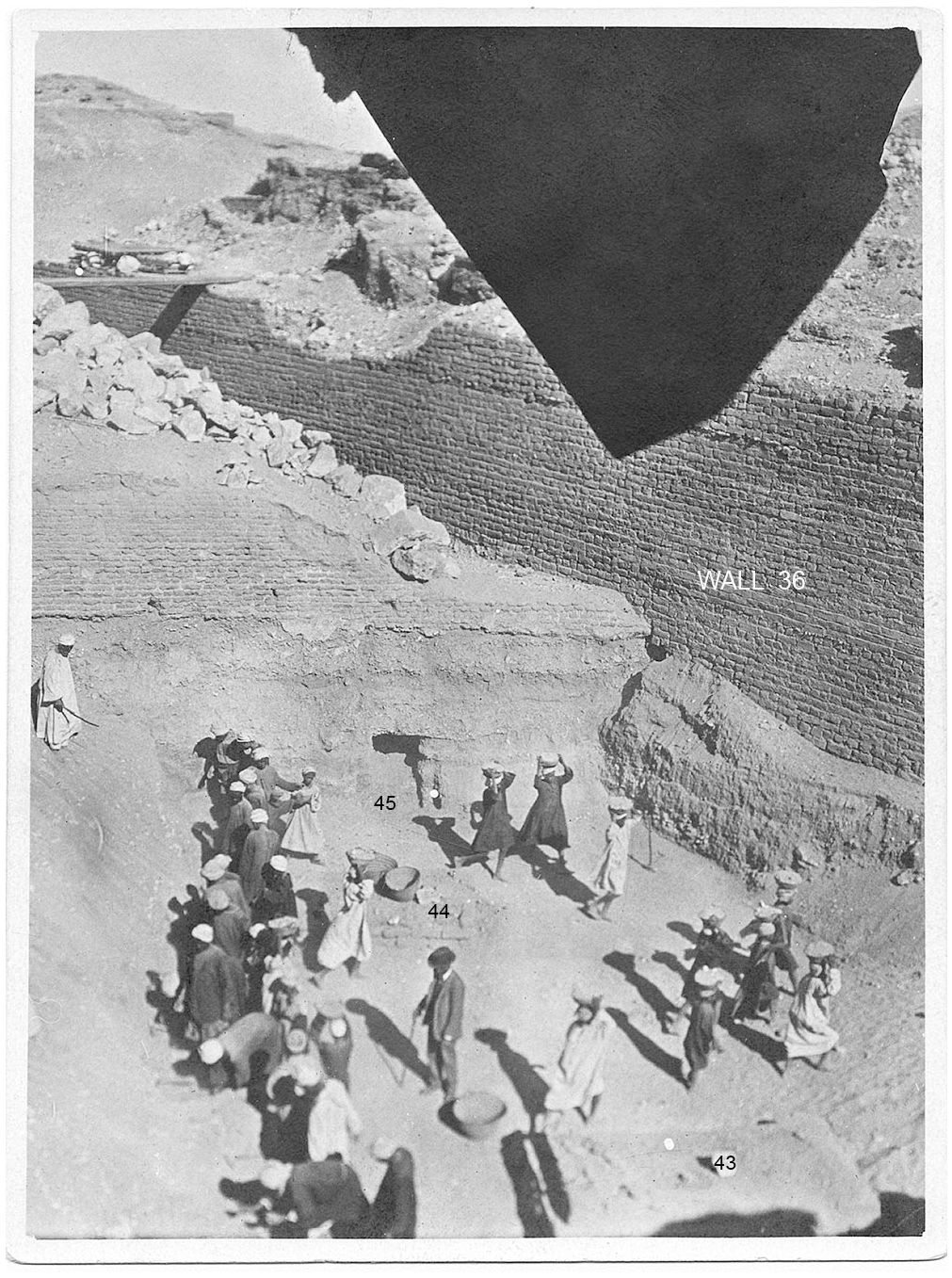
View down into northeast corner of Carnarvon 62’s court 41; the small subsidiary rock-cut tomb 45 near center (author, from © photo courtesy Metropolitan Museum of Art, Department of Egyptian Art Archives, MMA snapshot 16).
Post-excavation history
The tablets have not been located. However, the coffin has been traced to a traditional rishi in the British Museum, EA 52950 (fig. 15), thanks to Carter’s recording of mn as a personal name, the Museum’s interest in Carnarvon’s work, and the source of the coffin. 81 Three pots near the head of the coffin are provisionally assigned by Ayers to the Seventeenth Dynasty to early Eighteenth Dynasty. Of the scarabs in the tomb that could be sorted into types by Ben-Tor, one was Late Middle Bronze IIB Canaanite and three were probably from the early reigns of the Eighteenth Dynasty. Photos of the coffin before restoration show paint losses, but the interior of the wooden lid does not seem damaged, thus the tablets may have been relatively complete. The coffin containing the two boards has a resemblance to the rishi coffin of Antef VI Sekhemre-heruhermaat (Louvre E 3020).
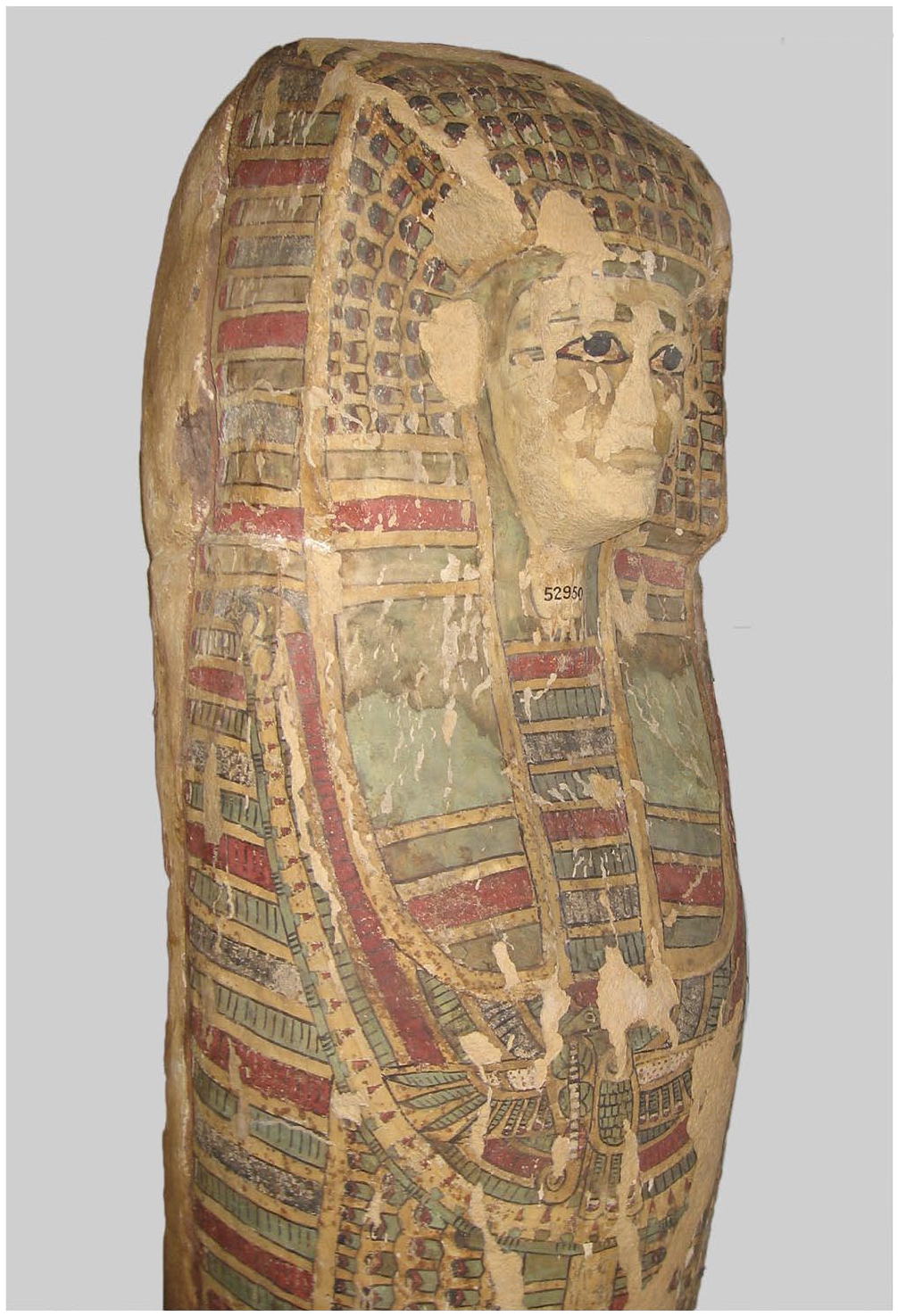
Traditional rishi coffin of the owner of burial 45-6 in the Carnarvon 62 complex (BM EA52950, photo © Gianluca Miniaci, courtesy of the Trustees of the British Museum).
It has been seen that in 1913 Möller wrote that he would work up Carnarvon V 82 but that the fragments went to the Egyptian Museum and were published by Maspero in 1914. In the following sections, it will be seen that two more writing boards were found in 1913 (XI and XII), from main Tomb 62. These ended up in Gardiner’s hands, one in fragile condition, the other not. But if it is unlikely that Tablets IX–X from pit tomb 45 went to Gardiner or Möller, it is also unlikely that they went to the EMC’s Sale Room. Perhaps they are in the Museum, yet unrecognized. 83 Another equally tenuous possibility is that two boards in the Petrie Museum from Petrie’s collection are from tomb 45. 84
Carnarvon Tomb 62, west burial chamber A, burial 62-8: Carnarvon XI
Plan and Tablet finds
Main Tomb 62 was briefly described earlier in this article; its west burial chamber A is the unmarked innermost chamber to the left of ‘n. chapel a’ in fig. 1. 85 I do not consider this chamber original 86 but am uncertain when it was cut. Its contents date to the period of reuse: ‘a mass of coffins, about 18 in number stacked one upon another in a most careless manner. Most of them were broken and only a few could be removed and examined separately’. 87 Similar circumstances reported in other parts of the complex indicate that it is impossible to say whether west burial chamber A’s condition signaled reburial, as Carter judged was the case at Carnarvon 37, or whether the burials would today be considered original. 88
Carter described coffin 62-8 thus:
Dugout coffin containing the mummy of a man. Resting upon the mummy was a rough wooden palette (uninscribed) attached by string to a wooden (covered with plaster) tablet bearing a hieratic inscription on both sides and some drawings of a locust. (See notes upon tablet by Möller and Gardiner) [subsequently added, ‘never received’].
89
By the ‘rough wooden palette’ attached with string to the writing tablet, Carter meant a scribe’s palette, and the placement of it and the tablet on the body indicates ownership. One could conclude that the deceased was a scribe, notwithstanding the low status that dugout coffins normally signify.
Carter was of the opinion that the ground-level spaces of main Tomb 62 were completely blocked in the time of Ahmose or somewhat later, and that robbers had subsequently entered those spaces. There is no way to corroborate this, but it is true that there are no royal names in the main tomb later than Ahmose, and that the finds that were recorded did not extend into Hatshepsut’s time.
Post-excavation history
In 2014, Stephen Quirke connected the mention of a locust in Carter’s ‘Report 1912–13’ to a photograph published by Helmut Brunner in 1957. 90 The board had entered the Ashmolean Museum in 1948 as a gift from Gardiner; its number became 1948.91, its dimensions recorded as 14 × 25 cm, and its provenance listed as ‘Thebes’. Hagen published the board in 2014 with reference to a transliteration Gardiner had made, now in the Griffith. 91 A pencil note on Gardiner’s ink transcription of side ‘a’ reads, ‘Given to the Ashmolean’. The transcriptions are executed in ink and headed by the label ‘62, 8’, a reference that can now be understood as the provenance of the board, Carnarvon Tomb 62, burial 8 in west burial chamber A. A Hymn to the Nile with a list of names ties this Tablet to the one mentioned by Möller in his 1913 diary (see Carnarvon V entry given earlier).
Carnarvon Tomb 62, west burial chamber A debris, 1913: Carnarvon XII
Plan and Tablet finds
Carnarvon XII was found in west burial chamber A as well, but in debris. After listing five of the 18 coffins in the chamber that ‘could be removed and examined separately,’ Carter wrote, ‘Among the remaining debris, the following interesting objects were found: a wooden tablet (see notes by Müller and Gardiner)’ to which Carter subsequently added ‘never received’. 92 The chamber measured c.2.2 × 3.4 m—not a large space for 18 coffins, yet Carter did not associate the tablet with coffin 62-8 (containing Carnarvon XI) or with burial 62-6, also in a dugout coffin with a scribe’s palette nicely inscribed for ‘the excellent and truly quiet scribe, Teti’.
Post-excavation history
In 2014, James Allen connected the Carter/Carnarvon photo of Tablet XII (fig. 13, bottom) with the tablet published by John Barns in 1968 as Ashmolean 1964.489, a wisdom text that entered the museum as a bequest of Gardiner. 93 Barns reported that, because the wood had disintegrated, the ancient plaster surfaces had been individually mounted on sheets of glass by means of paraffin.
It will be noticed that the bottom photo in fig. 13 has a different character than the black and white Carnarvon/Carter photos above it. More importantly, Gardiner’s transliterations of sides ‘a’ and ‘b’—also in the Griffith but as AHG/29.33 a, b—are both labeled ‘62 A’ in the same ink. A later pencil note in Gardiner’s hand on the transliteration of side ‘b’ reads, ‘I think from Carnarvon’s dig at Thebes. This one handed to Barns for publication’. The label ‘62 A’ must refer to west chapel A of the main tomb, 62; in fact, the notation is comparable to the ‘62, 8’ on Gardiner’s transliterations of Carnarvon XI. The four Gardiner sheets are on similar paper, folded similarly. In sum, the envelope with the photographs of Carnarvon VI and VII from court 41 (fig. 13) was originally given to the MMA’s Egyptian Expedition by Carter. At some point the photo of Carnarvon XII was inserted into the ‘Courtyard 41’ envelope that contained photos of Carnarvon VI–VII.
Other scribal finds at the Carnarvon 62 complex
In addition to the items already mentioned, pots with hieratic inscriptions, scribal equipment, and the title ‘scribe’ were found in several parts of the complex. 94
Conclusions
Extensive study of archives and archaeological excavations has established provenances for 12 literary writing boards from Carnarvon excavations in the lower Asasif between 1908 and 1913. In his essay for the Carnarvon 62 digital publication (cited in footnote 9), Hagen discusses the presence of tablets and ostraca with literary texts in cemeteries at Thebes and elsewhere. 95 Half of the Carnarvon Tablets were in tombs: III and IV in a tomb chamber as valued possessions of an individual with scribal equipment; 96 IX–XI within burials that had scribal palettes; and V and XII in the debris of tomb chambers. The other half were found outside tomb entrances, namely I–II and VI–VIII. Because of the level of writing in V–VII and VIII, Hagen has suggested that those Tablets could have been used in scribal training. Certainly the open court of Tomb 62, where V–VII were found, would have been an appropriate place for training. Unfortunately, not enough is known about the area in front of Tomb 9 to characterize it in reference to Tablets I–II and VIII.
Importantly, Hagen’s analyses push back the date of early literary texts into the Second Intermediate Period when ceramics, coffins, and selected objects show exceptional creative development. The particular contexts in the lower Asasif range from modest to substantial and provide a glimpse of boys and men who participated in the literary culture of the mid-second millennium bc.
This study also points out the fragility of archaeological information that does not receive prompt publication from excavators. At the same time, it is meant to encourage the development of means that take advantage of digital advancements.
Footnotes
Funding
The author received no financial support for the research, authorship, and/or publication of this article.
1.
Earl of Carnarvon and H. Carter, Five Years’ Explorations at Thebes: A Record of Work Done 1907–1911 (Oxford, 1912), 2, 4, 34–5, 38, pls xxv–xxvi.
2.
Carnarvon and Carter, Five Years, 64–88.
3.
Carnarvon and Carter, Five Years, 2, 4, 34, 51; see also footnote 20 of this article. The location ‘Deir el-Bahari’ is used for Tablets I–IV in P. Vernus, ‘Schreibtafel’, in W. Helck and W. Westendorf (eds), LÄ V (Wiesbaden, 1984), 703–9.
4.
While A. M. Lythgoe, the Metropolitan Museum of Art Curator and Director of Excavations, referred to the area closest to the cultivation as the ‘eastern or lower Asasif’, ‘lower Asasif’ was commonly used by early members of the Museum’s Egyptian Expedition. They appear to have experienced the area as the lower end of the Asasif valley which sloped upward from the cultivation to the temples of Mentuhotep II and Hatshepsut, shielded by a wide bay of desert cliffs. See A. M. Lythgoe (ed.), The Egyptian Expedition, 1915–16, BMMA 12 (1917), Supplement, 7–8; H.E. Winlock, ‘Excavations at Thebes in 1912–13, by the Museum’s Expedition’, BMMA 9 (1914), 12,  . The term is maintained here because of its agreement with archival records as well as for the fact that Ptolemaic tombs covered a wider area than that where the Tablets were found (cf. footnote 29 of this article).
5.
Carnarvon and Carter, Five Years, 88. The number ‘41’ was given to the large court in front of the tomb to which it belonged, 62; the British team understood the character of the court only towards the end of excavation in the area. The number 41 was cited by A. H. Gardiner (‘The Tomb of a Much-Travelled Theban Official’, JEA 4 (1917), 28–9), but it is not clear when Carter wrote the text Gardiner used. The Topographical Bibliography (PM I/2 [2nd rev. edn; Oxford, 1964], 616) probably obtained the number ‘41’ from Gardiner’s article; the Griffith Institute (Griffith) did not have the Carter manuscript that corrected the number (footnote 13 of this article). Other corrections are made in the publication cited in n. 9. Inconsistencies in terms are understandable considering the complexity of the Tomb 62 site, disparity of records, changes in institutional staff since the days of excavation, and distances between the Griffith Institute in Oxford and the MMA in New York.
6.
PM I/2, 886 exceptionally preferenced Carter as excavator, but it must be remembered that the concession for excavation was the Earl of Carnarvon’s and that it passed to the Countess, his wife, after the Earl’s death (T. G. H. James, Howard Carter: The Path to Tutankhamun (London, 1992), 272–3, 374). Contemporary sources recognized Carnarvon as concession holder. Lythgoe referred to the site as ‘the large courtyard tomb from which Lord Carnarvon has got so much interesting material’ (letter of 24 March 1913, MMA Department of Egyptian Art Archives); A. Lansing referred to ‘Lord Carnarvon’s expedition’ (‘Excavations in the Assasîf at Thebes’, 7, in Lythgoe, The Egyptian Expedition, 1915–16; the Egyptian Museum’s Journal d’entrée (JE) cites ‘Fouilles Carnarvon’ as source of objects; accession cards at the MMA list ‘Lord Carnarvon’s Excavations’. Theban Tomb 313 (PM I/1, 388–89) was previously MMA 510 and earlier still, Carnarvon 81. See also footnote 19 for further on Carnarvon.
7.
Lansing, ‘Excavations in the Assasîf’, 7–26.
8.
The geographic area considered here has been reviewed by P. Whelan (Mere Scraps of Rough Wood? 17th–18th Dynasty Stick Shabtis in the Petrie Museum and Other Collections (GHP Egyptology 6; London, 2007), 14–19) and G. Miniaci (Rishi Coffins and the Funerary Culture of Second Intermediate Period Egypt (GHP Egyptology 17; London, 2011), 84–96) but with less documentation.
9.
10.
A ‘3-dimensional’ digital format was an efficient means of processing and presenting information from excavations undertaken 100 years ago at a very damaged site, but prospects for hosting and longevity are limited, as are peer review, distribution, library cataloguing, and journal review.
11.
Gardiner, ‘Much-Travelled Official’, 28–38; PM I/2, 617. This tomb did not have writing boards. The two limestone stelae that Gardiner identified as Eleventh Dynasty were lying in court debris. No plan of the tomb has come to light, and from available records, it is impossible to verify the original location of those stelae: Lilyquist, Excavations,
12.
The term is used in the 1912–13 Report described in footnote 13 and in manuscript catalogues in the MMA’s Department of Egyptian Art that Carter drew up for objects in Carnarvon’s personal collection, purchased by the MMA in 1926 from the Countess of Carnarvon.
13.
An illustrated manuscript written in 1912–13, the Report is housed in a cardboard slipcase labeled ‘Howard Carter Manuscript Notebook’. Given to Lansing for publication, it is now in the Department of Egyptian Art, MMA. It and a number of mounted Carnarvon/Carter photographs were stolen from American Express Cairo in 1920 but came to light in Connecticut in 1975. It is reproduced in full as
14.
Although visits to the Griffith Institute took place in 1990 and 1992, almost all material studied was sent by staff of the Institute, namely H. Murray, J. Málek, D. Magee, E. Fleming, C. Warsi, and F. Bosch-Puche, to whom I am deeply grateful.
15.
It was my understanding when working at the MMA that the Carter documents had come from his Elwat el-Diban house, left to the MMA in Carter’s will (James, Howard Carter, 407).
16.
Records at Highclere Castle were not available for study.
17.
A. Amin, photographer; K. M. Abd El-Qader, curator; M. B. Eldien Hassan, of the Grand Egyptian Museum; N. Hassan Salen and M. Abdel Razek of the EMC’s Registration office. The photography was initiated by Hagen, who is thanked for reading an early version of this article. I also thank the Editor, reviewers, and copy-editor for their time and attention in bringing this study to light.
18.
PM I/2, 618–19. See Miniaci, Rishi Coffins, 84, and F. Hagen, An Ancient Egyptian Literary Text in Context: The Instruction of Ptahhotep (OLA 218; Leuven, 2012), 174–9. For an overview of Carnarvon and Carter’s work between 1907 and 1914, see C. N. Reeves and J. H. Taylor, Howard Carter before Tutankhamun (London, 1992), 85–103.
19.
For the 1908 date and an appraisal of Carnarvon’s interest and participation in excavations, as well as Carter’s role as Carnarvon’s archaeologist, see James, Howard Carter, 138–66 and N. Strudwick, The Legacy of Lord Carnarvon: Miniatures from Ancient Egypt and the Valley of the Kings (Laramie, WY, 2001).
20.
Five Years, 2, 4. A footnote explained that Birabi is ‘the name [that] is locally used … for a ‘vaulted tomb’, of which many occur in the district’. In a letter dated 17 March 1911 to E. A. Budge, Carnarvon also characterized the area of this region both as ‘a large mound lying nearly on the axis of the temple of Deir el-Bahri’ and ‘in the Basalli portion of Dira Abu el-Naga’ (Department of Middle East, courtesy Trustees of the British Museum, kindness of J. Taylor). Lansing used the term Birabi more properly, that is, for the upper levels of his excavations that were dominated by Ptolemaic tombs: Lilyquist, Excavations,
21.
Five Years, 34–5.
22.
Five Years, 34.
23.
While Five Years is a gold mine of information, the information is not well organized and can be misleading, as in Miniaci, Rishi Coffins, 84, where Tomb 9 is located nearer TT 15, the tomb of Tetiky; see J. Dorner’s map in M. Bietak and E. Reiser-Haslauer, Das Grab des `Anch-hor, Obersthofmeister der Gottesgemahlin Nitokris, Teil 2 (ÖAW V; Vienna, 1982), pl. I. For the line of cultivation as it was perceived early in the twentieth century, see Marquis of Northampton, W. Spiegelberg, and P. E. Newberry, Report on Some Excavations in the Theban Necropolis during the Winter of 1888–9 (London, 1908), pl. ii; Lansing, ‘Excavations in the Asasif’, .
24.
Five Years, 38.
25.
Five Years, 4; understood also by Hagen, Ptahhotep, 175–6.
26.
Five Years, 38.
27.
The Griffith’s photo identifications are from the inventory mentioned above [text with n. 15] that was in the MMA but was transferred to the Griffith by W. C. Hayes in 1956: ‘Carter MSS: Work and Excavations in Thebes, Meir – Kuseir el Amarna, Balaman in the Delta, and Middle Egypt’. Group I is Thebes, group J is Excavations (pages 15–18). Notations on photographs and on envelopes containing photographs are sometimes in Carter’s hand and sometimes in the hand of a Griffith staff member (communication with E. Fleming, Apr 2010).
28.
29.
See Five Years, 8, 42–5, 47–8 for the Ptolemaic remains that spread at least from Mentuhotep II’s causeway northward past Hatshepsut’s valley temple.
30.
Carter MSS. I.J. 223, 221, 220.
32.
These photos have been digitally enhanced.
33.
Five Years, 4.
34.
Five Years, 34–5.
35.
Five Years, 34.
36.
Chief Inspector Weigall wrote that at the end of the 1908 season Carnarvon brought the Tablets in a basket of ‘odds and ends and amongst these, and stuffed anyhow into the mouth of the basket was this Tablet [no doubt Carnarvon I] in two pieces’ (J. Hankey, A Passion for Egypt: Arthur Weigall, Tutankhamun and the ‘Curse of the Pharaohs’ (London, 2001), 127).
37.
Lilyquist, Excavations,
38.
Five Years, pl. xxvi.2. In Lansing’s Pit tomb 3, four complete pots were documented in the shaft.
39.
If the brick remains had been a small chapel or shrine, it wouldn’t have been termed a pit. For small brick chapels at Thebes, see most recently J. Galán, ‘Ahmose(-Sapair) in Dra Abu el-Naga North’, JEA 103 (2017), 179–201. For a larger example, C. Lilyquist, ‘A Foreign Vase Representation from a New Theban Tomb (The Chapel for MMA 5A P2), in Jacqueline Phillips (ed.), Ancient Egypt, the Aegean, and the Near East: Studies in Honour of Martha Rhoads Bell (San Antonio, TX, 1992), II, . Lilyquist, Excavations,
40.
41.
Five Years, 6.
42.
Five Years, 64, pl. xxx.
43.
Five Years, 64, pl. xxx; cf. Griffith Carter MSS. I.J. 70 in Lilyquist, Excavations,
44.
The name is read thus by P. F. Dorman, with the initial sign as Gardiner U30: Faces in Clay: Technique, Imagery, and Allusion in a Corpus of Ceramic Sculpture from Ancient Egypt (MÄS 52; Mainz, 2002), 77, 161–2, pl. vi.a–c.
45.
The entry is in vol. viii of the JE, as all JE numbers in this study unless otherwise noted. Page numbers not available.
46.
A. Lansing and W. C. Hayes, ‘The Museum’s Excavations at Thebes’, in H. E. Winlock The Egyptian Expedition 1935–1936, BMMA 32, Jan. Section II (1937), 23. Photograph supplied by Dorman, who will be publishing MMA intact tombs and deposits below TT 71.
47.
Lilyquist, Excavations,
48.
Diagnostic features are the black bands, elongated bodies, and wheel-finished bases, according to Ayers, communication 1 Dec 2018. Most of the pots in pl. xxvi.2 were purchased by the MMA (MMA 12.181.348–49, .360, .362–3, .365–6, .371–3, .389, .392, .450–1) but deaccessioned to the Oriental Institute Museum, Chicago. Two of the jars in pl. xxvi.1 are in the British Museum (EA 50747–8), a gift from Carnarvon in 1912.
49.
See B. Bothmer, ‘Cairo Museum Numbers’, NARCE 22 (1956), 16 for the years when numbers cited here would have been registered.
50.
Information about the Special Registers kindly supplied by former Egyptian Museum Director M. Saleh, 2 May 2018.
51.
Five Years, 37, pl. xxix.
52.
Funerary figures from the tomb of Tetiky, a hoe from Hatshepsut’s valley temple site, botanical remains from Carnarvon Tomb 5: Five Years, 20–1, 24, 40.
53.
A. H. Gardiner, ‘The Defeat of the Hyksos by Kamose: The Carnarvon Tablet, No. I’, JEA 3 (1916), 95–6.
54.
Without knowledge of the Tablet before Petrie gave it to Gardiner, one might note that Petrie was excavating at Qurna in 1909 (S. Quirke, ‘Petrie Archives in London and Oxford’, in D. Magee, J. Bourriau, and S. Quirke (eds), Sitting Beside Lepsius; Studies in Honour of Jaromir Malek at the Griffith Institute (OLA 185; Leuven, 2009), 453), and that among Petrie’s workmen was a member of the dealer family Molattam (F. Hagen and K. Ryholt, The Antiquities Trade in Egypt 1880–1930: The H. O. Lange Papers (Copenhagen, 2016), 250, 261). It is well known that Petrie visited dealers to see whether items from his own work had been brought in.
55.
Carnarvon must have had a Division with the Department of Antiquities in 1909, as he donated Tetiky objects to the British Museum in 1909 and 1910 (Museum’s website, EA1511 and EA49128–30; 26 Apr 1909 letter of Carnarvon to Budge, source as in footnote 20). For work at Tetiky’s tomb, see Five Years, 2–4.
56.
In addition to Five Years, 64–88 and PM I/2, 615–16, see the following for Tomb 37: S. T. Smith, ‘Intact Tombs of the Seventeenth and Eighteenth Dynasties from Thebes and the New Kingdom Burial System’, MDAIK 48 (1992) 193–231; B. B. Williams, New Kingdom Remains from Cemeteries R, V, S, and W at Qustul and Cemetery K at Adindan (University of Chicago Oriental Institute Nubian Expedition 6; Chicago, 1992), 6–10; Strudwick, Legacy of Lord Carnarvon, 26–7; Miniaci, Rishi Coffins, 84–91 for Tomb 37 as well as the corridor and pit tombs east of 37 that he considered subsidiary to Tomb 37; G. Rosati, ‘‘Writing-Board Stelae’ with Sokar-Formula: A Preliminary Account’ and G. Miniaci, ‘Note on the Archaeological Context of Tomb C37, Asasif’, in G. Miniaci and W. Grajetzki (eds), The World of Middle Kingdom Egypt (2000–1550 bc): Contributions on Archaeology, Art, Religion, and Written Sources, II (Middle Kingdom Studies 2; London, 2016), 209–28, 228–35.
57.
Five Years, 64.
58.
Lilyquist, Excavations,
59.
Five Years, 74 nos. 23–4. For the tablets see 77–8, nos 26 and 28, pls lv, lxxvi.1–2, lxxvii–lxxviii.
60.
M. Barwick, ‘Typology and Dating of the “White”-type Anthropoid Coffins of the Early XVIIIth Dynasty’, Études et Travaux 18 (1999), 7–33, D3 and D4. Djehuti’s coffin did not survive but Ahhotep’s was purchased by the MMA from the EMC saleroom in 1912: W. C. Hayes, The Scepter of Egypt: A Background for the Study of the Egyptian Antiquities in The Metropolitan Museum of Art, Part 2: The Hyksos Period and the New Kingdom (1675–1080 bc) (Cambridge, MA, 1959), 71–2. For Ahhotep’s canopic box, see Five Years, 73 no. 20 pl. lxi.1.
61.
G. Möller, Ausgrabung auf der Thebanischen Westseite, Frühjahr 1911, 75. Unpublished diary, Ägyptisches Museum, Staatliche Museen zu Berlin, kindness of J. Helmbold-Doyé and K. Finneiser. Möller described Carnarvon III as a model letter, but, according to Hagen, it is Kemit, framed as a letter begun by an archaic address formula.
62.
Five Years, 92.
63.
The JE numbers are switched in Vernus, LÄ V, 706. It may be noted that three writing-board stelae were in the radim of Tomb 37’s pit D, sunk into the floor of hall C (Five Years, 87, 90–3 nos 88–90, pls lxxv, lxxvi.3). Although Möller considered the writing on one of the stelae ‘typical of the Hyksos period’ (Five Years, 89), other scholars have assigned stelae with a Sokar-formula to the early Middle Kingdom, most recently Rosati, with Miniaci, in Miniaci and Grajetzki (eds), Middle Kingdom Egypt.
64.
Five Years, 2, 22–33, pl. XIII.
65.
The term ‘complex’ is also used in Miniaci, Rishi Coffins, 84. He uses ‘37/
66.
The name Antef/Intef was on a fragment of a stela in court debris and on a coffin fragment in the burial chamber, all of early Middle Kingdom type; uninscribed funerary cones were in court 41; pottery of the Eleventh and early Twelfth Dynasties was in subsidiary tombs.
67.
Lilyquist, Excavations,
68.
Lilyquist, Excavations,
69.
In 1912, JE 43634–48 and 43813–31 were entered, usually with references to 1907–11 published objects, although 43646 was excavated in 1912. In 1913, vol. ix of the JE shows objects 44265–69 from work in Carnarvon 62. In a letter dated 14 March 1913, from Cairo to Budge (source as in footnote 20), Carnarvon indicates that Tomb 62 is completed and that he has already had a Division with the Antiquities Department: Lilyquist, Excavations,
70.
Individual cards made by curatorial staff for Tablets V–VII carry a ‘31.12.27’ date.
71.
72.
For coffin types, originally defined at Tomb 37, see Five Years, 66–9. Carter’s orientation of the chambers is unexplained.
73.
D. Ben-Tor, Description, in Lilyquist Excavations,
74.
G. Möller, Ausgrabung auf der Thebanischen Westseite, Frühjahr 1913, 17, 24. Unpublished diary, Ägyptisches Museum, Staatliche Museen zu Berlin. Like the 1911 diary cited in footnote 61, this diary is being prepared for publication by Helmbold-Doyé and Finneiser, who kindly supplied digital scans of relevant pages (Lilyquist, Excavations,
75.
Subsidiary tomb 43 was excavated in 1912 but there is no diary entry for Möller that year. In the ‘Report 1912–13’, after describing name stones from the valley temple site, Carter wrote ‘Copies of these hieratic inscriptions are in the possession of Möller where the devil he is! H.C.’, and later, ‘(never forthcoming H.C. 1917)’:
76.
Very few small objects from the 1912–13 excavations were registered in the JE with a Carnarvon provenance. See footnotes 69, 83.
77.
G. Maspero, ‘Les enseignements d’Amenemhaît Ier à son fils Sanouasrît Ier’, Bd’É 6 (1914), 33–4.
78.
CarterMS, ‘Tombs’, 3, pl. iv, in Lilyquist, Excavations.
79.
MMA loose photo 16, Department of Egyptian Art Archives; Lilyquist, Excavations,
80.
81.
The source was Cairene dealer Panayotis Kyticas in 1914 (communication J. Taylor 19 December 2011). Kyticas would have bought the coffin in the EMC’s saleroom. For the type of wood used, see W. V. Davies, ‘Ancient Egyptian Timber Imports: An Analysis of Wooden Coffins in the British Museum’, in W. V. Davies and L. Schofield (eds), Egypt, the Aegean and the Levant: Interconnections in the Second Millennium bc (London, 1995), 148 (pl. 32.2). For the coffin’s characteristics, see Miniaci, Rishi Coffins, 216–17, rT03BM with 280, rT11carca.
82.
Möller had aided Carter/Carnarvon in the 1907–11 work; for relations between Carnarvon and Gardiner, see James, Howard Carter, 179–80.
83.
Five coffins likely from the Carnarvon excavations were registered without information in 1916 and 1925, according to the Temporary Register (TR). In 1912, two hand clappers from Carnarvon 62 were registered with a Deir el-Medineh provenance, and a baton and staff, was given no provenance. The JE and digital database in the Museum may not list all Carnarvon 62 objects physically present in the museum.
84.
Fleming called to my attention photographs in the Griffith that came from Petrie and were used by J. Černý in 1946 to make transcriptions, also in the Griffith (Griffith MSS 17_44_1 and 2; MSS 17_45_1 and 2; Černý notebook 49, pages 29–30). The boards are now in the Petrie Museum and were recently published without knowledge of the Griffith’s relevant documentation, reference from Hagen (S. Quirke, ‘Eighteenth Dynasty Writing Boards in the Petrie Museum’, in P. Collombert, D. Lefèvre, S. Polis, and J. Winand (eds), Aere perennius: Mélanges égyptologiques en l’honneur de Pascal Vernus (OLA 242; Leuven, 2016), 611–24). According to Quirke, there is no information about when or how Petrie acquired the boards (communication 19 December 2018).
85.
86.
Lilyquist, Excavations,
87.
88.
Carnarvon 62 complex tomb 64 included two coffins in good condition: MMA 14.10.1 (Hayes, Scepter of Egypt, 70, fig. 37) and British Museum EA 54350 (Reeves and Taylor, Howard Carter, 100; Miniaci, Rishi Coffins, 220–1, rT05BM)
89.
90.
Communication 1 July 2014; Vernus, LÄ V, no. 14 with more recent bibliography; F. Hagen, ‘An Eighteenth Dynasty Writing Board (Ashmolean 1948.91) and the Hymn to the Nile’, JARCE 49 (2013), 73–91.
91.
Griffith Institute AHG 29/34 a, b. L. McNamara supplied the Ashmolean information and Fleming the Griffith information.
92.
93.
J. Barns, ‘A New Wisdom Text from a Writing-Board in Oxford’, JEA 54 (1968), 71–6. Barns does not state when Gardiner turned over the project to him, only that it happened ‘some years’ before Barns’ publication.
94.
Lilyquist, Excavations,
95.
See also S. T. Smith, ‘Intact Tombs’, 208–9.
96.
The photograph of Djehuti’s coffin does not show a title. He dedicated two statuettes to his sons (found in Ahhotep’s coffin; Hayes, Scepter of Egypt, 60–1) but Djehuti’s title would not be expected on them.