




Abstract
This article is the publication of Ashmolean Museum AN 1888.561, a small, damaged limestone object carved with images of deities and texts relating to the Nineteenth Dynasty high priest of Onuris, Minmose. These features, as well as the object’s distinctive form, are described, and a brief commentary is given for the texts. It is suggested that the object might be a votive Isis-throne.

Introduction
In the ancient Egyptian collection of the Ashmolean Museum, Oxford, is a small fragment of a limestone object belonging to Minmose, high priest of Onuris in the reign of Ramesses II. It is described in the museum’s card catalogue as a fragment of a stepped base of a statue(tte), a description which may have led to its subsequent incorporation into object lists as a statue.
1
However, the surviving proportions are more suggestive of the block-throne sign
2
( : figs 1–8), probably as a standalone votive rather than a base for another object; these possibilities are discussed later in this article. Although Minmose’s title of high priest of Onuris does not occur among the surviving inscriptions on the object, the identification with him is certain from other titles and the name of his father, Hori, which is inscribed horizontally on the plinth. Minmose is known for his commissions of striking, often cryptographic, self-presentations in statues and stelae (e.g. figs 9–10),
3
and the distinctiveness of this object, especially in its form as well as the texts inscribed on it, is very much in keeping with this.
: figs 1–8), probably as a standalone votive rather than a base for another object; these possibilities are discussed later in this article. Although Minmose’s title of high priest of Onuris does not occur among the surviving inscriptions on the object, the identification with him is certain from other titles and the name of his father, Hori, which is inscribed horizontally on the plinth. Minmose is known for his commissions of striking, often cryptographic, self-presentations in statues and stelae (e.g. figs 9–10),
3
and the distinctiveness of this object, especially in its form as well as the texts inscribed on it, is very much in keeping with this.

Ashmolean Museum AN 1888.561 three-quarter view (© Ashmolean Museum, University of Oxford).

Ashmolean Museum AN 1888.561 front (© Ashmolean Museum, University of Oxford).

Ashmolean Museum AN 1888.561 top view (© Ashmolean Museum, University of Oxford).

Ashmolean Museum AN 1888.561 right side (© Ashmolean Museum, University of Oxford).
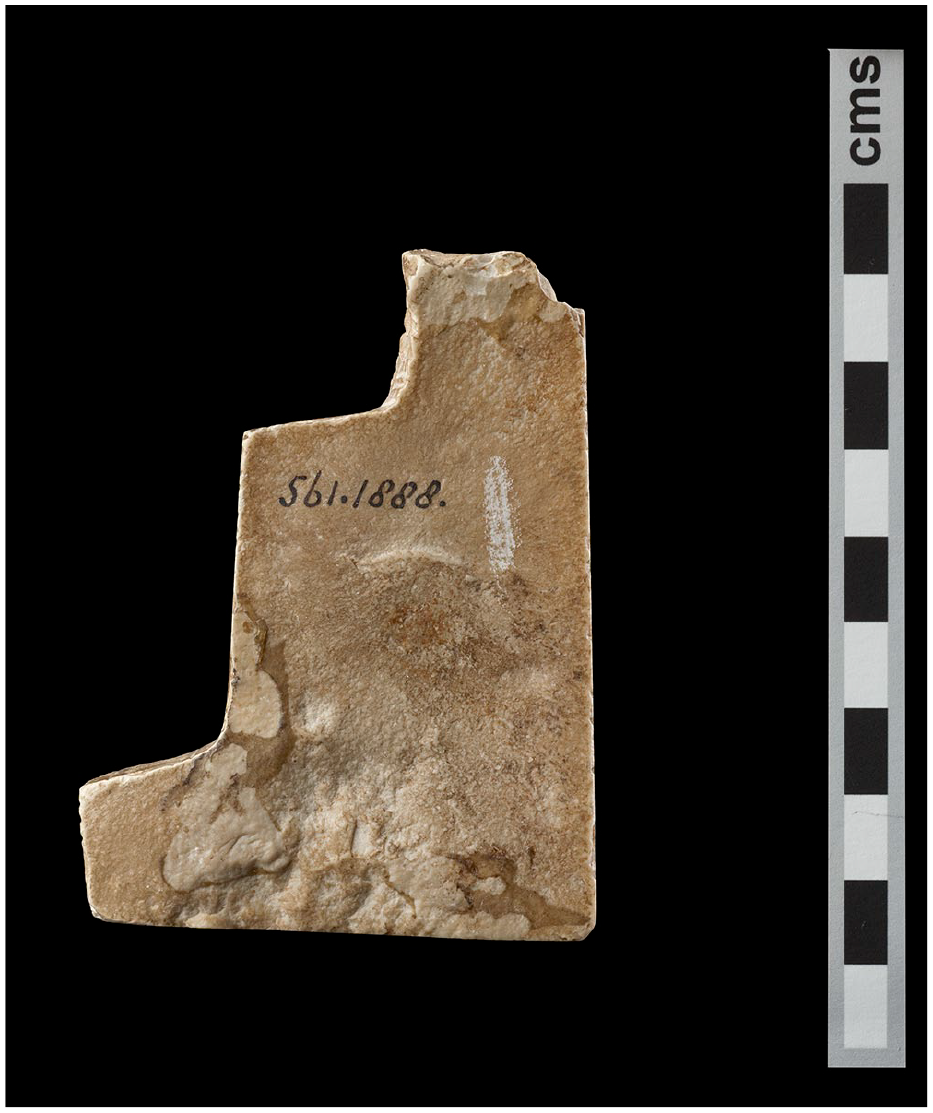
Ashmolean Museum AN 1888.561 left side (© Ashmolean Museum, University of Oxford).
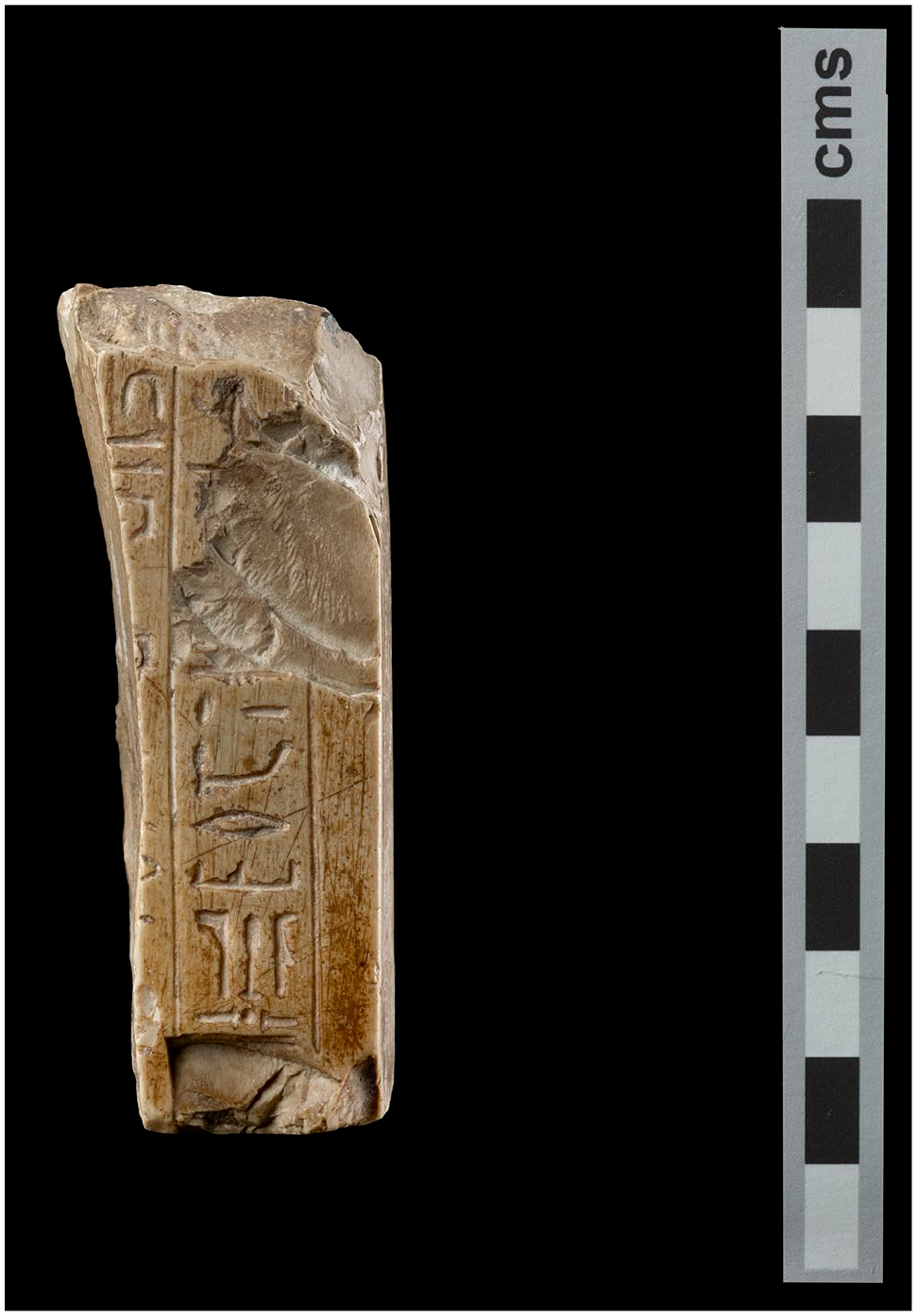
Ashmolean Museum AN 1888.561 rear (© Ashmolean Museum, University of Oxford).
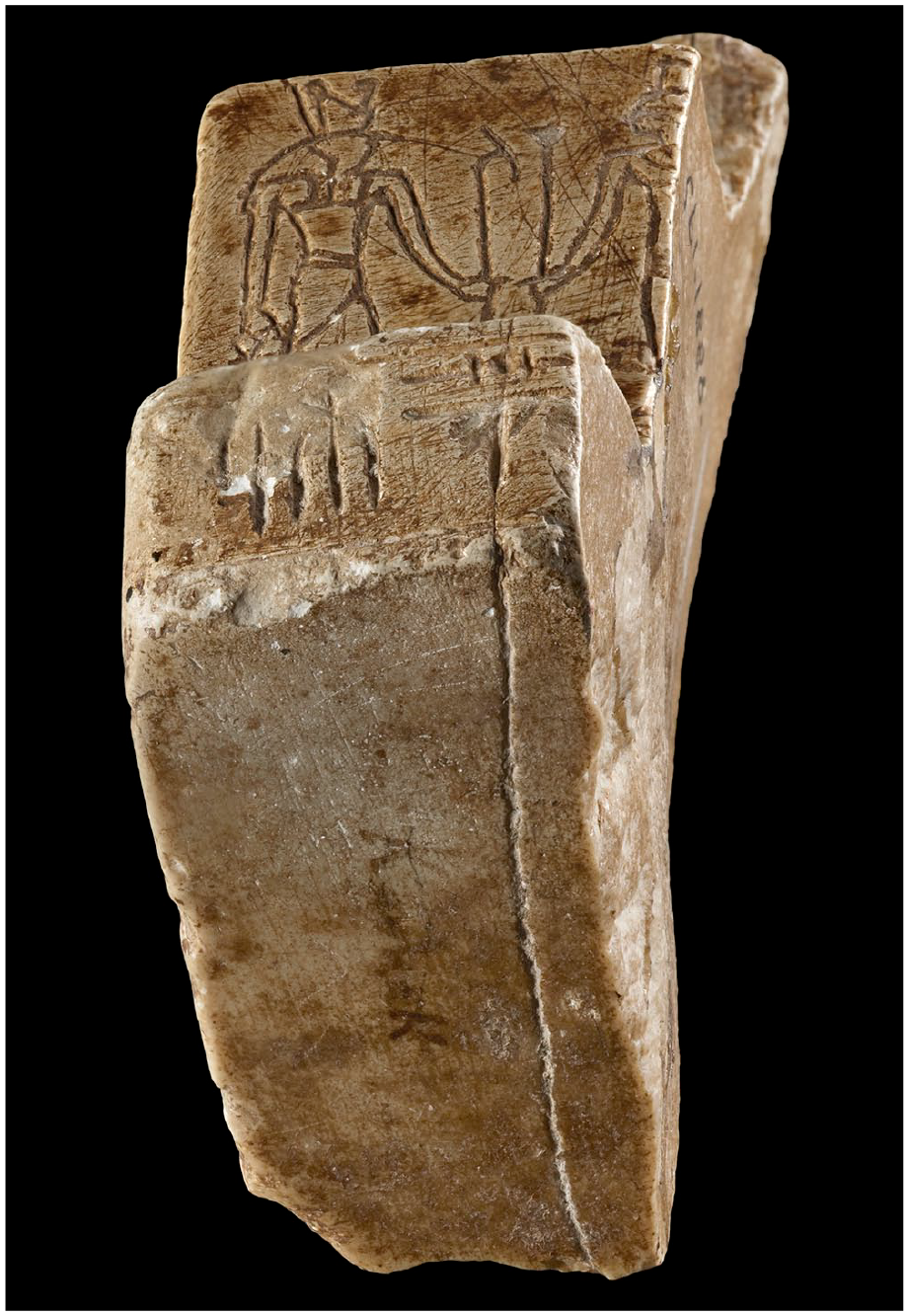
Ashmolean Museum AN 1888.561 base view (© Ashmolean Museum, University of Oxford).
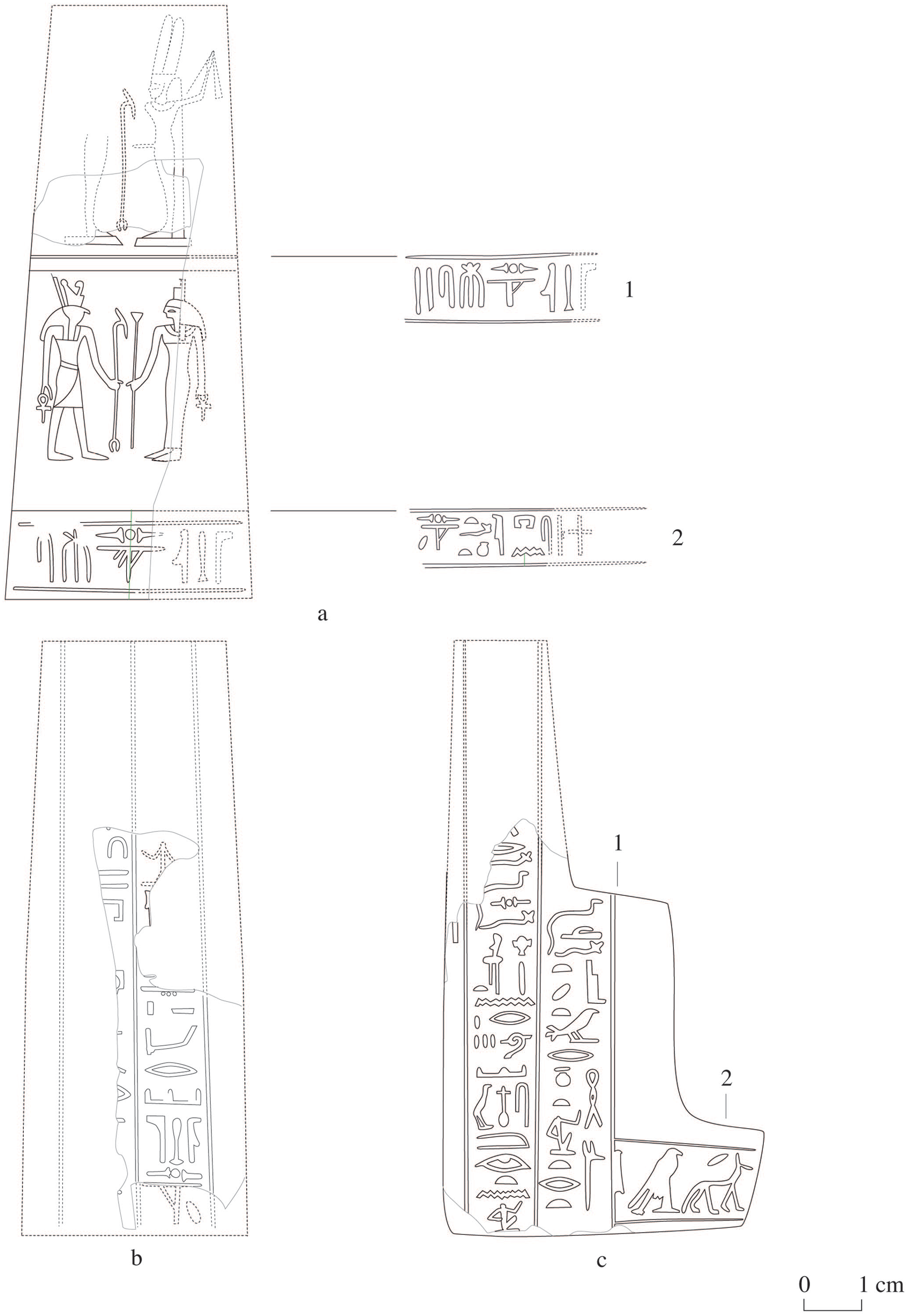
Line drawings with proposed reconstruction of Ashmolean Museum AN 1888.561: a. front; b. rear; c. right side (drawing: C. Alvarez).
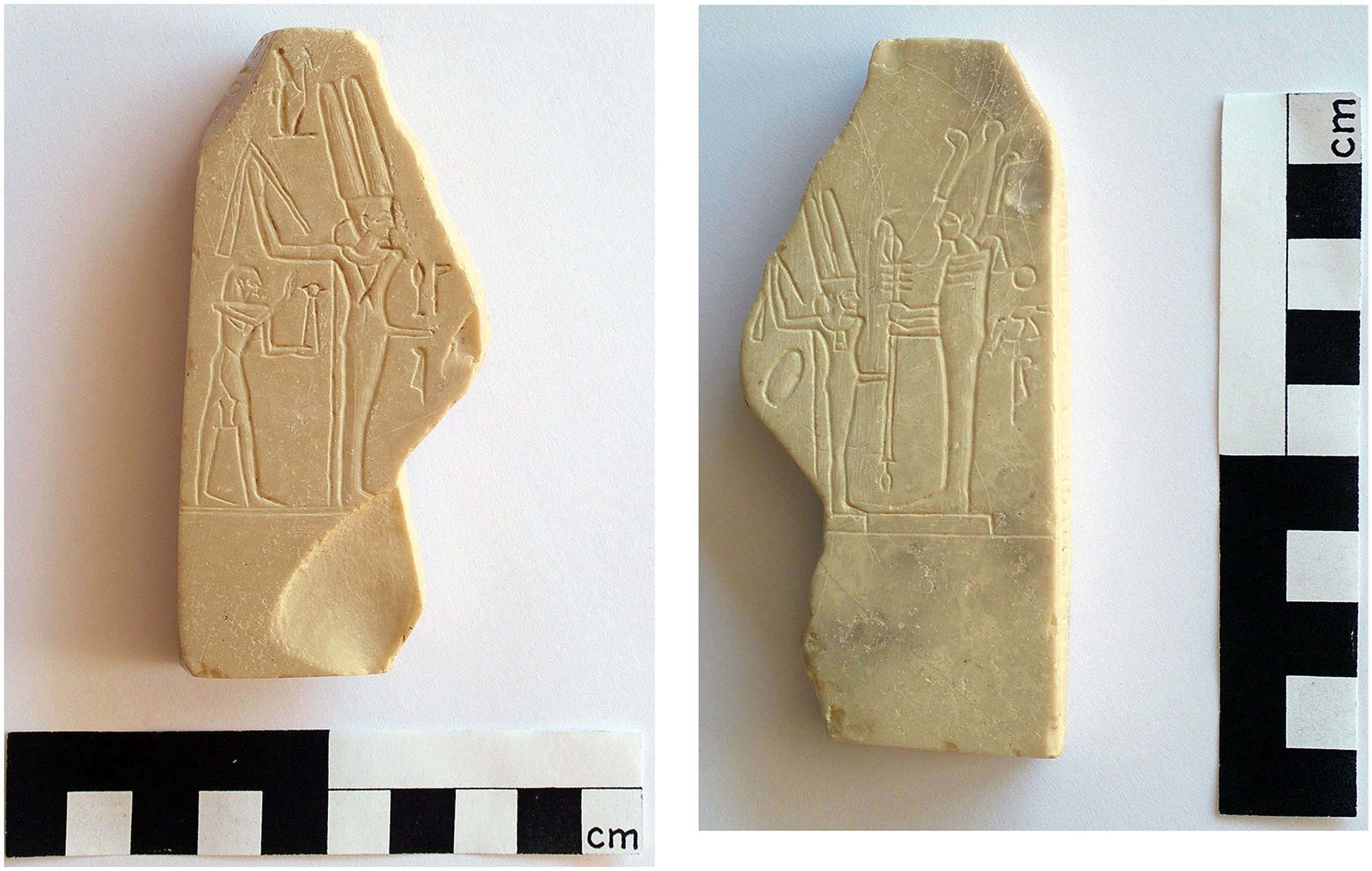
Abydos stela Ab K 2280 from Heqareshu hill (photo: courtesy of Andreas Effland).
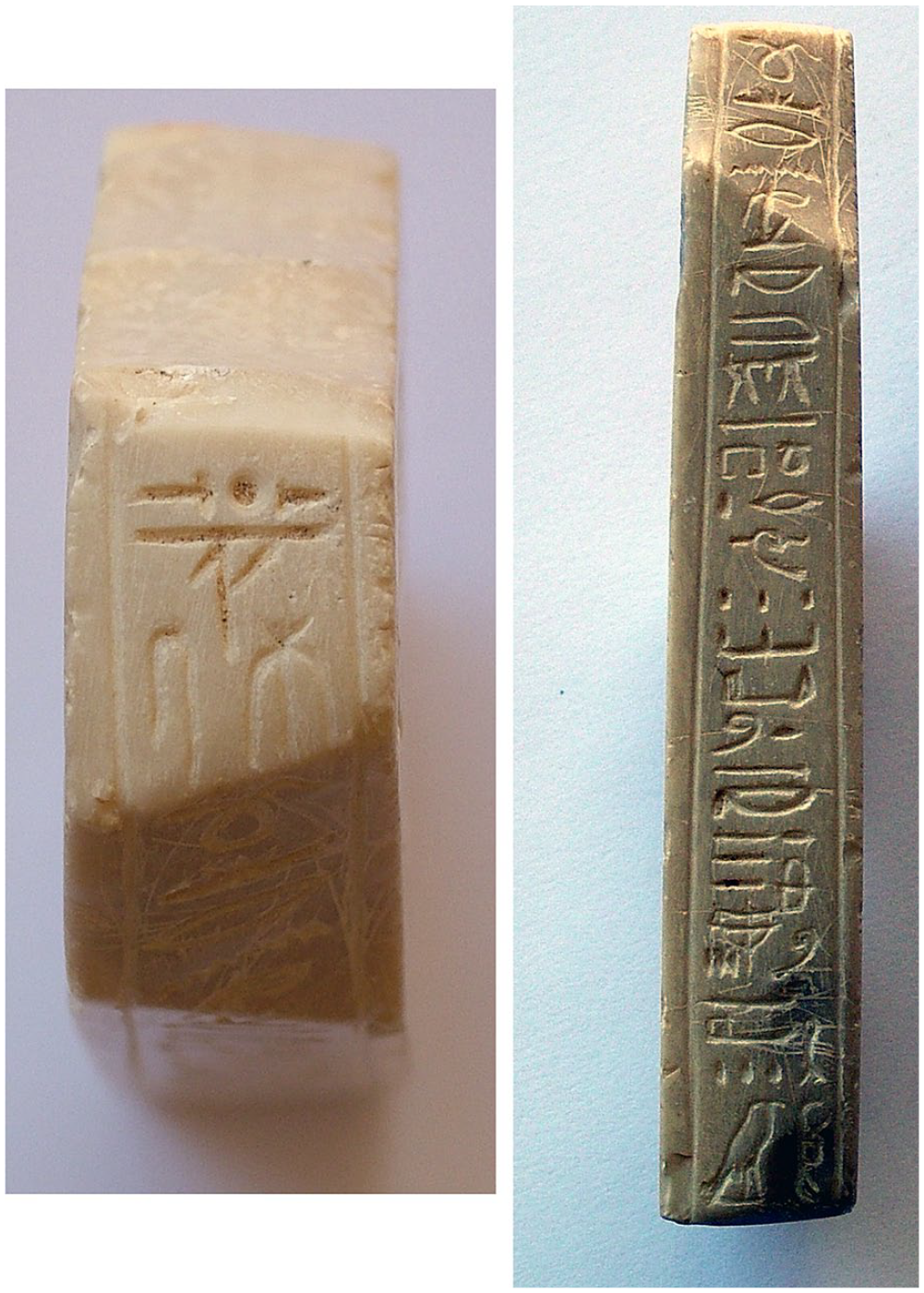
Inscribed edge of Abydos stela Ab K 2280 from Heqareshu hill (photo: courtesy of Andreas Effland).
Minmose held office in the latter part of the reign of Ramesses II, and was broadly contemporaneous with the high priest of Osiris Wenennefer, whose family dominated the Abydos priesthood in the Nineteenth Dynasty. 4 Minmose’s wife, Khatnesu, also called Buya, may have been a daughter of Wenennefer. 5 The two priests seem to have shared a memorial chapel in Petrie’s cemetery G in the Middle Cemetery at Abydos, 6 and Minmose is named on a number of Wenennefer’s monuments, including a stela dated to year 42, the only dated monument known to be associated with him. 7 Minmose’s father Hori was also high priest of Onuris, as known from the titularies given to him on Minmose’s monuments, and from his representation on the family monument of Amenemone, which is now in Naples. 8 Hori bears the single designation sȝb, ‘gentleman’, in the Ashmolean object’s surviving texts. 9 With the exception of an offering table apparently found at Mesheikh and a statue from the Karnak Cachette, all of Minmose’s provenanced objects come from Abydos, as does probably at least one of his unprovenanced statues. 10
The Ashmolean object came into the museum’s collections on 23 June 1888 as part of a significant donation by the scholar and collector Greville John Chester. It fits among ‘the kind of small objects he acquired by preference’. 11 In the entry in the hand-written museum accession register of the time, Minmose’s object is characterized as ‘a portion of a small monument of yellowish hard stone, cut into the form of a throne or steps’, followed by a brief description. The provenance ‘Karnak’ was crossed out and replaced with ‘Echmîm’ (Akhmim). Both provenances are also inscribed on the object. ‘Karnak’ was written on the base (fig. 7), with a similar handwriting to the register. Traces of ‘Echmîm’ are visible on the right side of the object, written in black ink along its uninscribed right edge, and leaving a number of ink dots on the surface nearby (fig. 4). This label seems to have been deliberately wiped away, since it is now smudged and barely visible. A number of other Chester objects accessioned at the same time were assigned the provenance ‘Echmîm’. As Andreas Effland observes, Akhmim was an ideal base for dealers selling objects from Abydos in the nineteenth century, since it was more accessible for European tourists and collectors than the site itself, so this designation may support Abydos as a possible provenance. 12 A fragment of a theophorous block statue of Minmose with figures of Amun, Mut, and Khonsu was found in the Karnak Cachette, so a Karnak provenance could be conceivable as well. 13 Although the Ashmolean object could come from Akhmim, Abydos, or Karnak, we suggest later in this article that it was probably dedicated in Abydos due to aspects of our reconstruction and its seemingly votive purpose.
Description
The object is carved in a creamy indurated limestone and now has a dark yellow-brown patina. It is small and can be comfortably held in the palm of the hand. Maximum dimensions are: height 8 cm, width 3.2 cm, length 5.7 cm. It has roughly the form of a block-throne sign, with a broken upward projection – the back of a square seat. A horizontal plinth extends 1.5–1.7 cm forward at the base. 14 Approximately one-third of the object is lost, cleaved cleanly through its vertical axis. The upper part of the backrest is almost entirely lost. The broken surfaces have a patina comparable with the worked surfaces, making it clear that this is old damage. 15 The broken surface of the object’s left side also bears traces of plaster and what might be some sort of adhesive (fig. 5). These might derive from a modern attempt to assemble the broken fragments; in which case, the lost third could be lying unidentified in a collection somewhere.
According to Klaus Kuhlmann, representations of a throne are either the sacred block-throne or the secular lion-throne. The block-throne consists of a base with a square seat and can be shown with a cushion that covers a backrest ( ) or with a high backrest. The lion-throne ‘combines a chair with a tall backrest with figures of two lions flanking it’.
16
The shape of both thrones differs from the hieroglyph
) or with a high backrest. The lion-throne ‘combines a chair with a tall backrest with figures of two lions flanking it’.
16
The shape of both thrones differs from the hieroglyph  for Isis’ headdress, which incorporates a thick backrest and proportions that would not allow for a seated figure. The hieroglyph seems to be a more stylized version of the block-throne, as is also the case when Isis is represented wearing it, where the seat can be particularly elongated with a short backrest and footrest.
17
Examples of three-dimensional representations of seated figures on thrones similar to the hieroglyph include New Kingdom seated statuettes from the Karnak Cachette of Mut and Renenutet, the latter nursing a child on her lap.
18
These provide helpful points of comparison with the form of the Ashmolean object, but neither offers an exact parallel.
for Isis’ headdress, which incorporates a thick backrest and proportions that would not allow for a seated figure. The hieroglyph seems to be a more stylized version of the block-throne, as is also the case when Isis is represented wearing it, where the seat can be particularly elongated with a short backrest and footrest.
17
Examples of three-dimensional representations of seated figures on thrones similar to the hieroglyph include New Kingdom seated statuettes from the Karnak Cachette of Mut and Renenutet, the latter nursing a child on her lap.
18
These provide helpful points of comparison with the form of the Ashmolean object, but neither offers an exact parallel.
The Ashmolean object most resembles the block-throne sign, with some differences. For example, frontal views show that the sides of the object are not perpendicular to the base but rather converge slightly to the top. The part corresponding to the seat itself is also not perpendicular to the plinth, as would be expected, but curved (fig. 4), and the plinth itself is quite narrow. At first glance, this profile looks like that of a miniature block statue, whose curves then correspond to the legs and feet under their cloth covering. The incorporation of images, here figures of Horus and Isis on the front section, is a well-attested feature of Ramesside block statues, strengthening the evocation. 19 However, the object’s proportions and the treatment of the surviving right surface mean that it cannot be understood as a fragment of a block statue; similarly, a head cannot be restored on the upper part, but instead the extension of the seatback.
The overall shape does evoke a block-throne and this is reinforced by the address to Isis on its right side and her representation on the front. 20 The curved section could relate to the carving, the material, the aesthetic choice of the artist, or a playful merging of the symbol of Isis with a statuette on a throne. Since this object seems to lie somewhere between an image and an actual throne, our idea of what comprises precise representation might not be necessary.
All worked surfaces except for the underside are inscribed. This latter area was smoothed and finished, and bears an incised line bisecting it lengthwise (fig. 7). This line continues over the front, where it merges with the staff of  in Minmose’s name, and onto the plinth, up to the indirect genitive
  in the title on the upward section (figs 8a, 8a2). A prolongation of this line would indicate an axis following Isis’s staff and would most likely have merged with the inscription’s central framing line on the back. The continuation of the line from the base to the rear side is lost because of the damage to the lower part of the object’s surface. The purpose of the line is not clear. It may show that all surfaces of the object were originally meant to have been fully inscribed and viewed, with this area eventually left unfinished. Or, on a more probable, practical level, it may have been an aid to symmetry (bearing the overall later loss in mind), intended to have been removed when the object received its final treatments and polishing.
The front of the plinth as well as the two upwards sections bear Minmose’s name and titles. The now lost top of the object might also have been inscribed. The object’s right side includes an address to Isis the Great. The character of the two columns of damaged text on the rear surface is less certain. These longer inscriptions may have comprised afterlife wishes, especially since sacred areas – tȝ ḏsr and rȝ-sṯȝw – are mentioned. There are two scenes of deities, the more complete of which shows Horus and Isis facing each other; image and text thus resonate with form.
The original size and appearance of the object can be partly modelled by reconstructing the scenes and restoring the titles; fig. 8 shows one possible restoration based on the remaining traces. The line on the base and front, which bisects and indicates an axis along Isis’ staff, suggests that the scenes would have consisted of two standing figures facing each other on both registers. The continuation of the line, as mentioned earlier, merging with the line dividing the texts, would suggest only two columns of texts on the rear surface, with signs facing left. The reconstruction of the upper register, with standing figures (see next section), would suggest a minimum height of 10.5 cm (based on the minimum full height of Min’s representation). Therefore, one-third of the texts on the rear and right surfaces has probably been lost. It could have been similar in height to Minmose’s Heqareshu stela (c.10 cm), perhaps hinting at the same provenance, workshop, or object ‘classification’.
Images
A scene of Horus and Isis fills the vertical area of the front of the seat (figs 1–2, 8a); the scene is not captioned but the iconography makes these basic identifications clear. The deities stand facing each other, perhaps with no baseline because of the curvature of the throne. The falcon-headed Horus faces right and wears the double crown, the rear portion of which extends to the top of the scene. His face has no internal detail, not even an eye. The lappets of his tripartite wig may perform double duty as straps of his corselet. There is no indication of a collar, and no internal detail to the upper body. Two incised lines indicate the band of his short kilt. He holds a was-sceptre in his forward left hand and an ankh-sign in his right. The lines of the figure are quite subtly rendered, especially in the curve of the back and buttocks.
Only the front of the figure of the goddess survives on the right. Traces of the Isis headdress are visible as  , and a horizontal line above might have resulted from the movement of the tool when incising the line of the top of the backrest. A similar extension to the top of Horus’ crown may have also been caused by the difficulty faced by the artist when carving this detail. The base of Isis’ crown is barely visible but seems to have consisted of one line protruding only very slightly to the front; the base is not necessarily carved on small objects.
21
The curve of the top of the goddess’s head is visible. The wig line is visible just above the eye. The eye is incised, and the outline of the nose is roughly shaped. The curved line of a collar runs from the shoulder to the break. The forward, right hand holds a wadj-sceptre. The now lost left hand would have probably held an ankh-sign. The forward line of her body survives down to the feet.
, and a horizontal line above might have resulted from the movement of the tool when incising the line of the top of the backrest. A similar extension to the top of Horus’ crown may have also been caused by the difficulty faced by the artist when carving this detail. The base of Isis’ crown is barely visible but seems to have consisted of one line protruding only very slightly to the front; the base is not necessarily carved on small objects.
21
The curve of the top of the goddess’s head is visible. The wig line is visible just above the eye. The eye is incised, and the outline of the nose is roughly shaped. The curved line of a collar runs from the shoulder to the break. The forward, right hand holds a wadj-sceptre. The now lost left hand would have probably held an ankh-sign. The forward line of her body survives down to the feet.
Another scene seems to have filled the space directly above, on the surface which formed the seatback of the throne. At the bottom of this area the visible traces seem to represent two mȝʿ-plinths with feet, both facing the central axis. A very small area of the original surface that survives in the top right corner of this section bears traces of two vertical lines. Figures on mȝʿ-plinths are usually seated on a throne or standing, often with a staff in their hands. The traces on the right-hand sections of the upper register show the front and rear part of a foot and another vertical line behind that foot. This line could be part of the seat of a throne, but ideally more space would be needed; the area for the length of the feet of a seated figure usually corresponds to a third of the plinth. A more convincing restoration is a standing figure of Min, with the ribbon of his crown falling all the way down to the plinth. The traces of two vertical lines in the surviving top right corner would then correspond to the back of the thigh and the ribbon (fig. 8a).
The plinth on the left is not very long – the preserved area of surface on the far left does not show any traces of its back – so there is not enough space for a seated figure on a throne. The traces show only the front part of a foot and possibly the ends of a two-pronged staff in front of it, thus another standing figure perhaps holding a was-sceptre. Effigy-form figures are expected on plinths, so a male deity, very probably Osiris, seems the most plausible reconstruction to us on the basis of the context and traces. Figures of Osiris and Min would appropriately complement those of Horus and Isis below. 22
If the figure on the left is Osiris, then it is very tempting to suggest that the scene represents a cryptographic writing of Minmose’s name, comparable to those found on many of his objects. One example is his stela from Heqareshu hill, although in this case the plinths on which the two gods stand are touching one another (fig. 9, right). However, in these orthographies the figure of Osiris is always on the right. Whatever the reconstruction, emblematic, miniature divine figures would be appropriate for a space like this that approximates an upper register.
Texts
Front areas (fig. 8a):
The upper of the two upward-facing horizontal surfaces of the seat bears a line of hieroglyphs framed by lines (figs 3, 8a1):
… ḥm-[nṯr]a šw mn-msw mȝa-ḫrw
… priest of Shub Minmose, true of voice.
The ‘Priest of Shu’ (not ‘priest of Maat’)
23
is also the culminating title in the text on the rear surface (see later). This title is attested as a final title for Minmose on his offering table from Mesheikh, a wall relief from Abydos, and especially on votive vessels from Abydos.
24
In these contexts it is preceded not by another title but by jr.n or wsjr (n). This title is also prominent in the cryptographic writings of his name and titles on his Brooklyn and Karnak statues, votive shabtis, and his stela from Heqareshu hill.
25
An extended and elevated variation –‘high priest (ḥm-nṯr tpy) of Shu son of Re’ – is part of a title string on the Brooklyn statue, immediately preceded by ‘chief steward in the temple of Onuris’.
26
The prominence of ‘priest of Shu’ in votive contexts and in cryptographic display means that it had a particular significance, substituting for his normally culminating title, high priest of Onuris, and perhaps relating to specific ritual performances. In this it might be comparable to the heseku title held by the high priest of Osiris, Wenennefer, which seems to be associated with offering, and was itself ‘enough to identify Wenennefer as HPO [high priest of Osiris]’.
27
‘Priest of Shu’ is not included among titles attested for Minmose’s two known successors in office, although Anhurmose, who held the office under Merenptah, is ‘[high priest] of Shu in Abydos’ in a text on a statue niche in his tomb.
28
 is on the edge of the break but is fully legible.
At the foot of the throne, on the upward-facing horizontal surface, is a line of hieroglyphs framed by lines (figs 3, 8a2):
… [jmy-j]sa n šw tfnt mn-mswb
… chamberlain of Shu and Tefnut, Minmose.
The break runs through Minmose’s name is written with
of js, but the reading is certain. The reconstruction allows us to estimate 1.6 cm to the end of the surface, giving space for a few more signs; smr wʿty would fit the remaining, preceding space well, for example. for ms, an orthography not otherwise attested in running text on his monuments. These orthographies have been treated by Ute and Andreas Effland.
29
The same orthography is likely to have been used on the back of the object, perhaps because of lack of space (fig. 8b).
for ms, an orthography not otherwise attested in running text on his monuments. These orthographies have been treated by Ute and Andreas Effland.
29
The same orthography is likely to have been used on the back of the object, perhaps because of lack of space (fig. 8b).
On the vertical front of the throne-plinth are the remains of a framed line of hieroglyphs, continuing onto the object’s right side (figs 2, 4, 8a, 8c):
…a mn-msw right sȝ sȝb ḥrjb
… Minmose, son of the gentleman Hori.
One or more groups are lost from the base in front of Minmose’s name, probably comprising titles. ‘Priest of Shu’ would fit the break for example, as suggested in our reconstruction (fig. 8a). The text probably began on the lost, left side of the plinth, with room for two to three groups, perhaps incorporating further titles and/or n kȝ n. Loss includes the top of The rear line of
 and , but the reading is certain.
 merges with the framing line of the columns behind. The carving of the falcon sign might have displaced slightly to the left.
Right side (fig. 8c):
We read the short horizontal line here, ‘son of the gentleman Hori’, as a continuation of the text on the front of the plinth, see earlier. Two right-facing columns of inscription with framing lines fill almost all of the remaining space. The first column is complete. The second has lost its uppermost sections, comprising at least two or probably three groups. The bottom left corner is broken away, including the bottom section of the framing line (figs 4, 8c). To the left of the leftmost framing line, emerging from the break, is the lower part of what appears to be a deliberately and neatly carved line; we tentatively suggest in footnote 20 that it could represent the cloth covering of the seat, although it might be a slip of the chisel or the start of a column line which was then abandoned and redrawn further to the right.
1 ḏd.f ȝst wrt ḥnwt.j wsrt a
2 …r.fb ḏs.f ḥr jmnt n rȝ-sTȝw snfr.w m jrt.n.j
He says: (O) Isis the Great, my mistress, powerful one … [to?] him/it, himself/itselfc on the west of Rosetau, being made perfect in accordance with what I have done.d
The somewhat uneven sign arrangement here, especially of  , which is positioned between two groups, probably ensures that the epithets of Isis neatly fill the column.
Just above  there is a trace of what could be the terminal point of a tall narrow sign, or perhaps a prong from the end of a tall, narrow sign with a prong end.
The referent for the  is difficult to determine. A male deity such as Osiris or Horus might be appropriate since this is a speech to Isis. Alternatively, it could refer to ritual action or to the object itself, created and dedicated as a votive by Minmose; see note d, following. In this it can be compared to the inscription on a naos of Thutmosis III which houses a falcon-shaped stone, where the demonstrative of jnr pn ‘this stone’ refers directly to the object in the naos.
30
is difficult to determine. A male deity such as Osiris or Horus might be appropriate since this is a speech to Isis. Alternatively, it could refer to ritual action or to the object itself, created and dedicated as a votive by Minmose; see note d, following. In this it can be compared to the inscription on a naos of Thutmosis III which houses a falcon-shaped stone, where the demonstrative of jnr pn ‘this stone’ refers directly to the object in the naos.
30
The broken context makes the sense difficult to discern. In a funerary context, snfr may refer to Minmose’s own transfiguration as a consequence of right action while alive, ‘in accordance with what I have done/achieved’. This sense of snfr is mobilized in a speech addressed to Khonsu in the Theban tomb of the high priest of Amun, Nebwenenef (reign of Ramesses II), recorded in a Wörterbuch record: ‘May you make perfect for me my akh-capacity in the presence of the court of the [divine judges] (snfr.k n.j ȝḫwt.j m-bȝḥ qnbt nt [ḏȝḏȝwt])’. 31 Similarly, a stela of a royal scribe of Ramesses II, Djehutyemheb, includes a speech to Osiris asking that he ‘protect me on account of my perfection (nfrw.j), cause that my ba be divine, my corpse made whole, my body made perfect (snfr ḥʿw.j), my bones made complete, for my future (n m-ḫt.j); for I was indeed, truly your beloved servant’. 32
A partly comparable formulation is found on an unpublished statue of Minmose in Berlin that shows him grinding grain and/or incense, and this may suggest that this passage refers to something Minmose created, conceivably this particular object. A text on the right side of the statue describes placing ‘my shabti (i.e. the statue itself) before the lord of eternity, having made for myself a twt-statue according to my nature, being in accordance with what I did on earth (jw m jrt.n.j tp tȝ)’. A broken passage on the statue’s front also refers to its form: ‘… grinding incense in accordance with what I have done (… nḏw snṯr jw m jrt.n.j)’. 33 In the present context, might the Ashmolean object refer to ‘itself (placed) on the west of Rosetau, being made perfect’? 34
Rear surface (fig. 8b):
The rear surface bears the remains of two columns of inscription that probably made up its full original extent (figs 6, 8b). The column on the right is left-facing, while the direction of the largely lost column on the left is not clear, but probably also faced left. At least two or three groups may be lost from the top of each column. We only attempt a translation for the rightmost column.
1…a 2[… … .. m(?)]b tȝ ḏsr ḥm-nṯr šw mn[-ms]c
… [… … .. in(?)] the sacred land: priest of Shu Min[mose].
The first legible trace in the second column looks like Below The loss here comprises about three groups. While it is tempting to restore a falcon sign in the uppermost surviving section of the final column, what appears to be a bird’s head with a beak is an illusion created by loss of surface stone. The proportions of the shape here would not fit with the falcon sign in Minmose’s father’s name on the object’s right side. Rather, there are traces of what might be a raised arm, which could be There seems to be not enough space for a full phonetic writing of Minmose’s name. A writing of his name with
 , perhaps the number 10. It is unlikely to be
  , often instead of
  in, for example, writings of the Štyt-shrine, as there are no traces of the side ticks or crossbar.
35
Inspection shows that what appears to be a vertical line next to the sign is a scratch browned by patina. This could be part of a request for 110 years, if this column is also left-facing; compare, for example, a prayer to Osiris on a Nineteenth Dynasty naos for a perfect West after 110 years on earth.
36
An offering formula on a contemporaneous statue from Saqqara follows the request for 110 years with ‘becoming divine in the wabet of 70 (days)’,
37
suggesting another possible reading for . A small trace visible immediately above this sign might be the left terminal point of a further , suggesting a reading of, for example, a number of an underworld gate, as in one of the reliefs from the Abydos chapel of Minmose and Wenennefer,
38
or an amount of time in mortuary preparation in somewhere like the wabet or pr-nfr (‘perfect house’). are two parallel horizontal lines, perhaps the extremities of
in, for example, writings of the Štyt-shrine, as there are no traces of the side ticks or crossbar.
35
Inspection shows that what appears to be a vertical line next to the sign is a scratch browned by patina. This could be part of a request for 110 years, if this column is also left-facing; compare, for example, a prayer to Osiris on a Nineteenth Dynasty naos for a perfect West after 110 years on earth.
36
An offering formula on a contemporaneous statue from Saqqara follows the request for 110 years with ‘becoming divine in the wabet of 70 (days)’,
37
suggesting another possible reading for . A small trace visible immediately above this sign might be the left terminal point of a further , suggesting a reading of, for example, a number of an underworld gate, as in one of the reliefs from the Abydos chapel of Minmose and Wenennefer,
38
or an amount of time in mortuary preparation in somewhere like the wabet or pr-nfr (‘perfect house’). are two parallel horizontal lines, perhaps the extremities of  , followed by part of what could be
  , perhaps m dwȝt, ‘in the underworld’, or m pr-nfr, ‘in the perfect house’, which would be appropriate to the remaining traces. Next is an area without traces of about 4 mm, then the curved edge of another sign, perhaps the rear arm of . The remaining traces look different from the seated man on the right side (fig. 8c), but the boxy shape of the shoulder and elbow could be related to the carving process. The carving seems to continue vertically along the break, and this could suggest the back of a seated man. In the area about 6 mm below this are what might be the terminal points of two horizontal signs, the second of which might be or . Just below this sign are the rightmost ends of what might be or
  , with other, small illegible traces below.
 in a linear style, as tentatively suggested in the reconstruction (fig. 8b).
39
The vertical sign below evokes
in a linear style, as tentatively suggested in the reconstruction (fig. 8b).
39
The vertical sign below evokes  ,
,  , or
, or  . Traces of parallel horizontal lines directly above tȝ might be ; the admittedly indistinct trace of the lower horizontal does not seem to correspond to the curve of
  . is most likely and would fit the available space well. There was probably not enough space for mAa-xrw, unless it was written very schematically.
Discussion
This object has no parallel, and it is uncertain exactly what it was. The inscriptions run to the bottom edge of the surviving surfaces, meaning that the object could not have been embedded into another surface without obscuring some of the text. All of its surviving surfaces apart from the base were inscribed and so should not have been covered by something else, like a seated figure. Its proportions also suggest that it could not have been a stepped base for an object set into the lost upper surface, as it would have toppled over. Its shape resembles a stylized throne, similar to Isis’ headdress, and the inclusion of her image and an address to her strengthen its identification as a stand-alone votive object dedicated to her. Despite the absence of parallels, an inscribed votive throne would sit within the range of emblematic objects, such as large model ankhs, menats, sistra, columns, and Isis-knot amulets, noted by Geraldine Pinch among votive objects dedicated at Hathor temples and shrines, although these rarely bear extensive dedicatory inscriptions. 40 It can also fit among the range of small inscribed votive objects in temples, such as small stelae, basins, and statuettes, especially those showing goddesses seated on comparable thrones, noted earlier. 41
Modelling its place of dedication is also challenging, with Karnak and Abydos being the two most obvious places on the basis of the early curatorial notes and internal evidence.
The emergence of precincts associated with Osiris, and therefore Isis, at Karnak is a development of the first millennium bce. 42 Isis seems to have had a more limited presence there in the New Kingdom. Laurent Coulon describes Isis, in particular, as having ‘un statut d’invitée’. 43 Thus, identifying obvious areas within this complex as potential appropriate sites for the dedication of this little votive is difficult. It is easier for Abydos, in part because of the mention of sacred areas that can relate to either funerary or votive practices. For the former, it could be associated with Minmose’s mortuary cult, such as the chapel he may have shared with his kinsman, Wenennefer. For the latter, it is possible to suggest places like the area of Heqareshu hill, which is linked with Rosetau on Minmose’s stela from there (fig. 10). 44
The increasing prominence of Isis at Abydos in the New Kingdom, especially the late New Kingdom, means it is also possible that this object was dedicated in a temple area closely associated with her, such as the portal of Ramesses II, or in her temple proper. 45 If Min is as prominently displayed on the object as our reconstruction suggests, this could perhaps also relate the object, and the form of Isis Minmose addresses on it, to the cult of Min of Coptos. 46 At Abydos, the worship of Isis of Coptos was connected to the cult of Min, rather than that of Osiris, also giving her a ‘guest status’. 47 Min merges with Horsiese over time, 48 and this association could play out over the surface of the Ashmolean object, with possible representations of Osiris and Min above and Horus/Horsiese and Isis below. An ambiguity in the identification of Horus may well be deliberate in this context.
Although this suggestion is tentative, layers of meaning are intertwined in this unconventional object. In the first instance, it may write the goddess’s name. This would generate a powerful interplay with an object that is her name and the repeated and prominent incorporation of Minmose’s name across its surface. Such an embedding of his name within hers would hardly be possible with a statue and would be almost impossible with a two-dimensional image of her carved on a stela, although Minmose’s Heqareshu stela does comparably project the potency of naming, albeit through cryptography rather than form (fig. 9). The figures of Min and Osiris that comprise elements of his titles and name dominate the surviving surfaces of the stela’s two faces, suggesting Minmose’s identification with them, as well as divine presence and protection. The surviving edge of the stela is inscribed with a short address to Minmose that speaks directly to these ideas (fig. 10): ‘Minmose, may your name be permanent (rwḏ) within Rosetau, so that there will be given to you the bread, water, and breath of the followers of Horus themselves’. 49 Strikingly, the wish is formulated as a second-person address, rather than the more conventional first or third person, giving voice to the donor of the object, or perhaps a potential viewer, even the gods.
Despite its miniature scale, the Ashmolean object transcends the amuletic while being large enough for extensive inscription, so that protection is only one of its possible range of meanings. At some 10 cm high and 4.5 cm wide, the Heqareshu stela is also small enough to be placed in the hand. 50 Neither object would have been worn around the body, although they could relate briefly to it when held. These are artefacts that were held, manipulated and handed over.
The extraordinarily diverse and often highly experimental forms of self-presentation commissioned by Minmose, Wenennefer and their groups are frequently grandiose, exemplified by, for example, Wenennefer’s over-life-size pillar statues, 51 as well as the almost life-size and life-size statues of Minmose from Karnak and, probably, Abydos. 52 Minmose’s Isis-throne, alongside his Heqareshu stela, show how related levels of expertise and meaning can be invested in artefacts that are, by comparison, very small.
In the lower register of an unprovenanced Nineteenth Dynasty sandstone stela, a figure of the daughter of the owner, second from the left in the bottom register, stands holding a nefer-hieroglyph in the palm of her outstretched left hand ( ).
53
The other women on the stela hold sistra, lotus flowers, or both, rendering this detail exceptional. Her name is Nefertiry, so that in a sense she offers both perfection and the essence of her own name, and thus her self. Although in form and context Minmose’s object is very different, it may be a comparable offering, exploiting strategies of presentation also mobilized on the British Museum stela.
54
Minmose’s object would then concretely manifest and invoke Isis’ name, while also incorporating his own name and self, and perhaps his hopes for transfiguration, being made perfect (snfr), as stated in the inscription on the piece’s right side.
).
53
The other women on the stela hold sistra, lotus flowers, or both, rendering this detail exceptional. Her name is Nefertiry, so that in a sense she offers both perfection and the essence of her own name, and thus her self. Although in form and context Minmose’s object is very different, it may be a comparable offering, exploiting strategies of presentation also mobilized on the British Museum stela.
54
Minmose’s object would then concretely manifest and invoke Isis’ name, while also incorporating his own name and self, and perhaps his hopes for transfiguration, being made perfect (snfr), as stated in the inscription on the piece’s right side.
Our thanks to Liam McNamara for permission to work on this object, for access to and discussion of the museum records, and references. Andreas Effland kindly allowed us to include photographs of stela Ab K 2280, and offered important information and ideas. John Baines, Roland Enmarch, Julia Hamilton, and Ellen Jones commented invaluably on drafts. An anonymous reviewer gave insights and references, which helped nuance our arguments. Chiara Salvador assisted Elizabeth with the initial collation, while Julia, Ellen and Jordan Miller also undertook a significant variety of research- and formatting-related tasks for her: thank you team.
Footnotes
Funding
The author(s) received no financial support for the research, authorship, and/or publication of this article.
1
PM VIII/2, 683 (no. 801-655-622); U. Effland and A. Effland, ‘Minmose in Abydos’, GM 198 (2004), 6 n. 8.
2
3
For figs 9– , see Effland and Effland, GM 198, 13–16; U. Effland and A. Effland, Abydos: Tor zur ägyptischen Unterwelt (Darmstadt, 2013), 40–5. Further examples include his ‘doorstop’ statue: J. J. Clère, ‘Deux statues “gardiennes de porte” d’époque ramesside’, JEA 54 (1968), 135–48; also V. Rondot, ‘De la fonction des statues-cubes comme cale-porte’, RdE 62 (2011), 141–57; a statue showing him grinding grain/incense, the only Ramessid example of this type known to us: E. Frood, ‘Minmose the Miller: A Ramessid Servant Statue Preparing Incense (Berlin ÄM 24179)’, in preparation; and his ‘bald’ begging statue: J. J. Clère, Les chauves d’Hathor (OLA 63; Leuven, 1995), 73–80, doc. A; also E. Frood, ‘When Statues Speak About Themselves’, in A. Masson-Berghoff (ed.), Statues in Context: Production, Meaning and (Re)uses (Leuven: 2019, 3–20). For the cryptographic formulations see Effland and Effland, GM 198, 11–16.
4
For overviews, see K. A. Kitchen, ‘A Brief Visit to Some Ramesside Friends at Abydos’, in S. Ikram and A. Dodson (eds), Beyond the Horizon: Studies in Egyptian Art, Archaeology and History in Honour of Barry J. Kemp, I (Cairo, 2009), 185–8, and A. P. Thomas, ‘A Review of the Monuments of Unnefer, High Priest of Osiris at Abydos in the Reign of Ramesses II’, in C. Price, R. Forshaw, A. Chamberlain, and P. T. Nicholson (eds), Mummies, Magic and Medicine in Ancient Egypt: Multidisciplinary Essays for Rosalie David (Manchester, 2017), 56–68.
5
B. M. Bryan, ‘The Career and Family of Minmose, High Priest of Onuris’, CdE 61/121 (1986), 22–5. Henning Franzmeier concludes that Khatnesu cannot have been a daughter of Wenennefer since this would place her in the wrong generational group: ‘News from Parahotep: The Small Finds from his Tomb at Sedment Rediscovered’, JEA 100 (2014), 174 n. 100, 175 table 2. In this, he follows D. Raue, ‘Ein Wesir Ramses’ II’, in H. Guksch and D. Polz (eds), Stationen: Beiträge zur Kulturgeschichte Ägyptens, Rainer Stadelmann gewidmet (Mainz, 1998), . In the light of their close relationship, it might make sense that Wenennefer would name his daughter after Minmose’s wife.
6
With Effland and Effland, GM 198, 7–9; Effland and Effland, Abydos, 43–4. Angela P. Thomas concludes, on the basis of her review of the excavation history, that it was probably Minmose’s tomb: Thomas, in Price et al. (eds), Mummies, Magic and Medicine, 62–4.
7
8
Bryan, CdE 61/121, 21–2. For the Naples monument, see R. Pirelli, ‘The Monument of Imeneminet (Naples, INV. 1069) as a Document of Social Changes in the Egyptian New Kingdom’, in C. J. Eyre (ed.), Proceedings of the Seventh International Congress of Egyptologists, Cambridge, 3–9 September 1995 (OLA 82; Leuven, 1998), 871–84; M. Trapani, ‘The Monument of Imeneminet (Naples, INV. 1069): An Essay of Interpretation’, in C. J. Eyre (ed.), Proceedings of the Seventh International Congress of Egyptologists, Cambridge, 3–9 September 1995 (OLA 82; Leuven, 1998), 1165–76.
9
Betsy Bryan suggests that sȝb signalled Minmose’s ‘posthumous respect’ for his father: Bryan, CdE 61/121, 22 n. 4.
10
Clère, Les chauves, 73–80, doc. A. For a list of monuments and objects known for Minmose, organized by provenance, see Effland and Effland, GM 198. The entry for his offering table, no. 23095 in the Cairo catalogue, records that it was found at Mesheikh on February 25, 1891, and given to the museum by Chester: A. Kamal, Catalogue général des antiquités égyptiennes du Musée du Caire, nos 23001–23256: Tables d’offrandes (Cairo, 1909), 81–2.
11
G. Seidmann, ‘The Rev. Greville John Chester and “The Ashmolean Museum as a Home for Archaeology in Oxford”’, Bulletin of the History of Archaeology 16:1 (2006), 30.
12
Personal communication; see also Bryan, CdE 61/121, 5–7, on Wilbour’s purchase of the Brooklyn statue of Minmose at Akhmim. Karnak could have been ascribed to the Ashmolean object as a provenance by a dealer, or, obtained in Luxor, it could have later been mixed in with a group purchased at Akhmim.
13
14
1.5 cm from the side, and 1.7 cm from the centre. The front of the base is slightly curved.
15
Frauke Pumpenmeier’s description of a break on Minmose’s Heqareshu stela as ‘shell-like’ is also an apt characterization of the conchoidal quality of some of the damage here: G. Dreyer, U. Hartung, T. Hikade, E. C. Köhler, V. Müller, and F. Pumpenmeier, ‘Nachuntersuchungen in frühzeitlichen Königsfriedhof 9./10. Vorbericht’, MDAIK 54 (1998), 129.
16
Kuhlmann, in Wendrich (ed.), UCLA Encyclopedia, 8.
17
E.g. A. M. Calverley, The Temple of King Sethos I at Abydos, Volume III: The Osiris Complex (London, 1938), pl. 6.
18
Statue of Mut: Cairo JE 37836 / 38684: Karnak Cachette database: <http://www.ifao.egnet.net/bases/cachette/ck478>; statue of Renenutet: Cairo CG 42138: Karnak Cachette database: <http://www.ifao.egnet.net/bases/cachette/ck533> accessed 10 May 2019. See also the fragment of a statue of an unknown man from the Twenty-first Dynasty temple of Isis at Giza: Digital Giza <> (statue on right) accessed 10 May 2019.
19
20
A possible detail of the block-throne could be given by a small line visible on the external side of the leftmost column, perhaps hinting at the cushion covering the seat (). However, not enough of this line is preserved to determine whether it was deliberately carved and should be considered a meaningful part of the final object.
21
E.g. U. Effland and A. Effland, ‘Umm el-Qaab (Abydos), Ägypten. Untersuchungen zum Osiriskult in Abydos vom Alten Reich bis in die Spätzeit. Die Arbeiten der Jahre 2017 und 2018’, e-Forschungsberichte des Deutschen Archäologischen Instituts, 2 (2018), fig. 6. <> accessed 20 July 2019.
22
Min, Isis, Harendotes and Aperetiset are shown together in a relief from Akhmim, dating to the reign of Ay: A. Forgeau, Horus-fils-d’Isis: la jeunesse d’un dieu (BdE 150; Cairo, 2010), 173; K. P. Kuhlmann, ‘Der Felstempel des Eje bei Achmim’, MDAIK 35 (1979), 176–7, pl. 52. Close associations between Osiris, Min, Horus and Isis are also shown on Ramesside stelae from Abydos, e.g. G. A. Gaballa, ‘Three Funerary Stelae from the New Kingdom’, MDAIK 35 (1979), pl. 16.
23
Cf. Bryan, CdE 61/121, 14.
24
KRI III, 472.8 (table); KRI III, 474.6 (relief); KRI III, 64.14, 477.1; Effland and Effland, GM 198, 9–10 (vessels).
25
26
Bryan, CdE 61/121, 12–14.
27
C. Raedler, ‘Creating Authority: The High Priest of Osiris Wenennefer and a Special Deification of Ramesses II’, in T. A. Bács and H. Beinlich (eds), Constructing Authority: Prestige, Reputation and the Perception of Power in Egyptian Kingship, Budapest, May 12–14, 2016. 8. Symposion zur ägyptischen Königsideologie / 8th Symposium on Egyptian Royal Ideology (Wiesbaden, 2017), 225.
28
B. Ockinga and Y. al-Masri, Two Ramesside Tombs at el Mashayikh, Part 1: The Tomb of Anhurmose – the Outer Room (Sydney, 1988), 48, pls 32a, 33b. For Siese, a high priest of Onuris in the Twentieth Dynasty, see KRI V, 428.2–14.
29
Effland and Effland, GM 198, 12–13.
30
A. von Lieven, ‘“His Majesty Found this Stone in the Shape of a Divine Falcon” (Cairo CG 70002 + JE 40064 [b])’, in L. Coulon (ed.), La Cachette de Karnak: nouvelles perspectives sur les découvertes de Georges Legrain (Cairo, 2016), 256–7. Our thanks to a reviewer for discussion of this point and suggesting this reference.
31
TLA, DZA 29.317.260.
32
KRI III, 491.16–492.2.
33
Frood, ‘Minmose the Miller’, in preparation.
34
The use of snfr in restoration inscriptions, in particular those that describe the ‘embellishment’ or ‘completion’ of royal statues in Karnak in the early Eighteenth Dynasty, supports this interpretation: Urk. IV, 605.15–606.8; cf. Wb. IV, 163.1–2; also S. Grallert, Bauen - Stiften - Weihen: ägyptische Bau- und Restaurierungsinschriften von den Anfängen bis zur 30. Dynastie (Berlin, 2001), I, 31–3.
35
36
KRI III, 127.1–2.
37
KRI III, 373.5–6.
38
P. Lugn, Ausgewählte Denkmäler aus ägyptischen Sammlungen in Schweden (Leipzig, 1922), pl. 16, no. 22b; KRI III, 459, 10–11.
39
Compare, for example, the linear carving style of the determinative of qȝ in an epithet of Onuris ‘high of plumes’, with a long vertical line indicating feet, in one of the reliefs from Minmose and Wenennefer’s Abydos chapel: Lugn, Denkmaler Schweden, pl. 19, no. 18.
40
E.g. G. Pinch, Votive Offerings to Hathor (Oxford, 1993), 140, 143–6, esp. 145 (which mentions sistrum handles or columns with non-royal inscriptions), 269–72, 299–300.
41
See n. 18.
42
E.g. L. Coulon, A. Hallmann, and F. Payraudeau, ‘The Osirian Chapels at Karnak: An Historical and Art Historical Overview Based on Recent Fieldwork and Studies’, in E. Pischikova, J. Budka, and K. Griffin (eds), Thebes in the First Millennium BC: Art and Archaeology of the Kushite Period and Beyond (London, 2018), 271–93; L. Coulon, ‘Les formes d’Isis à Karnak à travers la prosopographie sacerdotale de l’époque Ptolémaïque’, in L. Bricault and M. J. Versluys (eds), Isis on the Nile: Egyptian Gods in Hellenistic and Roman Egypt; Proceedings of the IVth International Conference of Isis Studies, Liège, November 27–29, 2008 (Leiden, 2010), 121–47; L. Coulon, ‘Les statues d’Osiris en pierre provenant de la Cachette de Karnak et leur contribution à l’étude des cultes et des formes locales du dieu’, in L. Coulon (ed.), La Cachette de Karnak: nouvelles perspectives sur les découvertes de Georges Legrain (Cairo, 2016), 505–63.
43
Coulon, in Bricault and Versluys (eds), Isis on the Nile, 122.
44
A very relevant set of material related to votive practices in Heqareshu hill is F. Pumpenmeier, Eine Gunstgabe von Seiten des Königs: ein extrasepulkrales Schabtidepot Qen-Amuns in Abydos (Heidelberg, 1998).
45
M. Münster, Untersuchungen zur Göttin Isis vom Alten Reich bis zum Ende des Neuen Reiches (Berlin, 1968), 165; M.-A. Pouls Wegner, ‘Birth and Rebirth in the Abydos Landscape’, in I. Regulski (ed.), Abydos: The Sacred Land of the Western Horizon. (Leuven, 2019, 235–54). Minmose’s unprovenanced ‘bald-one’ statue also bears an address to Isis the Great and may have been dedicated in Abydos: Clère, Les chauves, 73, n. 5.
46
The central position of on the front of the plinth could also be a visual device, attracting the eye to the god’s name, as well as ensuring the prominence of Minmose’s name.
47
Münster, Untersuchungen, 167.
48
Forgeau, Horus-fils-d’Isis, 179.
49
Effland and Effland, GM 198, 13; Effland and Effland, Abydos, 41.
50
51
Frood, Biographical Texts, frontispiece and 97–9; V. Chrysikopoulos, Catalogue of Sculptures of the Egyptian Collections of the National Archaeological Museum, Athens (Paris: forthcoming).
52
See n. 2 and n. 11.
53
British Museum EA 349: M. L. Bierbrier (ed.), Hieroglyphic Texts from Egyptian Stelae etc. in the British Museum, 12 (London, 1993), pls 60.2, 61.2; Collection online <https://www.britishmuseum.org/research/collection_online/collection_object_details.aspx?objectId=177428&partId=1&museumno=349&page=1> accessed 19 January 2019.
54
A much earlier point of comparison is the kneeling statues of Senenmut showing him holding emblematic cryptograms of Hatshepsut’s prenomen Maatkare: C. H. Roehrig, R. Dreyfus, and C. A. Keller (eds), Hatshepsut: From Queen to Pharaoh (New York, 2005), 128–30, cat. nos 70–1, cf. cat no. 72.