



Abstract
Rituals against enemies, including the execration rituals and texts, have been studied at some length. However, the gaps in knowledge about the rituals, and the potential sources that must remain unexcavated in the field or unrecognized in museum storerooms have been lamented by scholars. Often overlooked in storage or even on display, many execration figures lack the definitive provenance that might make them more appealing to researchers. The Egyptian Museum in Cairo holds a significant collection of execration figurines. The present contribution is the result of research undertaken at the EMC concerning three groups of execration figurines and associated objects. The three groups feature one or more figurines contained inside a distinctively shaped Egyptian alabaster container, thus making them unique among execration deposits. This paper aims to place the material studied within the larger scope of the study of execration figurines through a detailed examination of possible find spots, dating, and parallels for the figurines and associated objects.

Introduction
Although many groups of objects deposited during the performance of ancient Egyptian execration rites, 1 and the related texts, 2 have been studied at some length, the gaps in knowledge about the rituals and the potential sources that must remain unexcavated in the field or unrecognized in museum storerooms have been lamented. 3 Often overlooked in storage or even on display, many execration figures in museum collections were purchased during the early history of the institutions and consequently lack the definitive provenance that might make them more appealing to researchers. This is the case even for the Egyptian Museum in Cairo (EMC).
The EMC holds a significant collection of execration figurines derived from many different ritual interments from a wide variety of locations and historical periods, but very few are on display. Of these, only one group 4 has been thoroughly published: the five Egyptian alabaster figurines featured in Posener’s Cinq figurines d’envoûtement, 5 three of which are now displayed in Room 27 on the upper floor of the Egyptian Museum in Cairo. The same room also exhibits other groups of execration figurines that, although not unnoticed, 6 have gone essentially unpublished. Appearing briefly (in three lines) 7 among the Middle Kingdom entries in Posener’s descriptive list of known examples of execration figurines, 8 these will be referred to here as Tura Group 1 (JE 45204a–e; SR 3/210a–e; GEM 1426a–e), 9 Tura Group 2 (TR 25.11.15.10a–c; SR 3/228a–c), and the Atfih Group (JE 66573a–b; SR 3/216.1–2, SR 3/217) based on their supposed provenance from the notes in the Journal d’entrée.
This paper aims to place the execration figurines of the EMC within the larger scope of known execration figurines through a detailed examination of the possible dating, locations, parallels, boxes, and symbolism behind the figurines. To conduct this study, which draws primarily from archaeological sources (supplemented, when possible, with textual evidence), the EMC Database was consulted to obtain the archival data for the three unpublished execration groups. Parallel groups and individual objects were sought next. In addition, research was undertaken on the significance of the various features of the groups, including the figures, the Egyptian alabaster boxes, and elements of style and iconography.
Lastly, study and photography of Tura Group 2 and the Atfih Group was undertaken by the author at the Egyptian Museum in Cairo. Tura Group 1 was in storage and thus unavailable for direct examination, so for these objects photographs had to be relied upon.
Description of the Groups
Tura Group 1: JE 45204a–e (GEM 1426)
Perhaps the most distinct of the three groups under discussion, JE 45204a–e (GEM 1426) comprises an Egyptian alabaster container with lid (a), two Egyptian alabaster model posts (d–e), and two painted limestone figurines (b–c) (fig. 1). Selected for display in the Grand Egyptian Museum and consequently unavailable for direct examination, this group was registered in the Journal d’entrée in 1914. Because Tura Group 1 was purchased, information related to the context of its discovery is not available. Although the JE does not provide the name of the seller in this case, the catalogue does give a general location for the objects as el-Masara/Tura, noting that the group was found ‘in a field close to the railway.’

View inside of box, objects displayed individually, Tura Group 1 (GEM 1426 a–e) (photo: Ahmed Mohamed-Elhami Aly, courtesy of the Egyptian Museum in Cairo).
The Egyptian alabaster container is rectangular with one semicircular end. The EMC Database gives its measurements as width: 16 cm; length/depth: 24 cm. 10 Its sides are polished smooth (fig. 2). The flat lid is likewise polished and is shaped to match the box, although it merely lies on top and lacks provision for any kind of fitting that might keep it from sliding out of place.

Lateral view of box, objects displayed atop box, Tura Group 1 (GEM 1426 a–e) (photo: Ahmed Mohamed-Elhami Aly, courtesy of the Egyptian Museum in Cairo).
Examination of the quality and the hardness of the Tura and Atfih boxes revealed they are certainly made out of a translucent calcite stone popularly known in Egyptology as ‘alabaster’, 11 although there has been much discussion of the terminology used for this shelly-banded translucent stone in Egypt. 12 True alabaster as it is known to geologists is based on calcium sulphate (gypsum). 13 While gypsum alabaster does occur in Egypt, the ancient Egyptians rarely used this softer stone for the creation of vessels, preferring the use of a hard, translucent calcite based stone. 14 Harrell has suggested the use of the word ‘travertine’ to describe the Egyptian translucent rock, as traditional travertine is comprised of a calcium carbonate (calcite) as is the Egyptian stone. However, Klemm and Klemm prefer the term ‘Egyptian alabaster’ or ‘calcite alabaster’. 15 They note that unlike the Egyptian stone, travertine is not translucent, is porous in nature, and has a low temperature of precipitation. 16 The Tura and Atfih boxes are prime examples of the ancient Egyptians’ level of craftsmanship concerning calcite alabaster.
Inside the container, at the square end of the hollow, are also three small concavities. One is slightly off center, while the other two are at the corners, where the walls have vertical channels. The length of the interior walls also contains traces of such striations or channels, but these and the corresponding bottom concavities have been almost entirely smoothed away. These are most likely a result of the construction of the box, although the indentations might also have allowed the model posts to stand.
Each model post is 10.5 cm tall; the record gives no measurements for diameter. Both are made of limestone. One post tapers at one end; whether this feature was intentional rather than being the result of (perhaps modern) damage is difficult to determine from photographs. Because no measurements are given for the interior of the box, no firm conclusion can be drawn regarding how the box accommodated the model posts, that is, if the posts might have stood (such as, in the corner concavities) or must have lain horizontally. The function of these two calcite model posts is likewise unknown. They may have supported the lid, or could have carried some symbolic meaning. Perhaps the figurines were originally tethered to the posts as an additional means of restraint. Imagery of prisoners affixed to posts and columns is plentiful. 17 The practice may not have only been known through artistic motifs. The skeleton of a man with his arms and legs bound behind his back was discovered buried under several layers of pottery at the settlement site behind the sacred lake of the Theban Mut Temple complex. Salima Ikram has suggested that the bound skeleton would likely have been affixed to a post originally. 18
The two male prisoner figurines of the Tura 1 Group are finely carved in limestone (fig. 3). Each is depicted in the typical kneeling-prisoner motif, with arms bound behind his back. 19 One (JE 45204b) has Nubian features, the other (JE 45204c) is likely Asiatic (or even Egyptian) although the face has been completely damaged. 20 Although the Nubian figure appears to be at least one full centimeter larger, both are given the same height (6.5 cm) in the EMC Database. Given the small size of these figurines, the Egyptian alabaster box provided for them seems disproportionately large. In addition to being taller than the other figurine, the Nubian figurine is also proportionately thinner. It is painted with a black/brown pigment and has facial features that are well defined and typical of Egyptian representations of their southern neighbors. The smaller figurine is proportionally wider across the chest, waist, and hips than its Nubian counterpart. This figurine, painted red, is less well preserved, having the front of its face and knees chipped off. While the breaks across the face and legs could have been done intentionally in antiquity, the brightness of the exposed limestone indicates that the damage happened in more recent times. In addition to the fragmented face and knees, there are several chips in the paint across the torso and wig.

Close up view of the figurines and posts displayed atop the box lid, Tura Group 1 (GEM 1426a–e) (photo: Ahmed Mohamed-Elhami Aly, courtesy of the Egyptian Museum in Cairo).
Tura Group 2: TR 25.11.15.10a–c (SR 3/228a–c)
Tura Group 2 consists of two prisoner figurines of unpainted limestone, along with an Egyptian alabaster box and lid (fig. 4). The Egyptian Museum in Cairo acquired this group in 1915 under unusual circumstances. The Temporary Register notes that one ‘Moberley’ 21 found the objects somewhere near Tura and sent them to the museum. However, the entry in the Journal d’entrée acknowledges that it is not known whether the objects were sent merely for an opinion or as a donation. Perhaps due to these circumstances, this group has never received a JE number; a century after their entry into the museum collection, the objects maintain only Temporary Register (TR) and Special Register (SR) numbers.
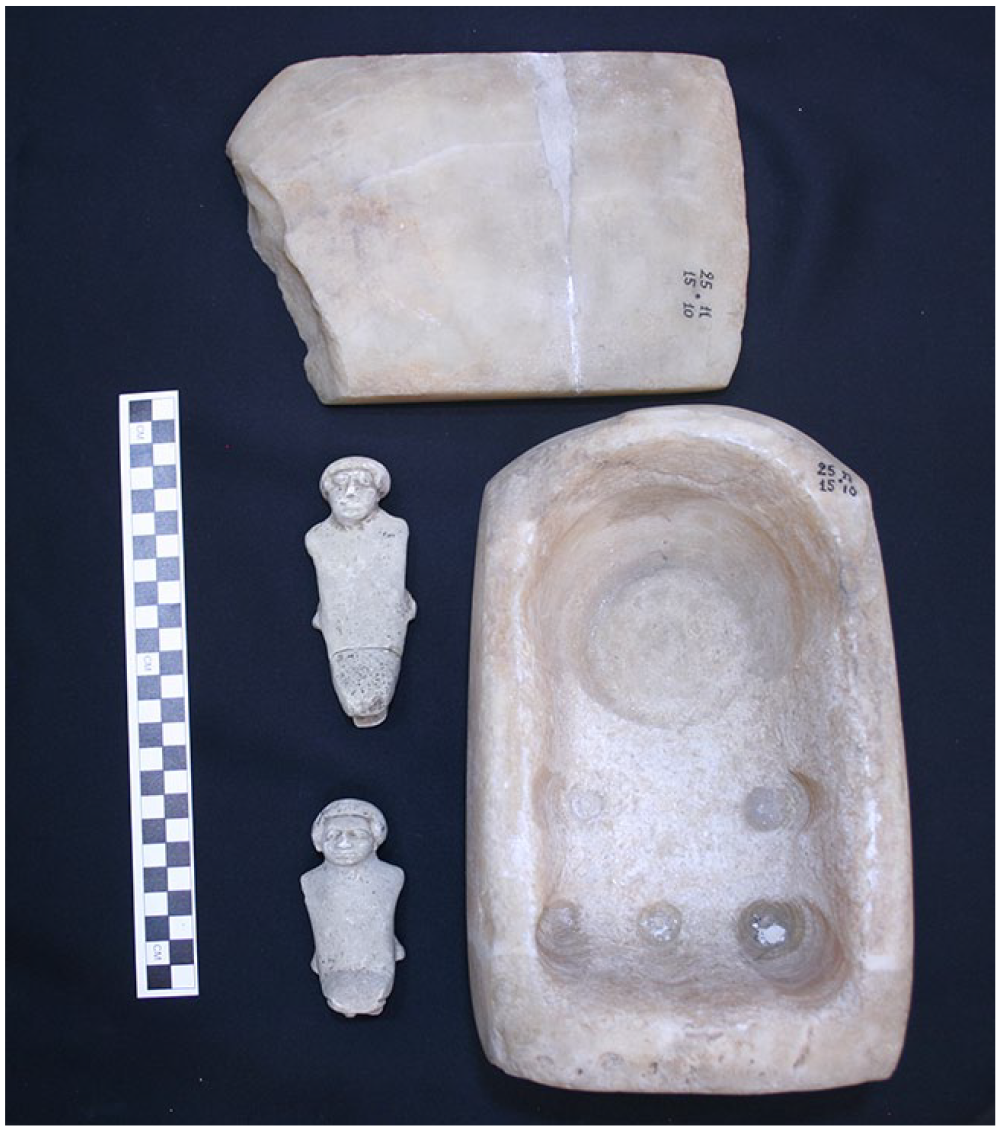
View inside box, objects displayed individually, Tura Group 2 (TR 25.11.15.10a–c) (photo: author).
The two limestone figures of Tura Group 2 depict foreign male prisoners kneeling with arms bound behind their backs (fig. 5). The arms, pinioned at the elbows, form an X on the back of the figure, similar, for example, to those of execration figurines from Uronarti and Mirgissa. 22 The hands, held near their hips, can be seen from the front. Arms bound in this manner is a convention typical of execration figurines and depictions of prisoners in general (fig. 6). The stylized ligature at the elbows is first attested in figurines of the First Intermediate Period or the early Middle Kingdom. 23 Some figurines bearing only a schematic human depiction, especially those dating to the Old Kingdom, have holes at the elbows through which string could be passed, 24 although this is not the case here. These unpainted figurines have clearly defined facial details and hairstyles that differ in appearance. The overall detail in craftsmanship is well done in comparison to the rougher human outlines seen in some other execration figures. 25 There is no indication of separation for the legs. The bends in the knees and ankles can be seen only from the side (fig. 7). The soles of the feet are flat with the heels under the posterior of the figurine, and special care was taken to define them.

Frontal view of the figurines, Tura Group 2 (TR 25.11.15.10b, c) (photo: author).
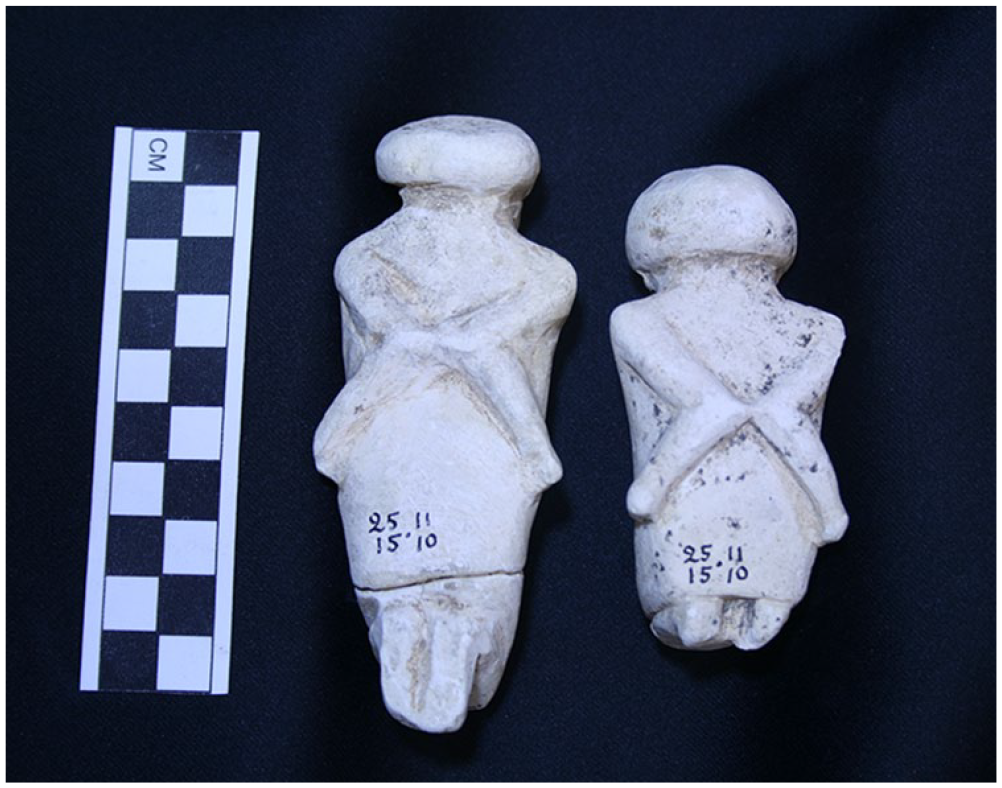
Verso of the figurines. Tura Group 2 (TR 25.11.15.10b, c) (photo: author)

Lateral view of the figurines—kneeling position (figures not to scale), Tura Group 2 (TR 25.11.15.10b, c) (photo: author).
The larger figurine, TR 25.11.15.10b, measures 11 cm from head to feet. The span of its shoulders is 4.4 cm, and the body tapers down to 4 cm in the center. The figurine is 2.2 cm at its thickest point. At the hips, where the legs angle forward for the kneeling position, the object has broken into two pieces. It is now fastened together with a binding agent of some kind. This could be an intentional break, attained in antiquity during the process of abuse. However, this damage might instead have happened in modern times and been repaired either by the seller or by the museum. Without relevant written records, it is difficult to say which might be the case. The facial characteristics are much different from those of the smaller figurine. The larger has a thin nose and a longer, more narrow face. Its eyes are indistinct and may have been left out entirely: There is a defined surface where the eyes should be, but this lacks the definitive eye circles present in its companion. The shape of its hair (perhaps wig), which covers the ears, is a somewhat unusual shape. The hairstyle is rounded and protruding on the front, sides and back, but flat on the top. The hairstyle closely resembles Middle Kingdom depictions of Asiatics, 26 although oddly, most similarly to those of foreign women. 27 The top of the hairstyle of the figure features several indentations that might be evidence of intentional damage (fig. 8).

Top of the head of the non-Nubian figurine bearing evidence of intentional damage, Tura Group 2 (TR 25.11.15.10b) (photo: author).
The smaller figure, TR 25.11.15.10c, is 8.6 cm from head to foot, 4.5 cm across the shoulders, and tapers to 3.5 cm at the center of the body. It is 2.7 cm at its thickest point. It presents the same bound and kneeling position as the larger, but its feet are much shorter, are not as clearly defined, and may be damaged. This figurine is conspicuously a typical Egyptian depiction of a Nubian, with its wide nose, large lips, and large eyes having been well constructed. The hair or wig, beneath which the ears protrude, is typically Nubian and is rounded around the head. The body shows no real evidence of purposeful damage. The tops of the knees, especially on the left side, as well as a portion of the right shoulder, have been chipped off.
While this damage does not appear to be intentional, it is hard to say for certain. The top of the head has some slight, rounded indentations that seem to have been the result of a blunt object (fig. 9). Given that this damage is in a location typical for intentional damage to execration figurines, it may have been purposeful, although the intention is not as obvious as is the damage to the larger figure.
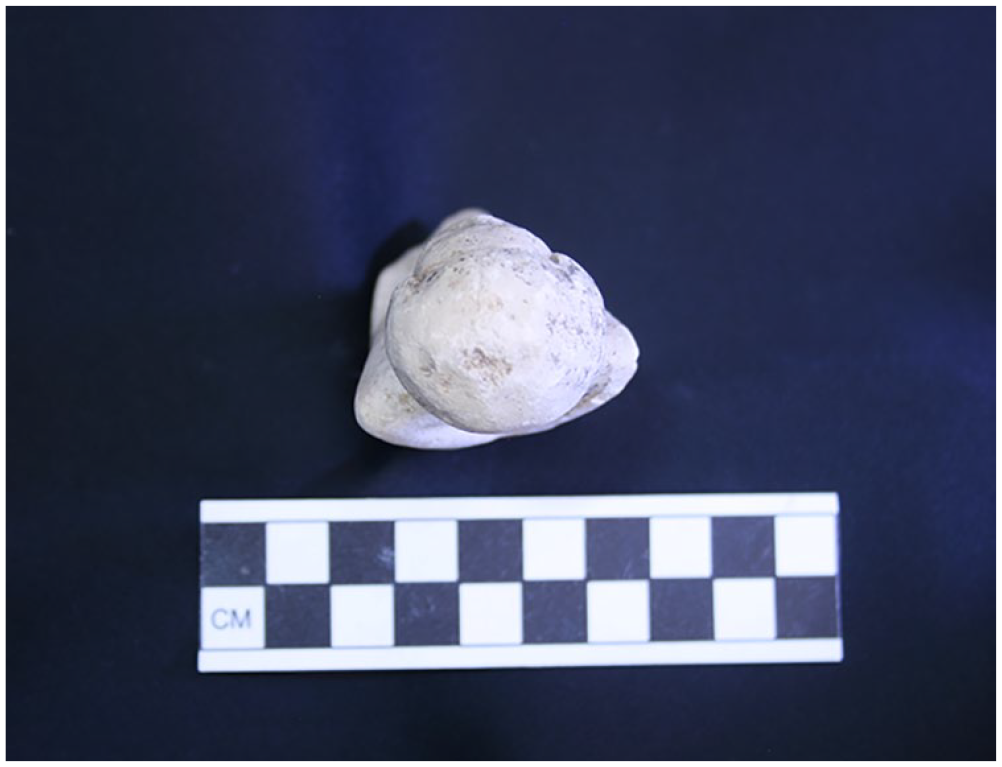
Top view of the Nubian figure showing damage to the head, Tura Group 2 (TR 25.11.15.10 c) (photo: author).
The Egyptian alabaster box of Tura Group 2 (TR 25.11.15.10a(1)), is again rectangular with a semicircular end (fig. 10). The dimensions of the exterior are 15 cm in width by 25 cm in length and 12 cm in height; the corresponding interior dimensions are 11 cm by 20 cm by 7.5 cm, large enough to accommodate both figurines (fig. 11). 28 Box and lid appear to be of rough manufacture or poor conservation; the box might even have been unfinished. The interior faces have been left unpolished, and they feature six circular concavities, likely tool marks from the boring process during construction (fig. 12). There are three marks along the rectangular internal edge (including one at each corner), one centered along each side length, and lastly a concavity, much larger in diameter than the other five, at the rounded end.

Side view of the box, Tura Group 2 (TR25.11.15.10a) (photo: author).
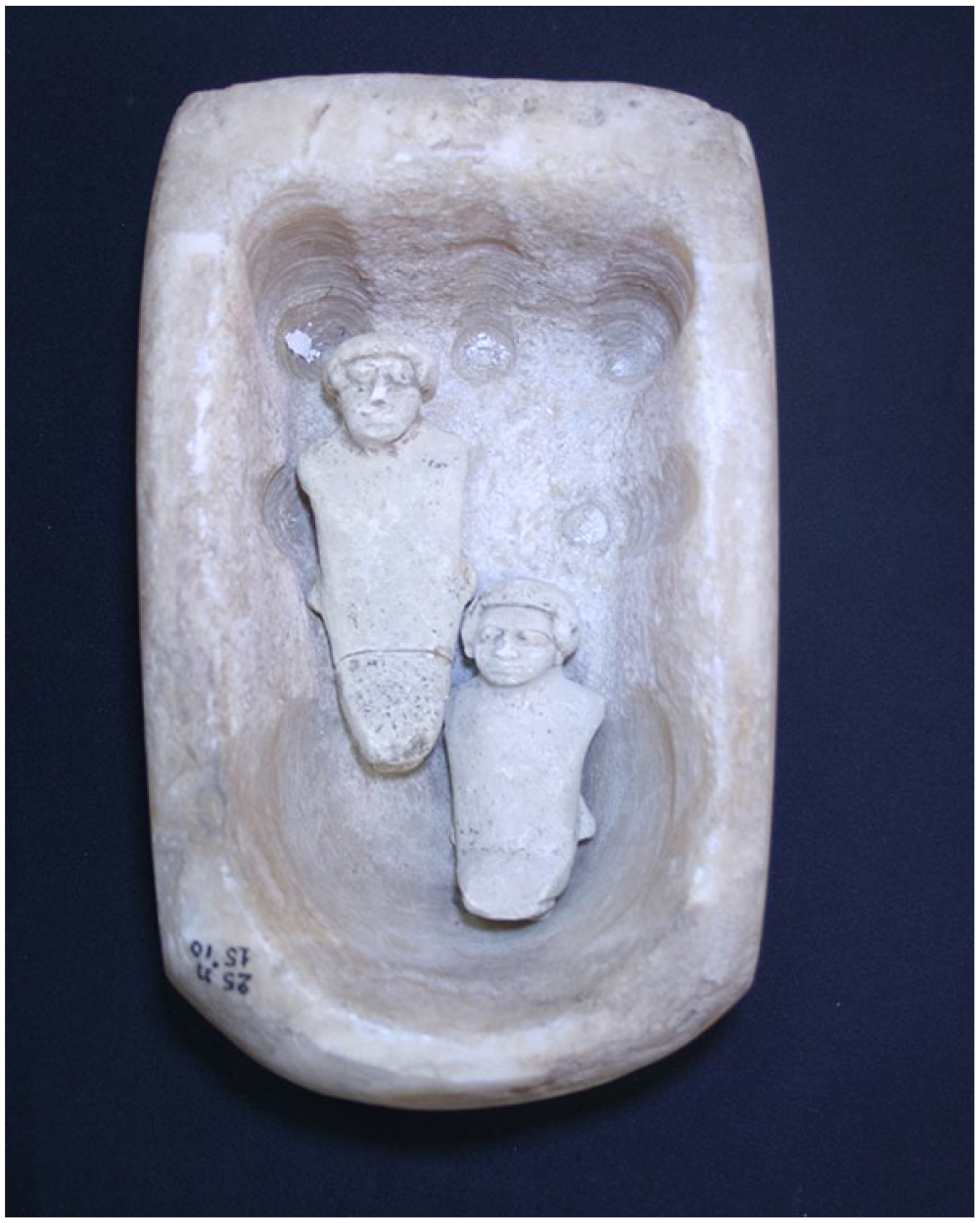
View inside the box, figurines displayed inside the box, Tura Group 2 (TR 25.11.15.10a–c) (photo: author).

View inside the box, Tura Group 2 (TR 25.11.15.10a) (photo: author).
The Egyptian alabaster lid (TR 25.11.15.10a(2)), which follows the shape of the box, is 23 cm in length (maximum), 15.5 cm wide, and 2.3 cm thick. 29 It sits atop of the box without the benefit of any kind of provision for a fit. The lid is broken in two places. A crack has been repaired in modern times with a powdery substance, and a large portion of the semicircular end of the lid is missing. The underside of the lid has a single circular borer mark, as if this piece of Egyptian alabaster was originally intended to become a different vessel.
Atfih Group: JE 66573a–b
This group, comprising an Egyptian alabaster box (JE 66573a) and a single limestone plaque-style figurine (JE 66573b), was registered in 1936 (fig. 13). The group was another purchase by the Egyptian Museum in Cairo, so it lacks definite archaeological provenance. According to the Journal d’entrée, the museum purchased the group for ten Egyptian pounds from a merchant named ‘Agaiby’ of Medinet el Fayum, who claimed that the limestone figurine was found inside the box ‘in a village east of Wasta,’ later specified in the EMC Database as Atfih.
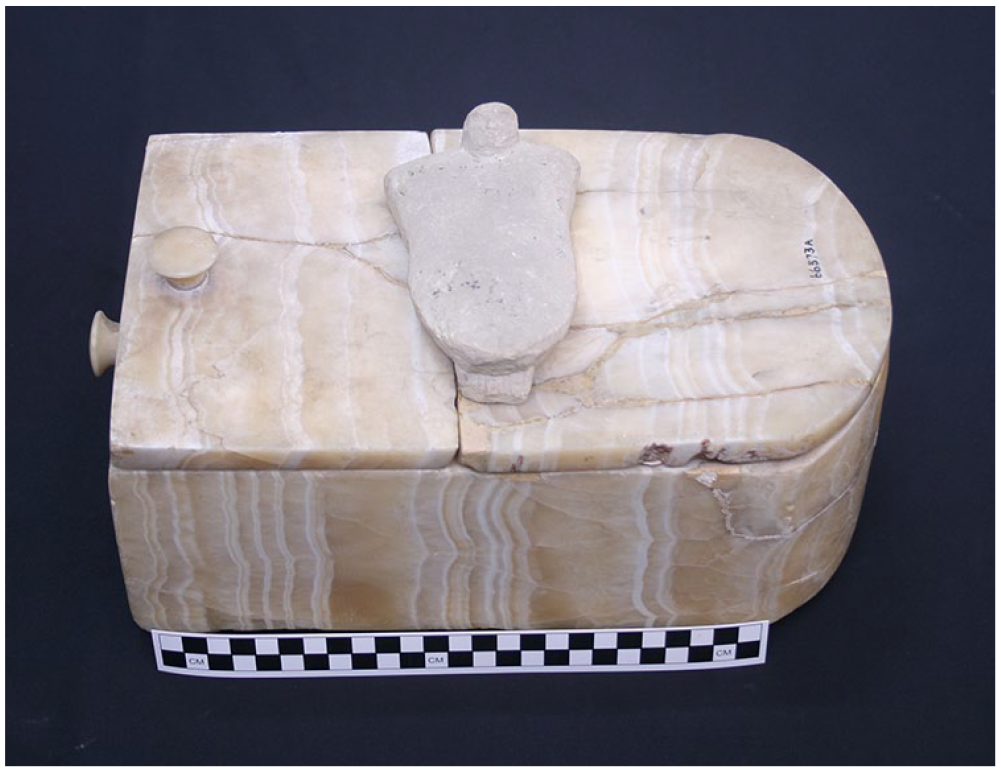
Side view of the box, figurine displayed atop the lid, Atfih Group (JE 66573a,b) (photo: author).
The JE also notes that the figurine was found enclosed in the box. Both the JE and Posener assign this group to the Middle Kingdom. 30 The antiquities dealer named Agaiby in the Journal d’entrée is likely Agaibi Makarios, a Coptic antiquities dealer active in the Fayum during the early 1930s. 31 He was known to have been visited by Friedrich Zucker on behalf of the Papyrus Hauniensis Collection. Hagen and Ryholt suspect that he is also the ‘Izabi’ who sold several papyri to the Yale Papyrus Collection and they note that he sold ‘a small alabaster coffin’, namely JE 66573a to the Egyptian Museum in Cairo in 1936.
The figurine included is again the form of a bound prisoner, but unlike the anthropoid figurines of the Tura groups, the Atfih figure presents a more simplified representation of a human figure with a slab-like body (fig. 14). It is 13.5 cm from head to knees, 8.5 cm across the shoulders, and 2 cm thick. The head measures 2.5 cm in length and 3 cm in width. A waistline has been indicated slightly; the figure narrows from across the shoulders to 7 cm at the waist and widens to 7.5 cm in the region of the hips. From there, it then tapers a bit further to the knees. Here a short vertical line indicates the individual legs.

Frontal view of the figure, Atfih Group (JE 66573b) (photo: author).
Despite the slab-like body, the figure has clearly defined and proportionate facial features. Its head is rounded at the top as if bald. The eyes, nose and mouth are neatly carved, but there are no ears. The lips rise at each end, creating the impression of a faint smile. The figurine is made of a poor-quality limestone. Several cracks are visible, especially along the sides and top of the head (fig. 15).
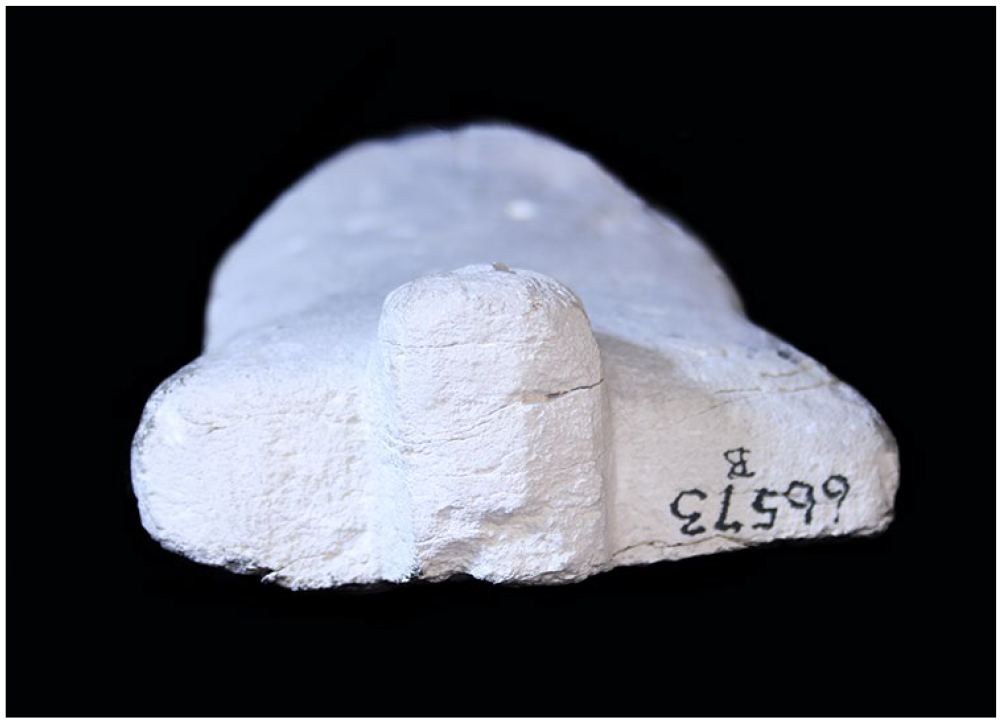
Top view of the figure, Atfih Group (JE 66573b) (photo: author).
The back of the figure is a much brighter white than the front, denoting discoloration of the latter (fig. 16). Little effort has been made to smooth the back, and much of the surface remains rough. Still, here one finds the typical ‘X’ that suggests, in a very rudimentary way, pinioned arms. Horizontal lines in the center of the ‘X’ indicate binding of the arms. Unlike the Tura groups, here no effort has been made to denote the bent knees (fig. 17). The feet are indicated, however, and are clearly visible as a single distinct protrusion that has been given an appropriate number of lines on the frontal plane and bottom edge to indicate ten toes (fig. 18). Although worn away completely in the center, the illegible remains of a hieratic inscription in black ink are visible—barely—along the chest and hips/thighs. Unfortunately, not even one sign is legible to assist with dating.
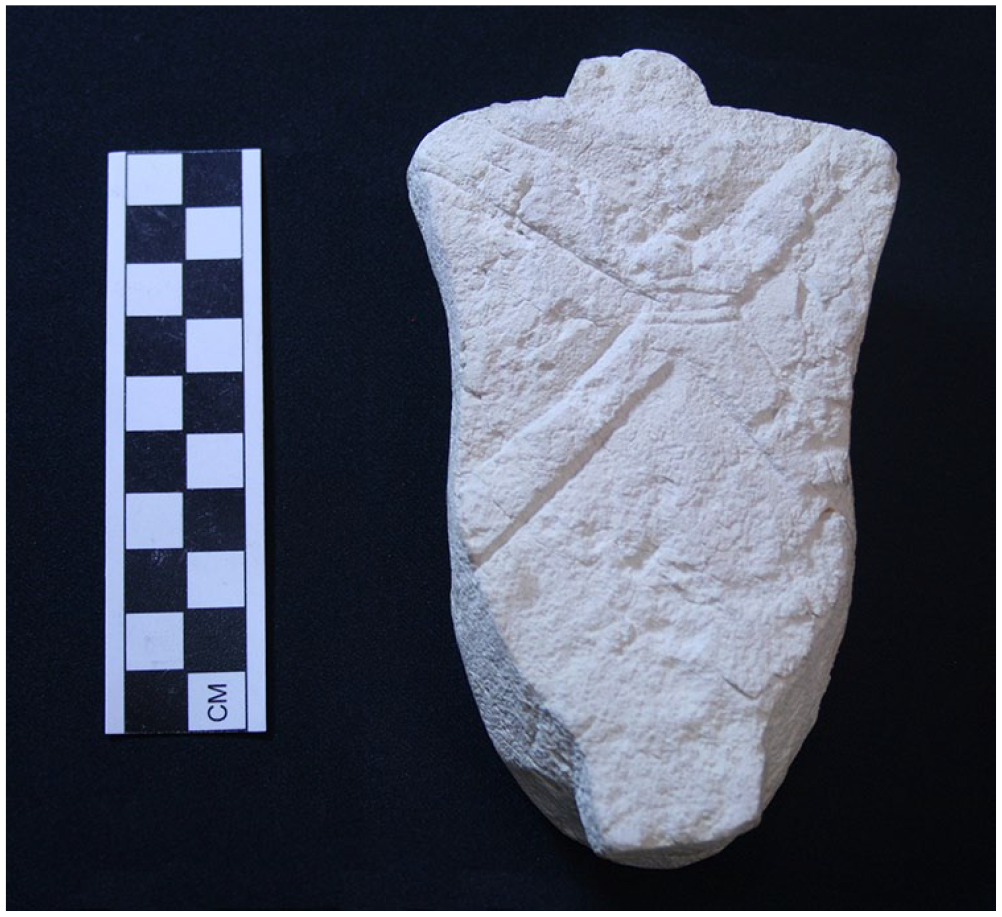
Verso of the figure, Atfih Group (JE 66573b) (photo: author).
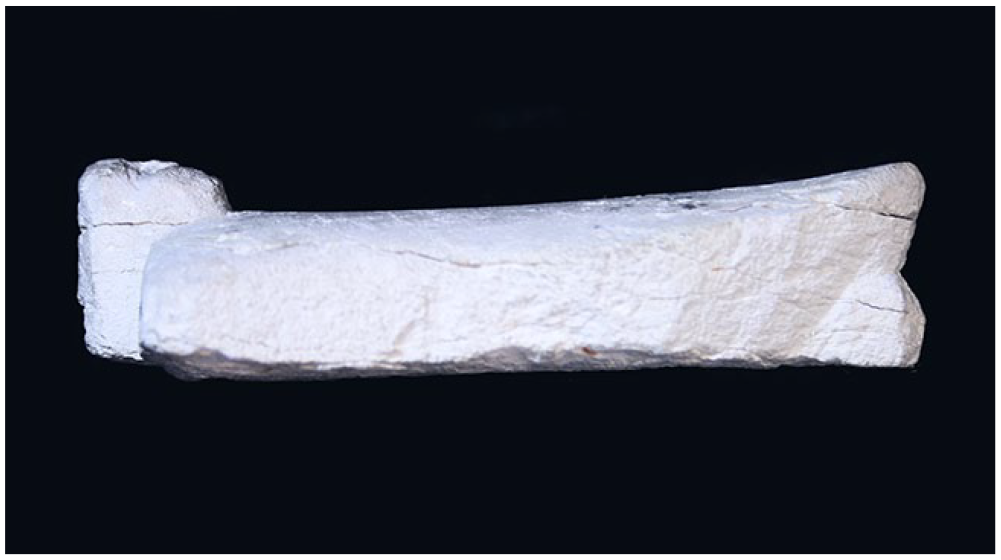
Lateral view of the figure, Atfih Group (JE 66573b) (photo: author).
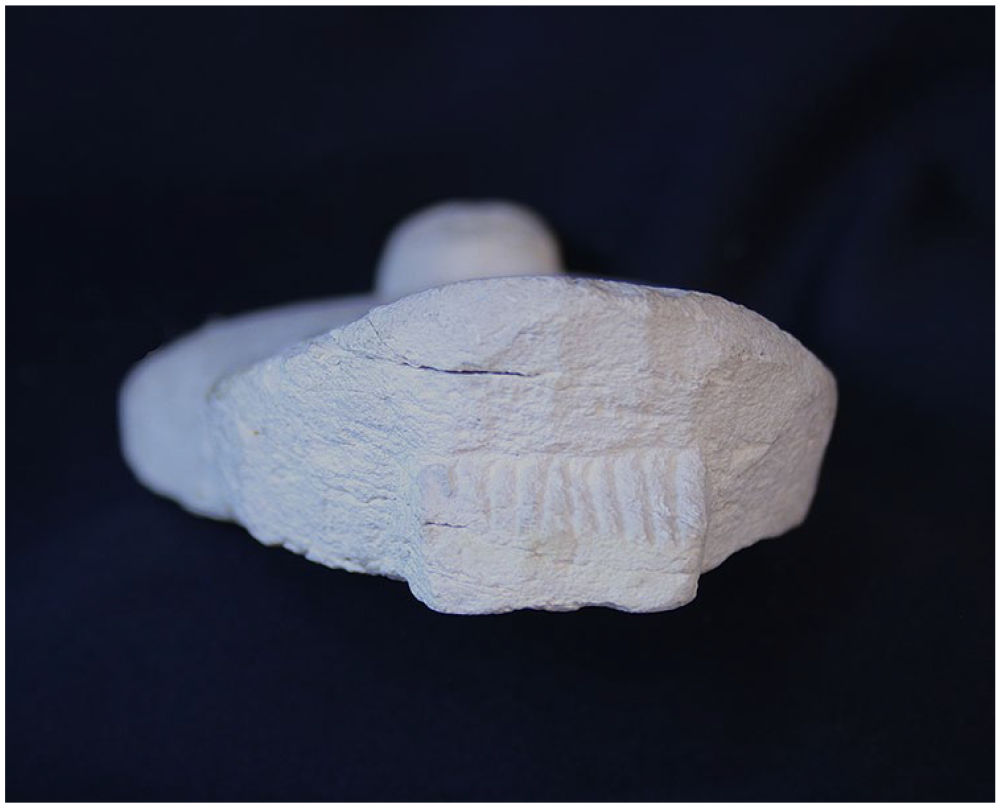
View of toe detail, Atfih Group (JE 66573b) (photo: author).
A digital image enhancement software was utilized to further inspect the inscription of the Atfih figurine. Decorrelation stretch (D-Stretch) is an image enhancement technique plugin to the imaging program ImageJ and uses the decorrelation stretch algorithm. Archaeologically, it has been used to enhance images of papyri, aerial site photography, rock art, and inscriptions. Through its manipulation of light and hue the program is able to expose images that are invisible to the naked eye. 32 However, even after utilizing the D-Stretch plugin on the images of the Atfih figurine, no signs were legible. Furthermore, it is clear that the text that ran through the middle of the figurine has been completely worn away (fig. 19). Perhaps multi-spectral (multiband) imaging, such as that done by Athena Van der Perre and the Egyptian Execration Statuettes (EES) Project for the execration figures from Saqqara known as the Brussels group, could reveal further portions of the inscription. 33 If the text is written in carbon black, Infrared Reflected Image (IRR) may be helpful in revealing more of the inscription, however at this time no portions of the text are legible. No intentional damage can be seen on the object and there are no clear signs of damage to the head. There are some indentations on the body more reasonably attributed to the poor quality of the limestone than to intentional mutilation.
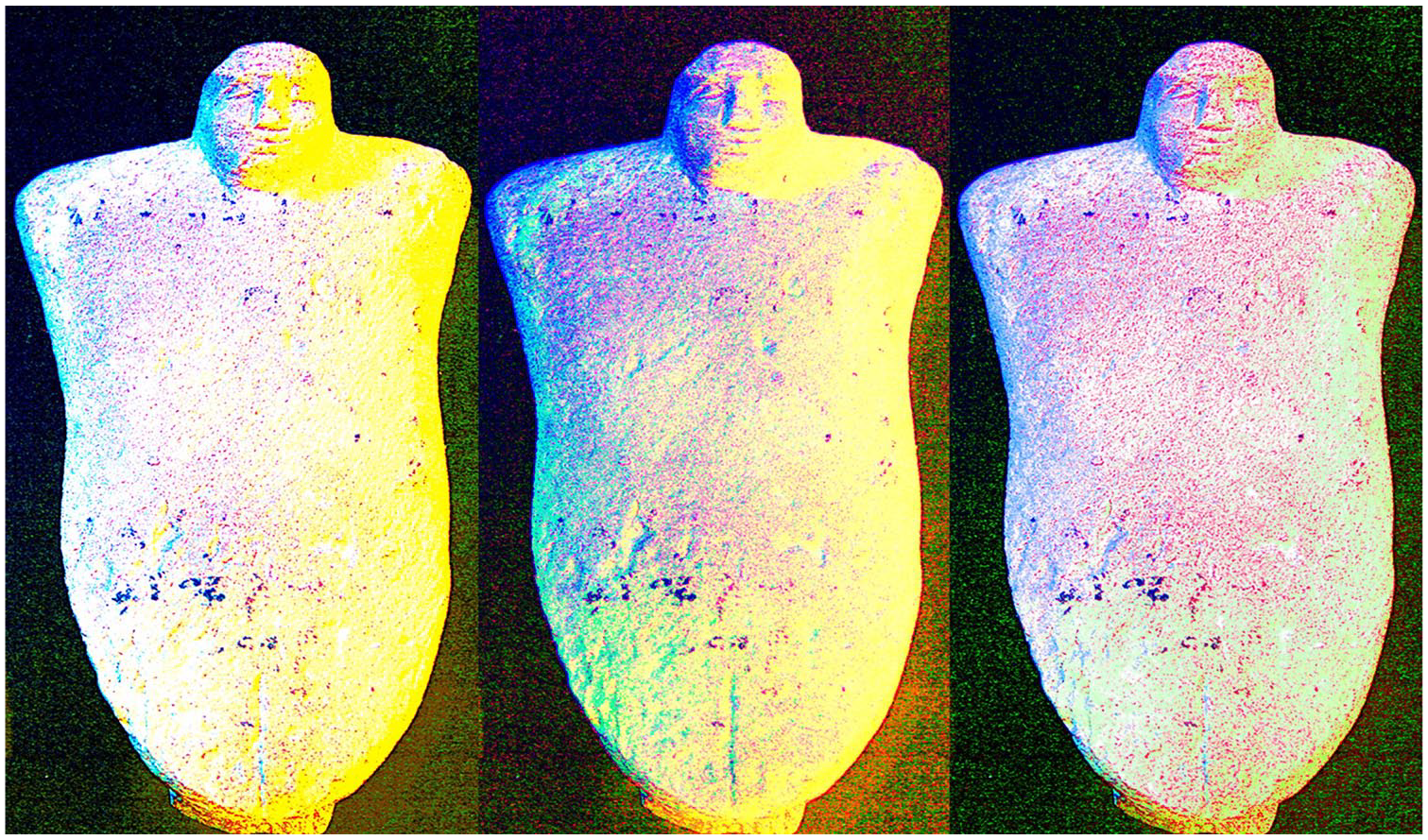
D-Stretch generated image. Left to right: lds/xp0.86-013/ydt hs14, Atfih Group (JE 66573b) (photo: author).
The box and lid of this group are, like those of the two Tura groups, rectangular with a semicircular end. The Atfih box (JE 66573a.1) features excellent craftsmanship and is the best quality of the three, with several features that makes it unique among them (fig. 20). It is also interesting to note the marked difference in the quality of the Egyptian alabaster and execution of the box as compared to the quality of the limestone and the relative simplicity of the figurine. Both box and lid are relatively thin (about 2 cm thick on average) and finely polished. The grains of the two pieces match, so both were likely made from the same stone. This box and lid are a different quality of Egyptian alabaster from that of Tura 2, or perhaps the stone is merely in a better state of preservation. Unique among the boxes of these three groups, the box and lid of the Atfih Group feature a matching pair of mushroom-shaped knobs; one protrudes horizontally from the flat end of the box, and the other rises vertically from the corresponding end of the lid. Such knobs were a common method of closure: string would be wound around the handles and sealed with mud or wax. 34
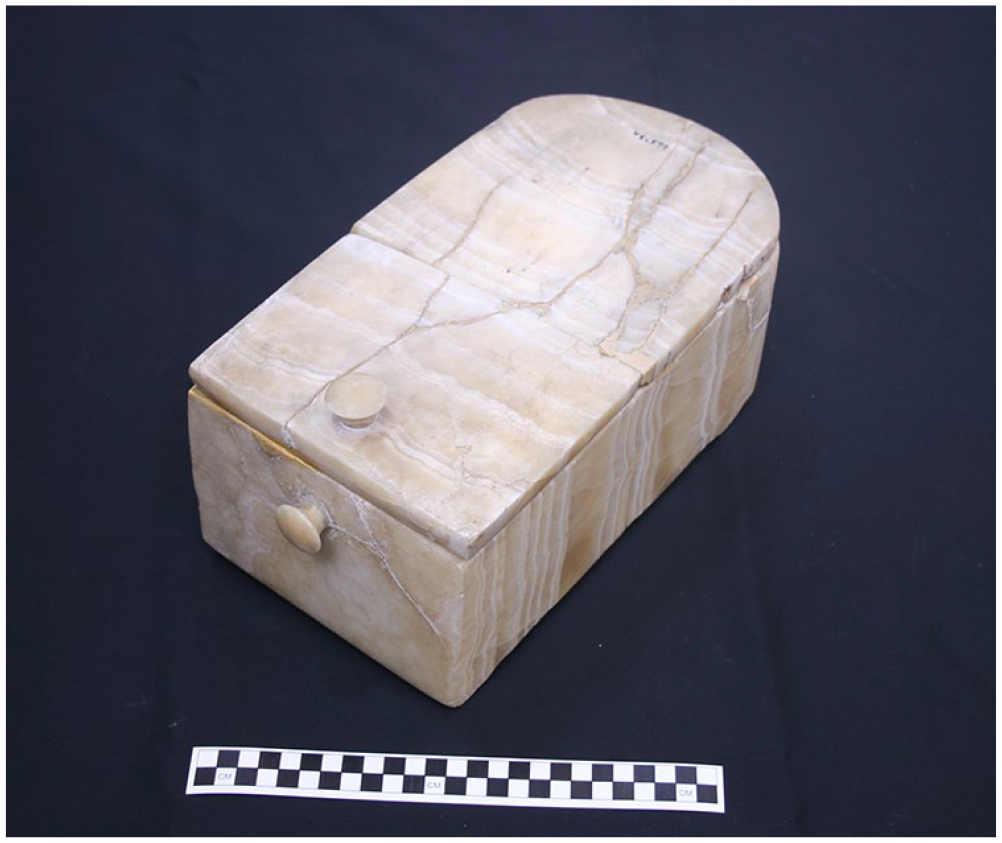
Angled view of the box with lid, Atfih Group (JE 66573a) (photo: author).
The box seems exceptionally large for the size of the figurine it held: 31.5 cm long, 17 cm wide, and 14 cm tall with the lid (12.5 cm without). The interior measures 27.5 cm in length, 14 cm in width, and 10.5 cm in depth and can easily accommodate the limestone figurine (fig. 21). The interior has also been smoothed, and only one borer mark can be seen (in one corner of the square end). However, unlike the exterior, the interior was not polished to a fine finish. The bottom of the box has two beam-like feet that raise the box off the ground (fig. 22). These feet, 3 cm wide, span the entire width of the box. One exterior side features a sticker, on which the Arabic number 20 has been written, perhaps affixed by the antiquities dealer in the 1930s. The museum database makes no reference to the sticker. A dark yellow substance has been used to restore several surfaces of the exterior and interior edge.

View inside the box with partial lid, figurine displayed inside, Atfih Group (JE 66573a,b) (photo: author).

Lateral view of the box—feet detail, Atfih Group (JE 66573a) (photo: author).
The lid (JE 66573a.2) (fig. 23), 31 cm in length, 17.5 cm in width, and 1.7 cm thick, has been broken in several places and restored in modern times with at least three different substances, indicating that the restoration was not done all at once. 35 The JE notes that the lid was crafted from two pieces, joined with tongue and grove (fig. 24). This joinery occurs toward the center of the lid, 13 cm in from the straight lid edge and was part of the original manufacture. The interior face of the lid has two projections, about 2 cm deep, to help it stay in place (fig. 25). One, near the straight end, is rectangular in section, 13 cm by 2.5 cm. The other follows the shape of the rounded end and measures 11.5 cm by 2 cm. The outer face of the lid is discolored, slightly darker than the interior face. A gash along one of the lateral edges appears to be a natural imperfection of the stone.
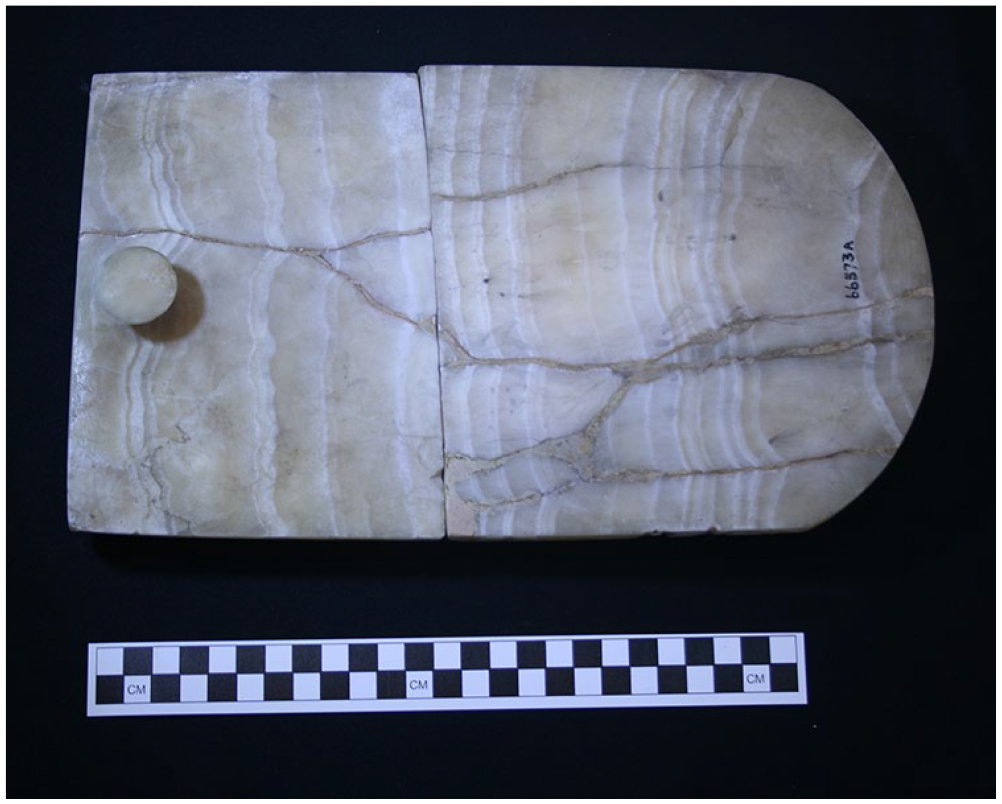
Exterior view of the lid, Atfih Group (JE66573a) (photo: author).

Tongue and groove feature of the lid, Atfih Group (JE 66573a) (photo: author).
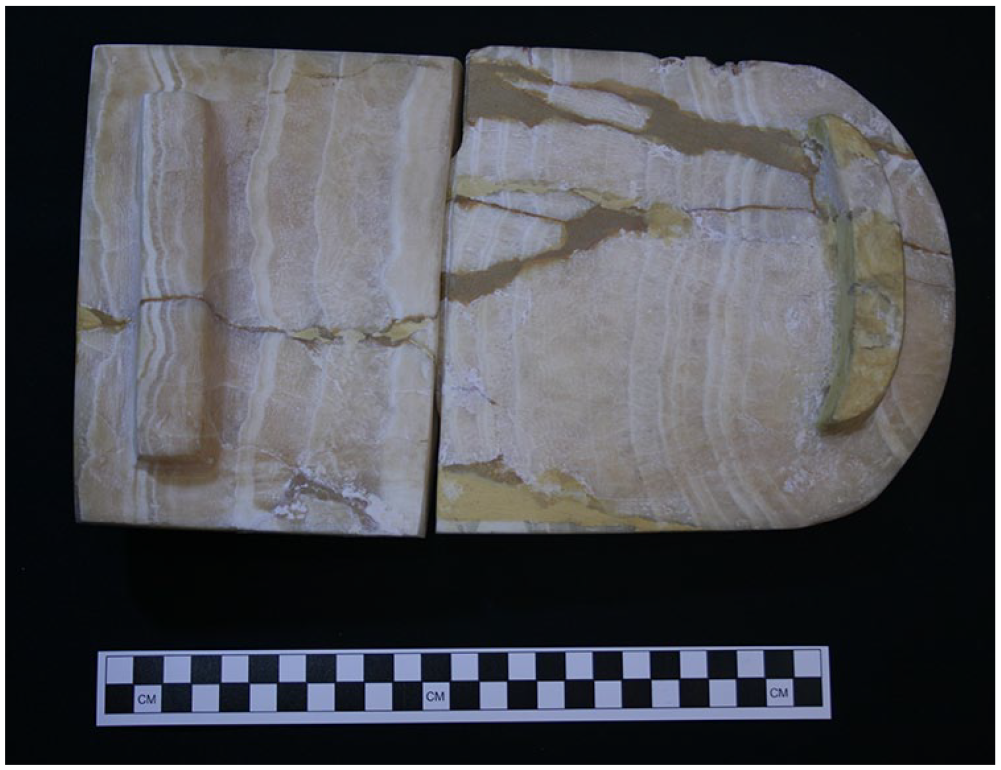
Interior view of the lid, Atfih Group (JE66573a) (photo: author).
Analysis and Discussion
Dating
The Development of Execration Figures
As the execration ritual developed through time, so too did the materials and style of execration figurines themselves. Early examples were often made of easily accessible material, such as unbaked mud. While clay and mud continued to be used, likely due to their magical significance, other higher-quality materials began to appear in subsequent periods.
The stylistic composition and shape of the execration figures also developed over time. Those of the Old Kingdom tend to be rather crudely modeled of unbaked mud and bear only a superficial human form. 36 They have slab-like bodies on which an inscription could easily be written; the examples from Giza often have only a pinch for a head. The execration deposits from this site contained so many figures that their crude human forms are likely a result of the quick and repetitive work required to mass-produce them in little time.
Execration figures from the Middle Kingdom begin to bear more resemblance to human figures of prisoners, with even the slab types often including indications of bound limbs and more defined human features, which earlier examples lack. 37 The anthropoid figures clearly represent prisoners in a kneeling position, with limbs pinioned behind their backs to signify their submission. Faces with clear depictions of stereotyped ethnicities appeared by this period, as well. In this period, the material of execration figurines expanded to more durable, luxury materials, such as Egyptian alabaster and limestone.
During the New Kingdom, detailed features become rarer. An excellent example of this is EA75190, 38 which has an anthropoid shape yet lacks definition. The New Kingdom also likely saw a movement toward wax figurines, as specified in the Papyrus Rollin and Papyrus Lee. These papyri, which are concerned with the harem conspiracy of Ramesses III, include making figurines of wax to affect the power and vigilance of the palace staff. 39 While wax figurines are mentioned in earlier texts such as Coffin Text Spell 37, the relatively sparse number of surviving figurines and increased mention of wax figurines during this period has led some scholars to deduce that wax figurines became more prevalent during the New Kingdom and into the Late Period. While the former statement involves some speculation, what can be said with certainty, is that there are fewer extant execration figurines and deposits securely dated to the New Kingdom than in other periods.
In the Late Period, execration figures once again develop very clear and defined features and more care is taken in the limbs and facial features. 40 Figurines of the Late Period are often anthropoid 41 and usually in a different style than the previously typical kneeling bound position. Late Period figurines are often depicted laying with their arms and feet tied together at the ankles and wrists. 42
In the Graeco-Roman era, textual evidence indicates a clear preference for wax, but figurines in other materials were also used. Execration figurines from this period are often Hellenistic/Roman, rather than Egyptian, in appearance. An example of this style, although not an execration figurine, is the Roman Period figure of a woman pierced by 13 nails (Louvre E. 27145), found near Antinoöpolis inside a clay vessel. 43 The figurine is part of a love spell, but the mechanism of the ritual is nearly identical to rituals against enemies.
Date of the Figures
Execration ritual deposits from the Middle Kingdom have been found at Saqqara, 44 Lisht, 45 Thebes, 46 Helwan, 47 Mirgissa, 48 Semna, 49 and Uronarti. 50 In addition, Middle Kingdom execration figurines without exact provenance are known from the Theban and Memphite areas.
Posener suspects that the Atfih group is from the Middle Kingdom, and although he does not comment explicitly on the date of the two Tura groups, his list includes them within the groups of Middle Kingdom figurines. 51 A note in the JE also supports a Middle Kingdom date for the Atfih figurine.
Parallels for the slab-style Atfih figurine (JE 66573b) include the Lisht figurines (the majority of which are in the Metropolitan Museum in New York), 52 the five Egyptian alabaster examples of Posener’s discussion in the EMC (JE 63956–9), 53 as well as some plaque-style examples from Saqqara. 54 The slab style figurines of the Old Kingdom do not prominently display facial features, giving only a slight pinch for a head. Both comparanda from the Middle Kingdom feature slab style figurines with a defined face or larger region for the head. Additionally, the cross marking on the verso of the Atfih figure to indicate arms bound behind the back are stylistically similar to the arm bindings of the figurines at Uronarti. The Atfih figurine is well within the stylistic tradition of the Middle Kingdom.
Middle Kingdom anthropoid forms similar to the figures of Tura Groups 1 and 2 can be seen in the two full limestone figurines from Mirgissa, 55 a figure in the Brooklyn Museum (Acc. No. 73.23), 56 several Egyptian alabaster figurines from Lisht, 57 and the intact figure from Uronarti. 58 Made of limestone, the Brooklyn figure is markedly similar to figures from Tura Group 2. At 11 cm in height, the figurine is only 1 cm taller than the larger of the Tura Group 2 figures, which it closely resembles stylistically. The figure from Mirgissa is the only of these comparanda found in situ; stylistically it is comparable to those of the Tura groups and the Brooklyn piece. The Mirgissa figurine, 14.5 cm tall, displays a lengthy text across the front. Although larger than others, its stylistic details are consistent with those of its contemporaries. The figures of Tura Group 1 are markedly smaller (6.5 cm) than the others, stylistically however they too are very similar.
The Middle Kingdom anthropoid figurines of Mirgissa, the Brooklyn Museum, Uronarti, and Saqqara are, like the boxed anthropoid figurines of the Egyptian Museum in Cairo, carved in limestone and have the same degree of detail in the facial features, with attention paid to the eyes, nose, and lips, and the hairstyles are all similar, as well. The kneeling and bound position is executed nearly identical among them. The wide-chested figures face forward and have their feet tucked under the buttocks and knees at a slight angle downward; each has a wide chest and clearly defined shoulders. All examples narrow at the waistline, creating a moderately hourglass shape. Additionally, the ligature at the arms of the Mirgissa and Brooklyn Museum figures are noticeably similar to those of Tura Group 2 in the protrusion of the rounded arms from the figurine’s body rather than a stylized ‘X’. 59 Furthermore, the rare addition of the boxes themselves paired with the figurines is only extant in examples from the Middle Kingdom.
Thus, both Tura Group 1 and Tura Group 2 lie well within the stylistic range of anthropoid figures of the Middle Kingdom. A hindrance to a more definitive determination is the lack of inscription that might provide textual clues for dating. Nonetheless, the unmistakable stylistic similarities between the Tura groups and anthropoid figures of unambiguous Middle Kingdom origin indicates that the most likely date for the Tura Groups is the Middle Kingdom.
Sources
Despite the fact that the pieces came from different sellers/donors and were registered by the museum over a span of 20 years, these three execration groups and their Egyptian alabaster boxes are said to originate from a fairly small region. The towns of Atfih and Tura are not far apart on the east bank of the Nile, and each features a cemetery—part of the greater Memphite necropolis—that was in use for long periods in antiquity. Both sites are also in the region of Helwan, which was the source of the five execration figurines that were the subject of Posener’s Cinq figurines d’envoûtement. These were, like the boxes of the Tura and Atfih groups, made from Egyptian alabaster. That objects of this stone are associated with execration rituals from this area may not be merely coincidental.
Atfih
Atfih lies roughly 100 km south of Cairo on the east bank of the Nile. The site received limited archaeological attention during the twentieth century and has gone for long periods with no official work being done at the site. It has also been the target of looting since antiquity. J. de M. Johnson, who worked there from 1911 to 1912, even expressed in his report concern that his field season would produce minimal discoveries because looting was so extensive. 60 Much more recently, Cassier notes in his review of work done at Atfih during the twentieth century that several pieces from the site appear in museums around the world. 61 The site includes several necropolises. The main portion of the site dates to the Graeco-Roman era, but several finds have been made from earlier periods. Johnson’s excavations uncovered a tomb initially believed to be from the New Kingdom; however, modern examination of its furnishings has determined that it is better dated to the Middle Kingdom. 62 Other objects from Atfih identified in museum collections also date to the Middle Kingdom, such as a sphinx of Sobekhotep IV in the EMC. 63
As already noted, the Journal d’entrée notes that JE 66573a–b came from ‘a village east of Wasta,’ a description fitting Atfih. Execration figures are commonly found in cemeteries, which the site features. That the limestone execration figurine and the Egyptian alabaster box of JE 66573a–b may have come from this location is plausible, although there is no way to be certain.
Tura
Located between Helwan and Cairo (about 14 km south of the latter), Tura 64 is the location of a well-known ancient limestone quarry from which came much of the bright-white, high-quality limestone used during the pharaonic period. Egyptian sources mention the quarry as early as the Old Kingdom, when it was tapped most famously for the casing stones of the Fourth Dynasty pyramids at Giza, and rock inscriptions at the site itself date from the Middle Kingdom through the Graeco-Roman Period. 65 Tura was also the location of a large necropolis used from the Old Kingdom until the Graeco-Roman Period.
Since the early 1940s, the Egyptian military has turned several caves at the Tura and el- Masara quarries into munitions storage magazines, 66 but construction of a cement factory in 1927 had ended most archaeology at the site. 67 Nonetheless, expansion of the factory prompted the 1965–66 excavation of Tura al-Asmant, which Fouad Yacoub published in 1988. 68 This work uncovered over 1,500 burials from the Old Kingdom through the Graeco-Roman Period. More than 125 from the Middle Kingdom were excavated within the enclosure of the cement factory. 69
The existence of Middle Kingdom burials at Tura and documented evidence of Middle Kingdom use of the limestone quarries there 70 suggests that the two Tura groups may in fact have been found in this location. However, while one note in the JE mentions that Tura Group 1 was found in Tura ‘in a field close to the railway,’ another indicates that the box and figurines were found in el-Masara. Located roughly 3 km south of Tura, Masara is also the site of an ancient quarry and necropolis. The area of Tura and Masara is, in fact, a continuous series of quarries and cemeteries, and the railway cuts through both. It is difficult thus to pinpoint a potential source for this grouping. Even so, Tura Group 1 probably derived from somewhere at the south end of Tura.
The Boxes
Creation
One of the earliest specialized forms of craftwork in ancient Egypt was the manufacture of stone vessels of various shapes and sizes. 71 This technology first developed during the early Predynastic Period and flourished throughout the pharaonic period. 72 So closely associated with stone working was craftsmanship that the determinative of the Egyptian word for ‘craftsman’, ḥmwty, is a drill. 73
The Egyptian alabaster boxes of the Tura and Atfih execration groups present excellent examples of the quality and skill of Egyptian stone workers. These boxes would have been hollowed out with the same basic techniques used for stone sarcophagi, but on a smaller scale. A tubular copper core barrel would have been attached to a twist/reverse twist drill, use of which preserved the vulnerable integrity of the vessel better than other means. 74 With this tool, and with sand as an abrasive, the craftsman removed several cylindrical cores to create enough work surface to complete the hollow interior and smooth its faces with a copper or flint chisel or some other tool. 75 This coring produced the concavities visible near the inside edges of the boxes from Tura, as well as a similar box from Uronarti (Ex. No. 28-11-299). 76 Such marks have been found in Egyptian alabaster vases and sarcophagi of Sekhemkhet and Khufu. 77 The large concavity seen in the rounded end of the Tura Group 2 box interior was likely produced by a different tool, most likely a figure-8-shaped stone tool attached to a fork-rod. These were used to enlarge initial holes made by tubular coring. 78
Parallels
During the Middle Kingdom, execration texts become standardized and began to follow a predictable formula. 79 In addition, another practice evolved during this period: enclosing them within boxes. The Tura and Atfih groups are not the only Middle Kingdom examples of containment, and there are earlier parallels as well. Several other deposits feature figurines placed within containers of different kinds, jars being perhaps the most common. 80 Figurines are also occasionally found enclosed in clay balls. 81 The use of boxes for execration deposits is rare. Other than the two groups from Tura and the one from Atfih, only two other cases are known with certainty, with the possibility of a third. The two other known groups, from Saqqara and Lisht, are of Middle Kingdom date, and in each the box was formed of unfired clay. The boxes and figurines are very different from each other and are altogether different from the Tura and the Atfih examples.
The Lisht Deposit
This deposit was uncovered by Lansing and Hayes for the Metropolitan Museum of Art during the 1932–33 season of their excavation at Lisht South. 82 The Lisht group consists of about 90 figures of unbaked clay, many of which are fragmentary, 83 and an unbaked clay box (MMA Acc. No. 33.1.66a, b). The group was discovered in the surface debris west of the mastaba of Senwosretankh. 84 Lansing and Hayes note in their report that some of the figurines were found mixed in ‘with a coffin-shaped mud box which had contained some of them’. 85 The figurines of this deposit date from the late Middle Kingdom (Thirteenth Dynasty) to the Second Intermediate Period. 86 Compared to others from the Middle Kingdom, the Lisht figurines are especially crude. The ‘bodies’ are similar to the mud-plaque figurines from the Old Kingdom Giza deposits, however, the facial detail of the figurines parallel plaque figurines of the Middle Kingdom. The resemblance of the broken mud box to a coffin is undeniable; there is very little room for other interpretations of its shape. The figurines and the mud coffin are now held at the Metropolitan Museum of Art in New York City. 87
The Saqqara Deposit
The so-called Brussels group (E.07601ab– related) 88 was discovered in 1922 in the vicinity of the pyramid of Teti at Saqqara in the northeast corner of the chapel in the cenotaph of the Sekwosret family, 89 and comprises a collection of figurines with texts written upon them. 90 Created in clay, the figures come in large and small sizes and some were laid in small boxes of unbaked clay. 91 The majority of these figures are now housed in the Cinquantenaire Museum in Brussels, 92 as is one of the boxes (MRAH E.07601aa). 93 This object, described as a ‘cercueil pour figurine magique,’ is made of unfired clay. 94
An unpublished black-and-white photograph of the Gunn collection in the Griffith Institute shows two inscribed execration figurines lying in a clay box
95
along with two spines of a catfish (Synodontis sp.). Coffin Text 37 specifies that such spines of the synodontis fish, which are poisonous,
96
must be used to inscribe the name of the intended victim on an execration figurine. It also provides instructions that explain the presence of execration deposits in cemeteries: To be spoken over a figure of the foe made of wax and inscribed with the name of that foe on his breast with the bone(?) of a synodontis fish: To be put in the ground in the abode of Osiris.
97
The photograph presents rare evidence of the archaeological record reflecting such details of the execration literature. Interestingly, as is apparent in this photograph, unlike the Lisht and EMC boxes, the boxes of the Saqqara groups lack lids. Unfortunately, the box and the spines are now lost. 98 It is possible that the figurines appearing in the photograph are held at the Cinquantenaire Museum in Brussels, as several of the Brussels figurines resemble them.
Symbolism/Interpretation 99
Mutilation
Execration figurines were often intentionally damaged through any of a number of prescribed abuses. Textual sources instruct the users to beat, stab, burn, spit, and (rarely) urinate on the figurines, usually in some combination or another, 100 e.g., ‘Spit on him four times… trample on him with the left foot… smite him with a spear… slaughter him with a knife… place him on the fire… spit on him in the fire many times’. 101 Evidence of figurines that have been ritually damaged has also been found in the archaeological record. For instance, of the 163 figurines found by Reisner in an Old Kingdom execration deposit at Giza, 31 had been broken. 102 Upon excavation, the jar that contained them was intact, 103 so this damage had to have been done prior to their interment. Other groups have also been found in situ missing pieces such as arms and legs, while other deposits have included model body parts suggestive of dismemberment. 104
Damage to the heads of execration figures is common. The heads of those from Saqqara feature several holes. However, Posener believes these holes to be too regular to have resulted from intentional mutilation to the figurines; he identifies them instead as, possible features to attach weapons or other objects to the head. 105 The execration figurines from Mirgissa present evidence that their heads had been stricken prior to the painting of their wigs, i.e., during the creation process. 106
Of the Tura and Atfih groups, only the figure pair from Tura Group 2 bears definitive evidence of intentional ritual abuse. The non-Nubian figurine of this group (TR 25.11.15.10b) presents the most conspicuous example. At least six percussion marks mar the head, two of which are fairly deep, and, although limestone is considered a soft stone (Mohs hardness of 3–4), 107 some effort is nonetheless required to carve or damage it (a fingernail, for example, cannot scratch it). 108 The slab figure of the Atfih Group does not appear to display any definitive evidence of intentional mutilation. 109
Direct study of the figurines of Tura Group 1 would be needed to assess these figurines for damage. However, the inclusion of the limestone posts together with the figures may suggest a relation to practice of ‘châtiment au pilori’. 110 Prisoners chained to pillars appear from the Old Kingdom through the Graeco-Roman Period. In the case of these figurines, their attachment to the posts may have been yet another means of magical punishment, subjugation, and control.
Materials
The figurines of the Tura and Atfih groups are carved from limestone. Care was taken for the facial details of all five figurines, but the two Tura groups are particularly finely detailed.
While the facial features of slab figures, including those of more costly material such as Egyptian alabaster, 111 are often only rudimentary or omitted entirely, those on the slab figure from Atfih were carved with notable attention. Even the ten toes of the Atfih figure were diligently portrayed (fig. 11). Like the anthropoid figurines from Tura, the Atfih slab figure is something entirely apart from the rushed creations of unbaked clay interred at Giza, Saqqara, and Lisht. The care that went into their carving parallels the material selected for their making.
Limestone is certainly more valuable than the most commonly utilized materials for execration figurines, clay (fired and unfired) and wax.
The quality of the figurines themselves is reflected by the material selected for the boxes that contained them. Their skillfully crafted Egyptian alabaster boxes make Tura Group 1, Tura Group 2, and the Atfih Group (and perhaps that from Uronarti) exceptional among execration deposits, which, when they have containers at all, are otherwise of clay or mud. Use of such materials indicates a degree of affluence that in turn strongly suggests—although some doubt must remain—that the rituals that resulted in the deposits at Tura and Atfih were enacted on behalf of the state rather than private individuals.
Conclusion
Tura Groups 1 and 2 and the Atfih Group most likely date to the Middle Kingdom. Their figurines are comparable in size, material, and style to other examples from this period, sharing many features with those from Saqqara, Mirgissa, and a Middle Kingdom figurine of unknown provenance from the Brooklyn Museum. Despite their identity as execration figurines, some of the figurines from the Tura and Atfih groups display no evidence of mutilation; this is not uncommon.
Although Tura Group 1, Tura Group 2, and the Atfih Group came into the Egyptian Museum in Cairo collection in the early twentieth century by means other than excavation, records of the purported sources should still be taken into account. All three groups are attributed to a certain quarry region on the east bank of the Nile, part of the greater Memphite area. Notes in the Journal d’entrée that suggest specific sources (‘in a field next to the railroad,’ ‘in a village east of Wasta’) for the figurines can be validated (railway tracks run through Tura, and Atfih is east of Wasta). While both Tura and Atfih would benefit from further archaeological exploration, it is known that each was occupied during the Middle Kingdom. It is also evident that each site is home to a large necropolis, a preferred location for execration deposits: the ‘abode of Osiris,’ as specified in Coffin Text 37. It is therefore plausible that the execration figurines of the Tura and Atfih groups did in fact originate from Tura and Atfih. While execration figurines often show signs of intentional mutilation, only the figurines of Tura Group 2 show any indication of purposeful damage. The Tura and Atfih groups of the Egyptian Museum in Cairo are certainly distinct among execration deposits, perhaps future study of execration materials as a whole will yield further information about the Tura and Atfih groups.
Footnotes
Acknowledgements
This paper is the culmination of a project I conducted during my graduate studies at Leiden University in 2016 and is a reworking of my master’s thesis. For allowing me to study and photograph the execration groups, I offer my sincere appreciation to the staff of the Egyptian Museum of Antiquities in Cairo, especially Sara Al-Ashmawi for her assistance with my paperwork and Mrs. Taqwa, the head of Section 3, for facilitating my request and providing the time I needed with the objects. Her expedient review and acceptance of my application made the work possible. I am indebted to Noreen Doyle for her patience, meticulous scrutiny, and pleasant commentary during the writing process. I owe a great deal to Marleen De Meyer of the Netherlands-Flemish Institute in Cairo for her resources, assistance, and words of encouragement with a piece of previous work which greatly contributed to a portion of this work. I am deeply grateful to Olaf Kaper of Leiden University, who always allowed me to visit his office without a moment’s notice and took the time to answer my many questions. Finally, tenacious insistence from Pearce Paul Creasman of the University of Arizona helped to make this work possible.
Funding
The author(s) disclosed receipt of the following financial support for the research, authorship, and/or publication of this article: Richard H. Wilkinson Junior Research Fellowship, provided by the University of Arizona Egyptian Expedition.
1
See R. Ritner, The Mechanics of Ancient Egyptian Magical Practice (SAOC 54; Chicago, 1993), 111–79; K. Muhlestein, ‘Execration Ritual’, in W. Wendrich, J. Dieleman, E. Frood and J. Baines (eds), UEE (Los Angeles, 2008), 1–4 < > accessed 11.01.2019; Y. Koenig, Magie et magiciens dans l’Égypte ancienne (Paris, 1994), 131–85; A. Vila, ‘Un dépôt de textes d’envoûtement au Moyen Empire’ Journal des Savants 3:1 (1963), 135–60.
2
See K. Sethe, Die Ächtung feindlicher Fürsten, Völker und Dinge auf altägyptischen Tongefäßscherben des Mittleren Reiches (Berlin, 1926), 59–62; G. Posener, Cinq figurines d’envoûtement (BdÉ 101; Cairo, 1987); J. Osing, ‘Ächtungstexte aus dem Alten Reich (II)’, MDAIK 32, (1976), 133–85, pls 40–51; S. Seidlmayer, ‘Execration Texts’, in D. B. Redford (ed.), The Oxford Encyclopedia of Ancient Egypt, I (Oxford, 2001) 487–9.
3
Y. Koenig, ‘À propos des textes d’envoûtement de Mirgissa’, in A. Roccati and A. Siliotti (eds), La Magia in Egitto ai Tempi dei Faraoni. Atti convegno internazionale di studi Milano 29–31 ottobre 1985 (Milan, 1987), 310; G. Posener, Cinq figurines d’envoûtement (Cairo, 1987), 6.
4
The collection of objects of individual execration deposits will be referred to as ‘groups’ or ‘groupings.’ Either term will encompass all of the artifacts associated with the deposit, including the receptacle, figurines, and any other objects included with the deposit.
5
Posener, Cinq figurines.
6
These have appeared in lists of execration figurines or been referred to briefly in museum catalogues but have not undergone in-depth study. See Posener, Cinq figurines, 2–6; E. Warmenbol (ed.), Sphinx: les gardiens de l’Égypte; exposition, Espace culturel ING, Bruxelles, 19 octobre 2006–25 février 2007 (Brussels, 2006), 196–7, cat. nos 32–4; E. Warmenbol (ed.), Beautés d’Egypte: ‘celles que les ans ne peuvent moissonner’: Catalogue de l’exposition créée au Musée du Malgré-Tout à Treignes (Belgique) du 2 juin au 15 décembre 2002 (Treignes, 2002), 105 cat. nos 36–7; Ritner, Mechanics, 175 n. 811 (from Posener).
7
Posener, Cinq figurines, 5.
8
Posener, Cinq figurines, 2–6.
9
JE: Journal d’entrée; SR: Special Registrar; TR: Temporary Registrar; EMC: Egyptian Museum in Cairo; GEM: Grand Egyptian Museum. At the time of study this group had been moved into storage at the Grand Egyptian Museum and was therefore not available for direct examination. The photographic and measurement data is limited to that available through The Egyptian Museum Database.
10
These are the only measurements of the box available in the EMC Database.
11
Gypsum alabaster has a Mohs hardness of 2, travertine of 3 (B. Aston, Ancient Egyptian Stone Vessels: Materials and Forms (SAGA 5; Heidelberg, 1994), 48).
12
For a complete discussion of the use of the term ‘alabaster’ in Egyptology, see Aston, Stone Vessels, 42–51; J. A. Harrell, ‘The Misuse of the Term ‘Alabaster’ in Egyptology’, GM 119, (1990) 37–42; D. Klemm and R. Klemm, ‘The Building Stones of Ancient Egypt: A Gift of its Geology,’ African Earth Sciences 33 (2001), 640–1.
13
Aston, Stone Vessels, 48.
14
Barbara Aston, who has done an extensive study on the subject the Egyptian use of stone materials, has found only seventeen vessels constructed of gypsum alabaster in museum collections around the world (Aston, Stone Vessels, 48).
15
This paper will follow the Klemm and Klemm terminology for the stone.
16
Klemm and Klemm, African Earth Sciences 33, 641.
17
An elaborate example of Ptolemaic date is in the Royal Museums of Art and History—Cinquantenaire Museum in Brussels (MRAH E.08241), and countless examples in wall reliefs and tomb paintings are also known from the Old Kingdom through to the Graeco-Roman Period. See N. Beaux, ‘Ennemis étrangers et malfaiteurs égyptiens. La signification du châtiment au pilori,’ BIFAO 91 (1991), 33–53.
18
B. Bryan and S. Ikram, ‘Investigating the Temple of the Goddess Mut at South Karnak: Session 3’ Virtual Lecture series; publication forthcoming. <https://www.youtube.com/watch?v=L1hIAcXmJa4&t=1872s&ab_channel=JohnsHopkinsUniversity> accessed 16.10.2020.
19
Unfortunately, no photographs of the backs of the figurines are available.
20
The EMC Database refers to the smaller red painted figure JE 45204c as ‘Syrian’, although with the damage as it remains it would be hard to determine the figurine’s intended identity or nationality. The names used in rites against enemies are often Asiatic, Nubian, or even Egyptian; it is therefore difficult to ascertain with certainty the intended identity of the small figurine.
21
The spelling of the name ‘Moberley’ is unclear. The name appears to have been spelled initially ending in i, but this was later changed to y.
22
Uronarti figures: D. Dunham (ed.), Second Cataract Forts Volume II: Uronarti, Shalfak, Mirgissa (Boston, 1967), pls XXXI, XXXII. Mirgissa figures: Koenig, in Roccati and Siliotti (eds), La magia in Egitto, 308, ; M. Heimer, ‘Une statuette d’envoûtement en albâtre du Moyen Empire’, RdE 33 (1981), 134–7.
23
See G. Posener and J. Osing, ‘Tablettes-figurines de prisonniers’, RdE 64 (2013), 135–75.
24
Several figurines from Saqqara (G. Posener, Princes et pays d’Asie et de Nubie: Textes hiératiques sur des figurines d’envoûtement du moyen empire.—suivis de remarques paléographiques sur les textes similaires de Berlin (Brussels, 1940), 18), as well as the Old Kingdom example of Espinel, now in the Museu Egipci de Barcelona (Inv. No. E618; A. D. Espinel, ‘A Newly Identified Old Kingdom Execration Text’, in E. Frood and A. McDonald (eds), Decorum and Experience: Essays in Ancient Culture for John Baines (Oxford, 2013), 30). Several unfired clay slab figurines from Giza have holes on their backs that led them to be once labeled as ‘tags’ (Osing, MDAIK 32, pl. 51).
25
For example, the five Egyptian alabaster figurines published by Posener: JE 63955–9 (Posener, Cinq figurines, pls 4–8).
26
See R. Schiestl, ‘The statue of an Asiatic man from Tell el-Dab’a, Egypt’, Ä&L 16 (2006), 173–85; Do. Arnold, ‘Image and identity: Egypt’s Eastern Neighbours, east Delta people and the Hyksos’, in M. Marée (ed.), The Second Intermediate Period (Thirteenth-Seventeenth Dynasties): Current Research, Future Prospects (OLA 192; Leuven 2010), 183–221; Do. Arnold, ‘Foreign and female’, in S. D’Auria (ed.), Offerings to the Discerning Eye: an Egyptological Medley in Honor of Jack A. Josephson (CHANE 38; Leiden, 2010), 17–31.
27
See Arnold, in D’Auria (ed.), Offerings to the Discerning Eye, 17–31; Arnold, in Marée (ed.), The Second Intermediate Period, 183–221. I do not believe that the figurine is necessarily meant to represent a foreign woman. It is worth noting however, that the flat-topped shape with protruding rounded edges of TR 25.11.15.10b most closely resembles the hairstyles of foreign women, especially a figurine of The Museum of Fine Arts, Boston, acc. no. 54.994, a figurine of The National Museums of Scotland, Edinburgh, A. 1911.260, and the foreign women depicted in the tomb of Ukhhotep II at Meir (Arnold, in D’Auria (ed.), Offerings to the Discerning Eye, 24–8). As opposed to the mushroom-shape hairstyles best exemplified by the well-known statue of an Asiatic man from Tell el-Dab’a or the alternate hairstyle of the Aamu men from the tomb of Khnumhotep II at Beni Hasan, and the Lisht fragment MMA acc. no. 13.235.3. (Arnold, in Marée (ed.), The Second Intermediate Period, 195–200).
28
The box is much heavier than one might expect. Unfortunately, weighing the box was not possible, but it likely weighs well over 9 kg.
29
TR 25.11.15.10a (2).
30
‘Moyen Empire probable’: Posener, Cinq Figurines, 5.
31
F. Hagen and K. Ryholt, The Antiquities Trade in Egypt 1880–1930: The H.O. Lange Papers (H. Humanistica 4 vol. 8; Copenhagen, 2016), 191.
32
The D-Stretch Homepage <http://www.dstretch.com/> accessed 11.01.2019. For more information on the Algorithm that the plugin utilizes, see <> accessed 11.01.2019.
33
A. Van der Perre, D. Braekmans, V. Boschloos, F. Ossieur, H. Hameeuw, and L. Delvaux, ‘The Egyptian Execration Figurines of the Royal Museums of Art and History, Brussels: Conservation, Pigments and Digitisation’, Bulletin des Musées royaux d’Art et d’Histoire 87/88 (2016–17) 5–30; see also Conservation, IR, UV and 3D-Imaging: the Egyptian Execration Statuettes (EES) Project <> accessed 11.01.2019.
34
G. Killen, Egyptian Woodworking and Furniture (Shire Egyptology Series 21; Buckinghamshire, 1994) 51–2. Examples abound, but this closure can be seen, for example, in the New Kingdom cartouche-shaped boxes of the Rijksmuseum van Oudheden inv. no. AAL 40, those from KV 62 (Carter Nos 269a/270b, 014b, 367k, 629(95)), and the Middle Kingdom (Twelfth Dynasty) cosmetics box of Kemeni in the Metropolitan Museum of Art (acc. no. 26.7.1438).
35
The substances are dark yellow, light yellow, and powdery white in color.
36
For examples of Old Kingdom execration, see A. Abu Bakr and J. Osing, ‘Ächtungstexte aus dem Alten Reich’, MDAIK 29 (1973), 97–133; J. Osing, ‘Ächtungstexte aus dem Alten Reich (II)’, MDAIK 32 (1976), 134–97; S. Wimmer, ‘Neue Ächtungtexte aus dem Alten Reich’, Biblische Notizen 67 (1993), 87–100; J. F. Quack, ‘Some Old Kingdom Execration Figurines from the Teti Cemetery’, BACE 13 (2002), 149–61, pls 24–5; Espinel, in Frood and McDonald (eds), Decorum and Experience, 26–33.
37
For examples of Middle Kingdom execration figurines, see those listed below under the heading ‘Date of the Figures.’ See also the First Intermediate Period or early Middle Kingdom example bearing arm ligatures published by Posener and Osing (Posener and Osing, ‘Tablettes-figurines de prisonniers’, RdE 64, (2013) 135–75).
38
British Museum online catalogue <http://www.britishmuseum.org/research/collection_online/collection_object_details.aspx?objectId=108976&partId=1&searchText=75190&page=1> accessed 11.01.2019.
39
pRollin line 1; pLee column 1 line 4; Ritner, Mechanics, 193–9; M. Raven, Wax in Egyptian Magic and Symbolism (OMRO 64; Leiden, 1983), 9. See also the figurine dated tentatively as anywhere from the late Old Kingdom onwards: C. Knoblauch, ‘Bound, stabbed and left for dead: a damaged wax figurine from Helwan’, GM 229 (2011), 53–63.
40
With the exception of the Tell Defenneh figurines that can be found in the Boston Museum of Fine Arts (acc. nos 87.811, 87.812) and the British Museum (EA23826).
41
For Late Period examples, see Posener, Cinq figurines, 6.
42
C. Kühne-Wespi, ‘Burnt or Buried: Execration Figurines after the New Kingdom,’ in J. F. Quack and C. Kühne-Wespi (eds), A Closer Look at Execration Figurines: Conference Proceedings held Thursday 12 – Saturday 14 October 2017, Heidelberg University Neue Universität (ORA, forthcoming).
43
Ritner, Mechanics, 112–13; P. du Bourguet, ‘Une ancêtre des figurines d’envoûtement percées d’aiguilles, avec ses compléments magiques, au Musée du Louvre’, in J. Vercoutter (ed.), Livre dui Centaenaire 1880–1980 (MIFAO 104; Cairo, 1980), 225–38; P. du Bourguet, ‘Ensemble magique de la période romaine en Égypte’, Revue de Louvre 25 (1975), 255–7.
44
Posener, Princes et pays; A. Abdalla, ‘The Cenotaph of the Sekwaskhet Family from Saqqara’, JEA 78 (1992), 93–4.
45
A. Lansing and W. C. Hayes, ‘The Egyptian Expedition: The Excavations at Lisht’, BMMA 11:2 (1933), 23–4, fig. 32; see also MMA acc. nos 22.1.742, 15.3.594, 22.1.741, and 15.3.213.
46
For the ‘Berlin Bowls,’ see Sethe, Die Ächtung, 59–62.
47
Posener, Cinq Figurines, 2–60.
48
A. Vila, ‘Un dépôt de textes d’envoûtement au Moyen Empire’, Journal des Savants 3 (1963) 135–60.
49
Dunham, Second Cataract Forts II, 54, pl. XXXII.
50
Dunham, Second Cataract Forts II, 54, pls XXXI, XXXII.
51
Posener, Cinq figurines, 5. Although Posener often guesses at dates for other figures, citing ‘Date tardive probable’ for several pieces (Posener, Cinq figurines, 2–6), he makes no mention of a period for either Tura group, but places them both in chronological order among the Middle Kingdom figurines in his list.
52
See MMA Acc. No. 33.1.77– and related acc. no. 15.3.593. Lansing and Hayes, The Metropolitan Museum of Art Bulletin 28, 23–4, fig. 32.
53
Posener, Cinq figurines, pls 1–8.
54
Posener, Princes et pays; see Rijksmuseum Van Oudheden, Leiden 1940/8.3, MRAH E.07614, MMA acc. no. 33.1.77–related.
55
Vila, Journal des Savants 3, 146, fig. 9.
57
MMA acc. nos 22.1.742, 15.3.594, 22.1.741 and 15.3.213.
58
Dunham, Second Cataract Forts II, 54, pl. XXXI.
59
Pictures of the verso of Tura Group 1 do not exist and I was unable to study them directly. However, similarities between the details of the hands and feet indicate a stylistically similar arm binding to Tura Group 2.
60
J. de M. Johnson, ‘The Graeco-Roman Branch: Excavation at Atfieh,’Archaeological Report (Egypt Exploration Fund) (1910–11), 6–7.
61
C. Cassier, ‘Fouilles à Atfih au début du XXe siècle’, Égypte Nilotique et Méditerranéenne 4, (2011), 275 n. 8. Cassier has tracked down objects uncovered during the Egypt Exploration Fund excavations at the site and the current locations of these artifacts are listed in an appendix in his article (Cassier, ENIM 4, 289–90).
62
Cassier, ENIM 4, 276, 288 n. 40.
63
Cassier, ENIM 4, 275 n. 8.
64
Also spelled: Tourah, Tûra, Toura, Tora.
65
R. Klemm and D. Klemm, Stones and Quarries in Ancient Egypt (London, 2008), 51.
66
Klemm and Klemm, Stones and Quarries, 51; N. Charlton, ‘The Tura Caves’, JEA 64 (1978), 128.
68
F. Yacoub, ‘Excavations at Tûra El-Asmant From the Old Kingdom till the Greco-Roman Period Seasons 1965– 1966,’ ASAE 67, (1988), 193.
69
Yacoub, ASAE 67, 205.
70
Klemm and Klemm, Stones and Quarries, 52.
71
For a more complete look at stone vessels and processing, see Aston, Stone Vessels, 42–51; I. Shaw, Ancient Egyptian Technology and Innovation: Transformations in Pharaonic Material Culture (London, 2012), 55–68; D. Stocks, ‘Making Stone Vessels in Ancient Mesopotamia and Egypt’, Antiquity 67:256 (1993), 596–603; D. Stocks, ‘Stone Sarcophagus Manufacture in Ancient Egypt’, Antiquity 73:282 (1999), 918–22; C. Lilyquist, Egyptian Stone Vessels: Khian Through Thutmosis IV (New York, 1995), 1–17; D. Stocks, Experiments in Egyptian Archaeology: Stoneworking technology in Ancient Egypt (London, 2003), 139–68.
72
Shaw, Technology and Innovation, 62.
73
Shaw, Technology and Innovation, 63.
74
Stocks, Antiquity 67, 600.
75
Stocks, Antiquity 73, 918–19.
76
Dunham, Second Cataract Forts II, 40, pl. LXIV.
77
Stocks, Antiquity 73, 919–21.
78
Stocks, Antiquity 67, 597–8.
79
For more information on Middle Kingdom execration texts, see Y. Koenig, ‘A propos des textes d’envoûtement de Mirgissa’, in A. Roccati, and A. Siliotti (eds), La Magia in Egitto ae Tempi dei Faraoni (Milan, 1987), 301–12; Sethe, Die Ächtung, 59–62; G. Posener, ‘Les textes d’envoutement de Mirgissa’, Syria 43:3/4 (1966), 277–87. For chronological order, Ritner gives this explanation: ‘The texts of the Middle Kingdom assemblages show progressive development from Old Kingdom prototypes, providing internal evidence for their chronological sequence: the Cairo alabaster figurines (Helwan) (Sesostris I), the Mirgissa deposit (Amenemhat II–Sesostris II), the Berlin bowls (mid Twelfth Dynasty), and the Saqqara figures (end of Twelfth Dynasty)’ (Ritner, Mechanics, 140 n. 620).
80
See Osing, MDAIK 32, 134–85; Abu Baker and Osing, MDAIK 29, 97–133; Quack, BACE 13, 149.
81
H. Willems, ‘The Social and Ritual Context of a Mortuary Liturgy of the Middle Kingdom (CT Spells 30–41)’, in H. Willems (ed.), Social Aspects of Funerary Culture in the Egyptian Old and Middle Kingdoms: Proceedings of the International Symposium Held at Leiden University 6–7 June, 1996 (OLA 103; Leuven, 2001), 318. An image of a figurine from Elephantine without the clay ball that contained it can be found in L. Borrmann, ‘Form Follows Function: der Zeichencharakter der altägyptischen Ächtungsfiguren’, in G. Neunert, A. Verbovsek, and K. Gabler (eds), Bild: Ästhetik - Medium - Kommunikation. Beiträge des dritten Münchner Arbeitskreises Junge Äegyptologie (MAJA 3), 7. bis 9.12.2012 (GOF IV; Wiesbaden, 2014), 103–17, Abb. 2. Seidlmayer has published preliminary comments in two articles (S. Seidlmayer, ‘Execration Texts’, in D. B. Redford (ed.), The Oxford Encyclopedia of Ancient Egypt, I (Oxford, 2001), 487; S. Seidlmayer, ‘Vom Sterben der kleinen Leute’, in H. Guksch, E. Hofmann, and M. Bommas (eds), Grab und Totenkult im Alten Ägypten (Munich, 2003), 60–74; also referenced in Willems, in Willems (ed.), Social Aspects of Funerary Culture, 318) and given a presentation at the Seventh Congress of Egyptologists in Cambridge in 1995, but they have not been otherwise published.
82
Lansing and Hayes, BMMA 28, 4.
83
Posener, Cinq Figurines, 3.
84
Lansing and Hayes, BMMA 28, 23.
85
Lansing and Hayes, BMMA 28, 25 fig. 32; MMA acc. no. 33.1.66.
87
See MMA Acc. No. 33.1.68–related and MMA acc. no. 33.1.66a, b.
88
The majority of the Saqqara figurines are part of the MRAH Brussels Museum Collection.
89
Abdalla, JEA 78, 93.
90
Posener, Cinq Figurines, 3.
91
Posener, Cinq Figurines, 3.
92
One figurine of this group is housed in Leiden as the RMO inv. no. F 1941/ 8.1. Tel Aviv Hareetz Museum holds some additional figurines and several other figurines from the Saqqara group are held at the Egyptian Museum in Cairo in storage in two crates labeled only with the temporary number TR 1.6.38.1–2. There is no indication of how many figurines are contained in the two crates.
93
MRAH Online Catalogue <http://carmentis.kmkg-mrah.be/eMuseumPlus?service=ExternalInterface&module=collection&objectId=84676&viewType=detailView> accessed 11.01.2019.
94
It should be noted that while these boxes may appear to resemble mud trays found in mortuary contexts, they are markedly dissimilar; the boxes found associated with the execration figurines from Saqqara being much deeper. For mud trays, see S. Ikram, ‘Mud Trays in Ancient Egyptian Mortuary Practices’, JARCE 46 (2010) 125–31.
95
Gunn MSS XIV.40(3); publication from Athena Van Der Perre and Antonio Morales forthcoming. Thanks to Athena Van Der Perre for information regarding this photograph and to Marleen De Meyer for notifying me of the existence of this photograph.
96
M. Raven, Egyptian Magic: The Quest for Thoth’s Book of Secrets (Cairo, 2012), 71.
97
A. de Buck, The Egyptian Coffin Texts I: Texts of Spells 1–75 (OIP 34; Chicago, 1935), 146–57; Ritner, Mechanics, 173; Quack, BACE 13, 155. See also CT 103 (A. de Buck, The Egyptian Coffin Texts II: Texts of Spells 76–163 (OIP 49; Chicago, 1938), 109–10), in which to send someone’s soul from the earth to the netherworld, ‘Over an image of clay (?)… [The name of] the man is to be placed upon it in the ground’ (Ritner, Mechanics, 174).
98
The box in the Brussels museum is not the one seen in the photograph.
99
For a detailed examination of the notion of containment in rituals against enemies and the shape of the Tura and Atfih boxes, see T. L. Finlayson, ‘The Concept of Containment in Execration Rituals: A Case Study’, in J. F. Quack and C. Kühne-Wespi (eds), A Closer Look at Execration Figurines: Conference Proceedings held Thursday 12 – Saturday 14 October 2017, Heidelberg University Neue Universität (ORA, forthcoming).
100
Examples can be found in the Papyrus Bremner-Rhind, P. Louvre 3129, P. British Museum 10252, and P. Salt 825.
101
S. Schott, Urkunden mythologischen Inhalts VI, Erstes Heft: Bücher und Sprüche gegen den Gott Seth (Leipzig, 1929), 5 (Louvre 312 B 39–48); Muhlestein, UEE, 2–3.
102
Osing, MDAIK 32, 156.
103
Osing, MDAIK 32, 156.
104
105
Posener, Princes et pays, 18–19.
106
Vila, Journal des Savants 3, 147.
107
Depending on the quality and inclusions of other minerals in the stone; B. Aston, J. Harrell, and I. Shaw, ‘Stone’, in P. Nicholson and I. Shaw (eds), Ancient Egyptian Materials and Technology (Cambridge, 2000), 40.
108
Aston et al., in Nicholson and Shaw (eds), Materials and Technology, 48.
109
It should be noted that not all of the abuses prescribed by written sources leave concrete evidence; spitting and urination in particular would be difficult to trace archaeologically.
110
Beaux, BIFAO 91, 33–53; M. Perraud, ‘Un nouveau type de cuillère ornée: les prisonniers étrangers au pilori’, BIFAO 99 (1999), 369–75.
111
For example, the five Egyptian alabaster figurines published by Posener JE 63955–9 (Posener, Cinq figurines, pls 1–2, 4–8).