



Abstract
This paper explores 32 inscribed objects from foundation deposits of the Temple of Thutmose III, Djeserakhet, at Deir el-Bahari. They contain ointment jars, chisels, saws, axes, surveyor’s stakes, ‘Opening of the Mouth’ adzes, a grinder, and a model of a rocker. They are kept at the Egyptian Museum in Cairo and the museum database records that they were found at Sheikh Abd el-Qurna; however, the method of acquisition is unknown. This paper evaluates these pieces of information in light of the inscriptions on these objects and other objects from foundation deposits for the same king from the same site, Djeserakhet (which are scattered in different museums around the world), to reconstruct their archaeological context. This paper also notes the current museum inventory numbers of these objects to create a network of the entire group. It closely scrutinizes these objects, their inscriptions, the techniques used for engraving them, and the addressed deity.

Many foundation deposits for King Thutmose III have been studied whether they were found at his constructions, including his temple, Djeserakhet, 1 with the causeway, kiosk, and Hathor chapel at Deir el-Bahari, or from different locations: 2 e.g. Mendes, Kom el-Hisn, Abydos, Karnak, el-Qurna, Koptos, and Hierakonpolis. This paper explores carefully for the first time 32 objects from King Thutmose III’s foundation deposits at the temple of Amun, Djeserakhet. 3 They are kept at the Egyptian Museum in Cairo. The database of the museum records that these objects came from Sheikh Abd el-Qurna and were found in 1859, except for a grinder which was found in 1860. The provenance of these objects will be evaluated in light of the textual and archaeological evidence. The acquisition method of these objects is unknown. The paper closely examines these objects, the inscriptions, the addressed god, and the techniques which were used in engraving them. It also compares parallels from the other foundation deposits at the same site and their dispersed objects in other museums to reconstruct the archaeological context for this group of objects. Additionally, it tracks these scattered objects and their inventory numbers to network the entire set of objects from Djeserakhet.
Description
The foundation deposit under discussion contained 32 unpublished objects: twelve wooden surveyor’s stakes, four wooden and bronze saws, a wooden rocker, seven mesekhtyu adzes, three chisels, two axes, two ointment jars and a calcite grinder. All of these objects are inscribed with the name of the king Thutmose III.
Two ointment jars (JE 5439–40, CG 16024–5, SR 7/19804-5)
Two ointment jars (fig. 1) of beaker form are made of calcite, also known as Egyptian alabaster (H. 12 cm W. 5.5 cm).
4
They are in a good condition, though CG 16025 has a crack on one side. Both jars contain remains of resinous unguents.
5
Their flat disk-shaped lids are inscribed with the cartouche of the king, Menkheperre. The sides of the jars are inscribed with a hieroglyphic text inside a rectangular frame. This frame and the hieroglyphic signs were filled with blue pigment.
6
The text is divided into two vertical columns and reads from right to left (CG 16024): nTr-nfr Mn-xpr-Ra mry Imn xft pD Ss(r) Hr Imn Dsr Axt The perfect god, Menkheperre, beloved of Amun, on the occasion of stretching the cord for Amun Djeserakhet
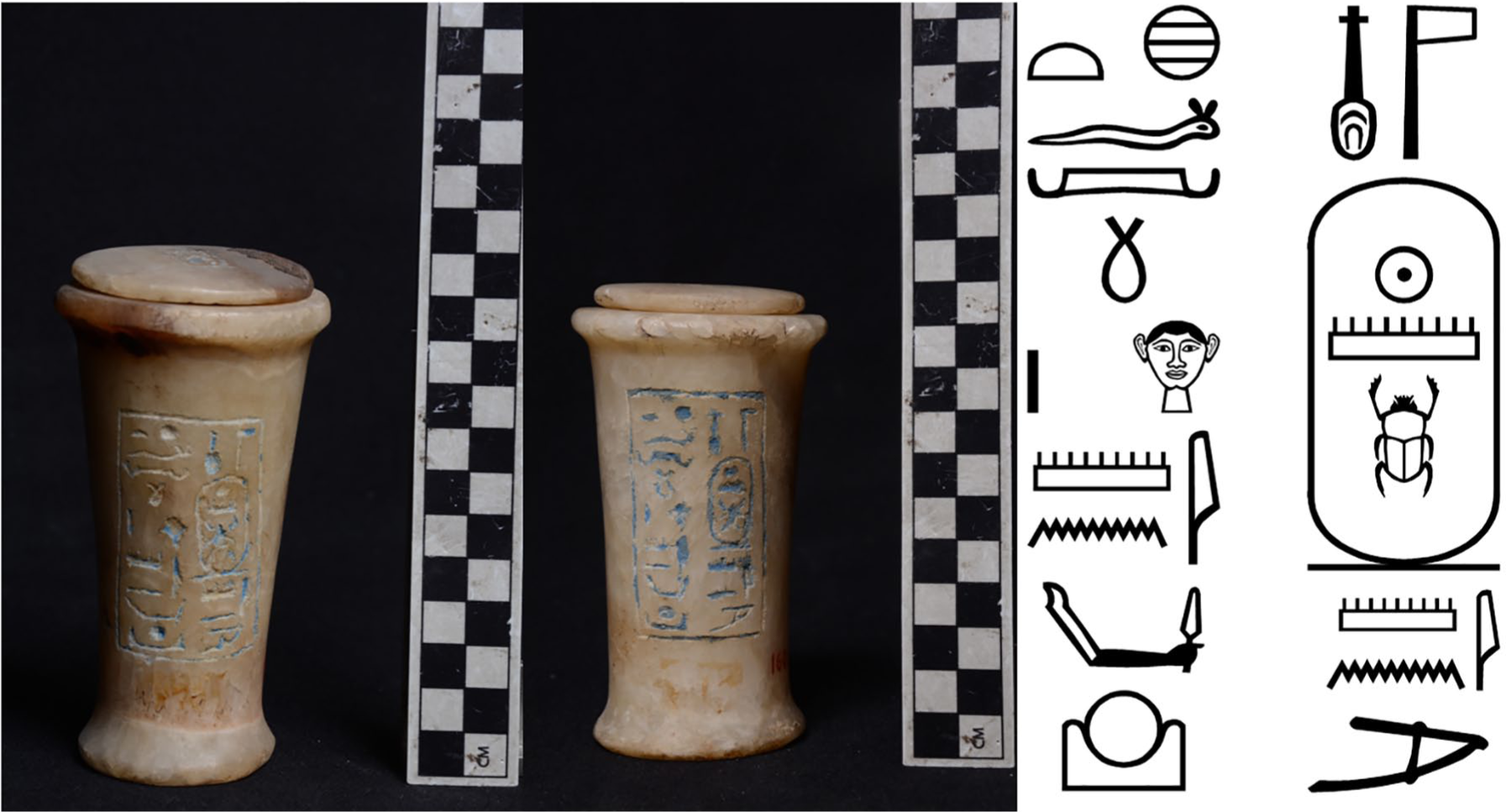
Two ointment jars with inscribed details on CG 16024 (right) (courtesy of the Egyptian Museum, Cairo).
Four saws (JE 5743–6, CG 1979–82, SR 7/19798–801)
Egyptian saws were used in cutting wood in one direction as the teeth of the blades were directed towards the carpenters. 7 They were also used in cutting the joints of the stone vertically and horizontally. This feature is attested on some temples of Upper Egypt, as saws left their marks on the stone. 8
Four bronze saws with wooden handles were attested in this group (fig. 2).
9
Their length is 30–31 cm. The wooden handle without the bronze blade measures 10–11 cm (CG 1979, L. 11 cm W. 2 cm) while the bronze blade measures 19–21.4 cm (CG 1979, L. 19 cm W. 2 cm).
10
These four saws would have been used for cutting the joints of the stone, as they have the same characteristics of the saws in the experimental study of E. Laroze and A. Garric: being short with trapezoidal blades and have similar dimensions.
11
They differ as they have the remains of teeth along the blades. They are engraved horizontally with similar hieroglyphic inscriptions on the bronze blades.
12
The inscription reads from right to left (e.g. CG 1982, fig. 2): nTr-nfr Mn-xpr-Ra mry-Imn xft pD Ss(r) Hr Imn Dsr Axt The perfect god Menkheperre, beloved of Amun, on the occasion of stretching the cord for Amun Djserakhet
The surfaces of the handles of CG 1981–2 show damage in many locations, which may indicate use. 13 The bronze blades and the wooden handles of these two saws are separate. The tip of the bronze blades of CG 1979, 1980 and 1982 are broken which may point to the same direction showing signs of use. 14 Only CG 1981 keeps its sharpened tip. 15 It is noticed that the sign of Dsr (G45) is not placed above the sign of Axt (N27), but before it (CG 1979, 1982). The locations of these two signs differ from their typical locations, Dsr above Axt, 16 in comparison to all of the other wooden tools of this foundation deposit and on the bronze blades (CG 1980). On CG 1979, it seems that the scribe wrote incorrectly Hr (D2) in this form adding an additional stroke, but the stroke beneath the face directly, could stand plausibly for the neck (cf. Hr on CG 1980). The round signs on CG 1979 (the sun-disc for Re (N5), and the face (D2), Hr) and x (Aa1) on CG 1980 appear to be less skilfully executed, showing the difficulty of engraving on metals, though they were presented well on CG 1982 and CG 1981. 17 This differentiation may indicate that they were engraved by different artists. All of the signs on wooden objects below were written first in black ink, and then they were engraved, so there must be a way to guide the artist who engraved the signs on the bronze blades.

Four saws with inscribed details on CG 1982 (courtesy of the Egyptian Museum, Cairo).
Three chisels (JE 5747–9, CG 1976–8, SR 7/19779: 7/19802–3)
Chisels were important for carpenters and stonemasons, as they were used in carving and engraving inscriptions and in the manufacture of boats, statues, jars, vessels, and many other objects.
18
Only one of the three chisels (fig. 3) is intact (CG 1976, L. 29 cm W. 2 cm), comprising the wooden handle with its flat bronze blade.
19
The remains of the other two are only the wooden handles (CG 1977–8, L. 18–25 cm). The intact chisel is engraved with a hieroglyphic inscription on its handle (CG 1976):
20
nTr-nfr Mn-xpr-Ra mry-Imn xft pD Ss(r) Hr Imn Dsr Axt The perfect god, Menkheperre, beloved of Amun, on the occasion of stretching the cord for Amun Djeserakhet
The technique of using the black ink to write the hieroglyphic signs, then engraving them by the artist, was applied to these chisels. 21 The inscription on CG 1977 was written running from the butt of the wooden handle to the beginning of the handle, 22 compared to the other two chisels, where the inscription runs from the beginning of the handle to the butt. 23 This indicates that the text probably was written first, then the bronze blade attached to the handle; the scribe probably made a mistake, or they were engraved by different artists. On CG 1978, the signs are smaller and the inscriptions are less deep which may indicate that it was written by a different craftsman. The un-inscribed side of the handle of CG 1976 has two horizontal cracks and a third across these two cracks from the end. 24 Remains of an unspecified dark substance were attested in the big crack which may have been used to restore this slot.

Three chisels with inscribed details on CG 1976 (courtesy of the Egyptian Museum, Cairo).
Seven mesekhtyu adzes (JE 5750–6, CG 1953–9, SR 7/19791–7)
The mesekhtyu adze was used in the ritual of the ‘Opening of the Mouth’. 25 Seven inscribed wooden mesekhtyu tools (L. 22–25.9 cm), in the shape of an adze handle, are attested in this group (fig. 4). It seems that they were used in the ritual of ‘stretching the cord’ in the temple, 26 as their type differs from the ‘real or model examples -with metal blades- of the actual woodworking tool’. 27 These seven adzes belong to ‘the stylized type’ where attention is paid to their magical function. 28 The front edges of two of these tools are broken (CG 1957, 1958) which may indicate signs of use. CG 1959 differs slightly in its shape from the other six tools, as the upper section was not cut well. All of these are inscribed with the same incised hieroglyphic inscription. It runs horizontally along the upper edge and reads from right to left (e.g. CG 1954).
nTr-nfr Mn-xpr-Ra mry-Imn xft pD Ss(r) Hr Imn Dsr Axt The perfect god, Menkheperre, beloved of Amun, on the occasion of stretching the cord for Amun Djserakhet
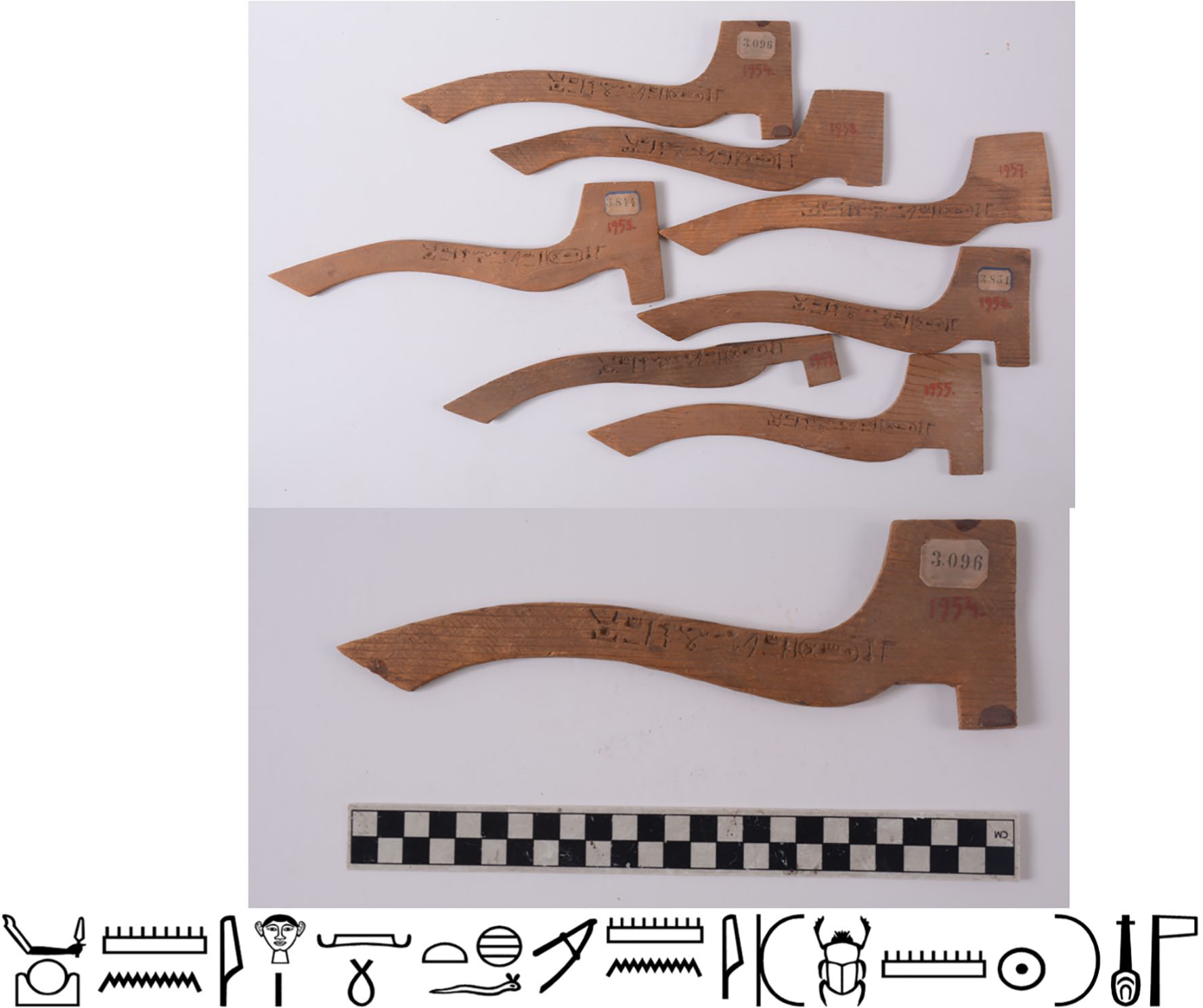
Seven mesekhtyu adzes with inscribed details on CG 1954 (courtesy of the Egyptian Museum, Cairo).
The same technique, using black ink, was applied here, and then the signs were engraved by the same or a different artist. This is evident on the entire group (CG 1953–9). No differences were detected in regards to the location of the signs. The preposition Hr (D2) was written in this form, except on CG 1957 where it was written .
Two axes (JE 5760–1, CG 1973: 1975b, SR 7/19807: 7/19809)
One axe with a bronze blade (CG 1973, L. 7.5 cm W. 4.5 cm) and a wooden haft is intact (L. 43.1 cm W. 2.6 cm). The other axe (CG 1975b) has only the head (L. 9.5 cm), while its wooden handle was lost.
29
The blades are made of a thin sheet of bronze to be used in cutting wood.
30
They have straight butts and incurved sides (fig. 5). The cutting edges of the blades are convex and narrower than the butts. The bronze head of the intact axe is slackening off the wooden handle. The latter is curved with a concave back and varied in shape of its sections between cylindrical, ovoid, and faceted from the butt to the beginning respectively.
31
A thong of leather is bound around the top of the wooden haft, where the shallow slit is located, to secure the bronze blade to the wooden handle.
32
A hieroglyphic inscription is engraved on the bronze blades of these axes. It reads (CG 1975, fig. 5):
33
nTr-nfr Mn-xpr-Ra mry-Imn xft pD Ss(r) Hr Imn Dsr Axt The perfect god, Menkheperre, beloved of Amun, on the occasion of stretching the cord for Amun Djeserakhet
34
The round signs, sun-disc (N5) and x (Aa1) are well engraved on both bronze blades, 35 compared to the saws on CG 1979–80. The sign mn (Y5, CG 1975) in ‘beloved of Amun’ is written without vertical strokes, compared to the other two mn signs. 36 The signs on CG 1975 are carved deeper than the signs on CG 1973.
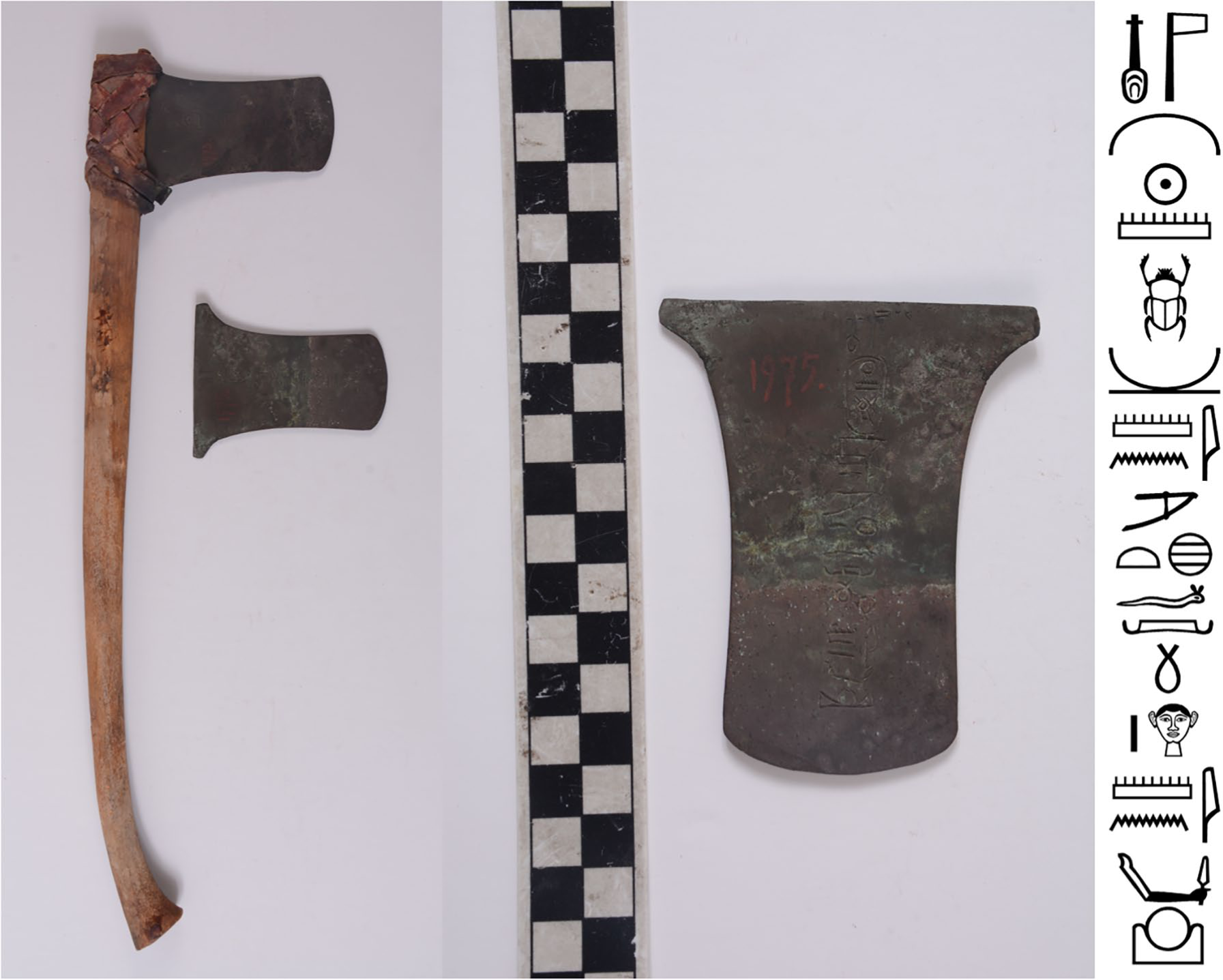
Two inscribed axes (CG 1973 and 1975) with inscribed details on CG 1975 (courtesy of the Egyptian Museum, Cairo).
Twelve surveyor’s stakes (JE 5763–74, CG 1960–70: CG 1974)
This group includes twelve inscribed surveyor’s stakes (fig. 6). They are intact and in a good condition, except CG 1970 which is broken into two pieces and CG 1974 which lost its lower part. The length of the stakes measure nearly 42–45 cm, except CG 1974 with a length of 27.8 cm, as the lower part was lost. The lower part of the eleven other stakes were shaped and sharpened to be hammered into the ground while doing the survey, stretching the cord around the temple. The lower parts of some of these stakes have the remains of black soot (CG 1960, 1962, 1968). All of the stakes are engraved with hieroglyphic inscriptions including the name of Thutmose III. They were engraved vertically, reading from right to left, on the upper part, except CG 1970 on which the inscription was engraved on the lower part, as this stake was broken probably during the shaping, so the artist avoided engraving the inscription on the upper, fragmented part. This stake, CG 1970, also does not have a sharpened point. The remains of the black ink around the signs indicate that the engraved hieroglyphic signs were written in black ink first, then the artist engraved them with his chisel. The hieroglyphic inscription, having the same text on all twelve stakes, reads (e.g. CG 1960, fig. 6): nTr-nfr Mn-xpr-Ra mry Imn xft pD Ss(r) Hr pD Ss(r) Hr Imn Dsr Axt The perfect god, Menkheperre, beloved of Amun, on the occasion of stretching the cord for,
37
on the occasion of stretching the cord for Amun Djeserakhet
The inscription on CG 1974 is fragmented, as the quality of the wood is poor and fragile, though it is still readable. The rest of the inscriptions on the other stakes are clear. The size of the signs is small and written in a narrow space on CG 1966, compared to the other stakes. CG 1960–1, and 1967 have bigger signs. The size of the cartouche, in which the name of King Thutmose III is engraved, varies. It is big on CG 1960–1, 1974, and 1968 and is quite small on CG 1966 and 1970 while the size of the rest of the cartouches is similar on the rest of the stakes. This variation in the size of the cartouches may point to different scribes. Furthermore, the scribe wrote xft in this form nine times, but it is written three times in this form (CG 1961, 1963, 1967).
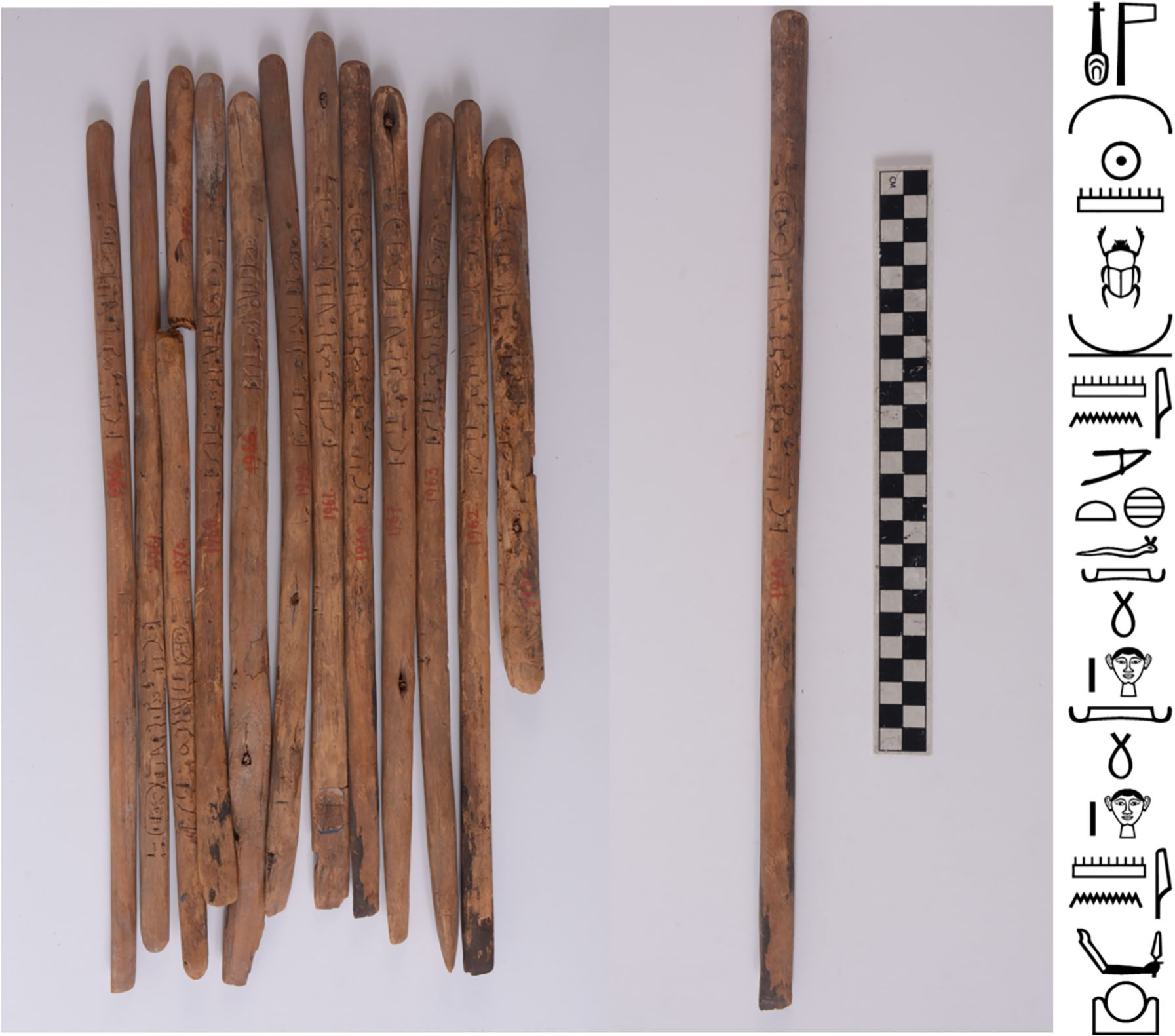
Twelve inscribed wooden surveyor’s stalks with inscribed details on CG 1960 (courtesy of the Egyptian Museum, Cairo).
Grinder (JE 6397, CG 1971, SR 7/19808)
This is the only piece which was found in 1860. It is made of calcite and measures 8 cm in length. The grinding back of this grinder bears a brownish material (fig. 7). The top of this grinder is engraved with two vertical columns of hieroglyphic inscription inside a rectangular frame for the same text which reads from right to left (fig. 7): nTr-nfr Mn-xpr-Ra mry Imn xft pD Ss(r) Hr Imn Dsr Axt The perfect god, Menkheperre, beloved of Amun, on the occasion of stretching the cord for Amun Djeserakhet
A blue pigment and binder were applied to the engraved signs and the rectangular frame. There are many scratches on the base of the grinder and dark brown stains which may point to marks of use.
Wooden rocker model (JE 9955, CG 1972, SR 7/19810)
Big wooden rockers were used to maneuver blocks of stone during construction.
38
This model wooden rocker (L. 23.7 cm W. 5.5 cm) is in a good state of preservation (fig. 8). It consists of two parallel boards with rounded undersides which are joined by five cross sticks.
39
Both outer sides of the sledge bear an incised inscription which reads on the first side (fig. 8 top): nTr-nfr Mn-xpr-Ra mry-Imn xft pD Ss(r) (Hr) Imn Dsr Axt The perfect god, Menkhepere, beloved of Amun, on the occasion of stretching the cord for Amun Djeserakhet
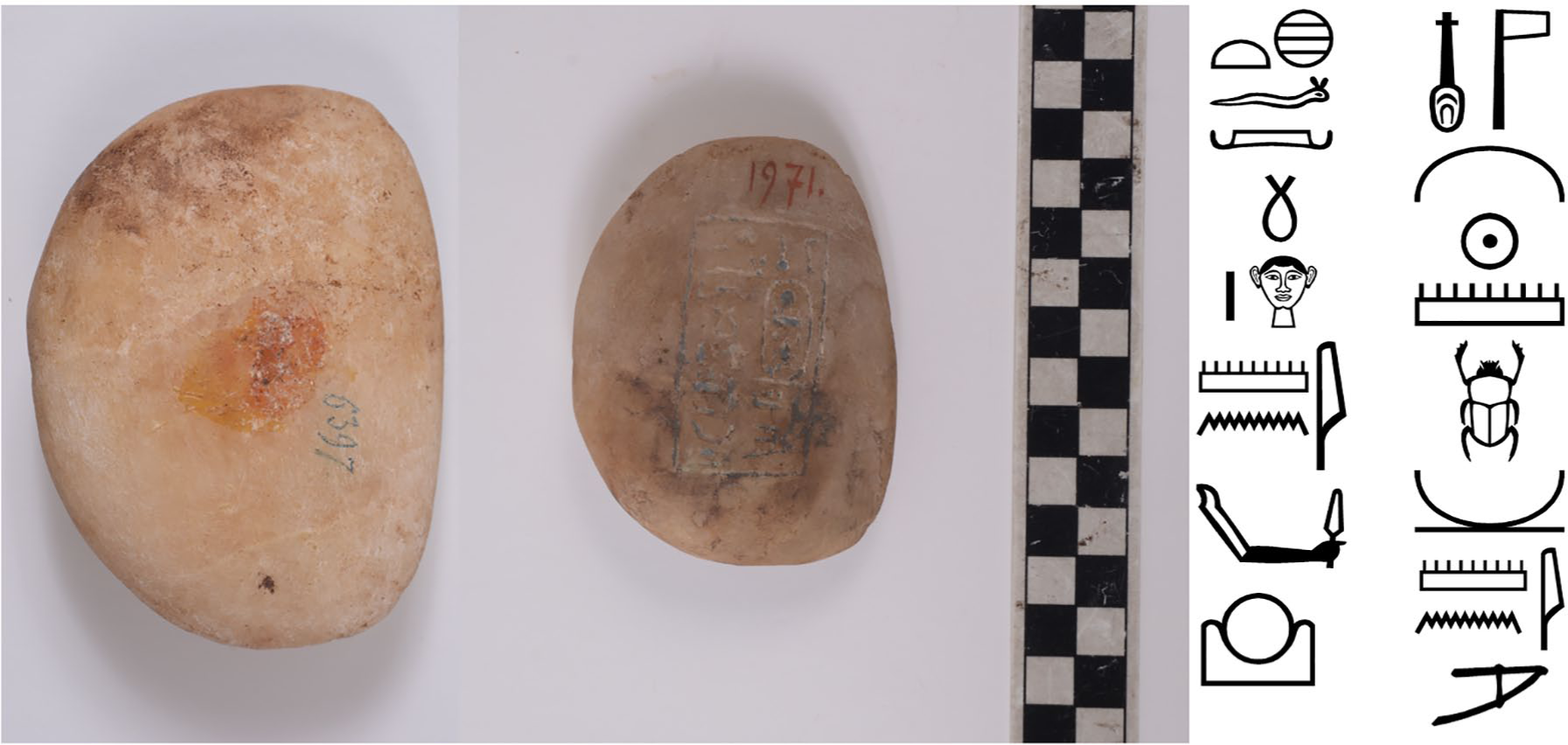
Inscribed grinder (CG 1971) (courtesy of the Egyptian Museum, Cairo).
The second side (fig. 8 bottom) bears the same hieroglyphic inscription. It reads: nTr-nfr Mn-ḫpr-Ra mry-Imn xft pD Ss(r) Hr Imn Dsr Axt The perfect god, Menkhepere, beloved of Amun, on the occasion of stretching the cord for Amun Djeserakhet
The scribe forgot the preposition Hr (D2) with stroke (Z1) beneath. The hoe (U7), mr, ‘beloved’ preceded the name of the god Amun on the first side. The artist who engraved the signs did not engrave the details of each sign on the second side, e.g. the strokes which come out from the sign of mn (Y5) were left off, 40 and the base of the cartouche including the name of the king Thutmose III were omitted, as well. The incised signs are deeper on the first side with more detail than on the other side. The entire incised inscription on the second side was written inside a rectangular frame running along the long sides of the rocker. The hieroglyphic inscriptions are clear and large, compared to the surveyors’ stakes. This could be explained by the wide space on the rocker. Similar to the surveyors’ stakes, the technique, which was used in incising the signs, was written first in black ink, then the signs were engraved by the same scribe or a different artist.

Wooden rocker (CG 1972) with inscribed sides (courtesy of the Egyptian Museum, Cairo).
Discussion
The database of the Egyptian Museum in Cairo states generally that this foundation deposit came from Sheikh Abd el-Qurna in July of 1859 (1860 for the grinder). The unpublished Catalogue Général also records that one of the seven mesekhtyu adzes (JE 5753, CG 1953, SR 7/19794) was found on the face of a mummy between the wrappings; according to the catalogue of A. Mariette, it was ‘Auf dem Gesicht einer Mumie unter den Binden gesfunden’. 41 An old label in the display case next to the studied objects indicates that they were found in a tomb at Sheikh Abd el-Qurna. The note by Mariette, as well as the label, indicate a tomb as the findspot, but it is difficult to accept this assumption, as the ritual of pD-Ss(r) ‘stretching the cord’ was attached to temple objects. 42 The aforementioned textual evidence indicates Djeserakhet, 43 the temple complex of Thutmose III for Amun including the causeway, kiosk, valley temple, and Hathor shrine, at Deir el–Bahari. 44 The explanation for this challenging dilemma is that these objects were plundered from the site of the temple after it had been destroyed at the end of the Twentieth Dynasty 45 and were later re-used. This suggestion is plausible; especially D. Arnold and J. Settgast found an intact foundation deposit beneath the kiosk of Djeserakhet, i.e. the temple of Thutmose III (see below).
All of the 32 objects of the foundation deposit address Amun, the main deity in the representations of the temple, for whom the temple Djeserakhet was built, and who was worshipped there in both of his forms, Amun-Re and Amun Kamutef. 46 Moreover, they address the ritual of pD Ss(r) ‘stretching the cord’ for Amun Djeserakhet. It is one of the crucial foundation rites that was performed at new constructions, where a cord was stretched around the four corners of the building after it had been marked. 47 It is the only rite which is mentioned on the objects of the foundation deposits and is only found on objects from Thebes. 48 The set in the Cairo Museum holds twelve surveyor’s stakes which were probably used in the ‘stretching the cord’ ritual. The king was represented frequently on the walls of the temples from the Old Kingdom to the Roman Period, hammering stakes into the ground with the help of the goddess Seshat at the foundation ritual. 49
This set of objects could belong to a deposit pit, especially since many other foundation deposits were later found between 1961–6 for Thutmose III at this site. 50 While these objects were found in 1859–60, the temple was not discovered until 1961–2; 51 these objects were looted from the site and were later handed to the museum. Two foundation deposits were found in two pits beneath the kiosk/bark station of this temple in 1966 by the German Archaeological Institute in Cairo. 52 One pit was plundered completely and the other was found intact. Each pit is round and measures 1.15–1.35 m in depth and 1.05 m in diameter. 53 The Cairo Museum foundation deposit may belong to this plundered pit or to another two disturbed pits which were found beneath the south and the north walls of the causeway (see below). 54 The aforementioned intact pit beneath the bark station could point to the number of objects and its distribution inside the plundered pits in which the objects in the Cairo Museum were probably deposited and taken later. 88 different pottery vessels were found in the intact pit with a leg of cattle-like sacrifice placed on the top. 55 The pit was filled subsequently with coarse gravel to the surface. 56 On the west side of the pit at the base, a niche was cut. 72 objects were found inside it in sets of four items. 57 A string of carnelian beads was also found with these objects, but no scarabs or amulets. 58 These objects are kept in the Egyptian Museum in Cairo 59 and the Ägyptisches Museum in Berlin (tab. 1). 60
The distribution list of the objects in the Cairo and Berlin museums from the intact foundation deposit pit of Djeserakhet.
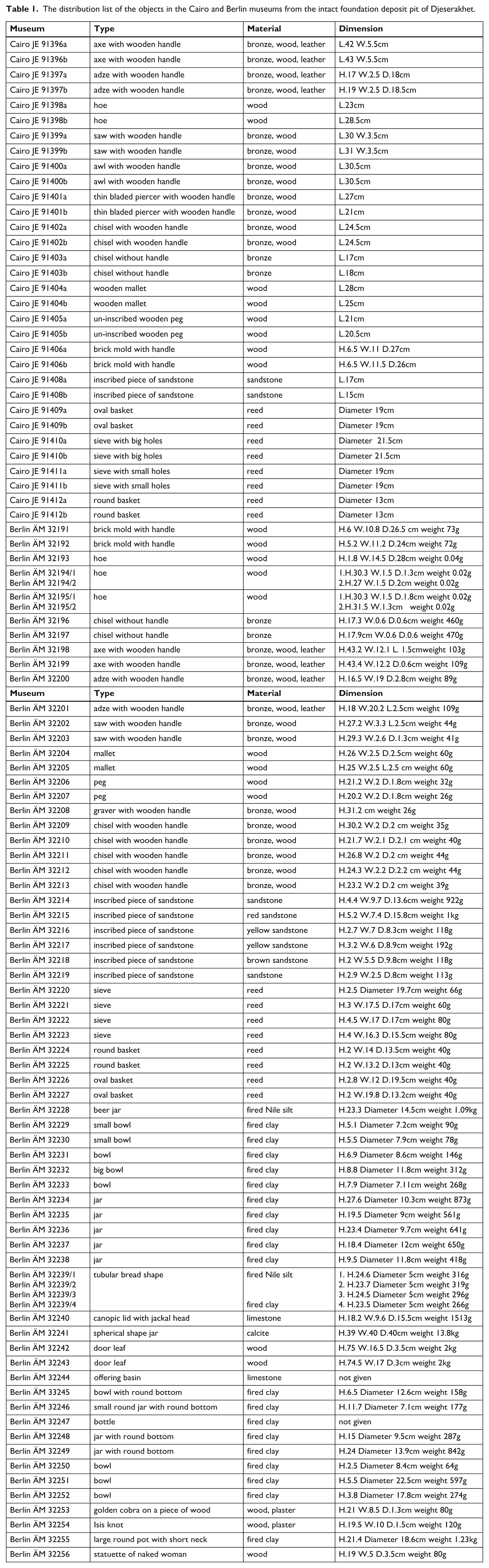
The inscribed wooden and metal objects from this intact pit contain a similar inscription as the aforementioned texts above (JE 91396a–b, JE 91397a–b, JE 91398b, JE 91399a–b, JE 91402a–b, JE 91406a–b, ÄM 32209–10, ÄM 32191–2) or the king is just named ‘the perfect god, Menkheperre’ adding occasionally ‘beloved of Amun’ (JE 91400a–b, JE 91401a–b, JE 91404a–b, JE 91408a–b, ÄM 32216 and 32218, ÄM 32212–13), leaving out the name of the ritual, pD Ss(r), and the temple, Imn Dsr Axt. 61
As for the other two plundered deposit pits, they were found beneath the south and north walls of the causeway of the temple. The southern one was found beside the western enclosure wall of the tomb of Basa (TT 389). 62 The northern should have been investigated in another campaign for the German Archaeological Institute, but nothing has been published since then. 63
The objects, which came from Djeserakhet and are scattered in different museums, were probably obtained/robbed from the three aforementioned plundered foundation deposits. The Egyptian Museum in Cairo 64 holds an ointment jar, msxtyw tool, 65 wooden rocker, and three chisels. 66 G. Maspero (1885–1915) reported that ‘les dépôts trouvés par Naville à Deir-el-Bahari’. 67 However, the foundation deposit listed in the database of the Cairo Museum, which was excavated by E. Naville (1844–1926) at Deir el-Bahari for the EEF in 1895, contains a wooden rocker (JE 31328, CG 1993), a hoe (JE 31327, CG 1995), and a bronze adze with wooden handle (JE 31326, CG 1997), which bear the name of the Queen Hatshepsut, not Thutmose III. The queen is styled ‘the perfect god, Maatkare, beloved of Amun who is in Djeserdjeseru’. 68 Furthermore, an axe (JE 31329, CG 1998), msxtyw tool (JE 31330, CG 1994), 69 saw (JE 31331, CG 1996), and ointment jar (JE 31332, CG 16007), 70 were also excavated for the EEF at Deir el-Bahari in 1896, but they do again bear the name of Hatshepsut and her temple (nTr nfr MAat-kA-Ra mrt Imn xnty Dsr Dsr(w)). 71 RMO Leiden has six inscribed objects: an axe (AB179), a wooden adze with bronze blade and linen around the front (AB 177), 72 three chisels with different blade shapes (AB 180a–c), and a saw (AB 178). 73 They were acquired by the museum from Giovanni Anastasi (1780–1860), a Greek merchant, and registered at the museum in 1829. 74
The British Museum in London holds two axes (EA6058–9), a hoe (EA6060), an adze (EA6061), six chisels (BM EA36737, 6062–3, 6066–8), and two saws (BM EA6064–5). 75 The Oriental Museum, Durham University 76 keeps an axe (EG3557), two chisels (EG4565–6), a drill (EG4569), a saw (EG4568), and an adze (EG4570). 77 The Metropolitan Museum of Art, New York keeps a model of a rocker (05.4.17), which was found by the EEF in 1905. The Metropolitan obtained the object via the EEF in the division of finds. 78 Another axe head was also recorded in the Nash Collection. 79
The acquisition date of some of the British Museum foundation deposit objects from the same site is older than the 1859 acquisition date for the Cairo Egyptian Museum set. The adze (BM EA6061), axe (BM EA6059), and chisel (BM EA6063) were acquired in 1835. They were purchased at Sotheby’s from the H. Salt (1780–1827) 80 third collection (1824–7). 81 This indicates that the British got a hold of the objects from the three plundered foundation deposit pits.
The RMO Leiden collection was obtained in 1828. Anastasi perhaps gathered the objects a few years before the sale to the Dutch government. Thus, at least three out of twelve objects of the British Museum and five objects at RMO Leiden were acquired close in time, which may confirm that this site was heavily plundered at the time.
The current group of objects at the Egyptian Museum in Cairo was acquired at different dates between 1859–60 and a second group was acquired in 1966. The method of acquisition of the group which entered the museum in 1859–60 is unknown. They may have been obtained from antiquities dealers, robbers, or via the random excavations looking for objects for the Bulaq Museum. 82 The second group from 1966 came from the excavation by the German Archaeological Institute and the objects were divided between the excavator and the Egyptian Museum (tab. 1). 83 The last group, which according to G. Maspero, was attributed to Thutmose III and found by E. Naville, actually belonged to Hatshepsut.
The databases of the Egyptian Museum in Cairo, the British Museum, RMO Leiden, and the Ägyptisches Museum Berlin, indicate that the blades of the axes, chisels, saws, and adzes are made of bronze. The Oriental Museum, Durham University (EG3557, EG4565–6, EG4568–70) states that some of these objects were made of copper with sycamore handles. However, these material assumptions are not based on chemical analysis. The Museum of August Kestner at Hannover carried out a detailed analysis on several tools from a foundation deposit of Thutmose III. The outcome of this careful examination shows that some objects were made of leaded bronze, copper with impurities, and one object is made of leaded arsenical copper. 84 This result demonstrated that bronze is not the sole material from which the objects of the Egyptian Museum Cairo and other museums were made.
The technique used to engrave the hieroglyphic inscriptions on the wooden tools is similar on all examples: they are painted in black ink first, and then the signs were engraved with a chisel. This raises the possibility that they were made in the same workshop. However, the different sizes and shapes of the signs may point to different craftspeople. The details of some engraved signs, e.g. mn, and its position in relation to others, e.g. Dsr and Axt, also indicates multiple craftspeople. The palaeography of the text demonstrates that the writer used both hieroglyphic and hieratic script (Gardiner N35). 85 The stone objects, including the ointment jars, grinder, and yellow and brown pieces of sandstone are painted in blue pigment with binder. 86
The state of preservation of these 32 objects of the Cairo Museum varies. The objects made of stone, including the ointments jars and the grinder, are in a good condition. However, the wooden objects suffered; this includes the broken surveyor’s stake (CG 1970), the poor and fragile quality of the wood (CG 1974), and the stake missing its lower part (CG 1974). Some wooden handles also have cracks (CG 1976). The front edges of two mesekhtyu adzes were lost (CG 1957–8). Some objects lost their blades (CG 1977–8), wooden handles (CG 1975b), or have a broken front (CG 1979, 1980 and 1982). However, all of the objects from the intact pit at the same museum (CG 91396–406, 91408–12), which were found by the German Archaeological Institute, are in a very good state of preservation.
To conclude, the 32 objects probably came from the plundered foundation deposit pits beneath the kiosk or south and north walls of the causeway. These objects may have come from one pit or from all three of them, as some objects have more than four examples, the standard number from the intact pit beneath the kiosk, e.g. there are seven mesekhtyu adzes and twelve surveyor’s stakes. This indicates that the number of objects in each pit may have varied, since their numbers differed from that of the intact pit, which was revealed by the German Archaeological Institute and divided between the Cairo Museum and the Ägyptisches Museum Berlin. The surveyor’s stakes, the mesekhtyu adzes, the grinder, and the ointment jars do not have parallels in museums around the world outside the Cairo Museum. The model of the wooden rocker at the Egyptian Museum in Cairo has a sole parallel which is kept at the Metropolitan Museum of Art and which was found during the excavations of the EEF.
Footnotes
Acknowledgements
I would like to thank my colleagues Stephen Quirke, Marwa Abd el-Razik, Janice Kamrin, Jan Moje, Daniel Soliman, Neal Spencer and Penelope Wilson for their help with the images and information about the objects in their collections. Sincere thanks also go to Brigitte Balanda, and the editors and anonymous referees of the JEA.
Funding
The author received financial support from the IFAO for the research.
