



Abstract
Arguably one of the most remarkable painters/draughtsmen, not only in his direct surroundings of Deir el-Medina but in the history of New Kingdom painting altogether, the Chief Draughtsman Amenhotep, son of Amunnakhte has left us a substantial body of identifiable work. His artistic output includes royal and private tomb-chapels augmented by a corpus of figured ostraca numbering at 24 known pieces. It follows then that the many different types of artwork contained in his production provide an especially rich opportunity for exploring art historical themes of particular import and can inform our understanding of these in significant ways. Moving away from the habitually confronted modern reading of decorum as a manacle of artistic freedom, this contribution aims at drawing attention to how decorum seems to have been seen in essentially positive terms, an inference cognate with what transpires from the study of the works of Amenhotep.
Introduction
That institutions and conventions defined – and confined – Egyptian visual culture ‘that successfully moulded the shape of pharaonic culture to the very end’
1
is a well-established commonplace. The centrality of a distinctive style to this visual culture, an aspect that was so agreeable to Plato, is no less the case.
2
As such, this distinctiveness of the style, its life-history, and its sheer longevity almost always evoke some concept of a system of artistic conventions. In more recent times, W. Davis attempted to introduce ‘canonical representation’ and ‘canonical tradition’ as descriptive terms applicable to this system, where ‘canonical’ is not to be confused with ‘canon’, meaning a specific system comprising rules for the proportionate combination of parts.
3
The idea of ‘canonical’ rules and reliant sub-rules developed and expounded by Davis were then easily adapted by J. Assmann to his own interpretation of pharaonic art, and especially of composition, in which he enumerates five sets of rules, in contrast to Davis’s four, namely: 1) Rules of proportion (‘canon’ in the strict sense); 2) Rules of projection (i.e., representation of space in two-dimensional compositions); 3) Rules of display (i.e., iconic formulas and conventions); 4) Rules of exclusion (i.e., what is programmatically not displayed, especially the space-time abstraction of Egyptian images); 5) Syntactic rules (especially the hypotactic organization of image structure).
4
Another way of defining the character of pharaonic art for Assmann has been to emphasize the relation of art to literature, an idea expressed in the phrase or ‘compositional principle’ hierotaxis.
5
Despite being seen by him as deeply significant for the aims of pharaonic art and values of ancient Egyptian culture as a whole, the importance of this idea has been mostly passed up by scholars in general, although they have not denied its relevance.
Rather, the introduction by J. Baines of the concept of decorum is what has essentially gained wide acceptance for the description of the principled processes governing the production of art in ancient Egypt. 6 It refers, in short, to the suitability or appropriateness of a design and was relevant as a standard principle of art theory from the Renaissance to the beginnings of modernism. 7 Not inconsequentially, it also derives from ancient literary and rhetorical theory. 8
Decorum, then, is discernible in various ways, in practice, in the details of individual works, and in the overall progression or developmental course of pharaonic art. Working thus on different levels, it emerged in response to elite concerns in the late Predynastic and Early Dynastic periods, when, as formulated by Baines, ‘… there was a great transformation in artistic styles and content, leading to an iconographic definition of the Egyptian cosmos that set the pattern for later periods.’ 9
The relatively late introduction of decorum into discussions of ancient Egyptian art did not result in its intellectual baggage being left behind, not least the negative connotations that have also come to adhere to the term. For present purposes, it suffices to observe here that the body of material that mostly provoked both direct and indirect comments highlighting and condemning the repressiveness of decorum, though not called as such in earlier literature, was that of the so-called figured ostraca. By their very nature, these sketches in black or black and red ink on limestone flakes offered a way to appreciate Egyptian art within an art-historical discourse that was still under the influence of the romantic myth of artistic genius and the modernist preoccupation with originality. It is hardly surprising, then, to meet such examples as B. Peterson’s near-praise of figured ostraca precisely because he saw one of their core values as being their freedom from ‘standard iconographic traditions’. But the communis opinio was formulated along these lines even earlier, and in a most eloquent way, by Nina de Garis Davies:
10
‘The sketch, the irresponsible, rapid, natural outcome of a gay, a humorous or a retrospective mood, here appears instead of the finished and conventional drawing where professional gravity, propriety, reputation were at stake. There were no doubt idle moments as well as gratuitous material in the necropolis, where otherwise punctilious discipline and age-long convention laid benumbing weight on the spirit and on the pen.’
11
‘But some of them must be the work of the best draughtsmen that Egypt then had; for they would be the first to rise above the deadening weight of their profession to make merry and free with the pen, as they would be the most capable of using this curious medium to best advantage to instruct a pupil, to make clear to themselves the arrangement of a scene or group, to fix the pleasant memory of another artist’s success, or to follow the still pleasanter impulse of improving or correcting it.’
13
‘… sketching on ostraca was part of an informal system of ongoing cultural and artistic practice by succeeding generations of artisans based on common images and styles that enabled increased proficiency in proportion, color use, and dexterity, as well as creating an avenue for creativity and innovation.’
14
‘Informal sketching allowed the craftsmen of Deir e1-Medina not only the opportunity to learn and practice their accepted norms but also the chance to risk and test new artistic forms and combinations. It was one of the main methods by which style was maintained, but it was also the avenue through which styles were updated and modified - a psychological and neurological mechanism for taste change.’
15
The figured ostraca of the Chief Draughtsman Amenhotep
The term ‘figured ostraca’ refers to a highly heterogeneous group, found predominantly, but not exclusively, in Western Thebes 16 and dating to the Nineteenth and Twentieth Dynasties, that includes a wide array of pieces, carrying a varied pictorial repertoire and displaying equally diverse forms of usage and skill ranges. When C. Keller referred to them as the ‘waste paper of ancient Thebes’, 17 she was merely pointing to one of the most basic characteristics of the carrier materials, limestone flakes or pottery sherds, namely availability, and the fact that apart from a smaller group that will be commented on below, they were produced with a short use-life in view. 18
It must also be borne in mind that the community of Deir el-Medina and its various members producing these, besides their principal purpose of creating the royal tombs, were also responsible for a range of unofficial projects, such as decorating the chapels and houses of the settlement itself, private tombs for both an outside clientele and for members of the community, as well as a wide array of everyday or prestige objects, including funerary furniture. 19 It may come as no surprise then that figured ostraca offer a more or less accurate mirror of the scope of these activities in more ways than one. Identifying the exact context of many ostraca or thematically close groups of ostraca, however, has proven to be more elusive than expected. 20 Scholarly research for a satisfactory explanation of their nature nevertheless quickly expanded beyond stating the obvious about sketching, to include a reference to poor quality not necessarily signifying the hand of a pupil or apprentice. 21 While rejecting these former attempts at explanation, Cooney formulates her own overarching theory based on what she sees as a deliberate limiting of subjects for sketching, or in her expression a ‘differentiated and homogenized set of iconography for informal sketching’. 22 Her emphasis on skill acquisition through sketching at the expense of other factors as the main instigator of figured ostraca production, however, overstates this uniformity, on the one hand, while downplaying the lack of a more meaningful chronology for the corpus, on the other. Moreover, whereas Cooney favours skill acquisition through sketching, it is possible to entertain the prospect of a more flexible and less monocausal explanation when referencing stylistic analysis.
As admitted by C. Keller, who is the veritable groundbreaker of stylistic analysis of figured ostraca, for various reasons the study of their style has favoured the draughtsmen of the Twentieth Dynasty over those of the Nineteenth. 23 Foremost among these draughtsmen, due to his relatively definable body of artistic work, is the Chief Draughtsman Amenhotep (vi), son of the famous scribe Amunnakhte (v), son of Ipuy (ii). 24 On the basis of textual evidence, the bare essentials of his career include his first appearance as a draughtsman near the end of Ramesses III’s reign (Year 28) with its end coming nearly at the end of that of Ramesses IX (Year 17). Promoted probably under Ramesses IV (Year 2) to the post of Chief Draughtsman, during his 47 year career, Amenhotep oversaw and personally worked on five royal (KV 1, 2, 6 twice, 9), two queenly (KV 10), 25 and at least one princely tomb (KV 19) in the Valley of the Kings, as well as probably KV 13 at one point. 26 In the Valley of the Queens, several tombs can be associated with him, namely QV 51 (Isis (Ta-hemdjeret)), probably QV 52 (Tyti) and QV 74 ((Dua)Tentopet), with his artistic presence also visible to a degree in QV 42 (Paraherwenemef). 27 While his participation in the production of funerary art is questionable, as is his membership in the so-called ‘informal workshop’ catering to the local elite, 28 he did execute the decoration of at least two private tomb-chapels, that of a wab-priest and ḥry-sštꜣ of the estate of Amun, and ḥm-nṯr of ‘the mansion of ꜥꜣ-ḫpr.w-Rꜥ (Amenhotep II)’, Kynebu (TT 113), and that of the chief of the altar-chamber and chief of the temple archives of the estate of Amun, Imiseba (B) (TT 65), with approximately fifteen years separating the two. 29
Beside these commissioned monumental works, Amenhotep also left behind a corpus of figured ostraca, making his artistic output a promising context in which to engage with some issues of decorum, all the more so, since it is commonly assumed that in most cases of commissioning a work of art, especially ones involving complex iconography, the programme was given to the artist by either a patron or some specialist (scholar) acting at the patron’s behest. While programmes, particularly ones including compositions of unusual theological content, may have involved close patronal oversight, it would be a mistake to underestimate the role of the artist, his skill as a visualizer, and his ingenuity in producing them.
Apart from the monumental works just mentioned, which are by their nature rather resistant to stylistic analysis, figured ostraca played a crucial role in C. Keller’s identification of Amenhotep’s artistic repertoire.
30
Adopting a synchronic approach in attempting to ‘isolate hands’, her point of departure was the close study of a sub-type of figured ostraca, namely those defined as signed pieces (fig. 1).
31
‘Stele’ ostracon fragment dedicated to unknown deity/deities, O. Cairo CG 25037 (Daressy, Ostraca, pl. VIII).
This strategy enabled her to link drawing styles, established through the identification of discrete stylistic characteristics, to names and to proceed from there to attribute unsigned ostraca to artists. This perception of style presupposes the notion of a recognizable artistic personality while also assuming that one can make distinctions between individual styles, and not the least the capacity to assess the quality of a work of art. Moreover, it inherently attributes something similar to a connoisseurial attitude to the artists themselves, to use a term that itself appeared only during the eighteenth century.
Twelve signed autographic ostraca can be assigned to Amenhotep, supplemented by a further twelve unsigned pieces on the basis of attributes identified through stylistic analysis. 32 To these may be added a papyrus sketch (P. Turin Cat. 1954 vs.), as well as illustrations added to an architectural drawing of his (P. Turin Cat. 2038 = CGT 55002 vs.).
Signed ostraca
1: ‘Stele’ ostracon dedicated to Amun (O. Cairo CG 25114)
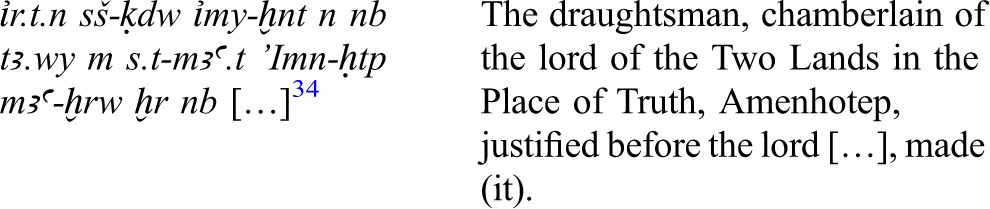
2: ‘Stele’ ostracon dedicated to the Theban triad (O. Cairo CG 25051)

3: ‘Stele’ ostracon dedicated to the Theban triad (O. Cairo CG 25117)

4: ‘Stele’ ostracon dedicated to Amun by the ‘Servant in the Place of Truth’ Userhatmose (O. Cairo CG 25115)

Note: In the presently known corpus of Amenhotep’s ‘stele’ ostraca, this is the only one where the worshipper/donor, the sḏm(-ꜥš) m s.t-mꜣꜥ.t Wsr-ḥꜣ.t-ms is different from its maker Amenhotep. 36 This Userhatmose may be identical with the writer of a letter (P. DeM 21), as well as the person mentioned in a note (O. Cairo CG 25303) recording the arrival of the vizier Neferrenpet to commission a work (ἰἰ ἰm.y-r Nἰw.t ṯꜣty Nfr-rnp.t r sḥn […]) in an unknown year of Ramesses IV. 37
5: ‘Stele’ ostracon dedicated to Ptah(-Sokar-Osiris) (O. Cairo CG 25052)

6: ‘Stele’ ostracon dedicated to Ptah(-Sokar-Osiris) (O. MMA 14.6.213) 38

Note: Originally it may have been a sketch or design ostracon. 39
7: ‘Stele’ ostracon dedicated to Meresgeret (O. Bruxelles E.6573)

8: ‘Stele’ ostracon dedicated to Harakhte (O. Cairo CG 25129)
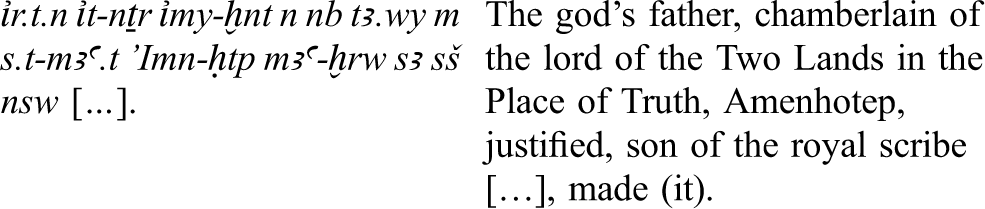
9: ‘Stele’ ostracon dedicated to Thoth and Sefkhet-Abwy (O. Cairo CG 25029)

10: ‘Stele’ ostracon fragment dedicated to unknown deity/deities (O. Cairo CG 25037)

11: ‘Stele’ or sketch ostracon depicting a goddess (O. Cairo CG 25066) 41

12: Drawing of a sacred bull (Apis?) 42 (O. Cairo CG 25095)

13: ‘Stele’ or study ostracon showing Banebdjed and Onuris-Shu (O. Bruxelles E.7424)
Note: As the figure facing the deities is missing, the piece could be understood in various ways, namely as either a ‘stele’ ostracon or a compositional sketch.
14: Sketch ostracon depicting Ramesses IX offering Maat (rt.) and Ramesses IX libating (vs.) (O. MMA 14.6.215 + O. Cairo CG 25017)
Note: The piece probably contains exploratory drawings reflective of the design process involving the entrance scenes of the royal tomb of Ramesses IX (KV 6), hence the different iconography of the two royal figures. 44
15: Sketch ostracon depicting a king censing (O. FAMSF 52.6.21 rt.)
Note: Based on its stylistic closeness to O. MMA 14.6.213 + O. Cairo CG 25017 and P. Turin Cat. 1954 + Provv. 8589 vs. (see below), the king depicted here is probably also Ramesses IX.
16: Sketch ostracon depicting libating king (O. BM 50710)
17: Sketch ostracon depicting a king (O. Cairo CG 25007)
18: Sketch ostracon depicting a king libating and censing (O. Cairo CG 25006)
19: Sketch ostracon depicting Amun (rt.) and adoring king (vs.) (O. BM 60001)
20: Sketch ostracon depicting Queen Isis (O. OIM 17006)
21: Sketch ostracon representing the offering Ramesses IX (O. Musei Vaticani inv. 25027) (fig. 3 a–b)
Note: Marucchi’s description as ‘Frammento in pietra arenaria con la figura di un re genuflesso in adorazione, …’ (‘Sandstone fragment with the figure of a kneeling king in adoration, …’) lead to the misidentification of the piece as a statue fragment. 46 The ostracon’s material was also mistakenly given as sandstone instead of limestone.
This drawing for which no directly connected painting or relief exists shows the kneeling Ramesses IX facing proper right with arms raised in adoration. The king wears the cap crown 47 with floating streamers and a uraeus, a shebyu- and a weskhet-collar, a sash across one shoulder, and a kilt with probably a sporran or apron. As the black finalizing line has disappeared in most areas, it cannot be determined if he was also supposed to have had arm jewellery.
The red underdrawing is finely and precisely delineated without corrective strokes. The thick contour line of the cap crown also fits very well with drawings by Amenhotep from TT 65.
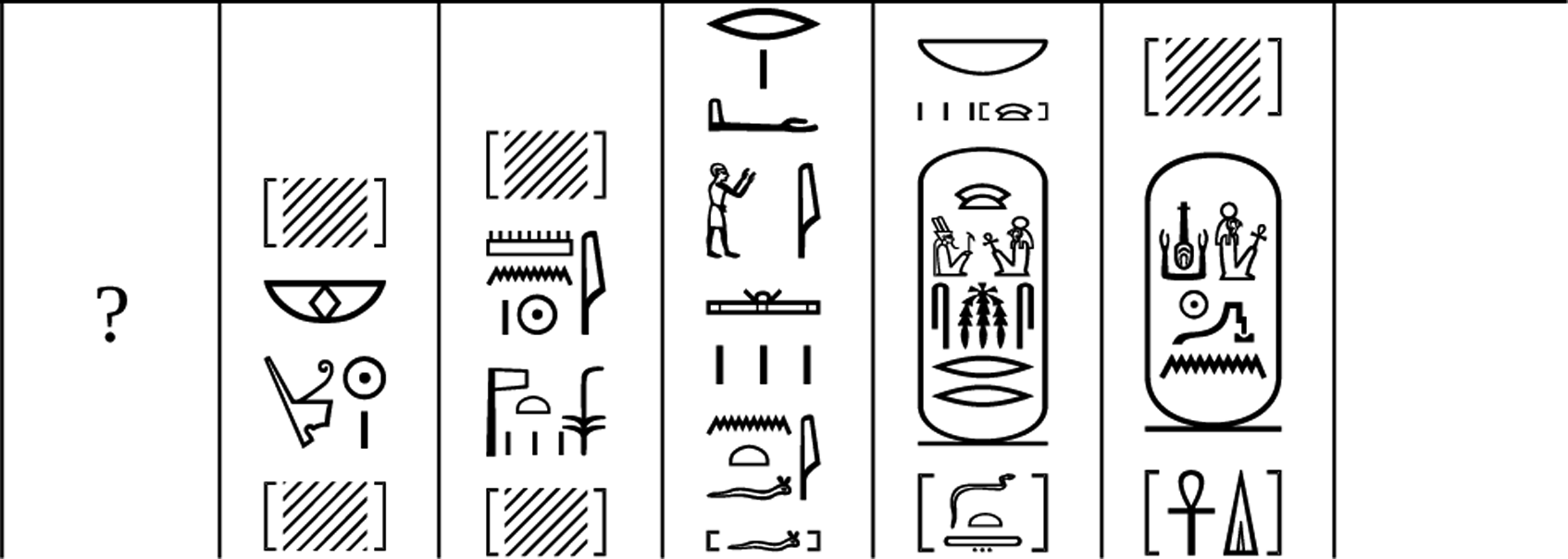
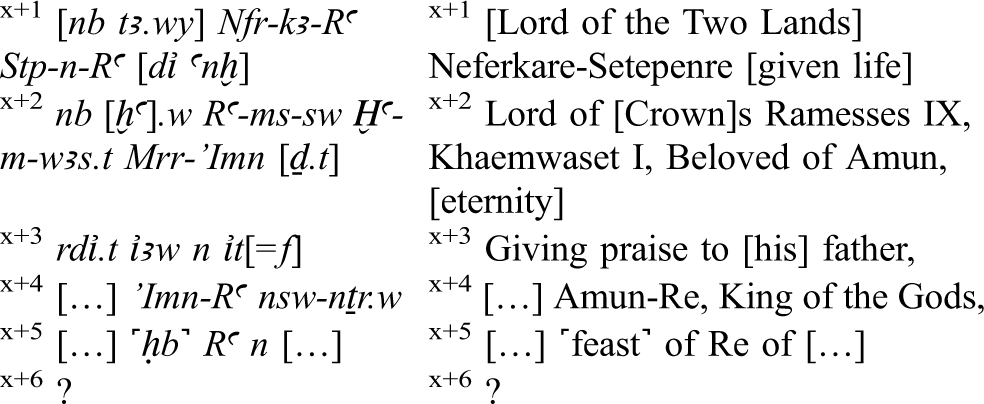
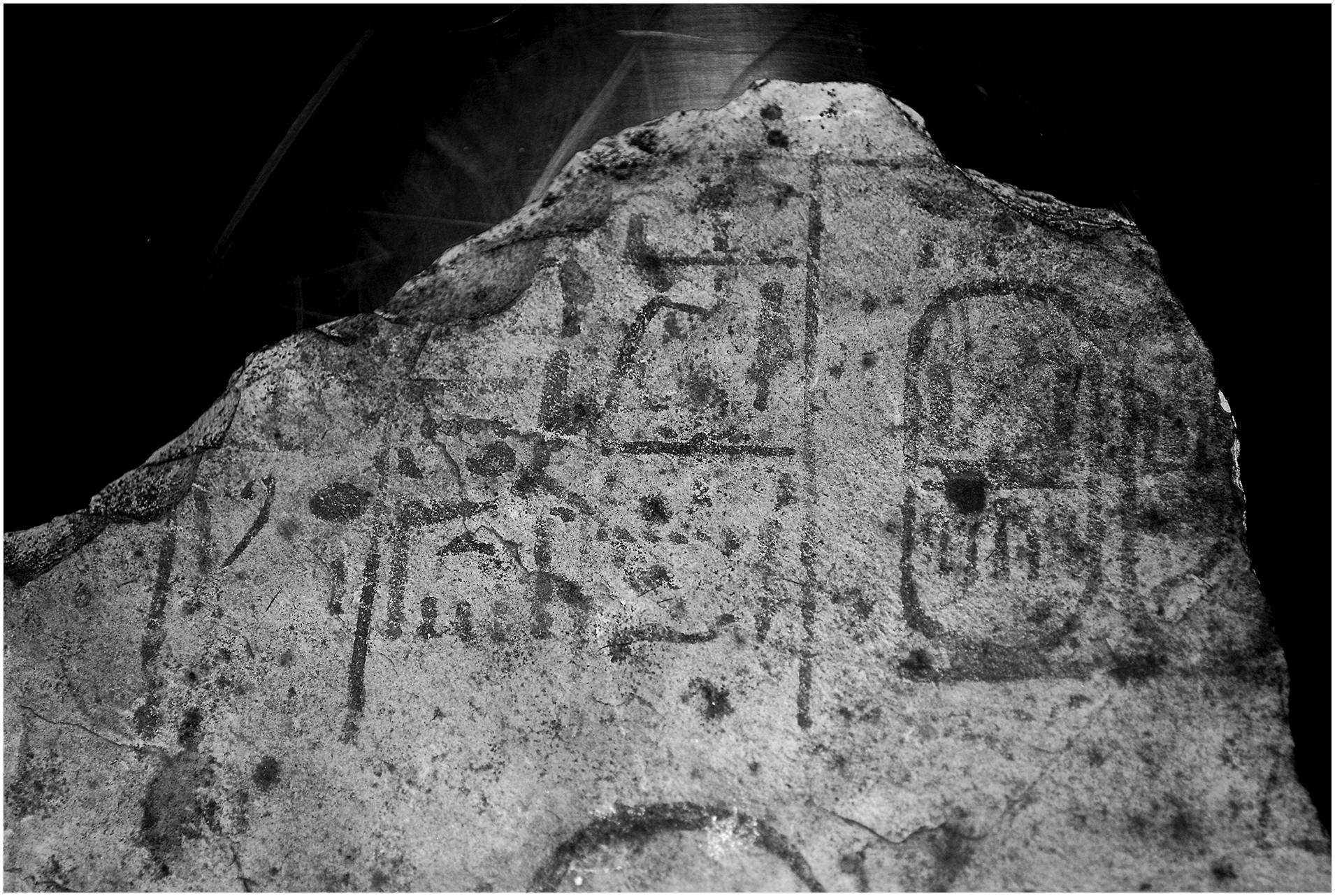
Text of O. Musei Vaticani inv. 25027 rt. (photo: © Governorate of the Vatican City State-Directorate of the Vatican Museums).
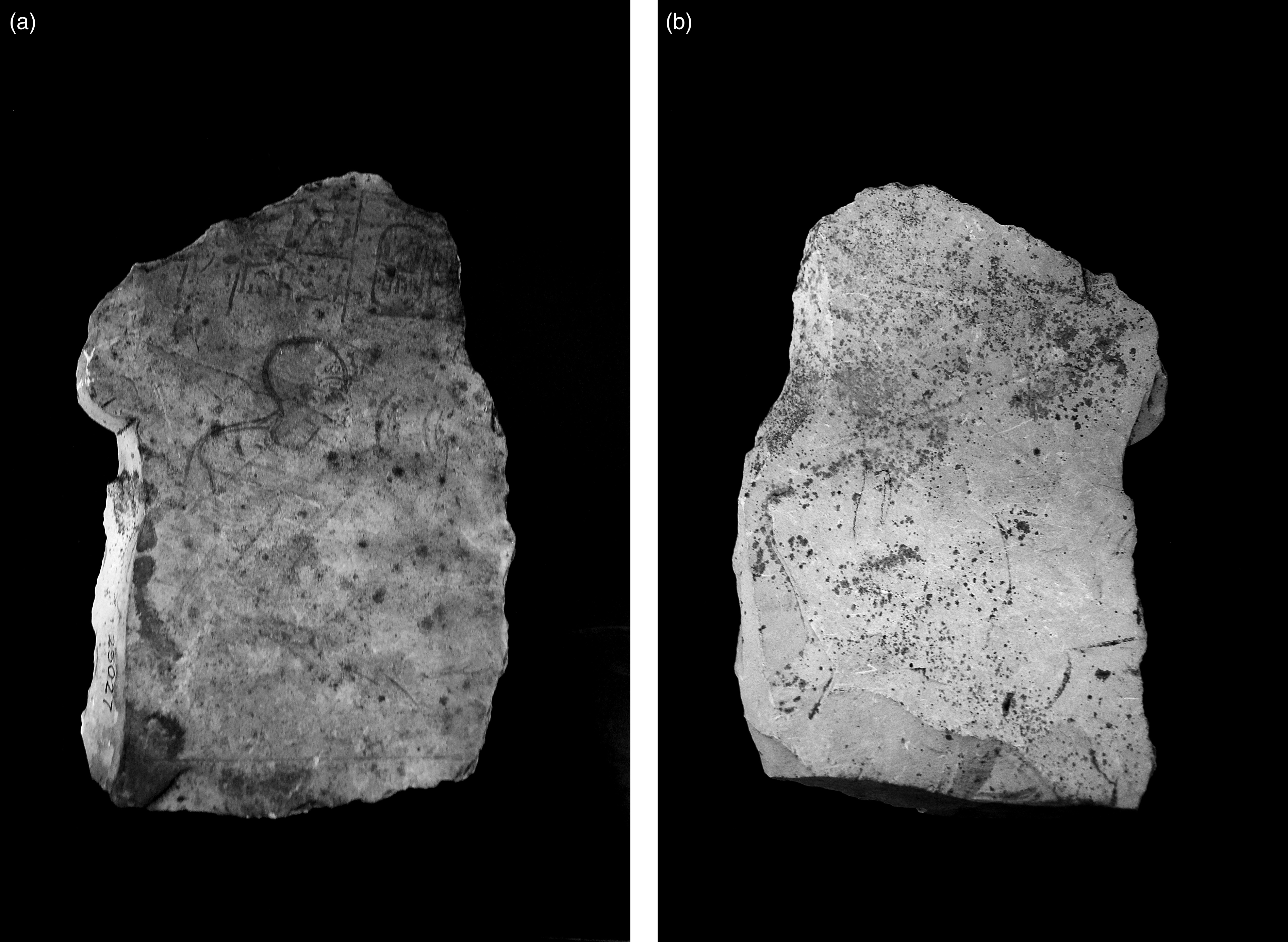
a) Sketch ostracon representing the offering Ramesses IX, O. Musei Vaticani inv. 25027 rt. (photo: © Governorate of the Vatican City State-Directorate of the Vatican Museums); b) O. Musei Vaticani inv. 25027 vs. (photo: © Governorate of the Vatican City State-Directorate of the Vatican Museums).
Badly faded lines on the verso are indicative of its use for drawing as well. It may be tentatively suggested that analogous to some other ostraca of Amenhotep, it showed the figure of Amun, the subject of the king’s praise.
22: Sketch ostracon depicting a prostrate king (rt.) and a cow’s head (vs.) (O. Cairo CG 25019)
Note: The recto is a ‘quick’ or ‘rough’ sketch used by a draughtsman in principal to lay out a composition to be explored and understood. In this case this seems to have been done related to the decorative scheme of the second doorway’s lintel in KV 6 that shows the parallel figures of Ramesses IX in this exact posture adoring the sun disk. 48
The verso qualifies as an ‘individuated’ or singularizing sketch. It is not without significance, moreover, that the central panel on the transverse hall’s ceiling in TT 65 has a version of this frontal view cow’s head with sun disk albeit without the ram-headed deity in it.
23: Sketch ostracon depicting the pregnant goddess of the sky from the Book of Day (O. Cairo CG 25074)
Note: Singling out one element from a larger composition, the piece falls into the category of ‘individuated’ or singularizing sketches.
24: ‘Presentation drawing’ depicting the victory celebration of Ramesses IX (O. BM EA 5620) (fig. 4 a–c)
a) O. MMA 14.6.215 rt.; b) O. BM 5620 (EA 5620, courtesy of the Trustees of the British Museum), detail; c) TT 65 Axial Corridor, Southern Wall, detail.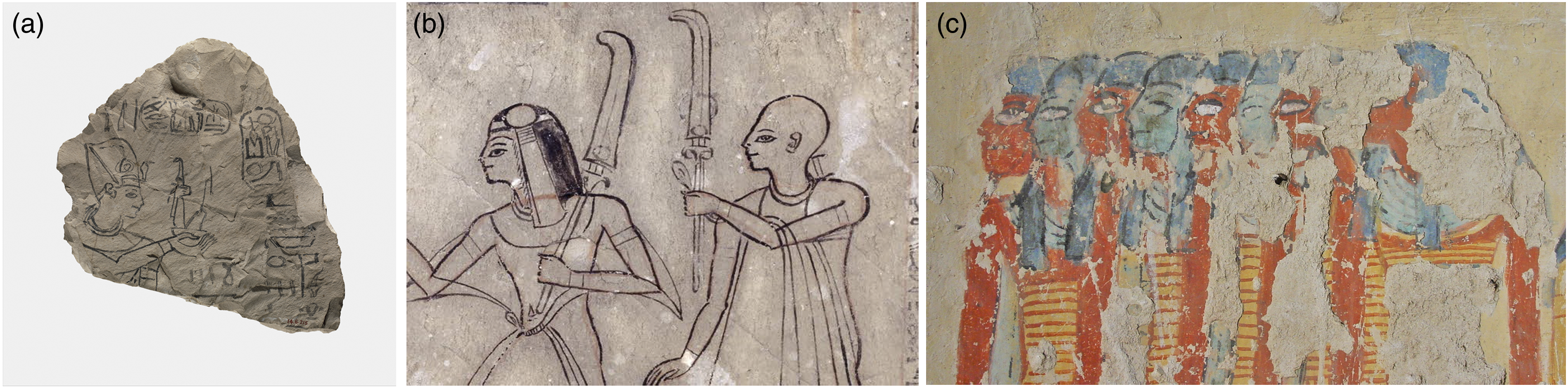
Note: An interesting non-figural parallel is supplied by O. Cairo CG 25201, a hieroglyphic ostracon containing a eulogical or rhetorical titulature of Ramesses IX that is clearly dependent on the text of Ramesses III’s ‘Rhetorical Stela’ of Chapel C in the Ptah-Meresgeret oratory. 49 Unfortunately, Daressy did not publish a photograph of the ostracon thereby rendering it impossible to determine through the study of his hieroglyphic hand whether it is indeed the work of Amenhotep or somebody else. 50
Drawings on papyri
1: P. Turin Cat. 1954 vs. (+Provv. 8589) 51
Note: The drawing of the bowing figure of Ramesses IX, probably in the act of censing, was already ascribed to Amenhotep by C. Keller (see n. 52). The drawing itself seems to be an isolated study and not part of a larger composition, since the verso of the other known fragment is empty of texts or drawings. 52 The lack of colouring further supports this impression.
Two iconographic details may be pointed out here that are diagnostic of Amenhotep’s hand, namely the long upward curve of the uraeus’ tail that is identical to how this was rendered on O. FAMSF 52.6.21 rt. and O. MMA 14.6.215. And secondly the smile, albeit exaggerated here, is similar to those of both O. FAMSF 52.6.21 rt. and a figure from TT 65 (fig. 5 a–d). a) O. FAMSF 52.6.21 rt.; b) P. Turin Cat. 1954 vs. (+Provv. 8589) (Scan Museo Egizio); c) O. MMA 14.6.215 + O. Cairo CG 25017 (after Keller, in Andreu (ed.), Deir el-Médineh et la Vallée des Rois, 107 fig. 8); d) TT 65 Northern Rear Wall, detail of gold altar.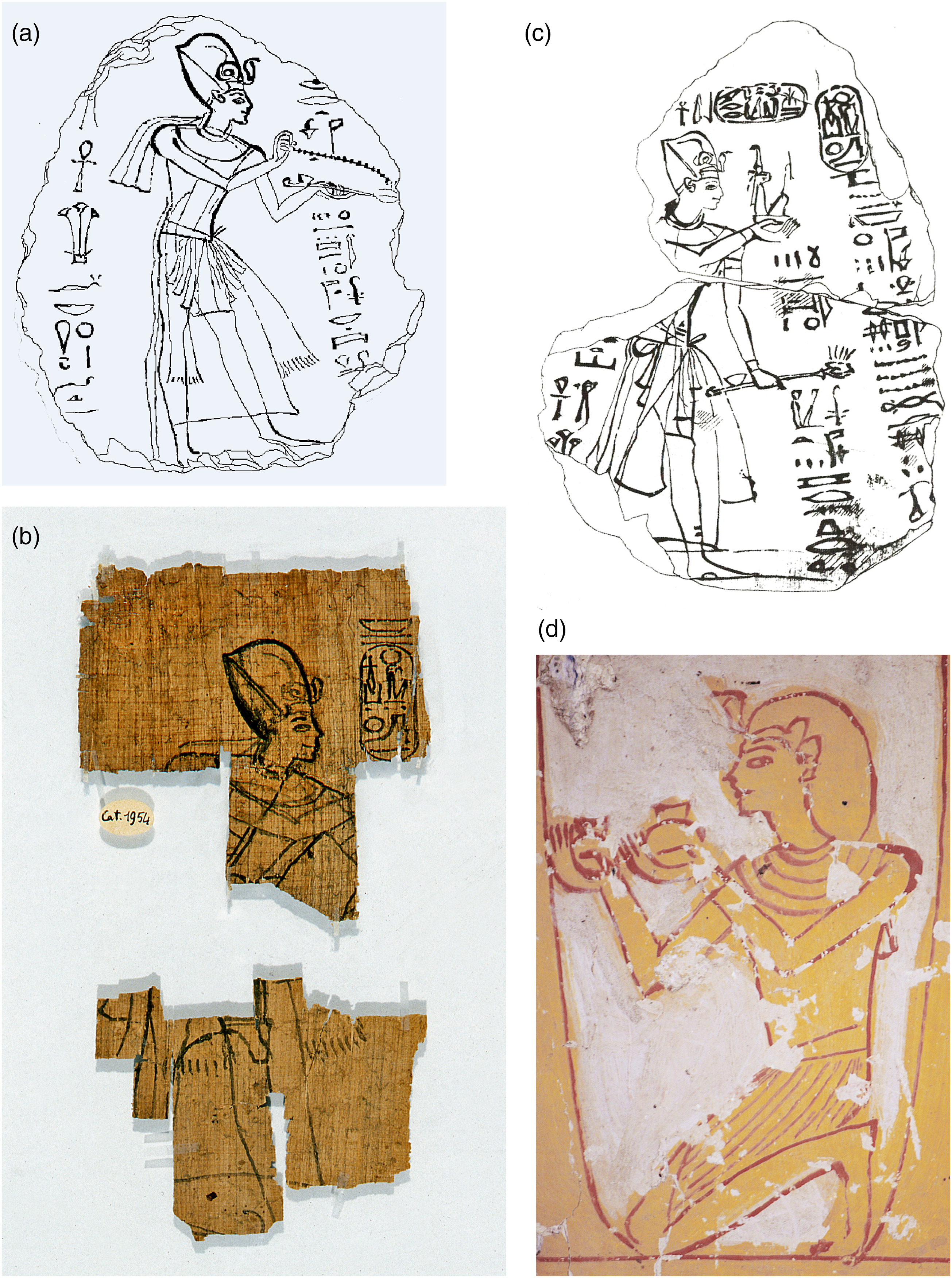
A noteworthy detail is the spelling of Ramesses IX’s prenomen as Nfr-kꜣ.w-Rꜥ instead of the normative Nfr-kꜣ-Rꜥ, a form found occasionally used in his royal tomb from its second phase of decoration onwards. 53 The form also occurs on a small limestone stele fragment preserving a part of the body and the prenomen of Ramesses IX preferably from Deir el-Medina. 54
2: Architectural plan of Ramesses IV’s tomb, KV 2 (P. Turin Cat. 2038 = CGT 55002 vs.)
Note: In contrast to P. Turin Cat. 1885 rt. (the ricordo of KV 2) where only the sarcophagus was drawn as viewed from above, and O. Cairo CG 25184 (a development drawing of KV 6)
55
that only has the plan, P. Turin Cat. 2038 = CGT 55002 vs. (a modified version of KV 2’s original plan or modello on the recto of the same papyrus) features additional figural elements.
56
In the burial chamber (J), two so-called ‘guardian’ statues were drawn facing the sarcophagus as well as kneeling, front-facing human figures (‘target figure’) and star-grids of ‘Ramesside star clocks’.
57
The linework of the figures is typical of Amenhotep’s artistic hand and comparable to that of small-scale figures in TT 65, for instance one depicting a processional statuette of Ramesses IX (fig. 6 a–b). a) Detail of P. Turin Cat. 2038 = CGT 55002 vs. (Scan Museo Egizio); b) processional statuette of Ramesses IX, TT 65, Northern End Wall detail.
The question to be addressed here is to what extent these ostraca can be regarded as informal, and as such, how far removed they are from the decorous, if at all. Interpretations of ‘informal’ usually understand it as describing something out of accord with official, prescribed rules or forms, while in the literary/linguistic mode it generally denotes everyday conversational language in contrast to formal, principally written, language. In characterising figured ostraca, however, criteria of ‘informality’, as for example in Cooney’s recent usage, seem to include such traits as incompleteness, that is lacking colouring and/or captions in contrast to finished formal pictures, as well as a perceptible absence of (again formal) function or purpose, here apparently disregarding issues of training. 58 Before proceeding further with the ostraca of Amenhotep, two brief remarks are in order. Firstly, borrowing the art-historian D. Arasse’s subtle pronouncement on drawings, we can say that sketches on ostraca are in essence intimate and personal. 59 Whereas formal works of art are rarely the result of individual effort, as the responsibility for the final appearance and content of a work may belong to many actors, sketches or drawings are frequently done for the sole benefit of the person making them.
This leads us to the second point, of the seeming lack of purpose for many figured ostraca. Such a notion derives mainly from ostraca whose subject matter cannot be easily correlated with either the work or private life of the artisans of Deir el-Medina. 60 When trying to interpret the presence of, for instance figures of monkeys, lions, or horses on a large number of ostraca, what needs to be acknowledged is the lack or loss of their ‘pre-text’, a term describing the story or narrative from which a picture draws its subject. 61 As an illustration, the variant themes depicted on the wall-paintings in the uniquely preserved above-ground section of the tomb of Ipuy (TT 217) from the reign of Ramesses II, may be cited here as eloquent witness to how much has been lost from the visual milieu of the settlement. 62
As also indicated by their being signed, a large proportion of the attributed figured ostraca of Amenhotep are in effect not sketches, but fall into the category defined as ‘stele ostraca’.
63
Interpretation of the significance of this distribution of types is not easy, but it cannot be dismissed simply as due to accidents of preservation or written off as a problem of attribution. It has the consequence of placing these pieces firmly into the class of formal rather than informal art, the only distinguishing feature being that they have not received colour.
64
Another feature often overlooked in discussions of figural or hieroglyphic ostraca is their size.
65
It is noticeable, for instance, that the height of most of Amenhotep’s ‘stele ostraca’ are consistently around 45–7 cm (the widths showing more variance), suggestive of a conscious preference on his part. The difference is hence not between formal and informal but between a generalised or generic and a personal style. That both styles could exist side-by-side in royal and private tombs clearly shows that the system of decorum did not itself discriminate between the two (fig. 7 a–b). a) Deities from the ceiling composition of the third corridor of Ramesses IX’s tomb (KV 6); b) the head of a golden Amun statue from TT 65.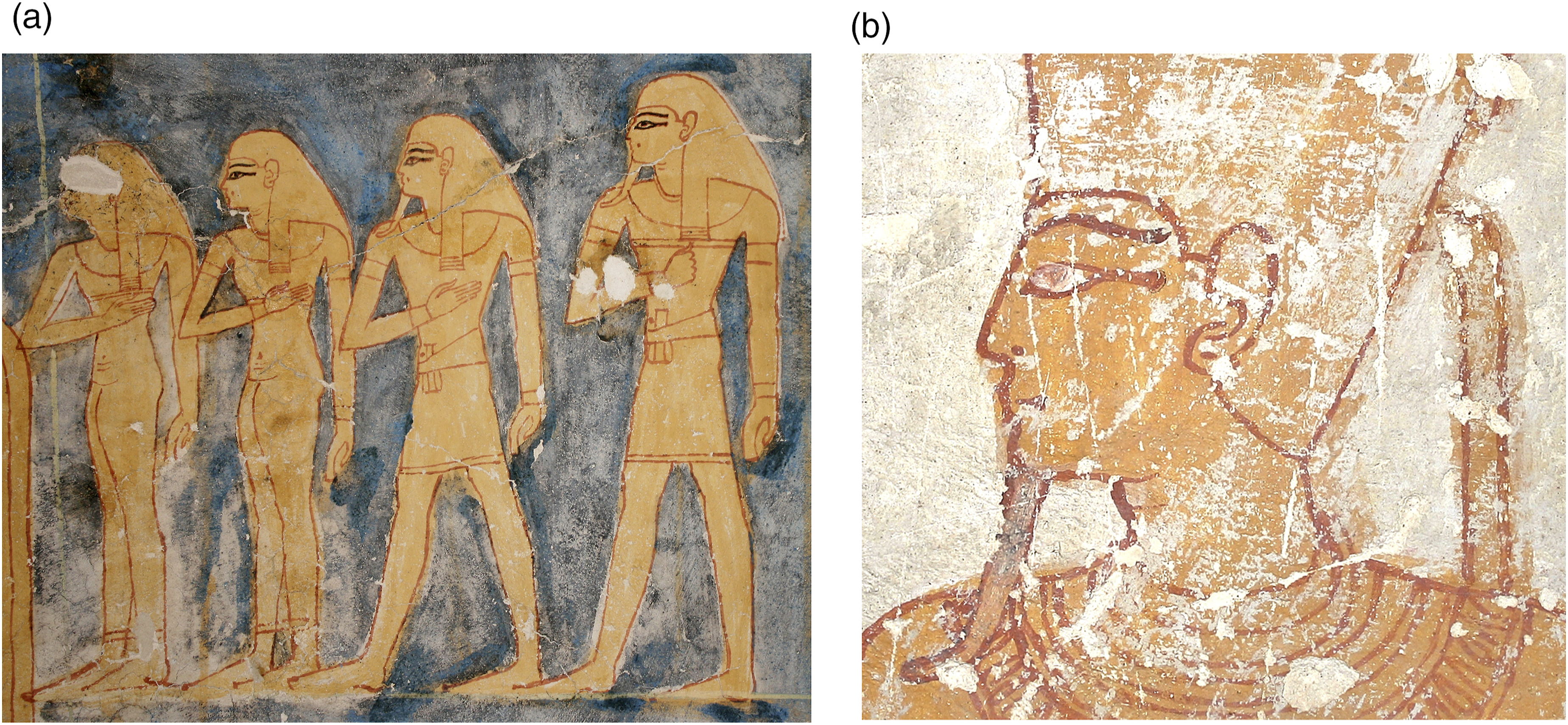
More intriguingly, it also reveals the opportunity that was presented to painters and draughtsmen to adopt distinctive graphic styles, a characteristic mannerism through which their individuality could become integral to the artwork itself (fig. 8). Figure of the king in the astronomical scene of the tomb of Ramesses VII (KV 1).
How individual these mannerisms could be, however, is highly uncertain, since stylistic attributes, apart from a minority that could be generated spontaneously, depended principally upon training.
66
Distinguishing between the two is then of paramount importance, as any artist will possess some momentary or transient mannerisms and some stable ones. Moreover, one further phenomenon must be taken into account: this involves the observation that artists or apprentices in workshops tend to work in the style of the ‘master’ artist, so that one personal style is subordinate to another, or the master’s style is executed by others. To cite two examples here: firstly, Amenhotep worked on the tomb-chapel of Imiseba (TT 65) together with at least his son, Amunnakhte, according to the graffito he left in KV 9, but identifying his artistic presence in the wall-paintings have proven to be frustratingly elusive (fig. 9).
67
Representations of Isis and Nephthys from different hands in the ceiling decoration of TT 65’s transverse hall.
The second noteworthy example is KV 19, the tomb of Prince Montuhirkhopshef, where, besides Amenhotep, at least one other well-known draughtsman, Hormin, partook in the decorative work, as is shown by some minor stylistic indicators. However, despite Hormin’s presence, to achieve the effect of stylistic unity for the tomb, a certain amount of stylistic ‘masquerading’ was required on his part (fig. 10 a–b). Two renderings of Prince Montuhirkhopshef from two different panels of his tomb.
As in any other artistic setting, particularly that of a workshop, training in Deir el-Medina involved skills taught through gaining familiarity with rules and standards, the underlying principle resting on the stipulation of a collective conformity to these. Elements and mannerisms entering into the artistic vocabulary of the individuals through the process of training depended on the models chosen for repetitive imitation, which was the basic vehicle of skill acquisition. Of course, repetition and imitation, whether creative or demonstrative, were not confined to learning, but were standard practices of Egyptian art in all periods and involved repeating styles, themes, and even specific details. 68 It is equally clear that the question of artistic innovation was addressed within these boundaries, but also that resolute compliance with decorum, understood in this instance as order and rule, could also produce what the aesthetic taste of the time would have appreciated as perfection.
Amenhotep’s rendering of Queen Isis in QV 51, of which, as noted above, we incidentally also possess a study by him (O. OIM 17006), may have been a repetition of his own earlier representation of Queen Minefer in the tomb of her son, Prince Paraherwenemef (QV 42) (fig. 11), but could also have been done by intentionally adopting a pre-existing design.
69
Queen Minefer from QV 42 (after Leblanc, Memnonia 12/13 (2011–12), 199, fig. 3).
In the case of Hormin’s elegant rendering of the jewellery on the arm of the lady Wiay, grandmother of TT 65’s owner Imiseba (fig. 12), it is hard to deny that it harks back to a much older model, one that is to be found in a scene in Queen Nefertari’s tomb (QV 66).
70
Jewellery of the lady Wiay as depicted in TT 65.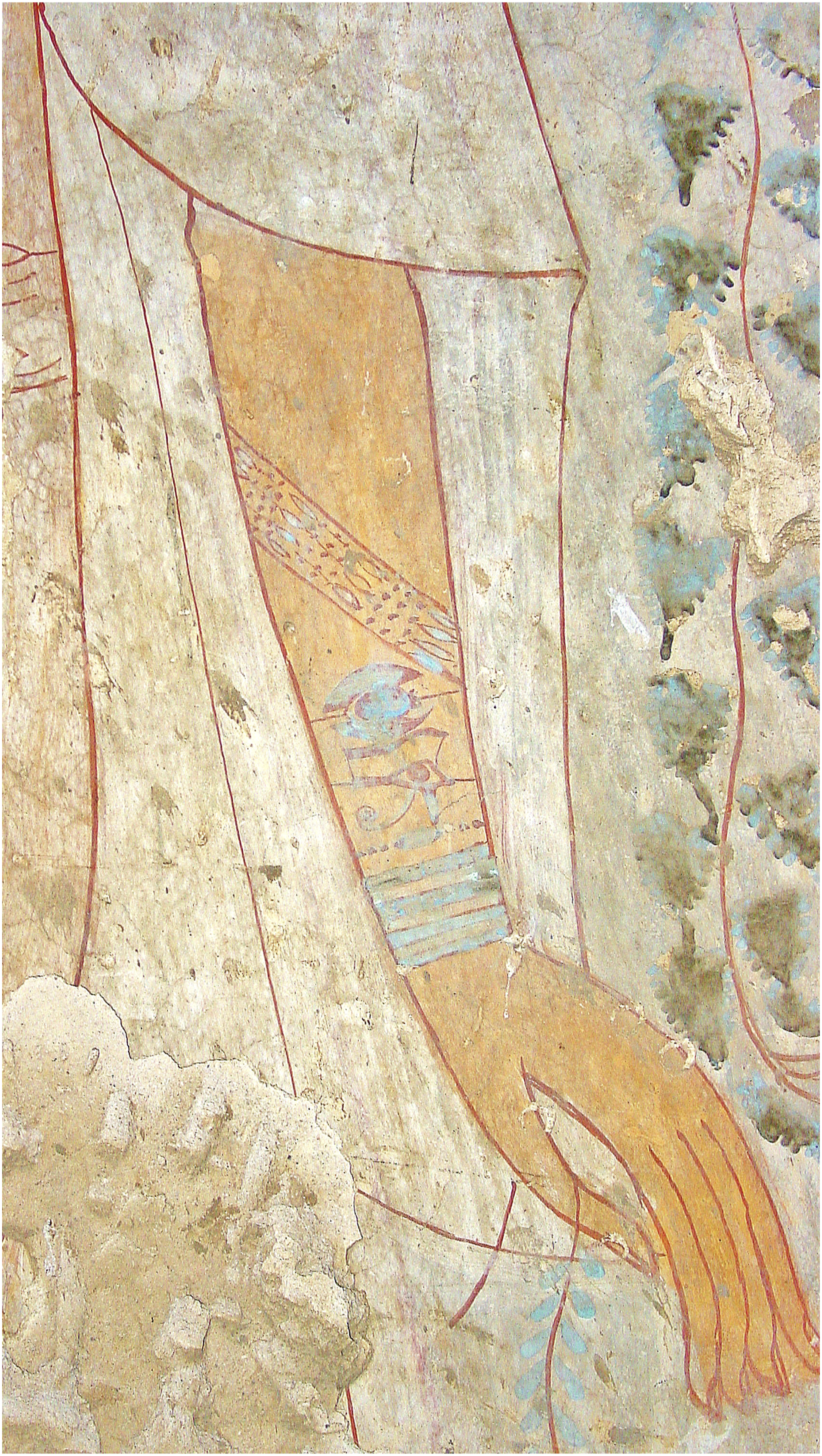
This applies to a host of other minor details such as small-scale figures, such as the figure supporting the processional bark of Amun in TT 65, which might have been expected to be rendered with some individuality. Instead, when compared with (Ramesside) temple reliefs depicting the same subject, such as that found in Sety II’s bark chapel for example, the dependence is hard not to see (fig. 13a–b). a) Figure supporting the processional bark of Amun (TT 65); b) the same figure in the bark chapel of Sety II (Karnak).
Other imitations or borrowings may appear misleadingly like Morellian details characteristic of a particular artist and generate a sense of intra-style variation. The features of some but not all of Prince Montuhirkhopshef display emphasised inner canthi, a short line curving down from the corner of the mouth, and three lines indicating pronounced tendons on the neck (fig. 14). The immediate source for this version is not important here, as scores of early Nineteenth Dynasty models in addition to Nefertari’s would be suitable, because instead of displaying his individual idiosyncrasies, the painter here was simply repeating an iconographic type.
71
A rendering of Prince Montuhirkhopshef reflecting its dependence on early Nineteenth Dynasty iconography (KV 19).
Repetition then should be understood as a distinct type of making, that by design interprets, borrows, or recontextualizes earlier artwork, and, as a legitimate procedure sanctioned by decorum, achieves a certain type of originality.
72
Incidentally, it also throws the essential quality of decorum, the establishing of authority and value through the sanctioning of correctness, into sharp relief. That it could be used and exploited as a legitimizing tool can be best illustrated by how it could even be used to ‘invent’ a monument. One of the most intriguing features of TT 65 is the presence of transposed royal temple scenes laid out on the walls of its transverse hall.
73
Most revealingly, these all foreground the ruling king Ramesses IX and the major festivals of Egypt, in general, and of Thebes in particular, in the manner of royal memorial temples (fig. 15). What its non-royal owner, Imiseba (and Amenhotep) in effect created through the repetition and recontextualization of the most appropriate temple scenes was exactly that, a royal memorial temple context, but one that had never existed. That the purpose of Imiseba was to create a royal context into which he could integrate his own is of secondary importance here. More significant for the present argument is its reflection of the awareness that art informed by decorum plays an essential role in maintaining, forming, and re-forming tradition and its distinguishing style. And it may be added that this most definitively applies to the more strongly formal figured ostraca of Amenhotep, the ‘stele’ ostraca: in their case the register of their design and content is one that is well within the parameters of decorum. Ramesses IX shown censing and libating before the bark of Amun (TT 65).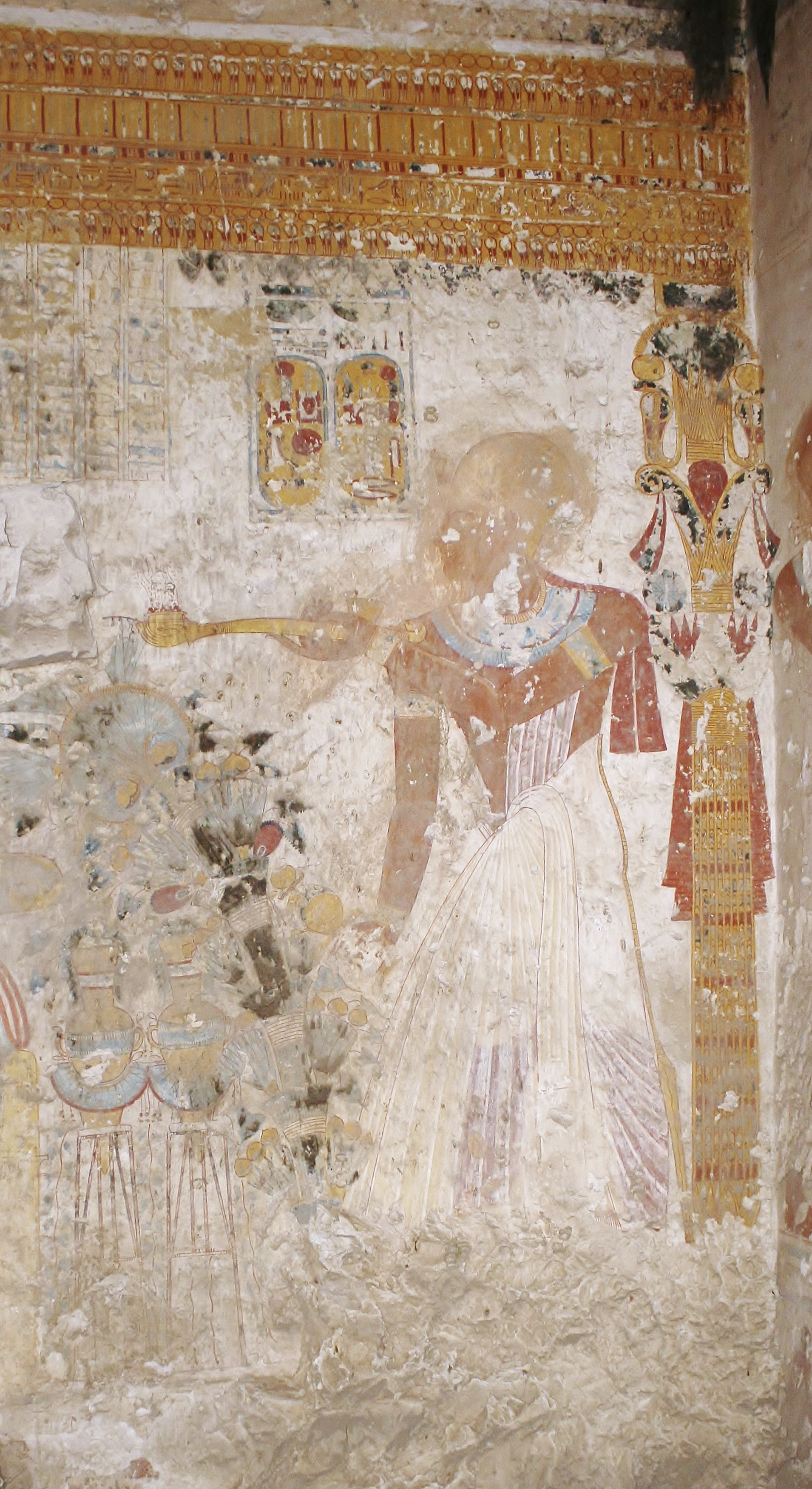
Footnotes
Acknowledgments
I would like to thank Andreas Dorn here, who invited me to give the original version of this paper at the conference Filtering Decorum – Facing Reality at the Université de Liège, 29–30 October 2013. I would also like to offer my warmest thanks to John Baines for reading and commenting on my text, the result of which is a significantly improved manuscript.
Funding
All research in the Theban necropolis, thus also in Theban Tomb 65 is made possible by the grant of the National Research, Development and Innovation Office, Hungary (NKFIH, Project No. 124322).
