




Abstract
The funerary papyri belonging to the priesthood of Amun-Re of the Twenty-First Dynasty offer a rich field for exploration. The socio-religious circumstances of the period influenced the representations within the papyri leading to a variety of innovative illustrations. Of these are the depictions of the barn swallow, which is the topic of the current study. The present work focuses on 24 representations of the swallow in a corpus of 22 papyri that are currently in various museums around the world. The study classifies those representations into two main divisions, namely those of Chapter 86 of the Book of the Dead and those depicting the bird on the prow of the morning solar boat.

The Swallow: An Overview
In ancient Egyptian funerary contexts from the New Kingdom onward, one notices representations of a small black bird. The bird belongs to a species of barn swallow known as Hirundo rustica. 1 Two sub-species of the Hirundo rustica birds are distinguishable in Egypt. The first of these species is the European Barn Swallow Hirundo rustica rustica, 2 a migratory swallow species migrating from Russia and Eastern European territories and passing through Egypt. 3 The second species, Hirundo rustica savingii, is a non-migratory sub-species of barn swallow that resides in Egypt. Since Egypt was on the route of the migratory birds travelling from Europe to central Africa and vice versa, both sub-species were known to the ancient Egyptians. It is apparent that the Egyptians did not differentiate between the two sub-species 4 which shared similar behaviours and characteristics.
The barn swallow, which is distinguishable by its forked tail, is characterized by the blueish-black colour of its back and the back of its head, its reddish-brown face, the whitish colour of its chest, and the black band separating its face from its body 5 (fig. 1 6 ). The bird is also characterized by its pointy wings and sharply forked tail 7 (fig. 2). Birds of the Egyptian resident non-migratory sub-species can be mostly differentiated from the European barn swallow by the closeness of the colours of their face and chest, both of which are of a reddish-brown colour. 8
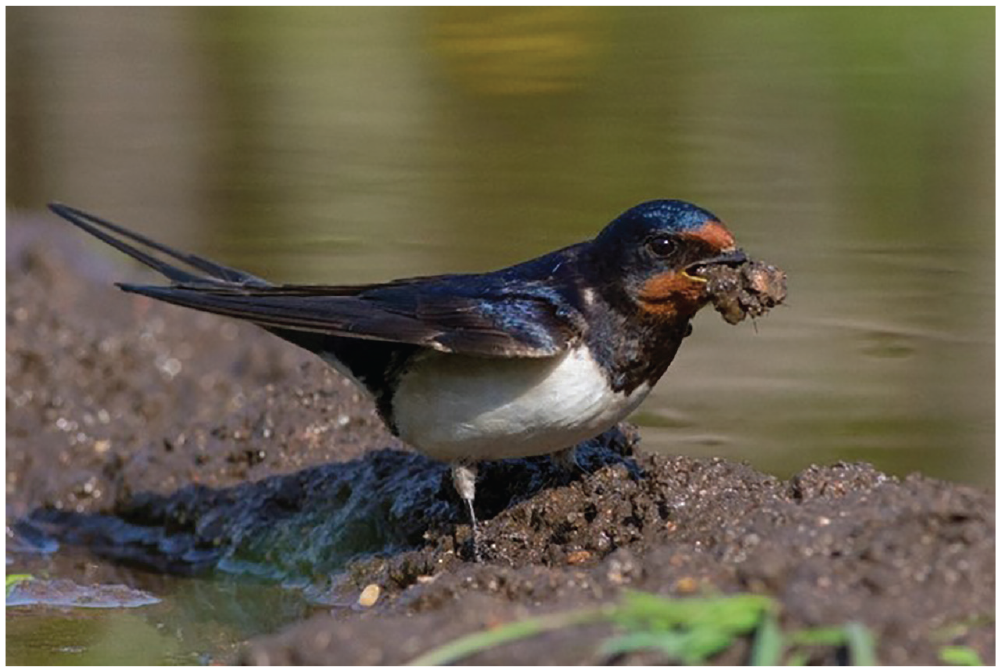
Barn swallow with a mud lump in its beak to build its nest (© Shutterstock Image ID: 1751926136).
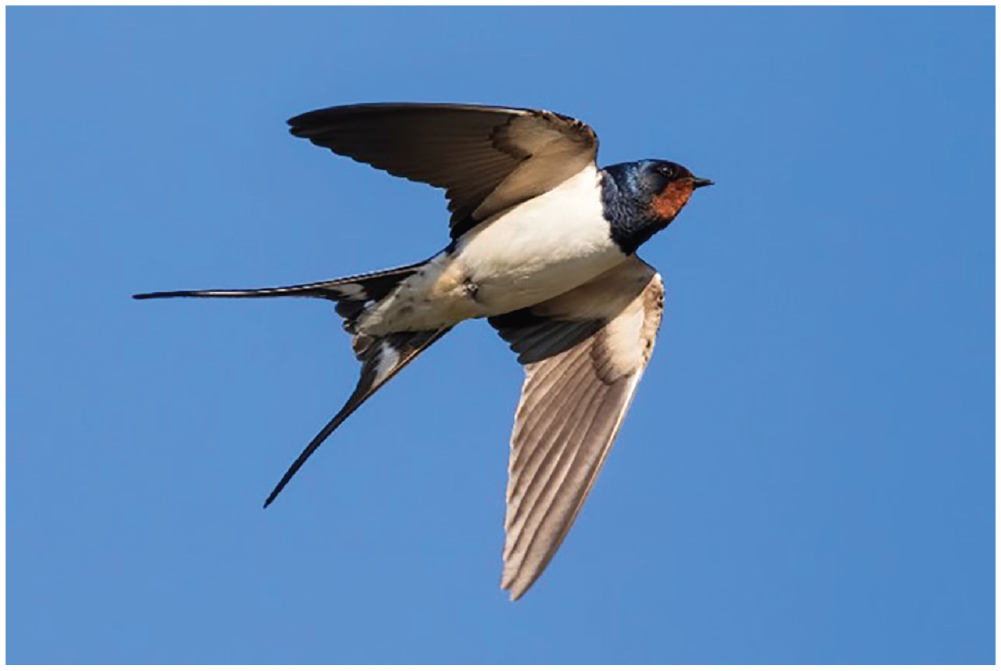
A barn swallow during flight (© Shutterstock Image ID: 1740607679).
The barn swallow gets its name from its tendency to build its nest inside man-made structures such as barns and temples. This would serve twofold benefits for the bird; not only would it protect the swallow from other predators, but it would also provide it with insects common in places rich with food such as temples, or with animal dung around barns. This explains why the bird nests inside man-made buildings, a behaviour that led the swallow to develop a close association with human habitation 9 (figs 3–4).
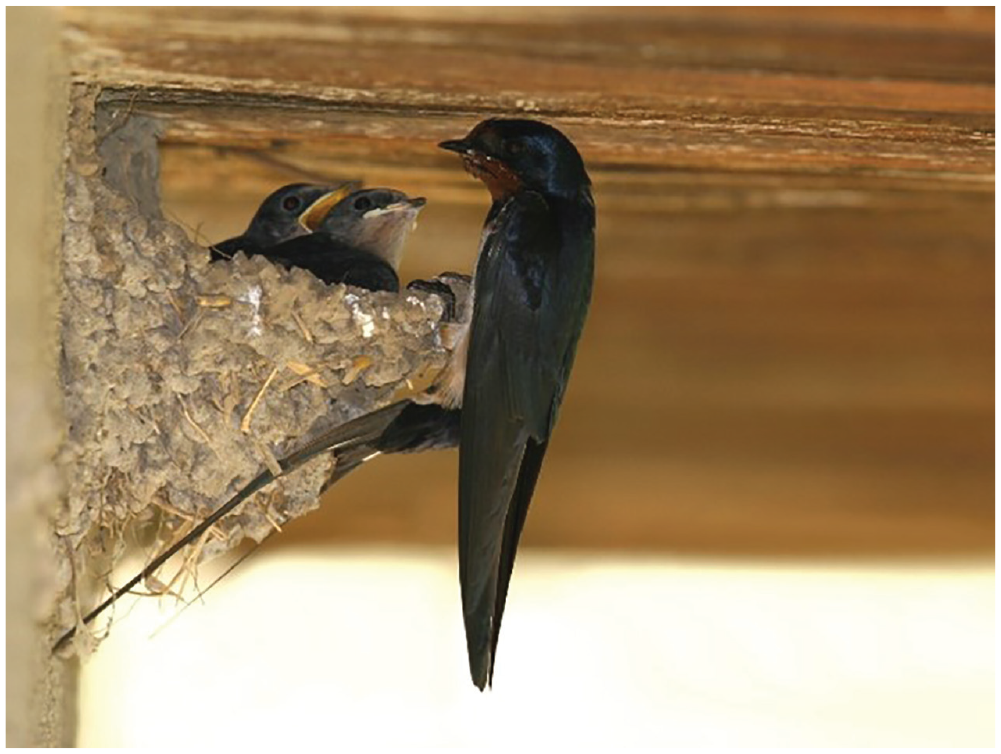
A barn swallow perched on its mud nest built under the ceiling of a man-made building (© Shutterstock Image ID:168992813).
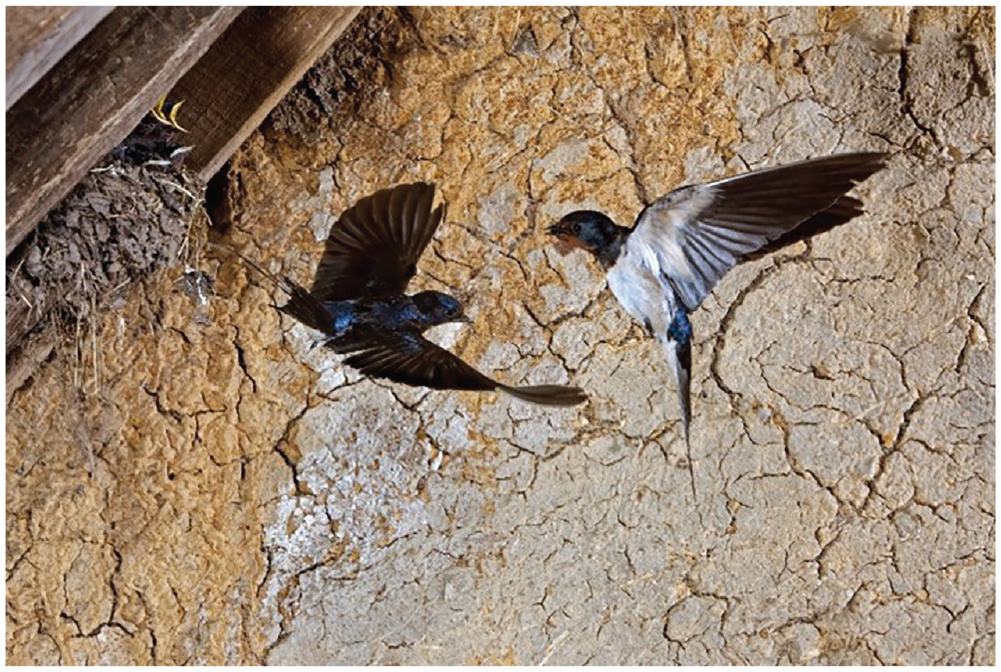
A barn swallow defending its nest (© Shutterstock Image ID: 1613090839).
The ancient Egyptians have given religious significance to several other behaviours of the swallows. For instance, an intriguing behaviour of the swallow is that it looks as if it is observing humans from above and tolerating their existence (fig. 3). Also, during the breeding season, the barn swallow parents protect their youngsters by flying in circles in a characteristic dance around potential threats, resembling the sun circuit with its connotations of life generating and protection 10 (fig. 4).
The barn swallow, like other migratory birds, intrigued the ancient Egyptians, as they considered them to be of a mythical nature. They believed that they had come from the dark and damp region of the far north, in which they were human-headed birds speaking the language of man. They also believed that when these human-headed birds arrived in Egypt, the sunlight would make them turn fully into birds. 11
The ancient Egyptians called the swallow mnt,
12
which is the sign  (G 36 of Gardiner’s sign list) that carries a positive connotation, as opposed to the negative connotation of G 37, which represents a sparrow.
13
The pronunciation of the name of the bird may have added another positive connotation as it shares similarity with the word mnty, meaning endure. This was used in a description of the bird
(G 36 of Gardiner’s sign list) that carries a positive connotation, as opposed to the negative connotation of G 37, which represents a sparrow.
13
The pronunciation of the name of the bird may have added another positive connotation as it shares similarity with the word mnty, meaning endure. This was used in a description of the bird  tȝ mnt nfrt mnty mnty n ḏt ‘the beautiful swallow menit which endures menty, which endures menty eternally’,
14
associating the bird with eternity. Hence, the swallow is simultaneously eternal and daily, just like the sun god with whom it was related.
15
tȝ mnt nfrt mnty mnty n ḏt ‘the beautiful swallow menit which endures menty, which endures menty eternally’,
14
associating the bird with eternity. Hence, the swallow is simultaneously eternal and daily, just like the sun god with whom it was related.
15
The swallow’s solar association was vaguely mentioned in the Pyramid Texts Spell 449, in association with the emergence of Pepi I as Horus in the morning. 16 However, the nature of the bird was astral in Spell 467, where it was associated with the northern stars. 17 The solar aspect of the barn swallow was more apparent during the Middle Kingdom. In the Coffin Texts (CT), the barn swallow was mentioned in CT 283, where it was associated with Hedjedjyt, a daughter of the god Re 18 whose name may mean ‘bird of light’ due to the use of a bird determinative after the name. 19 In CT 294, the deceased is given the shape of the bird by the flaming goddess, with his back and head of lapis lazuli, belly of white gold and neck of red gold, 20 a description that matches not only that of the migratory European barn swallow 21 (figs 1–2) but also that of the god Re. The black colour of the bird often has a metallic blueish hue under the sun, similar to lapis lazuli, which is said to be the colour of the sun god’s hair, while the reddish-brown face was compared to gold, which is linked to the flesh of Re. 22 In addition, the whitish colour of the chest was compared to electrum, all three minerals related to the sun god Re. 23
By the New Kingdom, the solar identity of the bird was well established where it was depicted in the Book of the Dead (BD) in one of the transformation chapters, Chapter 86, and on the solar boat in several religious representations. The solar aspect of the swallow is also echoed in Egyptian literature. In a New Kingdom love poem, a girl protests the declaration of the arrival of sunrise made by the twittering of a swallow that shall end her night with her lover. 24
A significant solar link between the barn swallow and the god Re is their mutual connection to the Mound of Creation. The basis of this may be understood upon observing the behaviours of the swallow. The bird builds its nest by using small balls of silt that it collects in its beak (fig. 1). This behaviour must have resonated with the Egyptians’ notion of creation of the world when the appearance of the benu-bird caused the Primeval Water to recede and the Mound of Creation to appear and must have perfectly fit with a migratory bird that travels over the sea like the swallow (fig. 2). This connection is echoed in a Demotic ancient Egyptian text known as the ‘Fable of the Swallow and the Sea’. 25 The text refers to a swallow who had the daily habit of leaving its young in the care of the sea to go to fetch them food. One day, the bird returned to find that the sea had risen and taken away its young. To avenge for the loss of its young, the swallow decided to bring earth from the land to the sea and water from the sea to the land. The text reflects the Egyptian perception of the swallow and its relationship to the creation of the first mound and the flood recession. 26 The text denotes the link between the swallow and the sun god in the daily journey of both the bird and the sun. It also links the vengeance of the swallow to the daily role that Re plays in overcoming the powers of chaos represented in the story by the stormy sea.
Socio-Religious Impact on the Funerary Papyri of the Twenty-First Dynasty
The innovations that occurred in the representations of the swallow in the Twenty-First Dynasty papyri are better understood within the context of other transformations of the same period. With the lack of security, inscribed tombs were no longer feasible, giving eminence to the use of papyri and coffin decoration. 27 This followed the approach used during the New Kingdom, during which papyri were found mostly in uninscribed tombs indicating that they represented an alternative to walls decorations. 28 Niwiński called this concept ‘rule of alternative’ that was well established by the beginning of the Twenty-First Dynasty. 29
In contrast to the practice of having one papyrus of the Book of the Dead per person, 30 which was usually placed within the coffin set or on the mummy during the New Kingdom, 31 it became customary for each burial of the priesthood of Amun during the Twenty-First Dynasty to be equipped with two or more papyri. 32 However, the socio-economic circumstances that led to the use of collective tombs compelled the priests to have smaller sizes of papyri than those used for the New Kingdom elite. 33 With this novel practice of having more than one papyrus per burial, it became more customary to place a papyrus with extracts of the Amduat within the coffin set, and to insert another with extracts of the Book of the Dead within an Osirian statuette that was supposedly placed in the near vicinity of the deceased’s coffin set. 34 The small size of the statuettes may well be another factor that led to the abridgment of the texts.
During the Twenty-First Dynasty, those abridged versions, which are predominantly pictorial with minimal to no texts in some specimens, 35 became more prevalent and replaced lengthy papyri that used to have prolonged texts with no vignettes at all in some cases. This change is mostly recognized for papyri classified as the Book of the Dead. 36 The tendency to expand the use of vignettes in relation to texts had been gradually growing since the New Kingdom, an approach that further expanded during the Twenty-First Dynasty. 37
The abovementioned factors explain the need to apply the rule of pars pro toto in funerary papyri during the Twenty-First Dynasty, 38 a rule that started to appear by the end of the New Kingdom. 39 Accordingly, a limited selection of the Book of the Dead chapters were chosen, and each was represented by a small portion of the chapter, by the title of the chapter, or merely by its adjoining vignette. 40
These stylistic and religious modifications in the funerary compositions of the papyri compelled Egyptologists to find other designations than those used for the funerary compositions of the New Kingdom. Alexander Piankoff followed an earlier suggestion of calling the funerary papyri of the Twenty-First Dynasty ‘Mythological Papyri’. The reason for this name was that the contents of each papyrus were not restricted to one type of religious composition, but were rather a mixture of funerary symbols and representations. 41 Thus, Piankoff classified the papyri according to their contents under three main sub-categories. 42 However, as papyri contents were often more focused around one theme such as the Amduat, the Book of the Dead or the Book of Aker, this led Andrzej Niwiński to recategorize the papyri into two main types, namely the Book of the Dead type and the Amduat type, with further sub-categories within each type. 43 This classification depended on the papyri titles occasionally written by the ancient Egyptians themselves on some papyri and/or the dominant themes and iconography of papyri. Nevertheless, this classification was challenged by Marissa Stevens, who argued that the papyri of the Twenty-First Dynasty are not thematic. Subsequently, she created a classification for some representations that were not found in earlier afterlife books under a class that she labelled ‘Cosmographic Scenes’, 44 a term that is found befitting for use in the current work.
The Representations of the Swallow in the Funerary Papyri of the Twenty-First Dynasty
Twenty-four representations of the swallow in 22 papyri comprise the corpus here examined (table 1). During the course of the study, I realized that the bird is represented in two main classes of funerary representations, the swallow in the Book of the Dead Chapter 86, and the swallow on solar boat prow. Both classes are represented in diverse, innovative fashions as shall be discussed below.
Papyri with representations of the swallow Book of the Dead Chapter 86 used in this work.

The Swallow in the Book of the Dead Chapter 86
The text of Chapter 86 of the Book of the Dead is accompanied by a vignette of a swallow in a standing still position, quite often perched on a mound. The text starts with r n ỉrt ḫprw m mnt ḏd mdw ỉn…, ‘Formula for taking form as a swallow, Words spoken by N’. 45 The chapter has a closing paragraph which confirms that ‘whoever knows this formula, would be able to turn himself into a swallow’. 46 The word ḫpr is believed to be used similarly as the German Werden, having primarily the sense of turning, hence of becoming rather than the sense of creating. 47
The prototype of Chapter 86 is found in the Coffin Texts on a Middle Kingdom sarcophagus where the spell CT 283 identifies the deceased as a swallow and ends with the rubric ḫprw m mnt ‘taking form as a swallow’. 48 On another sarcophagus, the spell begins with tm mt m wḥm ỉnk mnt ‘for not dying again (as) I am a swallow’, 49 thus serving the same concept of becoming a swallow. De Buck considers CT 296 a continuation of CT 283, both of which he finds to be equivalent to Chapter 86 of the Book of the Dead. 50 In CT 296, even though the bird is not mentioned by name, the spell was associated with the swallow based on the characteristics stated in the text that relate to the bird as a messenger of the sun god. 51
The chapter is one of transformation chapters (Chapters 76–88) that are concerned with the help of the deceased to be transformed into a variety of images of the god. From the New Kingdom onward, these chapters were some of the most widely used combinations of chapters. 52 The transformation chapters deal with the transformation of the deceased ba into a living ba taking a variety of forms including – among others – a phoenix, a falcon, a heron, and a swallow. Transforming into such forms was believed not only to give the deceased power over food, drinks, and air, but also to enable them to permanently cross freely into the underworld in any form of their choice and to become forever divine. 53 These spells were also meant to help the deceased in his transfiguration into an Akh, the transfigured dead assimilated to the gods. 54
The transformation chapters are largely used in a solar context. The word that is used in the spell to indicate transformation, ḫpr, is written with a scarab that is in itself a symbol of the sun in one of its transformation forms from night to day. 55 The transformation chapters are closely associated with the solar journey to the extent that they have become twelve in number resembling the twelve hours of the night, with the addition of Chapter 76 as an introductory chapter. 56
A variety of interpretations were made regarding the significance of these spells. Some Egyptologists considered them to be like a dream that would enable the deceased to acquire the characteristics of the mentioned creature. Others suggested that it was considered as a kind of functional identification. 57 Particularly in the case of the swallow, this functional identification would help the deceased and their ba to unite with the solar boat. 58 A version of Chapter 86 indicates that the wordings of the spell are to be recited by the deceased themself to ensure that the transformation into the swallow occurs. 59
It is worth mentioning that Chapter 86 was the most widely used of the transformation chapters 60 during the New Kingdom and the Third Intermediate Period, 61 to the extent that it was found on funerary stelae. 62 In Deir el-Medineh, reflections of the divinity of the swallow are found in representations of the bird in decorative motifs, 63 funerary stelae 64 and tomb decorations. 65
The representations of the transformation chapters have altered during the Twenty-First Dynasty in accordance with the changes that overtook the Book of the Dead as discussed above. With the comprehension of the concept of pars pro toto, one would be able to interpret the reasons that compelled the Book of the Dead papyri artisans, as an alternative of including texts and vignettes of all transformation chapters, to only draw the chosen vignettes with little texts. Hence, not only did the location of the chapter differ, but the layout of the vignette itself was also depicted in a variety of styles. This led to an array of novel settings as shall be further elaborated.
When examining the representations of Chapter 86 in the specimens studied in the current work, I realized that the vignette of the swallow is represented in five innovative styles. For a matter of convenience, I have categorized them S1–S5 throughout this paper. In the S1 category, the bird is depicted within a square in the upper section of the papyrus; in S2, the vignette of the swallow is placed in a group among other vignettes with hardly any text; in S3, the vignette of the swallow is placed to the side and is accompanied with hieratic inscriptions; in S4, the vignette depicts the swallow flying; and in S5, the vignette portrays a pair of swallows perched on two mounds. It is worth noting that the papyri within these categories do not necessarily fit into the same categories of Niwiński’s typology.
The first category, S1, includes five papyri: the papyri of Tawdjatre 66 (fig. 5 a–b), Ankhesenmut 67 (fig. 6), Henuttawy-Duathathor 68 (fig. 7a–b), Padiamun A 69 (fig. 8), and Nesitanebashru 70 (fig. 9). Although the style bears similarity to New Kingdom papyri representations in bearing a frieze with vignettes in the upper part of the papyrus 71 (figs 29–31), one notices a few novel details. It caught my attention that the vignette of Chapter 86 was not strictly placed with other transformation chapters but rather arranged in new arrangements. For instance, in the papyrus of Tawdjatre (fig. 5a), one finds vignettes of some of the transformations chapters placed in line with other chapters in the following order: Chapter 8; Chapter 77 and 78; Chapter 9; Chapter 85; a vignette of Chapter 17; Chapter 86; and Chapter 146. 72 These vignettes are either accompanied with a brief text or even a title related to the chapter that it represents or have no text at all. To the latter belongs the vignette of Chapter 86 that the artist used solely to represent the chapter without the customary text. Even though the vignettes were placed in a row of squares similar to the arrangement followed in the Book of the Dead papyri during the New Kingdom, the text in the lower register was not related to the selected chapters but is ‘a long text composed of passages from the Ritual of the Dead’ 73 of one single chapter, Chapter 125B. 74

Papyrus Tawdjatre, details showing vignette of Chapter 86, SR VII/11496 (photo: Abir Enany).
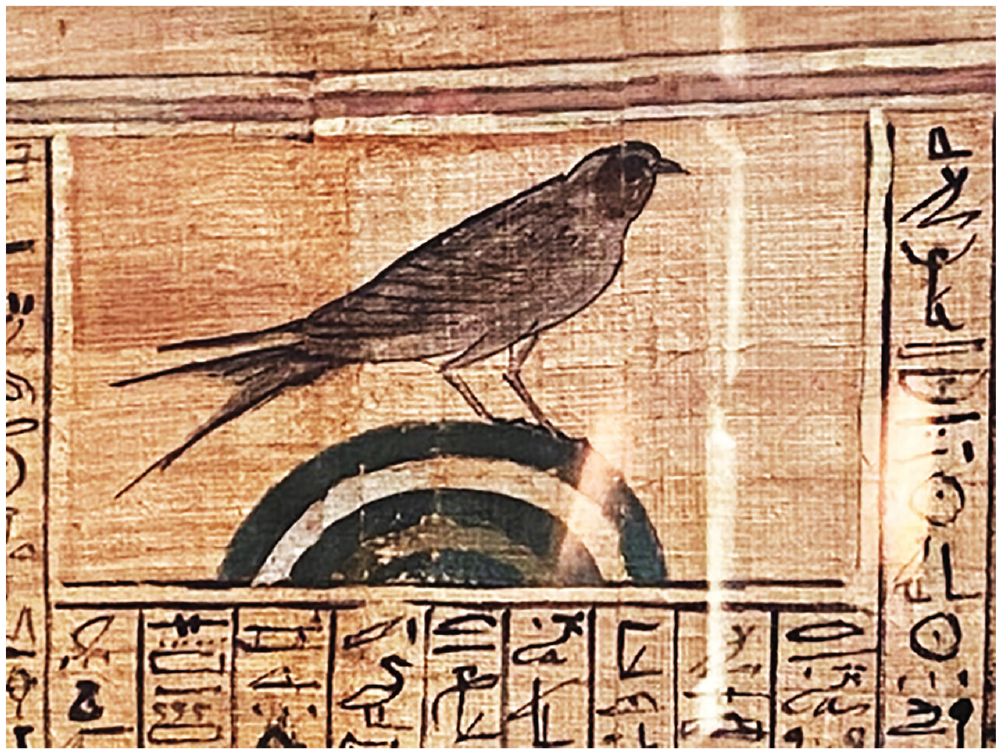
Papyrus of Ankhesenmut, detail showing vignette of Chapter 86, SR VII/10255 (photo: Abir Enany).
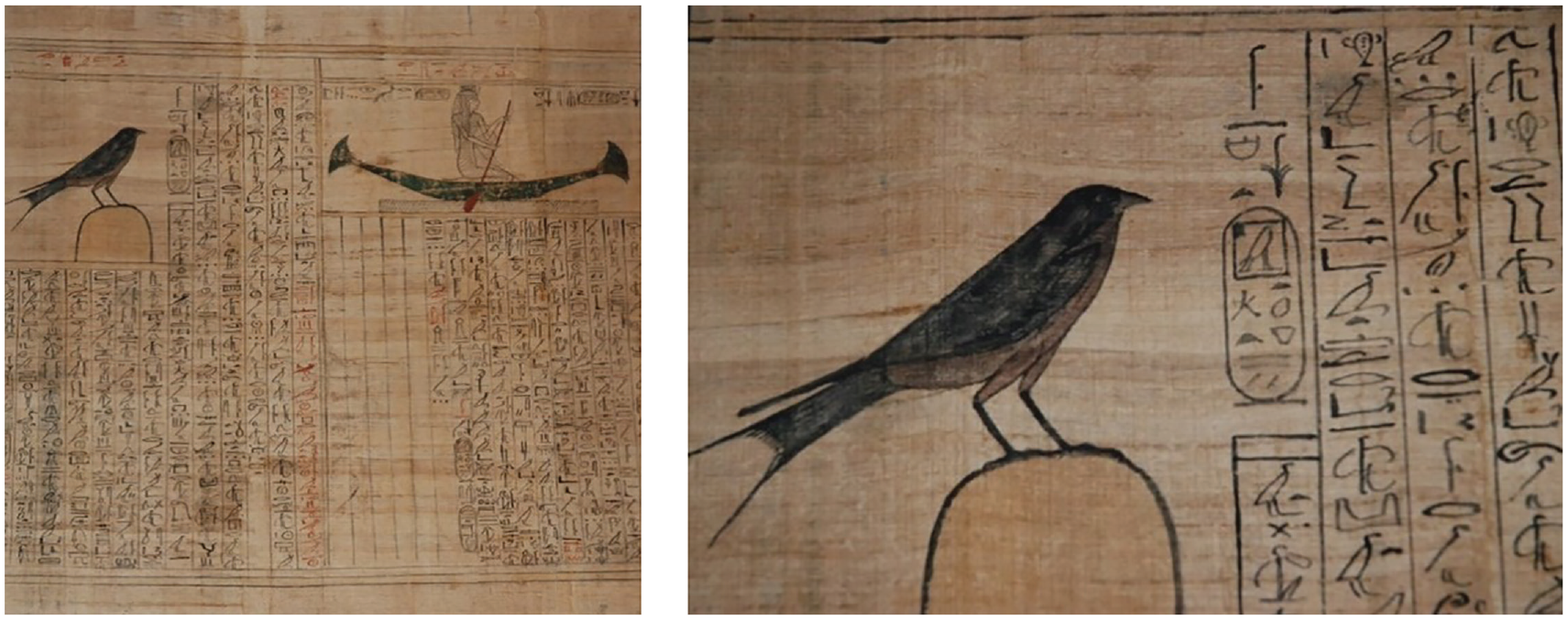
Papyrus of Henuttawy-Duathathor, details showing vignette of Chapter 86, SR IV/955, JE 95856 (photo: courtesy of EMC).
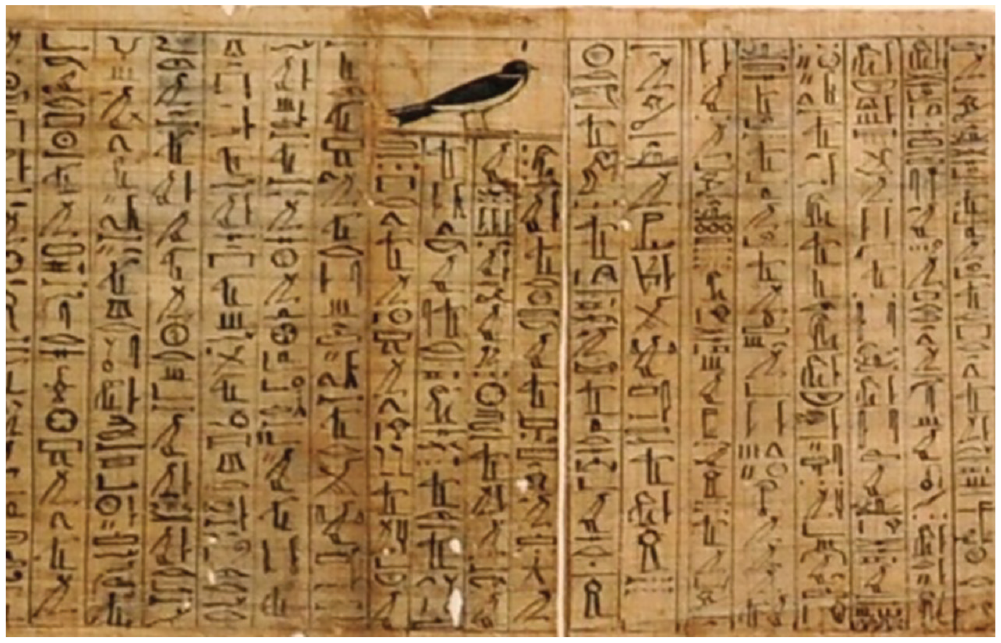
Papyrus of Padiamun A, detail showing vignette of Chapter 86, SR VII/10653 = Tr 23.4.40 (photo: courtesy of EMC).
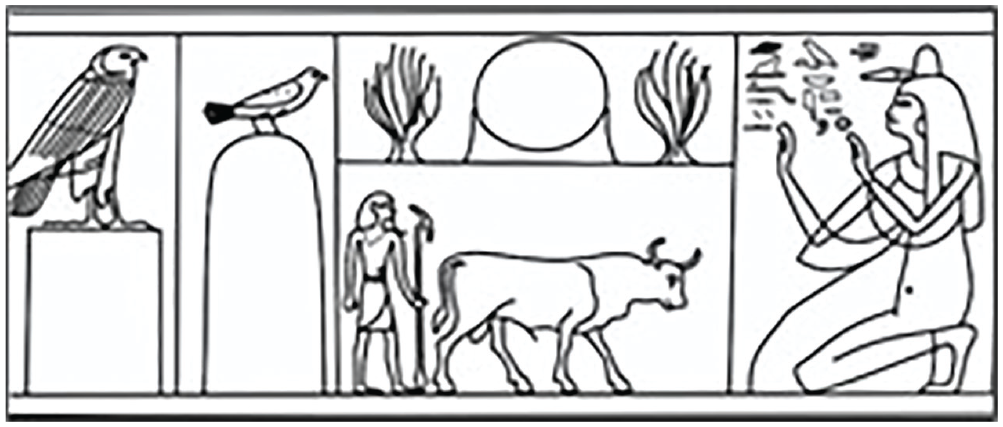
Papyrus of Nesitanebashru, detail including vignette of Chapter 86, BM 10554
In both the papyrus of Ankhesenmut and that of Nesitanebashru, the chapter is similarly represented with the vignette alone. 75 However, two other papyri of category S1, those of Henuttawy-Duathathor and of Padiamun A, despite sharing the same layout of other S1 papyri, differ in that they both contain a text of Chapter 86 in addition to the vignette. 76
The category S2 is represented by four papyri of the specimens here studied. Those are the papyri of Djedkhonsuiuefankh 77 (fig. 10), Shednsuher 78 (fig. 11), Padiamun B 79 (fig. 12, not to be confused with Padiamun A above), and Khonsumes 80 (fig. 13). In all four examples, the vignette is assembled with other vignettes of the transformation chapters stacked together in two or three rows in one or more groups of vignettes with the absence of segregated registers. 81 For instance, in the papyrus of Shednsuher, the vignettes of the transformation chapters are placed in two groups separated by text. In all of the S2 papyri, the chapters are represented by vignettes only, except for the papyrus of Djedkhonsuiuefankh, where the title of each chapter is provided beside it. Here the text comprises solely the title of the chapter ỉrt ḫprw m mnỉt ‘Taking the form of a Swallow’, written next to the vignette of the swallow on the mound.
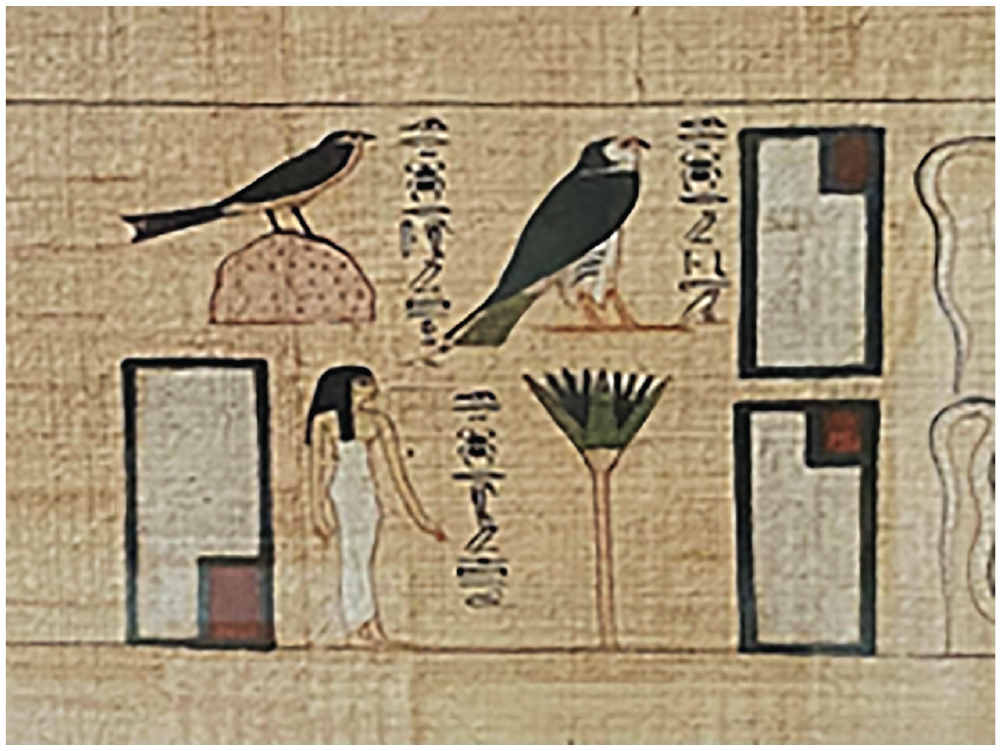
Papyrus of Djedkhonsuiuefankh, detail including vignettes of Chapter 86, SRVII/10247 = JE 33999 (photo: Abir Enany).
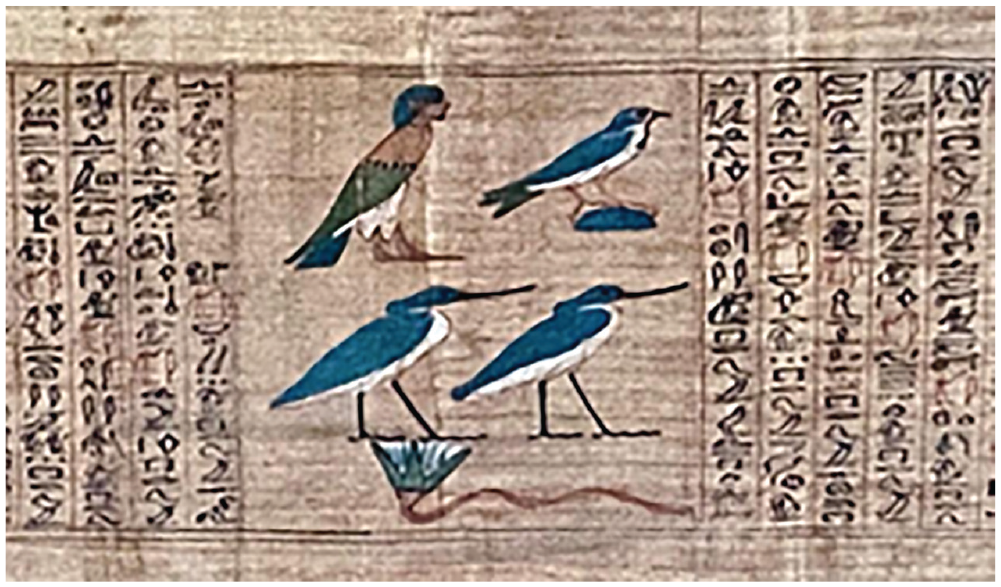
Papyrus of Shednsuher, detail including vignettes of Chapter 86, SR VII/11494 (photo: Abir Enany).
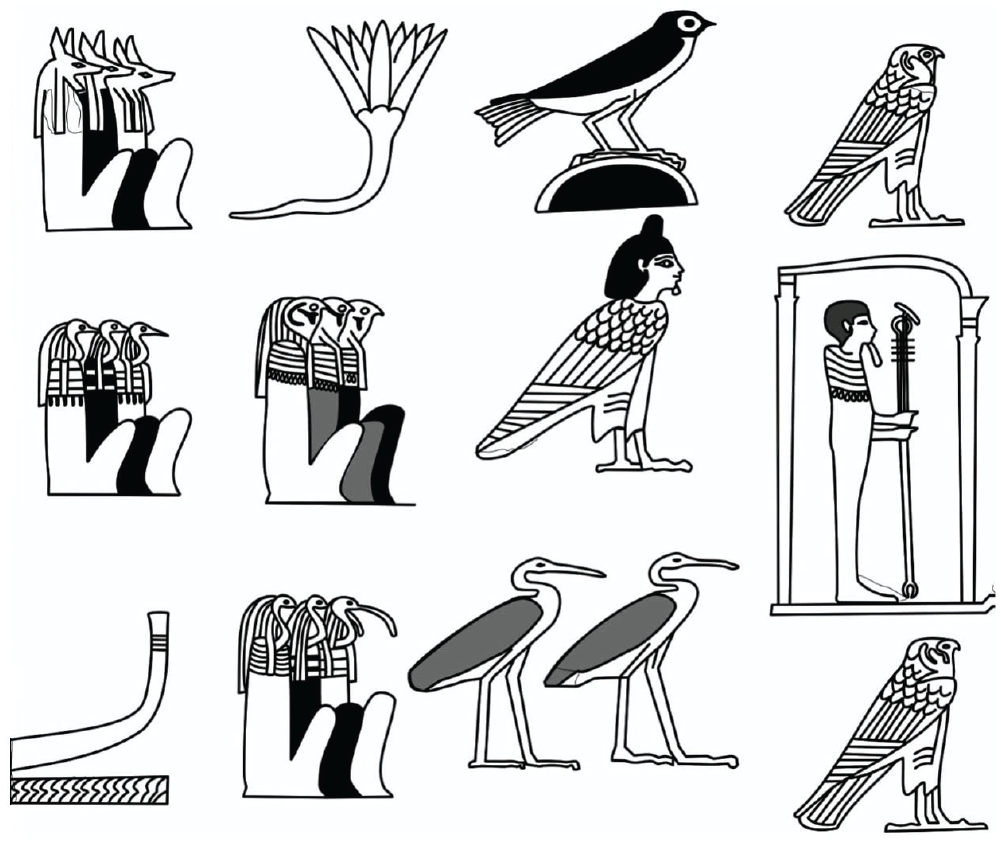
Papyrus of Padiamun B, detail including vignettes of Chapter 86, SR IV/981 = JE 95879
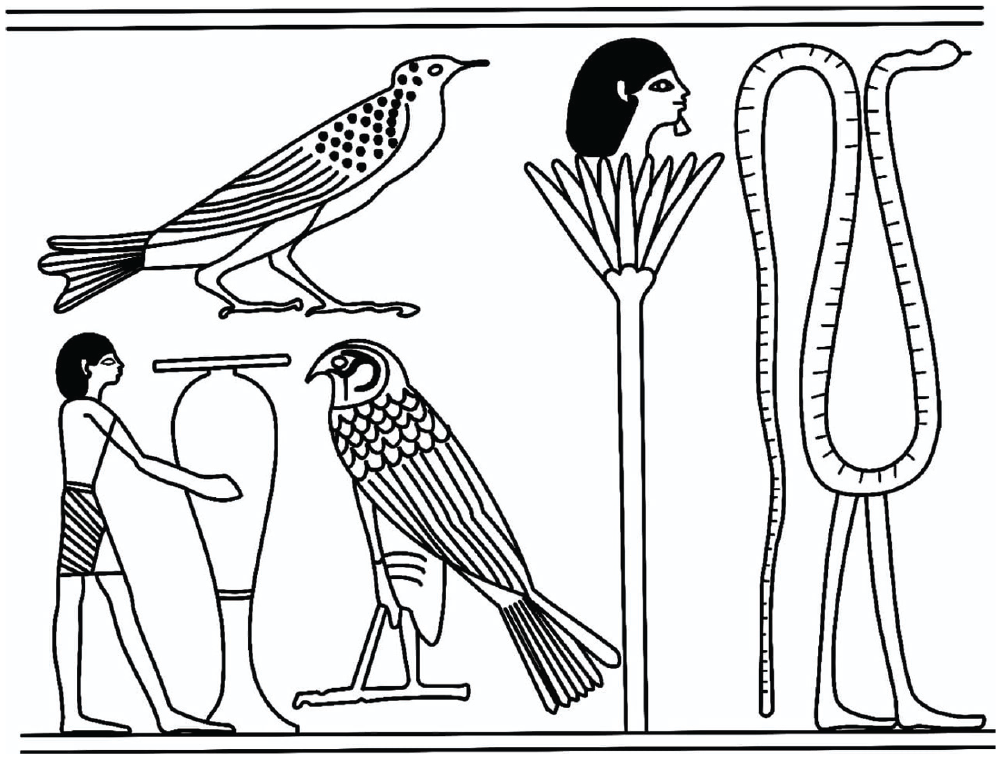
Papyrus of Khonsumes, detail including vignettes of Chapter 86, Kunsthistorisches Museum Vienna 3859 A
In this category, the vignettes are the de facto chapters. The manner in which they are stacked together clearly reflects the concept of the rule of pars pro toto that was broadly used during this period, 82 and differs from the previous custom of placing the transformation chapters in a consecutive order as was customary during the New Kingdom. 83
The category S3 is represented by two papyri of the specimens of the current study, the papyri of Gautseshen 84 (fig. 14) and Nesikhonsu 85 (fig. 15). Chapter 86 is represented in these two papyri with text and vignette and both papyri were written in hieratic. The vignettes are here placed to the side of the text in the vicinity of other transformation chapters.
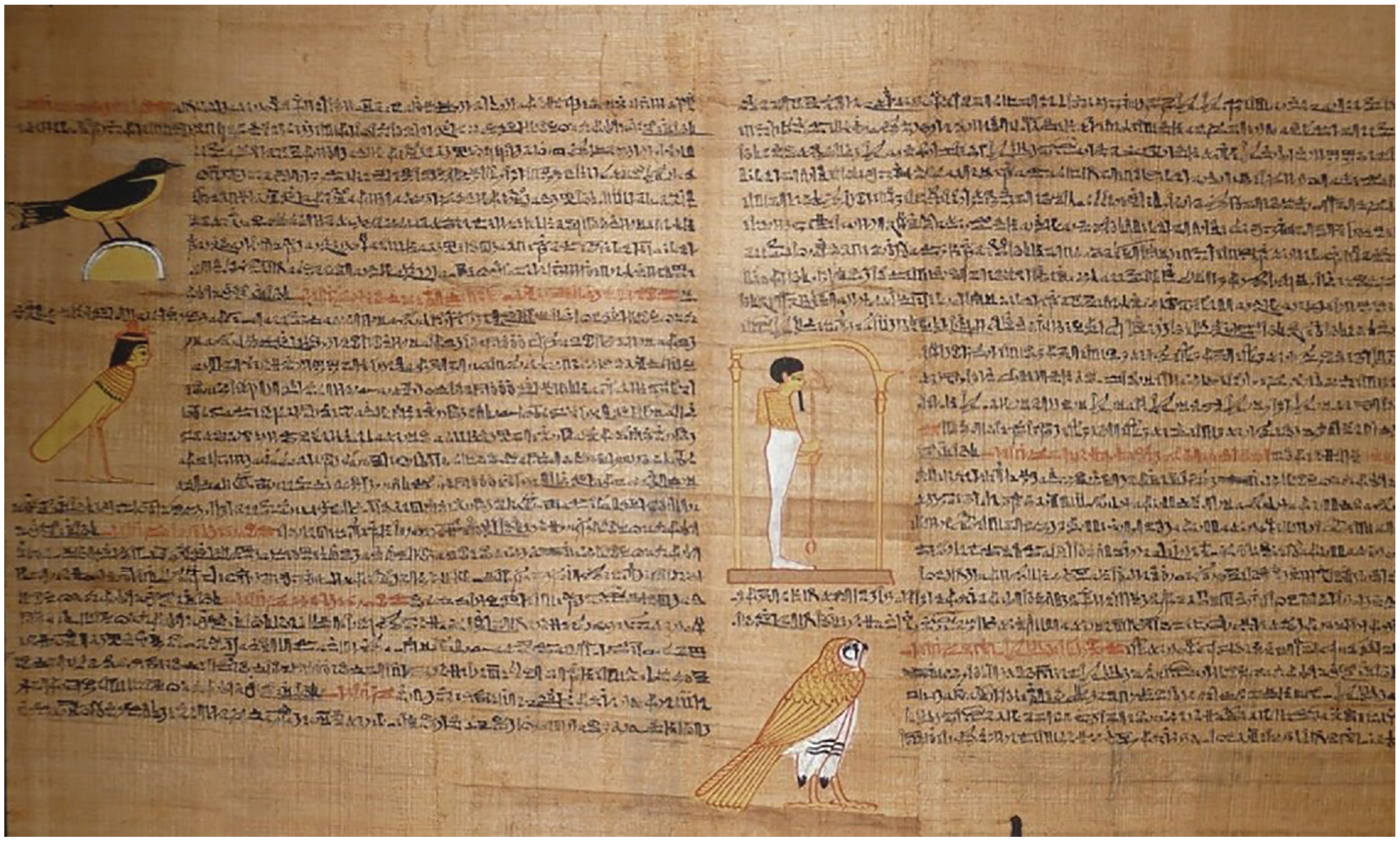
Papyrus of Gautseshen, detail including vignettes of Chapter 86, JE 95838 (photo: courtesy of EMC).
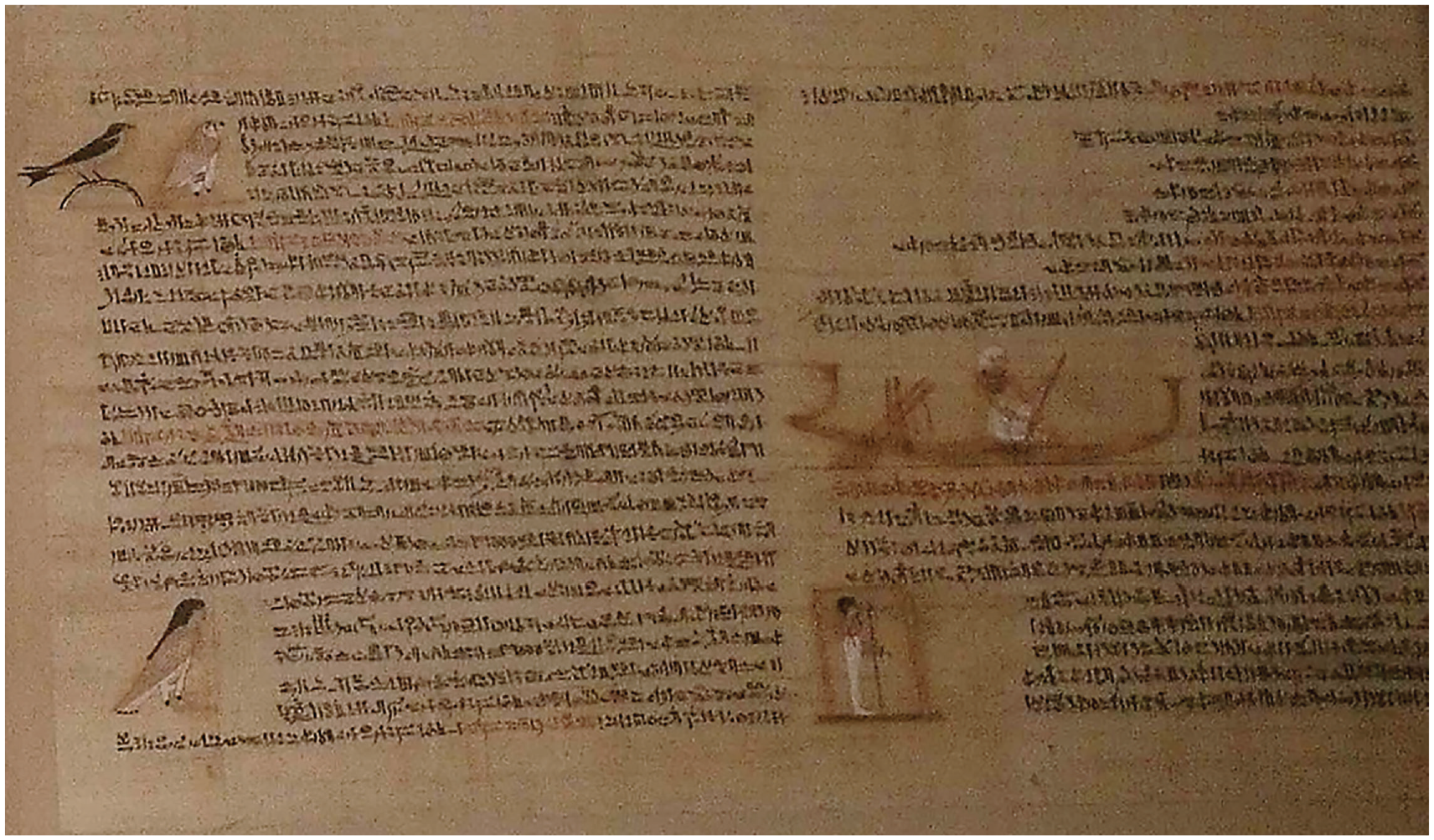
Papyrus of Nesikhonsu, detail including vignettes of Chapter 86, JE 26230 (photo: courtesy of EMC).
The fourth category S4 is represented by two papyri as well, the papyrus of Isis 86 (fig. 16), and of Maatkare 87 (fig. 17). I based this classification on the depiction of the swallow during flight in both papyri, in contrast to the customary standing still posture of the bird, a novel representation that has, to my knowledge, never been used in earlier representations of Chapter 86. 88 The two papyri are otherwise different. The papyrus of Isis is written in hieratic like other papyri of Niwiński’s type BD.II.2, 89 while that of Maatkare is written in cursive hieroglyphs, characteristic of type BD II.1. 90 The vignette of the swallow is represented to the side of the text in the papyrus of Isis in resemblance to the representations of S3, whereas in the papyrus of Maatkare, it is represented in a box close to the upper part of the papyrus in a similar fashion to the representations of S1. The vignette of the swallow in the latter example shares the same box with a serpent, namely the vignette of Chapter 87 ‘Taking the form of a Serpent’. An extremely brief text of the latter chapter follows the abridged text of Chapter 86. 91
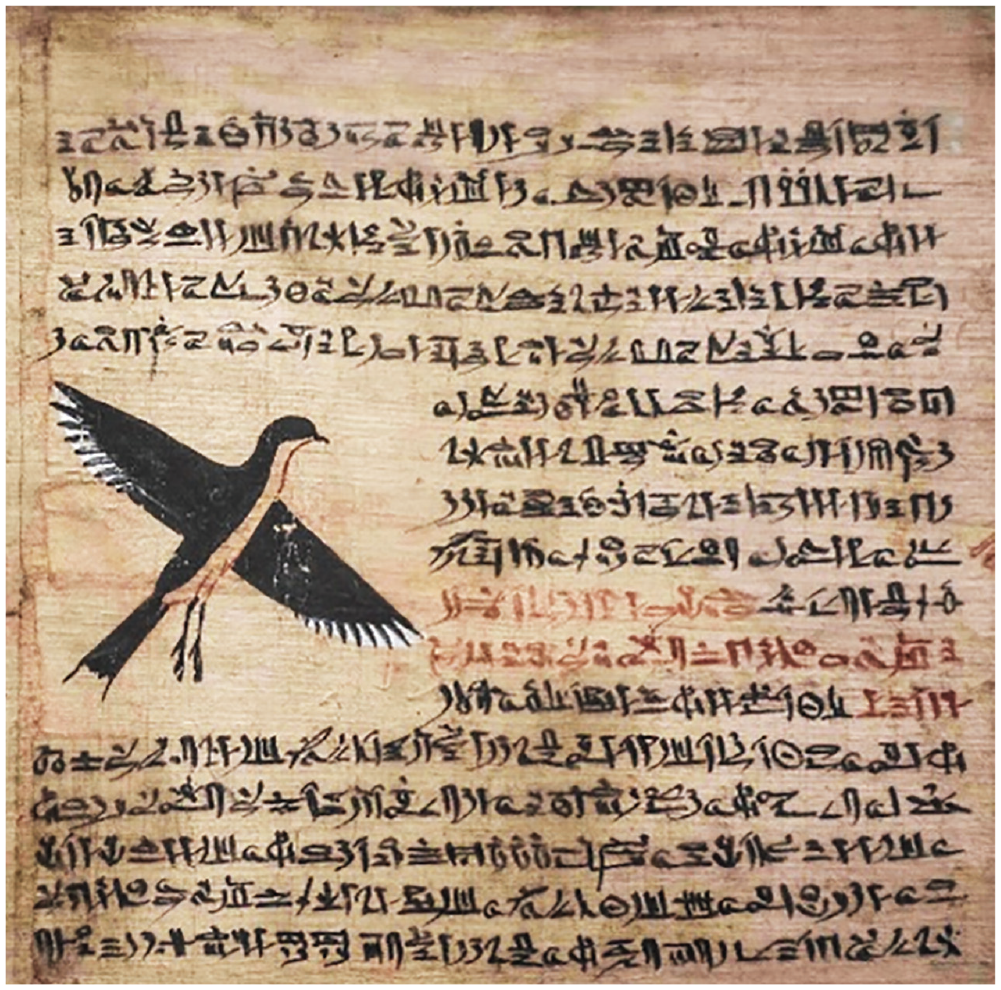
Papyrus of Isis Cairo, detail including vignettes of Chapter 86, SR IV/549 (photo: Abir Enany).
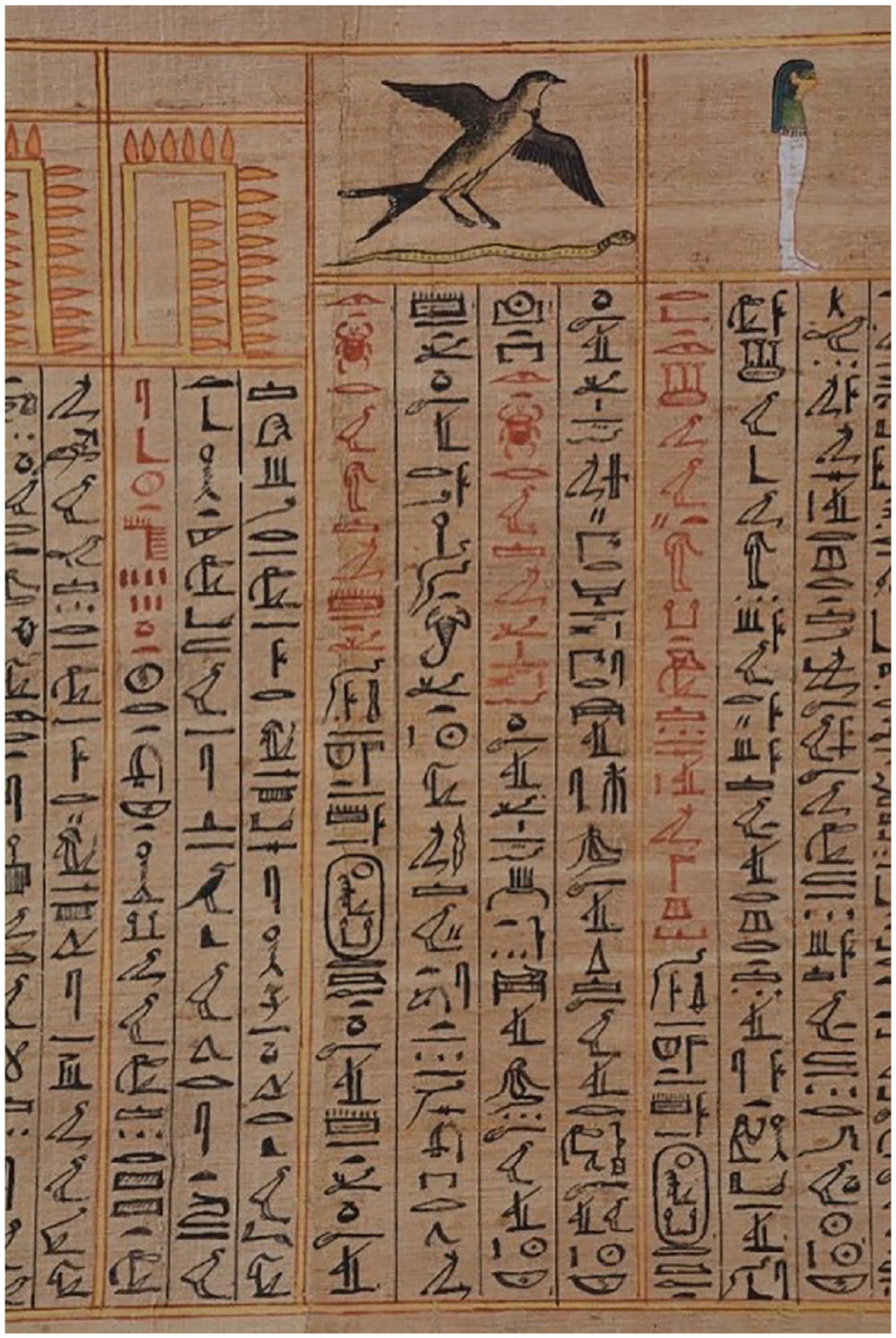
Papyrus of Maatkare, detail including vignettes of Chapter 86, SR IV/980 = JE 26229 (photo: Sameh Abdel-Mohsen, courtesy of EMC).
This unconventional style of representing the swallow of Chapter 86 in flight may be related to the concept of using the bird symbol itself to magically enable the deceased to have the freedom to wander anywhere they wish. It also reflects the fascination of the ancient Egyptians with the flying skills of the swallow, a fascination that is elucidated in CT 278 where the deceased is said to fly like a swallow and crackle like a goose. 92 The artisan, in his desire to highlight the idea of flying, portrayed the swallow in a manner that evokes the word and the hieroglyphic ideogram pȝ ‘to fly’, 93 G 40 on Gardiner’s sign list. Furthermore, the flying posture bears clear resemblance to the depiction of the ba-bird in its flight over the mummy. 94 Examples of the association of the swallow with the ba-bird shall be highlighted in the following category.
The category S5 is represented by four papyri, each depicting Chapter 86 with a pair of swallows perched on two mounds, the papyri of Tjanefer 95 (fig. 18), Tashedkhonsu 96 (fig. 19), and Panebenkemetnekht 97 (fig. 20), in addition to the papyrus of Djedmutiwesankh. 98 Although this last papyrus does not have two mounds, it has been included within this category for reasons that will be explained below. 99
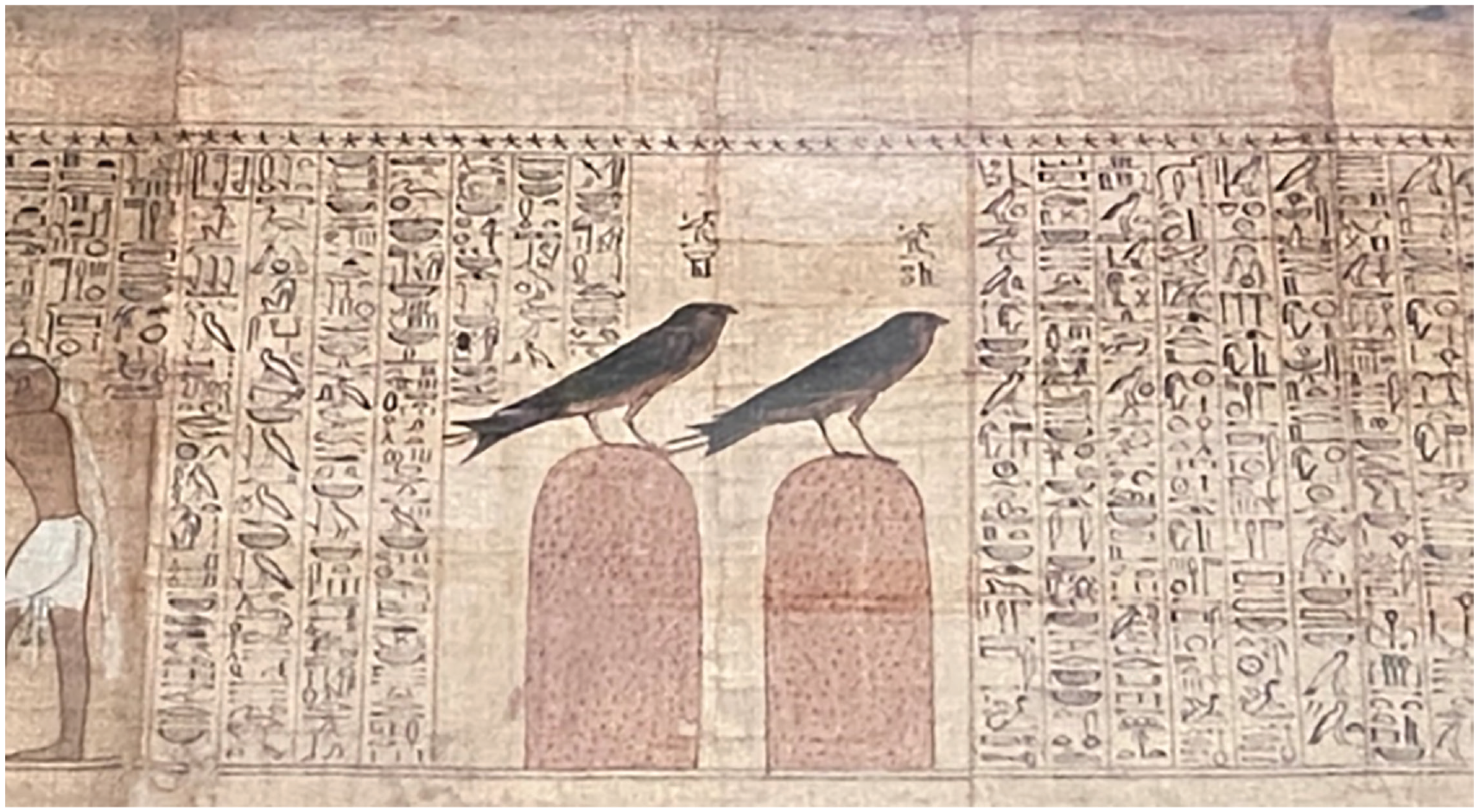
Papyrus of Tjanefer, detail including vignettes of Chapter 86, SR VII/10244 = JE 33997 (photo: Abir Enany).
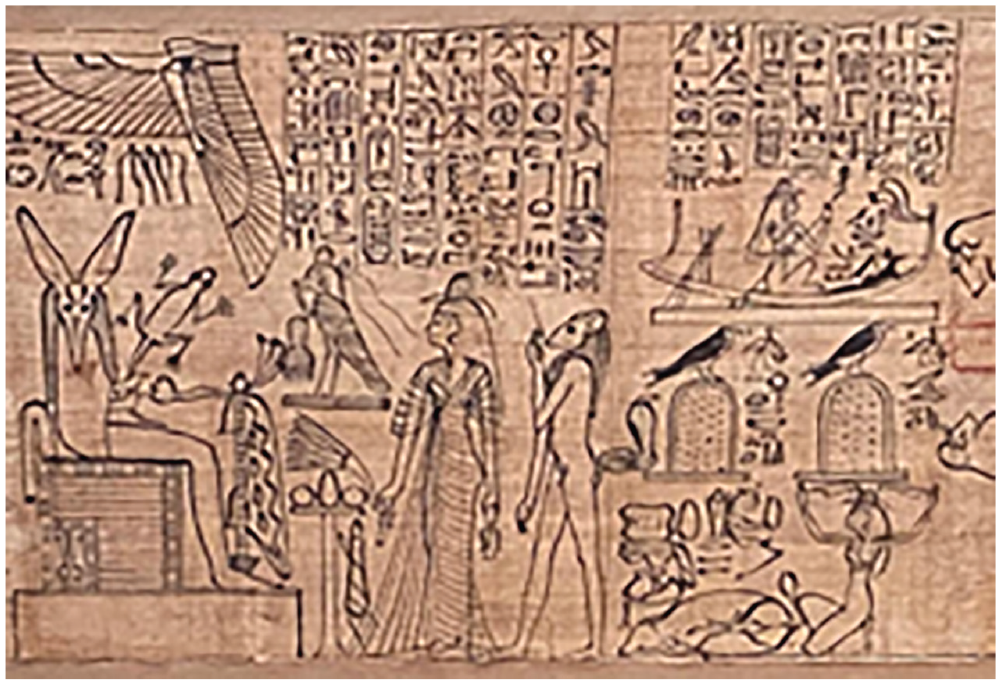
Papyrus of Tashedkhonsu, detail including vignettes of Chapter 86, SR VII/10240 (photo: Abir Enany).
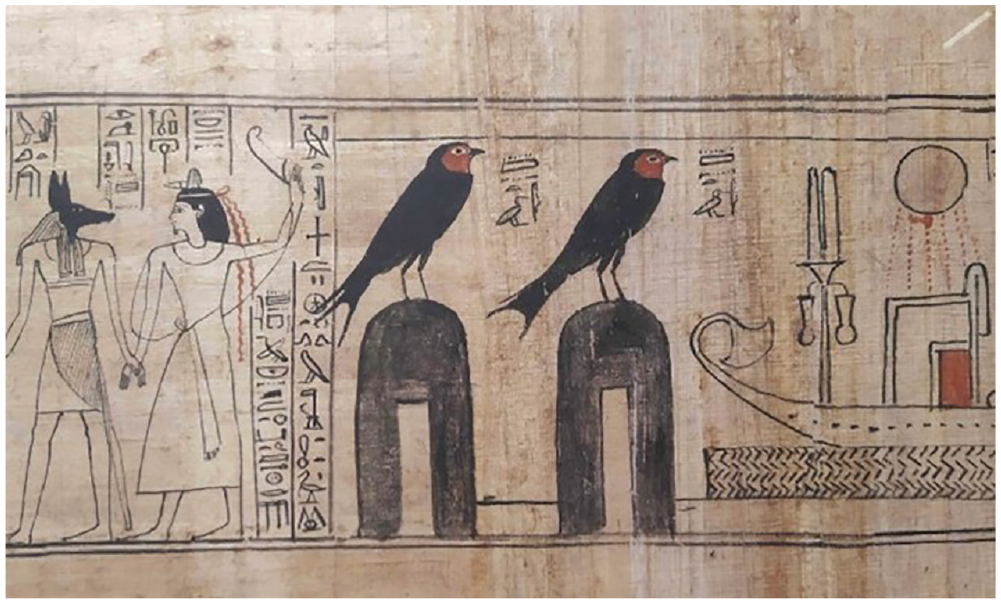
Papyrus of Panebenkemetnekht, detail including vignettes of Chapter 86, SR VII/11506 (photo: Abir Enany).
In the first two specimens, the birds have their identity clearly marked beside them: the ba of Isis and the ba of Nephthys (figs 18–19). In the third, each bird is labelled mnỉt and the mounds have an atypical feature, particularly that each mound is provided with a door (fig. 20). The door in the mound relates to the association of the tomb with the mound of creation. 100 The mound and the tomb were associated with one another to the extent that the swallow of Chapter 86 was represented in some scenes perched on a tomb instead of a mound, 101 a representation often used to depict the ba-bird. 102 A similar doored mound is found in the papyrus of Djedmutiwesankh, 103 but here, instead of two birds over two mounds, there is one mound with a swallow facing the ba-bird of the deceased on top of a tỉt-sign (fig. 21). It is likely that the Egyptian artist, instead of representing two mounds with two swallows depicting Isis and Nephthys, illustrated one mound with a swallow, likely indicating Nephthys, and a ba-bird symbolizing Isis. This may be deduced from the tỉt-sign of Isis, which is used here instead of the mound. It might be worth noting that in the papyri of Tjanefer and of Tashedkhonsu, where the names of the goddesses are written by the birds, Nephthys’ name was written next to the swallow to the left, whereas that of Isis was written next to the swallow to the right in a parallel allocation to that found in the papyrus of Djedmutiwesankh. Furthermore, these two papyri clearly reflect the association of the ba with the swallow, an association that is reflected in some New Kingdom texts 104 and is perfectly depicted in the Eighteenth Dynasty papyrus of Iwtnyrsyh, where the swallow is portrayed perched over the mummy 105 in an attitude parallel to that of a ba-bird in Book of the Dead Chapter 89. 106
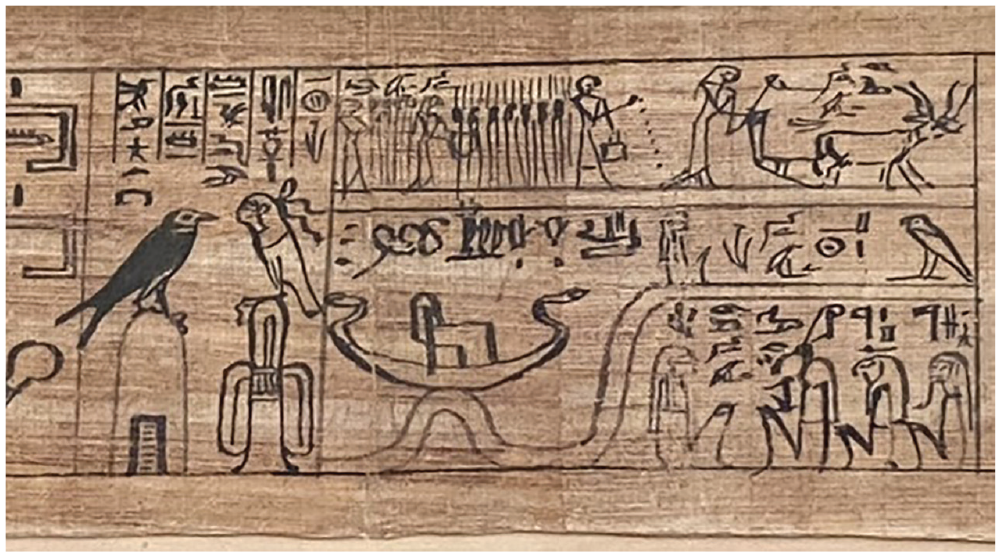
Papyrus of of Djedmutiwesankh, detail including vignettes of Chapter 86, SR VII/10223 (photo: Abir Enany).
In an attempt to interpret the representation of two swallows on two neighbouring mounds, Niwiński suggested that this is because Chapter 86 was one of the chapters that played an important role in replacing other chapters during the Twenty-First Dynasty. 107 However, I propose a different interpretation to these representations.
The two mounds represented here recall the two mounds of Re ỉȝty that are found in other funerary representations. For instance, in the sixth division of the Book of Caverns, the two mounds signify the two methods of the births of Re, ḫpr and msỉ, 108 interpreted as the god’s manifestation and his physical birth respectively. 109 In addition to being a symbol of creation, the two mounds represent the two horizons, an association that further confirms their connection to rebirth. 110 The two mounds ỉȝty were also associated with subterranean divinities that were believed to cause inundation. 111
As for the representation of Isis and Nephthys as two swallows, it has a precedent in the representation of the two goddesses as birds flanking the mound containing the body of Osiris in the fifth hour of the Amduat. I know of at least one occasion where the two goddesses were featured as swallows, namely in the tomb of Ramses VI. 112 Even though the birds are not named, they both have pointy tails and a horizontal posture similar to that of a swallow, as well as traces of a dark colour on the back of the body and a light colour on the front. In addition, Plutarch mentions in his account that Isis took the form of a swallow during her search for Osiris. 113 It is worth mentioning that the representations of the fifth hour of the Amduat are extremely rare as the papyri of the Twenty-First Dynasty mostly included the hours from the ninth to the twelfth, 114 with only very few examples of abridged forms of the complete book. 115
According to the aforementioned proposition, the vignettes here presented would serve a multitude of meanings, signifying Chapter 86 of the Book of the Dead where the deceased wishes to be transformed into a swallow, symbolizing the two mounds of the births of Re, and receiving the magical protection of Isis and Nephthys as they protect the mound containing the body of Osiris represented in the fifth hour of the Amduat. 116 It is therefore plausible to consider that the Egyptian artist combined three religious representations in one, one from the Book of the Dead, one from the Book of Caverns and a third from the Amduat. Combining figures and vignettes of different funerary compositions in the same papyrus was not an unusual practice during this period. 117 This hypothesis remains in accordance with the rule of pars pro toto and with the term ‘Mythological Papyri’ discussed earlier.
The idea of transforming into a swallow matches the Egyptian perceptions of the nature of death, which they conceptualized as ‘a perpetual movement of changing forms’. 118 It is apparent that the swallow carries diverse symbolism. It is associated with the god Re, the goddess Isis – and subsequently with Nephthys – and with the ba of the deceased. These symbolic aspects of the bird are in some way interrelated. In its association with Re, the swallow represents the rising aspect of the god, 119 thus relating to rebirth. Similarly, the association of the bird with Isis resonates with the role of the goddess in the resurrection of Osiris.
The Swallow on the Solar Bark Prow
New Kingdom scenes of the swallow on the prow of the solar bark are found in a variety of religious compositions. Chapter 15 of the Book of the Dead, which has a hymn to Re at his rising to help the deceased Osiris unite with the god in Maat, occasionally includes a vignette with a swallow on the prow of the solar boat accompanying the text glorifying the morning light and Re at sunrise. 120 Similarly, a vignette of Chapter 17 of the Book of the Dead has occasional depictions of the solar bark with a swallow on its prow, 121 a similar representation of which is found on the east wall of the tomb of Sennedjem. 122 In the tomb of Ramses VI the swallow is represented on the prow of the morning solar boat in the representations of the Book of Aker, 123 in the representations of the Book of the Day on the ceiling of the tomb, 124 and again in a scene of the resurrection of Osiris in the same tomb. 125
In these scenes, the swallow is standing on the prow of the mʿnḏt morning solar boat 126 that takes the form of a box 127 covered in a reed mat. This mat has been a subject of discussion by several scholars. Scenes and models of the prow reflect that it was made of reeds, or beads imitating the reeds, likely to represent the protective fender of the boat. 128 Those reed species have been identified as Phragmites communis, a marsh plant that was, and still is, abundant in Egypt and was likely related to Lower Egypt. 129 The correlation of the swallow and this species of reed is seen in a royal bead garment known as the ‘Lower Egyptian costume’ that was related to hunting and to the defeat of enemies. 130 The association of the garment to Lower Egypt is known from the time of Narmer who is represented wearing it together with the Red Crown while holding his mace in his victorious march over the Lower Egyptian enemies. 131
The swallow in this type of costume is represented perched with a sun disk on its back thus representing an amulet called sjȝt. 132 The amulet, which was solely made in red carnelian, 133 reflects the association of both the garment and the swallow to the god Re and offers an interpretation for the use of this particular reed on the prow of the solar boat. Details of the aforementioned reed may be observed in a number of illustrations. 134 As a result of being a migratory bird, the swallow was connected to the north in ancient Egyptian texts, 135 a connection that is echoed in this dress. Thus, the swallow location on the reed mat of the prow of the solar boat reflects its connection to the sun god and to the north, a cardinal point that has been linked to the solar ascent. 136
The New Kingdom representations of the swallow on the prow of the solar boat would continue to be represented in the papyri of the Twenty-First Dynasty, but, like other depictions, would follow new approaches. As discussed above, the funerary representations of this period did not strictly follow the earlier funerary themes of each papyrus, an innovation that led to the designation of the papyri as ‘Mythological Papyri’. Furthermore, within the papyri, the motifs underwent further changes and became used within new funerary compositions with variations of added or omitted details. Therefore, when discussing the representations of the solar boat with a swallow on its prow, I will use the term ‘Cosmographic Scenes’ that was suggested by Marissa Stevens and the classifications that she identified in the papyri of the Twenty-First Dynasty. 137 Stevens identified 46 unique representations that she labelled Cosmographic Scenes (CS), each of which appeared in at least one papyrus. However, one notices that the same Cosmographic Scene was illustrated with variations in different papyri.
In light of the above, the depictions of the morning solar boat are found in diverse funerary compositions of the papyri of the Twenty-First Dynasty. Within the seven papyri 138 in the current corpus that include the motif of the solar boat with a swallow on the prow, three papyri have the motif classified as CS 3 and one has it as CS 5. Additionally, it is found in one example as a detail of the Book of Aker, in another as a detail of Chapter 17 of the Book of the Dead, and in one more as a detail from the twelfth division of the Book of the Gates.
Within the same class of Cosmographic Scenes, one can recognize variant depictions, such as in the motif classified as CS 3 represented on three papyri from the corpus, none of which are identical. The three papyri are the papyri of Her-Uben B 139 (fig. 22), Dirpu 140 (fig. 23), and Djehutimes (fig. 24). 141
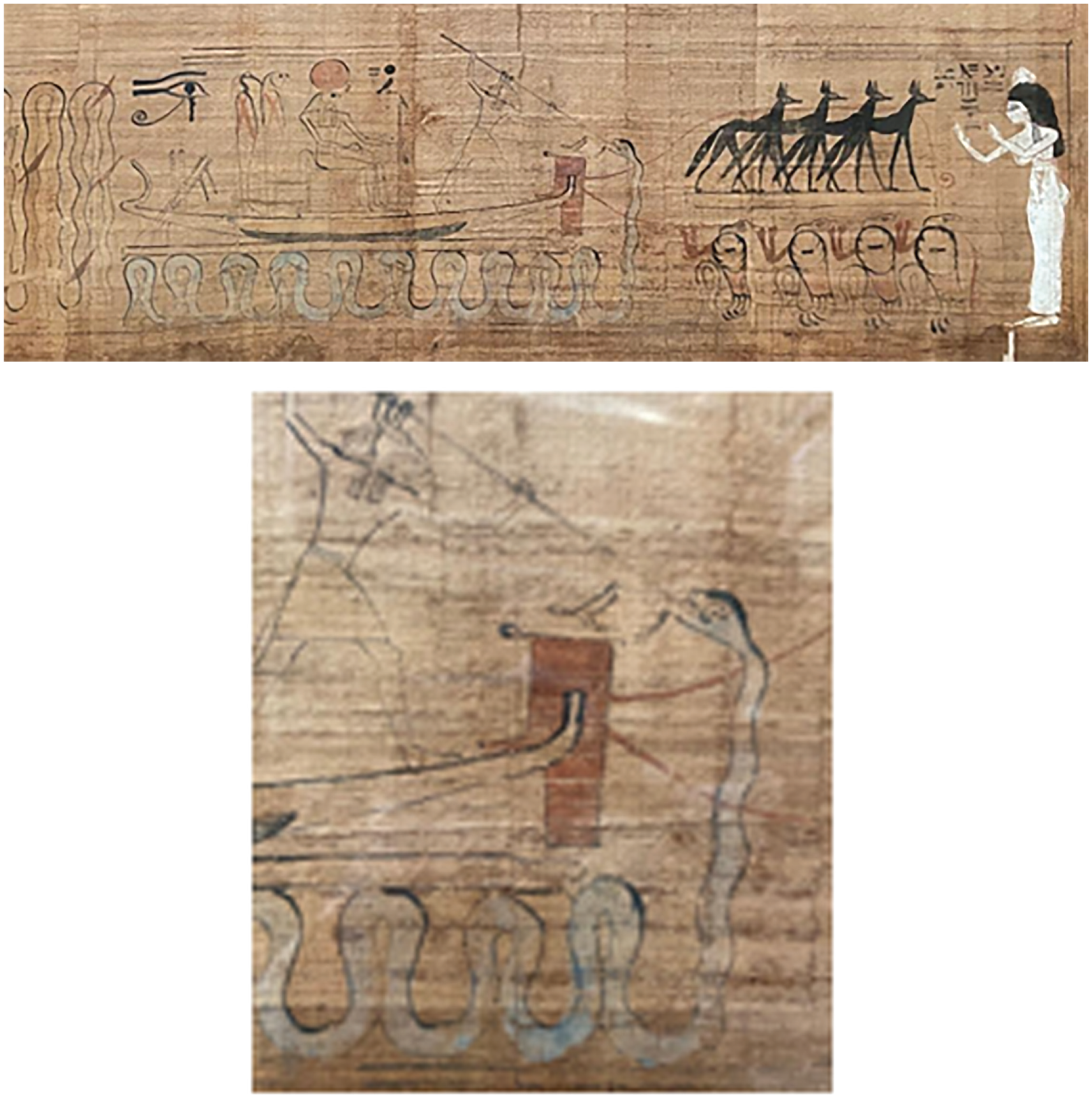
Papyrus of Her-Uben-B, swallow on the prow of the solar boat, SR VII/10254 = JE 31986 (photo: Abir Enany).
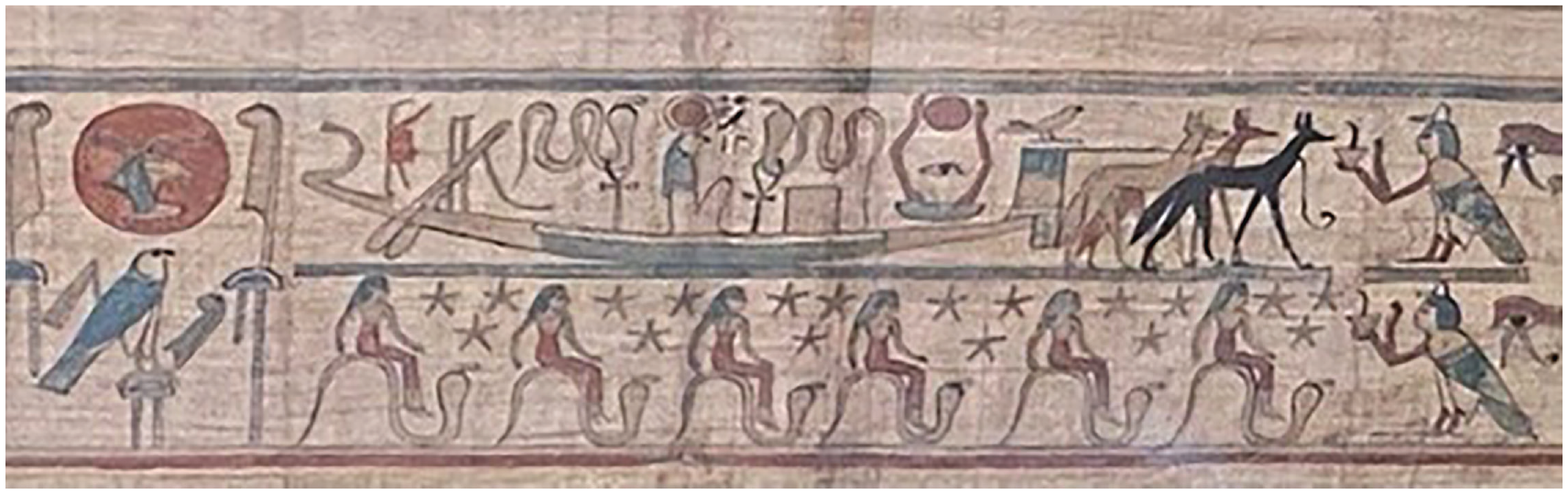
Papyrus of Dirpu, swallow on the prow of the solar boat, SR VII/10257 (photo: Abir Enany).
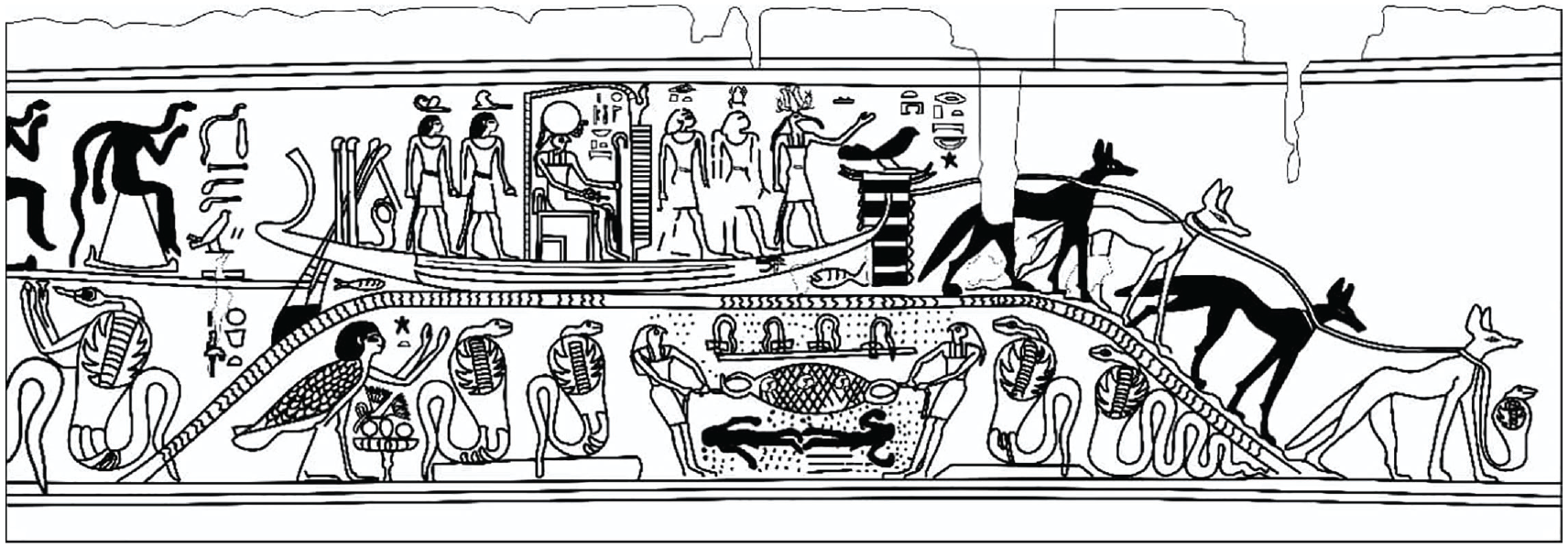
Papyrus of Djehutimes, swallow on the prow of the solar boat, Museo Egizio Turin, 1781 (drawing: Iman Elsaid).
The solar boat in the three papyri has a figure of the god Re in the centre, depicted as a falcon-headed man seated on a throne in the first, as a falcon-headed god figure in the second, and as a falcon-headed man seated on a throne within a shrine in the third. Additionally, the companions of Re differ in the three papyri. While in the papyrus of Her-Uben B the god Seth stands to the front of the boat spearing a long serpent that is attempting to attack the solar boat with the two mummiform figures of Horus and Thoth standing behind Re, the companions of Re in the papyrus of Dirpu are two cobras flanking him with ʿnḫ-signs dangling from their necks. In the papyrus of Djehutimes there are three gods, Thoth, Kheper, and the Eye of Re as a male divinity in front of the shrine of Re with two more divinities behind the shrine.
The papyri also differ in the composition drawn under the line of the sky. In the papyrus of Her-Uben B, it is the long serpent being speared by Seth, while in the papyrus of Dirpu a row of six other cobras is found under the line of the sky acting as seats for six goddesses. This lower row bears a strong resemblance to the representations of the twelfth division of the Book of the Gates, 142 where eight goddesses are represented sitting above serpents. The text accompanying such representations in the tomb of Ramses VI reveals that with their serpents under them and their stars on their arms, the goddesses, who represent the morning, come from the ‘two chapels’. These chapels are referring to the sanctuaries of the north and the south, and, according to the text, the goddesses call the spirits of the east, adore the sun god as he comes out from the east, and guide the crew of the solar boat. 143 As for the papyrus of Djhutimes, the line of the sky consists of a vaulted narrow strip of water with another Cosmographic Scene below, namely CS 40, that has two hawk-headed gods twisting a net containing severed human heads in what resembles wine pressing scenes. 144
In all three examples, the solar boat is being towed by three or four jackals, a detail that resonates with the scenes of the Book of Day, wherein four jackals represent the four bas who worship Re as he rises on the eastern horizon. 145 However, they differ in number and colour. While there are four completely black jackals in the first papyrus, there are three of different colours in the second, one black, one red, and one yellow, and there are four in the third, two black and two white.
The motif of the solar boat with the swallow on its prow is also represented in the papyrus of Khonsureneb (fig. 25). 146 Here it is classified as from the Book of Aker 147 due to its resemblance to a detail of the Book of Aker, wherein a figure of the double lion-headed god Aker is carrying a solar boat while a sun-disc with a falcon head is emerging downwards over a mummified figure. 148 Despite the similarities between the two scenes, there are several points of discrepancy. In the scene in the tomb of Ramses VI, the solar boat is not provided with a prow box and thus the swallow detail is missing. In addition, in the papyrus of Khonsureneb, instead of the double Aker, the boat is above the line of the sky resting on the sky sign pt and the mummified figure is laying under the line of the sky from which a protruding falcon head is sending rays to the mummy. Another difference is that instead of the four Osiris figures in the tomb of Ramses VI, in the papyrus of Khonsureneb there are four other divinities, namely Isis and Wadjet to the right, and Nephthys and Nekhbet to the left of the mummified figure.
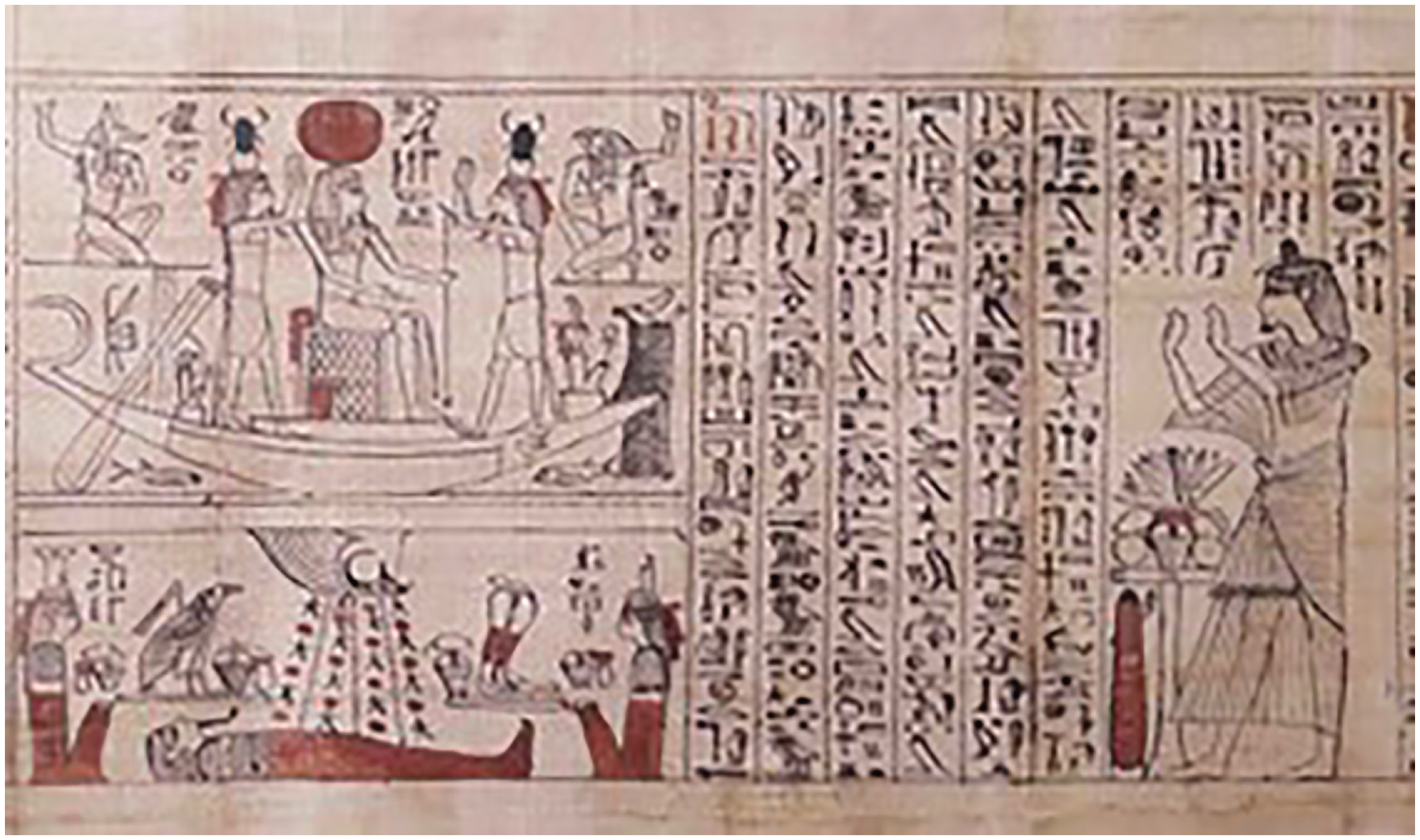
Papyrus of Khonsureneb, swallow on the prow of the solar boat, SR VII/11501 (photo: Abir Enany).
In addition to variations within the same class of Cosmographic Scenes, one finds similar details shared by different types of scenes. Although there is no apparent water under the solar boat in the papyrus of Khonsureneb, it is implied with the two fish represented under the boat looking inward near the prow and stern. The same detail is found under the solar boat in the papyrus of Djhutimes, even though the latter represents a CS 3 representation while the former is a detail of the Book of Aker.
The next almost unique representation of a solar boat with a swallow perched on its prow is the papyrus of Nesipakashunty (fig. 26). 149 In this papyrus, the solar boat motif is embedded in CS 5 that represents the sky goddess Nut as a vault over the earth god Geb. To my knowledge, none of the other specimens that include CS 5 had this unique combination. 150 However, this combination of details recalls earlier representations of the goddess Nut in the religious composition known as the Book of the Heavenly Cow where the morning and the evening solar boats are represented on the body towards the fore and hind legs of the goddess. 151 In the papyrus studied here, the god Re takes the posture of a seated divinity with the sign of Maat in his hand facing another seated divinity with the sign of Maat on her head. Behind Re, and partly attached to the rudder, there is a cobra goddess wearing the crown of Upper Egypt. Underneath the line of the sky lies a nude figure of the god Geb.
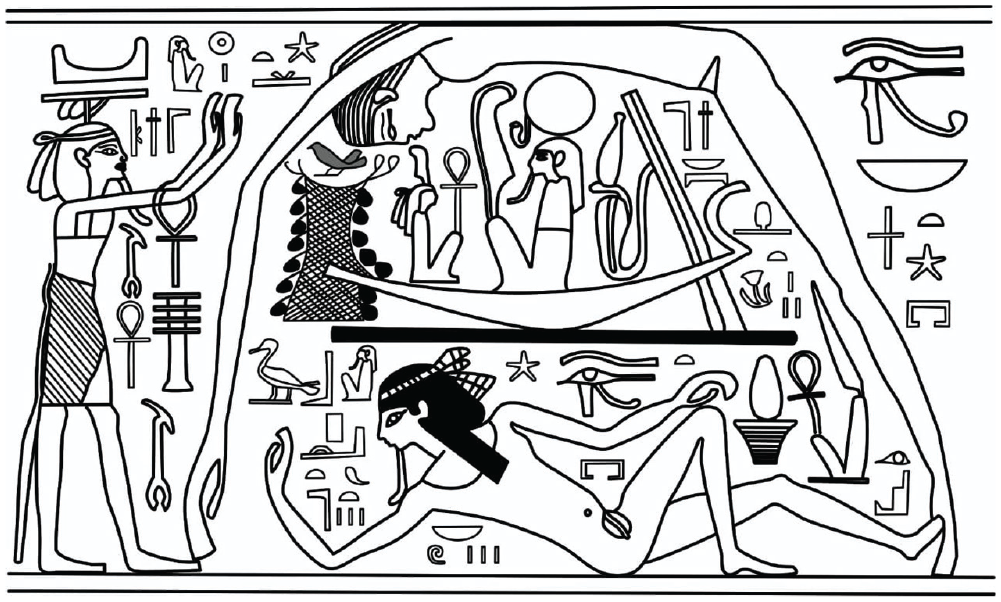
Papyrus of Nesipakashunty, swallow on the prow of the solar boat, Musée du Louvre, E.17401 (drawing: Iman Elsaid).
Another depiction of the motif of the solar boat with the swallow on the prow is from the papyrus of Nesitanebashru 152 (fig. 27). It is represented as a detail within the freeze containing Chapter 17 of the Book of the Dead. The motif here is simple, with the god Re represented as a scarab-headed deity alone in the boat. In front of the boat, the goddess Isis is standing facing the swallow while behind the boat two baboons are represented in adoration.
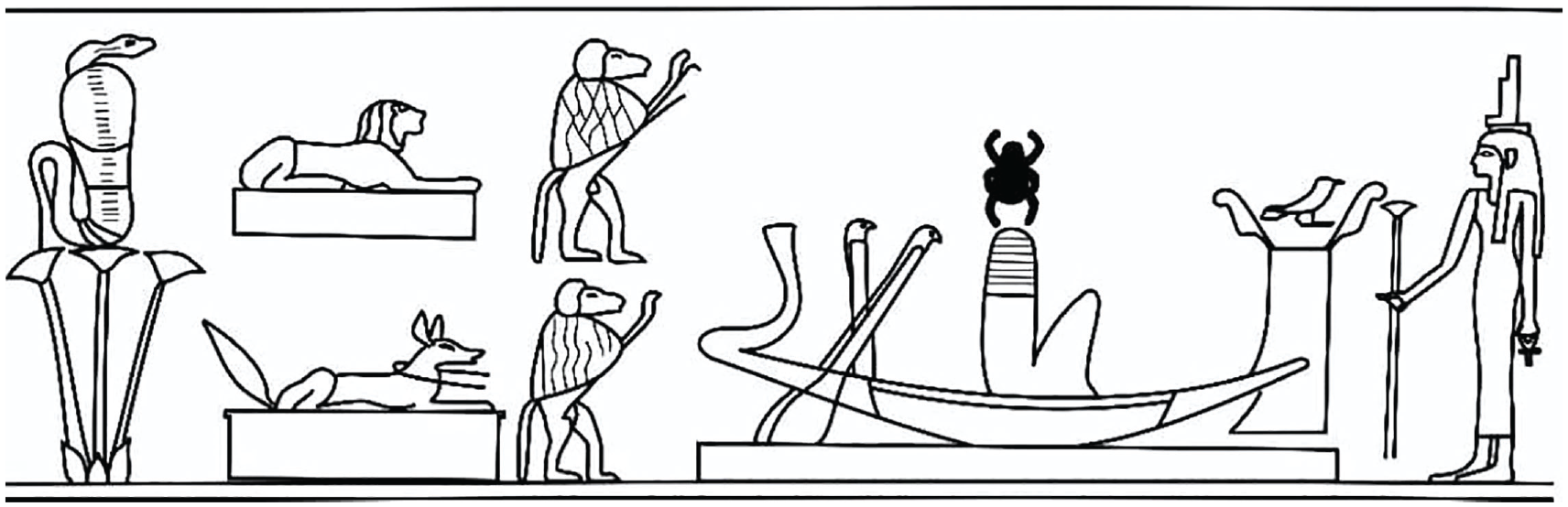
Papyrus of Nesitanebashru, swallow on the prow of the solar boat, BM 10554 (drawing: Iman Elsaid).
The final example of the motif of the solar boat with the swallow on the mat prow also comes from the papyrus of Nesitanebashru and represents a detail of the twelfth division of the Book of the Gates 153 (fig. 28). In this depiction, the solar boat is represented on the sky sign that is supported by four gods representing the four Sons of Horus. The boat is towed by three male deities and three ram-headed ones. 154 The god inside the central shrine of the boat is Amun-Re in his form as a ram-headed god. The companions of Amun-Re in the boat are of a more functional significance; a goddess near the prow just behind the swallow inspects the conditions of the region ahead of the boat and reports them the deity behind her, who in turn informs the god by the rudder. 155
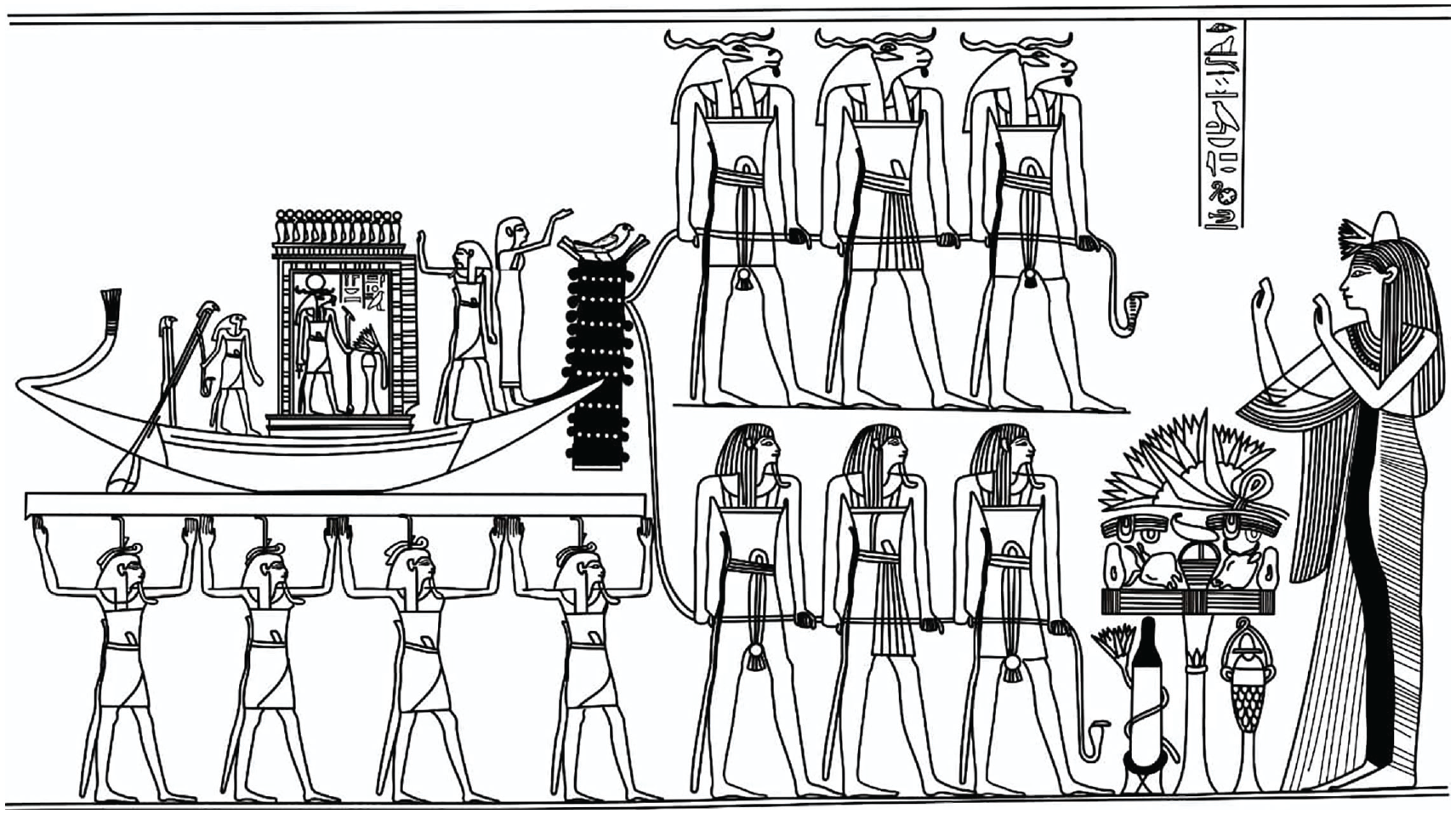
Papyrus of Nesitanebashru, swallow on the prow of the solar boat, BM 10554 (drawing: Iman Elsaid).
The Geographical Orientation of the Papyri with the Swallow
The depictions of the swallow in the funerary papyri of the Twenty-First Dynasty take the same direction that they took during the New Kingdom (figs 29–31), even though the direction of the papyri is different. During the New Kingdom, the flow of the papyri started from the left and continued to the right with the vignettes facing right. This flow was switched during the Twenty-First Dynasty when the papyri began to start from the right. 156 One would expect the vignettes to switch their direction towards the left. However, that is not the case. The vignettes maintained their traditional view of looking towards the right of the papyri. In all the representations of Chapter 86 here discussed, the direction of the swallow is always looking to the right from the reader’s position. The same alignment is observed in the specimens of the solar boat with the swallow on the prow, where the bird is looking to the right side of the papyrus in all but one specimen, an alignment that matches earlier representations of the sun boat that is usually depicted heading towards the right. 157
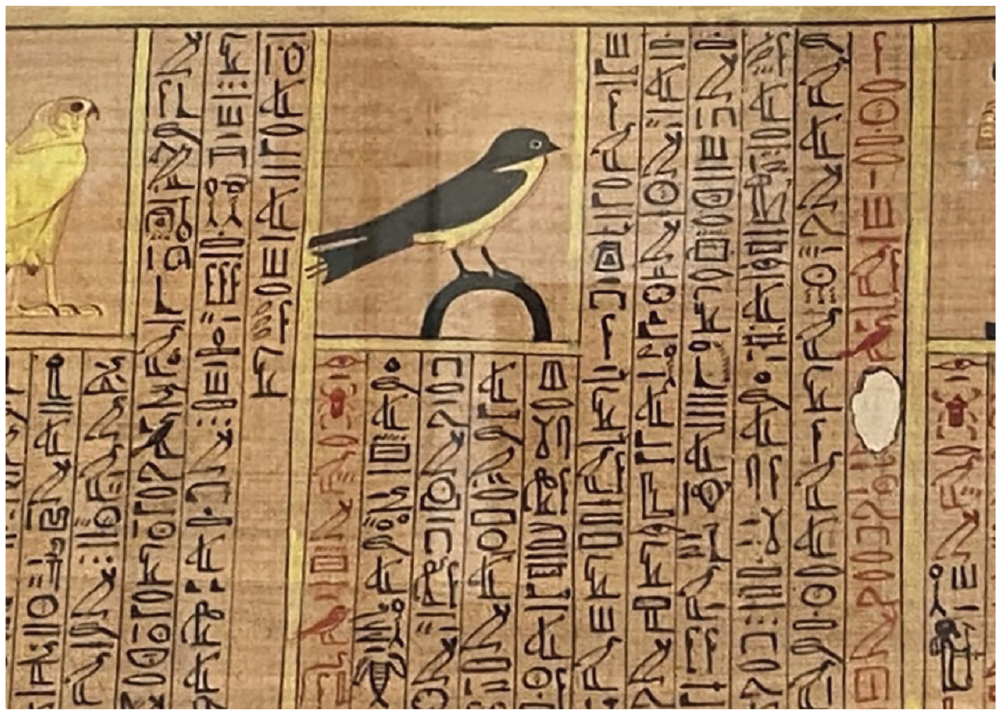
Papyrus of Yuya, detail including vignettes of Chapter 86, CGC 51189 (photo: Abir Enany).
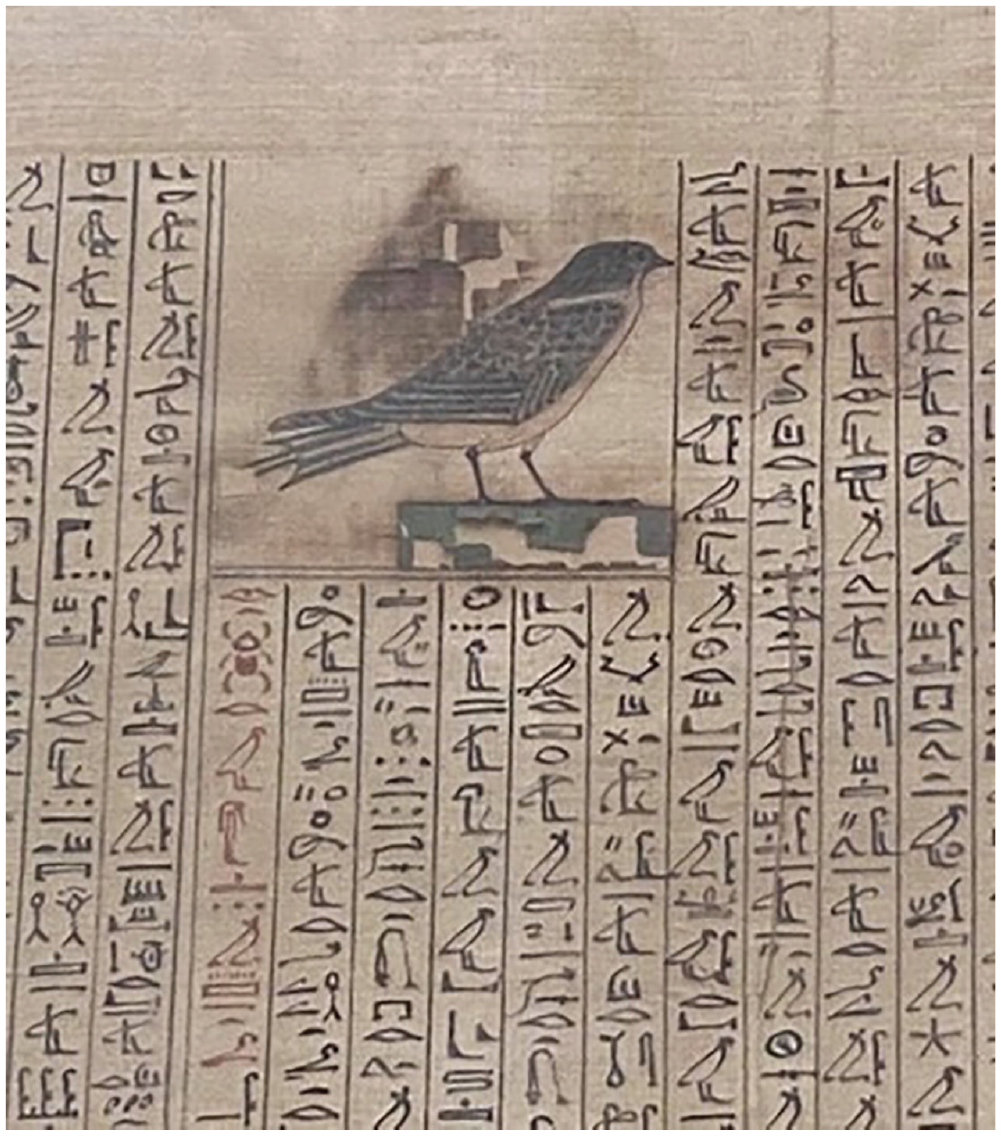
Papyrus of Maiherpri, detail including vignettes of Chapter 86, CGC 24095 (photo: Abir Enany).
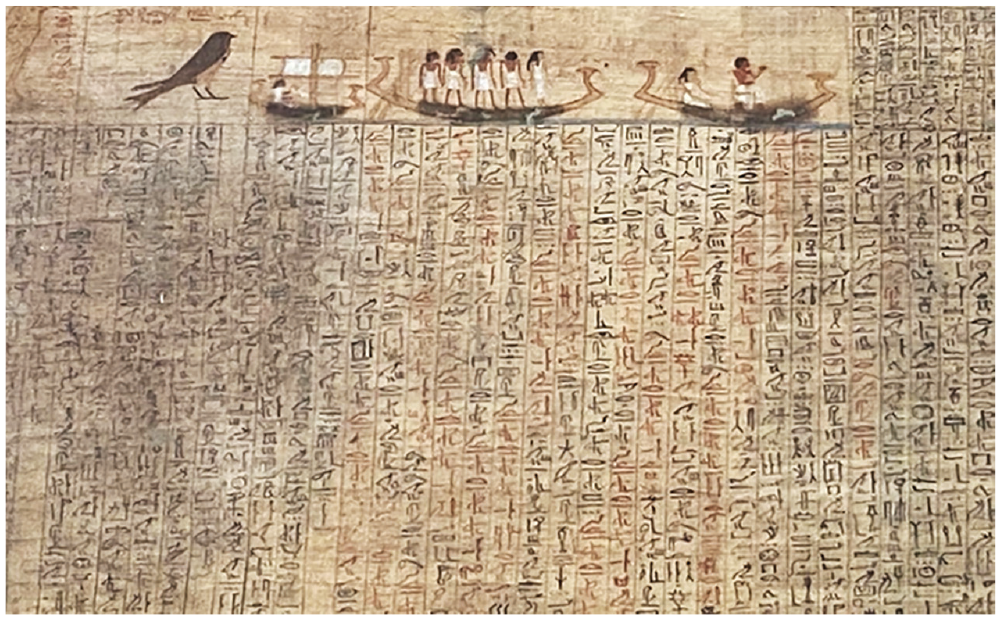
Papyrus of Senhotep, detail including vignettes of Chapter 86, JE 95652/CGC 40004 (photo: Abir Enany).
As the same alignment was likewise observed in other vignettes, it was suggested that the scribes of the Twenty-First Dynasty used the same alignment of the earlier religious composition to be in keeping with traditions. 158 However, I believe that there is further significance for this.
A repeated pattern that may be observed in the corpus is that there are scenes related to the west behind the boat towards the left. For instance, in the papyrus of Dirpu, behind the representations of the solar boat is a representation of a falcon on the sign of the west flanked with two other signs of the west. Above the falcon’s head is a sun disc with a ram head within. In addition to this combination, there are goddesses representing the east under the solar boat, who are similarly facing towards the right of the papyrus (fig. 23).
As for the papyrus of Djhutimes, behind the solar bark scene there are cobra goddesses depicted adoring the ba of Re with the accompanying text indicating that they represent the west 159 (fig. 24). The same orientation may be observed in the papyrus of Her-Uben B (fig. 22), where the boat is represented heading to the right while the texts and representations to the left of the papyrus are related to the entry of the deceased through a gate leading to the western realm of Osiris. 160
In the papyrus of Khonsureneb, there is considerable emphasis on the directions. In the upper section there are two figures representing the souls of Nekhen and Pe, representing the shrines of the south and the north, also associated with the sun setting and rising, respectively. 161 In the lower part of the representation under the line of the sky, the goddesses Isis and Nephthys are flanking the mummy with Wadjet and Nekhbet in front of them. Here, Isis as a symbol of the solar ascent is paired with Wadjet as a symbol of the north, while Nephthys is paired with Nekhbet as symbols of the solar descent and the south, respectively. 162 The direction of the solar boat is once again towards the right of the papyrus, evidently heading east (fig. 25).
The association of the goddess Isis with the east and sunrise and that of Nephthys with west and sunset is not an unusual one. 163 In the scenes of the Book of the Day from the tomb of Ramses VI, the goddess Isis is represented in the morning boat, evidently linked to the east, while Nephthys is represented in the evening boat. 164 The association of Isis with the east is again used in the Papyrus of Nesitanebashru 165 (fig. 27), where she stands facing the swallow on the prow of the solar boat as it heads to the right, or the east. Behind the boat in this specimen, instead of depictions related to the west, a figure of the goddess Wedjat of Lower Egypt is represented perched on three papyrus plants, both being symbols of the North. Here, the symbols of the North bring to mind the scene of the tomb of Sennedjem mentioned above, where the pr-nw shrine of P is placed behind Re in the solar boat that has a swallow on its prow. 166 The correlation between the swallow and the goddess of Lower Egypt is logical considering that as a migratory bird the swallow was seen as a northern symbol.
This rightwards orientation of the swallow is likewise maintained in the papyri of aforementioned category S5, which contains depictions of the double mounds. While the mound to the right represented Isis, or east, the one on the left represented Nephthys, or west (figs 18, 19, and 21).
These representations give indications to the destination of the swallow, evidently towards the east. A representation in the papyrus of Tawdjatre reinforces this concept, where the swallow on the mound is facing the sign of the east 167 in an attempt to emphasize the relationship of the swallow with the east, and likewise with the sunrise (fig. 5b).
Although this orientation might seem contrary to the ancient Egyptian identification of the east ỉȝbt with the left and of the west ỉmnt with the right, 168 it must be noted that this identification is bound to the standpoint of the viewer as the ancient Egyptians were looking south by default, equating the east with the left and the west with the right. 169
In 23 of the 24 examples examined here, the swallow is looking to the right side of the papyrus, with only one exception being the papyrus of Nesipakashunty where the boat and the bird look towards the left (fig. 26).
Accordingly, I believe that the papyri here studied have a tendency to reflect geographical orientations towards the east. The eastward orientation of the swallow is comprehensible in light of the role that it is typically associated with, namely that of a messenger, 170 and a reporter. From the top of the Mound of Creation as well as from the prow of the solar boat, the bird reports the arrival of the sun and light to the world, 171 thus emphasizing the daily and eternal creation of the universe. Furthermore, from its stance on the prow of the solar boat, the swallow has a wide vision of areas ahead of the solar boat, and with its twittering, has the ability to report to the rest of the crew of the solar boat thus ensure a safe voyage to the sun god. This role of the swallow as a reporter and a messenger, is a crucial factor in the desire of the Egyptian deceased to be associated with the swallow. 172
Concluding Comments
The changes that took place in religious representations and the relatively small size of the papyri of the Twenty-First Dynasty gave supremacy to the vignette over the written text, creating an array of novel depictions of the barn swallow. Those depictions reflect a mixture of symbolism related to the swallow, whether represented as the vignette of Chapter 86 of the Book of the Dead or perched on the prow of the morning solar boat.
There is an apparent geographical context for the depictions of the swallow in the representations here studied. The majority of the scenes indicate that the swallow is heading eastwards, both when it rides in the morning solar boat and when it is represented on a mound.
The swallow, which was strongly associated with the sun god Re in his sunrise, was also corelated to other symbols and divinities. It was linked to the goddess Isis in her role as a symbol of the east, as well as her role in fetching the body of Osiris. Being a migratory bird that travels to Egypt from northern territories, the bird was also associated with the north. The connection of the bird with the sunrise led to its association with resurrection, consequently relating the swallow to the ba-bird of the deceased. In its capacity as an excellent flyer related to Re, the swallow acquired the function of the messenger and reporter of the sun god which made the bird a favoured symbol with which the deceased wishes to be identified. Furthermore, the association of the deceased with the swallow would ensure that the deceased are able to renew daily and to endure forever, just like the sun god.
Footnotes
Acknowledgements
I would like to express my gratitude to Dr. Marwa Abdel Razek, Head of the Registration Collection Management and Documentation Department in the Egyptian Museum in Cairo, for her help during my journey with the Twenty-First Dynasty Papyri.
Funding
The author did not receive funding for this project.
1.
J. Cooper and L. Evans, ‘Transforming into a swallow: Coffin Text Spell 294 and avian behaviour’, ZÄS 142:1 (2015), 12.
2.
C. Brown and M. B. Brown, ‘Barn swallow’, Birds of North America 452, (1999), 4–5.
3.
H. te Velde, ‘The swallow as herald of the dawn in ancient Egypt’, in J. Bergman, K. Drynjeff, and H. Ringgren (eds), Ex Orbe Religionum: Studia Geo Widengren, XXIV mense apr. MCMLXXII quo die lustra tredecim feliciter explevit oblata ab collegis, discipulis, amicis, collegae magistro amico congratulantibus, 1 (Leiden, 1972), 31, n. 3.
4.
Cooper and Evans, ZÄS 142:1, 19, 21.
5.
P. F. Houlihan, The Birds of Ancient Egypt (Cairo, 1988), 122–4; F. Servajean, ‘À propos d’une hirondelle et de quelques chats à Deir al-Médîna’, BIFAO 102 (2002), 122; Cooper and Evans, ZÄS 142:1, 18.
6.
Swallow photographs from www.shutterstock.com. Fig. 1 <https://www.shutterstock.com/image-photo/barn-swallow-collects-nest-building-material-1751926136> accessed 11.12.2020; fig. 2 <https://www.shutterstock.com/image-photo/portrait-flying-barn-swallow-rustica-hirundo-1740607679> accessed 11.12.2020; fig. 3 <https://www.shutterstock.com/image-photo/barn-swallow-perched-on-his-nest-168992813> accessed 11.12.2020; fig. 4 < > accessed 11.12.2020.
7.
K. P. Foster, ‘A flight of swallows’, AJA 99:3 (1995), 411.
8.
Cooper and Evans, ZÄS 142:1, 18.
9.
Brown and Brown, Birds of North America 452, 1999, 1.
10.
Cooper and Evans, ZÄS 142:1, 20–1.
11.
te Velde, in Bergman, et al. (eds), Ex Orbe Religionum, 30 n. 3.
12.
Wb., II, 68, 2–4; Wb.: Die Belegstellen, II, 100–1; R. O. Faulkner, A Concise Dictionary of Middle Egyptian (Oxford, 1972), 107; R. Wassermann, ‘Schwalbe’, LÄ V (1984), 754–5; Houlihan, Birds, 122–4; Servajean, BIFAO 102, 353, 362; Cooper and Evans, ZÄS 142:1, 14–15.
13.
A. Gardiner, Egyptian Grammar (Oxford, 1979), 471.
14.
G. Maspero, ‘Notes sur quelques points de grammaire et d’histoire’, Recherches et Travaux II (1880), 108; Wb. Die Belegstellen II, 100; A. Piankoff, Mythological Papyri, I: Texts (Egyptian Religious Texts and Representations 3, Bollingen Series XL/3; New York, 1957), 5, n. 15; Servajean, BIFAO 102, 353–4.
15.
B. Bruyère, Rapport sur les fouilles de Deir el Médineh (1935-1940) (FIFAO 20:3; Cairo, 1952), 106.
16.
J. P. Allen, The Ancient Egyptian Pyramid Texts (WAW 23; Atlanta, 2005), 152.
17.
Allen, Pyramid Texts, 161; Cooper and Evans, ZÄS 142:1, 12.
18.
Coffin: Sq6C, see: A. De Buck, The Egyptian Coffin Texts, IV (Illinois, 1951), 33; R. O. Faulkner, The Ancient Egyptian Coffin Texts, I (Bath, 1973), 212–13.
19.
te Velde, in Bergman, et al. (eds), Ex Orbe Religionum, 30.
20.
Coffin B1C, see De Buck, Coffin Texts, IV, 46, Spell 294, h–i; Faulkner, Coffin Texts, I, 219; Servajean, BIFAO 102, 354–5. The gold is specified in the text as nbw n(.y) iww, which has been suggested to be a rust-red gold: Cooper and Evans, ZÄS 142:1, 14, 18.
21.
Faulkner, Coffin Texts, I, 219; Cooper and Evans, ZÄS 142:1, 14–5, 18.
22.
W. K. Simpson (ed.), The Literature of Ancient Egypt: An Anthology of Stories, Stelae, Autobiographies, and Poetry (3rd edn; New Haven, 2003), 290.
23.
Cooper and Evans, ZÄS 142:1, 18.
24.
te Velde, in Bergman, et al. (eds), Ex Orbe Religionum, 27.
25.
Simpson, Literature, 494–6.
26.
te Velde, in Bergman, et al. (eds), Ex Orbe Religionum, 28–9; Cooper and Evans, ZÄS 142:1, 13.
27.
A. Niwiński, Studies on the Illustrated Theban Funerary Papyri of the 11th and 10th Centuries B.C. (OBO 86; Fribourg, 1989), 35.
28.
Niwiński, Papyri, 30.
29.
Niwiński, Papyri, 33–4.
30.
With some exceptions such as in the case of Hatnefer, the mother of Senenmut, who had two papyri: Niwiński, Papyri, 5.
31.
W. C. Hayes, ‘The Egyptian expedition 1934–1935: The Tomb of Nefer-khewet and his family’, BMMA 30, No. 11:2 (1935), 26; C. Aldred, ‘The funerary papyrus of Woseramūn’, JEA 36 (1950), 112; Niwiński, Papyri, 4–7; N. Reeves, ‘Amenhotep, overseer of builders of Amun: An Eighteenth-Dynasty burial reassembled’, MMJ 48 (2013), 24; R. Sousa, Gilded Flesh: Coffins and Afterlife in Ancient Egypt (Oxford, 2019), 61, 77.
32.
Niwiński, Papyri, 4, table XVa.
33.
Niwiński, Papyri, 37–8.
34.
A. Enany, ‘Three papyrus sheaths of Priestesses of Amun’, JEA 107 (2021), 159–75.
35.
Piankoff and Rambova, Mythological Papyri, I, 3; Niwiński, Papyri, 133.
36.
Niwiński, Papyri, 121. Especially for the papyri of his type BD.III.1.
37.
Niwiński, Papyri, 28.
38.
Niwiński, Papyri, 17.
39.
Niwiński, Papyri, 20–1.
40.
Niwiński, Papyri, 38.
41.
Piankoff and Rambova, Mythological Papyri, I, 20–1.
42.
Piankoff and Rambova, Mythological Papyri, I, 20–1.
43.
Niwiński, Papyri, 111–209.
44.
M. Stevens, Shaping Identities in the Context of Crisis: The Social Self Reflected in 21st Dynasty Funerary Papyri (PhD Thesis, University of California; Los Angeles, 2018), 187–200.
45.
S. Quirke, Going Out in Daylight – prt m hrw: The Ancient Egyptian Book of the Dead, Translation, Sources, Meanings (GHP Egyptology 20; London, 2013), 201.
46.
Quirke, Going Out in Daylight, 202.
47.
P. Le Page Renouf and E. Naville, The Egyptian Book of the Dead: Translation and Commentary (London, 1904), 29, n. 5.
48.
On coffin Sq6C, De Buck, Coffin Texts, IV, 33; Faulkner, Coffin Texts, I, 212–13; Quirke, Going Out in Daylight, 201–2.
49.
On coffin Sq1C, De Buck, Coffin Texts, IV, 33; Faulkner, Coffin Texts, I, 213; Quirke, Going Out in Daylight, 201–2.
50.
De Buck, Coffin Texts, IV, 48, n. 2.
51.
Quirke, Going Out in Daylight, 201–2; Cooper and Evans, ZÄS 142:1, 13.
52.
Quirke, Going Out in Daylight, 179–80; R. Metawi and H. Refai, ‘Illustrative repertoire of the Book of the Dead in mythological papyri of the 21st Dynasty’, Cahiers Caribéens d’Egyptologie 22 (2017), 56.
53.
L. V. Zabkar, A Study of the Ba Concept in Ancient Egyptian Texts (SAOC 34; Chicago, 1968), 156.
54.
R. Lucarelli, ‘Gods, spirits, demons of the Book of the Dead’, in F. Scalf (ed.), Book of the Dead: Becoming God in Ancient Egypt (OIP 39; Chicago, 2017), 127.
55.
Lucarelli, in Scalf (ed.), Book of the Dead, 127.
56.
Quirke, Going Out in Daylight, 179–80.
57.
Cooper and Evans, ZÄS 142:1, 14.
58.
Cooper and Evans, ZÄS 142:1, 14.
59.
Cooper and Evans, ZÄS 142:1, 14.
60.
Niwiński, Papyri, Table Ia and Table Ib; Quirke, Going Out in Daylight, 180.
62.
P. Lacau, Stèles du Nouvel Empire (CGC Nos 34001–34189; Cairo 1926), 1/2, 102; E. Brovarski, ‘Senenu, High Priest of Amun at Deir El-Bahri’, JEA 62 (1976), 59–61.
63.
Bruyère, Rapport Deir el Médineh (1935–1940), 105.
64.
G. Maspero, ‘De quelques cultes et de quelques croyances populaires des Égyptiens, §1 : Le culte de l’hirondelle, de la chatte et de l’oie’, Études de mythologie et d’archéologie égyptiennes, II (Paris, 1893), 395–6; Bruyère, Rapport Deir el Médineh (1935-1940), 106–7.
65.
B. Bruyère, La tombe n° 1 de Sen-Nedjem à Deir el Médineh (MIFAO LXXXVIII; Cairo, 1959), 35, pl. XXVII.
66.
SR VII/11496.
67.
SR VII/10255. The papyrus has been given a new museum number SR VII/19324 and the old one has become SR I/10255. It has now been transferred to the museum of Sharm el Sheikh.
68.
SR IV/955, JE 95856.
69.
TR 23.4.40.1.
70.
BM EA10554: E. A. W. Budge, The Greenfield Papyrus in the British Museum (London, 1912), 24, pl. XXIX.
71.
See for instance papyri of Yuya, CGC 51189, Maiherpri, CGC 24095, and Senhotep, JE 95652 CG 40004, SR 2512.
72.
Piankoff and Rambova, Mythological Papyri, I, 135–7.
73.
Piankoff and Rambova, Mythological Papyri, I, 137.
74.
M. Tarasenko, ‘The vignettes of the Book of the Dead Chapter 17 during the Third Intermediate Period (21st –22nd Dynasties)’, SAK 41 (2012), 382.
75.
M. Stevens, ‘Illustrations of temple rank on 21st Dynasty funerary papyri’, in M. P. Hlouchová, D. Belohoubková, J. Honzl, and V. Nováková (eds), Current Research in Egyptology 2018, Proceedings of the Nineteenth Annual Symposium, Czech Institute of Egyptology, Faculty of Arts, Charles University, Prague, 25–28 June 2018 (Oxford, 2019), 183, 210; Totenbuchprojekt Bonn, TM 134455, <totenbuch.awk.nrw.de/objekt/tm134455> accessed 18.10.2020; Totenbuchprojekt Bonn, TM 134519, <totenbuch.awk.nrw.de/objekt/tm134519> accessed 18.10.2020.
76.
Stevens, CRE 2018, 201.
77.
SRVII/10247 = JE 33999, Niwiński, Papyri, 200–3, Pap. Cairo 84; type A.III.1b pl. 44 c.
78.
SR VII/11494.
79.
SR IV/981 = JE 95879. The owner of this papyrus is a different man than his namesake, the owner of papyrus TR 23.4.40.1, used in this work. I therefore called them Padiamun A and Padiamun B to avoid confusion.
80.
A. Piankoff, Mythological Papyri, II, Plates (Egyptian Religious Texts and Representations 3, Bollingen Series XL/3; New York, 1957), pl. XVI, Kunsthistorisches Museum Vienna 3859 A.
81.
See also: Papyrus British Museum EA10020, Niwiński, Papyri, 121, fig. 12; <> accessed 15.10.2020.
82.
Niwiński, Papyri, 121–2.
83.
Niwiński, Papyri, 25.
84.
SR IV/936 = JE 95838.
85.
JE 26230, transferred to NMEC.
86.
87.
SR IV/980, JE 26229.
88.
Compare, for instance, papyri CGC 51189, CGC 24095, JE 95652/CGC 40004, BM EA10470; EA10471,14; EA10477,10; EA10554.
89.
Niwiński, Papyri, 258.
90.
Niwiński, Papyri, 268.
91.
E. H. Naville, Papurus funéraires de la XXIe Dynastie : Le papyrus hiéroglyphique de Kamara et le papyrus hiératique de Nesikhonsou au Musée du Caire (Paris, 1912), 16, pl. V.
92.
De Buck, Coffin Texts, IV, 23, a–b; te Velde, in Bergman, et al. (eds), Ex Orbe Religionum, 27; Faulkner, Coffin Texts, I, 209.
93.
Wb I, 494.
94.
T. G. Allen, The Egyptian Book of the Dead Documents in the Oriental Institute Museum at the University of Chicago (OIP 82; Chicago, 1960), pls XXVI, XXVII, LXX; Quirke, Going Out in Daylight, 205.
95.
SR VII.10244, J.33997.
96.
SR VII/10240.
97.
SR VII/11506, Piankoff and Rombova, Mythological Papyri, II, pl. XXV.
98.
SR VII/10223, Niwiński, Papyri, Cairo 60, Type: BD.III.1b.
99.
An interesting parallel is found in the unpublished papyrus Cambridge E.92.1904: Totenbuchprojekt Bonn, TM 134405, <totenbuch.awk.nrw.de/objekt/tm134405> <http://totenbuch.awk.nrw.de/objekt/tm134430> accessed 22.09.2020, here two birds are represented, one on a mound and the other on the headless body of the deceased, see Niwiński, Papyri, 137, .
100.
te Velde, in Bergman, et al. (eds), Ex Orbe Religionum, 28.
101.
E. Hornung, Das Totenbuch der Ägypter (München, 1974), 175, fig. 45.
102.
For instance: EA10470,33; Zabkar, Ba Concept, pl. 3.
103.
SR VII/10223.
104.
L. V. Zabkar, ‘Correlation of the transformation spells of the Book of the Dead and the amulets of Tutankhamun’s mummy’, in F. Geus and F. Thill (eds), Mélanges offerts à Jean Vercoutter (Paris, 1985), 382–3.
105.
106.
107.
Niwiński, Papyri, 137.
108.
109.
C. Manassa, The Late Egyptian Underworld: Sarcophagi and Related Texts from the Nectanebid Period, (Wiesbaden, 2007), 383; J. C. Darnell, The Enigmatic Netherworld Books of the Solar-Osirian Unity: Cryptographic Compositions in the Tombs of Tutankhamun, Ramesses VI and Ramesses IX (OBO 198; Fribourg, 2004) 345.
110.
Manassa, The Late Egyptian Underworld, 384; Hornung, MDAIK 37, 223.
111.
E. Drioton, ‘Les origines pharaoniques du Nilomètre de Rodah’, BIE XXXIX (1953), 302, 307.
112.
Piankoff, Ramses VI, pls 84, 86.
113.
114.
Niwiński, Papyri, 175, 185.
115.
Niwiński, Papyri, 188.
116.
E. Hornung, The Egyptian Amduat (trans. by D. Warburton; Zurich, 2007), 148.
117.
Niwiński, Papyri, 129, 149–50, 161, 188–9, 192.
118.
Piankoff and Rambova, Mythological Papyri, I, 4.
119.
D. Craig Patch, ‘A “Lower Egyptian” costume: Its origin, development, and meaning’, JARCE 32 (1995), 113.
120.
Renouf and Naville, Book of the Dead, 22–5, pl. 10. This chapter, which is a collection of hymns to the rising and the setting sun, is debatable in its classification as a BD chapter and is sometimes classified as a solar litany: Niwiński, Papyri, 25, n. 74, and 94–5; Quirke, Going Out in Daylight, 33.
121.
R. O. Faulkner, The Egyptian Book of the Dead: The Book of Going Forth by Day (San Francisco, 1998), pl. 10.
122.
Bruyère, Sen-Nedjem, 35, pl. XXVII.
123.
Piankoff, Ramses VI, I, 344–5, fig. 101; II, pls 113, 118.
124.
Piankoff, Ramses VI, I, 390, fig. 130, 133; II, pl. 149.
125.
Piankoff, Ramses VI, I, 438–9, fig. 142; II, pls 183–4.
126.
Craig Patch, JARCE 32, 110.
127.
G. A. Reisner, Models of Ships and Boats (CGC Nos 4798–4976, 5034–5200; Cairo, 1913), 102, 107, 108.
128.
129.
Thomas, JEA 45, 46–8; Craig Patch, JARCE 32, 111.
130.
Craig Patch, JARCE 32, 94–116.
131.
Craig Patch, JARCE 32, 94–110.
132.
Craig Patch, JARCE 32, 101.
133.
Zabkar, in Geus and Thill (eds), Mélanges offerts à Jean Vercoutter, 381; B. R. Hellinckx, ‘Tutankhamun’s carnelian swallow with sun disc: Part of a garment?’, JEA 83 (1997), 110.
134.
135.
J. Černý, ‘Reference to blood brotherhood among Semites in an Egyptian text of the Ramesside Period’, JNES 14:3 (1955), 161–3; te Velde, in Bergman, et al. (eds), Ex Orbe Religionum, 30.
136.
M. J. Raven, ‘Egyptian concepts on the orientation of the human body’, JEA 91 (2005), 39.
137.
Stevens, Shaping Identities, 187–200; Stevens, CRE 2018, 162–228.
138.
Papyrus of Her-Uben B SR VII/10254 = JE 31986; Papyrus of Dirpu SR VII/10257; Papyrus of Khonsureneb, SR VII/11501; Papyrus of Nesipakashunty, Louvre, No. E.17401 = Piankoff and Rombova, no. 9; Pap. Of Djehutimes, Museo Egizio, 1781 = Piankoff and Rombova, Mythological Papyri, II, pl. XXI; Papyrus of Nesitanebashru, BM 10554: Budge, The Greenfield Papyrus, 14–15 and pl. XVI.
139.
SR VII/10254/JE 31986; Stevens, CRE 2018, 170, 201.
140.
SR VII/10257; Niwiński, Papyri, Cairo 92, Piankoff and Rombova Mythological Papyri, II, pl. 6; Stevens, CRE 2018, 170, 195.
141.
Museo Egizio Turin, 1781; Piankoff and Rombova, Mythological Papyri, II, pl. 21; Niwiński, Papyri, Turin 10, 368; Stevens, CRE 2018, 170, 199. Also compare the same CS 3 representation on papyrus Paris BN 170–3 of Tentamun, where baboons are towing the solar boat. The representation below the line of the sky is BD Ch. 137A, Niwiński, Papyri, Papyrus Paris 9, 136, , Stevens, CRE 2018, 224.
142.
Piankoff and Rombova, Mythological Papyri, I, 85, according to this reference, this is the eleventh division, but I follow Hornung’s classification: E. Hornung, The Egyptian Book of the Gates (trans. by E. Hornung and T. Abt; Zurich, 2013), 410–11 who classified it as the twelfth division.
143.
Piankoff, Ramses VI, I, 216, fig. 69.
144.
Stevens, CRE 2018, 174, 199.
145.
Jackals were used to represent both the eastern and western spirits, Piankoff, Ramses VI, I, 389–90, fig. 130. The eastern spirits were also represented as baboons and the western spirits represented as jackals who adore and tow the solar boat, see Darnell, The Enigmatic Netherworld Books, 178, 282; Manassa, The Late Egyptian Underworld, 246.
146.
SR VII/11501.
147.
Stevens, CRE 2018, 206.
148.
Piankoff, Ramses VI, I, 330–1, fig. 89.
149.
Louvre E.17401, Piankoff and Rombova, Mythological Papyri, II, pl. 9; Niwiński, Papyri, Papyrus Paris 50, 363; Stevens, CRE 2018, 215.
150.
Stevens, CRE 2018, 170.
151.
152.
BM EA10554; DB 320; Budge, The Greenfield Papyrus, 14–15 and pl. XVI.
153.
Stevens, CRE 2018, 210.
154.
Budge, The Greenfield Papyrus, 77–8 and pls CI–CII.
155.
Budge, The Greenfield Papyrus, 77 and pls CI–CII.
156.
Niwiński, Papyri, 13–17.
157.
A. L. Frothingham, ‘Ancient orientation unveiled: I’, AJA 21:1 (1917), 64.
158.
Niwiński, Papyri, 13–17.
159.
Piankoff and Rombova, Mythological Papyri, I, 170; Piankoff and Rombova, Mythological Papyri, II, pl. 21.
160.
Piankoff and Rombova, Mythological Papyri, I, 76.
161.
Piankoff and Rombova, Mythological Papyri, I, 64–5.
162.
Piankoff and Rombova, Mythological Papyri, I, 64–5.
163.
Frothingham, AJA 21:1, 64; E. Thomas, ‘Solar barks prow to prow’, JEA 42 (1956), 75–6; Raven, JEA 91, 39, 43. In addition to the usual association of the goddess Isis with the south, see Raven, JEA 91, 41.
164.
Piankoff, Ramses VI, 389–90, fig. 130.
165.
BM EA10554: Budge, The Greenfield Papyrus, 14–15 and pl. XVI.
166.
Bruyère, Sen-Nedjem, pl. XXVII.
167.
Piankoff and Rambova, Mythological Papyri, I, 137; N. Grimal, J. Hallof, and D. van der Plas, Hieroglyphica : Sign List, Publications interuniversitaires de recherches égyptologiques informatisées I (2nd edn revised and enlarged by J. Hallof, H. van den Berg, and G. Hallof; Utrecht, 2000), 1R–2, 2R–4, Sign R127A.
168.
Raven, JEA 91, 39.
169.
Raven, JEA 91, 39.
170.
te Velde, in Bergman, et al. (eds), Ex Orbe Religionum, 30; Quirke, Going Out in Daylight, 201–2; Cooper and Evans, ZÄS 142:1, 13.
171.
te Velde, in Bergman, et al. (eds), Ex Orbe Religionum, 27.
172.
Zabkar, in Geus and Thill (eds), Mélanges offerts à Jean Vercoutter, 381–2.