



Abstract
Generally, the Book of the Dead in the New Kingdom was inscribed in hieroglyphic and cursive hieroglyphic scripts. However, a few examples were inscribed in hieratic handwriting at the beginning of the Eighteenth Dynasty. This paper will present interesting examples of these early sources. Three hieratic manuscripts from the beginning of the Eighteenth Dynasty belong to the lady Hatnefer, the mother of the renowned Senenmut. This group of hieratic manuscripts consists of two papyri and one leather roll. This paper will also shed light on the handwriting of the manuscripts and try to figure out the number of scribes who were involved in writing these manuscripts based on palaeographical analysis.

Introduction
Three copies of the Book of the Dead (hereafter BD) are inscribed for Hatnefer, who lived in the first half of the Eighteenth Dynasty. 1 She was the wife of Ramose and the mother of the famous official Senenmut, who served during the reign of Hatshepsut and Thutmose III. As Senenmut became the best-known official in the court of Hatshepsut, he probably desired to honour his mother during his lifetime with an appropriate burial place. Therefore, he prepared a small tomb of one burial chamber for his mother early in the joint reign of Hatshepsut and Thutmose III. 2 This modest tomb also contained the reburial of her husband Ramose. 3 At the same time, it seems that Senenmut took his mother’s burial as an opportunity to rebury some of his other relatives, as well. 4 The small tomb of Hatnefer was discovered in 1935–6 during the work of the Egyptian Expedition of the Metropolitan Museum of Art, New York (MMA) below the tomb of Senenmut, TT 71. 5 It is situated under the ruins of the artificial terrace in front of tomb TT 71, on the northeast face of the hill of Sheikh Abd el–Qurna. 6 The majority of the objects and funerary equipment discovered in the tomb belong to Hatnefer. 7 Today, these objects are distributed between the Egyptian Museum Cairo (EMC) and the MMA, according to the division of 1936. 8
The anthropoid mummiform coffin of Hatnefer with arms crossed over the chest is one of the best-preserved objects found in this tomb. 9 This wooden coffin is elaborately manufactured; the eyes were inlaid in ebony, obsidian and alabaster, and gold foil was used to cover the face, throat, and to cover the written strips running over the coffin. 10 The mummy of Hatnefer resting in this coffin was wrapped in sheets of linen and shawls inscribed with the name and titles of Hatshepsut in cursive hieroglyphs. 11 The mummy was also covered with a linen shroud inscribed in cursive hieroglyphs with the spell BD 72 followed by the text of CT 335, 12 which is now preserved in the EMC (JE 66218). 13 Under the shroud and outside the mummy wrappings, two hieratic papyri and one leather roll were placed on the chest, tied together with a linen strip, and partially inserted under the mask of the mummy (figs 1–2). 14 The contemporary hieratic manuscripts of Neferkhawet, Ruyu, and Neferkhawet’s son-in-law Baki were found in similar positions, on the chest or the shoulder of these mummies. 15 As for the group of Baki, a single sheet of papyrus, c. 78 x 22 cm, was placed in an opened position over the face and body of the mummy with 20 lines of cursive hieroglyphs. 16 A small, folded sheet of papyrus was placed across the thighs of the mummy and another papyrus roll was placed over the left shoulder of the mummy. 17 Unfortunately, and due to long exposure to moisture, the surfaces of these papyri were blackened and most of the inscriptions had disappeared. 18 Similarly, all of the papyri from the tomb of Neferkhawet were severely affected by damp, and those belonging to Neferkhawet and Ruyu were ‘pulverized by rock fall’. 19 The lady Hatnefer owned four objects with BD spells in different scripts, i.e. two in hieratic and two in cursive hieroglyphs. All of these objects are preserved in the Egyptian Museum Cairo and all of them contain the name of Hatnefer. 20 In the New Kingdom, most of the copies of the BD were produced in hieroglyphs and cursive hieroglyphs and some of them were written in retrograde orientation. 21 However, a few hieratic examples dated to the beginning of the Eighteenth Dynasty have survived. 22 Most probably, these examples indicate that the earliest arrangement of the spells written on different surfaces was composed in hieratic script. 23 At some time in the Eighteenth Dynasty, around the first years of Amenhotep II, 24 production of BD copies in the hieratic script was completely stopped and the scribes used only hieroglyphs and cursive hieroglyphic scripts. 25 Thus, this paper presents three early interesting BD documents for the same owner, two of them in hieratic. The importance of this paper lies in displaying the longest known example of the BD written in hieratic in the New Kingdom i.e., papyrus Hatnefer I. This paper will shed further light on the history of these documents since the time of excavation, including their acquisition by the MMA and their return to the EMC. The restoration process of the manuscripts and their current state of preservation will be presented. This article will also tackle the content of the manuscripts, especially the sequence of spells in comparison with other contemporary sources, the distribution of the vignettes and the scribal marks attested in the texts. Together, the three manuscripts are too large to be presented fully in a journal article, thus their final publication by the current author will follow at a future date. 26
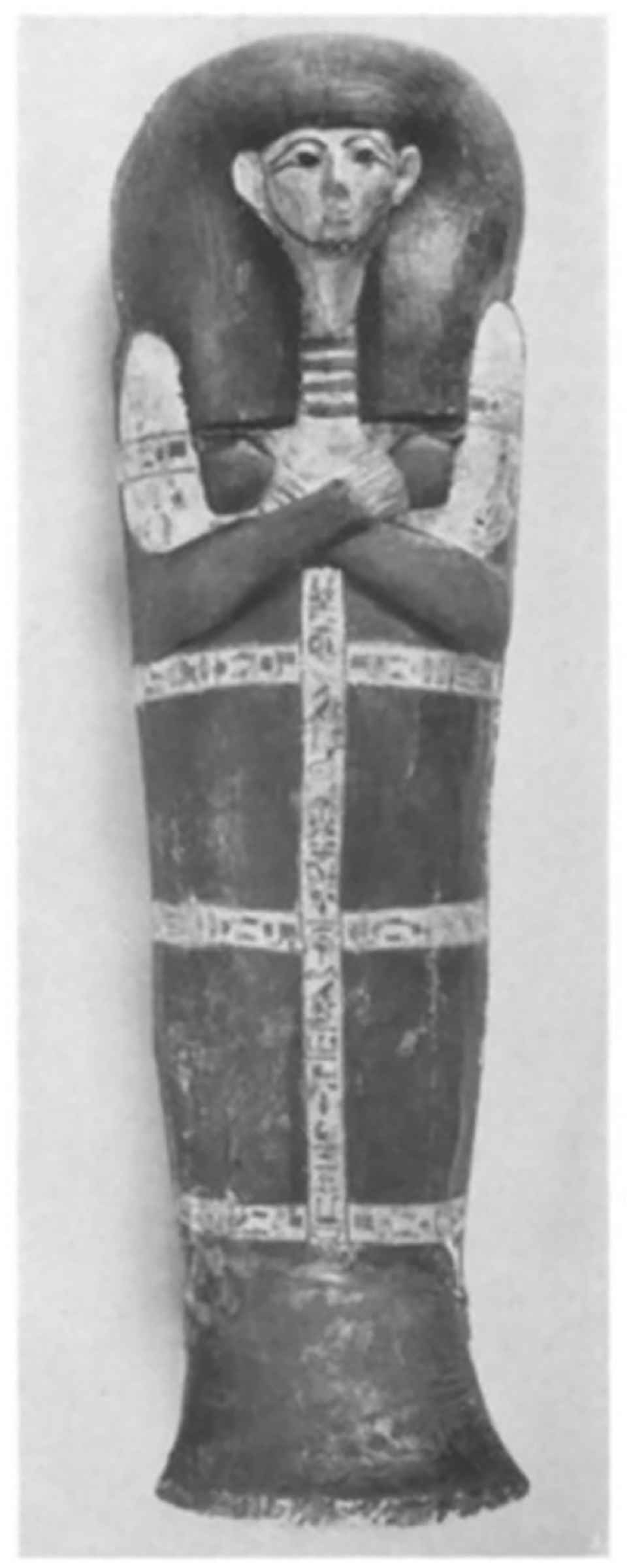
The coffin of Hatnefer in the EMC, JE 66197 (courtesy of the Egyptian Museum, Cairo).

The mummy of Hatnefer before and after the removal of the inscribed shroud with the BD papyrus over her chest (courtesy of the Egyptian Museum, Cairo).
Acquisition and State of the Manuscripts
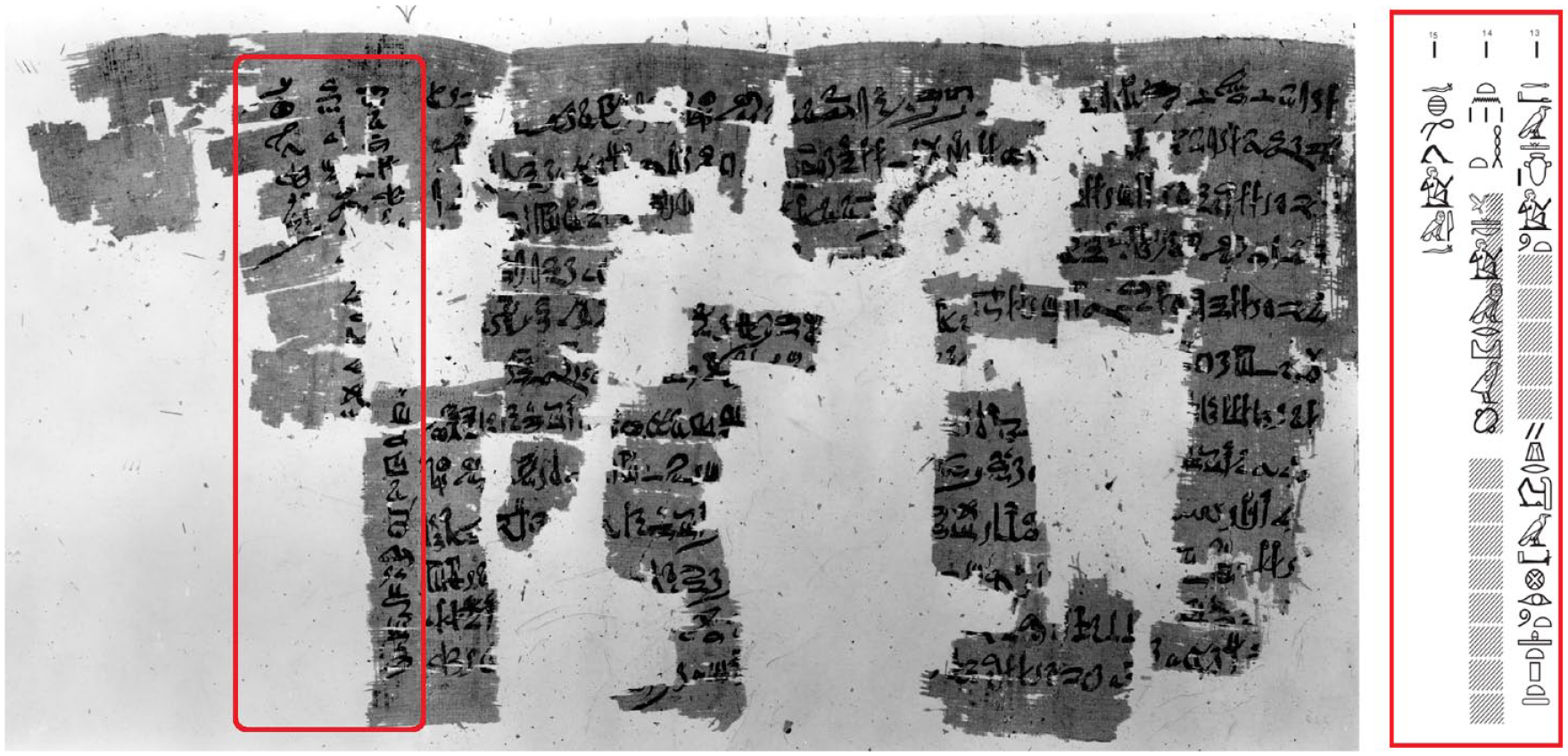
The two papyri were kept in the MMA for seventeen years before their return to Egypt in 1953. 27 At the time of their return, W. C. Hayes decided to unroll and photograph the papyri. They were also divided into eight sections, varying from 61 cm to 119 cm in length, and were kept between pieces of cardboard to be secured during the journey to Egypt. 28 In 1953, the papyri entered the EMC and were later recorded with the leather roll under one temporary number (TR 25–1–55–6). 29 Unfortunately, the lower parts of the two papyri were badly disintegrated, particularly Hatnefer I, because they were placed over the chest of the wet mummy directly after the mummification process. 30 In 2008, a process of conservation of the papyri was started in the EMC. 31 The team noticed that the two papyri were in a worse condition than they had been in 1953, and papyrus Hatnefer II had also suffered from the displacement of the separate fragments because it was stored vertically rather than flat. 32 The small team focused on papyrus Hatnefer I and succeeded overall in transferring and remounting the sections of the papyri into new glass frames. It seems that transferring the papyrus to a new surface was not an easy task, however, as the papyrus was severely agglutinated to the cardboard. Unfortunately, because of the strong adhesive, some fragments of the lower parts had been damaged and could not be transferred to the new mounts (fig. 3). The leather roll remained in Egypt after its discovery and did not receive any restoration because of its good state of preservation (fig. 7).
MMA Photos of the Hieratic Papyri
The papyri are now more incomplete than when they were unrolled in 1953. This can be observed through the comparison of old photos from the MMA and those showing the current state of the manuscripts (fig. 3). Several areas of the lower parts of the papyri are still visible in the old photos, while most of the lower parts are no longer present today, especially of the large manuscript (papyrus Hatnefer I). Thus, the black and white MMA photos of the two papyri still represent the best documentation of the objects as they help in restoring the missing parts of the texts.
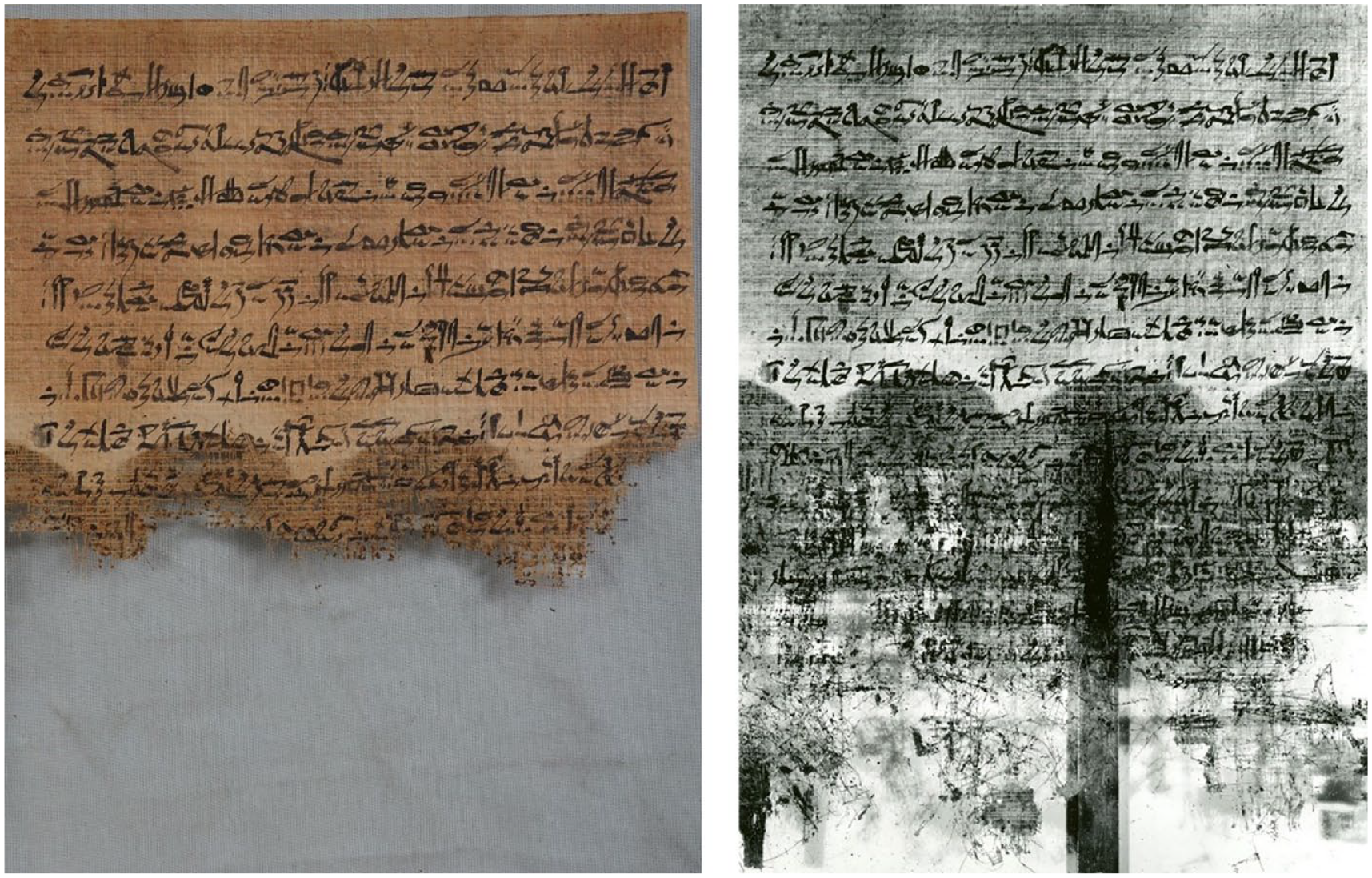
Page 16 of the recto shows the current (left) and previous state (right) of papyrus Hatnefer I.
Description of the Manuscripts
Papyrus Hatnefer I
Generally, the two hieratic papyri were recorded in the ordinary scribal format known in administrative or literary texts of the time, and do not provide any special features seen in contemporary hieroglyphic or cursive hieroglyphic BD examples. 33 Papyrus Hatnefer I is still the longest known hieratic BD manuscript dated to the early Eighteenth Dynasty. It represents a brief transitional stage from the earliest examples of the BD to the highly sophisticated copies of the later New Kingdom. 34 This long papyrus roll consists of a series of sheets glued together. The text is written on both recto and verso. There are 22 pages for the recto while the verso has eighteen pages and four additional blank pages, particularly at the end of the scroll. The manuscript seems to be thin and is of a yellowish colour. The handwriting is bold and has a good form. The joins of the papyrus are neatly done, and it is difficult to observe them with the naked eye. 35 Most of the content of the spells was inscribed in black ink, while the rubrics are used to highlight the titles and the key points of the spells. The number of lines in this roll varies from one page to the next, with each page containing between 15–20 lines. It is noteworthy that only papyrus Hatnefer I, among the contemporary examples, recorded the title of the BD as pr.t m hrw on a blank page at the end of the verso in a vertical column (fig. 4), in contrast to the horizontal layout of the text through the rest of the manuscript.
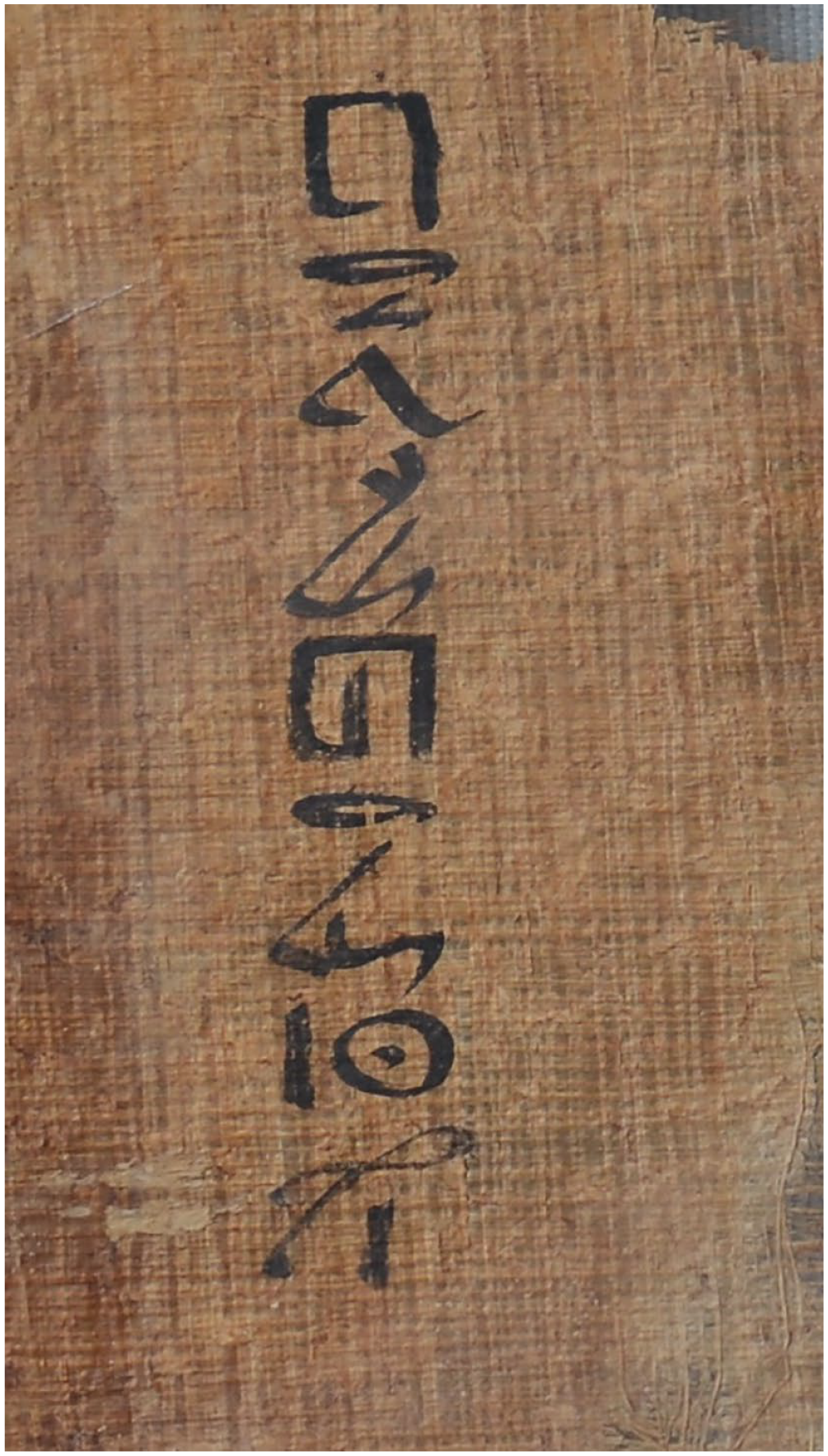
The title of the BD on the verso of papyrus Hatnefer I (courtesy of the Egyptian Museum, Cairo).
The internal evidence suggests that papyrus Hatnefer I was produced as stock, not on special order: some suffix pronouns were modified from masculine to feminine to be compatible to the new owner of the manuscript.
36
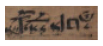
The name of Hatnefer is attested on this papyrus more than 31 times on both the recto and the verso. Her name was commonly written as  , while in a few examples it is written in the short form
  . There are no attestations of her family members except the name of her mother Djehuty and her title as nb.t-pr ‘mistress of the house’ appears once on the second page of the recto
 .
37
The name of Hatnefer was followed by the epithet mȝʿ.t-ḫrw in a few examples, e.g.,
.
37
The name of Hatnefer was followed by the epithet mȝʿ.t-ḫrw in a few examples, e.g., 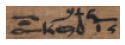 rt. 12.4,
  vs. 15.6, and her name was sometimes preceded by the title nb.t pr, e.g.,
 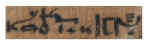 rt. 3.8,
 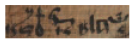 vs. 16.6.
This papyrus roll is cut into four long sections and each section is preserved between glass frames. The total preserved length of the papyrus at the time of excavation was about 4.65 m.
The measurements of the four sections of papyrus Hatnefer I. 38

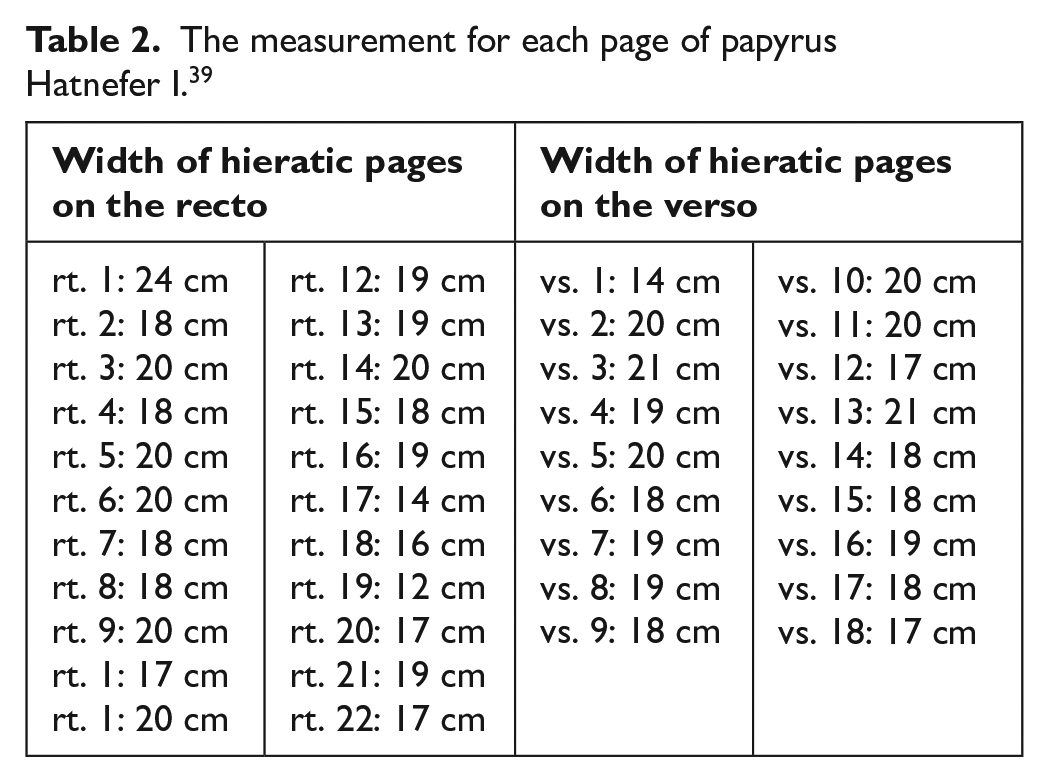
The actual width of the pages is not fixed, with the first page being the widest. The upper margin of the papyrus is not large, measuring only between 1–1.5 cm in some places of the text, while the lower margin is larger than the upper, especially in the last pages of the verso.
The measurement for each page of papyrus Hatnefer I. 39
The hieratic handwriting runs smoothly and homogenously over the recto and the verso of the papyrus without any noticeable distinction in the handwriting. The initial examination of the palaeography comparing phrases, words, signs, names, and ligatures revealed that the papyrus is written by at least three different scribes. 40 The amount of writing of each scribe throughout the manuscript is not uniform. The peculiarities of the handwriting for the three copiers are very close, thus the distinction between the handwriting is difficult to discern, particularly without specific borders.
Papyrus Hatnefer II
This papyrus was found in the same place as the longer manuscript. According to the conservation report published by Peter Dorman, this roll measures about 2.55 m length and is made of a very thin and high-quality papyrus. 41 It was divided also into four sections and placed between white cardboard before it was taken back to Egypt. 42 This manuscript is in a very bad condition, especially because it was not transferred to glass frames like the long papyrus in 2008. It can be seen that several pieces of the papyrus are displaced when comparing old and new photos (figs 5–6). Unfortunately, the author of this paper found only one section of this papyrus, while the locations of the other three sections in the EMC cannot be determined. Thus, the old photos of the MMA represent the best and most complete documentation for papyrus Hatnefer II thus far.
MMA photo for the last section of papyrus Hatnefer II with the three hieratic columns (courtesy of MMA).

New photo for the last section of papyrus Hatnefer II (courtesy of the Egyptian Museum, Cairo).
The papyrus is written in nine horizontal hieratic pages only on the recto, while the verso is uninscribed. The handwriting is very faint overall, and several pieces of the papyrus are lost. The width of the pages of this roll varies from one page to another. The number of lines varies between 11–14 per page. The recto contained a large and detailed vignette for the BD spell 150 in addition to several blank pages. A very faint drawing for the same illustration could be noticed on the verso. The name of Hatnefer was preceded by the name of Osiris about sixteen times. It was followed by the epithet mȝʿ.t-ḫrw about seventeen times. Most of the previous cases are inscribed together: Wsỉr Ḥȝ.t- nfr mȝʿ.t-ḫrw rt. 1.11,
  rt. 2.5.
The handwriting of this short papyrus suggests there was only one scribe, as several signs of the same shape were executed in different pages of the papyrus. The signs of this papyrus were formed smaller than the signs of the large manuscript, and the handwriting is more cursive. In the papyrus, the size of the handwriting, line spacing, and the thickness of the writing was not the same. The most interesting point in this short manuscript is the changing of the writing direction. The spell 149 that ends the papyrus was inscribed in horizontal lines like the rest of the manuscript, however the scribe preferred to end this spell in vertical columns. With the directional change of the writing, the scribe also changed the forms of some hieratic signs to fit within the columns.
The Leather Roll
The leather roll is composed of fourteen cursive hieroglyphic columns written in black ink in retrograde style. This manuscript started with the vignette of BD spell 100 at the beginning of the roll. The scribe used a pre-prepared format with vertical lines as text dividers to write down this text. The text occupied the middle part of the leather roll, while the last section of the roll is still blank (fig. 7). The total measurements of the leather roll are about 16.5 x 43.5 cm, roughly 9 cm of which is left blank at the end of the manuscript. The height of columns is about 13.5 cm, while the upper and lower margins measure 1.5 cm. The written text occupies a band 17.5 cm wide in the middle of the roll. The vignette is illustrated at the beginning of the roll in a free space measuring about 16.5 cm wide. Although the leather is in a bad condition and has several holes, cracks, and missing parts, the text is almost complete. The name of Hatnefer is mentioned three times here, two times inside the text of the spell and once accompanying the vignette. The name in the vignette is inscribed in short form only, with two signs without the classifier. The name inside the text of the spell is written in long form.
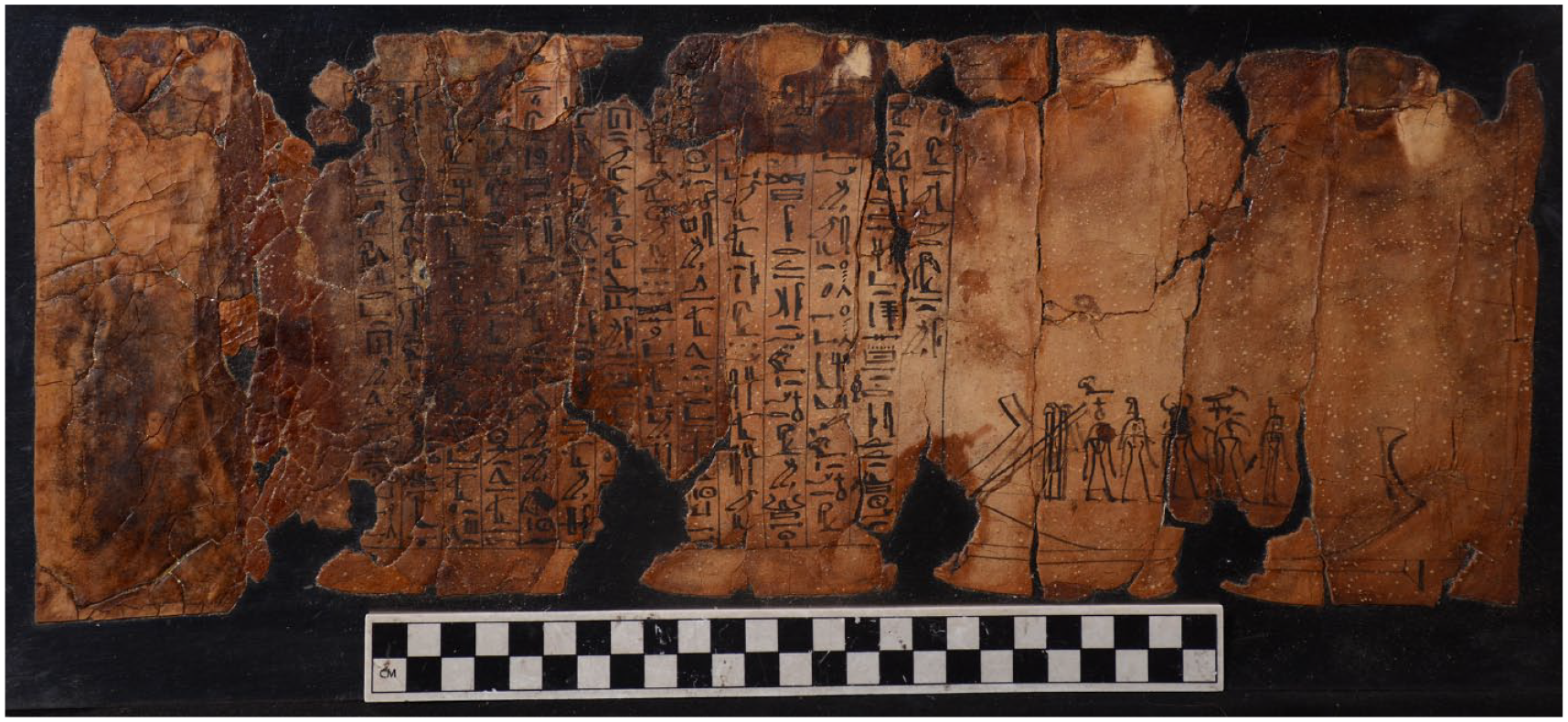
The leather roll of Hatnefer inscribed with cursive hieroglyphs; TR 25-1-55-6 (courtesy of the Egyptian Museum, Cairo).
Sequence of the Spells 43
Funerary compositions in ancient Egypt were subject to creativity and individual modifications, especially with regards to the length and choice of the spells. The reasons for the choice of specific spells in the manuscripts are still unknown, but certainly it is not a random process. 44 One can assume that the economic and social status of the owner could play a role in the quality of the BD copy but maybe not in the vignette’s distribution or in the spell sequence. Consequently, individualism or random choices for the spell sequence will eventually lead to non-identical versions. However, most of the Eighteenth Dynasty BD show a similar systematic sequence. As previously mentioned, the beginnings of the BD were formed before the New Kingdom, when Queen Mentuhotep’s sarcophagus displayed a similar sequence of spells to those that later occurred on the early Eighteenth Dynasty manuscripts. These run as follows: BD 17-18-22-23-24-25-26-43-30A-31-33-45-72-122-56-CT 362-BD 55-CT 372, CT 373-BD 30B-64-119-144-CT 154. 45 This order was not restricted to the papyri and leather rolls, but was also applied on the walls of the tomb; for example, the burial chamber of the Overseer of the Treasury Djehuty TT 11, who served during the joint reign of Hatshepsut and Thutmose III. 46 The BD of Djehuty written on the walls of his tomb offers spells in the following sequence: BD […153…]-78-86-81A-88-87-99B-7-102-38A-14-22-23-24-25-26-28-27-43-30a-31-33-[34-35]-74-45-93-91-41-42-114-112-113-108-109-125a, b, c [-v126-…]-64, 149-150. 47 Interestingly, several Eighteenth Dynasty BD rolls addressed certain key themes which were considered essential for the existence of the deceased in the afterlife. 48 Eight groups of spells have been observed on papyri of the Eighteenth Dynasty that are predominantly found assembled together, though not in precisely the same order. An effort was made to identify the internal coherence of these associated utterances; for example, these having to do with transformations into different efficacious being, utterances for coming forth by day. 49 Usually the sequence starts with spell 17, which is a widespread and enigmatic hymn of creation in which the deceased is identified as one with the creator. 50 In spell 18, the god Thoth is asked to proclaim the deceased true of voice as he declared Osiris true of voice. 51 Spells 22–28 and 30A present the subject of securing mouth and heart. 52 The function of spell 43 is similar, but protects the head. Spells 31–35 aim at driving out any harmful forces that might threaten the preserved body. 53 Spell 74 is to quicken the feet, perhaps initially for the departure of the final funeral procession on its way from the embalming-place to tomb-chamber. Spell 45 is to prevent decomposition. Spell 93 is intended to prevent a reversal of the cosmic cycle. Spell 91 functioned to provide freedom to the Ba-soul, the freely moving aspect of the identity of the deceased. Spells 41–42 aimed to prevent the destruction of the deceased. Spell 14 sought to seek to avoid any divine discontent with the deceased, and the contentedness of the deceased is then secured with an offering liturgy that is known from numerous other Middle and New Kingdom sources. Spell 92 seeks to open the tomb to the bA-soul of the deceased. Spell 63A is an appeal to the bull of the west. In spell 105 the deceased receives offerings in the underworld, and in spell 95 secures a place beside Thoth in a protective role. Spell 72 is for offerings in initiation to new status, a supply central to the eternal life of the deceased and so often found inscribed on sarcophagi. Many of the Eighteenth Dynasty BD manuscripts end with spell 136, securing transfigured status as passengers on Re’s barque, to some extent at least merged with the sun, the creator, and spells 149–150, a chart of fourteen spaces called mounds in the fictional map of the underworld. 54
The spell sequences on Hatnefer’s BD.

Papyrus Hatnefer I
The text of this papyrus dropped the BD spells 17 and 18 that are attested in the papyri of Ahmose, Nebimes, and Sobekmose. 55 It started directly with BD spell 22 that enables the mouth to speak in the presence of the god of the Netherworld. 56 In total, papyrus Hatnefer I contains 60 spells, about 40 on the recto and 20 on the verso. This is the largest assemblage of spells compiled on a hieratic BD manuscript of the Eighteenth Dynasty. The spell 106 of the Coffin Texts was also included in this papyrus. 57
Papyrus Hatnefer II
The short papyrus displays a few spells ordered in the following sequence: rt. BD 136A-136B-149-V150; vs. BD V150. The same spells in the same order with this vignette are partly attested in the cursive hieroglyphic papyrus of Sobekmose and in the hieratic papyrus of Ahmose and Mwti. 58
The Leather Roll
The leather manuscript contains only the BD spell 100 with its vignette. This spell is for making an excellent transfigured spirit, and for enabling it to go down to the boat of Re. 59
A wide range of spells is presented in the three manuscripts of Hatnefer, with different numbers. Each manuscript has its own character in terms of the choice of spells and no spell was repeated.
The Vignettes of the Manuscripts
Papyrus Hatnefer I
This papyrus contains only one vignette, partly preserved, painted in red and black ink. It relates to chapter BD 125D, which is located on the first page of the verso (fig. 8), and is a representation of four squatting baboons seated around a rectangular lake of fire. Sometimes, this vignette was accompanied by its own text, i.e., BD spell 126, while in other manuscripts it was used as one of the illustrations of BD spell 125. 60 According to the spell 126, these baboons help the deceased to enter to the Resetjau and let him pass by the secret portals of the west. 61 While it is positioned on the first page of the verso, this vignette corresponds with the text on the recto. Unlike other contemporary BD examples, this vignette is executed in a page that was originally dedicated to it, and not inserted among the spells where no other inscriptions are accompanied. Several examples of the latter are known, where the illustrations were inserted among the texts in a small size and sometimes in a clumsy drawing style, such as the Ahmose papyrus, where the vignette was placed between columns 240–243. 62
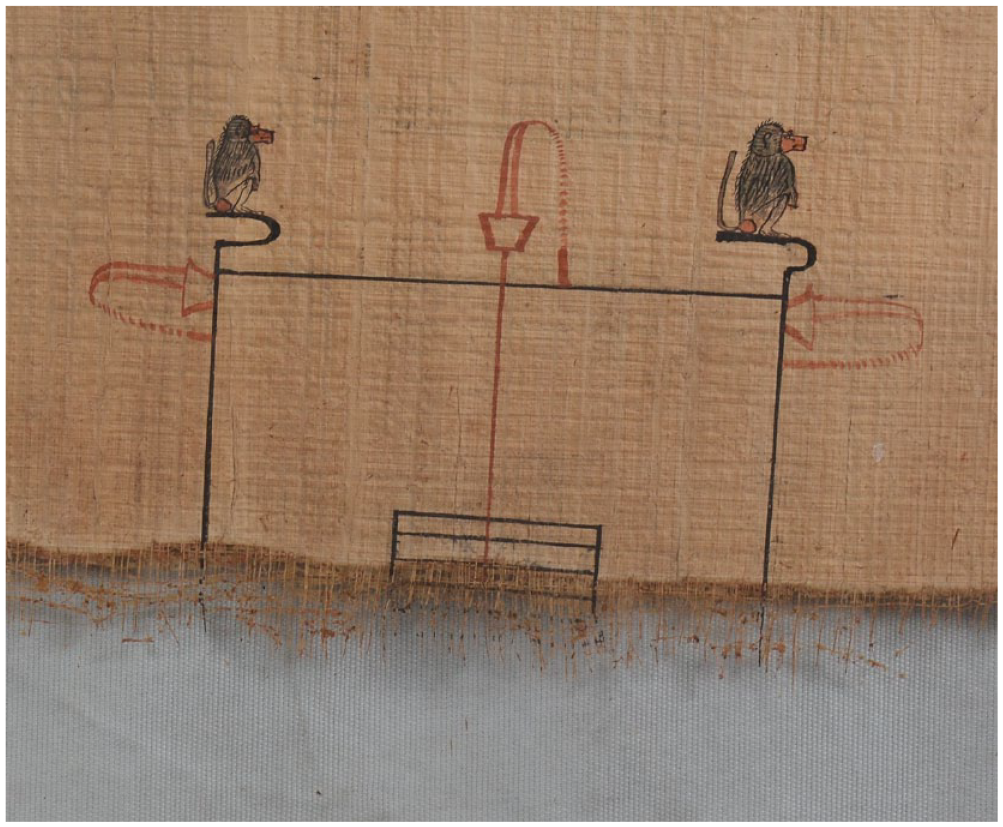
Vignette BD 125D on the first page of the verso of papyrus Hatnefer I (courtesy of the Egyptian Museum, Cairo).
Papyrus Hatnefer II
Although it is shorter than papyrus Hatnefer I, this papyrus contains two large vignettes of the same spell BD 150 which ends many Eighteenth Dynasty BD papyri, one on the recto and the other on the verso (figs 9–10). 63 The recto contains the larger and better-preserved illustration, which is in a very good hand, while the vignette on the verso is hardly visible because the ink is very faint. This vignette illustrates about fifteen compartments of different heights and shapes executed in black and red ink. Most are delineated by double lines, and a few are instead outlined with a single thick line. Some symbols appear more than once, such as the oval shapes. Four curled snakes appeared on the left side of the vignette. Short labels were inscribed inside the mounds in hieratic script in black ink identifying the names of the mounds as they are arranged from top to bottom and from left to right. 64 The large vignette on the recto constitutes the largest known vignette on the Eighteenth Dynasty hieratic BD manuscripts. It was drawn in a separate space and is not integrated with the spells, while the other on the verso seems to be drawn solely without any accompanying texts. A similar vignette is attested on papyrus Los Angeles 83.AI.46.3, where the mounds are arranged vertically in two columns. 65 The spells are inscribed in hieratic columns, but the labels attached to the fifteen mounds are inscribed in cursive hieroglyphs.
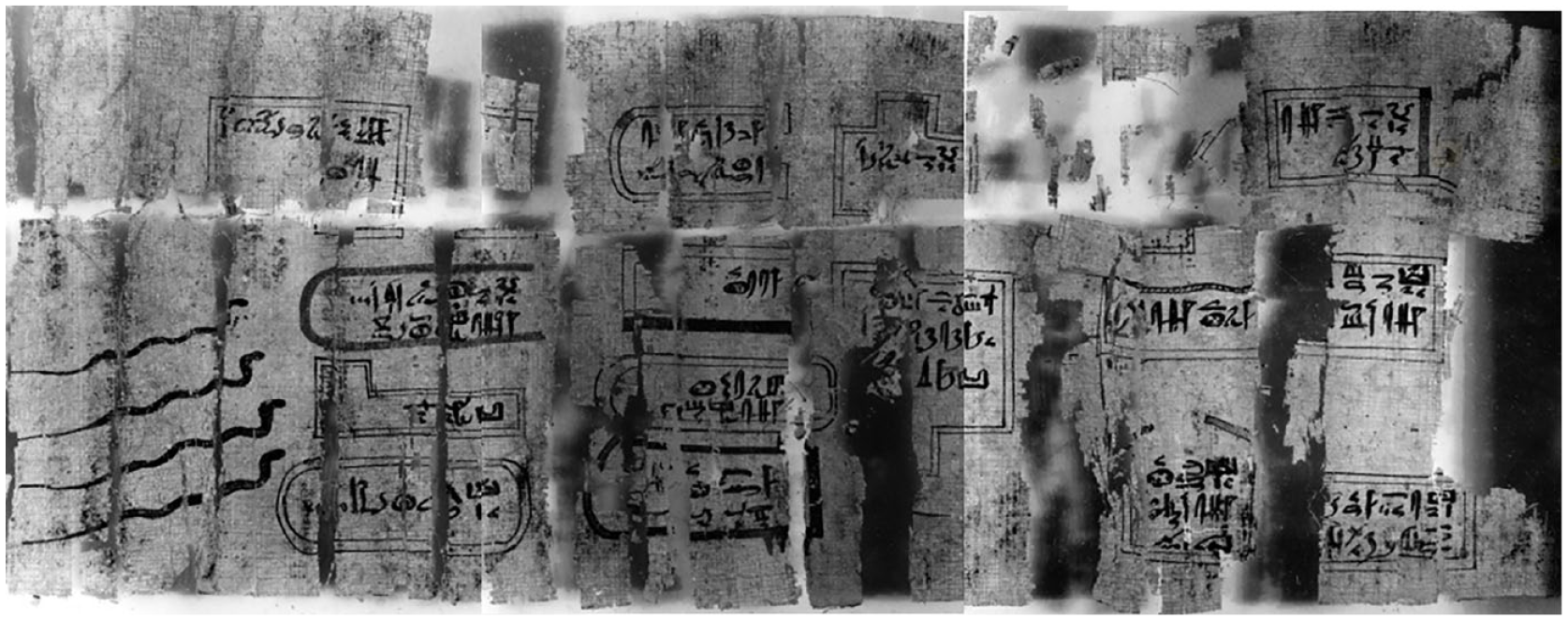
Vignette BD 150 on the recto of papyrus Hatnefer II (courtesy of MMA).

Vignette BD 150 on the recto of papyrus Hatnefer II which shows the current state of preservation (courtesy of the Egyptian Museum, Cairo).
The Leather Roll
The leather roll presents the vignette of BD spell 100 for enabling the deceased to go down into the boat of the god Re with his retinue. 66 In this vignette, Hatnefer was depicted in black ink standing on a boat behind Isis, Thoth, Khepri and Shu (fig. 11). A similar illustration occurs on several contemporary BDs, such as the papyrus of Amenhotep. 67 The name of the owner is written over her head in black ink, as are most of the god’s names. The figures of Hatnefer, the gods, and the drawing of the boat were represented very simply in black ink. The goddess Isis and Hatnefer were dressed in long robes indicating their gender, distinguishing them from the other similarly featured figures. The standing position of Hatnefer is like the position of the male gods.
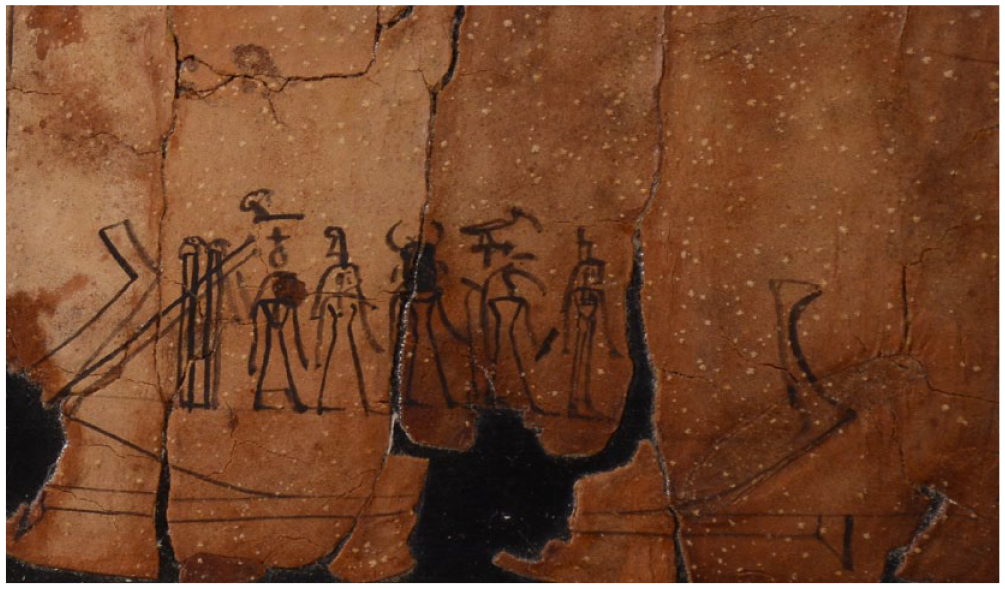
Vignette of spell BD 100 on the leather roll of Hatnefer (courtesy of the Egyptian Museum, Cairo).
Scribal Marks, Editing and Corrections
Due to the importance of the BD, most of the ancient Egyptians were keen, as far as they were able, to produce accurate copies of this composition. For this reason, sometimes editing and scribal comments appeared on the texts. These paratextual signs constitute internal indications of the production processes for this genre. The best example of these auditing processes is found in the BD papyrus of Yuya that declared ‘[the book] is completed from the beginning to its end as it was written, having been copied, revised, compared, and verified sign by sign’. 68 This suggests that the proofreading processes were somehow systematic. The two papyri of Hatnefer and the leather roll display quite interesting examples of proofreading, scribal comments, and revision marks.
Papyrus Hatnefer I
Red Circles
Faint red circular signs are attested, about four times, over some rubrics of this manuscript, especially on the recto. The first red circle is attested over the rubric of the first page (fig. 12). The same sign also occurs in a large form above one rubric in the second page of the recto, over one of the rubrics of the third page, and over the rubric of page 12 (figs 13–15). Similar red circles, certainly with a different function, have been attested in the BD papyrus of Ankhefenkhonsu from the Twenty-Fifth/Twenty-Sixth Dynasty (P. Cairo Egyptian Museum JE 95717/S.R.IV 651, BD spell 99). 69 The mark is also attested in the papyrus of Nespasefy at the end of the last line of one column, with another red circle found at the beginning of a new column. 70 The scribe, in the latter cases, utilised this red circle to separate the adjacent columns and to also avoid confusion between spells BD 20 and 21. 71 The red circle also appears in the black ink text of the Saite BD papyrus of Tasheretenaset. 72 Seemingly the function of the red circle in the funerary texts of the Late Period is to refer to the continuation of the text in an unexpected place. 73 It is noteworthy that the function of the present red circles are not identical with the known red or black verso points that were frequently used in literary texts to help in recitation, in learning to read, and as division marks. 74
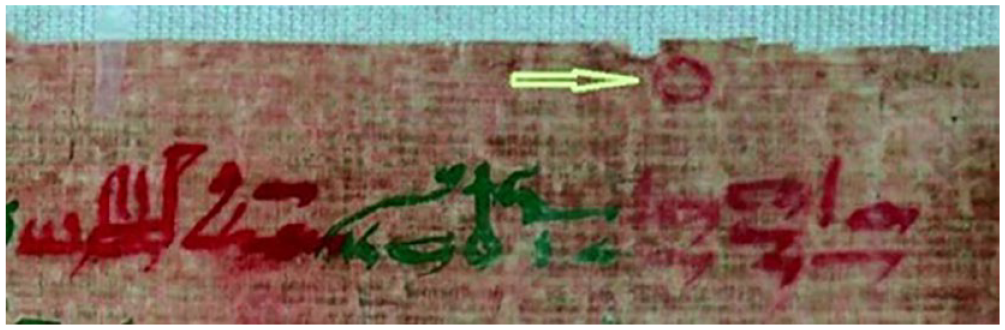
Papyrus Hatnefer I, rt. 1, 1(DStretch).
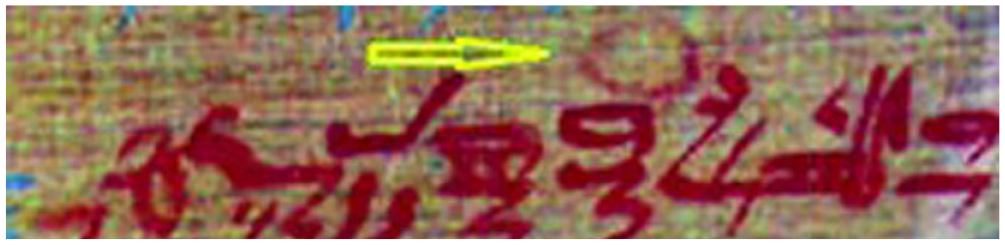
Papyrus Hatnefer I, rt. 2, 5 (DStretch).

Papyrus Hatnefer I, rt. 3, 7(DStretch).
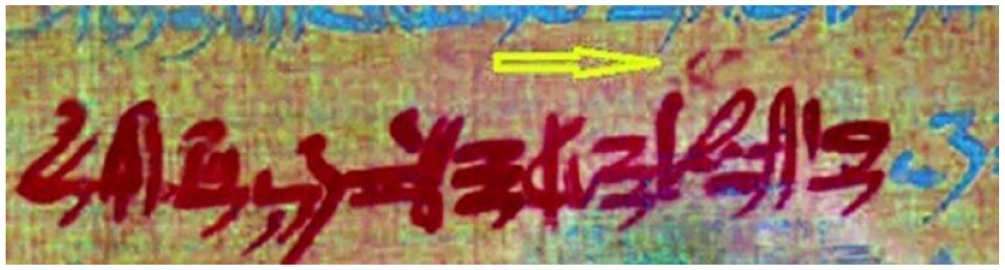
Papyrus Hatnefer I, rt. 12, 6 (DStretch).
Black Circles
Three examples of black circles are inscribed in clear and bold handwriting above some selected rubrics of pages 4 (fig. 16) and 5 (figs 17–18). No other similar circles could be seen in the rest of the papyrus. Little can be suggested here about the function of these circles: the text in these places is well organized and the spellings of the spells are correct. The only aspect of note is that both black and red circles were inscribed over the rubrics of the first few pages and not through the whole text. Perhaps they could be an indication mark helping the scribe to insert the rubric in these places, but this raises the question of why they were attested in these few examples and not through the other rubrics of the papyrus? At the same time, contemporary examples for the black circles remain unknown.

Papyrus Hatnefer I, rt. 4, 8.
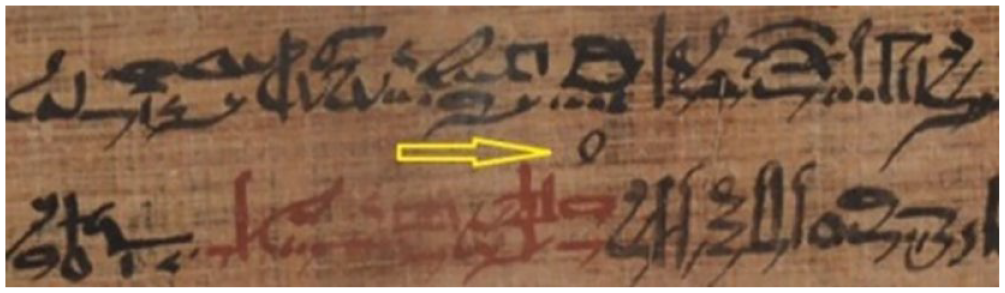
Papyrus Hatnefer I, rt. 5, 2.
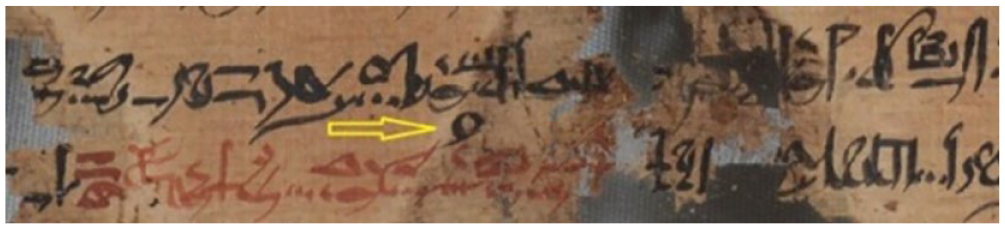
Papyrus Hatnefer I, rt. 5, 8.
Additions over the Lines
It seems that the scribe was very keen and paid particular attention to checking their text and completing missing parts. Thus, they sometimes added missing elements such as words and signs over the line in the correct place. This attitude reflects their consciousness of the importance of the text on both a personal scale, as a commercial product, and for the customers, purchasing a funerary good: the customer should be kept satisfied.
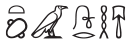
Figures 19–22 show cases in papyrus Hatnefer I where the scribe added the missing parts without using any special insertion marks (figs 19–22). In the first example (fig. 19) the scribe forgot the vocative particle  which is considered as an opening particle at the beginning of the BD spell 91, i.e. ʾI ḳȝ dwȝ.tw.f ‘Oh high one who is adored’.
75
In another example (fig. 20), they added the preposition
which is considered as an opening particle at the beginning of the BD spell 91, i.e. ʾI ḳȝ dwȝ.tw.f ‘Oh high one who is adored’.
75
In another example (fig. 20), they added the preposition  over the line in the exact place in spell 34. The spell says: r n psḥ
  was added to complete the word ḥwt
  .
.
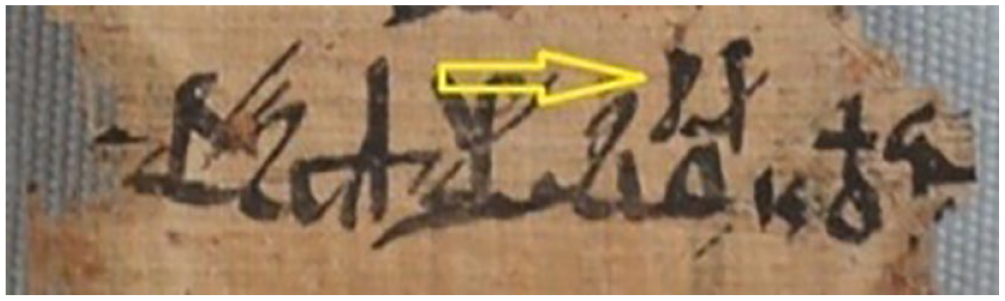
Hatnefer papyrus.
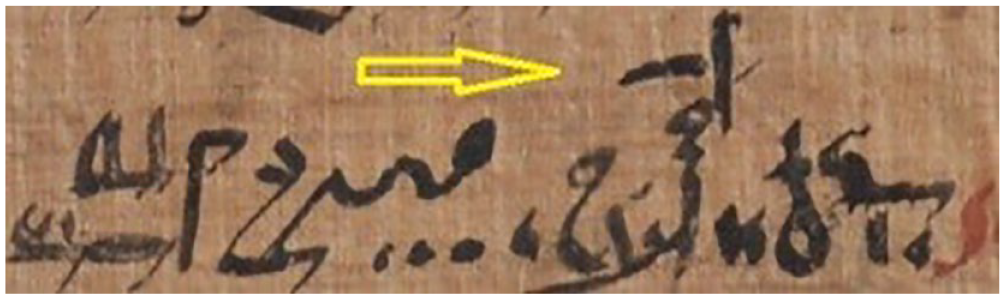
Hatnefer papyrus I, rt. 4, 4. I, rt. 4, 18.
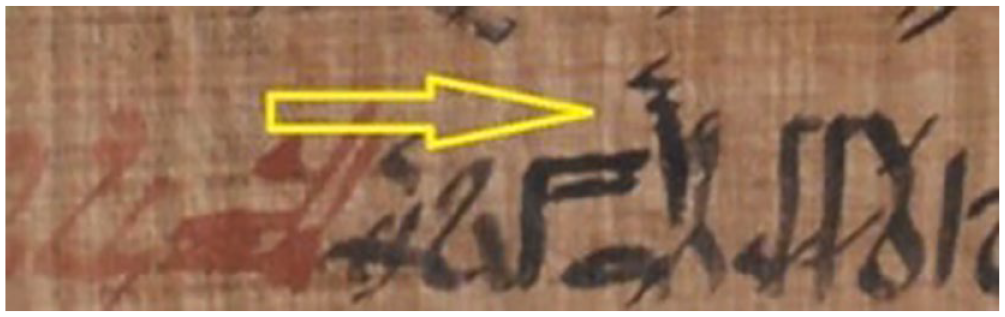
Hatnefer papyrus I, rt. 4, 2.
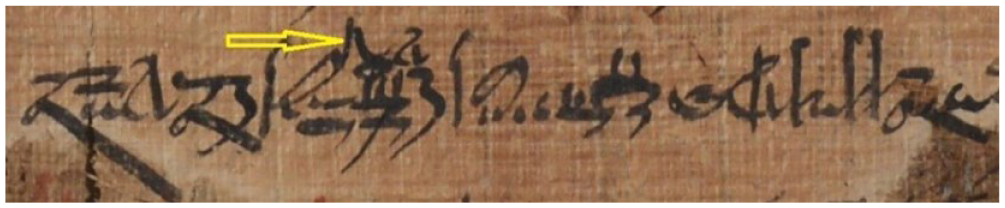
Hatnefer papyrus I, rt. 7, 5.
In the latter example (fig. 22), the scribe added their notes over the text, placing the sign ȝ  with another unknown sign over the group
  in order to complete the missing part. However, when the spell 14 is compared with other contemporary texts, the meaning and the spelling of the text can be seen to be correct without their addition i.e., ỉ. nb ḥtpw m gn wr ‘Oh Lord of offerings, as the greatly revered’.
77
Another type of addition can be seen in this papyrus when the scribe realized that they forgot the three plural strokes, and tried to insert their forgotten signs in the correct place, not over the line (fig. 23).
in order to complete the missing part. However, when the spell 14 is compared with other contemporary texts, the meaning and the spelling of the text can be seen to be correct without their addition i.e., ỉ. nb ḥtpw m gn wr ‘Oh Lord of offerings, as the greatly revered’.
77
Another type of addition can be seen in this papyrus when the scribe realized that they forgot the three plural strokes, and tried to insert their forgotten signs in the correct place, not over the line (fig. 23).

Papyrus Hatnefer I, rt. 19, 5.
As far as I am aware, no such examples for proofreading are known in the hieratic Eighteenth Dynasty contemporary BD, however it can be seen in the cursive hieroglyphs BD papyrus of Nu, BM EA 10477 from the Eighteenth Dynasty. The scribe used the cross mark to add something that was originally forgotten in the text. The cross mark was placed over the vertical line separating the columns 33 and 34, while the addition was inscribed in the lower margin.
78
The text of the spells was executed in cursive hieroglyphs in columns and in retrograde style, while the addition was inscribed in a horizontal hieratic line. Similar cases of proofreading are known in later manuscripts. The insertion of missing parts, sometimes above the line, was common for the copyists of these texts. Sometimes, when the scribe found an omitted part, they placed a deletion mark and refined their mistake by copying the omitted text after a second mark  ,
79
which most probably refers to the finger.
80
,
79
which most probably refers to the finger.
80
Additions in the Margins
In some cases, the scribes added their comments or missing parts within the page margin, not inside the text. These additions vary from a single sign to several words. The recto of papyrus Hatnefer I displays two examples of additions in the margin. On the left margin, the scribe added only a single sign for the seated man with his hand to the mouth (A2), without any indication as to its exact place or where it should be inserted (fig. 24). A similar sign is attested in some New Kingdom medico-magical texts, being placed in different areas of the margins. 81 In the latter genre of texts, it could mean ‘to memorize, to remember’. 82 The function of the sign in the current text is uncertain, but it at least does not indicate a missing part of the text. The second insertion relates to spell BD 72, which is attested on the linen shroud of Hatnefer in cursive hieroglyphs and on her large papyrus in hieratic text. In the latter example, page 10, the scribe who checked the spell noticed that the phrase ḥr dȝỉw ‘on a linen cloth’ is missing. Thus, they decided to add the missing part in the left margin exactly in the precise place using the sign (x) as insertion mark. 83 The interesting thing in this addition is that the text is inscribed vertical direction not horizontally as the original text was written (fig. 25). 84
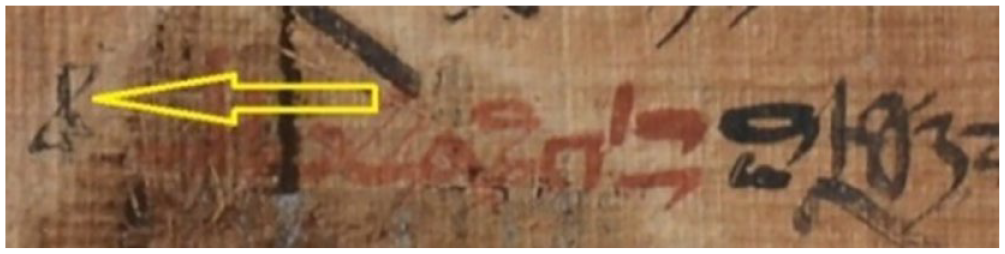
Papyrus Hatnefer I, rt. 7, 6.

Papyrus Hatnefer I, rt. 10, 8-9.

ʾIr rḫ mḏȝt (ṯn) tp (tȝ) ỉr.tw.s m sš [ḥr dȝỉw] ḥr ḳrs.f (r-pw)
‘As for the one who knows (this) Book upon (earth), whether it is placed in writing [on a linen cloth] (or) his coffin’ 85
Deletion Marks
Red and black strokes were usually used for the deletion of incorrect words and the subsequent addition of the correct ones from earlier times to the Roman Period.
86
In page 8 on the recto of papyrus Hatnefer I, the scribe used a red faint diagonal stroke as a deletion mark, deleting a wrong sign, without replacing it with the correct one (fig. 26). In this example, the determinative  of the word iwa was seemingly inscribed in the wrong form and thus the reviewer of the text made a deletion mark. In later examples of deletion, the scribes sometimes erased the word by covering it with ink and replacing it with the correct word directly above (fig. 27).
87
of the word iwa was seemingly inscribed in the wrong form and thus the reviewer of the text made a deletion mark. In later examples of deletion, the scribes sometimes erased the word by covering it with ink and replacing it with the correct word directly above (fig. 27).
87
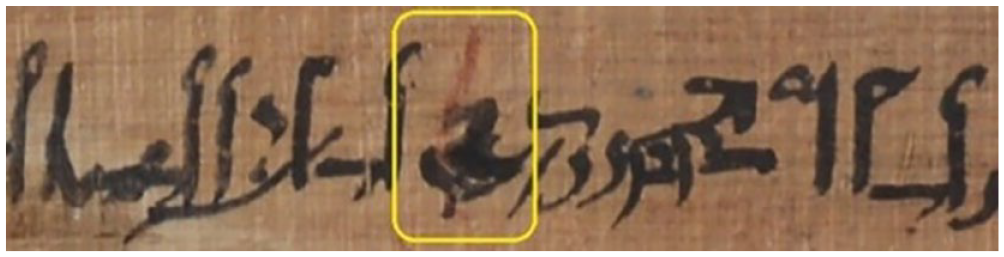
Papyrus Hatnefer I, rt. 8, 5.
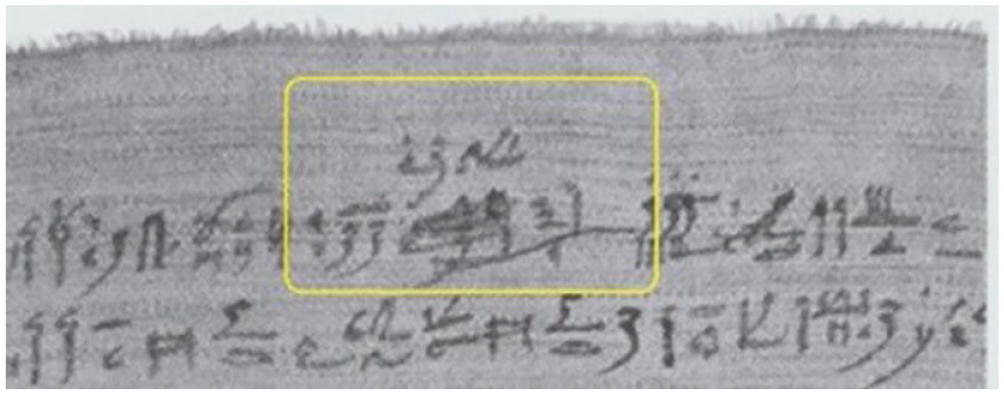
Mummy wrappings of the priest Hor.
Modification
Most probably, this longer BD papyrus I of Hatnefer was produced from stock not on special order, and it seems that it was originally made for a man. The suffix pronoun used for the masculine was I.9  . Thus, the pronouns were modified in several cases from the masculine to the appropriate feminine pronoun to be suitable for the new owner of the manuscript. This modification occurred once on the recto and six times on the verso (figs 28–31). Traces of the long tail of the horned viper can be seen under the new feminine pronoun
  in the previous cases especially when using the DStretch programme to improve and highlight the red colour
  .
.

Papyrus Hatnefer I, vs. 4 (DStretch).

Papyrus Hatnefer I, vs. 4, 6 (DStretch).
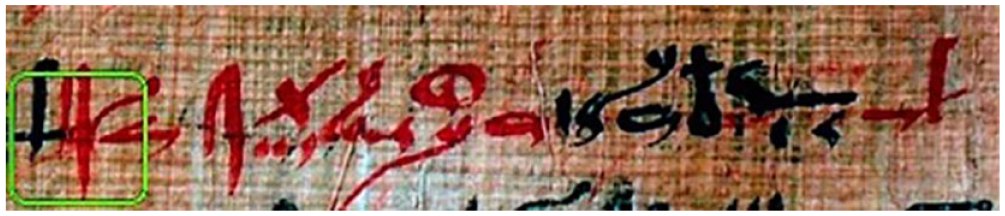
Papyrus Hatnefer I, vs. 2, 1 (DStretch).
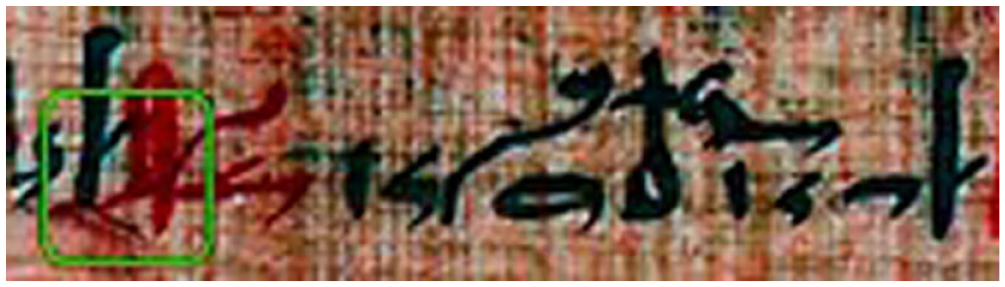
Papyrus Hatnefer I, vs. 5, 7 (DStretch).
The amendments were not always successful, and sometimes they made the situation worse. In one case when the scribe tried to amend the pronoun from male to female, they spoiled the text by creating a large smudge of black ink, visible as traces of their fingerprint was left over the writing surface (fig. 32). A palimpsest can also be observed in page two on the recto, where the title of Hatnefer is written over traces of earlier ink with emendation in the personal pronoun (fig. 33).
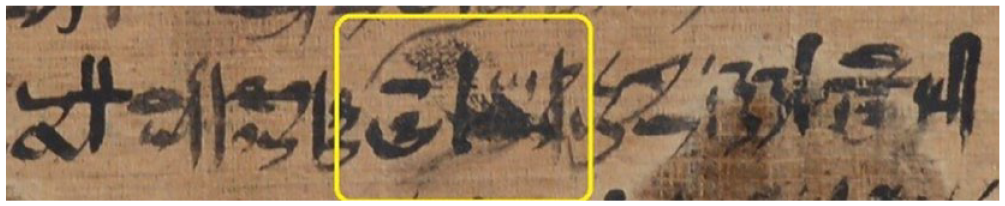
Papyrus Hatnefer I, rt. 11, 6.

Papyrus Hatnefer I, rt. 2, 6.
Usually, the scribes left empty spaces for inserting names, titles, and affiliations of the future owners of a manuscript. 88 When the manuscript was acquired, the relevant details of the owner were inserted into the appropriate places. Sometimes, these spaces were designated by a horizontal line of red ink, waiting for the name of the new owner. Such an instance can be seen in the longer papyrus of Hatnefer (fig. 34).
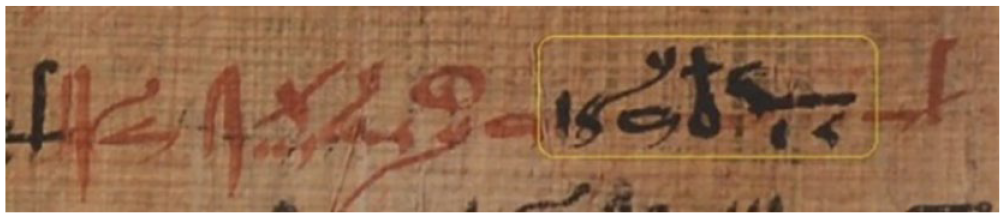
Papyrus Hatnefer I, vs. 5, 7.
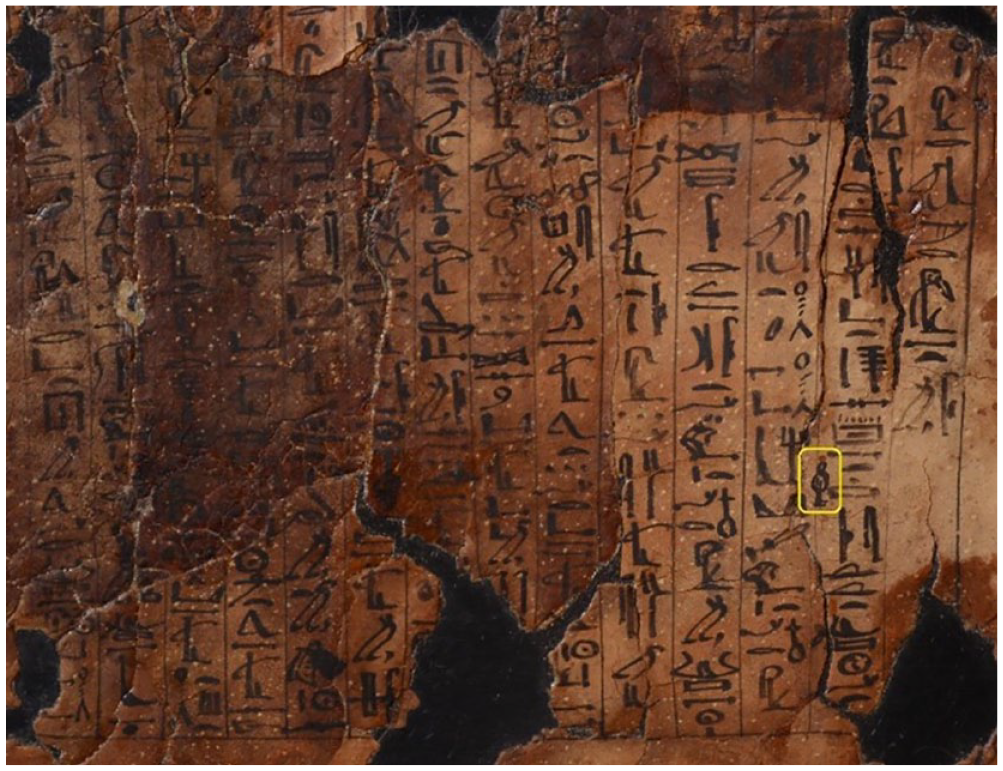
The Mast Sign?
The two signs  and
and  (second in red) were attested on the recto of pages 13 and 14. The black sign is shaped in a small form and inserted over the line as a part of the spell 99B
  ḏd rn.ỉ ỉn ḫrpw ‘Tell my name, says the mallet’ (fig. 35), while the large one is inscribed in red ink on the right margin close to line number 6 (fig. 36). The interpretation of these signs remains unclear. At first glance, the black sign could be used as a determinative of the below word ḫrp that normally uses S24
 . However, when the text is compared to similar sources of the same BD spell 99B, it reveals that the spelling is correct with
  M3 not with ḫrp-sign especially when the word means mallet.
89
Thus, this sign may indicate that the scribe misunderstood the correct spelling and meaning of the word. As for the large sign in red ink, the function may be inaccurate as well, although a similar example, in black ink, is attested on the recto of papyrus Chester Beatty I in the right margin of the page and very close to the intended line (fig. 37).
90
In this case, the sign was probably used to indicate a missing word, and this word was added over the line in black ink.
91
In papyrus Hatnefer I, nothing could be noticed to explain the presence of the sign except the clumsy wording of part of spell 105, where the scribe superfluously added kȝ.ỉ that has no meaning in the sentence.
M3 not with ḫrp-sign especially when the word means mallet.
89
Thus, this sign may indicate that the scribe misunderstood the correct spelling and meaning of the word. As for the large sign in red ink, the function may be inaccurate as well, although a similar example, in black ink, is attested on the recto of papyrus Chester Beatty I in the right margin of the page and very close to the intended line (fig. 37).
90
In this case, the sign was probably used to indicate a missing word, and this word was added over the line in black ink.
91
In papyrus Hatnefer I, nothing could be noticed to explain the presence of the sign except the clumsy wording of part of spell 105, where the scribe superfluously added kȝ.ỉ that has no meaning in the sentence.

Papyrus Hatnefer I, rt. 14, 3.
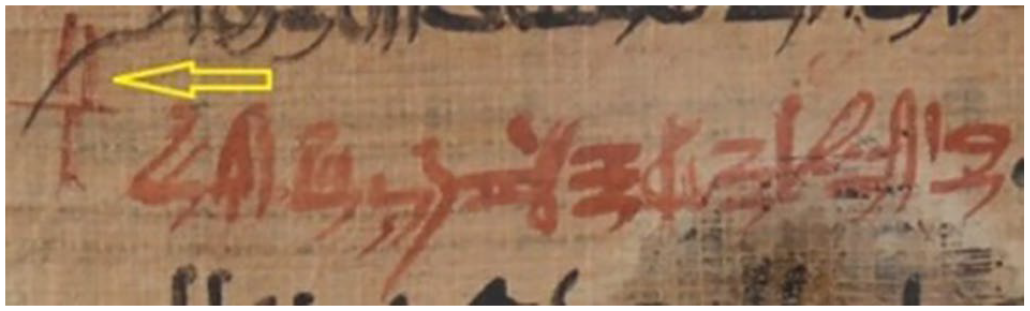
Papyrus Hatnefer I, rt. 12.

Papyrus Chester Beatty I, rt. 11, 6.

Papyrus Hatnefer I, rt. 13, 6, showing the miswording.
Hatnefer Papyrus: fȝ m mḫt ḳȝ mȝʿ.t r fnd Nu Papyrus: fȝ m mḫt ḳȝ mȝʿt r fnd n
‘Oh lifter on the balance, may what is right be high to the nose of Re on this day, [do not let] my head be displaced there’. 93
Papyrus Hatnefer II
This short manuscript exhibits four examples of proofreading and revising the text, most of which are additions over the lines. Apparently, the purpose of this addition was to complete missing parts of the text. Some were added in the correct places, while a few were added somewhat distant from the intended correction.
Additions over the Lines
On page one, traces of faint inscriptions in black ink could be seen over the last word of the first line (fig. 39), and the word  is inserted in the right margin of the second line very close to the first word (fig. 40). The scribe, in this case, noticed that the words
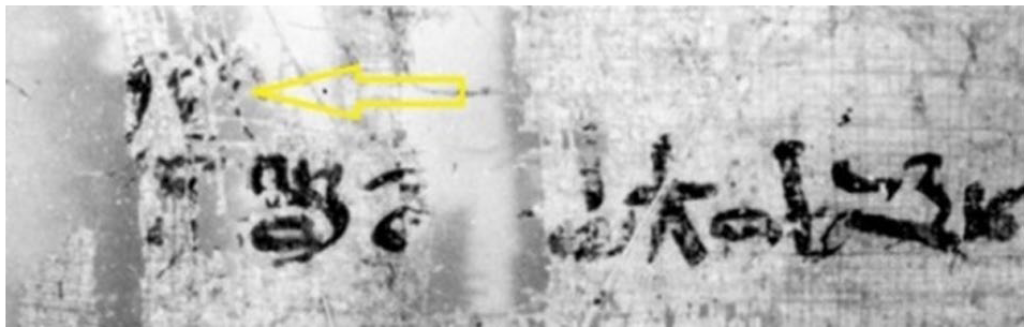
Papyrus Hatnefer II, 1. 1.
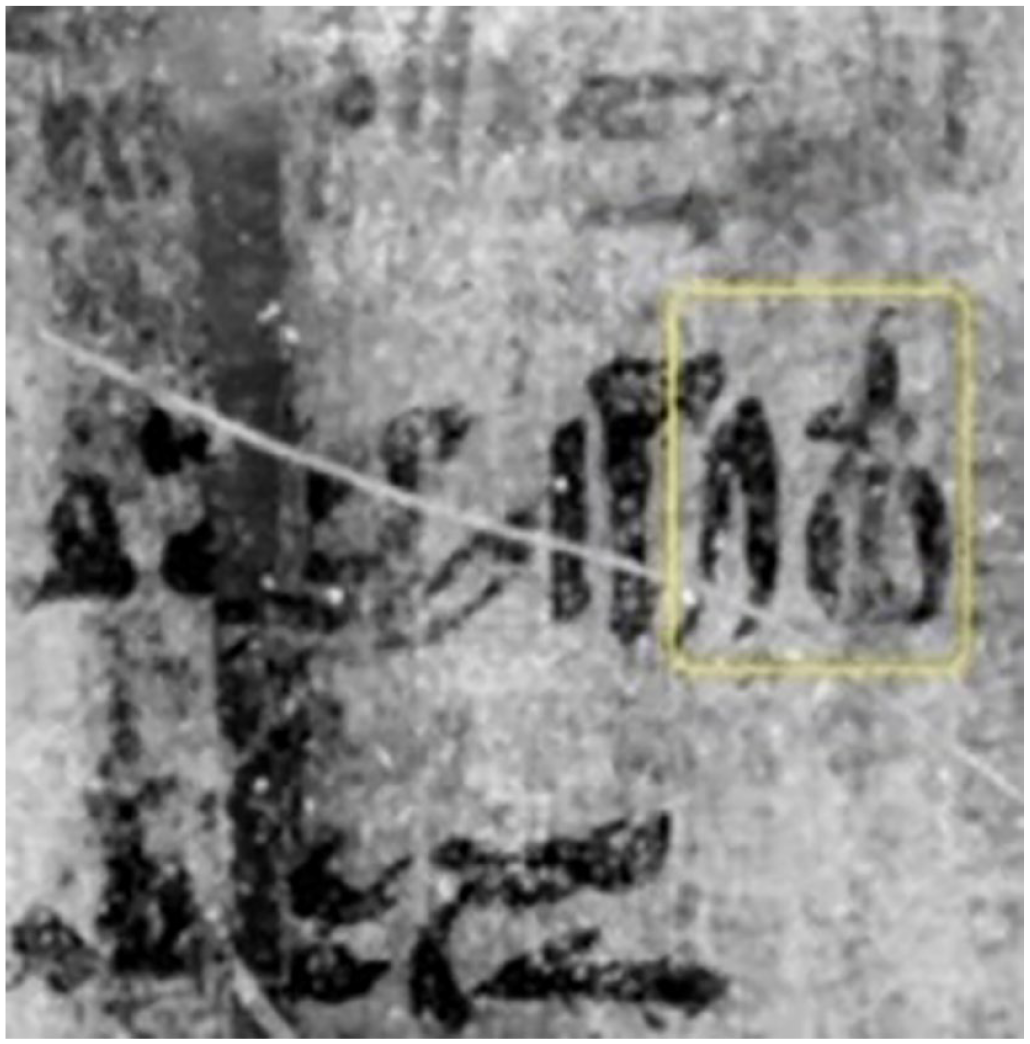
Papyrus Hatnefer II, 1. 2.
Another example of an addition was found over line 11 on the second page of this manuscript, in BD spell 136B (fig. 41). The scribe noticed the absence of the sign  (N9) that forms the word psḏ.t, and they preferred to add it over the line. This addition was not over the exact place, but added over the line and before the word
  . On the other hand, the scribe wrote the word ‘ennead’ psḏ.t, in an odd spelling
  while they always used the number nine followed by the ending of the ordinal numbers
  .
.

Papyrus Hatnefer II, 2. 11.
In page 6, line 9 the scribe realized that they forgot the copula ỉw, in the BD spell 149 so they inserted it over the line in its exact place in small handwriting completing the sentence  (fig. 42).
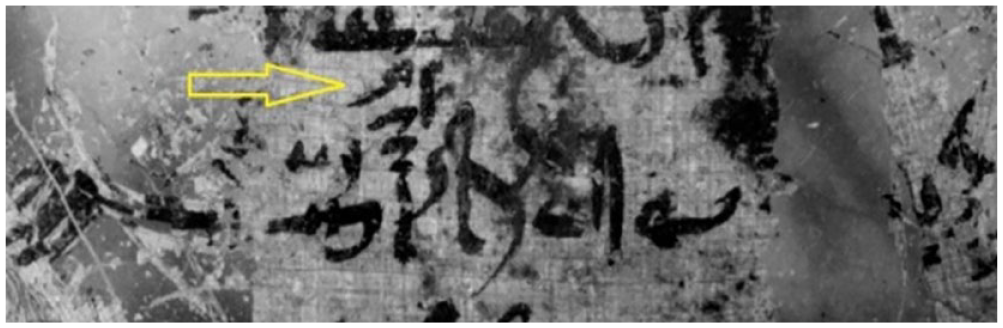
Papyrus Hatnefer II, 6. 9.
The last example of page 8, line 7, in this shorter manuscript shows another addition over the line. According to the meaning, and based on a comparison with other sources, this addition should be the vocative particle  not the verb
  that was added by the scribe over the line in the correct place (fig. 43). The meaning in this part runs as follows ỉ. sty nṯr ‘Oh scent of the god’, and thus perhaps the scribe was confused in writing this word phonetically like verb ỉỉ.
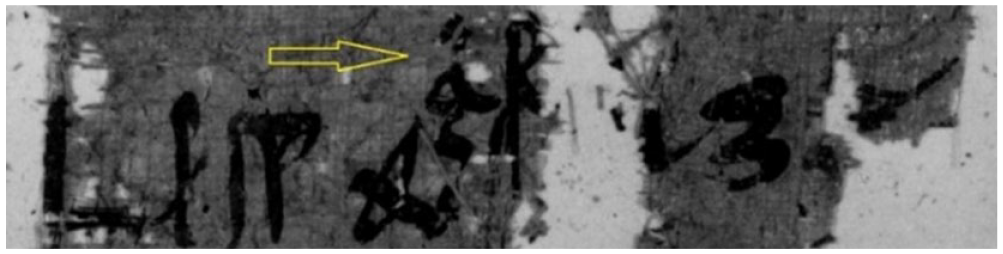
Papyrus Hatnefer II, 8. 7.
Leather Roll
The leather roll is inscribed with spell 100 in columns with vertical lines used as a text divider. Over the third dividing line from the right, a tỉt-sign in small form is inscribed in the correct place to complete the word on its right side  .It is worth mentioning that the last three columns are not considered a part of spell 100, however they are sometimes inscribed over the boat in the accompanying vignette such as the BD papyrus of Nu BM EA 10477 (fig. 44).
94
.It is worth mentioning that the last three columns are not considered a part of spell 100, however they are sometimes inscribed over the boat in the accompanying vignette such as the BD papyrus of Nu BM EA 10477 (fig. 44).
94
Hatnefer leather roll.
Conclusion
This paper presented an interesting group of BD manuscripts from the early Eighteenth Dynasty. These scarce examples were inscribed in the hieratic script in vertical or in horizontal directions. In most cases, they were characterized by an absence or limited number of vignettes. The importance of these early examples lies in their rarity at that time and their close relationship to the Coffin Texts inscribed before the New Kingdom.
Footnotes
Acknowledgements
I am deeply thankful to the curators of the Egyptian Museum in Cairo for providing me with photographs. I would also like to thank the curators of the Metropolitan Museum of Art for providing me with photographs and granting me permission to publish them. My special thanks go to Ursula Verhoeven, Johannes Gutenberg University, and my colleague Ahmed Mekawy for carefully reading this paper and providing me with valuable comments. My appreciation also goes to the IFAO and the DAAD Egypt for providing me the facilities to finish this paper. I am very grateful to Anna Stevens, Monash University, for reading this paper and correcting my English.
Funding
This paper was prepared during the fellowship granted by the IFAO, Egypt to the author and during the three months scholarship funded by the DAAD Cairo to Johannes Gutenberg University, Mainz in 2019.
1.
Most probably, Hatnefer grew up in the town of Armant. Nothing is known about the origins of her husband Ramose, but he most probably had a modest occupation, such as a tenant farmer, artisan, or even a small landowner. C. H. Roehrig, ‘Life along the Nile: Three Egyptians of ancient Thebes’, BMMA 60:1 (2002), 26. Particularly, his coffin does not bear any titles for him, and this could indicate that he was a commoner. A. Lansing and W. Hayes, ‘The museum’s excavations at Thebes, the Egyptian Expedition 1935–1936’, BMMA 32:2 (1937), 16.
2.
According to Lansing and Hayes, this burial can be dated exactly to year seven of the co-regency between Hatshepsut and Thutmose III. Lansing and Hayes, BMMA 32:2, 20; P. Dorman, ‘Compositional format and spell sequencing in early versions of the Book of the Dead’, JARCE 55 (2019), 21.
5.
Lansing and Hayes, BMMA 32:2, 12; PM I, 2, 669.
6.
P. Dorman, The Tombs of Senenmut, Architecture and Decoration of Tombs 71 and 353 (New York, 1991), 23.
7.
Lansing and Hayes, BMMA 32:2, 22. The other objects found in this tomb that do not belong to Hatnefer are the wooden coffin of Ramose, and two ordinary coffins with six unknown mummies for three women and three children. Lansing and Hayes, BMMA 32:2, 31; Dorman, The Tombs of Senenmut, 23.
8.
The objects in the EMC include a coffin of Ramose, JE 66196; a coffin of Hatnefer, JE 66197; the shroud of Hatnefer, JE 66218; a linen-chest with a hieratic inventory inside the lid mentioning Minhotep, the brother of Senenmut, JE 66002; an alabaster jar with the sealing of Hatshepsut, JE 66206; a pottery amphora with hieratic text, JE 66207; five pottery jars, JE 66208; and a perfume vase of Senenmut, JE 51830. Note that the tomb of Hatnefer and its contents will be published in the near future by Peter Dorman. For more details about some of these objects, see W. C. Hayes, Scepter of Egypt II: A Background for the Study of the Egyptian Antiquities in the Metropolitan Museum of Art. The Hyksos Period and the New Kingdom (1675-1080 B.C.) (Cambridge, USA, 1959), 201–5, 222, 227.
9.
Lansing and Hayes, BMMA 32:2, 19.
10.
Lansing and Hayes, BMMA 32:2, 19.
11.
Lansing and Hayes, BMMA 32:2, 19.
12.
L. Díaz-Iglesias Llanos, ‘Glimpses of the first owners of a reused burial: Fragments of a shroud with Book of the Dead spells from Dra Abu el-Naga North’, BIFAO 118 (2018), 83–126, 95.
13.
I. Munro, Die Totenbuch-Handschriften der 18. Dynastie im Ägyptischen Museum Cairo (ÄA 54; Wiesbaden, 1994), pl. 10.
14.
Lansing and Hayes, BMMA 32:2, 20; Hayes, The Scepter of Egypt II, 226.
15.
Hayes, The Scepter of Egypt II, 226; Dorman, BARCE 197, 17; Dorman, JARCE 55, 22–3. The tomb of Neferkhawet was uncovered by the expedition of the MMA in season 1934–5, located very close to the causeway of Thutmose III at Deir el-Bahari. Neferkhawet shared his tomb with his wife Rennefer. His son and heir Amenemheb were buried in a contiguous burial chamber along with his daughter Ruyu and her husband Boki: S. T. Smith, ‘Intact tombs of the Seventeenth and Eighteenth Dynasties from Thebes and the New Kingdom burial system’, MDAIK 42 (1992), 227. Unfortunately, the current location of the hieratic BD manuscript is unknown, and no photos are presented in the publications. There is no information to indicate if this manuscript contains vignettes or not. The interesting point regarding this manuscript is that it was found in the provenance of Deir el-Bahri, as with many other contemporary hieratic BDs. Ruyu was buried in the family tomb of her father Neferkhawet. She holds the title ‘the house lady’, as had her mother Rennefer, but it can be assumed that she reached this high status through the power of her father. This was the reason she was given a copy of the BD, M. Barwik, ‘Amenemheb and Amenemopet: New light on a papyrus from the National Museum in Warsaw’, in J. Aksamit (ed.), Essays in Honour of Prof. Dr. Jadwiga Lipińska, I (Warschau, 1997), 332. The same could be the case for Hatnefer, who held the same title, ‘the house lady’, and derived her status through the authority of her son Senenmut.
16.
Hayes, The Scepter of Egypt II, 226. Hayes suggested that it represented the Book of Amduat. W. C. Hayes, ‘The tomb of Nefer-Khewet and his family’, BMMA 32:2 (1935), 26, no. 18.
17.
Hayes, The Scepter of Egypt II, 226.
18.
Hayes, The Scepter of Egypt II, 226; Hayes, BMMA 32:2, 26; Dorman, JARCE 55, 23.
19.
Hayes, BMMA 32:2, 26; Dorman, JARCE 55, 23, n. 18.
20.
The linen shroud of Hatnefer will not be discussed in this paper because it is already published in Munro, Die Totenbuch-Handschriften der 18. Dynastie.
21.
H. Kockelmann, ‘How a Book of the Dead manuscript was produced’, in F. Scalf (ed.), Book of the Dead: Becoming God in Ancient Egypt (OIMP 39; Chicago, 2018), 69. According to the BD project-Bonn, a few hieratic BD manuscripts could date to the Nineteenth and Twentieth Dynasties. E.g., Nineteenth Dynasty: O. IFAO 1608, O. IFAO 3016, O. London BM EA 29511, P. London BM EA 9953 A, P. New York Amherst 33, sh. 4[1], P. Reading. Twentieth Dynasty: Linen shroud of Cairo Museum J.E. 35409, O. IFAO 423, P. Marseille 5323, P. Turin 1828. < > accessed 27.03.2020.
22.
For more information about these early sources cf. K. Hassan, ‘Early Eighteenth Dynasty hieratic Book of the Dead manuscripts: An insight into the writing style and format’, Shedet 9 (2022), 129–51.
23.
P. Dorman, ‘The origins and early development of the Book of the Dead’, in F. Scalf (ed.), Book of the Dead: Becoming God in Ancient Egypt (OIMP 39; Chicago, 2018), 34. The known examples were distributed in several museums around the world such as Papyrus Los Angeles 83.AI.46.3, Papyrus Ahmose (Louvre E. 11085/REF AE O 24030), Leather roll of Nebimes (British Museum EA 10281), Papyrus Mwti (P. Brüssel MRAH SN), Papyrus Sobekmose (Brooklyn Museum of Art, New York 37.1777 E), Papyrus Neferkhawet, Papyrus Ruyu, Papyrus Boki, Papyrus London (British Museum 10738, 1–3), Papyrus Mesemnetjer (Louvre E. 21324) partially in hieratic, Papyrus Moscow (Pushkin Museum).
24.
Munro, BMSAES 15, (2010), 208.
25.
R. Lucarelli, ‘Cursive hieroglyphs in the Book of the Dead’, in V. Davies and D. Laboury (eds), The Oxford Handbook of Egyptian Epigraphy and Paleography (Oxford, 2020), 4.
26.
Dorman will not publish them in detail in his forthcoming volume on the funerary objects of Hatnefer.
27.
Dorman, BARCE 197, 17. The leather roll was sent to the EMC directly after the excavation and did not travel to the Metropolitan Museum with the two hieratic papyri. Most probably, it was unnumbered at that time until it was recorded with the two papyri under one number. The TR (Temporary Register) number indicates that they were recorded in January 1955, and not directly after their return from the MMA in 1953.
28.
Dorman, BARCE 197, 17.
29.
30.
Dorman, BARCE 197, 18.
31.
The conservation team consisted of Dorman (Chicago University) and Ted Stanley (Special Collections Paper Conservator, Princeton University Library), with the assistance of Moamen Othman (Museum Conservation Specialist, EMC).
32.
Dorman, BARCE 197, 18.
33.
Dorman, JARCE 55, 21–2.
34.
Dorman, BARCE 197, 19.
35.
The author of this paper checked the joins of the papyrus in the EMC.
36.
Some BD manuscripts were produced by special order, such as the papyrus of Amenemhet of the Late Period; cf. I. Munro, The Golden Book of the Dead of Amenemhet (pToronto ROM 910.85.236.1-13) (HAT 14; Wiesbaden, 2015), 56.
37.
The names of the owner’s mother and father were usually recorded in the BD. Sometimes these are recorded with their titles and epithets, cf. Munro, The Golden Book, 6; I. Munro, Das Totenbuch des Jah-mes (pLouvre E. 11085) aus der frühen 18. Dynastie (Wiesbaden, 1995), 2–3. For more information about the titles in BD manuscripts, see F. Albert, ‘Quelques observations sur les titulatures attestées dans les Livres des Morts’, in R. Lucarelli, M. Müller-Roth, and A. Wüthrich (eds), Herausgehen am Tage: Gesammelte Schriften zum altägyptischen Totenbuch (SAT 17; Wiesbaden, 2012), 1–66.
38.
The measurements of the long papyrus was taken by the author of current paper in the EMC.
39.
The measurements here refer to the actual hieratic writings, not the whole sheet of the papyrus.
40.
The scribes of the papyri will be fully discussed and presented by the author in another paper based on the palaeographical examination of the handwriting.
41.
Dorman, BARCE 197, 17. The present author cannot provide a detailed measurement of this short papyrus because it is in a very bad condition, many pieces of it have become separated, and the locations of some glass frames in the EMC are now unknown.
42.
Dorman, BARCE 197, 17.
43.
For more information about these papyri, see K. H. Hassan, ‘The hieratic Eighteenth Dynasty Book of the Dead of the Lady Hatnofer from the Egyptian Museum in Cairo: Preliminary overview’, in S. A. Gülden, T. Konrad, and U. Verhoeven (eds), Ägyptologische „Binsen“-Weisheiten IV: Hieratisch des Neuen Reiches. Akteure, Formen und Funktionen. Akten der internationalen Tagung in der Akademie der Wissenschaften und der Literatur Mainz in Dezember 2019 (Mainz, 2021), 297–302.
44.
Kockelmann, in Scalf (ed.), Book of the Dead, 73.
45.
C. Geisen, Die Totentexte des verschollenen Sarges der Königin Mentuhotep aus der 13. Dynastie: Ein Textzeuge aus der Übergangszeit von den Sargtexten zum Totenbuch (SAT 8; Wiesbaden, 2004), 55–155.
46.
J. M. Galán, ‘The inscribed burial chamber of Djehuty (TT11)’, in J. M. Galán, B. M. Bryan, and P. F. Dorman (eds), Creativity and Innovation in the Reign of Hatshepsut: Papers from the Theban Workshop 2010 (Chicago, 2014), 247; for more details about the Ahmoside sequence of spells, cf. Dorman, JARCE 55, 47–52.
47.
Galán, in Galán, et al. (eds), Creativity and Innovation, 264.
48.
J. Taylor, Journey through the Afterlife: Ancient Egyptian Book of the Dead (London, 2010), 56.
49.
Dorman, in Scalf (ed.), Book of the Dead, 38. For more information about the function of the BD spell 17, cf. U. Rößler-Köhler, Zur Tradierungsgeschichte des Totenbuches zwischen der 17. und 22. Dynastie (Tb 17) (SAT 3; Wiesbaden, 1999); G. Lapp, Totenbuch Spruch 17 (TBT 1; Basel, 2006).
50.
Quirke, Going out in Daylight, xii.
51.
Dorman, in Scalf (ed.), Book of the Dead, 38; for more information about this spell and other parallels, cf. Lapp, Totenbuch Spruch 17.
52.
Dorman, in Scalf (ed.), Book of the Dead, 38; for more information about these spells and other parallels, cf. B. Lüscher, Die Mund- und Herzsprüche (Tb 21–30) (TBT 9; Basel, 2016).
53.
Dorman, in Scalf (ed.), Book of the Dead, 38; for more information about these spells and other parallels, cf. G. Lapp, Die Feindabwehrsprüche (Tb 31–37, 39–42) (TBT 10; Basel, 2017).
54.
Quirke, Going Out in Daylight, 303.
55.
56.
About this spell and its function, cf. Quirke, Going Out in Daylight, 82–3.
57.
M. Heerma van Voss, ‘Sargtext 106 im Totenbuch’, in L. H. Lesko (ed.), Egyptological Studies in Honor of Richard A. Parker (Hanover, NH, 1986), 49–52.
59.
Quirke, Going Out in Daylight, 224.
60.
P. O’Rourke, An Ancient Egyptian Book of the Dead: The Papyrus of Sobekmose (Brooklyn, 2016), 107.
61.
Quirke, Going Out in Daylight, 277.
62.
Munro, Das Totenbuch des Jah-mes, pl. 12.
63.
Quirke, Going Out in Daylight, 365.
64.
For the names of these mounds, see Quirke, Going Out in Daylight, 366.
66.
Quirke, Going Out in Daylight, 224.
67.
Quirke, Going Out in Daylight, 224.
68.
J. Černý, Paper and Books in Ancient Egypt (Chicago, 1952), 25; Kockelmann, in Scalf (ed.), Book of the Dead, 74. For the hieroglyphic text, cf. E. Naville, The Funeral Papyrus of Iouiya (London, 1908), pl. 33.
69.
U. Verhoeven, ‘Paratextual signs in Egyptian funerary and religious texts from the Saite and Early Ptolemaic Period’, in N. Carlig, G. Lescuyer, A. Motte, and N. Sojic (eds), Signes dans les textes : Continuités et ruptures des pratiques scribales en Égypte pharaonique, gréco-romaine et byzantine. Proceedings of the International Colloquium, 2–4 June 2016 (Papyrologica Leodiensia 9; Liège, 2020), 105.
70.
71.
Verhoeven, in Carlig, et al. (eds), Signes dans les textes, 105.
72.
Verhoeven, in Carlig, et al. (eds), Signes dans les textes, 105; I. Munro, Die Totenbuch-Papyri des Ehepaars Ta-scheret-en-Aset und Djed-chi aus der Bes-en-Mut-Familie (26. Dynastie, Zeit des Königs Amasis) (HAT 12; Wiesbaden, 2011), pl. 22.
73.
Verhoeven, in Carlig, et al. (eds), Signes dans les textes, 11.
74.
A. Motte and N. Sojic, ‘Paratextual signs in the New Kingdom medico-magical texts’, in N. Carlig, G. Lescuyer, A. Motte, and N. Sojic (eds), Signes dans les textes : Continuités et ruptures des pratiques scribales en Égypte pharaonique, gréco-romaine et byzantine. Proceedings of the International Colloquium, 2–4 June 2016 (Papyrologica Leodiensia 9; Liège, 2020), 67. For more information about the function of the verso points cf. N. Tacke, Verspunkte als Gliederungsmittel in ramessidischen Handschriften (SAGA 22; Heidelberg, 2001); O. Goelet, ‘Verse points, division markers, and copying’, BES 19 (2015), 347–58; R. B. Parkinson, Poetry and Culture in Middle Kingdom Egypt: A Dark Side to Perfection (London, 2002), 115–17.
75.
Quirke, Going Out in Daylight, 209.
76.
Quirke, Going Out in Daylight, 107.
77.
Quirke, Going Out in Daylight, 31.
78.
G. Lapp, The Papyrus of Nu (BM EA 10477) (London, 1997), 55, pls 58–9; Verhoeven, in Carlig, et al. (eds), Signes dans les textes, 107.
79.
Munro, The Golden Book, 7, pl. 30, l. 15, 20.
80.
For more information about the meaning and the function of this sign, see Verhoeven, in Carlig, et al. (eds), Signes dans les textes, 108–11, citing A. Gasse, Un papyrus et son scribe : Le livre des Morts Vatican Museo Gregoriano Egizio 48832 (Paris, 2002), 32; J. F. Quack, ‘Positionspräzise Nachträge in spätzeitlichen Handschriften’, SAK 33 (2005), 343.
81.
For the location of the sign in the margin and the different sources, see Motte and Sojic, in Carlig, et al. (eds), Signes dans les textes, 75–6.
82.
Motte and Sojic, in Carlig, et al. (eds), Signes dans les textes, 76
83.
For similar examples about the cross sign (x), see Lapp, The Papyrus of Nu, pls 58–9, the lower margin; and cf. M. Allam, ‘Marking signs in hieratic and glosses in ancient Egyptian texts’, BEM 4 (2007), 30.
84.
A detailed discussion about the addition of dAiw Hr in the papyrus and its connection to the version inscribed on the linen shroud of Hatnefer is presented by Dorman, JARCE 55, 45–7.
85.
Dorman, JARCE 55, 46.
86.
See Verhoeven, in Carlig, et al. (eds), Signes dans les textes, 97; Motte and Sojic, in Carlig, et al. (eds), Signes dans les textes, 72–4; for other examples cf. R. Lucarelli, The Book of the Dead of Gatsehen: Ancient Egyptian Funerary Religion in the 10th Century BC (EU 21; Leiden, 2006), 16, pl. 15, l. 17.
87.
H. Kockelmann, Untersuchungen zu den späten Totenbuch-Handschriften auf Mumienbinden I: Die Mumienbinden und Leinenamulette des memphitischen Priesters Hor (SAT 12; Wiesbaden, 2008), pl. 8.
88.
Kockelmann, in Scalf (ed.), Book of the Dead, 72–3.
89.
For similar spellings see G. Lapp, Catalogue of the Books of the Dead in the British Museum: The Papyrus of Nebseni (BM EA 9900) III (London, 2004), pl. 36, l. 9; U. Verhoeven, Das frühsaitische Totenbuch des Monthpriesters Chamhor C (BAÄ 7; Basel, 2017), pl. 33, l. 19.
90.
Sometimes it is interpreted to mean cancelled or corrected, however the exact interpretation of this sign across Egyptian texts is uncertain. For more discussion about this sign see Motte and Sojic, in Carlig, et al. (eds), Signes dans les textes, 75, n. 96.
91.
A. H. Gardiner, The Library of A. Chester Beatty: Description of a Hieratic Papyrus with a Mythological Story, Love-songs, and Other Miscellaneous Texts. The Chester Beatty Papyri, No. 1 (London, 1931), pl. XI A, rt. 11, 6. For more information about this sign in the administrative texts cf. W. Helck, Altägyptische Aktenkunde des 3. und 2. Jahrtausends v. Chr. (MÄS 31; München, 1974), 61.
92.
Version in the papyrus of Nu; Quirke, Going Out in Daylight, 232.
93.
Quirke, Going Out in Daylight, 232.
94.
E. A. W. Budge, The Book of the Dead: The Chapters of Coming Forth by Day. The Egyptian Texts According to the Theban Recension in Hieroglyphic Edited from Numerous Papyri, with a Translation, Vocabulary, etc. (London, 1989), 211–12.