




Abstract
A serpentine god is attested on over a dozen coffins and sarcophagi dating from the Third Intermediate Period onwards. In the earliest versions, it has the head of a horse, while in later ones it appears to be a purely mythical monster. The texts identify this deity as a protective god for the deceased. New pictorial and textual sources now allow a re-evaluation of previous explanations and a new proposal for interpretation.
Keywords

Introduction
One of the most remarkable features of ancient Egyptian religion is the mixed forms of gods and goddesses, combining human bodies with animal heads or compounds of different animal species. Ancient Greek authors, as well as, more recently, Goethe, referred to those ‘beastly figures’ in a mocking or even derogatory way. 1 Well-known examples include the god Anubis with a jackal head, the falcon-headed Horus or the ram-headed Amun. Less clear is the attribution of the animal species of Seth, whose head is most likely that of an aardvark, although it is usually explained as a purely imaginary animal. 2 Probably the most remarkable example of a purely hybrid being is the goddess Ammit, punisher of the dead who did not pass the heart-weighing of Thoth. She is a mixture of a crocodile’s head, lion’s upper body and hippopotamus’ lower body. Furthermore, even the rather gentle goddess Tawaret, protector of birth and pregnant women, has a hippopotamus body and a crocodile tail. Of course, there were no concrete natural models for those imaginative creations. Another quite rarely depicted creature initially also seems to represent a combination of different animals. However, it has been frequently interpreted as a specific biological species. The deity Ḥȝyšš (var. Ἰȝšš) is attested on coffins and sarcophagi 3 since the Late Period, and sometimes occurs in tombs and temples. 4 The protective god has a horse-like head on a serpent’s body. Recent discoveries and publications of its representation, and one example with an extensive accompanying inscription, offer new data for a reevaluation of former interpretations and support another proposal for a biological model of this mythical creature.
Ḥȝyšš on the Sarcophagus of Amuniu in Cairo (TR 13/1/21/1)
The deity Ḥȝyšš is one of 48 protective gods that are divided into two groups of 24 on each side of the sarcophagus of Amuniu from Saqqara (fig. 1). 5 The priest Amuniu, called Beniuutehtef, born of Mutiti, lived during the Ptolemaic Period in Leontopolis (Tell el-Yahudiya) near Heliopolis. 6 Arranged in groups of two to four, the gods range from well-known (e.g., Anubis, Atum, Neith, Isis) to ‘small’ gods, some of whom are known from other sarcophagi, whereas others are attested only here; the names of these lesser deities often demonstrating a connection to the funerary realm (e.g., ḳrs ḳrs ‘He who buries the coffin’). Ḥȝyšš appears on both sides in the sixth register from the top. It is shaped like a snake with two coils, and a horse-like head with two ears and a thin, elongated protuberance 7 on its forehead (fig. 2a and b).
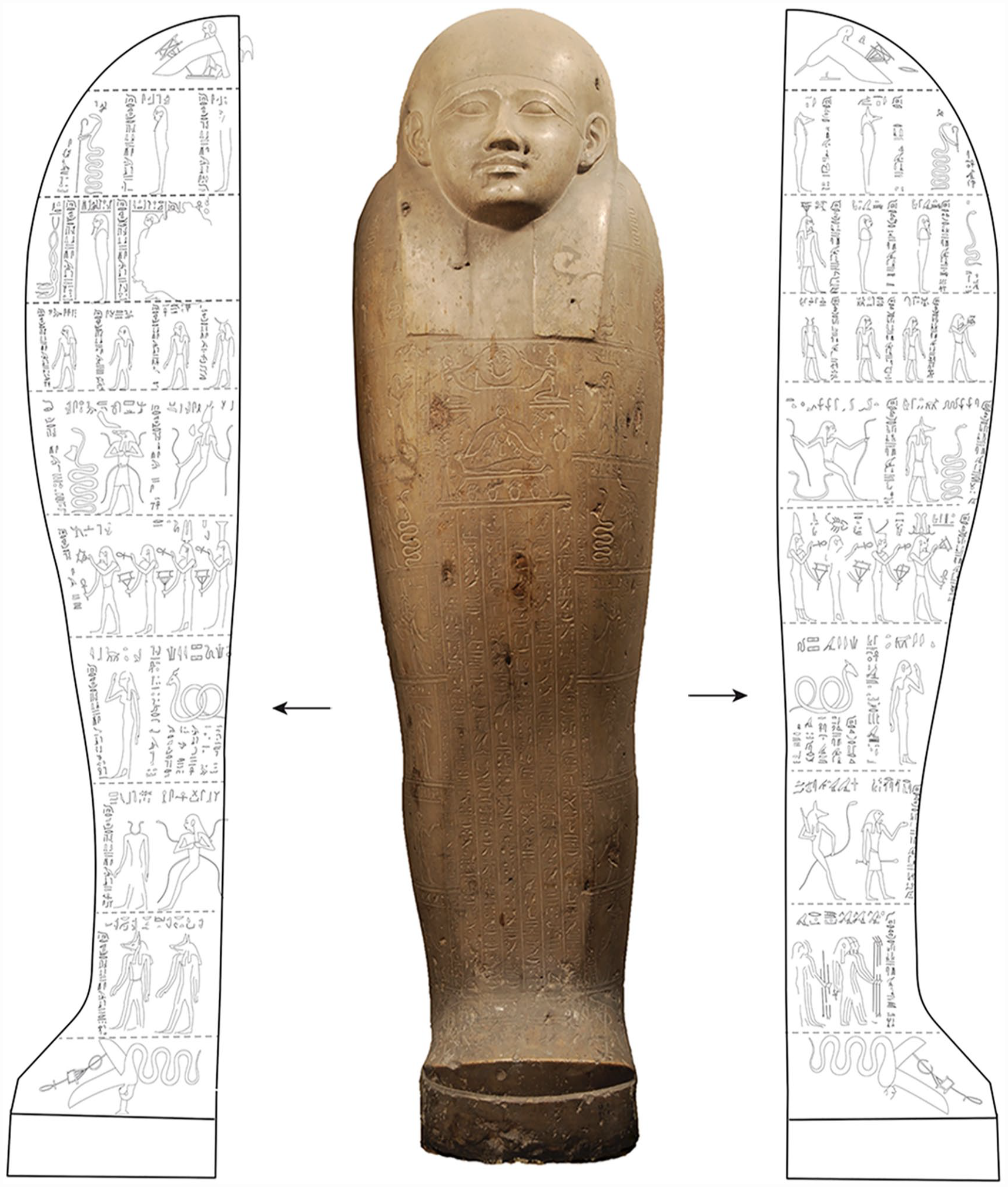
The sarcophagus of Amuniu (TR 13/1/21/1). Arrows note the position of the Ḥȝyšš (photo: Ahmed Amin).
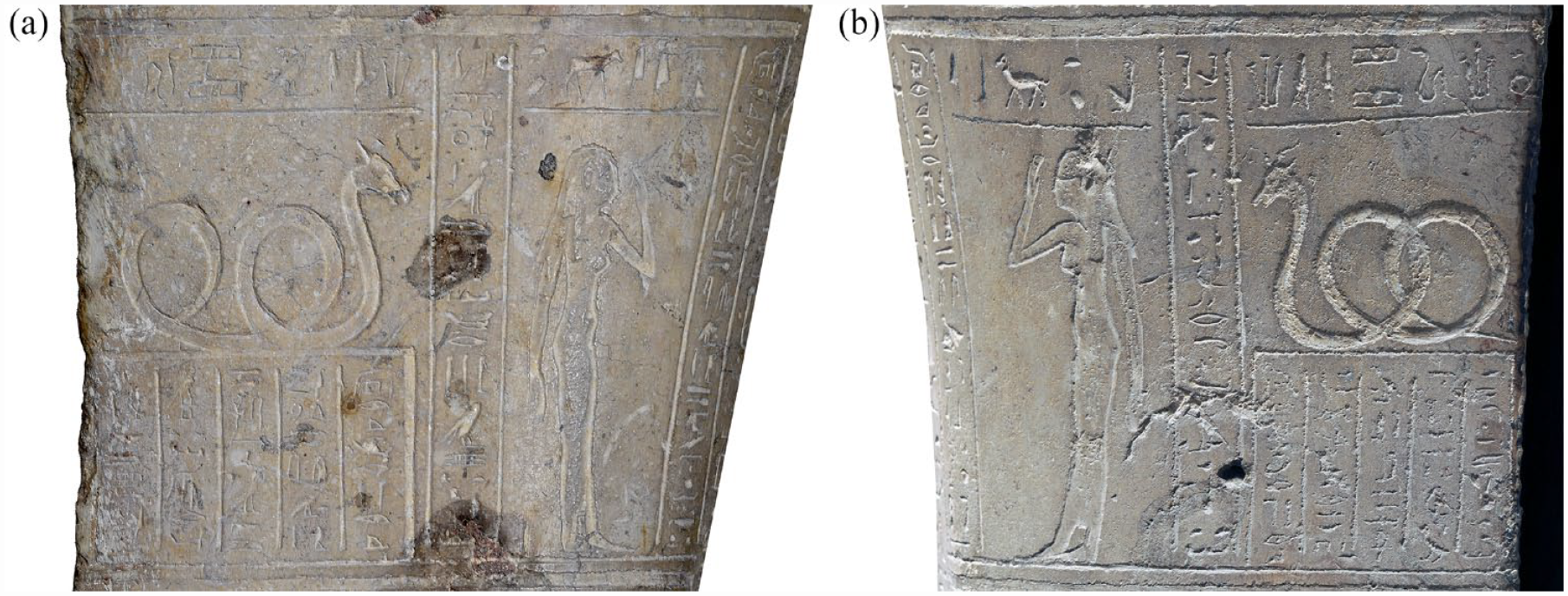
Ḥȝyšš and the accompanying mourning goddess in front. a) Right side, b) left side (photo: Ahmed Amin).
The god is placed on a pedestal, while a mourning goddess (Ngy.t on the right, Ἰbȝ.t on the left) stands in front of it. The text calls it Ḥȝyšš, ‘The god who animates the ba in the necropolis, who makes holy the mummies in the nome of Igeret (nṯr sʽnḫ bȝ m ẖr.t-nṯr ḏsr sʽḥ.w m spȝ.t ỉgr.t)’ on the right side, and Ḥȝyšš of Lower Egypt, ‘the god who animates the shadows, who lets the ba rest upon the corpse in the necropolis (nṯr sʽnḫ šw.wt sḫn bȝ r ẖȝ.t m ẖr.t-nṯr)’ on the left side. The creature thus shows the typical beneficial functions of funerary and protective gods, whose menacing form is an effective means of protection against enemies. 8
Other Attestations of
Ḥȝyšš
Fifteen more attestations of the hybrid snake deity, from the tenth century BC up to the Roman Period, are known. Since there are several recent works that contain lists of (almost) all known examples, some with illustrations, this shall not be repeated here (see, however, table 1 with a concordance at the end of the article). Rather, the specimens will be grouped according to their dating and similarity and put into context so that their development and possible interpretation can be examined more closely.
All attestations of the horse-serpent known at present. Concordance with the previous listings.

Type a
Characteristics: Head of a horse, (short) snake body, generally only one coil, no accompanying name
Attestations: Wooden coffins and cartonnage mummy-cases
Dating: Twenty-Second–Twenty-Sixth Dynasty
The first attestations, albeit without name, appear on several wooden coffins from Thebes: from the Twenty-Second Dynasty the coffins of Djedkhonsuiufankh (Louvre N 2585), 9 of a woman named Perenbastet in Manchester (inv. 5053), 10 and of Horkhebi, son of Kha(em)ipet, in a private collection in Wales; 11 from the Twenty-Fifth/Twenty-Sixth Dynasty 12 the coffins of Padiamun in Liverpool (World Museum 53.72.1, 2), 13 of his brother Nehemsumontu in Boulogne-sur-mer (inv. 1B), 14 and of Besenmut in Paris (Louvre E 10374). 15 There are two more examples, which, however, cannot be compared with the other contemporary ones, as they have not been published yet or have disappeared altogether: the outer coffin of Nehemsumontu (Boulogne-sur-mer inv. 1C), 16 and an unpublished coffin in Liverpool (Garstang Museum E 576). 17 Two more attestations on cartonnages are known, one on the complete cartonnage case of Nekhtkhonsuiru Ameneminet (Louvre E 5534), 18 and one on a cartonnage fretwork fragment in Liverpool (Garstang Museum E 2002). 19
In all these cases, the deity is placed at the shoulder of the coffin, usually below the collar. Of the known cases, all examples but two depict the body of the serpent with one coil (the exceptions are Besenmut with three coils, Nekhtkhonsuiru with one coil inside another). The creatures have a very accurate horse’s head including mane, ears and muzzle. On both the coffin of Padiamun and Nekhtkhonsuiru, it appears together with Isis and Nephthys, depicted either as women or as kites. In the case of Nekhtkhonsuiru, they make the gesture of mourning, which is also performed by the two goddesses associated with Ḥȝyšš on the sarcophagus of Amuniu. There is thus a tradition of using these mysterious creatures in pairs, acting as protective gods on coffins and cartonnages, sometimes additionally in connection with the sisters of Osiris. 20 Although there are some coffins which seem to be produced in the same workshop, both in the earliest phase (Twenty-Second Dynasty) 21 and in the second phase (Twenty-Fifth/Twenty-Sixth Dynasty), 22 the evidence is scarce, compared to the abundant number of coffins known. 23
Type b
Characteristics: Head of an undetermined animal (horse?), body of a snake with two or more coils, named Ḥȝyšš or Ἰ(ȝ)š(š)
Attestations: Sarcophagi and one wooden coffin
Dating: Ptolemaic Period
Three more Ptolemaic examples together with Amuniu’s sarcophagus form a group. One appears on the sarcophagus of Udjahor (Louvre D 11 = N 347), although the horse-serpent is written Ἰȝšš. 24 The serpent’s body has three coils, but the head is almost identical to that of Amuniu, although the central element between the ears is longer and bent forward in the example on the left side of the sarcophagus, while it consists of three thinner strokes in the scene on the right side. 25 The composition of the scene is the same, the creature placed upon a pedestal, with another god in front, although it is an upright snake with no connection to the lamenting women. 26 Furthermore, Ἰȝšš is described as šmʽw on the right side and, as is the case on Amuniu’s sarcophagus, mḥw on the left side. 27 The accompanying text on both sides is similar, but not identical with that of Amuniu: ‘the god who revives the ba in the necropolis, who animates the ba of the Osiris of the god’s servant Udjahor, born of Herkhepeshes (?), 28 justified’ (nṯr sʽnḫ bȝ m ẖr.t-nṯr di=f ʽnḫ bȝ n Wsir ḥm-nṯr WDȝ-Ḥr ms Ḥr-ḫpš=s (?) mȝʽ.t-ḫrw).
Similar to that of the sarcophagi of Amuniu and Udjahor, in terms of the visual appearance of the snakes and the composition of the scene, is the depiction on the wooden coffin of the priest Horkaka 29 (Brussels E. 7042): 30 in the top register of the exterior of the lid, a pair of the serpentine creatures appear symmetrically, designated here as Ἰš šmʽw on the right side and Ἰš mḥw on the left side. They have two coils, and the mysterious long protuberance appears on their heads in front of the two ears. They are placed on a pedestal inscribed with text, and have a second accompanying text above them. The serpents are described here again as ‘the god who revives the ba in the necropolis, who animates the ba of the Osiris Horkaka’. However, the description diverges from that of Amuniu, focusing primarily on the protection of the deceased: ‘I watch over you, (o) Osiris Horkaka, justified, in the necropolis! I exercise his protection in the Duat, eternally, so that he leads the Duat in the midst of men.’ As on Amuniu’s sarcophagus and on some of the earliest examples, they each follow a goddess, in this case the lamenting women par excellence, Isis and Nephthys. They are described here as cleaning the body of the deceased with water and providing him with fresh air. The central scene shows the deceased on a bier with his ba above and the sons of Horus below, elements that are also present at the centre of Amuniu’s sarcophagus. While the coffin of Horkaka thus contains numerous parallels with the other Ptolemaic representatives, it also displays certain elements of the earlier examples, namely the connection with Isis and Nephthys, as well as the attachment near the shoulder of the coffin, and thus near the head of the deceased lying in the funeral container.
One more Ptolemaic anthropoid sarcophagus whose decoration includes a horse-serpent is known, but curiously enough, the actual piece has since 1852 served as the coffin of Alexander, Duke of Hamilton, who brought the green schist sarcophagus, belonging to a woman named Iretiru, to Glasgow. 31 A serpent with fifteen coils on the sides of the lid of the sarcophagus has a head quite similar to the ones on the other Ptolemaic examples, although no ears nor a protuberance on the forehead are visible. 32 The head is furthermore positioned at the shoulder, as is the case on many of the wooden coffins of type a. No accompanying inscriptions are visible. This example shows that the use of the horse-serpent was not restricted to the same fixed pattern but could be adopted according to the needs of decoration.
Type c
Characteristics: Head of a hippopotamus, body of a snake with two coils, named Ḥȝyšš
Attestations: Tomb and temple
Dating: Late Period and Roman Period
Another pair of Ḥȝyšš was found in the tomb of Iufaa at Abusir, dating to the late Twenty-Sixth to the beginning of the Twenty-Seventh Dynasty. 33 The creature is again placed on a pedestal and depicted as a snake with two coils, which in this case are shifted towards the tail; its head seems to be that of a hippopotamus, as is indeed stated in the accompanying text. It bears the name Ḥȝyšš and the epithet ‘the god who animates the ba in the necropolis (nṯr sʽnḫ bȝ m ẖr.t-nṯr)’, which is almost the same text as on the sarcophagi of Udjahor and Amuniu. Furthermore, it is named in an accompanying offering formula as ‘this splendid god, who swims (in) the sea (nṯr pn mnḫ mḥ wȝḏ-wr)’, giving information about the ‘natural habitat’ of the god. A longer text below comprises a very instructive description of the outer appearance: It is a creator god (nṯr ʽȝ n sp tpy), its name is Red (dšr), 34 its head is like a female hippopotamus of lapis lazuli, its body like hematite, and it lives near the mouth of the sea (rȝ n wȝḏ-wr) with two different locations for both snakes (hȝ.w-nb.wt and šn-rḫy.t). Although it is not possible to locate these toponyms exactly, they probably refer to regions in the Aegean and the Nile Delta respectively. 35 Thus, instead of simply naming Upper and Lower Egypt as the location of the animals, here both places are in the northern coastal area of the Mediterranean. The text then states that the ba of the one who makes offerings to the god shall live in the necropolis (ʽnḫ bȝ=f m ẖr.t-nṯr). Then an offering list follows.
Only recently could another depiction be identified by its name after the cleaning of the ceiling in travée A in the Roman pronaos of the Khnum temple in Esna.
36
A snake with two coils and the head of a crocodile or hippopotamus
37
bears the name Ḥȝyšš šmʽ 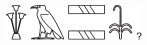 (fig. 3).
38
Von Lieven compares some of the genii in the tableau with those in the vignette of BD 149. This alleged funerary use may also explain the presence of Ḥȝyšš in this otherwise astronomical context.
39
Interestingly, the creatures in Esna in travée A (north) and F (south) are similar to the other snake gods in the tomb of Iufaa.
40
(fig. 3).
38
Von Lieven compares some of the genii in the tableau with those in the vignette of BD 149. This alleged funerary use may also explain the presence of Ḥȝyšš in this otherwise astronomical context.
39
Interestingly, the creatures in Esna in travée A (north) and F (south) are similar to the other snake gods in the tomb of Iufaa.
40
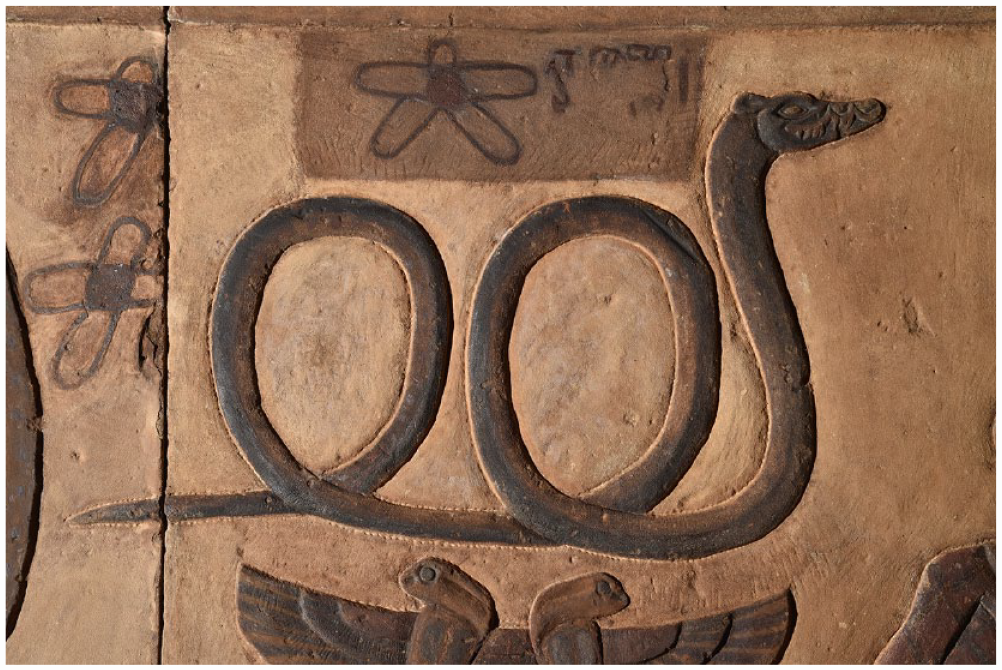
Ḥȝyšš on the ceiling of the temple of Esna (photo: Ahmed Amin, © Egyptian Ministry for Tourism and Antiquities).
In the two examples from type c, the crocodile/hippo’s head shows another evolution of the creature, which has developed from a naturalistic horse with a snake’s body to a dragon-like sea serpent and finally to a typical Egyptian polymorphic genius. Despite the large distance between Abusir (near modern Cairo) and Esna (in the south of Egypt), there must have been a similar template for both attestations, connected apparently to astronomy, which is not present on the coffins and sarcophagi.
Interpretations
The god Ḥȝyšš seems to be a kind of hippokampos (ἱππόκαµπος) or hippocamp, a sea monster attested in several mythologies throughout antiquity (Greek, Phoenician, Roman, and even Pictish), which is a composite of a horse head (and forefeet) and a fishtail (see e.g., fig. 4). 41 Since in ancient Egypt the snake is well-known in depictions of deities and demons, stellar constellations and last, but not least, the ‘monster’ Apophis, the use of a snake body instead of a fish is not surprising. 42 Kákosy speculates as to the Egyptian origin of the ubiquitous horse-serpent, since the combination of animal heads on snake bodies is a regular phenomenon in Egypt. 43 Thomas likewise describes a possible Egyptian development of the motif during the Libyan dynasty, when the importance of horses, which had only been known in Egypt since the New Kingdom, increased. 44 In any case, this would account for the very accurate rendition of the horse’s head on the earlier examples. On the other hand, Kákosy discusses the possibility of the concept of the sea-horse coming to Egypt through contact with Greece and Phoenicia during the seventh–sixth century BC. 45
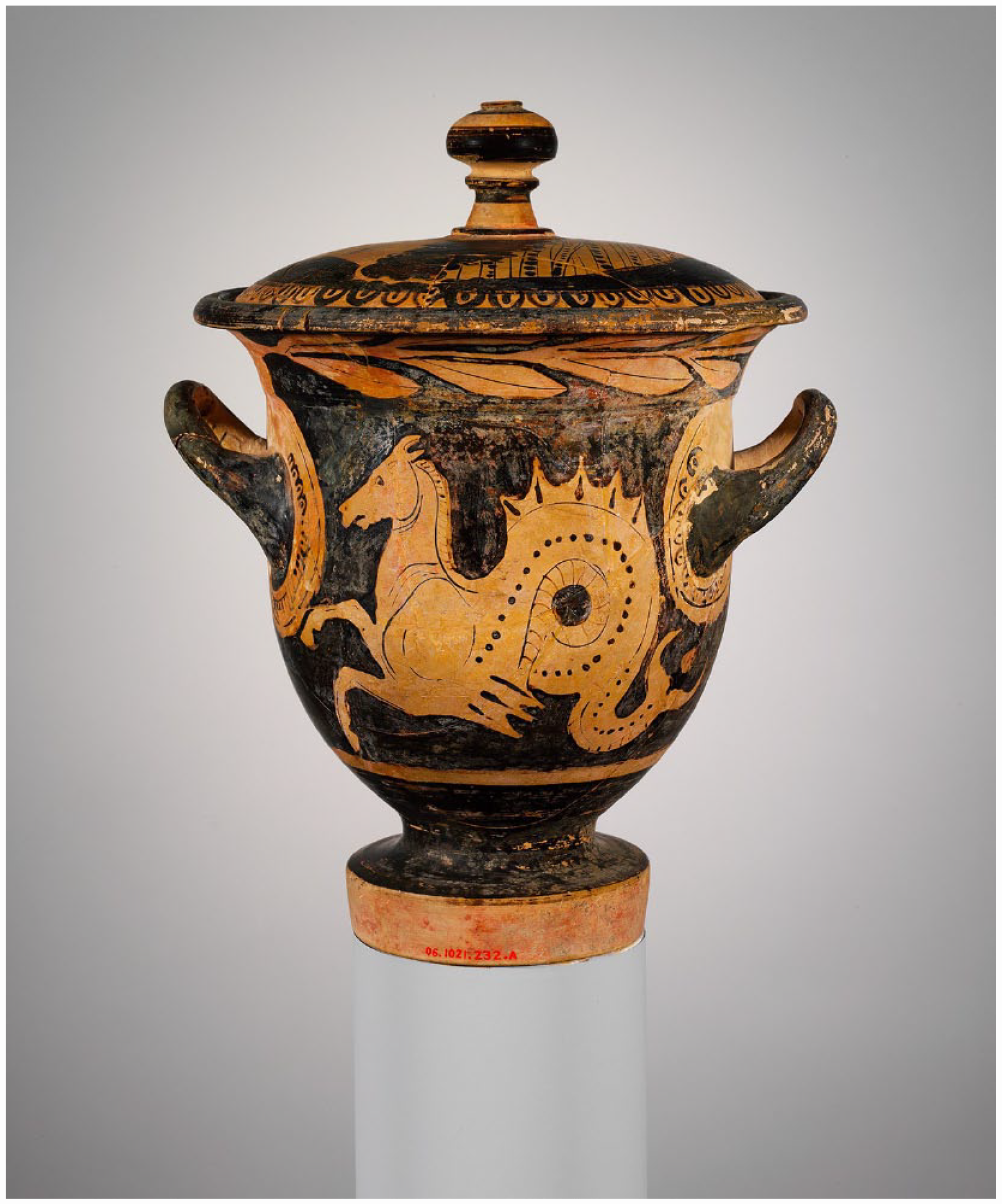
The hippokampos on a Greek red-figure bell-krater, Greek, Boeotian, fifth century BC, terracotta. MMA 06.1021.232a, b (Rogers Fund, 1906 CC0 1.0, <https://www.metmuseum.org/art/collection/search/247395> date accessed 06.05.2022).
Since the earliest known Egyptian examples of the ‘horse-serpent’ are older than these Greek representations, Thomas considers another line of transmission possible, namely from Near Eastern imagery. 46 This would fit with Kákosy’s proposition of a Semitic origin of the name, related to Arabic Hayya meaning ‘serpent’ 47 and Akkadian sisû meaning ‘horse’, which would be an exact rendition of the creature depicted. 48 However, the etymology of the latter component is not so clear, as all words for ‘horse’ deriving from Indo-Iranian languages (in addition to the Akkadian sisû: e.g., Hebrew sūs, Aramaic swsy, and also Egyptian ssm.t), do not have a š as is present in the god’s name. 49 An Egyptian etymology is proposed by Miatello, who understands the word as ‘the one behind the excretion (ḥȝ ỉšš)’, referring to the seahorse’s reproduction process at the end of which the male may release several thousand offspring from their ventral pouch. 50 However, this might firstly be a circular conclusion, which takes the identity of the seahorse as the model of the creature as given, and secondly it is highly doubtful whether the procreation act of those tiny animals, which moreover, primarily takes place at night, was actually observed, although this should not be ruled out completely. Many researchers also consider a repeated introduction or development of the motif to be conceivable, given that there is a clear difference between the early evidence (type a) and the late source groups (types b and c). 51
Despite the earliest depictions, which clearly show the head of a real horse, Kákosy has proposed that the hippocamp – in every culture – was modelled after the seahorse. 52 Indeed, its Latin genus name Hippocampus is suggestive and has often led to confusion between a) the biological designation of the animal and b) that of the mythological creature. 53 Of course, the representations are conceivable as an imaginative transformation by an artist, who had never seen an actual seahorse himself and thus merely followed its description as a mixture of horse and fish/snake. 54 The Greek hippokampos as draft animal of Poseidon’s chariot is explicable by his characteristic as a god of horses, so that the horse with a fishtail would be merely the ‘aquatic version’ of the quadruped. The later Egyptian examples, however, as well as other Greek sea monsters, such as Ketos (see, e.g., figs 5 and 6), seem to be rather ‘monstrous’ and dragon-like creatures, and it is difficult to imagine that they were modelled after the only 15–20 cm long seahorses.
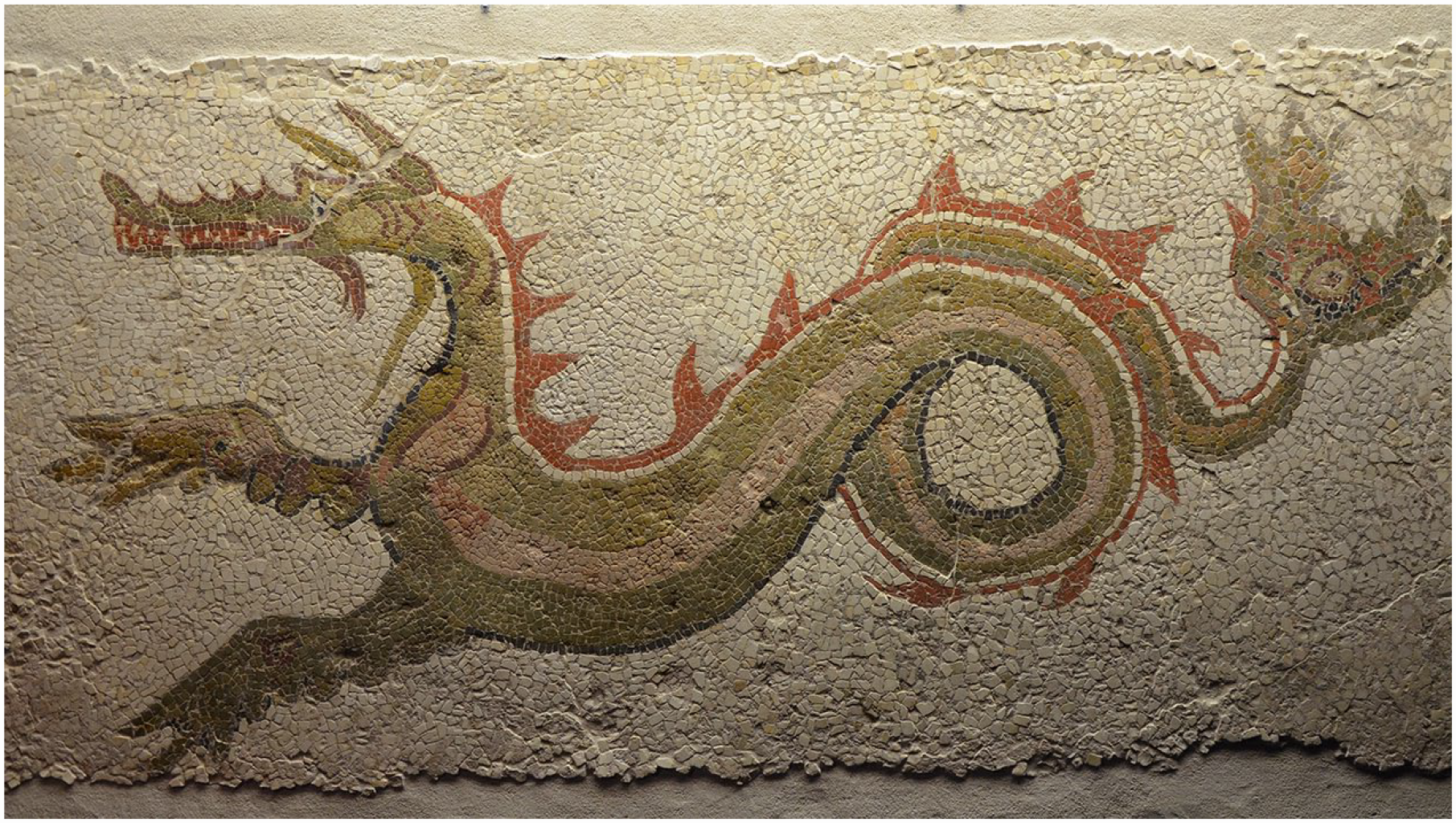
Mosaic with a sea monster from Caulonia (Monasterace), the dorsal ‘fins’ in red. Casa del Drago, third century BC (CC BY-SA 2.0, photo: Carole Raddato).
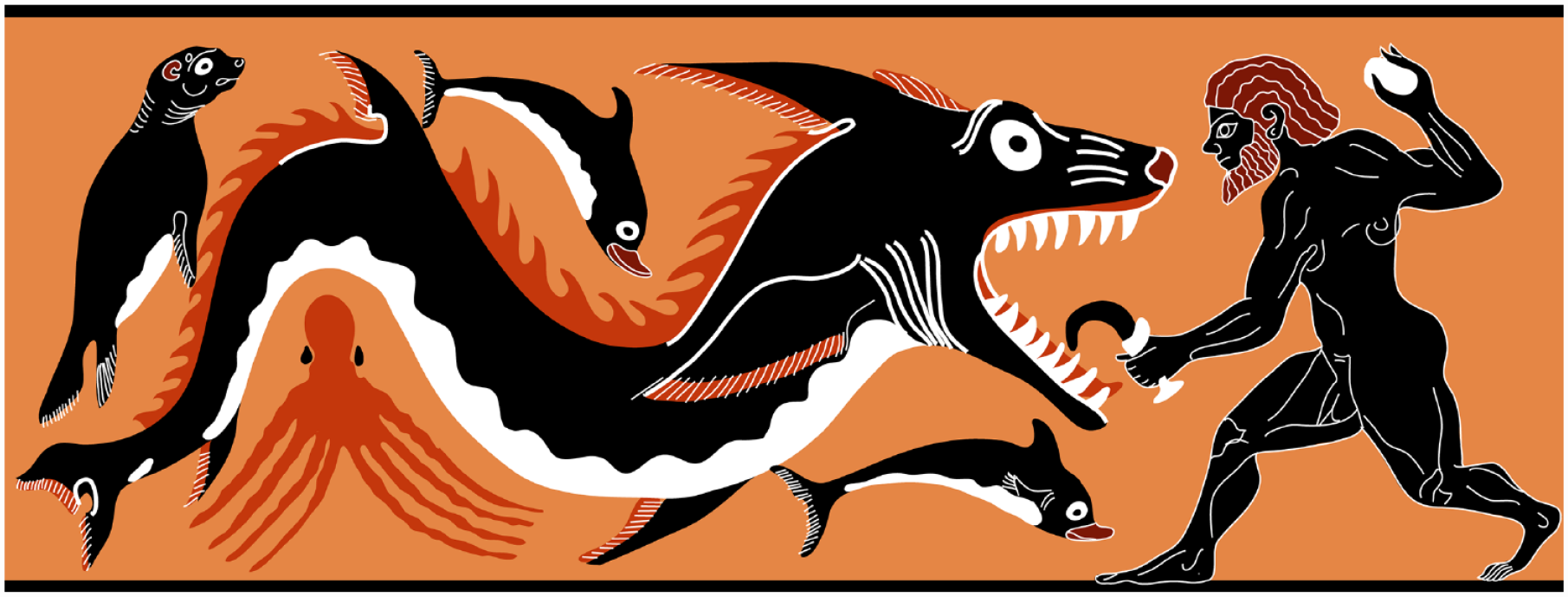
Herakles fighting the sea-monster Ketos, the dorsal ‘fins’ in red. Caeretan Black Figure hydria, c. 530–520 BC (Stavros S. Niarchos Collection, drawing: author).
A terrifying appearance was well-suited for a protective deity. 55 Thomas furthermore refers to the speed that is inherent to both horse and snake, as well as the mortal danger that poisonous snakes pose. 56 All this makes the interpretation as a seahorse rather unlikely. I thus suggest another identification of the animal that inspired at least the later forms of the Egyptian horse-serpent, if there was any real example in nature at all: 57 the giant oarfish (Regalecus glesne) (fig. 7). This species of large, snakelike, bony fish inhabits almost all seas of the world, including the Mediterranean. 58 This corresponds to the description in the tomb of Iufaa that the creature swims in the Mediterranean Sea (wȝḏ-wr), although this would also be true for the seahorse. They are rarely sighted, since they mostly live in the deep seas and only float to the surface when dying. Sometimes specimens are washed to shore, and it has therefore been proposed that they have contributed to the myths of sea monsters (fig. 8). 59

The giant oarfish, first fin rays and dorsal fins in red (coloured print, c. 1700–1880. Iconographia Zoologica, Regalecus gladius. Box 53: 137.03.03.001. Special Collections University of Amsterdam – UBA01 IZ13700013. Public domain).

Giant oarfish that washed ashore on a Bermuda beach in 1860. The animal was c. 5 m long and was originally described as a sea serpent (Wikimedia commons, PD-old, source: Harper’s Weekly).
This findspot may also have led to the conclusion in the Iufaa text that they lived at the ‘mouth of the sea’. The huge size of 3 to 11 metres might have inspired the spacious measurements of 70 cubits (35 m) for the chamber in which the creature is located according to the text in the tomb of Iufaa, 60 although this might also be a purely symbolic number. 61 The elongated first few fin rays of the dorsal fin of the oarfish are in striking accordance with the later depictions of Ḥȝyšš and its mysterious protuberance(s) in the middle of the head. The fins additionally stand out by their bright red colour, which may be reflected by some of the descriptions of Ḥȝyšš in the tomb of Iufaa: Its designation as ‘Red’ (dšr) as well as ‘it is like hematite (ỉw=f mỉ dỉdỉ)’ and ‘their bottom sides are in the flames of fire (ỉw ẖrw=sn m pʽ.w n.w ḫ.t)’. 62
The red colour of dorsal ‘fins’ is also found in depictions of Ketos and other sea monsters (see figs 5 and 6), which could be a coincidence, based on artistic conventions, but on the other hand might have its cause in observations of nature.
Conclusion
All sixteen attestations of the snake god named in the later sources Ḥȝyšš (var. Ἰȝšš) are found from the Third Intermediate Period until the Roman Period on coffins and sarcophagi. This protective deity is often connected with depictions of mourning goddesses and several times is placed near the shoulder of the coffin. Only the oldest examples depict a real horse’s head, while later ones are not so clear as to the form of the head. Two later examples even display a hippopotamus’s head. Thus, although the seahorse has often been proposed as its model, it seems to be nearer to the Greek hippokampos, which was a purely mythical monster like the Minotaur or centaur, that is, a mixture of two different creatures. However, based on features found in some of the pictures and in the most extensive descriptive text, the extremely rare and enormous snakelike giant oarfish is proposed here as a new interpretation for an – at least partial – real-life model.
Footnotes
Acknowledgements
I thank Raymond Dosoo (Würzburg) for correcting my English and his useful comments, and Andrea Kucharek (Heidelberg) for her careful reading of this paper. I furthermore thank Günter Vittmann (Würzburg) and Christian Leitz (Tübingen) for reading earlier drafts.
Funding
The author did not receive funding for this project but did perform initial research as a part of a DAAD project.
1
E.g., Lucian, Deorum concilium, 10–11; in the poem ‘Mit Bakis‘ Weissagen vermischt’, l. 420–3, in J. W. von Goethe, Zahme Xenien (München, 2014), 2. See, regarding the judgment of ancient authors on the animal cult in Egypt, S. Pfeiffer, ‘Der ägyptische „Tierkult“ im Spiegel der griechisch-römischen Literatur’, in A. Alexandridis, M. Wild, and L. Winkler-Horaček (eds), Mensch und Tier in der Antike: Grenzziehung und Grenzüberschreitung. Symposion vom 7. bis 9. April 2005 in Rostock (Wiesbaden, 2008), 373–93; B. Hufft, ‘„Wie kommst du Kläffer dazu, ein Gott sein zu wollen?“ Zur Tiergestaltigkeit von Gottheiten im Alten Ägypten’, in E. Martin (ed.), Tiergestaltigkeit der Göttinnen und Götter zwischen Metapher und Symbol (Biblisch-Theologische Studien 129; Neukirchen-Vluyn, 2021), 37–103.
2
P. de Maret, ‘L’oryctérope, un animal « bon à penser » pour les Africains, est-il à l’origine du dieu égyptien Seth?’, BIFAO 105 (2005), 107–28.
3
I use the term ‘sarcophagus’ for containers made of stone, and ‘coffin’ for wood or other materials.
4
See, on this deity, LGG V, 21a–b; P. Vernus and J. Yoyotte, Bestiaire des Pharaons (Paris, 2005), 248; L. Kákosy, ‘The hippocampos in Egyptian sepulchral art’, OLP 18 (1987), 5–12; J. H. Taylor, ‘The earliest Egyptian hippocampus’, in T. Schneider and K. Szpakowska (eds), Egyptian Stories: A British Egyptological Tribute to Alan B. Lloyd on the Occasion of his Retirement (Münster, 2007), 405–16. An extensive study has been provided by C. Thomas, ‘Le Cheval-Serpent, un curieux génie funéraire’, RdE 64 (2013), 211–29, who adds, to the six examples named by Kákosy, six more, but seems to have missed one or two, which are mentioned by Taylor, in Schneider and Szpakowska (eds), Egyptian Stories. Another list (with drawings) of thirteen attestations (including one bronze, which really seems to be a seahorse, and has nothing to do with the god Ḥȝyšš) and a new interpretation of the name is presented by L. Miatello, ‘Texts and iconography of Padiamun’s coffin in the Liverpool Museum’, Birmingham Egyptology Journal 4 (2016), 31–8. See, on this coffin, with a short paragraph on the horse-serpent, A. Dautant, R. Lucarelli, L. Miatello, and C. M. Sheikholeslami, ‘Creativity and tradition in the coffin of Padiamun (Liverpool 1953.72): A case study of Twenty-Fifth Dynasty mortuary practice’, in A. Kóthay (ed.), Burial and Mortuary Practices in Late Period and Graeco-Roman Egypt: Proceedings of the International Conference held at Museum of Fine Arts, Budapest, 17–19 July 2014 (Budapest, 2017), 177–95. The latest discussion, with a presentation of the example in the shaft tomb of Iufaa in Abusir, is R. Landgráfová, ‘The seahorse (ḥȝjšš) from the shaft tomb of Iufaa: New evidence of the elusive creature’, Annals of the Náprstek Museum 40 (2019), 59–68.
5
V. Altmann-Wendling, ‘The sarcophagus of Amuniu (TR 13/1/21/1)’, in C. Leitz, Z. Mahrous, and T. Tawfik (eds), A Selection of Ptolemaic Anthropoid Sarcophagi in Cairo (Cairo, 2021), 191–238, 220–2, 232–4. An even larger number of 34 deities on each side is present on the sarcophagus of Panehemisis, see C. Leitz, Der Sarg des Panehemisis in Wien (SSR 3; Wiesbaden, 2011), 51–178 § 6–7. 28 deities appear on each side of the sarcophagus of Horemhab, see Leitz, Panehemisis, 401–15 § 5–6, cf. also C. Leitz, Z. Mahrous, and T. Tawfik (eds), Catalogue of Late and Ptolemaic Period Anthropoid Sarcophagi in the Grand Egyptian Museum (Grand Egyptian Museum – CG 1; Cairo, 2018), 57. Their function is described in several texts that are presented by Leitz, Panehemisis, 53–6. See, on the protective gods, C. Teotino, Eine Studie zu den apotropäischen Gottheiten auf den Kairener Sarkophagen des Djedher (CG 29304) und Anchhapi (CG 29303) (SSR 35; Wiesbaden, 2022).
6
Nothing more is known about the person except the titles on the sarcophagus, which call him a ḥm-nṯr-priest of Osiris, who resides in Leontopolis (ỉȝ.t-ḫnw) (§ 2, l. 3, see Altmann-Wendling, in Leitz, et al. (eds), Ptolemaic Anthropoid Sarcophagi, 199).
7
Kákosy, OLP 18, 7: ‘horn’; Kákosy, OLP 18, 9: ‘horn or lock of the mane’. The depiction on the right side is not as clear as on the left, the second ear and the ‘horn’ might be missing.
8
See below, interpretation.
9
Taylor, in Schneider and Szpakowska (eds), Egyptian Stories, 407–9; Thomas, RdE 64, pl. 16c.
10
Taylor, in Schneider and Szpakowska (eds), Egyptian Stories, 409–10. It is not mentioned by name by Thomas, RdE 64, who does not refer to Taylor’s article either, but it is probably Thomas’ no. 11, the inside of a wooden coffin from the Twenty-Second Dynasty, which was mentioned without further information or photograph by N. Cooke, ‘Burton’s mummy: The fate of the mummy brought to England by James Burton in the 19th century’, Minerva 7:6 (1996), 29.
11
Taylor, in Schneider and Szpakowska (eds), Egyptian Stories, 410–11 points out the similarity to the two aforementioned pieces and therefore suggests the same workshop and similar date for the three coffins, before the reign of Osorkon I. This coffin is not mentioned by Thomas, RdE 64.
12
Taylor, in Schneider and Szpakowska (eds), Egyptian Stories, 411 argues for the Twenty-Fifth Dynasty instead of the Twenty-Sixth Dynasty date given by Kákosy, OLP 18, 5–6. Thomas, RdE 64, 211 dates to a transition from Twenty-Fifth to Twenty-Sixth Dynasty.
13
M. A. Murray, ‘An Egyptian hippocampus’, in E. B. Knobel, W. W. Midgley, J. G. Milne, M. A. Murray, and W. M. F. Petrie (eds), Historical Studies (BSAE 19; London, 1911), II, 39–40, pl. XXI; R. Moss, ‘By-products of bibliography’, JEA 54 (1968), 174; pl. XXVI; Cooke, Minerva 7:6, 26–9; Taylor, in Schneider and Szpakowska (eds), Egyptian Stories, 411; Thomas, RdE 64, 2013, pl. XIIa; a recent publication by Miatello, Birmingham Egyptology Journal 4, 10–61. Murray compares the depiction to a hippocamp in an early temple of Athena, which is also clearly similar to the creature on the coffin with respect to colouring (Murray, in Knobel, et al. (eds), Historical Studies, II, 40); she therefore deduces a direct influence of Greek Archaic art.
14
Anonymous, Société et Croyances au temps des Pharaons : Musée des Beaux-Arts et d’Archéologie de Boulogne-sur-Mer, 28 juin–25 octobre 1981 (Boulogne-sur-Mer, 1981), 23; Thomas, RdE 64, pl. 16a. On the dating, see Taylor, in Schneider and Szpakowska (eds), Egyptian Stories, 412.
15
Taylor, in Schneider and Szpakowska (eds), Egyptian Stories, 413; Thomas, RdE 64, 212, pl. 16b. It has the accompanying text imy dwȝ.t ‘the one who is in the Duat’ (Thomas, RdE 64, 224). Taylor, in Schneider and Szpakowska (eds), Egyptian Stories, 415–16 furthermore mentions the inscription in-ʽȝ ‘the one who brings the doorkeeper (?)’ and proposes a connection with the judgment scene. Miatello, Birmingham Egyptology Journal 4, 36, however, understands as ‘the one who brings back = closes the door’ and connects this with a function of the beast as an apotropaic deity at doors.
16
See Thomas, RdE 64, 211 nn. 3 and 5. According to descriptions, it looked similar to the inner coffin.
17
Thomas, RdE 64, 212; Miatello, Birmingham Egyptology Journal 4, 32 (j).
18
Thomas, RdE 64, pl. XIIb; Kákosy, OLP 18, 6, pl. I. Dated to the Twenty-Fifth Dynasty by Taylor, in Schneider and Szpakowska (eds), Egyptian Stories, 412–13. Thomas, RdE 64, 212, 227, however, writes Libyan Dynasty, without any explanation in the description.
19
Thomas, RdE 64, pl. XIIc. Due to the similarity with the cartonnage of Nekhtkhonsuiru, it is dated to the same period by Taylor, in Schneider and Szpakowska (eds), Egyptian Stories, 413 n. 35. The identity of the depiction on the funerary bed from Roman Kharga, mentioned by Kákosy, OLP 18, 9, is doubted by Taylor, in Schneider and Szpakowska (eds), Egyptian Stories, 406, and Thomas, RdE 64, 215.
20
See, on this function, also Thomas, RdE 64, 224.
21
Taylor, in Schneider and Szpakowska (eds), Egyptian Stories, 410.
22
Taylor, in Schneider and Szpakowska (eds), Egyptian Stories, 413.
23
See the remarks by Taylor, in Schneider and Szpakowska (eds), Egyptian Stories, 410–14.
24
Kákosy, OLP 18, 8–9; pl. 5; Buhl, Sarcophagi, 101–2; Thomas, RdE 64, 215. See also Guermeur, Cultes d’Amon, 63–5.
25
Kákosy, OLP 18, 9 interprets this as the mane.
26
They are instead gods of the Netherworld and the Judgment Scene, as may also be the case for the horse-serpent on the coffin of Besenmut (see above, n. 15).
27
It is therefore plausible that a duality of Lower and Upper Egypt was always intended.
28
See on the name Kákosy, OLP 18, 8–9.
29
Probably Ḥr-kȝkȝ and not Ḥr-kȝ.wy, as can be found in some publications. The same name appears on the statue JE 37328 from the Karnak Cachette (K. Jansen-Winkeln, Biographische und religiöse Inschriften der Spätzeit aus dem ägyptischen Museum Kairo (ÄAT 45; Wiesbaden, 2001), I, 258–66, no. 41 (263–4 n. 7 on the reading of the name, he proposes a connection with the kȝkȝ-plant); II, 438–9; pls 86–7. I thank Günter Vittmann for the discussion on this name.
30
A study of this coffin in the thesis of De Caluwe is unpublished and contains only rough drawings: A. De Caluwe, De houten sarcofaag E. 7042 van de Koninklijke Musea voor Kunst en Geschiedenis te Brussel (PhD thesis, Rijksuniversiteit Gent; Gent, 1990), 26, 39–45. It will now be published anew by Carolina Teotino (Tübingen). See until then, W. von Bissing, ‘Geschnitzter Holzsarg persischer Zeit aus Ägypten’, Archiv für Orientforschung 10 (1935–6), 133–40; C. De Wit, ‘Quelques objets intéressants de la collection des musées, I : Un sarcophage égyptien de basse époque’, Bulletin des Musées royaux d’art et d’histoire 28 (1956), 21–7; M.-P. Vanlathem, Oudegyptische lijkkisten en mummies: Cercueils et momies de l’Égypte ancienne (Bruxelles, 1983), 22–3; C. Teotino, ‘The rectangular coffin of Horkaui (E.7042)’, in L. Delvaux and I. Therasse (eds), Sarcophages : Sous les étoiles de Nout (Bruxelles, 2015), 144–7;  date accessed 30.12.2021.
31
The presence of the horse-serpent on the sarcophagus was pointed out by Taylor, in Schneider and Szpakowska (eds), Egyptian Stories, 416 n. 42; M. L. Bierbrier, The Tomb-Builders of the Pharaohs (London, 1982), 134–5 (fig. 91). The publication from the rubbings, made when the sarcophagus was moved from the mausoleum and interred in a grave, is still pending; see A. Dodson, ‘Legends of a sarcophagus’, in T. Schneider and K. Szpakowska (eds), Egyptian Stories: A British Egyptological Tribute to Alan B. Lloyd on the Occasion of his Retirement (Münster, 2007), 47–53. This makes it the fifteenth attestation, as it was not mentioned in the more recent lists of the creature.
32
Dodson, in Schneider and Szpakowska (eds), Egyptian Stories, , confirmed by a picture of the rubbing, which Aidan Dodson was kind enough to send to me, shows the creature, although it is not very detailed. Unfortunately, only one side was copied before the final burial of the sarcophagus, but it can be presumed that the other side was decorated symmetrically.
33
Landgráfová, Annals of the Náprstek Museum 40, 59–68.
34
The statement of Landgráfová, Annals of the Náprstek Museum 40, 64, that the northern Ḥȝyšš on the sarcophagus of WDA-1r may be called ‘the One which shines red (psḏ dšr (?)’, is probably unlikely as this is part of the designation of the snake in front of the horse-serpent.
35
Landgráfová, Annals of the Náprstek Museum 40, 62, 64.
36
See (without text) S. Sauneron, Le temple d’Esna : Nos. 399–472, I (Esna I/1; Cairo, 1969), no. 401. This makes a total number of sixteen horse-serpents known so far. It has already been briefly mentioned and shown (without inscription), but not described further by Landgráfová, Annals of the Náprstek Museum 40, 62, 65 ().
37
See the depiction and textual description in the tomb of Iufaa. A. von Lieven, Der Himmel über Esna: Eine Fallstudie zur religiösen Astronomie in Ägypten am Beispiel der kosmologischen Decken- und Architravinschriften im Tempel von Esna (ÄA 64; Wiesbaden, 2000), 16 identifies it as a crocodile’s head, but it resembles very much the heads of the two standing gods, whose bodies are clearly that of hippos. Von Lieven, Himmel über Esna, 15 n. 48 states, regarding those two deities, that it is hard to distinguish between the crocodile and hippo head. Yet, the heads of the crocodiles in the same travée seem in comparison a bit more elongated and the eyes smaller.
38
I thank Christian Leitz, who is leading the Esna-Project Tübingen, for providing me with this information. The accompanying texts exist only in a sketchy scripture, as their carving in stone was never carried out; they are therefore difficult to read. Leitz comments on the last sign that it is only visible on an older photograph and therefore not completely certain. See on the depiction (without consideration of the text, which was not visible before the cleaning), von Lieven, Himmel über Esna, 15–17.
39
Travée A contains an elaborated depiction of the complete lunar cycle (see V. Altmann-Wendling, MondSymbolik – MondWissen: Lunare Konzepte in den ägyptischen Tempeln griechisch-römischer Zeit (SSR 22; Wiesbaden, 2018), 606–12). Since almost all scenes of the ceiling are first attested in tombs, a use on both astronomical ceilings and as protective deities for the deceased is not very surprising (see on a similar case concerning some protective gods, which are also attested as lunar days, V. Altmann-Wendling, ‘The sarcophagus of Hor-Re (GEM 2761)’, in C. Leitz, et al. (eds), Late and Ptolemaic Period Anthropoid Sarcophagi, 75; Altmann-Wendling, MondSymbolik, 286–91).
40
Landgráfová, Annals of the Náprstek Museum 40, 62.
41
See e.g., G. Wissowa and W. Kroll (eds), Paulys Real-Encyclopädie der classischen Altertumswissenschaft: Neue Bearbeitung. Erste Reihe A–Q (Stuttgart, 1893–1963), 8, 1748–72, s.v. Hippokampos.
42
Vernus and Yoyotte, Bestiaire, 45, 294–334, 637–41. Compare the depictions of Isis and Nephthys with snake bodies on the sarcophagus of Amuniu (Altmann-Wendling, in Leitz, et al. (eds), Ptolemaic Anthropoid Sarcophagi, 236–8).
43
Kákosy, OLP 18, 10. Taylor, in Schneider and Szpakowska (eds), Egyptian Stories, 414 also considers an Egyptian origin to be the most plausible, as the first appearance of the creature occurs in a period of little contact with the Mediterranean and the Near East.
44
Thomas, RdE 64, 223. See, on the horse in Egypt, Vernus and Yoyotte, Bestiaire, 535–43.
45
Kákosy, OLP 18, 10–11. The earliest source from Egypt known to him was a Greek vase with a hippocamp, possibly from the sixth century BC, found in Tanis. A small find that shows a hippocamp is mentioned by Thomas, RdE 64, 215, pl. XIIIa, see M. Jaramago Canora, ‘El caballito de mar egipcio del Museo de Bellas Artes’, Boletín de la Asociación Española de Orientalistas 30 (1994), 301–7. Jaramago Canora is surely right in the assumption that the model for a bronze from Madrid was a real (albeit dead) seahorse, since its upper body strongly resembles this small aquatic animal. Miatello, Birmingham Egyptology Journal 4, 32, counts this as his thirteenth attestation of the hybrid horse-serpent as is found on the sarcophagi and coffins, but there is no connecting element, even the Egyptian origin can be doubted.
46
Thomas, RdE 64, 221–3 with further references; an example for a creature closer resembling the specimen on the later Egyptian sarcophagi is attested in, e.g., Mesopotamia (ibid., pl. XIIId).
47
Aramaic ḥwh, see W. Gesenius, Hebräisches und aramäisches Handwörterbuch über das Alte Testament (18th edn; Berlin, 2013), 329.
48
Kákosy, OLP 18, 11.
49
See with more examples, Gesenius, Hebräisches und aramäisches Handwörterbuch, 877. I thank Günter Vittmann for helpful comments on this matter.
50
Miatello, Birmingham Egyptology Journal 4, 38.
51
Kákosy, OLP 18, 12; Taylor, in Schneider and Szpakowska (eds), Egyptian Stories, 416.
52
Kákosy, OLP 18, 10, pl. VI, followed by e.g., LGG V, 21a ‘Seepferdchen’; Vernus and Yoyotte, Bestiaire, 248; Miatello, Birmingham Egyptology Journal 4, 38.
53
Thomas, RdE 64, 217 writes: ‘Nombre des chercheurs […] ont employé le mot “hippocampe” ; en realité, il ne s’agit pas de representations naturalistes d’hippocampes’, thus thinking of meaning a, although – to my understanding – most of the previous studies use the word in meaning b. Thomas, RdE 64, 218–21 further elaborates by distinguishing between the ‘hippocampe’ and ‘cheval de mer’.
54
Cf. early depictions of elephants or giraffes in medieval Europe, which bear very little resemblance to the actual animal.
55
Cf. the knives or snakes held by other protective deities (see, e.g., Leitz, Panehemisis, 51–178, § 6–7). See also Vernus and Yoyotte, Bestiaire, 647–52 on the functions of hybrid creatures, among them, relevant here, the evocation of terror in order to repel enemies and the accumulation of different capacities.
56
Thomas, RdE 64, 224.
57
In Egyptian, but also in Greek mythology, to mention only two, there are undoubtedly numerous ‘monsters’, which represent a combination of two real beings (like the Minotaur, the centaur, or the many Egyptian genii with snake bodies and the heads of humans, birds, etc.), which have not inspired a search for a real model in nature. There is even another similar hybrid creature with a fish-tail, but a goat’s head instead of that of a horse, the Capricorn. Since, however, creatures similar to the hippokampos exist in many different cultures, there might be a deeper meaning behind it. See, on fantastic beasts, Vernus and Yoyotte, Bestiaire, 632–55.
58
T. R. Roberts, Systematics, Biology, and Distribution of the Species of the Oceanic Oarfish genus Regalecus (Teleostei, Lampridiformes, Regalecidae) (Paris, 2012); on sightings in the Aegean, see G. Minos, ‘On the occurrence of crested oarfish Lophotus lacepede Giorna, 1809 in northern Aegean Sea’ [in Greek], in G. Minos, T. Karidas, and P. S. Economidis (eds), Proceedings of the 15th Hellenic Conference of Ichthyologists (Thessaloniki, 2013), 161–4.
59
See, e.g., R. Ellis, Seeungeheuer: Mythen, Fabeln und Fakten (Basel, 1997), 45–6.
60
Landgráfová, Annals of the Náprstek Museum 40, 60.
61
M. Rochholz, Schöpfung, Feindvernichtung, Regeneration. Untersuchung zum Symbolgehalt der machtgeladenen Zahl 7 im alten Ägypten (ÄUAT 56; Wiesbaden, 2002).
62
One would rather expect this to describe the upper rather than the bottom side, but this might be a confusion or incorrect description of this rarely sighted animal. This is also the reason for the present name ‘oar fish’: the dorsal fins were originally interpreted as the fish’s means of locomotion, thus resembling oars.
Author biography
Victoria Altmann-Wendling studied Egyptology, Prehistory, and Palaeoanthropology in Tübingen, where she also received her PhD with a thesis on the moon in ancient Egypt. She worked on projects in Tübingen, Heidelberg and Munich and has been working in Würzburg on a project on the Horus temple of Edfu since 2019. Her scholarly interests are ritual texts, funerary culture, astronomy, and Graeco-Roman temples.