



Abstract
Translation and discussion of multiple Late Period statues from the Karnak Cachette, all of which feature similar content and a preponderance of uniliteral (quasi-alphabetic) spellings.

Introduction
The following statues, all discovered in the Karnak Cachette, share the same rare formulas, a penchant towards Late Period, quasi-alphabetic writing, and other notable spellings. A connection between the first three statues was noted years ago by Herman De Meulenaere, who only translated a brief excerpt. 1 Further similarities can be found on a cuboid statue published by Jansen-Winkeln (JE 37873 = CG 48646), 2 and an archaizing scribal statue (JE 37195). 3 Although only one of these statues has been completely translated (JE 36987), the difficult text on its base can be better understood through comparison with the first two statues. The following discussion will thus not dwell on the objects themselves, but instead will focus on their quasi-alphabetic texts.
The term ‘quasi-alphabetical’ here refers to a well-documented feature of Late Period texts. Common words are stripped of their conventional determinatives, ideograms, and multiliteral signs, and spelled primarily using unliteral signs, frequently omitting weak consonants (ȝ, ỉ, w, and in certain contexts ʿ). 4 As others have noted, this writing style – beginning already in the 25th Dynasty, if not earlier – predates major Egyptian contacts with Greece; furthermore, the term ‘alphabetical’ is a misnomer. Generally, only the strong consonants are recorded, not the vowels, and such uniliteral spellings typically occur alongside conventional spellings using ideograms and classifiers. Herman De Meulenaere had noted that this writing system, however frequent at Sais and Memphis, was relatively rare on Theban monuments of the 26th Dynasty, and emphasized the personal connections dedicants from this group (e.g., JE 37873, Doc. B) might have maintained with Psamtek I and the Delta. 5
While this graphic peculiarity, which removes most traditional word boundaries and contextual clues, often challenges modern Egyptologists, it remains an open question of how ancient readers perceived them. For learned scribes and priests, familiar with biographical clichés and offering formulas, and of course all fluent in the ancient Egyptian language, these minimal phonetic clues may have sufficed to prompt the correct readings.
Yet some evidence would support the traditional view that such texts were intentionally obfuscating. First, a similar alienating procedure was applied to the Netherworld books of the New Kingdom, making those highly classified texts even harder to parse for the uninitiated. 6 Second, such spellings in the Late Period often occur on the monuments of highly educated individuals, well-versed in earlier texts and monuments (e.g., Harwa, Montuemhat, Sheshonq, Padiamenope). The texts below come from statues of major scribes, two of them Overseers of Instruction (imy-rA sbA) (Docs C–D), tasked with, among other things, teaching hieroglyphs to novice priests and elucidating difficult passages in texts.
Documents
Primary statues
A. Baltimore, Walters Art Museum 22.175 (K 429)
Kneeling, naophorous statue of Pakharkhonsu.
7
A small figurine of Osiris is kept within a naos, which rests on the dedicant’s lap.
Pakharkhonsu was a priest of Montu Lord of Thebes (North Karnak), and his only scribal titles were ‘scribe of the divine seal (sš ḫtmty-nṯr)’ and ‘reckoning scribe (sš ḥsb)’ of the Domain of Amun. Based on stylistic criteria, his statue has been dated to the early 26th Dynasty.
B. New York, Metropolitan Museum of Art 19.2.2 (K 238)
Theophorous statue belonging to Harbes, also known as Psamtek-nefer.
8
Harbes stands behind a large statue of Osiris, who stands upon a socle, not inside a naos. Cartouches on his arm securely date this statue to the reign of Psamtek II.
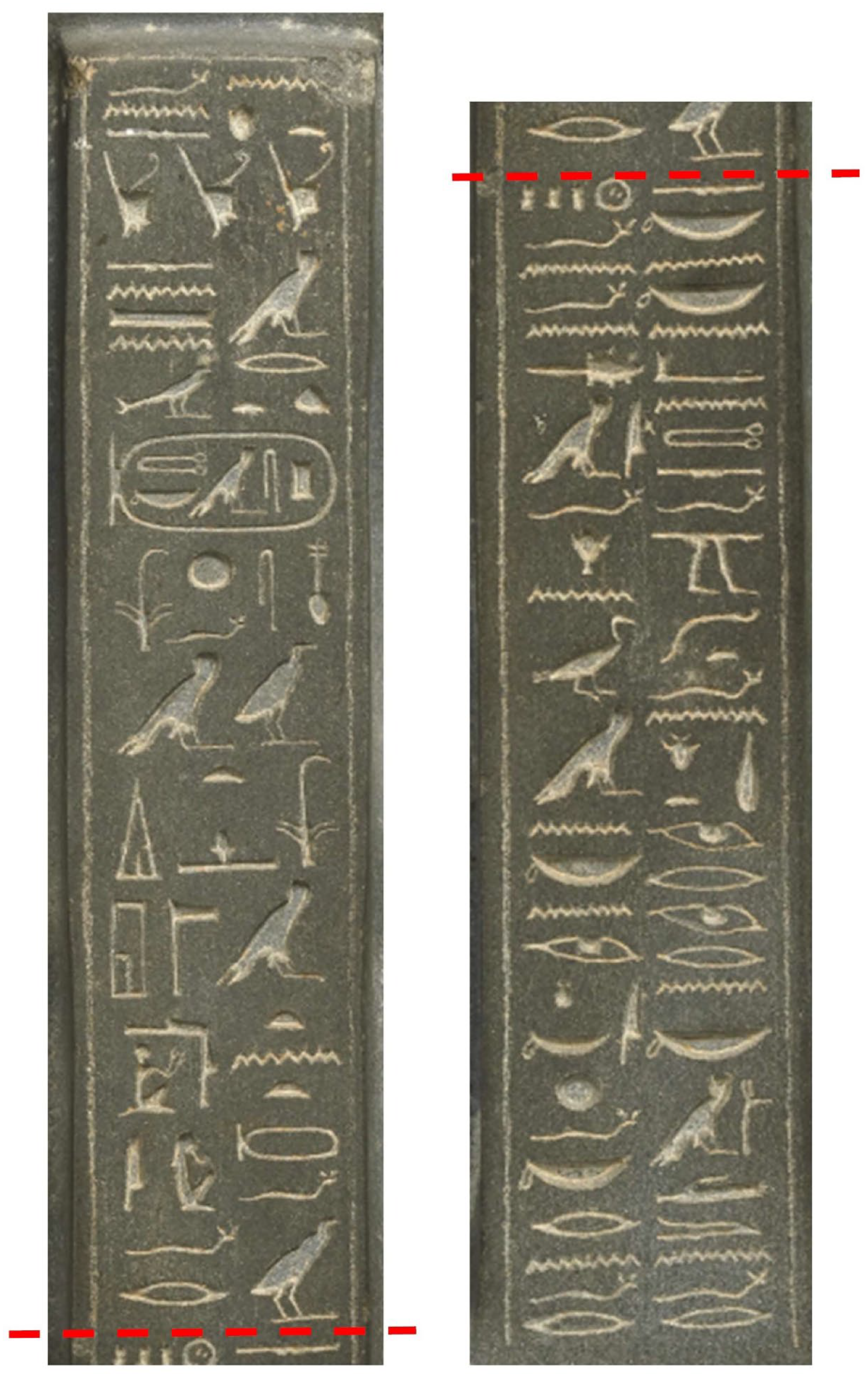
Back Pillar of MMA 19.2.2 = Doc. B (photo: courtesy of The Metropolitan Museum of Art, New York. Rogers Fund, 1919).
C. Cairo, JE 36987 (K 191)
Kneeling, naophorous statue of Userkhonsu, similar in style to Doc. A.
11
Userkhonsu was an Overseer of Teaching and wȝb-priest of Sekhmet. 14 The former job involved teaching the intricacies of hieroglyphs and hieratic, while the latter required deep knowledge of both natural science (specifically veterinary medicine) and religious rituals. 15 As such, it is not surprising that he also showcased rare spellings on his private statue, and even claimed to belong to ‘the Crew of the Ibis (Thoth)’, an allusion to literate scribes. 16
Supporting statues
D. Cairo, JE 37195 (K 380)
Archaizing, seated scribal statue of Djedhor.
17
As in classical versions from earlier periods, an offering text occurs on the papyrus in his hands. This religious text ends with a variant of
Djedhor was notably a Director of Serqet, Overseer of Teaching, Scribe of the Divine Book, and possibly (Scribe) of Oracles in the Domain of Amun. 18 Just like with Userkhonsu (Doc. C), these titles were closely linked to erudition and research into difficult hieroglyphic texts. 19
E. Cairo, CG 48608 (K. 424)
This striding statue of the early 26th Dynasty does not generally use the same system of quasi-alphabetic spellings.
20
It is only included here because it includes a variant of the final phrase from
Texts
Text 1

Text 1 (A = WAM 22.175, B = MMA 19.2.2)

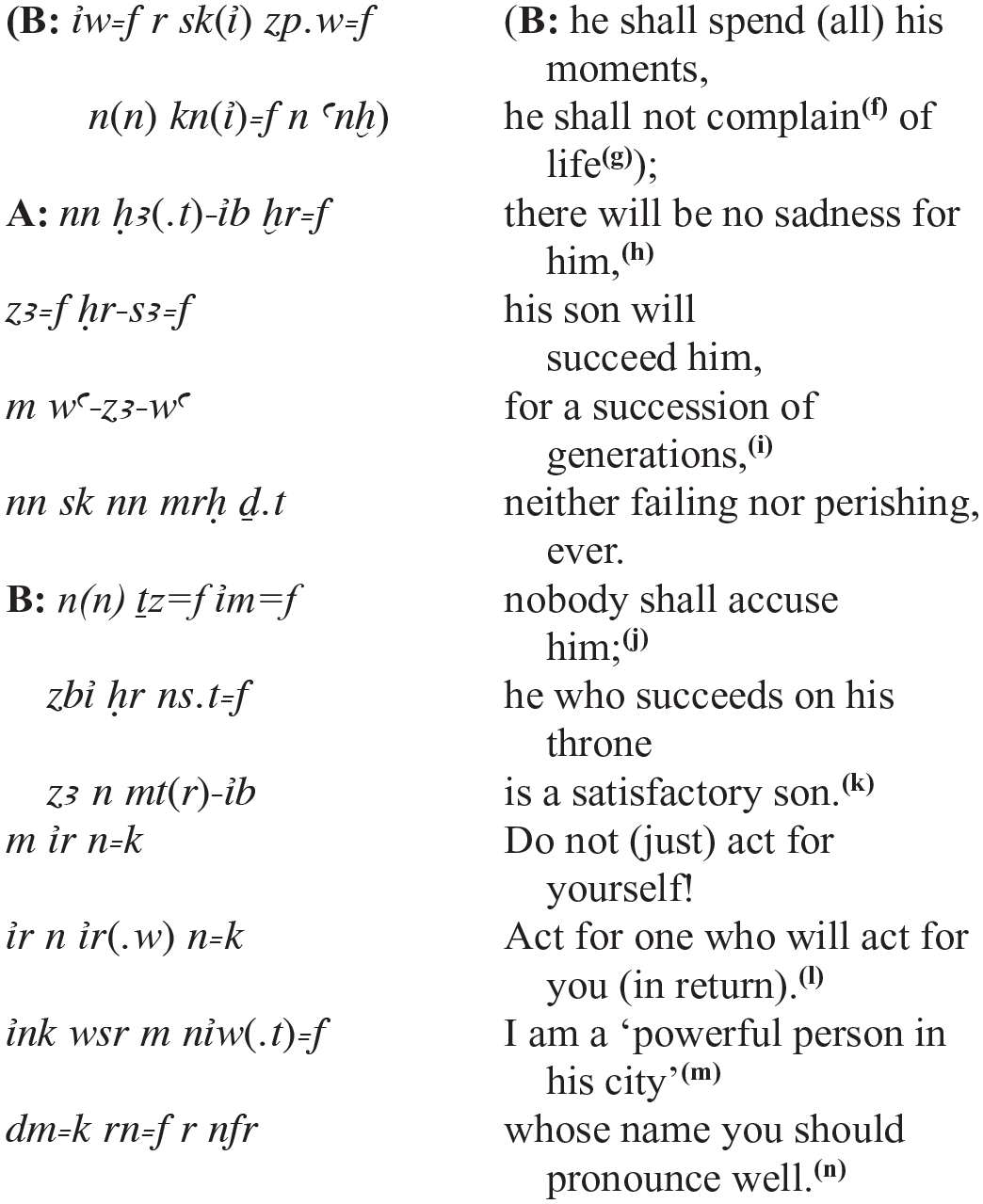
(a) The abbreviated spelling of dwȝ ( ) nỉ(r) (
 ) featuring honorific transposition was recognized by De Meulenaere, who gathered many similar phonetic writings of nỉr (cf. Coptic: ⲛⲟⲩⲧⲉ ).
22
De Meulenaere proposed the curious oval sign for dwȝ in
) featuring honorific transposition was recognized by De Meulenaere, who gathered many similar phonetic writings of nỉr (cf. Coptic: ⲛⲟⲩⲧⲉ ).
22
De Meulenaere proposed the curious oval sign for dwȝ in  ), which also served as an ideogram for dwȝ-wr, the god of barbers.
23
Unfortunately, neither hieroglyph resembles that traditional sign in the slightest.
24
One might consider the similarly-named god dwȝw (LGG VII, 506-7), whose traditional emblem was a curvy object on a standard (
), which also served as an ideogram for dwȝ-wr, the god of barbers.
23
Unfortunately, neither hieroglyph resembles that traditional sign in the slightest.
24
One might consider the similarly-named god dwȝw (LGG VII, 506-7), whose traditional emblem was a curvy object on a standard ( ), occasionally resembling an egg (
 ); but otherwise spellings of that divine name always feature the divine standard. Rather, the collation of
The apparent sḏm=f form used here is understood as a typical Late Period simplification of the classic sḏm.ty=fy construction, ‘one who shall hear’. 27 A subjunctive sḏm=f (‘if he should praise god…’) would not be appropriate here, as there is no antecedent for the masculine pronoun. In the following clause, however, sḫ(ȝ)=f could be either a similar future participle, or perhaps a subjunctive sḏm=f continuing the sentence: ‘whoever shall praise god (…) and if he should commemorate it (…)’. The same form appears below in Doc. C, col. 4, and in both cases the verb is dwȝ, reduced to t. With this verb, perhaps the repeated dentals explain the omitted ty-infix: *dwȝ.t(y)=f(y) > *t.t=f > t=f (effectively the current spelling). 28
Note also that the same abbreviated writing of snn, ‘statue’, occurs on the related object JE 37873 and elsewhere. 29
(b) On the left side of the statue, Harbes’s title is spelled: 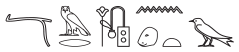 . That title clearly marks the indirect genitive following zš(.w), but it is unclear to what the first n in the phonetic transcription corresponds (
 ). Since another indirect genitive following ỉmy-rȝ does not appear in most Demotic or Coptic equivalents, the most likely restoration is the plural article n(ȝ). While this would not be included in classical spellings of the title, it would have been pronounced, and thus the second n crept into this quasi-alphabetical spelling via metathesis. Alternatively, the scribe might have been influenced by the verb zn/zš, ‘to open’, which was often spelled znš (e.g.,
  , Wb. III, 454, 1).
(c) Similar spellings of sḫȝ are relatively common. 30 While the verb has various connotations (‘to remember; commemorate’), in the present context, used in parallel with dwȝ-nṯr, it almost certainly means ‘to read (its inscriptions) out loud’. 31 Based on the consonantal principle, one might also understand this verb as sȝḫ, ‘to transfigure; glorify,’ 32 but other Late Period texts spell that as sỉḫ, not just sḫ. 33
(d) The dependent pronoun nȝ, ‘these’, should properly appear before the noun it modifies (‘the gods’); one would expect nṯr.w ỉpw or nṯr.w ỉpn.
(e) Similar texts from the Karnak Cachette mention ‘wiping’ or ‘clearing away’ (both: skỉ) food offerings from statues,
34
but despite the similar consonants, that can hardly be the correct reading here. Instead, this verb is most likely a new use of skỉ, ‘to pass (a period of time)’.
35
A slightly less likely alternative relies on the general phonetic equivalence between k and q during the Late Period,
36
so might instead read sq(ȝ)=f zp.w=f, ‘he shall increase his moments (of life)’, similar to the phrase sqȝi ʿḥʿ/rnp.wt, ‘to increase a lifetime/years’ (Wb. IV, 303, 9). If not for the internal details in the zp-sign of
(f) Here, I understand this statement as having the rare verb knỉ, ‘to complain; lament’. 37 As in the previous phrase, one could arguably posit interchange between k and q, and thus translate kn > qnỉ, ‘to lack’ instead.
(g) This particular spelling of ʿnḫ with final -X is rare;
38
other uniliteral spellings write either ʿnḫ or ʿnš.
39
The layout of
(h) A similar spelling of this compound (ḥw-ỉb < ḥȝ.t-ỉb, ‘sadness’)
40
occurs in Pétosiris 116, 3 and 126, 5, with the same syntax: 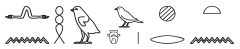 , nn ḥ(ȝ)w(.t)-ỉb ḫr=tn, ‘there shall be no sadness for (ḫr) you’.
41
, nn ḥ(ȝ)w(.t)-ỉb ḫr=tn, ‘there shall be no sadness for (ḫr) you’.
41
(i) Following the interpretation of this idiom proposed by Karl Jansen-Winkeln. 42
(j) The syntax of this statement is unusual. Typically, one would expect ‘his accuser shall not exist (nn/nn wn ṯzz ỉm=f)’, or ‘he shall not be accused (nỉ ṯz.tw ỉm=f)’ (Wb. V, 408, 4; Perdu 1998: 141–142, n. aa). Perhaps the scribe might have confused the typical determinative to this verb ( ) with its common uniliteral value f (< fȝỉ), or the viper following ṯzz writes s/z in the geminating form,
43
instead of its normal value f.
) with its common uniliteral value f (< fȝỉ), or the viper following ṯzz writes s/z in the geminating form,
43
instead of its normal value f.
(k) The phrase zbỉ ḥr ns.t, ‘to accede upon the throne’, elsewhere refers to royal succession. 44 Since the phrase mdw-ỉb would not make much sense here, this is most likely a phonetic variant of the well-attested epithet mtr-ḥȝ.t, ‘correct of heart’. 45 The translation here relies on the common Demotic idiom: ḥȝ.tˆ mtr n-ỉm=f, ‘the heart is satisfied with it’ (CDD M, p. 280). The phonetic equivalence between mdw and mtr (both reduced to *mt) is best attested in the variant spellings of the common personal name Ns-pȝ-mdw (var. Ns-pȝ-mtr), ‘Espemetis’. 46
(l) The second phrase (‘act for the one who acts for you’) occurs verbatim in The Eloouent Peasant (B 2 108). 47 For the sentiment, compare Ankhsheshonoy VII, x+16: ‘Do not hesitate to serve (šms) the one who will serve (šms) you.’ Otherwise, this appears to be the unique Late Period quotation of this earlier maxim. Although the theme of reciprocity is ubiquitous on private monuments, those phrases are typically framed in the third person (‘(as for) one who acts, one acts for them (ỉrr ỉr(.w) n=f)’) or directly in the first person (‘do for me that which I did (ỉr n=ỉ ỉr(t).n=ỉ)’). 48
(m) Jansen-Winkeln copied this group as  (JWIS IV/1: 340), but the sign does not have any interior details, just like in the spelling of sḫ(ȝ) above. Although the present interpretation assumes this is an ideogram for nỉw.t, it should be noted that the city sign looks quite different on the sides of the statue, so one must assume a substitution for circular hieroglyphs.
Various non-royal epithets highlight an individual’s privileged status within their city (nỉw.t),
49
as in the expression ȝḫ m nỉw.t=f below in
Given the similar formulation (ȝḫ m nỉw.t=f) in
(n) Note the repetition of rn=f r nfr, which appears as duplicated spellings of the word nfr 52
Text 2
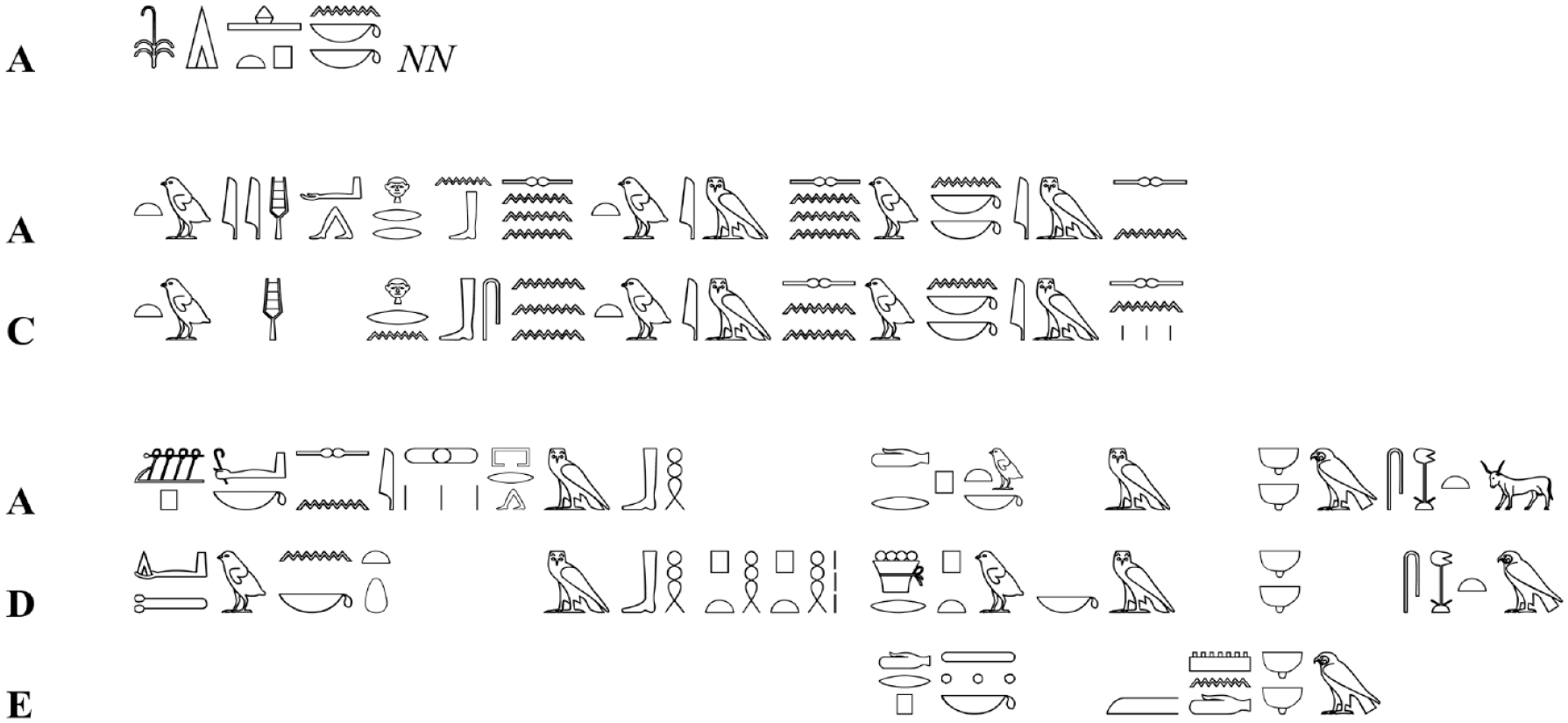
Text 2 (A = WAM 22.175, C = JE 36987, D = JE 37195, E = CG 48608)
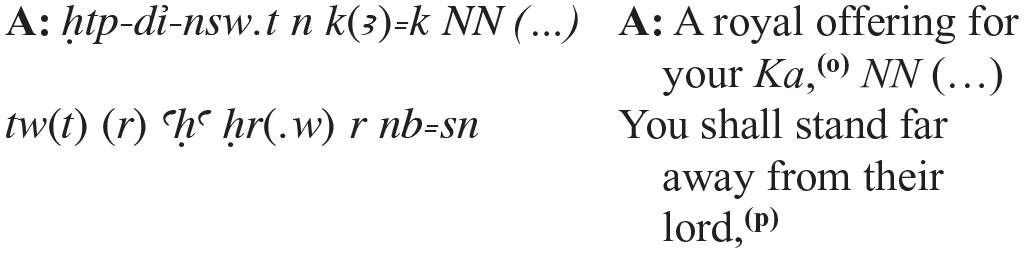
(o) As Selim noted, this phrase is to be read n k(ȝ)=k, ‘for your Ka’,
53
since the two k-signs repeat and the following offering formula is a direct address to the deceased. This fact complicates the suggestion by Philippe Collombert to read similar Late Period examples with 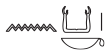 NN as ‘for the Ka (of NN)’, interpreting the uniliteral k as a phonetic complement, rather than a vocative: ‘for your Ka, NN’.
54
NN as ‘for the Ka (of NN)’, interpreting the uniliteral k as a phonetic complement, rather than a vocative: ‘for your Ka, NN’.
54
(p) Selim already identified the parallels between
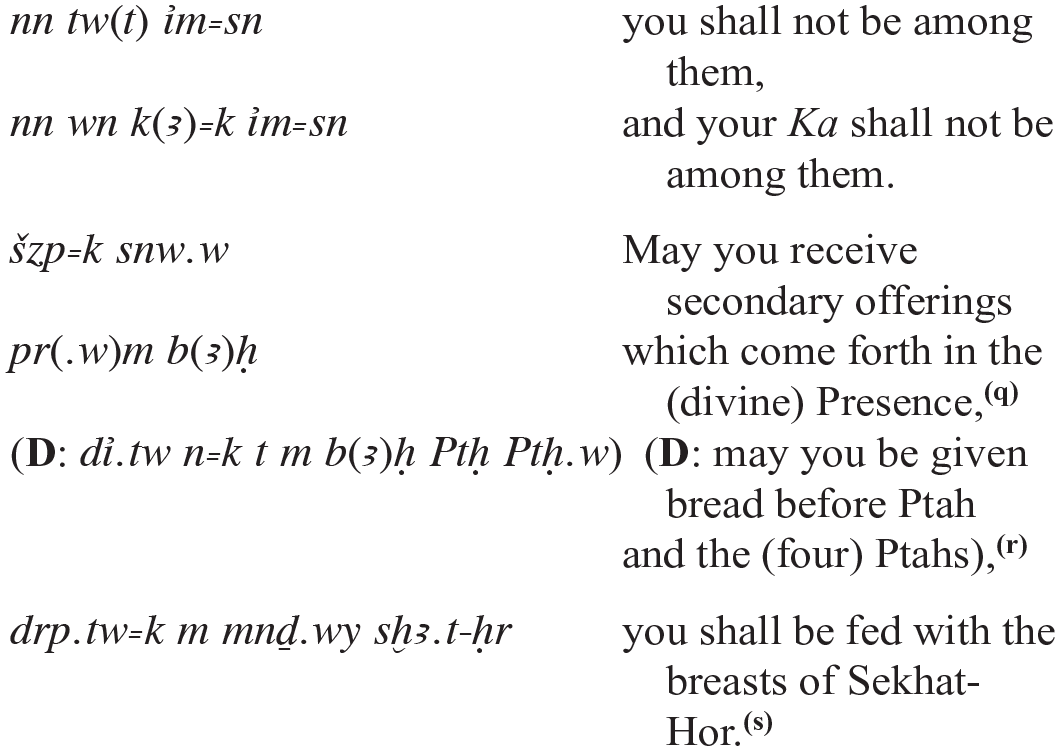
Instead, one may recognize the phrase ḥrỉ r nb, ‘to be distant from (one’s) lord,’ attested on two other Late Period statues.
57
In those instances, the dedicant desires to never be far from the king. But in this case, the preceding text refers to food offerings and sacrificial animals, therefore, the ‘lord’ in question most likely refers to Seth or Apophis. The uniliteral phonetic spelling of nb occurs twice again in
The understanding of this verb ḥrỉ is confirmed by a close parallel in PT 245 (Pyr. 251c-d): 59

Note that this spell from the Pyramid Texts was known in the Late Period, as a copy appears in the tomb of Padiamenope (TT 33). 60 Some of these phrases, without the verb ḥrỉ, were incorporated into BD 177, also attested in the 25th Dynasty. 61
(q) Both texts spell bȝḥ as bḥ, and
(r)
(s) As Jansen-Winkeln already suggested,
65
the text copy by Steindorff of  ) here is incorrect, as confirmed by collation and by the parallel in
Text 3 (Doc. C = JE 36987)
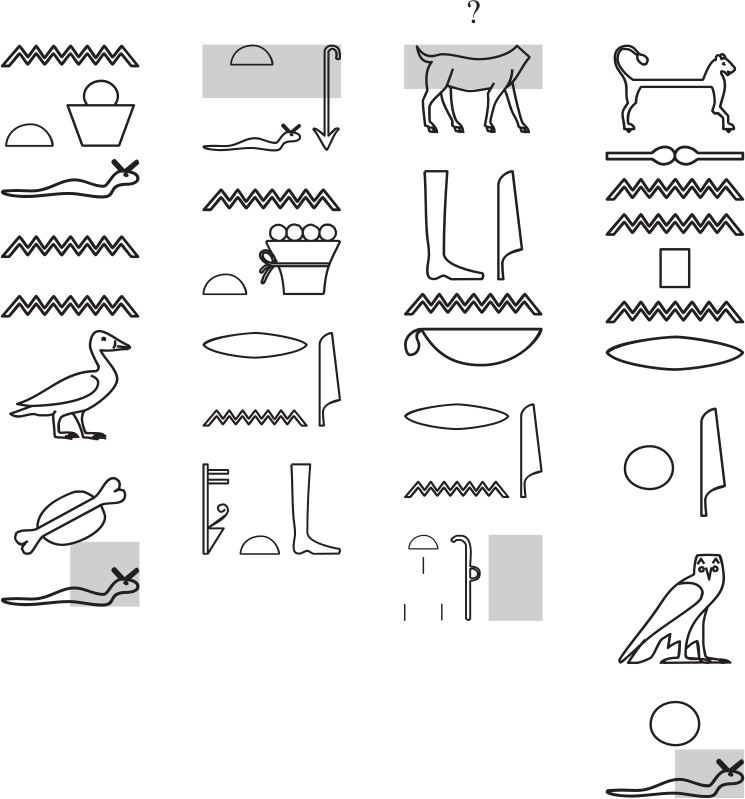
NB: Selim already recognized that this text is a variant of typical ‘Appeals to the Living’, where the dedicant promises rewards to whomever will protect their statue.
66
The main differences in interpretation arise from recognizing similar abbreviations noted in  = nỉw.t,
  = k(ȝ),
  = nb,
= nb,  = dwȝ-nṯr), and noticing the repeated syntactical pattern in cols 1–3.
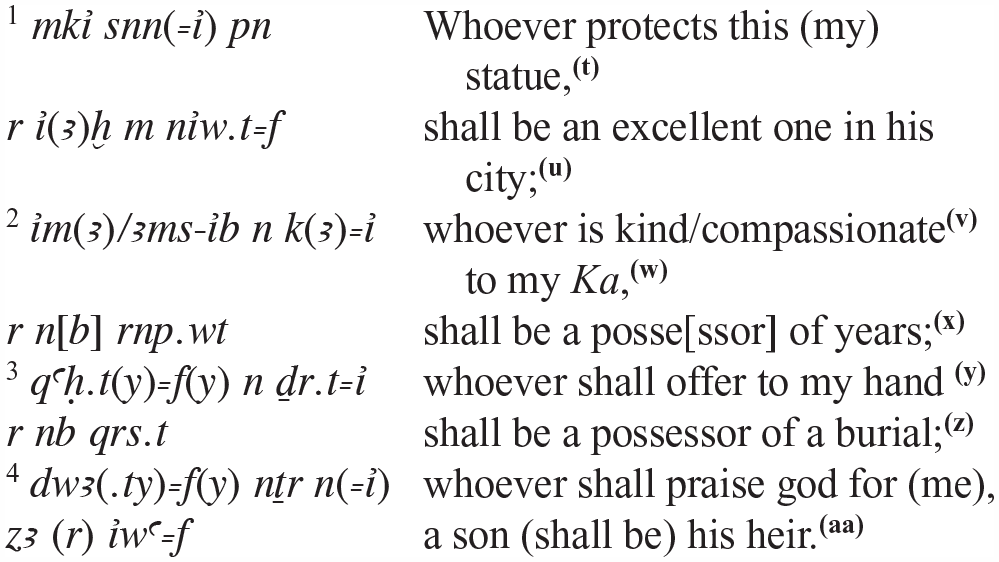
(t) Selim correctly recognized the ideographic value of the bed sign for mkỉ, ‘to protect’, which occurs on other texts from this period.
67
Note the same alphabetic spelling of snn, ‘statue’, occurs in the beginning of
(u) Other ‘Appeals to the Living’ specify that whoever acts positively towards the statue ‘shall be an elder of their city (ỉw=f r ỉȝw n nỉw.t=f )’. 68 The present text employes the term ỉ(ȝ)x, ‘effective one’, 69 a variant which occurs already in the First Intermediate Period. 70
(v) Selim copied the headless cow skin hieroglyph, and attributed to it the phonetic value ỉmy, to read ỉmy-ỉb, ‘what is in the heart’. 71 While this is possible, context suggests this is another friendly action towards the statue expected of the reader. Using the same phonetic value, one might instead translate ỉm(ȝ)-ỉb n, ‘who is gracious toward’, a typical attribute mentioned frequently in this context. 72
Nonetheless, it is not possible to verify the particular bovid sign here on published photographs, because the statue’s knees cast a shadow over it. Thus, one might propose emending the sign to that of a cow with its head turned backwards (i.e.,  for *
for * ), thus writing *ȝms-ỉb, ‘to have compassion’.
73
), thus writing *ȝms-ỉb, ‘to have compassion’.
73
(w) The same alphabetic spelling of ‘Ka’ occurs multiple times
(x) The first two signs preceding the damage appear to be phonetic elements of rnp.wt. However, comparison with the formulation in column 3 suggests restoring the leg sign to obtain: r n[b] rnp.wt, ‘shall be a lo[rd] of years’. The same spelling of nb occurs above in
This expression alludes to a long life, but it is also a divine epithet (LGG III, 684), and a status that the deceased boasts of attaining in BD 85.
(y) The primary interpretation of the first sign I owe entirely to the suggestion by an anonymous reviewer for the JEA. While Selim and Jansen-Winkeln copied a simple sedge hieroglyph ( ), comparison with the photograph confirms this sign looks more like a tall brazier:
  or
or  . This rare hieroglyph appears with variants (e.g.,
  ,
,  ) as a determinative to very different words formed with the same root qʿḥ, such as ‘exotic’, ‘to bend’, and ‘corner’.
74
Accordingly, this sign on the present statue would represent the revival of an archaic sign value, albeit here used as an ideogram, in a variant of the phrase qʿḥ ʿ(.wy)/ḏr.t n, ‘to bend the arm(s)/hand for (somebody, with offerings)’.
75
The only complication here is that this phrase usually has ‘arm/hand’ as the direct object,
76
whereas here the priest would bend himself to the statue’s hand. It is possible that the suffix pronoun is simply misplaced here, and one might alternatively emend the text to read: ‘whoever shall bend a hand to me (qʿḥ.t(y)=f(y) ḏr.t n=ỉ).’
) as a determinative to very different words formed with the same root qʿḥ, such as ‘exotic’, ‘to bend’, and ‘corner’.
74
Accordingly, this sign on the present statue would represent the revival of an archaic sign value, albeit here used as an ideogram, in a variant of the phrase qʿḥ ʿ(.wy)/ḏr.t n, ‘to bend the arm(s)/hand for (somebody, with offerings)’.
75
The only complication here is that this phrase usually has ‘arm/hand’ as the direct object,
76
whereas here the priest would bend himself to the statue’s hand. It is possible that the suffix pronoun is simply misplaced here, and one might alternatively emend the text to read: ‘whoever shall bend a hand to me (qʿḥ.t(y)=f(y) ḏr.t n=ỉ).’
If, however, the tall sign was meant to be a plant ( ), this group might alternatively write sṯi (mw), ‘to pour out (water)’, for which one might compare a similarly phonetic writing on JE 37873 (
 ).
77
In general, one would expect the verb to be followed by a direct object (mw, qbḥw). It is possible that the single water sign stands, pars pro toto, for the plural mw, just as in other ideograms of the title stm/sṯỉ-mw:
).
77
In general, one would expect the verb to be followed by a direct object (mw, qbḥw). It is possible that the single water sign stands, pars pro toto, for the plural mw, just as in other ideograms of the title stm/sṯỉ-mw:  .
78
Note, finally, that the hieroglyph in question also resembles the Late Period monogram for the same stm-title:
.
78
Note, finally, that the hieroglyph in question also resembles the Late Period monogram for the same stm-title:  .
79
.
79
Similar wishes on statues beseech priests to ‘place flowers on my statue, pour out water (sṯỉ mw) for my body (ḏ.t)’, 80 a term consonantally similar to ḏr.t. Other statues request various food offerings, including ‘a handful (ḏȝ.t) of water’. 81 One also thinks of the famous tonsured statues of Hathor, where the dedicants cup a hand to their mouth for offerings. On those monuments, quite different from the present statue, the priests typically ask for beer to be poured in their hand, 82 but in one example the dedicant is more flexible: 83

The archaizing, phonetic spelling of ḏr.t finds multiple Late Period parallels in the popular phrase pgȝ ḏr.t, ‘to extend the hand’. 84
(z) The phrase ‘lord of a burial (nb ors.t)’
85
is also a common epithet,
86
and a quality which the deceased requests in BD 154, similar to nb rnp.wt (see above, text note
(aa) For the writing of dwȝ-nṯr with the initial bread sign, see above,
The final signs could be interpreted multiple ways. For Selim, this clause was a punishment: nn zȝ (r) ỉwʿw=f, ‘there will be no son (to) be his inheritance’. While the two n-signs alone can often write the negation nn, one expects a positive wish following the first phrase (‘Whoever praises god…’). Accordingly, one might again compare the related statue JE 37873, where the same signs appear in relation to inheritance: ‘your sons shall be on your thrones (zȝ=tn ḥr ns.t=tn), never perishing (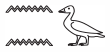 : nn ḥtm ḏ.t)’.
87
Based on that parallel, one could interpret: ‘whoever praises god for (me), his heir shall not perish (n(n) ḥtm ỉwʿw=f)’. For the sentiment, compare a passage on JE 37129: ‘your house shall not perish bearing your heir (nn ḥtm pr=k ẖr ỉwʿw=k)’.
88
: nn ḥtm ḏ.t)’.
87
Based on that parallel, one could interpret: ‘whoever praises god for (me), his heir shall not perish (n(n) ḥtm ỉwʿw=f)’. For the sentiment, compare a passage on JE 37129: ‘your house shall not perish bearing your heir (nn ḥtm pr=k ẖr ỉwʿw=k)’.
88
The present interpretation takes a middle path between those options. One expects the priests to praise god for the deceased. While the first three columns mention specific objects (‘this (my) statue’, ‘my Ka’, ‘my hand’), here it appears to be n=(ỉ), ‘for (me)’. The expected n=ỉ is apparently here written  , with no suffix pronoun, as attested on other Late Period monuments.
89
Although the suffix pronoun and r of futurity are explicitly written in the preceding columns, here both signs, neither strictly necessary, would have been omitted. Compare the variant
, with no suffix pronoun, as attested on other Late Period monuments.
89
Although the suffix pronoun and r of futurity are explicitly written in the preceding columns, here both signs, neither strictly necessary, would have been omitted. Compare the variant
In these four columns, Userkhonsu provides different incentives for priests to act on behalf of the statue, namely by honouring his memory during temple services.
90
The four benefits seem to align with the Four Kas, a group of popular wishes on other monuments, as summarized by Dimitri Meeks:
91
Col. 1 Wealth and prestige in the community while alive (‘une existence matérielle heureuse’) Col. 2 A long lifetime (nb rnp.wt) ( ‘une longue vie’) Col. 3 A proper burial (nb ors.t) (‘un bel enterrement’) Col. 4 A legacy of heirs after death (‘une bonne postérité’)
As divinized Kas serving Ptah in Memphis, these four gods were generally associated with the same wishes, although the sources differ on who precisely gave out which benefits.
92
These wishes are mentioned rather obliquely on
Conclusion
Previous scholars have noted various cases of intertextuality among private statues of the Karnak Cachette. 94 For example, the exemplary statue of Ser-Djehuty, although most likely installed in the nearby Mut Temple, apparently inspired Theban artisans and scribes during the Ptolemaic Period. Not only do specific phrases and funerary wishes appear in full on other objects, even the vignette on its front can be seen on later statues. 95 While it is always possible that such passages were simply quotes from the same liturgical or ritual texts, or that dedicants selected choice phrases from archival papyri in the workshops, the hieroglyphic inscriptions on statues suggest a different method of transmission. Namely, the texts themselves make it clear that priests were expected to interact with the statues as part of their temple services, giving them remainders of divine offerings, cleaning off dust and crumbs from old offerings, and of course reading their inscriptions out loud, keeping the names of their sacerdotal forebears alive by uttering them in their prayers. 96 One may imagine that certain individuals, drawn to archaisms or original spellings, took note of singular expressions they encountered on the statue inscriptions they recited throughout their careers. 97 For example, a Theban private statue of the Ptolemaic Period belonging to a Montuemhat employs the ‘cryptogram’ of the well-known, like-named governor from centuries earlier (25th–26th Dynasties). 98
The first statues studied here (Docs A and B) apparently date to the early 26th Dynasty. They share a similar ‘Appeal to the Living’ (
Footnotes
Acknowledgements
The author would like to thank Laura Seitter of the Walters Art Museum for providing study photographs, and the anonymous reviewers from JEA for their valuable suggestions.
Funding
The author did not receive funding for this project.
1.
De Meulenaere 1994: 69, n. 31;  : 63–64.
2.
Jansen-Winkeln 1998a: 155–159, pl. VIII; Jansen-Winkeln 2014, I: 206 (53.341). In that article, Jansen-Winkeln also compared the similar spellings on JE 37354, which he subsequently published in , I: 77–78, 366–369 (no. 15).
3.
De Meulenaere 2003: 63–64, grouped these objects together as ‘un groupe homogène’, with the exception of JE 37195, and also including Baltimore WAM 22.159 (, II: 1061–1062, 60.566), which only shows a limited number of quasi-alphabetic spellings.
4.
Der Manuelian 1994: 81–83; Jansen-Winkeln 1998a: 168–172; Perdu 1996: 49–54; Perdu 2016: 81–89; Engsheden 2006: 1–7; : 301–303; Klotz 2014–2015: 99–101.
7.
Steindorff 1946: 14, 63, pls 31, 117 (no. 180); Jansen-Winkeln 2014, II: 1047–1048 (60.539); <https://www.ifao.egnet.net/bases/cachette/ck389> with earlier bibliography (accessed 19.09.2023); additional photographs at the museum’s collection database: <> (accessed 19.09.2023). I would like to thank Laura Seitter of the Walters Art Museum who provided study photographs for collation.
8.
Bothmer 1960: 55, pls 44–45 (no. 48); Jansen-Winkeln 2014, I: 340 (55.112); <https://www.ifao.egnet.net/bases/cachette/ck963> with earlier references (accessed 19.09.2023); Gozzoli 2019: 180–181. Excellent photos on the museum’s collection database: <> (accessed 19.09.2023).
9.
For other examples of this textual layout, see De Meulenaere 1991: 246 n. 12 (citing this example); see also Boston, MFA 68.152 + Sameda 507 = , I: 119–120 (54.234); Stockholm, MME 1986:1 + Vatican 22686 = Jansen-Winkeln 2014, I: 347.
10.
For the title, see Pressl 1998: 45–46; : 178–179 n. a.
11.
Selim 2004a: 166–170, pl. 14; Jansen-Winkeln 2014, II: 1073–1074 (60.591); <> with additional photographs and bibliography (accessed 19.09.2023).
13.
Cf. Jansen-Winkeln 2014, II: 1074, who included this statue in a volume dedicated to the 26th Dynasty but noted: ‘Eine Datierung der Statue in nachsaitische Zeit wäre nicht auszuschließen’. : 170, argued for a 26th Dynasty date.
15.
For the closely linked duties of these officials, as evidenced in the Book of the Temple, see Quack 2002; Quack 2021; .
16.
Selim 2004a: 167, n. c; see also : I, 132–133, n. 8.
17.
Jansen-Winkeln 2014, II: 1074 (60.592); the statue itself is unpublished, but see detailed photographs from the Karnak Cachette database: <> (accessed 19.09.2023).
18.
For a similar group of titles in a family of Ptolemaic period priests from Akhmim, see Depauw 2002: 76–78, 80–81; Klotz and LeBlanc 2012: 665, n. d. See also a stela of a similarly titled priest from Ptolemaic Edfu: Swansea, Egypt Centre W1041: <> (accessed 19.09.2023).
19.
21.
22.
De Meulenaere 1994: 69; for the abbreviated spelling of nt < nṯ(r), see also : 306 n. 83 (with additional references).
24.
For the evolution of the beard sign, Hendrickx, et al. 2014: 137–140.
25.
For the tall, simple loaf (G. X3) in : 287 n. 102.
26.
For the converse phenomenon, the dwȝ sign or group spelling the unliteral values t/T, see Sauneron 1982: 162, 194 (for the second example, see Esna III, 393.22); : 140–141.
27.
See primarily Jansen-Winkeln 1994 (with many examples); Perdu 1996: 57 n. h, 60 n. t; : 733 n. 2.
28.
Jansen-Winkeln 1994: 124–125 tabulated many examples of this form, and notably while there is one example each of dwȝ=f and dwȝ=sn, he found Late Period examples of dwȝ.ty=fy or dwȝ.ty=sn. Note this is the same grammatical form used in the related genre of threat formulae, namely sḏm.ty=fy (protasis) followed by ỉw=f r + noun or infinitive (apodasis): : 6–9, 30–31.
29.
Jansen-Winkeln 1998a: 156, left, lines 7–8, 158, n. 4; , I: 25, n. 10 (already discussing the present example), 434, no. 39b, 5.
30.
Perdu 1992: 158 n. q (already citing the example in : 156 (left, line 9).
31.
Price 2011: 226–227. The verb is typically used in similar contexts of verbs of speaking, including ḏd, ‘to say’, dm, ‘pronounce’, nỉs, ‘to call out’: : 204–205 n. g.
32.
34.
Jansen-Winkeln 1998a: 156, left, line 8, 158 n. f; : 4–5.
35.
Wb IV, 314, 12; kindly suggested by an anonymous JEA reviewer.
36.
For traditional q spelled as k, compare Kurth 2007: 539, §29.3 (note especially the alternation of q/k in spellings of ‘Kleopatra’ and ‘Kaisaros’); compare also the use of the kȝ-sign to write expected q in numerous words in Demotic: .
37.
See Gutbub 1973: 177–179 n. am; , I: 58–59 n. 74.
39.
Kurth 2007: 532, §26.2; : 143, n. 114; Esna III, 356.27, 377.5.
40.
Wb III, 7, 10–11; cf. Otto 1964: 140; Wilson 1997: 614; Jansen-Winkeln 1985, I: 127 n. 17. Some texts directly contrast ḥȝw.t-ỉb, ‘sadness’ with the near homophone ȝw.t-ỉb, ‘happiness’: : 154, Text B; Dendara III, 83, 8.
41.
Another similar spelling in Esna II, 39, 8 (Fernández Pichel 2023: 108–109, n. b). For examples with the preposition ḫr, see also : 398, l. 18; Edfou V, 151, 5; Edfou VII, 75, 15; 142, 5; Dendara VI, 165, 5.
42.
Jansen-Winkeln 1991; more examples in Jansen-Winkeln 2001, I: 296; : 492, col. 7.
43.
This rare value of the viper is attested in the Late and Ptolemaic Periods: De Meulenaere 1988, 70, n. b; Fairman 1950; Darnell 2004: 232, n. 249. As others have suggested, the rare uniliteral value might derive from the term ‘zȝ-tȝ-serpent’, or the related serpentine wand, which elsewhere can simply write zȝ, ‘protection’, for which see also /15: 96, n. q, 107.
44.
KRI II, 749.14 (cited by Meeks, AL III, 79.2490).
45.
Wb II, 173.6; Klotz 2010: 141 n. d (with references); : 178 n. ag.
46.
Ranke, PN I, 175, 1; Dem. NB, 644–646; Klotz 2015: 68 n. c. For the phonetic shift, compare also .
47.
Parkinson 2012: 119 (for the similar passage in B1 140–141), 299; see already : 283, no. 6.
49.
Doxey 1998: 186–189; Janssen 1946, I: 1–2 (ȝḫ, ỉȝw), 6, H16 (ʿȝ); Helck 1975: 38, no. 49, line 4 (wr); Jansen-Winkeln 1999: 71, A.2.h.10 (wr); Jansen-Winkeln 2001, I: 346, no. 8, d4, 404, no. 27, c10 (ỉmȝḫw); 420, no. 34, a3 (qbb); Pétosiris 61, 17 (bwȝw), 29 and 89, 6 (ỉȝw); Leitz 2011: 231, 248 (ḥzy); Posener 1936: 18, Text D, 33 (z nfr); , I: 346 (55.126) (ỉqr).
50.
For examples, see Doxey 1998: 375; , I: 504 (57.212), col. 37 (Philadelphia, 42-9-1).
52.
For which, compare again JE 37354: Jansen-Winkeln 2001, I: 366, no. 15, a5; : 69, 125 (A.2.g.7).
53.
This uniliteral spelling of ‘Ka’ occurred rather frequently in personal names during the Old Kingdom: Wb V, 86, 10; Ranke, PN II, 208–216. For this value in later periods, see the references in Klotz 2014: 318, n. 178, and add , I: 153, text f, 4.
58.
Jansen-Winkeln 1998a: 170; Jansen-Winkeln 2001, I: 434, no. 39, c5 (with a red crown); : 119 n. j, 123, col. 2.
59.
I thank the anonymous JEA reviewer who signaled this text passage as well as BD 177.
60.
Dümichen 1885, pl. XXIV, col. 3. Further Late Period versions of this spell have been noted (e.g., the tombs of Harwa, Pabasa, Iufaa) but those are currently unpublished; cf. : 181 n. 87.
61.
CG 41065: Gauthier 1913: 445, col. 11; for the date, see : 527–528 (52.323).
63.
Jansen-Winkeln 1998a: 156 (left, line 9; right), 157; , I: 366, o. 15, A4.
64.
65.
Jansen-Winkeln 2014, II: 1047; , I: 12 n. 9.
66.
Selim 2004a: 169: ‘The one who protects this statue against destruction ? by protecting what is in the heart of another one (= the statue) years shall be established (for) him without limits. As to the evil one who will reject what he has heard, there will be no son (to) be his inheritance.’ An essentially similar translation by : 257.
67.
Selim 2004a: 169, n. a; for the Late Period, see also Perdu 1999: 235 n. c; : 320–321 n. a.
68.
Jansen-Winkeln 2009: 282 (51.35), papyrus, line 4; 496 (52.261), cols 13–14; , I: 396 (56.125); II, 783, 5–6 (60.76); 918, line 9 (60.297); 927 (60.323), left side; Pétosiris 89, 6.See also the variant ỉw=f r ỉmȝḫ n nỉw.t=f: Jansen-Winkeln 2014, II: 974 (60.411).
69.
For this spelling of Ax in the Late Period, see Jansen-Winkeln 1998a: 164, col. 3, 169; Engsheden 2009: 118 n. I, 123, col. 2. Compare also similar spellings of sỉḫ > sȝḫ, ‘to transfigure’: : 84 n. 62.
70.
Janssen 1946: 1; see also : 43, no. 45 (cited by the TLA).
71.
Selim 2004a: 169 nn d–e; cf. also Roberson 2020: 77 (F26). For this alphabetic spelling of ỉb, quite common in the Late Period, see recently : 83 n. 56 (with references).
72.
E.g. Jansen-Winkeln 1999: 86–87; : 59 n. p.
73.
For this common phrase, see Jansen-Winkeln 1985, I: 77 n. 52; Jansen-Winkeln 2001, I: 250 n. 9; : 83 n. mm.
74.
Wb V, 18–19; Molen 2000: 649; Hannig 2003: 1329; KRI I, 182.15, 63A (= DG V, 165), 186.8. Note, especially, the detailed copies of this sign in the biography of Harkhuf: Urk. I
2
, 124.14, n. a, 126.1, n. a. See the remarks of Gunn 1925: 250. A Late Period example of this determinative for qʿḥ apparently occurs in the tomb of Padiamenope (TT 33), in a copy of PT 304 (470c): : pl. XXIX, col. 32.
76.
One exception is Urk IV, 121.12 (Tomb of Paheri): ‘whoever shall bend with the hand (qʿḥ.ty=fy nb m ḏr.t)’.
81.
Wb V, 516, 7; Jansen-Winkeln 2001, I: 91, 93 n. 11; : 369–370 n. d.
85.
For this abbreviated spelling of qrs.t, see Jansen-Winkeln 1998a: 164, col. 4, 166 n. 14; and compare , I: 502 (57.212), Socle, line 7.
87.
Jansen-Winkeln 1998a: 156, left, line 11, 158 n. 7 (collation shows the bird is definitely a goose, as recorded in Jansen-Winkeln’s hand copy, but not the textual note). For this ideographic value of the goose, see also : 86.
90.
This theme, derived from classical ‘Appeals to the Living’, is very common on Late Period temple statues. Cf. Perdu 2000: 175–193; : 219 n. n.
91.
Wild 1954: 201–206; Sauneron 1958: 163–164; : 35–47; Jasnow 1984: 8; Thiers 2009: 425–438. The descriptions here are based on the benefits listed on stela Berlin 22489 and Esna III, 319.19–20, as summarized by Meeks 1963: 35.
94.
Jansen-Winkeln 2007: 71–73; Klotz 2013: 177–180. For copied statues and texts, see also –21.
96.
For the expected interactions between priests and private statues within the temple, see Price 2011: 214–264; .
97.
Suggested already by Jansen-Winkeln 2007: 73. For the strategy of using archaic, unconventional, or enigmatic hieroglyphs to draw attention to a private statue, see Price 2011: 219–220; : 144.
99.
: 63–64, argued based on the similar spellings that all monuments discussed here belonged to the same period (roughly late sixth–early fifth centuries BCE, to the reign of Psamtek II). Nonetheless he also assumed that Userkhonsu (whom he incorrectly called ‘Khonsoumès’) specifically imitated the statues, or at least the writing style, of Harbes (Doc. B).
Author biography
References
