




Abstract
The Dr Elizabeth Casson Memorial Lecture 2018, given on June 12th 2018 at the 42nd Annual Conference and Exhibition of the Royal College of Occupational Therapists, held at the Belfast Waterfront, Belfast, UK.
This lecture aims to set out the potential for the global occupational therapy profession to exchange knowledge for social transformation practice. It identifies the profession’s concern with narratives as a vehicle for a socially critical approach to occupation, which can be used to negotiate intervention and action. Drawing on examples from literature, history and service users, the paper suggests that narrative provides a means for relating the value of occupation beyond professional boundaries to capture popular imagination and demand for the profession. Examples are given of the critical discussion of the everyday impact of health inequity, and in addressing diversity both in the profession and engaging service users.
My lecture concludes that occupational therapy is a global network with the population of a city, and thus represents a community that can be a vibrant voice for social transformation through occupation through a reciprocal exchange of narrative. This is a collective and dialogical process which can draw on the experiences of both southern and northern hemispheres.
Keywords
Introduction
The opportunity to deliver the Dr Elizabeth Casson Memorial Lecture is a great honour and a chance to say an extended ‘thank you’ to the many people in a global community of occupational therapists through whom my standing here is possible. I want to say a particular thank you to Silvia Sanz Victoria. When Frank Kronenberg, Salvador Simó Algado and I met in Barcelona to sign up for our first book, she put Frank and I up on her floor. We’d had a meal with the publishers and had to walk to her flat across Barcelona, some two or three miles. It was 2 a.m., and Frank couldn’t remember the right flat number in her apartment block. We pushed a few buttons, and then Frank threw stones up at the windows. By this time I was eyeing up a derelict building across the street as a possible billet. Silvia’s was the second head that popped out in response. She had an exam the next morning, but we stayed up till 5 a.m. talking and drinking the whisky I’d brought to celebrate the deal. I’m not sure what our reviewer, Annie Turner, and the publishers thought when we turned up the next morning looking pretty rough, but Silvia saved us both from possible arrest as vagrants. Since this adventure my wife Linda insists that I Skype her every day when I’m away. However, that moment was a step change in my career, an entry to the global city of occupational therapists.
The profession has become global over the hundred years since the establishment of the first occupational therapy professional body in the United States but has many histories and local contexts in each country. I want to talk about the combination of global and glocal (that latter term characterised by having both global and local considerations) and how the personal everyday instance, like Silvia’s hospitality, relates to a wider connection with the world. I am going to reflect on the connection between the narrative of meaning, purpose and social justice, which seems to be the main concern of my work, to the larger occupational therapy story: the personal, professional and political influences on the profession and what we, as therapists and as activists for occupation in a global profession, might do, or give, in order to realise its power and potential.
There should be a key message to take away from a Casson lecture, but the message I’m going to communicate is composed of more than one concept:
Occupation is complex, but that does not mean that the concept is difficult to get across to people; Narrative offers a powerful vehicle for conveying the significance of occupation and enables the imagination of possible change; Our shared narratives can facilitate connections in a global city of occupational therapists with social transformation objectives.
Occupation’s connection with life narrative makes it a powerful concept, both socially and historically, expressed through cultural means. It is a discourse, the point of which is to provoke and promote social change. If occupations have cultural meaning and purpose, they must involve some personal cost or investment in order to have the power to make change; some element of commitment and heroism. Elizabeth Casson is an occupational therapy hero; she fought for change and established the profession in the United Kingdom (UK). But she did not do this alone, and the struggle to keep a focus on occupation as a means to health is continuous and ongoing.
I have always found the relationship between the professional concept of occupation and its relationship with everyday life to be paradoxical. This comes from my own interest in life narrative and the way that such stories are shaped through the lens of clinical practice. Intervention can be based on shared knowledge and concepts that come out of the narrative co-created between a therapist and client.
In literature, narratives about everyday life – and which clearly concern occupation – are often generated, recorded and shared for a social-critical purpose. Linking narratives to wider social, historical, political and cultural issues might be termed discourse or dialogue. In this sense, narratives are not just stories or occupational histories but are also a powerful and accessible means of developing a shared and egalitarian critique about complex situations. They can weave together disparate threads of experience to form a context composed of ‘dialogical action’ and ‘dialogical imagination’ (Farias et al., 2018: 4). These terms mean that occupational intervention can be negotiated through a narrative process which essentially starts with a conversation. Intervention is negotiated through a reflective dialogue which leads to the imagining of possible changes, and not only inspires, informs and involves but also produces action.
Occupation is a diverse and plural concept with a complex relation to understandings of health (Fortune and Kennedy-Jones, 2014), but occupational therapy offers some ways to manage complicated health issues through its established core of narrative understanding and reasoning (Mattingly, 1991a, 1991b). Many people are interested in occupational therapy’s potential for social transformation. Social transformation means different forms of cultural and historical action in different parts of the world. Different contextual influences determine how occupational therapies in different places are enacted (Farias et al., 2018).
Where there are differences between what a person and what the community needs or wants, a number of narratives have to be collated and explored. Occupational therapists are engaged in developing bespoke meaningful and purposeful interventions that fit individual and community narratives of experience. Basing reasoning in narrative suggests a powerful ability; it is an element of cultural and historical action for transformation (Yamagata-Lynch, 2010). Narrative-based reasoning operates at a practical level where people can imagine the possible for themselves and for their communities.
When ordinary working people compose life narratives, often documenting the story of their life for the benefit of their grandchildren, they are thinking of their legacy, their achievements and their part in human continuity. These narratives are sometimes found as loose pages in biscuit tins after someone’s death, as was the manuscript of Robert Tressell’s classic working class novel The Ragged-Trousered Philanthropists (1914/2012); only a few are published. Some key themes of such narratives are survival and witnessing community, social and personal changes (Morley and Worpole, 2009), perhaps reviewing the paths a person has taken towards their destiny. These paths are multi-dimensional, located in shifting historical and geographical spaces of particular times and places that their narrators have occupied. Tressell’s novel was written about his later working life in Hastings. An opening passage explains how human history has been developed by all people in society. Likewise, the people occupational therapists work with and occupational therapists themselves are part of a narrative historical process. It is a transformational process, reflecting on the past but aiming for change. As human beings we are all the agents, indeed, the heroes, of that progress.
Progress is never smooth, and the struggle for progress makes the narrative. A reflective question the profession might ask is: What is our story in this struggle going to be and how are we going to enact and tell it?
The global city of occupational therapists
It’s great to be in Belfast, a city whose history has made it truly global, and one from which migrants have sailed to all parts of the world. I hope everyone visiting the conference has time to explore what Belfast has to offer. A walk I’ve done here before is along the River Lagan to the Giant’s Ring, one of many remnants of previous cultures to be found in these isles off the coast of Europe. The Giant’s Ring was constructed 5000 years ago; that’s between 160 and 300 lifetimes, depending on the length of a generation. At this conference we could line up 300 participants and make this distance human and tangible. Such highly technological monuments took a lot of investment to construct by people who perhaps looked to the future and also to the past. Thus, in its centre is a small passage tomb, a gateway to an underworld through which the spirit passes. Such monuments are evidence of the very different occupations, cultures and outlooks which led to their creation, but still probably developed by people with a sense of identity and a story behind it.
Occupational narratives may start with the people who exchange them, but require a context of social, historical and cultural circumstances to supply the narrative material which is interpreted through action and experience. The thread of historical narratives of occupation spools out far beyond an individual’s lifetime, and ultimately unites everyone, however individual we each are. We are enmeshed, inspired, informed and involved, in a continuous thread of narrative. The stories we exchange are themselves little passages or portals into other people’s perspectives and, through them, we can briefly immerse ourselves in a vision as depicted by someone else.
Occupational therapists have still to seize their heroic destiny and realise the power within their central concept. The occupational therapy profession is a global community, one without borders (Kronenberg et al., 2005, 2010; Sakellariou and Pollard, 2016). It numbers around 480,000 people (World Federation of Occupational Therapists (WFOT), 2018), a diverse city approximately the size of a virtual Manchester, connected through the exchange of ideas. A citizen of that city might ask what kind of price or sacrifice a person might pay, or make, not just in order to be a great occupational therapist amongst that community, but to effectively tell the story beyond the professional horizon to a wider world.
Difference and diversity
Occupational therapy can lay claim to pragmatist roots in 19th century and early 20th century social reform (Morrison, 2016). Despite the notable men involved at the inception of the profession, it was led and practised by a community of powerful women through most of the following century, with its historical roots in the middle or upper classes (Peters, 2011).
Peters’ (2011) engaging oral history of leading women occupational therapists between 1950 and 1980, and taking part in Lisette Farias’s work on social transformation (Farias et al., 2018), both had resonance for me with a much earlier book by the medieval proto-feminist Christine De Pisan, City of Ladies (1983[1405]). In her book, De Pisan replied to the misogynistic depiction of women in the popular culture of her time. She defended the values and social contribution of women in a conflict-prone warrior society where men saw women (and, indeed, everyone of low status) as their property. It would be ahistorical to claim that she was a social transformer, but the idea De Pisan suggests of a city of women exemplars might be a valiant basis for a bold occupation-based social transformation project.
Taking up the heroic challenge of social transformation is not unproblematic. To consider the development of the occupational therapy profession as a virtual city suggests that its members are the kind of citizens who are concerned with certain social values. Thus, to be part of that city, to take a professional stance in advancing transformational narratives of justice, requires some thought about where one stands in relation to the idea of occupational therapy. The story of what Watson and Swartz have called ‘transformation through occupation’ (Watson and Swartz, 2004) needs a context, a basis for action. An intervention cannot be applied without critical and reflexive thinking about ‘why, where, what, when and how’ it is supposed to be effective and ‘who’ will be affected: the five Ws and one H often presented as essential to a successful narrative.
De Pisan was a rare woman in medieval times, privileged and educated. In her book of narratives she attempted to expound the civilising influence of women at every level of her violent society. However, she had to navigate the passage of her city of ladies through the seas of an intensely misogynistic culture of almost complete male power. She could not afford to alienate her audience or compromise the social position that gave her the opportunities to publish her arguments (Brown-Grant, 1999).
The powerful American occupational therapists whom Peters (2011) described were also careful of their social position, through which some of them were able to lobby US presidents and other key influential figures shaping policy. Having this influence produced tensions in the direction of occupational therapy, between the pursuit of rational and scientific and of feminine and caring socially oriented visions for the profession. Peters (2011) points out that the philanthropic vision, so strong in early occupational therapy, is a narrative that uncritically perpetuates itself. Powerful white women tend to encourage younger powerful white women into upholding the founding values of the profession which then continue, unquestioned.
British occupational therapists are mostly white women (Taylor, 2007). Such a narrowly defined community will have difficulty in not, as Owens (2016: 194) puts it, ‘seeing white’. This means that people may have difficulty recognising the full impact of issues which are outside their experience (Beagan, 2007) and may assume that everyone in their community sees things the same way.
A need to recognise the narratives of community diversity that arise from Britain’s colonial engagement with the world has been raised by previous Casson speakers (Taylor, 2007; Yates, 1996/2004). In the UK, the shameful treatment of the Windrush generation, immigrants from the Caribbean who were invited into the UK after World War II and only recently faced problems establishing their eligibility to stay due to recent government tightening of immigration rules (see Al Jazeera, 2018), is evidence of a disregard even for the living past, a past which the National Health Service (NHS) was built on, with workers recruited from the Commonwealth. There are changes in British education funding which certainly seem a threat to professional diversity. They will impact on access to the profession and may affect the way in which occupational therapy develops its core business in the future, if the base from which members are recruited is narrowed rather than broadened.
While the connection between social class and diversity on health outcomes is well understood and documented (Marmot et al., 2010; Wilkinson and Pickett, 2010), the impact of social class and cultural diversity on recruitment into the allied health professions is very under-researched in the UK. As changes to tuition fee funding have made opportunities for professional education appear to be expensive, the number of applications has fallen by 10% (Council of Deans of Health, 2018). Important potential contributors to the profession with different experiences of class (Beagan, 2007), culture, ethnicity (Owens, 2016) or disability (Taylor, 2007) which may enable them to bring diverse unique perspectives to their work, a factor which often underpins leadership, could be lost.
Occupation, narratives and dialogues
If Government policy through the Department of Health and the institution of the NHS has been such a strong influence on occupational therapy in the UK (Clouston and Whitcombe, 2008; Paterson, 1998), the discussions my colleagues and I have had with occupational therapists around the world reveal how much culture, social environment, history and geography significantly affect local occupation-based practice (Kronenberg et al., 2005, 2010; Sakellariou and Pollard, 2016; van Bruggen et al., in press). Dialogue is a means of understanding these differences between the English-speaking global north and the global south, establishing the stories that underpin the different personal, political and professional positions that people occupy in their societies. Occupational interventions are more than clinical, they require a social, dialogical, reciprocal approach (Morrison, 2016). It is clear that translating differences and experience can be a valuable way to discover the limitations and the possibilities of our profession.
The consequence of years of migration and the interplay of cultural difference might be that some aspects of the global south are already well established in the north through the plethora of cultures that make up the British population. Arguably, the experiences of occupational therapy colleagues around the world may prove directly relevant to Britain’s local needs and also tell occupational stories which come from different cultural and glocal perspectives (see, for example, Garcia-Ruiz, 2016). If the UK is a place of superdiversity (Vertovec, 2007), everyone’s story encompasses some degree of that diversity.
A personal narrative from the local to the glocal
My narrative of superdiversity began before I had even heard of occupational therapy. I wanted to learn about writing, and nearly 40 years ago joined a group which became part of the community publishing and worker writing movement. Through this I gained what was to be an interest in occupation, meaning and purpose which derives from the unwritten, tacit and experiential, from personal history and community narratives. These stories would come from communities such as London’s Jewish East End or Caribbean migrants’ experiences of living and working in Britain. One of the cultural assumptions addressed by the community publishing movement was that working and unemployed peoples’ lives of struggle were regarded as meaningless and uninteresting by other, more privileged social groups (Morley and Worpole, 2009) – the same kind of cultural invisibility of difference I have just discussed as a potential problem in occupational therapy (see, for example, Ikiugu et al., 2011).
For me this was a rich, profound and vernacular education, a critical discussion about equality, equity and a grass roots sense of the politics of class, race and gender – not easy conversations, but learning gained from each other (Parks et al., in press). I learned how people employed fiction, poetry or forms of community history as a critical and cultural means of gaining an understanding of society through what people do. Publishing groups used ideas from dialogical approaches to learning, such as Paulo Freire’s (1972) pedagogy in adult literacy and English Marxist historians such as Raphael Samuel (2016/1981) of history from below, told in terms of ordinary people and their heroic everyday struggles rather than the aggrandising narratives of the powerful. Paulo Freire is often recognised as an originator of reflective methods in education. Importantly, his ideas came from practical experience of promoting literacy in rural Brazil under a military dictatorship. They are ideas that come from a context of oppression, working with few resources, and from the global south. Such ideas place local situations in the context of the global: the forces of the world order have been described as elements of a binary global struggle. ‘From above’ (Petras and Veltmeyer, 2018: 12) the forces are led by elites and corporations in the capitalist ordering of the world, mostly the global north, and mediated by the professional groups, such as occupational therapists, who serve them, over the struggle ‘from below’ by a combined force of workers, peasants, the precariat of people in poverty and on benefits, and indigenous peoples, most of whom inhabit the global south.
A critical history from below is a concept based in everyday narratives. My mum came from Swindon in Wiltshire, and when we moved back there at the end of the 1960s she told me how the self-taught writer Alfred Williams cycled through local villages collecting folk songs, and later published them as Folk Songs of the Upper Thames (1923), recording rural life. In addition to teaching himself Latin, Greek and Sanskrit, Williams, who worked for over 20 years at the Great Western Railway Works in Swindon, wrote a searing account, Life in a Railway Factory (1915/1992), which detailed oppressive working conditions there, and their effect on the local townspeople, most of whom were dependent on the company for employment. It cost him his job, and his life thereafter was affected by severe poverty. In 1931 Williams died in conditions that were described by a friend as starvation. He had been cycling eight miles daily to visit his terminally ill wife in hospital, who survived him by a few weeks.
The post-war health minister Aneurin Bevan, whose ex-miner father died in his arms in the terminal stages of silicosis, had a passionate and heroic concern to push through the National Health Service Bill in 1946 (Jenkins, 1986). Bevan’s experience is reflected in many writings by ordinary people in community publications describing extremes of illness derived from common causes such as flu (influenza), diabetes, poor food, housing and industrial conditions (Morley and Worpole, 2009) during the 1920s and 1930s, before the advent of the NHS. Two key novels are credited with having been a significant influence on pre-war public opinion and on pressure for state healthcare: The Citadel was a popular novel by AJ Cronin (1937/1965), a doctor who had practised in Bevan’s South Wales coalfield home town, Tredegar; Robert Tressell’s The Ragged-Trousered Philanthropists (1914/2012) had also described the debilitating poverty, inequity and poor health of working people, even though the first editions had the full critical content expurgated. The public imagination and demand for a state health service was less the product of evidence (and the evidence-based practice for which Cronin’s novel called) than of popular narrative that spoke to the experiences many had directly witnessed. In my mum’s view, the story of local writer Alfred Williams related to her own experiences. Born before World War II, and having been treated as a small child in the county hospital for suspected diphtheria, a fatal disease, both were traumatic events she often talked about. She appreciated the corrective work of the NHS on both her sons’ childhood talipes (once called club foot) and associated conditions. She knew how this might have been managed, and how expensive treatment might have been, without free state healthcare provided.
Such common hardships were widely accepted experiences of poverty that today might be described in clinical health terms of structural or economic violence (Farmer et al., 2006). Research into health inequities and the complex picture of social circumstances which help to perpetuate them shows how little the division of health expectations has altered in the decades since those pre-war experiences (Marmot et al., 2010; Wilkinson and Picket, 2010). These effects are intergenerational, a repeated story of how the health conditions encountered in professional practice have social and economic causes. The Marmot report of 2010 represents only one chapter in a long story of the complex impact of social, economic, geographical and environmental factors on public health. As the division widens, new social classes are emerging with perpetuated low expectations, whose existence in the social spectrum is defined by the term ‘precariat’ because of the uncertainty of their income and even of their housing (Savage et al., 2013).
In her account of occupational therapy and the NHS (1998), Paterson noted that few people would be able to remember what healthcare had been like before the creation of the NHS in 1948. Twenty years on it seems even more important to tell these stories, now, at a time when decades of marketisation and relentless austerity in the UK health sector has damaged service capacity. To address some of these priorities the Royal College of Occupational Therapists and some NHS trusts have promoted the value of the occupational therapy profession in helping to manage crisis admissions and ease the cost and demand pressures in the health system (RCOT, 2017), but it is a hard fight. The consequences of the recent winter pressures on professional culture in the NHS are particularly concerning when read of in some recent student assignments I have encountered in my academic role. Students report bullying, harassment, intimidation, miscommunication and even the exclusion of occupational therapists and other allied health professionals from clinical decision-making processes. In 15 years of teaching I have not come across this on such a scale. It is not particular to any one trust or clinical area – but is clearly identified by students as an effect of the financial pressure the health system as a whole is under.
My students ask what kind of reasoning entraps a holistic and client-centred professional into functioning as a discharge technician. They wonder why, after a three-year professional education course, allied health professionals are mostly required to assess whether service users can be sent home because they are medically fit. The personal needs of the service user, as well as the professional views of occupational therapists and those of their colleagues, are all outweighed by the political factors of resource management and the wider, complex organisational factors which affect the implementation of any process (Ham and Berwick, 2017). The human story in the care process is often lost.
Yet Yasuaki Hayama’s (2014) description of his rehabilitation in Japan following a stroke is a lively account of occupational therapy. Hayama’s resultant enthusiasm led him to establish two older people’s day centres to encourage occupation. Progressing through the milestones of his rehabilitation, Hayama (2014) talks about preparing noodles and regaining everyday interests, through to gaining post-graduate qualifications. His motivation in setting out his narrative is to show the value of occupational therapy; most occupational therapy literature is directed inwardly to the profession itself. Nursing and medicine have heroic presences in popular culture, but few people have heard of occupational therapy. Perhaps occupational therapists have yet to find the right readership for their stories.
Occupation as a ‘great idea’
The spread of ideas often requires a critical mass. The global community of occupational therapists is spread around the world like a kind of archipelago, a virtual group of islands that comprise its city, like a Venice. Being a small profession, everyone knows someone who knows someone else who you also know. But while being small can be a challenge, it is not necessarily a disadvantage. As Florence Clark (2010) has eloquently written about the profession’s need to develop power and influence for its survival, it is necessary to think big, in terms of strategic opportunities to take leadership, and also to build personal and professional networks. Perhaps we only have to connect to make things happen.
Community publishing networks can concern the discussion of local narratives as a means of generating a critical social perspective and a demand for social change. Publication, distribution and performance are vital actions of this community expression. A global city of occupational therapists might also use narratives as one of its tactical means for disseminating its values. To live in the global city, to be an active citizen of that archipelago of little islands of practice and ideas, requires more than simply paying your membership fees. It involves making use of your status, connecting within the city and representing the city outside its boundaries, although a global city built on an archipelago is open, it does not have walls. The practice of exchanging narratives is one of the profession’s network-building strategies for enacting occupation-based transformation.
Social transformation involves actively listening, and advocating with, and developing, narratives. It involves the negotiation and navigation of actions which relate to change. Social transformation relates the individual to the community through dialogical, reciprocal interventions, and occupation-based interventions can be a vehicle for this flexible way of working.
Nick Pollard offers a bottle of Henderson’s Relish (signed by the Sheffield Hallam University team) as a ‘word bingo’ prize during his lecture. Nick Pollard receives a presentation at his Dr Elizabeth Casson Lectureship from Dr Rebecca Khanna of Sheffield Hallam University (L) and Dr Patricia McClure, Chairman of Council, Royal College of Occupational Therapists.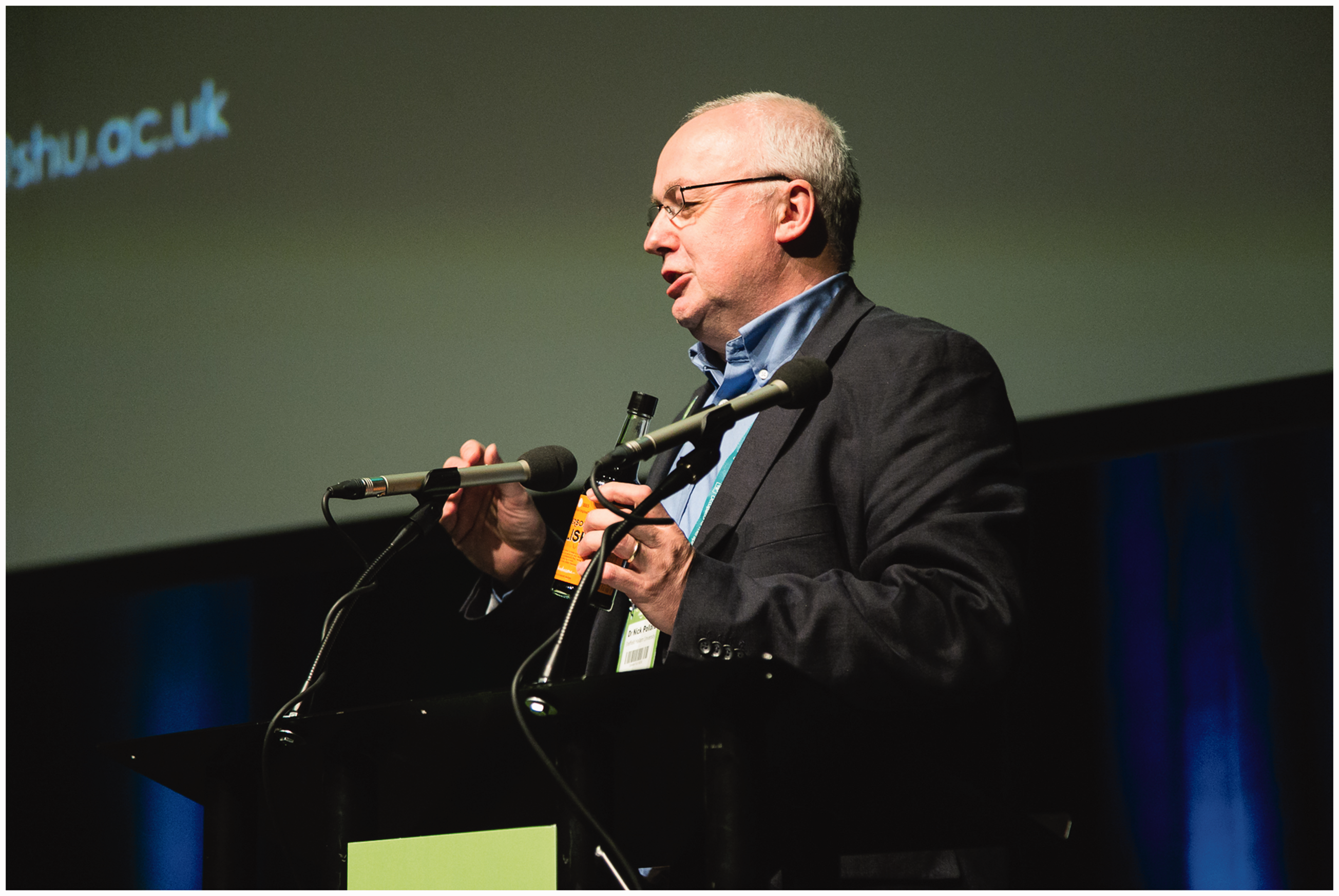

Individual narratives bring the need for and impact of social transformation down to an everyday reality that everyone can recognise and relate to, and can use to build the struggle from below. Occupational therapists, like those in other clinical professions, necessarily use a range of scientific tools, knowledge and methods, but their impact is always experienced at a personal, family or community level. Doing, being, becoming and belonging are the components of stories about relationships between occupation and trajectories of health and wellbeing across the lifespan. They connect meaning, purpose and even destiny and legacy from one generation to the next. Doing, being, becoming and belonging also describes a historical progress, and implies that this is shaped by wider events in the world over time, but also that it is a possible, tangible process in which individuals and communities can participate.
We are a city of occupational therapists, a small profession which, even so, reaches across the world, East and West, South and North. We remember Elizabeth Casson’s work in developing and advancing the profession in the UK, but the story of occupational therapy is not only about the other pioneering women, and sometimes men, who developed it: it is also about the city itself – which is heroic, drawing on a global and glocal combination of knowledge bases. I have certainly found that if you contact people across the world, even unsolicited, the worst they can do is ignore you. Most of the time you can start a conversation, even if you have to boldly use Google Translate to aid your communication. This is how I have been privileged to work with some of my heroes – the community of advocates of some core occupation-based values who shape my thinking about the profession and its potential.
We should use our superdiverse status as a global city to build our strengths and express our breadth as a profession. Occupational therapy is familiar with narrative as a tool, but this can be expanded into a tool for inspiring, informing and involving people in actions at a personal and community level, kept alive by an inclusive cultural exchange. This is something vital and visceral, personal and political, not merely professional, because a common feature of occupational therapy practice involves working with the consequences of health inequity and trying to enhance life quality through doing practical things together. It is not exclusive from research and evidence-based practice; occupational practice reaches out to the wider public through narrative ‘from below’, inspires demand for its services and informs the research and development process to connect and get its findings realised ‘above’. It involves some sacrifices to make things happen – for example working to make the exchange of language and concepts multilingual; choosing to witness and reveal the simple and everyday as significant; challenging assumptions and fixed institutional priorities; reaching out and finding out who you can work with to gain power by sharing power. It is a heroic endeavour, but a collective rather than an individualistic heroism. And it involves some narrative conception of destiny – not only for occupational therapists – which is implied in the story of doing, being, becoming and belonging for all the people we work with.
Footnotes
Acknowledgements
Thanks to Silvia Sanz Victoria, Jennifer Creek, Theresa Baxter, Joan Healey, Dikaios Sakellariou and Antoinette Wade for their comments and to the staff and students of Occupational Therapy and Vocational Rehabilitation team at Sheffield Hallam University for their support.
Research ethics and consent
Research ethics approval and consent were not relevant to this invited lecture.
Declaration of conflicting interests
The author declared no potential conflicts of interest with respect to the research, authorship and/or publication of this article.
Funding
The author received no financial support for the research, authorship and/or publication of this article. The author was invited to give this lecture at the 2018 Annual Conference and Exhibition of the Royal College of Occupational Therapists.