



Abstract

The World Federation of Occupational Therapists (WFOT) is the international representative of the occupational therapy profession. As such, WFOT promotes the development and practice of occupational therapy around the world, demonstrating its relevance and contributions to communities and societies. In 2014, the research programme area of WFOT was first established in the management structure of WFOT at the council meeting in Japan. This important change reflected the vision of WFOT and its more than 100 member organisations – to promote the development of research evidence to support responsive, ethical, culturally sensitive and contextually relevant occupational therapy practice, and to partner with member organisations to build local research capacity in response to national and international research priorities. One key strategy to achieve this vision was to develop the first global occupational therapy research agenda, through collaborative actions with member organisations. Since then, WFOT’s research programme has worked to develop the international research priorities project, which culminated in the first dynamic international agenda for research in our profession.
This editorial will outline the WFOT research priorities developed since 2014, to provide a framework to develop research partnerships across the WFOT membership. Occupational therapy is concerned with a broad range of health and social care issues that affect engagement in meaningful occupation, and diverse research activities are needed to support the profession on the world stage. These priorities were designed to capture the range of research endeavours by occupational therapists internationally. Therefore, they are not a prescriptive set of priorities meant to limit the range of our research efforts but, rather, they reflect a starting point that enables international collaborations and increases visibility for our contributions. Moreover, this is a dynamic document that WFOT is committed to update as the needs of the international community change and as societies are faced with new and unexpected challenges that call for the kind of innovation that only occupational therapists can provide.
The development of the research priorities project was entrusted to a subgroup of WFOT delegates from every continent, who convened to undertake this task (see Figure 1 for the original group). Research priorities are strategic areas of research activity that are considered of key importance for occupational therapy. They have the potential to inform occupational therapy theory and to contribute to the advancement of practice as well as the building of research capacity in response to local needs. Some research priorities have been published for occupational therapy in the UK (Bannigan et al., 2008), Ireland (Health Research Board, 2010), and the USA (American Occupational Therapy Foundation, 2015), and for particular client groups such as mental health (Duncan et al., 2003; Hitch and Lhuede, 2015) and cerebral palsy (McIntyre et al., 2010).
World Federation of Occupational Therapists (WFOT) delegates at the recent WFOT congress 2018. Left to right front row: Sue Baptiste (WFOT Vice President), Suchada Sakornsatian (WFOT delegate, Thailand), Susan Coppola (WFOT delegate, USA), Liliana Alvarez (WFOT delegate, Columbia), Mehdi Rassafiani (WFOT, Iran); Left to right middle row: Lana van Niekerk (WFOT alternative delegate, South Africa), Lolita Cibule (WFOT delegate, Latvia), Zdenka Pihlar (WFOT delegate, Slovenia), Tecla Mlambo (WFOT delegate, Zimbabwe), Siew Yim Loh (WFOT alternative delegate, Malaysia), Sarinya Sriphetcharawut (WFOT alternative delegate, Thailand); Left to right back row: Naum Mesquita (WFOT delegate, Brazil), Lynette Mackenzie (WFOT alternative delegate, Australia). Reproduced by kind permission of delegates and the WFOT.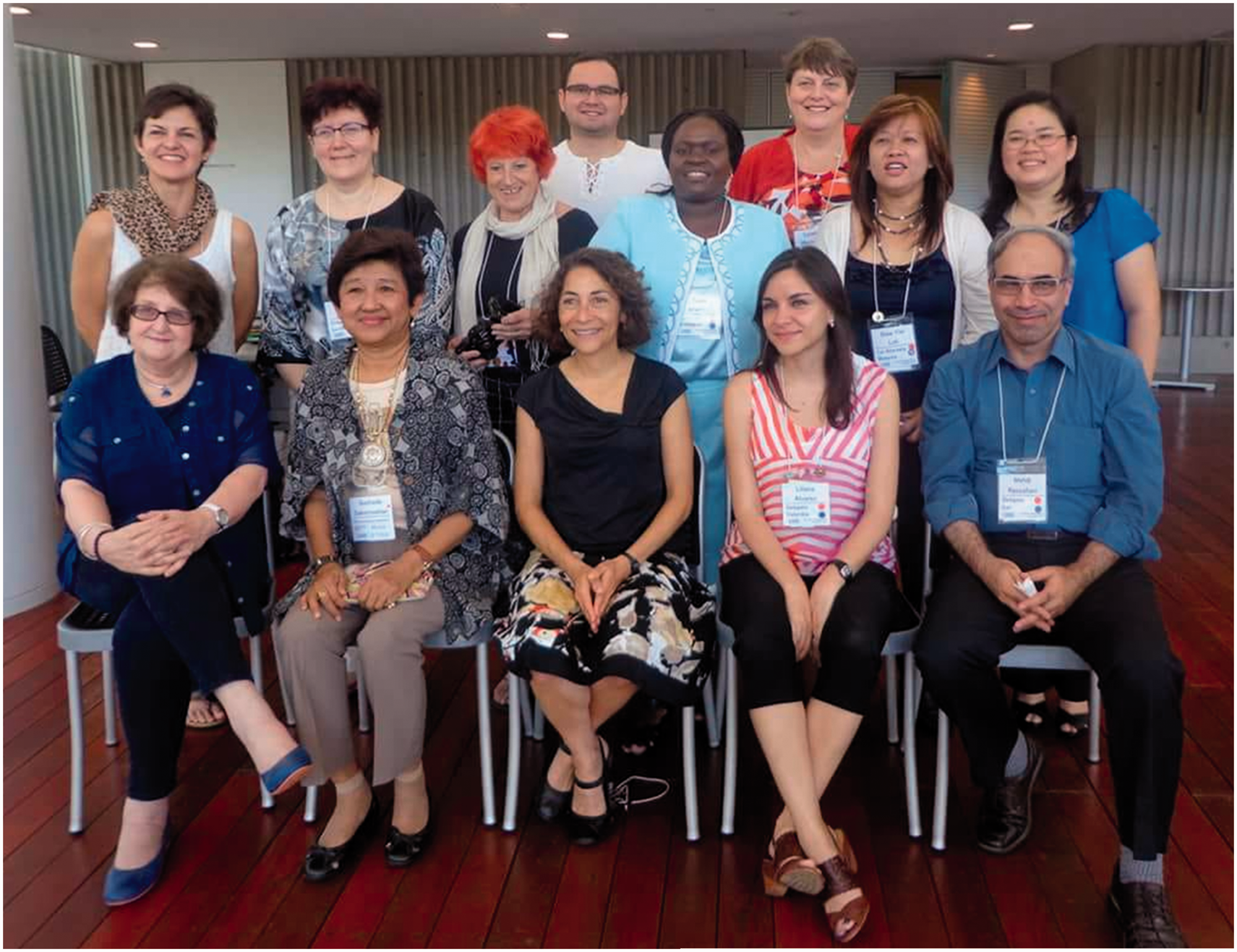
The project group identified the existing range of international research priorities relevant to occupational therapy, and then identified a list of international occupational therapy research priorities that would be relevant across the membership of WFOT. Following ethics approval, a survey was distributed among the WFOT member organisations and WFOT approved education programmes to gather information about existing research priorities. These were coded and thematically analysed. A Delphi process, using two rounds, was then implemented to reach consensus about research priority areas of relevance for occupational therapy. A total of 46 countries were represented across the Delphi research process. Responses to the initial survey were received from 34 WFOT member organisations and 26 universities. Research priority themes involved targeted areas of occupational therapy practice, outcome measurement and occupational therapy education, practice and professional issues. A total of 40 research priorities were identified for rating and ranking in the following Delphi round, which involved 38 member organisations and 40 universities. The final Delphi round rated and ranked the findings from round two which involved 19 member organisations and 15 universities. A final list of eight generic research priorities was developed. These are listed in Figure 2.
Research priorities for the World Federation of Occupational Therapists. Reproduced by permission.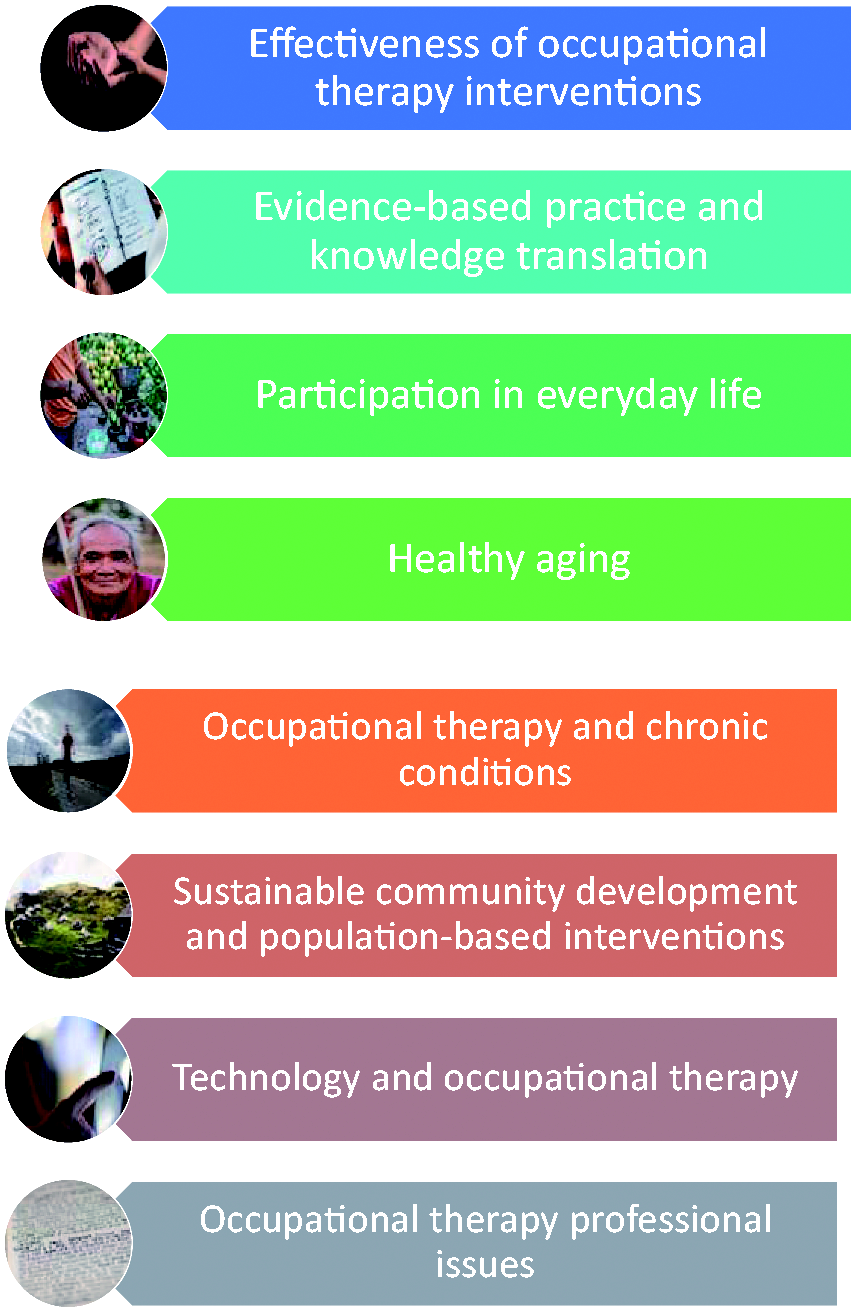
A full explanation of the rationale and scope for each of the research priorities listed is given in World Federation of Occupational Therapists et al. (2017).
We hope that these research priorities are only the start of developing the research capacity of occupational therapy worldwide, by helping to link researchers who have common interests. We intend to conduct further research to determine how these research priorities are being adopted by WFOT members and universities, to map the diversity of occupational therapy research, worldwide, and to identify any differences between WFOT regional areas.
Footnotes
Research ethics
Not applicable for this editorial.
Declaration of conflicting interests
The authors are representatives of the WFOT but have no other conflict of interest.
Funding
Not applicable for this editorial.