




Abstract

Advancing knowledge is a key aim of conducting research. Disseminating that knowledge beyond the confines of the research team by the accessible reporting and publication of findings is inherent to the research process. There can be a dilemma, however, of whether limited time and resources should be dedicated to advancing knowledge for a home audience of primarily occupational therapists, or an away audience, principally those from outside of the profession.
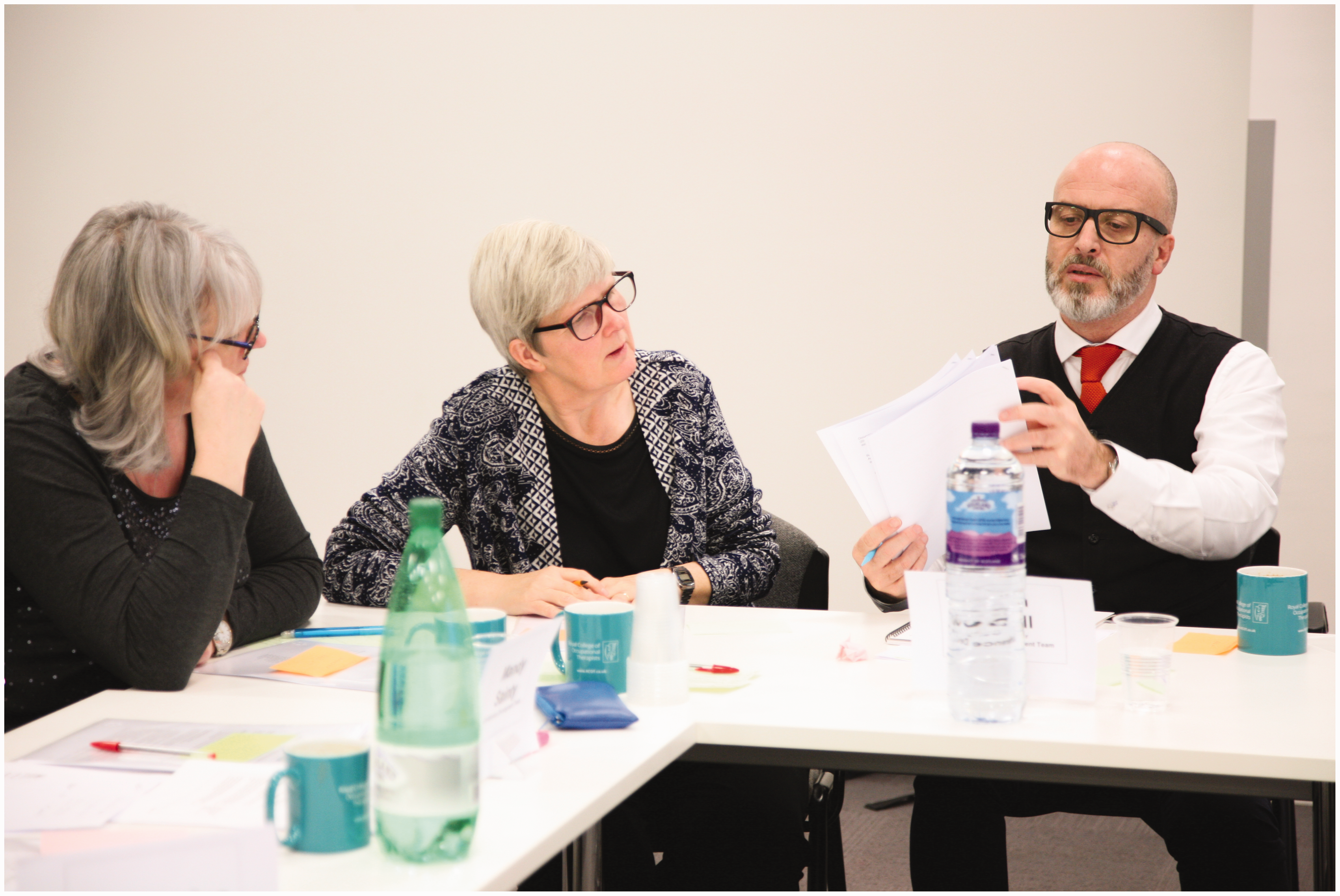
Royal College of Occupational Therapists Conference Development Team meeting: Sarah Lawson, Mandy Sainty (centre) and Ken Levins.
Evidence of a dissemination plan is a common mandatory requirement for research grant applications or ethics approval. The involvement of patients, service users, and the public in that dissemination plan (as well as in research design, management, and conduct) is additionally a core principle and expectation, as for example when applied to health and social care research in the United Kingdom (Health Research Authority et al., 2018: 11). Effective dissemination of findings is, as such, an ethical responsibility of all researchers.
The National Institute for Health Research (NIHR) defines effective dissemination as ‘getting the findings of your research to the people who can make use of them, to maximise the benefit of the research without delay’ (NIHR, n.d.). A dissemination plan will be influenced, therefore, not only by the nature of the research being undertaken but by the audience with whom the researcher needs to communicate and influence.
Research takes many forms and includes systematic reviews, feasibility studies, pilot studies, and interventional trials. It can be small scale with a single methodological approach, or a large mixed methodology study with both qualitative and quantitative findings. The audience with whom a researcher needs to communicate can also be diverse and may include health and social care professionals, service users and the public, service providers, commissioners and decision-makers, researchers and academics, and sponsors and funders. A large collaborative study, for example, is likely to require a range of knowledge advancement activities at various stages of the research. Publication and presentation of findings of a feasibility or pilot study may be particularly important when seeking future funding for a trial, whilst academics and other researchers may have a specific interest in a study’s methodological approaches. Practitioners and decision-makers, meanwhile, may be predominantly interested in the implications of findings on practice and service delivery, such as those provided by a systematic review or an interventional study. The astute researcher will be mindful that a judicious use of references can alert their different audiences to the other elements of their dissemination plan. Targeting the information, timing, and mode of information exchange for each audience is therefore important to ensure effective dissemination takes place during, and beyond, the life of a research project.
Demonstrating the impact of their work is an increasing imperative for researchers (UK Research and Innovation, n.d.), yet, whilst there are many creative opportunities available to reach and engage with specific audiences, traditional peer-reviewed publications and presentations continue to be important outputs. Resources for dissemination are not, however, without their limitations, and with respect to both academic journals and conferences the researcher will need to establish priorities, and make decisions, in terms of where they will submit their manuscript(s) or abstract(s).
Occupational therapy researchers have an important role in effectively communicating the usefulness of occupational therapy to the widest spectrum of stakeholders, including those who commission services (Adams, 2016). A plethora of academic journals and conferences exist, and these can be attractive in terms of imparting knowledge to that wider away audience, especially where a journal’s impact factor, or the perception of a conference’s prestige, is high.
Researchers can also submit to occupational therapy-specific journals such as the British Journal of Occupational Therapy (BJOT) and its international counterparts. In a comparable vein, the World Federation of Occupational Therapists (WFOT) holds an International Congress every four years, and a joint COTEC-ENOTHE Congress (the Council of Occupational Therapists for the European Countries, and the European Network of Occupational Therapy in Higher Education) has more recently been established. Many of the WFOT’s member organisations, such as the Royal College of Occupational Therapists, also host their own professional conferences. In the context of disseminating to these home audiences it is important to acknowledge that researchers working in Higher Education may be faced with particular challenges. For example, in the United Kingdom there may be away requirements linked to their institution’s submission to the Research Excellence Framework (Research Excellence Framework, 2019).
The translation of research evidence into practice is multifarious, but the positive attitudes of occupational therapists can be hindered by implementation barriers, for example lack of time or concerns regarding relevance and application to practice (Upton et al., 2014). Researchers have a responsibility for dissemination, but this has to be counterbalanced by occupational therapists using that evidence to inform their practice, in line with the professional code of ethics pertinent to their country. Publishing or presenting for a predominantly occupational therapy audience can assist in reducing those barriers. The strategic direction set out by the BJOT makes an important contribution to this situation by placing an emphasis on publishing ‘research providing evidence for practice’, that is, with a clinical or client focus (Craik, 2016). Conferences targeting occupational therapists can provide a complementary arena in which to present findings face-to-face and provide the opportunity to raise awareness, engage in two-way discussion, build networks, and inspire occupational therapists to reflect on the latest evidence in relation to their own practice. Presenting at a conference, where a significant proportion of the delegates are occupational therapists working in a practice setting, plays a vital role in ‘bringing alive’ published evidence. It can be indispensable and should not be discounted by researchers. Researchers should, therefore, include in their dissemination plan the sharing of their research outcomes, with an emphasis on the implications for practice, through at least one occupational therapy-specific journal and conference.
The focus of this editorial has been on publishing and presenting research findings, but it would be remiss not to highlight that as well as an ethical responsibility, dissemination activities also provide a valuable contribution to a researcher’s career development. They can increase the researcher’s exposure and profile, cultivate personal and professional skills, extend networks, and, additionally, initiate the complex process of the translation of evidence into practice.
There are definite benefits to be gained from maximising exposure of research evidence to a targeted population of occupational therapists, but it also important to avoid purely locating dissemination within a profession-specific echo chamber. Effective dissemination of evidence is crucial and the perspicacious researcher should, therefore, ensure that they utilise the full range of opportunities available to them to procure the greatest reach and impact, both home and away.
Information regarding the Royal College of Occupational Therapists Annual Conference can be viewed at www.rcot.co.uk/conference.
The 2nd COTEC-ENOTHE Congress 2020 details can be accessed at www.cotec-enothe2020.com.
Footnotes
Declaration of conflicting interests
The author declared the following potential conflicts of interest with respect to research, authorship and/or publication of this article: The author is a member of the Royal College of Occupational Therapists’ Conference Development Team 2018–2021.
Funding
The author received no financial support for the research, authorship, and/or publication of this editorial.